Posted in MARIAN TITLES

Matka Boża Leśniańska / Blessed Mother of Leśna, Leśna Podlaska, Biała Podlaska, Lublin, Poland (1683) and Memorials of the Saints – 26 September

Matka Boża Leśniańska / Blessed Mother of Leśna, Leśna Podlaska, Biała Podlaska, Lublin, Poland (1683) – 26 September:
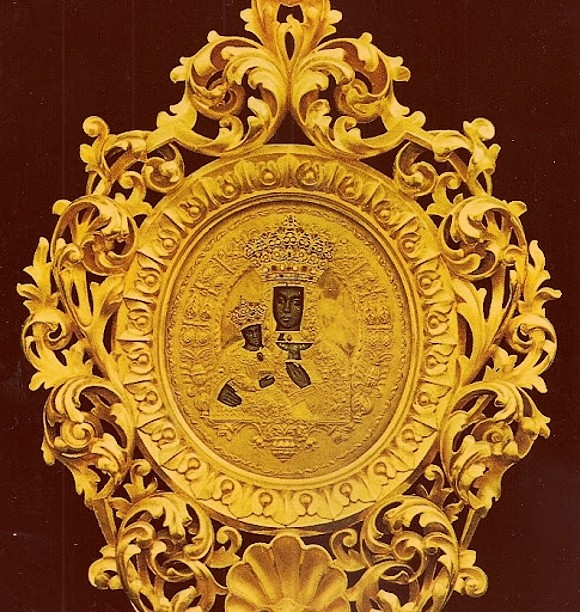
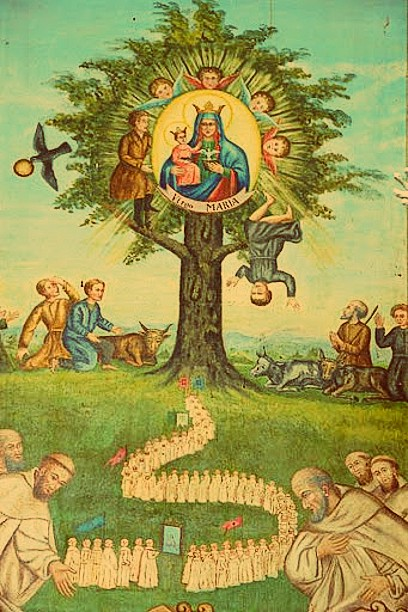
The Leśnia Sanctuary begins on 26 September 1683. On that day, two shepherds – Miron Makaruk and Aleksander Stelmaszuk – looking for the lost cattle in the bushes, noticed a stone image of the Mother of God hanging on a wild pear tree, which gave an extraordinary glow. Wanting to take the painting off, one of the bravest young men climbed the tree but each time fell to the ground. The local inhabitants, seeing what was happening, began to pray fervently. Soon, Zabłocki’s elders from nearby Bordziłówka arrived and only he, as an unusually prayerful man, took the painting off the tree. Droplets of “sweat” appeared on the image and this phenomenon continued for a long time. Then the painting was taken to the manor in Bukowice.

This extraordinary find deeply touched the religious and secular authorities of the time. Soon a wooden Church was erected on the site of the appearance of the Image. On 26 September 1695, a Parish was established in Lesna. From the very beginning, the Image attracted crowds of believers who experienced many favours thanks to the Blessed Mother, especially cures of illnesses. The Bishop of Lutsk, Franciszek Prażmowski, issued a decree in 1700, in which he stated that the appearance of the Image should be considered miraculous.
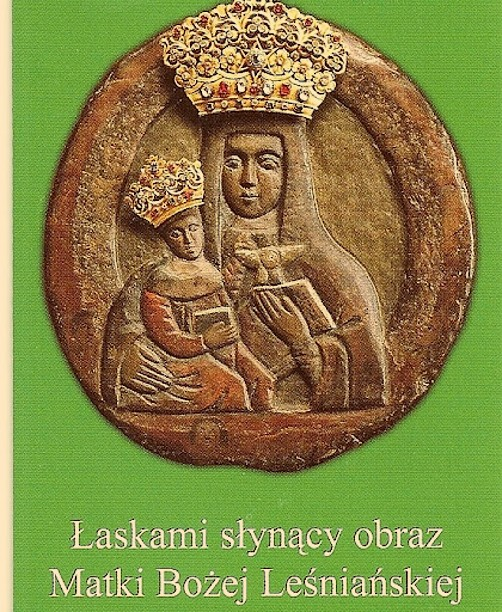
In the Lesnian Image, Mary is presented, embracing the Child Jesus with her right arm. The Child Jesus is holding the book with his right hand and his left hand is raised up in a gesture of teaching. Mary, standing in half-figure, is facing the viewer. In her left hand she holds an open book, on which, with outstretched wings, a dove – a symbol of the Holy Spirit – is supported. The figure of the Mother of God is covered with a coat.

The image of the Mother of God is a relief carved in field stone. The dimensions of the Image are: width 29.3 cm, height 31.4 cm, thickness 4.6 cm, weighs 9.5 kg.

On the site of the appearance of the Image of the Mother of God in 1718. a small Church was built. It exists to this day and is called the “Chapel of the Appearance of the Miraculous Image.” In 1727, the Parish of Leśna and the care of the Miraculous Image were taken over by the Pauline Fathers from Jasna Góra. They began the construction of a magnificent Church, which was erected in the years 1731 – 1758. It was consecrated under the invocation of the “Nativity of the Blessed Virgin Mary and the Holy Apostles Peter and Paul” on 8 September 1758. Huge crowds of the faithful of the Latin and Uniate rite were drawn to the Leśnia Sanctuary.
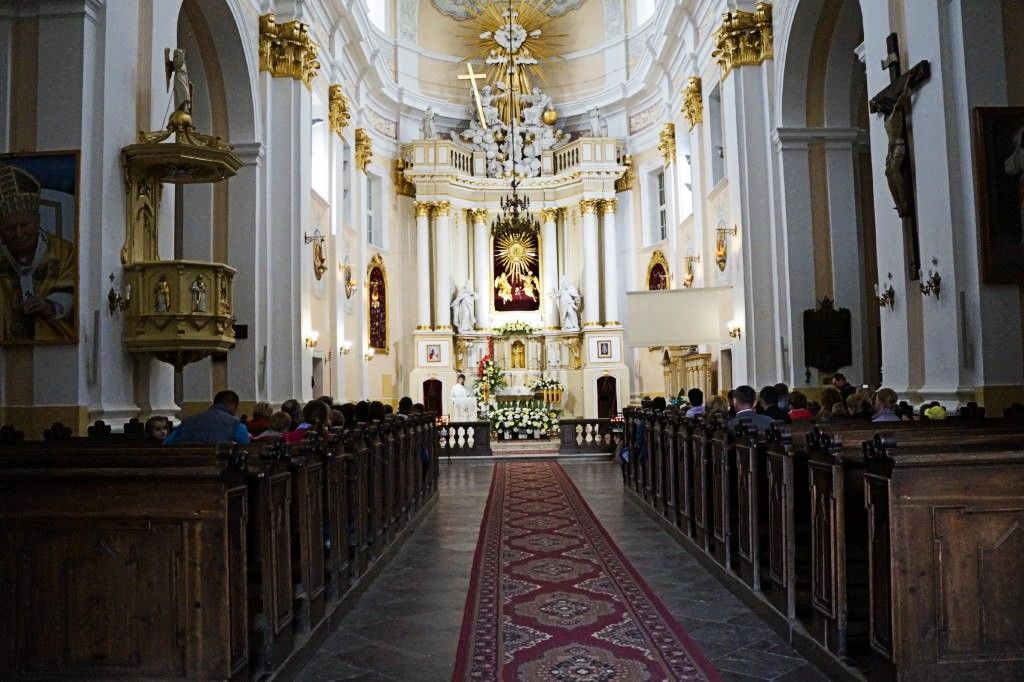
The situation changed with the partitions of Poland, when Leśna found itself under the Russian partition. After the fall of the January Uprising, the Lesnian Sanctuary found itself in a desperate situation. As part of the repression for helping the insurgents, on the night of 27-28 October 1864 , the Pauline Fathers were deported from Leśna. It was then, that the Bishop of Janów, Beniamin Szymanski, ordered to secretly take out the Miraculous Image and put a copy in its place. It was done in 1865. Soon the tsarist government abolished the Podlasie Diocese. The exiled Bishop took the Miraculous Picture with him to Łomża. He put it in the Church of the Benedictine Sisters. In 1875, the Church in Leśnia was taken over for the purposes of the Orthodox Church. Then the pilgrimages stopped. In 1889, an Orthodox nunnery was established in Lesna. It was to become the centre of Russification of Poles. In 1905 Tsar Nicholas II came to Lesna, whose relative was the superior of the nuns of Leśna. After the outbreak of World War I, the sisters left Leśna and took with them a copy of the painting of the Mother of God, still being firmly convinced that it was the original painting.

On 16 August 1915, the temple in Leśnia returned to Catholic worship. On 25 May 1919 . The Pauline Fathers returned to Lesna and immediately began renovation works in the Sanctuary. First of all, the search for the Miraculous Picture began, which was not found until 5 May 1926 in Łomża. It happened thanks to Fr. Aleksander Łaziński. After the canonical trial conducted by Bishop H. Przeździecki, the Miraculous Image returned in a triumphant parade from Siedlce to Leśna on 25 September 1927. It was a great celebration for the entire Podlasie Diocese and over 25,000 people attended this event. In the interwar period, the Pauline Fathers decorated the Sanctuary. They looked after the pilgrims who were again in large numbers at the feet of their Lesnian Mother.

In 1939, the difficult time of the Nazi occupation began. In the fall of 1940, the Germans occupied the Monastery and expelled the Pauline Fathers.
After the war, in 1951, under the direction of the Prior – Father Jerzy Tomziński, the Church received a Pulpit and an Organ.

On 18 August 1963 , the Primate of Poland, Cardinal Stefan Wyszyński, together with the Bishop of Podlasie, Ignacy Świrski, crowned the Miraculous Image with papal crowns. From 11 to 12 June 1970, Cardinal Karol Wojtyła stayed in Leśna. On 25 September 1977, the 50th anniversary of the return of the Miraculous Image was solemnly celebrated. In 1983, the solemn celebrations of 300 years of the appearance of the Miraculous Image took place and in 1984 the Church in Leśnia was elevated to the rank of a Minor Basilica. In 1992, a break-in was made to the temple in Leśnia and attempts were made to steal the golden crowns from the Miraculous Image. In 1995, the 300th anniversary of the establishment of the Parish in Leśna Podlaska was celebrated. This time the ceremony was presided over by the Primate of Poland, Cardinal Józef Glemp. In 1996, works on frescoes and paintings in the Basilica began and they were completed in 2002. On 26 September 2019, the Leśnia Sanctuary celebrated the 100th anniversary of the return of the Pauline Order to Leśna Podlaska.
St Cosmas (Optional Memorial)
St Damian (Optional Memorial)
(Died c 286 ) Martyrs. Twin brothers and Physicians, Apostles of Charity, Evangelists – born in the 3rd century, of Arabic descent and died by being tortured, without suffering any injury and finally they were beheaded c 286 in Aegea, Cilicia (modern Ayas, Turkey). The Martyr twins are remembered in the Roman Canon of the Mass in the prayer known as the Communicantes (from the first Latin word of the prayer). They are also recalled in the Litany of the Saints and in the older form of the Roman rite, in the Collect for Thursday in the Third Week of Lent, as the Station Church for this day is Santi Cosma e Damiano.

St Amantius of Tiphernum
St Callistratus of Constantinople
St Colman of Elo
St Cyprian of Antioch
St Eusebius of Bologna
St John of Meda Ord.Hum. (1100-1159) Priest, Monk, Abbot
St Justina of Antioch

St Marie Victoire Therese Couderc
St Meugant

St Nilus the Younger (910-1005) Abbot and Confessor and Founder of Italo-Greek Monasticism in southern Italy.. St Nilus was a charismatic leader and leading spiritual personality of his time.

St Senator of Albano
St Vigilius of Brescia
—
Martyrs of Korea – 12 saints: Twelve lay people in the apostolic vicariate of Korea who were imprisoned, tortured and martyred together in the persecutions in Korea.
• Saint Agatha Chon Kyong-Hyob
• Saint Carolus Cho Shin-Ch’ol
• Saint Catharina Yi
• Saint Columba Kim Hyo-Im
• Saint Ignatius Kim Che-Jun
• Saint Iulitta Kim
• Saint Lucia Kim
• Saint Magdalena Cho
• Saint Magdalena Ho Kye-Im
• Saint Magdalena Pak Pong-Son
• Saint Perpetua Hong Kum-Ju
• Saint Sebastianus Nam I-Gwan
They were beheaded September 1839 in Seoul Prison, South Korea and Canonised on 6 May 1984 by St Pope John Paul II.

Martyred in the Spanish Civil War:
• Blessed Amalia Abad Casasempere de Maestre
• Blessed Andreu Felíu Bartomeu
• Blessed Antonio Cid Rodríguez
• Blessed Josefa Romero Clariana
• Blessed Manuel Legua Martí
• Blessed María Jord´ Botella
• Blessed Pau Castell´ Barber´
• Blessed Teresa Rosat Balasch
Posted in Our MORNING Offering

Our Morning Offering – 26 September – Indulgenced Prayers to Our Lady

O Virgin Mary, Our Lady of the Most Blessed Sacrament, glory of the Christian people, joy of the universal Church, salvation of the world, pray for us, and awaken in all the faithful devotion to the Most Holy Eucharist, in order that they may render themselves worthy to receive it daily.

(500 days every time said)

Holy Mary, the deliverer, pray for us and for the souls in Purgatory.

(300 days every time said)

Mother of Perpetual Help, pray for us.

(300 days every time said)

Immaculate Queen of Peace, pray for us.

(300 days every time said)

Mother of orphans, pray for us.

(300 days every time said)

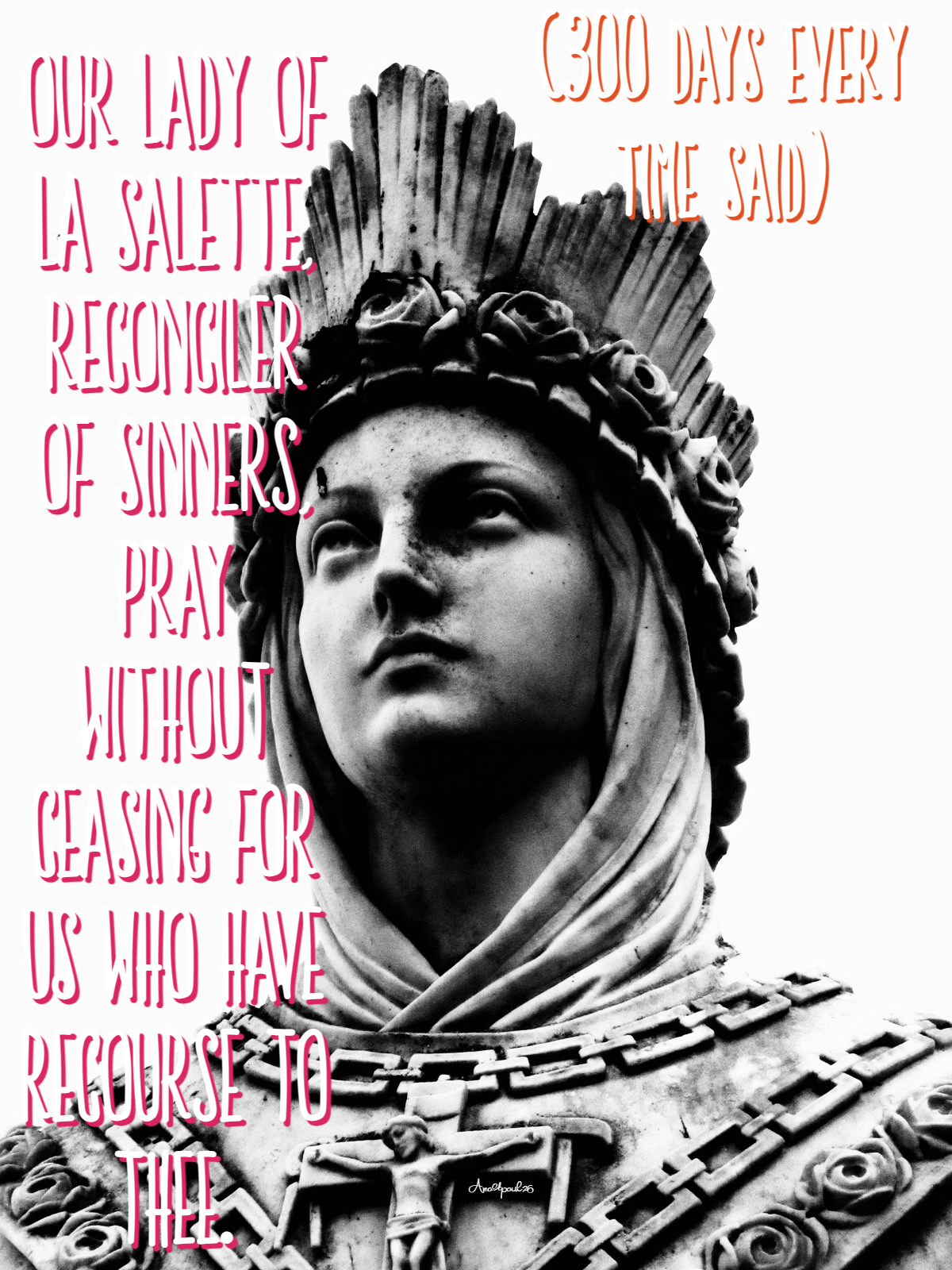
Our Lady of La Salette, reconciler of sinners, pray without ceasing for us who have recourse to thee.

(300 days every time said)

Queen of Apostles, pray for us.

(300 days every time said)

Almighty and merciful God, Who didst establish in Blessed Mary ever Virgin a refuge and help of sinners, grant that through her protection we, being absolved from all sins, may obtain the joyous effect of Thy mercy. Through Christ Our Lord. Amen.

(3 years every time said)

O Mary, queen of the clergy, pray for us; obtain for us numerous and holy priests.

(300 days every time said)

Cleanse my heart and my body, O holy Mary.

(300 days every time said)

Posted in SEPTEMBER-The SEVEN SORROWS of MARY and The HOLY CROSS

Thought for the Day – 26 September – Manual of Devotions in Honour of The Seven Dolors

Manual of Devotions in Honour of The Seven Dolors of the Blessed Virgin Mary by Father Sebastian

OBLIGATIONS AND PRACTICES OF PIETY

The faithful who wear the Scapular of our Blessed Lady, are not bound by any particular obligation in order to gain the Indulgences attached. The visit to some Church of the Order, one of the conditions requisite for certain Indulgences, may be commuted by a confessor for any other pious work, when there is any infirmity or hindrance of a grave nature, which prevents such a visit being made; such for instance would be the too great distance from the church, and in such a case it would be well to ask the confessor to appoint in its place some other sanctuary, as for instance a parish church.

This faculty of commutation was granted by a brief of Clement XIII, on the 17th August, 1762. If there be any Confraternity of the Seven Dolours established in the place, they ought to endeavour to fulfil their obligations, the principal of which are to assist at the public exercises of the Confraternity ; to say daily seven Paters and Aves in memory of the Dolours of the Mother of God, and to repeat the same prayers at the death of any member of the association, for the repose of his soul. Lastly, the frequent recital of the Rosary is recommended.

INDULGENCES ATTACHED TO THE SCAPULAR OF THE DOLOURS

Plenary Indulgences

I. On the day on which the Scapular is received.

II. At the hour of death, by invok- ing by tongue or in heart the Holy Name of Jesus.

III. The day on which a member makes an hour’s spiritual exercise in honour of the Dolours.

IV. By assisting at the monthly procession, or by fulfilling what is ap- pointed by the confessor in place of said procession.

V. Once in the month for those who repeat daily three Paters in memory of our Saviour’s Passion, and three Aves in commemoration of the Dolours, for those that are in their last agony.

VI. Once in the month also for those who say every day seven Hail Marys and the verse:- “Holy Mary, pierce me through, In my heart each wound renew, Of my Saviour crucified.”

VII. During the Forty Hours Devotion.

VIII. Passion Sunday.

IX. Feast of the Seven Dolours.

X. The Saturday following the Commemoration of the Seven Dolours.

XI. The Annunciation of the Blessed Virgin Mary.

XII. The Assumption of our Blessed Lady.

PARTIAL INDULGENCES

I. Seven years and seven quarantines on the Feast of Christmas, the Annunciation, the Purification, the Assumption, and all Fridays throughout the year, by reciting five Our Fathers and five Hail Marys in memory of the Passion.

II. Five years and as many quarantines, when members accompany the Blessed Sacrament to the sick.

III. Three hundred days once a day for those who say seven Hail Marys, followed by the verse Holy Mother, &c.

IV. One hundred and fifty days every time they meditate on the Passion or on the Dolours, and say seven Our Fathers and seven Hail Marys with the “Stabat Mater,” or perform the spiritual exercises practised in the Churches of the Servites.

V. One hundred days for those who recite the “Stabat Mater.”

VI. Sixty days for each work of Charity.

Posted in Our MORNING Offering

Our Morning Offering – 25 September – Indulgenced Prayers to Mary

All fair art thou, O Mary,

And the original stain is not in thee. Thou art the glory of Jerusalem.

Thou art the joy of Israel.

Thou art the honour of our people.

Thou art the advocate of sinners.

O Mary,

O Mary,

Virgin most prudent,

Mother most clement,

Pray for us;

Intercede for us with the Lord Jesus Christ.

(500 days every time said)

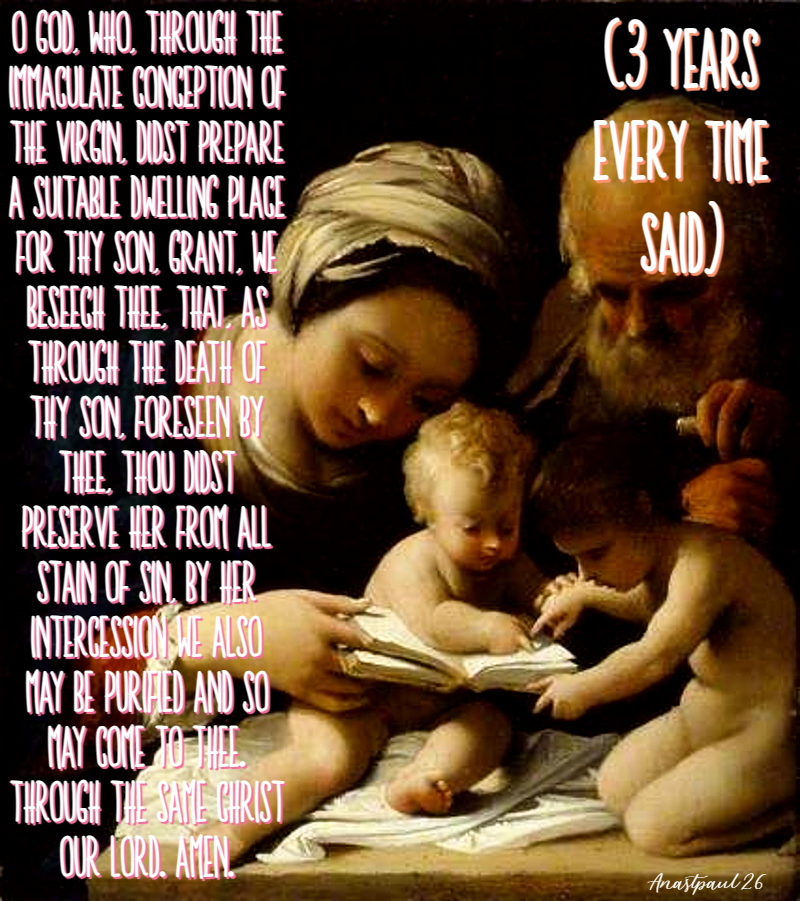
O God, Who, through the Immaculate Conception of the Virgin, didst prepare a suitable dwelling place for Thy Son, grant, we beseech Thee, that, as through the death of Thy Son, foreseen by Thee, Thou didst preserve her from all stain of sin, by her intercession we also may be purified and so may come to Thee. Through the same Christ Our lord. Amen.

(3 years every time said)

Bid me bear, O Mother blessed, On my heart the wounds impressed, Suffered by the Crucified.

(500 days every time said)

Mary sorrowing, Mother of Christians, pray for us.

(300 days every time said)

Virgin most sorrowful. pray for us.

(300 days every time said. 5 years if this prayer, along with a Hail Mary, is said seven times in honour of the most sorrowful Mother)

Sweet heart of Mary, be my salvation.

(300 days every time said)

O purest heart of Mary, Virgin most holy, obtain for me from Jesus purity and humility of heart.

(300 days every time said)

Queen of the most holy rosary, pray for us.

(300 days every time said)

Queen, glory of Carmel, pray for us.

(300 days every time said)

Posted in SEPTEMBER-The SEVEN SORROWS of MARY and The HOLY CROSS

Thought for the Day – 25 September – Scapular of the Seven Sorrows of Mary

Manual of Devotions in Honour of The Seven Dolors of the Blessed Virgin Mary by Father Sebastian

OF THE SCAPULAR AND THE ROSARY OF OUR LADY OF SEVEN DOLOURS.

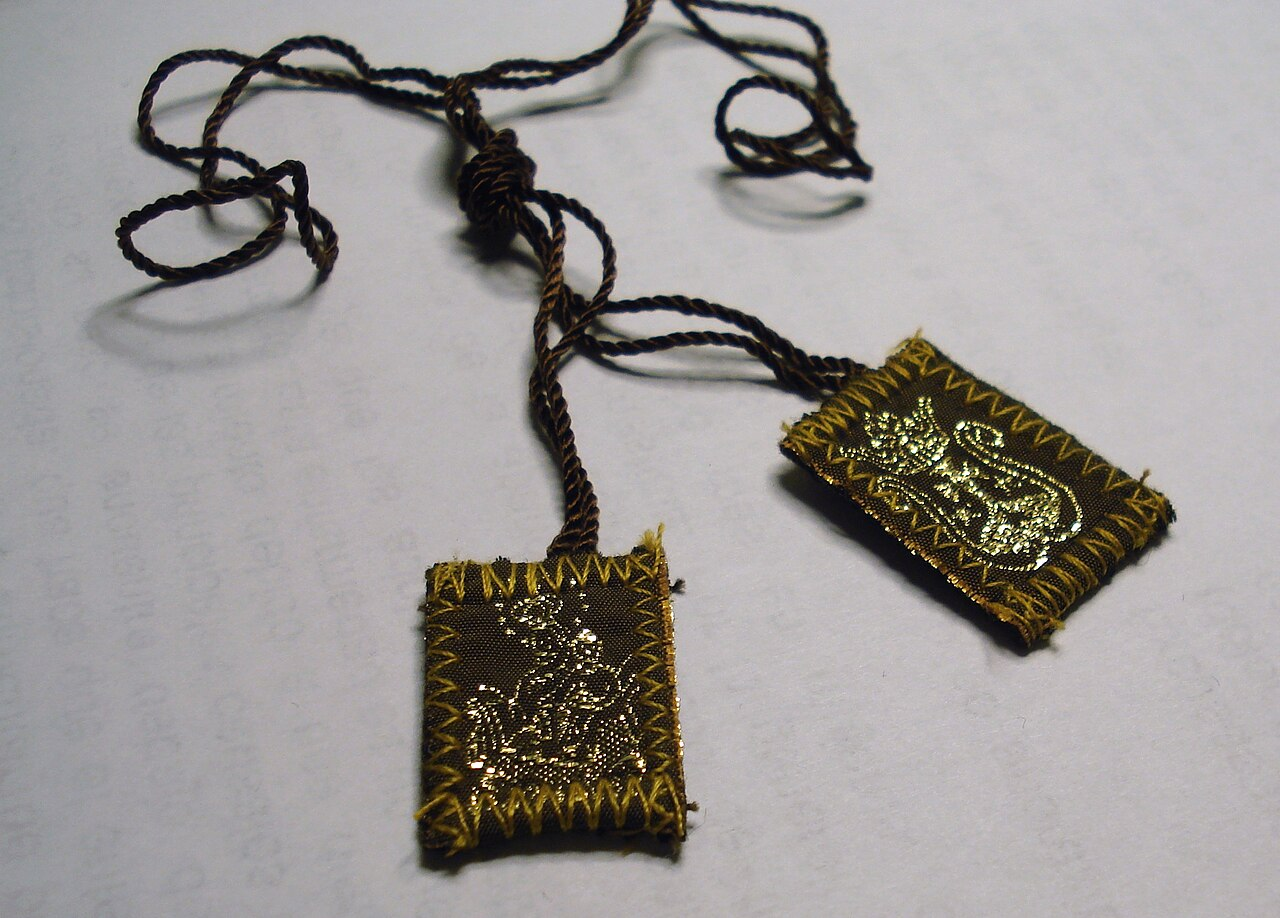
Devotion to our Blessed Lady is as ancient as the Church herself. But the long wars and dissensions which had desolated Europe, the ignorance, neglect of duties, and the consequent brutality of manners which ensued from this state of things, had greatly diminished it. However, an immense number of miracles which took place in the early part of the thirteenth century, communicated to it a new vigour and a wider extension. The instruments of mercy which the Blessed Virgin made use of to produce this effect were the Rosary, which was revealed to St. Dominic, in the year 1206, and the Scapulars of the Seven Dolours and of Mount Carmel, the first of which she herself gave to the seven Founders of the Order of Servites, and the second to St. Simon Stock.

Scapular of the Seven Sorrows of Mary

In the year 1233 seven noblemen of the city of Florence, whose names were Buonfiglio Monaldi, Buonagiunta Manetti, Manetto dell’ Antella, Amedeo degli Amidei, Ugiccione Uguccioni, Tostegno de’ Tostegni, and Alexis Falconieri, members of a pious Confraternity for honouring the Blessed Virgin, had assembled on the festival of the Assumption, to pay their homage and celebrate her triumph. At one and the same time the Mother of God appeared to each, and told them that they were to quit the world, and embrace a more perfect state of life. They did not hesitate to obey this heavenly voice, and having consulted with the blessed Ardingo, Bishop of Florence, as to the mode of life which they should adopt, they renounced their dignities, distributed their goods to the poor, and clothed themselves in grey habits, and retired to a small house outside the town, on the feast of the Nativity of their holy Patroness (8th September, 1233).

If, at any time, they were obliged to enter the city of Florence, in order to consult the Bishop, the people assembled about them in crowds, and the little children used to exclaim, “Here are the servants of Mary! Here are the servants of Mary!” Amongst these children was St. Philip Benizzi, who was then hardly five months old, and who, in after years, was called by our Blessed Lady to assume the habit of her servants. This humble retreat of the seven Solitaries soon became so besieged by visitors, that they were obliged to look out for a more retired place.

Their good Mother indicated to them the summit of Mount Jenario, where they removed and passed six years, principally occupied about their own sanctification, in the practice of the most austere penance, and assiduous meditation on the Passion of our Lord, and on the Dolours of his Blessed Mother. The venerable Bishop Ardingo had more than once exhorted them to establish an Order devoted to the Blessed Virgin, but in vain. The co operation of heaven became necessary to overcome the diffidence of these holy men, and triumph over their humility. On the evening of one Good Friday, whilst they were absorbed in profound meditation, they saw their august patroness descending from heaven, surrounded by a number of heavenly spirits, some of whom carried the instruments of the Passion; another, the rules of St. Augustine; one amongst them had in his hand a palm; another a scroll,on which the following words were engraven in golden letters, “Servants of Mary.” Finally there was one who carried in his hands a black habit of a new form.

The seven anchorites, filled with astonishment at this glorious apparition, waited respectfully for the Blessed Virgin to make known her will. Mary, in the attitude of a Mother overwhelmed with affliction, and, at the same time, full of maternal tenderness, approached them, and, pointing to the objects placed before their eyes, said : “Receive this habit which I present to you, and receive also the rule of St. Augustine, which you are to follow, so that, being designated by the name of my servants, you may one day obtain the palm of eternal life offered to you.” The holy Solitaries immediately adopted the habit of their new Institute, by the spirit of which they, and so many of the faithful, were to be sanctified, through the continual meditation on the Passion of Jesus Christ, and on the bitter sorrows of his Holy Mother.

In order that all the world might be able to clothe themselves in the livery of the Servants of Mary, they instituted a smaller habit of the same form, material, and colour, with that of the religious of the Order, and desiring also to give to the faithful an easy method of honouring the principal Dolours of Mary, they instituted a Rosary divided into seven parts, each of which is composed of one Pater and seven Aves. Mary promised to the seven holy founders, and more particularly to the Blessed Alexis, to protect in a special
manner, on all occasions, but particularly at the hour of death, those who
honour her Dolours.

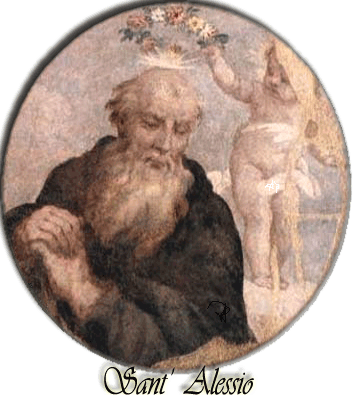
St Alexis, last to die

But if we desire to secure this precious protection of the Blessed Virgin Mary, we must not be satisfied with meditating at long intervals on her Dolours, and with wearing the habit of mourning which reminds us of them. Our compassion, if it be a true one, ought to cause us to avoid that which is the true cause of her sorrow-that is to say, everything that offends God.

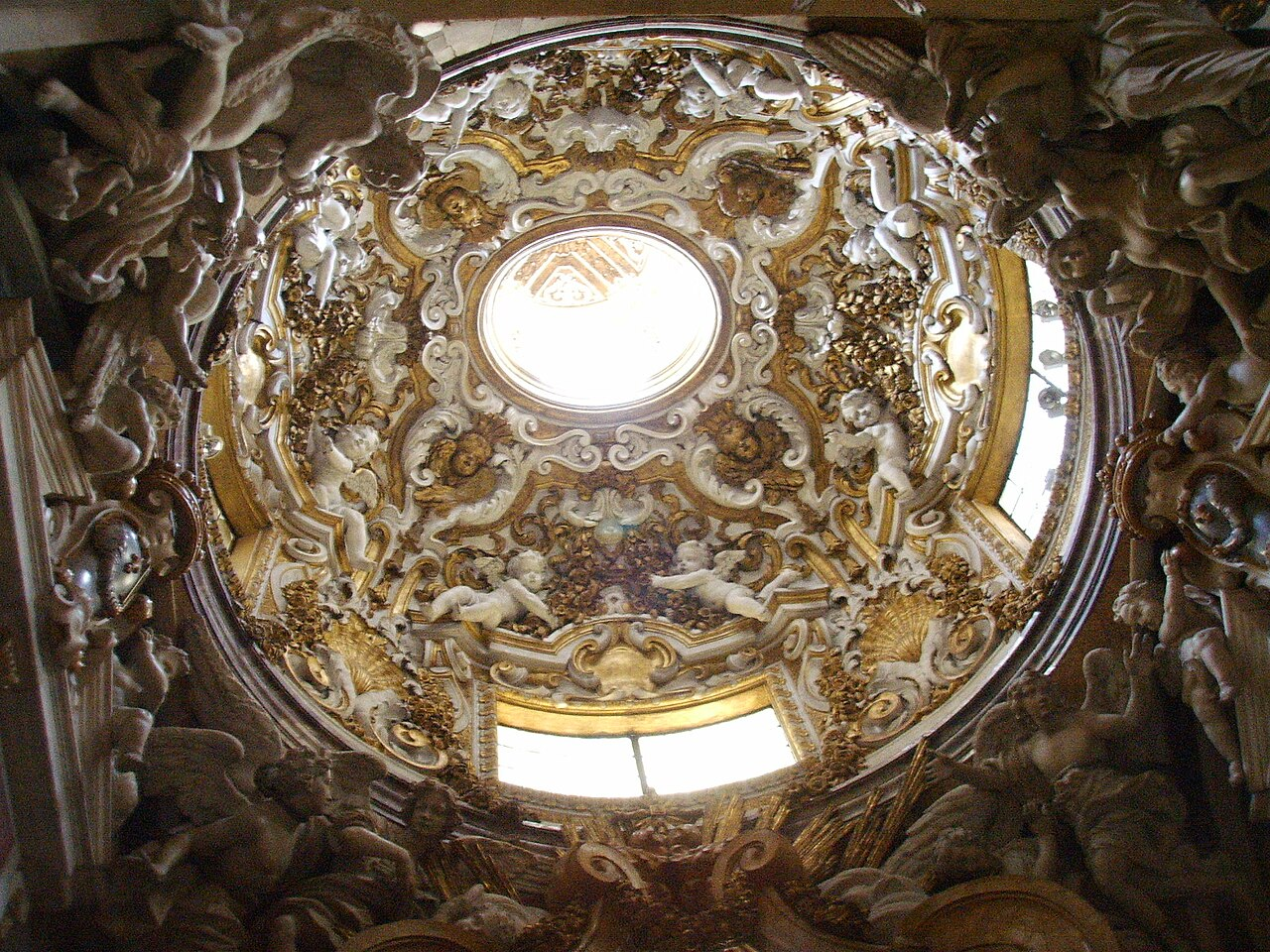
Ceiling in the Servite mother church, Santissima Annunziata, Florence
Posted in MARIAN TITLES

Our Lady of Walsingham / Virgin of the Sea (1061) , Marian Feasts and Memorials of the Saints – 24 September

Nuestra Señora de las Mercedes / Our Lady of Mercy/Ransom, Barcelona, Spain (1218) – 1 August, 24

Our Lady of Walsingham / Virgin of the Sea (1061) – 24 September:

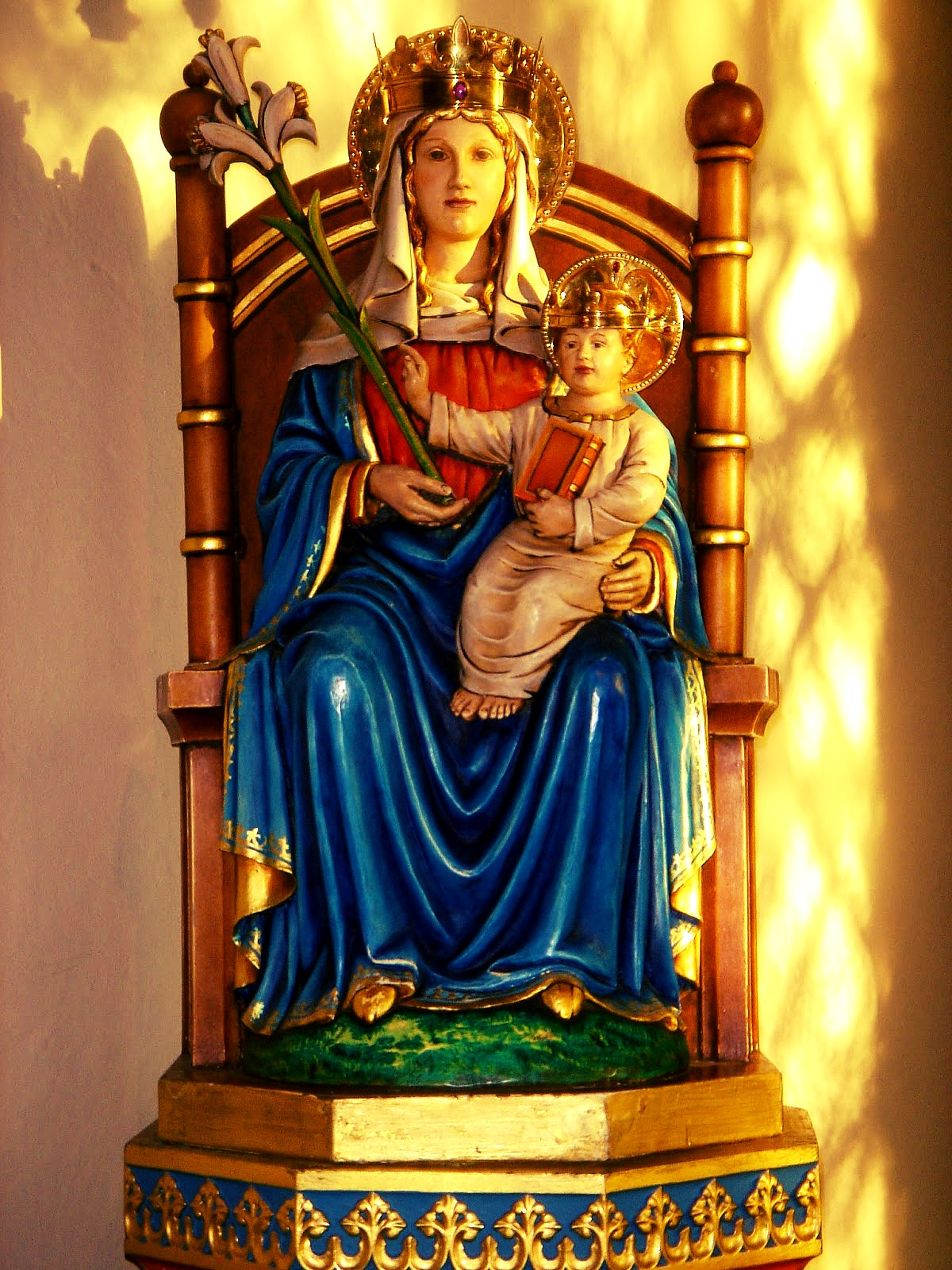
The story of the Walsingham Shrine begins in Saxon times. In 1061, the Lady of the Manor, Richeldis de Faverches, was taken in spirit to Nazareth, shown the House where the Annunciation took place and asked by Our Lady, to build a replica in Norfolk. She was promised that ‘Whoever seeks my help there will not go away empty-handed.‘ The simple wooden house that she built soon became the focus of special devotion to Our Lady. The ‘Holy House’ was later encased in stone to protect it from the elements.

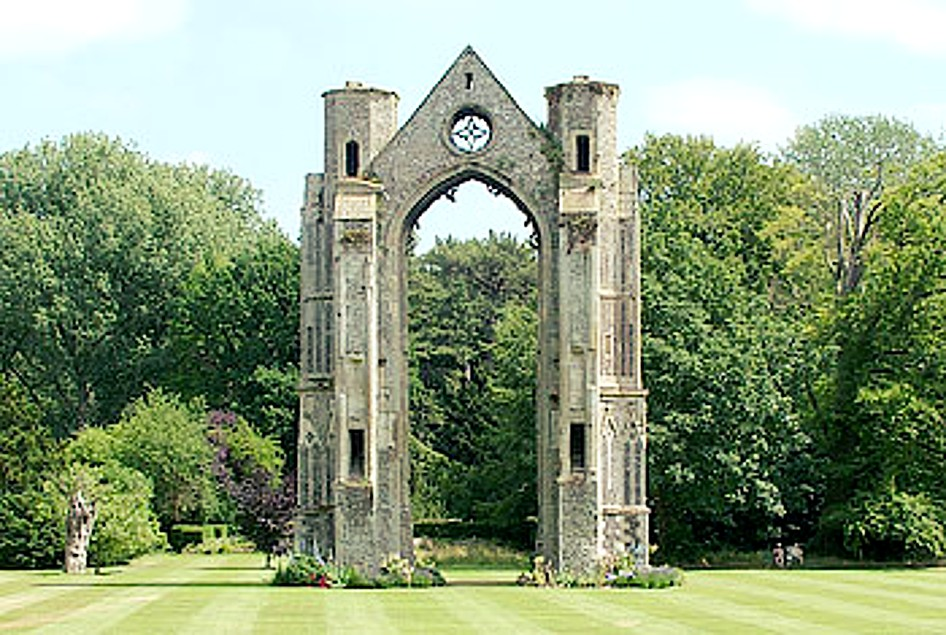
In 1153, the Augustinian Canons founded a Priory to care for the spiritual needs of the pilgrims. Their magnificent Priory Church was added in the fifteenth century. Only the ruin of the Priory Arch remains and archaeology has placed the site of the ‘Holy House’ in its shadow.

Walsingham became one of the foremost Shrines of medieval Christendom. Among the pilgrims to the ‘Holy House’ were many royal visitors. Henry III in 1226, Edward I (eleven times), Edward II in 1315, Edward III in 1361, Richard II in 1383, Edward IV in 1469, Henry VI in 1487 (and many other times) and Henry VIII in 1511, in thanksgiving for the birth of his son, Prince Henry.
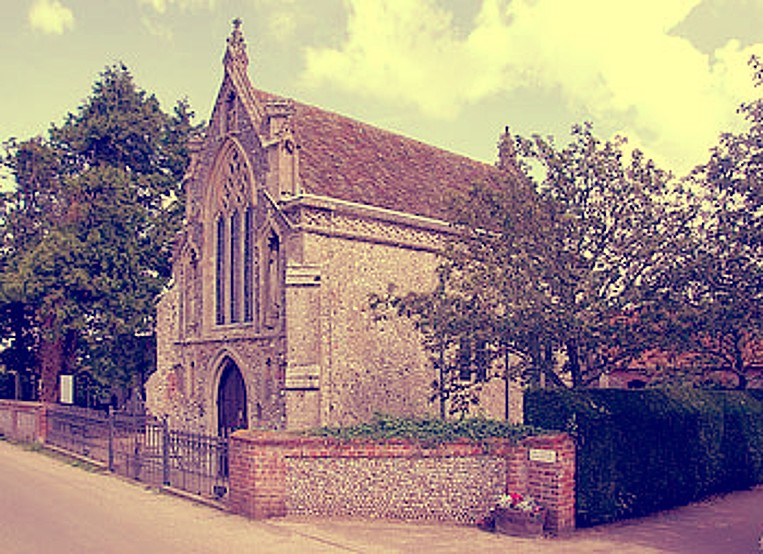
In 1340, the Slipper Chapel was built at Houghton St Giles, a mile outside Walsingham. This was the final ‘Station’ Chapel on the way to Walsingham. It was here, that pilgrims would remove their shoes to walk the final ‘Holy Mile’ to the Shrine barefoot.

The Slipper Chapel

Erasmus, the Dutch scholar, visited Walsingham in 1513 and was impressed by the splendour of the Shrine. He wrote:

‘When you look inside, you would say, it is the abode of saints, so brilliantly does it shine with gems, gold and silver … Our Lady stands in the dark at the right side of the Altar … a little image, remarkable neither for its size, material or workmanship.’

This was soon to come to an end. Henry VIII ordered the dissolution of the monasteries and in 1538 the Priory was closed, the ‘Holy House’ burned to the ground and the Statue of Our Lady taken to London to be destroyed.
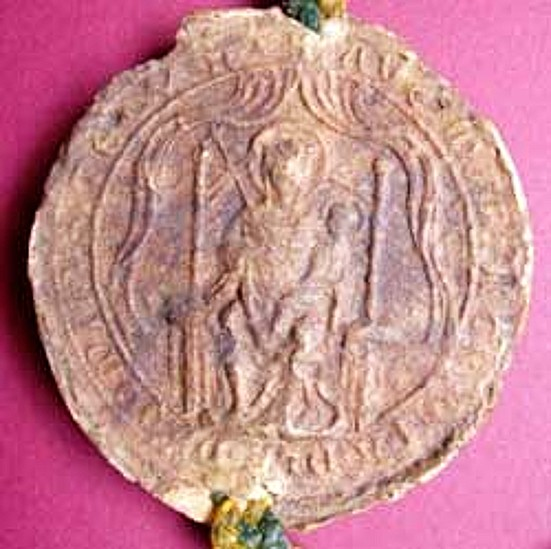
In 1896 Miss Charlotte Boyd bought the Slipper Chapel, which had seen centuries of secular use. She devoted herself to its restoration. The Statue of the Mother and Child was carved at Oberammergau and based on the design of the original statue – a design found on the medieval seal of Walsingham Priory, an imprint of which is in the British Museum.

The Walsingham seal: around the edges
Ave Maria gratia plena dominus tecum

The first Mass since the Reformation was offered in the Slipper Chapel on 15 August 1934 and a few days later Cardinal Francis Bourne led a pilgrimage of 10,000 people to the Chapel and declared it to be the Catholic National Shrine of Our Lady.

St Anathalon of Milan
St Andochius of Autun
St Anthony Gonzalez

St Chuniald
Bl Colomba Matylda Gabriel
St Coprio
St Erinhard
St Felix of Autun

St Gerard Sagredo OSB (980-1046) Bishop and Martyr, “The Apostle of Hungary,” Venetian nobleman, Benedictine monk, Prior of San Giorgio, Missionary to Hungary, Adviser to King Saint Stephen, Tutor to Prince Saint Emeric, Hermit, Bishop of Csanád, Writer, Reformer

St Geremarus
St Gislar
St Isarnus of Toulouse
St Lupus of Lyons

St Pacificus of Severino OFM (1653-1721) Priest, Franciscan Friar, Mystic, Miracle-worker, Missionary, Superior of the Friary of San Severino and joyful sufferer for Christ.

St Paphnutius of Egypt
Bl Robert Hardesty
St Rusticus of Clermont
St. Rupert of Salzburg
St Terence of Persaro (c 210-c 247) Martyr Layman
St Thyrsus of Autun
St Ysarn of Saint Victor
Bl William Spenser
—
Martyrs of Chalcedon – (49 saints): Forty-nine Christian choir singers of the church in Chalcedon in Asia Minor who were martyred together in their persecutions of Diocletian in 304.

Martyred in the Spanish Civil War:
• Blessed Antonio Pancorbo López
• Blessed Esteban García y García
• Blessed José María Ferrándiz Hernández
• Blessed Juan Francisco Joya Corralero
• Blessed Luis de Erdoiza Zamalloa
• Blessed Manuel Gómez Contioso
• Blessed Melchor Rodríguez Villastrigo
• Blessed Pascual Ferrer Botella
• Blessed Rafael Rodríguez Mesa
• Blessed Santiago Arriaga Arrien

Posted in SEPTEMBER-The SEVEN SORROWS of MARY and The HOLY CROSS

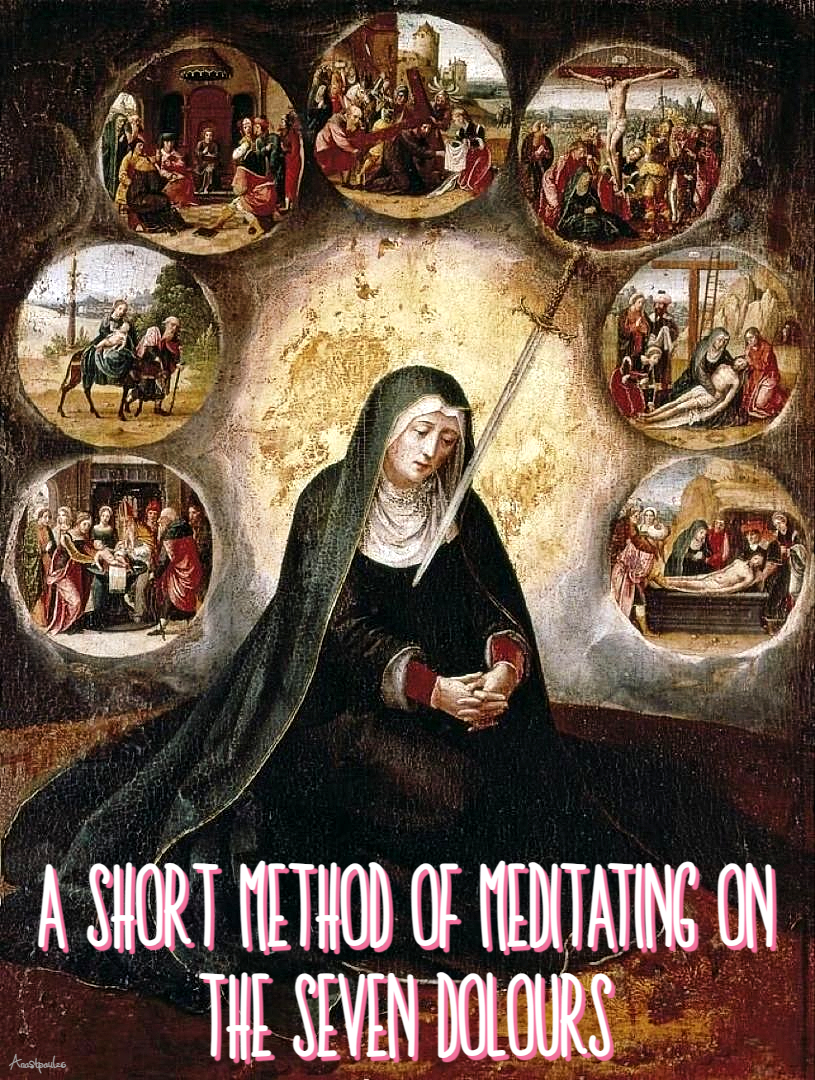
Thought for the Day – 24 September – A Short Method of Meditating on the Seven Dolors

Manual of Devotions in Honour of The Seven Dolors of the Blessed Virgin Mary by Father Sebastian

A SHORT METHOD OF MEDITATING ON THE SEVEN DOLOURS

I. Place yourself in spirit at the feet of the Queen of Martyrs, and offer her your meditation.
II. Ask her blessing and assistance.
III. Think what Mary suffers in the Dolour on which you wish to meditate.
IV. Think who Mary is that suffers.
V. Think why Mary suffers.
VI. Think how Mary suffers.
VII. Think how you suffer.
VIII. Think which is the principal virtue taught by Mary in that Dolour upon which you are meditating.
IX. Think whether you practice that virtue or not; if not, beg pardon of God, and promise amendment.
X. Finish by making some very praсtical resolutions, and by praying to Mary for relief in all your wants, both spiritual and temporal.

Prayer to the Most Desolate Virgin.
Hail Mary, full of sorrows, the Crucified is with thee; most sorrowful art thou amongst women, and most sorrowful is the fruit of thy womb, Jesus. Holy Mary, Mother of the Crucified, beg tears for us, the crucifiers of thy Son, now and in the hour of our death.
Amen.

An Indulgence of 100 days was granted by his Holiness Pius IX., on December 23rd, 1847, for each recital of this prayer.

Posted in SEPTEMBER-The SEVEN SORROWS of MARY and The HOLY CROSS

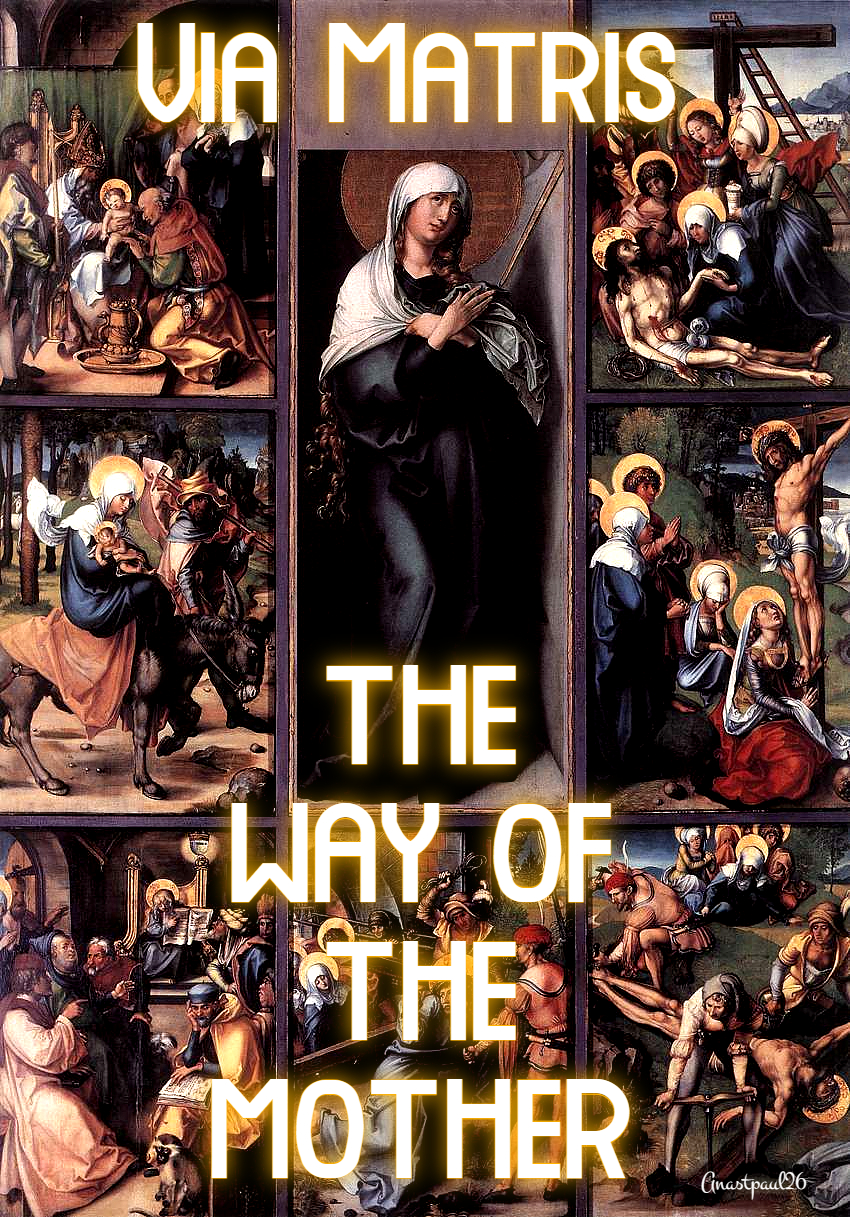
Thought for the Day – 23 September – Devotions in Honour of The Seven Dolors – Via Matris

Manual of Devotions in Honour of The Seven Dolors of the Blessed Virgin Mary by Father Sebastian

THE WAY OF THE MOTHER

Whatever act of homage is practised by the faithful in honour of the Blessed Virgin is welcomed by her with singular love, but above all she is pleased at seeing us occupied in compassionating her Dolours. Such a devotion is so gratifying to Mary, that when she found it in the time of St. Bridget very much neglected, she complained to her in these words:- “There are few who remember my sorrows.”

Wherefore, in order to assist you in meditating upon the Dolours of Mary, we propose to you this devout exercise of the Stations of her Seven Dolours, which can be practised in public or private, in the same manner as the Way of the Cross. This holy exercise has been instituted for some time, and is every day spreading. It was publicly practised in Rome A.D. 1836, in the Church of St. Marcellus, and has been enriched by copious Indulgences of the holy memory of Gregory XVI. A Plenary Indulgence was granted, on July 31st, 1887, to those who on any day shall visit seven times the Stations of the Dolours, and for each time seven years’ Indulgence.

V. Come Holy Ghost, replenish the hearts of the faithful.
R. And enkindle in them the fire of thy love.
V. Send forth thy spirit, O Lord, and they shall be regenerated.
R. And Thou shalt renew the face of the earth.
V. Remember thy congregation.
R. Which Thou hast possessed from the beginning.
V. Lord, hear my prayer.
R. And let my cry come unto Thee.
V. The Lord be with thee.
R. And with thy spirit,

Act of Contrition.
Oh most afflicted Virgin! Alas, with what unthankfulness in my past life have I acted towards God! with what ingratitude have I corresponded to his innumerable benefits! Now, however, I am truly penitent, and in the bitterness of my heart and the sorrow of my soul, I humbly beg pardon for having. outraged his infinite bounty, resolving for the future, by his grace, never more to offend Him. Oh! by all the Dolours which thou hast borne in the Passion of Jesus, I pray thee with tears to implore from Him pity and mercy for my many grievous sins. Receive this holy devotion, which I am about to perform, in memory of those pains and Dolours. Grant! oh grant that those seven daggers which pierced through thy soul may likewise pierce through mine, and that I may live and die in the friendship of the Lord, and enjoy eternally the glory which He has acquired for me by his most precious Blood. Amen.

STATION I. FIRST DOLOUR

How great was the shock to Mary’s heart at hearing the sorrowful words, in which holy Simeon told the bitter Passion and death of her sweet Jesus, since in that same moment she realized in her mind all the insults, blows, and torments which the impious men were to offer to the Redeemer of the world. But a still sharper sword pierced her soul. It was the thought of men’s ingratitude to her beloved Son. Now consider that, because of your sins, you are unhappily among the ungrateful, and casting yourself at the feet of the Mother of Dolors, say with sorrow:

Virgin beloved, who did feel so bitter pangs of soul at seeing the abuse which I, wretch that I am, would make of the Blood of your dear Son, obtain for me, I pray you, by your riven heart, that in time to come, I may better correspond to God’s mercies, profit by his heavenly grace, receive not in vain his lights and inspirations, and so be among the blessed number of those who are saved by the bitter passion of Jesus. Amen.

Amen. Ave Maria.
Virgin most sorrowful, pray for us.
O Mary, sweetness of my life,
Stamp on my soul thy bitter strife,
And pray for me, that I may see Thy joys for all eternity.

STATION II. SECOND DOLOUR

Consider the sharp sorrow which Mary felt when, Saint Joseph being warned by an angel, she had to flee by night in order to preserve her beloved Child from the slaughter decreed by Herod.

What anguish was hers in leaving Judea, lest she should be overtaken by the soldiers of the cruel king ! How great her privations in that long journey ! What sufferings she bore in that land of exile, what sorrow amid that people given to idolatry ! But consider how often you have renewed that bitter grief of Mary, when your sins have caused her Son to flee from your heart. Wherefore repent, and turn to her, humbly saying:

Sweetest Mother, once and once only Herod obliged you to flee with your Jesus, to escape the slaughter which he had commanded; but I, how often have I forced my Redeemer, and you with him, to flee from my heart, when I have admitted into it accursed sin, hateful to you and to my loving Lord. With tears and contrition I humbly beg for pardon. Mercy, dear Lady, mercy ! And I promise you that, for the future, with the help of God, I will ever maintain my Savior and you in complete possession of my soul. Amen.

Amen. Ave Maria.
Virgin most sorrowful, pray for us.
O Mary, sweetness of my life,
Stamp on my soul thy bitter strife,
And pray for me, that I may see Thy joys for all eternity.

STATION III. THIRD DOLOUR

How dreadful was the grief of Mary, when she saw that she had lost her beloved Son ! And, as if to increase her sorrow when she sought him diligently among her kinfolk and acquaintances, she could hear no tidings of him. No hindrances stayed her, nor weariness, nor danger; but she forthwith returned to Jerusalem, and for three long days sought him sorrowing.

Great be your confusion, O my soul, who has so often lost your Jesus by your sins, and has given no heed to seek him at once: a sign that you do make of very little or of no account the precious treasure of divine love. Weep then for your blindness, and turning yourself to that Lady of sighs, your Mother, say with compunction:

Virgin most afflicted, obtain that I may learn from you to seek Jesus when I have lost him by giving ear to my passions and to the evil suggestions of the devil; obtain that I may find him again, and when I possess him once more, that I may ever repeat the words of the Spouse, “I found Him whom my soul loveth; I held Him, and I will not let him go.” Amen.

Amen. Ave Maria.
Virgin most sorrowful, pray for us.
O Mary, sweetness of my life,
Stamp on my soul thy bitter strife,
And pray for me, that I may see Thy joys for all eternity.

STATION IV. FOURTH DOLOUR

Come, O you sinners, come and see if you can endure so sad a sight. This Mother, so tender and loving, meets her beloved Son, meets him amidst an impious rabble, who drag him to a cruel death, wounded, torn by stripes, crowned by thorns, streaming with blood, bearing his heavy Cross. Ah, consider, my soul, the grief of the blessed Virgin thus beholding her Son! Who would not weep at seeing this Mother’s grief? But who has been the cause of such woe? I, it is, who with my sins have so cruelly wounded the heart of my sorrowing Mother! And yet I am not moved; I am as a stone, when my heart should break because of my ingratitude.

Virgin most holy, I crave pardon for the sorrows I have caused you. I know and confess that I deserve it not, for it is I through whom your Jesus was so treated; yet do you call to mind that you are the Mother of mercy. Show mercy then to me, and I promise to be more faithful to my Redeemer in the time to come, and thus to console you for the many sorrows I have offered to your afflicted heart. Amen.

Amen. Ave Maria.
Virgin most sorrowful, pray for us.
O Mary, sweetness of my life,
Stamp on my soul thy bitter strife,
And pray for me, that I may see Thy joys for all eternity.

STATION V. FIFTH DOLOUR.

In this fifth Dolour, imagine thyself, oh my soul, on the heights of Calvary when the most afflicted Virgin saw her beloved Son die. Meditation. Come, oh devout soul! come to Calvary, where are being offered to God two sacrifices; one is the Body of Jesus, the other is the heart of Mary. Оh! sorrowful spectacle, to look upon this good Mother in such a sea of woe beholding Him, who is more dear to her than life itself, martyred by the most cruel death. Alas! every blow of the hammer, every wound, every lacera- tion which the Saviour of the world received on his sacred Body, Mary received upon her heart. She stood there at the foot of the cross, so penetrated with pain and transfixed with such agony that it could not be decided which should be the first to expire Jesus or Mary. Fixing her eyes on her Blessed Son she sees that He is already breathing forth his last breath; she gazes upon his sunken eyes, his ghastly looks, his livid lips, and listens to his difficult breathing, and at last she knows that He no longer lives, and that He has already yielded his blessed spirit to his Eternal Father. Ah! surely she wished that at that moment her soul could be separated from her body and united to the soul of Jesus. And who could bear such a sight as this? Oh, most afflicted of all mothers! instead of returning from Calvary to be free from such bitter suffering, thou didst remain there immovable as a rock in order to drink to the last drop the chalice of thy affliction.

What confusion must this be for me, my soul, who strive in every way to remove those little crosses and light sufferings which God thinks fit to send me for my greater good. Grant! oh grant that I may know the value of sufferings and that I may become so attached to them, that not being satisfied with those thou sendest to me, I may cry out with St. Francis Xavier,
“Plura, Domine, plura:” “More sufferings, oh my God-oh yes, more sufferings.”

Amen. Ave Maria.
Virgin most sorrowful, pray for us.
O Mary, sweetness of my life,
Stamp on my soul thy bitter strife,
And pray for me, that I may see Thy joys for all eternity.

STATION VI. SIXTH DOLOUR.

In this sixth Dolour contemplate, oh my soul, the Blessed Virgin when she received into her arms her dead Son after He was taken down from the cross. Meditation. Consider the pang which penetrated the heart of Mary when she held in her arms the dead Body of her Son. Ah! when she fixed her weeping eyes upon his gaping wounds, when she counted his sorrows and saw Him shedding so much blood, how terrific must have been the shock to her mind, and how deadly the blow which broke her sacred heart; and, indeed, she would have fallen down dead, through agony, but for the assistance of Divine power. Oh poor Mother! yes, Mother of Martyrs, thou didst bear to the tomb the dear object of thy most tender care, who, from being fair as the rose, became like to a bed of thorns by the ill-treatment and lacerations given by the executioners.

And who would not pity thee, who would not feel themselves struck by sorrow at seeing thee in sorrow, such as would move to pity the most stony heart? I behold St. John inconsolable, Mary Magdalen with the other Marys in bitterest grief, Nicodemus not able to stand under his afflictions. And I, alas! I alone cannot shed a tear in the midst of such sorrow, ungrateful and unthankful creature that I am. Oh, my dear Mother Mary, grant that my heart may be transfixed by those same daggers which passed through thy most afflicted heart, and that I may now become truly penitent for those sins which caused thee such a cruel martyrdom.

Amen. Ave Maria.
Virgin most sorrowful, pray for us.
O Mary, sweetness of my life,
Stamp on my soul thy bitter strife,
And pray for me, that I may see Thy joys for all eternity.

STATION VII. SEVENTH DOLOUR.

In this seventh Dolour, contemplate, oh my soul, the most sorrowful Virgin at the Sepulchre of her dead Son. Meditation. Consider how full of woe must have been the sigh which the most afflicted heart of Mary sent forth when she placed in the tomb her amiable Jesus. Oh! what pain, what great woe, must she have felt in her soul, when she beheld the rock lifted with which that sacred monument was to be closed; she could not be separated from the side of the sepulchre, and her sorrow was such that it rendered her immovable, nor was she ever satisfied with looking at those cruel wounds. And when the tomb was closed, so great was her grief that she could hardly live.

Oh! most cruelly-tortured Mother, thou wilt depart presently in body from this place, but here will thy heart remain with thy true treasure. Оh grant that here too all my affections and my love may rest. How is it possible not to be struck with love for the Saviour who has given his Precious Blood for our salvation? And how is it possible not to love thee, who hast suffered so much for love of us?

Oh! by all thy Dolours upon which we have meditated, grant this favour, that the memory of those pains may always remain impressed upon our minds, hat our poor hearts may be inflamed with love of God and thee, most sweet Mother, and that the last sighs of our lives may be united to those which thou didst send forth from the depth of thy heart at the Passion of Jesus; to whom be honour, glory, and thanks for ever and ever.

Amen. Ave Maria.
Virgin most sorrowful, pray for us.
O Mary, sweetness of my life,
Stamp on my soul thy bitter strife,
And pray for me, that I may see Thy joys for all eternity.

At the end, returning to the altar, say one part of the Stabat Mater.
V. Pray for us, most sorrowful Virgin
R. That we may be made worthy of
the promises of Christ.

Prayer.
O God, in whose Passion, according to the prophecy of Simeon, the sword of sorrow pierced the soul of thy most glorious Mother, the Virgin Mary, mercifully grant that we who meditate upon her Dolours may obtain happіness by the effects of thy Passion.
Amen.

Posted in CATHOLIC Quotes

Quote/s of the Day – 22 September – St Thomas of Villanova

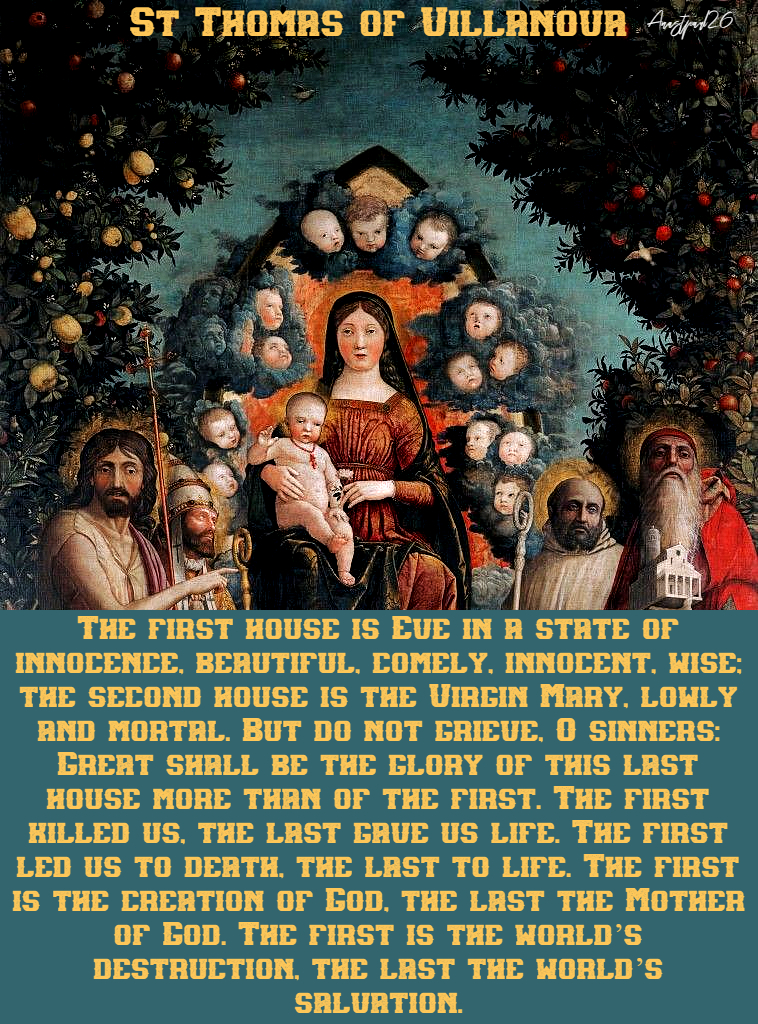
The first house is Eve in a state of innocence, beautiful, comely, innocent, wise; the second house is the Virgin Mary, lowly and mortal. But do not grieve, O sinners: Great shall be the glory of this last house more than of the first. The first killed us, the last gave us life. The first led us to death, the last to life. The first is the creation of God, the last the Mother of God. The first is the world’s destruction, the last the world’s salvation.

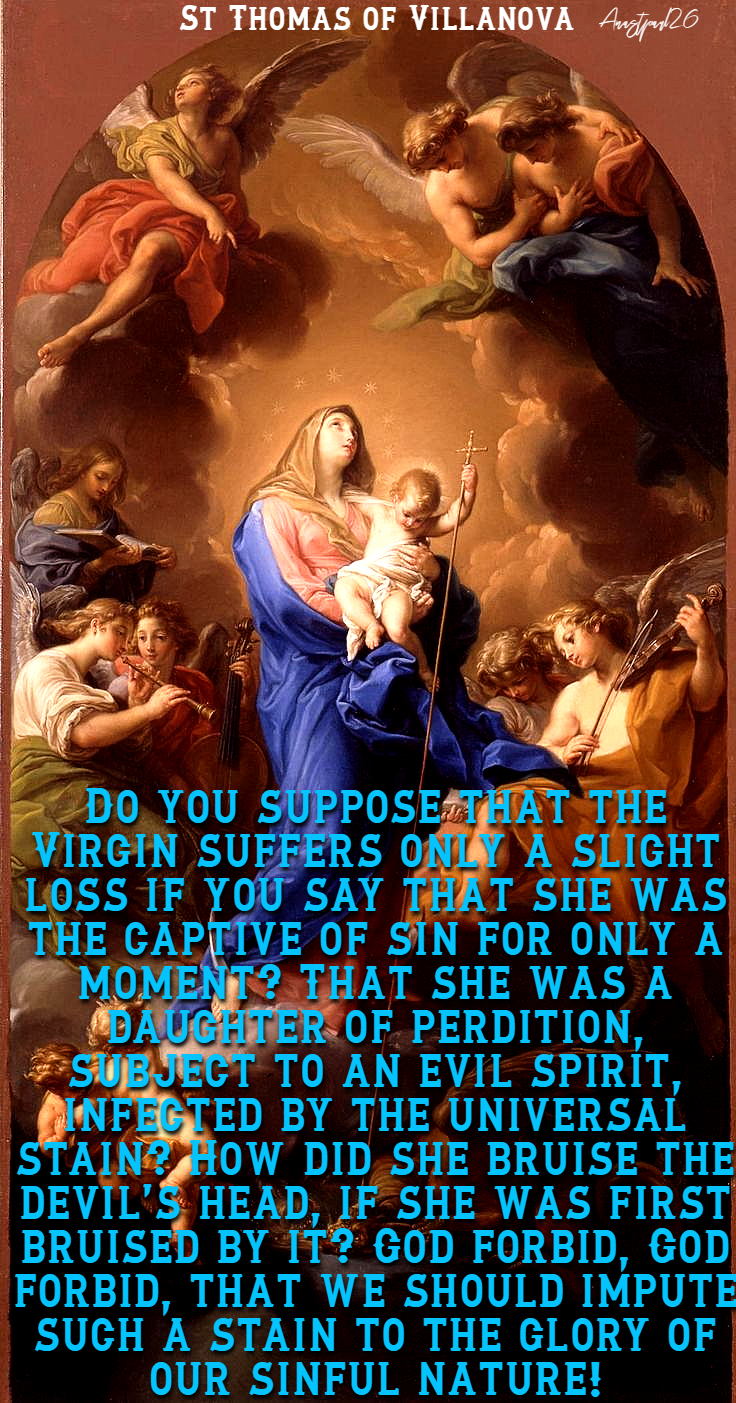
Do you suppose that the Virgin suffers only a slight loss if you say that she was the captive of sin for only a moment? That she was a daughter of perdition, subject to an evil spirit, infected by the universal stain? How did she bruise the devil’s head, if she was first bruised by it? God forbid, God forbid, that we should impute such a stain to the glory of our sinful nature!

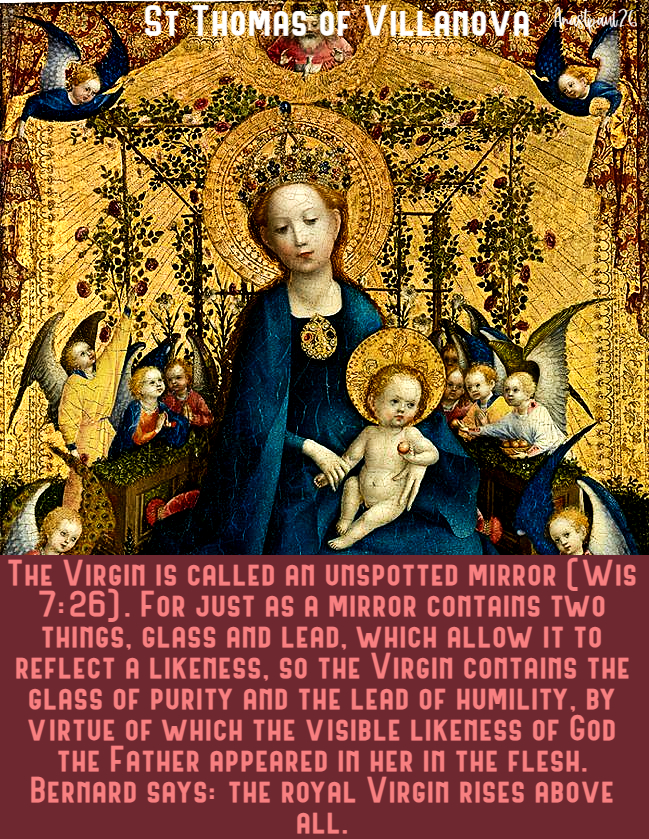
The Virgin is called an unspotted mirror (Wis 7:26). For just as a mirror contains two things, glass and lead, which allow it to reflect a likeness, so the Virgin contains the glass of purity and the lead of humility, by virtue of which the visible likeness of God the Father appeared in her in the flesh. Bernard says: the royal Virgin rises above all.

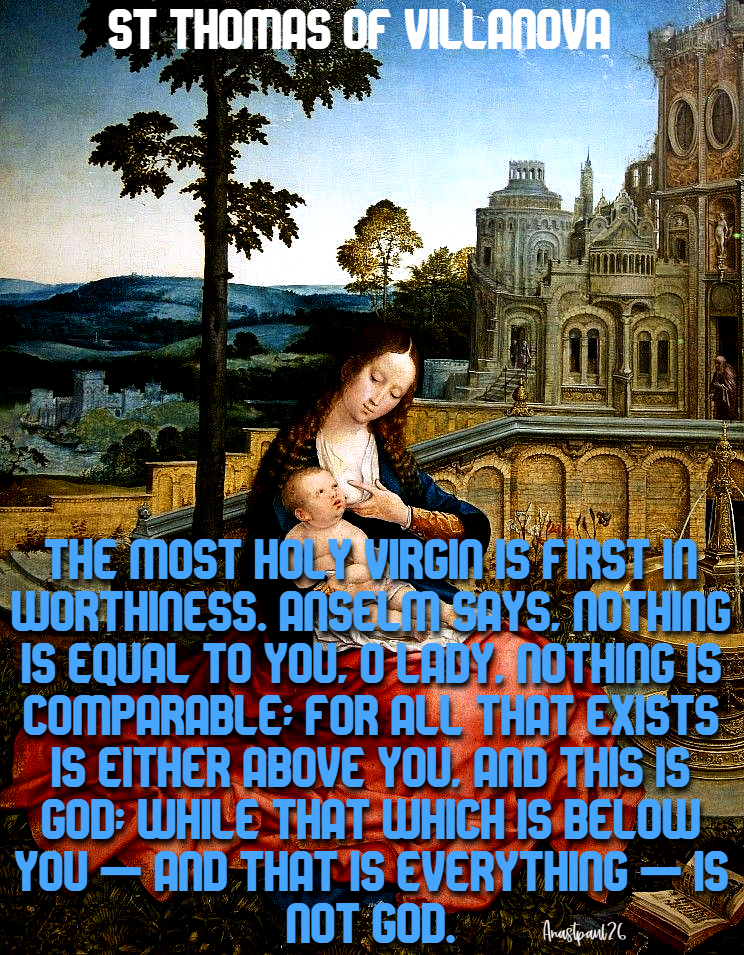
The most holy Virgin is first in worthiness. Anselm says, Nothing is equal to you, O Lady, nothing is comparable; for all that exists is either above you, and this is God; while that which is below you — and that is everything — is not God.

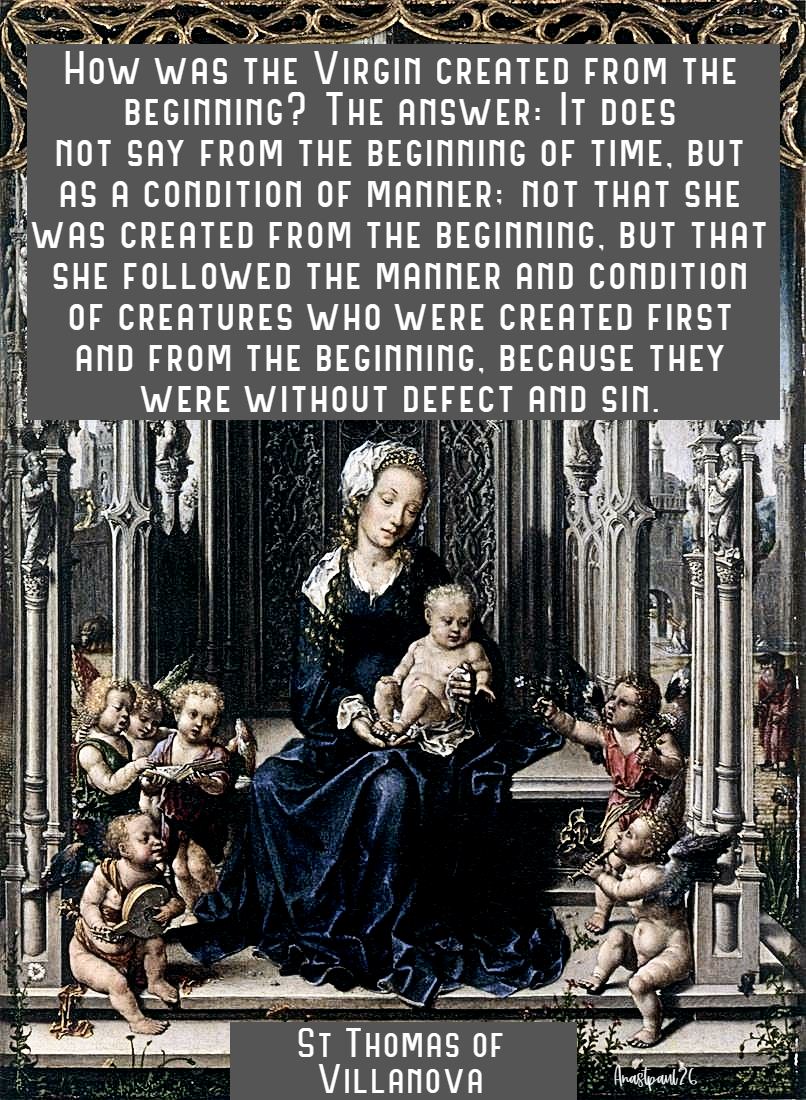
How was the Virgin created from the beginning? The answer: It does not say from the beginning of time, but as a condition of manner; not that she was created from the beginning, but that she followed the manner and condition of creatures who were created first and from the beginning, because they were without defect and sin.

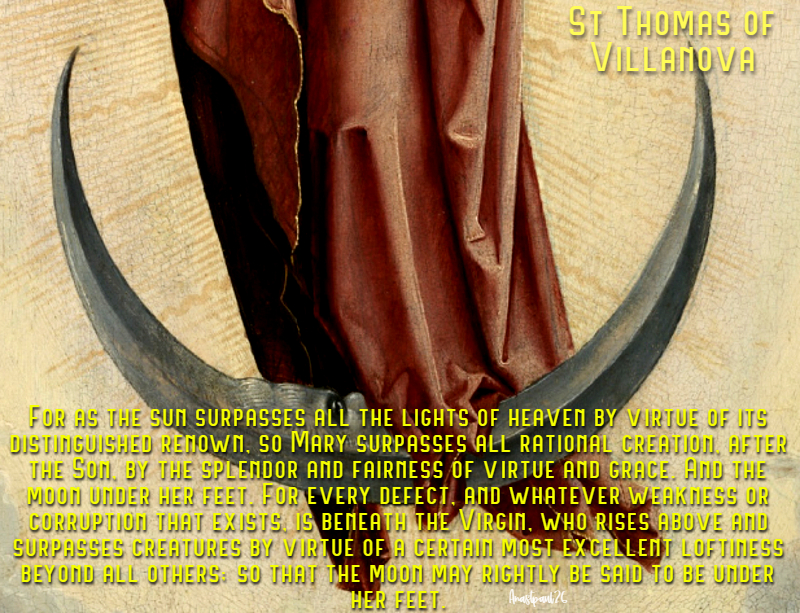
For as the sun surpasses all the lights of heaven by virtue of its distinguished renown, so Mary surpasses all rational creation, after the Son, by the splendor and fairness of virtue and grace. And the moon under her feet. For every defect, and whatever weakness or corruption that exists, is beneath the Virgin, who rises above and surpasses creatures by virtue of a certain most excellent loftiness beyond all others; so that the moon may rightly be said to be under her feet.

Posted in SEPTEMBER-The SEVEN SORROWS of MARY and The HOLY CROSS

Thought for the Day – 22 September – Manual of Devotions in Honour of The Seven Dolors

Manual of Devotions in Honour of The Seven Dolors of the Blessed Virgin Mary by Father Sebastian

LITANY OF THE SEVEN DOLOURS OF
THE BLESSED VIRGIN

Lord have mercy on us. Lord have mercy on us.
Christ have mercy on us. Christ have mercy on us.
Lord have mercy on us. Lord have mercy on us.
Christ hear us. Christ graciously hear us.
God the Father of Heaven, Have mercy on us.
God the Son, Redeemer of the World, Have mercy on us.
God the Holy Ghost, Have mercy on us.

Holy Trinity, one God, Have mercy on us.

Mother of Dolours, Pray for us.

Thou who didst find no room in the inn, Pray for us.
Who wast forced to take refuge in a stable, Pray for us.
Who didst lay thy first-born in a manger, Pray for us.

Who didst witness the circumcision of thy Son, Pray for us.
Who didst hear that thy Son was set as a sign that should be contradicted, Pray for us.

Who didst hear that thy own soul should be pierced with a sword, Pray for us.
Who didst fly into Egypt with thy Son, Pray for us.
Who didst grieve for the murder of the Innocents, Pray for us.
Who for three days didst seek sorrowing thy Son, lost in the
Temple when He was twelve years old, Pray for us.
Who didst note the constant hatred of the Jews against Him, Pray for us.
Who on the day of the last Supper didst bid farewell to thy Son going to Jerusalem to die. Pray for us.

Who didst learn that He was betrayed by Judas, and led away captive, Pray for us.
Who didst see Him delivered us as a malefactor by the chief priests, Pray for us.
Who didst hear that He was falsely accused, Pray for us.
Who didst learn that his blessed face was struck, Pray for us.
Who didst learn that He was most cruelly treated by the Jews and
the soldiers, Pray for us.

Who didst hear thy Son rejected for Barabbas, Pray for us.
Who didst behold Him beaten with scourges and crowned with thorns, Pray for us.
Who didst hear sentence pronounced against Him, Pray for us.
Who didst go to meet thy Son loaded with the Cross, Pray for us.
Who didst see his blessed hands and feet pierced with nails, Pray for us.
Who didst receive the last words of Jesus upon the Cross. Pray for us.
Who didst stand by Him in his agony, Pray for us.

Who didst receive into thy bosom the lifeless Body of thy Son taken down from the Cross, Pray for us.
Who after the Body of Jesus was buried didst return home all sad and desolate. Pray for us.
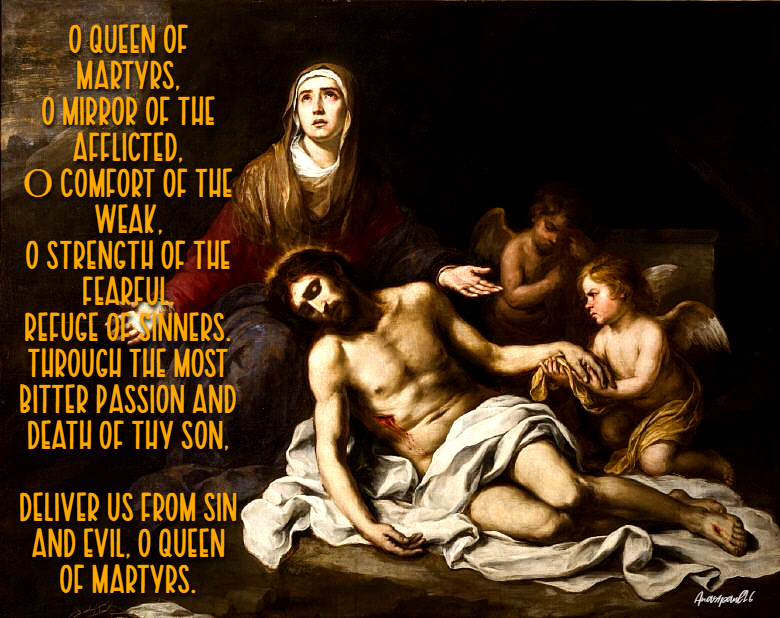
O Queen of Martyrs,
O Mirror of the afflicted,
Ο Comfort of the weak,
O Strength of the fearful,
Refuge of Sinners.
Through the most bitter Passion and Death of thy Son,

Deliver us from sin and evil, O Queen of Martyrs.
Through the most poignant sorrow
of thy heart, Deliver us from sin and evil, O Queen of Martyrs.
Through thy exceeding sadness and desolation, Deliver us from sin and evil, O Queen of Martyrs.
Through thy extreme anguish, Deliver us from sin and evil, O Queen of Martyrs.
Through thy groans and tears, Deliver us from sin and evil, O Queen of Martyrs.
Through thy maternal compassion, Deliver us from sin and evil, O Queen of Martyrs.

Through thy most powerful patronage, Deliver us from sin and evil, O Queen of Martyrs.

From immoderate sadness, Deliver us from sin and evil, O Queen of Martyrs.
From a pusillanimous spirit, Deliver us from sin and evil, O Queen of Martyrs.
From every occasion and danger of sin, Deliver us from sin and evil, O Queen of Martyrs.
From the snares of the devil, Deliver us from sin and evil, O Queen of Martyrs.
From hardness of heart, Deliver us from sin and evil, O Queen of Martyrs.
From impenitence, Deliver us from sin and evil, O Queen of Martyrs.
From sudden and unprovided death, Deliver us from sin and evil, O Queen of Martyrs.
From eternal damnation, Deliver us from sin and evil, O Queen of Martyrs.
We sinners,
Beseech thee hear us.
That thou wouldst vouchsafe to preserve us by thy patronage in true faith, hope, and charity,
We beseech thee hear us.
That thou wouldst vouchsafe to obtain for us perfect sorrow and repentance for our sins, We beseech thee hear us.
That thou wouldst vouchsafe to bring consolation and assistance to those who call upon thee, We beseech thee hear us.
That thou wouldst vouchsafe to succour us in the agony of death, We beseech thee hear us.
That thou wouldst vouchsafe to obtain for us a happy death, We beseech thee hear us.
Mother of God, We beseech thee hear us.
Lamb of God, who takest away the sins of the world,
Spare us, O Lord.
Lamb of God, who takest away the sins of the world,
Graciously hear us, O Lord.
Lamb of God, who takest away the sins of the world,
Have mercy on us, O Lord.
Christ hear us,
Christ graciously hear us.
Lord have mercy on us,
Christ have mercy on us.
Lord have mercy on us.
V. In all our tribulations and
afflictions,
R. Succour us, O Virgin Mary,

PRAYER.
Write, O afflicted Mother, on my repentant heart thy Seven Dolours and the five bleeding Wounds which thy dear Son bore, that I may read therein sorrow and true love; sorrow, to endure for Jesus and for thee every sorrow; love, to despise every love for Him and for thee. Live, crucified Jesus and heartbroken Mary, for ever and ever! Through the same Jesus Christ our Lord. Amen.

Memorare Triste.
Remember, O Virgin Mary, most sorrowful of the afflicted daughters of suffering Eve, that from all ages it has never been known that anyone imploring thy assistance failed to gain thy compassion and protection. Animated with the confidence which this inspires, to thee, O Queen of Martyrs and Virgin Mother, I come, as a contrite sinner, weeping and kneeling. Do not, O Mother of Jesus crucified, despise my suppliant voice, but hear and grant my prayer. Amen.

Posted in SEPTEMBER-The SEVEN SORROWS of MARY and The HOLY CROSS

Thought for the Day – 21 September – Manual of Devotions in Honour of The Seven Dolors

Manual of Devotions in Honour of The Seven Dolors of the Blessed Virgin Mary by Father Sebastian

ROSARY OF THE SEVEN DOLORS OF THE BLESSED VIRGIN MARY

I. The heartrending anguish which Mary felt in her pure soul when she heard from the prophetic lips of Holy Simeon the future sufferings of her Son.
One Our Father and seven Hail Marys.

II. The sword of grief which transfixed Mary’s heart during the flight into Egypt.
One Our Father and seven Hail Marys.

III. Mary’s misery and woe when Jesus was lost for three days.
One Our Father and seven Hail Marys.

IV. Mary meets Jesus carrying his cross, and she faints at his feet.
One Our Father and seven Hail Marys.

V. Mary stands beneath the cross, beholds Him die, and falls into the arms
of St. John, with a broken heart. One Our Father and seven Hail Marys.

VI. Mary recovers from her swoon, and receives on her lap the corpse of her Son. One Our Father and seven Hail Marys.

VII. Mary with tears in her eyes follows her Son to the tomb and sees Him buried. One Our Father and seven Hail Marys.

In honour of the tears Mary shed during her Dolours.
Three Hail Marys.

V. Pray for us, O sorrowful Mother of Jesus.
R. That we may be made worthy of the promises of Christ.

PRAYER.
Grant, we beseech Thee, O Lord Jesus Christ, that the Blessed Virgin thy Mother may intercede for us with thy clemency, now and at the hour of our death; who, in the hour of thy Passion, was pierced in her most holy soul by a sword of sorrow ; grant this, O Jesus Christ, Saviour of the world, who livest and reignest with the Father and the Holy Ghost, world without end. Amen.

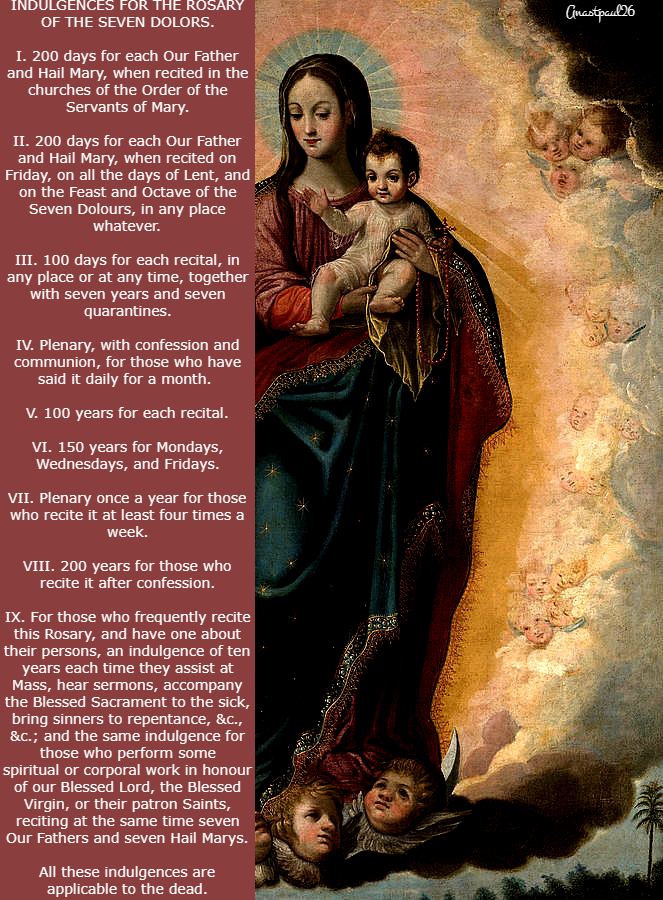
INDULGENCES FOR THE ABOVE ROSARY.

I. 200 days for each Our Father and Hail Mary, when recited in the churches of the Order of the Servants of Mary.

II. 200 days for each Our Father and Hail Mary, when recited on Friday, on all the days of Lent, and on the Feast and Octave of the Seven Dolours, in any place whatever.

III. 100 days for each recital, in any place or at any time, together with seven years and seven quarantines.

IV. Plenary, with confession and communion, for those who have said it daily for a month.

V. 100 years for each recital.

VI. 150 years for Mondays, Wednesdays, and Fridays.

VII. Plenary once a year for those who recite it at least four times a week.

VIII. 200 years for those who recite it after confession.

IX. For those who frequently recite this Rosary, and have one about their persons, an indulgence of ten years each time they assist at Mass, hear sermons, accompany the Blessed Sacrament to the sick, bring sinners to repentance, &c., &c.; and the same indulgence for those who perform some
spiritual or corporal work in honour of our Blessed Lord, the Blessed Virgin, or their patron Saints, reciting at the same time seven Our Fathers and seven Hail Marys.

All these indulgences are applicable to the dead.

Posted in Our MORNING Offering

Our Morning Offering – 20 September – Indulgenced Prayers to the Blessed Virgin

We fly to thy patronage, O holy Mother of God, despise not our petitions in our necessities, but ever deliver us from all dangers, O glorious and blessed Virgin.

(5 years every time said. Plenary indulgence at the point of death to all who have frequently recited it during life)

Grant us, thy servants, we beseech thee, O Lord God, to enjoy perpetual health of mind and body, and, by the intercession of glorious Blessed Mary ever a Virgin, to be delivered from present sorrow and to enjoy everlasting gladness. Through Christ Our Lord. Amen.

(3 years every time said)

O holy Mary, help the unfortunate, aid the weak, refresh the sorrowful, pray for the people, intercede for the clergy, plead for religious women; let all enjoy thine aid who keep holy commemoration of thee.

(3 years every time said)

In thy conception, O Virgin Mary, thou wast immaculate; pray for us to the Father, whose Son, Jesus, conceived of the Holy Ghost, thou didst bring forth.

(300 days every time said)

To thee, O Virgin Mother, who wast never defiled with the slightest stain of original or actual sin, I commend and entrust the purity of my heart.

(300 days every time said)

O Mary, who didst come into this world free from stain, do thou obtain for me from God that I may pass out of it free from sin.

(300 days every time said)

Blessed be the holy and Immaculate Conception of the most blessed Virgin Mary, Mother of God.

(300 days every time said)

O Mary, conceived without sin, pray for us who have recourse to thee.

(300 days every time said)

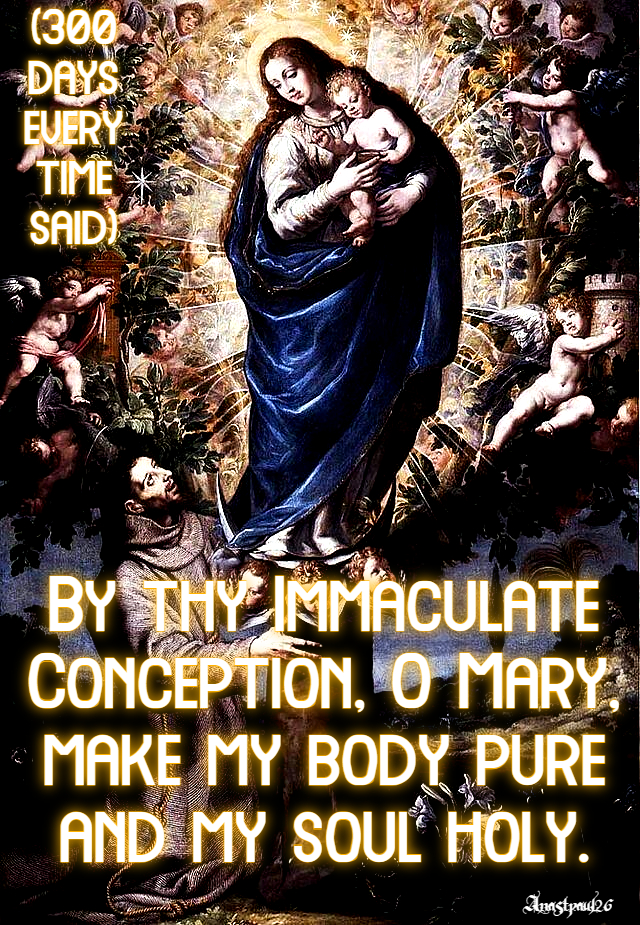
By thy Immaculate Conception, O Mary, make my body pure and my soul holy.

(300 days every time said)