Posted in MARIAN TITLES

Feast of the Holy Relics, Nossa Senhora da Medalha Milagrosa / Our Lady of the Miraculous Medal, Monte Sião, Brazil (1939) and Memorials of the Saints

Feast of the Holy Relics

Nossa Senhora da Medalha Milagrosa / Our Lady of the Miraculous Medal, Monte Sião, Brazil (1939) – 5 November now moved to 27 November:
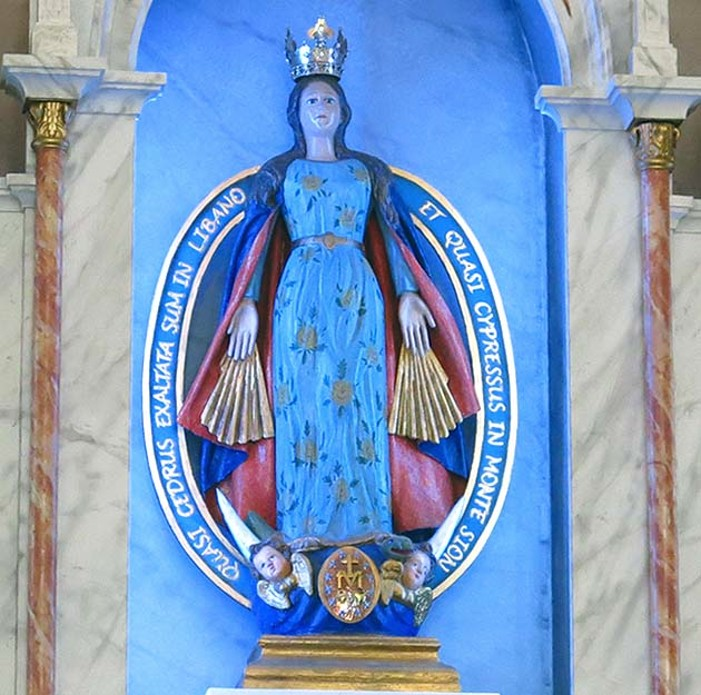
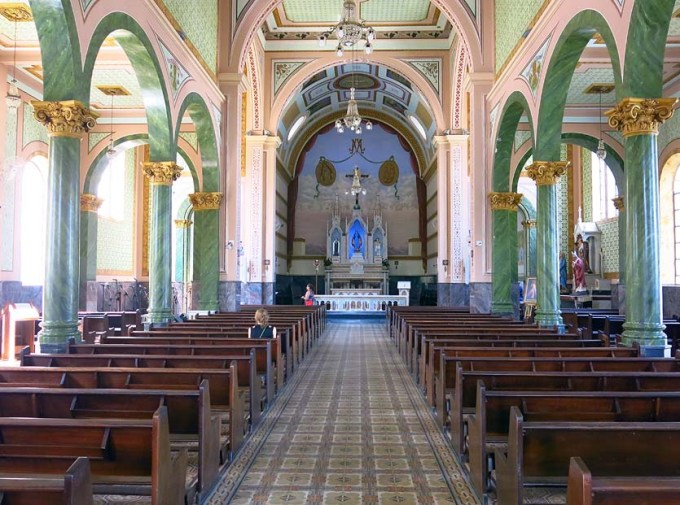
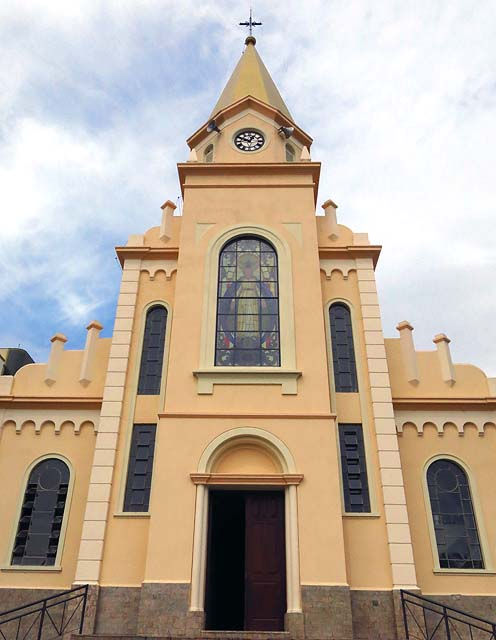
The first Church in Monte Sião appeared in 1849, dedicated to Our Lady of the Miraculous Medal, built by the founder of the place, Antonio Bernardes de Souza. The official Consecration of the Church took place on 13 April 1850. In the Parish of Father Luigi Cocoresi, from 1883 to 1890, more precisely in 1881, the Chapel was replaced by the Parish Church, built on top of in in the same square. The new Church was also built of clay based on strips of sawn wood.

In the parish administration of Fr. José Eugênio de Faria – Fr Zequinha – in 1934, the construction of the current Mother Church began, which is located in the same place as the previous two.

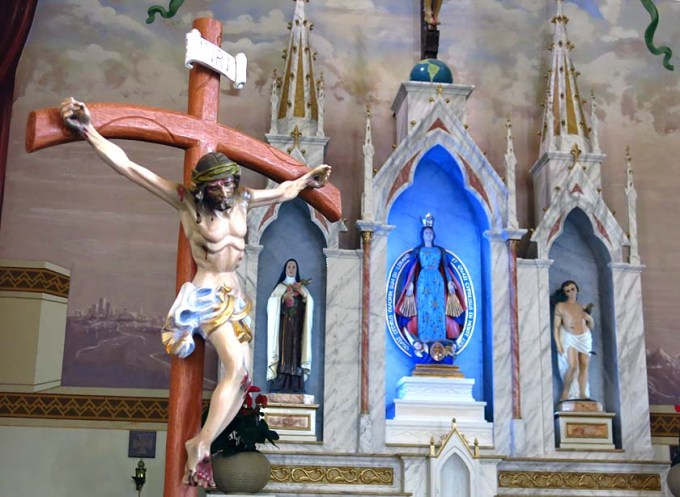
The Church’s architecture resembles the style of Roman art from the 12th century and the main Altar is entirely carved in wood, where the centenary image of the Patron Saint, the Blessed Mother, can be seen. The image of Our Lady of the Miraculous Medal, which adorns the main Altar, was brought to Monte Sião around 1860 and came from Portugal, through a Portuguese farmer, Mr João Pereira Batista Machado, who would have funded both its acquisition and the transportation. The image arrived at the Port of Rio de Janeiro and was brought to the City on the back of animals, inside a cargo jack and wrapped in dry corn husk.
In 1937, at the request of the Bishop, the image was removed from the Altar and sent to a Chapel in the countryside, claiming that the Statue looked too modern.

The faithful greatly missed the Statue in the Igreja Matriz. It was then, that between 1937 and 1939, the City of Monte Sião was inflicted by a period of great drought. There was rain in every other City but not there. The people then associated the lack of rain with the absence of the Statue of their Patron and went to intercede with the Parish Priest, to bring the Statue back. On 5 November 1939, the Statue was allowed to return. The day was sunny and a procession was held to honour the Patroness.

When the Statue reached the City, the first drops began to fall and then a heavy rain, soaking everyone. This was called the rain miracle and after that, everything went smoothly. The Statue underwent a restoration in the year 2015, which returned all the original features to the image, which had been lost with previous restorations.

Although the Feast was 5 November it was moved to co-incide with the official Feast of the Miraculous Medal, 27 November, which is a local public holiday, when it is celebrated after a Novena between 18 and 26 November, with a Mass in honour of the Patron , the Blessed Maria of the Miraculous Medal.
All Saints and Blesseds of the Society of Jesus:

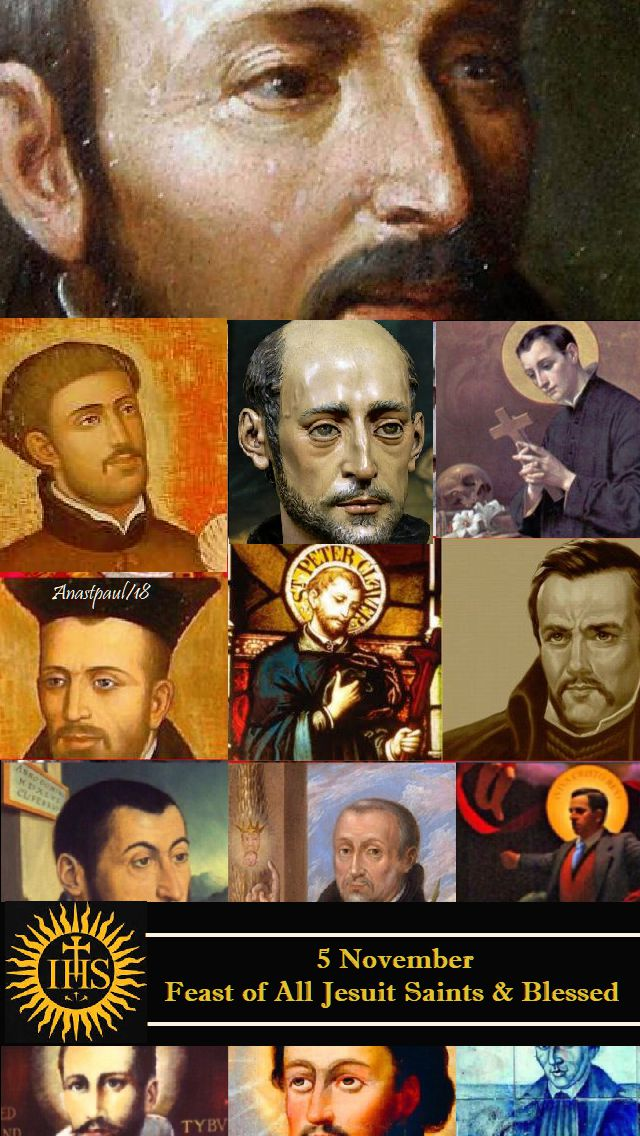
The Society of Jesus, commonly known as the Jesuits, was Founded in 1534 by Saint Ignatius Loyola (1491-1556) at Montmartre, Paris, France. A body of clerics regular organised for Apostolic work, following a religious rule and relying on alms for their support. It was the chief instrument of the Catholic Reformation. Pope Paul III approved the new rule in 1540 and Ignatius was elected the first general of the order in 1541. The constitutions, drafted by him and based on his Spiritual Exercises were adopted in 1558. It was the first order which enjoined by its constitutions devotion to the cause of education. The ministry of the Society consists chiefly in preaching. teaching catechism. administering the sacraments. conducting missions in parishes, taking care of parishes. organising pious confraternities, teaching in schools of every grade, writing books, pamphlets, periodical articles, going on foreign missions and special missions when ordered by the current Holy Father, to whom they take a vow of total obedience. Our current Holy Father, Pope Francis is a Jesuit and has jokingly wondered aloud who is boss of whom in his Order. The general resides at Rome, Italy and has a council of assistants. The motto of the Society is Ad Majorem Dei Gloriam (For the greater glory of God).
St Augustine of Terracina
Bl Bernhard Lichtenberg
St Bertille (c 629-c 703) Abbess
St Canonica
St Comasia
St Ðaminh Mau
St Dominator of Brescia
St Elizabeth
St Domninus the Physician
St Epistemis
St Eusebius of Terracina
St Felix of Terracina
St Fibitius
St Galation
St Gerald of Beziers
Bl Gomidas Keumurjian
Bl Gregory Lakota
St Guetnoco
St Guido Maria Conforti
St Hermenegild
St Idda
St Juan Antoni Burró Mas
St Juan Duarte Martín
St Kanten
St Kea
St Laetus of Orleans
St Magnus of Milan
St Mamete
St Marco of Troia
Bl María del Carmen Viel Ferrando
Bl Simon Ballachi
St Spinulus of Moyen-Moûtier
St Sylvanus of Syria
St Zachary
—
Martyrs of Caesarea Maritima – 4 saints: Four young Christian men who were martyred together in the persecutions of Maximian – Aussenzius, Philotheus, Timothy and Theotimus. They were martyred in the arena at Caesarea Maritima, Palestine.

Martyred in the Spanish Civil War:
• Blessed Juan Antoni Burró Mas
• Blessed Juan Duarte Martín
• Blessed María del Carmen Viel Ferrando
Posted in MARIAN TITLES

Feasts of Our Lady and Memorials of the Saints – 12 October

Nossa Senhora Aparecida / Our Lady Aparecida, Aparecida, Sao Paulo, Brazil (1717) – 12 October: Also known as – Our Lady Who Appeared:
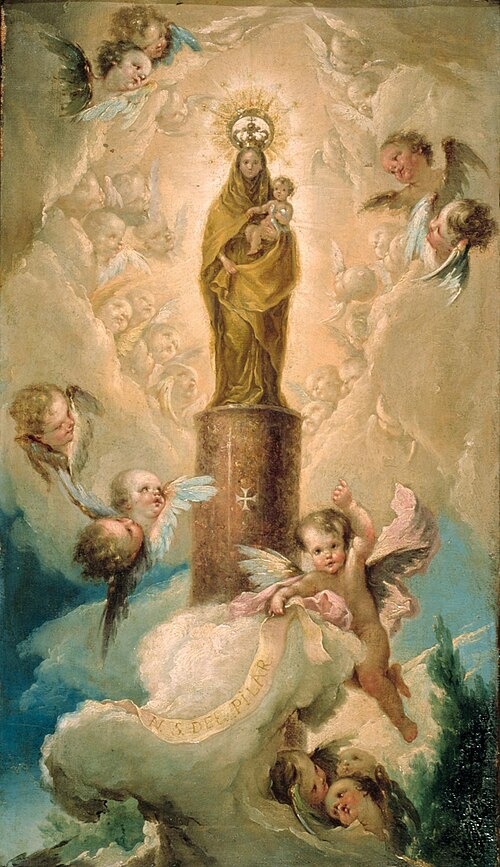
Nuestra Señora del Pilar / Our Lady of the Pillar – 12 October:

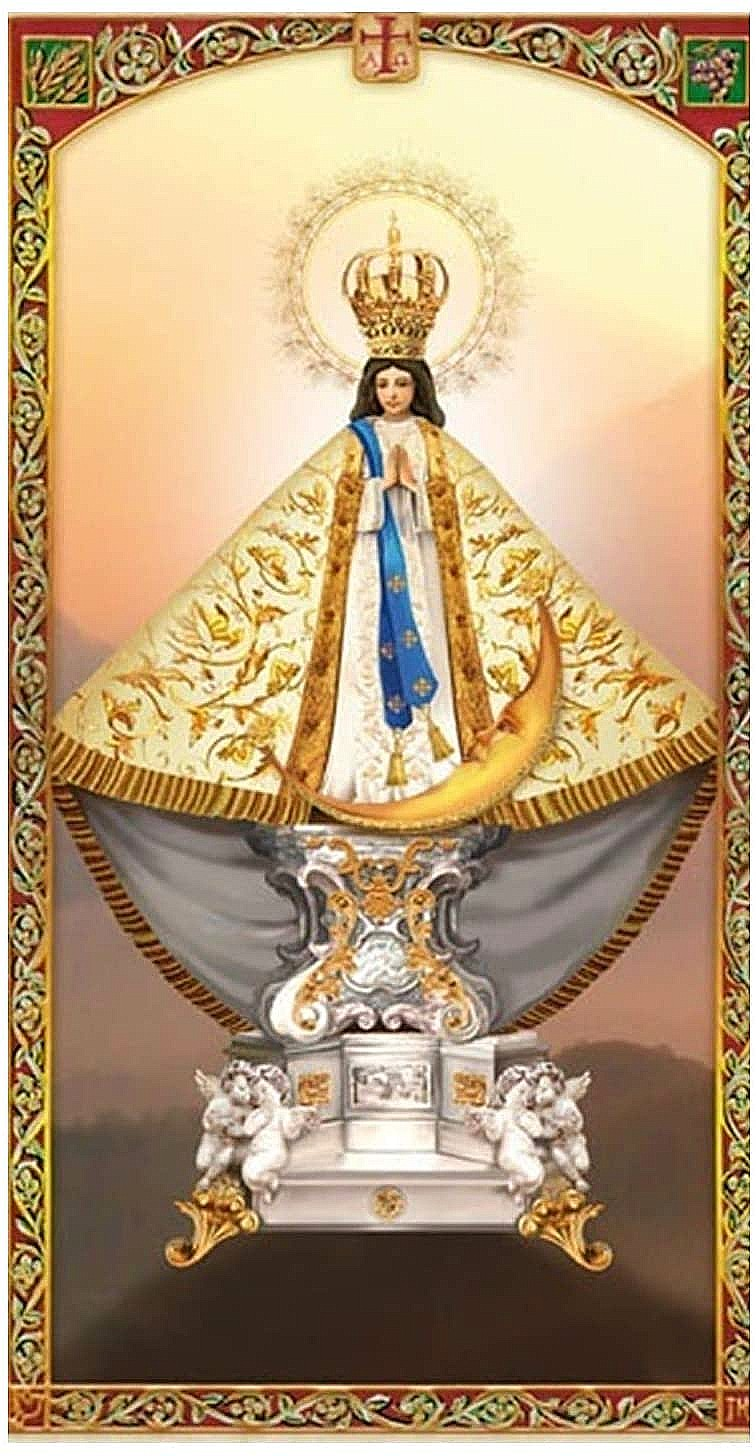
Virgen de Zapopan / Our Lady of Zapopan, Zapopan, Jalisco, Mexico, (1541) – 18 January, 12 October:

Today the village of Zapopan is a quiet little place not many miles from Guadalajara, reached by an excellent highway. Its tranquility and religious atmosphere must be a far cry from pre-Conquest times, when it was a feudal district and tributary of the powerful King of Tonala. In those days the Indians of the district worshiped an idol called Teopintzintl, “The Child God,” to which they offered gifts of hare and partridge. When the kingdom of Tonala bowed to Nuno de Guzman in 1530, Zapopan came under Spanish dominion. The Indian Queen, Chihuapili Tzapotzinco, ordered all the chieftains under her rule, to render their obedience to the Spanish Crown and in March of 1530 the Governor of Atemajac, under whose jurisdiction lay Zapopan, complied with this order. The Mixton War of 1541, however, depopulated the district and the Commander of Tlaltenango, Francisco de Bobadilla, obtained the Viceroy’s permission to repopulate Zapopan with Indians from Tlaltenango, thus lessening the chance of another uprising.

On the eighth of December, 1541, the people of Zapopan was resettled in accordance with the agreement, and on that day, the Franciscan Fray Antonio de Segovia, gave to the newly settled colony, a small image of Our Lady of the Immaculate Conception. For ten years it had accompanied him on his apostolic journeys. In fact, only a short while before, while the Mixton War was still in progress, Fray Antonio, with his missionary companion Fray Miguel de Bolonia, had gone among the warring Indians, the image about his neck, exhorting them to make peace with the Spaniards. It is related that while Fray Antonio was preaching, the Indians saw luminous rays issuing from the image of Our Lady, and that this fact, as much as his preaching, caused them to stop fighting. In thirty-six hours Fray Antonio de Segovia brought to the Viceroy for pardon, more than six thousand Indians, who had laid down their arms. From that time Fray Antonio called the image La Pacificadora, “She Who Makes Peace.”

The image is made of paste – pieces of cornstalk, smoothed and cemented together with glue. It is little more than 30 centimetres in height and represents the Virgin Mary under her title of the Immaculate Conception. The hands, joined before the breast, are of wood. The original sculpture donated by Fray Antonio de Segovia consisted only of the upper half, it is believed, the lower section having been added at a later date. As the lower half is not in proportion to the upper, the reconstruction gives a stunted effect to the image. However, nowadays the Statue is always covered with rich vestments of fabric, the disproportion is not apparent.

In its sculptured form, the Statue represents Our Lady standing with her feet upon a rudely formed crescent moon. She wears a red tunic and a dark blue mantle outlined in gold. One may find much to be desired in the image, considered as a work of art. Yet we must remember that it has the honour of being the first image of the Virgin Mary venerated in the State of Jalisco and that it has seen the Church, in that part of Mexico, grow from the tiniest seed to the great, many-branched tree of the present-day Catholic Faith. Furthermore, for over four centuries, Our Lady of Zapopan has been a constant channel of heavenly favours to the people of Jalisco. A beautiful Church has bee built to house and enshrine her and it remains a vital source of devotion and pilgrimage. Our Lady under this title is celebrated on 18 January and 12 October.

St Amelius of Mortara
St Amicus of Mortara

St Cyprian
St Domnina of Anazarbus
St Edisto
St Edistius of Ravenna

St Edwin of Northumbria (586-616) King and Martyr.

St Evagrius the Martyr
St Felix
St Herlindis

St Juan Osiense
St Maximilian of Celeia
St Meinards
St Monas of Milan (Died 249)Rodobaldo Cepolla

St Pantalus of Basle
St Priscian the Martyr
St Relindis

St Rodobaldo II Cipolla of Pavia (Died 1254) Bishop of Pavia. St Roboaldo II is remembered as a zealous shepherd and for his intense charitable activity.

Bl Roman Sitko
St Salvinus of Verona
St Serafino of Montegranaro OFM Cap (1540-1604) Franciscan Capuchin Lay Friar
Bl Thomas Bullaker

St Wilfrid (c 633-709) Bishop, Abbot, Founder of Monasteries and Churches.

Martyred in the Spanish Civil War:
• Blessed Bartolomé Caparrós García
• Blessed Eufrasio of the Child Jesus
• Blessed José González Huguet
• Blessed Pedro Salcedo Puchades
• Blessed Rafael Lluch Garín

Posted in MARIAN TITLES

Feast of the Transfiguration of Our Lord, Nossa Senhora das Graças / Our Lady of Graces, Pesqueira, Pernambuco, Northeast, Brazil (1936) and Memorials of the Saints – 6 August

Transfiguration of Our Lord (Feast)

AND

Nossa Senhora das Graças / Our Lady of Graces, Pesqueira, Pernambuco, Northeast, Brazil (1936) – 6 August :

On 6 August 1936, Maria da Luz Teixeira, 13, and Maria da Conceição, 16 (a poor girl living with the Teixeira family), were gathering castor beans on Guarda mountain in the Cimbres district, 15 miles from Pesqueira. There was a flash of light and then Maria da Conceição said, “Look, there’s an image that looks like Our Lady.” Maria da Luz saw it too, up on a rock. They ran home and told Maria da Luz’s parents. At her mother’s insistence, Artur Teixeira climbed the hill with the girls, who reached the spot long before he struggled up through the brush. He saw nothing unusual but, at his suggestion, the girls together asked the image, “Who are you?” “I am Grace.” They asked what she wanted. “I’ve come to warn of three punishments sent by God. Tell the people to pray much and do penance.”

After this the girls returned to the site daily, where they prayed with a growing crowd of pilgrims. On 9 August, the crowd demanded a sign; reluctantly, the girls asked for one. The next day, they found water flowing from the rock and two sets of footprints embedded in stone, one an adult’s and one a child’s. The apparition confirmed they belonged to her and her son. The Bishop conducted an investigation. Maria da Luz described Our Lady of Grace as “similar to Our Lady of Mount Carmel in Pesqueira Cathedral but her mantle is blue and her dress cream, with a belt. She has a little child in her left arm and both have very beautiful crowns on their heads.”

Eventually the Virgin told her that the people’s response had been sufficient to avert the three chastisements, sometimes identified as armed bandits (particularly the notorious Lampião, killed by police in 1938) and the coming of World War II or a Communist regime to Brazil. Maria da Conceição died young. In 1940, Maria da Luz joined the Religious of Christian Instruction, taking the name Sister Adélia. In her absence, pilgrims continued to visit the Shrine at the apparition site, where 296 carved stone steps lead to a Statue of Our Lady of Grace (as depicted on the Miraculous Medal, without the Child, not as the girls saw her) and to report miracles there.

Bl Gezelin of Schlebusch
St Gislain of Luxemburg
St Glisente of Brescia
Bl Goderanno
Bl Guillermo Sanz
St Hardulf of Breedon

St Pope Hormisdas (c 450-523) Bishop of Rome from 514 until his death in 523. A talented diplomat, arbitrator and negotiator.

St James the Syrian

St Justus and St Pastor of Alcala – Holy Martyred Children (Died 304) Saints Justus and Pastor of Alcala were two brothers, who in their tender age overcame, with an heroic courage, the rage and power of Dacian, armed with all the instruments of cruelty.

Bl Octavian of Savona
St Pope Sixtus II (Died 258) Pope and Martyr

St Stephen of Cardeña
Bl Tadeusz Dulny
Bl William of Altavilla
—
Martyrs of Cardeña: Two hundred Benedictine monks at the Saint Peter of Cardegna monastery, Burgos, Spain who were martyred in the 8th century by invading Saracens. They were buried by local Christians in a nearby churchyard in Burgos, Spain and Beatified in 1603 by Pope Clement VIII (cultus confirmed).

Martyred in the Spanish Civil War: 10 Beati
• Blessed Alejandro Casare Menéndez
• Blessed Andrés Soto Carrera
• Blessed José González Ramos Campos
• Blessed José María Recalde Magúregui
• Blessed Juan Silverio Pérez Ruano
• Blessed Saturnino Ortega Montealegre