Matka Boża Różańcowa / Our Lady of the Rosary, Krakow, Poland (1600s) – First Sunday of October, 2 October:
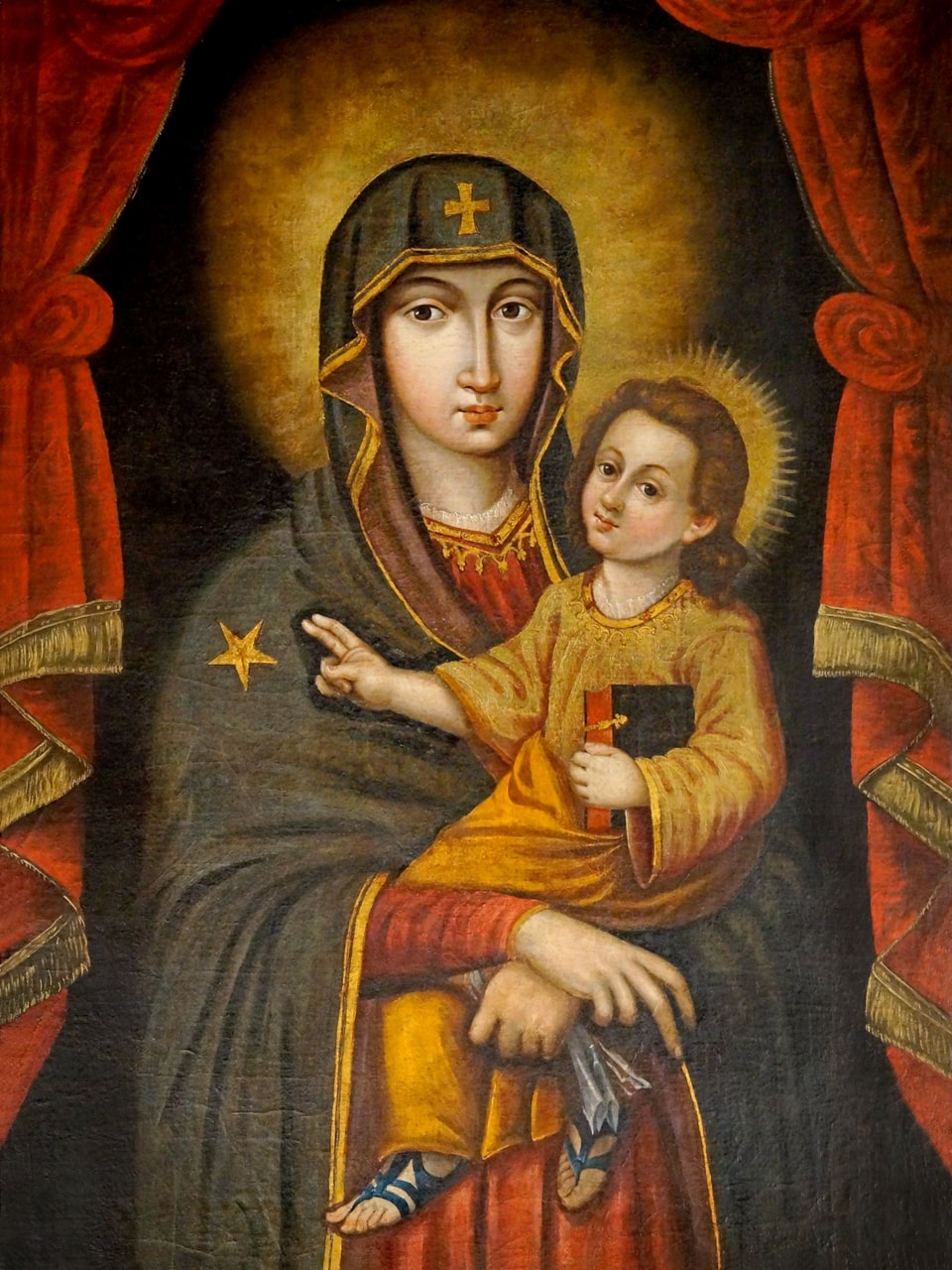
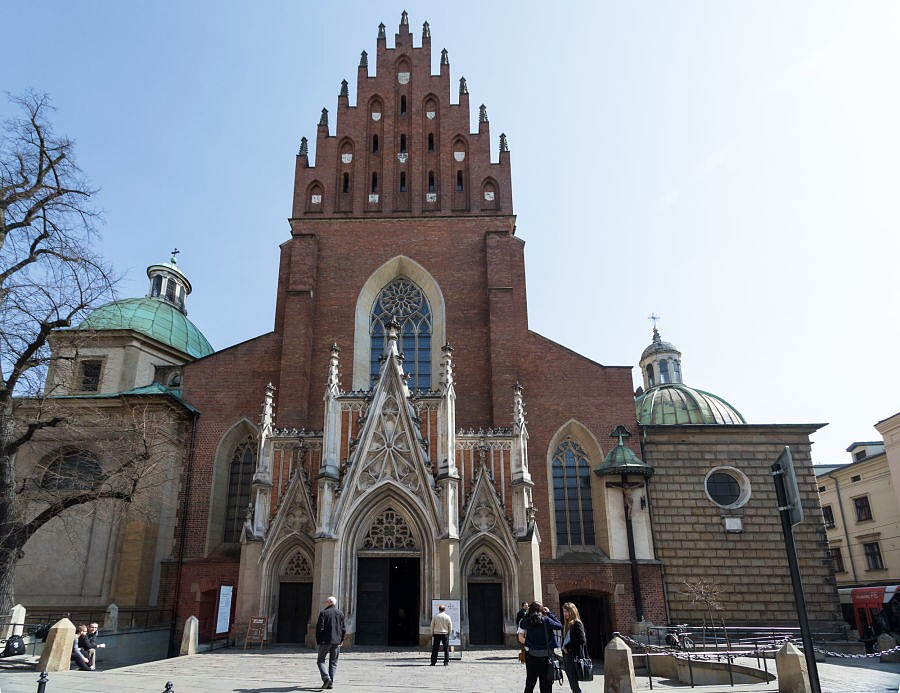
In the Dominican Basilica of the Trinity in Cracow is a large Chapel dedicated to the Mother of God of the Rosary. The icon on its main Altar, crowned on 2 October 1921, is a copy of the ancient Salus Populi Romani (Health of the Roman People) image in the Basilica of St Mary Major of the Snows in Rome — the icon Pope Gregory the Great carried in procession to end the plague of 597. During the Battle of Lepanto (7 October 571), when ships of a coalition of Christian countries routed the Turkish navy off Greece, Pope Pius V prayed the Rosary with a large group of faithful before the Roman icon. The old image thus became associated with the newer devotion of the Rosary and with saving Europe from Ottoman rule.
Churches throughout Catholic Europe were dedicated to Our Lady of the Rosary and copies of the Salus Populi Romani proliferated. Cardinal Maciejowski brought such a copy from Rome to Cracow in 1600. The image played a part in the “Polish Lepanto” in 1621, when at Khotyn, Ukraine (then Chocim, Poland) an allied force of Poles, Lithuanians and Ukrainians faced a Turkish army twice its size. On 3 October, the Bishop of Krakow led an hours-long Rosary procession with the holy icon. The entire population joined in. When the Turks gave up their attack and signed a treaty, Our Lady of the Rosary gained another victory. Her feast is celebrated in Krakow on the first Sunday of October.
The Swedish deluge contributed to the destruction of the original image of the Mother of God. T he cult, however, was so strong that a copy of the previous painting was quickly funded. The present one comes from the 50s and 60s of the 17th century. Numerous votive offerings made on the occasion of receiving favours have also survived from that time. The oldest exhibited in the Church are dated to 1703, the older ones are in the Archdiocese Museum. The love for the Blessed Mother is also evidenced by the silver dress donated in the 1770s by the Działyński family,and the sceptre of Our Lady of the “Pious Gregory of Pierzchno” foundation at the turn of the 17th and 18th centuries.
St Alfonso del Rio St Andrea Ximenez
St Beregisius St Eleutherius of Nicomedia Bl Georges-Edme René St Gerinus
St Leudomer St Maria Antonina Kratochwil St Modesto of Sardinia St Saturius of Soria St Theophilus of Bulgaria St Thomas de Cantilupe of Hereford (c 1218-1282) Bishop St Ursicinus II — Martyred in Antioch, Syria: Martyred in one of the early persecutions, date unknown. St Cyril of Antioch St Primus of Antioch St Secundarius of Antioch
Martyred in Nagasaki, Japan: A husband, wife and two sons, who were all martyred together in the persecutions in Japan. They were beheaded on 2 October 1622 in Nagasaki, Japan and Beatified by Pope Pius IX on 7 May 1867. • Blessed Andreas Yakichi • Blessed Franciscus Yakichi • Blessed Lucia Yakichi • Blessed Ludovicus Yakichi
Martyred in the Spanish Civil War: • Blessed Elías Carbonell Molla • Blessed Enrique Sáiz-Aparicio • Blesssed Felipe González de Heredia Barahona • Blessed Francisco Carceller Galindo • Blessed Isidoro Bover Oliver • Blessed Juan Carbonell Molla • Blessed Juan Iñiguez de Ciriano Abechuco • Blessed Manuel Borrajo Míguez • Blessed María Francisca Ricart Olmos • Blessed Mateu Garrolera Masferrer • Blessed Pedro Artolozaga Mellique • Blessed Pedro Salcedo Puchades
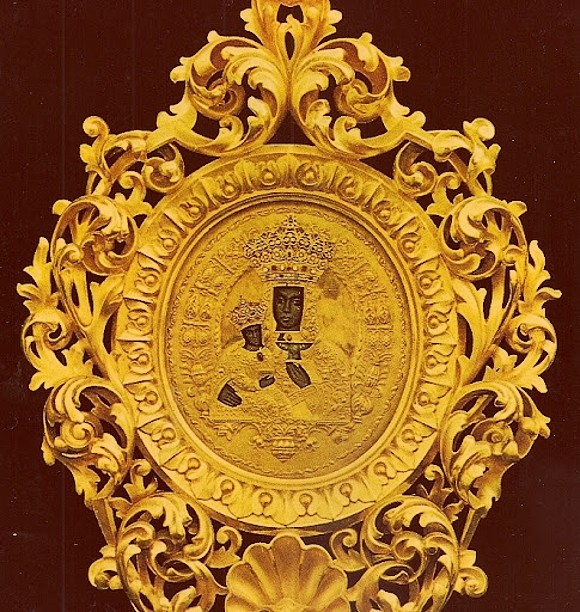
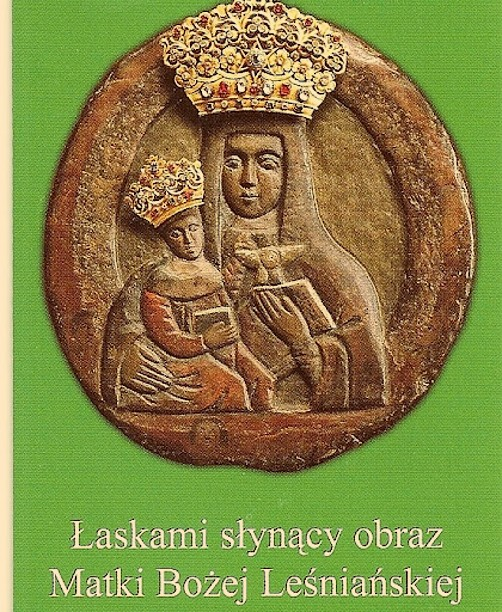
Matka Boża Leśniańska / Blessed Mother of Leśna, Leśna Podlaska, Biała Podlaska, Lublin, Poland (1683) – 26 September:
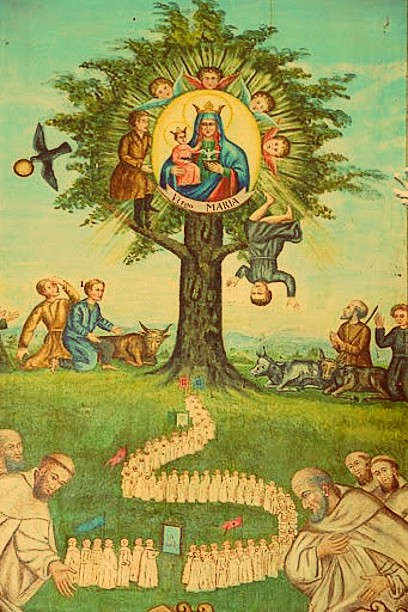
The Leśnia Sanctuary begins on 26 September 1683. On that day, two shepherds – Miron Makaruk and Aleksander Stelmaszuk – looking for the lost cattle in the bushes, noticed a stone image of the Mother of God hanging on a wild pear tree, which gave an extraordinary glow. Wanting to take the painting off, one of the bravest young men climbed the tree but each time fell to the ground. The local inhabitants, seeing what was happening, began to pray fervently. Soon, Zabłocki’s elders from nearby Bordziłówka arrived and only he, as an unusually prayerful man, took the painting off the tree. Droplets of “sweat” appeared on the image and this phenomenon continued for a long time. Then the painting was taken to the manor in Bukowice.
This extraordinary find deeply touched the religious and secular authorities of the time. Soon a wooden Church was erected on the site of the appearance of the Image. On 26 September 1695, a Parish was established in Lesna. From the very beginning, the Image attracted crowds of believers who experienced many favours thanks to the Blessed Mother, especially cures of illnesses. The Bishop of Lutsk, Franciszek Prażmowski, issued a decree in 1700, in which he stated that the appearance of the Image should be considered miraculous.
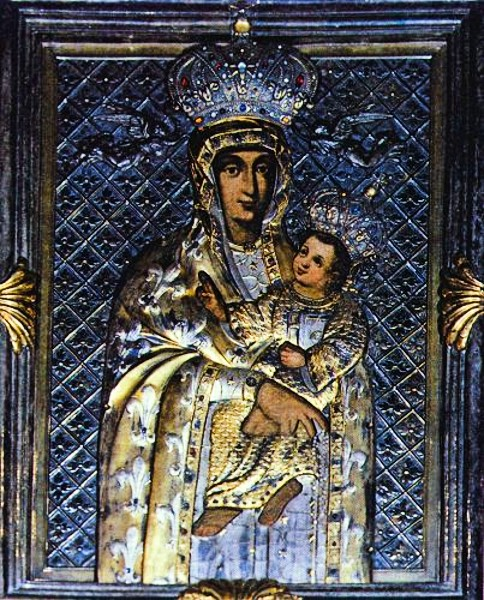
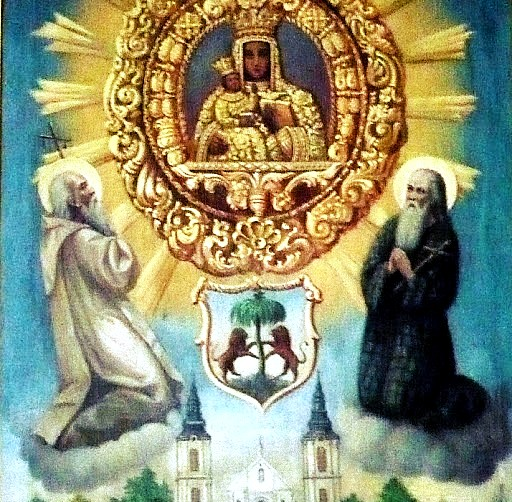
In the Lesnian Image, Mary is presented, embracing the Child Jesus with her right arm. The Child Jesus is holding the book with his right hand and his left hand is raised up in a gesture of teaching. Mary, standing in half-figure, is facing the viewer. In her left hand she holds an open book, on which, with outstretched wings, a dove – a symbol of the Holy Spirit – is supported. The figure of the Mother of God is covered with a coat.
The image of the Mother of God is a relief carved in field stone. The dimensions of the Image are: width 29.3 cm, height 31.4 cm, thickness 4.6 cm, weighs 9.5 kg.
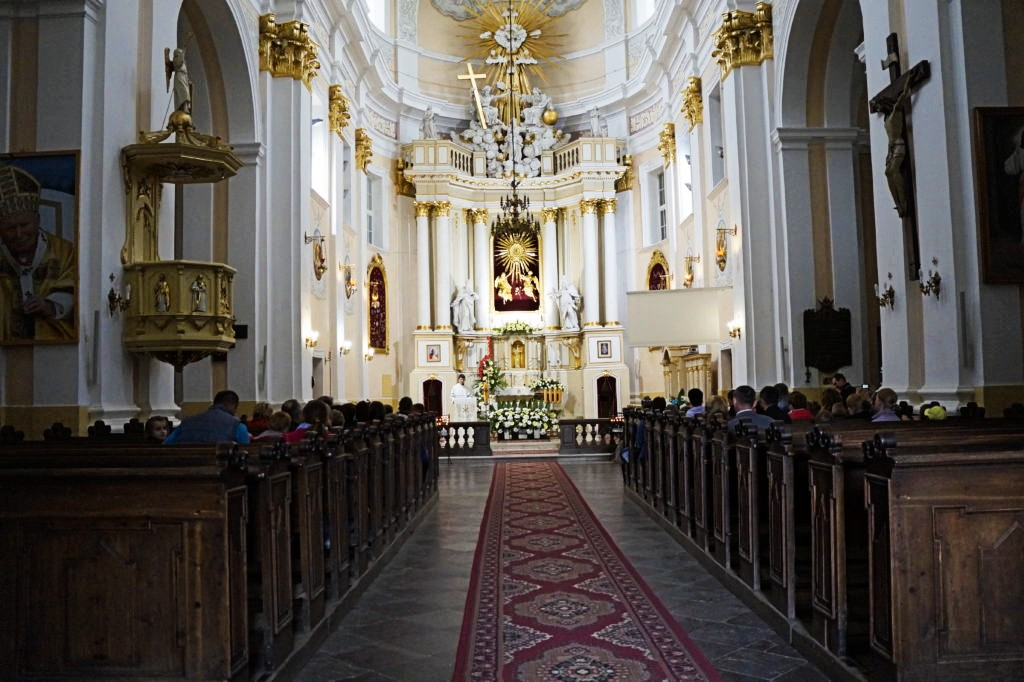
On the site of the appearance of the Image of the Mother of God in 1718. a small Church was built. It exists to this day and is called the “Chapel of the Appearance of the Miraculous Image.” In 1727, the Parish of Leśna and the care of the Miraculous Image were taken over by the Pauline Fathers from Jasna Góra. They began the construction of a magnificent Church, which was erected in the years 1731 – 1758. It was consecrated under the invocation of the “Nativity of the Blessed Virgin Mary and the Holy Apostles Peter and Paul” on 8 September 1758. Huge crowds of the faithful of the Latin and Uniate rite were drawn to the Leśnia Sanctuary.
The situation changed with the partitions of Poland, when Leśna found itself under the Russian partition. After the fall of the January Uprising, the Lesnian Sanctuary found itself in a desperate situation. As part of the repression for helping the insurgents, on the night of 27-28 October 1864 , the Pauline Fathers were deported from Leśna. It was then, that the Bishop of Janów, Beniamin Szymanski, ordered to secretly take out the Miraculous Image and put a copy in its place. It was done in 1865. Soon the tsarist government abolished the Podlasie Diocese. The exiled Bishop took the Miraculous Picture with him to Łomża. He put it in the Church of the Benedictine Sisters. In 1875, the Church in Leśnia was taken over for the purposes of the Orthodox Church. Then the pilgrimages stopped. In 1889, an Orthodox nunnery was established in Lesna. It was to become the centre of Russification of Poles. In 1905 Tsar Nicholas II came to Lesna, whose relative was the superior of the nuns of Leśna. After the outbreak of World War I, the sisters left Leśna and took with them a copy of the painting of the Mother of God, still being firmly convinced that it was the original painting.
On 16 August 1915, the temple in Leśnia returned to Catholic worship. On 25 May 1919 . The Pauline Fathers returned to Lesna and immediately began renovation works in the Sanctuary. First of all, the search for the Miraculous Picture began, which was not found until 5 May 1926 in Łomża. It happened thanks to Fr. Aleksander Łaziński. After the canonical trial conducted by Bishop H. Przeździecki, the Miraculous Image returned in a triumphant parade from Siedlce to Leśna on 25 September 1927. It was a great celebration for the entire Podlasie Diocese and over 25,000 people attended this event. In the interwar period, the Pauline Fathers decorated the Sanctuary. They looked after the pilgrims who were again in large numbers at the feet of their Lesnian Mother.
In 1939, the difficult time of the Nazi occupation began. In the fall of 1940, the Germans occupied the Monastery and expelled the Pauline Fathers. After the war, in 1951, under the direction of the Prior – Father Jerzy Tomziński, the Church received a Pulpit and an Organ.
On 18 August 1963 , the Primate of Poland, Cardinal Stefan Wyszyński, together with the Bishop of Podlasie, Ignacy Świrski, crowned the Miraculous Image with papal crowns. From 11 to 12 June 1970, Cardinal Karol Wojtyła stayed in Leśna. On 25 September 1977, the 50th anniversary of the return of the Miraculous Image was solemnly celebrated. In 1983, the solemn celebrations of 300 years of the appearance of the Miraculous Image took place and in 1984 the Church in Leśnia was elevated to the rank of a Minor Basilica. In 1992, a break-in was made to the temple in Leśnia and attempts were made to steal the golden crowns from the Miraculous Image. In 1995, the 300th anniversary of the establishment of the Parish in Leśna Podlaska was celebrated. This time the ceremony was presided over by the Primate of Poland, Cardinal Józef Glemp. In 1996, works on frescoes and paintings in the Basilica began and they were completed in 2002. On 26 September 2019, the Leśnia Sanctuary celebrated the 100th anniversary of the return of the Pauline Order to Leśna Podlaska.
St Cosmas(Optional Memorial) St Damian(Optional Memorial) (Died c 286 ) Martyrs. Twin brothers and Physicians, Apostles of Charity, Evangelists – born in the 3rd century, of Arabic descent and died by being tortured, without suffering any injury and finally they were beheaded c 286 in Aegea, Cilicia (modern Ayas, Turkey). The Martyr twins are remembered in the Roman Canon of the Mass in the prayer known as the Communicantes (from the first Latin word of the prayer). They are also recalled in the Litany of the Saints and in the older form of the Roman rite, in the Collect for Thursday in the Third Week of Lent, as the Station Church for this day is Santi Cosma e Damiano.
St Nilus the Younger (910-1005) Abbot and Confessor and Founder of Italo-Greek Monasticism in southern Italy.. St Nilus was a charismatic leader and leading spiritual personality of his time.
St Senator of Albano St Vigilius of Brescia — Martyrs of Korea – 12 saints: Twelve lay people in the apostolic vicariate of Korea who were imprisoned, tortured and martyred together in the persecutions in Korea. • Saint Agatha Chon Kyong-Hyob • Saint Carolus Cho Shin-Ch’ol • Saint Catharina Yi • Saint Columba Kim Hyo-Im • Saint Ignatius Kim Che-Jun • Saint Iulitta Kim • Saint Lucia Kim • Saint Magdalena Cho • Saint Magdalena Ho Kye-Im • Saint Magdalena Pak Pong-Son • Saint Perpetua Hong Kum-Ju • Saint Sebastianus Nam I-Gwan They were beheaded September 1839 in Seoul Prison, South Korea and Canonised on 6 May 1984 by St Pope John Paul II.
Martyred in the Spanish Civil War: • Blessed Amalia Abad Casasempere de Maestre • Blessed Andreu Felíu Bartomeu • Blessed Antonio Cid Rodríguez • Blessed Josefa Romero Clariana • Blessed Manuel Legua Martí • Blessed María Jord´ Botella • Blessed Pau Castell´ Barber´ • Blessed Teresa Rosat Balasch
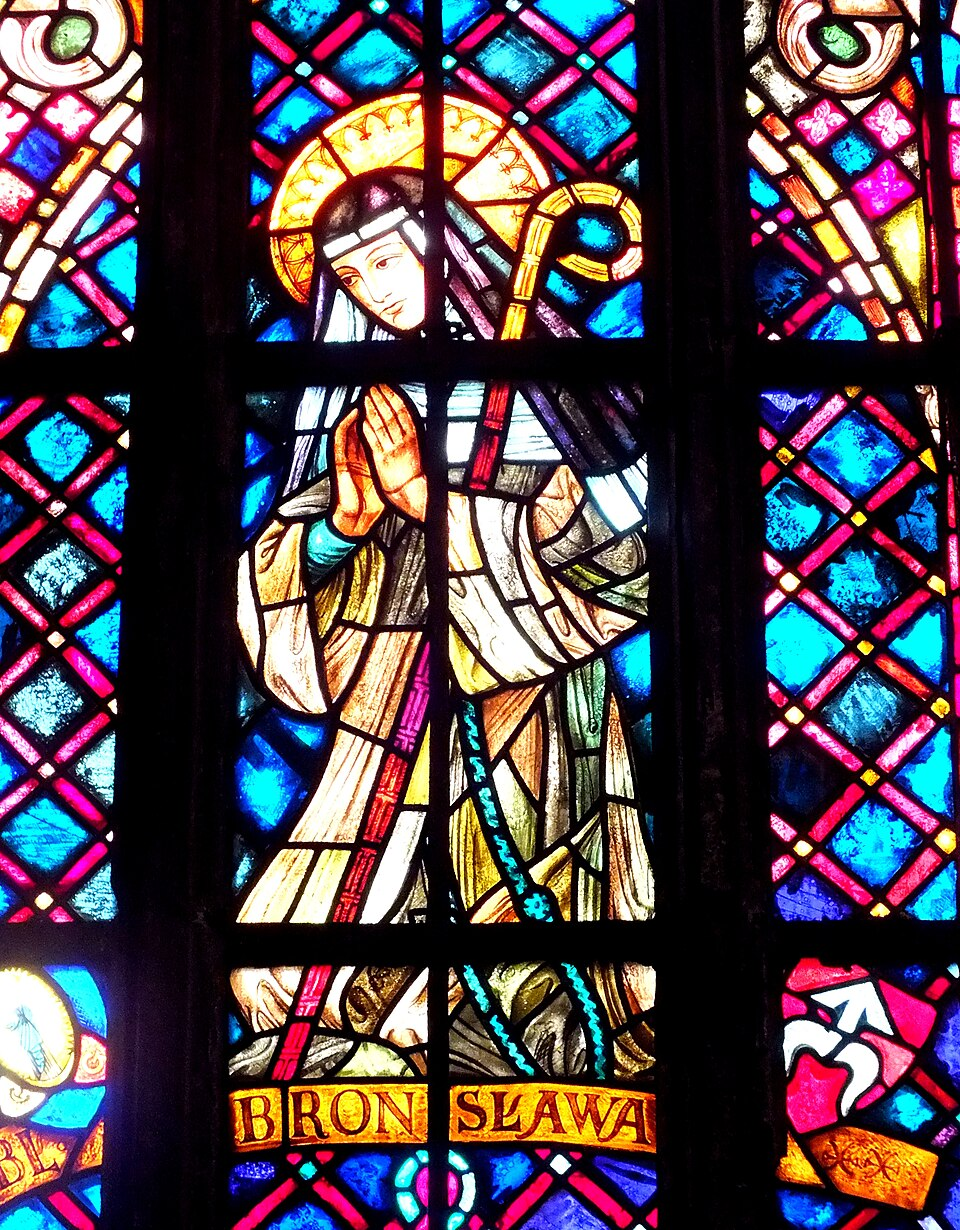
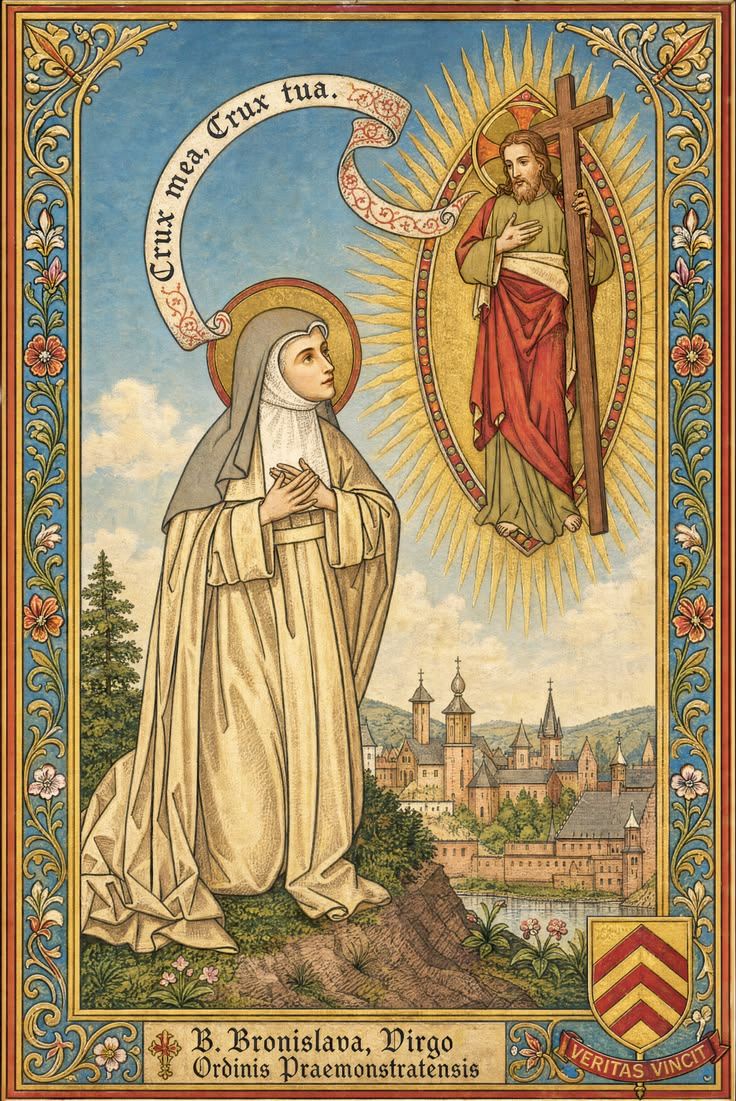
Blessed Bronislava of Poland, also known as Bronislava Odrowaz, Bronislava of Cracow, Bronislawa. She was a cousin of Saint Hyacinth and Blessed Czeslaw. The daughter of Count Stanislaus and Countess Anna of Prandata-Odrowaz, she was born at the castle of Kamien in Upper Silesia, Poland, in 1203, becoming at age sixteen a Premonstratensian nun at a convent founded by her maternal grandfather. Saint Hyacinth himself introduced her to this community of the Norbertines.
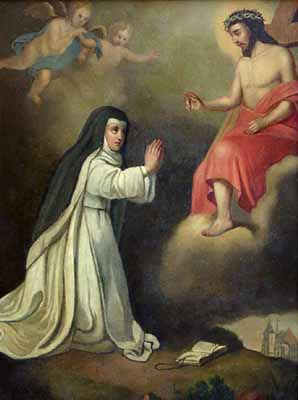
She was deeply devoted to the Holy Cross. After her profession in 1223, Christ Crucified appeared to her and said, “Bronislava, as my Cross has been your cross, so my glory will be your glory.” When the Tartars invaded Krakow in 1241, Bronislava, holding the cross in her hand, encouraged her sisters with the words, “Do not be afraid, the cross will save us.” She then knocked on the wall with her crucifix, at which a corridor opened before them and they all escaped into a nearby forest. Some of the Sisters joined another surviving convent, while Bronislava and a few others built huts on the ruins of their former home. They ministered to the poor, sick, and homeless of the surrounding countryside. The local population considered her their patroness on whom they could count when they needed protection.
The Norbertine rule was rigorous. They lived in cells that had dirt floors and no stoves; they suffered intensely from cold and frost, following a vow of extreme poverty and had no contact with the outside world. After 15 years of solitary, austere religious life, Bronislava accepted the burden of becoming a Superior. Later she became a hermitess on the hill of Sikornik. When Saint Hyacinth died, she received a vision of him ascending to heaven holding the hand of the Blessed Virgin.
Bronislava died on August 29, 1259, two years after her beloved cousin. Both of them had been devoted to the holy Mother of God and to her Rosary in its earliest form. Her body was taken to the convent church and she was invoked as a saint. Her relics were placed in a precious reliquary and were carried in solemn procession each year on the anniversary of her death. In 1707 she was designated a patroness of Krakow and Poland, of orphans, young people, a happy death and of the prevention of disease.
She was beatified by Pope Gregory XVI on 23 August 1839, after being attributed for protecting Zwierzyniec from cholera in 1835. The efforts of the Polish bishops toward the canonization of Bronislava in 1947 by Pope Pius XII were thwarted by 40 years of Communist rule.
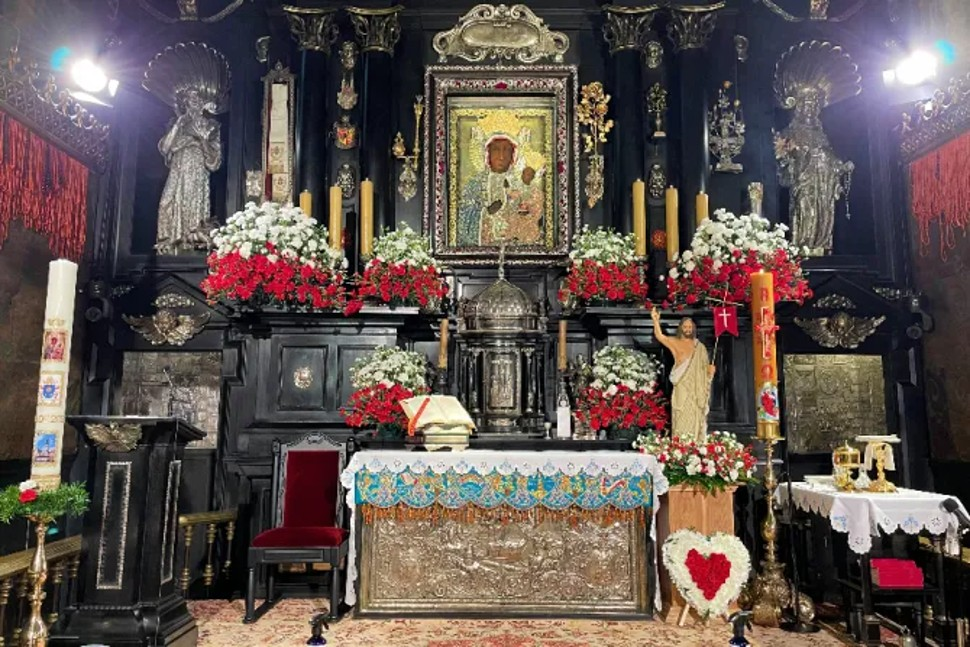
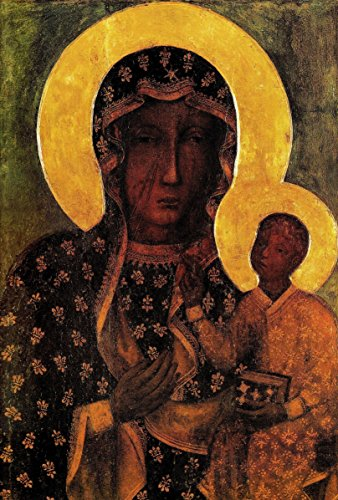
Our Lady of Czestochowa, Queen of Poland– Our Lady of Czestochowa is a revered icon of the Virgin Mary housed at the Jasna Góra Monastery in Częstochowa, Poland. Several Pontiffs have recognised the venerated icon, beginning with Pope Clement XI who issued a Canonical Coronation to the image on 8 September 1717 via the Vatican Chapter. Patron of Poland. According to tradition, the Icon of Jasna Góra (Bright Mountain) was painted by St Luke the Evangelist on a tabletop built by Jesus Himself and the Icon was discovered by St Helen, mother of Emperor Constantine and collector of Christian Relics, in the Holy Land.
St Pope Zephyrinus (died 217) Martyr, he was Bishop of Rome or Pope from 199 to his death in 217. He was born in Rome. He is known for combatting heresies and defending the Divinity of Christ.
St Jeanne Elisabeth des Bichier des Anges FC (1773-1838) (commonly referred to as St Elisabeth Bichier) and known as “the Good Sister” – Religious and co-Founder with Saint André Hubert Fournet (whom we celebrate on 13 May) of the Sisters of the Cross, Sisters of St Andrew, a religious congregation which was established for the care of the poor and the instruction of rural children in the Diocese of Poitiers in 1807. She also helped to inspire the founding of a community of Priests dedicated to Missionary service, the St Elisabeth died in 1838, at which time there were about 600 Daughters of the Cross serving in some 100 communities. She was Beatified by Pope Pius XI in 1934 and Canonised by Pope Pius XII in 1947.
Bl Jean Bassano Bl Jean of Caramola Bl Juan Urgel Bl Margaret of Faenza St Maximilian of Rome St Melchizedek the Patriarch St Orontius of Lecce St Pandwyna St Rufinus of Capua St Secundus the Theban St Victor of Caesarea St Victor the Martyr St Vyevain of York
Martyrs of Celano – 3 Saints: Three Christians, Constantius, Simplicius and Victorinus, Martyred in the same area at roughly the same time. They were Martyred in c 159 in the Marsica region of Italy. At some point their relics were interred under the main Altar of the San Giovanni Vecchio Church in the Collegiata di Celano and were authenticated in 1057 by Pope Stephen IX. The city was depopulated in 1222; when it was re-built, the relics were re-enshrined in the Church.
Martyred in the Spanish Civil War:
Bl Emilio Serrano Lizarralde Bl Francesc Casademunt Ribas Bl Josep Maria Tolaguera Oliva Bl Luis Valls Matamales Bl María de Los Ángeles Ginard Martí Bl Pere Sisterna Torrent



You must be logged in to post a comment.