Posted in SEPTEMBER-The SEVEN SORROWS of MARY and The HOLY CROSS

Thought for the Day – 14 September –On the Third Dolor

Reflections on each of the Seven Dolors of Mary by St Alphonsus Liguori

Of The Loss Of Jesus In the Temple

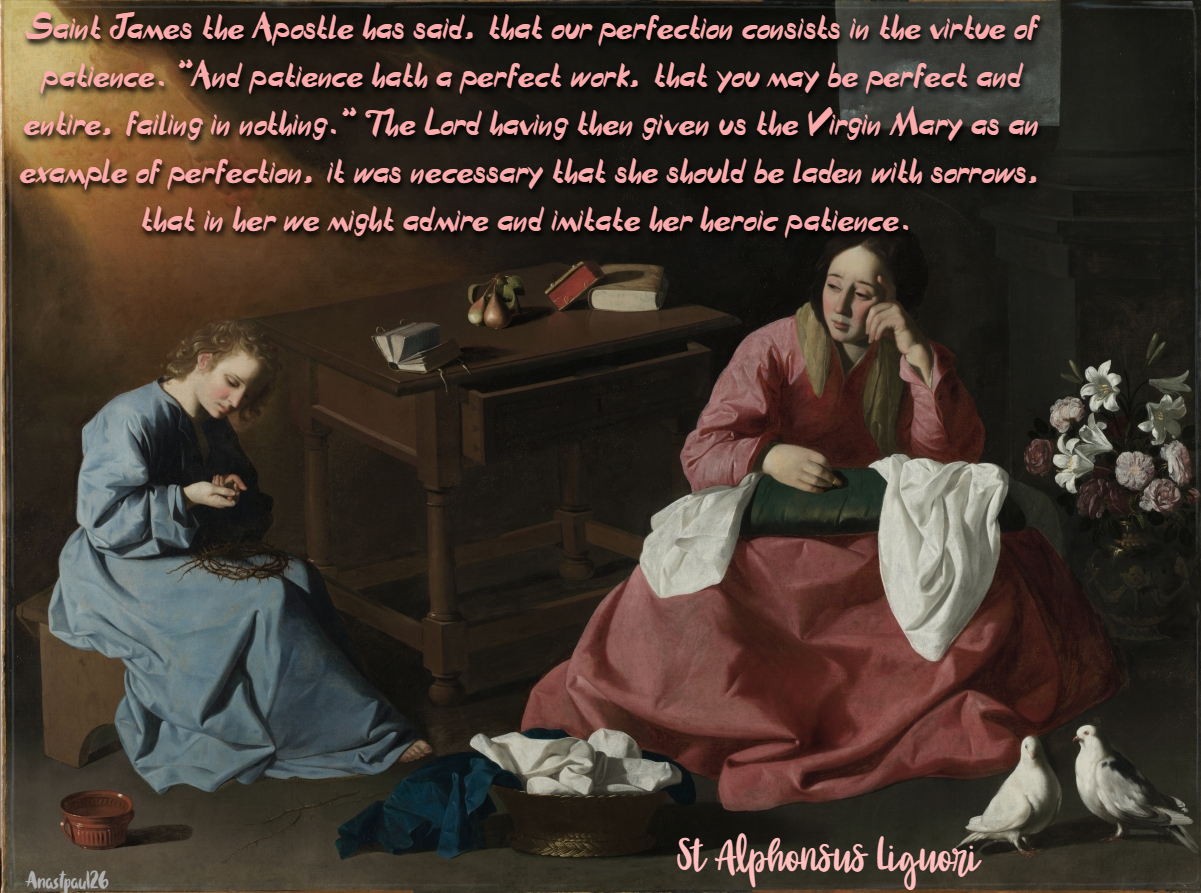
Saint James the Apostle has said, that our perfection consists in the virtue of patience. “And patience hath a perfect work, that you may be perfect and entire, failing in nothing.” The Lord having then given us the Virgin Mary as an example of perfection, it was necessary that she should be laden with sorrows, that in her we might admire and imitate her heroic patience. The dolor that we are this day to consider is one of the greatest which our divine mother Buffered during her life, namely, the loss of her Son in the temple. He who is born blind is little sensible of the pain of being deprived of the light of day; but to him who has once had sight and enjoyed the light, it is a great sorrow to find himself deprived of it by blindness. And thus it is with those unhappy souls who, being blinded by the mire of this earth, have but little knowledge of God, and therefore scarcely feel pain at not finding him. On the contrary, the man who, illuminated with celestial light, has been made worthy to find by love the sweet presence of the highest good, oh God, how he mourns when he finds himself deprived of it !

From this we can judge how painful must have been to Mary, who was accustomed to enjoy constantly the sweet presence of Jesus, that third sword which wounded her, when she lost him in Jerusalem, and was separated from him for three days.

Some writers assert, and not without reason, that this dolor was not only one of the greatest, but that it was the greatest and most painful of all. For in the first place, Mary in her other dolors had Jesus with her; she suffered when St. Simeon uttered the prophecy in the temple; she suffered in the flight to Egypt, but always with Jesus; but in this dolor she suffered at a distance from Jesus, without knowing where he was: “And the light of my eyes itself is not with me.” Thus, with tears, she then exclaimed: Ah, the light of my eyes, my dear Jesus, is no more with me; he is far from me, I know not where he is! Origen says, that though the love which this holy mother bore her Son, she suffered more at this loss of Jesus than any martyr ever suffered at death. Ah, how long: were these three days for Mary! they appeared three ages.

Secondly. Mary well understood the cause and end of the other dolors, namely, the redemption of the world, the divine will ; but in this she did not know the cause of the absence of her Son. The sorrowful mother was grieved to find Jesus withdrawn from her, for her humility, says Lanspergius, made her consider herself unworthy to remain with him any longer, and attend upon him on earth, and have the care of such a treasure. And perhaps, she may have thought within herself, I have not served him as I ought. Perhaps I have been guilty of some neglect, and therefore he has left me. They sought him, lest he perchance had left them, as Origen has said. Certainly there is no greater grief for a soul that loves God than the fear of having displeased him. And therefore Mary never complained in any other sorrow but this, lovingly expostulating with Jesus after she found him : “Son, why hast thou done so to us? Thy father and I have sought thee sorrowing.”! By these words she did not wish to reprove Jesus, as the heretics blasphemously assert, but only to make known to him the grief she had experienced during his absence from her, on account of the love she bore him.
This sorrow of Mary ought, in the first place, to serve as a comfort to those souls who are desolate and do not enjoy the sweet presence they once enjoyed of their Lord. They may weep, but let them weep in peace, as Mary wept in the absence of her Son. Let them take courage, and not fear that on this account they have lost the divine favor, for God himself said to St. Theresa: “No one is lost without knowing it; and no one is deceived without wishing to be deceived.” If the Lord departs from the sight of that soul who loves him, he does not therefore depart from the heart. He often hides himself that she may seek him with greater desire and love. But those who would find Jesus must seek him, not amid the delights and pleasures of the world, but amid crosses and mortifications, as Mary sought him: We sought thee sorrowing, as she said to her Son: “Dolentes quasrebamus te.”

Moreover, in this world we should seek no other good than Jesus. Job was not unhappy when he lost all that he possessed on earth; riches, children, health, and honors, and even descended from a throne to a dunghill; but because he had God with him, even then he was happy. St. Augustine, speaking of him, says: He had lost all that God had given him, but he had God himself

Posted in SEPTEMBER-The SEVEN SORROWS of MARY and The HOLY CROSS

Thought for the Day – 12 September – On the First Dolor

Reflections on each of the Seven Dolors of Mary by St Alphonsus Liguori

Saint Simeon’s Prophecy

In this valley of tears, every man is born to weep, and every one must suffer those afflictions that daily befall him. But how much more miserable would life be, if every one knew also the future evils which are to afflict him! Too unhappy would he be, says Seneca, whose fate was such. The Lord exercises his compassion towards us, namely, that he does not make known to us the crosses that await us; that if we are to suffer them, at least we may suffer them only once. But he did not exercise this compassion with Mary, who, because God wished her to be the queen of dolors, and in all things like his Son, and to see always before her eyes, and to suffer continually all the sorrows that awaited her; and those were the sufferings of the passion and death of her beloved Jesus. For St. Simeon in the temple, after having re ceived the divine child in his arms, predicted to her that this child was to be the mark for all the opposition and persecution of men; “Set for a sign which shall be contradicted;” and that therefore the sword of sorrow should pierce her soul: “And thy own soul a sword shall pierce.”

The holy Virgin herself said to St. Matilda, that at the announcement of St. Simeon all her joy was changed into sorrow. For, as it was revealed to St. Theresa, the blessed mother, although she knew before this that the life of her Son would be sacrificed for the salvation of the world, yet she then learned more particularly and distinctly the sufferings and cruel death that awaited her poor Son. She knew that he would be contradicted in all things.

When David, in the midst of all his pleasures and royal grandeur heard from Nathan the prophet, that his son should die “The child that is born to thee shall surely die” he could find no peace, but wept, fasted, and slept upon the ground. Mary received with the greatest calmness the announcement that her Son should die, and peacefully continued to submit to it; but what grief she must have continually suffered, seeing this amiable Son always near her, hearing from him words of eternal Iife and beholding his holy demeanor. Abraham suffered great affliction during the three days he passed with his beloved Isaac, after he knew that he was to lose him. Oh God ! not for three days, but for thirty three years, Mary had to endure a like sorrow. Like, do I say? A sorrow as much greater as the Son of Mary was more lovely than the son of Abraham. The blessed Virgin herself revealed to St. Bridget, that while she lived on the earth there was not an hour when this grief did not pierce her soul: As often, she continued, as I looked upon my Son, as often as I wrapped him in his swaddling clothes, as often as I saw his hands and his feet, so often was my soul overwhelmed as it were with a fresh sorrow, because I considered how he would be crucified. 

The evangelist says, that as Jesus Christ advanced in years, so also he advanced in wisdom and in grace with God and men. That is, he advanced in wisdom and in grace before men or in their estimation; and before God, according to St. Thomas, inasmuch as all his works would continually have availed to increase his merit, if from the beginning grace in its complete fulness had not been conferred on him by virtue of the hypostatic union. But if Jesus advanced in the esteem and love of others, how much more did he advance in Mary’s love! But oh God, as love increased in her, the more increased in her the grief of having to lose him by a death so cruel. And the nearer the time of the passion of her Son approached, with so much greater pain did that sword of sorrow, predicted by St. Simeon, pierce the heart of the mother; precisely this the angel revealed to St. Bridget, saying: “That sword of sorrow was every hour drawing nearer to the Virgin as the time for the passion of her Son drew nearer.”

If, then, Jesus our King and his most holy mother did not refuse, for love of us, to suffer during their whole life such cruel pains, there is no reason that we should complain if we suffer a little. Jesus crucified once appeared to sister Magdalene Orsini, a Dominican nun, when she had been long suffering a great trial, and encouraged her to remain with him on the cross with that sorrow that was afflicting her. Sister Magdalene answered him complainingly: “Oh Lord, thou didst suffer on the cross only three hours, but it is more than three years that I have been suffering this cross.” Then the Redeemer replied: “Ah! ignorant soul, what dost thou say? I, from the first moment I was conceived, suffered in heart what I afterwards suffered on the cross. ” If, then, we too suffer any affliction and complain, let us imagine that Jesus and his mother Mary are saying to us the same words.

Posted in CATHOLIC Quotes

Quote/s of the Day – 18 August – Let us run to Mary

Quote/s of the Day – 18 August – “The Month of the Immaculate Heart of Mary” – Within the Octave of the Assumption

No matter how sinful
one may have been,
if he has devotion to Mary,
it is impossible that he be lost.

St Hilary of Poitiers

The very fact
that God has elected her,
proves, that none was ever
holier than Mary;
if any stain had disfigured her soul,
if any other virgin
had been purer and holier,
God would have selected her
and rejected Mary.

St Jacob of Sarug

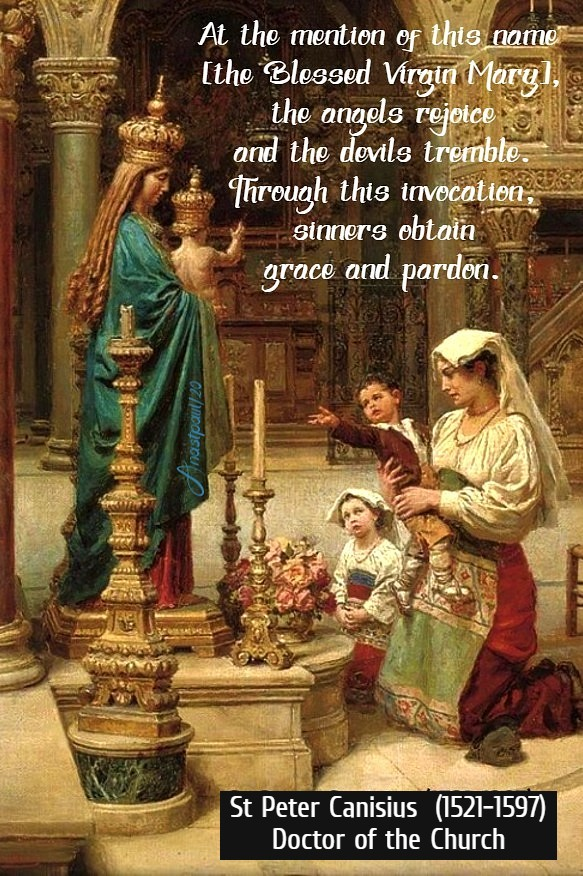
At the mention of this name
[the Blessed Virgin Mary],
the Angels rejoice
and the devils tremble.
Through this invocation,
sinners obtain
grace and pardon.

St Peter Canisius SJ

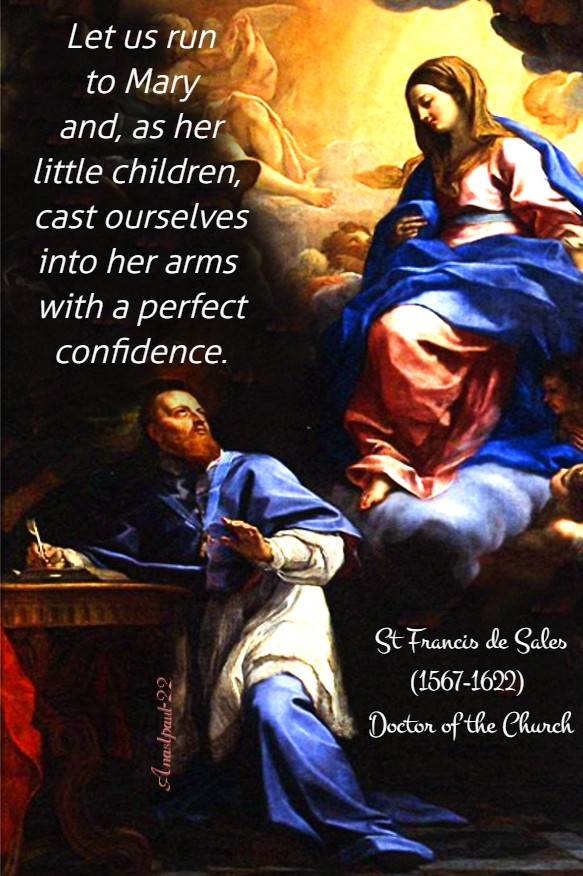
Let us run to Mary
and, as her little children,
cast ourselves into her arms
with a perfect confidence.

St Francis de Sales

It is Mary alone to whom God has given the keys of the cellars of divine love, and the power to enter into the most sublime and secret ways of perfection, and the power likewise to make others enter in there also. It is Mary alone who has given to the miserable children of Eve, the faithless, the entry into the terrestrial paradise, that they may walk there agreeably with God, hide themselves there securely against their enemies, and feed themselves there deliciously, without any more fear of death, on the fruit of the trees of life and of the knowledge of good and evil, and drink in long draughts the heavenly waters of that fair fountain, which gushes forth there with abundance; or rather she is herself that terrestrial paradise, that virgin and blessed earth, from which Adam and Eve, the sinners, have been driven, and she gives no entry there except to those whom it is her pleasure to make Saints.

St Louis de Montfort

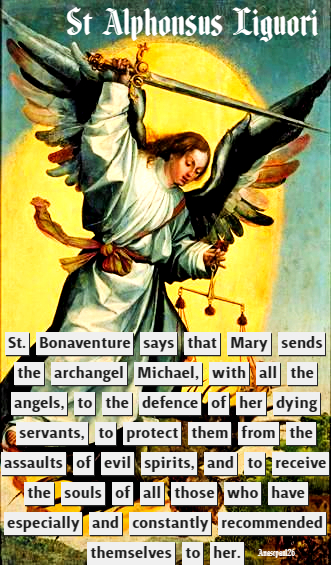
St. Bonaventure says that Mary sends the archangel Michael, with all the angels, to the defence of her dying servants, to protect them from the assaults of evil spirits, and to receive the souls of all those who have especially and constantly recommended themselves to her.

St Alphonsus Liguori

Posted in Our MORNING Offering

Our Morning Offering – 7 August – O Mother Blest By St Alphonsus

Our Morning Offering – 7 August – “Month of the Immaculate Heart of Mary”

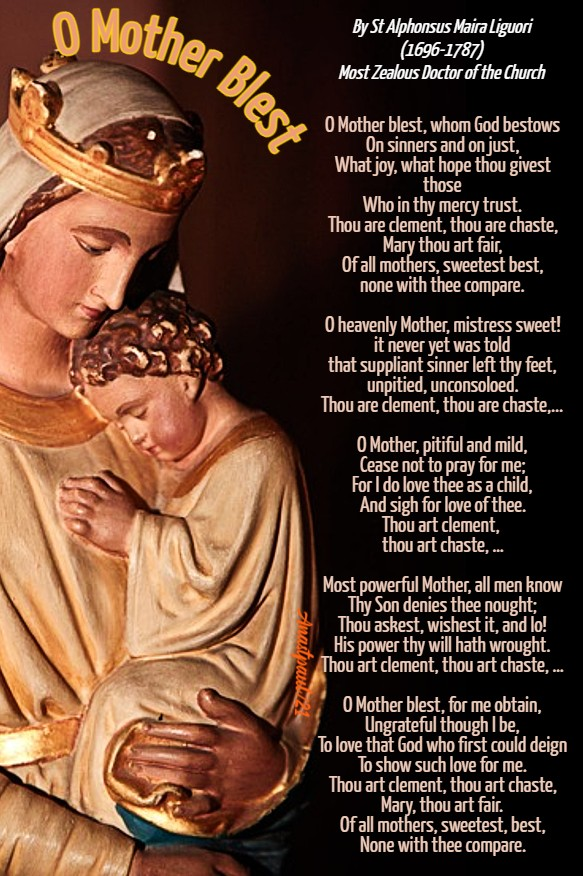
O Mother Blest
By St Alphonsus Maira Liguori (1696-1787)
Most Zealous Doctor of the Church

Trans. Fr Edmund Vaughn C.SS,R, (1827 – 1908 )

O Mother blest, whom God bestows
On sinners and on just,
What joy, what hope thou givest those
Who in thy mercy trust.
Thou are clement, thou are chaste,
Mary thou art fair,
Of all mothers, sweetest best,
none with thee compare.

O heavenly Mother, mistress sweet!
it never yet was told
that suppliant sinner left thy feet,
unpitied, unconsoloed.
Thou are clement, thou are chaste, …

O Mother, pitiful and mild,
Cease not to pray for me;
For I do love thee as a child,
And sigh for love of thee.
Thou art clement, thou art chaste, …

Most powerful Mother, all men know
Thy Son denies thee nought;
Thou askest, wishest it, and lo!
His power thy will hath wrought.
Thou art clement, thou art chaste, …

O Mother blest, for me obtain,
Ungrateful though I be,
To love that God who first could deign
To show such love for me.
Thou art clement, thou art chaste,
Mary, thou art fair.
Of all mothers, sweetest, best,
None with thee compare.