“Thus it will be at the end of the age. The angels will go out and separate the wicked from the righteous and throw them into the fiery furnace, where there will be wailing and grinding of teeth.”…..Matthew 13:49-50
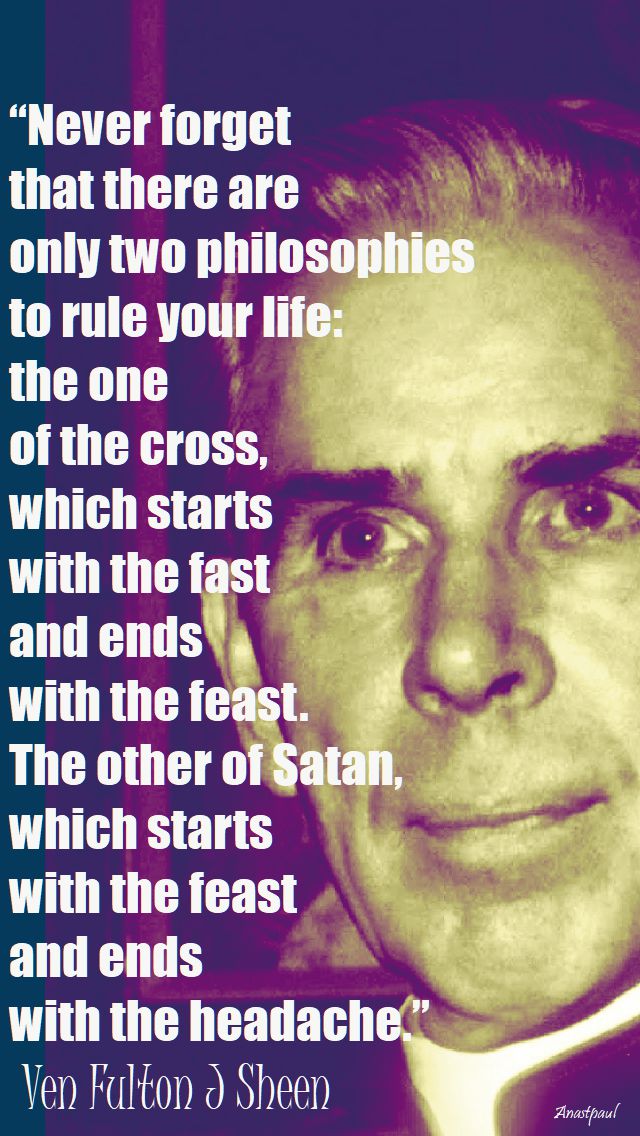
REFLECTION – “Never forget that there are only two philosophies to rule your life: the one of the cross, which starts with the fast and ends with the feast. The other of Satan, which starts with the feast and ends with the headache.” ..― Venerable Fulton J. Sheen
PRAYER – Help me Lord, to listen to Your word and live by it, so that I may be counted among the good ones whom Your angels will choose for eternal happiness. Let me accept the reality of good and evil living side by side in this world. And let me not be scandalised if the situation is not different also within Your Church in this world. Holy Martyrs of Spain , pray for us! Amen
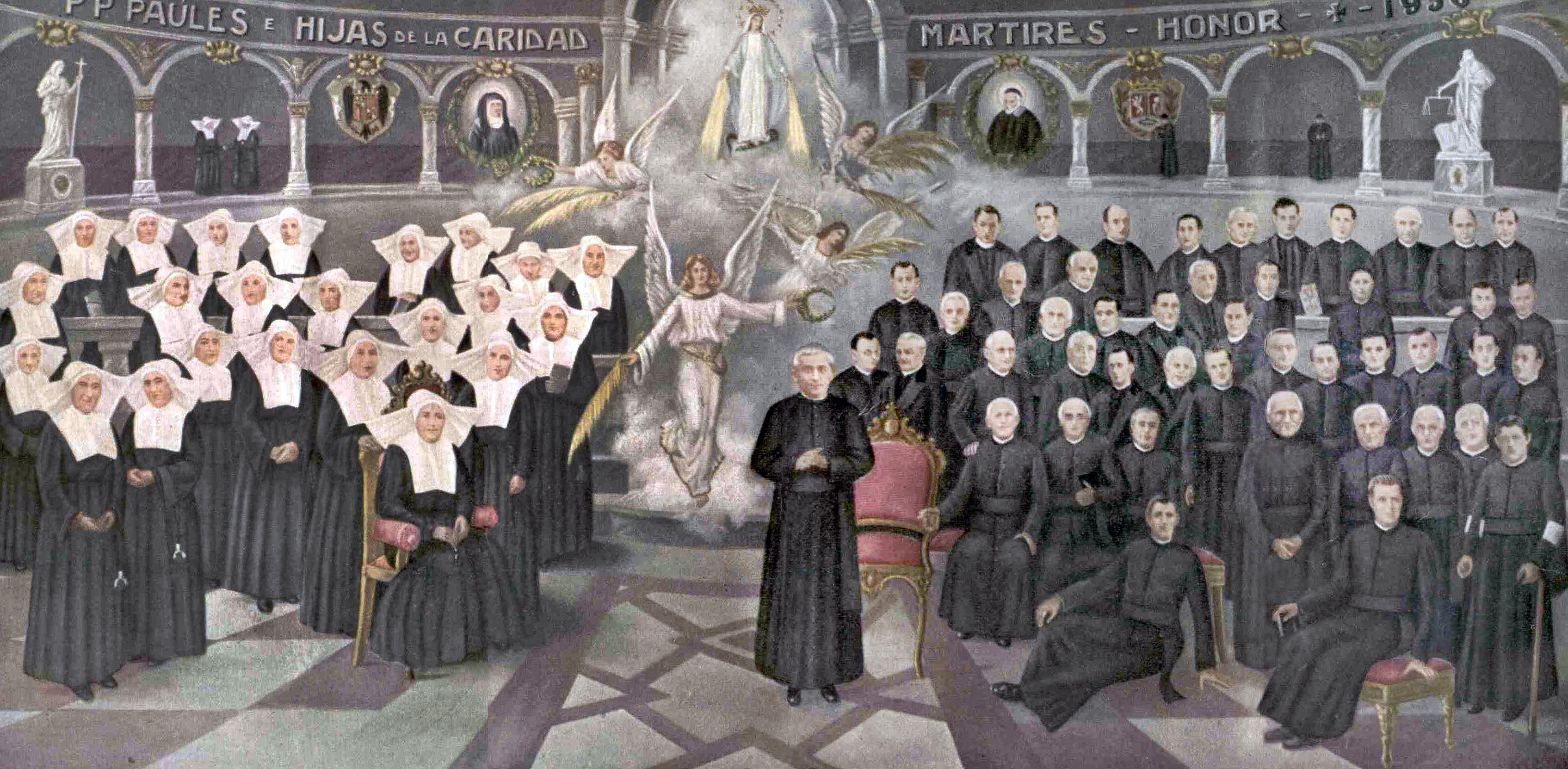
Saints of the Day – 3 August – The Martyrs of the Spanish Civil War 1931-1939
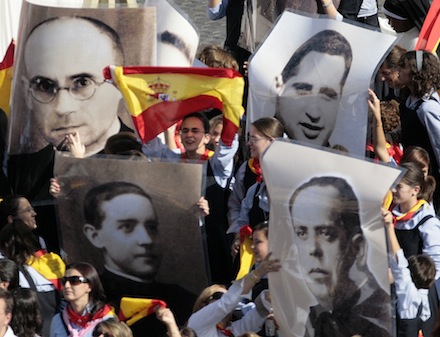
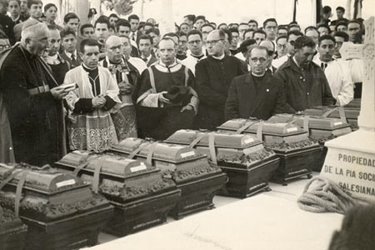
Fifty thousand Spanish people attended the Beatification ceremony of 498 Martyrs, victims of religious persecution in 1930’s Spain. These 498 people were killed only for their faith in Jesus Christ and their ideals, their killing being part of the anti-Catholic plan of the Republican government in power since 1931. The figures of this persecution are beyond comprehension and a complete and hate-filled attack on all Catholics whilst the world watched the violence: 13 Bishops, 4,154 Priests and Seminarians, 2,365 Religious, 283 Nuns and about 4,000 Laymen killed for helping or hiding Nuns or Priests.
As Monsignor Vicente Carcel Orti, the Spanish historian who has been living in Rome for forty years and who worked for the Curia, points out, the Spanish Church did not seek any confrontation with the Republic, but was persecuted in spite of her neutrality. The government persecuted the Church in legislative terms, while Republican extremists used violence against people and things. Anti-clerical violence was unleashed by Freemasons and Communists. Persecution started long before the civil war. According to Monsignor Carcel Orti, the shameful history of the Spanish Republic, a puppet in the hands of the Stalinist regime, has been concealed on account of its follow-up: the long winter of Franco’s dictatorship has, in a way, justified a distorted and mythicized reading of those tragic years.
This not too-long and highly informative interview with the Spanish historian is meant to throw light on this dramatic period in the history of the Spanish Church in order to achieve a better understanding of what is going on in present-day Spain.
Twentieth-century Spain was a nation of Martyrs. What was the political and ideological context in which the persecution of the Church and the martyrdom of believers occurred?
MONSIGNOR VICENTE CARCEL ORTI: It was a slow process which began with a great anticlerical movement in the 19th century. In 19th century Spain the Church was closely linked to the monarchy by means of concordats. Catholicism was, in practice, the state religion, like the Orthodox religion in Greece and Romania and Anglicanism in England. In the 1920’s King Alphonse XIII handed power over to Primo de Rivera, who set up a military dictatorship (we are talking about the age of dictatorships: there was Mussolini in Italy, Stalin in Russia and Hitler in Germany). The military regime, on the one hand, dissolved parliament, trade unions and political parties; on the other hand it ushered in a period of security and economic growth, through public works amongst other things. Unfortunately economic growth came to a sudden halt with the 1929 world crisis. The following year the Republicans won the municipal elections. Thus General Primo de Rivera relinquished his power while the king left the country, though without abdicating. It was under these circumstances that the Republicans seized power on April 14th, 1931, and proclaimed the Republic.
Why did the Republic persecute the Church and Catholic believers?
MSGR VICENTE CARCEL ORTI: The Republicans had built up so much hatred for the monarchy and everything relating to it, the Church included, that, once they seized power, they began to hit their enemies. Their first and easiest target was the Church, being defenseless. The new regime made laws against the Church; in the meantime anarchists, socialists and Communists began to use violence against people and things.
What was the role of Freemasonry in this anti-Catholic campaign?
MSGR VICENTE CARCEL ORTI: Freemasonry played a key role in the anti-Catholic campaign since Freemasons were present in political institutions, in the government and the “Cortes” (the Spanish parliament), where they had at least 183 deputies. Spanish Freemasonry, therefore, played a major role in the making of anti-Catholic laws and in the defamatory campaign against the Church.
What kind of persecution was the Church faced with from 1931 to 1936?
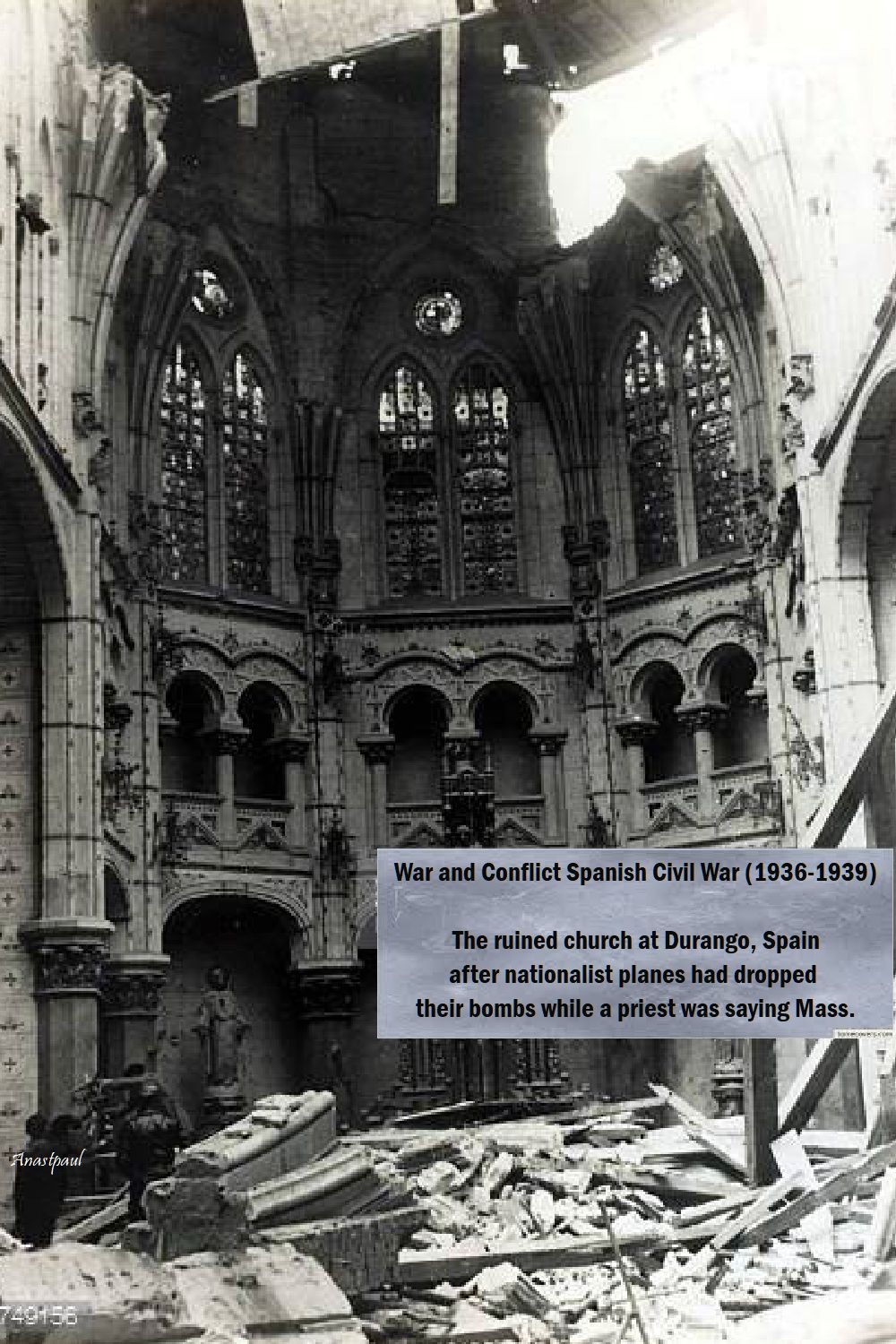
MSGR VICENTE CARCEL ORTI: As historians have ascertained, a growing number of measures against the Catholic Church and religious practice were taken between 1931 and 1936. These oppressive laws aimed at a radical and antidemocratic conception of the separation between Church and State. Numberless examples could be quoted: the Jesuits were dissolved in January 1932; in May 1933 a law against ecclesiastical property deprived the Church of all her possessions, which were handed over to civil authorities; a law was passed against the teaching of religion in schools, and the clergy was forbidden to teach. Violent persecution proper began in 1934 with the “Turon martyrs,” who have already been canonised and many other believers murdered during the Communist Revolution of the Asturias, when priests, religious and seminarians, 37 in all, were killed and 58 churches were burned. After 1936 in all the main cities, cathedrals, religious communities and parish churches were attacked, ransacked and burned. These persecutions aimed at erasing all traces of Catholic tradition in Spain. Hatred for the faith went even beyond murders and found expression in thousands of sacrilegious acts:tabernacles were emptied, consecrated particles were eaten, shot at, strewn in the streets and trodden on; churches were used as stables, altars were demolished, priests and nuns were held at gunpoint in the attempt to force them to recant their faith. Let us remember that persecutions started years before the beginning of the civil war, and the Church could be accused of supporting Franco’s Falangists, referred to as “rebels.”
But wasn’t the Church hostile to the Republican government?
MSGR VICENTE CARCEL ORTI: Spanish bishops recognised the legitimate Republican government from the start. The problem, however, was that the Republican authorities had always been openly hostile to Catholics. After the events of the Asturias, in the summer of 1936, socialists, Communists and anarchists started the most violent persecution in the history of Spain, aimed at the physical elimination of the Church, of both people and things; this persecution lasted until 1939.
Could you quote any figures?
MSGR VICENTE CARCEL ORTI: Albeit incomplete, the figures are impressive: 18 bishops, 4,184 between priests and seminarians, 283 nuns and about 4,000 laymen were killed for helping or hiding priests or nuns. It must be emphasized that in the part of the country occupied by Franco’s troops, no harm was done to the clergy nor were the churches destroyed.
Some critics of Franco say that he had 16 Basque Priests executed?
MSGR VICENTE CARCEL ORTI: It is true that when the nationalist troops entered Bilbao, 16 priests were shot, not because they were priests but for political reasons with other people. I have found the documentary evidence of this along with the witness of the bishop who had asked those priests to refrain from being involved in political activities. Such political activities triggered off Franco’s repression, which also involved 16 priests. When the Pope learned about this, he immediately sent a telegram to Franco, who promised that events like that would never happen again. The martyrdom of priests, however, only occurred in the “red” areas. In addition, the Republicans destroyed churches and monasteries (in my diocese, the diocese of Valencia, over 1000 churches and other sacred buildings were destroyed).
When did the Beatification causes of the Spanish Martyrs begin?
MSGR VICENTE CARCEL ORTI: At the end of the civil war in 1939, the Holy See demanded that all information about the persecution available to parishes and dioceses be collected. Once all the necessary material had been collected, bishops gradually started the diocesan phase of the beatification cases. These cases began in the 1940’s and continued into the 1950’s. At the end of the diocesan phase, all documents were sent to Rome for the “Roman” phase, to be held by the Congregation for the Causes of the Saints. Yet Paul VI stopped the cases, as he thought it would be best to wait until fifty years had passed from those dramatic events. Also, he posed a condition: Spain was to have a democratic government (the military regime was still in power in 1960’s Spain). At the beginning of John Paul II’s pontificate Spain was already a democracy; the Spaniards therefore asked the Pope to proceed with the beatification cases but he did not comply with their request, since fewer than fifty years had passed since the end of the civil war. John Paul II waited until 1987 to celebrate the first beatification case of martyrs who were victims of religious persecution (three Carmelite nuns from Guadalajara). This marked the beginning of the beatifications of our martyrs. On October 18th we celebrated sixteen beatifications, raising 979 martyrs to the altars. As far as I know, the Congregation is now examining another 2000 cases so that 2000 martyrs will probably be beatified in six or seven years’ time.
The Church has sometimes been accused of opening up an old sore with the Beatification of the Martyrs of the civil wa?
MSGR VICENTE CARCEL ORTI: It is a specious dispute with a strong ideological and political orientation. The victims beatified and canoniSed have never been referred to as “martyrs of the civil war,” but victims of religious persecution; the Church has always paid tribute to martyrs of faith and always will. Civil and military institutions commemorate “soldiers killed in war” or “victims of political repression,” both on the Republican and on the Nationalist sides but this doesn’t mean opening up an old sore, even though political parties sometimes clearly exploit past events.
How can these Martyrs become a mark of reconciliation?
MSGR VICENTE CARCEL ORTI: Nowadays the word “martyr” is abused; in common speech it is used in several senses, but its original and most proper use refers to someone suffering or dying for God’s sake, bearing witness to their faith, forgiving and praying for their executioners, as Jesus Christ did on the cross. Others can be called “heroes” or “victims” for various causes, sometimes questionable, but are referred to as “martyrs,” since this word is abused, being extended to those suffering for somebody or something.
“Christian martyrs” have no ideological or political motivation except their faith in God and love of their neighbors. These martyrs never waged or fomented any war; they were never involved in party strife. They brought an everlasting message of peace and love, which lightens our faith and feeds our hope.
The Beatification of these martyrs coincides with the Spanish Parliament’s decision to commemorate the victims of Franco’s regime. Who were they?
MSGR VICENTE CARCEL ORTI: They were people killed in the civil war and in the ensuing wave of repression. This involved the winners’ ideological enemies. Franco’s reaction was violent but did not last too long. Republicans were tried, though by court-martials and documents of these trials have come down to us.
A point must be made: those who fought for the Republic at that time did not fight for freedom or democracy but to set up a regime like the one in power in the Soviet Union. Franco was therefore right when he said that he was making war on Communism. If he had not won, there would have been the Spanish Soviet Union.
All over the world left-wing parties have always idealised the Spanish Republicans and depicted Franco as the incarnation of evil.
MSGR VICENTE CARCEL ORTI: Franco saved the Church from total destruction. Without his intervention the Church would probably have been blotted out. Yet no one knew at the time that he would become a dictator.
Franco also saved Spain from the Second World War.
MSGR VICENTE CARCEL ORTI: This is another very important element. At the end of the civil war, Hitler paid a visit to Franco and asked his permission for the German army to cross Spain as far as Gibraltar (he intended to conquer North Africa and occupy the whole Mediterranean). Franco did not give his consent on the grounds that the country had been devastated by the civil war and could not afford to be involved in another conflict.
Pius XI, who was in contact with Franco, warned him against Hitler (Franco declared himself a Catholic, Hitler was a pagan).
At the end of the Second World War Franco established relations with the U.S.A. and brought his country into the U.N. Spain was recognised by all states. When certain circles demand that the Spanish Church apologise for her relations with Franco’s regime,I therefore ask myself: “What do we have to apologize for? For having ten thousand martyrs?” Such requests are made by the ideological heirs of those who persecuted the Church. They do everything to erase all memories of her martyrdom.
MSGR VICENTE CARCEL ORTI:These requests are only demagogical. In addition, the Spanish Church produced a document many years ago, recognising that mistakes had been made and forgiving her persecutors. In this document it was also pointed out that no other course of action was possible under those circumstances.
Why is the struggle against Franco still a myth to the whole of the Left, a symbol of the fight for democracy against dictatorship?
MSGR VICENTE CARCEL ORTI:Most of the European Left was and is Communist. Since Franco was the only one to defeat Communists on the battlefield, these have reacted by presenting the fight of the International Brigades as the fight for freedom against dictatorship. Unfortunately Communist organizations are the most backward and the most conservative ones nowadays; they are unable to revise their past or make any self-criticism.
Socialist, Communist and Masonic parties are in power in Spain nowadays. They see the Church in the same way as the Republicans who tried to destroy her 70 years ago. Needless to say, nobody kills priests and nuns or burns religious buildings but the Church is perceived as a hindrance to the real progress of Spain and the whole of mankind, as an institution to marginalize and reduce to silence, being the holder of a conservative vision of man, an ideological adversary. Zapatero seems to be willing to create a new world, a new man in Spain.
MSGR VICENTE CARCEL ORTI: This is typical of all left-wing totalitarian regimes. Stalin too intended to create a new man; so did Pol Pot. Freedom is at risk in Spain, as the state is trying to interfere with people’s private lives, to impose a given way of life, to decide how they must bring up their children, etc. It is not enough for laws to be passed by a parliament to be right. As there is only one voice to defend man’s good, attempts are being made to hush it. Yet, whilst politicians are voted into and out of power, the Church remains.
Martyrs Born Various Died 1934, 1936-1939 Venerated in Roman Catholicism Beatified 29 March 1987 1 October 1989 29 April 1990 25 October 1992 10 October 1993 1 October 1995 4 May 1997 10 May 1998 7 March 1999 11 March 2001 by Pope John Paul II 29 October 2005 28 October 2007 23 January 2010 17 December 2011 by Pope Benedict XVI[1] 13 October 2013 1 November 2014 5 September 2015 3 October 2015 21 November 2015 23 April 2016 8 October 2016 29 October 2016 25 March 2017 6 May 2017 21 October 2017 11 November 2017 by Pope Francis Canonised 4 May 2003 in Madrid by Pope John Paul II Feasts – Various
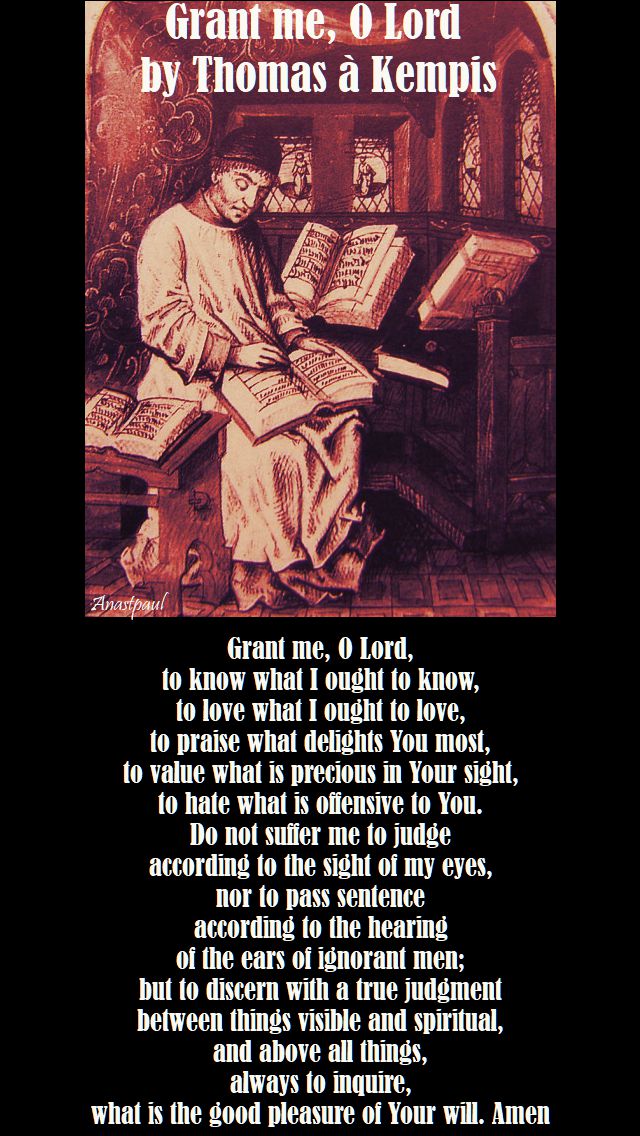
Grant me, O Lord,
to know what I ought to know,
to love what I ought to love,
to praise what delights You most,
to value what is precious in Your sight,
to hate what is offensive to You.
Do not suffer me to judge
according to the sight of my eyes,
nor to pass sentence
according to the hearing
of the ears of ignorant men;
but to discern with a true judgment
between things visible and spiritual,
and above all things,
always to inquire,
what is the good pleasure of Your will. Amen
St Abibas
St Anthony the Roman
St Aspren of Naples
Bl Augustine Gazotich
Bl Benno of Metz
St Dalmatius
St Euphronius of Autun
St Gamaliel
St Gaudentia
Bl Godfrey of Le Mans
Bl Gregory of Nonantula
St Hermellus
St Nicodemus
St Senach of Clonard
St Trea of Ardtree
St Waltheof of Melrose
—
Martyrs of Vercelli – 4 saints (below)
Martyred in the Spanish Civil War: https://www.youtube.com/watch?v=HAioTwJ0BMA
BlAndrés Avelino Gutiérrez Moral
Bl Antonio Isidoro Arrué Peiró
Bl Eleuterio Mancho López
Bl Eugenio Remón Salvador
Bl Federico López y López
Bl Francisco Bandrés Sánchez
Bl Geronimo Limón Márquez
Bl Jose Guardiet y Pujol
Bl Patricio Beobide Cendoya
Bl Ricardo Gil Barcelón
Bl Salvador Ferrandis Seguí
Be filled with the Spirit, addressing one another in psalms and hymns and inspired songs. Sing praise to the Lord with all your hearts. Give thanks to God the Father always and for everything in the name of our Lord Jesus Christ. (Ephesians 5:18-20)
Prayer was the breath of St. Dominic’s life, the light on his path, the staff on his pilgrimage. He prayed always. In childhood his delight was to serve Mass, to visit the Blessed Sacrament and to chant Office. As a student, he learned wisdom more from prayer than from books. He won more souls by prayer than by preaching or miracles. In traveling, St Dominic prayed as he went, sometimes the Veni Creator Spiritus or the Ave Maris Stella or sometimes he recited psalms. He often reminded his companions to think of God. Many times St. Dominic spent the night in prayer before the altar. His methods of prayer were various: sometimes he lay prostrate, then stood erect, then knelt down. For hours he would stand before a crucifix, genuflecting and making fervent ejaculations. Often he stretched out his arms like a cross, pleading earnestly to God. On occasion he was seen in rapture by the vehemence of his prayer. “In all labours and trials, in hunger, thirst, fatigue, his heart turned always to God.”
Pray for us, blessed father, St. Dominic, That we may be made worthy of the promises of Christ.
Let us pray:
O God,
who enlightened Your Church
by the virtues and preaching of St Dominic,
Your confessor and our father,
mercifully grant that by his prayers
we may be delivered from present dangers
and ever increase in spiritual blessings.
We pray too, that we may learn
from our blessed St Dominic,
to pray always, constantly living with You
in our hearts, minds and souls.
Pray too Holy St Dominic,
that our prayers and yours,
may draw back those
who have lapsed from the one, true faith
and for this our special intention …
(make your request)
Through Christ our Lord. Amen
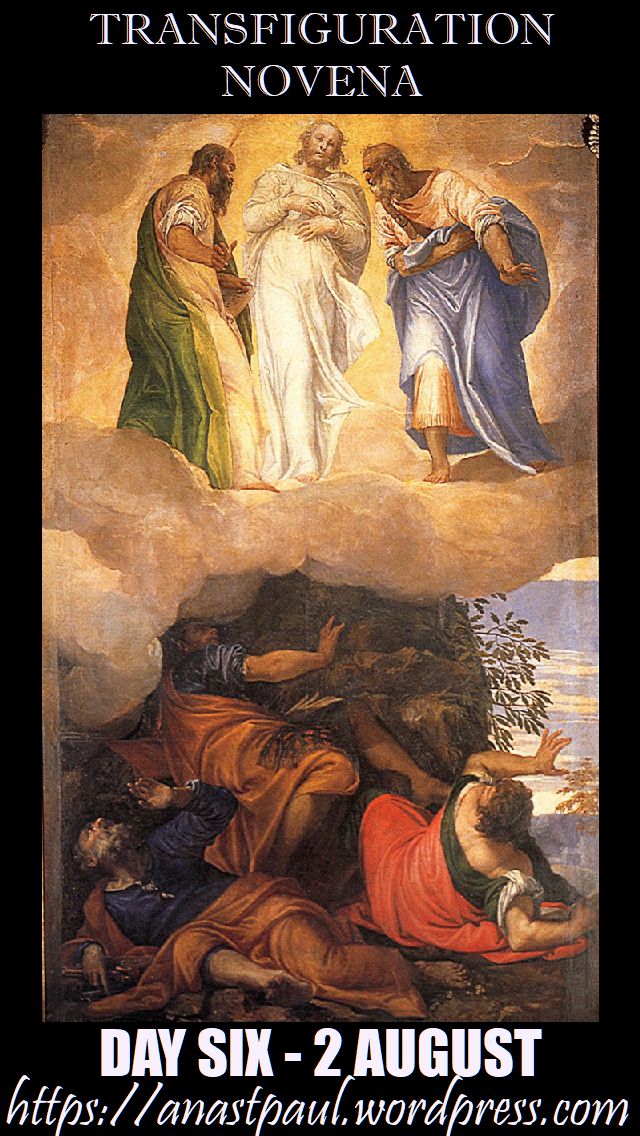
The value of the vision and the accompanying glory is its gift of equipping us for service and endurance.
No one can stay on the mountaintop of Tabor forever, for there are responsibilities in the valley.
Christ fulfilled His life’s work not in the glory but in the valley and it was there He was truly and completely the Messiah.
Let us Pray:
O Christ our Lord,
You took Peter, James and John
and led them up a high mountain by themselves
and there you equipped them, by Your glory,
with understanding and courage for the journey ahead.
We pray for ourselves,
that we may come to be transfigured and prepared,
for service to You, Your Holy Church and our neighbour
and be equipped with endurance to complete our mission
and to look forward in hope of being transfigured at the last day. Amen
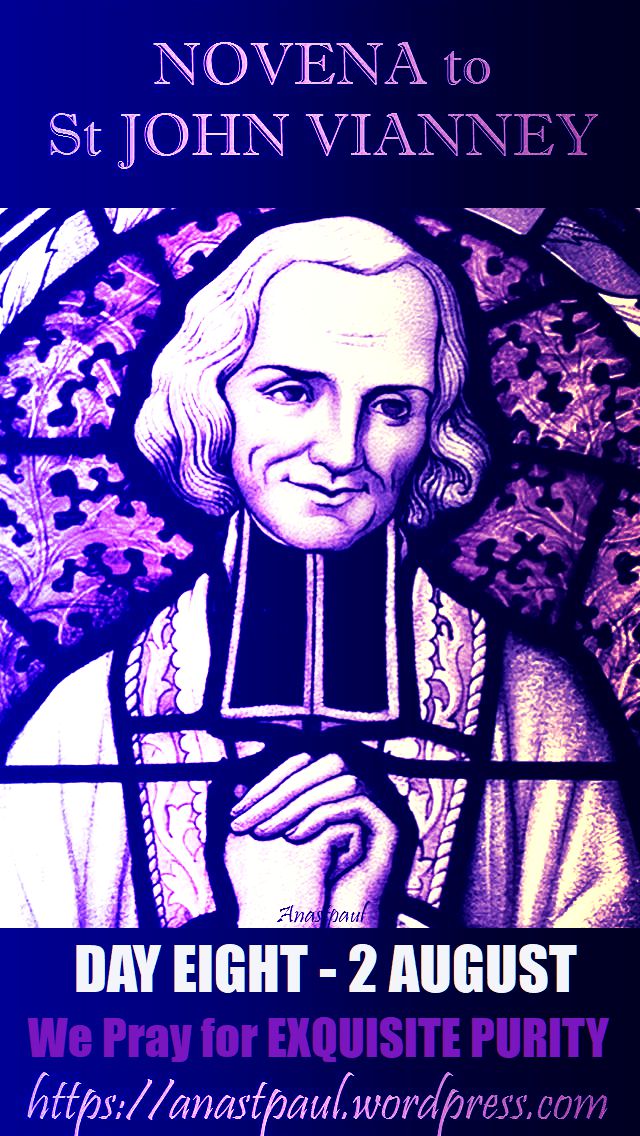
O Holy Priest of Ars,
a witness of your life made this magnificent praise of you:
‘We would have taken him for an angel in a mortal body.”
You so edified others:
modesty and exquisite purity radiated from your body.
With such charm and with such enthusiasm,
you preached to others about these beautiful virtues
which you said resembled the perfume of a vineyard in bloom.
Please I beg you,to join your entreaties to those of Mary Immaculate
and Saint Philomena in order that I guard always,
as God asks me, the purity of my heart.
You, who have directed so many souls towards the heights of virtue,
defend me in temptations and obtain for me the strength to conquer them.
Holy Priest of Ars, I have confidence in your intercession.
Pray for me during this novena especially for …
(mention silently your special intentions).
Our Father, Hail Mary, Glory Be.
Adoration of the Blessed Sacrament is one of the best ways to spend time with Jesus. There is so much noise around us these days. Spending a quiet hour with Jesus in humble adoration will bring many graces and blessings to you. Things that you have never even considered before will now be made present to you. Bad things that would have happened to you will now not happen. Here are some thoughts about what Jesus is asking you during this time. As He told Peter, “Could you not spend one hour with me?”St. Peter Julian Eymard tells us all how to spend an hour in Adoration!
“MY CHILD, you need not know much in order to please Me; only love Me dearly. Speak to Me as you would talk to your mother, if she had taken…
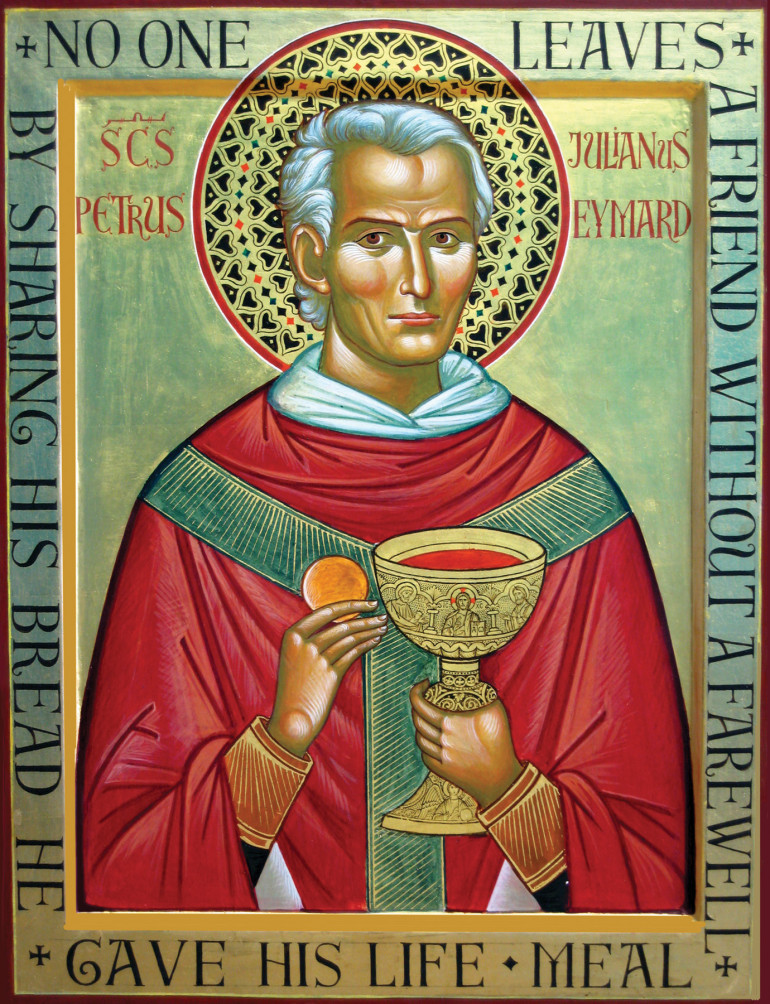
Thought for the Day – 2 August – The Memorial of St Peter Julian Eymard “Apostle of the Eucharist”
“I can remember very clearly that afternoon when I ran out of this room, down the stairs and out the front door. I ran into the church with all the energy of a five-year-old. It was empty. I did something so out of place. I climbed and sat on the table of the altar and I just leaned my head against the tabernacle. My sister, Marianne, asked me, “What are you doing there?” I quickly answered, ‘I am near Jesus and I’m listening to him.’”
Anticipating the renewal brought about by the Second Vatican Council, Saint Peter Julian Eymard had a vision of Eucharistic communities of priests, deacons, brothers, sisters and lay people living lives of total dedication to the spiritual values that are inspired by the celebration of the Eucharist and deepened through prayer before the Blessed Sacrament.
His life was a true journey to Christ in the Eucharist, a journey begun intuitively on that day when a small boy wandered away from his family home to go to church―to listen to Jesus in the tabernacle.
Prayer to Saint Peter Julian Eymard
St Peter Julian,
the Lord has given you,
as he once did to Jacob, His servant,
an ever-searching faith.
All your life long, you have sought the way
to deepen your union with God
and to satisfy the hungers of humanity.
In the Eucharist, you have discovered the answer to your searching:
God’s love was there for you and for all humanity.
Answering this gift of love,
you made the gift of yourself to God
and you have given of yourself to the service of His people.
Your life, modeled on that of the Cenacle,
where Mary and the apostles were united in prayer,
inspired your disciples to live in an atmosphere of prayer.
Their apostolic zeal caused them to build Christian communities
where the Eucharist is the center and source of life.
Saint Peter Julian,
accompany us on our journey of faith.
May our ardent prayer and our generous service
help us to contribute to the establishing of a world
where there is justice and peace.
May our celebrations of the Eucharist
proclaim the liberating love of God
for the renewal of His church
and the coming of His kingdom.
Amen.
Quote/s of the Day – 2 August – The Memorial of St Peter Julian Eymard “Apostle of the Eucharist”
“During the days of His mortal life, Jesus was present in one place only. He dwelt in one house only. Few persons were privileged enough to enjoy His presence and listen to His words. But today in the Blessed Sacrament, He is, we may say, everywhere at one and the same time. In a way, His humanity shares the prerogative of His divine immensity which fills all things. Jesus is present in His entirety in an infinite number of temples and in each one of them. Since all the Christians scattered throughout the world are members of His Mystical Body, it does seem necessary that He, as the soul of it, should be everywhere present throughout the whole body, giving it life, and sustaining it in each one of His members.”
“Have a great love for Jesus in His divine Sacrament of Love; that is the divine oasis of the desert. It is the heavenly manna of the traveller. It is the Holy Ark. It is the Life and Paradise of love on earth.”
“When we work hard, we must eat well. What a joy, that you can receive Holy Communion often! It’s our life and support in this life – receive Communion often and Jesus will change you into Himself.”
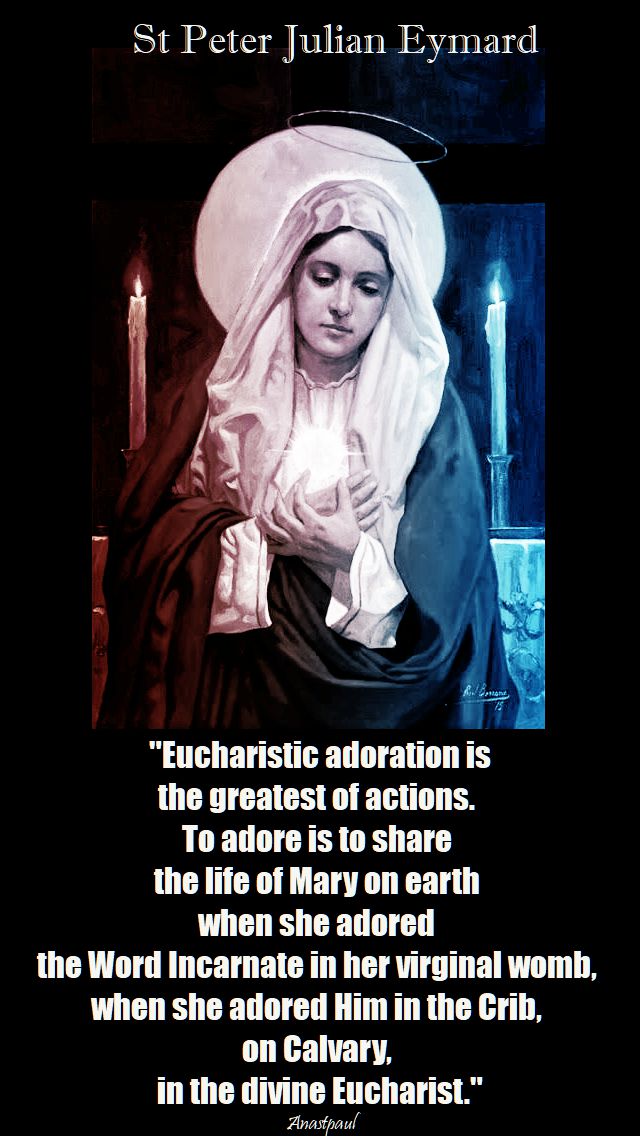
“Eucharistic adoration is the greatest of actions. To adore is to share the life of Mary on earth when she adored the Word Incarnate in her virginal womb, when she adored Him in the Crib, on Calvary, in the divine Eucharist.”
…..At present I know partially; then I shall know fully, as I am fully known.
So faith, hope, love remain, these three; but the greatest of these is love…1 Corinthians 12-13
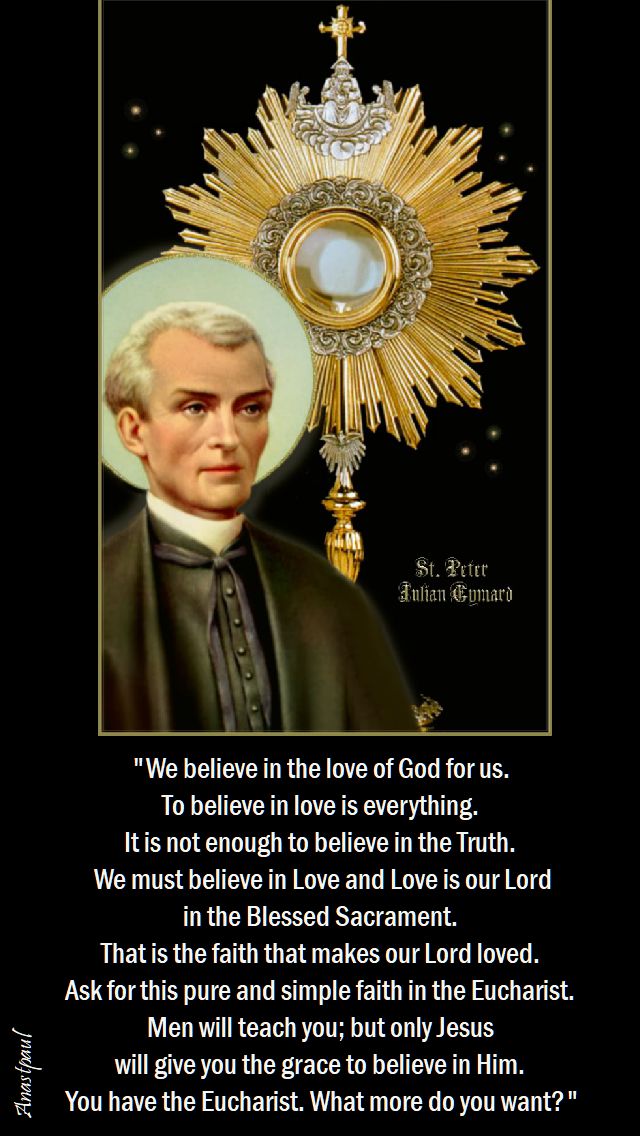
REFLECTION – “We believe in the love of God for us. To believe in love is everything. It is not enough to believe in the Truth. We must believe in Love and Love is our Lord in the Blessed Sacrament. That is the faith that makes our Lord loved. Ask for this pure and simple faith in the Eucharist. Men will teach you; but only Jesus will give you the grace to believe in Him. You have the Eucharist. What more do you want?”… St Peter Julian Eymund
PRAYER – Lord our God, help us to imitate the constancy and love of St Peter Julian in proclaiming the Real Presence and Love of Jesus Christ, who remains waiting for us all in the Holy Eucharist. By living the love and faith in the Holy Eucharist as St Peter Julian did, may we come to share the life of our Lord Jesus, Your Son, who waits and loves and reigns with You and the Holy Spirit, one God forever and ever. St Peter Julian Eymard, pray for us, amen.
Our Morning Offering – 2 August – The Eighteenth Sunday in Ordinary Time
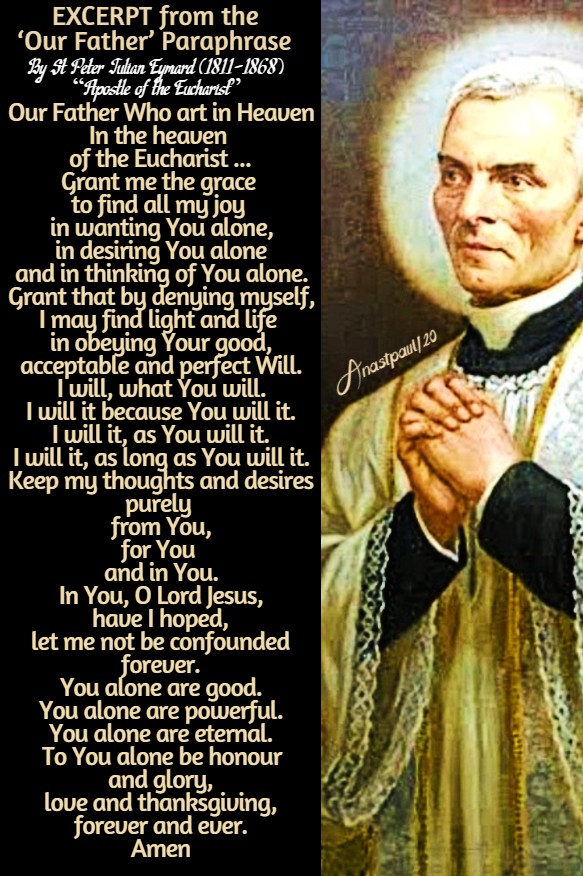
EXCERPT from the ‘Our Father’ Paraphrase By St Peter Julian Eymard (1811-1868) “Apostle of the Eucharist”
Our Father Who art in Heaven
In the heaven of the Eucharist …
Grant me the grace to find
all my joy in wanting You alone,
in desiring You alone
and in thinking of You alone.
Grant that by denying myself,
I may find light and life
in obeying Your good,
acceptable and perfect Will.
I will, what You will.
I will it because You will it.
I will it, as You will it.
I will it, as long as You will it.
Keep my thoughts and desires purely
from You,
for You
and in You.
In You, O Lord Jesus, have I hoped,
let me not be confounded forever.
You alone are good.
You alone are powerful.
You alone are eternal.
To You alone be honour and glory,
love and thanksgiving,
forever and ever.
Amen
And here is the full Prayer:
PRAYER OF ST PETER JULIAN EYMARD Our Father Paraphrased
Our Father Who art in Heaven
In the heaven of the Eucharist,
to You Who are seated
on the throne of grace and love,
be benediction,
and honour,
and power and glory forever and ever!
Hallowed be Your Name
first in myself,
through the spirit of Your humility,
obedience and charity.
May I, in all humility and zeal, make You known,
loved and adored by all men in the Holy Eucharist.
Thy Kingdom come
Thy Eucharistic kingdom.
Rule forever over us
for Your greater glory
through the power of Your love,
the triumph of Your virtues
and the grace of a Eucharistic vocation
in my state as a layman.
Grant me the grace of Your love
so that I may be able to effectively
extend Your Eucharistic kingdom everywhere
and realise the desire You expressed: “I have come to cast fire on the earth; and what will I but that it be kindled!”
O, that I might be the incendiaries of this heavenly fire!
Thy Will be done on earth as it is in Heaven
Grant me the grace to find
all my joy in wanting You alone,
in desiring You alone
and in thinking of You alone.
Grant that by denying myself,
I may find light and life in obeying Your good,
acceptable and perfect Will.
I will, what You will.
I will it, because You will it.
I will it, as You will it.
I will it, as long as You will it.
Keep my thoughts and desires purely from You,
for You and in You.
Give us this day our daily bread
You are our Eucharistic Lord
and You alone will be my food and clothing,
my riches and glory,
my remedy in illness
and my protection against all evil.
You will be all things to me.
And forgive us our trespasses
Forgive me Jesus,
for I am sorry for all my sins
just as they stand in Your eyes.
As we forgive those who trespass against us
For anyone who has offended me in any way,
with my whole heart I forgive them
and desire for them the gifts of Your love.
And lead us not into temptation but deliver us from evil.
Deliver me Jesus,
from the demon of pride,
impurity, discord and complacency.
Deliver me, from the cares and worries
of life, so that with a pure heart
and a free mind, I may joyfully spend my life
and devote all that I am
and all that I have,
in the service of You, my Eucharistic Lord.
Amen
In You, O Lord Jesus, have I hoped;
let me not be confounded forever.
You alone are good.
You alone are powerful.
You alone are eternal.
To You alone be honour and glory,
love and thanksgiving forever and ever. Amen Amen!
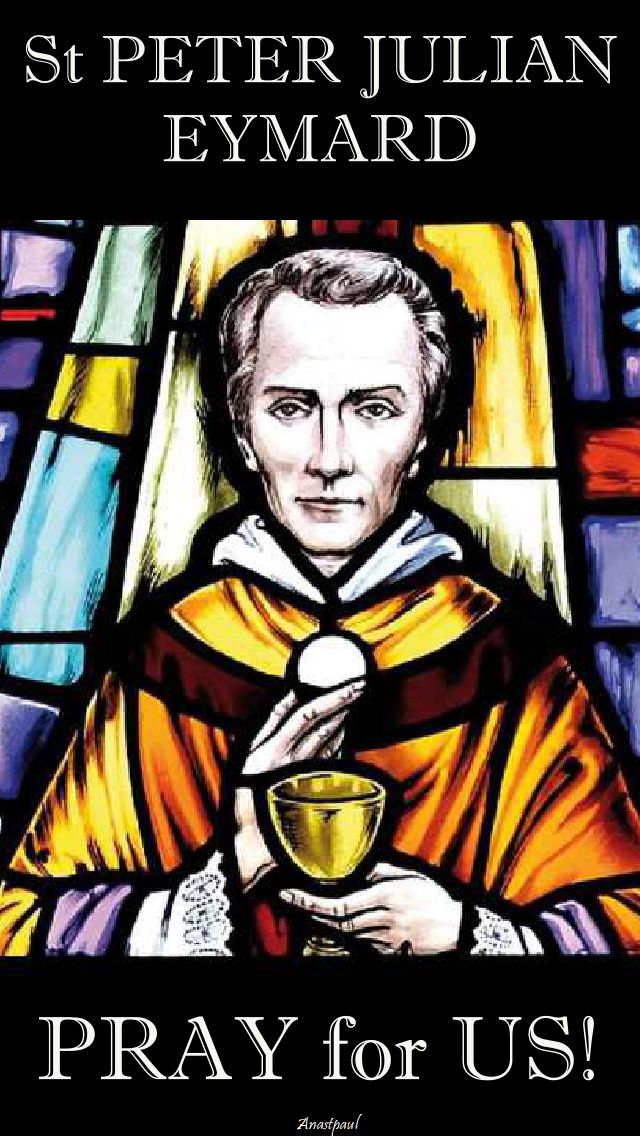
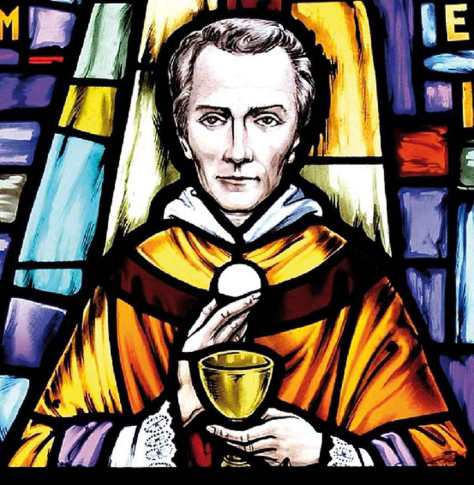
Saint of the Day – 2 August – St Peter Julian Eymard SSS (1811-1868) – “Apostle of the Eucharist” – (4 February 1811 at La Mure, France – 1 August 1868 at La Mure, Isère, France following a stroke). He was Canonised on 9 December 1962 by Pope John XXIII. Priest, Religious, Founder of two religious institutes, Congregation of the Blessed Sacrament Fathers and Brothers and the Servants of the Blessed Sacrament. Attributes – Eucharist, Monstrance, Eucharistic Adoration, Eucharistic Congress, Cope Humeral Veil Congregation of the Blessed Sacrament.
He once described himself as “a little like Jacob, always on a journey,” always seeking. But, in truth, it was there from the beginning―the great love and the driving passion of his life: Jesus Christ in the Eucharist.
One day, young Peter Julian Eymard [pronounced A-mard], just five years of age, wandered off from the family home. His sister and half-sister searched frantically for the boy and finally located him in the parish church, standing on a stool close to the tabernacle of the high altar. In response to their anxious questioning, he answered simply, “I am here listening to Jesus.”
The Early Years – 1811-1839
Like all of us, Peter Julian Eymard was conditioned by his familial and cultural background as well as by the social and political milieu of his time.
Life in France during the first half of the nineteenth century was difficult. Years earlier, the French Revolution had radically altered the political, social and religious landscape of the country. As a teenager, Eymard would experience the Industrial Revolution which swept across Europe. As a young man, he witnessed the dawning of the Age of Romanticism in art, music, and literature.
Peter Julian’s road to the priesthood, as well as his life as a priest, was shadowed by the cross. An intransigent anti-clericalism marked French society and his father, having seen several sons die, did not want his only surviving son to become a priest. His first attempt to pursue the priesthood ended in serious illness. Following his father’s death, he tried once again and on July 20, 1834, at age 23, was ordained a priest of the Diocese of Grenoble.
The church of Eymard’s day was greatly affected by Jansenism, a religious movement which focused on the gravity of human sinfulness and a corresponding belief in the unworthiness of human motivation and activity. Thus, in his seminary years and first years of ministry, Father Peter Julian Eymard was influenced by a predominantly reparation spirituality. He would struggle his whole life to seek that inner perfection that would enable him to offer the gift of his entire self.
Perhaps it was the intensification of this spiritual struggle along with his lifelong devotion to Mary that led him to enter religious life. On August 20, 1839, Father Eymard professed vows as a member of the Society of Mary (the Marists).
The Marist Years – 1839-1856
Throughout his life, Peter Julian had an intense devotion to Mary, the Mother of God. He knew about the apparition of Our Lady of La Salette and enjoyed traveling to various Marian shrines. It was Father Eymard’s apostolic work for the Society of Mary that would put him in contact with the various currents of eucharistic piety that were flowing through the French church and elsewhere in Europe.
Despite persistent health issues, Peter Julian was an amazingly energetic and hardworking priest and religious. Naturally drawn to contemplation, the demands of his ministry, especially his preaching schedule and the various administrative duties assigned to him, made it impossible for him to live a purely contemplative life. He was an outstanding organiser of lay societies, a zealous educator, a well-prepared preacher and something of a prophetic figure in his Marist community and even to his superiors.
Father Eymard was especially effective at preaching eucharistic devotions, very popular at the time. It was on one such occasion, on Corpus Christi, May 25, 1845, that he had a powerful experience that would change the course of his life. While carrying the Blessed Sacrament in procession at Saint Paul’s Church in Lyons, he felt an intense attraction to Christ in the Eucharist and resolved to“bring all the world to the knowledge and love of our Lord; to preach nothing but Jesus Christ and Jesus Christ eucharistic.”
This grace would gradually consume his life and his energies over the next several years. When responsibility for writing a rule for the new Third Order of Mary was entrusted to him by Father Jean Claude Colin, the Marist founder, Peter Julian asked permission to write a eucharistic rule. Father Colin answered that this was not the charism of the Society of Mary. Nevertheless, the idea for such a rule had already been written in the mind and heart of Father Eymard, and, in 1856, he made the painful decision to leave the Marists in the hope of a founding a religious congregation dedicated to the Eucharist.
The Years of Founding – 1856-1868
Founding the Congregation of the Blessed Sacrament was not an easy task. Faithfully following the Holy Spirit’s inspiration brought Father Eymard relational conflicts, situations of personal embarrassment, financial troubles and physical exhaustion. The first hurdle was getting approval for the new eucharistic institute.
The work of preparation for First Communion, especially among adults, was the aspect of Eymard’s vision that interested Archbishop Marie Dominique Auguste Sibour of Paris when the two met and the priest shared his project. Eucharistic communities and organisations were springing up throughout France―many of them emphasising only prayer and reparation―but Archbishop Sibour rightly perceived that Eymard’s intuition into the Eucharist was not limited merely to adoration but to reaching out to those who were estranged from the church and evangelising them. He gave approval on May 13, 1856.
Father Eymard immediately directed his ministry to the young workers, the “rag pickers” and the other barely employable men who made up a large segment of the labour force of Paris. No sooner did he attract a few men to join him than he had to close the house and move to another location. This happened twice within the span of a few years. At times, the Eymardian communities were so poor that a neighbouring convent of sisters fed the priests and brothers. Not being able to provide food and shelter did not help Father Eymard attract vocations!
“Gift of Self”
As early as 1845―and perhaps owing to the grace of his experience at Saint Paul’s in Lyons on Corpus Christi―Father Eymard began to move away from a spirituality of reparation to a spirituality which emphasised the love of Christ. In 1865, just three years prior to his death, he made a long retreat in Rome. During this retreat, he was struck by the overwhelming realisation of Christ’s love for him, a love which he felt was taking over his entire life. In response, he wished to make the “gift of self:” of his will, his personality and his affections, to God and to Christ in the Eucharist.
In 1858, together with Marguerite Guillot, he founded the Servants of the Blessed Sacrament, a contemplative congregation for women. He is quoted as saying, “You take communion to become holy, not because you already are.”
Eymard was a friend and contemporary of Saints Peter Chanel, Marcellin Champagnat, and Blessed Basil Moreau.
He died at the age of fifty-seven in La Mure on 1 August 1868, of complications from a stroke.
He was declared venerable in 1908, beatified by Pope Pius XI on 12 July 1925 and canonised by Pope John XXIII on 9 December 1962. St Pope John Paul II named Eymard “Apostle of the Eucharist.”
St Eusebius of Vercelli (Optional Memorial)
St Peter Julian Eymund (Optional Memorial)
—
Our Lady of the Angels: The image of Our Lady of the Angels is only about 10 cms high and is carved in a simple fashion on dark stone. She has a round, sweet face, slanted eyes and a delicate mouth. Her colouring is leaden, with scattered golden sparkles. She carries the Christ Child on her left arm. Only the faces of Mary and the Child are visible; the rest is covered by a cloak that is gathered in pleats. The statuette is displayed in a large gold monstrance that surrounds it and enlarges its appearance. While searching for firewood on 2 August 1635, the feast of the Holy Angels, a poor mestizo woman named Juana Pereira discovered this small image of the Virgin sitting beside the footpath near Cartago, Costa Rica. Juana took it home with her but it soon disappeared only to be re-discovered at the same place beside the same path. The statue repeated this behaviour five more times – taken to homes and then the parish church – and returning on its own to the site where Juana found it. The locals finally took this to mean that Our Lady wanted a shrine built there, and so it was.
The shrine soon became a point of pilgrimage, especially for the poor and outcast. The image was solemnly crowned in 1926. In 1935 Pope Pius XI declared the shrine of the Queen of Angels a basilica. The stone on which the statue was originally sitting is in the basilica and is being slowly worn away by the touch of the hands of the pilgrims. A spring of water appeared from beneath the stone and its waters carried away to heal the sick.
Patronage – Costa Rica, diocese of Getafe, Spain.
—
St Auspicius of Apt
St Betharius of Chartres
St Centolla of Burgos
St Etheldritha of Croyland
Bl Frederic Campisani
Bl Giustino Maria Russolillo
Bl Gundekar of Eichstätt
Bl Joanna of Aza
Bl John of Rieti
St Maximus of Padua
St Pedro de Osma
St Plegmund
St Rutilius
St Serenus of Marseille
St Sidwell
St Pope Stephen I
—
Martyred in the Spanish Civil War:
Bl Ceferino Jimenez Malla
Bl Felipe de Jesús Munárriz Azcona
Bl Fernando Olmedo Reguera
Francesc Company Torrelles
Francisca Pons Sarda
Bl Francisco Calvo Burillo
Francisco Manzano Cruz
Bl Francisco Tomás Serer
José Peris Ramos
Bl Juan Díaz Nosti
Bl Leoncio Pérez Nebreda
Bl Leoncio Pérez Ramos
Martí Anglés Oliveras
Bl Miguel Amaro Rodríguez
Catholic Devotion for the Month of August: The Immaculate Heart of Mary
The month of August is dedicated to the Immaculate Heart. Since the 16th century Catholic piety has assigned entire months to special devotions. The month of August is traditionally dedicated to the Immaculate Heart of Mary. The physical heart of Mary is venerated (and not adored as the Sacred Heart of Jesus is) because it is united to her person and is the seat of her love (especially for her divine Son), virtue and inner life. Such devotion is an incentive to a similar love and virtue. Just as the Sacred Heart represents Christ’s love for mankind, the Immaculate Heart represents the desire of the Blessed Virgin to bring all people to her Son.
This devotion has received new emphasis in this century from the visions given to Lucy Dos Santos, oldest of the visionaries of Fatima, in her convent in Tuy, in Spain, in 1925 and 1926. In the visions Our Lady asked for the practice of the Five First Saturdays to help make amends for the offenses committed against her heart by the blasphemies and ingratitude of men. The practice parallels the devotion of the Nine First Fridays in honour of the Sacred Heart.
In the midst of the second world war Pope Pius XII put the whole world under the special protection of our Saviour’s Mother by consecrating it to her Immaculate Heart and in 1944 he decreed that in the future the whole Church should celebrate the feast of the Immaculate Heart of Mary. This is not a new devotion. In the seventeenth century, St. John Eudes preached it together with that of the Sacred Heart; in the nineteenth century, Pius VII and Pius IX allowed several churches to celebrate a feast of the Pure Heart of Mary. Pius XII instituted today’s feast of the Immaculate Heart of Mary for the whole Church, so as to obtain by her intercession “peace among nations, freedom for the Church, the conversion of sinners, the love of purity and the practice of virtue”(Decree of May 4, 1944). On October 31, 1942, Pope Pius XII made a solemn Act of Consecration of the Church and the whole world to the Immaculate Heart. Let us remember this devotion year-round, but particularly through the month of August.
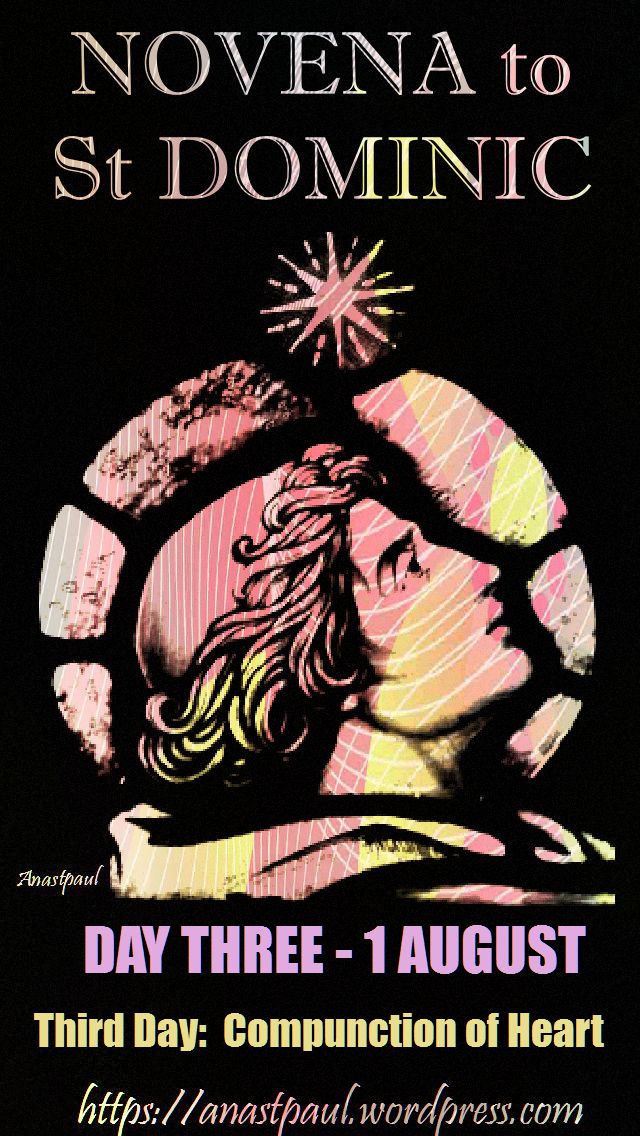
Third Day: Compunction of Heart Those who fear the Lord seek to please him, those who love him are filled with his law. Those who fear the Lord prepare their hearts and humble themselves before him. Let us fall into the hands of the Lord and not into the hands of men, for equal to his majesty is the mercy that he shows. (Sirach 2: 16-18)
ROSA PATIENTIAE ROSE OF PATIENCE
Though so pure that Holy Church calls him “Ivory of Chastity” and Christian art puts a lily into his hands, Dominic was always weeping over sin. His soul being full of contrition, acts of sorrow were constantly upon his lips. On seeing towns or villages, he used to weep over the sins committed there against God. But this sorrow was not merely hidden in the soul; it bore fruit in works of penance. Three times every night he scourged himself: once for his own sins, once for those of others and once for the suffering souls. He was a rule of abstinence, even on journeys never eating meat or food cooked with meat. His fasts were strict and continual; even when traveling over Europe on foot, he fasted from September until Easter, though preaching daily. He never had a room of his own but slept anywhere: on the ground, a bench, or the altar step. Being a zealous lover of the rule, he punished faults but with such fatherly love that penance was accepted and even desired from his hands.
“If you have no sins of your own to weep for,” St. Dominic would say, “still weep, after the example of our Lord Jesus Christ and grieve for the sinners of the world that they may repent.”
Anyone who does not take up his cross and follow me cannot be my disciple. (Luke 14:27)
Pray for us, blessed father, St. Dominic, That we may be made worthy of the promises of Christ.
Let us pray:
O zealous preacher of penance,
Holy Father St. Dominic,
whose ardent desire for the salvation of souls,
made you ever ready to endure the greatest labours and fatigues
and even to give your life in order to win them to God,
pray for us, that treading in the steps of Jesus Crucified,
the Redeemer and Physician of souls,
we may disregard all suffering
and generously sacrifice ourselves
for the needs of others.
Grant us we pray, true contrition and
sadness for our sins and for those of all the world.
Teach us how to do penance for all the pain we cause
our Lord and Saviour.
Pray too Holy St Dominic,
that our penance may draw back those
who have lapsed from the one, true faith
and for this our special intention …
(make your request)
Through the same Christ our Lord. Amen
The transfiguration anticipates the paschal mystery which begins with the cross. Jesus can attain His permanent glory in his resurrection. But first He must die on the cross. Transfiguration appears as a preparation and strengthening for the disciples to face the coming passion and death of Jesus, when His glory seems most unseen. It was given to the disciples to prepare them for the tragedy of the cross.
Let us Pray:
O Christ,
before Your passion and death
You revealed the resurrection
to Your disciple on Mount Tabor;
we pray for Your holy church
which labours amid the cares
and anxieties of this world,
that in its trials we, who are the Church,
may always be transfigured
by the joy of Your Victory. Amen
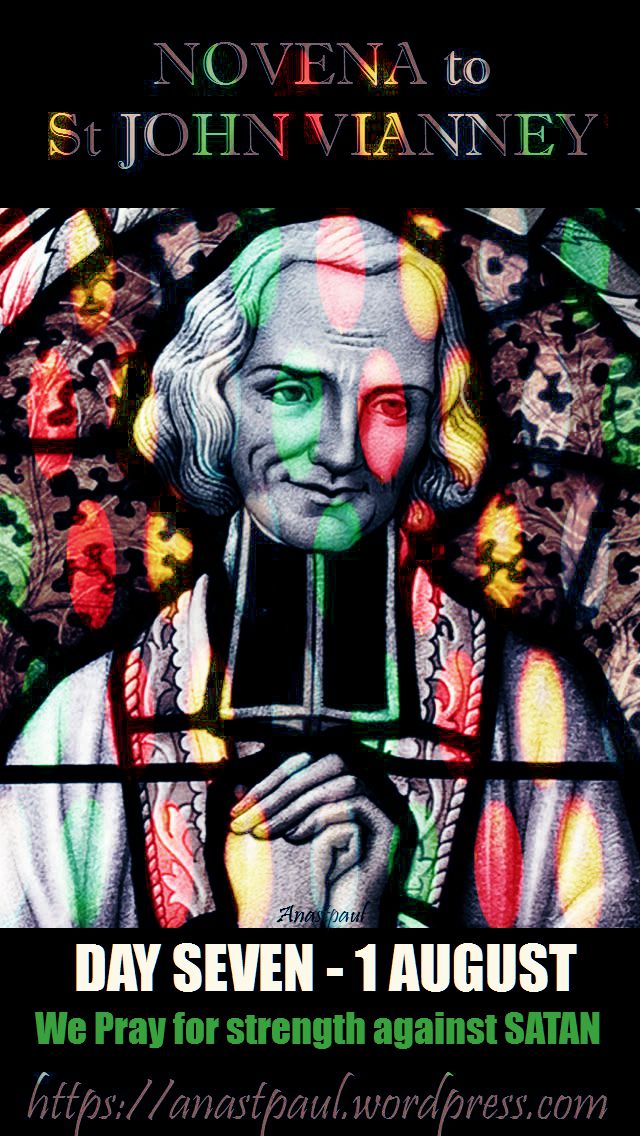
O Holy Priest of Ars,
the infamous attacks of the devil
which you had to suffer
and the trials which disheartened you by fatigue,
would not make you give up the sublime task of converting souls.
The devil came to you for many years to disturb your short rest
but you won because of mortification and prayers.
Powerful protector,
you know the temptor’s desire to harm my baptised and believing soul.
He would have me sin, by rejecting the Holy Sacraments
and the life of virtue.
But good Saint of Ars dispel from me the traces of the enemy.
Holy Priest of Ars,
I have confidence in your intercession.
Pray for me during this novena especially for …
(mention silently your special intentions).
Our Father, Hail Mary, Glory Be.
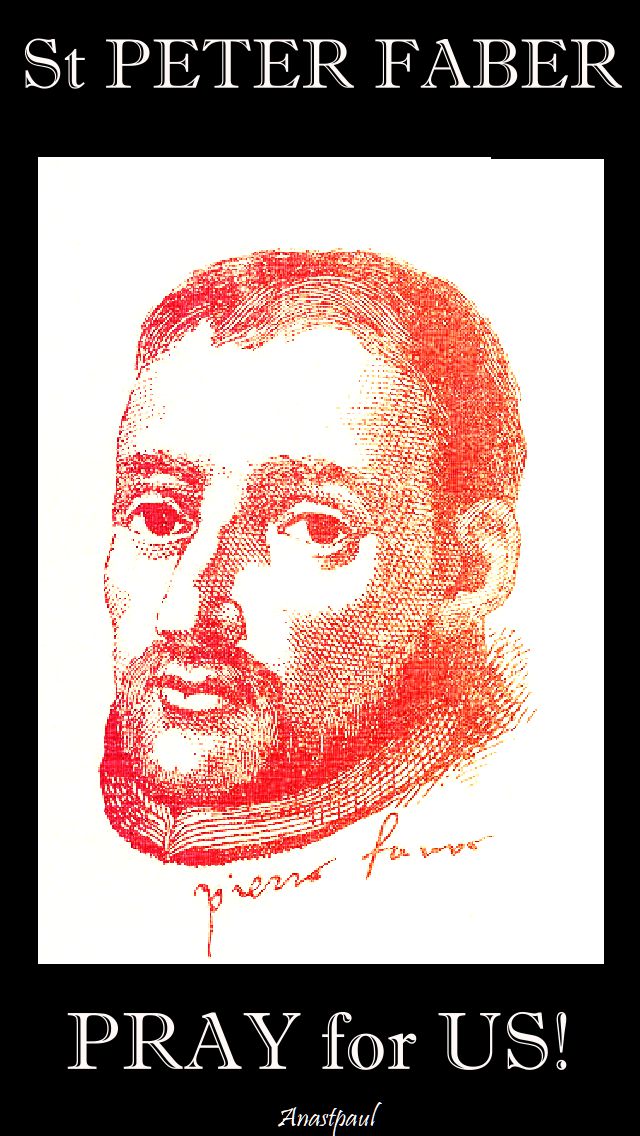
Thought for the Day – 1 August – The Feast of St Peter Faber S.J.
Annuncio vobis gaudium magnum! On 13 November 2013 Pope Francis announced the canonisation of Pierre Favre, SJ, aka Peter Faber (1506-46). For many Catholics the response was probably, “Who?”
For most Jesuits, though, the response was probably, “Finally!” For Pierre Favre has been a Blessed since…1872. Francis has announced this as an “equivalent canonization,” as Pope Benedict XVI had done with the canonization of St Hildegard of Bingen. In these cases the devotion to the saint is already well established.
In the Pope’s recent interview in America, he singled out for praise the man often called the “Second Jesuit.” The Pope was asked the reason for his devotion to this “First Companion” of St. Ignatius of Loyola, founder of the Society of Jesus. “[Pierre Favre’s] dialogue with all,” said the pope, “even the most remote and even with his opponents; his simple piety, a certain naïveté perhaps, his being available straightaway, his careful interior discernment, the fact that he was a man capable of great and strong decisions but also capable of being so gentle and loving.” Favre spent a great deal of his Jesuit life working with Protestants during the explosive time of the Reformation; and, as the pope intimated, he always did so with great openness and charity–during a time when they were called “heretics.”
One of my favorite quotes from Pierre–no, my favorite–is: “Take care, take care, never to close your heart to anyone.”
Favre was said by St. Ignatius to be the man best suited to direct others in the Spiritual Exercises–quite an accolade from the author of the Exercises. But, surprisingly, Favre’s story is not nearly as well known as those of his two famous college roommates, Ignatius Loyola and Francis Xavier. (When I once asked an elderly Jesuit why Favre was still a Blessed and not a saint, he said, “Even in heaven he is humble! He doesn’t want to place himself on par with Ignatius and Xavier.”) Many Jesuits are devoted to this humble spiritual master: the new Jesuit residence at Boston College for men in formation is named after him–though they may have to sandblast the “Blessed” on the stone sign in front of the house. But he still languishes in relative obscurity. Or will for another month. Indeed, that so many writers can’t even agree on a standard way of referring to the man–you will see, variously, the original French “Pierre Favre,” the somewhat modified Anglo-French “Peter Favre,” and the totally Anglicized “Peter Faber”–is an indication of the lack of attention given him. That of course changes with the canonisation.
For Favre, a man troubled all his life by a “scrupulous” conscience, that is, an excessive self-criticism, Ignatius was a literal godsend. “He gave me an understanding of my conscience,” wrote Favre. Ultimately, Ignatius led Peter through the Spiritual Exercises, something that dramatically altered Favre’s worldview.
This happened despite some very different backgrounds. And here is one area where Ignatius and his friends highlight an insight on relationships: friends need not be cut from the same cloth. The friend with whom you the least in common may be the most helpful for your personal growth. Ignatius and Peter had, until they met, led radically different lives. Peter came to Paris at age 19 after what his biographer called his “humble birth,” having spent his youth in the fields as a shepherd. Imbued with a simple piety toward Mary, the saints, relics, processions, and shrines and also angels, Peter clung to the simple faith of his childhood. Ignatius, on the other hand, had spent many years as a courtier and some of them as a soldier, undergone a dramatic conversion, subjected himself to extreme penances, wandered to Rome and the Holy Land in pursuit of his goal of following God’s will.
One friend had seen little of the world; the other much. One had always found religion a source of solace; the other had proceeded to God along a tortuous path.
Ultimately, Ignatius helped Peter to arrive at some important decisions through the freedom offered in the Spiritual Exercises. Peter’s indecision before this moment sounds refreshingly modern, much like the frustrating indecision of any college student today. He wrote about it in his journals:
“Before that–I mean before having settled on the course of my life through the help given to me by God through Inigo–I was always very unsure of myself and blown about by many winds: sometimes wishing to be married, sometimes a doctor, sometimes a lawyer, sometimes a professor of theology, sometimes a cleric without a degree–at times wishing me to be a monk.”
In time, Peter decided to join Ignatius on his new path, whose ultimate destination was still unclear. Peter, sometimes called the “Second Jesuit,” was enthusiastic about the risky venture from the start. “In the end,” he writes, “we became one in desire and will and one in a firm resolve to take up the life we lead today….”His friend changed his life. Later, Ignatius would say that Favre was the most skilled of all the Jesuits in giving the Spiritual Exercises. From The Jesuit Guide to Almost Everything.
So dear humble St Peter, we ask of you to pray that we too may become humble in the service of our Lord. Please pray for us!
Quote/s of the Day – 1 August – Memorials of St Alphonsus Liquori and of St Peter Faber S.J.
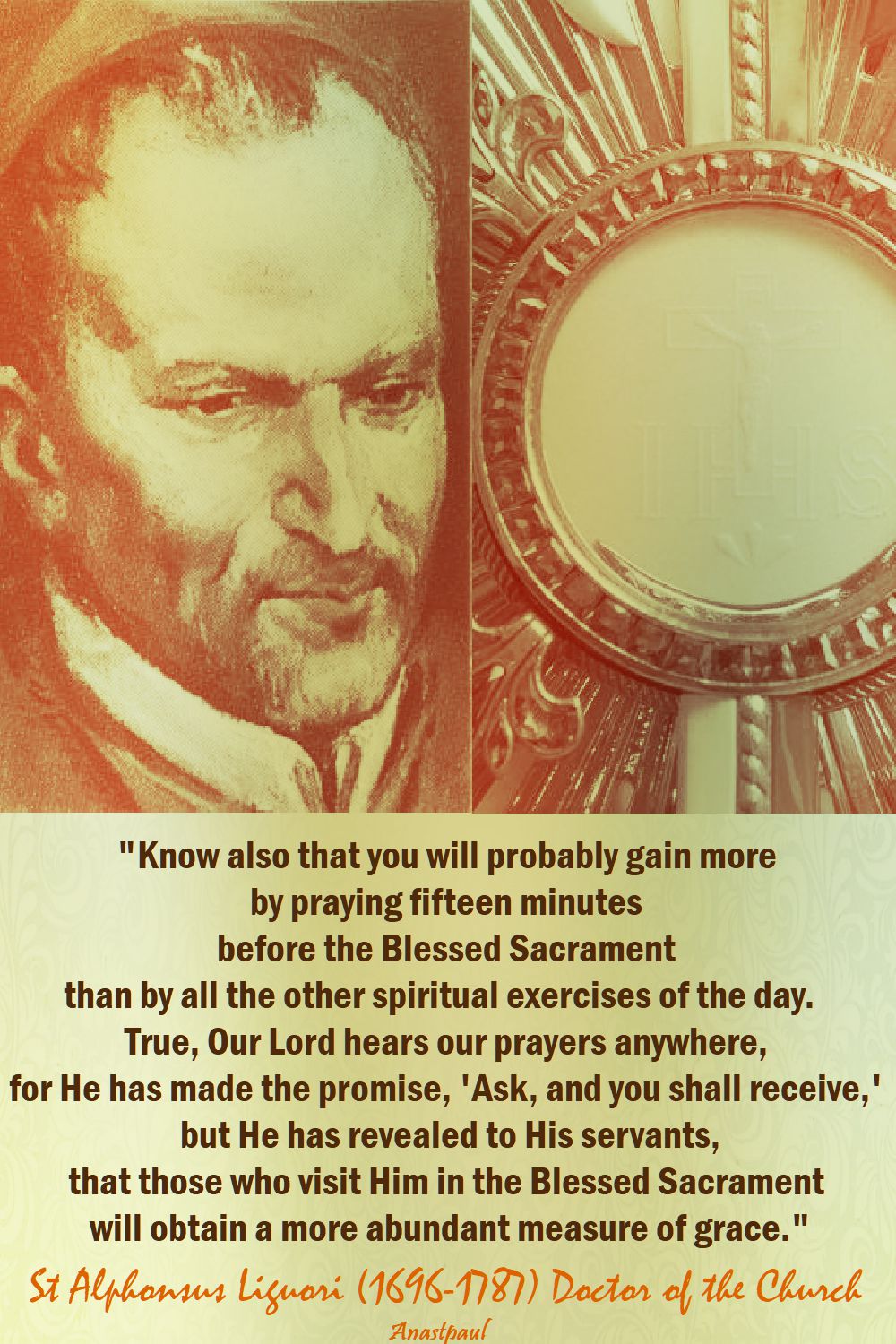
“Know also that you will probably gain more by praying fifteen minutes before the Blessed Sacrament than by all the other spiritual exercises of the day. True, Our Lord hears our prayers anywhere, for He has made the promise, ‘Ask, and you shall receive,’ but He has revealed to His servants, that those who visit Him in the Blessed Sacrament will obtain a more abundant measure of grace.”
“Your God is ever beside you – indeed, He is even within you.”
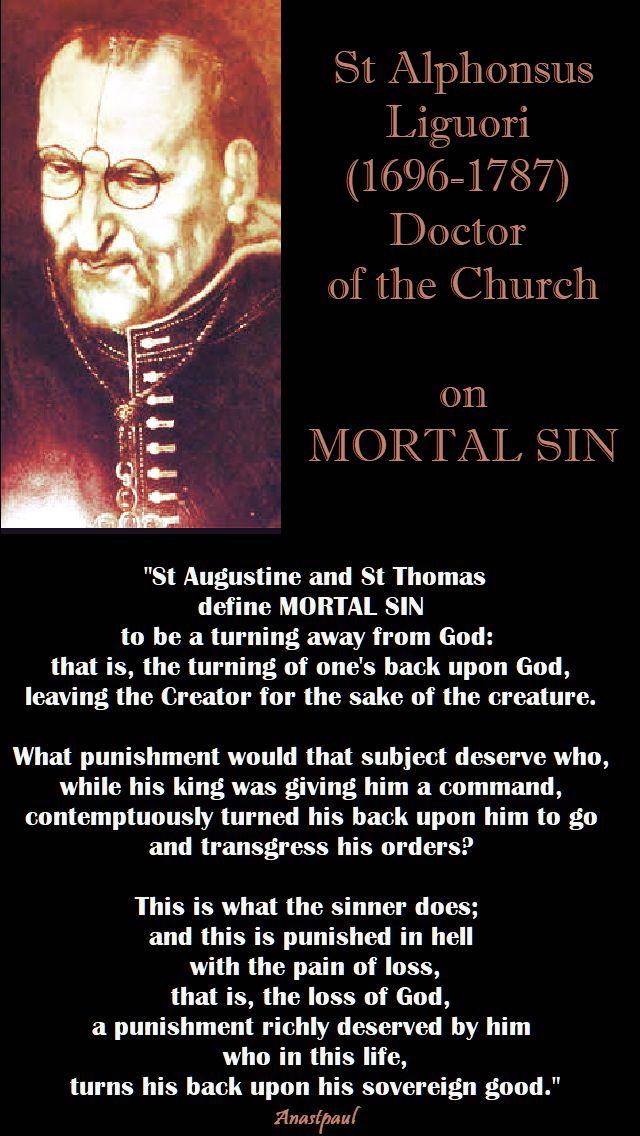
“St Augustine and St Thomas define mortal sin to be a turning away from God: that is, the turning of one’s back upon God, leaving the Creator for the sake of the creature. What punishment would that subject deserve who, while his king was giving him a command, contemptuously turned his back upon him to go and transgress his orders? This is what the sinner does; and this is punished in hell with the pain of loss, that is, the loss of God, a punishment richly deserved by him who in this life turns his back upon his sovereign good.”
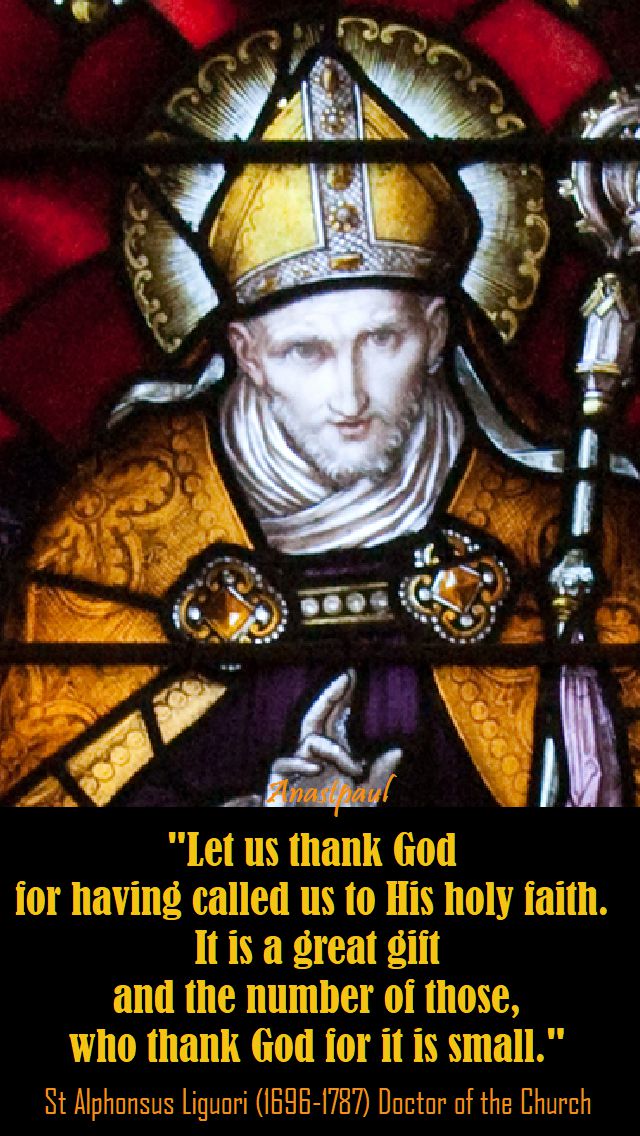
“Let us thank God for having called us to His holy faith. It is a great gift and the number of those, who thank God for it is small.”
St Alphonsus Liguori (1696-1787) Doctor of the Church
“Seek grace in the smallest things and you will find also grace, to accomplish, to believe in and to hope for the greatest things.”
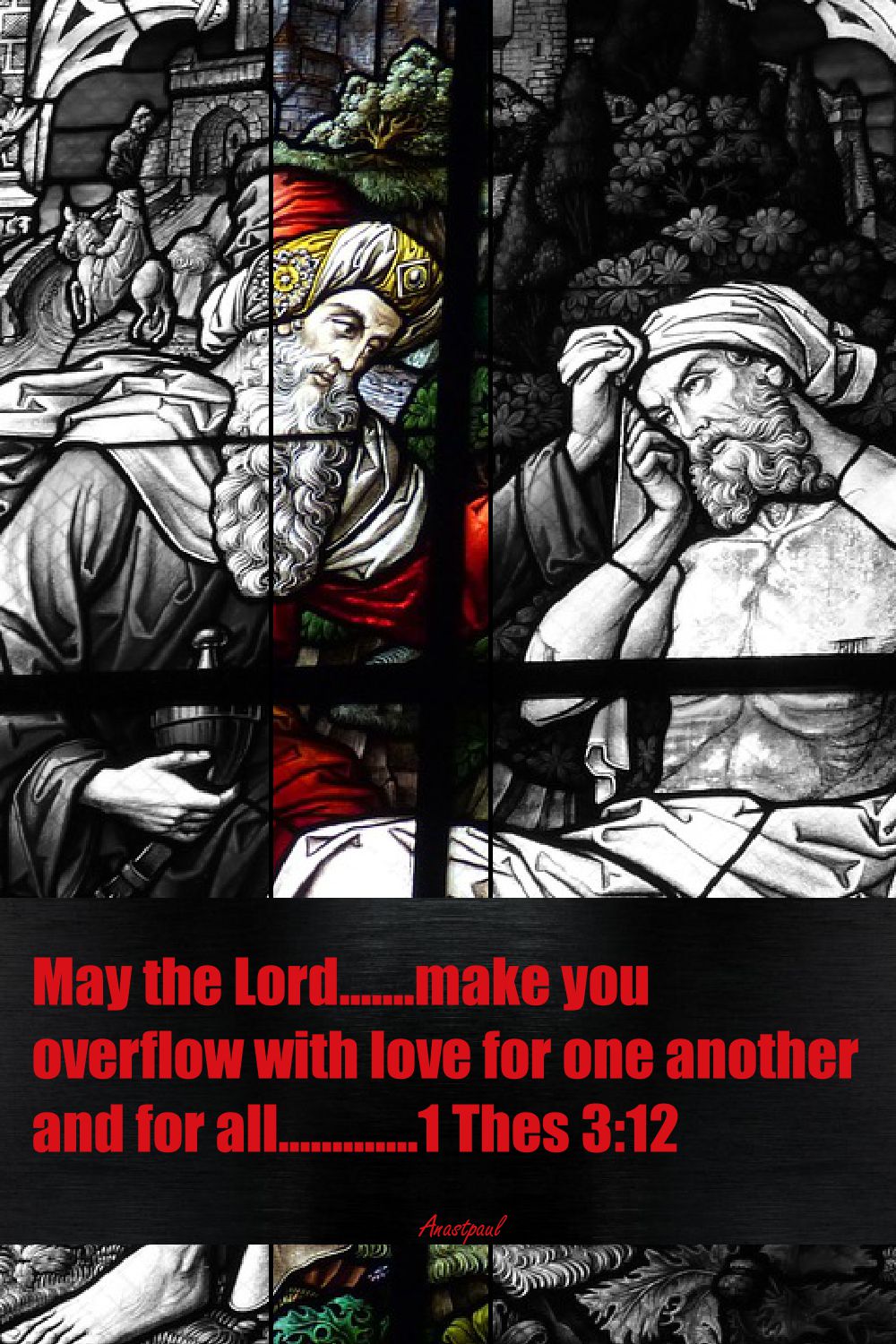
May the Lord…make you overflow with love for one another and for all.1 Thessalonians 3:12
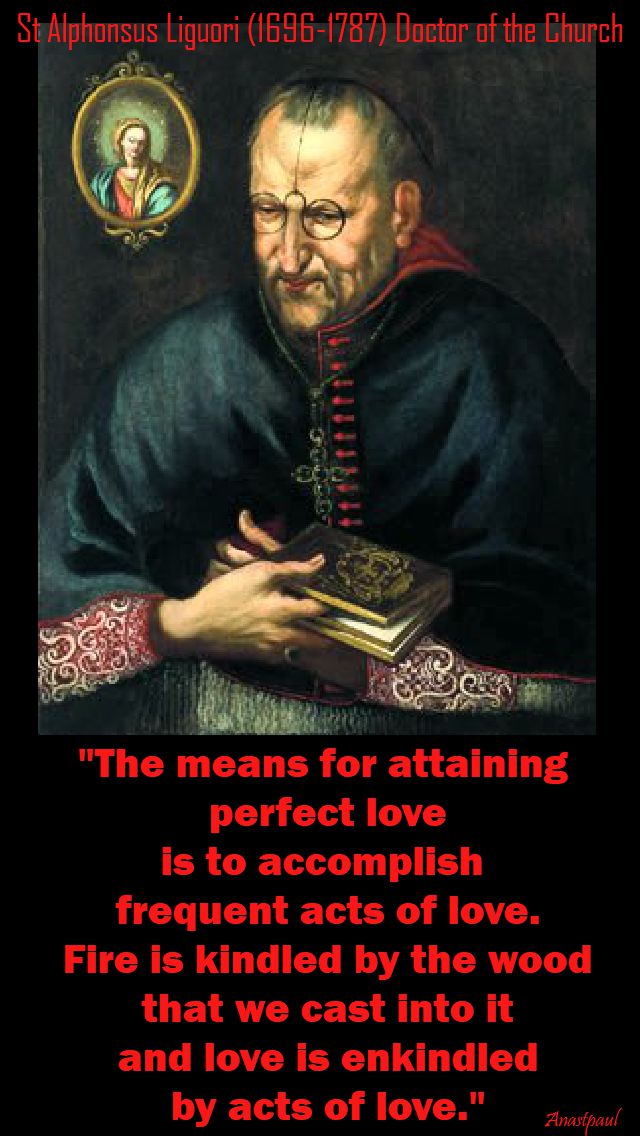
REFLECTION – “The means for attaining perfect love is to accomplish frequent acts of love.
Fire is kindled by the wood that we cast into it and love is enkindled by acts of love.”….St Alphonsus Liguori (1696-1787) Doctor of the Church
PRAYER – Loving Father, grant me the grace to strive after perfect love. Help me to bring forth frequent acts of love, to all and sundry, to each of my neighbours, so that I may grow in this greatest of virtues. St Alphonsus Liguori pray for us, amen.
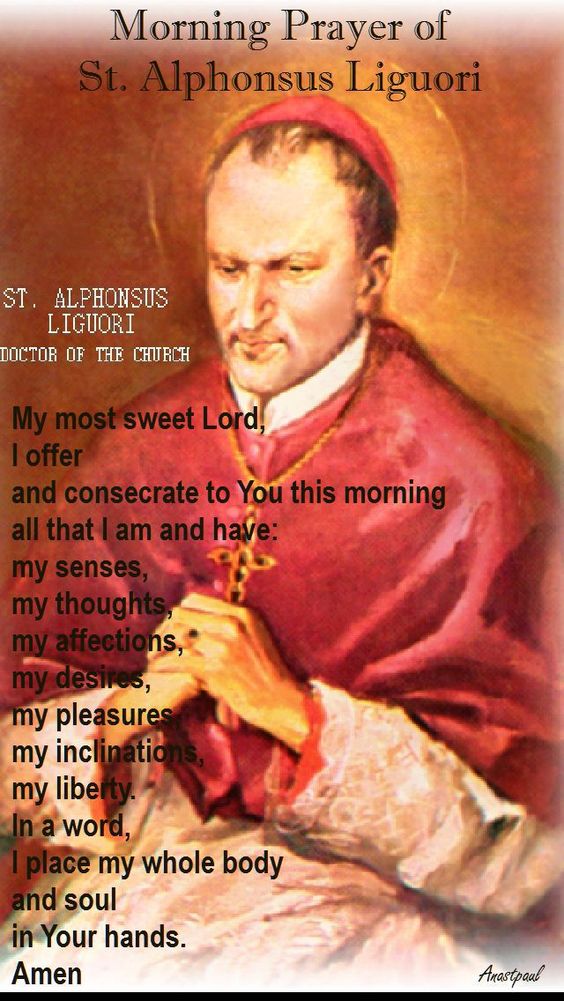
Morning Prayer of St. Alphonsus Liguori (1696-1787) Doctor of the Church Doctor zelantissimus (Most Zealous Doctor)
My most sweet Lord,
I offer and consecrate to You this morning
all that I am and have:
my senses,
my thoughts,
my affections,
my desires,
my pleasures,
my inclinations,
my liberty.
In a word,
I place my whole body and soul in Your hands. Amen
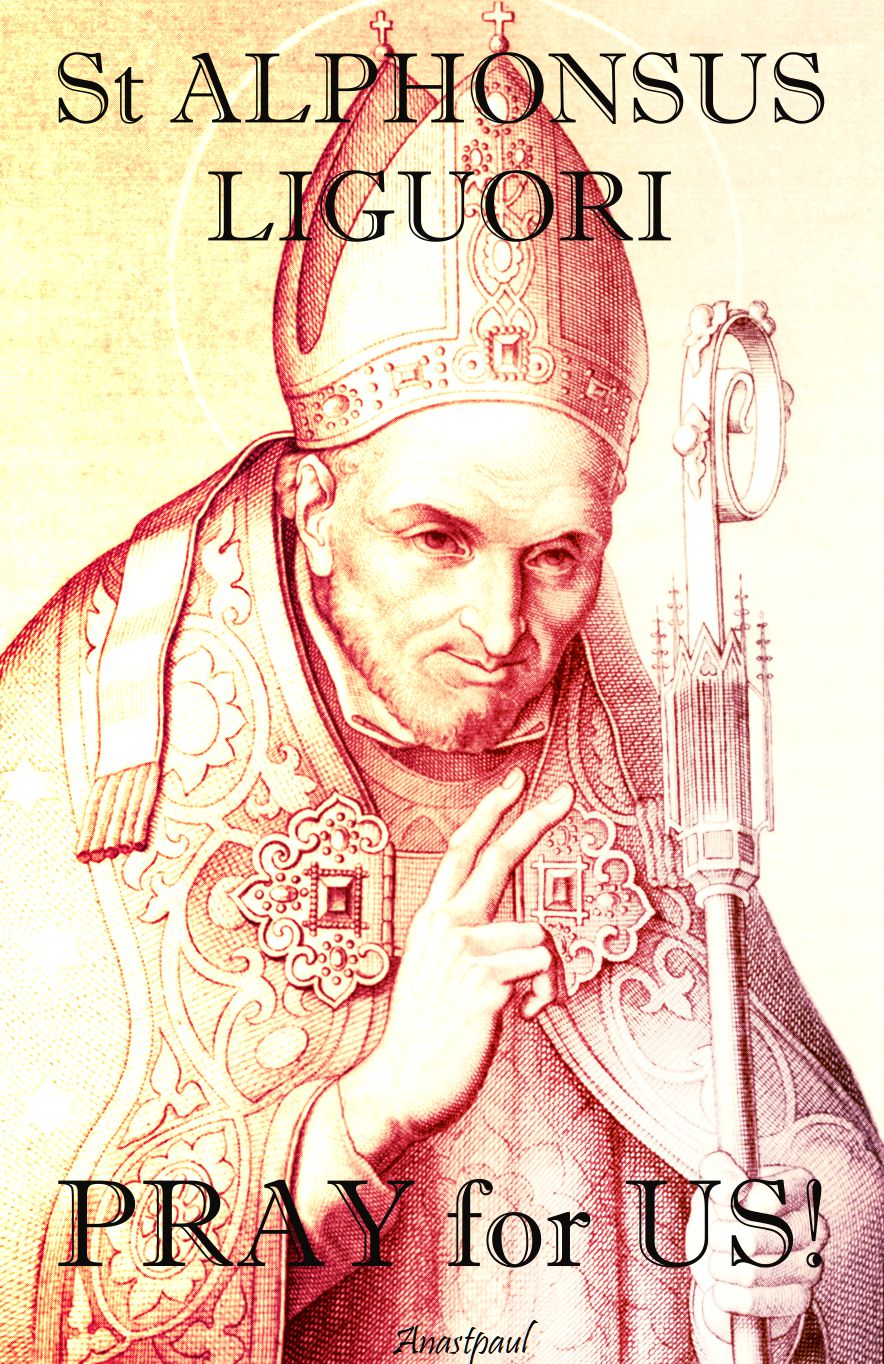
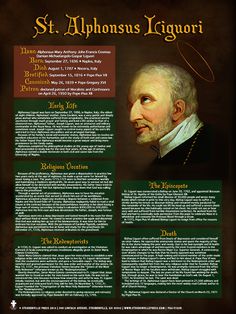
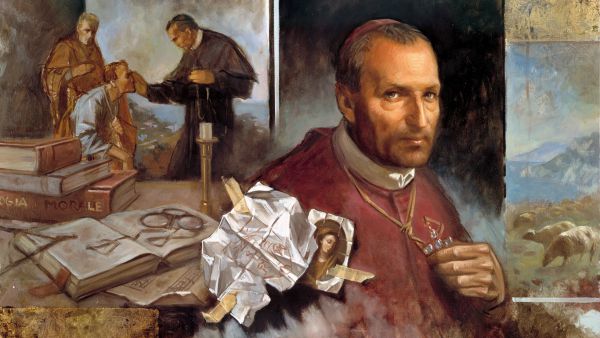
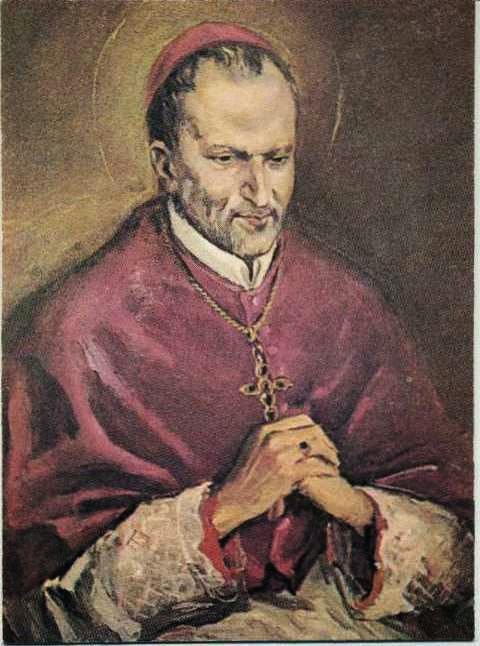
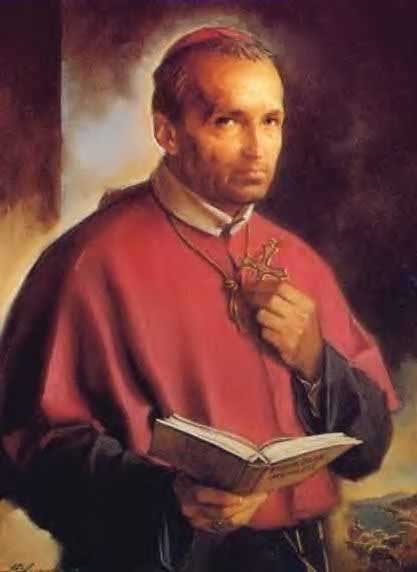
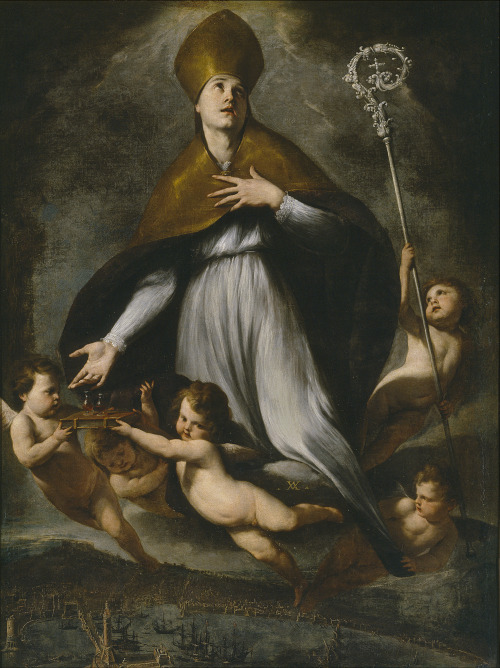
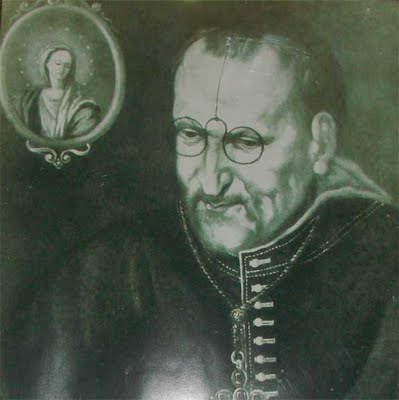
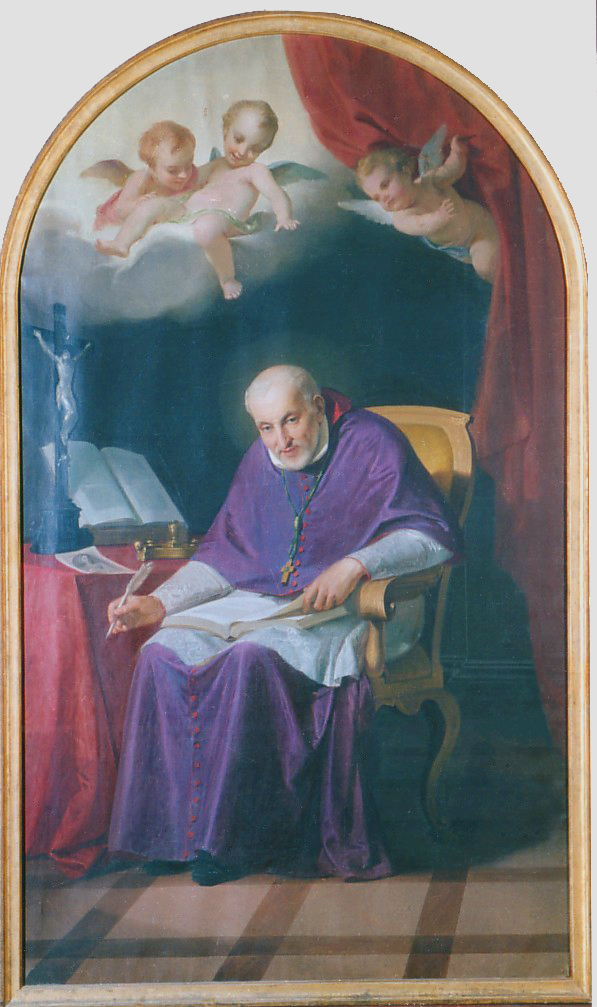
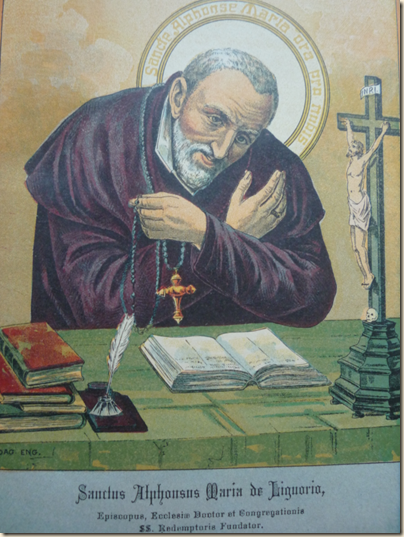
Saint of the Day – 2 August – St Alphonsus Maria de Liguori C.Ss.R. – Doctor of the Church-Bishop, Confessor, Founder, Spiritual Writer, Composer, Musician, Artist, Poet, Lawyer, Scholastic Philosopher and Theologian. Born on 27 September 1696 at Marianelli near Naples, Italy and died on 1 August 1787 at Nocera, Italy of natural causes. He was Canonised on 26 May 1839 by Pope Gregory XVI and declared Doctor of the Church by Pope Pius IX in 1871. He founded the Congregation of the Most Holy Redeemer (the Redemptorists). In 1762 he was appointed Bishop of Sant’Agata dei Goti. Patronages – against arthritis, against scrupulosity, of Confessors (given on 26 February 1950 by Pope Pius XII), final perseverance, moral theologians, moralists (1950 by Pope Pius XII), scrupulous people, vocations, Diocese of Acerra, Italy, Diocese of Agrigento, Italy,l Pagani, Italy, Sant’Agata de’ Goti, Italy. Attributes – chaplet, praying with a monstrance in his hands, pen, quill, crucifix, writing, bishop with his chin on his chest (due to his arthritis).
St Alphonsus learned to ride and fence but was never a good shot because of poor eyesight. Myopia and chronic asthma precluded a military career so his father had him educated for the legal profession. He was taught by tutors before entering the University of Naples, where he graduated with doctorates in civil and canon law at 16. He remarked later that he was so small at the time that he was almost buried in his doctor’s gown and that all the spectators laughed. When he was 18, like many other nobles, he joined the Confraternity of Our Lady of Mercy with whom he assisted in the care of the sick at the hospital for “incurables”.
He became a successful lawyer. He was thinking of leaving the profession and wrote to someone, “My friend, our profession is too full of difficulties and dangers; we lead an unhappy life and run risk of dying an unhappy death”. At 27, after having lost an important case, the first he had lost in eight years of practicing law, he made a firm resolution to leave the profession of law. Moreover, he heard an interior voice saying: “Leave the world, and give yourself to me.”
In 1723, he decided to offer himself as a novice to the Oratory of St. Philip Neri with the intention of becoming a priest. His father opposed the plan but after two months (and with his Oratorian confessor’s permission), he and his father compromised: he would study for the priesthood but not as an Oratorian and live at home. He was ordained on 21 December 1726, at 30. He lived his first years as a priest with the homeless and the marginalised youth of Naples. He became very popular because of his plain and simple preaching. He said: “I have never preached a sermon which the poorest old woman in the congregation could not understand”. He founded the Evening Chapels, which were managed by the young people themselves. The chapels were centres of prayer and piety, preaching, community, social activities and education. At the time of his death, there were 72, with over 10,000 active participants. His sermons were very effective at converting those who had been alienated from their faith.
Liguori suffered from scruples much of his adult life and felt guilty about the most minor issues relating to sin. Moreover, the saint viewed scruples as a blessing at times and wrote: “Scruples are useful in the beginning of conversion…. they cleanse the soul and at the same time make it careful”.
In 1729, Alphonsus left his family home and took up residence in the Chinese Institute in Naples. It was there that he began his missionary experience in the interior regions of the Kingdom of Naples, where he found people who were much poorer and more abandoned than any of the street children in Naples. In 1731, while he was ministering to earthquake victims in the town of Foggia, Alphonsus claimed to have had a vision of the Virgin Mother in the appearance of a young girl of 13 or 14, wearing a white veil.
Congregation of the Most Holy Redeemer (The Rdemptorists) – On 9 November 1732, he founded the Congregation of the Most Holy Redeemer, when Sister Maria Celeste Crostarosa told him that it had been revealed to her that he was the one that God had chosen to found the congregation. He founded the congregation with the charism of preaching popular missions in the city and the countryside. Its goal was to teach and preach in the slums of cities and other poor places. They also fought Jansenism, a heresy that supported a very strict morality: “the penitents should be treated as souls to be saved rather than as criminals to be punished”. He is said never to have refused absolution to a penitent.
A gifted musician and composer, he wrote many popular hymns and taught them to the people in parish missions. In 1732, while he was staying at the Convent of the Consolation, one of his order’s houses in the small city of Deliceto in the province of Foggia in Southeastern Italy, Liguori wrote the Italian carol “Tu scendi dalle stelle” (“From Starry Skies Descending”) in the musical style of a pastorale. The version with Italian lyrics was based on his original song written in Neapolitan, which began Quanno nascette Ninno (When the child was born). As it was traditionally associated with the zampogna, or large-format Italian bagpipe, it became known as Canzone d’i zampognari the (“Carol of the Bagpipers”).
Bishop Alphonsus was consecrated Bishop of Sant’Agata dei Goti in 1762. He tried to refuse the appointment by using his age and infirmities as arguments against his consecration. He wrote sermons, books and articles to encourage devotion to the Blessed Sacrament and the Blessed Virgin Mary. He first addressed ecclesiastical abuses in the diocese, reformed the seminary and spiritually rehabilitated the clergy and faithful. He suspended those priests who celebrated Mass in less than 15 minutes and sold his carriage and episcopal ring to give the money to the poor. In the last years of his life, he suffered a painful sickness and a bitter persecution from his fellow priests, who dismissed him from the Congregation that he had founded.
Death In 1775, he was allowed to retire from his office and went to live in the Redemptorist community in Pagani, Italy, where he died.
Veneration and legacy He was beatified on 15 September 1816 by Pope Pius VII and canonized on 26 May 1839 by Pope Gregory XVI.
In 1949, the Redemptorists founded the Alphonsian Academy for the advanced study of Catholic moral theology. He was named the patron of confessors and moral theologians by Pope Pius XII on 26 April 1950, who subsequently wrote of him in the encyclical Haurietis aquas.
Moral theology Alphonsus’ greatest contribution to the Church was in the area of moral theology. His masterpiece was The Moral Theology (1748), which was approved by the Pope himself and was born of Alphonsus’ pastoral experience, his ability to respond to the practical questions posed by the faithful and his contact with their everyday problems. He opposed sterile legalism and strict rigoururism. According to him, those were paths closed to the Gospel because “such rigour has never been taught nor practiced by the Church”. His system of moral theology is noted for its prudence, avoiding both laxism and excessive rigour. Since its publication it has remained in Latin, often in 10 volumes or in the combined 4-volume version of Gaudé. It saw only recently its first publication in translation, in an English translation made by Ryan Grant and published in 2017 by Mediatrix Press. The English translation of the work is projected to be around 5 volumes.
Mariology His Mariology, though mainly pastoral in nature, rediscovered, integrated and defended that of St Augustine of Hippo, St Ambrose of Milan and other fathers; it represented an intellectual defence of Mariology in the 18th century, the Age of Enlightenment, against the rationalism to which his often flaming Marian enthusiasm contrasted:
The Glories of Mary Marian Devotion Prayers to the Divine Mother Spiritual Songs The True Spouse of Jesus Christ
Other works Great Means of Salvation and of Perfection The Way of Salvation and of Perfection The Way of the Cross, Preparation for Death, The Incarnation, Birth and Infancy of Jesus Christ The Holy Eucharist Victories of the Martyrs
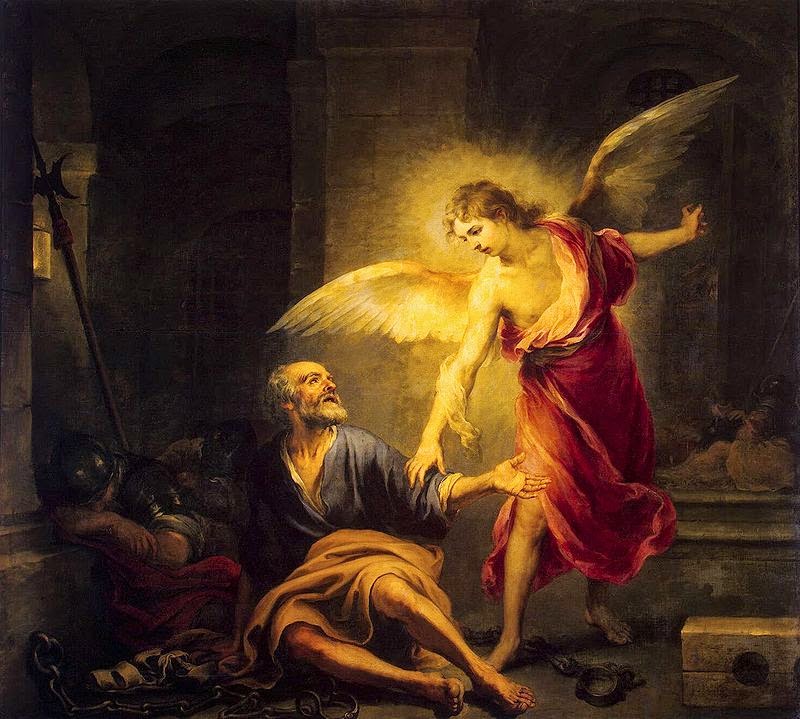
Feast of Saint Peter in Chains: The feast was originally kept in Rome, Italy to commemorate the dedication of the Church of Saint Peter on the Esquiline Hill built by Eudoxia Licinia in 442 and rebuilt by Adrian I in the 8th century. When the chains which Saint Peter had worn in prison and from which he was freed by angelic intervention, Acts 12:1-19, were later venerated there, the feast received its present name. The date when these chains were brought from Jerusalem is disputed; some claim they were brought in 116 by travellers sent in search of them by Saint Balbina and her father Saint Quirinus, while others think Saint Eudoxia brought them in 439. Pope Saint Leo the Great united them to the chains with which Saint Peter had been fettered in the Mamertine Prison, forming a chain about two yards long which is preserved in a bronze safe and guarded by a special confraternity.
—
Bl Aleksy Sobaszek
St Alexander of Perga
St Almedha
St Arcadius
St Attius of Perga
St Benado Vo Van Due
St Buono
St Brogan
St Charity
St Ðaminh Nguyen Van Hanh
St Ethelwold of Winchester
St Exuperius of Bayeux
St Faith
St Faustus
St Felix of Gerona
St Friard
Bl Gerhard Hirschfelder
St Hope
St Jonatus
St Justin of Paris
St Kenneth of Wales
St Leontius of Perga
Bl Maria Imelda of the Eucharistic Jesus
Bl Maria Stella of the Most Blessed Sacrament
St Maur
St Nemesius of Lisieux
Bl Orlando of Vallombrosa
St Peregrinus of Modena
St Peter Faber
St Rioch
Bl Rudolph
St Secundel
St Secundus of Palestrina
St Sophia
St Verus of Vienne
Saints Faith, Hope and Charity: The daughters of Saint Sophia. While still children, they were tortured and martyred for their faith in the persecutions of Hadrian. They were scourged, thrown into a fire and then beheaded.
—
Holy Maccabees: Jewish dynasty which began with the rebellion of Mathathias and his five sons against the Syrian king, Antiochus IV (168 BC) and ruled the fortunes of Israel until the advent of Herod the Great. Syrian attempts to force Greek paganism on the Jews, the profanation of the Temple at Jerusalem, and the massacre which followed, brought the nation to arms under Mathathias, a priest of the sons of Joarib. At the death of Mathathias, Judas Machabeus, his third son, drove the Syrians and Hellenists out of Jerusalem, rededicated the Temple, and began an offensive and defensive alliance with the Romans. Before the treaty was concluded, however, Judas, with 800 men, risked battle at Laisa with an overwhelming army of Syrians under Bacchides, and was slain. He was succeeded in command by his youngest brother, Jonathan (161 BC). Jonathan defeated Bacchides, revenged the death of his brother, and made peace with Alexander who had usurped the throne of Demetrius, the successor to Antiochus. A period of peace followed in which Jonathan ruled as high priest in Jerusalem, but Tryphon, who was plotting for the throne of Asia, treacherously captured him at ptolemais and later put him to death. The captaincy of the armies of Israel then fell to Simon, the second son of Mathathias. Under him the land of Juda flourished exceedingly. He obtained the complete independence of the country and a grateful people bestowed upon him the hereditary kingship of the nation. His rule marked five years of uninterrupted peace. He was treacherously slain by his son-in-law, Ptolemy, about the year 135 BC After Simon the race of the Machabees quickly degenerated. In 63 BC the Romans thought it necessary to interfere in the fratricidal war between Hyrcanus II and Aristobulus II. With this interference and the advent of Herod the Great the scepter passed forever from the land of Juda. The story of the Machabees is written in the two books of the Old Testament which bear that name.
Martyrs of Nowogrodek – 11 beati: A group of eleven Holy Family of Nazareth nuns who were murdered by Nazis in exchange for the release of 120 condemned citizens of Nowogrodek, Belarus.
• Adela Mardosewicz
• Anna Kukolowicz
• Eleonora Aniela Józwik
• Eugenia Mackiewicz
• Helena Cierpka
• Jadwiga Karolina Zak
• Józefa Chrobot
• Julia Rapiej
• Leokadia Matuszewska
• Paulina Borowik
• Weronika Narmontowicz
They were murdered on 1 August 1943 by the Gestapo in Novogrudok, Hrodzyenskaya voblasts’, Belarus and
Beatified on 5 March 2000 by St Pope John Paul.
Martyrs of Philadelphia – 6 saints: A group of six Christians martyred. No information about them has survived but the names – Aquila, Cyril, Domitian, Menander, Peter and Rufus. They were martyred on an unknown date in Philadelphia (modern Alasehir, Turkey).
Martyred in the Spanish Civil War:
Bl Benito Iñiguez de Heredia Alzola
Bl Francesc de Paula Soteras Culla
Bl Joan Bonavida Dellá
Bl José de Miguel Arahal
Bl Justino Alarcón Vera
Sebastià Tarragó Cabré
Vicente Montserrat Millán
Nicholas de la Torre Merino














 AnaStpaul
You must be logged in to post a comment.