Virgen Blanca – The Dedication of the Cathedral of Our Lady of Toledo, Spain and the White Virgin (Also known as the Smiling Madonna) (1085) – 25 October:
The Abbot Orsini wrote: “Dedication of Our Lady of Toledo, in Spain, about the year 1075, by Bernard, Archbishop of that City.”
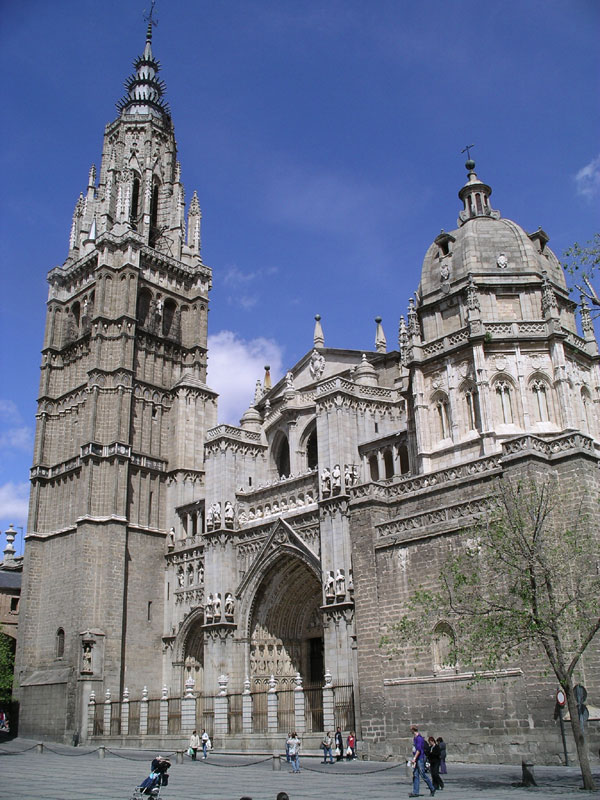
The City of Toledo in Spain was not reconquered until 1085, when King Alfonso VI, King of Leon and Castile, took the City from the Moors. This was an important step in the Reconquista, as Toledo had once been the capital of Visigothic Spain. The City’s Cathedral had been desecrated and used as a mosque by the Moslem invaders of Spain but the people had the pleasure of seeing it blessed and consecrated in the year 1087. It was placed under the advocacy of the Blessed Virgin Mary, as King Alfonso wrote:
“I, Alfonso, Emperor of all Spain by God’s Providence, convened with the Bishops, namely, that for these ten will I preserve the papal honour of Saint Mary of the City of Toledo, which was formerly the See…”
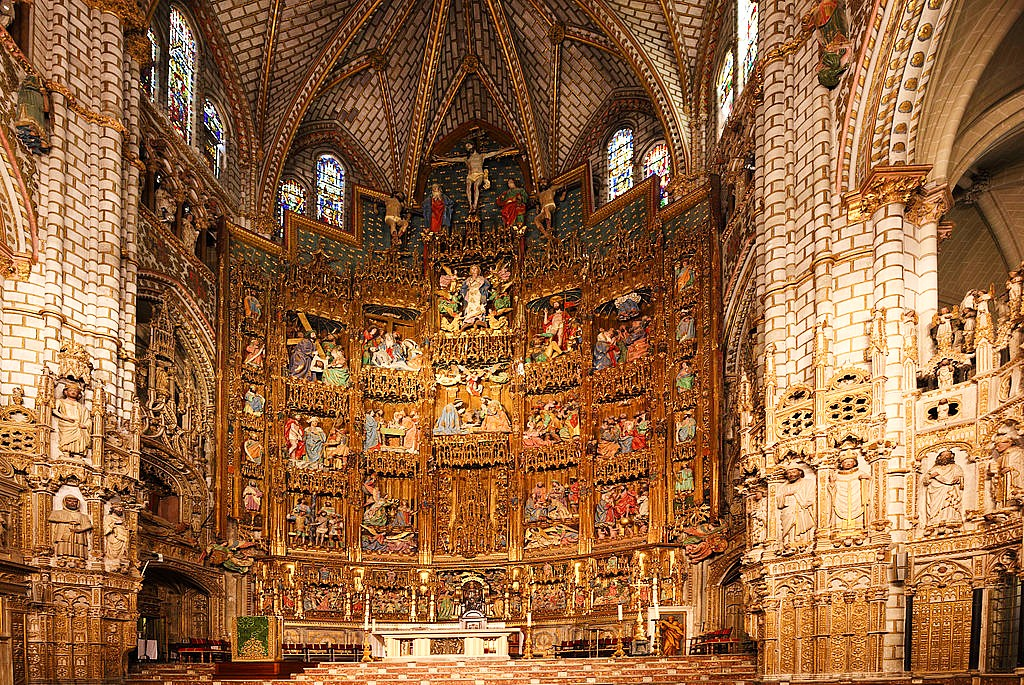
In 1225 a new Cathedral was begun to replace the older one, for which King Fernando III drew up the plans and laid the cornerstone. Fernando’s good friend, the Archbishop Rodrigo Ximenez de Rada, worked very enthusiastically for the completion of the new Cathedral where he was Bishop.
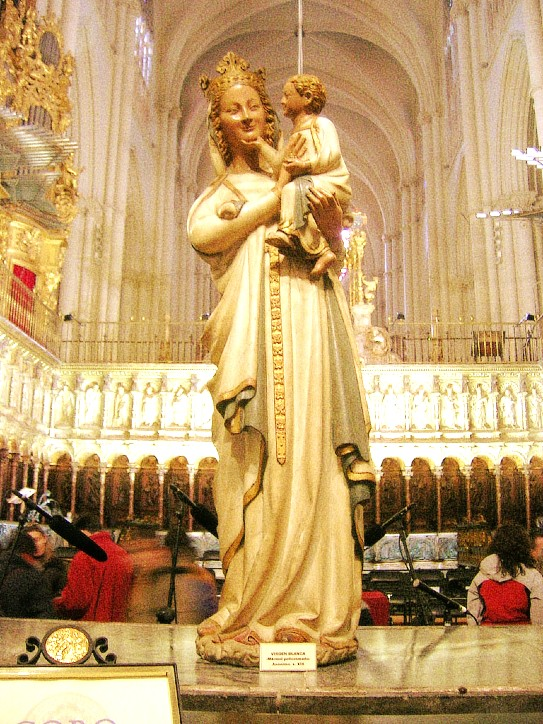
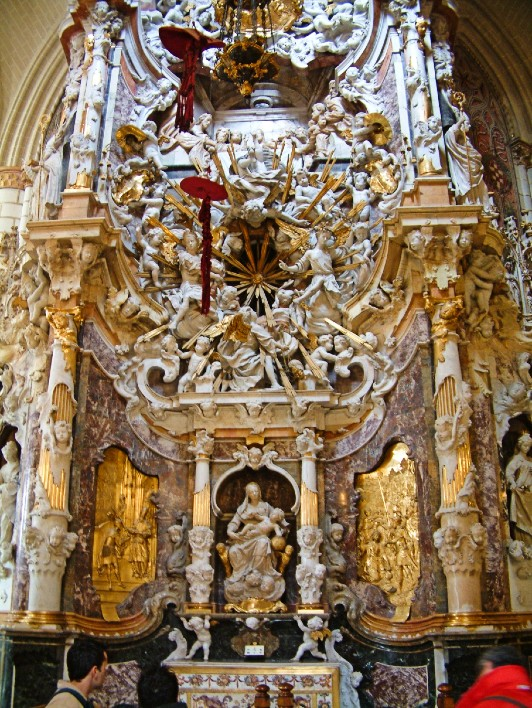
There are so many masterpieces of art and beautiful Shrines in the City of Toledo, Spain, that a visitor may easily miss the White Virgin. She stands atop an Altar in the choir of Toledo’s magnificent Cathedral. It is said that you can live to be 100 years old, visit this wonderful Cathedral once a week for all of your life and still never finish discovering its glories!
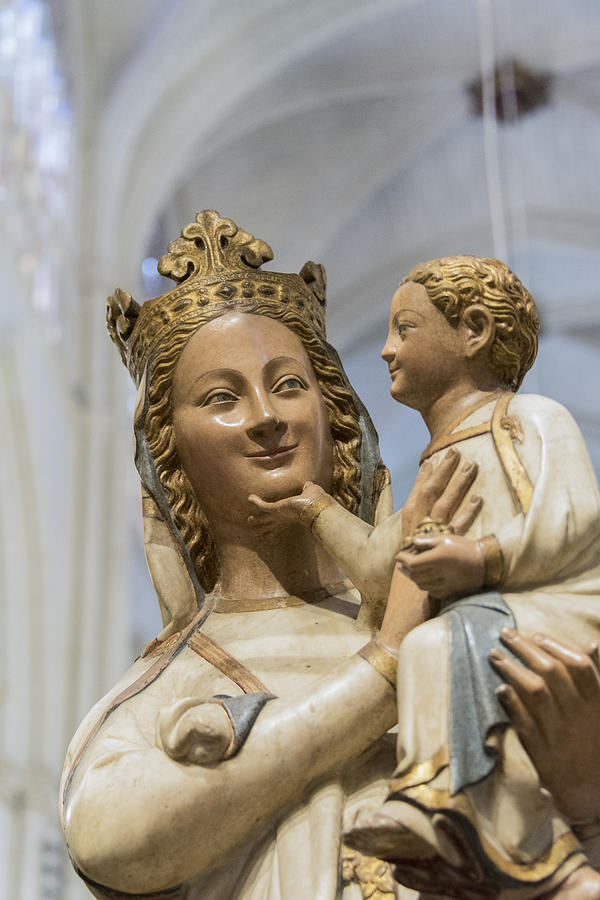
The sacred image of Our Lady is a polychromed alabaster Statue of French origin from the twelfth century. Both Mother and Child are clothed in white, their garments bordered with jeweled gold. Their faces darkened by time, are framed with curly, strawberry-blond hair.
The Statue has also been called the “Smiling Virgin of Toledo;” for the Child’s right hand caresses His Mother’s face, tickling her chin. She responds with a smile that gives this image its popular name. It is also called the “Virgin of Prima” and the “Virgen Blanca.”
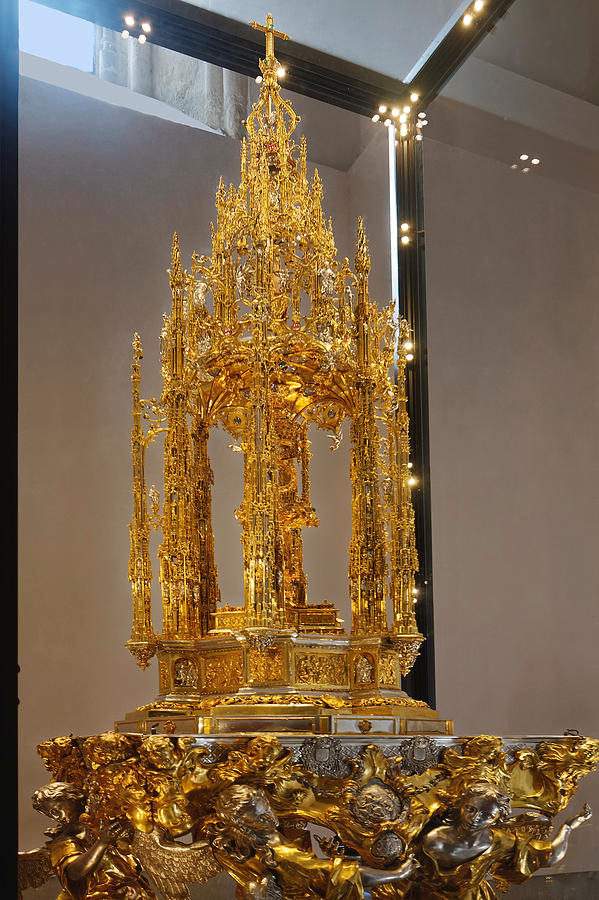
There is also another artifact worthy of special mention and that is the ten foot tall great Monstrance of Arfe. It is made of both silver and gold, inset with precious gems. It took nearly 8 years to construct and is done in a Gothic style that is truly a magnificent work of art.
St Alfons Arimany Ferrer
St Bernard of Calvo
St Canna verch Tewdr Marw
St Chrysanthus
St Crispin & St Crispian – (†285 or 286) Martyrs, Twin brothers, Laymen.
St Cyrinus of Rome
St Daria
St Dulcardus
Bl Edmund Daniel
St Fronto of Périgueux
St Fructus of Segovia
St Gaudentius of Brescia (Died 410) Bishop
St George of Périgueux
St Goeznoveus of Leon
St Guesnoveus
Bl Henry of Segusio
St Hilary of Javols / St Hilary of Mende
St Hildemarca of Fecamp
St Januarius of Sassari
St Lucius of Rome
St Lupus of Bayeux
St Mark of Rome
St Maurus of Pécs OSB (c 1000-c 1075) Bishop, the first Hungarian Benedictine Monk and Abbot, Peace-maker, Writer and Hagiographer.
St Miniato of Florence
St Peter of Rome
St Protus of Sassari
St Recaredo Centelles Abad
St Tabitha
Blessed Thaddeus McCarthy (c 1455–1492) “White Martyr of Munster” – Bishop
Martyrs of Constantinople:
Marciano
Martirio
Martyrs of Cruz Cubierta: A mother, Blessed María Teresa Ferragud Roig de Masiá and her four daughters, Blessed María Joaquina Masiá Ferragud, Blessed María Vicenta Masiá Ferragud, Blessed María Felicidad Masiá Ferragud and Blessed Josefa Ramona Masiá Ferragud, all nuns, who were Martyred in the Spanish Civil War, on 25 October 1936 in Cruz Cubierta, Alzira, Valencia, Spain.
Forty Martyrs of England and Wales: 40 represent a group of 300+.
Martyred in the Spanish Civil War:
• Blessed Alfons Arimany Ferrer
• Blessed Recaredo Centelles Abad


