Posted in DOCTORS of the Church, DOMINICAN OP, franciscan OFM, Hail MARY!, MARIAN DEVOTIONS, MARIAN POETRY, MARIAN QUOTES, MARIAN REFLECTIONS, MARIAN TITLES, POETRY, QUOTES of the SAINTS

Quote/s of the Day – 12 September – Mary’s Name

Quote/s of the Day – 12 September – Feast of the Most Holy Name of Mary

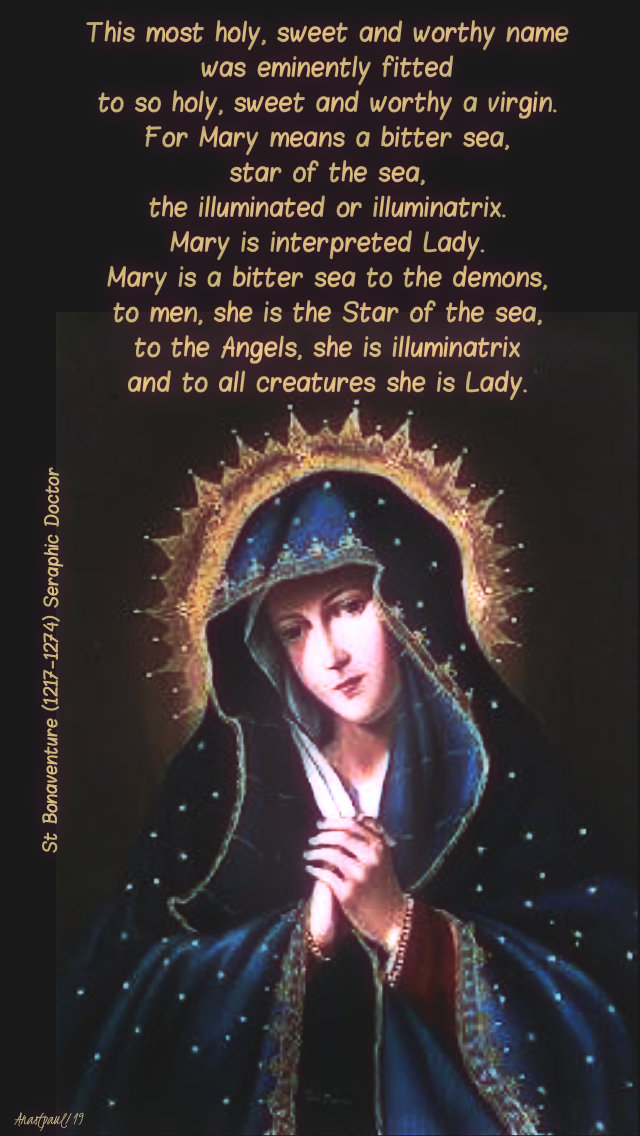
“This most holy, sweet and worthy name
was eminently fitted
to so holy, sweet and worthy a virgin.
For Mary means a bitter sea, star of the sea,
the illuminated or illuminatrix.
Mary is interpreted Lady.
Mary is a bitter sea to the demons,
to men, she is the Star of the sea,
to the Angels, she is illuminatrix
and to all creatures she is Lady.”

St Bonaventure (1217-1274) Seraphic Doctorthis most holy sweet name = st bonaventure 12 sept 2019 no 2.jpg

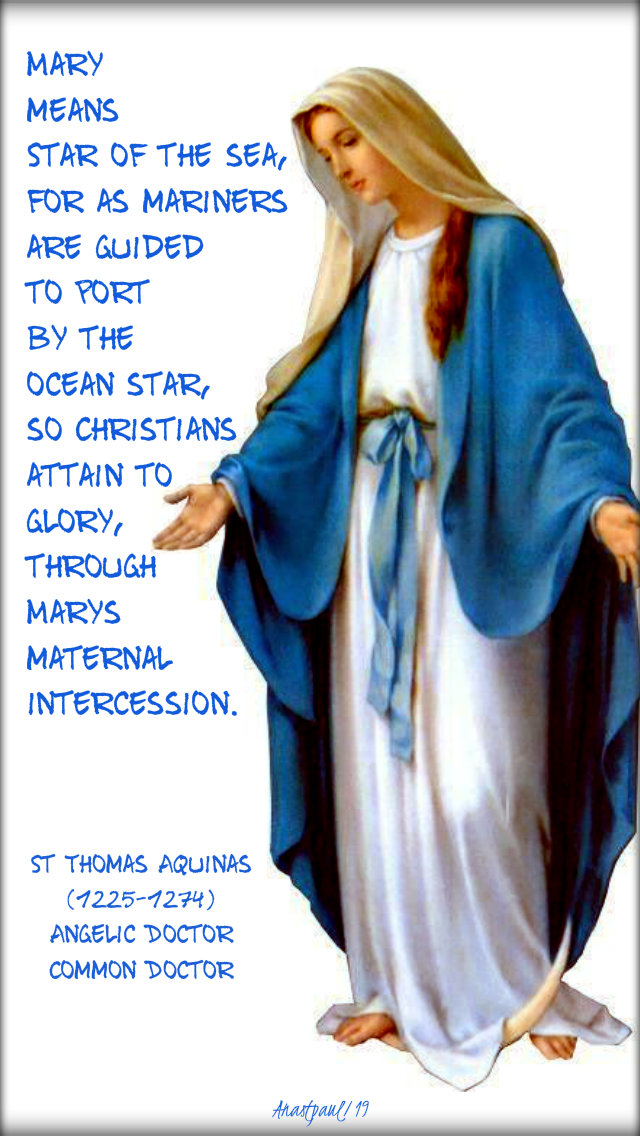
“Mary means Star of the sea,
for as mariners are guided to port
by the ocean star,
so Christians attain to glory,
through Mary’s maternal intercession.”

St Thomas Aquinas (1225-1274)

Angelic Doctor
Common Doctor

mary means star of the sea - st thomas aquinas 12 sept 2019

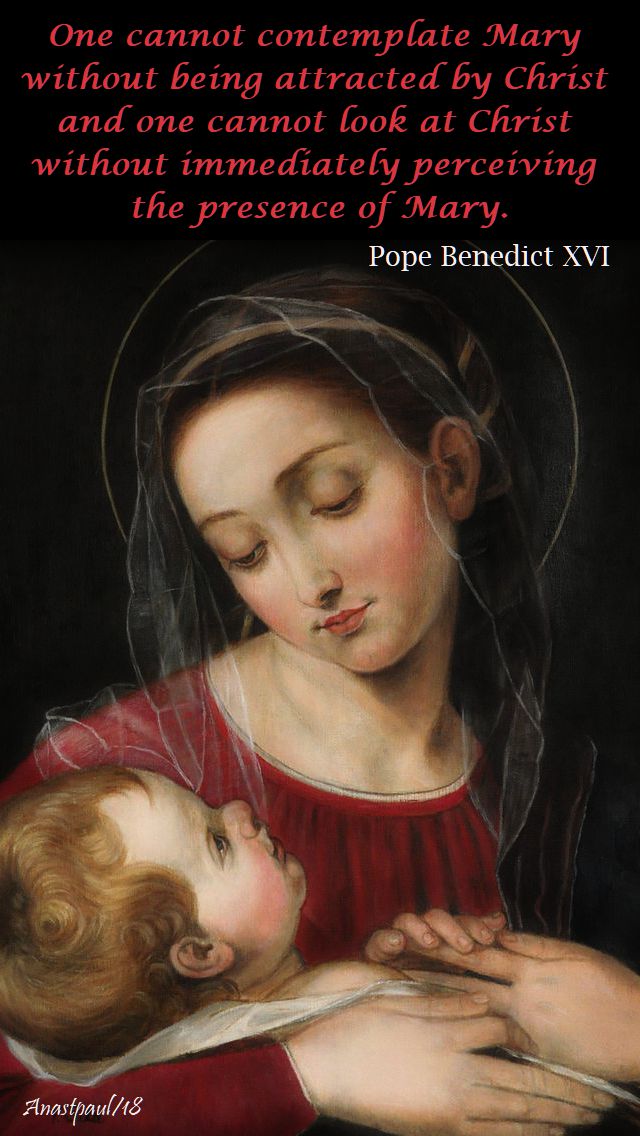
“One cannot contemplate Mary
without being attracted by Christ
and one cannot look at Christ
without immediately perceiving
the presence of Mary.”

Pope Benedict XVIone-cannot-contemplate-mary-pope-benedict-open-house-conversations-with-st-louis-de-montfort-the-secret-of-mary-28-sept-2018.jpg

Mary’s Name

Rare perfume is a rough and reeking place,
A bell-like music breaking through the blare
Of strident streets, a dear remembered face
Appearing through the mind’s pondrous despair.

A foam of summer flowers fringing the drear
Immobile desert sea, a cherished voice
Calling in some long night of pain and fear
To make the heavy, heaving heart rejoice.
Such is the mystic wonder of her name
That is a shudder down Hell’s shaken halls,
And joy where angel-wings flit like white flames,
Where height to echoing height its glory calls.

Liam Bhophy

The Apostle – October 1962the most holy name of mary 12 sept 2019

Posted in DOMINICAN OP, ON the SAINTS, PRACTISING CATHOLIC, PRAYERS for CANONISATION, QUOTES on CHARITY, QUOTES on HUMAN DIGNITY, QUOTES on JUSTICE, QUOTES on LOVE, QUOTES on MERCY, SAINT of the DAY

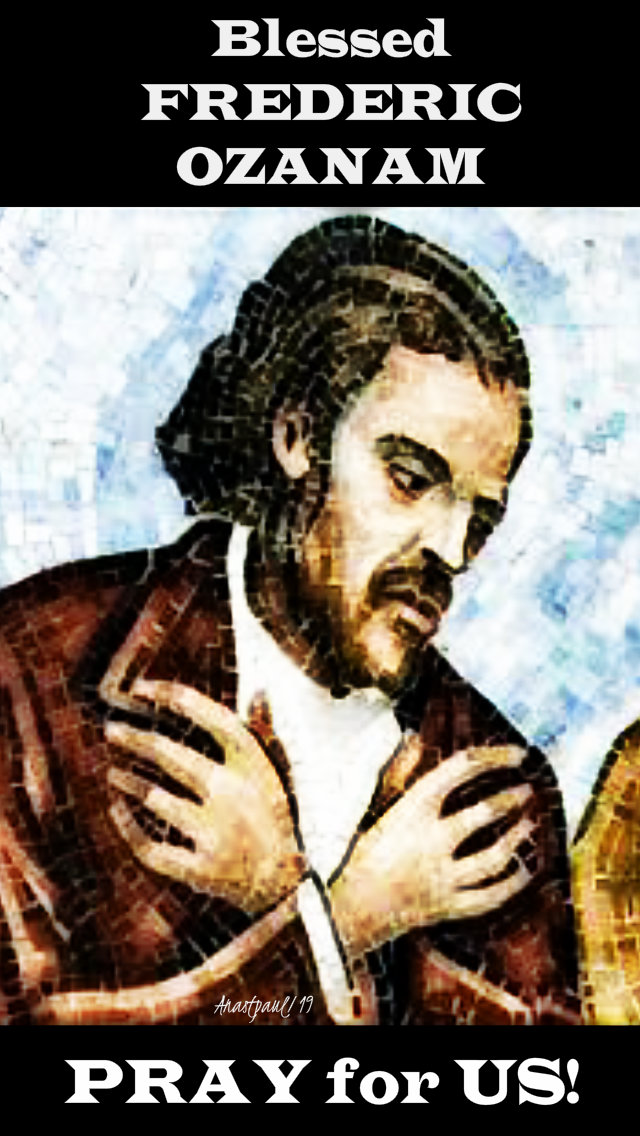
Thought for the Day – 9 September – “One of those privileged creatures who came direct from the hand of God …”

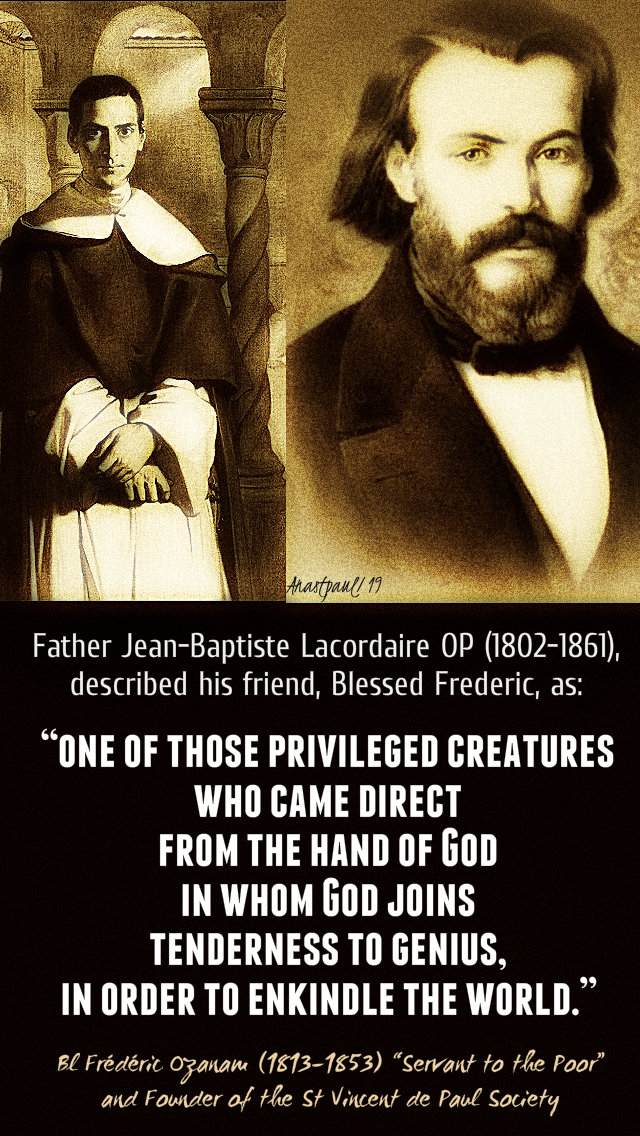
Thought for the Day – 9 September – The Memorial of Blessed Frédéric Ozanam (1813–1853) “Servant to the Poor” and Founder of the St Vincent de Paul Society

A man convinced of the inestimable worth of each human being, Frédéric served the poor of Paris well and drew others into serving the poor of the world.   Through the Saint Vincent de Paul Society, which he founded, his work continues to the present day.

Once, after Frédéric spoke about Christianity’s role in civilisation, a club member said: “Let us be frank, Mr Ozanam, let us also be very particular.   What do you do besides talk to prove the faith you claim is in you?”

Frédéric was stung by the question.   He soon decided that his words needed a grounding in action.   He and a friend began visiting Paris tenements and offering assistance as best they could.   Soon a group dedicated to helping individuals in need under the patronage of Saint Vincent de Paul formed around Frédéric.

Feeling that the Catholic faith needed an excellent speaker to explain its teachings, Frédéric convinced the Archbishop of Paris to appoint Dominican Father Jean-Baptiste Lacordaire OP (1802-1861), the greatest preacher then in France, to preach a Lenten series in Notre Dame Cathedral.   It was well-attended and became an annual tradition in Paris.   Meanwhile, the Saint Vincent de Paul Society was growing throughout Europe.   Paris alone counted 25 conferences.

In 1846, Frédéric, Amelie, and their daughter Marie went to Italy, there he hoped to restore his poor health.   They returned the next year.   The revolution of 1848 left many Parisians in need of the services of the Saint Vincent de Paul conferences.   The unemployed numbered 275,000.   The government asked Frédéric and his coworkers to supervise the government aid to the poor.   Vincentians throughout Europe came to the aid of Paris.

In 1852, poor health again forced Frédéric to return to Italy with his wife and daughter. He died on 8 September 1853.   In his sermon at Frédéric’s funeral, Fr Lacordaire described his friend as “one of those privileged creatures who came direct from the hand of God in whom God joins tenderness to genius, in order to enkindle the world.”one of those priviliged creatures - bl frederic by jean baptiste lacordaire 9 sept 2019.jpg

Frédéric was beatified in 1997.   Since Frédéric wrote an excellent book entitled Franciscan Poets of the Thirteenth Century, and since his sense of the dignity of each poor person was so close to the thinking of Saint Francis, it seemed appropriate to include him among Franciscan “greats.”

His commitment to the plight of those in need and social justice for all, inspires us to look around our communities today—outside our safety zones—and activate the Christian virtues of charity that we are all called to by the life of Jesus.   He said:

“Yours must be a work of love, of kindness, you must give your time, your talents, yourselves.   The poor person is a unique person of God’s fashioning with an inalienable right to respect.   You must not be content with tiding the poor over the poverty crisis, You must study their condition and the injustices which brought about such poverty, with the aim of a long term improvement.”

Prayer for the Canonisation of Blessed Frédéric Ozanam

Lord, you made Blessed Frédéric Ozanam
a witness of the Gospel, full of wonder
at the mystery of the Church.
You inspired him to alleviate poverty and injustice
and endowed him with untiring generosity
in the service of all those suffering.
In family life, he revealed a most genuine love
as a son, brother, husband and father.
In secular life, his ardent passion for the truth
enlightened his thought, writing and teaching.
His vision for our society was a network of charity
encircling the world inspired
by St Vincent de Paul’s love, boldness and humility.
His prophetic social vision appears in every aspect of his life,
together with the radiance of his virtues.
We thank you Lord, for these many gifts.
May the Church proclaim his holiness,
as a saint, a providential light for today’s world!
We ask this prayer through Jesus Christ, our Lord.
Amen

Blessed Frederic, Pray for us too, Amen!bl frederic ozanam pray for us 9 sept 2019 no 2.jpg

Posted in DOMINICAN OP, SAINT of the DAY

Saint of the Day – 6 September – Blessed Bertrand de Garrigues OP (c 1195-1230)

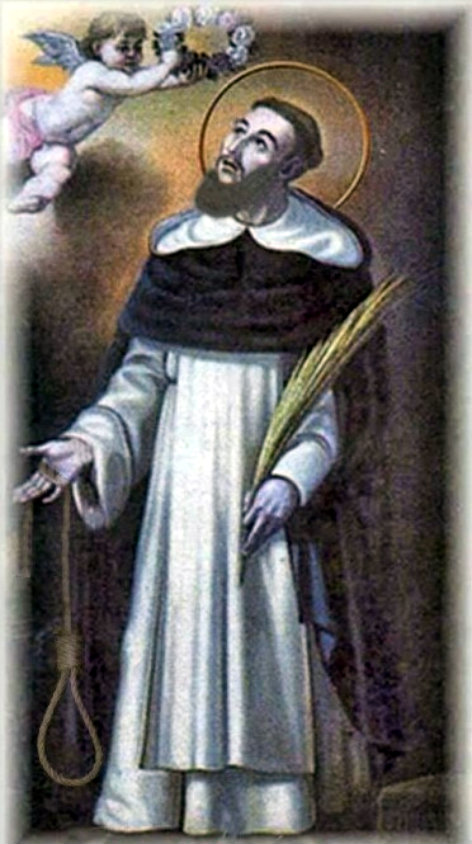
Saint of the Day – 6 September – Blessed Bertrand de Garrigues OP (c 1195-1230) Dominican Priest, Preacher, Evangeliser, Confessor – known as “The Second Dominic” was one of the first companions of Saint Dominic. Born c 1195 at Garrigue, diocese of Nîmes, France and died on 18 April 1230 at Garrigue, diocese of Nîmes, France of natural causes.   It has been said of him that he was ” a true reflection of the holiness of his master.”   Aside from being known as “the beloved companion of Dominic,” “the dearest associate in all his labours, the sharer in his devotions” “the imitator of his sanctity” and “the inseparable companion of his journeys” Bl Bertrand was one of the first 16 followers of St Dominic.Blessed-Bertrand-of-Garrigue-Dominican
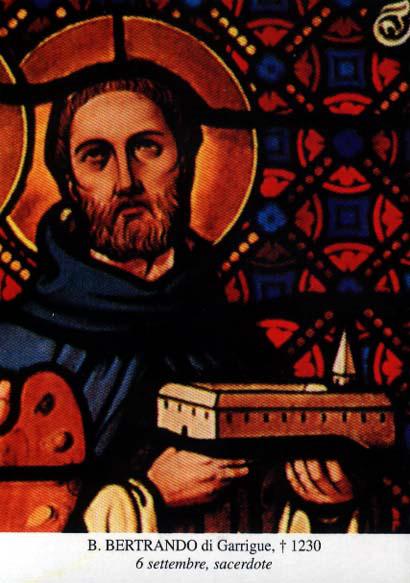
Blessed Bertrand was born in c 1195 at Garrigue, France.   Blessed Bertran’s parents were the friends of the Cistercian Sisters of the Convent of Notre Dame of the Woods at Bouchet.   This association of his family must have made a strong impression on the young Bertrand, as we was known to be a pious youth and from an early age expressed a desire to serve as a member of the clergy and fight the heresy of the Albigenses.

As a young priest, Blessed Bertrand was assigned to a band of missionaries, under the direction of Cistercian fathers, who were charged by the Holy See to bring the Albigenses back to a civilised life and to the Church.   It was during this mission work that Blessed Bertrand met Saint Dominic.   The two at once became close friends and spiritual brothers.

“Cast in the same mould and filled with the same spirit, they laboured, prayed and fasted together – all for the glory of God, the benefit of the Church, the good of religion and the salvation of souls  . Doubtless they effected more by their saintly lives and supplications before the throne of mercy than by their sermons, however eloquent and earnest these were.

The early writers speak of none of Saint Dominic’s first disciples more frequently, or in terms of higher praise, than of Blessed Bertrand de Garrigue.   They represent him as pious, candid, humble, zealous, much given to prayer, extremely mortified.

If we may judge by their representation of him, he was a true Israelite in whom there was no guile, greatly beloved by Saint Dominic, one of his most frequently chosen companions in labour and travel.   For this reason, as well as because they had toiled together for years, one can but believe that Bertrand was one of the first to whom Dominic made known his design of establishing an apostolic order, whose primary object should be the salvation of souls through an active ministry and whose field of operation should embrace the world.

In spite of his modesty and retiring manners, Bertrand was the kind of a man who would espouse such a cause with his whole heart, for the grace of God ever impelled him to do all in his power to increase the harvest of heaven.” – (The First Disciples of Saint Dominic, The Very Reverand Victor F. O’Daniel, O.P., S.T.M., Litt.D., 1928)dominicans
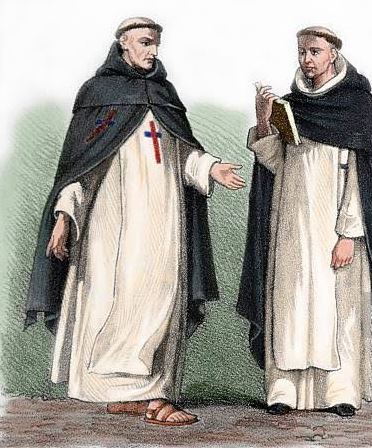
Blessed Bertrand received the habit of the Order from Saint Dominic.   It was apparent that in the very early days of the Order, Blessed Bertrand was considered second in rank only to Saint Dominic himself.   This may be evidenced by the fact that Saint Dominic left Blessed Bertrand in charge of the community when he went to Rome in the fall of 1215 to seek papal confirmation of the Order. In 1216 Saint Dominic named Blessed Bertrand as the third prior of the Order, in the Church of St Romanus, when St Dominic travelled to the Vatican to receive final approbation of the order.

Blessed Bertrand was known for his austere life and his obedience.   In fact, Bertrand was often known to wail aloud over his own sins, until Saint Dominic forbade him from wailing for his own sins but instructed him to bemoan the grave sins of the wicked.   In obedience, he immediately took on a life of prayer for the wicked of the world.

The last journey of Saint Dominic and Blessed Bertrand was in 1219 when the pair travelled to Paris where, upon arrival, the two spent the entire night in prayer at the Notre Dame Church, at Roe-Amadour.   Tradition tells us that during this journey the Holy Spirit gave Saint Dominic and Blessed Bertrand the gift of tongues and they were thus able to converse with German pilgrims in their native language.

In obedience to Saint Dominic, it appears that Blessed Bertrand did not speak of any of the miracles of Saint Dominic until after his death and then only to Blessed Jordan of Saxony, the first Master General of the Order after our Father Saint Dominic.

The last apostolic work of Blessed Bertrand was for the Cistercian Sisters of Notre Dame of the Woods at Bouchet, in the Diocese of Valence, where he was giving to these austere sisters a course of sermons on the spiritual life.   At only the age of about 35, Blessed Bertrand grew sick and died while with the Cistercian Sisters in 1230.   His body was buried in the conventual cemetery of the Cistercian Nuns near the apse of the abbatial church.dominican monks and sisters
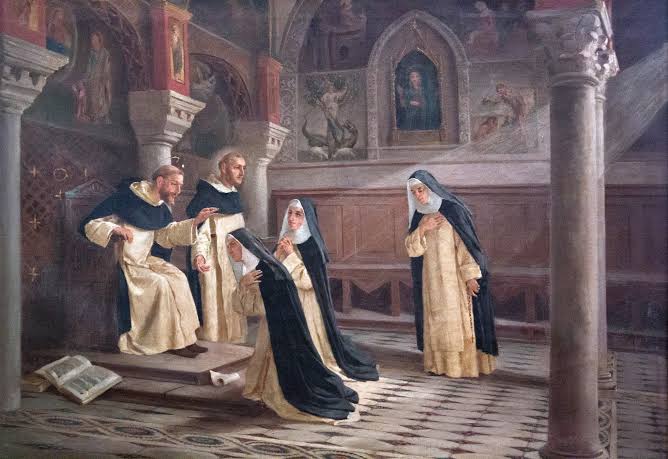
However, shortly after his death marvellous cures began to come forth through his intercession.   As a consequence, the Cistercian Nuns had an altar erected in his honour in their church and placed a statute of Blessed Bertrand upon the altar.   Blessed Bertrand’s remains, found wholly intact, were afterwards exhumed and placed beneath the altar.   However, the remains of Blessed Bertrand were destroyed by fire in 1561 during the religious wars that followed the Protestant Reformation.bl bernard de garrigue

Years later the cemetery of Notre Dame of the Woods became known as “Saint Bertrand’s Cemetery,” a name that endures to this day.   Blessed Bertrand was beatified when his cultus was confirmed on 14 July 1881 by Pope Leo XIII.

O God,
you joined to the holy patriarch Dominic
a companion and wonderful imitator in Blessed Bertrand.
With the help of his prayers
may we follow in life the faith which he preached
and so obtain the promised rewards in heaven.
We ask this through our Lord Jesus Christ, Your Son,
who lives and reigns with You and the Holy Spirit,
one God, forever and ever.
Amen.

Posted in DOMINICAN OP, SAINT of the DAY

Memorials of the Saints – 6 September

St Arator of Verdun
St Augebert of Champagne
St Augustine of Sens
St Beata of Sens
St Bega
Blessed Bertrand de Garrigues OP (c 1195-1230) “The Second Dominic”
St Cagnoald
St Consolata of Reggio Emilia
St Cottidus of Cappadocia
St Eleutherius the Abbot
St Eugene of Cappadocia
St Eve of Dreux
St Faustus of Alexandria
St Faustus of Syracuse
St Felix of Champagne
St Frontiniano of Alba
St Gondulphus of Metz
St Imperia
St Macarius of Alexandria
St Maccallin of Lusk
St Magnus of Füssen (Died c 666?)
Biography:
https://anastpaul.com/2017/09/06/saint-of-the-day-6-september-st-magnus-of-fussen/
St Mansuetus of Toul
St Onesiphorus
St Petronius of Verona
St Sanctian of Sens
St Zacharius the Prophet

Martyrs of Africa – 6 saints: There were thousands of Christians exiled, tortured and martyred in the late 5th century by the Arian King Hunneric. Six of them, all bishops, are remembered today; however, we really know nothing about them except their names and their deaths for the faith – Donatian, Fusculus, Germanus, Laetus, Mansuetus and Praesidius.

Martyred in the Spanish Civil War:
• Blessed Diego Llorca Llopis
• Blessed Felipe Llamas Barrero
• Blessed Pascual Torres Lloret
• Blessed Vidal Ruiz Vallejo

Posted in DOMINICAN OP, MYSTICS, SAINT of the DAY

Thought for the Day – 4 September – Be imprinted in our hearts, Lord

Thought for the Day – 4 September – Wednesday of the Twenty-second week in Ordinary Time, Year C and the Memorial of Blessed Catherine of Racconigi OP (1486-1547)

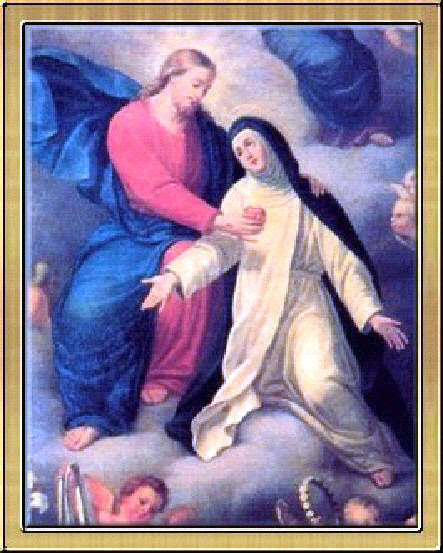
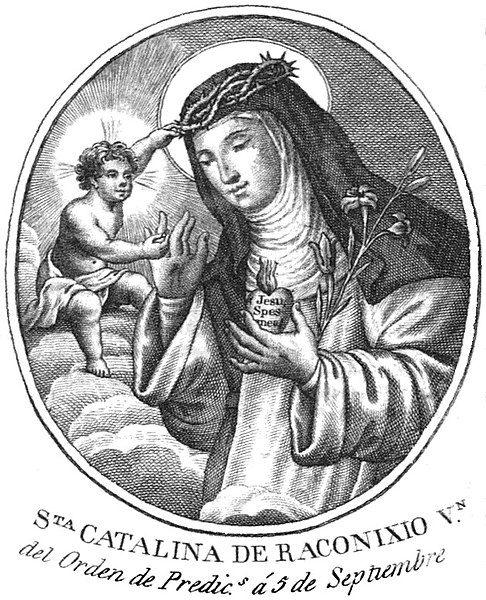
Just as the Carmelites have their many famous Teresas so too do the Dominicans have their Catherines – St Catherine of Alexandria (c287-c305) (by adoption as patroness of the Order), St Catherine of Siena (1347-1380) Doctor of the Church, St Catherine de Ricci (1522-2590), Bl Catherine Jarrige (1754-1836) and Bl Catherine of Racconigi, today’s saint. Most of these Catherine’s were espoused to the Lord.   Many of them received crowns of thorns.   They all showed the greatness of God’s grace to draw hearts close to Him.

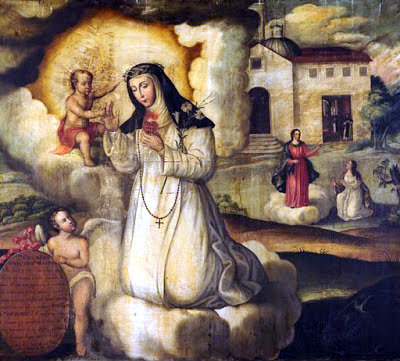
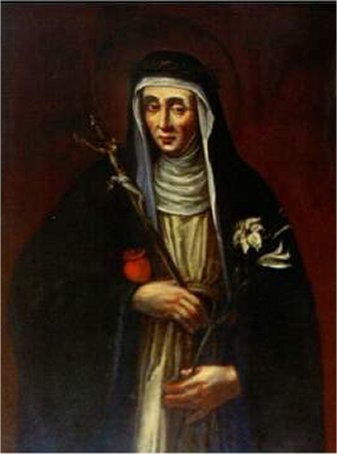
Aside from being espoused to the Lord at the age of five and aside from receiving the stigmata and a crown of thorns, Bl Catherine of Racconigi is a prime example of Christ drawing hearts close to Him.   Several times the Lord appeared to her and took her heart so that He might cleanse and beautify it.   Moreover, as the tradition holds, the words Jesu, spes mea –“Jesus, my hope!”–were inscribed on her heart in letters of gold.   Christ loves His virgin brides.   The tokens that He has given them, especially to the saintly Dominicans cloistered nuns and active sisters, shows that He desires nothing but union with souls.   Sometimes, this means sharing in the hardships of His Passion.   For Bl Catherine, this meant a life of destitute poverty, abandonment by many friends at death and even the challenge of being deprived of her confessor before she died.   Yet, through it all, her Hope–Christ the Lord, drew her to Himself, where she is now in perfect happiness in heaven.

O Lord, our Hope, who did enrich with an abundance of celestial gifts, the heart of Blessed Catherine, already filled with You, grant, through the intercession of that glorious Virgin, that You may be wholly fastened to our hearts, who for our sake, was wholly fastened to the cross, Christ our Lord. Amen.

Blessed Catherine of Racconigi, Pray for Us!bl catherine of racconigi pray for us 4 sept 2019.jpg

Posted in DOMINICAN OP, MYSTICS, SAINT of the DAY

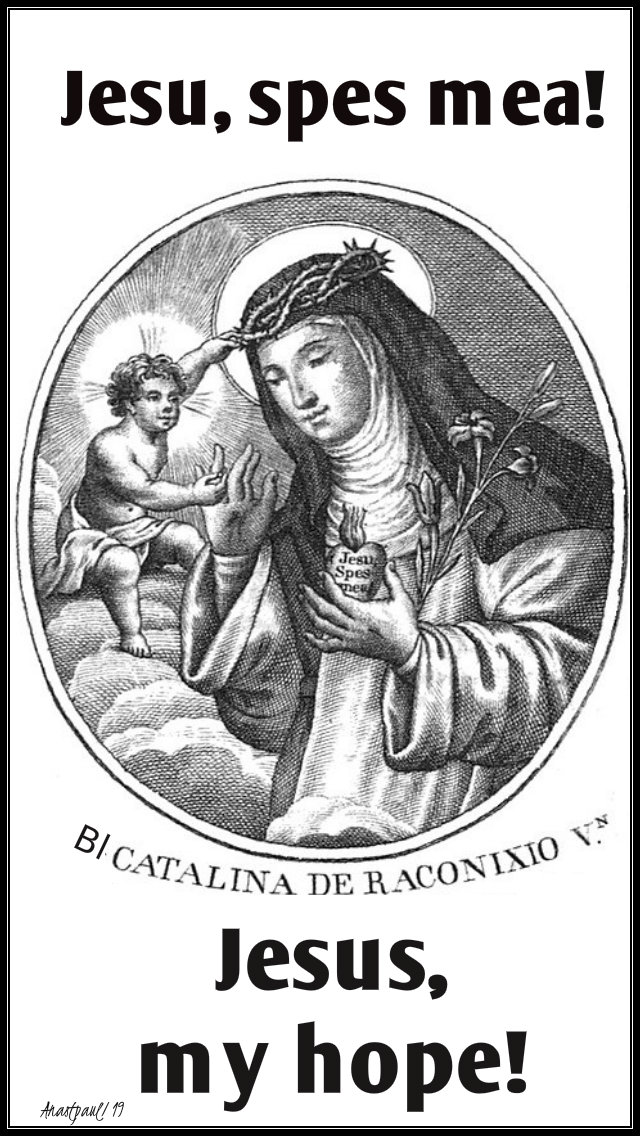
Quote of the Day – 4 September – Jesu, spes mea!

Quote of the Day – 4 September – Wednesday of the Twenty-second week in Ordinary Time, Year C and the Memorial of Blessed Catherine of Racconigi OP (1486-1547)

Jesu, spes mea!

Jesus, my hope!

Bl Catherine of Racconigi (1486-1547)jesu spes mea - jesus my hope bl catberine of racconigi 4 sept 2019.jpg

Posted in DOMINICAN OP, MYSTICS, SAINT of the DAY

Saint of the Day – 4 September – Blessed Catherine of Racconigi OP (1486-1547)

Saint of the Day – 4 September – Blessed Catherine of Racconigi OP (1486-1547) – Third Order Dominican, Mystic, Stigmatist – born as Caterina Mattei in June 1486 in Racconigi, Cuneo, Italy and died on 4 September 1547 at Caramagna Piemonte, Cuneo, Italy.bl catherine of racconigi-header

Most of the information regarding Catherine Mattei is derived from a ‘vita’ written by her friend, John Francis Pico, Prince of Mirandola.   Catherine Mattei was born in the Piedmont region of Northwest Italy in 1487 into an impoverished household in the Province of Cuneo.   Intermittent conflicts in the area brought widespread poverty.   Her parents were Giorgio and Bilia de Ferrari Mattei.   Her father, an unemployed locksmith, became despondent and quarrelsome as so many do when they lose their livelihood.  Her mother supported the family by weaving coarse cloth at home.   Catherine and her brother grew up in an atmosphere that was absent of the peace of Christ.

Surprisingly, God reached the heart of little Catherine when she was only five.   It was then that her mystical experiences began.   Our Lady appeared to her while the tiny child was praying alone in her tiny room and told Catherine that Jesus wished to make her His spouse.   Then, as a child her own age, Jesus Himself appeared, accompanied by many other saints including Catherine of Siena and Peter Martyr and the Blessed Mother placed the ring of espousal on her finger.   Like the ring of Saint Catherine of Siena, it was visible to today’s saint but could not be seen by others.bl catherine.jpg

Thereafter Catherine had frequent ecstasies and visions.   Jesus always appeared to her as a man her own age, whatever that was at the time.   He talked with her, taught her how to pray and several times took her heart away to cleanse it.   When He appeared with His Cross, she offered to help Him.   He let it rest on her shoulder a moment and it left a wound for the rest of her life.   She also received the stigmata, though it too remained invisible to others and, at her request, it was only revealed by her confessor after her death.

And, of course, Jesus worked many miracles on behalf of His friend – made a broken dish whole again and provided money and food when the family’s poverty was extreme.   In times of trial, the heavenly hosts came to comfort the girl who received great consolation from the aspiration, “Jesus, my hope!”bl catherine of racconigi.jpg

Because her family opposed her becoming a Dominican, she took the habit of a tertiary. Her mystical experiences roused a storm of gossip among her neighbours, who were terrified at the lights and sounds that came from her home.   The devil stirred up more trouble to mitigate her influence over other souls.   Even the Dominican fathers ostracised her and eventually she was forced out of town and settled in Racconigi.

There rich and poor sought out Catherine for her wise counsel, prayers and material assistance.   She was almost continually in ecstasy.   The particular object of Catherine’s prayers was the salvation of soldiers dying in battle and the holy souls in Purgatory. Numerous miracles occurred before and after her death and a cult arose at her tomb almost immediately.   Even her persecutors were aware of her sanctity and retracted their bitter words.

Pope Pius VII confirmed her holiness and cult in 1810 by naming her Blessed.bl 486px-Catherine_de_Racconigi.jpg

Posted in DOMINICAN OP, SAINT of the DAY

Thought for the Day – 23 August – It seems that when we have become most like slaves, there is the greatest talk of “freedom.”

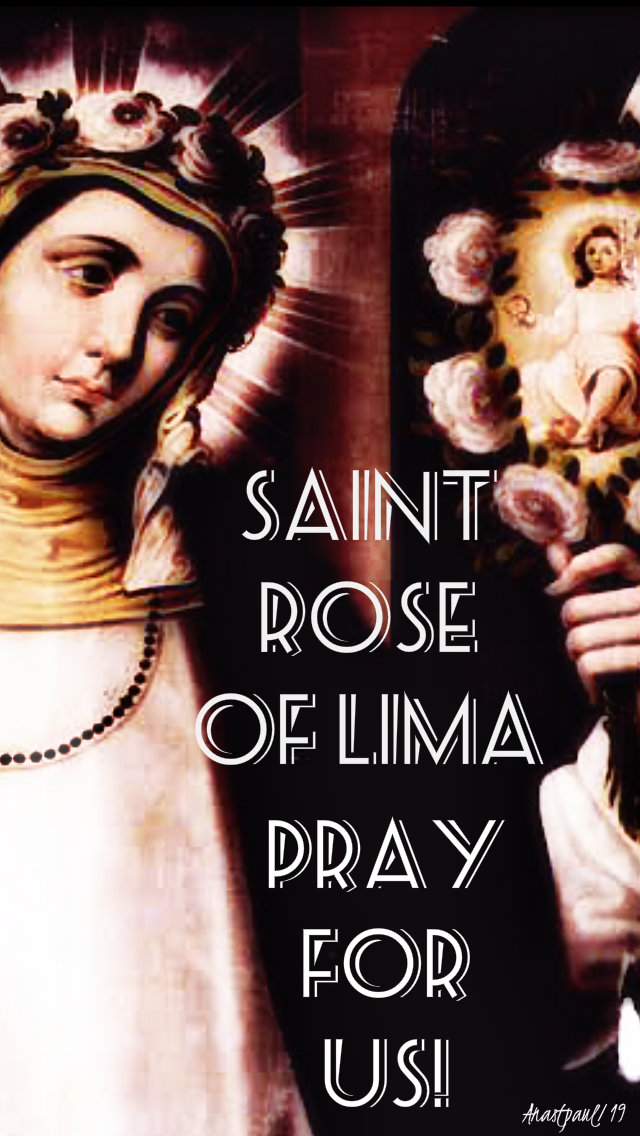
Thought for the Day – 23 August – Friday of the Twentieth week in Ordinary Time, Year C and the Memorial of St Rose of Lima (1586-1617)

The first Canonised saint of the New World has one characteristic of all saints—the suffering of opposition—and another characteristic which is more for admiration than for imitation—excessive practice of mortification.

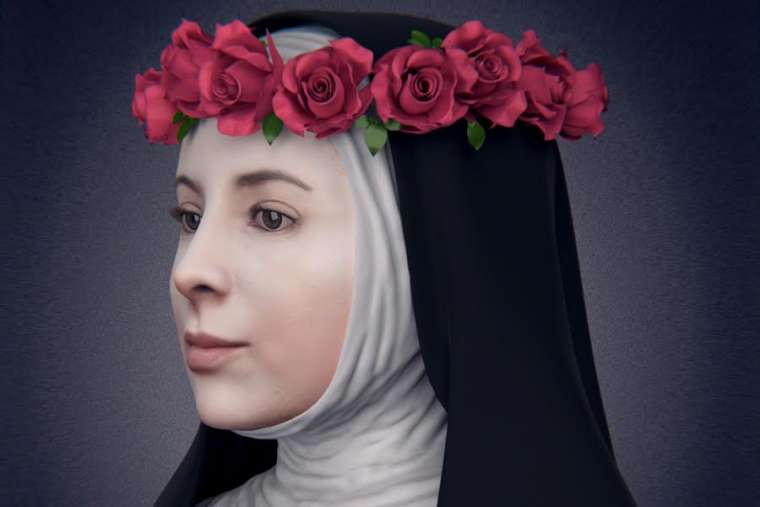
The saints have so great a love of God that what seems bizarre to us and is indeed sometimes imprudent, is simply a logical carrying out of a conviction, that anything that might endanger a loving relationship with God, must be rooted out.   So, because her beauty was so often admired, Rose used to rub her face with pepper to produce disfiguring blotches.   Later, she wore a thick circlet of silver on her head, studded on the inside, like a crown of thorns.  (Scientists recently performed an analysis of her skull, which has been kept by Dominicans in Peru and created a digital reconstruction of her face.  – See below).St_Rose_of_Lima_Credit_Divulga_o_Ebrafol_Brazilian_Team_of_Forensic_Anthropology_and_Odontology_CNA_8_26_15.jpg

What might have been a merely eccentric life was transfigured from the inside.   If we remember some unusual penances, we should also remember the greatest thing about Ros -: a love of God so ardent, that it withstood ridicule from without, violent temptation, and lengthy periods of sickness.   When she died at 31, the city turned out for her funeral. Prominent men took turns carrying her coffin.

It is easy to dismiss excessive penances of the saints as the expression of a certain culture or temperament.   But a woman wearing a crown of thorns may at least prod our consciences.   We enjoy the most comfort-oriented life in human history.   We eat too much, drink too much, use a million gadgets, fill our eyes and ears with everything imaginable.   Commerce thrives on creating useless needs on which to spend our money. It seems that when we have become most like slaves, there is the greatest talk of “freedom.”   Are we willing to discipline ourselves in such an atmosphere?

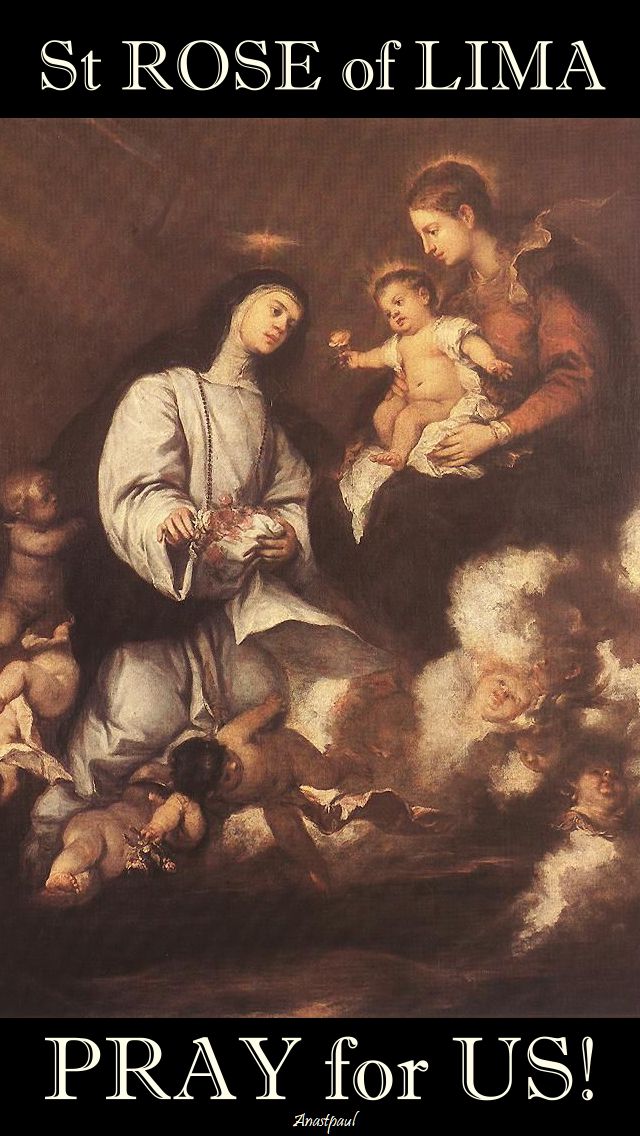
St Rose of Lima, Pray for Us!st rose of lima pray for us 23 aug 2019.jpg

Posted in DOMINICAN OP, QUOTES of the SAINTS, QUOTES on ALMS, QUOTES on CHARITY, QUOTES on GRACE, QUOTES on LOVE, QUOTES on SACRIFICE, QUOTES on SUFFERING, SAINT of the DAY, The MOST PRECIOUS BLOOD

Quote/s of the Day – 23 August – St Rose of Lima

Quote/s of the Day – 23 August – Friday of the Twentieth week in Ordinary Time, Year C and the Memorial of St Rose of Lima (1586-1617)

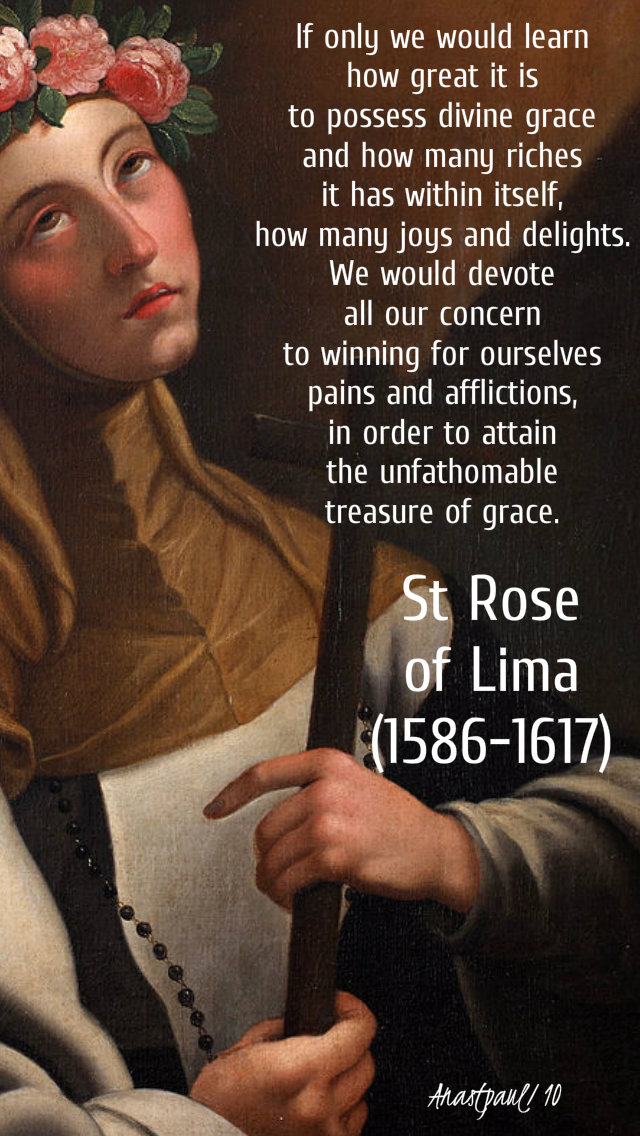
“If only we would learn how great it is
to possess divine grace and how many riches it has within itself,
how many joys and delights.
We would devote all our concern to winning for ourselves
pains and afflictions,
in order to attain the unfathomable treasure of grace.”if only we would learn - st rose of lima - 23 aug 2019.jpg

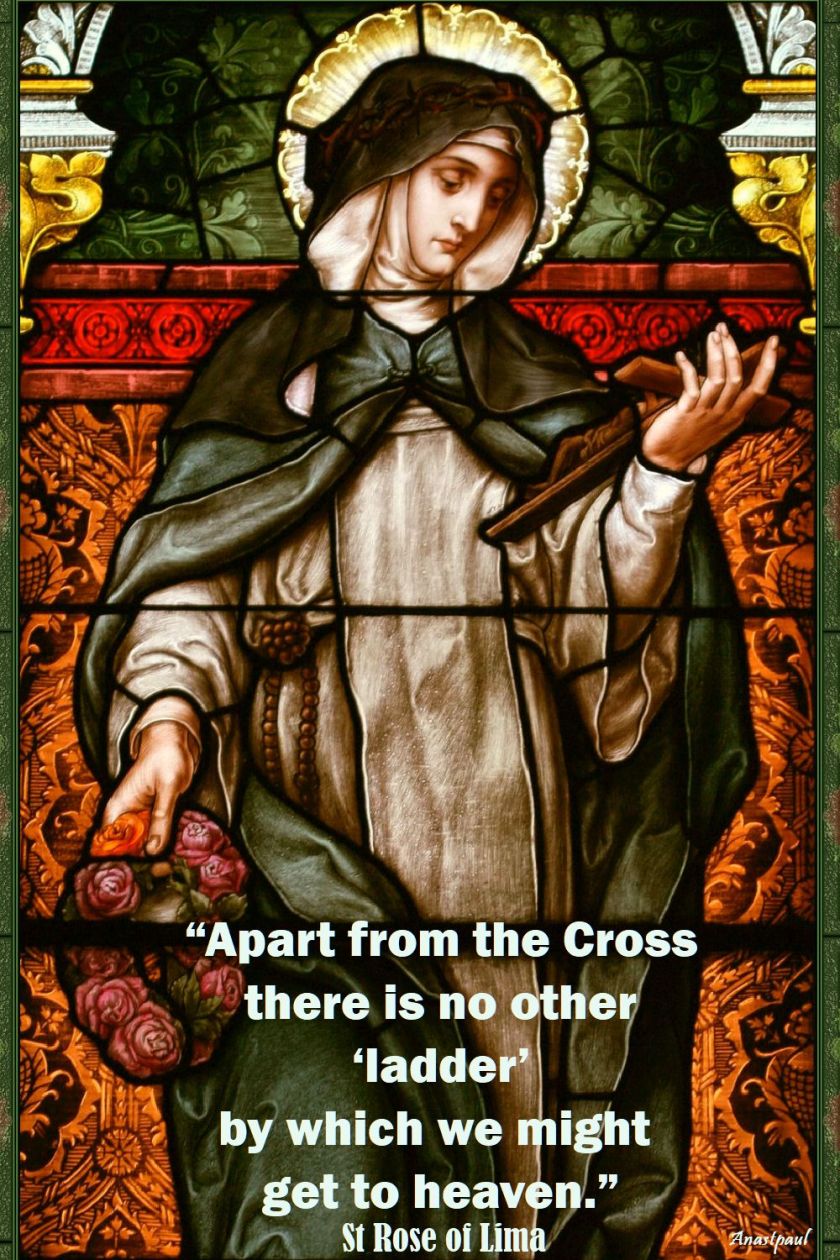
“Apart from the Cross
there is no other ‘ladder’
by which we might get to heaven.”apart-from-the-cross-st-rose-of-lima 23 aug 2017.jpg

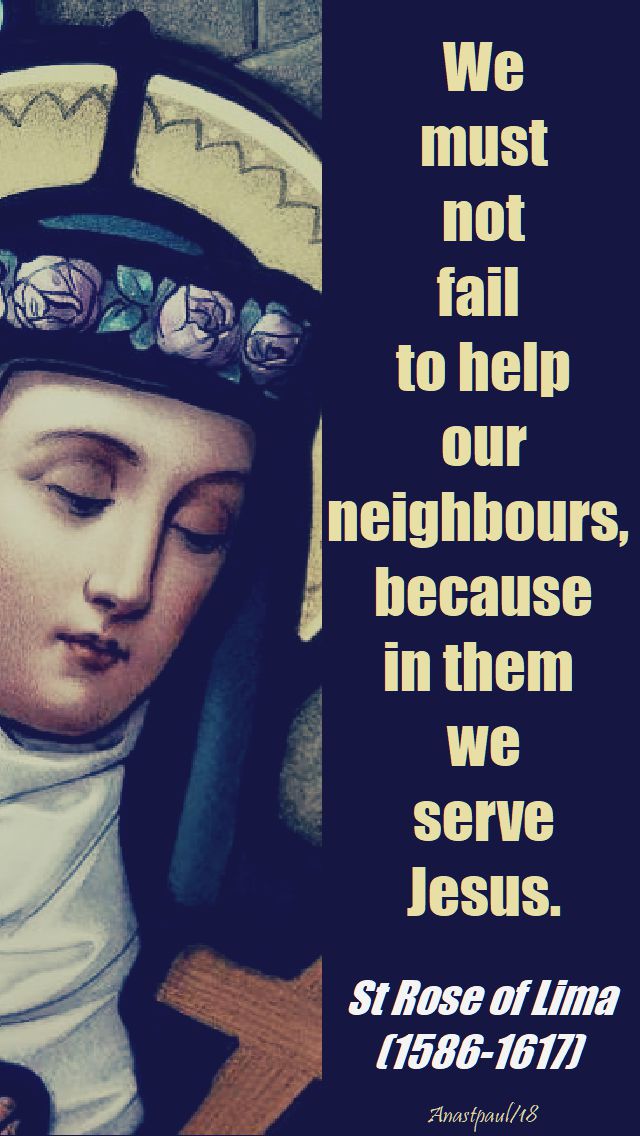
“We must not fail
to help our neighbours,
because in them we serve Jesus.”

St Rose of Lima (1586-1617)we-must-not-fail-st-rose-of-lima-23-aug-2018.jpg

Posted in DOCTORS of the Church, DOMINICAN OP, MORNING Prayers, PRAYERS for SEASONS, QUOTES of the SAINTS, QUOTES on CHARITY, QUOTES on LOVE, SAINT of the DAY, The WORD

One Minute Reflection – 23 August – Love the Lord, Love your neighbour

One Minute Reflection – 23 August – Friday of the Twentieth week in Ordinary Time, Year C, Today’s Gospel: Matthew 23:34-40 and the Memorial of St Rose of Lima (1586-1617)

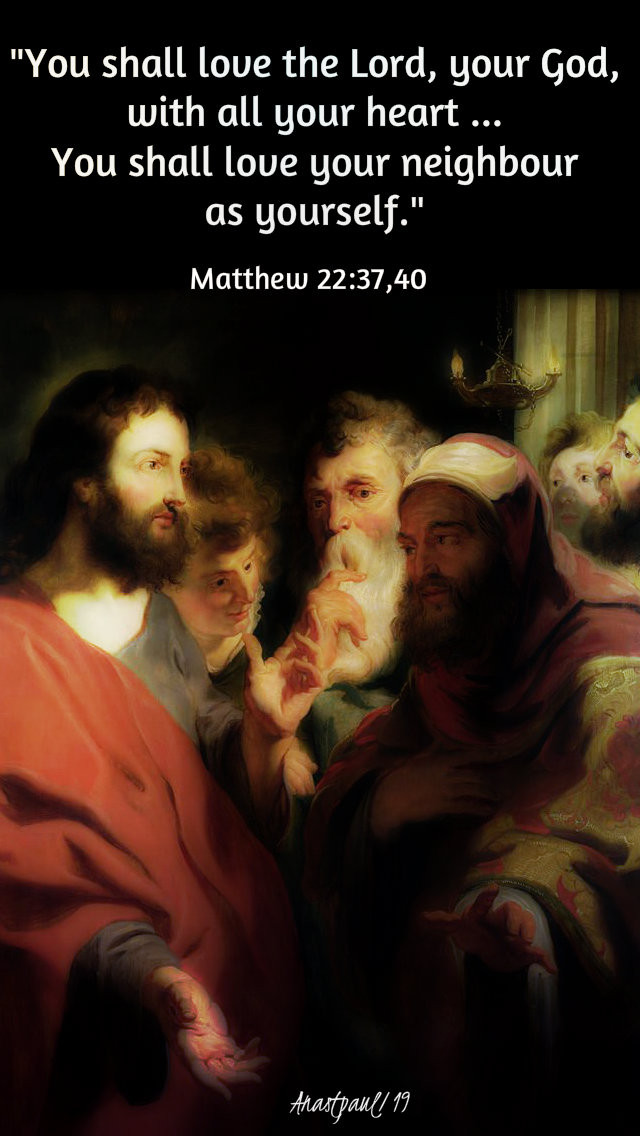
“You shall love the Lord, your God, with all your heart … You shall love your neighbour as yourself.” … Matthew 22:37,40matthew 22 37 and 40 you shall the lord your god you shall yourneighbour - 23 aug 2019.jpg

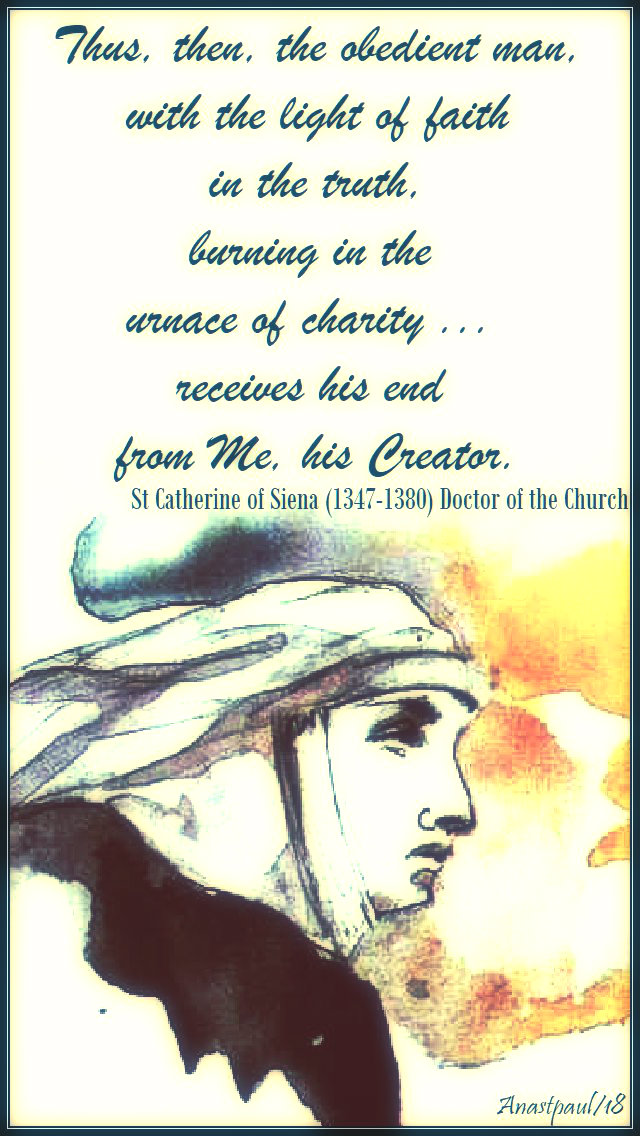
REFLECTION – “Thus, then, the obedient man,with the light of faith, in the truth burning in the furnace of charity … receives his end from Me, his Creator.”…St Catherine of Siena (1347-1380) Doctor of the Churchthus-then-the-obedient-man-no 2 - st-catherine-of-siena-23-aug-2018.jpg

PRAYER – “God our Father, for love of You, St Rose of Lima left the world and gave herself to a life of penitence, austerity and charity.   Help us by her prayers, so to follow the path of life on earth, in complete love of You and thus of Your children, that we may obtain the fullness of joy in Your presence in heaven and be clothed fit for the wedding feast.  We make our prayer through Christ our Lord, in the unity of the Holy Spirit, one God forever, amen.st-rose-of-lima-pray-for-us-23-aug-2017


Posted in DOMINICAN OP, SAINT of the DAY, VATICAN Resources

Memorials of the Saints – 23 August

St Rose of Lima (1586-1617) OP (Optional Memorial)
Biography:
https://anastpaul.com/2018/08/23/saint-of-the-day-23-august-st-rose-of-lima-1586-1617/

St Abbondius of Rome
St Altigianus
St Apollinaris of Rheims
St Archelaus of Ostia
St Asterius of Aegea
St Claudius of Aegea
St Domnina of Aegea
St Eleazar of Lyons
St Eonagh
St Flavian of Autun
Bl Franciszek Dachtera
Bl Giacomo Bianconi of Mevania
St Hilarinus
St Ireneus of Rome
Bl Jean Bourdon
Bl Ladislaus Findysz (1907-1964) Martyr
St Lupo of Novi
St Luppus
St Maximus of Ostia
St Minervius of Lyons
St Neon of Aegea

St Philip Benizi (1233-1285)
Biography here:   https://anastpaul.wordpress.com/2017/08/23/saint-of-the-day-23-august-st-philip-benezi/

St Quiriacus of Ostia
St Theonilla of Aegea
St Timothy of Rheims
St Tydfil
St Victor of Vita
St Zaccheus of Jerusalem

Martyrs of Agea – 4 saints: A group of Christian brothers, Asterius, Claudius and Neon, denounced by their step-mother who were then tortured and martyred in the persecutions of Pro-consul Lysias. They were crucified in 285 outside the walls of Aegea, Cilicia (in Asia Minor) and their bodies left for scavengers.

Martyred in the Spanish Civl War:
• Blessed Constantino Carbonell Sempere
• Blessed Estanislau Sans Hortoneda
• Blessed Florentín Pérez Romero
• Blessed José Polo Benito
• Blessed Lorenzo Ilarregui Goñi
• Blessed Manuela Justa Fernández Ibero
• Blessed Mariano García Méndez
• Blessed Nicolás Alberich Lluch
• Blessed Pere Gelabert Amer
• Blessed Petra María Victoria Quintana Argos
• Blessed Ramón Grimaltos Monllor
• Blessed Urbano Gil Sáez
• Blessed Vicente Alberich Lluch

Posted in DOMINICAN OP, SAINT of the DAY

Saint of the Day – 22 August – Blessed Giacomo Bianconi OP (1220-1301)

Saint of the Day – 22 August – Blessed Giacomo Bianconi OP (1220-1301) – Dominican Priest and Friar, Confessor, Spiritual Advisor, founder and restorer of convents and churches – born on 7 March 1220 at Mevania (modern Bevagna), diocese of Spoleto, Umbria, Italy and died on 22 August 1301 at Mevania, Italy of natural causes.   He is also known as Blessed James Bianconi.1_Benedetto_di_Bindo._Blessed_James_of_Bevagna,_c._1415_Fondazione_Monte_dei_Paschi,_Siena.

Blessed Giacomo was born in Bevagna and was received into the Dominican Order at Spoleto in 1236.   After his ordination, he devoted his energies to the eradication of the heresy of the Nicolaites from Umbria and finally succeeded in converting its chief propagator, Ortinellus.   He became Provincial Minister in 1281 and was elected Prior of the Dominican convents in Spoleto, in 1291 and Foligno, in 1299.

Blessed Giacomo was prominent in providing aid to refugees from Bevagna after the Emperor Frederick II sacked the city in 1249.   He was subsequently active in the rebuilding of the town, which culminated in the rebuilding of Palazzo dei Consoli in 1270.   In 1291, he received permission to rebuild the church of San Giorgio in Bevagna and to construct the adjoining convent.   He also established two nunneries in Bevagna – Santa Lucia and Santa Margherita.   Towards the end of his life, he also served as Lector at San Domenico, Orvieto, where he acted as the spiritual advisor of the Blessed Jane of Orvieto.   This Church is now renamed as Sts Domenico & Giacomo.

These two statues below, which are thought to have been bought by the Blessed Giacomo in Perugia, were moved from in Sts Domenico & Giacomo to the Pinacoteca in 2016:

✴a figure of the Madonna and Child; and

✴a wooden Crucifix.   Once, as he prayed before it because he was experiencing doubts about his salvation, blood spurted from the image and he heard Christ saying:  “This blood is the sign of your salvation”.img-Blessed-Giacomo-Bianconi.jpg

Both statutes were recorded in the 17th century the Cappella del Crocifisso at SS Domenico & Giacomo, which belonged to the Antici family.

After a life of extraordinary austerity, Giacomo died in Bevagna.   Sts George and Dominic appeared to him as he died, in order to reward him for the honour that he had shown to them during his life.

When the Blessed Giacomo died in 1301, he was buried in San Giorgio.  Bev-SD-New-SarcophagusMiracles were reported at his grave and his relics were translated in 1302 into a sarcophagus that is now on the counter-facade of Sts Domenico & Giacomo, to the left of the entrance.

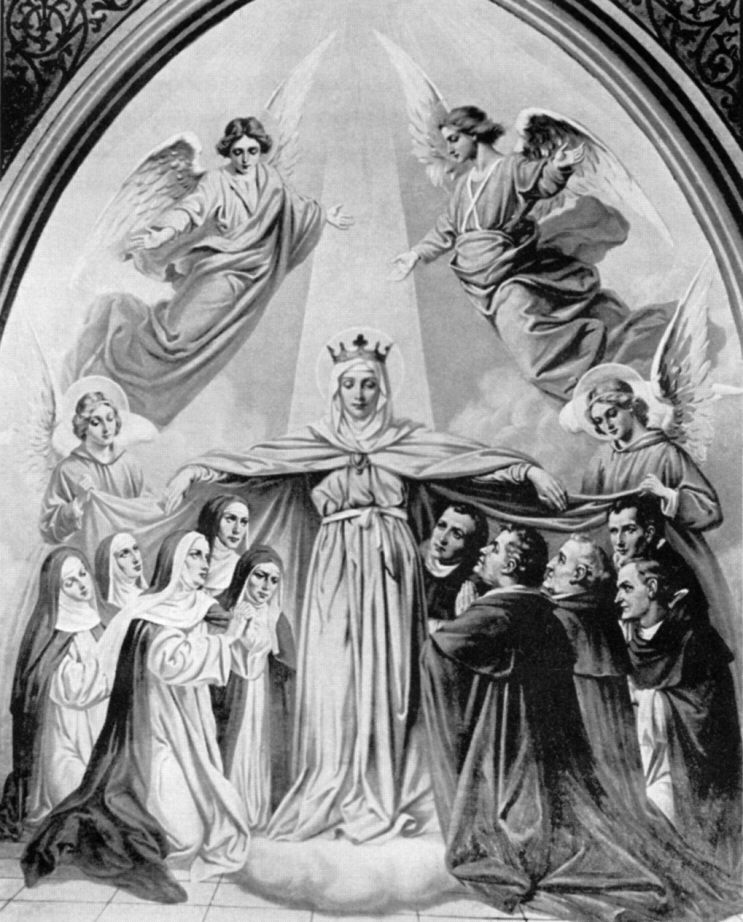
The Dominicans rebuilt San Giorgio in 1397 and re-dedicated it as Sts Domenico & Giacomo, probably as part of a bid for the canonisation of Giacomo Bianc  oni. Pope Boniface IX granted indulgences to those who prayed before his relics during the first three days of May.   Boniface IX granted similar indulgences in respect of Blessed Peter Crisci of Foligno.   However, any early attempt to secure canonisation failed.

The relics were re-interred in 1589 in a new sarcophagus, as part of a fresh attempt to secure his beatification.   This was adorned with painted scenes by Ascensidonio Spacca, il Fantino that depict the Blessed Giacomo.

Bishop Alfonso Visconti initiated a process for canonisation in 1608 but this was halted when he died soon after.   Bishop Maffeo Barberini (later Pope Urban VIII) re-opened the case in 1612 and this led in 1632 to a formal process under three bishops, including Bishop Lorenzo Castrucci of Spoleto.   This process was inconclusive and a second was needed before Urban VIII Beatified the Blessed Giacomo in 1641  . The frescoes in the cloister of the convent, which depict scenes from the life of the Blessed James, commemorate this event.

The death of Urban VIII in 1644 probably precluded the canonisation of the Blessed Giacomo.   Yet another process was instituted in 1658 and Pope Clement X confirmed the cult in 1672.   The relics were finally translated to the gilded bronze urn on the high altar of SS Domenico & Giacomo in 1686.  Blessed Giacomo’s praise can be read in the Roman martyrology on 22 August

Posted in DOMINICAN OP, SAINT of the DAY

Saint of the Day – Blessed Jordan of Pisa OP (c 1255–1311)

Saint of the Day – Blessed Jordan of Pisa OP (c 1255–1311) – Dominican Friar, Theologian, Professor, renowned Preacher, Founder of the Confraternity of the Holy Redeemer at Pisa, Visionary, Marian devotee, promoter and daring innovator of the vernacular Italian language as a ‘church’ language and a tool for evangelisation – born c 1255 at Pisa, Italy and died on 19 August 1311 at Piacenza of natural causes.   At a time when scholars believed that no colloquial tongue could ever replace Latin as a ‘gentleman’s’ language, Jordan worked to make Italian the beautiful tongue that it is today.

used for blessed jordan of pisa - dominican Constavez.png
See the Note at the bottom

Jordan attended the University of Paris where he first encountered the Dominican friars in 1276.   Four years later, probably after obtaining his degrees, he returned to Italy and took the habit.   He began a long teaching career there as soon as he was qualified to do so.

He preached and taught variously at Siena, Viterbo and Perugia before eventually moving to Florence, in which area he was a widely respected preacher, eventually being appointed by the provincial chapter at Rieti as a lector in the church of Santa Maria Novella in 1305.   He held that post for the next three years and contributed greatly to its esteem.   In 1301, he attended a general meeting of the order held in Cologne, Germany..

He seems to have been fascinated with the whole question of preaching as an apostolic tool and to have been one of the first to make a scientific study of it.   He pointed out that the Greek church was “invaded by a multitude of errors,” because the Greeks had no preachers, he could never say enough in praise of Saint Dominic’s farsightedness in establishing an order specifically for preaching.

Jordan studied methods of making sermons more effective, both by using examples that would reach the people and by the use of the vernacular.   This latter was a much-disputed subject in his day, Jordan was considered a daring innovator.   Because it was controversial, he strove to make Italian a beautiful instrument on which he could play the melodies of the Lord.

bl jordan of pisa 800px-Pantheologia,_ms_van_Kruisherenklooster_Maastricht_1470_(UB_Groningen,_ms._18)_-_1
Bl Jordan’s Pantheologia (written early 14th century, this manuscript from 1470)

Blessed with an extraordinary memory, Jordan was renowned for his knowledge in general and knew the Breviary by heart, as well as the Missal, most of the Bible (with its marginal commentary), plus the second part of the Summa.   This faculty of memory he used in his sermons but he was quick to point out to young preachers that learning alone can never make a preacher.   By the holiness of his own life he made this plain and continually preached it to those he was training to preach.

Jordan of Pisa had two great devotions–to Our Blessed Mother and to Saint Dominic.   He was favoured with a vision of Our Lady, she came into the fathers’ refectory and served at table.   Jordan, who was the only one who could see her, could barely eat for excitement.   He spoke often of her in his sermons and also of Saint Dominic. dominican saints and the blessed virgin

In 1311 the Master General,  Aymericus Giliani, appointed him professor of theology at the friary of Saint James in Paris, to deliver his reading of the Lombard’s Sentences and obtain his master’s degree but Jordan died on his way to Paris.   His body was returned from Piacenza, where death overtook him, to rest in the church of Santa Caterina in Pisa.
On 23 August 1833, Blessed Jordan’s cultus was confirmed by Pope Gregory XVI and in 1838 he was Beatified by Pope Gregory XVI.

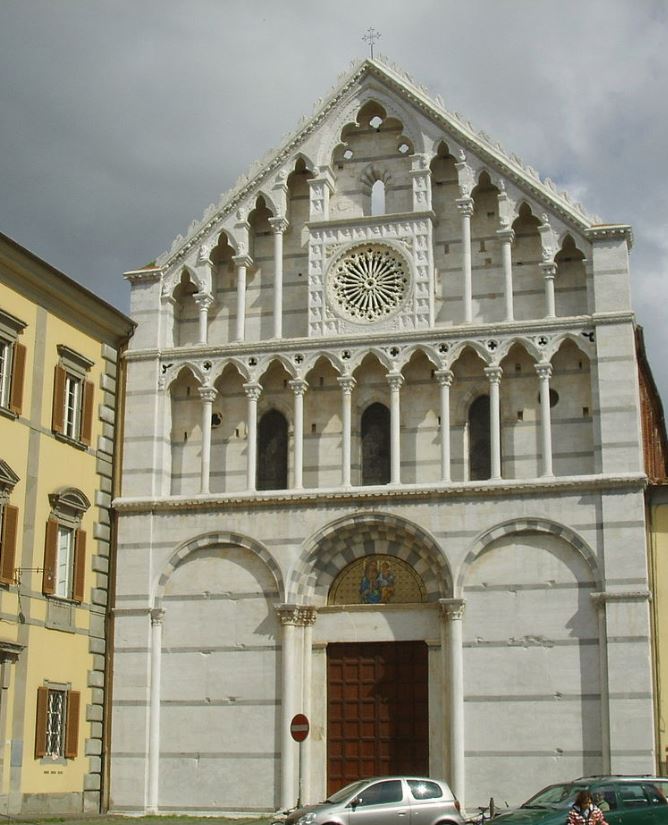
santa catarina pisa bl jordan of pisa relics
Santa Caterina in Pisa

Jordan studied the use of preaching for evangelisation.   He pioneered the use of the Tuscan language for preaching and lecturing, which helped establish it as the foremost among the vernaculars of Italy.   His Tuscan was reputedly versatile and musical but never elaborate or ornate.   At Florence he would reportedly preach five times a day, walking about, both indoors and out, followed by a crowd of listeners as he developed his topic.   During his lengthy sermons his friend and disciple, Silvester of Valdiseve (1278–1348), sometimes sat near the pulpit with wine to refresh him.   Some of his listeners took notes that have survived.   His preaching was said to have a positive effect on Florentine public life and morality by its emphasis on sound (i.e. Thomistic) doctrine, Christian living and perseverance.   What he had to say would have sounded dry in Latin but significantly, no Latin sermons by Jordan have survived.

God of holiness,
by the integrity of his life and gentle manner
You made Blessed Jordan
a fitting minister to preach the gospel.
By following his example,
may we generously strive to serve You
through service to our neighbour
and so gain the fruit of an everlasting reward.
We ask this through our Lord Jesus Christ,
Your Son, who lives and reigns with You
and the Holy Spirit, one God, forever and ever.
Amen

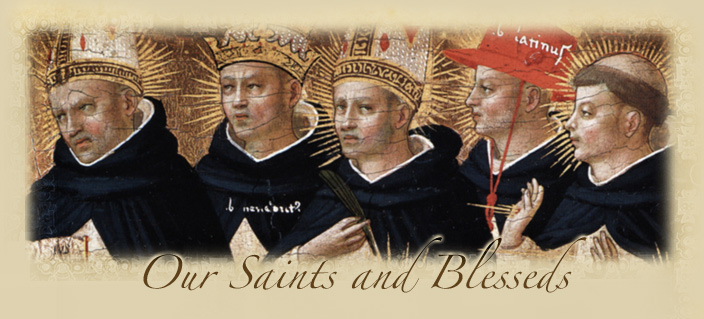
General Calendar of the Order of Preachersdominican our_saints_and_blesseds

Note:  The first image above is probably NOT Blessed Jordan but the image found online for him, is actually Blessed Jordan of Saxony.   I used this unknown friar above as there seem to be no known images available of Blessed Jordan of Pisa.

Posted in DOMINICAN OP, SAINT of the DAY

Memorials of the Saints -19 August

St John Eudes (Optional Memorial)
Biography here:
https://anastpaul.wordpress.com/2017/08/19/saint-of-the-day-19-august-st-john-eudes-apostle-of-two-hearts/

St Andrew the Tribune
St Badulf of Ainay
St Bertulf of Luxeuil
St Calminius
St Credan of Evesham
St Donatus of Mount Jura
St Elaphius of Châlons
St Ezekiel Moreno Y Diaz
St Guenninus
Bl Guerricus
Bl Hugh Green
Bl Jordan of Pisa OP (c 1255–1311)
St Julius of Rome
St Louis of Toulouse
St Magnus of Anagni
St Magnus of Avignon
St Magnus of Cuneo
St Marianus of Entreaigues
St Marinus of Besalu
St Magino of Tarragona
St Mochta
St Namadia of Marsat
St Rufinus of Mantua
St Sarah the Matriarch
St Sebaldus
St Thecla of Caesarea
St Timothy of Gaza

Martyrs of Nagasaki – 15 beati: A group of missionaries and their laymen supporters who were executed for spreading Christianity in Japan.
• Antonius Yamada
• Bartholomaeus Mohyoe
• Iacobus Matsuo Denji
• Ioachim Díaz Hirayama
• Ioannes Miyazaki Soemon
• Ioannes Nagata Matashichi
• Ioannes Yago
• Laurentius Ikegami Rokusuke
• Leo Sukeemon
• Ludovic Frarijn
• Marcus Takenoshita Shin’emon
• Michaël Díaz Hori
• Paulus Sankichi
• Pedro de Zúñiga
• Thomas Koyanagi
Theywere beheaded on 19 August 1622 at Nagasaki, Japan and Beatified on 7 May 1867 by Pope Pius IX.

Martyred in the Spanish Civil War
Martyred Carmelite Sisters of Charity – 9 beati
Martyred Salesians of Ciudad Real – 8 beati
Martyred Subiaco Benedictines of Barcelona – 7 beati
• Blessed Agueda Hernández Amorós
• Blessed Agustí Busquets Creixell
• Blessed Andrés Pradas Lahoz
• Blessed Antolín Martínez y Martínez
• Blessed Antoni Pedró Minguella
• Blessed Càndid Feliu Soler
• Blessed Cipriano González Millán
• Blessed Damián Gómez Jiménez
• Blessed Elvira Torrentallé Paraire
• Blessed Félix González Bustos
• Blessed Francisca de Amézua Ibaibarriaga
• Blessed Francisco de Paula Ibáñez y Ibáñez
• Blessed Ignasi Guilà Ximenes
• Blessed Isidro Muñoz Antolín
• Blessed Joan Roca Bosch

Posted in DOMINICAN OP, SAINT of the DAY

Thought for the Day – 17 August – To be full of God

Thought for the Day – 17 August – The Memorial of St Hyacinth OP (1185-1257) – “Apostle of Poland” “Apostle of the North”

The life of this thirteenth century “Apostle of the North,” known for his zeal for souls, makes him a great patron for our modern times, so much in need of young hearts fearlessly leaving all to proclaim the Gospel.   Zeal such as that of S. Hyacinth is the driving force of the Order of Preachers.

If we consider the Greek etymology of the word “enthusiasm,” which means “to be full of God,” Hyacinth comes across as a figure unconditional in his enthusiasm for preaching the Good News.   Born of noble parents in Poland around 1185, he was educated in Cracow.   On a trip to Rome in 1218, he met St Dominic, from whom both Hyacinth and his cousin, Ceslaus, received the habit of the Friars Preachers.   A painting at the Dominican Church of Santa Sabina in Rome depicts this event with Ceslaus lying prostrate on the floor and Hyacinth being clothed by St Dominic in the white robe of “the athletes of the faith.”   Within a few months of his reception of the habit, Hyacinth embarked on his first mission, sent by St Dominic to preach and establish the Order in Poland.

After unceasing labours and vast journeys, Hyacinth spent his last few months of life in a monastery he had founded in Cracow.   Although worn out and weakened by illness and fever, he kept watch in the service of God until his death by celebrating Mass on the Feast of the Assumption.   He was anointed at the foot of the altar on 15 August 1257 and died the same day.   Canonised over 300 years later, he was the seventh Dominican to be raised to sainthood.

How can we relate to this saint today and call on him to watch over re-evangelisation efforts carried out by the followers of Christ around the world?   The answer lies in Hyacinth’s fidelity to the charism of St Dominic.   This Polish Dominican responded without hesitation to the personal call of Christ, re-echoed centuries later by St John Paul II in the words, duc in altum (cast out into the deep).   Hyacinth followed Christ with all the idealism and fervour of his youth  . With trust, Hyacinth put the little he had into the hands of the Lord, who blessed and multiplied his offering, feeding the thousands who were converted, baptised, re-evangelised or inspired to join the Order of Preachers.

The flame that set the heart of this “Polish St Dominic” on fire to preach the Truth is still burning. T  hat flame is the Person of Jesus Christ, searching for those who will give their lives for the Gospel in this “springtime of evangelisation.”   In 1957 the Polish Dominican Provincial remarked that strong devotion to St Hyacinth was always followed by renewed activity and spiritual fervour among the Polish Dominicans, while a weakening in this filial dependence on his intercession invariably resulted in a far less energetic spirit among the brethren.   From his place on the Bernini colonnade at St Peter’s, Hyacinth urges us to assume our place in the glorious mission to spread the Kingdom of God.

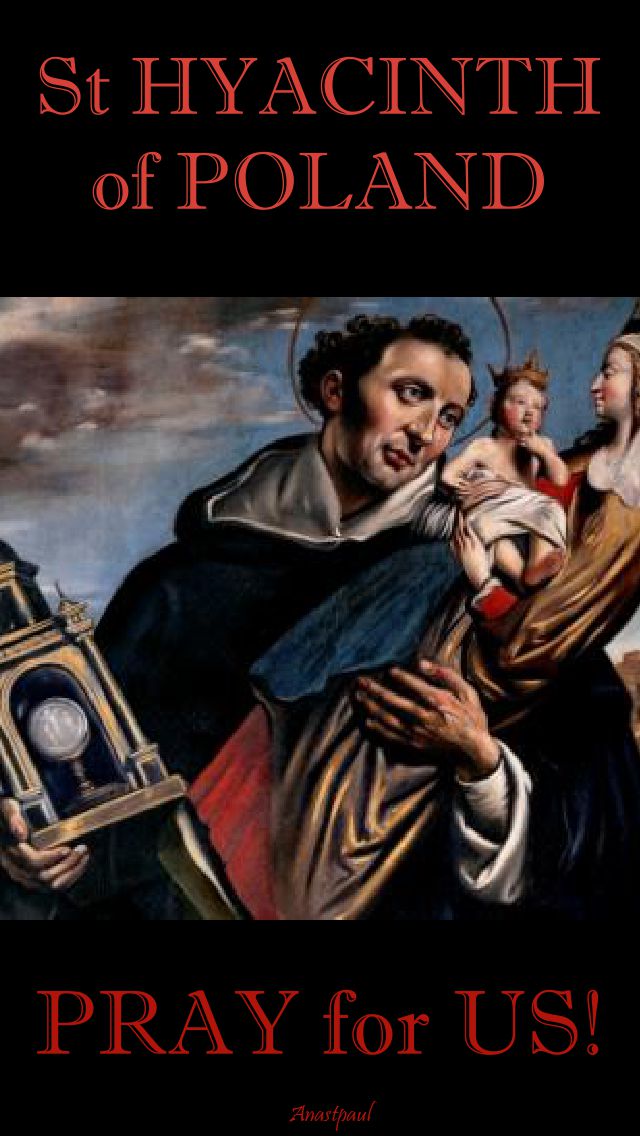
St Hyacinth of Poland pray for Poland, the Church and for us all!st hyacinth of poland pray for us

Posted in DOMINICAN OP, SAINT of the DAY

Memorials of the Saints – 17 August

St Amor of Amorbach
St Anastasius of Terni
St Beatrice da Silva Meneses
St Benedicta of Lorraine
St Carloman
St Cecilia of Lorraine
St Clare of the Cross of Montefalco (c 1269-1308) 

St Donatus of Ripacandida
St Drithelm
St Elias the Younger
Bl Enric Canadell Quintana
Bl Eugenio Sanz-Orozco Mortera
St Pope Eusebius
St Eusebius of Sicily
St Hyacinth OP (1185-1257)
A complete biography here:   https://anastpaul.wordpress.com/2017/08/17/saint-of-the-day-17-august-st-hyacinth-o-p-apostle-of-poland-and-apostle-of-the-north/

St Jacobo Kyushei Gorobioye Tomonaga
St James the Deacon
St Jeanne of the Cross Delanoue (1666-1736)
Biography:
https://anastpaul.com/2018/08/17/saint-of-the-day-17-august-st-jeanne-delanoue-1666-1736/
St Jeroen of Noordwijk
St Juliana of Ptolemais
St Leopoldina Naudet
St Mamas
Bl Marie-Élisabeth Turgeon
St Michaël Kurobyoie
St Myron of Cyzicus
Bl Nicholas Politi
Bl Noël-Hilaire Le Conte
St Paul of Ptolemais
St Theodore of Grammont

Martyred in the Spanish Civil War: Bl Antoni Carmaniú Mercarder, Bl Facundo Escanciano Tejerina, Bl Eugenio Sanz-Orozco Mortera, Bl Enric Canadell Quintana, Florencio López Egea and see below –
Martyrs of Malaga – 8 beati: A priest and seven brothers, all members of the Hospitallers of Saint John of God, all martyred together in the Spanish Civil War:
• Antonio del Charco Horques
• Eusebio Ballesteros Rodríguez
• Florentino Alonso Antonio
• Isidro Valentín Peña Ojea
• Juan Antonio García Moreno
• Manuel Sanz y Sanz
• Pedro Pastor García
• Silvestre Perez Laguna
17 August 1936 in Málaga, Spain – they were Beatified on 13 October 2013 by Pope Francis.
Martyrs of Maspujols – 3 beati: Three priests in the archdiocese of Tarragona, Spain.
Martyred together in the Spanish Civil War:
• Josep Mañé March
• Magí Civit Roca
• Miquel Rué Gené
17 August 1936 in Maspujols, Tarragona, Spain. They were Beatified on 13 October 2013 by Pope Francis. The beatification ceremony was celebrated in Tarragona, Spain.

Posted in DOMINICAN OP, QUOTES of the SAINTS, QUOTES on COURAGE, QUOTES on EVANGELISATION, QUOTES on HERESY, QUOTES on HUMILITY, QUOTES on MISSION, QUOTES on PRAYER, SAINT of the DAY

Quote/s of the Day – 8 August – Go forth …

Quote/s of the Day – 8 August – The Memorial of St Dominic (1170-1221)

“We must sow
the seed,
not hoard it.”we-must-sow-the-seed-not-hoard-it-st-dominic-8-aug-2018.jpg

“Heretics are to be converted
by an example of humility
and other virtues
far more readily,
than by any external
display or verbal battles.
So let us arm ourselves with
devout prayers
and set off,
showing signs of genuine humility
and go barefooted
to combat
Goliath.”

St Dominic (1170-1221)heretics are to be converted - st dominic 8 aug 2019

Posted in DOMINICAN OP, Our MORNING Offering, PRAYERS of the SAINTS, SAINT of the DAY

Our Morning Offering – 8 August – St Dominic’s Blessing

Our Morning Offering – 8 August – The Memorial of St Dominic (1170-1221)

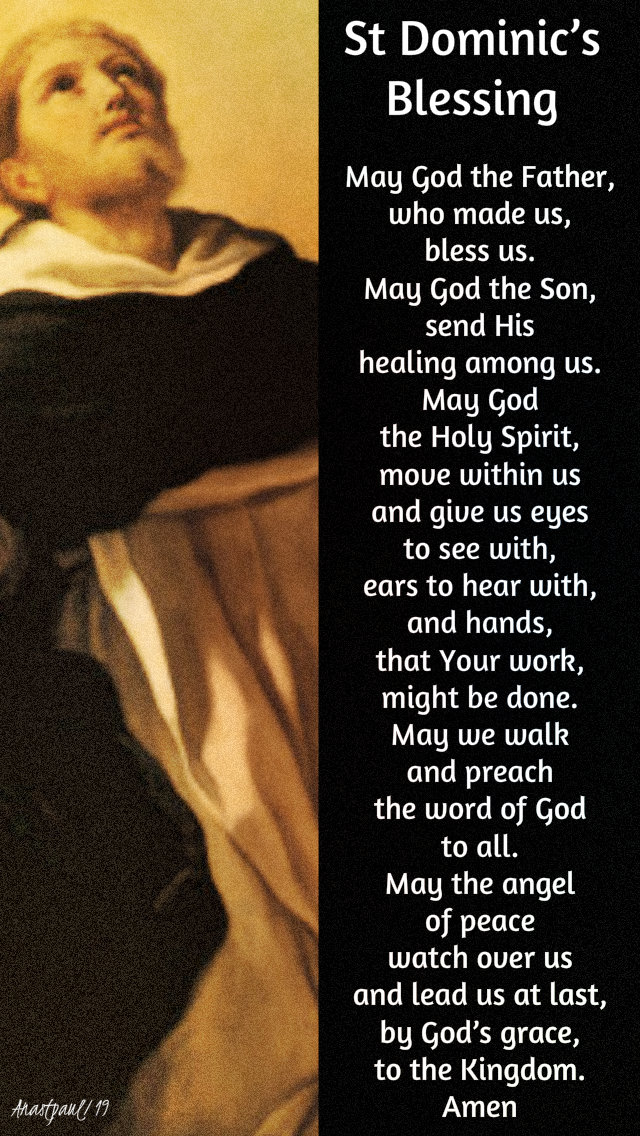
St Dominic’s Blessing

May God the Father,
who made us, bless us.
May God the Son,
send His healing among us.
May God the Holy Spirit,
move within us
and give us eyes to see with,
ears to hear with,
and hands, that Your work,
might be done.
May we walk and preach
the word of God to all.
May the angel of peace
watch over us
and lead us at last,
by God’s grace,
to the Kingdom.
Amenst dominic's blessing - 8 august 2019.jpg

Posted in DOMINICAN OP, franciscan OFM, SAINT of the DAY

Memorials of the Saints -8 August

St Dominic de Guzman O.P. (1170-1221) (Memorial)
All about him here:
https://anastpaul.wordpress.com/2017/08/08/saint-of-the-day-8-august-st-dominic-de-guzman-founder-of-the-dominican-order-of-preachers/

St Aemilian of Cyzicus
St Altman of Passau
Ven Antonio/Margil of Jesus OFM (1657-1726)
St Cyriacus the Martyr
St Eleutherius of Constantinople
St Ellidius
St Famianus of Compostela
St Gedeon of Besancon
St Hormisdas of Persia
Bl John Felton
Bl John Fingley
St Largus
St Leobald of Fleury
St Leonidas of Constantinople
St Marinus of Anzarba
St Mary of the Cross/ Mary MacKillop (1842-1909) – the first Australian born Saint
Biography:
https://anastpaul.com/2018/08/08/saint-of-the-day-st-mary-of-the-cross-1842-1909/

St Mummolus of Fleury
St Myron the Wonder Worker
St Paulus Ge Tingzhu
St Rathard of Diessen
St Severus of Vienne
St Sigrada
St Smaragdus
St Ternatius of Besançon
St Ultan of Crayke
Bl William of Castellammare di Stabia
Bl Wlodzimierz Laskowski

Martyrs of Albano – 4 saints: Four Christians who were martyred together, and about we today know little more than their names – Carpóforo, Secondo, Severiano and Vittorino. They were martyred in Albano, Italy – their remains are interred in the San Senator cemetery, on the Appian Way, 15 miles from Rome, Italy.

Martyrs of Rome – 5 saints: Five Christians martyred together; we know nothing else about them but the names – Ciriaco, Crescenziano, Giuliana, Memmia and Smaragdus. They were martyred at the 7 mile marker, on the Via Ostia, Rome, Italy.

Martyred in the Spanish Civil War – Martyrs of El Saler – 5 beati: Five nuns, all members of the Sisters of the Pious Schools, all teachers, and all martyred together in the Spanish Civil War.
• Antonia Riba Mestres
• Maria Baldillou Bullit
• María Luisa Girón Romera
• Nazaria Gómez Lezaun
• Pascuala Gallén Martí
They were martyred on 8 August 1936 in El Saler, Valencia, Spain and Beatified on 11 March 2001 by Pope John Paul II.

Martyred in the Spanish Civil War:
Bl Cruz Laplana Laguna
Bl Fernando Español Berdie
Bl Leoncio López Ramos
Bl Manuel Aranda Espejo
Bl Mariano Pina Turón
Bl Pedro Álvarez Pérez

Posted in DOMINICAN OP, SAINT of the DAY

Memorials of the Saints – 3 August

St Abibas
St Anthony the Roman
St Aspren of Naples
Bl Augustine Gazotich OP (1262-1323)
Biography:
https://anastpaul.com/2018/08/03/saint-of-the-day-3-august-blessed-augustine-gazotich-o-p-1262-1323/
Bl Benno of Metz
St Dalmatius
St Euphronius of Autun
St Gamaliel
St Gaudentia
Bl Godfrey of Le Mans
Bl Gregory of Nonantula
St Hermellus
St Nicodemus
St Senach of Clonard
St Trea of Ardtree
St Waltheof of Melrose O.Cist. (c 1095-1159)

Martyrs of Vercelli – 4 saints (below)-
Martyred in the Spanish Civil War:
BlAndrés Avelino Gutiérrez Moral
Bl Antonio Isidoro Arrué Peiró
Bl Eleuterio Mancho López
Bl Geronimo Limón Márquez
Bl Patricio Beobide Cendoya
The Story of these around 10000 Martyrs:
https://anastpaul.com/2017/08/03/saints-of-the-day-3-august-the-martyrs-of-the-spanish-civil-war-1931-1939/

Posted in DOMINICAN OP, SAINT of the DAY

Saint of the Day – 26 July – Blessed Robert Nutter OP (c 1557-1600) Martyr

Saint of the Day – 26 July – Blessed Robert Nutter OP (c 1557-1600) Martyr – Dominican Religious Priest – Born in c 1557 at Burnley Lanes, Lancashire, England and was martyred by being hanged on 26 July 1600 at Lancaster, England.

Throughout the religious upheavals following the English Reformation the vast majority of English Catholics, many of whom lived in Lancashire, remained staunchly loyal to the throne.

Nutter was born at Burnley, Lancashire.   He entered Brasenose College, Oxford in 1564 or 1565 and, with his brother John Nutter, also a Catholic martyr, became a student of the English College, Reims.   He was ordained at Soissons, on 21 December 1581 along with Venerable William Dean and George Haydock.bl robert nutter.jpg

Returning to England, he was committed to the Tower of London, along with his brother, also a priest, on 2 February 1584.   He remained in the pit forty-seven days, wearing irons for forty-three days and twice was subjected to the tortures of “the scavenger’s daughter”.   On 10 November 1584, he was again consigned to the pit.   Robert witnessed his older brother’s execution before being released.   The authorities hoped that he might inadvertently lead them to Catholic safe houses.    He was again arrested and transported to France on 21 January 1585, with twenty other priests and one layman, aboard the Mary Martin of Colchester, from Tower Wharf.

Landing at Boulogne, 2 February, he revisited Rome in July but, returned then to England as escort to newly ordained priests.   When the party was brought ashore at Gravesend, Nutter gave his name as Rowley but was recognised and on 30 November 1585 again committed to prison in London, this time to Newgate Prison.

In 1587 he was removed to the Marshalsea Prison and thence, in 1590, was sent to Wisbech Castle, Cambridgeshire.   While in prison he joined the Dominican Order.

There, in 1597, he signed a petition to Father Henry Garnet in favour of having a Jesuit superior but, on 8 November 1598, he and his fellow martyr, Edward Thwing, with others, besought the Pope to institute an archpriest.   On 10 March 1600, the keeper having left the gate unlocked, Nutter and his companions made their escape.   Some were never recaptured but those who headed south were taken and Nutter was sent to Lancaster, where he was executed on 26 July 1600.

Robert Nutter was beatified by Pope John Paul II in 1987.   It was said of Blessed Robert Nutter that, “He was a man of a strong body but of a stronger soul, who rather despised and conquered death.”

Prayer

Almighty, ever-living God,
You gave Your martyrs Robert Nutter
and his companions grace
to lay down their lives for Christ.
Help our weakness too,
give us the strength to live for You,
even as they did not shrink
from dying for Your sake.
We ask this through our Lord Jesus Christ, Your Son,
who lives and reigns with you and the Holy Spirit,
one God, forever and ever.
Amendominican saints

John Nutter, Blessed Robert’s Brother
John Nutter attended St John’s College, Cambridge.   In 1578 the English College at Douai relocated temporarily to Rheims.   John and his brother Robert arrived there in August the following year.   John was ordained at Laon in September 1582 and left for Yorkshire in November  . However, gale winds blew toward the Suffolk coast. John Nutter had contracted an illness before sailing and as it grew worse, he ferried ashore at Dunwich. The ship was subsequently driven on a sandbank and men of the town searched it for anything salvageable.   A bundle of Catholic books were found.   The ill Nutter was questioned at the inn where he had been taken and acknowledged that he was a priest. He was arrested and taken to the Marshalsea.   He remained there a year before being tried and condemned and shortly thereafter executed at Tyburn, along with James Fenn, George Haydock, Thomas Hemerford, and John Munden.

Posted in CARMELITES, DOMINICAN OP, SAINT of the DAY

Memorials of the Saints – 26 July

Sts Anne & St Joachim (Memorial) – Parents of the Blessed Virgin Mary, Grandparents of Jesus
Their story:
https://anastpaul.wordpress.com/2017/07/26/saints-of-the-day-26-july-sts-joachim-and-anne-parents-of-the-blessed-virgin-mary-grandparents-of-jesus/

Bl Andrew the Catechist
St Austindus of Auch
St Bartholomea Capitanio
St Benigno of Malcestine
Bl Camilla Gentili
St Charus of Malcestine
Bl Edward Thwing
Bl Élisabeth-Thérèse de Consolin
St Erastus
Bl Évangéliste of Verona
St Exuperia the Martyr
Bl George Swallowell
St Gérontios
Bl Giuseppina Maria de Micheli
St Gothalm
St Hyacinth
Bl Jacques Netsetov
Bl John Ingram
St Joris
Bl Marcel-Gaucher Labiche de Reignefort
Bl Marie-Claire du Bac
Bl Marie-Madeleine Justamond
Bl Marie-Marguerite Bonnet
St Olympius the Tribune
St Parasceva of Rome
St Pastor of Rome
Bl Pérégrin of Verona
Bl Pierre-Joseph le Groing de la Romagère
Bl Robert Nutter OP (c 1557-1600) Martyr
St Simeon of Padolirone
St Symphronius the Slave
St Theodulus the Martyr
St Titus Brandsma OCD (1881-1942) Martyr of the Faith
Biography:
https://anastpaul.com/2018/07/26/saint-of-the-day-27-july-blessed-titus-brandsma-o-c-d-1881-1942-martyr-of-the-faith/

St Valens of Verona
Bl William Ward

Posted in DOMINICAN OP, SAINT of the DAY, VATICAN Resources

16 July – SAINT Bartholomew of the Martyrs/ of Braga OP (1514-1590)

16 July – SAINT Bartholomew of Braga OP ArchBishop of Braga also known as Bl Bartholomew of the Martyrs (Bartolomeu Fernandez dei Martiri Fernandes) (1514-1590)

https://anastpaul.com/2018/07/16/saint-of-the-day-16-july-blessed-bartholomew-of-the-martyrs-1514-1590/

On 8 July 2019, Pope Francis approved the favourable votes cast by the Eminent and Excellent members of the Congregation and extended to the Universal Church the liturgical worship in honour of Blessed Bartholomew of the Martyrs (born Bartolomeu Fernandes), of the Order of Preachers, archbishop of Braga, born in Lisbon, Portugal on 3 May 1514 and died in Viana do Castelo, Portugal, on 16 July 1590, inscribing him in the book of Saints (Equipollent Canonisation).

Alleluia!

Saint Bartholomew of the Martyrs, Pray for Us!st bartholomew of the martyrs - 16 july 2019.jpg

Posted in DOMINICAN OP, SAINT of the DAY

Saint of the Day – 18 June – Blessed Osanna Andreasi OP (1449-1505)

Saint of the Day – 18 June – Blessed Osanna Andreasi OP (1449-1505) Virgin, Mystic with a gift of prophecy and Stigmatist, Spiritual Director, reformer, apostle of charity – born on 17 January 1449 at Mantua, Italy and died in 1505 of natural causes.   Patronages – Mantua, school girls.bl osanna by luigi costa.JPG

Osanna was the daughter of the nobles Niccolò Andreasi, whose family had originated in Hungary and of Agnese Gonzaga.   She was reported to have had a vision of angels at age six.   Feeling called to consecrated life, she rejected a marriage arranged by her father. Unable to explain her attraction to religious life to her father, in 1463, at the age of 14, she secretly received the religious habit of the Third Order of St Dominic.   She had been drawn to this Order from her admiration of two members of the Order, the holy tertiary, Saint Catherine of Siena and her contemporary, Friar Girolamo Savonarola, who both represented to her lives of strict self-denial.

Returning home, Osanna explained that she had made a religious vow and had to wear it until she had fulfilled her promise, which is an ancient custom.   She waited 37 years to complete her vows so she could care for her brothers and sisters after the death of her parents.bl osanna andreasi.png

A legend states that Osanna, like St Catherine of Siena, miraculously learned to read and write.   One day she saw a piece of paper with two words and said, “Those words are ‘Jesus’ and ‘Mary.'” From that time on, anything relating to the spiritual was within her grasp to read.

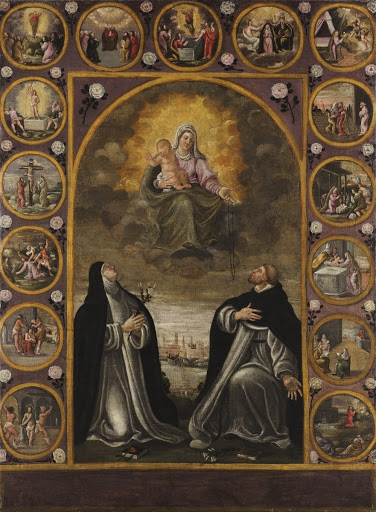
When Osanna was thirty years old, she received the stigmata on her head, her side and her feet.   She also had a vision in which her heart was transformed and divided into four parts.   For the rest of her life, she actively experienced the Passion of Jesus but especially intensely on Wednesdays and Fridays.   Osanna confided these things in her biographer and “spiritual son,” the Olivetan monk, Dom Jerome of Mount Olivet, as well as the fact that for years, she subsisted on practically no food at all.bl asanna and the mysteries of the rosary

Osanna was a mystic who would fall into ecstasies whenever she spoke of God, and a visionary who saw images of Christ bearing His cross.   She bore the stigmata along with red marks but there was no bleeding.   She helped the poor and sick and served as spiritual director for many, spending much of her family’s considerable fortune to help the unfortunate.   She spoke out against decadence and criticised the aristocracy for a lack of morality.   She was a friend of another holy member of her Order, the Blessed Columba of Rieti and is recorded to have sought counsel from another, the Blessed Stephana de Quinzanis.6_18_osanna_de_mantoue_rose

These phenomena brought Ossana to the attention of Mantua’s ruling family.   Most notably, she was sought by Francesco II Gonzaga and his wife, Isabella d’Este, as both a spiritual guide and a counsellor on matters of state.   She frequently foretold correctly events which later came to pass and gained the reputation of a seer.   When she died in Mantua on 18 June 1505, all the members of the nobility and clergy attended her funeral, as her body was taken in procession to the Church of St Dominic, where it was enshrined.   Later, her remains were transferred to the Cathedral of St Peter in Mantua, where they are still venerated.

Her confidant, Dom Jerome (Italian: Girolamo de Monte Oliveto), wrote a vita (biography) of her life in 1507, very shortly after her death.   Although Jerome noted that Osanna was not quick to discuss her spiritual experiences, in the last years of her life she adopted Jerome as a “spiritual son,” “conceived in the Blood of Christ.”

Jerome’s account is especially unique due to his intimate relationship with his subject. The biography takes the form of a detailed report of his conversations with Osanna. Jerome appended to his account Latin translations of twenty-four letters from Osanna, accompanied by documents certifying their authenticity.

According to Father Benedict Ashley, OP, these letters express an “intense and constant physical and inner suffering” made bearable only by “sublime experiences of union with God which [Osanna] cannot describe except in broken and inadequate language.”   A special source of misery for Osanna was the degradation of the Church under the abusive pontificate of Alexander VI.

In a response to a request by the Marchesa Isabella d’Este while on a visit to Rome, through a papal brief of 8 January 1515, Leo X authorised the celebration of her feast day in the City of Mantua.   Her local cultus was confirmed by Pope Innocent XII with a Papal bull of 24 November 1694 and extended to the whole of the Dominican Order two months later.

Osannamantua
The Blessed Virgin Mary in glory appearing to the Blessed Osanna Andreasi
by Ippolito Andreasi (c 1575)


Posted in DOMINICAN OP, SAINT of the DAY

Memorials of the Saints – 18 June

St Abraham of Clermont
St Alena of Dilbeek
St Amandus of Bordeaux
St Arcontius of Brioude
St Athenogenes of Pontus
St Calogero of Sicily
St Calogerus of Fragalata
St Calogerus the Anchorite
St Colman mac Mici
St Cyriacus of Malaga
St Demetrius of Fragalata
St Edith of Aylesbury
St Elizabeth of Schonau
St Elpidius of Brioude
St Equizio of Telese
St Erasmo
St Etherius of Nicomedia
Bl Euphemia of Altenmünster
St Fortunatus the Philosopher
St Gerland of Caltagirone
St Gregory Barbarigo (1625-1697)
About St Gregory:   https://anastpaul.com/2018/06/18/saint-of-the-day-18-june-2018-st-gregory-barbarigo-1625-1697/

St Gregory of Fragalata
St Guy of Baume
St Jerome of Vallumbrosa
St Marcellian
St Marina of Alexandria
St Marina of Bithynia
Bl Marina of Spoleto
St Mark
Bl Osanna Andreasi OP (1449-1505)
St Osanna of Northumberland
St Osmanna of Jouarre
St Paula of Malaga
Bl Peter Sanchez

Hermits of Karden:  A father (Felicio) and his two sons (Simplicio and Potentino)who became pilgrim to various European holy places and then hermits at Karden (modern Treis-Karden, Germany). (Born in Aquitaine (in modern France) Their relics transferred to places in the Eifel region of western Germany at some point prior to 930. They were canonised on 12 August 1908 by Pope Pius X (cultus confirmation).

Martyrs of Ravenna – 4 sai nts:  A group of four Christians martyred together. We have no details but their names – Crispin, Cruciatus, Emilius and Felix. They were martyred in Ravenna, Italy, date unknown.

Martyrs of Rome – 3 saints: Three Christians martyred together . We have no details but their names – Cyriacus, Paul and Thomas. In Rome, Italy, date unknown.

Martyrs of Tripoli – 3 saints:  Three imperial Roman soldiers, at last two of them recent converts, who were imprisoned, tortured and executed for their faith. Martyrs – Hypatius, Leontius and Theodulus. They were Greek born and they died c135 at Tripoli, Phoenicia (in modern Lebanon).

Posted in DOCTORS of the Church, DOMINICAN OP, FATHERS of the Church, MORNING Prayers, QUOTES of the SAINTS, SAINT of the DAY, The HOLY GHOST, The WORD

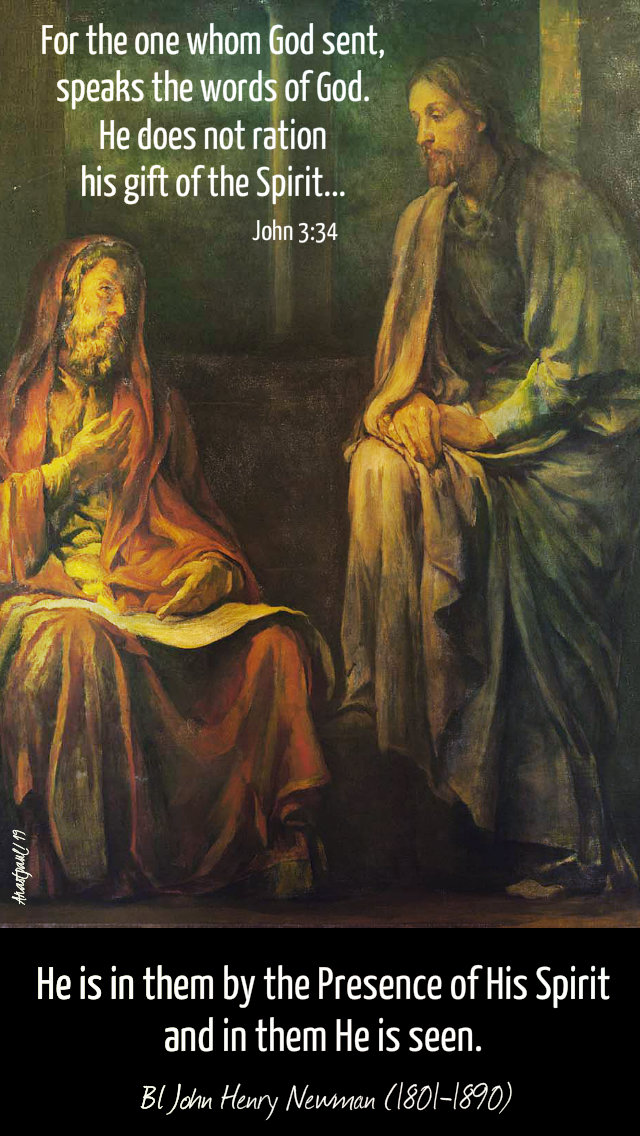
One Minute Reflection – 2 May – He is in them by the Presence of His Spirit and in them He is seen.

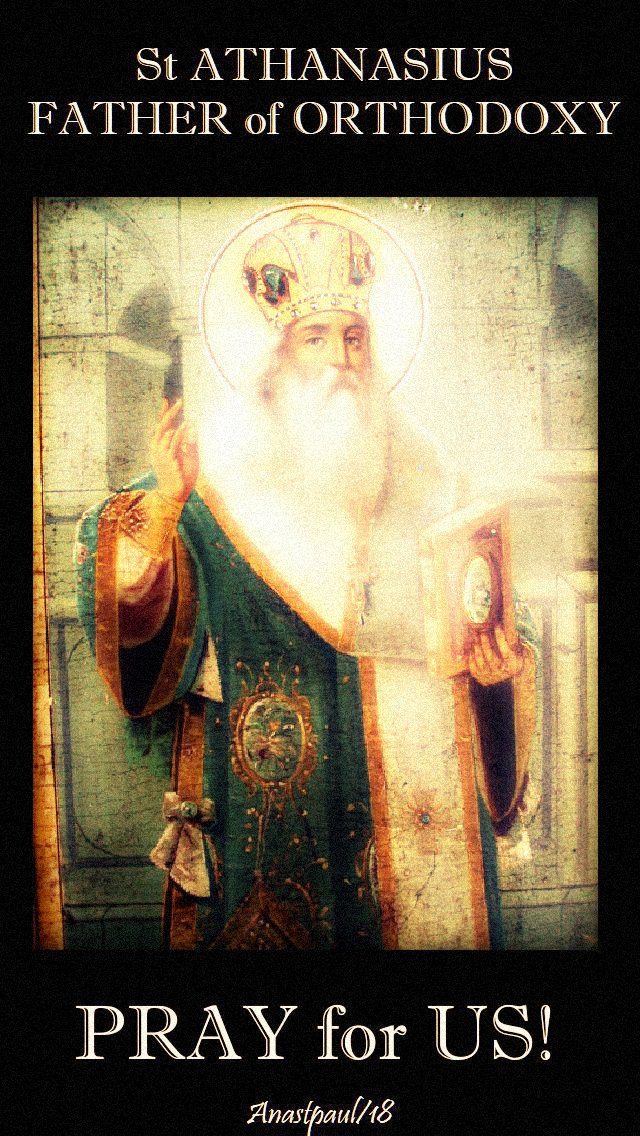
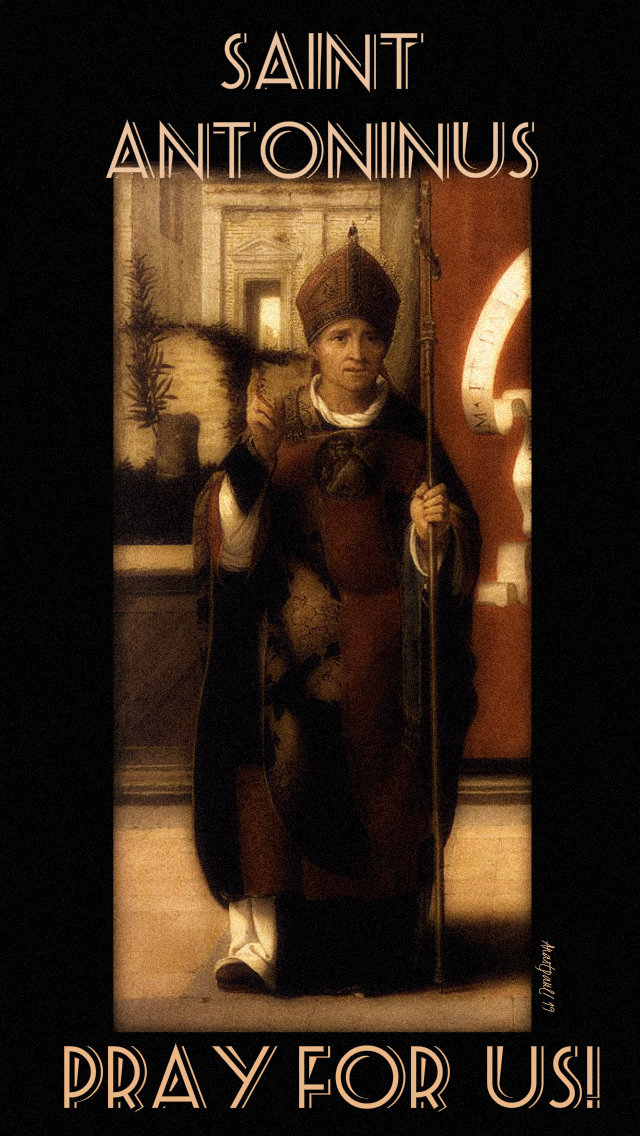
One Minute Reflection – 2 May – Thursday of the Second week of Easter, Gospel: John 3:31–36 and the Memorial of St Athanasius (297-373) – Father and Doctor of the Church and St Antoninus OP (1389-1459), Gospel:  John 3:31–36

For the one whom God sent speaks the words of God.   He does not ration his gift of the Spirit…he who does not obey the Son shall not see life…John 3:34,36

REFLECTION – “The sanctification or, rather, the deification of the nature of man, is one main subject of St Athanasius’s theology.   Christ, in rising, raises His Saints with Him to the right hand of power.   They become instinct with His life, of one body with His flesh, divine sons, immortal kings, gods.   He is in them, because He is in human nature and He communicates in them that nature, deified by becoming His, that them It may deify.   He is in them by the Presence of His Spirit and in them He is seen.”…Bl John Henry Newman (1801-1890)he does not ration his gift john 3 34 - he is in them by the presence - bl john henry newman 2 may 2019.jpg

PRAYER – Lord God, whose name is holy and whose mercy is proclaimed in every generation, send forth Your Spirit into our hearts and grant that, faithfully pondering on all that is holy, we may ever live in the splendour of Your presence.   Listen we beseech You, to the prayers we request from St Athanasius and St Antoninus, to help us on this earthly journey.   We make our prayer through Christ, Your Son our Lord and Saviour, with the Holy Spirit, one God forever amen.st-athanasius-pray-for-us-2-may-2019

st antoninus - pray for us 2 may 2019


Posted in DOMINICAN OP, SAINT of the DAY

Saint of the Day – 2 May – Saint Antoninus of Florence OP (1389-1459) “Antoninus the Counsellor”

Saint of the Day – 2 May – Saint Antoninus of Florence OP (1389-1459) Archbishop of Florence, Dominican Priest and Friar, Confessor, spiritual director, apostle of mercy, theologian, writer, reformer, Prior of the Order. Born as Antonio Pierozzi (also called de Forciglioni) on 1 March 1389 in the city of Florence and died on 2 May 1459 at Florence, Italy.   Known as “Antoninus the Counsellor”.   Patronages – Moncalvo, Turin, Italy, University of Santo Tomas Graduate School, Manila, Philippines, Saint Antoninus Parish, Municipality of Pura, Tarlac Philippines.header snip st antoninus.JPG

Anthony Pierozzi, born on 1 March 1389, was soon nicknamed “Antoninus” (“Little Anthony”), either because of his small stature or his weak health.   Thus began the life of the future Saint Antoninus born to noble parents in Florence, Italy.

The influence of the Dominicans on Antoninus’ early life led him to seek admittance to the Dominican Order at the age of 15.   Antoninus approached the prior of the convent in Fiesole, Blessed Brother John Dominic (c 1355–1419, with his request to be admitted to the Order.   Perhaps noticing the weak health of the aspirant and not wishing to give an outright refusal to Antoninus’ request, Brother John Dominic told him to come back once he had memorised the Decretum of Gratian, or the Code of Canon Law at the time.   To the prior’s surprise, the youth returned within the year having accomplished the task required of him.   He was thus admitted to the Order.

The love and zeal he had as a novice never left Antoninus.   He became a great reformer more by example than by word.   Elected prior at a young age, Antoninus served as superior for many years.   He, like his brothers in St Dominic and St Thomas Aquinas, was concerned with the formation of the friars of the Order of Preachers.   Hence he prepared the Summa Moralis, a systematic and comprehensive presentation of Christian Moral Theology, which he wrote, as he said, during the summer and the winter of his life. Antoninus’ writings treated the practical aspects of living the faith.   His writings were a major development in the field of moral theology.   St Antoninus also wrote a biography of Blessed John Dominic and a history of the world.st antoninus bishop of florence op.jpg

Antoninus’ devotion to the Sacrament of Penance and spiritual counsel earned him the title of Antoninus the Counsellor.   Such was his ability to instruct and to guide others.

Antoninus accepted into the Order Brother John of Fiesole, the future artist, Fra Angelico (c 1395–1455).   Having an eye for recognising the gifts of others, Antoninus instructed Fra Angelico to prepare his own Summa Moralis, not in words but through his painting. Hence when the new convent of San Marco was built, Prior Antoninus had Fra Angelico grace each of the friar’s cells with a painting based on a scene from the life of Christ.

After he was appointed Archbishop of Florence, Antoninus’ residence became known as the hostel for the poor, such was his generosity and service for victims of poverty.   His sensitivity to the needs of others led him to found the “Men of St Martin,” in order to offer quiet support to the wealthy who had become indigent.   Hence, the Archbishop lived out the works of mercy.

THE ALMS OF ST ANTONINUS OF FLORENCE.jpg
The Alms of St Antoninus by Lorenzo Lotto

He came to win the esteem and love of his people, especially by his energy and resource in combating the effects of the plague and earthquake in 1448 and 1453.    Antoninus lived a life of austerity as archbishop, continuing to follow the Dominican Rule.   His relations with the Medici regime were close but not always harmonious, with his serving several times as an ambassador for the Republic to the Holy See during the 1450s.ST ANTONINUS ARCHBISHOP OF FLORENCE.jpg

St Antoninus died on 2 May 1459 and Pope Pius II conducted his funeral.   The Pope happened to be on his way to the Council of Mantua when he heard of the Archbishop’s death.   The Archbishop’s wish was that he be buried at the priory which he had founded in the City.  st sntoninus incorrupt body.JPG

He was Canonised on Trinity Sunday, 31 May 1523 by Pope Adrian VI, who himself held ideas of radical and drastic church reform similar to those of Antoninus.

Eternal God, you blessed Saint Antoninus with a marvellous gift of counsel.   By the help of his prayers, while we walk in the darkness of this life, may we learn from the light of Christ all that we ought to do.   We ask this through our Lord Jesus Christ, your Son, who lives and reigns with you and the Holy Spirit, one God, forever and ever. Amen800px-Collezione_loeser,_busto_di_sant'antonino,_stucco_dipinto,_xv_sec.

Posted in DOCTORS of the Church, DOMINICAN OP, FATHERS of the Church, SAINT of the DAY

Memorials of the Saints – 2 May

St Athanasius (c295-373) – Father and Doctor of the Church (Memorial)
Biography:   https://anastpaul.wordpress.com/2018/05/02/saint-of-the-day-2-may-st-athanasius-c295-373-father-and-doctor-of-the-church-father-of-orthodoxy/

St Alpin de Châlons
St Antoninus of Florence OP (1389-1459)

Bl Bernard of Seville
St Bertinus the Younger
Bl Boleslas Strzelecki
Bl Conrad of Seldenbüren
St Cyriacus of Pamphylia
St Eugenius of Africa
St Exsuperius of Pamphylia
St Felix of Seville
St Fiorenzo of Algeria
St Gennys of Cornwall
St Germanus of Normandy
St Gluvias
St Guistano of Sardinia
St Joseph Luu
Bl Juan de Verdegallo
St Longinus of Africa
St Neachtain of Cill-Uinche
St Theodulus of Pamphylia
St Ultan of Péronne
St Vindemialis of Africa
St Waldebert of Luxeuil
St Wiborada of Saint Gall
Bl William Tirry
St Zoe of Pamphylia

Martyrs of Alexandria – 4 saints: A group of Christians marytred together in the persecutions of Diocletian. We know little more than their names – Celestine, Germanus, Neopolus and Saturninus. 304 in Alexandria, Egypt

Posted in DOMINICAN OP, SAINT of the DAY, The HOLY ROSARY/ROSARY CRUSADE

Saint of the Day – 30 April – Saint Pope Pius V (1504-1572)

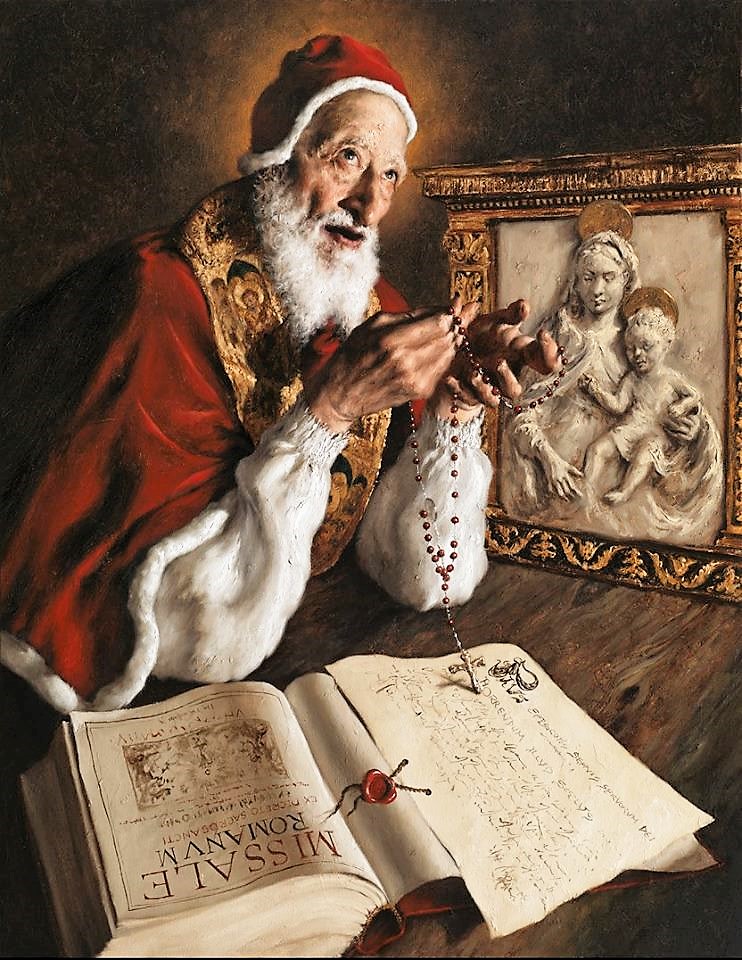
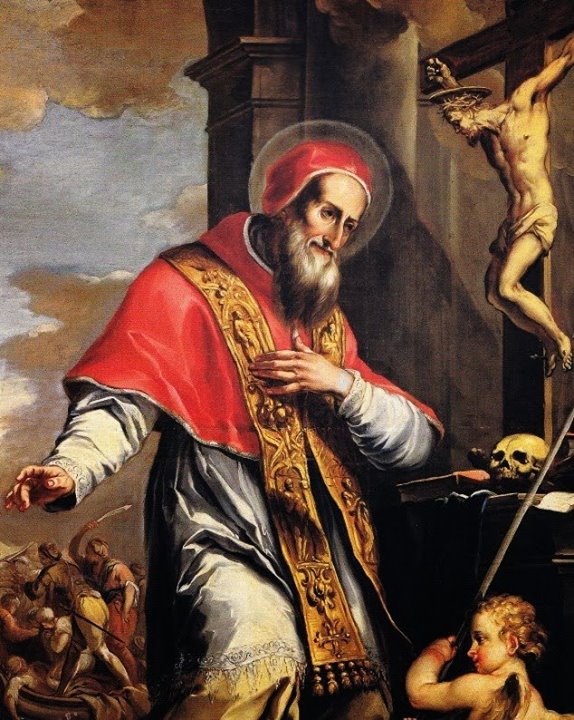
Saint of the Day – 30 April – Saint Pope Pius V OP (1504-1572) – born Antonio Ghislieri (from 1518 called Michele Ghislieri, OP) 17 January 1504 at Bosco, diocese of Alessandria, Lombardy, Italy, was head of the Catholic Church and ruler of the Papal States from 8 January 1566 to his death in 1572.   He died on 1 May 1572 in Rome, Italy, apparently of a renal disorder caused by kidney stones.   He was a reformer, an apostle of prayer and charity, a great organiser, Marian devotee and apostle of the Holy Rosary, lover of the Holy Cross.  Pius V was highly ascetic.  pius v rosary.jpgHe wore a hair shirt beneath the simple habit of a Dominican friar (for which reason he is often attributed with the institution of the White cassock worn by the Holy Father) and was often seen in bare feet.  In the time of a great famine in Rome he imported corn at his own expense from Sicily and France, a considerable part of which he distributed among the poor and sold the rest to the public at a very low price.  After the papal election, instead of hosting an elaborate banquet, he ordered that the food be given to people in real need.   Tradition holds that he once restored a beggar’s severed foot.header Pius_V_Santi_Giovanni_e_Paolo_Venice_-_Pope_Pius_V_by_Bartolomeo_Letterini.jpg

He is chiefly notable for his role in the Council of Trent, the Counter-Reformation, the Battle of Lepanto and the standardisation of the Roman rite within the Latin Church. Pius V declared Thomas Aquinas a Doctor of the Church.

As a cardinal, Ghislieri gained a reputation for putting orthodoxy before personalities, prosecuting eight French bishops for heresy.   He also stood firm against nepotism, rebuking his predecessor Pope Pius IV to his face when he wanted to make a 13-year-old member of his family a cardinal and subsidise a nephew from the papal treasury.

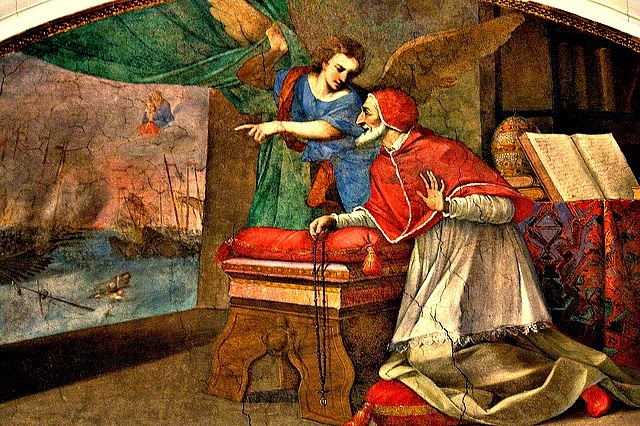
By means of the papal bull of 1570, Regnans in Excelsis, Pius V excommunicated Elizabeth I of England for heresy and persecution of English Catholics during her reign. He also arranged the formation of the Holy League, an alliance of Catholic states to combat the advancement of the Ottoman Empire in Eastern Europe.  4_30_Pope St Pius V lepanto 3 bestAlthough outnumbered, the Holy League famously defeated the Ottomans at the Battle of Lepanto in 1571.   St Pius V attributed the victory to the intercession of the Blessed Virgin Mary and instituted the feast of Our Lady of Victory.   Biographers report that as the Battle of Lepanto ended, Pius rose and went over to a window, where he stood gazing toward the East. “…Looking at the sky, he cried out, ‘A truce to business, our great task at present is to thank God for the victory which He has just given the Christian army’.”st pius v  vision.jpg

Pope Pius V was from a poor Italian family and had entered the Dominican order at age 14.   A teacher, a master of novices, a bishop and finally a cardinal, he was a strict and honest man, as well as a zealous reformer.   He wept when he was told in 1566 that he had been elected pope.   The 18-year-long Council of Trent had ended 3 years before and he, as Holy Father, had the task of implementing it.

The previous pope had been easygoing but Pius V made immediate changes.   At first, the people complained that the atmosphere of Rome became like that of a monastery.   But soon the pope’s personal character changed their minds.   He ordered that the gifts given at his coronation be sent to hospitals and to those in need.   The Church finances were examined, the army was reduced and the lifestyles of the cardinals and bishops were simplified.   Seminaries were established, synods were held, dioceses were organised, and parish priests were called to regular meetings.   A new catechism was completed.   Parish priests were made responsible for Catholic education.   The Roman Missal became the sole Mass book for the Western Church (with a few minor exceptions) for four centuries.

His first care as Pope was to reform the Roman court and capital by the strict example of his household and the severe punishment of all offenders.   He next endeavoured to obtain from the Catholic powers the recognition of the Tridentine decrees, two of which he urgently enforced-the residence of bishops and the establishment of diocesan seminaries.

He revised the Missal and Breviary and reformed the ecclesiastical music.   Nor was he less active in protecting the Church.

We see him at the same time supporting the Catholic King of France against the Huguenot rebels, encouraging Mary Queen of Scots, in the bitterness of her captivity and excommunicating her rival the usurper Elizabeth, when the best blood of England had flowed upon the scaffold and the measure of her crimes was full.

But it was at Lepanto that the Saint’s power was most manifest, there, in October, 1571, by the holy league which he had formed but still more by his prayers to the great Mother of God, the aged Pontiff crushed the Ottoman forces and saved Christendom from the Turk.Chapel_of_Pius_V_Santi_Giovanni_e_Paolo_(Venice)_-_Pope_Pius_V_by_Bartolomeo_Letterini

St Pius was accustomed to kiss the feet of his crucifix on leaving or entering his room. One day the feet moved away from his lips.   Sorrow filled his heart and he made acts of contrition, fearing that he must have committed some secret offence but still he could not kiss the feet.   It was afterwards found that they had been poisoned by an enemy.St pius v cross.jpg

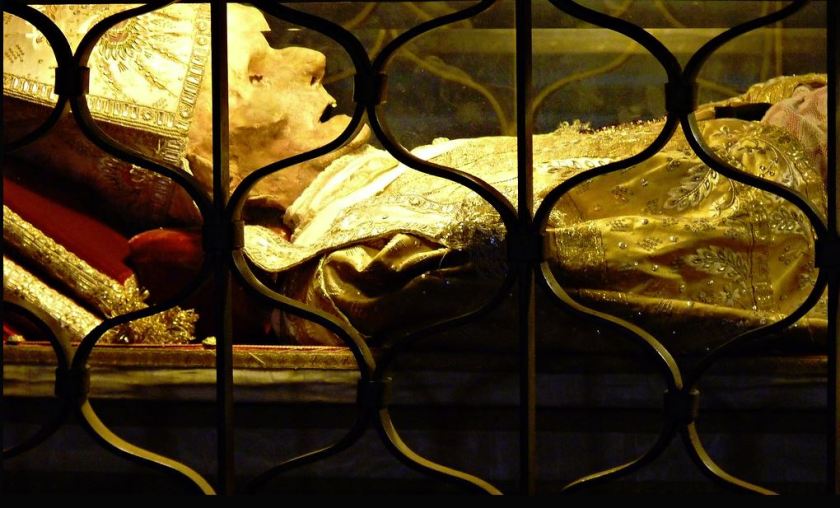
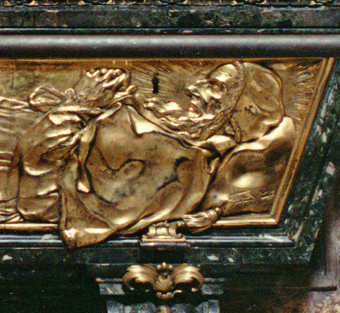
After only six years as pope, Pius V died of a painful disease, of which he had never complained.   He was buried in the chapel of St Andrea which was close to the tomb of Pope Pius III, in the Vatican. Although his will requested he be buried in Bosco, Pope Sixtus V built a monument in the chapel of SS. Sacramento in the Liberian basilica. His remains were transferred there on 9 January 1588.  The front of his tomb has a lid of gilded bronze which shows a likeness of the dead pope. Most of the time this is left open to allow the veneration of the saint’s remains.640 tomb-Roma-Santa_Maria_Maggiore01

tomb - Pius_V_head_Wiki
Portrait of Pius V by Pierre Le Gros on the tomb

In 1696, the process of Pius V’s canonisation was started through the efforts of the Master of the Order of Preachers, Antonin Cloche.   He also immediately commissioned a representative tomb from the sculptor Pierre Le Gros the Younger, to be erected in the Sistine Chapel of the Basilica di Santa Maria Maggiore.   The pope’s body was placed in it in 1698.   Pope Pius V was beatified by Pope Clement X in the year 1672 and was Canonised by Pope Clement XI (1700–21) on 22 May 1712.

Blessed Cardinal John Henry Newman declared that:

 “St Pius V was stern and severe, as far as a heart burning and melted with divine love could be so … Yet such energy and vigour as his were necessary for the times.   He was a soldier of Christ in a time of insurrection and rebellion, when in a spiritual sense, martial law was proclaimed.”St_Pius_V-.jpg

st pius V lepanto 2

Posted in CHRIST, the WAY,TRUTH,LIFE, DOCTORS of the Church, DOMINICAN OP, QUOTES of the SAINTS, QUOTES on FAITH, QUOTES on FEAR, QUOTES on HAPPINESS, QUOTES on HEAVEN, QUOTES on LOVE, QUOTES on SILENCE, QUOTES on TRUTH, SAINT of the DAY

Quote/s of the Day – 29 April – Catherine

Quote/s of the Day – 29 April – Monday of the Second week of Easter, Year C and the Memorial of St Catherine of Siena (1347-1380) Doctor of the Church

“What is it you want to change?
Your hair, your face, your body?
Why? For God is in love with all those things
and He might weep when they are gone!”what-is-it-you-want-to-change-st-catherine-of-siena-29-april-2018.jpg

“All the way to heaven IS heaven
because Jesus said,
“I am the way.”all the way to heaven IS heaven - st catherine of siena - 29 april 2019

“Speak the truth in a million voices.
It is silence that kills!”speak the truth in a million voices - st catherine of siena - 29 april 2019.jpg

“Turn over the rudder in God’s name
and sail with the wind,
heaven sends us.”

St Catherine of Siena OP (1347-1380) Doctor of the Church

More St Catherine quotes here:   https://anastpaul.wordpress.com/2018/04/29/quote-s-of-the-day-29-april-fifth-sunday-of-eastertide-and-the-memorial-of-st-catherine-of-siena-1347-1380-doctor-of-the-church/turn over the rudder - st catherine of siena 29 april 2019.jpg