Posted in franciscan OFM, MARIAN TITLES, SAINT of the DAY

Ember Friday of the First Week of Lent, Nossa Senhora das Florestas,/ Our Lady of the Forests, Porto, Portugal (12th Century) and Memorials of the Saints – 11 March

Ember Friday of the First Week of Lent +2022

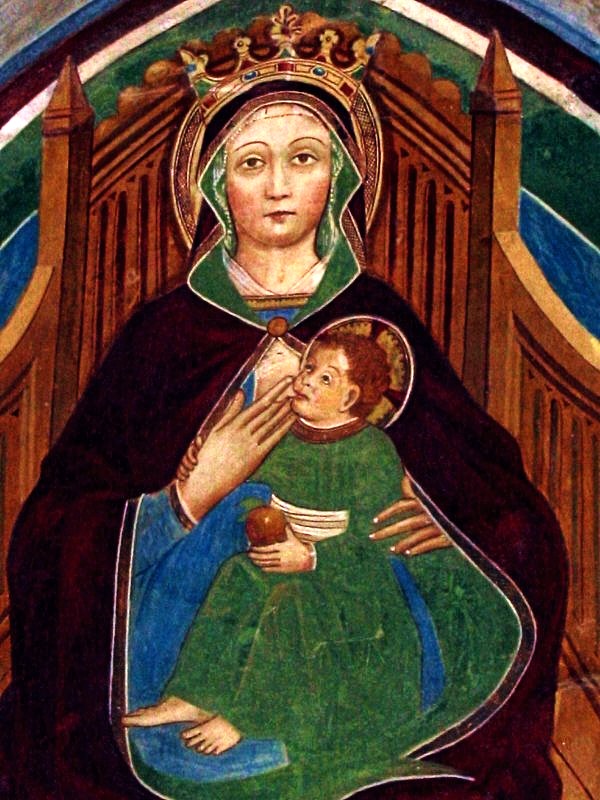
Nossa Senhora das Florestas,/ Our Lady of the Forests, Porto, Portugal (12th Century) – 11 March:
HERE:

https://anastpaul.com/2021/03/11/our-lady-of-the-forests-porto-portugal-12th-century-and-memorials-of-the-saints-11-march/

St Aengus the Culdee
St Alberta of Agen
St Alexius U Se-Yong
St Amunia
St Aurea of San Millán

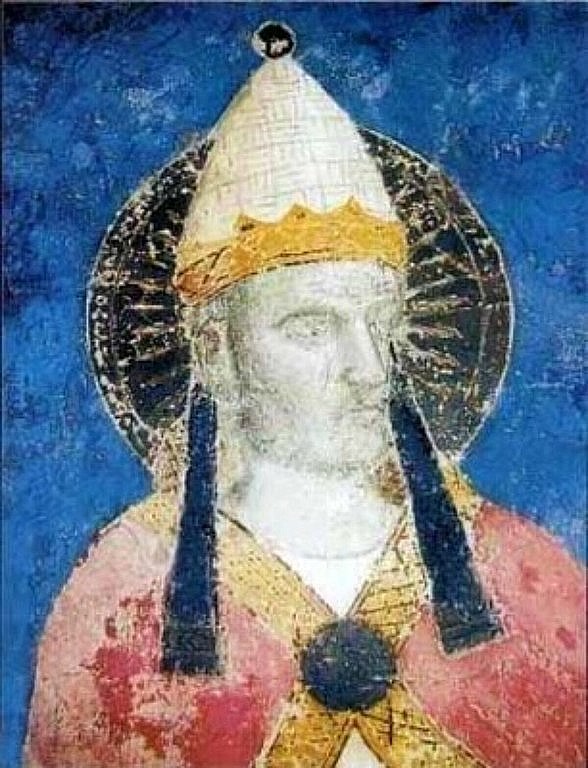
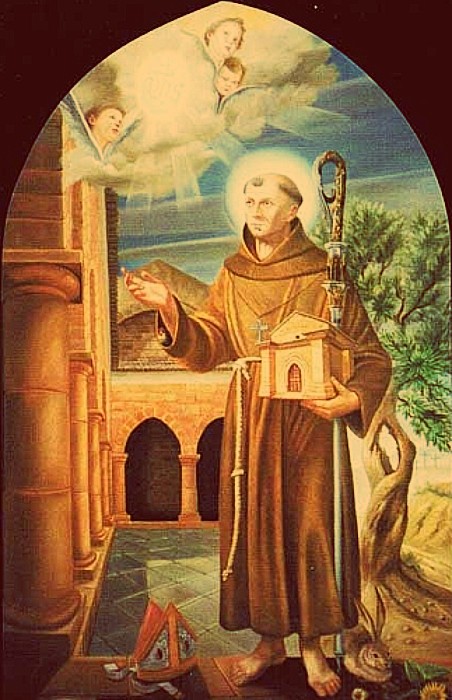
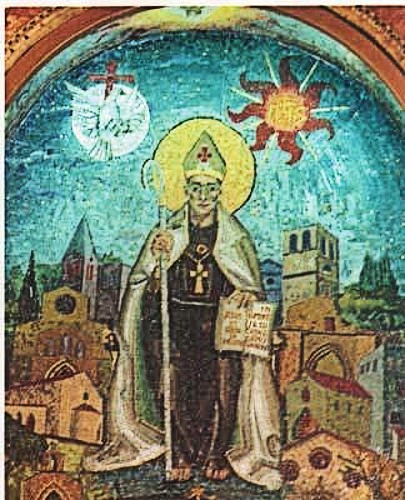
St Benedict Crispus of Milan (Died 725) Archbishop of Milan from c 685 until his death. A poem written about ten years after his death, De laudibus Mediolani- In Praise of Milan, praises him and remembers his veneration by the entire land and informs us that he was buried in the Basilica of Saint Ambrose.
His Life:

https://anastpaul.com/2020/03/11/saint-of-the-day-11-march-saint-benedict-crispus-of-milan-died-725/

St Candidus the Martyr
St Constantine II
St Constantine of Carthage
St Ðaminh Cam

St Eulogius of Córdoba (Died 857) Priest and Martyr, Writer, Poet, Theologian, Teacher.
Biography:

https://anastpaul.com/2019/03/11/saint-of-the-day-11-march-st-eulogius-died-857-priest-and-martyr/

St Firmian the Abbot
St Firmus the Martyr
St Gorgonius the Martyr
St Heraclius of Carthage
Bl John Kearney
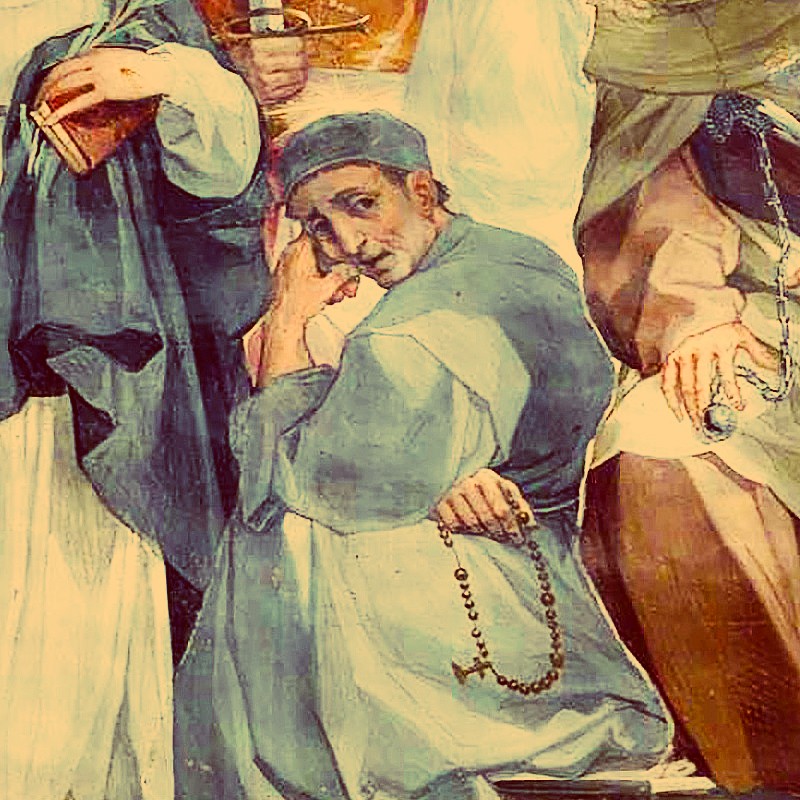
Blessed John Baptist Righi of Fabriano OFM (1469–1539) Priest, Friar of the Friars Minor
St Marcus Chong Ui-Bae
St Peter the Spaniard
St Pionius
St Piperion the Martyr
St Rosina of Wenglingen
St Sophronius of Jerusalem
St Thalus the Martyr
Bl Thomas Atkinson
St Trophimus the Martyr
St Vigilius of Auxerre
St Vincent of Leon

St Vindician of Cambrai (c 632-c 712) Bishop of Arras-Cambrai, Belgium. He was a spiritual follower of Saint Eligius (588- 660) (Saint Eloi).
His Life:

https://anastpaul.com/2021/03/11/saint-of-the-day-11-march-saint-vindician-of-cambrai-c-632-c-712-bishop/

St Zosimus of Carthage

Martyrs of Antioch: A group of Christians Martyred together by Emperor Maximian Galerius. Martyred in c 300 in Antioch, Syria.

Posted in "Follow Me", CHRIST the LIGHT, franciscan OFM, GOD ALONE!, HOLY SPIRIT, Our MORNING Offering, PRAYERS of the SAINTS, QUOTES on CHARITY, QUOTES on COURAGE, QUOTES on FAITH, QUOTES on GRACE, QUOTES on HOPE, QUOTES on HUMILITY, The HEART, The HOLY GHOST, The MOST HOLY & BLESSED TRINITY, The WILL of GOD

Our Morning Offering – 7 March – All Highest, Glorious God & Prayer to do the Will of God

Our Morning Offering – 7 March – Monday of the First Week of Lent

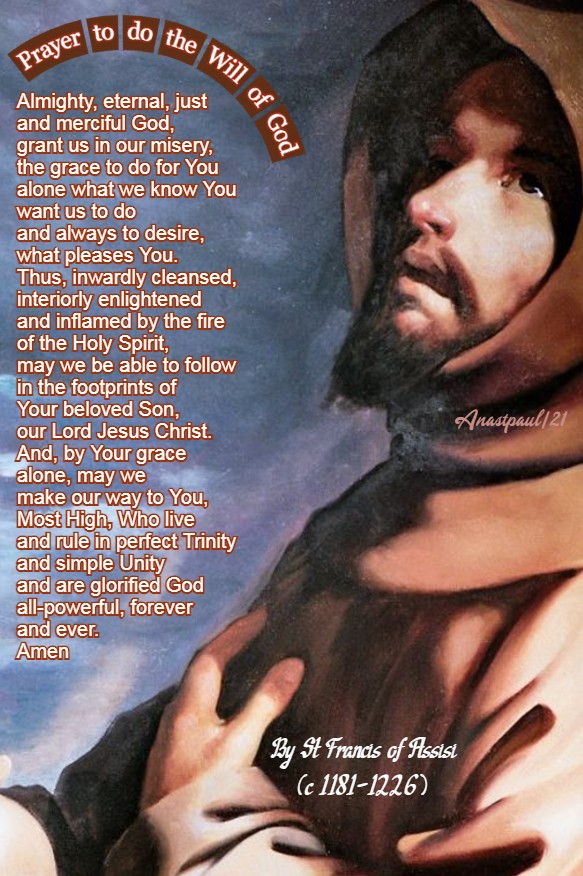
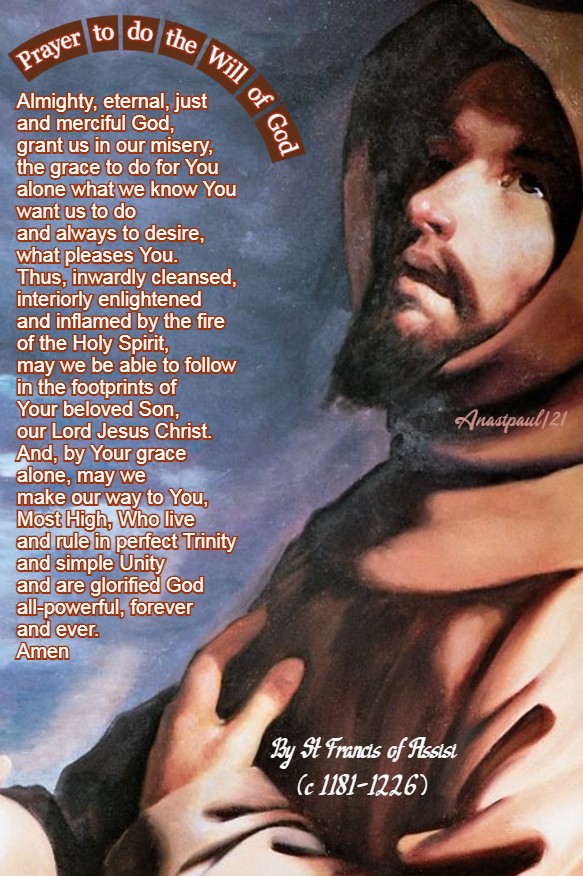
Prayer to do the Will of God
By St Francis of Assisi (c 1181-1226)

Almighty, eternal, just and merciful God,
grant us in our misery,
the grace to do for You alone
what we know You want us to do
and always to desire, what pleases You.
Thus, inwardly cleansed,
interiorly enlightened
and inflamed by the fire of the Holy Spirit,
may we be able to follow in the footprints of
Your beloved Son, our Lord Jesus Christ.
And, by Your grace alone,
may we make our way to You,
Most High, Who live and rule in perfect Trinity
and simple Unity
and are glorified God
all-powerful, forever and ever.
Amen

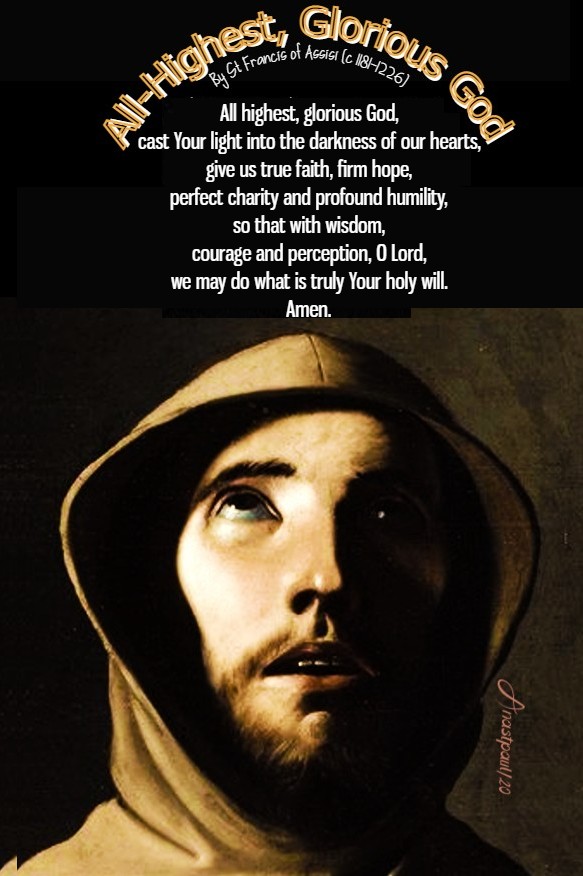
All Highest, Glorious God

All highest, glorious God,
cast Your light into the darkness of our hearts,
give us true faith, firm hope,
perfect charity and profound humility,
so that with wisdom,
courage and perception, O Lord,
we may do what is truly Your holy will.
Amen.

Posted in franciscan OFM, MARIAN TITLES, SAINT of the DAY

The First Sunday of Lent, Nossa Senhora da Nazaré / Our Lady of Nazareth, Pierre Noire, Portugal, (1150) and Memorials of the Saints – 6 March

The First Sunday of Lent +2022

Nossa Senhora da Nazaré / Our Lady of Nazareth, Pierre Noire, Portugal, (1150) – 6 March:
HERE:
https://anastpaul.com/2021/03/06/nossa-senhora-da-nazare-our-lady-of-nazareth-pierre-noire-portugal-1150-and-memorials-of-the-saints-6-march/

Sts Perpetua and Felicity (Died c203) Martyrs in Carthage (Roman province of Africa – modern day Tunisia) – Patrons of Mothers, Expectant Mothers, ranchers, butchers, Carthage, Catalonia.
Feast day moved in 1969 to 7 March.
Their Life and Death:

https://anastpaul.com/2017/03/07/saints-of-the-day-7-march-saints-perpetua-and-felicity/

St Aetius
St Bairfhion
St Baldred of Strathclyde
St Baldred the Hermit
St Balther of Lindisfarne
St Basil of Bologna
St Cadroë
St Chrodegang of Metz (c 714-776) Bishop

St Colette PCC (1381-1447) Abbess and Foundress of the Colettine Poor Clares, a reform branch of the Order of Saint Clare.
Biography:

https://anastpaul.com/2017/03/06/saint-of-the-day-6-march-st-colette/
AND:
https://anastpaul.com/2019/03/06/saint-of-the-day-6-march-st-colette-2/

St Cyriacus of Trier
St Cyril of Constantinople
St Evagrius of Constantinople
St Fridolin Vandreren of Säckingen
Bl Guillermo Giraldi
St Heliodorus the Martyr
Bl Jordan of Pisa
St Julian of Toledo
St Kyneburga of Castor
St Kyneswide of Castor
St Marcian of Tortona
Bl Ollegarius of Tarragona
St Patrick of Malaga
St Sananus

Blessed Sylvester of Assisi OFM (Died 1240) Priest, Friar. Sylvester was one of the first 4 followers of St Francis of Assisi and was the first Priest in the Franciscan Order.
About St Sylvester:

https://anastpaul.com/2021/03/06/saint-of-the-day-6-march-blessed-sylvester-of-assisi-ofm-died-1240-priest/

St Tibba of Castor
St Venustus of Milan

Martyrs of Amorium – 42 Saints – Also known as Martyrs of Syria and Martyrs of Samarra;
A group of 42 Christian senior officials in the Byzantine Empire who were captured by forces of the Abbasid Caliphate when the Muslim forces overran the City of Amorium, Phrygia in 838 and massacred or enslaved its population. The men were imprisoned in Samarra, the seat of the Caliphate, for seven years. Initially thought to be held for ransom due to their high position in the empire, all attempts to buy their freedom were declined. The Caliph repeatedly ordered them to convert to Islam and sent Islamic scholars to the prison to convince them; they refused until the Muslims finally gave up and killed them. Martyrs. We know the names and a little about seven of them:
• Aetios
• Bassoes
• Constantine
• Constantine Baboutzikos
• Kallistos
• Theodore Krateros
• Theophilos
but details about the rest have disappeared over time. However, a lack of information did not stop several legendary and increasingly over-blown “Acts” to be written for years afterward. One of the first biographers, a monk name Euodios, presented the entire affair as a judgement by God on the empire for its official policy of Iconoclasm.
Deaths:
• beheaded on 6 March 845 in Samarra (in modern Iraq) on the banks of the Euphrates river by Ethiopian slaves
• the bodies were thrown into the river, but later recovered by local Christians and given proper burial.

Posted in franciscan OFM, MARIAN TITLES, SAINT of the DAY

The First Saturday of Lent, Notre-Dame-de-Bon-Secours/Our Lady of Good Help, Montreal, Canada (1657) and Memorials of the Saints – 5 March

The First Saturday of Lent +2022

Notre-Dame-de-Bon-Secours/Our Lady of Good Help, Montreal, Canada (1657) – 5 March:
HERE:

https://anastpaul.com/2021/03/05/notre-dame-de-bon-secours-our-lady-of-good-help-montreal-canada-1657-and-memorials-of-the-saints-5-march/

St Adrian of Caesarea
St Caron
St Carthach the Elder
Bl Christopher Macassoli of Vigevano
St Clement of Santa Lucia
St Colman of Armagh
St Conon of Pamphylia
Bl Conrad Scheuber
St Eusebius of Cremona
St Eusebius the Martyr
St Gerasimus
Bl Giovanna Irrizaldi
Bl Ion Costist

St John Joseph of the Cross OFM (1654-1734) – Italian Priest, Friar of the Order of the Friars Minor, Mystic, Ascetic, gifted with prophecy and miracles.
Biography:

https://anastpaul.com/2019/03/05/saint-of-the-day-5-march-st-john-joseph-of-the-cross-ofm-1654-1734/

St Kieran (Died c 530) Bishop
Bl Lazër Shantoja
St Lucius I, Pope
St Oliva of Brescia
St Phocas of Antioch

St Piran (Died 480) Abbot, Hermit, Missionary, miracle-worker.
St Piran’s Life:

https://anastpaul.com/2021/03/05/saint-of-the-day-5-march-saint-piran-died-480/

Bl Roger
Bl Romeo of Limoges
St Theophilus of Caesarea
St Virgilius of Arles

Posted in CARMELITES, franciscan OFM, MARIAN TITLES, SAINT of the DAY

Notre-Dame-de-Grande-Puissance / Our Lady of Great Power, Quebec, Canada, (1673) and Memorials of the Saints – 25 February

Notre-Dame-de-Grande-Puissance / Our Lady of Great Power, Quebec, Canada, (1673) – 25 February:
HERE:

https://anastpaul.com/2021/02/25/our-lady-of-great-power-quebec-canada-1673-and-memorials-of-the-saints-25-february/

St Adelelmo of Engelberg
St Aldetrudis
St Ananias of Phoenicia
Blessed Avertano of Lucca O.Carm ( 1320-1380 )
St Caesarius of Nanzianzen
St Callistus Caravario
Bl Ciriaco Maria Sancha Hervas
Bl Didacus Yuki Ryosetsu
St Domenico Lentini
St Donatus the Martyr
Saint Felix III, Pope
St Gerland the Bishop
St Gothard the Hermit
St Herena the Martyr
St Justus the Martyr
St Laurentius Bai Xiaoman
St Luigi Versiglia

Blessed Maria Adeodata Pisani (1806-1855) Maltese Nun, Writer, Apostle of Charity.
Biography:

https://anastpaul.com/2018/02/25/saint-of-the-day-25-february-blessed-maria-adeodata-pisani-osb-1806-1855/

St Nestor of Side
St Riginos
Bl Robert of Arbrissel

Blessed Sebastian of Aparicio OFM (1502-1600) “The Angel of Mexico,” Franciscan Lay Brother, Confessor, Ascetic, apostle of the poor, builder of roads and bridges in Mexico and thus is honoured as the founder of the transport and road system in Mexico.
About Blessed Sebastian:

https://anastpaul.com/2021/02/25/saint-of-the-day-25-february-blessed-sebastian-of-aparicio-ofm-1502-1600-the-angel-of-mexico/

St Tharasius
St Toribio Romo González
St Victor of Saint Gall

St Walburga (c 710-779) Nun and Missionary. Daughter of St Richard the King. Sister of St Willibald and St Winebald, niece of St Boniface.
The Life of St Walburga:

https://anastpaul.com/2017/02/25/saint-of-the-day-25-february-st-walburga/

Martyrs of Egypt – A group of Christian men who were exiled to Egypt for their faith and were eventually Martyred for their faith in the persecutions of Numerian. We know little more than their names:
Claudianus
Dioscurus
Nicephorus
Papias
Serapion
Victor
Victorinus

Posted in FEASTS and SOLEMNITIES, franciscan OFM, JESUIT SJ, MARIAN TITLES, SAINT of the DAY

Feast of the Chair of Saint Peter at Antioch, Notre-Dame de Rennes / Our Lady of Miracles and Virtues, Rennes, France (1357) and Memorials of the Saints – 22 February

The Chair of Saint Peter at Antioch (Feast)

Notre-Dame de Rennes / Our Lady of Miracles and Virtues, Rennes, France (1357) – 22 February:
HERE:

https://anastpaul.com/2021/02/22/our-lady-of-of-miracles-and-virtues-rennes-france-1357-feast-of-the-chair-of-st-peter-and-memorials-of-the-saints-22-february/

St Ailius of Alexandria
St Angelus Portasole
St Aristion of Salamis
St Athanasius of Nicomedia
St Baradates of Cyrrhus

Blessed Diego Carvalho SJ (1578-1624) Priest and Martyr of the Society of Jesus, Missionary to Japan. Patronage Japanese miners.
His Life and Death:

https://anastpaul.com/2021/02/22/saint-of-the-day-22-february-blessed-diego-carvalho-sj-1578-1624-priest-and-martyr/

St Elwin

Blessed Émilie d’Oultremont d’Hoogvorst/Maria of Jesus (1818-1878) Widow, Mother, Religious and Founder of The Sisters of Mary Reparatrix whose charism is Eucharistic Adoration combined with the evangelisation of society, especially of women.
About Blessed Émilie:

https://anastpaul.com/2020/02/22/saint-of-the-day-22-february-blessed-emilie-doultremont-dhoogvorst-known-as-emilia-maria-of-jesus-1818-1878/

St John the Saxon
St Limnaeus

St Margaret of Cortona TOSF (1247–1297) Penitent, Franciscan Tertiary, Mystic, Apostle of Charity, Founder of a charitable Lay Apostolate and an Order of Sisters known as “Le Poverelle” – Italian for “The Little Poor Ones.”
Biography:

https://anastpaul.com/2019/02/22/saint-of-the-day-22-february-st-margaret-of-cortona-tosf-1247-1297/

St Maximian of Ravenna
St Miguel Facerías Garcés
St Mohammed Abdalla
St Papias of Heirapolis
St Paschasius of Vienne
St Raynerius of Beaulieu
St Thalassius

Martyrs of Arabia – A memorial for all the unnamed Christians Martyred in the desert and mountainous areas south of the Dead Sea during the persecutions of Emperor Valerius Maximianus Galerius.

Posted in "Follow Me", CHRIST the LIGHT, CHRIST the WORD and WISDOM, CHRIST, the WAY,TRUTH,LIFE, DOCTORS of the Church, franciscan OFM, QUOTES on LOVE of GOD, QUOTES on SACRED SCRIPTURE, QUOTES on WISDOM, The GOOD SHEPHERD, The HEART, The WORD

Quote/s of the Day – 20 February – Good ground

Quote/s of the Day – 20 February – Sexagesima Sunday – 2 Cor. 11:19-33; 12:1-9, Luke 8:4-15

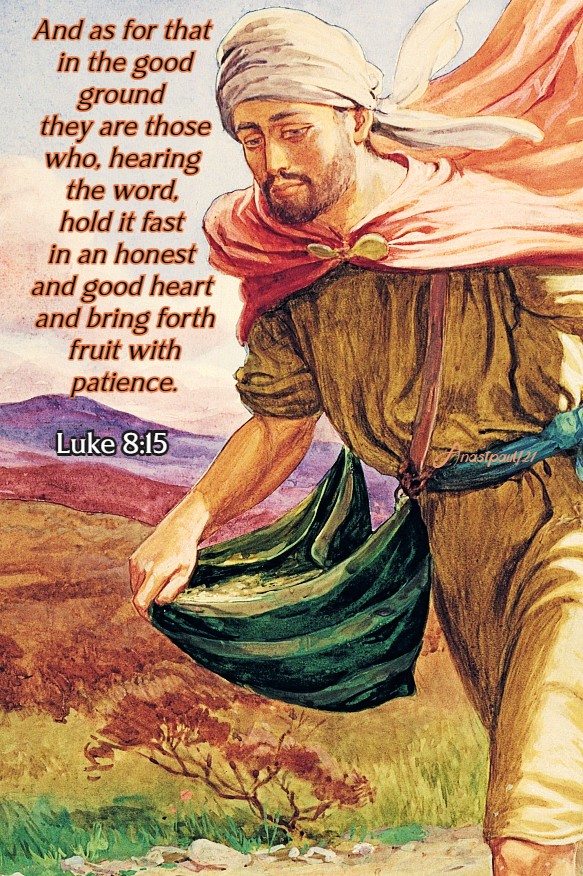
And as for that in the good ground
they are those who, hearing the word,
hold it fast in an honest and good heart
and bring forth fruit with patience.

Luke 8:15

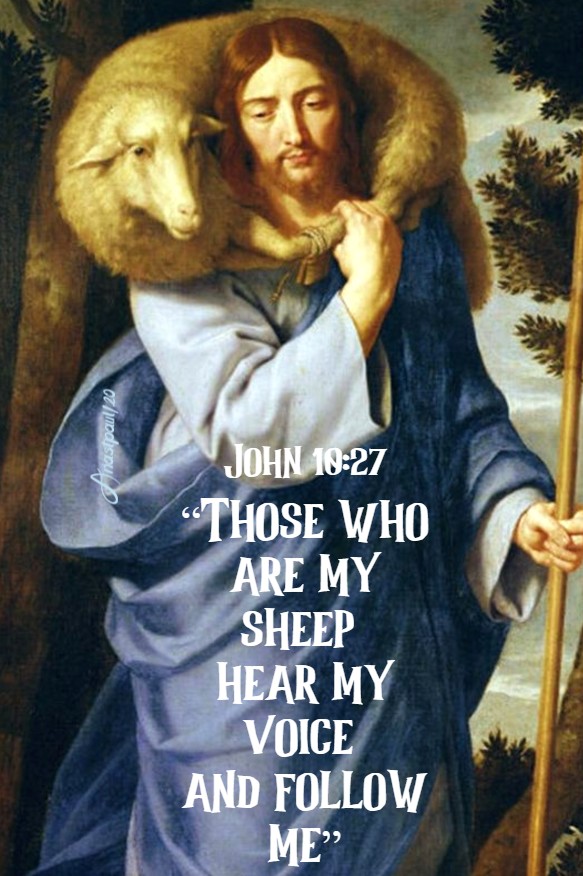
Those who are my sheep
hear my voice
and follow me

John 10:27

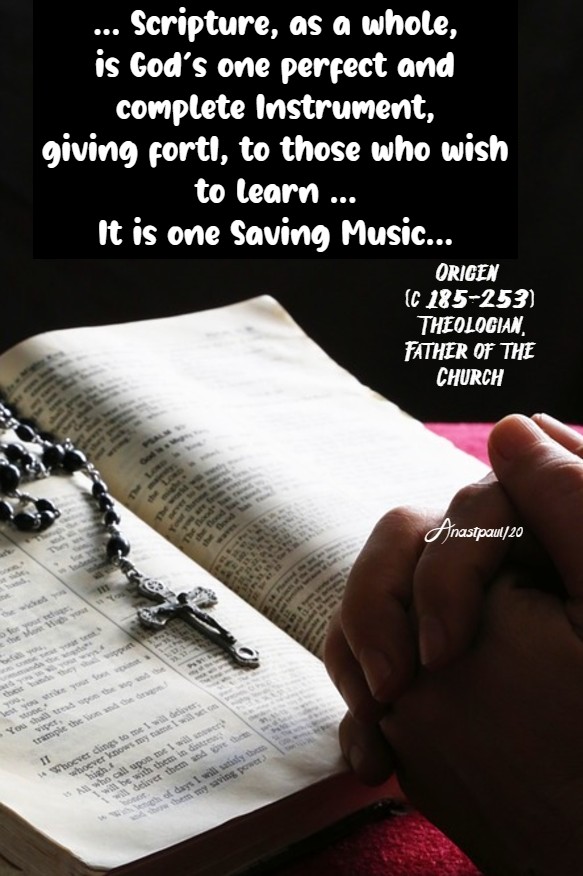
… Scripture, as a whole,
is God’s one perfect and complete instrument,
giving forth, to those who wish to learn …
It is one Saving Music…

Origen (c 185-253)
Theologian, Father of the Church

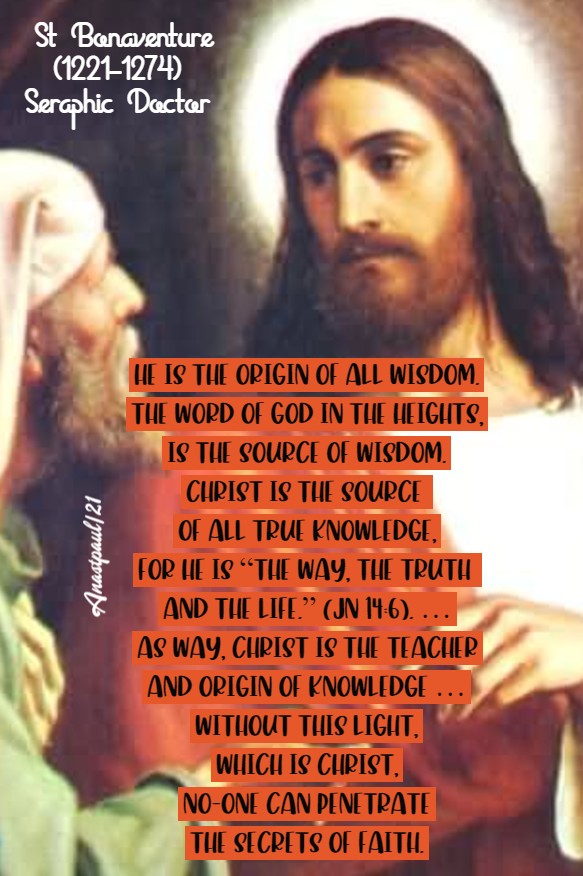
He is the origin of all wisdom.
The Word of God in the heights,
is the source of wisdom.
Christ is the source of all true knowledge,
for He is “the way, the truth and the life.” (Jn 14:6). …
As way, Christ is the teacher
and origin of knowledge …
Without this Light,
which is Christ,
no-one can penetrate
the secrets of faith.

St Bonaventure (1221-1274)
Seraphic Doctor

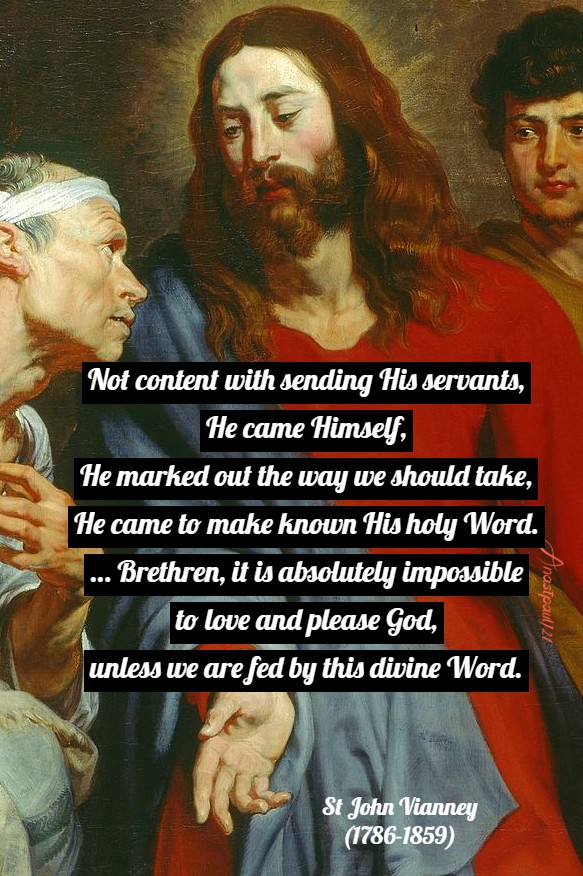
Not content with sending His servants,
He came Himself,
He marked out the way we should take,
He came to make known His holy Word.
… Brethren, it is absolutely impossible
to love and please God,
unless we are fed by this divine Word.

St John Vianney (1786-1859)

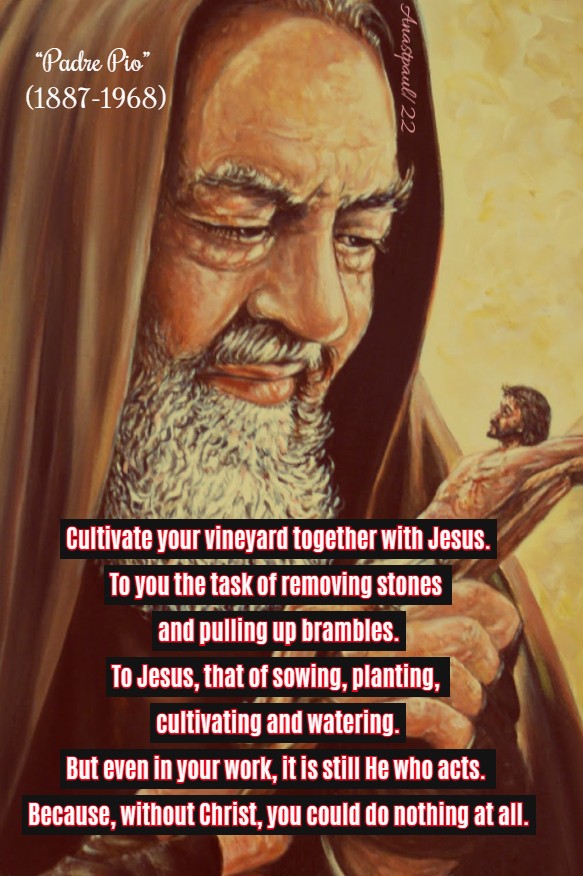
Cultivate your vineyard
together with Jesus.
To you the task of removing stones
and pulling up brambles.
To Jesus, that of sowing, planting,
cultivating and watering.
But even in your work,
it is still He who acts.
Because, without Christ,
you could do nothing at all.

St Pio of Pietrelcina
“Padre Pio” (1887-1968)

Posted in DOMINICAN OP, franciscan OFM, LENT, LENT 2022, MARIAN TITLES

Sexagesima Sunday, Notre-Dame de Bolougn-sur-Mer / Our Lady of Bolougn-sur-Mer, France (633) and Memorials of the Saints – 20 February

Sexagesima Sunday:
(Latin – Sexagesima, sixtieth) is the eighth Sunday before Easter and the second before Lent. The Ordo Romanus, St Alcuin and others, count the Sexagesima from this day to Wednesday after Easter. The name was already known to the Fourth Council of Orléans in 541. To the Latins it is also known as “Exsurge” from the beginning of the Introit. The station was at Saint Paul’s Outside the Walls of Rome and hence, the oratio calls upon the Doctor of the Gentiles. The Epistle is from Paul, 2 Corinthians 11 and 12, describing his suffering and labours for the Church. The Gospel (Luke 8) relates the falling of the seed on good and on bad ground, while the Lessons of the first Nocturn continue the history of man’s iniquity and speak of Noah and of the Deluge.

Notre-Dame de Bolougn-sur-Mer / Our Lady of Bolougn-sur-Mer, France (633) – 20 February:
HERE:

https://anastpaul.com/2021/02/20/our-lady-of-bolougne-sur-mer-france-633-and-memorials-of-the-saints-20-february/

St Amata of Assisi OSC (Died c 1250)
St Bolcan of Derken
St Colgan

St Eleutherius of Tournai (c 456-532) the first Bishop of Tournai, France, Martyr. Confessor.
His Life and Death:

https://anastpaul.com/2021/02/20/saint-of-the-day-20-february-saint-eleutherius-of-tournai-c-456-532-bishop-martyr/

St Eucherius of Orleans OSB (c 687-743) Bishop Orléans, Benedictine Monk, Confessor.
About St Eucherius:

https://anastpaul.com/2020/02/20/saint-of-the-day-20-february-saint-eucherius-of-orleans-c-687-743/

St Falco of Maastricht

St Francisco Marto (1908-1919) Two of the three Visionaries of Fatima.
St Jacinta Marto (1910-1920)

Today (2022) is the Sixth Anniversary of their Canonisation: https://anastpaul.wordpress.com/2018/02/20/saints-of-the-day-20-february-saints-francisco-1908-1919-and-jacinta-marta-1910-1920

St Leo of Catania
St Nemesius of Cyprus
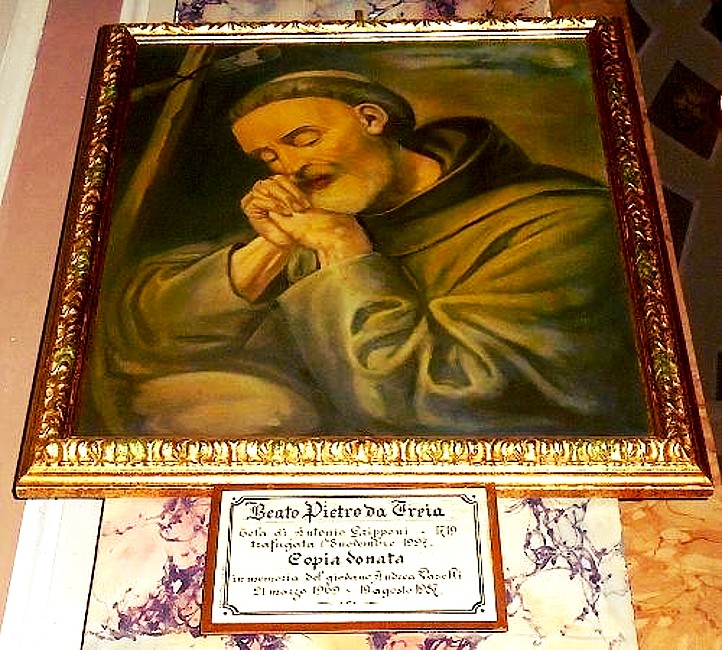
Blessed Pietro of Treia OFM (1214-1304) Friar of the Friars Minor.
St Pothamius of Cyprus
St Serapion of Alexandria
St Silvanus of Emesa

Blessed Stanislawa/Julia Rodzinska OP (1899-1945) Martyr, Dominican Sister, known as the “Mother of Orphans” and the “Apostle of the Rosary”, Apostle of Charity, Teacher, Catechist.
Biography:

https://anastpaul.com/2019/02/20/saint-of-the-day-20-february-blessed-julia-rodzinska-op-1899-1945-martyr/

St Valerius of Courserans
St Wulfric of Haselbury
St Zenobius of Antioch

Posted in franciscan OFM, MYSTICS, SAINT of the DAY

Saint of the Day – 20 February – Blessed Pietro of Treia OFM (1214-1304)

Saint of the Day – 20 February – Blessed Pietro of Treia OFM (1214-1304) Friar of the Friars Minor, renowned and eloquent Preacher, Mystic and Ecstatic who levitated and experienced visions. Born in 1214 and died on 19 February 1304 at the Franciscan Convent of Sirolo, Italy.

The Blessed Pietro da Treia was born in 1214 was descend from the noble Marchionni family. From childhood he showed a particular love for the Archangel Gabriel.

After spending the first years of his youth among the riches and comforts derived from his social condition, he decided to change his life and follow a more austere evangelical life. He entered the Order of Friars Minor at a very young age. Eager to imitate the virtues of St Francis, he also materially followed in his footsteps, residing for a long time in La Verna.

Blessed Pietro da Treia spent much of his time in contemplation but he was also an active Friar, especially in the ministry of the word, as an irresistible Preacher.

He travelled the Marches, captivating the crowds with his sacred eloquence. He had the gift of moving sinners, who through a good Confession, repented offering penances for their sins and were brought back to God.

His ecstasies and visions are well-known and documented. In Ancona the Blessed Peter while he was immersed in prayer before the Crucifix, placed on the main Altar of the Church, rose from the ground in ecstasy with his whole body and went to kiss the feet of the Lord Crucified. Later in the Convent of Forano, it was Pietro who saw a wonderful scene, in which the Madonna affectionately placed the Divine Baby Jesus on the loving arms of his brother Corrado da Offida.

Blessed Pietro died in the Convent of Sirolo on 19 February 1304, at the age of 79. Pope Pius VI, on 11 September 1793 approved the cult and Beatified him..

Posted in DOMINICAN OP, FATHERS of the Church, franciscan OFM, JESUIT SJ, MARIAN TITLES, SAINT of the DAY

Notre Dame-de-Bonne Nouvelle / Our Lady of Good Tidings, Lempdes, France (1500’s) and Memorials of the Saints – 19 February

Notre Dame-de-Bonne Nouvelle / Our Lady of Good Tidings, Lempdes, France (1500’s) – 18 February:
HERE:

https://anastpaul.com/2021/02/19/saint-of-the-day-19-february-blessed-alvarez-of-cordova-op-c-1350-c-1430-priest/

Blessed Alvarez of Cordova OP (c 1350–c 1430) Priest of the Order of Preachers, Confessor, Ascetic, Royal Advisor and Tutor, founder of many Churches and Convents, miracle-worker.
Biography:

https://anastpaul.com/2021/02/19/saint-of-the-day-19-february-blessed-alvarez-of-cordova-op-c-1350-c-1430-priest/

St Auxibius
St Baoithin

St Barbatus of Benevento (c 610-682) “Apostle of the South,” Bishop of Benevento, Preacher, Reformer, Confessor.
About St Barbatus:

https://anastpaul.com/2019/02/19/saint-of-the-day-19-february-st-barbatus-of-benevento-c-610-682-apostle-of-the-south/

St Beatus
St Belina
St Boniface of Lausanne
St Conon of Alexandria

St Conrad of Piacenza TOSF (c 1290-1351) Hermit, Pilgrim and Penitent, Member of the Third Order of St Francis.
The Life of St Conrad:

https://anastpaul.com/2020/02/19/saint-of-the-day-19-february-st-con

Bl Elizabeth of Mantua
St Gabinus
St George of Lodeve

Blessed John Sullivan SJ (1861-1933) Priest, Religious, Lawyer, Teacher, Writer, Miracle Worker, Apostle of Charity.
His life:

https://anastpaul.wordpress.com/2018/02/19/saint-of-the-day-19-february-blessed-john-sullivan-s-j-1861-1933/

Bl Józef Zaplata
St Lucia Yi Zhenmei
St Mansuetus of Milan
St Odran
St Proclus of Bisignano
St Quodvultdeus (Died c 450) Bishop, Confessor
St Valerius of Antibes
St Zambdas of Jerusalem

Posted in DOMINICAN OP, franciscan OFM, MARIAN TITLES, SAINT of the DAY

Notre-Dame de l’ Epine / Our Lady of the Thorn, Chalons-sur-Marne, France (1400) and Memorials of the Saints – 16 February

Notre-Dame de l’ Epine / Our Lady of the Thorn, Chalons-sur-Marne, France (1400) – 16 February:
HERE:
https://anastpaul.com/2021/02/16/our-lady-of-the-thorn-chalons-sur-marne-france-1400-and-memorials-of-the-saints-16-february/

St Aganus of Airola

Blessed Bernard Scammacca OP (1430-1487) Priest and Friar of the Order of Preachers, Preacher, Apostle of charity, Mystic, with a gift of prophecy and a great devotion to the Passion of Christ.
About Bl Bernard:

https://anastpaul.wordpress.com/2018/02/16/saint-of-the-day-16-february-blessed-bernard-scammacca-o-p-1430-1487/

St Faustinus of Brescia (not the St Faustinus brother of St Jovinus – 15 February)
St Gilbert of Sempringham
St Honestus of Nimes
St John III of Constantinople

Blessed Joseph Allamano (1851–1926) Priest, Founder of the Consolata Missionaries (I.M.C.) congregation for males and another for females, known as the Consolata Missionary Sisters.
Biography:

https://anastpaul.com/2019/02/16/saint-of-the-day-16-february-blessed-joseph-allamano-1851-1926/

St Julian of Egypt
St Juliana of Campania
St Juliana of Nicomedia
Blessed Mariano Arciero
St Maruta (Died 415) Bishop

Blessed Nicola Paglia OP (1197-1256) Priest of the Order of Preachers , faithful travelling companion of St Dominic, Superior General (twice). A cultured and far-sighted man, he promoted the study of Sacred Scripture and the compilation of biblical Concordances.
Blessed Nicola’s
Life:
https://anastpaul.com/2020/02/16/saint-of-the-day-16-february-blessed-nicola-paglia-op-1197-1256/

St Onesimus of Ephesus

Blessed Philippa Mareria OSC (c 1195-1236) Nun of the Poor Clares, foundress of the monastery of Franciscan Sisters of Saint Philippa Mareri of the Poor Clares, Penitent.
Her Life:

https://anastpaul.com/2021/02/16/saint-of-the-day-16-february-blessed-philippa-mareri-osc-c-1195-1236/

Martyrs of Cilicia – 12 Saints: A group of Christians who ministered to other Christians who were condemned to work the mines of Cilicia in the persecutions of Maximus. They were arrested, tortured and martryed by order of the governor Firmilian.
• Daniel
• Elias
• Isaias
• Jeremy
• Samuel
The group also includes the three known have been sentenced to the mines –
• Pamphilus
• Paul of Jamnia
• Valens of Jerusalem
and those who were exposed as Christians as a result of these murders –
• Julian of Cappadocia
• Porphyrius of Caesarea
• Seleucius of Caesarea
• Theodule the Servant
They were martyred in 309 in Cilicia, Asia Minor (in modern Turkey).

Posted in AUGUSTINIANS OSA, DOCTORS of the Church, FATHERS of the Church, franciscan OFM, GOD is LOVE, LOVE of NEIGHBOUR, PRAYERS of the SAINTS, QUOTES on LOVE, QUOTES on LOVE of GOD, QUOTES on SIN, The HEART, The WORD, Thomas a Kempis

Quote/s of the Day – 14 February – LOVE!

Quote/s of the Day – 14 February – The Memorial of St Valentine (176-273) Bishop and Martyr

LOVE!

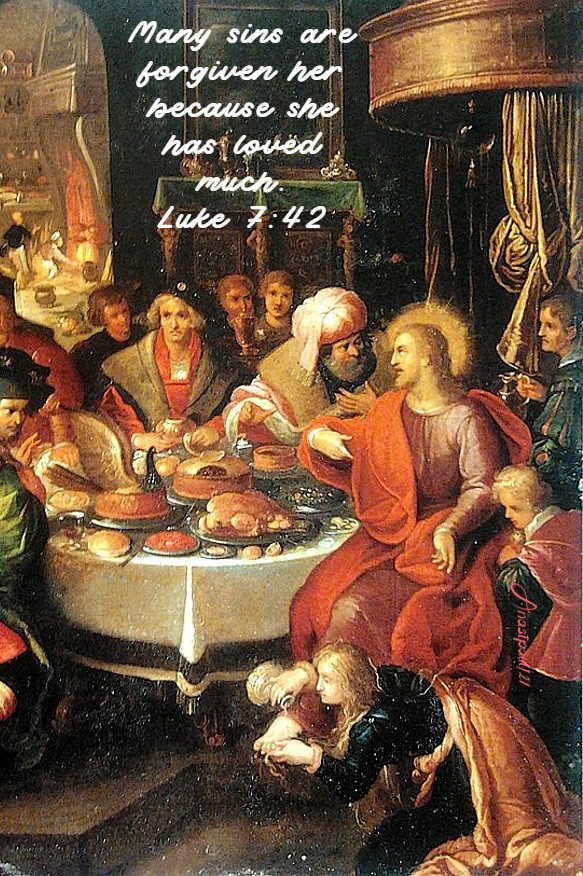
Many sins are forgiven her
because she has loved much.

Luke 7:42

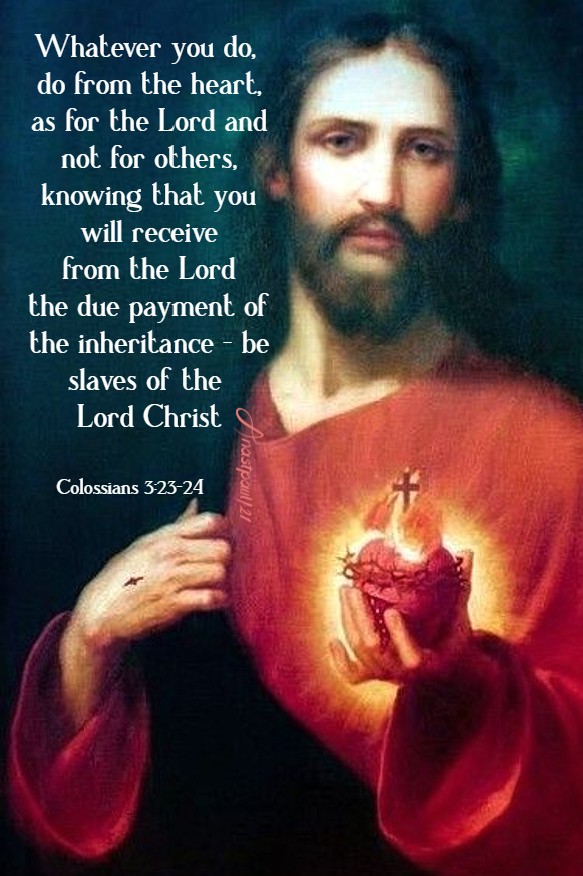
Whatever you do, do from the heart,
as for the Lord and not for others,
knowing that you will receive
from the Lord
the due payment of the inheritance;
be slaves of the Lord Christ.

Colossians 3:23-24

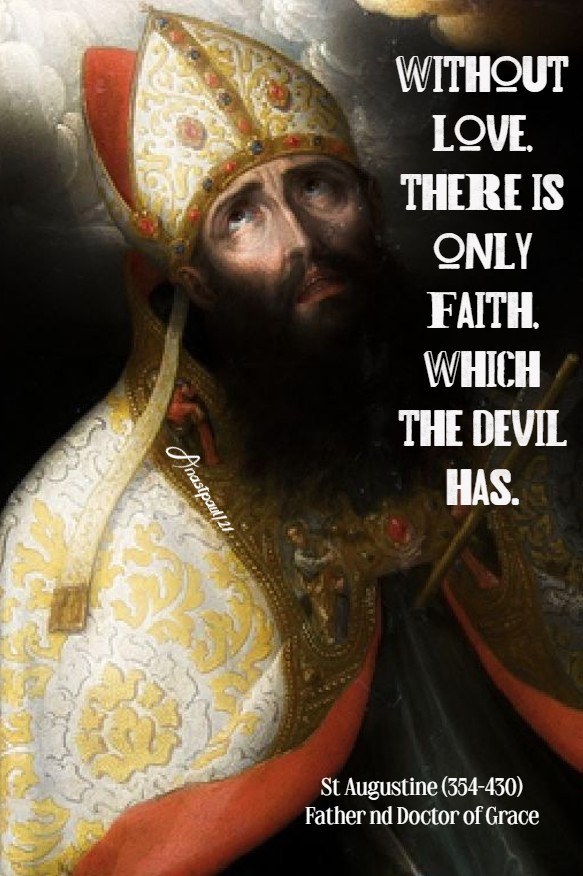
Without love,
there is only faith,
which the devil has.

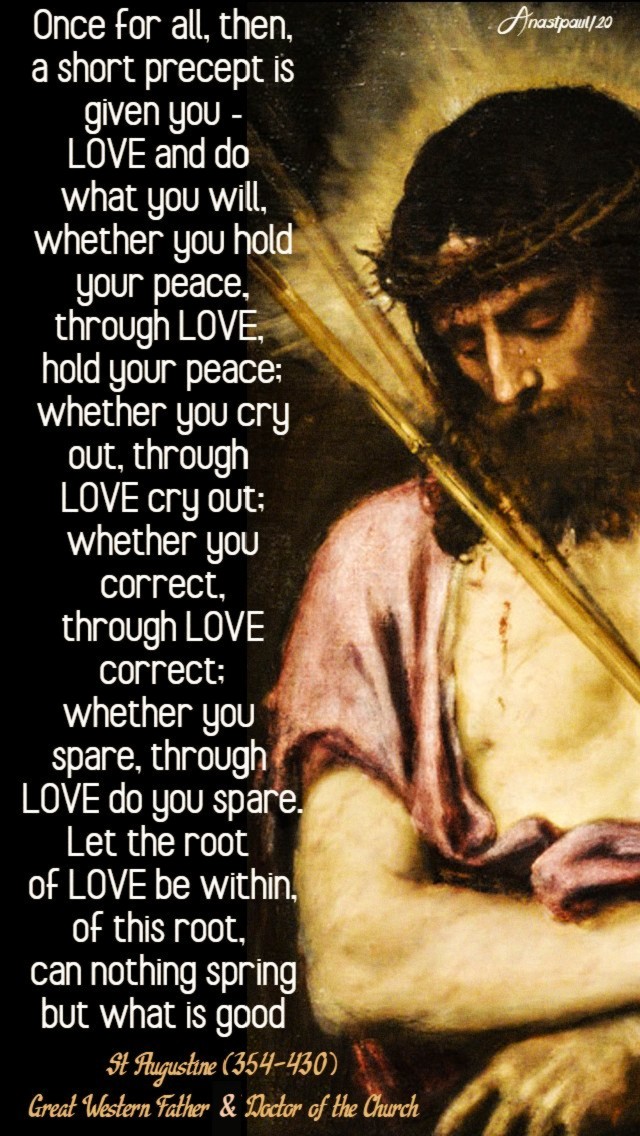
Once for all, then,
a short precept is given you –
Love and do what you will,
whether you hold your peace,
through love, hold your peace;
whether you cry out,
through love cry out;
whether you correct,
through love correct;
whether you spare,
through love do you spare.
Let the root of love be within,
of this root, can nothing spring

but what is good.”

St Augustine (354-430)
Father nd Doctor of Grace

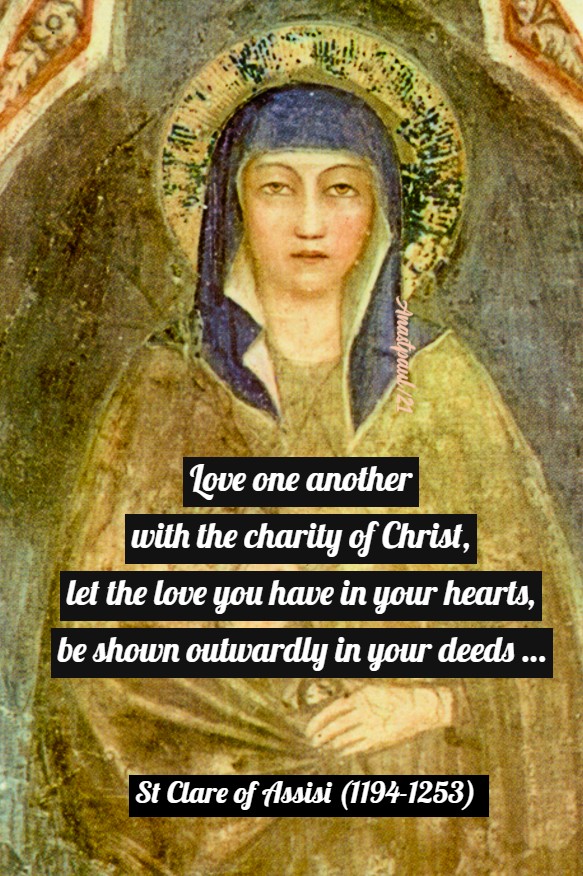
“Love[ing] one another
with the charity of Christ,
let the love you have in your hearts,
be shown outwardly in your deeds
…”

St Clare of Assisi (1194-1253)

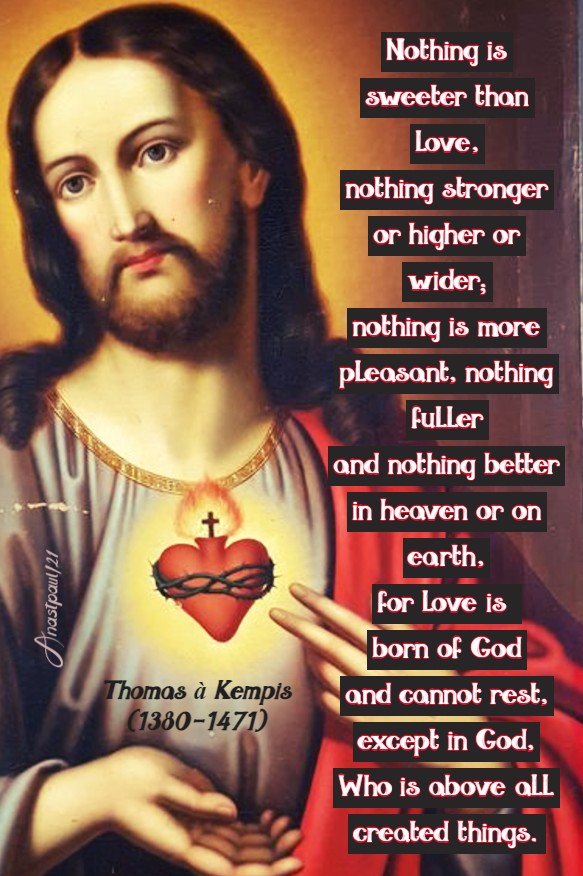
Nothing is sweeter than love,
nothing stronger or higher or wider;
nothing is more pleasant, nothing fuller
and nothing better in heaven or on earth,
for love is born of God

and cannot rest except in God,
Who is above all created things.

Thomas à Kempis (1380-1471)

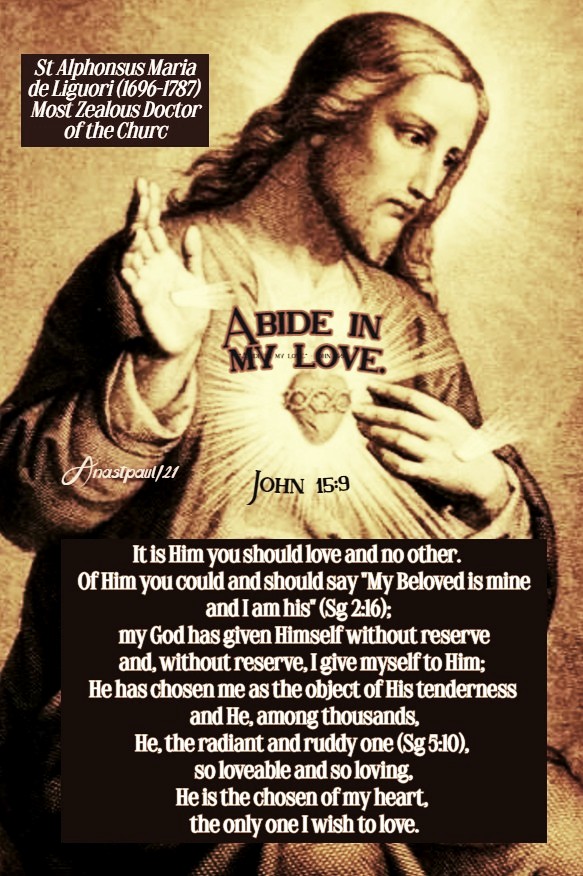
… It is Him you should love and no other.
Of Him you could and should say

“My Beloved is mine and I am his” (Sg 2:16);
my God has given Himself without reserve
and, without reserve, I give myself to Him;
He has chosen me as the object of His tenderness
and He, among thousands,
He, the radiant and ruddy one (Sg 5:10),
so loveable and so loving,
He is the chosen of my heart,
the only one I wish to love.

St Alphonsus Maria de Liguori (1696-1787)

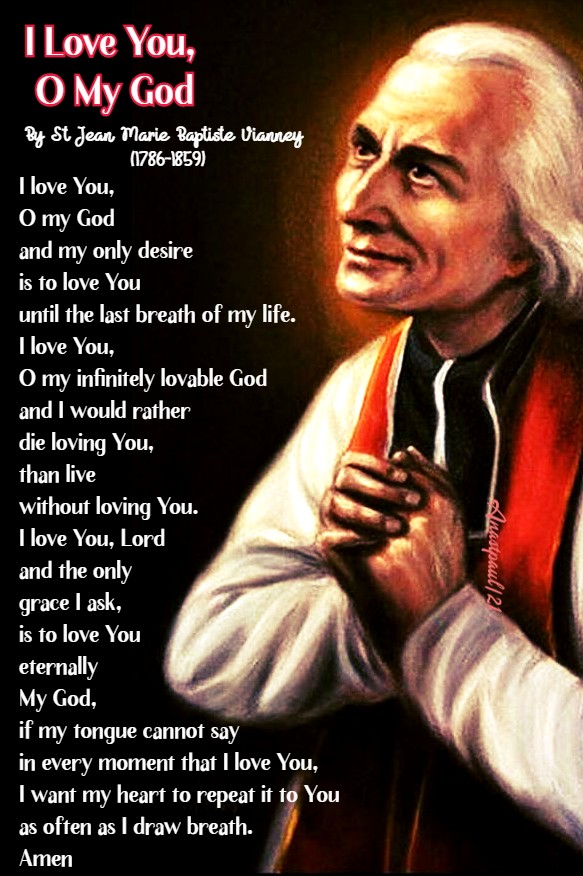
I Love You, O My God
By St Jean Marie Baptiste Vianney (1786-1859)

I love You,
O my God
and my only desire is to love You
until the last breath of my life.
I love You,
O my infinitely lovable God
and I would rather die loving You,
than live without loving You.
I love You, Lord
and the only grace I ask,
is to love You eternally
My God,
if my tongue cannot say
in every moment that I love You,
I want my heart to repeat it to You
as often as I draw breath.
Amen

Posted in CARMELITES, franciscan OFM, JESUIT SJ, MARIAN TITLES, SAINT of the DAY

Nostra Signora del Fuoco / Our Lady of the Fire, Forli, Italy (1428) and Memorials of the Saints – 4 February

Nostra Signora del Fuoco / Our Lady of the Fire, Forli, Italy (1428) – 4 February:
HERE:

https://anastpaul.com/2021/02/04/our-lady-of-fire-forli-italy-1428-and-memorials-of-the-saints-4-february/

St Andrew Corsini O.Carm (1302-1373) Bishop of Fiesole from 1349 until his death, known as the “Apostle of Florence,” Carmelite Friar, Penitent, Apostle of the poor, Peacemaker, Papal Legate.
Biography:
https://anastpaul.com/2021/02/04/saint-of-the-day-4-february-saint-andrew-corsini-o-carm-1302-1373-bishop/

Bl Dionisio de Vilaregut
St Donatus of Fossombrone
St Eutychius of Rome
St Filoromus of Alexandria
St Firmus of Genoa
Bl Frederick of Hallum
St Gelasius of Fossombrone
St Geminus of Fossombrone
St Gilbert of Limerick (c 1070–1145) Bishop
St Gilbert of Sempringham (c 1083-1189) Priest, Founder of the Gilbertine order,
St Isidore of Pelusium

St Jane de Valois O.Ann.M and TOSF (1464-1505) Princess, Queen, Founder, Religious Sister, Mystic, Teacher. Founded the monastic Order of the Sisters of the Annunciation of Mary. From this Order later sprang the religious congregation of the Apostolic Sisters of the Annunciation, founded in 1787 to teach the children of the poor.
Biography:

https://anastpaul.wordpress.com/2018/02/04/saint-of-the-day-4-february-saint-jane-of-valois-o-ann-m-1464-1505/

St John de Britto SJ (1647-1693) Martyr, Priest, Missionary to India, Confessor, Preacher.
Biography:

https://anastpaul.com/2019/02/04/saint-of-the-day-4-february-st-john-de-britto-sj-1647-1693-martyr/

St John of Irenopolis
Bl John Speed

St Joseph of Leonissa OFM (Cap) (1556-1612) Friar of the Capuchin Franciscans, Missionary Preacher, Confessor.
Biography
:
https://anastpaul.wordpress.com/2017/02/04/saint-of-the-day-4-february-st-joseph-of-leonissa/

St Liephard of Cambrai
St Magnus of Fossombrone
St Modan
St Nicholas Studites
St Nithard
St Obitius
St Phileas of Alexandria

Blessed Rabanus Maurus OSB (776-856) Archbishop, Monk, Abbot,Theologian, Poet, Writer, Teacher, Encyclopedist, “The Teacher of Germany.”
Blessed Rabanus’ Life:

https://anastpaul.com/2020/02/04/saint-of-the-day-4-february-saint-rabanus-maurus-osb-776-856/

St Rembert
St Themoius
St Theophilus the Penitent
St Vincent of Troyes
St Vulgis of Lobbes

Jesuit Martyrs of Japan: A collective memorial of all members of the Jesuits who have died as Martyrs for the faith in Japan.

Martyrs of Perga – 4 Saints: A group of shepherds martyred in the persecutions of Decius. The only details we have about them are the names – Claudian, Conon, Diodorus and Papias. They were martyred in c 250 in Perga, Asia Minor (in modern Turkey).

Posted in DOMINICAN OP, franciscan OFM, SAINT of the DAY

Memorials of the Saints – 1 February

St Ignatius of Antioch (c 35 – 107) Martyr, Bishop of Antioch, Apostolic Father of the Church
His Feast Day is today (General Roman Calendar, 12th century–1969).
Biography:

https://anastpaul.com/2018/10/17/saint-of-the-day-17-october-st-ignatius-of-antioch-c-35-107-father-of-the-church/
AND:
https://anastpaul.com/2018/10/17/saint-of-the-day-17-october-st-ignatius-of-antioch-c-35-107-father-of-the-church/

St Agrepe

Blessed Andrew of Segni OFM (1240-1302) Priest and Friar of the the Order of Friars Minor, Hermit, Spiritual teacher, Mystic, Miracle-worker and Exorcist.
Blessed Andrew’s Life:

https://anastpaul.com/2021/02/01/saint-of-the-day-1-february-blessed-andrew-of-segni-ofm-1240-1302/

Bl Anthony Manzoni
St Asclepiades
St Autbert of Landevenec
St Barbara Ch’oe Yong-i

Blessed Benedict Daswa (1946-1990) – Martyr, Layman
The first South African Blessed:

https://anastpaul.wordpress.com/2018/02/01/saint-of-the-day-1-february-blessed-benedict-daswa-1946-1990-martyr/

St Brigid of Fiesole

St Brigid of Ireland/Kildare (c 453-523) Virgin, Abbess, Apostle of Charity and foundress of several monasteries of nuns, including that of Kildare in Ireland.
St Brigid’ Story:

https://anastpaul.com/2019/02/01/saint-of-the-day-st-brigid-of-ireland-kildare-c-453-523/

St Cecilius of Granada
St Cinnia of Ulster
St Clarus of Seligenstadt
Bl Conor O’Devany
St Crewenna
St Darlaugdach of Kildare
St Henry Morse
St Ioannes Yi Mun-u
St Jarlath
Bl John of the Grating
St Kinnia

Blessed Luigi Variara SDB (1875-1923) Priest of the Salesians of Don Bosco, Founder of the Daughters of the Sacred Hearts of Jesus and Mary, of which Order he is the Patron.
Biography:

https://anastpaul.com/2020/02/01/saint-of-the-day-blessed-blessed-luigi-variara-sdb-1875-1923/

Bl Patrick O’Lougham
St Paul of Trois-Châteaux
St Paulus Hong Yong-ju
St Raymond of Fitero
Blessed Reginald of Orléans OP (c 1180 – 1220) Priest and Friar of the Order of Preachers
St Sabinus
St Severus of Avranches
St Severus of Ravenna
St Sigebert III of Austrasia
St Tryphon of Lampsacus
St Ursus of Aosta
St Veridiana

Martyrs of Avrillé – 47 Beati: Forty-seven Christians executed together for their faith in the anti-Catholic persecution of the French Revolution.
• Anne-François de Villeneuve• Anne Hamard• Catherine Cottenceau• Charlotte Davy• François Bellanger• François Bonneau• François Michau• François Pagis epouse Railleau• Gabrielle Androuin• Jacquine Monnier• Jeanne Bourigault
• Jeanne Fouchard épouse Chalonneau• Jeanne Gruget veuve Doly• Jeanne-Marie Sailland d’Epinatz• Louise-Aimée Dean de Luigné• Louise-Olympe Rallier de la Tertinière veuve Déan de Luigné• Madeleine Blond• Madeleine Perrotin veuve Rousseau• Madeleine Sailland d’Epinatz• Marguerite Rivière epouse Huau• Marie Anne Pichery épouse Delahaye• Marie-Anne Vaillot• Marie Cassin épouse Moreau• Marie Fausseuse épouse Banchereau• Marie Gallard épouse Quesson• Marie Gasnier épouse Mercier• Marie Grillard• Marie-Jeanne Chauvigné épouse Rorteau• Marie Lenée épouse Lepage de Varancé• Marie Leroy• Marie Leroy épouse Brevet• Marie Roualt épouse Bouju• Odilia Baumgarten• Perrine Androuin• Perrine Besson• Perrine-Charlotte Phelippeaux épouse Sailland d’Epinatz• Perrine Grille• Perrine Ledoyen• Perrine Sailland d’Epinatz• Renée Cailleau épouse Girault• Renée Grillard• Renée Martin épouse Martin• Renée Valin• Rose Quenion• Simone Chauvigné veuve Charbonneau
• Suzanne Androuin• Victoire Bauduceau epouse Réveillère.
They were martyred on 1 February 1794 in Avrillé, Maine-et-Loire, France and Beatified on 19 February 1984 by St Pope John Paul II at Rome, Italy.

Martyrs of Korea: Thousands of people were murdered in the anti-Catholic persecutions in Korea. Today we celebrate and honour:
• Saint Barbara Ch’oe Yong-i
• Saint Ioannes Yi Mun-u
• Saint Paulus Hong Yong-ju

Posted in franciscan OFM, SAINT of the DAY

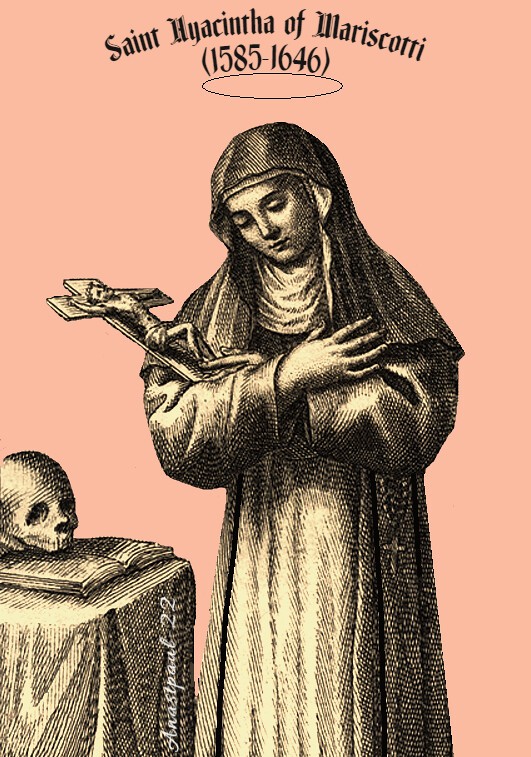
Saint of the Day – 30 January – Saint Hyacintha of Mariscotti TOR (1585-1646)

Saint of the Day – 30 January – Saint Hyacintha of Mariscotti TOR (1585-1646) Virgin, Sister of the Tertiary or Third Order Regular of St Francis (also TOSF), Penitent, Apostle of the poor, the sick, the elderly. She established apostolates to aid the latter as well as another devoted to the Adoration of the Holy Eucharist. Born in 1585 near Viterbo, Italy and died on 30 January 1640, aged 54, at Viterbo, Italy of natural causes. Also known as – Giacinta Marescotti, Clarice Marescotti.

The Roman Martyrology reads today: “In Viterbo, Saint Giacinta Marescotti, Virgin of the regular Third Order of Saint Francis, who, after fifteen years spent among vain pleasures, embraced a very hard life and established a brotherhoods for the assistance of the elderly and for the Adoration of the Holy Eucharist.

Hyacintha was born of a noble family, her parents being Count Marcantonio Marescotti and Countess Ottavia Orsini, whose father had built the noted Gardens of Bomarzo. They had their new baby daughter Baptised as Clarice. At an early ages she and her sisters, Ginevra and Ortensia, were sent to the Monastery of St Bernardine to be educated by the community of Sisters of the Franciscan Third Order Regular. When their studies were completed, her older sister, Ginevra, chose to enter the Monastic community as a nun, becoming known as Sister Immacolata.

In her early youth, Clarice had been noted for her piety but, as she grew older, she became frivolous. At the age of 20 Clarice set her heart upon marriage with the Marchese Capizucchi, but was passed over by him in favour of her younger sister, Ortensia. Disappointed, she entered the Monastery in Viterbo where she had been educated, receiving the name Hyacintha. She admitted later, that she did this only to hide her chagrin and not to give up the luxuries of the world. She kept a private stock of extra food, wore a habit of the finest material and received and paid visits at will.

For ten years, Hyacintha kept up this life, contrary to the spirit of her vows but at the same time, she retained a strong religious faith and was regular in her following of the daily routine of the Monastery life, with a tender devotion to the Virgin Mary. At that point, due to a severe illness, the Priest who served as the Confessor to the Monastery went to her cell to bring her Holy Communion. Shocked by the display of luxuries he saw there, he admonished her to a closer observance of the way of life to which she had committed herself.

Hyacintha experienced a profound inner transformation, after her serious illness and some deaths in the family.  Twenty-four extraordinary and very hard years began for Sister Hyacintha in total poverty. And of continuous penances, with harshness that are difficult to understand today. 

She gave away her costly garments, wore an old tunic, went barefoot, frequently fasted on bread and water and chastised her body by vigils. During the outbreak of a plague in the City, she became noted for her devotion in nursing the sick.

Hyacintha went on to establish two apostolates whose members were called Oblates of Mary or “Sacconi.” One of these, similar to the Society of St. Vincent de Paul, gathered alms for the convalescent, for the poor who were ashamed to beg and for the care of prisoners; the other procured homes for the aged.

By the time of her death, Hyacintha’s reputation for holiness was so great, that, at her wake, her religious habit had to be replaced three times. This was due to pieces of it being snipped off by the people to keep as a relic.

Hyacintha was Beatified by Pope Benedict XIII in 1726 and Canonised on 14 May 1807 by Pope Pius VII. Today her remains are preserved for veneration in the Church of her Monastery, which now bears her name.

Posted in franciscan OFM, MARIAN TITLES, SAINT of the DAY

Notre-Dame-de-Chatillion / Our Lady of Chatillion-sur- Seine, France (1130) and Memorials of the Saints – 29 January

Notre-Dame-de-Chatillion / Our Lady of Chatillion-sur- Seine, France (1130) – 29 January:
here:
https://anastpaul.com/2021/01/29/our-lady-of-chatillion-sur-seine-france-1130-and-memorials-of-the-saints-29-january/

St Francis de Sales CO, OM, OFM (Cap) (1567-1622)– Doctor of the Church: Doctor caritatis (Doctor of Charity) “The Gentle Christ of Geneva” and the “Gentleman Saint” – Bishop of Geneva, Doctor of Law and Theology, Writer, Theologian, Mystic, Teacher, Preacher, Founder along with St Jane Frances de Chantal, founded the women’s Order of the Visitation of Holy Mary (Visitandines). (Memorial)
Feast Day – 29 January (General Roman Calendar of 1960 and local communities.
Biography:

https://anastpaul.wordpress.com/2018/01/24/saint-of-the-day-24-january-st-francis-de-sales-1567-1622-doctor-of-the-church-doctor-caritatis-doctor-of-charity/
AND:
https://anastpaul.com/2019/01/24/saint-of-the-day-24-january-st-francis-de-sales-the-gentle-christ-of-geneva/

St Abundantia the Martyr
St Aphraates
St Aquilinus of Milan
St Barbea of Edessa
St Blath of Kildare
Bl Boleslawa Maria Lament
St Caesarius of Angoulême
Bl Charles of Sayn
St Constantius of Perugia (Died c 170) Martyr Bishop

St Dallan Forgaill (c 530- 598) Martyr, Monk, Reformer, Poet.
St Dallan’s story:

https://anastpaul.wordpress.com/2018/01/29/saint-of-the-day-29-january-st-dallan-forgaill-c-530-598/

St Pope Gelasius II (c 1060–1119) Bishop of Rome from 24 January 1118 to his death in 1119.
About Pope Gelasius II:

https://anastpaul.com/2020/01/29/saint-of-the-day-29-january-st-pope-gelasius-ii-c-1060-1119/
St Gildas the Elder

St Gildas the Wise (c 500-c 570) Priest and Abbot.
Biography:

https://anastpaul.wordpress.com/2017/01/29/saint-of-the-day-29-january-st-gildas-the-wise/

Blessed Juniper OFM (Died 1258) Franciscan Friar. Brother Juniper is called “the renowned jester of the Lord” and was one of the original followers of St Francis of Assisi.
Blessed Juniper’s life:

https://anastpaul.com/2019/01/29/saint-of-the-day-29-january-the-servant-of-god-brother-juniper-ofm-died-1258/

St Maurus of Rome
St Papias of Rome
St Sarbellius
St Serrano

St Sulpicius I (Died 591) Bishop of Bourges.
About St Sulpicius:

https://anastpaul.com/2021/01/29/saint-of-the-day-29-january-saint-sulpicius-i-died-591/

St Valerius of Trier
St Voloc

Posted in franciscan OFM, MORNING Prayers, PRAYERS of the SAINTS

Our Morning Offering – 26 January – Great and Glorious God

Our Morning Offering – 26 January – The Memorial of St Polycarp (c 69 – c 155) Martyr and Father of the Church

Great and Glorious God
By St Francis of Assisi (c 1181-1226)

Great and glorious God,
my Lord Jesus Christ!
I implore Thee to enlighten me
and to disperse the darkness of my soul.
Give me true faith, firm hope and perfect charity.
Grant me, O Lord, to know Thee so well
that in all things I may act by Thy Light
and in accordance with Thy holy Will.
Amen

Posted in DOCTORS of the Church, DOMINICAN OP, franciscan OFM, SAINT of the DAY

Feast of St Timothy and Memorials of the Saints – 24 January

St Timothy (1st Century) Disciple of St Paul, Bishop and Martyr

St Francis de Sales CO, OM, OFM (Cap) (1567-1622)– Doctor of the Church: Doctor caritatis (Doctor of Charity) “The Gentle Christ of Geneva” and the “Gentleman Saint” – Bishop of Geneva, Doctor of Law and Theology, Writer, Theologian, Mystic, Teacher, Preacher, Founder along with St Jane Frances de Chantal, founded the women’s Order of the Visitation of Holy Mary (Visitandines). (Memorial)
Feast Day – 29 January (General Roman Calendar of 1960 and local communities.
Biography:

https://anastpaul.wordpress.com/2018/01/24/saint-of-the-day-24-january-st-francis-de-sales-1567-1622-doctor-of-the-church-doctor-caritatis-doctor-of-charity/
AND:
https://anastpaul.com/2019/01/24/saint-of-the-day-24-january-st-francis-de-sales-the-gentle-christ-of-geneva/

St Anicet Hryciuk
St Artemius of Clermont
St Bartlomiej Osypiuk
Bertrand of Saint Quentin
St Daniel Karmasz
St Exuperantius of Cingoli

St Felician of Foligno (c 158-c 250) Bishop and Martyr, Confessor.
St Felician’s Life and Death:

https://anastpaul.com/2021/01/24/saint-of-the-day-24-january-saint-felician-of-foligno-c-158-c-250-martyr/

St Filip Geryluk
Bl Francesc de Paula Colomer Prísas
St Guasacht
St Ignacy Franczuk
Bl John Grove
St Julian Sabas the Elder
St Luigj Prendushi
St Macedonius Kritophagos
Blessed Marcolino Amanni of Forli OP (1317-1397)
Bl Marie Poussepin

Blessed Paola Gambara Costa TOSF (1463-1515) a Countess and member of the Third Order of St Francis, Laywoman, Mother, Widow, Apostle of the poor and sick.
Her Life:

https://anastpaul.com/2020/01/24/saint-of-the-day-24-january-blessed-paola-gambara-costa-tosf-1463-1515/

St Projectus
St Sabinian of Troyes
St Suranus of Sora
St Thyrsus
Bl William Ireland

Martyrs of Asia Minor – 4 Saints: A group of Christians martyred together for their faith. The only details to survive are four of their names – Eugene, Mardonius, Metellus and Musonius. They were burned at the stake in Asia Minor.

Martyrs of Podlasie – 13 Beati: Podlasie is an area in modern eastern Poland that, in the 18th-century, was governed by the Russian Empire. Russian sovereigns sought to bring all Eastern-rite Catholics into the Orthodox Church. Catherine II suppressed the Greek Catholic Church in Ukraine in 1784. Nicholas I did the same in Belarus and Lithuania in 1839. Alexander II did the same in the Byzantine-rite Eparchy of Chelm in 1874 and officially suppressed the Eparchy in 1875. The Bishop and the Priests who refused to join the Orthodox Church were deported to Siberia or imprisoned. The laity, left on their own, had to defend their Church, their liturgy and their union with Rome.
On 24 January 1874 soldiers entered the village of Pratulin to transfer the parish to Orthodox control. Many of the faithful gathered to defend their parish and Church. The soldiers tried to disperse the people but failed. Their commander tried to bribe the parishioners to abandon Rome but failed. He threatened them with assorted punishments but this failed to move them. Deciding that a show of force was needed, the commander ordered his troops to fire on the unarmed, hymn-singing laymen. Thirteen of the faithful died, most married men with families, ordinary men with great faith.
We know almost nothing about their lives outside of this incident. Their families were not allowed to honour them or participate in the funerals and the authorities hoped they would be forgotten. Their names are:
• Anicet Hryciuk
• Bartlomiej Osypiuk
• Daniel Karmasz
• Filip Geryluk
• Ignacy Franczuk
• Jan Andrzejuk
• Konstanty Bojko
• Konstanty Lukaszuk
• Lukasz Bojko
• Maksym Hawryluk
• Michal Wawryszuk
• Onufry Wasyluk
• Wincenty Lewoniuk
Martyrdom:
• shot on 14 January 1874 by Russian soldiers in Podlasie, Poland
• buried nearby without rites by those soldiers
Beatified – 6 October 1996.

Martyrs of Antioch:
Babylas
Epolonius
Prilidian
Urban

Posted in DOMINICAN OP, franciscan OFM, INCORRUPTIBLES, MARIAN TITLES, SAINT of the DAY

Espousal of the Blessed Virgin Mary, approved by Pope Paul III (1546) and Memorials of the Saints – 23 January

The Third Sunday after the Epiphany

Espousal of the Blessed Virgin Mary, approved by Pope Paul III (1546) – 23 January:
HERE:

https://anastpaul.com/2021/01/23/feast-of-the-espousal-of-the-blessed-virgin-mary-and-memorials-of-the-saints/

St Raymond of Peñafort OP (1175-1275) “Father of Canon Law” Dominican Priest, Doctor of Canon Law, the Third Master of the Order of Preachers, Founder of the Mercedarian friars, Writer, Teacher, Miracle-Worker.
St Raymond of Peñafort’s Feast day was inserted in the General Roman Calendar in 1671 for celebration on 23 January. In 1969 it was moved to 7 January, the day after that of his death. He is the Patron Saint of canon lawyers, specifically and lawyers, in general.
Biography:
https://anastpaul.com/?s=st+raymond+penafort

St Marianne Cope TOSF (1838-1918) Virgin, Third Order of the Friars Minor, Missionary to lepers.
Biography:

https://anastpaul.wordpress.com/2017/01/23/saint-of-the-day-23-january-st-marianne-cope/

St Abel the Patriarch
St Agathangelus
St Amasius of Teano
St Andreas Chong Hwa-Gyong
St Aquila the Martyr
St Asclas of Antinoe

Blessed Benedetta Bianchi Porro (1936-1964) Laywoman.
Her Life:

https://anastpaul.com/2020/01/23/saint-of-the-day-23-january-blessed-benedetta-bianchi-porro-1936-1964/

St Clement of Ancyra
St Colman of Lismore
St Dositheus of Gaza
St Emerentiana (Died c 301) Virgin, Martyr
St Eusebius of Mount Coryphe

Blessed Henry Suso OP (1295-1366) German Dominican Priest and Friar, Poet, Mystic and the most popular vernacular writer of the fourteenth century. His body is incorrupt.
Blessed Henry’s Life:

https://anastpaul.com/2019/01/23/saint-of-the-day-blessed-henry-suso-op-1295-1366/

St Ildephonsus (506-667) Archbishop of Toledo. Theologian, Scholar, Marian devotee, Writer, Evangeliser. Abbot Dom Guéranger calls him the Doctor of the Virginity of Mary. Saint Ildephonsus established the feast of the Expectation of the Blessed Virgin Mary, which is still kept in some places on 18 December.
Biography:

https://anastpaul.wordpress.com/2018/01/23/saint-of-the-day-23-january-st-ildephonsus-607-667/

Bl Joan Font Taulat

St John the Almoner (Died c 620) Bishop of Alexandria, Widower, Confessor, Apostle of the poor, Reformer – both within the Church and within the civic structures.
About St John:

https://anastpaul.com/2021/01/23/saint-of-the-day-23-january-st-john-the-almoner-died-c-620/

Bl Juan Infante
St Jurmin
St Lufthild
St Maimbod
Bl Margaret of Ravenna
Martyrius of Valeria
St Messalina of Foligno
St Ormond of Mairé
St Parmenas the Deacon
St Severian the Martyr

Posted in CHRIST, the WAY,TRUTH,LIFE, DOCTORS of the Church, FATHERS of the Church, franciscan OFM, JESUIT SJ, LOVE of NEIGHBOUR, QUOTES for CHRIST, QUOTES on CHARITY, QUOTES on COURAGE, QUOTES on DEATH, QUOTES on HUMILITY, QUOTES on LOVE, QUOTES on LOVE of GOD, QUOTES on PATIENCE, QUOTES on POVERTY, QUOTES on SACRIFICE, QUOTES on SELF-DENIAL, QUOTES on SUFFERING, QUOTES on the CROSS of CHRIST, QUOTES on THE WORLD, QUOTES on VIRTUE, The HEART, The HOLY CROSS, The KINGDOM of GOD / HEAVEN, The WORD

Quote/s of the Day – 20 January – Poor

Quote/s of the Day – 20 January – Hebrews 11:33-39; Luke 6:17-23

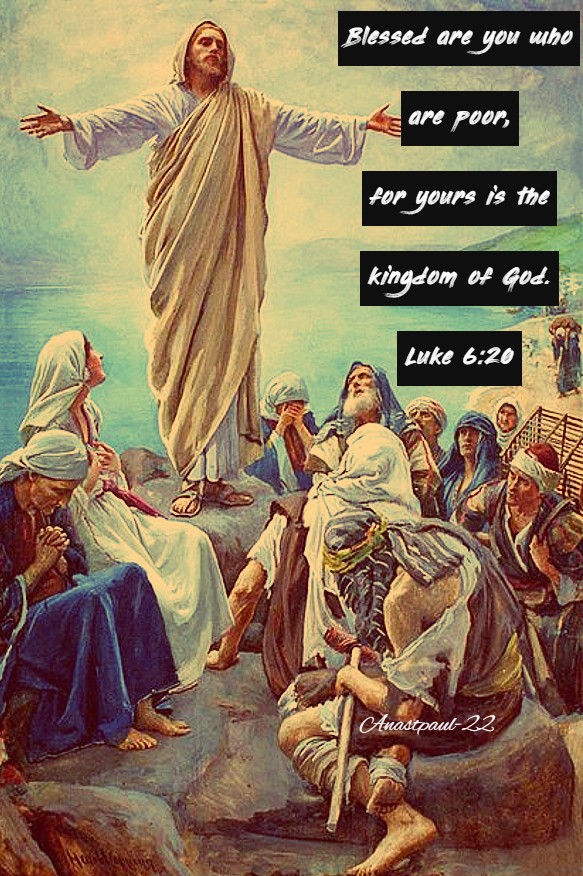
“Blessed are you who are poor,
for yours is the kingdom of God.

Luke 6:20

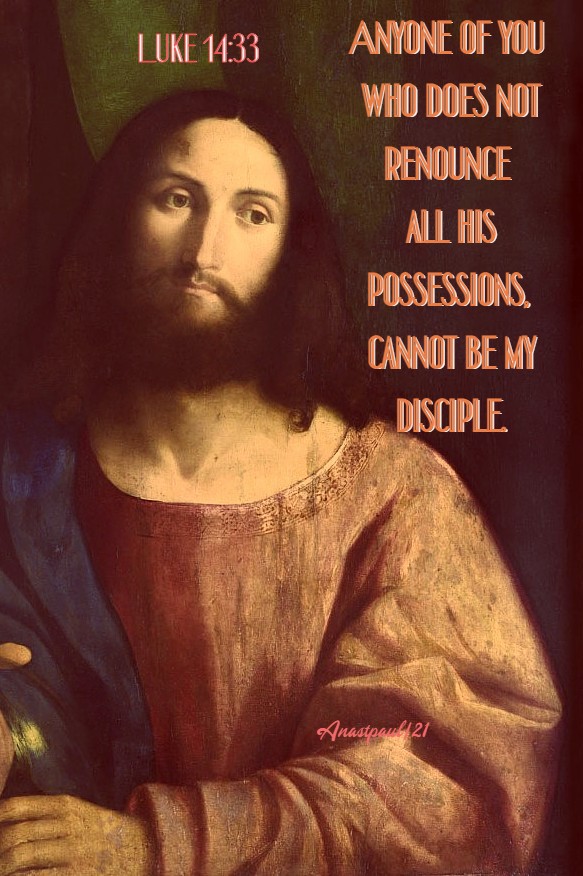
“… Anyone of you
who does not renounce
all his possessions,
cannot be my disciple.”

Luke 14:33

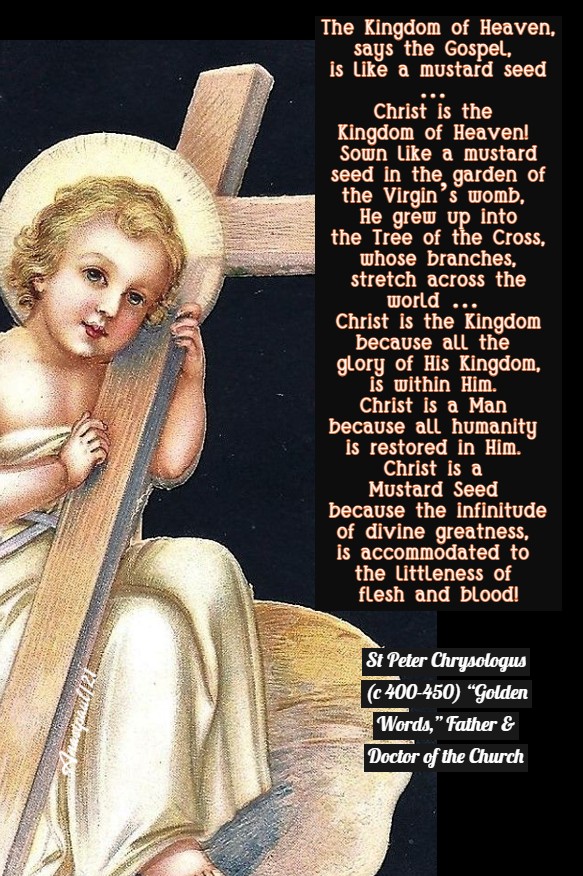
“The Kingdom of Heaven, says the gospel,
is like a mustard seed …
Christ is the Kingdom of Heaven!
Sown like a mustard seed
in the garden of the Virgin’s womb,
He grew up into the Tree of the Cross,
whose branches,
stretch across the world …
Christ is the Kingdom
because all the glory of His Kingdom,
is within Him.
Christ is a Man
because all humanity is restored in Him.
Christ is a Mustard Seed
because the infinitude of divine greatness,
is accommodated to
the littleness of flesh and blood!

St Peter Chrysologus (c 400-450)
“Golden Words”
Father & Doctor of the Church

“Keep a clear eye toward life’s end.
Do not forget your purpose
and destiny as God’s creature.
What you are in His sight,
is what you are and nothing more.
Remember that when you leave this earth,
you can take nothing that you have received…
but only what you have given – a full heart
enriched by honest service, love, sacrifice and courage
.”

St Francis of Assisi (c 1181-1226)

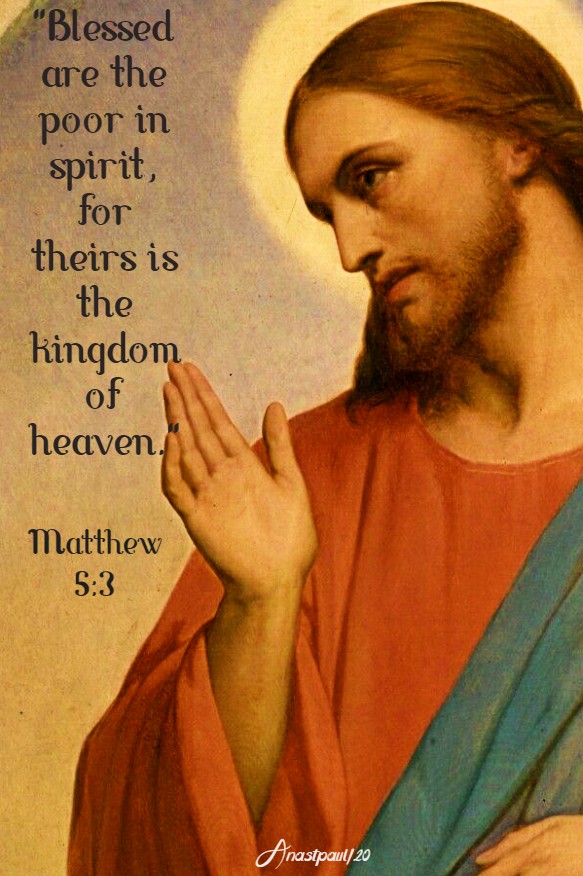
“Blessed are the poor in spirit,
for theirs is the kingdom of heaven.

Matthew 5:3

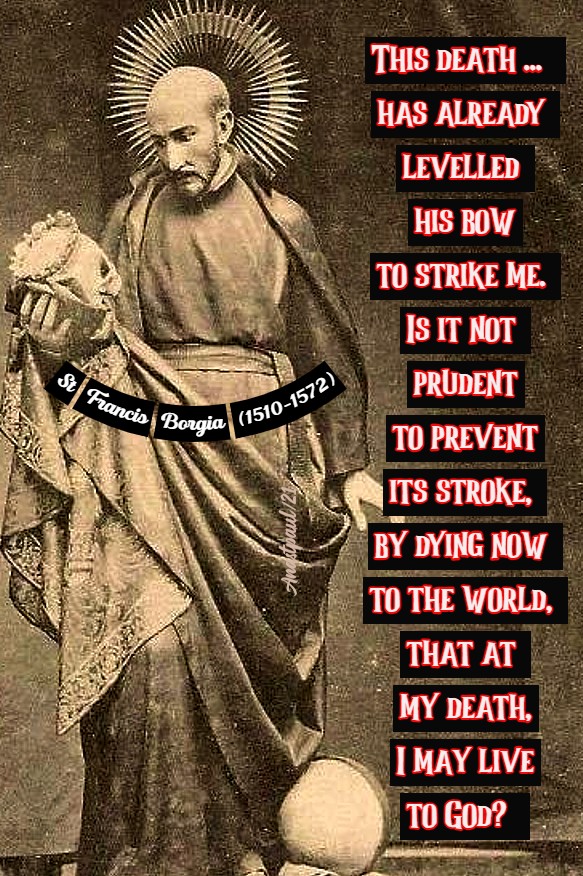
“This death … has already levelled
his bow to strike me.
Is it not prudent to prevent its stroke,
by dying now to the world,
that at my death,
I may live to God?

St Francis Borgia (1510-1572)

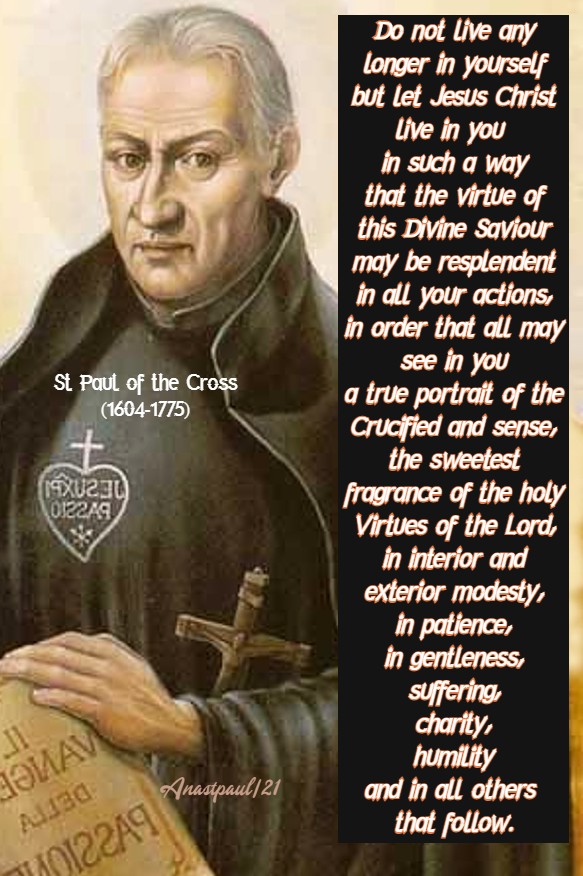
“Do not live any longer in yourself
but let Jesus Christ live in you in such a way
that the virtue of this Divine Saviour may be resplendent
in all your actions, in order that all may see in you
a true portrait of the Crucified and sense,
the sweetest fragrance of the holy virtues of the Lord,
in interior and exterior modesty,
in patience,
in gentleness,
suffering,
charity,
humility
and in all others that follow.

St Paul of the Cross (1604-1775)

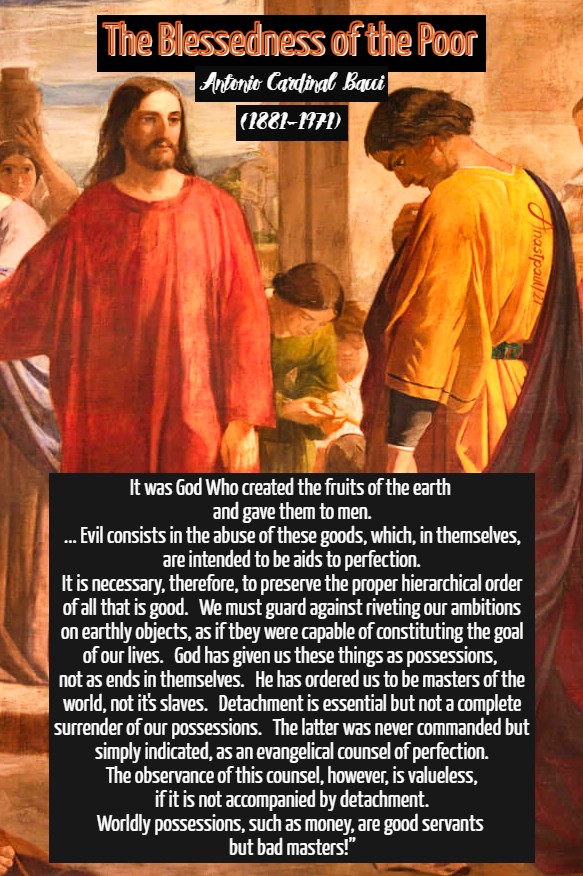
“It was God Who created the fruits of the earth
and gave them to men.
… Evil consists in the abuse of these goods,
which, in themselves, are intended
to be aids to perfection.
It is necessary, therefore, to preserve
the proper hierarchical order of all that is good.
We must guard against riveting
our ambitions on earthly objects,
as if tbey were capable of constituting
the goal of our lives.
God has given us these things as possessions,
not as ends in themselves.
He has ordered us to be masters of the world,
not it’s slaves.
Detachment is essential but not a complete surrender of our possessions.
The latter was never commanded but simply indicated, as an evangelical counsel of perfection.
The observance of this counsel, however,
is valueless, if it is not accompanied by detachment.
Worldly possessions, such as money,
are good servants but bad masters!

Antonio Cardinal Bacci (1881-1971)

Posted in "Follow Me", franciscan OFM, GOD ALONE!, PRAYERS of the SAINTS, QUOTES on GRACE, The WILL of GOD

Our Morning Offering – 13 January – Prayer to do the Will of God

Our Morning Offering – 13 January – The Octave Day of the Epiphany

Prayer to do the Will of God
By St Francis of Assisi (c 1181-1226)

Almighty, eternal, just and merciful God,
grant us in our misery,
the grace to do for You alone
what we know You want us to do
and always to desire, what pleases You.
Thus, inwardly cleansed,
interiorly enlightened
and inflamed by the fire of the Holy Spirit,
may we be able to follow in the footprints of
Your beloved Son, our Lord Jesus Christ.
And, by Your grace alone,
may we make our way to You,
Most High, Who live and rule in perfect Trinity
and simple Unity
and are glorified God
all-powerful, forever and ever.
Amen

Posted in franciscan OFM, MARIAN TITLES, SAINT of the DAY

Notre-Dame de Bessiere / Our Lady of Bessiere, Limousin, France, Madonna della Vetrana / Our Lady of the Vetrana (Castellana Grotte, Bari, Puglia, Italy (1691) and Memorials of the Saints – 11 January

Sixth Day within the Octave of Epiphany

Notre-Dame de Bessiere / Our Lady of Bessiere, Limousin, France – 11 January:
Here

https://anastpaul.com/2021/01/11/memorials-of-the-saints-11-january-4/

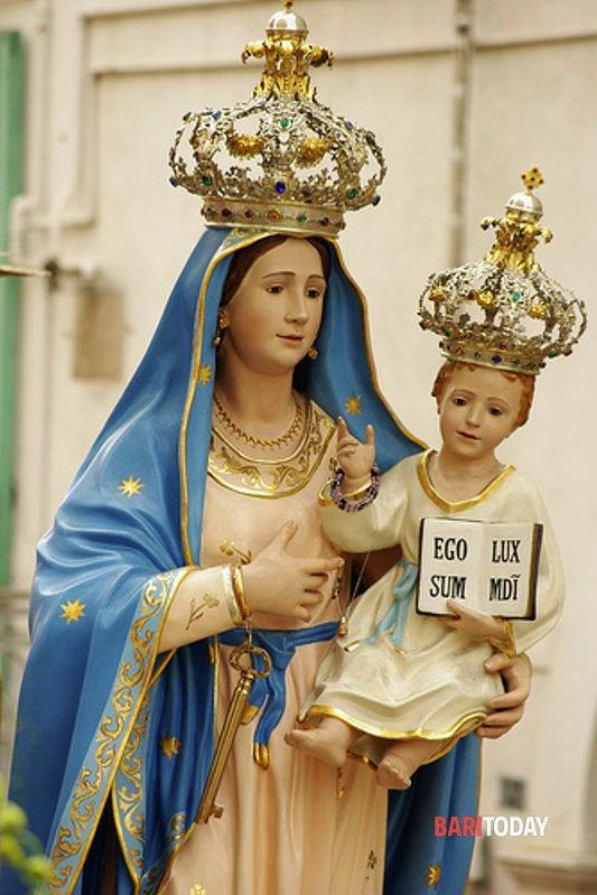
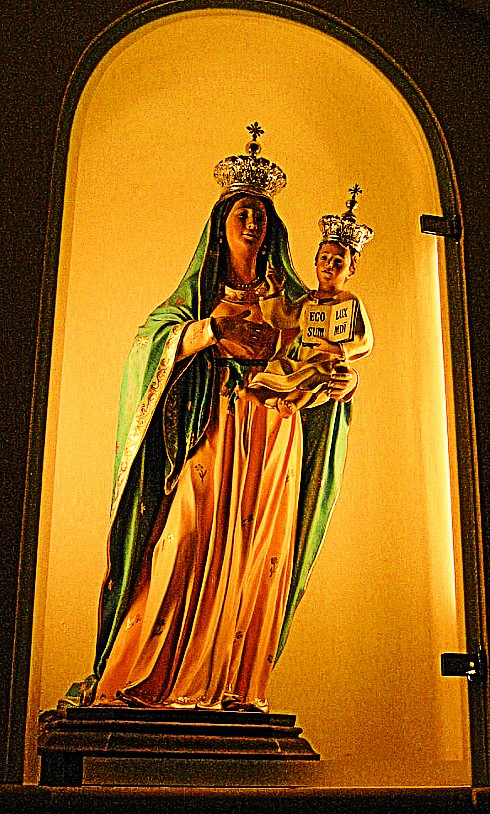
Madonna della Vetrana / Our Lady of the Vetrana (Castellana Grotte, Bari, Puglia, Italy (1691) – 11 January:

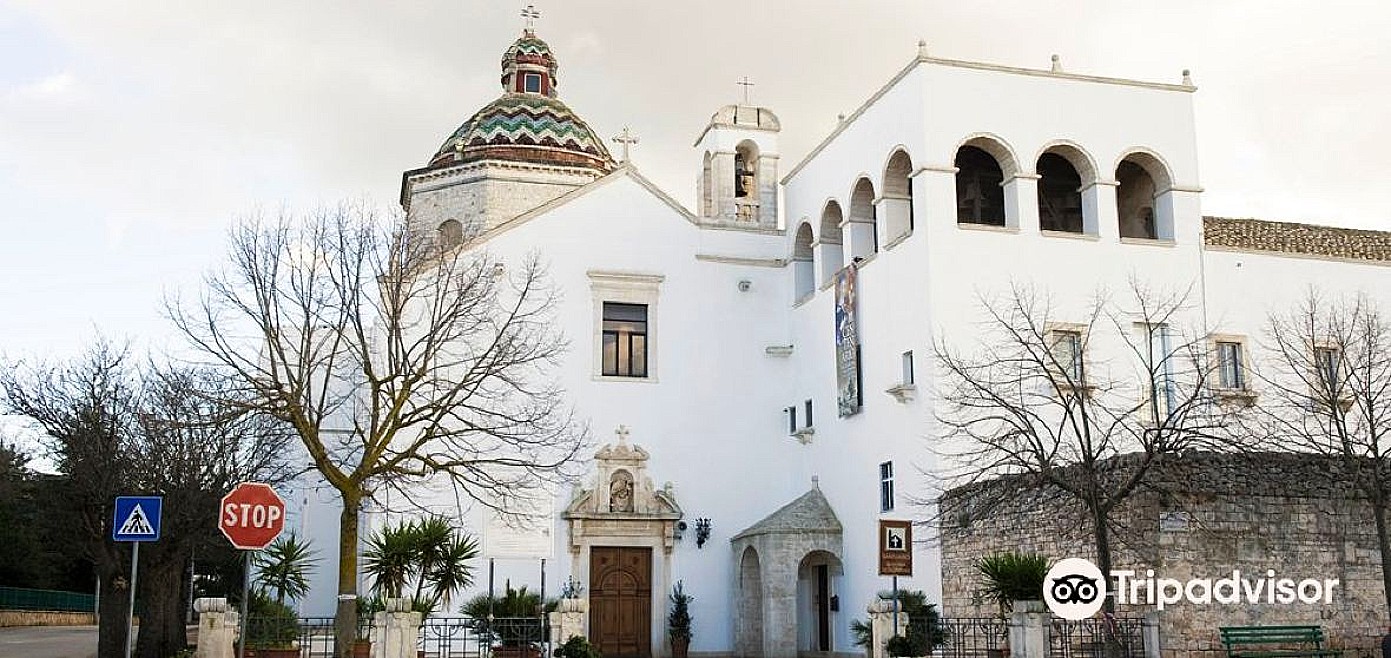
In Castellana from time immemorial, there was a small Chapel dedicated to the Mother of God which contained a miraculous Fresco which was greatly revered ,after the Madonna had rid the region of the plague in the seventeenth century. Since then, the Shrine became a destination for faithful pilgrims reaping countless miracles, which the Virgin Mother obtained from her Divine Son.

In late 1690 the Church was almost ruined when a serious incident came to disturb the Castellana and the surrounding area. A serious disease spread, carrying death and mourning. Casimiro wrote in 1726. “This evil that made a great slaughter among the people, once attacked, all six children of Hadrian (Count of Conversano) and his wife Isabel Caracciolo. He who loved his wife and children, seeing this danger, resorted to the intercession of the Virgin … All his family was spared from evil.
Two good priests’ recourse to the intercession of Saint Mary of the Vetrana and on 11 January 1691 one of them heard a voice that ordering the scourge to cease. “The Lady also expressed her desire to expand the Church.
So – continues Casimiro – “the Castellana people in recognition of the benefits received from the Virgin, immediately agreed to rebuild and expand the Church of St Maria della Vetrana.” The work lasted only a year and all the citizens of the Castellana took part.

Castellana, began to be known around the world after 23 January 1938, when Prof. Franco Anelli, a Caver, discovered a karst cave system. In 1959 because of this fascinating underground world, Castellana changed its name to ‘Castellana Grotte.

The festivities and celebrations on 11 January

St Alexander of Fermo
St Anastasius of Suppentonia

Blessed Ana Maria Janer Anglarill (1800-1885) Founder of the Sisters of the Holy Family of Urgell, of which order she is the Patron, Nurse, Teacher.
Her Story:

https://anastpaul.com/2020/01/11/saint-of-the-day-11-january-blessed-ana-maria-janer-anglarill-1800-1885/

St Boadin of Ireland
St Breandan of Ireland (the name is not an error)
St Eithne
St Fedelemia
Bl Francis Rogaczewski
St Francisca Salesia Aviat
St Honorata of Pavia
St Pope Hyginus (Died 142) Papal Ascension c 138
St Leucius of Alexandria
St Leucius of Brindisi
St Liberata of Pavia
St Lucius the Soldier
St Luminosa of Pavia
St Mark the Soldier
St Michael of Klopsk
St Palaemon
St Paldo
St Peter Balsam
St Peter of Alexandria
St Peter of Anea
St Peter the Soldier

St Salvius of Amiens (Died c 625) The 5th Bishop of Amiens, France, Monk, miracle-worker.
About St Salvius:

https://anastpaul.com/2021/01/11/saint-of-the-day-11-january-saint-salvius-of-amiens-died-c-625/

St Severus of Alexandria
St Speciosa of Pavia
St Taso
St Theodosius the Soldier
St Theodosius of Antioch

St Theodosius the Cenobiarch (423-529) Hermit/ AbboT/Founder of the Cenobitical Communities.
His Life:

https://anastpaul.com/2017/01/11/saint-of-the-day-11-january-st-theodosius-the-cenobiarch/

St Tipasio of Tigava

St Tommaso da Cori OFM (1655-1729) Friar and Priest, of the Friars Minor of St Francis, Preacher, Spiritual advisor, Evangeliser, Apostle of the Holy Eucharist, Prayer and Charity – known as the “Apostle of the Sublacense.”
About St Tommaso:

https://anastpaul.com/2019/01/11/saint-of-the-day-11-january-st-tommaso-da-cori-ofm-1655-1729/

St Vitalis of Gaza (Died c 625) Monk, Hermit. At Gaza, Vitalis was a monk for many years and earned considerable controversy for his methods in reforming the local prostitutes and scandalous women.” (Roman Martyrology).
Biography:
https://anastpaul.wordpress.com/2018/01/11/saint-of-the-day-11-january-st-vitalis-of-gaza-died-c-625/

Posted in franciscan OFM, SAINT of the DAY

Saint of the Day – 10 January – Blessed Pope Gregory X (1210-1276)

Saint of the Day – 10 January – Blessed Pope Gregory X TOSF (1210-1276) Bishop of Rome 1272 and Ruler of the Papal States until his death. He was elected on 1 September 1271 following the longest election in the history of the Church and ascended the throne on 27 March. He was a Third Order Franciscan. Born Teobaldo Visconti, in 1210 in Piacenza, Italy and died on 10 January 1276 at Arezzo, Italy of a fever. He was Beatified on 8 July 1713 by Pope Clement XI.

Teobaldo Visconti, a member of the illustrious Visconti family of Piacenza, was born in the City in 1210. In his youth, he was distinguished for his extraordinary virtue and his progress in his studies, especially of the Canon Law, which he began in Italy and pursued at Paris and lastly, at Liege. He was Archdeacon of this last Church, when he received an order from the Pope to preach the Crusade for the recovery of the Holy Land. Incredible were the pains which he took in executing this commission and in reconciling the Christian Princes, who were at variance.

When the Crusade faltered, a tender compassion for the distressed situation of the servants of Christ in those parts, moved the holy Archdeacon of Liege to undertake a dangerous pilgrimage to Palestine, in order to comfort them, and at the same time to satisfy his devotion by visiting the holy places.

In the interim, the See of Rome had been vacant for almost three years, from the death of Clement IV, in November 1268, the Cardinals, who were assembled at Viterbo, could not reach an agreement in the choice of a Pope. By common consent, they referred the election to six amongst them, who, on 1 September in 1271, nominated Teobald, the Archdeacon of Liege. Upon the news of his election, he prepared himself to return to Italy. Nothing could be more tender and moving than his last farewell to the disconsolate Christians of Palestine, whom he promised, in a most solemn manner, never to forget.

He arrived at Rome in March 1272 and was first Ordained Priest, then Consecrated Bishop and Crowned. He took the name of Gregory X and, to procure the most effectual succour to the Holy Land, called a General Council to meet at Lyons, where Pope Innocent IV had held the last in 1245. The fourteenth General Council, the second of Lyons, was opened in that City in May, 1274, in which were assembled five hundred Bishops and seventy Abbots.

The Council was closed by the fifth and last session, on 17 July. The more our holy Pope was overwhelmed with public affairs, the more watchful he was over his own soul and the more earnest in the interior duties of self-examination, contemplation and prayer. He spoke little, conversing assiduously in his heart with God; he was very abstemious in his diet and most rigorous to himself in all things. By this crucified life, his soul was prepared to taste the hidden manna which is concealed in the divine word, with which he continually nourished it, in holy meditation.

After the Council, he was taken up in measures for carrying out its decrees, particularly those relating to the Crusade in the East. By his unwearied application to business and the fatigues of his journey, in passing the Alps on his return to Rome, he contracted a distemper, of which he died at Arezzo, on 10 January, in 1276, three years and nine months after his Consecration and four years, four months, and ten days after his election. His name was inserted in the Roman Martyrology, published by Benedict XIV and he was Beatified on 8 July 1713, by Pope Clement XI.

Posted in franciscan OFM, JANUARY month of THE MOST HOLY NAME of JESUS, SAINT of the DAY, The HOLY NAME

Saint of the Day – 7 January – Blessed Matthew of Agrigento OFM (c 1377-1450) “Apostle of the Holy Name of Jesus”

Saint of the Day – 7 January – Blessed Matthew of Agrigento OFM (c 1377-1450) “Apostle of the Holy Name of Jesus” Bishop, Priest and Friar of the Friars Minor, Missionary Preacher often with St Bernardine of Siena, Provincial Vicar and General Commissioner of the Order, founder of many Convents. The Etymology of the name Matthew is “man of God,” from Hebrew. Born in 1377 as Matteo Guimerà on the Via Arco di San Francesco di Paola in Rabbato, Agrigento, Italy and died on 7 January 1450 in the Franciscan Monastery (which he had founded) of Santa Maria di Gesù, Palermo, Sicily, Italy of natural causes. Also known as – Matteo/Matthew Guimerà.

The Roman Martyrology states: “In Palermo, transit of Blessed Matteo Guimerá, Bishop of Agrigento, of the Order of Minors, lover and advocate of the Most Holy Name of Jesus

Matthew was born on the southern coast of Sicily in c 1377. His parents were pious Catholics and they educated and instilled in him, a fervent love of the Faith.

He entered the Seraphic Order in 1391-92 at the Convent of St Frances of Assisi in Agrigento where he made his religious profession in 1394. He studied theology in Bologna, Italy and Barcelona, Spain, where he earned his doctorate and was Ordained a Priest in 1400.

Matthew became a travelling missionary preacher in the region of Tarragona, Spain from 1400 to 1405 and was then appointed Novie Master. In 1417, Matthew returned to Italy, desiring to work with St Bernardine of Siena, who was leading the observant reform movement of the Franciscan Order which gave rise to the Observant Franciscans. They met in 1418, perhaps at the General Chapter of the Order held at Mantua and Matthew, soon afterwards, asked his superiors for permission, to transfer to the Observing branch of the Order.

Matthew’s friendship with St Bernardine had a profound effect on his life. The two were fellow preachers and shared a desire for reform. Both preached tirelessly and led an austere life, in keeping with the spirit of Franciscan rule. Likewise, both encouraged devotion to the Holy Name of Jesus – in the case of Matthew, joined to the name of Mary, the Mother of God – for this reason, many of the Convents he founded in Italy and Spanish lands bear the name of Santa Maria de Jesús.

Matthew had the support of King Alfonso the Magnanimous and Pope Eugene IV, for the expansion of the reform movement. . In 1425, Pope Martin V granted him the power to found observant convents, in addition to those he had already reformed: Messina , Palermo , Agrigento, Syracuse , Barcelona , Valencia , etc. In addition, he was Provincial Vicar of the Order in Sicily between 1425 and 1430 and General Commissioner from 1432 to 1440.

Invited by the King of Spain, in 1427-1428, he preached in Valencia , Barcelona, Vic and other places. Invited again, he returned in 1430 to preach and perform peacekeeping missions, spreading devotion to the Holy Name of Jesus and founding new observant convents. He was chosen Bishop of his native City, Agrigento which he wanted to refuse but at the insistence of King Alfonso, he was appointed Bishop on 17 September 1442 and Consecrated the following year.

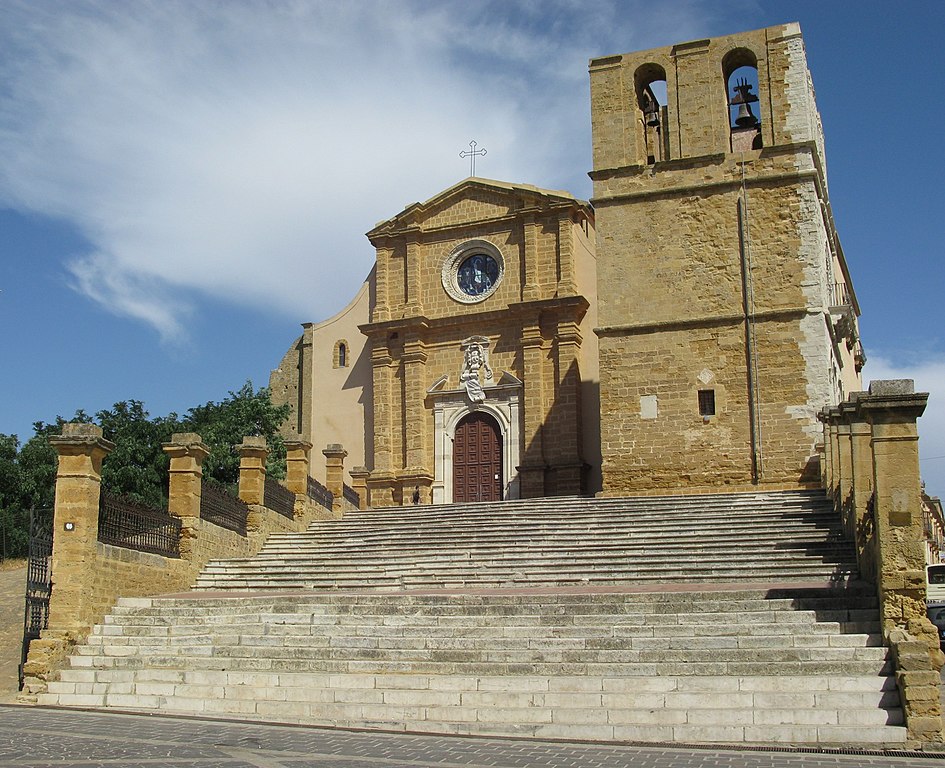
Cathedral of Agrigento, where Blessed Matthew was Bishop.

He was a reformist and a zealous Bishop of the ecclesiastical discipline of the clergy, which pitted him against a section of the clergy and the nobility, who slandered him (accused him of squandering Church property by exercising charity to the poor) and having illicit relations with a woman) and asked the Holy See to investigate. Prosecuted by the Papal Curia, he was found innocent and acquitted, regaining the Pope’s confidence. Again, however, his enemies provoked new conflicts and Matthew, realising that he was unable to maintain order, presented his resignation from the Bishopric.

When this was accepted in 1445, he retired to the Convent of Palermo, where he lived as a Friar until his death on 7 January 1450. He was buried in the same Convent.

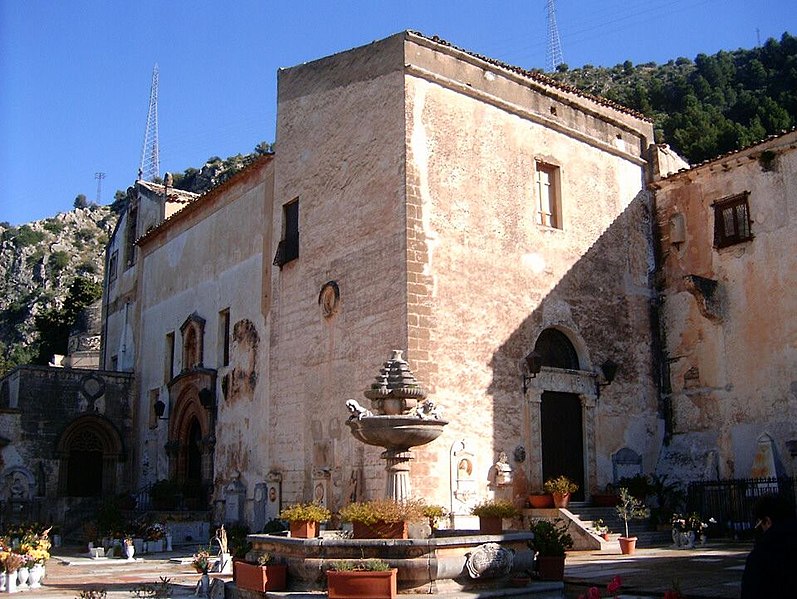
Convent of St Mary of Jesus of Palermo, founded by the Blessed and where he died and was buried.

The people soon considered him a saint and began to venerate him. In 1759 the Diocesan process of Beatification began , which led to the confirmation of the immemorial cult, equivalent to the Beatification by Pope Clement XIII on 22 February 1767.

Around a hundred of Blessed Matthew’s sermons are preserved, which were found during the twentieth century and only from 1960 began to be published by Agostino Amore. Written in Latin and the vernacular, they comment on biblical texts with great theological depth.

Posted in CHRISTMASTIDE!, DOMINICAN OP, franciscan OFM, MARIAN TITLES, SAINT of the DAY

Our Lady of Egypt, Madonna delle Grazie / Our Lady of Grace, Costa Folgaria, Italy (1588) and Memorials of the Saints – 7 January

Second Day of the Epiphany Octavv

Our Lady of Egypt and the Return of the Child Jesus from Egypt — 7 January:
https://anastpaul.com/2021/01/07/our-lady-of-egypt-and-memorials-of-the-saints-7-january/

Madonna delle Grazie / Our Lady of Grace, Costa Folgaria, Italy (1588) – 7 January, 8 September:

Brother Pietro Dal Dosso di Folgaria – a young Hermit Friar of the Order, Saint Jerome of Vicenza – was inspired directly by the Virgin Mary into building a small Church in her honour on the Echen Peak during the second half of the 16th century. Obediently, the Friar began his work and built a small Chapel, occupying what is now the Apse of the Sanctuary of the Madonna delle Grazie. In the 17th Century, the Magnifica Comunità di Folgaria expanded the small building and endowed it with a Bell Tower (1662). The Sanctuary currently hosts the miraculous Madonna, which was declared Holy Patron of Skiers by Papal Decree.
The Terracotta statue of the Virgin Mary dates to the second half of the 16th century and is venerated by thousands of believers, who hold an ancient feast – as well as a solemn procession – on the 8th of September every year, when the Statue is carried by ski instructors. All along its age-old history, the Sanctuary of Echen has always been a pilgrimage destination and numerous faithful have put up their own votive offers for graces received in the small Church. The Sanctuary is approximately 2 km away from Folgaria, near the hamlet of Costa and can be easily reached on foot after an easy walk. I am not sure why this Title is listed for today, 7 January but there must be a good reason.

St Raymond of Peñafort OP (1175-1275) “Father of Canon Law” Master of the Order of Preachers, Archbishop, Confessor, Evangelist, Missionary, (Memorial)
His Feast Day is 23 January although he died on 7 January
Biography:

https://anastpaul.com/2020/01/07/saint-of-the-day-7-january-st-raymond-of-penafort-op-1175-1275-the-father-of-canon-law/

St Aldric of Le Mans
Bl Ambrose Fernandez
St Anastasius of Sens
St Brannock of Braunton
St Candida of Greece
St Canute Lavard
St Cedd
St Clerus of Antioch
St Crispin I of Pavia
St Cronan Beg
St Emilian of Saujon
St Felix of Heraclea
Bl Franciscus Bae Gwan-gyeom
St Januarius of Heraclea
St Julian of Cagliari
St Kentigerna

Blessed Lindalva Justo de Oliveira DC (1953-1993) Virgin Martyr, Religious Sister of the Vincentian Sisters.
Her Life and Death:

https://anastpaul.com/2021/01/07/saint-of-the-day-7-january-blessed-lindalva-justo-de-oliveira-dc-1953-1993-virgin-and-martyr/

St Lucian of Antioch
Bl Marie-Thérèse Haze
Blessed Matthew of Agrigento OFM (1377-1450) “Apostle of the Holy Name of Jesus,” Franciscan Priest and Friar, Bishop, Missdionary Preacher often with St Bernardine of Siena.
St Pallada of Greece
St Polyeuctus of Melitene
St Reinhold of Cologne
St Spolicostus of Greece
St Theodore of Egypt
St Tillo of Solignac
St Valentine of Passau
St Virginia of Ste-Verge
Bl Wittikund of Westphalia

Posted in franciscan OFM, SAINT of the DAY

Saint of the Day – 30 December – Blessed Margherita Colonna (c 1255-1284)

Saint of the Day – 30 December – Blessed Margherita Colonna (c 1255-1284) Virgin, Nun, Mystic, Apostle of the poor. Born in c 1255 at Palestrina, Rome, Italy and died on 30 December 1284 at Castel San Pietro, Rome, Italy of natural causes. Also known as – Margaret, Margherita, Marguerite.

The Roman Martyrology states: “At Palestrina in Lazio, Blessed Margherita Colonna, Virgin, who preferred poverty for Christ to the riches and pleasures of the world, which she served by professing the Rule of St Clare.

Margherita was a member of the Italian Colonna family, which was notable in Italian history for centuries. She was born in Palestrina in 1255, daughter of Oddone Colonna and Mabilia Orsini who had two other children – Giovanni and Giacomo. In 1212, Giacomo became Cardinal of St Prassede and Legate of the Pontiff during the Fifth Crusade. It was he who brought the Column to Rome from the East, which, according to tradition, was used for the flagellation of Christ and which, even today, is preserved in the Roman Basilica which was his seat.

The years in which Margherita lived, were complicated and tumultuous for the Church: from 1268 to 1271, the Papal seat remained vacant, for the longest period in history. The Pope had not resided in Rome for twenty years. Long conclaves were followed by short Pontificates – the power of the Pontiff was fundamental eroded in the balance of the antagonism between France (Charles of Anjou occupied many regions of Italy) and the German Emperor of the Holy Roman Empire.

Margherita and the two brothers were soon orphaned. Destined for a prestigious wedding, important for noble alliances in her day, Margherita, in her heart, however, only wanted to be the virginal bride of Jesus. On 6 March 1273, with two pious housewives, she retired to Castel San Pietro, on the mountain overlooking Palestrina, at the Church of St Maria della Costa, to follow her vocation. In the wake of the Franciscan movement, their ideal of life fascinated a multitude of people from all walks of life. Margherita put on the rough habit, under which she put a sackcloth. She began fasting and penance, praying that her wish would come true: – to become a Poor Clare Nun.

She lived there for a few years in retreat. Her life as an anchorite was a scandal for the powerful Colonna family. However, the comfort came from her brother Giacomo, who, although very young, was already a Cardinal (from 1278) at the behest of Pope Nicholas III, while Giovanni was a Senator of Rome. Giacomo sincerely loved Christ as did his sister, so he took Margherita to Rome and together they prayed at the Tomb of the Apostles Peter and Paul. Then a new life began for Margherita. The substantial inheritance no longer belonged to her, it belonged to the poor who are never lacking on the path of the Saints. Her shining example aroused interest, especially from other women eager to spend their lives like her in the service of Jesus.

Margherita asked the General of the Friars Minor Girolamo Masci (future Pope Nicholas IV) for permission to enter the Monastery of Assisi. However, an illness prevented her from doing so. The Lord’s plans were different. She then thought of the Convent of Mentola (between Palestrina and Tivoli) where an image of the Holy Virgin, to which she was very devoted, a place also visited by St Francis. However, it was a fiefdom of the Count of Poli who did not want a Colonna in his territories. Margherita returned home and, with the help of her brother, the Cardinal, founded a Monastery on the nearby mountain, where the Lord was praised night and day.

Margherita took care of the formation of her companions but her charity went further, to the sick and the poor of the neighbouring region. Tradition says ,that once Jesus and the St John the Baptist came to her table, when she fed the poor but then disappeared when Margaret recognised them.

Having exhausted her substantial personal patrimony, she, who was born very rich, reached out to ask for alms and thus be able to continue her works of mercy for the suffering and hungry. She is also remembered for assisting the Friars Minor of the nearby Zagarolo Convent.

Margherita’s union with Christ became more and more intense: she was visibly comforted by Jesus, the Madonna and the Holy Father Francis. She fell into ecstasy several times and for seven years, she patiently endured an ulcerative wound on her side, carried like a stigmata of the Passion of Jesus.

Not even thirty years old, Margherita’s death was precious in the eyes of the Lord. She died, due to violent fevers, on 30 December 1284. Immediately her Tomb became a pilgrimage destination and the devotees, through her intercession, obtained many graces. In 1285, the community of Poor Clares moved to Rome, by the authorisation of Pope Honorius, taking with them, the venerated body of the Blessed (it remained there until 1871).

Margherita’s first biographer was her brother, the Cardinal and the second was the first Abbess of the St Sylvester Monastery in Rome, where her sisters had moved.

On 17 September1847, the Blessed Pope Pius IX confirmed the “ab immemorabili” cult and the liturgical memorial. Today the relics of Blessed Margherita are venerated in the Church of Castel San Pietro, not far from Palestrina. Here the seed she sowed over seven centuries ago, is still alive today through the Poor Clares of the Monastery of Santa Maria degli Angeli.

PRAYER
O God, You have made
the Blessed Virgin Margaret
admirable in the contempt of earthly goods,
ardent with love for You,
grant us, through her intercession,
that we may be continuously united to You,
as we carry our cross.
Pour upon us, O Lord,
the spirit of holiness
that You have given
to Blessed Margherita Colonna,
so that we can know the love of Christ,
which surpasses all knowledge
and enjoy the fullness of eternal life.
With Christ our Lord
and the Holy Ghost.
Amen.


Posted in franciscan OFM, SAINT of the DAY

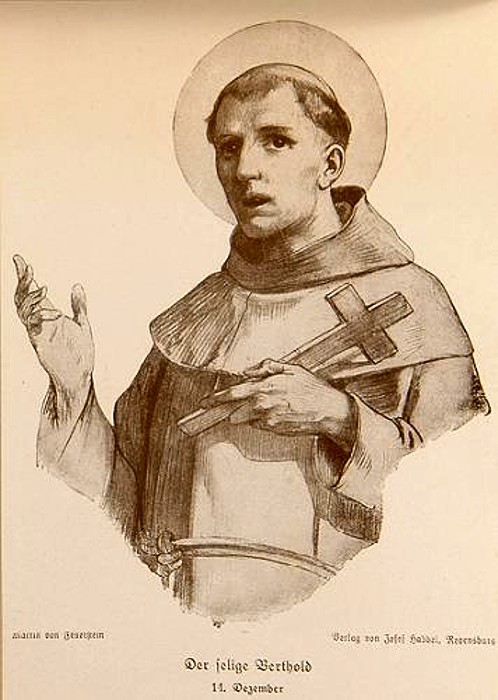
Saint of the Day – 14 December – Saint Berthold of Regensburg OFM (c 1220-1272)

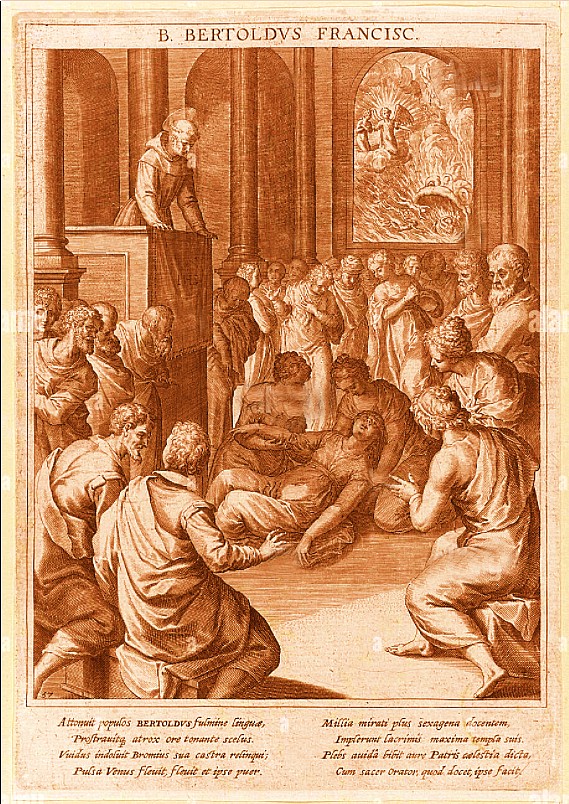
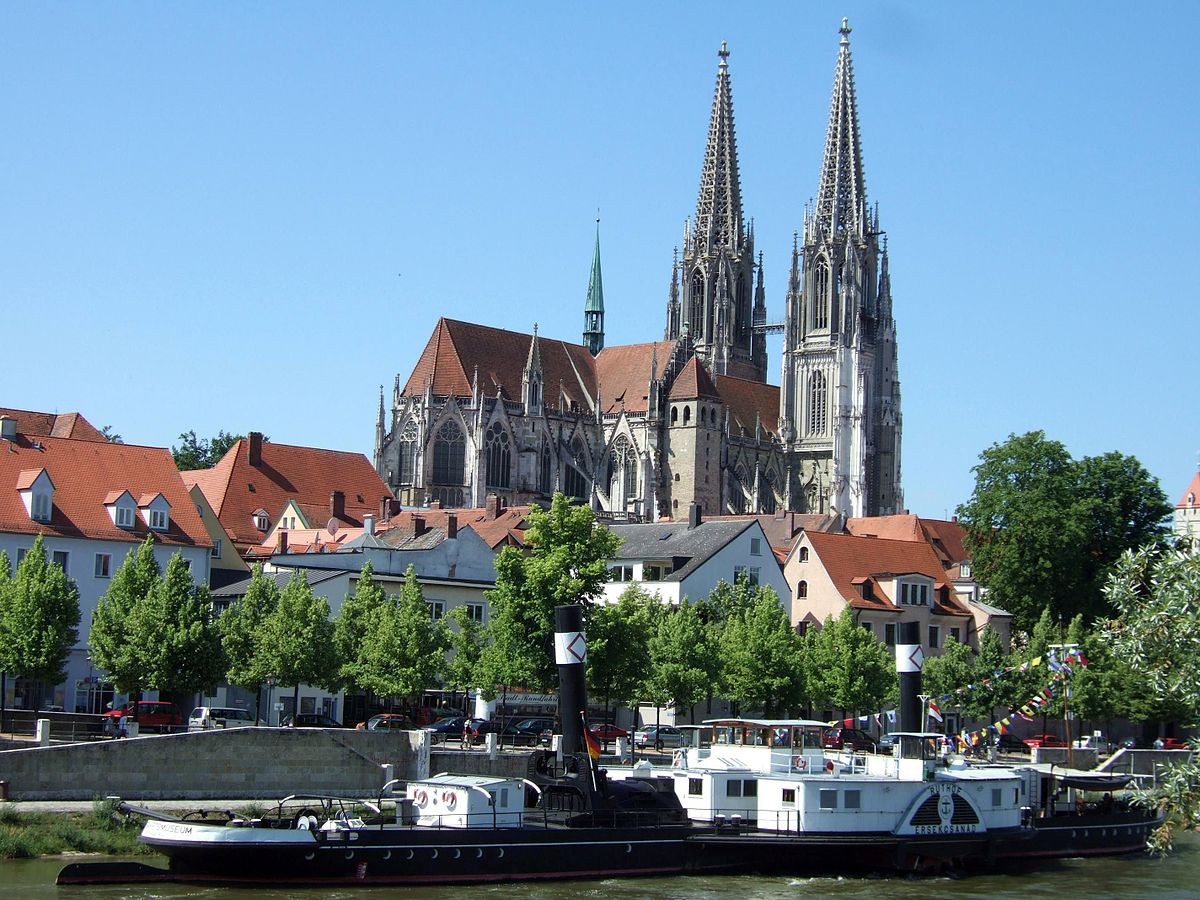
Saint of the Day – 14 December – Saint Berthold of Regensburg OFM (c 1220-1272) Friar of the Order of the Friars Minor, Renowned Preacher for which reason he was known as “Sweet Brother Berthold,” “The Beloved of God and man,” “A Second Elias,” “The Teacher of the Nations,” Missionary Evangelist covering large areas of Germany. It is recorded that he would preach to up to 100,000 people at one time. Born as Berthold Sachs, at Ratisbon, which is now Regensburg, Germany in c 1220 and died there on 14 December 1272 of natural causes. Also known as – Berthold of Ratisbon. Berthold was a Franciscan Friar in the Monastery of Regensburg and the most powerful preacher of repentance in the Thirteenth Century. Patronage – of Preachers.
Berthold was probably a member of a well-to-do middle-class family of Ratisbon named Sachs. The excellence of his literary training is proved by his sermons ,which show more than common acquaintance with the ancient classics. From his knowledge of the usages of secular life, it may be inferred that he was of mature age before he entered the Franciscans. The first fixed date in Berthold’s life is 1246, when the Papal Legate appointed him and David of Augsburg (another Franciscan Friar) as Inspectors of the Convent of Niedermünster. One of his contemporaries, the Abbot of Niederaltaich, a reliable Historian, speaks in 1250 of the great reputation that Berthold had in Bavaria as a preacher.

Four years later, the missionary journeys of this preacher extended as far as the Valley of the Rhine, Alsace and Switzerland. During the next ten years Berthold’s apostolic labours led him eastward into Austria, Moravia, Bohemia and Silesia. In 1263 Pope Urban IV appointed him to preach the Crusade and Saint Albert the Great was designated as his assistant. When speaking to Slavonic audiences, Berthold naturally employed an interpreter, just as St Bernard, in his day, made use of an interpreter in Germany. Notwithstanding any difficulties that might arise as to understanding, wherever he went Berthold exerted an extraordinary power of attraction over his hearers so that the Churches were not able to hold the great crowds of the faithful who came from all quarters to his Masses, and he was often obliged to preach in the open air. When this was the case, a Pulpit was generally arranged under the spreading branches of a linden tree. Long after his day “Berthold’s Linden” was to be seen at Glatz.

About 1270 he seems to have returned to Regensburg where he remained until his death on 14 December 1272. He had fallen down the stairs a few days prior to his death. His remains form the most precious relic among the treasures of the Cathedral of Regensburg.

Regensburg Cathedral

The poets and chroniclers of Bertold’s time made frequent reference to him. He was called “Sweet Brother Berthold,” “The Beloved of God and man,” “A Second Elias,” “The Teacher of the Nations.” All of these expressions are proofs of the high esteem in which his preaching and missionary zeal were held. The secret of the Preacher’s success, lay partly in the saintliness of his life and partly in his power to make use of the language of humble life. He became the great master, it may be said, the classic of homely speech and this rank has been maintained by his sermons to the present day. One of his two popular discourses on the Last Judgment became a favourite book of the people under the title “The Valley of Josaphat“. There is no doubt, that Brother Berthold preached in German., and used translators when necessary, as said above

The Interior of Regensburg Cathedral

For a long time scholars disagreed as to how his sermons had been preserved. It is now generally accepted, that the sermons were often written down afterwards in Latin, frequently with marginal comments in German – these reports of the sermons, as they may be called, partly German, partly Latin, or at times in the language in which they were delivered (recorded by the translators, we presume), are what have been handed down to posterity.

The discourses thus preserved, are of the greatest importance for the history of the development of the literature of homiletics; -they are of equal value as rich sources for determining the condition of education and culture in the thirteenth century. It is difficult, therefore, to understand, how this greatest of Catholic Preachers to the poor, could have been forgotten for centuries! It was not until some of Brother Berthold’s sermons were published in 1824 that attention was called to the eloquent Franciscan and his holy and zealous life of a true disciple of Christ! Since this date, the enthusiasm for Berthold grew steadily, so that he has become a favourite, both of Germanic scholars and of the historians of the development of German civilization and of the Faith. He is also regarded as the great pattern of homely Pulpit eloquence.

Seventy-two of his sermons have been preserved for our edification, some of which are available online.

Posted in CARMELITES, franciscan OFM, MARIAN TITLES, SAINT of the DAY

Madonna del Patrocinio / Our Lady of Defence (Faenza, Ravenna, Emilia-Romagna, Italy) (1685) and Memorials of the Saints – 14 December

Madonna del Patrocinio / Our Lady of Defence – also known as Santa Maria del Calcare (Faenza, Ravenna, Emilia-Romagna, Italy) (1685) – 14 December:

In Forlì, in eastern Italy, the Baldi family owned a painting of the Madonna nursing the Christ Child. A woman of the family joined the Camaldolese Benedictine Convent there under the name of Sister Frances and at her death, the Bishop requested that the sacred image be moved to the Convent Church.
In 1614, such great crowds attended the Madonna’s transfer ceremony that the Sisters decided to build a special Chapel for the Blessed Virgin of Defence. On the last Sunday of September, 1650, the painting was installed in its new marble Shrine. An annual festa on that day commemorated the beginning of public veneration of the Virgin of Defence.
During the night of 20 November 1685, a fire spread from the Convent laundry to the parlour and Sacristy and had almost entered the Chapel of the holy image when the flames stopped unexpectedly. Only in morning did the nuns realise what happened.
This miracle rekindled public devotion to the Blessed Virgin of Defence, which the Vatican approved officially in 1721. During the Risorgimento, the government closed many religious communities and seized their goods. When their Convent was suppressed in 1862, the Camaldolese Nuns of Forlì moved with their Madonna to Faenza, about 15 miles away. The small Sanctuary of the Madonna del Patrocinio, is located along the old mule track that led from Bieno and Santino to the sunny pastures of Ompio. The Sanctuary, built at the beginning of the 18th century, was the destination of endless penitential processions of peasants, shepherds and woodcutters. The place is surrounded by dense chestnut and oak woods; almost a border between the lakes (Maggiore and Mergozzo) and the infinite forest of the Val Grande.
On 14 December 1954, at the close of the Marian Year, the sacred image was solemnly crowned by the Bishop of Faenza, Msgr Giuseppe Battaglia. At the nuns’ request, the Virgin’s crown was made of the gold rings they had received at their solemn profession, together with pilgrims’ votive offerings. St Catherine’s Convent was demolished in 2008 for construction of a Catholic rest home. I believe the miraculous image now resides in the local Parish Church.

St John of the Cross OCD (Memorial) (1542-1591) Doctor of the Church
St John’s Feast Day is 24 November (General Roman Calendar, 1738–1969)
Full Biography:
https://anastpaul.wordpress.com/2017/12/14/saint-of-the-day-14-december-1542-1591-doctor-of-the-church/
AND:
https://anastpaul.com/2018/12/14/saint-of-the-day-14-december-st-john-of-the-cross-ocd-1542-1591/

St Abundius of Spain
St Agnellus of Naples
St Berthold of Regensburg OFM (c 1220-1272) Friar of the Order of the Friars Minor, Renowned Preacher for which reason he was known as “Sweet Brother Berthold,” “The Beloved of God and man,” “A Second Elias,”,”The Teacher of the Nations.”
Bl Buenaventura Bonaccorsi

St Folcuino of Therouanne
Bl Joan Lambertini
St John Pan y Agua (Bread-and-Water)
Bl John Discalceat
St Justus of Spain
St Matronianus of Milan
St Pompeius of Pavia
Bl Protasi Cubells Minguell

St Venantius Fortunatus (c 530 – c 609) Bishop, Poet, Hymnist, Writer.
Another “Golden Words”:

https://anastpaul.com/2019/12/14/saint-of-the-day-14-december-saint-venantius-fortunatus-c-530-c-609/

St Viator of Bergamo
St Yusuf Jurj Kassab al-Hardini
Bl William de Rovira

Martyrs of Alexandria – 4 saints: A group of Egyptian Christians martyred together in the persecutions of Decius – Arsenius, Dioscurus, Heron and Isidore. They were burned to death in 250 at Alexandria, Egypt.

Martyrs of Apollonia – 7 saints: Martyred in the persecutions of Decius. The only surviving details are three names – Callinicus, Leucio and Tirso. Apollonia, Bithynia (in modern Turkey).

Martyrs of Ashkelon – 3 saints: Several pilgrims from Egypt to Cilicia (in modern Turkey) who planned to minister to fellow Christians suffering in the persecutions of emperor Maximinus. They were arrested, torture, mutilated and then imprisoned in Ashkelon. Some were ordered to forced labour in the mines, but we have the names of three who were martyred by order of governor Firmilian – Ares, Elijah and Promo. They were burned at the stake or beheaded at the gates of Ashkelon c 308.
Martyrs of Hayle – 2+ saints: Several Christians, including a brother and sister, who were martyred together by pagans. The only other information to survive are the names of the two siblings – Fingar and Phiala. 5th century at Hayle, Cornwall, England.

Martyrs of Syria – 3 saints: Three Christians who were martyred together. Known to Saint John Chrysostom who preached on their feast day and left us the only details we have – their names – Drusus, Theodore and Zosimus. The date and precise location of their martyrdom is unknown, but it was in Syria, possibly in Antioch.

Posted in DANTE ALIGHIERI!, franciscan OFM, SAINT of the DAY

Saint of the Day – 4 December – Blessed Pietro Tecelano TOSF (c 1200 – 1289)

Saint of the Day – 4 December – Blessed Pietro Tecelano TOSF (c 1200 – 1289) Layman, Widower, Franciscan Tertiary, Apostle of the sick and the poor, spiritual and secular adviser, miracle-worker. Born in c 1200 at Campi, Tuscany, Italy and died in early December 1289 in Siena, Italy of natural causes. Patronages – Siena, Italy and Comb-makers. Also known as – Pietro Pettinaio, Peter…. Pier…. Additional Memorials – 16 March, 4 and 11 November, 10 December – Memorials on different Calendars.

The Roman Martyrology states: “In Siena, Blessed Pietro Pettinario, religious of the Third Order of St Francis, distinguished for his particular charity towards the needy and the sick and for his life of humility and silence.”

Pietro was born around 1200 in Campi, a village of Castelnuovo Berardenga near Siena and moved with his parents to Siena at some point during his childhood.

He married but the couple remained childless. In order to provide for his new wife he worked as a comb-maker, that is a merchant of bone and mother-of-pearl combs used in spinning. .. He purchased a house in which vines flourished so as to make wine. Sadly his wife died and Pietro then lived alone and devoted his time to his business and soon became rich and famous.

Perhaps converted thanks to the newly born Franciscan Order, he became famous once more but now for his generosity towards his competitors – on market days he arrived late to sell, so as not to damage them too much. In addition to carrying out his working activity, he also dedicated himself to assisting the sick at the hospital of Santa Maria della Scala where he bound wounds and sores and helps the most needy. In this work he was assisted by eight friends – merchants and lawmen, who he had encouraged to join him in his apostolate.

He lived a simple life, giving excess wealth to the Franciscans and he spent his evenings in meditation and devoting such nights to God in prayer.

Pietro left no writings and is remembered for his silences, we often see him depicted with a finger on his lips. The few things he said and the many he did, were very effective, to the point that some traffickers, after having defrauded the City, returned the money to him, he then returned it to the relevant section of the City administration. The governors, in turn, often called upon him for help and advice – in 1282 , for example, he was asked to choose the five inmates to be amnestied.

When the Franciscans of Siena had doubts about the authentic vocation of their novices , they had them examined by him. His life was inspired by the most rigorous followers of St Francis of Assisi, the spirituals.

The Dominican preacher, Blessed Ambrogio Sansedoni, who went to Pietro for spirtual guidance, renounced his election as a Bishop on Pietro’s advice.

Seeking solitude, he sold his home and business, donating the proceeds to the poor and spent the last few years of his life, as a guest of the Franciscans. There, considered himself far too talkative, Pietro aimed at living amongst them in silence.He undertook several pilgrimages to religious sites including Assisi, where Saint Francis of Assisi worked and lived.

During his lifetime he was hailed as a miracle-worker and was considered a great saint. He became a sought after adviser to Priests as well as to the people of Siena and was considered charismatic.

Pietro died in early December 1289 (possilby the 4th) at an advanced age and was buried at the Franciscan Church in Siena. His grave soon became a pilgrimage site and the scene of miracles. A Shrine was built over his grave in 1326 and an annual local feast in his honour was established in 1329. The Shrine was lost to fire in 1655 and remaining relics were preserved when the Poor Clare nuns took them into their care

The people of Siena adored Pietro and called for his Canonisation. Official recognition of Pietro’s holiness led to Pope Pius VII confirming his “cultus” acting as formal Beatification on 18 August 1802.

Dante Alighieri included Pietro in his work (Divina Comedia) in “Canto XIII” through the character of Pier the Comb-Seller.

Posted in franciscan OFM, SAINT of the DAY

Saint of the Day – 27 November – Blessed Bernardine of Fossa OFM (1420-1503)

Saint of the Day – 27 November – Blessed Bernardine of Fossa OFM (1420-1503) Priest and Friar of the Observant Friars Minor of St Francis, Missionary in Italy and a renowned Preacher, noted Historian, Lawyer, Ascetical Writer, rising within the Order to important positions. Born in 1420 in Fossa, Aquila, Italy as Giovanni Amici and died on 27 November 1503 in the Franciscan Convent in L’Aquila, Italy of natural causes, aged 83. Also known as – Bernardine d’Amici, Bernardine of Aquila, Bernardine of Aquilanus, Fra Bernardino of Fossa, Giovanni Amici. Additional Memorial – 7 November (Franciscans). Patronages – the City and Diocese of L’Aquila.

The Roman Martyrology states: “At L’Aquila, blessed Bernardino da Fossa (Giovanni) Amici, Priest of the Order of Minors, who preached the Catholic Faith in many Provinces of Italy.

Giovanni belonged to the ancient and noble family of the Amici and sometimes bears the name of Aquilanus on account of his long residence and death in the Town of Aquila.

He was of very lively intelligence and excelled in his studies. He graduated in Canon and Civil Law in Perugia and in 1445, at 21, he entered the Friars Minor of the Observance and completed his novitiate at Gubbio. On 13 March 1446 he made his solemn profession in the Convent of Stroncone taking the name of Bernardine and receiving the Habit from St James of the Marches who was then preaching a course of Lenten sermons at Perugiato. As was the custom of many religious Orders at the time, the place of birth was added, so Giovanni became Fra ‘Bernardino da Fossa.

Bernardine was endowed with outstanding organisational, spiritual and guiding skills and was, therefore, entrusted with various positions in the Franciscan Convents of Gubbio, Stroncone and others, also in Umbria. From there he passed into the Abruzzi, residing especially in his own City of L’Aquila.

He was a zealous Priest and talented Preacher in numerous Umbrian Towns. He was elected Provincial Father of the Friars Minor Observants for the Abruzzi four times , holding the office from 1454 to 1460 and then from 1472 to 1475 : between 1464 and 1467 he was instead Superior of Bosnia and Dalmatia, a Province just established by Pope Pius II and in 1468 he was elected Procurator of the Order at the Holy See .

He was twice elected bishop of Aquila (first in 1472 , on the death of Cardinal Amico Agnifili and then in 1491 , as the successor of Giovanbattista Gaglioffi) but he declined the election both times, from a spirit of humility.

In 1475 he abandoned all office and retired to the Convent of San Giuliano dell’Aquila. On 16 January 1495 , he managed to stop the troops of Charles VIII and persuaded them not to cross the L’ Aquila territory, sparing the population the serious consequences of a military occupation.

Bernardine was also a prolific writer – his writings include several sermons and short ascetical works and focus on themes of history and theology. His nephew, Antonio Amici, who was also his Biographer, published some of Bernardine’s works in 1572 , today of great value due to the extreme rarity of the preserved copies. Bernardine was the Author of the first life of his Patron, St Bernardino of Siena.

Bernardine died in the Convent of L’Aquila on 27 November 1503 and was always given a cult of blessed, both in Italy and throughout the Franciscan Order.
The cult was later confirmed by the Beatification of Pope Leo XII on 26 March 1828.

Apparition of Christ to the Blessed Bernardino of Fossa by Francesco da Montereale,