Posted in SAINT of the DAY

Saint/s of the Day – 24 July – Saints Boris and Gleb

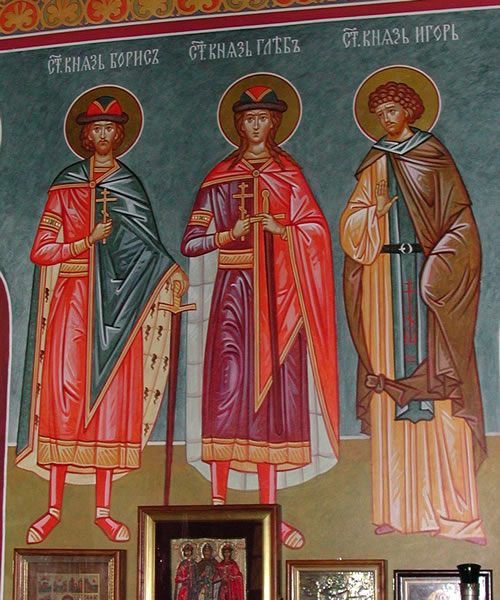
Boris and Gleb (or Glev), whose Christian names were Roman and David, were the first saints canonized in Kievan Rus’ after its Christianization. Sons of Saint Vladimir I of Kiev and Anne of Constantinople, great-grandsons of Saint Olga of Kiev.

They were younger children of Vladimir the Great, who favored them over his other children. Boris married and ruled the town of Rostov. Gleb, ruled the easternmost town of Murom. Born shortly before the Baptism of Rus’, the brothers were brought up to be pious Christians. Boris, the older of the two, loved to read the Sacred Scriptures, the works of the Holy Fathers, and especially, the lives of saints. Under their influence, St. Boris developed a fervent desire to emulate the spiritual struggles of these holy heroes, and often prayed that the Lord make him worthy of such an honor. Both excelled in charity and kindness, emulating the example of their father, Saint Vladimir, who was merciful towards the needy, the sick, and the indigent.

The brothers were murdered during the Kievan succession crisis of 1015–1019. The Primary Chronicle, which relates their lives, says their brother, Sviatopolk the Accursed, plotted their assassinations. Boris learnt of his father’s death upon his return with the Rus’ army to Alta. Upon being informed of Sviatopolk’s accession to the throne and urged to replace him, Boris replied: “Be it not for me to raise my hand against my elder brother. Now that my father has passed away, let him take the place of my father in my heart.”

“If he (Sviatopolk) spills my blood and resolves to kill me, I will be a martyr before my Lord. I will not resist, for it is written, “God resisteth the proud, and gives grace to the humble. (Boris’s words)

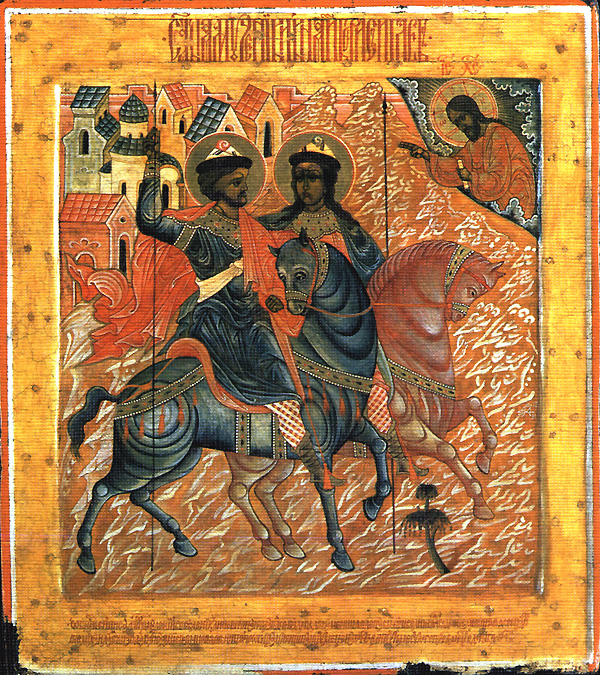
Despite his brother’s acquiescence, Sviatopolk sent men to execute him. When they arrived they heard him chanting psalms and praying before an icon of Christ. He asked the Lord to strengthen him for the suffering he was about to endure. He also prayed for Sviatopolk, asking God not to count this against him as sin. Boris and his Hungarian manservant, George, were stabbed to death with spears while asleep in a tent. Later, the prince was discovered still breathing in a bodybag being transported to Kiev, but the Viking men sent to murder him, ended his life with the thrust of a sword.

Gleb believed his father was still alive and rushed to his father’s deathbed. On the way, the saint’s brother, Yaroslav, learnt of Sviatopolk’s treachery and urged Gleb not to meet him. His boat was seized near Smolensk, and in the middle of praying to God, Gleb was assassinated by his own cook, Torchin, who cut his throat with a kitchen knife.

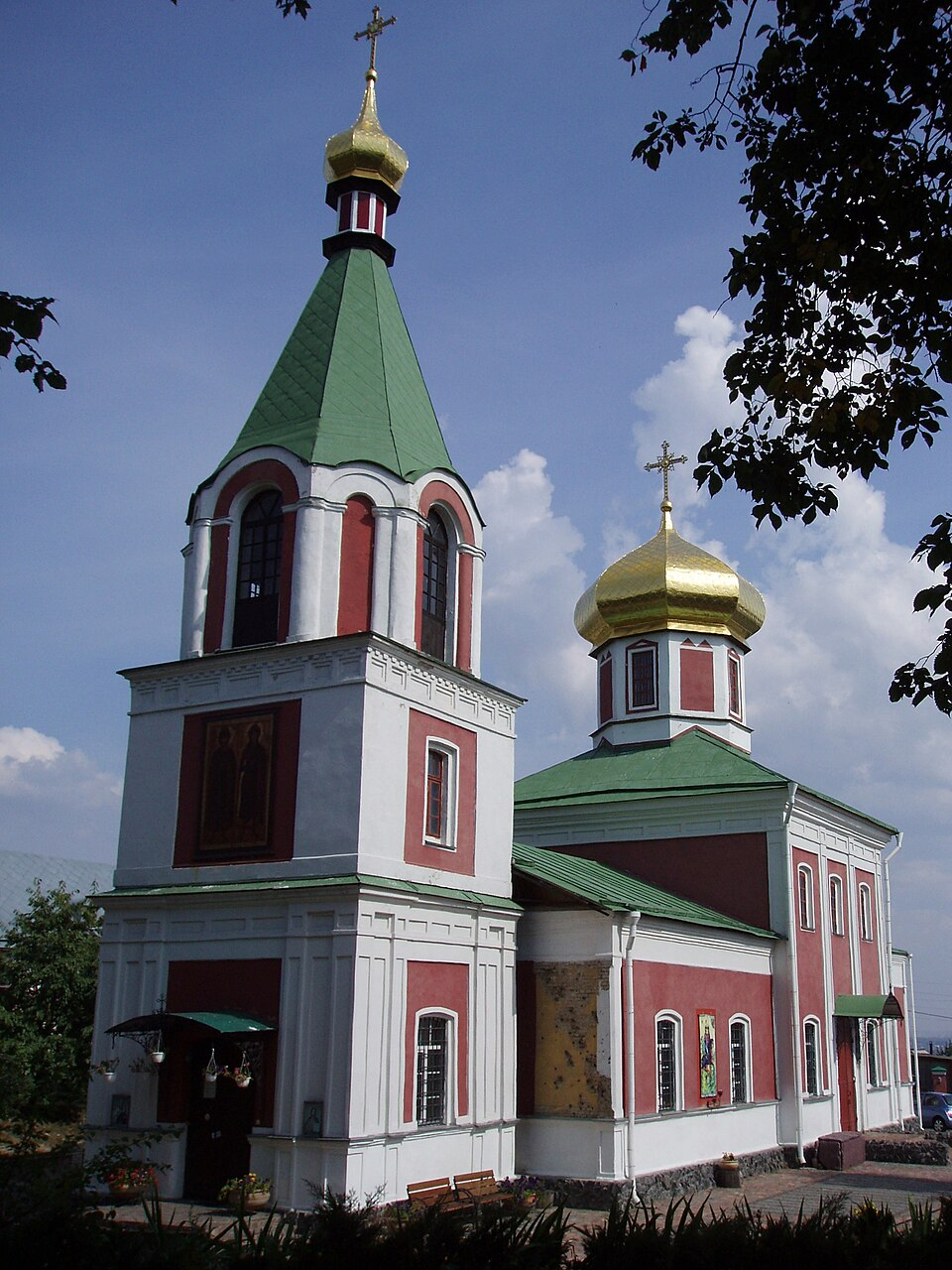
In 1020 another of Vladimir’s sons, Yaroslav, usurped Sviatopolk, and then buried the bodies of Boris and Gleb in the church of Saint Basil at Vyshgorod. Miracles were reported at their tomb, and it became a site of pilgrimage.

The rebuilt church in Vyshhorod

The highest motives were attributed to the brothers’ resignation – unwillingness to repel injustice to themselves by force, and violently oppose an elder brother and thus embroil their people in a civil war. Not martyrs in the traditional sense, the Russian Church perceived them as “passion bearers” – blameless men who did not wish to die but refused to defend themselves, thus voluntarily submitting to death like Christ.

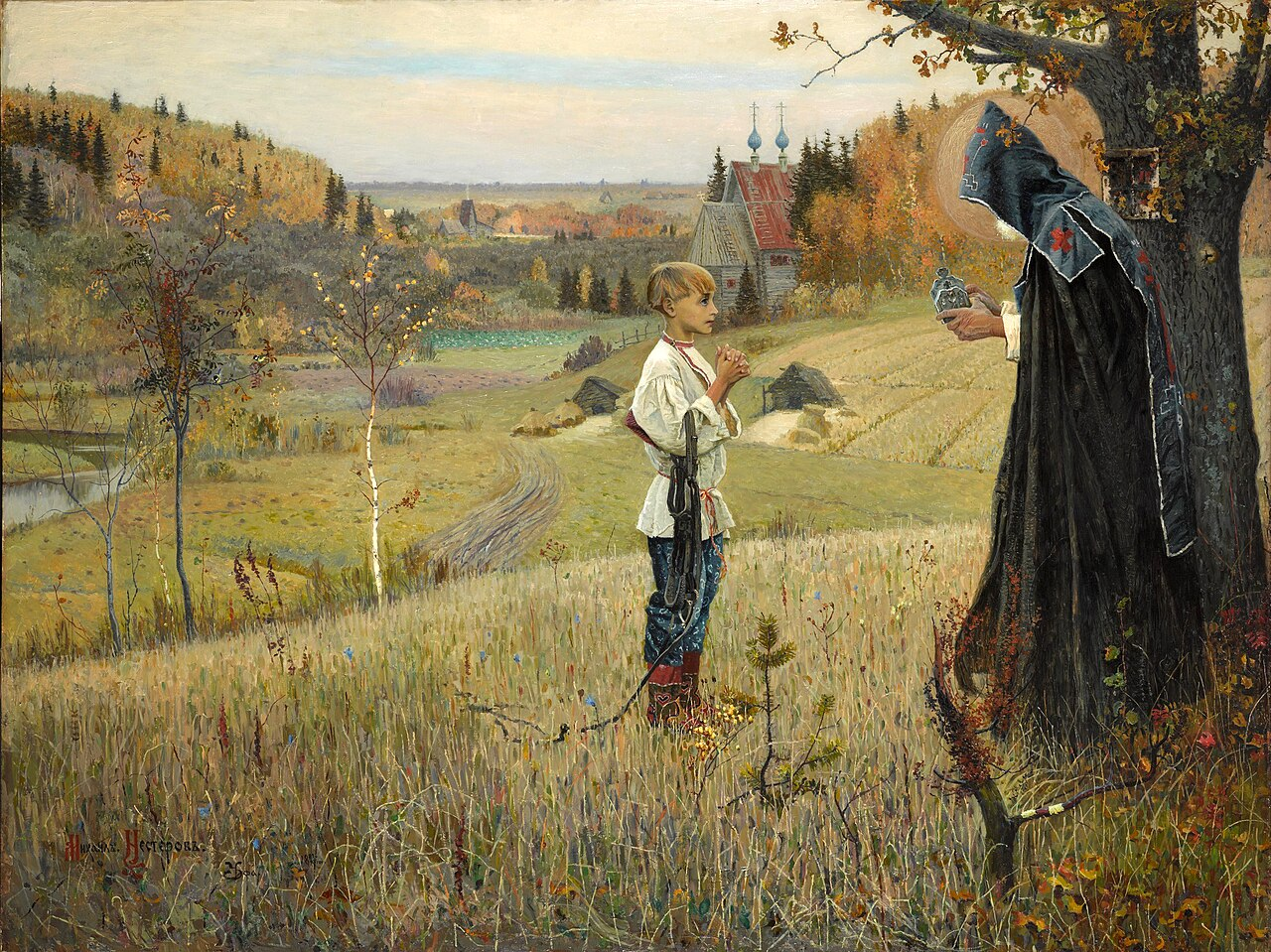
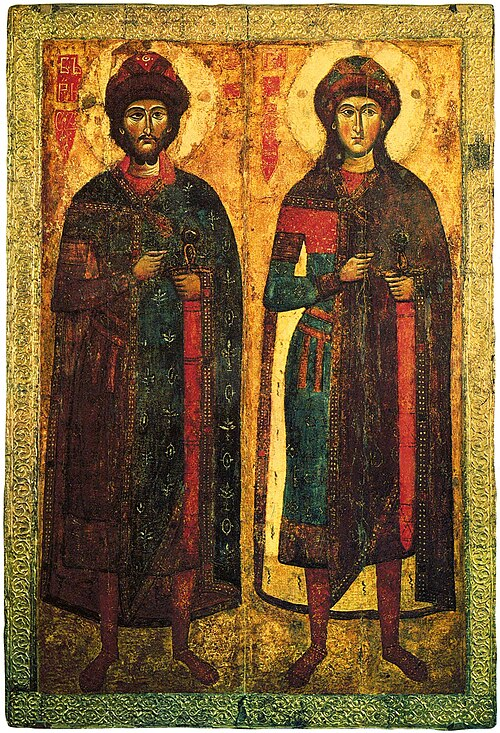
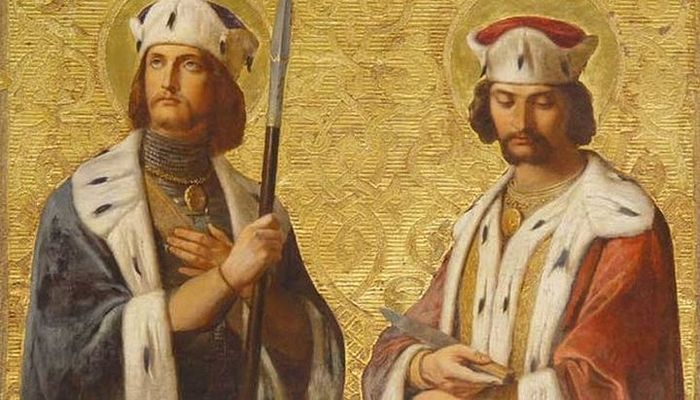
They were canonized in 1724 by Pope Benedict XIII (cultus confirmed) and their patronage is princes. In iconography Boris is depicted in princely attire. He most often holds a cross in his hands — a symbol of martyrdom and humility. He is often shown together with his brother Gleb; Boris’s seniority is indicated by the presence of a moustache or beard.

Posted in SAINT of the DAY

Saint of the Day – 19 July – Saint Romain of Ryazan

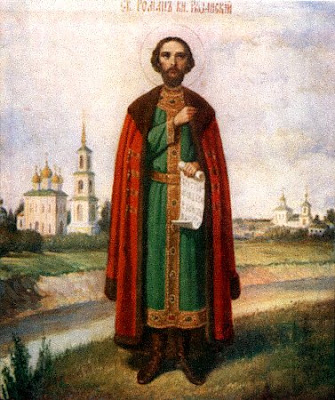
Saint Romain of Ryazan, also known as Romanus or Roman. Son of the Prince of Ryazan, Russia, Roman was from a family who, during the Tatar yoke, became famous as defenders of Christianity. Both of his grandfathers died for their country in battle with Batu Khan, the founder of the Golden Horde. Raised to have a great love for the Catholic faith, the prince took care of impoverished and oppressed subjects, and protected them from the violence and robbery of the Khan’s tax collectors. As a consequence, these people denounced him before the Tatar Khan Mengu-Timur.

In 1270, Roman was summoned to the Horde, where the Khan declared that he would have to choose: either martyrdom or the Tatar (Islamic) faith. The prince answered that a Christian cannot change a true faith to a false one. For his firmness in the confession of faith, he was subjected to cruel tortures: they cut off his tongue, gouged out his eyes, cut off his ears and lips, cut off his arms and legs, flayed the skin from his head and, having chopped it off, put it onto a spear. Veneration for him began immediately. His relics were secretly returned to Ryazan and buried. Their place of burial remains unknown.

The first defeat of Napoleon by the Russians when he invaded in 1812, occured on St Roman’s feast day.

Posted in SAINT of the DAY

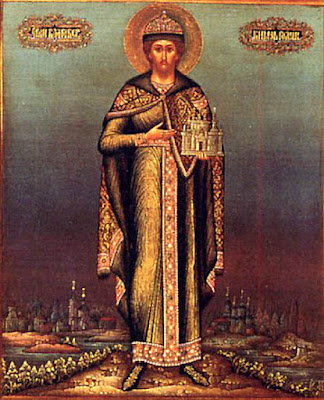
Saint of the Day – 15 July – St Vladimir I of Kiev

Vladimir the Great, Vladimir I Sviatoslavich, Volodymyr I Sviatoslavych, Vladimir Veliky. Grandson of Saint Olga of Kiev. Son of the pagan Norman-Rus prince Svyatoslav of Kiev and his consort Malushka. Grand prince of Kiev. Prince of Novgorod in 970. Vladimir’s father of the Rurik dynasty and after his death in 972, Vladimir was forced to flee abroad after his brother Yaropolk murdered his other brother Oleg to become the sole ruler of Rus’. Vladimir assembled a Varangian army and, with the help of an uncle, returned to depose Yaropolk in 978. By 980 Vladimir had consolidated the Kievan realm from Ukraine to the Baltic Sea, and had solidified the frontiers against Bulgarian, Baltic, and Eastern nomads.

Christianity had made some progress in Kiev, but Vladimir remained pagan, had seven wives, established temples, and participated in idolatrous rites, possibly involving human sacrifice. Around 987, Byzantine Emperor Basil II sought military aid from him. The two reached a pact for aid that involved the giving of Basil’s sister Anne in marriage, and Vladimir becoming a Christian. Never before had a Byzantine imperial princess, and one “born in the purple”, married a barbarian. Vladimir was baptized, took the patronal name Basil in compliment to his brother-in-law, and ordered the Christian conversion of Kiev and Novgorod. Idols were thrown into the Dnieper River, and the new Rus Christians adopted the Byzantine rite in the Old Church Slavonic language. The reason for his choice of the Byzantine rite, is that his envoys were most impressed with their visit to Constantinople, saying, “We knew not whether we were in Heaven or on Earth … We only know that God dwells there among the people, and their service is fairer than the ceremonies of other nations.”

Vladimir expanded education, judicial institutions, and aid to the poor. He and Anne had the martyr sons Saint Boris and Saint Gleb. Following the death of Anne in 1011, another marriage affiliated him with the German Holy Roman emperors. His daughter became the consort of Casimir I the Restorer of Poland.

Vladimir then formed a great council out of his boyars and set his twelve sons over his subject principalities. During his Christian reign, he lived the teachings of the Bible through acts of charity. He would hand out food and drink to the less fortunate, and made an effort to go out to the people who could not reach him. His work was based on the impulse to help one’s neighbors by sharing the burden of carrying their cross. He founded numerous churches, including the Desyatynna Tserkva (Cathedral of the Tithes), established schools, protected the poor and introduced ecclesiastical courts. He lived mostly at peace with his neighbors, the incursions of the Pechenegs alone disturbing his tranquility.

Vladimir fell ill, most likely of old age, and died at Berestove, near modern-day Kiev on the 15th of July 1015 . The various parts of his dismembered body were distributed among his numerous sacred foundations and were venerated as relics.

Patronages: Converts, parents of large families, reformed and penitent murderers, Russia, Ukrainian Catholic Diocese of Stamford, Connecticut, archeparch of Winnipeg, Manitoba