Passionate Catholic.
Being a Catholic is a way of life - a love affair "Religion must be like the air we breathe..."- St John Bosco
Prayer is what the world needs combined with the example of our lives which testify to the Light of Christ.
This site, which is now using the Traditional Calendar, will mainly concentrate on Daily Prayers, Novenas and the Memorials and Feast Days of our friends in Heaven, the Saints who went before us and the great blessings the Church provides in our Catholic Monthly Devotions.
This Site is placed under the Patronage of my many favourite Saints and especially, St Paul.
"For the Saints are sent to us by God
as so many sermons.
We do not use them, it is they who move us
and lead us, to where we had not expected to go.”
Charles Cardinal Journet (1891-1975)
This site adheres to the pre-Vatican II Catholic Church and all her teachings. .
PLEASE ADVISE ME OF ANY GLARING TYPOS etc - In June 2021 I lost 100% sight in my left eye and sometimes miss errors. Thank you and I pray all those who visit here will be abundantly blessed. Pax et bonum! 🙏
Quote/s of the Day – 7 July – “Month of the Most Precious Blood” – Readings: Ps 131:9-10, Ps 131:1, Ps 131:16-17, Ps 109:4, Heb 7:23-27, Luke 10:1-9, Ps 67:36, Matt 10:27
“And He said to them, The harvest indeed is great, but the laborers are few. Pray therefore the Lord of the harvest to send forth laborers into His harvest.”
Luke 10:1-9
“Go. Behold, I send you forth as lambs in the midst of wolves.”
Luke 10:1-9
“A person who wishes to become the Lord’s disciple must repudiate a human obligation, however honourable it may appear, if it slows us, ever so slightly, in giving the wholehearted obedience we owe to God.”
St Basil the Great (329-379) Father and Doctor of the Church
“He wants you to become a living force for all mankind, lights shining in the world. You are to be radiant lights as you stand beside Christ, the Great Light, bathed in the glory of Him who is the Light of Heaven.”
St Gregory Nazianzen (330-390) Father & Doctor of the Church
“Pray as though everything depended on God. Work as though everything depended on you.”
St Augustine (354-430) Father & Doctor of the Church
“What a tragedy, how many souls are being shut out of heaven and falling into hell, thanks to you!”
7th Day – Types of the Precious Blood: (4) The Offerings for Sins of Ignorance
In the Book of Leviticus an elaborate ritual is prescribed in expiation of sins committed through ignorance. A calf is to be offered, and the ancients of the people are to lay their hands upon its head, and the priest is to carry some of its blood into the tabernacle of the testimony, and to sprinkle it seven times before the veil and to pour forth the blood at at the foot of the altar. All this is in expiation for sins committed by those who at the time knew not that they were sins. What a proof of God’s hatred of sin, even though he who did the act was was not at the time aware that it was a sin!
Yet such ignorance is rarely altogether without some fault. Sometimes there was at least some faint suspicion that the deed done was displeasing to God, sometimes the ignorance was itself the result of sin blinding the soul and dulling the perceptions, sometimes it was the consequence of obstinacy and self-will. I may have committed many sins through ignorance: were they altogether without fault?
Those sins had to be atoned for with blood, and that blood was a type of the blood of Jesus. He, therefore, shed His Precious Blood for my sins of ignorance as well as sins of malice, and whatever fault was in them added to His sacred sufferings. I must then compassionate with Him in all that He suffered for the countless sins that men have committed against God through ignorance, and especially for my own.
Notre-Dame d’Iron / Our Lady of Iron, Dunois, France (1631) – 6 July:
Saint-Sulpice-le-Dunois is a small Village located near the centre of France. Once home to Our Lady of Iron, it is situated near the larger Town of Blois, its population was only 517 citizens in the year 2007, which was a decrease from the 636 citizens who had lived there in 1999. It was in the Chapel of this tiny Village of Saint-Sulpice-le-Dunois, in the year 1631, that our story takes place involving Our Lady of Iron.
There was a young French couple living in the village at that time, who felt themselves singularly blessed. Were they not fortunate? They took pleasure in their youth and enjoyed good health, had happy employment,lived in a modest home and they had recently been blessed with a fine baby whom they felt was as sweet as the Babe of Bethlehem. Thus they mused on their way home together after early morning Mass one day.
As soon as they entered their home, Pierre hurried to the cradle to gaze lovingly at his infant son. The child must have been restless, he thought, as there was evidence that he had struggled with the bedclothes which were tossed about and tangled strangely about the infant. Pierre reached in and lifted his son to hold him in his arms, only to find that the tiny figure was rigid and cold. Stunned, he called for his wife disbelieving, for it seemed their baby was dead!
Pierre’s thoughts turned to Our Blessed Mother and then to the Statue of Our Lady of Iron at the Parish Church. They had spent many hours there in the past praying for her assistance and her help had never failed them. They determined to take their baby there instantly! Surely, Mary would not fail them in this time of dire need.
Together they entered the Church, and sadly laid the lifeless form at the feet of the Statue of Our Lady of Iron. As they began to pray for her intercession, they dedicated their baby to the Blessed Virgin Mary. In that very instant, the child who had been smothered by struggling in its cradle, cried out and came back to life. News of the miracle spread far and wide and the fame of Our Lady of Iron was assured.
Bl Angela of Bohemia Bl Augustin-Joseph Desgardin Bl Christopher Solino St Cyril of Thessaloniki St Dominica of Campania (c 287-303) Virgin Martyr St Gervais St Giusto of Condat St Goar of Aquitaine St Godelieve
St Saxburgh of Ely St Sisoes the Great Bl Suzanne Agathe de Loye St Thomas Alfield St Tranquillinus of Rome — Martyrs of Campania – 23 saints: A group of 23 Christians arrested, tortured and then beheaded together in the later 3rd century by order of governor Rictiovarus in the persecutions of Diocletian. The names that have come down to us are – Antoninus, Arnosus, Capicus, Cutonius, Diodorus, Dion, Isidore, Lucia, Lucian, Rexius, Satyrus and Severinus.
Martyrs of Fiesole – 5 saints: Five Christians martyred together in the persecutions of emperor Domitian – Carissimus, Crescentius, Dulcissimus, Marchisianus and Romulus. c 90 near Fiesole, Italy.
‘At Rome, the holy martyr Tranquillinus, father of the holy martyrs Mark and Marcellian. He had been converted to Christ by the preaching of the holy martyr Sebastian, baptized by the blessed Priest, Polycarp, and himself ordained a Priest by the holy Pope Caius. He was praying at the grave of blessed Paul, upon the Octave Day of the Apostles, when the pagans under the Emperor Diocletian tried and stoned him. And so he finished his testimony, (in the year 286.)’ (Roman Martyrology)
Our Morning Offering – 6 July – “Month of the Precious Blood”
An Old Morning Prayer – Excerpt From The Blossoms of the Cross — 1894 The Sisters of St Joseph
I rise In God’s strength, In God’s power, In the Agony of Christ, In the Cross of Christ, In Christ’s Precious Blood, These will sustain me against my enemies, visible and invisible. I rise in the blessing of Christ which my dearest Jesus left to the whole world. Protect me, All-Holy Trinity, God the Father, Who created me, God, the Son, Who redeemed me in His Precious Blood, God, the Holy Ghost, Who sanctified me in Holy Baptism. God, the Father, I give myself to Thee! God, the Son, I commend myself to Thee! God, the Holy Ghost, teach me! Mary, Mother of God, assist me! All you Saints of God, pray for me! All you Holy Angels, protect me! The Cross of Christ preserve me! Amen
One Minute Reflection – 6 July – “Month of the Precious Blood” – The Octave Day of Sts Peter and Paul –
“O man of little faith, why did you doubt?” – Matthew 14:31
REFLECTION – “Once again the disciples are a plaything of the waves and a storm, similar to the first one (Mt 8:4) hurls itself against them. The first time, however, they had Jesus with them, whereas this time they are alone and left to themselves. … I think this was because our Saviour wanted to stir their sleeping hearts and, by throwing them into a panic, He inspired in them a strong desire for His presence and kept the remembrance of Him constantly in their minds. Hence, He did not come to their help at once but “during the fourth watch of the night He came towards them, walking on the sea …”
Peter, ever volatile, always getting in before the other disciples, said: “Lord, if it is Thee, command me to come to Thee on the water” … He didn’t say, “Command me to walk on the water” but “come to thee,” for, there was none who loved Jesus as much as he. He did the same thing after the Resurrection – unable to bear moving as slowly as the others in the boat, he jumped into the water to get there before them and satisfy his love for Christ. …Getting out of the boat, then, Peter went towards Jesus, more delighted to be going towards Him, than to be walking on the water. But after confronting the greatest danger, that of the sea, he was to give in to a lesser, that of the wind. Such is human nature! Often, having overcome serious dangers we are conquered by lesser ones … Peter had not yet been set free from all his fear … in spite of Christ’s presence beside him. For it is of no use to be beside Christ if one is not close to Him by faith. This is what emphasises the distance separating Master from the disciple …
“O man of little faith, why did you doubt?” So if Peter’s faith had not faltered, he would have resisted the wind without difficulty. And the proof of this, is that Jesus grasped Peter ,while leaving the wind to continue blowing … Just as the mother bird supports the fledgling which has prematurely left the nest, with her wings, as it is about to fall and draws it back into the nest, so does Christ, with regard to Peter.” … St John Chrysostom (345-407) Bishop of Constantinople, Father and Doctor of the Church – (Homilies on Saint Matthew’s Gospel no 50, 1-2).
PRAYER – O God, Who made this day holy by the Martyrdom of Your Apostles Peter and Paul, grant Thy Church to follow in all things, the teaching of those, from whom she first received the faith. Through Jesus Christ, Thy Son our Lord, Who lives and reigns with Thee, in the unity of the Holy Ghost, God, world without end. Amen (Collect).
Quote/s of the Day– 6 July – “Month of the Precious Blood” – Readings: Genesis 32: 23-33, Psalms 17: 1b, 2-3, 6-7ab, 8b and 15, Matthew 9: 32-3
We are not without a Shepherd!
“I pray for them. I do not pray for the world but for the ones you have given me, because they are yours. All mine are yours and all yours are mine and I am glorified in them. … Holy Father, keep them in your name, which you have given me, that they may be one, even as we are one.”
John 17:9-11
“This, beloved, is the way in which we found our salvation, Jesus Christ, the High Priest who offers our gifts, the patron and helper in our weakness (Heb 10:20; 7:27; 4:15). I t is through Him, that we look straight at the heavens above. Through Him, we see mirrored, God’s faultless and transcendent countenance. Through Him, the eyes of our heart were opened. Through Him, our unintelligent and darkened mind shoots up into the light. Through Him, the Master was pleased to let us taste the knowledge that never fades,”
St Pope Clement I (c 35 – c 99)
“The mark of Christ’s sheep is their willingness to hear and obey, just as disobedience is the mark of those who are not His. We take the word ‘hear’ to imply obedience to what has been said.”
St Cyril of Alexandria (376-444) Father and Doctor of the Church
“Pray in the spirit and sentiment of love, in which the royal prophet said to Him, ‘Thou, O Lord, are my portion.’ Let others choose to themselves, portions among creatures, for my part, You are my portion, You alone I have chosen for my whole inheritance.”
St Augustine of Canterbury (Died c 605)
And if by chance you do not know Where to go in quest of Me, Do not go far My Face to see, Searching everywhere high and low, But in yourself must seek for Me.
For, soul, in you I am confined, You are My dwelling and My home; And if one day I chance to find Fast-closed the portals of your mind I ask for entrance when I come.
Oh, do not seek me far away, For, if you would attain to Me, You only need My Name to say And I’ll be there, without delay. Look in yourself to seek for Me!”
6th Day – Types of the Precious Blood: (3) The Peace-Offering
The peace-offering was one of the chief sacrifices of the Old Law. It was an offering of gratitude for blessings received, or of petition for blessings desired. So Jesus offered Himself upon the cross, not only to obtain for us the blessings of eternal life, but also to render thanks to God for His mercy to man and make to Him the only possible return worthy of His majesty.
The blood of the heifer sacrificed was shed as a necessary part of the sacrifice. “The priests, the sons of Aaron shall offer the blood thereof, pouring it round about the altar.” (Lev. i. 5). There is no mark of our gratitude to God like willingness to suffer for Him. The blood is, as it were, the life, and the shedding of it corresponds in the body to the sacrifice of our will in the soul , which is the noblest sacrifice that man can make to God. Do I sacrifice my will to God’s, or is self-will still strong within me?
The blood was shed, moreover, as a means of obtaining fresh favours. Those who are anxious to gain great things from God must make some sacrifice for His sake, andthose who are most powerful with Him, are those who give up their will to His. Christ in His sacred humanity is all-powerful with God, because in the head of the book it is written of Him that He should fulfil the will of God and was content to do it. Do I deserve such influence with Him?
This morning we buried my beloved mother with a mass, and in a beautiful old cemetery near her much loved parents. The (weather and the) outpouring of kindness and love was spectacular. Thank you for all your support and prayers!
Our Lady of Mount Athos, Great Lavra, Greece , 8th cent. – 5 July:
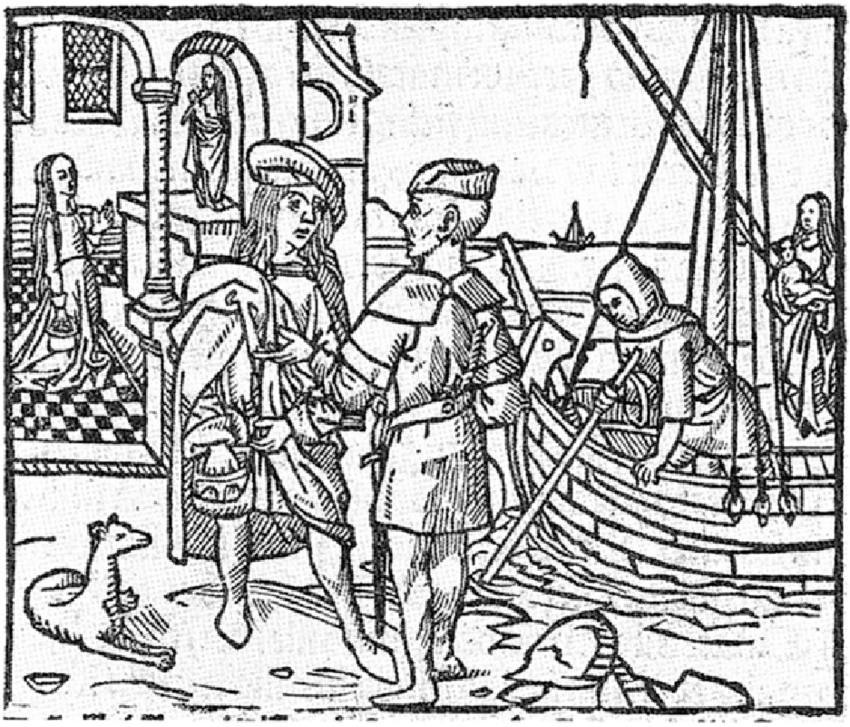
In the 900s, the unfinished Great Monastery on Mount Athos ran out of funds and the starving Monks had to leave. Finally the Monastery Founder, St Athanasius the Athonite, left too in search of help. On the road he met a woman in a long blue veil, who said, “Go back! You will have everything you need if you do not abandon the Monastery!” When Athanasius asked the lady’s name, she answered, “I am the Mother of your Lord.”
The Abbot asked for a sign. “Strike the rock with your staff,” she said, and promised to be responsible for the Monastery provisions herself — to be its stewad. As water flowed from the rock, she vanished.
Athanasius returned to find the building completed and stocked with supplies. Soon it was full of Monks again. To this day, the Great Lavra regards the Mother of God as its steward, helped by a Monk with the title of assistant steward. In a Shrine on the left of the entrance to the Monastery Church, the Icons depict many saints connected with the Monastery. To Our Lady’s right St. Athanasius holds a model of the building. Down the road, the holy spring still flows.
St Agatho of Sicily St Athanasius the Athonite St Athanasius of Jerusalem St Cast St Cyprille of Libya / St Cyrilla of Cyrene St Domèce St Domitius of Phrygia St Edana of West Ireland Bl Edward Cheevers Blessed Elias of Bourdeilles OFM (c 1407-1484) Archbishop of Tours and Cardinal St Erfyl St Fragan Bl George Nichols St Grace of Cornwall St Gwen Bl Humphrey Pritchard
St Marinus of Tomi St Mars of Nantes St Marthe Bl Matthew Lambert St Modwenna St Numerian of Treves Bl Patrick Cavanagh St Philomena of San Severino St Probus of Cornwall Bl Richard Yaxley Bl Robert Meyler St Rosa Chen Aijieh St Sedolpha of Tomi St Stephen of Reggio St Teresia Chen Qingjieh St Theodotus of Tomi Bl Thomas Belson St Thomas of Terreti St Triphina of Brittany St Triphina of Sicily St Zoe of Rome
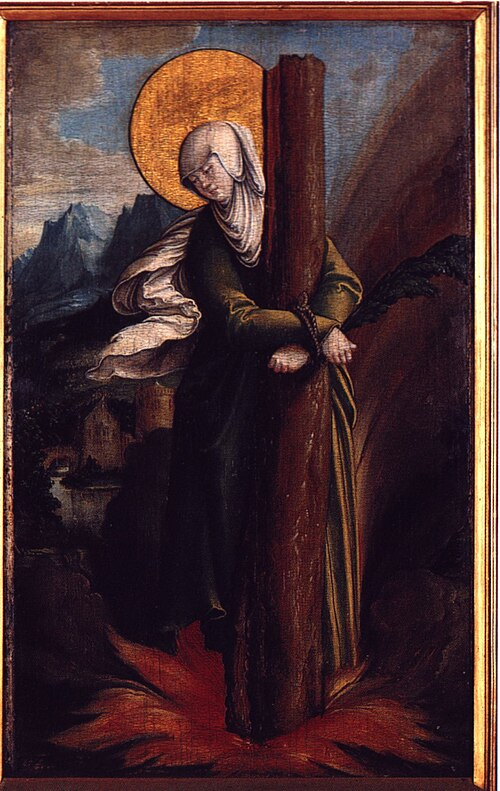
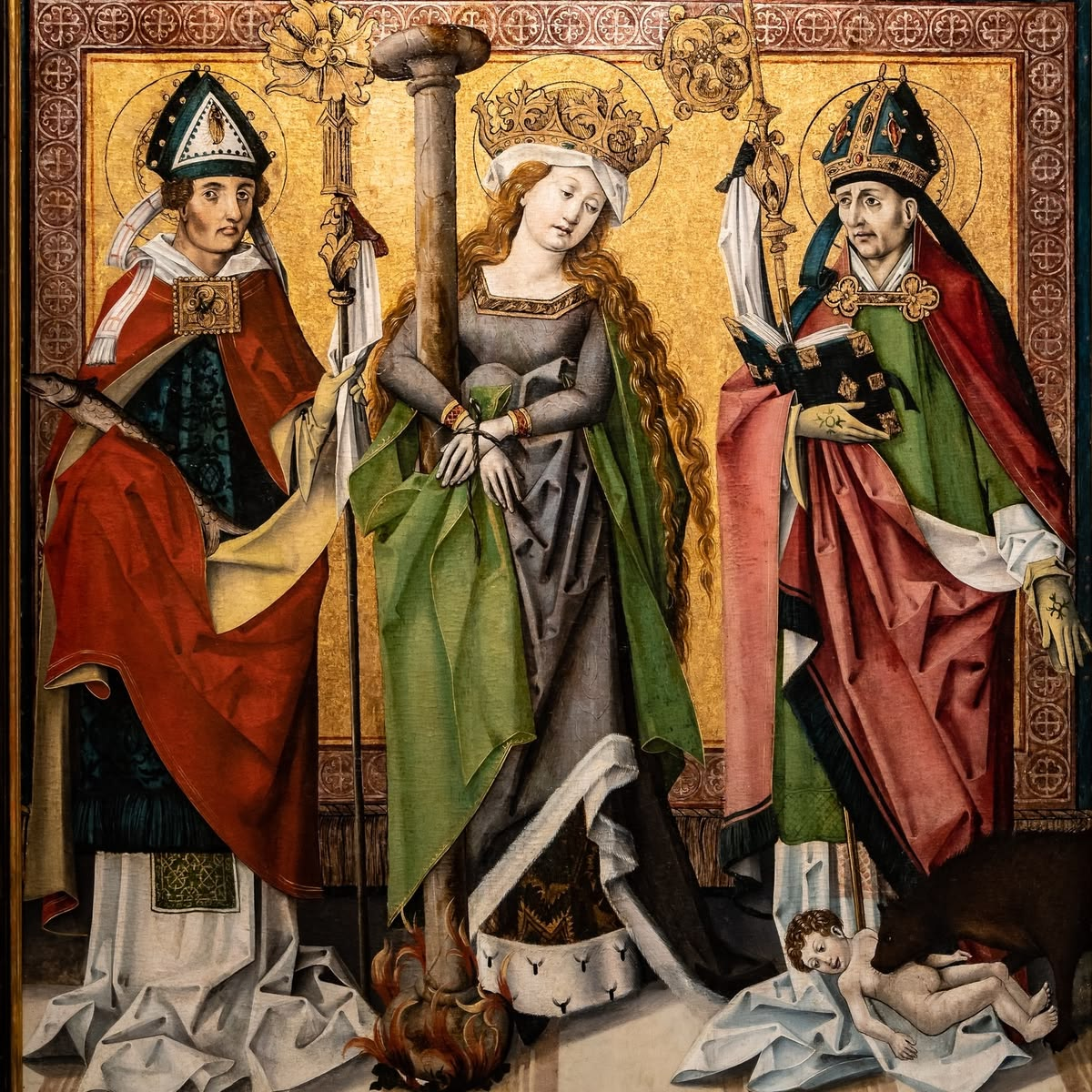
Saint Cyrilla of Cyrene, also known as Cyrilla of Libya, Ciprilla, Cirilla, Cypria, or Cyprille, was an elderly widow who lived during the time of the persecutions of Emperor Diocletian. She was a devout Christian who refused to worship idols, no matter what she was threatened with. Coming from the city of Cyrene in Libya, her unbreakable faith made her a target for the pagan authorities. Despite her advanced age, she became one of the countless victims of the brutal persecution campaign. The barbaric Romans concocted a wicked ploy to force her to make a sacrifice to their gods by placing live coals and incense in her bare hands, so as to force her to drop the flaming mass onto the altar and make it appear as though she had consented.
But, demonstrating heroic fortitude and resolution, she instead clung tightly to the coals, refusing to cooperate with the demon worshippers. Her refusal to renounce her faith left her tormentors astounded and enraged. Undeterred by her unwavering commitment to the faith, they resorted to further extreme measures. They subjected her to various forms of torture in an attempt to break her spirit, but she remained utterly resolute in her commitment to Christ. Ultimately, Cyrilla was tortured to death. Her body was torn apart with metal hooks, an experience she endured with incredible bravery and unwavering faith.
Our Morning Offering – 5 July – “Month of the Most Precious Blood”
Your Blood, The Fire of Love! By St Catherine of Siena (1347-1380) Doctor of the Church
O sweet Jesus, my Love, to strengthen my soul and to rescue it from the weakness into which it has fallen, You have built a wall around it and have mixed the mortar with Your Blood, confirming my soul and uniting it to the sweet will and charity of God! Just as lime mixed with water is placed between stones to cement them together, so You, O God, have placed between Your creature and Yourself, the Blood of Your only-begotten Son, cemented with the divine lime of the fire of ardent charity, in such a way that there is no Blood without fire, nor fire without Blood. Your Blood was shed, O Christ, by the fire of love! Amen.
One Minute Reflection – 5 July – “Month of the Most Precious Blood” – Readings: Genesis 28: 10-22a, Psalms 91: 1-2, 3-4, 14-15ab, Matthew 9: 18-26 and the Memorial of St Anthony Mary Zaccaria CRSP (1502-1539)
“The girl is not dead but sleeping” – Matthew 9:24
REFLECTION – “Let us consider, dear friends, how the Master is continually proving to us, that there is to be a resurrection, of which He made the Lord Jesus Christ the first fruits, when He raised Him from the dead.
Let us observe, dear friends, the resurrection that is regularly taking place. Day and night show us a resurrection – night falls asleep, day arises; day departs, night comes on. Let us take the crops – how and in what way does the sowing take place? The sower goes out and sows each seed in the ground. They fall into the ground dry and bare, and decay; – then from their decay, the greatness of the Master’s providence raises them up, and from a single grain, many spring up and bear fruit…
Do we, then, regard it as a great and marvellous thing, for the Creator of all things, to bring about the resurrection of those who have served Him with holiness in the assurance of a good faith?… With this hope, then, let our souls be bound to Him, that is faithful, to His promises and upright in His judgements. He, Who has commanded us not to lie will much more not lie Himself. For nothing is impossible to God except lying (Jn32:17; Lk 1:37; 6,18).
So let faith in Him be rekindled in us and let us understand, that all things are possible to Him. With His majestic Word He constituted all things and with a Word, He can overturn them…when He pleases and as He pleases, He will do everything, and none of the things He has decreed will pass away. All things are in His sight and nothing has escaped His Providence.” – St Pope Clement I (c 35-c 99)Pope from about 90 to 99 – Letter to the Corinthians, §24-28 ; SC 167
PRAYER – Almighty Lord and God, protect and strengthen us by Your power throughout this day, even as You have enabled us to begin it. By Your grace, may the our faith be our guide and let our every thought, word and deed aim at doing Your will and what is pleasing in Your sight. Grant that by the prayers of Saint Anthony Zaccaria, we may ever turn our eyes and hearts to our Lord Jesus Christ. Through Him, Your divine Son, who lives and reigns with You and the Holy Spirit, God now and forever, amen.
Quote/s of the Day – 5 July – “Month of the Most Precious Blood” – the Memorial of St Anthony Mary Zaccaria CRSP (1502-1539)
“In His mercy, God has chosen us, unworthy as we are, out of the world, to serve Him and thus, to advance in goodness and to bear the greatest possible fruit of love in patience.”
“If you want to pray well, first detach yourself from things of the world, purify yourself from your passions, which deprive your soul of your trust in God, then prepare yourself for prayer through meditation.”
“ True spiritual life consists in this: that man keep his eyes on God all the time, long for nothing but for God, keep nothing in mind but God, begin every single action,in God’s name and direct it to Him.”
5th Day – Types of the Precious Blood: (2) The Blood of the Paschal Lamb
On the night when God delivered His people from Egypt a lamb was slain that was a type of the Lamb of God. It was to be a lamb without blemish, no bone of it was to be broken, it was to be wholly consumed by those in whose dwelling it was slain, and its blood was to be shed to the last drop. Apply these conditions of the paschal lamb to the Lamb of God, and see how perfectly they were fulfilled in the sacrifice of the cross.
The blood of the paschal lamb was to be sprinkled on the door-posts of the Israelites, and thereby they were to be rendered safe from the judgement that fell upon the Egyptians. So the Precious Blood sprinkled upon our hearts saves us from the punishment we have justly deserved. It appeases the anger of God and marks us as belonging to Him, and travellers to the heavenly Jerusalem longing to be freed from the bondage of earthly things.
How is the Precious Blood sprinkled on our souls? In all the sacraments of the Church, in every act of contrition, in every deed of supernatural charity, in every prayer offered humbly and with confidence, it falls upon us, and renders us safe from the avenging angel, and secures us from the anger of God that our sins have justly merited. Asperges me, Domine, hyssopo et mundabor – ‘Sprinkle me, O Lord, and I shall be rendered clean in Thy sight.’
Nuestra Señora del Refugio / Our Lady of Refuge, Matamoros, Tamaulipas, Mexico (1720) – 4 July:
Jesuit Missionary Father Juan José Güica brought a painting of Our Lady, Refuge of Sinners from Italy to Mexico in 1720. In a dream, the Virgin told Padre Güica to ask the Franciscans of Zacatecas to use and promote the image; – they distributed over 150 copies, making this one of the most widespread Marian devotions in Mexico.
In 1793 Franciscan Friars came to the new settlement which would become Matamoros, renaming the area “Nuestra Señora del Refugio de los Esteros Hermosos” (Our Lady of the Refuge of the Lovely Marshes).
The Cathedral of Our Lady of Refuge, built in 1832, displays an 1886 painting of her. Her fiesta, celebrated in many Mexican Towns, commemorates the coronation of the original “Refugium Peccatori” in the Jesuit Church of Frascati, Italy, on 4 July 1717.
Bl Agatha Yun Jeom-Hye St Albert Quadrelli St Andrew of Crete St Anthony Daniel St Aurelian of Lyons St Bertha of Blangy St Carileffo of Anille Bl Catherine Jarrige St Cesidio Giacomantonio Bl Damiano Grassi of Rivoli St Donatus of Libya St Edward Fulthrop St Elias of Jerusalem St Finbar of Wexford St Fiorenzo of Cahors St Flavian of Antioch St Giocondiano Bl Giovanni of Vespignano St Haggai the Prophet Bl Hatto of Ottobeuren Bl Henry Abbot St Henry of Albano St Hosea the Prophet St Innocent of Sirmium Bl John Carey Blessed John Cornelius SJ (1557– 1594) Martyr, English Priest of the Society of Jesus, Missionary. Bl Jozef Kowalski St Jucundian St Laurian of Seville St Lauriano of Vistin Bl Maria Crocifissa Curcio St Namphanion the Archmartyr Bl Natalia of Toulouse St Odo the Good Bl Odolric of Lyon Bl Patrick Salmon Bl Pedro Romero Espejo
Hosea (‘Salvation’), also known as Osee, son of Beeri, was an 8th-century BC prophet in Israel and the author of the Book of Hosea. He is the first of the Twelve Minor Prophets. Hosea is often seen as a “prophet of doom”, but underneath his message of destruction is a promise of restoration. Hosea was a contemporary of Jonah, Amos, Isaiah and Micah.
He married Gomer, but she proved to be unfaithful. Hosea knew she would be such, as God tells him so in the opening statements of the book. This marriage was arranged in order to serve as a symbol of Israel’s unfaithfulness to the Lord, and dramatizes the breakdown in the relationship between God and his people Israel. Hosea’s family reflected the adulterous relationship which Israel built with other gods.
His children’s names likewise represent God’s estrangement from Israel. They are prophetic of the fall of the ruling dynasty and the severed covenant with God. The name of Hosea’s daughter, Lo-ruhamah, which translates as ‘not pitied’, is chosen as a sign of displeasure with the people of Israel for following false gods. The name of Hosea’s son, Lo-ammi, which translates as ‘not my people’, is chosen as a sign of the Lord’s displeasure with the people of Israel for following those false gods.
Even though Gomer runs away from Hosea and sleeps with another man, he loves her anyway and forgives her. Likewise, even though the people of Israel worshipped false gods, God continued to love them and did not abandon his covenant with them. The buying back of Gomer is also an analogy to the redemptive qualities of Jesus Christ’s sacrifice on the cross, and his buying back of the human race from the devil.
One Minute Reflection – 4 July – “Month of the Precious Blood” – Ezekiel 2: 2-5, Psalms 123: 1-2, 2, 3-4, Second Corinthians 12: 7-10, Mark 6: 1-6
“So he could notperform any mighty deed there, apart from curing a few sick people by laying his hands on them …” – Mark 6:5
REFLECTION – “One meaning of “could not” is simply the limits of some human will. Take, for example, the point ,that Christ “could not” fulfill any signs in Nazareth was due to disbelief on their part. Something essential for healing is required on both sides—faith on the part of the patients, power on that of the healer. So one side without its counterpart “could not,” so to speak, perform them.
As this can be seen in medical care, it can also be seen in moral transformation. Similarly involving the limits of the will are the texts: “The world cannot not hate you” and “How can you speak good, being evil?” The metaphor of “impossibility” here must mean free refusal by the will. The same idea applies to those passages which say that what is, impossible for humanity is possible for God.
Note also those passages that say that a person “cannot” (in one sense) be born a second time and a needle’s eye “cannot” let a camel through. What would stop these events happening if God willed them directly? Besides all these, there is, as in the case we are presently considering, a “cannot” in the sense of that which is totally inconceivable. We cannot conceive that God can be evil or fail to exist. It is inconceivable that reality cannot exist or two times two is fourteen. So here, it cannot be the case, that the Son would do anything which the Father would not do!” – St Gregory Nazianzen (330-390) Archbishop of Constantinople, Father and Doctor of the Church – Oration 30 (On the Son),10-11.
PRAYER – Lord our God, make us love You above all things and all our fellow-men, with a love that is worthy of You. May we look to Your Divine Son in total trust, faith, love and imitation. Grant too, that by the prayers of the Blessed Virgin Mary, we too may be granted the grace to follow Your only Son, no matter our sufferings, to one day reach You, in our heavenly home. We make our prayer, through Christ our Lord, in the unity of the Holy Spirit, one God, forever amen.
Eternal Father, I offer Thee the Precious Blood of Jesus in satisfaction for my sins and for the wants of holy Church. – Indulgence 100 days, Each time, Pope Pius VII, 22 September 1817.
Quote/s of the Day – 4 July – “Month of the Precious Blood”
“Greater love than this no man hath, that a man lay down his life for his friends.”
John 15:13
“Jesus, knowing that his hour was come, … he loved them unto the end.”
John 13:1
“I beg you never to entertain the least dread and to place all your trust in the Blood of Christ Crucified … May all servile fear be banished from your spirits. You will say with Saint Paul … “I can do all things through Christ crucified, since he is within me by desire and love and he strengthens me” (cf. Phil 4:13; Gal 2:20). Love, love, love! By His Blood, the gentle Lamb has made an unassailable rock of your soul.”
St Catherine of Siena (1347-1380) Doctor of the Church
“The actions of good Christians are of such great value, that heaven is given to us for them. However, … it is not because they come from us and are the wool of our hearts. Rather, it is because they are dyed with the Blood of the Son of God. I mean, that the Saviour sanctifies our actions by the merits of His Blood. A branch of the vine, united and joined to the stock, produces fruit, not by it’s own power but empowered by the stock. Now we are united by charity to our Redeemer, as members to the head (Eph 4:15-16). That is why our fruits and good works, drawing their value from Him, merit life everlasting.”
St Francis de Sales (1567-1622) Doctor of Charity
“How long are you going to be deaf to His call? Or are you going to lose your soul, which Jesus Christ bought at the price of His Precious Blood?”
Our Morning Offering – 4 July – “Month of the Precious Blood”
For those unable to attend Holy Mass today and for all of us, everyday!
Act of Spiritual Communion By St Alphonsus Maria de Liguori (1696-1787) Most Zealous Doctor
I desire, good Jesus, to receive Thee in Holy Communion and since I cannot now receive Thee in the Blessed Sacrament, I beseech Thee to come to me spiritually and to refresh my soul with Thy sweetness. Come, my Lord, my God and my All! Come to me and never let me ever again be separated from Thee by sin. Teach me Thy blessed ways, help me with Thy grace to imitate Thy example, to practise meekness, humility, charity and all the virtues of Thy Sacred Heart. My divine Master, my one desire is to do Thy will and to love Thee, more and more. Help me, that I may be faithful to the end, in Thy service. Bless me in life and in death, that I may praise Thee, forever in heaven, Amen
4th Day – Types of the Precious Blood (1) The Blood of Abel
Abel was slain by his cruel brother, Cain, because he offered to God a sacrifice exceeding that of Cain, and his brother, filled with rage at the acceptance of Abel’s sacrifice, deliberately shed his innocent blood. So the Jews, filled with rage at the exceeding holiness of Jesus’ life, and at the sweet attractiveness of His words, and the divine beauty of His works of mercy, shed His Precious Blood. So the wicked are ever enraged against the good and grudge them their favour with God.
The blood of Abel cried out to God for vengeance on his murderer. The blood of Jesus, which speaketh better things than that of Abel, cries out to God for mercy on those who have outraged Him and put Him to death. Even while Jesus hung on the cross, He prayed His father to forgive them, and ever since, as long as the world shall last, His blood still cries, “Father, forgive them, for they know not what they do!” O Jesus, may Thy blood thus cry out for me!
Yet at the same time, it cries for vengeance on those who deliberately and willfully reject Him. Long, indeed, He bears with them, long and patiently. Yet, if in the end they spurn His Precious Blood, His very mercy will bring upon them a vengeance in proportion to His offer of love. O Jesus! may I never reject Thee or refuse Thy love and mercy!
Notre-Dame-de-la-Carole / Our Lady of la Carole, Paris (1418) – 3 July:
Roadside Shrines can still be seen in places all over Europe, though it is nothing like it used to be in the Middle Ages when these Shrines were extremely prevalent. They were public reminders of God and His Saints and were meant for the good of the general public, who would come upon the Shrine and pause for a moment to pray. They could be simple or somewhat elaborate, ranging from unadorned crosses to free standing towers or even small Chapels.
On 3 July in the year 1418, a Swiss soldier committed a sacrilege upon a Statue of the Blessed Virgin known as Our Lady of la Carole, or Our Lady of Carole. It was located at the corner of the Rue aux Ours, which was built in the 13th century and terminated at the hospital of Saint John, which is no longer in existence. The Rue aux Ours is now a short street that begins at Rue Saint-Martin and ends at the Boulevard Sebastopol in Paris, France. The soldier of the Duke of Burgandy’s troops, said to be a Swiss soldier, came upon the Shrine of the Blessed Virgin after having left a tavern where he had gambled away his money. He was probably intoxicated when he drew his sword and repeatedly struck the Statue of the Blessed Virgin with the weapon. The Statue of Our Lady of Carole then began to bleed profusely, as if made of flesh and blood and WAS wounded by the blows.
The citizens who had observed the sacrilege were outraged and followed the soldier as he fled from the scene of his crime. The man was eventually caught and apprehended and then brought before the Chancellor where he was sentenced to death for the outrage.
In remembrance of this incident and in expiation for the crime, there was a popular feast that took place on the Rue aux Ours every year. There were fireworks and a wax figure representing the sacrilegious wretch who had struck the image of the Blessed Virgin was set ablaze. This festival continued until the French Revolution brought an end to the traditional observance.
St Anatolius of Constantinople (Diedc 458) Bishop Bl Andreas Ebersbach Bl Barbara Jeong Sun-mae St Bladus St Byblig St Cillene St Dathus of Ravenna St Eusebius of Laodicea St Firminus St Firmus Bl Gelduin St Giuse Nguyen Ðình Uyen St Gunthiern St Guthagon St Heliodorus of Altinum St Hyacinth of Caesarea St Ioannes Baptista Zhao Mingxi St Irenaeus of Chiusi
St Maelmuire O’Gorman St Mark of Mesia St Mennone the Centurian St Mucian of Mesia St Paul of Mesia St Petrus Zhao Mingzhen St Philiphê Phan Van Minh St Raymond of Toulouse (Died 1118) Layman — Martyrs of Alexandria – 13 saints: Thirteen Christian companions marytred together. No details about them have survived but the names – Apricus, Cyrion (2 of), Eulogius, Hemerion, Julian, Julius, Justus, Menelaus, Orestes, Porfyrios and Tryphon (2 of). They martyred in Alexandria, Egypt, date unknown.
Martyrs of Constantinople – 24 saints: A group of 24 Christians martyred in the persecutions of Arian emperor Valens. We know little more than their names – Acacios, Amedinos, Ammonius, Ammus, Cerealis, Cionia, Cionius, Cyrianus, Demetrius, Eulogius (2), Euphemia, Heliodoros, Heraclios, Horestes, Jocundus, Julian, Martyrios, Menelaeus, Sestratus, Strategos, Thomas, Timotheos and Tryphon. They were martyred in c367 in Constantinople.
Theodotus and Companions – 6 saints: Six Christians who were imprisoned, tortured and martyred together in the persecutions of Trajan. Saint Hyacinth ministered to them in prison. We know nothing else about them but their names – Asclepiodotus, Diomedes, Eulampius, Golinduchus, Theodota and Theodotus. They were beheaded in c110, location unknown.
Hyacinth was a native of Caesarea in Cappadocia, and a member of a Christian family. As a boy, he was appointed to serve as an assistant to the chamberlain to the Emperor Trajan. His failure to participate in the sacrifices to the official Roman gods soon came to be noticed by other members of the Imperial household. One day, while the emperor and his entourage were offering sacrifice to idols, Hyacinth remained at the palace, shut himself up in a small room, and prayed fervently to the Lord Jesus Christ. One of the servants overheard him praying and denounced him to the emperor.
When he was denounced as a Christian, Hyacinth proclaimed his faith. He was brought to trial before Trajan, who tried to persuade him to deny Christ and sacrifice to idols, but the young boy refused. As a result, he was imprisoned and underwent numerous scourgings and tortures. He was deliberately served only food which had been blessed for sacrifice to the gods, the eating of which was banned to Christians. Thus, he starved to death after thirty-eight days, dying at the age of twelve. Just before his death, his jailers saw him being comforted by a pair of angels, one who covered him with his own robe, the other who bestowed a crown on him.
Hyacinth died in the city of Rome. Later, his relics were transferred to Caesarea.
One Minute Reflection – 3 July – Feast of St Thomas Apostle – Readings: Ephesians 2: 19-22, Psalms 117: 1bc, 2, John 20: 24-29
“Blessed are those who have not seen and have believed.” – John 20:29
REFLECTION – “There was a wonderful providence behind these words of the Saviour and they can be of very great help to us. They show, once again, how much He cares for our souls, for He is good and as Scripture says: “He wants everyone to be saved and to come to knowledge of the truth” (1Tm 2,4).
Even so, this saying of His may surprise us. As always, Christ had to be patient with Thomas, when he said he would not believe and, with the other disciples too, when they thought they were seeing a ghost! Because of His desire to convince the whole world, He most willingly showed them the marks of the nails and the wound in His side; – because He wished those, who sought this evidence, as a support for their faith, to have no possible reason for doubt – He even took food, although He had no need for it (Lk 24,41)…
But when anyone accepts what he has not seen, believing on the word of his teacher, the faith, by which he honours the One his teacher proclaims to him, is worthy of great praise. Blessed, therefore, is everyone who believes the message of the holy Apostles who, as Saint Luke says, were eyewitnesses of Christ’s actions and “ministers of the word” (Lk 1,2). If we desire eternal life and long for a dwelling place in heaven, we must listen to them.” – St Cyril of Alexandria (380-444), Bishop, Father and Doctor of the Church – Commentary on Saint John’s gospel, 12, 22
PRAYER – Father, let our celebration on the feast of Saint Thomas the Apostle, be the source of his unfailing help and protection. Fill us with Your life-giving grace through our faith in Your Son, Jesus the Christ, whom Thomas acknowledged to be his Lord and his God. We make our prayer, through our Lord Jesus in union with the Holy Spirit, one God with You, forever and ever, amen.
Quote/s of the Day – 3 July – Feast of St Thomas Apostle – Readings: Ephesians 2: 19-22, Psalms 117: 1bc, 2, John 20: 24-29
Jesus said to him, “Have you come to believe because you have seen me? Blessed are those who have not seen and have believed.”
John 20:28-29
“For by your doubting, I am taught to believe, by your forked-tongue, that revealed the Wound on the Divine Body that was pierced, I harvest the fruit for myself, without pain!”
St John Chrysostom (347-407) Father and Doctor
“I believe though I do not comprehend and I hold by faith, what I cannot grasp with the mind.”
St Bernard (1090-1153) Mellifluous Doctor
“To one who has faith, no explanation is necessary. To one without faith, no explanation is possible.”
“Believing is an act of the intellect assenting to the divine truth, by command of the will, moved by God through grace.”
St Thomas Aquinas (1225-1274) Doctor Angelicus/Doctor Communis
When the promise of the Redeemer to come was made to our first parents in the Garden of Eden after their fall, the shadow of the Precious Blood fell upon the world and reconciled it with God. The curse that had been incurred lost its fatal power to destroy. The anger of God had been appeased and He looked upon the earth through the medium of the Blood of His only-begotten Son, that was to be shed for sin, and for its sake offered forgiveness and mercy to the sinners who repented of their sin. So may He extend to me the forgiveness and mercy that I need far more than did Adam and Eve, for I have sinned far more deeply and often than they.
As the ages rolled on, the same shadow, sheltering men from God’s fierce anger, still rested on the earth. In its sweet shade rested Abraham and all the patriarchs, Samuel and all the prophets, through its influence sinners found mercy and saints obtained graces innumerable. If it did so much for the heathen world, what must it not do for Catholics! Grant, O Lord, that now and ever I may sit under His shadow Whom I have desired!
All through the four thousand years before Christ came, the tradition of the necessity of the shedding of blood for the forgiveness of sins was almost universal. The Jewish sacrifices were expressly ordained to keep up the memory of it. In heathen countries the blood of victims was almost everywhere offered. God never leaves Himself without a witness even among those who have departed far from Him. Admire His goodness in so doing.
8 The voice of my beloved, behold he cometh leaping upon the mountains, skipping over the hills. 9 My beloved is like a roe, or a young hart. Behold he standeth behind our wall, looking through the windows, looking through the lattices. 10 Behold my beloved speaketh to me: Arise, make haste, my love, my dove, my beautiful one, and come. 11 For winter is now past, the rain is over and gone. 12 The flowers have appeared in our land, the time of pruning is come: the voice of the turtle is heard in our land: 13 The fig tree hath put forth her green figs: the vines in flower yield their sweet smell. Arise, my love, my beautiful one, and come: 14 My dove in the clefts of the rock, in the hollow places of the wall, shew me thy face, let thy voice sound in my ears: for thy voice is sweet, and thy face comely.
Holy Gospel according to Saint Luke 1,39-47.
39 And Mary rising up in those days, went into the hill country with haste into a city of Juda. 40 And she entered into the house of Zachary and saluted Elizabeth. 41 And it came to pass that when Elizabeth heard the salutation of Mary, the infant leaped in her womb. And Elizabeth was filled with the Holy Ghost. 42 And she cried out with a loud voice and said: Blessed art thou among women and blessed is the fruit of thy womb. 43 And whence is this to me that the mother of my Lord should come to me? 44 For behold as soon as the voice of thy salutation sounded in my ears, the infant in my womb leaped for joy. 45 And blessed art thou that hast believed, because those things shall be accomplished that were spoken to thee by the Lord. 46 And Mary said: My soul doth magnify the Lord. 47 And my spirit hath rejoiced in God my Saviour.
Our Lady of the Walnut Our Lady of Madhu Our Lady of Montallegro Our Lady of the Grove Our Lady of the Leśniów Spring Our Lady of the Visitation Our Lady of the Way of Leon Our Lady of Vaussivieres
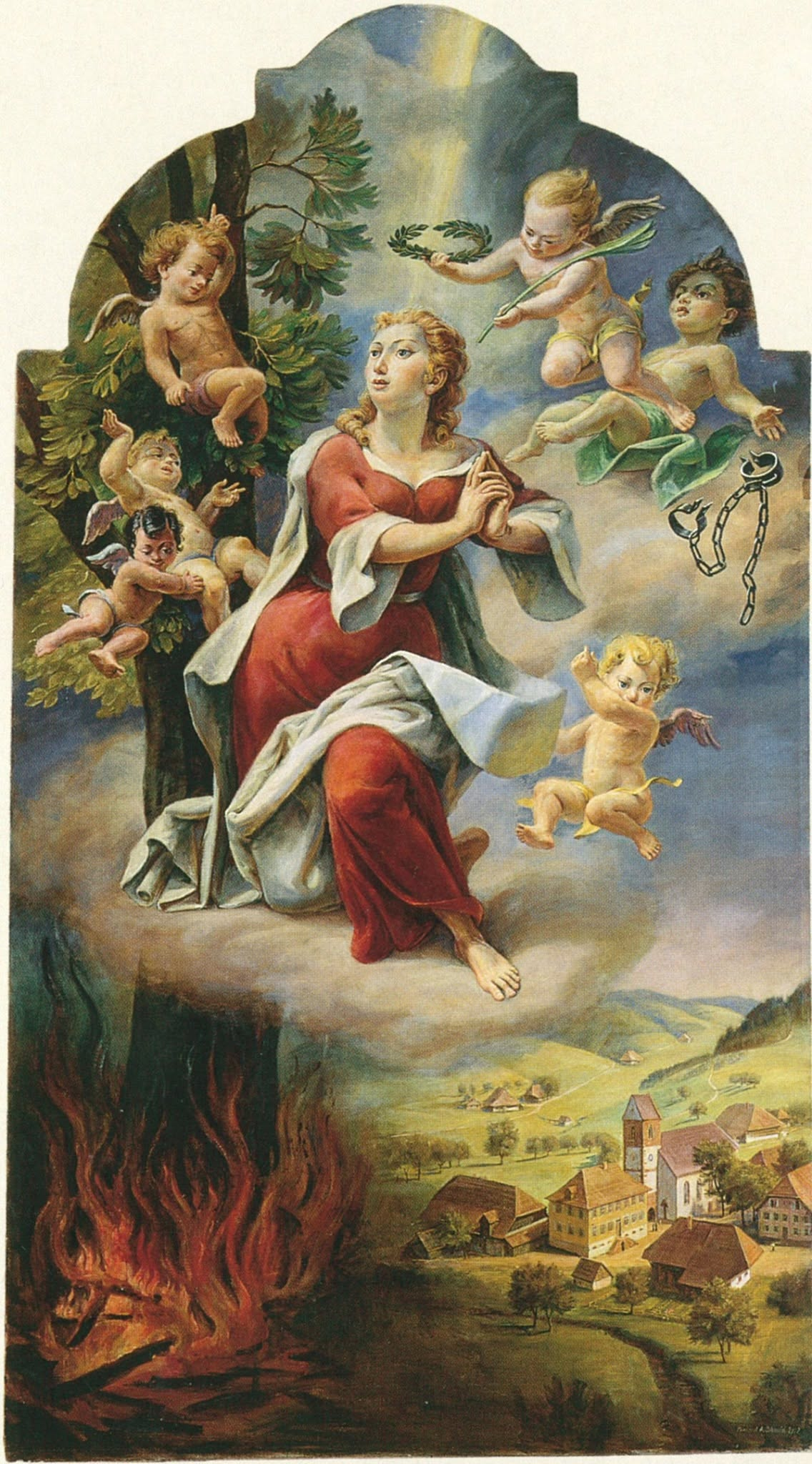
Notre Dame de la Visitation / Our Lady of the Visitation, Lescure, Valuéjols, Cantal, Auvergne, France (1717) – Commemorated on the Fourth Sunday of June, 2 July :
At around 19 years old, Shepherd Jean Paillé was devoted to the Virgin Mary, and would daily lead his flock, from his little village in central France ,to a wayside Cross on a bluff, where he would kneel to say the Rosary. On 2 July, 1717, his prayers at the Cross were met by an apparition of the Virgin herself, who asked that a Church be built on that spot, leaving behind a small Statuette of herself at the foot of the Cross. She returned several times with the same request. Finally, Jean answered, “But no one will believe me.”“Keep telling the people of Lescure,” she said “and eventually they will listen.” Both were right. When the shepherd mustered the courage to tell the villagers about his visions, they ridiculed him as a simpleton. So he built a small Shrine in the holy place himself, of dry stone, placing the Statuette inside it.
When bad weather threatened, Jean would go there to pray for help. Seeing those prayers answered, the villagers began to believe in his communication with the Virgin and decided to build her a Church in the village. Jean argued that the Holy Virgin wanted her Church on the promontory but wanting the convenience of building and having it in town, the people built the new Church in Lescure and installed the Statuette there. But, the next day, it had returned to the bluff. Jean was suspected of moving it but the same thing kept happening, even with the shepherd under watch, so finally everyone agreed, that Heaven wanted the Virgin’s Chapel to be on the heights and not in the town. This time Jean Paillé himself organised the work. Building materials poured in, which oxen carried up the hill as easily if they were made of feathers.
In 1724, some 3,000 pilgrims camped in the open air to witness the Consecration of the new Church. The Bishop’s delegate dedicated the Sanctuary to Our Lady of the Visitation, in memory of the first apparition date, 2 July, then the Catholic Feast of the Visitation, commemorating the visit of Mary, pregnant with Jesus, to her cousin Elizabeth, pregnant with John the Baptist. In recent years, the Feast of the Visitation has been moved to 31 May and the Solemnity of Our Lady of Lescure to the last Sunday in June.
She is invoked against illness, of the sick and for cures. Notre-Dame de Lescure, santé des infirmes, priez pour nous. Our Lady of Lescure, health of the sick, pray for us.
Bl Giovanni da Fabriano Becchetti St Jacques Fermin Bl Jarich of Mariengaarde St Jéroche St Lidanus of Sezze St Martinian of Rome St Monegundis St Oudoceus
Martyred Soldiers of Rome – 3 saints: Three soldiers who were converted at the martyrdom of Saint Paul the Apostle. Then they were martyred, as well. We known nothing else about them but their names – Acestes, Longinus and Megistus. Martyred c68 in Rome, Italy
Martyrs in Carthage by Hunneric – 7 saints: A group of seven Christians tortured and murdered in the persecutions of the Arian Vandal king Hunneric for remaining loyal to the teachings of orthodox Christianity. They were some of the many who died for the faith during a period of active Arian heresy. – Boniface, Liberatus, Maximus, Rogatus, Rusticus, Septimus and Servus.
Martyrs of Campania – 10 saints: A group of ten Christians marytred together in the persecutions of Diocletian. The only details about them to have survived are their names – Ariston, Crescention, Eutychian, Felicissimus, Felix, Justus, Marcia, Symphorosa, Urban and Vitalis. Martyred in 284 in Campania, Italy.
Martyrs of Seoul – 8 saints: Additional Memorial – 20 September as part of the Martyrs of Korea.
A group of eight Christians who were martyred together as part of the lengthy persecutions in Korea. • Agatha Han Sin-ae • Antonius Yi Hyeon • Bibiana Mun Yeong-in • Columba Gang Wan-suk • Ignatius Choe In-cheol • Iuliana Gim Yeon-i • Matthaeus Gim Hyeon-u • Susanna Gang Gyeong-bok They were martyred on 2 July 1801 at the Small West Gate, Seoul, South Korea. Beatified on 15 August 2014 by Pope Francis.
Saint Martinian of Rome was a member of the Praetorian Guard, the soldiers tasked with guarding the emperor. Assigned as the warden of Saint Peter and Saint Paul in the Mamertine Prison, the apostles converted him after a spring flowed miraculously in the prison. Peter then baptized him in these miraculous waters, which then led to Martinian’s own imprisonment within that very prison.
During his imprisonment, Martinian experienced visions and spiritual encounters that strengthened his resolve. Saint John the Baptist appeared to him, encouraging him in his suffering and reaffirming his faith. This spiritual encounter bolstered Martinian’s courage and determination to face martyrdom rather than renounce Christianity.
By order of the emperor Nero, Martinian was then tortured and beheaded. After his martyrdom with Paul, Lucina, a sympathizer, buried him in her own cemetery along the Aurelian Way. Pope Paschal I (817–824) translated the bones of the martyr to a chapel in the old Basilica of St. Peter. They still rest under the altar dedicated to him (and his fellow martyr, Processus) in the south transept of the present St. Peter’s Basilica.
You must be logged in to post a comment.