Thought for the Day – 12 August – Meditations with Fr Richard Frederick Clarke SJ (1839-1900)
CHARITY Meditations for a Month
The Joy of Charity “Charity rejoiceth in the Truth”
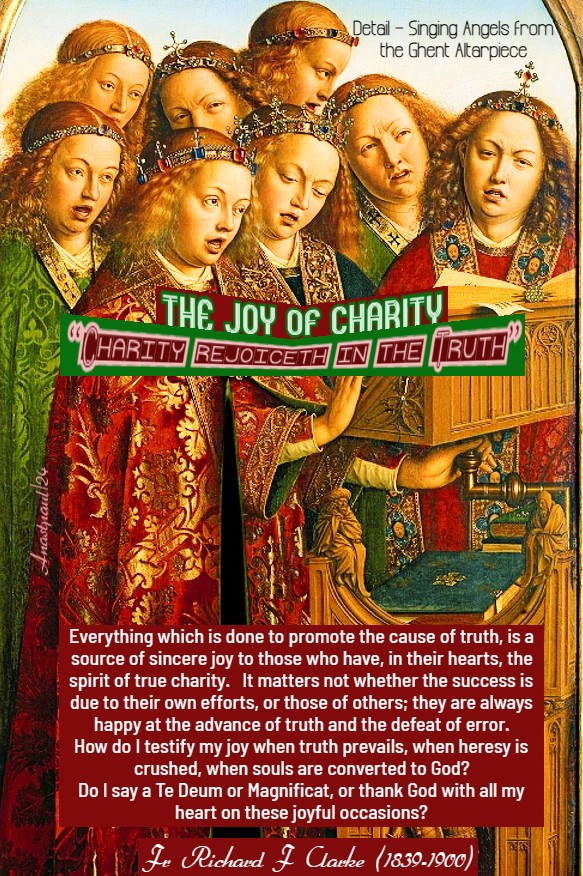
Everything which is done to promote the cause of truth, is a source of sincere joy to those who have, in their hearts, the spirit of true charity. It matters not whether the success is due to their own efforts, or those of others; they are always happy at the advance of truth and the defeat of error. How do I testify my joy when truth prevails, when heresy is crushed, when souls are converted to God? Do I say a Te Deum or Magnificat, or thank God with all my heart on these joyful occasions?
Charity also finds pleasure in the truth being known. It has no wish to conceal anything. Those who have it in their hearts, make no attempt to hide the truth concerning themselves. They are willing to be known as they really are, with all their defects and imperfections. They are even happy their faults should be manifested, as far as the manifestation tends to the glory of God and the edification of their neighbour. I will examine myself to see what progress I have made in charity. Do I rejoice in the truth being known about myself, even in matters which may humble my pride?
Do I rejoice in the truth when I find, I have misjudged or misunderstood my neighbours and they are very different from that which I thought them to be and, far better than myself? Do I rejoice in the truth when I am shown to be incorrect in some opinion and when, others rectify me? Do I rejoice in the truth when I am brought, face-to-face with my own weakness and nothingness and find that I cannot trust in myself but have to trust in God alone?
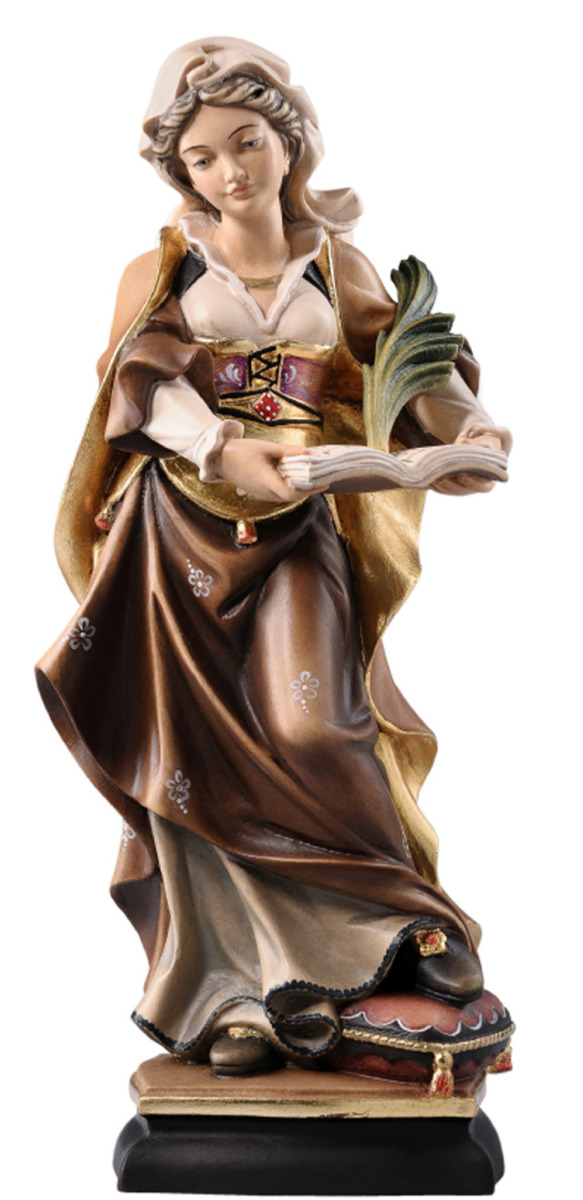
Quote/s of the Day – 12 August – St Clare (1194-1253) Virgin
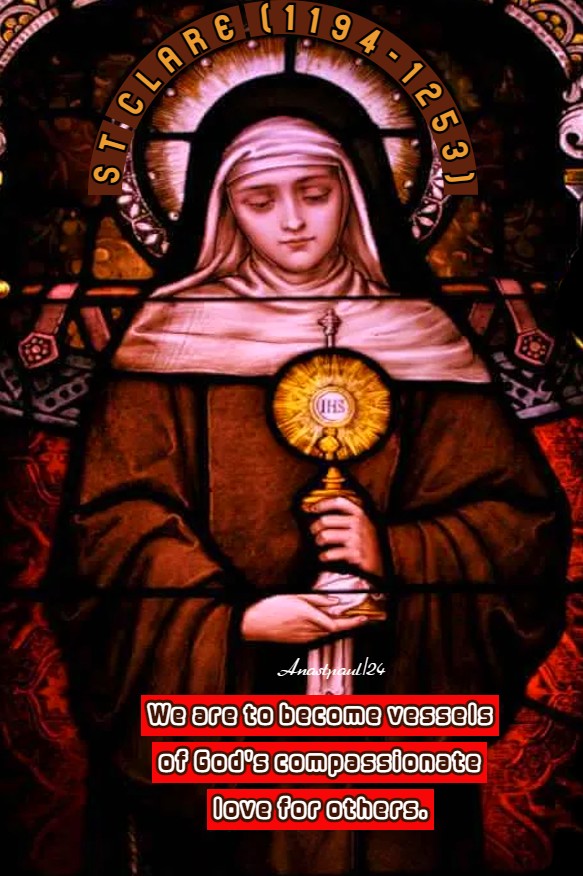
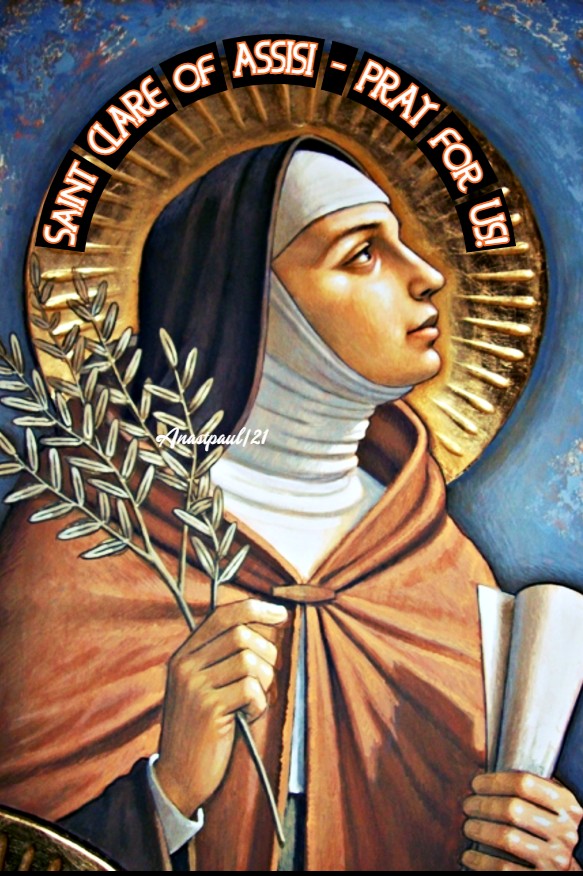
“We are to become vessels of God’s compassionate love for others.”
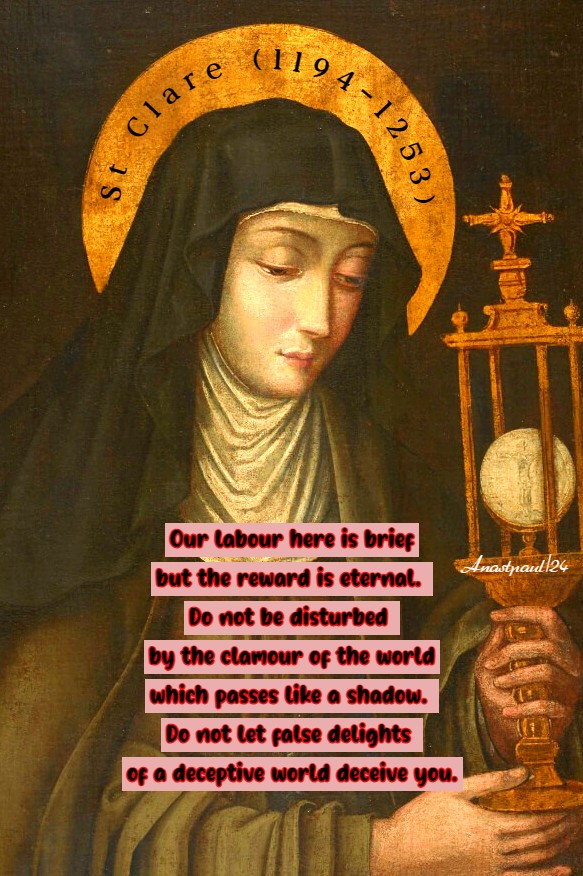
“Our labour here is brief but the reward is eternal. Do not be disturbed by the clamour of the world which passes like a shadow. Do not let false delights of a deceptive world deceive you.”
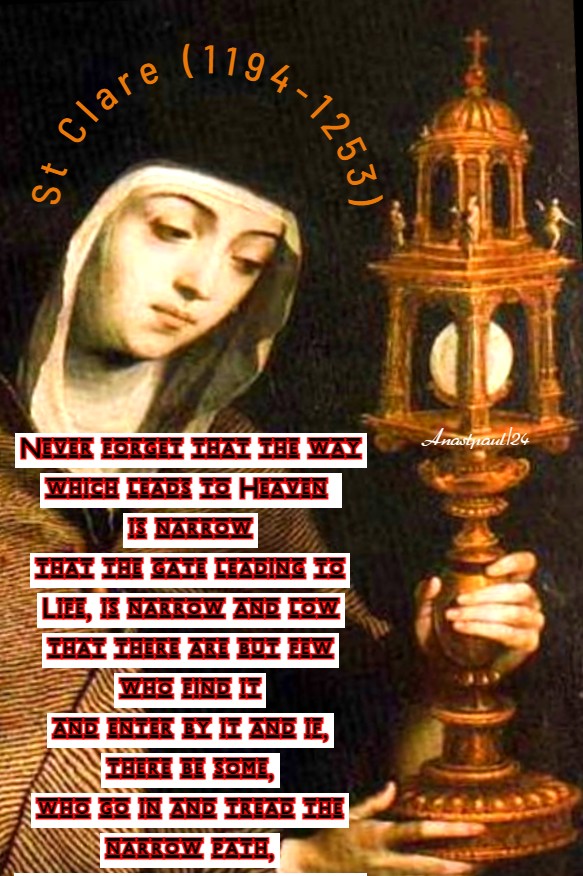
“Never forget that the way which leads to Heaven is narrow that the gate leading to Life, is narrow and low that there are but few who find it and enter by it and if, there be some, who go in and tread the narrow path, for some time, there are but very few, who persevere therein.”
One Minute Reflection – 12 August – “The Month of the Immaculate Heart of Mary” – St Clare of Assisi (1194-1253) Virgin – 2 Cor inthians 10:17-18; 11:1-2; Matthew 25:1-13 – Scripture search here: https://www.drbo.org/
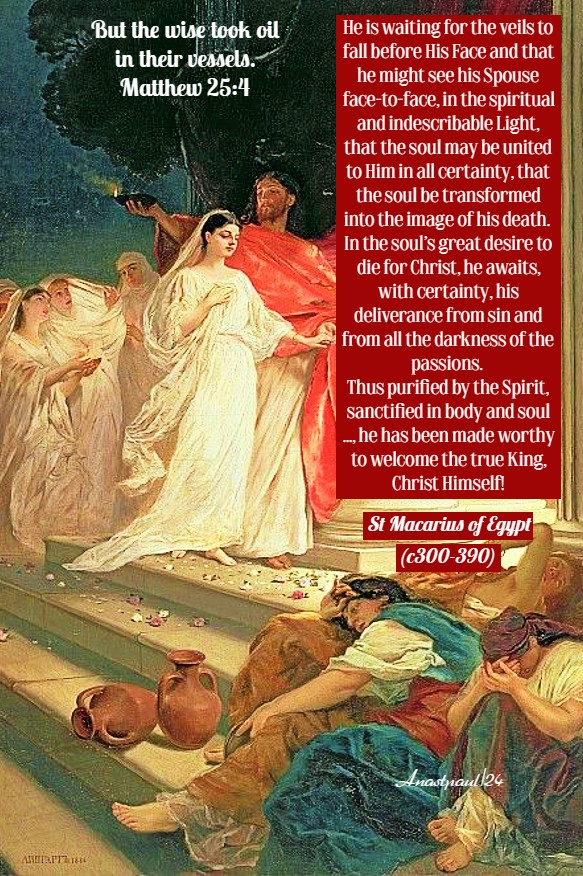
“But the wise took oil in their vessels” – Matthew 25:4
REFLECTION – “The soul who really loves God and Christ, even if it has done thousands of good works, thinks he has done nothing because of his insatiable hunger for God. Even if he has exhausted the body through fasting and vigils, he believes that he has not yet begun to be virtuous. In spite of the gifts of the Holy Ghost, the heavenly revelations and mysteries, he believes that he has not yet done anything because of his immense and insatiable love of the Lord. In faith and in love, he is always hungry and thirsty.
Persevering in prayer, he insatiably desires the mysteries of grace and to acquire every virtue. Wounded by love of the heavenly Spirit, animated by an ardent desire for his heavenly Spouse, he aspires to the grace of perfect, mysterious and ineffable communion with Him, in the sanctification of the Spirit. He is waiting for the veils to fall before His Face and that he might see his Spouse face-to-face, in the spiritual and indescribable Light, that the soul may be united to Him in all certainty, that the soul be transformed into the image of his death. In the soul’s great desire to die for Christ, he awaits, with certainty, his deliverance from sin and from all the darkness of the passions. Thus purified by the Spirit, sanctified in body and soul …, he has been made worthy to welcome the true King, Christ Himself!” – Sermon Attributed to St Macarius of Egypt (c300-390) Monk, Father
PRAYER – Hear us, O God, our Saviour that as we are gladdened by the festival of blessed Clare Thy virgin, so we may learn from it piety and devotion. Through the same Jesus Christ, Thy Son our Lord, Who lives and reigns with Thee, in the unity of the Holy Ghost, God, world without end. Amen (Collect).
Our Morning Offering – 12 August – “The Month of the Immaculate Heart of Mary”
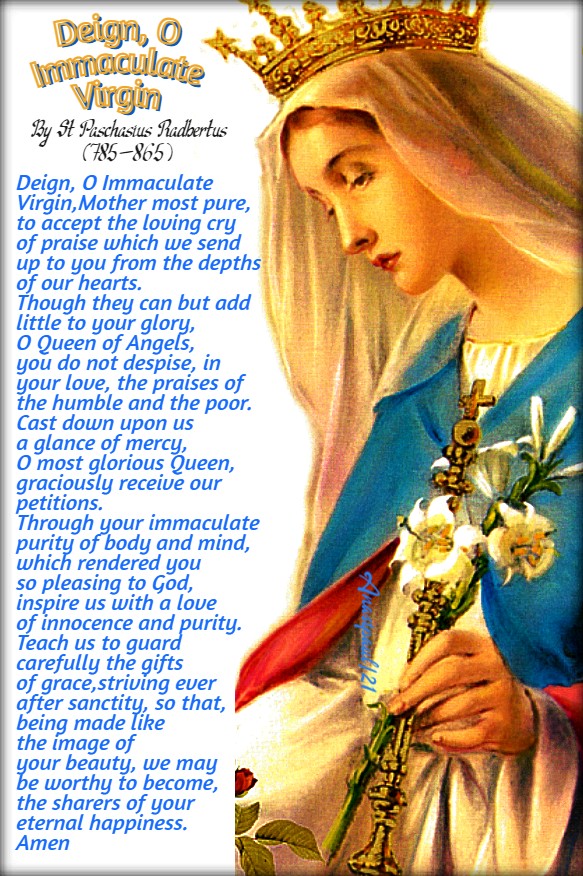
Deign, O Immaculate Virgin By St Paschasius Radbertus (785–865)
Deign, O Immaculate Virgin, Mother most pure, to accept the loving cry of praise which we send up to you from the depths of our hearts. Though they can but add little to your glory, O Queen of Angels, you do not despise, in your love, the praises of the humble and the poor. Cast down upon us a glance of mercy, O most glorious Queen, graciously receive our petitions. Through your immaculate purity of body and mind, which rendered you so pleasing to God, inspire us with a love of innocence and purity. Teach us to guard carefully the gifts of grace, striving ever after sanctity, so that, being made like the image of your beauty, we may be worthy to become, the sharers of your eternal happiness. Amen
Saint of the Day – 12 August – Saint Simplicius of Vercelli (Died c470) the 8th Bishop of Vercelli, Italy. Also called – Simplicio.
In the ancient Eusebian Basilica, now disappeared and replaced by the current Cathedral, the series of the first 40 Bishops of Vercelli could be seen painted in the central nave, starting from St. Eusebius up to Nottingo, who lived from the middle of the 6th Century to around 830. Under each portrait the name of the Bishop represented was written in large letters. The dating of this series of portraits is still being studied.
Of course, the portraits were an authoritative document for the history of the ancient Bishops but due to neglect or old age, they disappeared over the centuries and only 25 names could be read, when the Bishops Bonomius and Ferrerus, at the end of the 16th Century and the beginning of the 17th, wanted to transcribe them, to compose the Episcopal catalogue of the Diocese.
Added to this is the dispersion of the archive documents which occurred during the barbarian invasions, particularly in the Lombard era.
The little which is known about the Bishops of Vercelli, who lived from the middle of the 5th Century to the beginning of the 9th, comes from sepulchral inscriptions, from some local liturgical books, from documents of other Churches and from news of civil history.
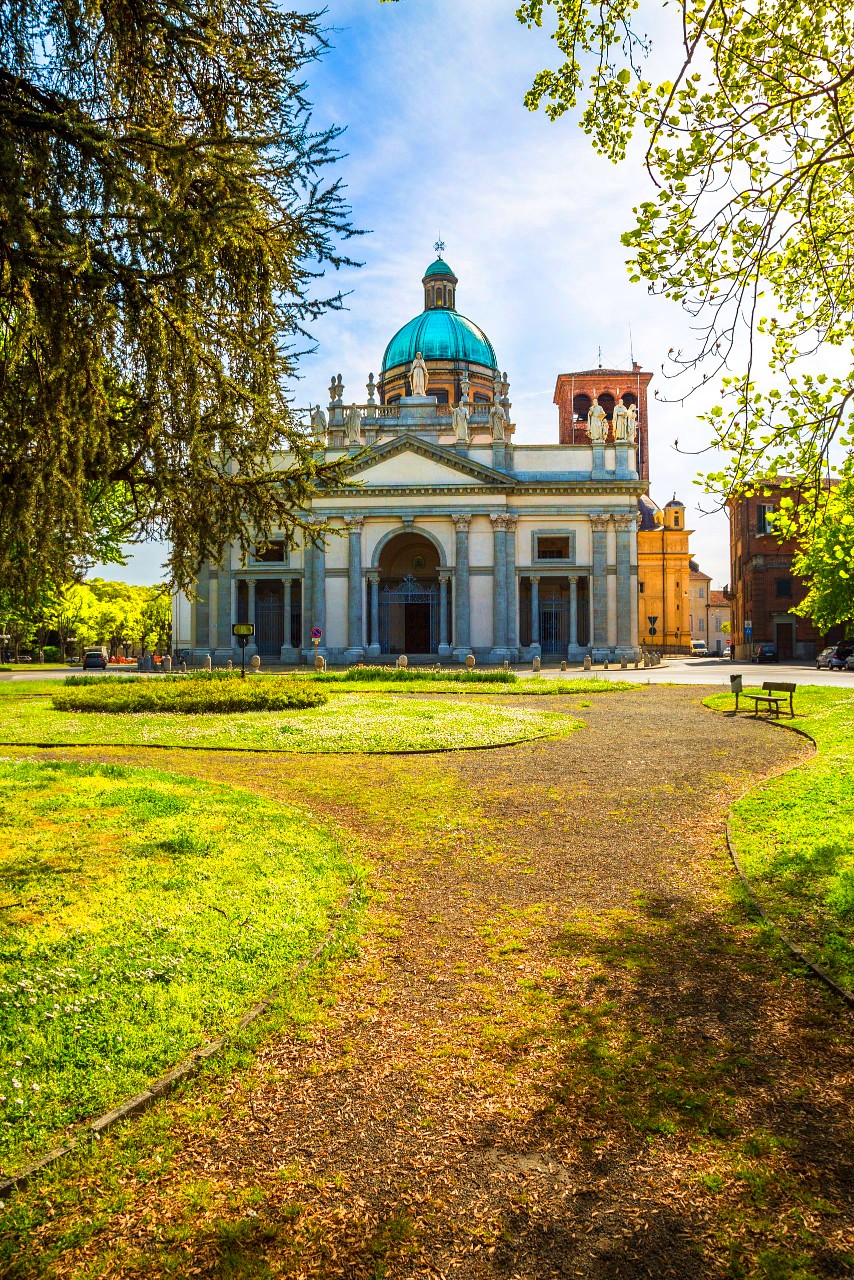
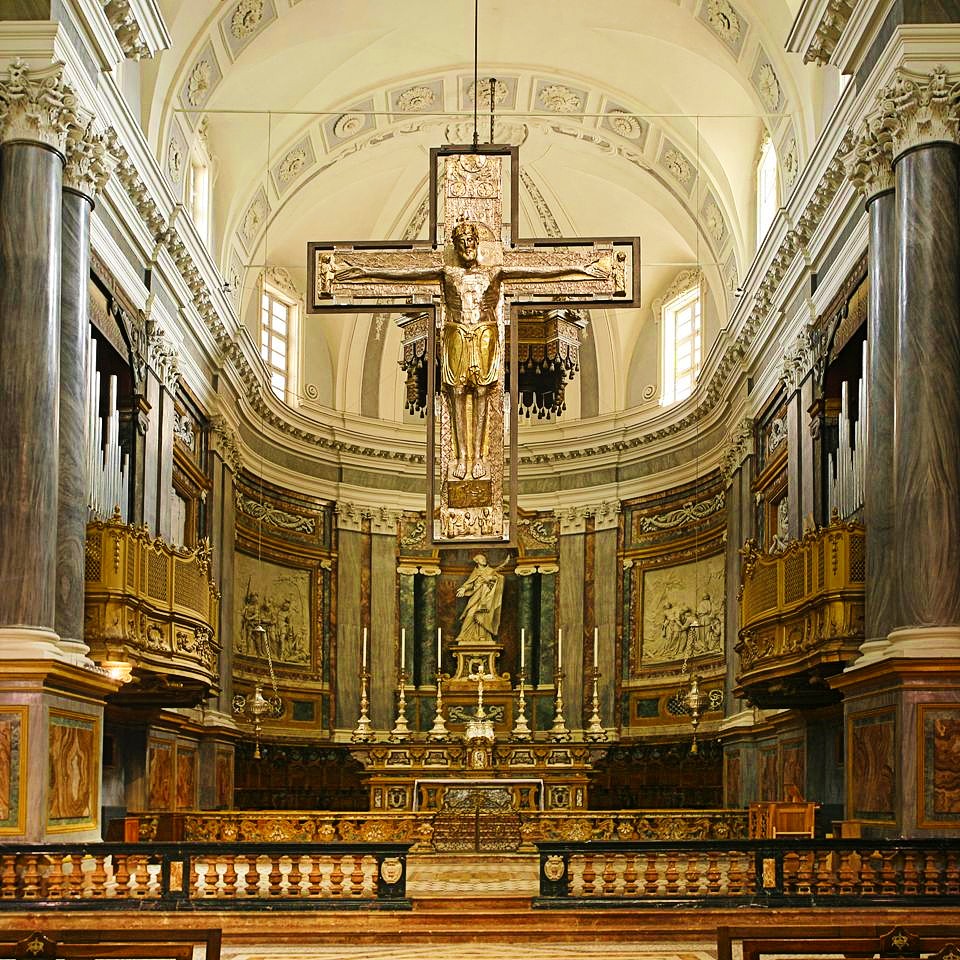
Vercelli Cathedral dedicated to St Eusebius
Therefore, even of St Simplicius very little is known, he was the 8th Bishop of Vercelli, as reported by the Episcopal catalogue compiled by the historian F Savio (1898) which corrects the previous ones. Our Saint is one of the Bishops whose name was not clearly legible under the faded effigy.
His Episcopate can be dated around 470, in the difficult period of the barbarian invasions. The historian, Cusano, reported that at the beginning of the 17th Century, his Tomb was discovered with the following inscription: “Simplicius, the 8th Bishop, extraordinarily endowed with the grace of God, shone brightly with the greatest splendour of sanctity.” (“Simplicius Episcopus octavus, mira Dei gratia praeditus, maximo sanctitatis splendeur praeluxit”).
The authoritative “Bibliotheca Sanctorum” catalogues him together with St Discolius, the 4th Bishop of Vercelli because they were probably celebrated on the same day, 12 August, in the local liturgical calendar. (Adapted from the Italian by Author: Antonio Borrelli).
St Eusebius of Milan (Died 462) Archbishop of Milan. Born in Greece (although some sources regard him as Milanese) and died on 12 August 462. He was the Archbishop from 449 until his death. The Roman Martyrology reads: “In Milan, Saint Eusebius, Bishop, who worked diligently for the True Faith and rebuilt the Cathedral destroyed by the Huns.” His Zealous Life of Grace: https://anastpaul.com/2023/08/12/saint-of-the-day-12-august-st-eusebius-of-milan-died-462-bishop/
St Felicissima the Blind St Gracilian St Herculanus of Brescia St Jambert of Canterbury St Julian of Syria
St Macarius of Syria St Merewenna St Micae Nguyen Huy My St Murtagh of Killala St Photinus of Marmora
St Porcarius of Lerins St Simplicius of Vercelli (Died c470) Bishop St Ust
Martyrs of Augsburg – 4 Saints: The mother, Hilaria,and three friends of of Saint Afra ofAugsburg. While visiting the tomb of Saint Afra who were seized by the authorities and Martyred when they visited Afra’s tomb – Digna, Eunomia, Euprepia and Hilaria. They were burned alive c 304.
Martyrs of Rome – 5 Saints: A group of Christians Martyred together in the persecutions of Diocletian. We know little more than their names – Crescentian, Juliana, Largio, Nimmia and Quiriacus. They died in c304 in Rome, Italy and were buried on the Ostian Way outside Rome.
Thought for the Day – 11 August – Meditations with Fr Richard Frederick Clarke SJ (1839-1900)
CHARITY Meditations for a Month
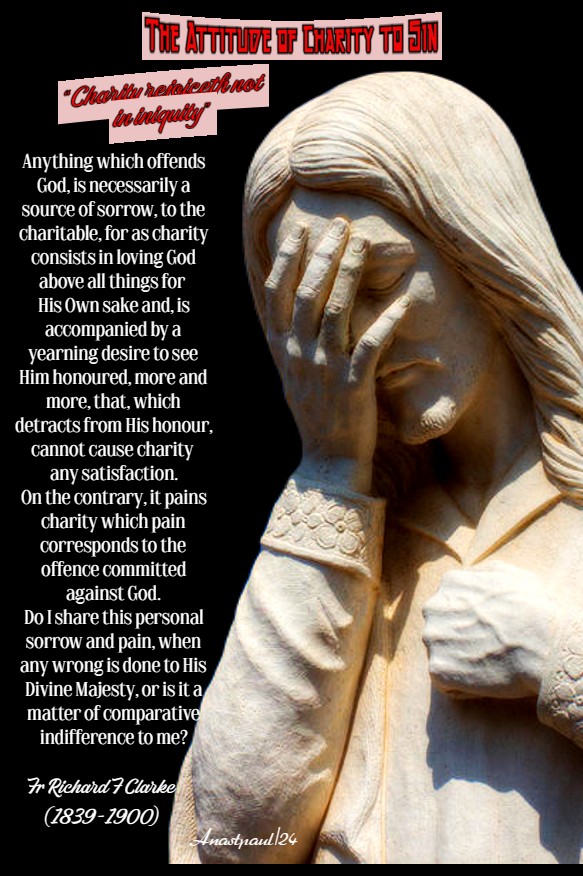
The Attitude of Charity to Sin “Charity rejoiceth not in iniquity”
Anything which offends God, is necessarily a source of sorrow, to the charitable, for as charity consists in loving God above all things for His Own sake and, is accompanied by a yearning desire to see Him honoured, more and more, that, which detracts from His honour, cannot cause charity any satisfaction. On the contrary, it pains charity which pain corresponds to the offence committed against God. Do I share this personal sorrow and pain, when any wrong is done to His Divine Majesty, or is it a matter of comparative indifference to me?
The Saints would gladly have given their lives to prevent sin. It was intensely painful to them to think how continually God is offended. Many Saints laid down their lives to prevent sin from being committed. The Saints all devoted themselves, with generous self-sacrifice, to the furtherance of God’s glory and, the hindrance of sin against Him. By prayer, by active zeal, by word, by work and by personal penance, the Saints fought against iniquity. What do I do to prevent all the sin and vice in this wicked world?
Above all, the Saints feared and dreaded any sin in themselves. They avoided with the utmost care anything which could lead to sin. No spectacle, however magnificent, no honour, however brilliant, no pleasure however intense, caused them anything but disgust and horror, if it was in any way mingled with iniquity. Is this true in my case? Do I relish things questionable or dangerous, or perhaps not altogether unmixed with positive sin!
Quote/s of the Day – 11 August – Pentecost XII – – 2 Corinthians 3:4-9; Luke 10:23-37– Scripture search here: https://www.drbo.org/
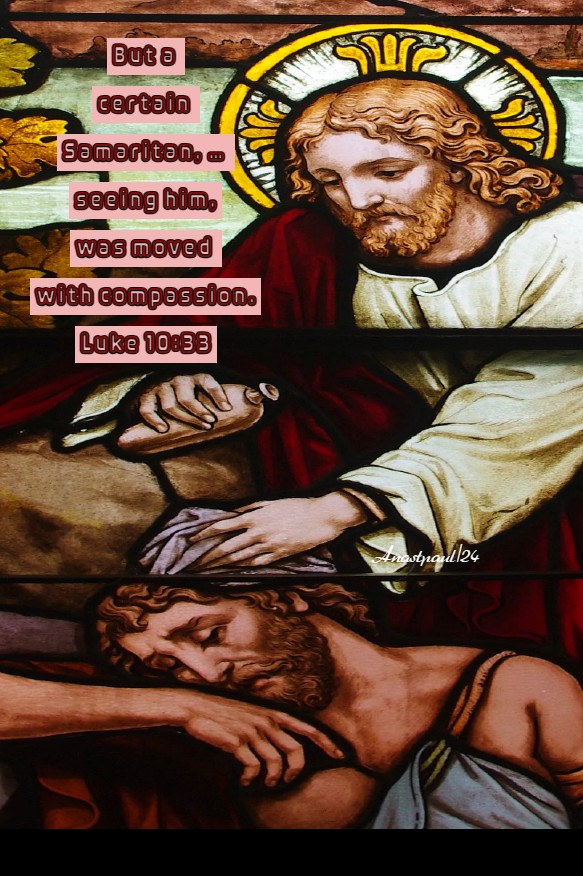
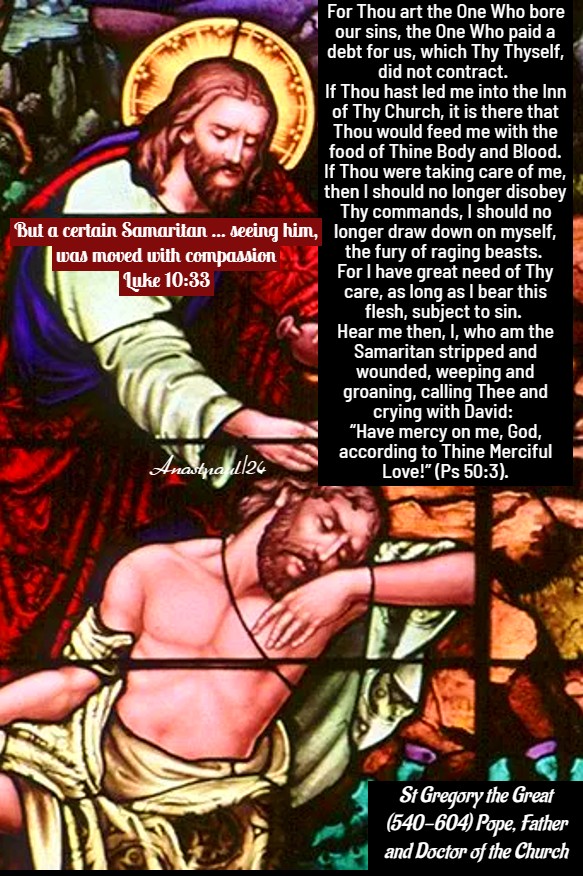
“But a certain Samaritan, … seeing him, was moved with compassion.”
Luke 10:33
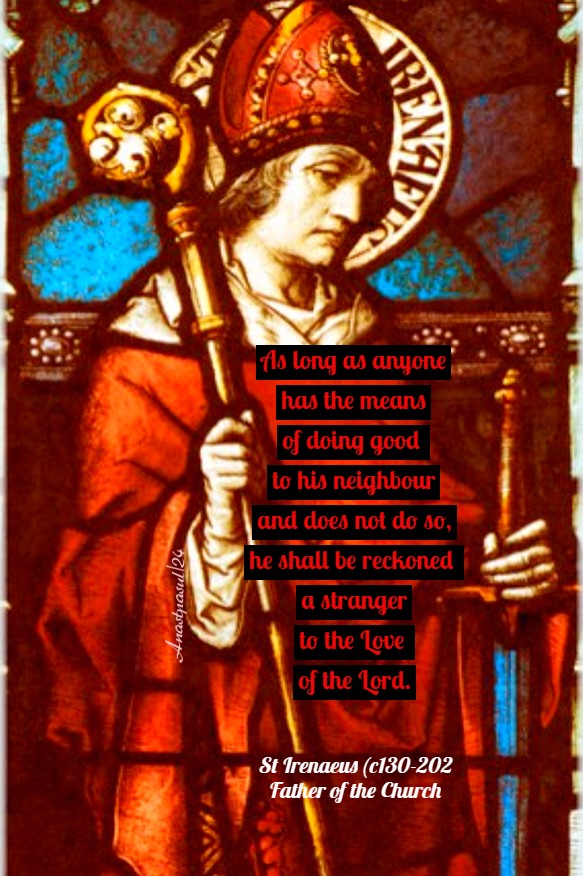
“As long as anyone has the means of doing good to his neighbour and does not do so, he shall be reckoned a stranger to the Love of the Lord.”
St Irenaeus (c130-202 Father of the Church
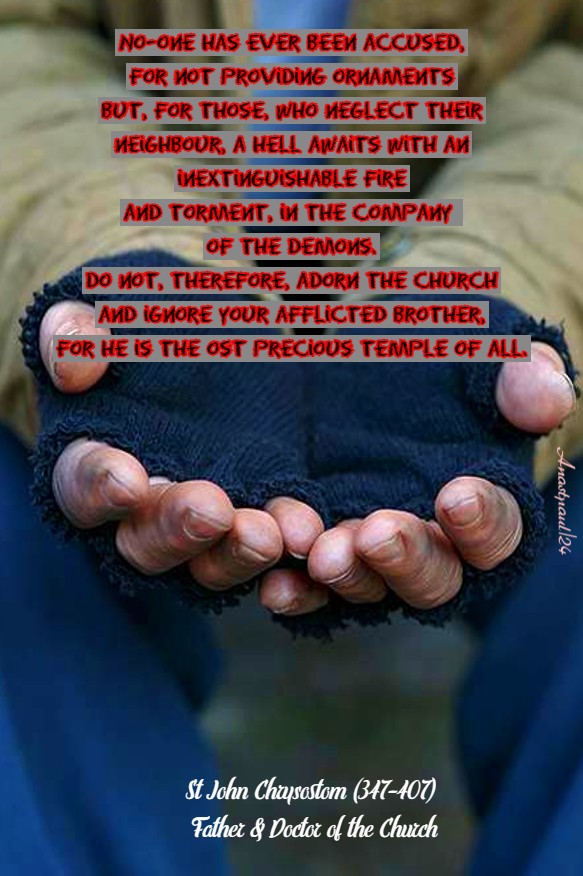
“No-one has ever been accused, for not providing ornaments but, for those, who neglect their neighbour, a hell awaits with an inextinguishable fire and torment, in the company of the demons. Do not, therefore, adorn the Church and ignore your afflicted brother, for he is the most precious temple of all.”
St John Chrysostom (347-407) Father & Doctor of the Church
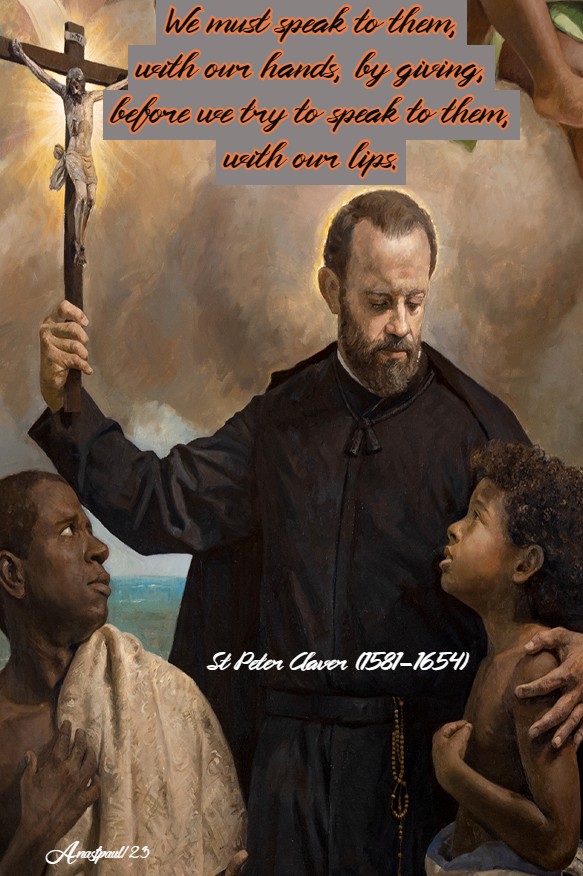
“We must speak to them with our hands before we speak to them with our lips.”
St Peter Claver (1580-1654)
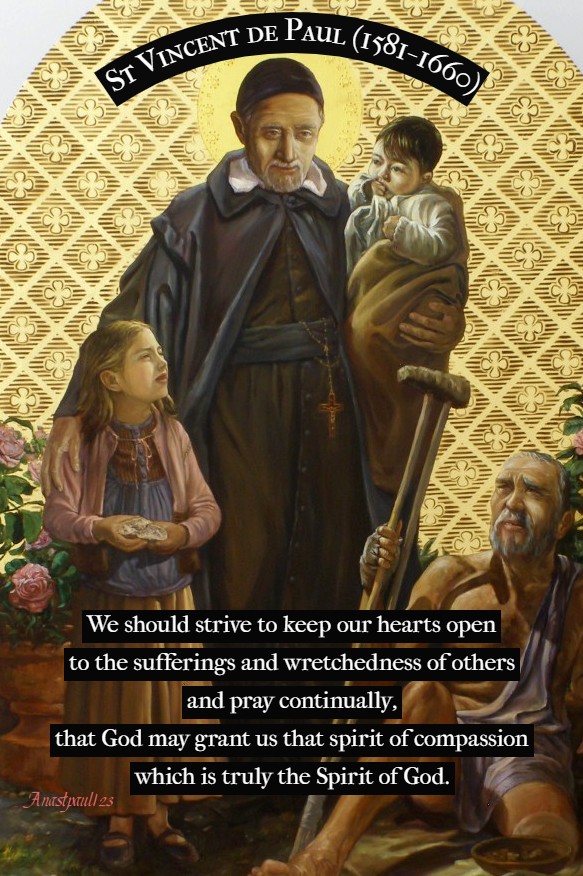
“We should strive to keep our hearts open to the sufferings and wretchedness of others and pray, continually, that God may grant us, that spirit of compassion which is truly the Spirit of God.”
St Vincent de Paul (1581-1660)
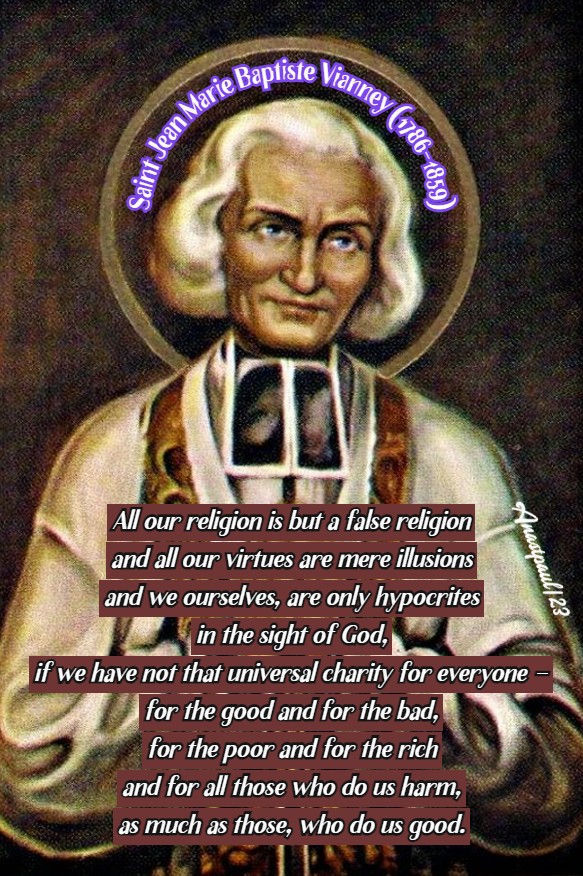
“All our religion is but a false religion and all our virtues are mere illusions and we ourselves are only hypocrites in the sight of God, if we have not that universal charity for everyone – for the good and for the bad, for the poor and for the rich and for all those who do us harm, as much as those who do us good.”
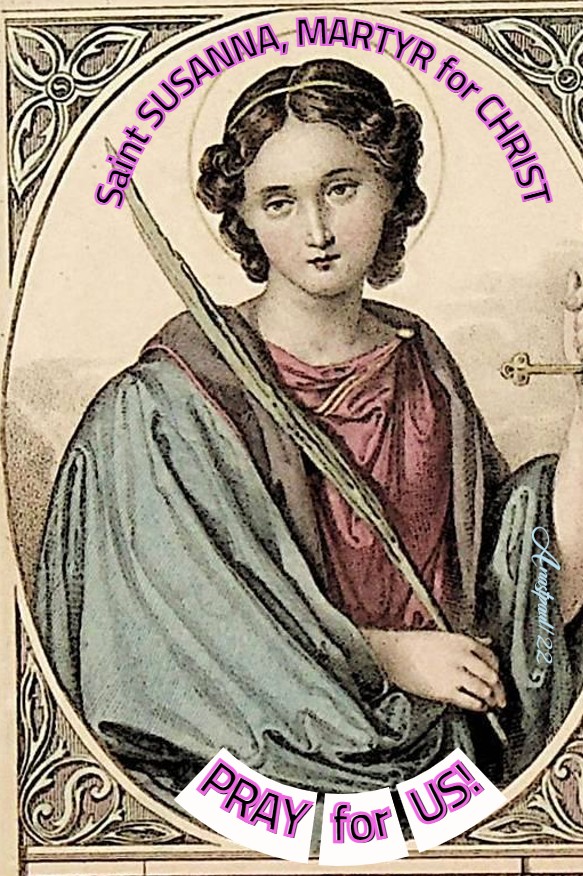
One Minute Reflection – 11 August – “The Month of the Immaculate Heart of Mary” – Pentecost XII – St Tiburtius (Died c286) Martyr, Layman, St Susanna of Rome (Died c 295) Virgin Martyr, St Philomena (Died 304) Virgin Martyr – 2 Corinthians 3:4-9; Luke 10:23-37– Scripture search here: https://www.drbo.org/
“But a certain Samaritan, … seeing him, was moved with compassion.” – Luke 10:33
REFLECTION – “O Lord Jesus, stirred by pity may Thou have the goodness to draw near me. Going down from Jerusalem to Jericho, Thou fall from the heights to our own lowest depths, from a state where people are full of life, to a land of the sick. Look, I have fallen into the hands of the angels of darkness, who have not only stripped off my garment of grace but, having beaten me with their blows, have left me half dead. May Thou treat the wounds of my sins, when Thou hast given me hope of recovering my health, lest they should triumph if I ever lose hope of healing. May Thou anoint me with the oil of Thine forgiveness and pour the wine of contrition, over me. If Thou set me on Thy Own mount, it is then that Thou “raise up the needy of the earth” that Thou “lift the poor from the ash-heap” (Ps 112:7).
For Thou art the One Who bore our sins, the One Who paid a debt for us, which Thy Thyself, did not contract. If Thou hast led me into the Inn of Thy Church, it is there that Thou would feed me with the food of Thine Body and Blood. If Thou were taking care of me, then I should no longer disobey Thy commands, I should no longer draw down on myself, the fury of raging beasts. For I have great need of Thy care, as long as I bear this flesh, subject to sin. Hear me then, I, who am the Samaritan stripped and wounded, weeping and groaning, calling Thee and crying with David: “Have mercy on me, God, according to Thine Merciful Love!” (Ps 50:3).” – St Gregory the Great (540-604) Pope, Father and Doctor of the Church (Exposition on the Seven Penitential Psalms),
PRAYER – May the constant protection of Thy holy Martyrs, Tiburtius and Susanna and Philomena support us, O Lord, for Thou never fails to look mercifully upon those whom Thou, hast given the help, of such intercession. Through Jesus Christ, Thy Son our Lord, Who lives and reigns with Thee, in the unity of the Holy Ghost, God, world without end. Amen (Collect).
Our Morning Offering – 11 August – “The Month of the Immaculate Heart of Mary” – Pentecost XII
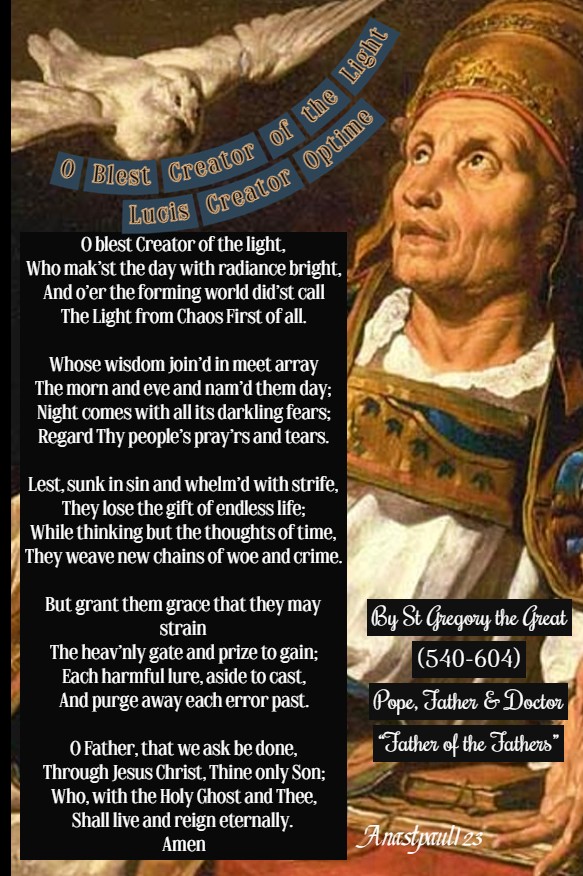
Lucis Creator Optime O Blest Creator of the Light By St Gregory the Great (540-604) Pope, Father & Doctor “Father of the Fathers”
O blest Creator of the light, Who mak’st the day with radiance bright, And o’er the forming world did’st call The Light from Chaos First of all.
Whose wisdom join’d in meet array The morn and eve and nam’d them day; Night comes with all its darkling fears; Regard Thy people’s pray’rs and tears.
Lest, sunk in sin and whelm’d with strife, They lose the gift of endless life; While thinking but the thoughts of time, They weave new chains of woe and crime.
But grant them grace that they may strain The heav’nly gate and prize to gain; Each harmful lure, aside to cast, And purge away each error past.
O Father, that we ask be done, Through Jesus Christ, Thine only Son; Who, with the Holy Ghost and Thee, Shall live and reign eternally. Amen
This hymn is used for Vespers (II) on Sundays throughout the year in the Extraordinary Form of the Roman Breviary. Trans John M Neale (1818-1866), 1851. Tune: “Lucis Creator Optime” Gregorian Chant, Mode VIII, traditional.
Saint of the Day – 11 August – St Equitius (Died c570) Abbot, Miracle-worker, a renowned Preacher and Evangeliser spreading the tenets and glory of monasticism, Founder of a Monastery. Equitius was born between 480 and 490 in the region of Valeria Suburbicaria (present-day L’Aquila-Rieti-Tivoli. Italy). He died at the Monastery of San Lorenzo di Pizzoli of natural causes. Also known as – Equizio.
The Roman Martyrology reads today: “In the Province of Valeria, St Equitius, Abbot, whose sanctity is attested to by the blessed Pope Gregory.”
St Gregory the Great refers to Equitius in his Dialogues and states that Equitius was a follower of St Benedict of Nursia.
Equitius worked to spread monasticism in Italy and the West but remained a Friar and through humility was never Ordained as a Priest.
Pope Gregory writes that Equitius’ reputation for sanctity was such that the Saint by his own example drew many disciples to embrace the religious life as Monks. According to ancient testimonies, the Monks of Equitius gave two Pontiffs to the Church and numerous Bishops and Cardinals.
Extraordinary events are related regarding Equitius, such as the liberation from temptations by the work of an Angel and the prophetic unmasking of a certain ‘Basil the Magician.’
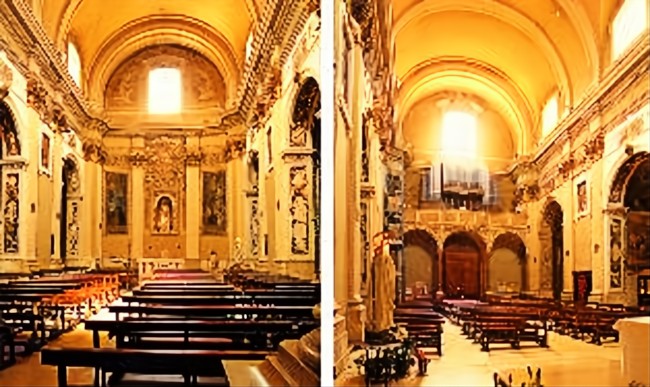
The Saint died in his Monastery of San Lorenzo di Pizzoli. After his death his unapproved order was absorbed by the Benedictines with which he had such affinity. His Feast is celebrated on 11 August and his remains rest in the Church of San Margherita all’Aquila, now of the Jesuits and known as San Margherita deL Gesu all’Aquila,
St Tiburtius (Died c286) Martyr, Layman, the son of Saint Chromatius the Prefect of Rome, also a Martyr. St Damasus (c305-384), the Pope, wrote about Tiburtius. He died by being beheaded in c286 in Rome, Italy and his remains are entombed in the Ad Duas Lauros Cemetery at the three mile marker on the Via Lavicana in Rome. The Roman Martyrology reads today: “At Rome, between the two laurels situate about three miles from the City, the birthday of St Tiburtius, Martyr, under the Judge Fabian, in the persecution of Diocletian. After he had walked barefoot on burning coals and confessed Christ with increased constancy. he was put to the sword.” His Life and Death: https://anastpaul.com/2023/08/11/saint-of-the-day-11-august-saint-tiburtius-died-c286-martyr/
St Cassian of Benevento St Chromatius the Prefect Martyr, the Father of St Tiburtius also celebrated today and also a Martyr St Digna of Todi St Equitius (Died c570) Abbot
Thought for the Day – 10 August – Meditations with Fr Richard Frederick Clarke SJ (1839-1900)
CHARITY Meditations for a Month
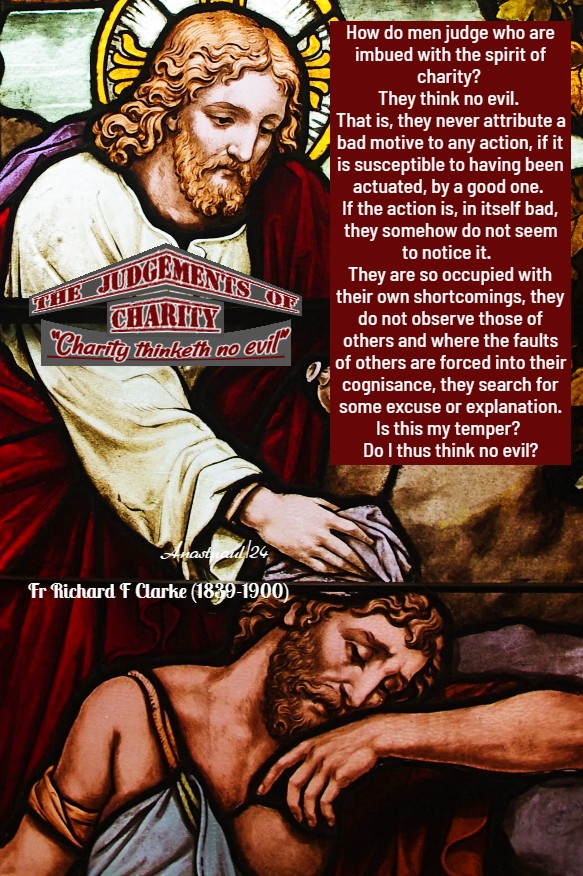
The Judgements of Charity “Charity thinketh no evil”
We are all surrounded by those, of whose actions, we are continual witnesses and, of whose character, from these actions, we cannot help forming an opinion. We see what they do and listen to what they say and we, not only receive, a certain impression from them but also, are tempted to judge them and to pronounce on their moral value. Moreover, we are too prone, to judge them unfavourably, rather than favourably, to ascribe to them inferior motives and, see faults in them, where there are none or, to exaggerate whatever defects maybe found in them. This unhappily, is my tendency. I cannot deny it!
Why is this? It is because I am so full of faults myself that I see many faults in others. It is the reflection of myself which I find so repulsive in them! I really attribute to them the very defects which, in some form or other, are to be found in me. It is because of my own want of charity that I judge them so harshly. How this ought to humble me and how careful it ought to make me, in my judgement of others.
How do men judge who are imbued with the spirit of charity? They think no evil. That is, they never attribute a bad motive to any action, if it is susceptible to having been actuated, by a good one. If the action is, in itself bad, they somehow do not seem to notice it. They are so occupied with their own shortcomings, they do not observe those of others and where the faults of others are forced into their cognisance, they search for some excuse or explanation. Is this my temper? Do I thus think no evil?
Quote/s of the Day – 10 August – St Lawrence (Died 258) Martyr, “Keeper of the Treasures of he Church” – 2 Corinthians 9:6-10; John 12:24-26 – Scripture search here: https://www.drbo.org/
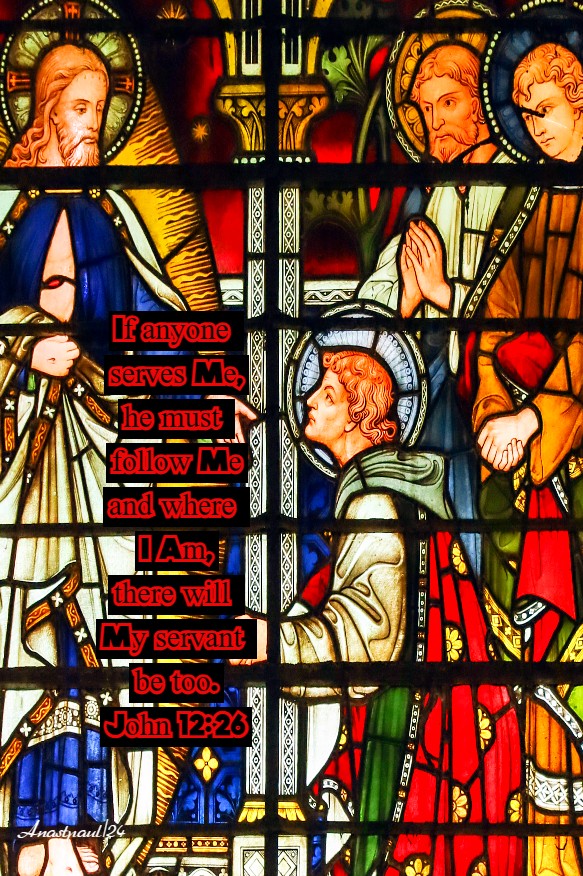
“If anyone serves Me, he must follow Me and where I Am, there will My servant be too.”
John 12:26
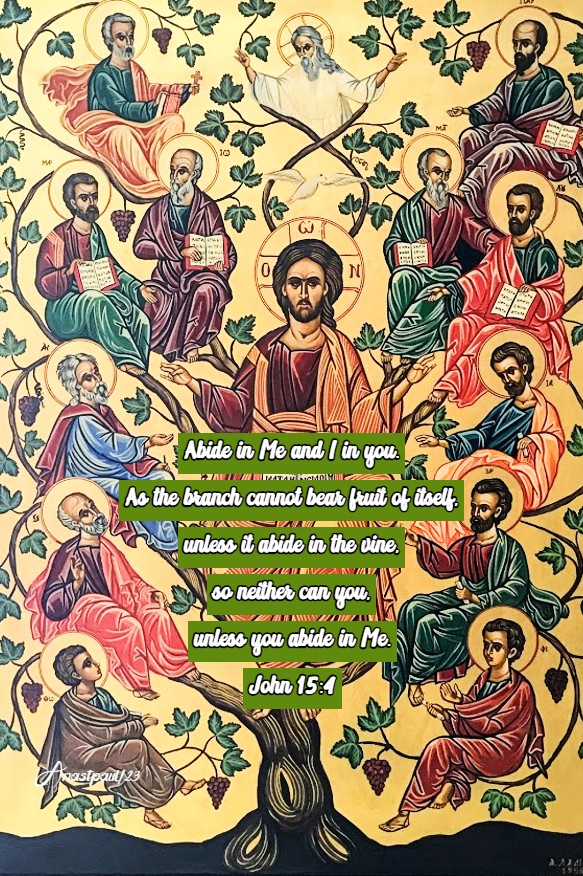
“Abide in Me and I in you. As the branch cannot bear fruit of itself, unless it abide in the vine, so neither can you, unless you abide in Me.”
John 15:4
“The present is nothing. But eternity abides for those on whom all Truth, all Good, has shone, in One Entire and Perfect Light. ”
St Paulinus of Nola (c 354-431)
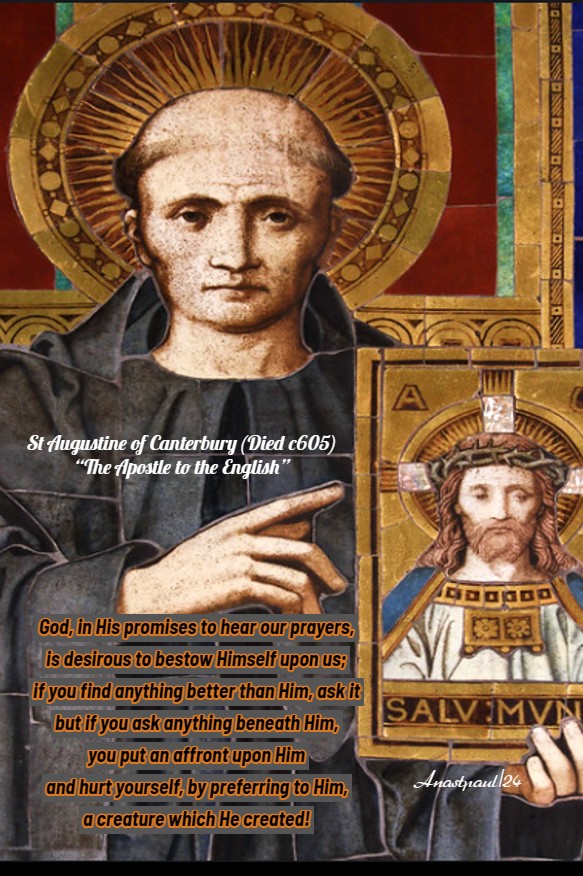
“God, in His promises to hear our prayers, is desirous to bestow Himself upon us; if you find anything better than Him, ask it but if you ask anything beneath Him, you put an affront upon Him and hurt yourself, by preferring to Him, a creature which He created!”
St Augustine of Canterbury (Died c605) “The Apostle to the English”
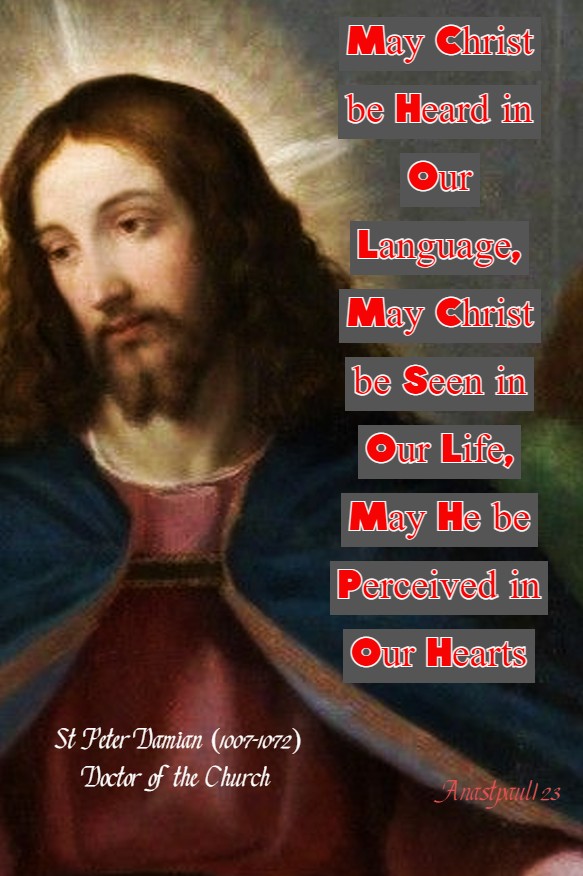
“May Christ be heard in our language, may Christ be seen in our life, may He be perceived in our hearts”
One Minute Reflection – 10 August – “The Month of the Immaculate Heart of Mary” – St Lawrence (Died 258) Martyr, “Keeper of the Treasures of he Church” – 2 Corinthians 9:6-10; John 12:24-26 – – – Scripture search here: https://www.drbo.org/
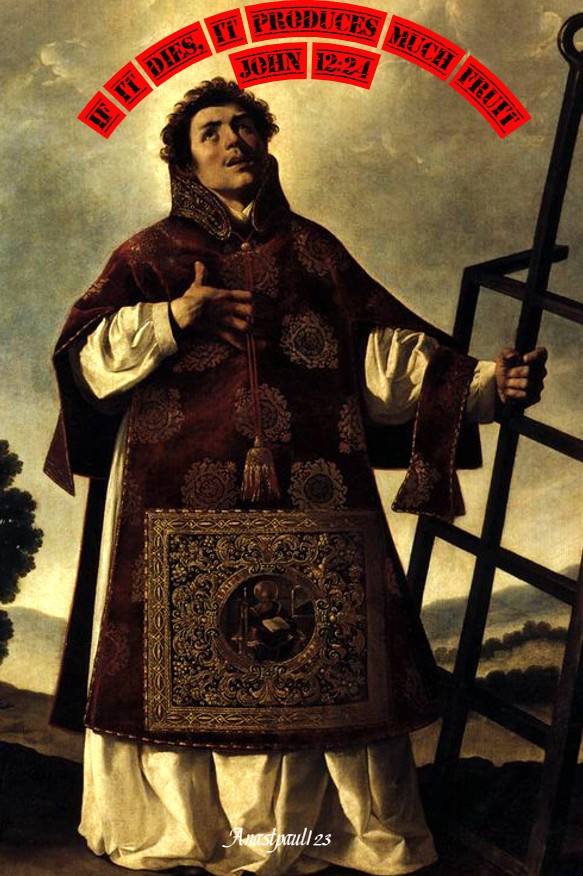
“If it dies, it produces much fruit” – John 12:24
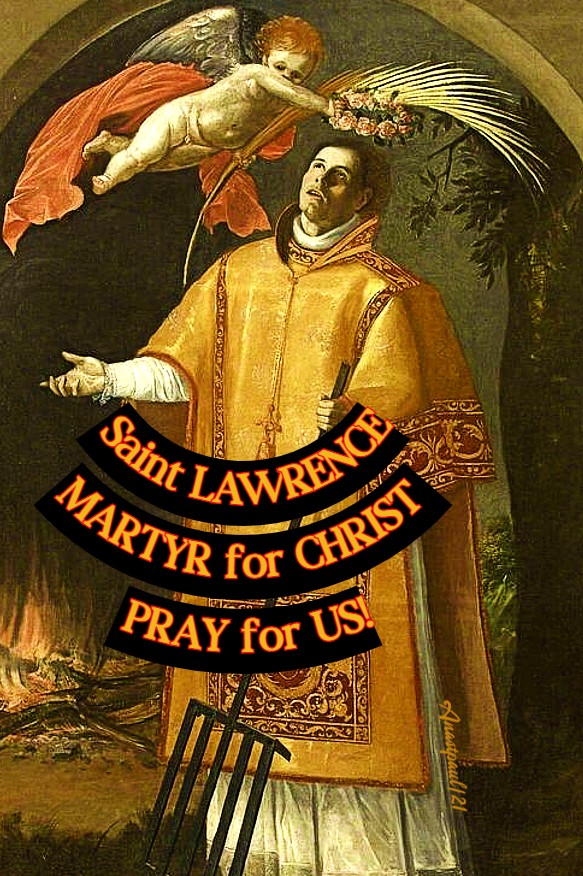
REFLECTION – “Saint Lawrence was a Deacon in Rome. The Church’s persecutors ordered him to hand over the treasures of the Church. It was to win a real treasure in Heaven that he underwent the torments which we cannot listen to, without horror, for he was stretched out on a gridiron over a fire … Nevertheless, he triumphed over all his bodily sufferings by means of the extraordinary strength he drew from his charity and, with the help of Him, Who made him resolute. “For we are His handiwork, created in Christ Jesus for the good works which God has prepared in advance that we should live in them” (Eph 2:10).
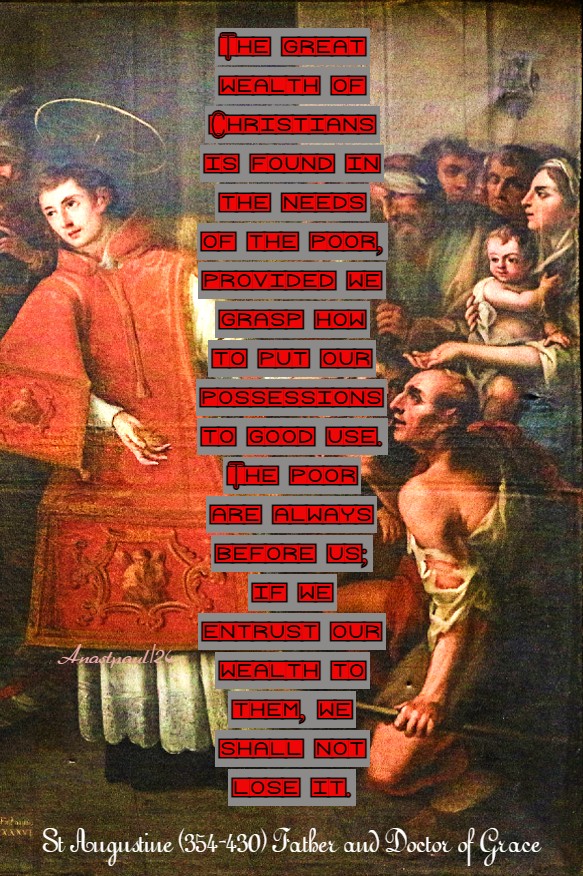
Now this is what stirred up his persecutors’ wrath … Lawrence said: “Order chariots to come along with me, on which I can bring you the treasures of the Church.” When he was given some chariots, he filled them with the poor and brought them back, saying: “These are the Church’s treasures.”
Nothing is truer, my brethren. The great wealth of Christians is found in the needs of the poor, provided we grasp how to put our possessions to good use. The poor are always before us; if we entrust our wealth to them, we shall not lose it.” – St Augustine (354-430) Father and Doctor of Grace (Sermon 302, for the Feast of Saint Lawrence).
PRAYER – Grant us, we beseech Thee, Almighty God, to extinguish the flames of our sins, as Thou granted St Lawrence to overcome the fires of his tortures. Through Jesus Christ, Thy Son our Lord, Who lives and reigns with Thee, in the unity of the Holy Ghost, God, world without end. Amen (Collect).
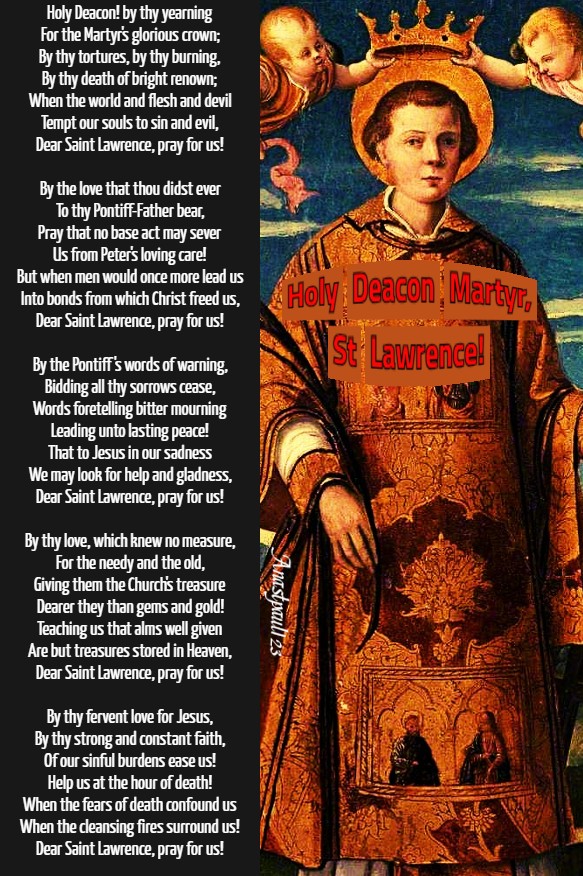
Our Morning Offering – 10 August – St Lawrence (Died 258) “Keeper of the Treasures of he Church,” Martyr, Archdeacon.
Holy Deacon Martyr, St Lawrence! Unknown Author
Holy Deacon! by thy yearning For the Martyr’s glorious crown; By thy tortures, by thy burning, By thy death of bright renown; When the world and flesh and devil Tempt our souls to sin and evil, Dear Saint Lawrence, pray for us!
By the love that thou didst ever To thy Pontiff-Father bear, Pray that no base act may sever Us from Peter’s loving care! But when men would once more lead us Into bonds from which Christ freed us, Dear Saint Lawrence, pray for us!
By the Pontiff’s words of warning, Bidding all thy sorrows cease, Words foretelling bitter mourning Leading unto lasting peace! That to Jesus in our sadness We may look for help and gladness, Dear Saint Lawrence, pray for us!
By thy love, which knew no measure, For the needy and the old, Giving them the Church’s treasure Dearer they than gems and gold! Teaching us that alms well given Are but treasures stored in Heaven, Dear Saint Lawrence, pray for us!
By thy fervent love for Jesus, By thy strong and constant faith, Of our sinful burdens ease us! Help us at the hour of death! When the fears of death confound us When the cleansing fires surround us! Dear Saint Lawrence, pray for us!
Saint of the Day – 10 August – Saint Asteria of Bergamo (Died c307) Virgin Martyr. Died by beheading. Asteria is the sister of St Grata of Bergamo, Martyr, who is celebrated on 4 September. The 2 sisters are Co-Patron Saints of Bergamo in Northern Italy. Also called – Hesteria.
The Roman Martyrology reads: “At Bergamo, St Asteria, Virgin and Martyr, in the persecutions of Diocletian and Maximian,”
Asteria and Grata, at the time of Diocletian and Maximian, buried Alexander of Rome. Grata was put to death; Asteria buried her and then she too was arrested, and tortured.
An ancient Epitaph describes her as having been beheaded as a Christian under Diocletian, when she had already reached her sixtieth year.
She was Martyred for refusing to worship the pagan god Jupiter and for constantly confessing Christ. She has been celebrated on 10 August, most especially in Bergamo for centuries.
St Deusdedit the Cobbler (6th Century)Confessor, Layman – Deusdedit was a poor layman shoemaker in 6th Century Rome, Italy. Patronages – shoemakers, of the poor. His name meaning, “dedicated to God.” The Roman Martyrology reads of him today: “At Rome, the holy Confessor Deusdedit, a working man, who gave to the poor, every Saturday, whatever he had earned during the week.” His Dedicated Life: https://anastpaul.com/2023/08/10/saint-of-the-day-10-august-st-deusdedit-the-cobbler-6th-century-confessor-layman/
St Gerontius St Paula of Carthage
Martyrs of Alexandria – 260+ Saints: A large number of Christians who were Martyred in Alexandria, Egypt between 260 and 267 in the persecutions of Decius and Valerian, whose names have not come down to us and who are commemorated together.
Martyrs of Rome – 165 Saints: Group of 165 Christians Martyred in the persecutions of Aurelian. 274 in Rome, Italy.
Thought for the Day – 9 August – Meditations with Fr Richard Frederick Clarke SJ (1839-1900)
CHARITY Meditations for a Month
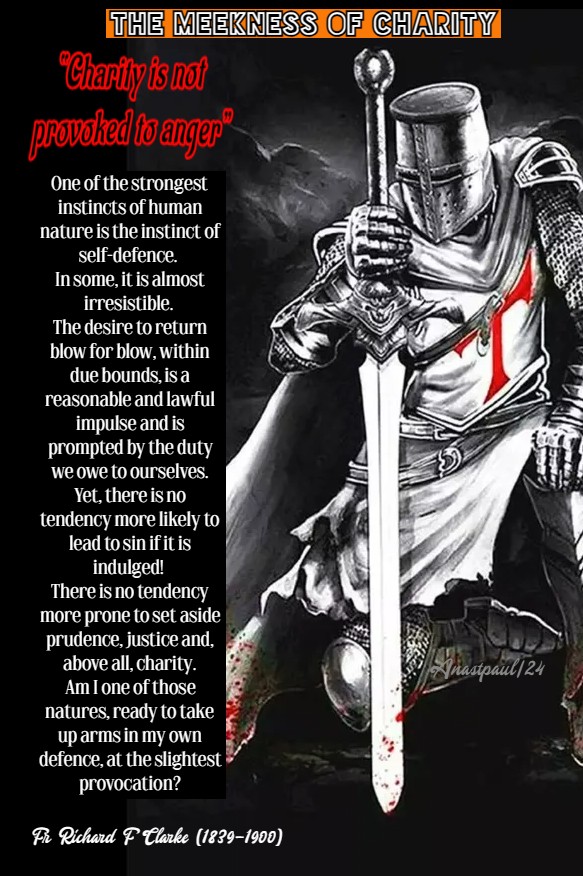
The Meekness of Charity “Charity is not provoked to anger”
One of the strongest instincts of human nature is the instinct of self-defence. In some, it is almost irresistible. The desire to return blow for blow, within due bounds, is a reasonable and lawful impulse and is prompted by the duty we owe to ourselves. Yet, there is no tendency more likely to lead to sin if it is indulged! There is no tendency more prone to set aside prudence, justice and, above all, charity. Am I one of those natures, ready to take up arms in my own defence, at the slightest provocation?
The instinct of self-defence is always prone to mislead us, due to our excessive self-love. We imagine we have been attacked, when in fact, nothing of the sort is the case. We see a slight or insult, when none was intended. We do not keep in mind how simple the true explanation may really be. We become angry, long for revenge and are carried beyond all bounds, by our wounded self-love. We say and do what we bitterly regret afterwards, alienating others from us and offending God by our angry words. How often, alas, I have done this!
How is this evil to be remedied? By charity and nothing else. If God were more prominent in our hearts, if we loved God more and ourselves less, if our ambition were to promote His honour and not our own, we should not indulge in these outbursts of intemperate or bitter words. Instead, we should not be easily provoked or become angry. We should take a gentle view of what has been done or we should accept the injury or unkindness done to us and offer it up for our sins in union with the supreme charity of Christ our Lord!
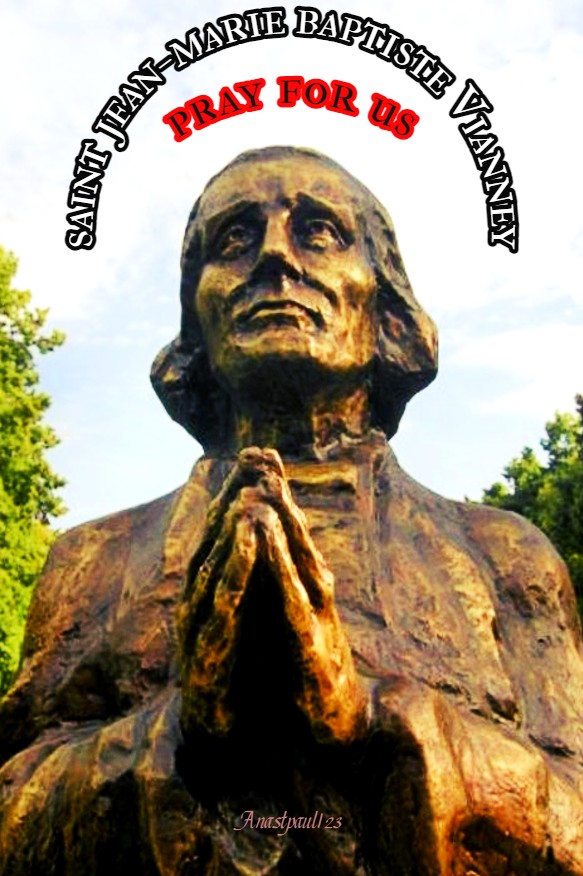
Quote/s of the Day – 9 August – St Jean-Marie-Baptiste Vianney (1786-1859) Confessor
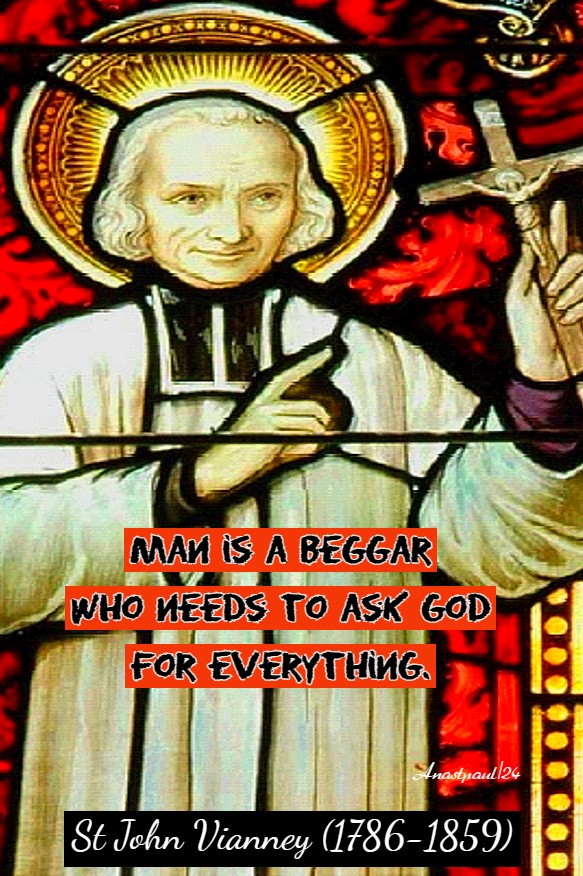
“Man is a beggar who needs to ask God for everything.”
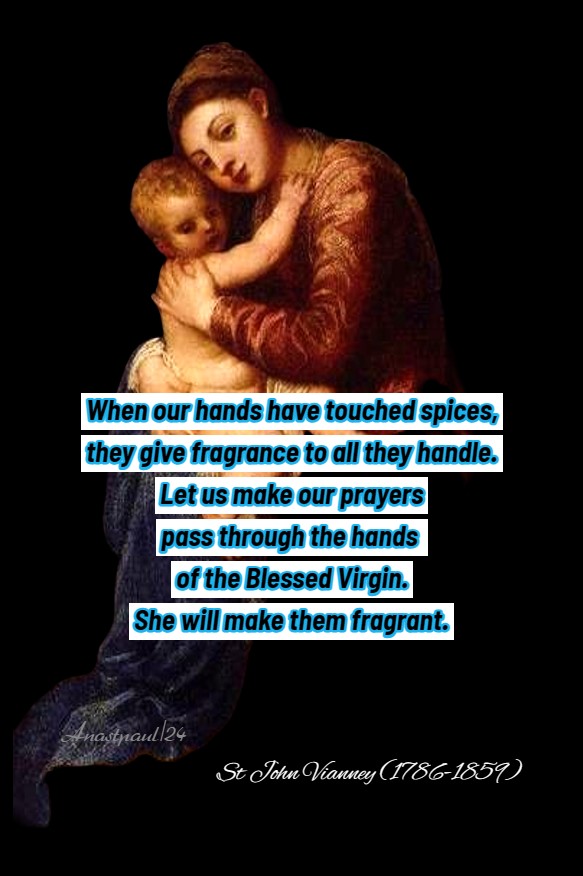
“When our hands have touched spices, they give fragrance to all they handle. Let us make our prayers pass through the hands of the Blessed Virgin. She will make them fragrant.”
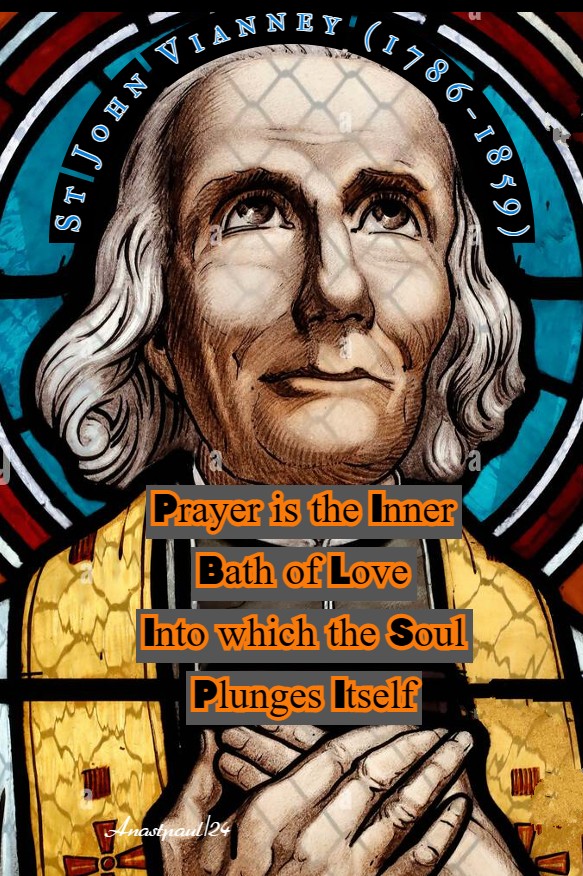
“Prayer is the inner bath of love into which the soul plunges itself.”
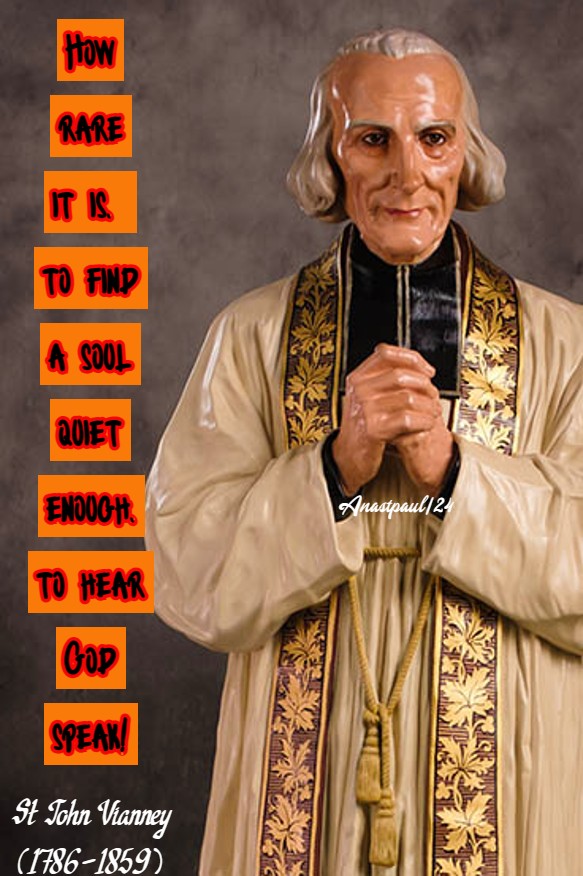
“How rare it is, to find a soul quiet enough, to hear God speak.”
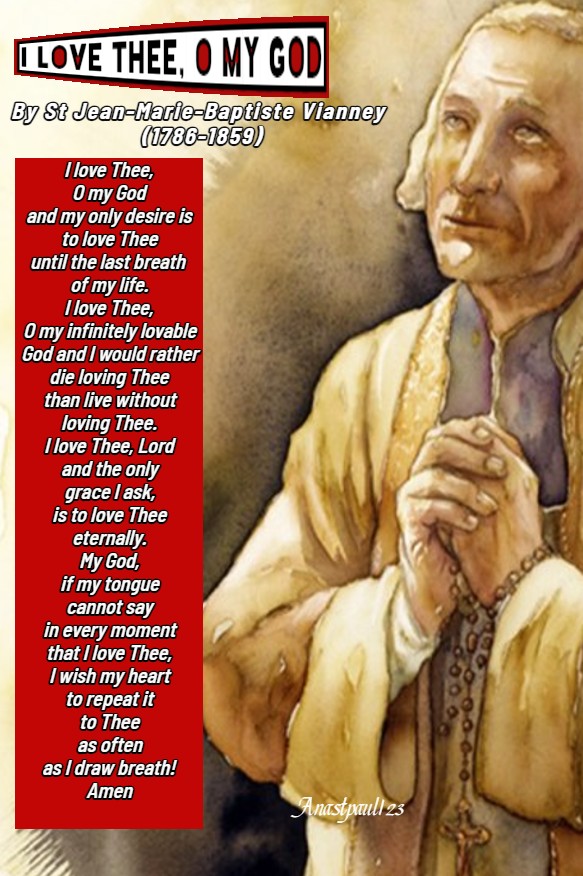
I Love Thee, O My God By St John Vianney (1786-1859)
I love Thee, O my God and my only desire is to love Thee until the last breath of my life. I love Thee, O my infinitely lovable God and I would rather die loving Thee than live without loving Thee. I love Thee, Lord and the only grace I ask, is to love Thee eternally. My God, if my tongue cannot say in every moment that I love Thee, I wish my heart to repeat it to Thee as often as I draw breath! Amen
One Minute Reflection – 9 August – “The Month of the Immaculate Heart of Mary” – St John Marie Vianney (1786-1859) Confessor – Sirach 31:8-11; Luke 12:35 – 40 – Scripture search here: https://www.drbo.org/
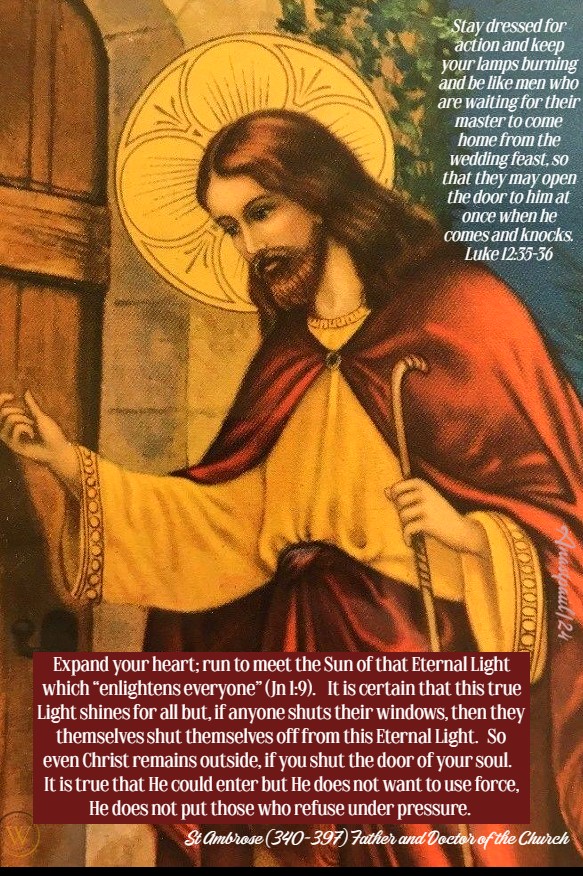
“Stay dressed for action and keep your lamps burning and be like men who are waiting for their master to come home from the wedding feast, so that they may open the door to him at once when he comes and knocks.” – Luke 12:35-36
REFLECTION – “God, the Word, stirs up the lazy and arouses the sleeper. For indeed, someone who comes knocking at the door is always wanting to come in. But it depends on us if He does not always enter or always remain. May your door be open to Him who comes; open your soul, enlarge your spiritual capacities that you may discover the riches of simplicity, the treasures of peace and sweetness of grace. Expand your heart; run to meet the Sun of that Eternal Light which “enlightens everyone” (Jn 1:9). It is certain that this true Light shines for all but, if anyone shuts their windows, then they themselves shut themselves off from this Eternal Light.
So even Christ remains outside, if you shut the door of your soul. It is true that He could enter but He does not want to use force, He does not put those who refuse under pressure. Descended from the Virgin, born from her womb, He shines throughout the universe to give Light to all. Those who long to receive the Light which shines with an everlasting brightness, open to Him. No night comes to intervene. Indeed, the sun we see each day gives way to night’s darkness but the Sun of Justice (Mal 3:20) knows no setting for Wisdom is not overcome by evil.” – St Ambrose (340-397) Bishop of Milan and Father and Doctor of the Church – 12th Sermon on Psalm 118
PRAYER – Almighty and merciful God, Who made St John-Marie glorious by priestly zeal and untiring fervoru in prayer and penance, grantP we beseech Thee that by his example and intercession, we may have strength to win for Christ, the souls of our brethren and, with them, attain everlasting glory.Through the same Jesus Christ, Thy Son our Lord, Who lives and reigns with Thee, in the unity of the Holy Ghost, God, world without end. Amen (Collect).
Our Morning Offering – 9 August – “The Month of the Immaculate Heart of Mary” – St Jean-Marie-Baptiste Vianney (1786-1859) Confessor
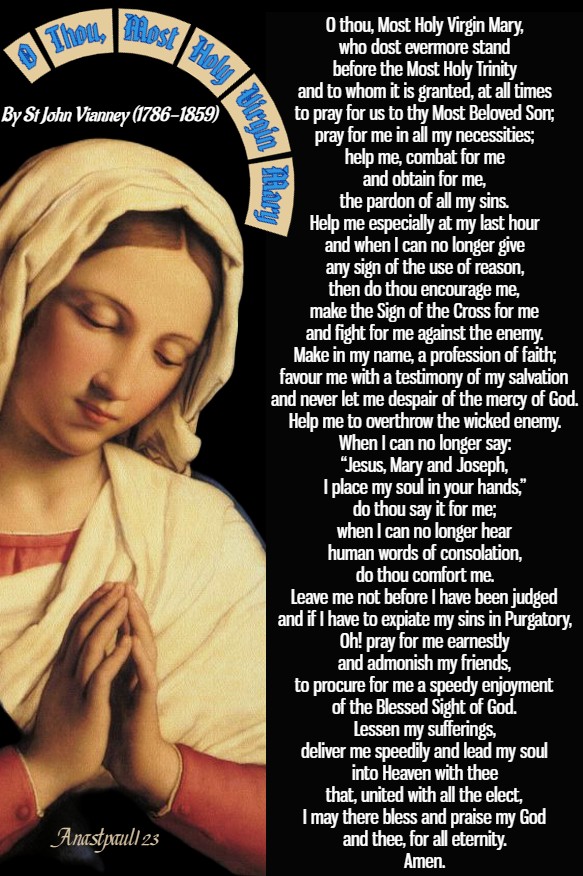
O Thou, Most Holy Virgin Mary (Pray for Me in All My Necessities) By St John Vianney (1786-1859)
O thou, Most Holy Virgin Mary, who dost evermore stand before the Most Holy Trinity and to whom it is granted, at all times to pray for us to thy Most Beloved Son; pray for me in all my necessities; help me, combat for me and obtain for me, the pardon of all my sins. Help me especially at my last hour and when I can no longer give any sign of the use of reason, then do thou encourage me, make the Sign of the Cross for me and fight for me against the enemy. Make in my name, a profession of faith; favour me with a testimony of my salvation and never let me despair of the mercy of God. Help me to overthrow the wicked enemy. When I can no longer say: “Jesus, Mary and Joseph, I place my soul in your hands,” do thou say it for me; when I can no longer hear human words of consolation, do thou comfort me. Leave me not before I have been judged and if I have to expiate my sins in Purgatory, Oh! pray for me earnestly and admonish my friends, to procure for me a speedy enjoyment of the Blessed Sight of God. Lessen my sufferings, deliver me speedily and lead my soul into Heaven with thee that, united with all the elect, I may there bless and praise my God and thee, for all eternity. Amen.
Saint of the Day – 9 August – Saint Falco of Palermo (Died mid 11th Century) Hermit, Monk, Miracle-worker. Born in the Calabria region of Italy and died ion 13 January of natural causes at Palermo, Italy. Also known as – Falcon, Falco the Hermit. Additional Memorias – 13 January in commemoration of his death and on the Sunday following 15 August 15 in memory of the translation of his Relics from the Church of St Egidius. St Falco was Canonised in 1893 by Pope Leo XIII.
Falco, born in Taverna in Calabria towards the middle of the tenth century, of the ancient and noble Poerio family, was, from a very young age, attracted by solitude andan eremetic life.
He soon decided to retire to the Monastery of Pesica near his hometown, among the Basilians, under the discipline of a holy Abbot named Ilarione. The community was already known throughout Calabria for the virtues and sanctity of all the brothers who formed it.
In 980 Calabria became the scene of ruin as a prey of the Saracens. From the Monastery of Taverna, the “seven brothers” (a long story of Falco’s friends who all entered religious life and were all Canonised with him) decided to leave for Abruzzo. Here they built some cells and a small Church, the ruins of which were visible until the end of the 19th Century. Here, they settled, living in poverty and sanctity, imposing rigid rules on themselves as true imitators of the ancient Monks of Egypt.
Under the guidance of their holy Abbot Hilarion, they led an austere life of fasting, eating mostly herbs, except on Sundays. Their conversation consisted of the practice of prayer and the recitation of praise. When the holy Abbot died, they elected as Superior, the youngest, Nicolò Greco, younger in age but not in merit. The new Abbot, to give thanks to God, asked his brothers to make a pilgrimage to Rome. During the journey, with their prayers, “the seven brothers” managed to free seven possessed people from evil spirits they had met near Lake Fucino. Once they set off again, one of them, weighed down by poor health, left his companions and, near Ortucchio, found shelter in the Church of the Santissima Vergine, in St Maria in Capo d’acqua.
The other companions, having completed the pilgrimage, returned to Prata to their monastic life. Nicolò was the Abbot for several years but at his death, the other brothers, unable to elect a successor, considered themselves free to follow their own path. Falco decided to return to Rome and set out but that same evening, having reached Palena, attempting to climb the mountain of Coccia, he felt his strength failing and was forced to rest in the nearby Church of St Egidius. At the unexpected arrival of this holy Friar, the district infested by evil spirits, was immediately purified and his presence was a reason for hope for the inhabitants of the place who immediately acclaimed him and showed him respect. He thus decided to remain in those mountains, continuing his life of rigours and prayers.
Out of extreme humility he never wished to embrace the Priesthood but to remain a very humble Friar, an example of virtue.
It was the morning of 13 January presumably of a year around the middle of the 11th Century, suddenly the small bell of the hermitage where Falco lived in retreat, was heard ringing. Many people rushed there, thinking that the Friar needed help and found him lifeless lying on a table with two lit candles. His body was transported to the Church of St Egidius Abate, where, after the funeral, he was buried.
A possessed man was passing by those parts when everyone with amazement, saw him break the ropes and run towards the Tomb of the Saint, where as soon as he arrived, he was freed from the devil. From that moment the fame of St Falco became even greater and confirmed by several other miracles, so much so that at the request of the people, the remains were exposed to public veneration.
If the archives of Sulmona and Palena had not been destroyed in a fire, we would today have countless descriptions of graces and miracles reported in the acts of his Canonisation.
In 1383, due to continuous raids and robberies, fearing for their fate, the Bishop of Sulmona decided to transfer the Relics and the Statue of St Falco to the Church of St Anthony Abbot in the centre of Palena. Since then, the Church and the Relics of St Falco became a destination for pilgrims, believers, devotees, the sick and the obsessed, even from far away.
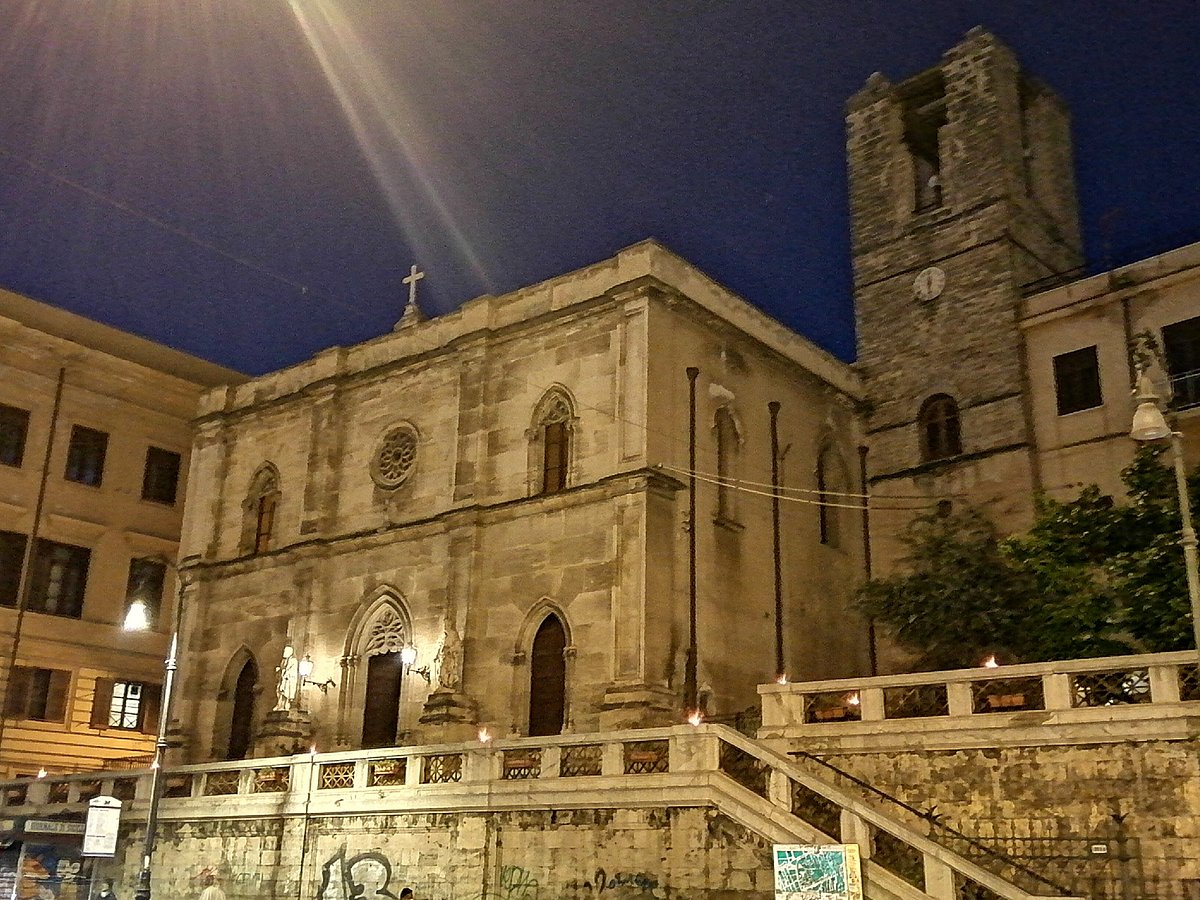
The Church of St Anthony Abbot in Palermo
In the earthquake of 1706, the Church was not exempt from disaster but was soon rebuilt with the help and devotion of the faithful. In 1841, fue to the growing devotion and the countless pilgrimages, it was decided to demolish the old Church to build a much larger and more spacious one and in 1842, thanks to the great devotion, a half-length silver Statue of the Saint was erected by the famous Domenico Capozzi.
The Shrine with his Relics, the Dalmatic tunic in the Greek style and the silver Statue containing his skull, are exposed twice a year for the devotion of the faithful, on 13 January in commemoration of his death and on the Sunday following 15 August 15 in memory of the translation of his Relics from the Church of St Egidius. St Falco was Canonised in 1893 by Pope Leo XIII.
Interior of the Church where St Falco is enshrined
St Nathy St Numidicus of Carthage St Phelim St Rusticus of Sirmium St Rusticus of Verona St Secundian of Civitavecchia St Stephen of Burgos St Verian of Civitavecchia
Martyrs of Civitavecchia: Three Christians Martyred together in the persecutions of Decius. We know little more than the names – Marcellian, Secundian and Verian. 250 near Civitavecchia, Italy.
Martyrs of Constantinople: 10 Saints: A group of ten Christians who were arrested, tortured and executed for defending an icon of Christ in defiance of orders from Emperor Leo the Isaurian. We know the names of three, but nothing else about them – Julian, Marcian and Mary. They were beheaded in Constantinople.
Thought for the Day – 8 August – Meditations with Fr Richard Frederick Clarke SJ (1839-1900)
CHARITY Meditations for a Month
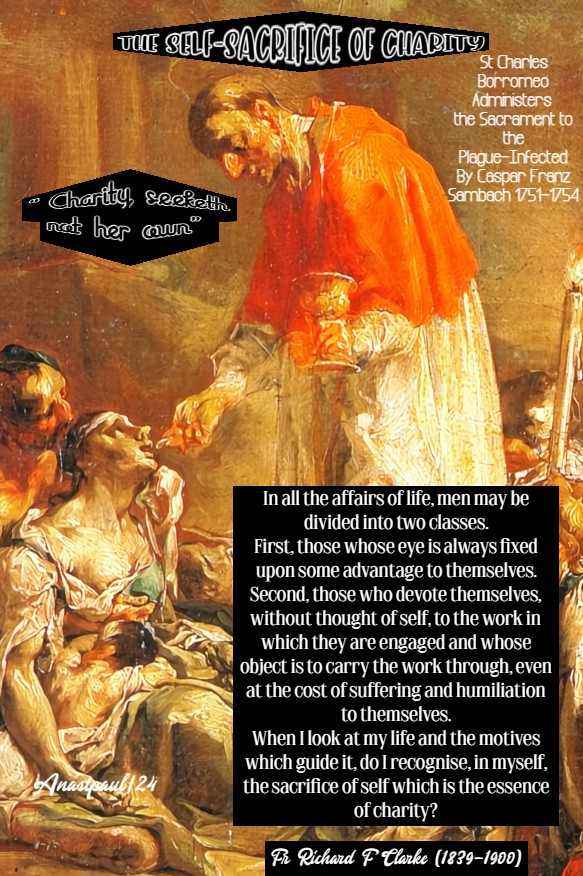
The Self-Sacrifice of Charity “Charity seeketh not her own”
In all the affairs of life, men may be divided into two classes. First, those whose eye is always fixed upon some advantage to themselves. Second, those who devote themselves, without thought of self, to the work in which they are engaged and whose object is to carry the work through, even at the cost of suffering and humiliation to themselves. When I look at my life and the motives which guide it, do I recognise, in myself, the sacrifice of self which is the essence of charity?
What reveals this spirit in my life? Not zeal, for there is a zeal which is nothing but a disguised form of self-seeking. Not activity, for an active nature rejoices in being employed. Not a strong interest in the work – perhaps the pious work in which I am engaged. All these maybe mere counterfeits. The real test is the willingness that the work should prosper independently of myself; a preference for its success, rather than my success, even though, I myself am thrust out of it; a readiness to disappear if by this, I am able do anything to help the good cause. Am I willing and true enough, to stand this first test?
Yet this is not enough. I must not be satisfied with a general willingness to obliterate myself, especially where this is, perhaps impossible. If my motives are pure, I must also be ready to be taken down, humbled, misjudged, or disparaged. I must be prepared to accept all the blame of failures and, to see others reap the praise of success and further, I must know this is done to me through God’s grace! Rather, I must rejoice in this as a good sign. Can I stand this second test?
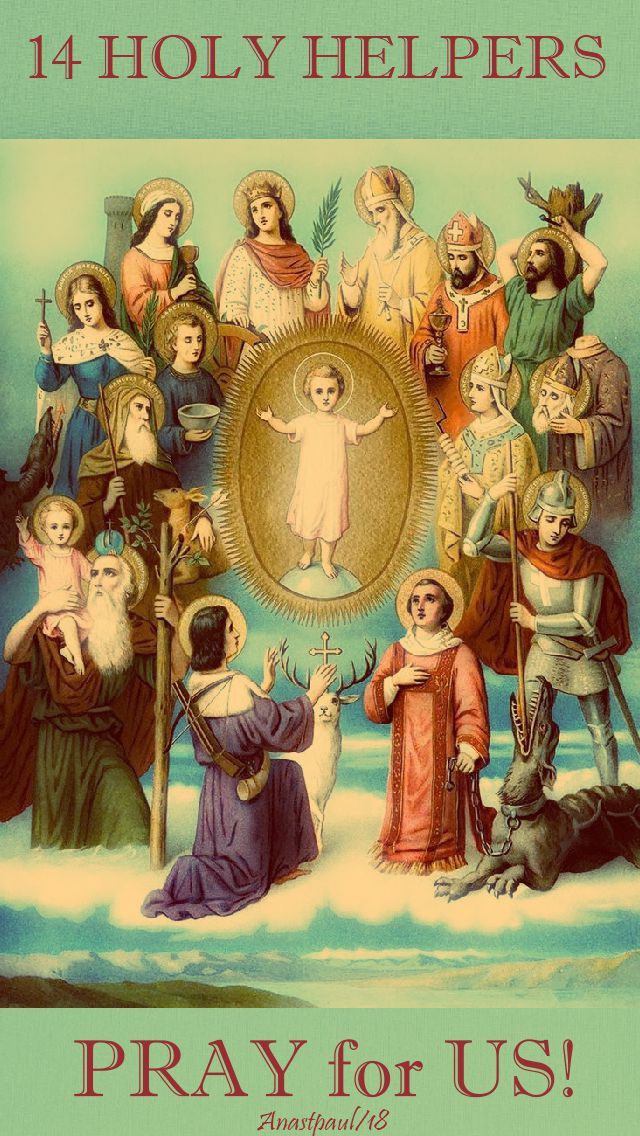
Quote/s of the Day – 8 August – The Fourteen Holy Helpers – 1 Thessalonians 2:13-16, Mark 16:15-18 – Scripture search here: https://www.drbo.org/
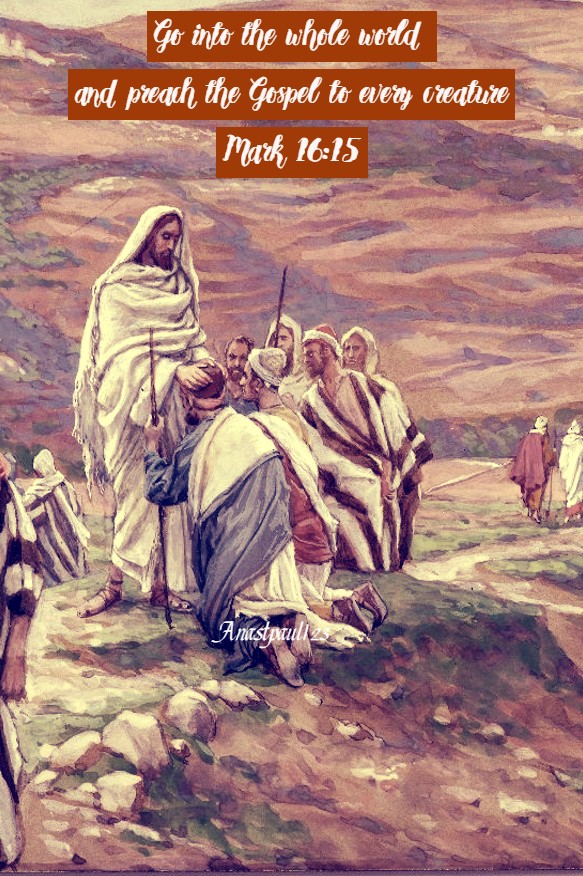
“Go into the whole world and preach the Gospel to every creature.”
Mark 16:15
“I have lit the light of your torch but it is up to you to see it is kept burning, not just to your personal advantage but also, in the interest of all who will see it and who, through it, will be led to the Truth. The worst wickedness would not put a shadow over your light, if you live with the vigilance of those who are called to bring the whole world to good. So, let your life correspond to the holiness of your mission, so that God’s grace may be proclaimed everywhere.”
St John Chrysostom (347-407) Father and Doctor of the Church
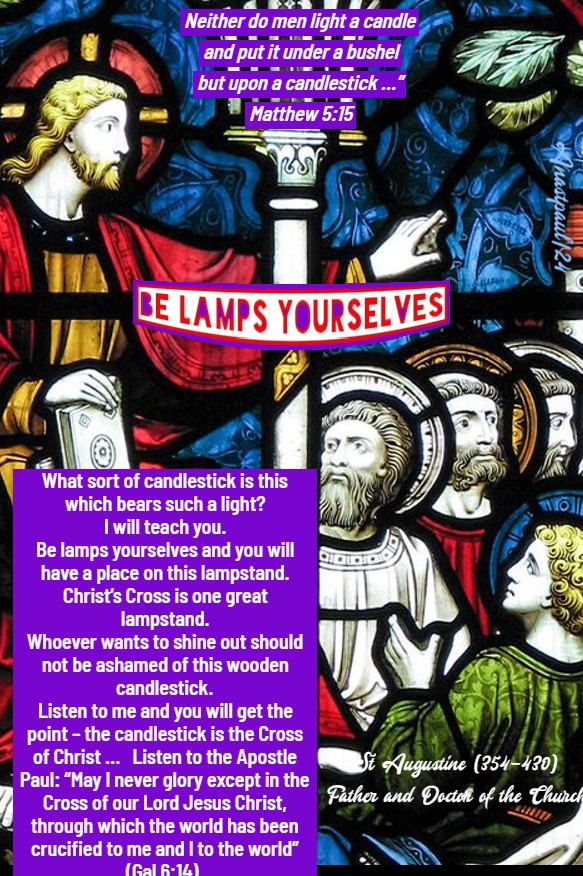
“What sort of candlestick is this which bears such a light? I will teach you. Be lamps yourselves and you will have a place on this lampstand. Christ’s Cross is one great lampstand. Whoever wants to shine out should not be ashamed of this wooden candlestick. Listen to me and you will get the point – the candlestick is the Cross of Christ … Listen to the Apostle Paul: “May I never glory except in the Cross of our Lord Jesus Christ, through which the world has been crucified to me and I to the world” (Gal 6:14).”
St Augustine (354-430) Father and Doctor of the Church
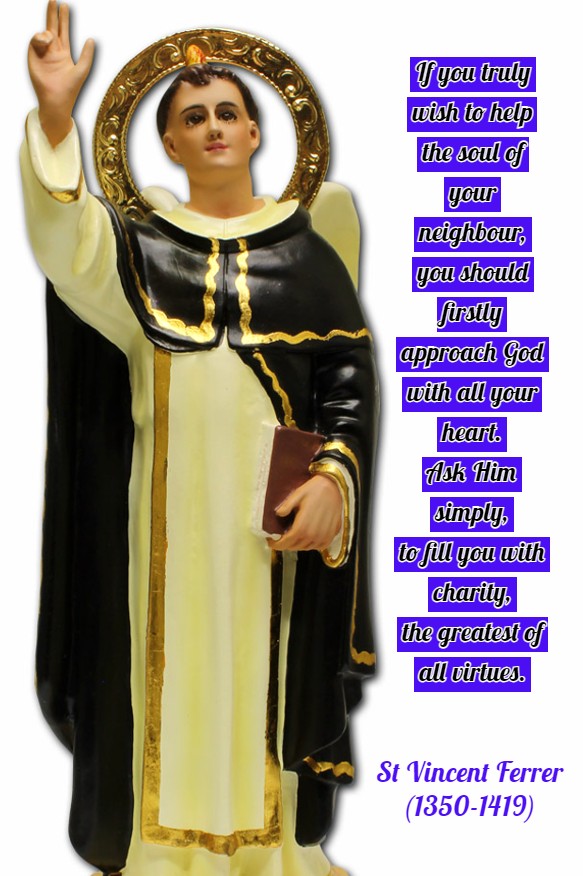
“If you truly wish to help the soul of your neighbour, you should firstly approach God with all your heart. Ask Him simply, to fill you with charity, the greatest of all virtues.”
One Minute Reflection – 8 August – “The Month of the Immaculate Heart of Mary” – The Fourteen Holy Helpers – 1 Thessalonians 2:13-16, Mark 16:15-18 – Scripture search here: https://www.drbo.org/
“He who believes and is baptised, shall be saved ...” – Mark 16:16
REFLECTION – “When He says, “All that the Father gives Me shall come to Me,” He touches on their unbelief, showing, that whoever does not believe in Him transgresses the Will of the Father. He covertly shows, that unbelievers are not only at variance with Him but also, with the Father. For if this is [the Son’s] Will and if this is the reason He came, that is, that He might save the entire world, then those who do not believe transgress His Will.
When, therefore, He says, the Father guides someone, there is nothing that hinders that person from coming to [Jesus]. And Paul says, that [the Son] delivers them up to the Father. Now, just as the Father, when He gives, does not take from Himself, so neither does the Son take from Himself when He gives up. The Son is said to give up to the Father because we are brought to the Father by Him. And at the same time, we read that it was the Father “by whom you were called to the fellowship of His Son,” that is, by the Will of the Father.
Faith in Me, He intimates here, is no ordinary thing or one which comes from human reason but [it] needs a revelation from above. And this He establishes throughout His discourses, showing, that this faith requires a noble sort of soul and one drawn on by God. The expression “that the Father gives Me” shows, that it is no accident whether a person believes or not. It shows, that belief is not the work of human reasoning but requires a revelation from on high and a mind devout enough to receive the revelation. “Whoever then,” our Lord says, “comes to Me, shall be saved,” meaning they shall be greatly cared for. For to save such as these, I took up flesh and the form of a servant.” – St John Chrysostom (347-407) Archbishop of Constantinople, Father and Doctor of the Church (Homilies on the Gospel of John 45)
PRAYER – PRAYER – O God, Who gladden us with the annual festival of Thy 14 holy Saints, mercifully grant, that we, who celebrate the anniversary of their death, may also strive to equal the courage of their Martyrdom. Through Jesus Christ, Thy Son our Lord, Who lives and reigns with Thee, in the unity of the Holy Ghost, God, world without end. Amen (Collect).
Our Morning Offering – 8 August – “The Month of the Immaculate Heart of Mary” – The Feast of the 14 Holy Helpers
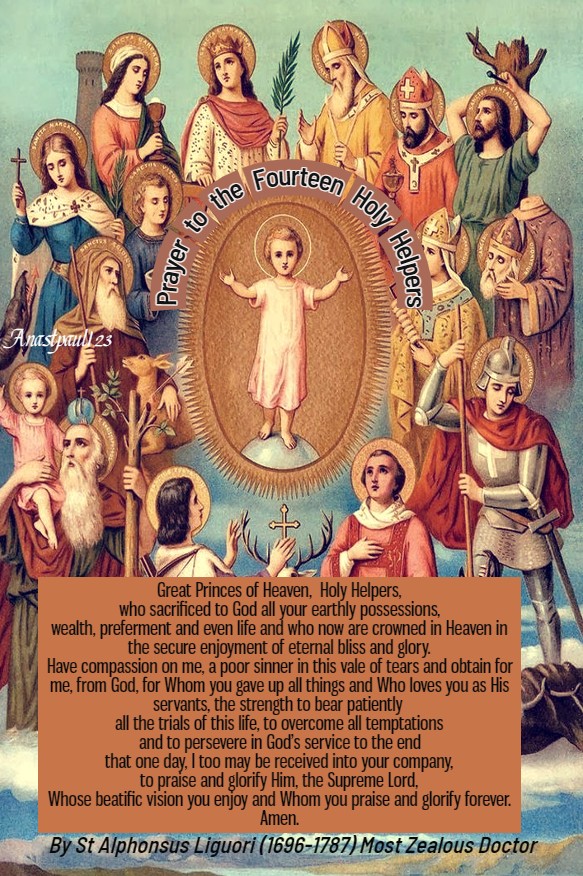
Prayer to the Fourteen Holy Helpers By St Alphonsus Liguori (1696-1787) Doctor of the Church
Great princes of Heaven, Holy Helpers, who sacrificed to God all your earthly possessions, wealth, preferment and even life and who now are crowned in Heaven in the secure enjoyment of eternal bliss and glory; have compassion on me, a poor sinner in this vale of tears and obtain for me from God, for Whom you gave up all things and Who loves you as His servants, the strength to bear patiently all the trials of this life, to overcome all temptations and to persevere in God’s service to the end, that one day I too may be received into your company, to praise and glorify Him, the supreme Lord, Whose Beatific Vision you enjoy and Whom you praise and glorify forever. Amen
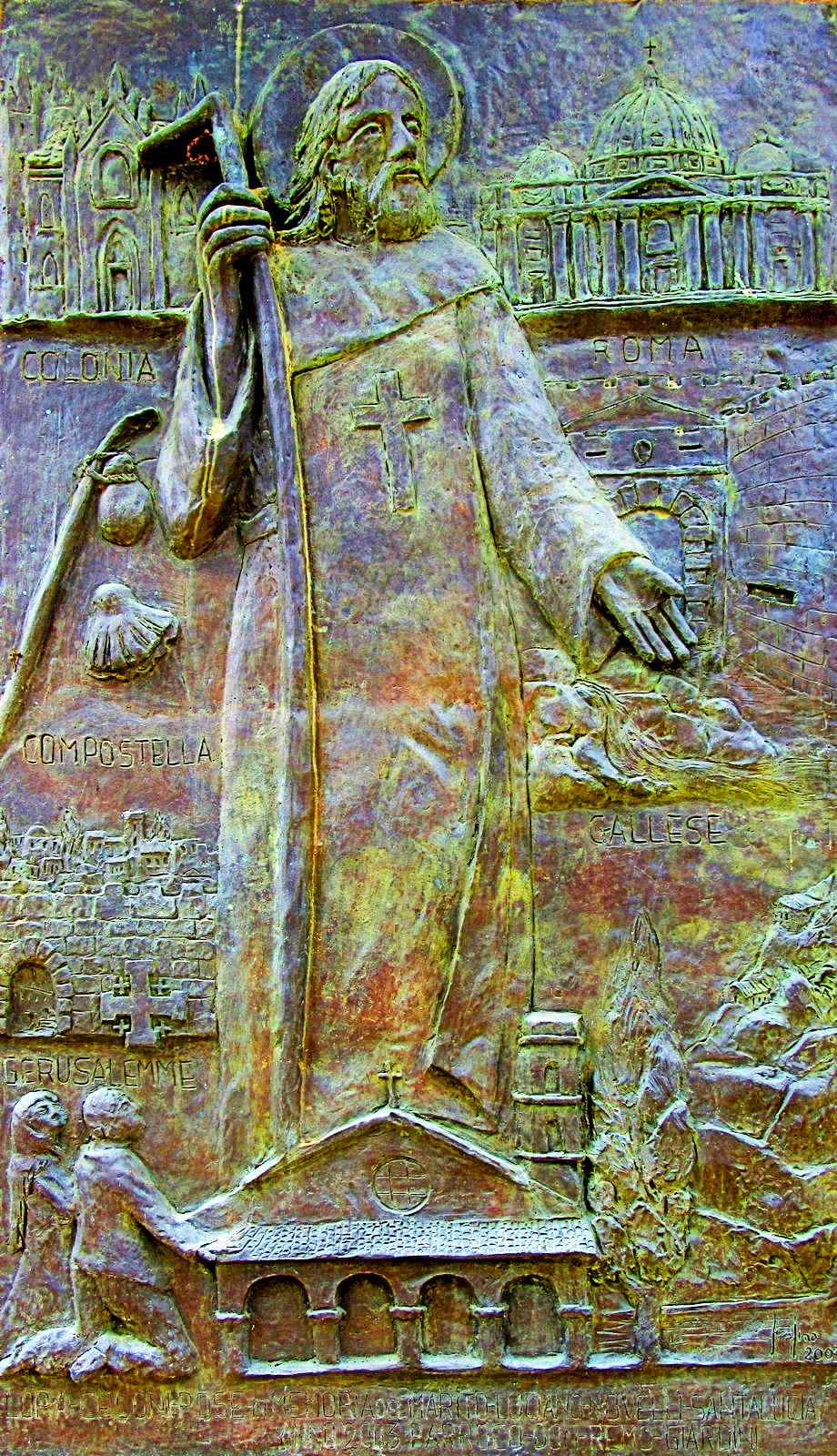
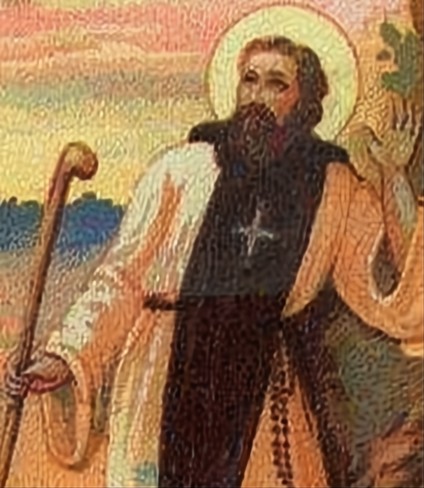
Saint of the Day – 8 August – Saint Famianus O.Cist. (1090-1150) Cistercian Monk, Hermit, Pilgrim, Miracle-worker. Born in 1090 in Cologne, Germany as Gerhard Quardus and died on 8 Augustn 1150, aged 59 or 60, in Gallese, Umbria, Italy of natural causes. St Famianus bears the great honour of being the first Cistercian to be Canonised which took place in 1154 by Pope Adrian IV. Patronage – of Gallese, Italy. Also known as – Gerhard, Wardo, Famian, Famiano, Famianus of Compostela, Famianus of Gallese. The name Famianud comes from Latin and means “who has acquired fame.”In Germany he is known as St Wardo Famianus.
Bronze Relief (2003) at the Basilica of St Famianus in Gallese
Gerhard (called Ward – the name Wardo is derived from ‘the fourth’ probably being the fourth child) Quadrus, son of a prominent family, gave away his inheritance and in 1108 travelled as a pilgrim to the seven pilgrimage Churches in Rome , where he stayed for six years.
In 1114 he made a pilgrimage to Santiago de Compostela and then lived in a Monastery dedicated to the Sts Cosmas and Damian near Tui in Galicia. When the Cistercian Abbey of Osera was built nearby, he joined the Order. But after some time he went on a second pilgrimage to the Holy Land and on his return, via Italy, he visted the Town of Gallese, where he later died.
He is highly venerated in Gallese. This Town in the Viterbo area was the birthplace of 2 Popes Marinus I (Pope from 882 until his death in 884) and Romanus I (Pope from August to November 89).. The prestige which the Town acquired thanks to its religiosity called several pilgrims to Gallese, including out Saint Famianud. This Monk, known as “di Gallese – of Gallese” died in the Town in question on 8 August 1150.
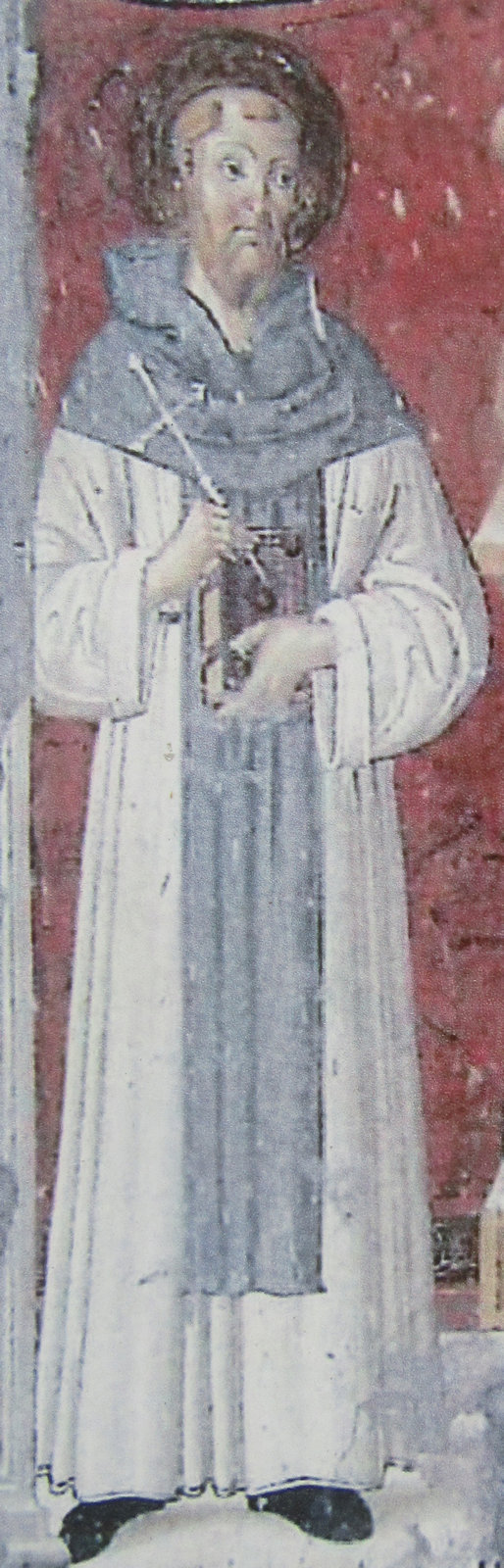
Fresco, 1516, in the Basilica of San Famiano in Gallese (School of Antonio del Massaro)
Famianus ws Canonised by Pope Adrian IV with the name of St Famianus in 1154 and his remains were placed in a cave, where in 1155, the Basilica which bears his name, was erected. Many miracles occurred at Wardo’s grave in Gallese which is why he was given the name Famianus. In 1244, a Basilica dedicated to him was built over his grave which included a pilgrims’ hostel and a small Monastery. Wardo’s body is still incorrupt to this day.
In the place of worship, the Incorrupt Body of St Famianus, the Patron Saint of Gallese, is preserved, guarded in a precious Sarcophagus placed in the crypt. The Church, located outside the urban perimeter, incorporates the cave, transformed into a crypt, where the Saint wanted to be buried. About three kilometers from the historic centre of Gallese, in the countryside, is another Church dedicated to St Famianus, the Chapel of St Famianus at Lungo.
In this Chapel, is preserved the spring which on 17 July 1150, the Saint, made flow by striking the ground with his walking stick. This had occurred at the end of his pilgrimage, which had taken him to Spain (where he is still highly venerated), to the Holy Land and to Rome Even today, on 17 July of each year, the place is the destination of a pilgrimage which travels from very early in the morning to reach the Chapel in time for Holy Mass.
The cult of the Saint and the custody of the two Churches are entrusted to the ancient Confraternity of St Famianus, reconstituted in 1990.
Basilica of St Famianus with Wardo’s Tomb in Gallese
St Eleutherius of Constantinople St Famianus O.Cist. (1090-1150) Cistercian Monk. His Body remains Inoccrupt in Gallese, Umbria, Italy. St Gedeon of Besancon St Hormisdas of Persia St Largus St Leobald of Fleury St Leonidas of Constantinople St Marinus of Anzarba St Mummolus of Fleury St Myron the Wonder Worker St Rathard of Diessen St Severus of Vienne St Sigrada St Smaragdus St Ternatius of Besançon St Ultan of Crayke
Martyrs of Albano – 4 Saints: Four Christians who were Martyred together, and about we today know little more than their names – Carpóforo, Secondo, Severiano and Vittorino. They were martyred in Albano, Italy – their remains are interred in the San Senator cemetery, on the Appian Way, 15 miles from Rome, Italy.
Martyrs of Rome – 5 Saints: Five Christians Martyred together; we know nothing else about them but the names – Ciriaco, Crescenziano, Giuliana, Memmia and Smaragdus. They were martyred at the 7 mile marker, on the Via Ostia, Rome, Italy.


















You must be logged in to post a comment.