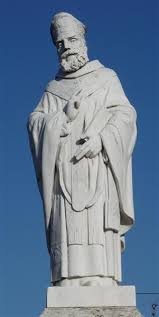
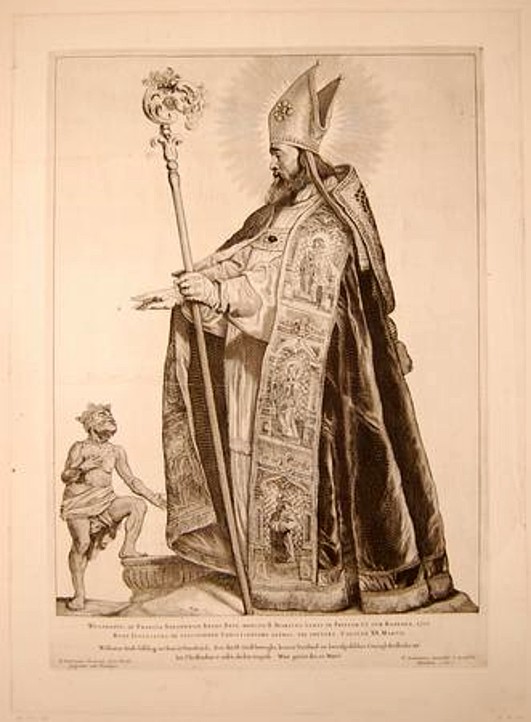
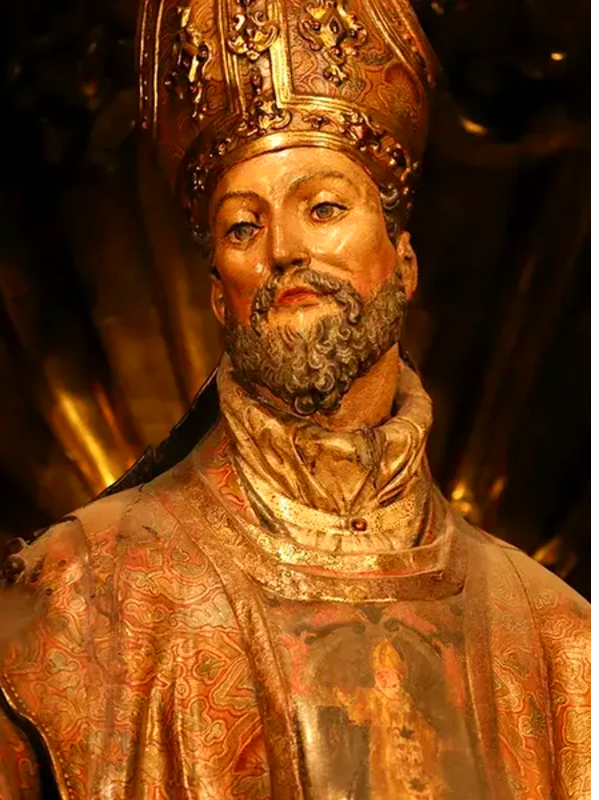
Saint of the Day – 21 March – Saint Birillus (Died c90) the 1st Bishop of Catania, Consecrated by St Peter, Missionary. Born in Antioch (in modern Turkey) and died in c90 in Catania, Italy of natural causes . Patronage – of the Archdiocese of Catania, Italy. Also known as – Berillo, Beryl, Beryllus, Brillus.
The Roman Martyrology reads today: “At Catania, St Brillus, who was Consecrated Bishop by St Peter. After converting many Gentiles to the Faith, he rested in peace in extremely old age.”
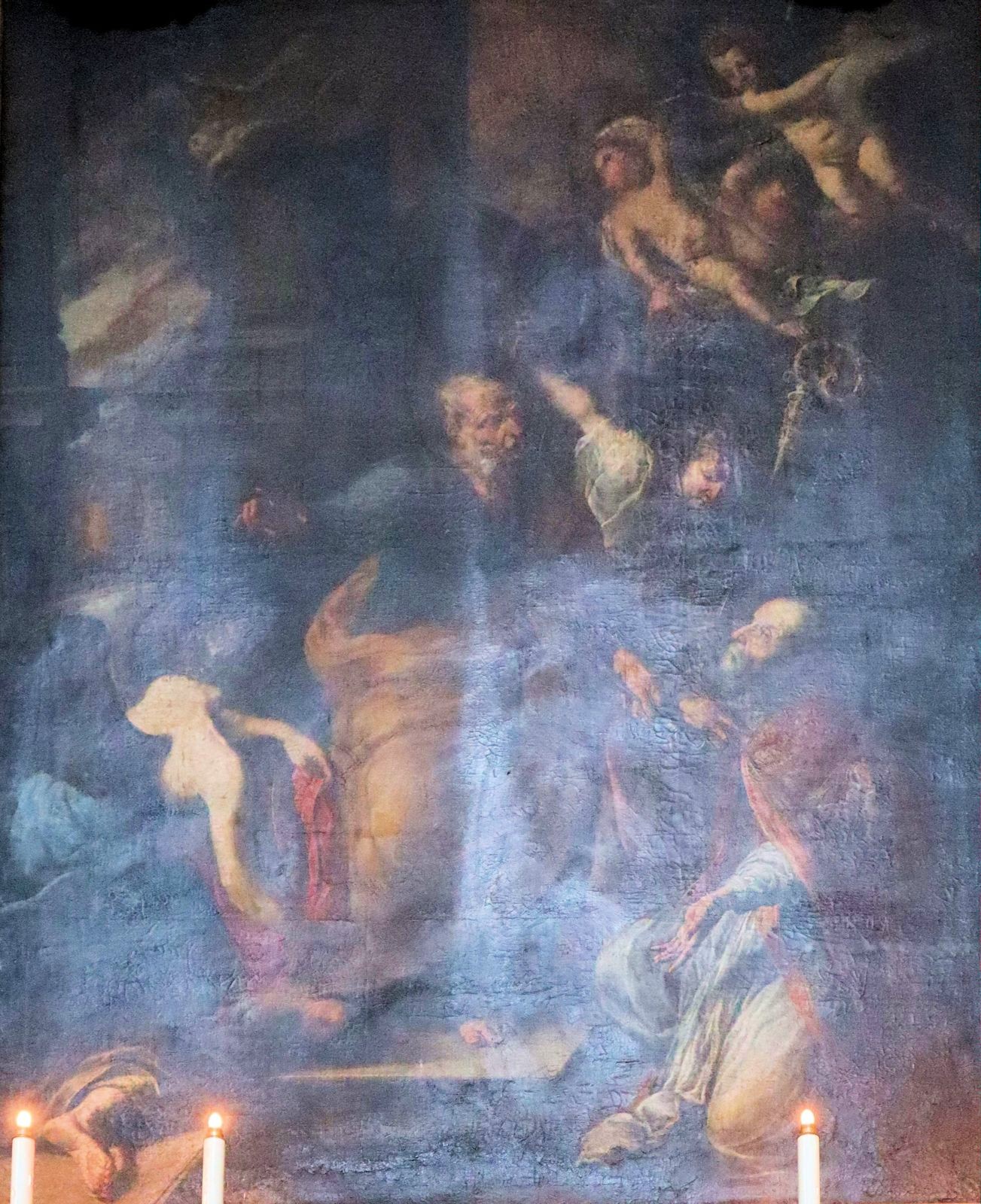
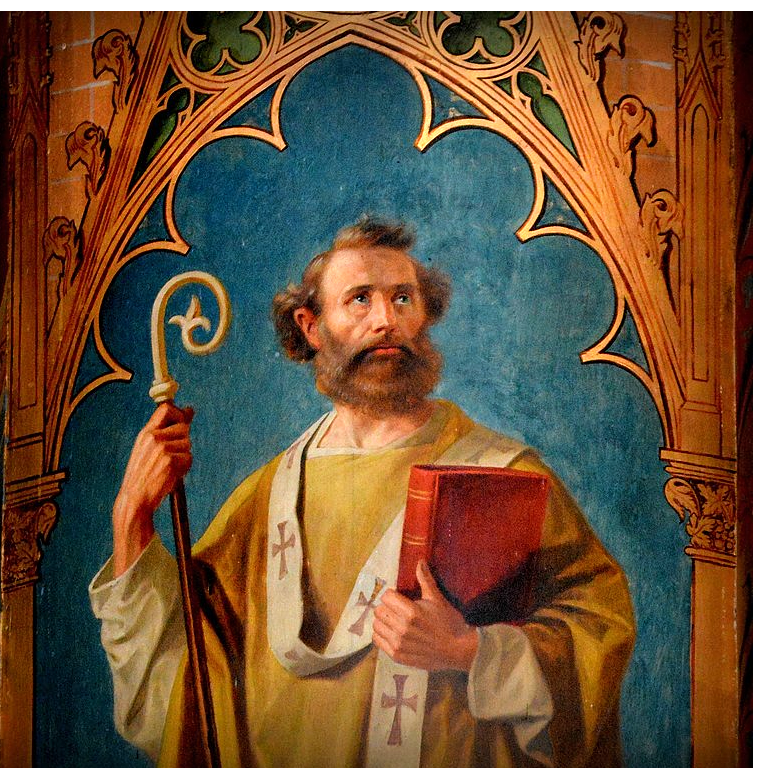
St Peter Consecrates St Birillus Bishop, 1693, in the Cathedral in Catania by Andrea Suppa
Birillus was Consecrated Bishop by St Peter in Antioch in 42 and sent to Catania as a Missionary. After a long service as the City’s 1st Bishop, he died at an advanced age.
St Peter sends St Birillus to preach the Gospel
Birillus was first mentioned in the 8th Century in the biography of Leo of Catania, then in that of Pancras of Taormina and in two liturgical texts of the 9th Century.
In fact, the City’s first Cathedral, from 380 onward, was the Church of Sant’Agata la Vetere —probably only appeared in the 3rd/4th Century.
The tradition concerning Birillus is, therefore, uncertain, nevertheless, he is highly revered in his City of Catania.
St John (Died 1146) Bishop of Valence , Founder of the Abbey of Bonnevaux, Monk, Abbot, Apostle of the poor, Social Reformer. The Roman Martyrology reads: “In Valence in the territory of Vienne in France, St John, Bishop, who, at first Abbot of Bonnevaux, suffered many adversities for the defence of justice and with charity took care of the peasants, the poor and the merchants ruined by debts.” Imitating the Lord: https://anastpaul.com/2022/03/21/saint-of-the-day-21-march-saint-john-of-valence-died-1146/
Bl Lucia of Verona (1514-1574) Laywoman, Apostle of the Sick
St Nicholas of Flue (1417-1487) Swiss Hermit and Ascetic who is the Patron Saint of Switzerland. He is sometimes invoked as Brother Klaus. A husband and father, a Mystic, a Writer, farmer, military leader, Member of the assembly, Councillor, Judge, he was respected as a man of complete moral integrity. He was Canonised on 15 May 1947 by Pope Pius XII. Holy St Nicholas: https://anastpaul.wordpress.com/2018/03/21/saint-of-the-day-21-march-st-nicholas-of-flue-1417-1487/St Nicholas of Flue (1417-1487)
St Serapion the Scolastic (Died c354-370) Bishop of Thmuis, near Diospolis in the Nile delta of Egypt, Monk and Hermit, Confessor, brilliant Scholar of great learning, Theologian, Writer, a companion to St Anthony, the Desert and a close friend of St Athanasius and gave support to him against the heretic Arians in Egypt, for which action he was exiled. St Serapion’s Life: https://anastpaul.com/2021/03/21/saint-of-the-day-21-march-saint-serapion-the-scolastic-died-c-354-370-bishop/
St Philemon of Rome Bl Santuccia Terrebotti
Martyrs of Alexandria: A large but unknown number of Catholics massacred in several Churches during Good Friday services in Alexandria, Egypt by Arian heretics during the persecutions of Constantius and Philagrio. They were Martyred on Good Friday in 342 in Alexandria, Egypt.
Thought for the Day – 20 March – Meditations with Fr Richard Frederick Clarke SJ (1839-1900)
“Short Meditations for March, St Joseph” From “The Devout Year” By Fr Richard Frederick Clarke SJ (1839-1900)
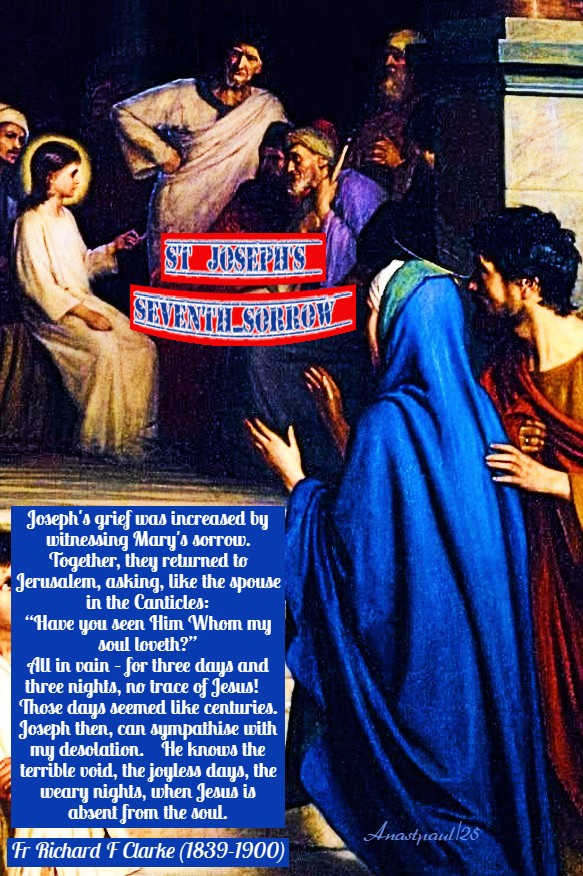
20th Day – St Joseph’s Seventh_Sorrow The Loss of Jesus for Three Days
+1. It was obligatory on all Jews who were within a moderate distance of Jerusalem, to pay a visit to the Temple once every year. In accordance with this law, Joseph went each year from Nazareth and Mary accompanied him. As soon as He was old enough, Jesus too, travelled with His parents. When He was twelve years old, He journeyed thither but, on their return, they suddenly missed Him amongst their fellow pilgrims. Vainly they sought Him everywhere and, with heavy hearts, they asked each member of their company, if they had seen Him. No, He was not there. Oh, what a bitter grief for St Joseph! How terrible were those three days without Jesus!
+2. Could it be through any negligence on his part? Joseph’s motive for separating himself from Jesus had been a most unselfish one – that Mary might have the joy of His company. Men and women travelled in separate caravans and children would travel with either. But perhaps. he might have been more vigilant. Anyway, he had lost Jesus and what could be worse than that!? How different from us, who too often remain content with earthly things, with scarce a thought of Jesus!
+3. Joseph’s grief was increased by witnessing Mary’s sorrow. Together, they returned to Jerusalem, asking, like the spouse in the Canticles: “Have you seen Him Whom my soul loveth?” All in vain – for three days and three nights, no trace of Jesus! Those days seemed like centuries. Joseph then, can sympathise with my desolation. He knows the terrible void, the joyless days, the weary nights, when Jesus is absent from the soul.
Quote/s of the Day –20 March – Ferial Day – Thursday in the Second Week in Lent – Jeremias 17:5-10 – Luke 16:19-31 – Scripture search here: https://www.drbo.org/
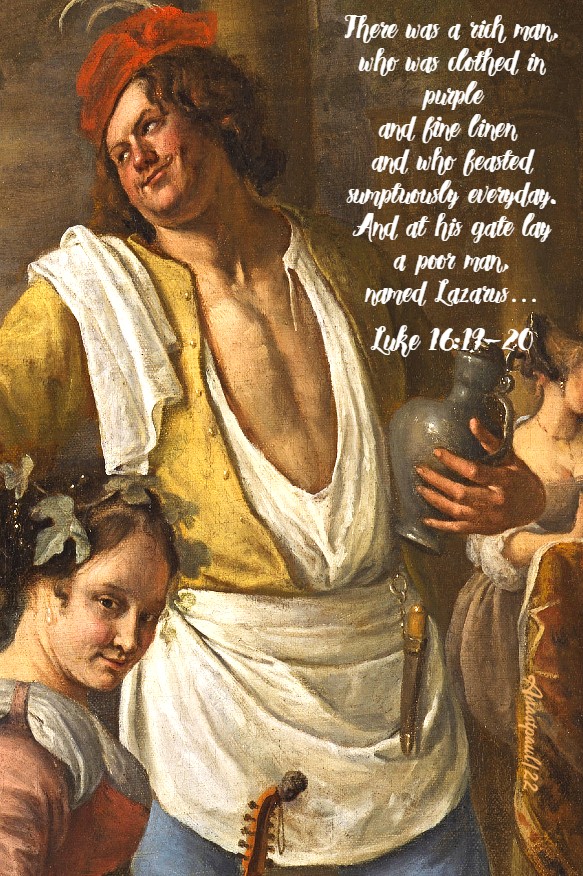
“There was a rich man, who was clothed in purple and fine linen and who feasted sumptuously everyday. And at his gate lay a poor man, named Lazarus…”
Luke 16:19–20
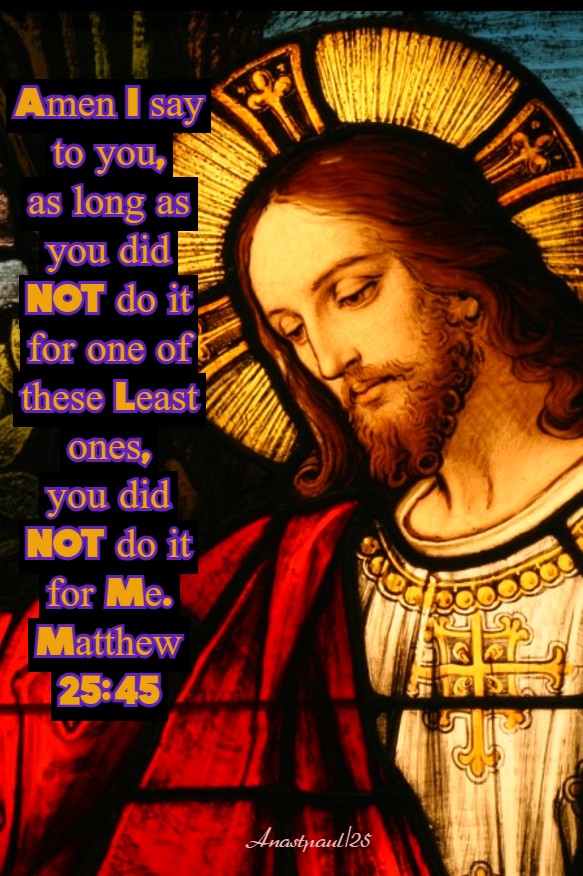
“Amen I say to you, as long as you did NOT do it for one of these least ones, you did NOT do it for Me.”
Matthew 25:45
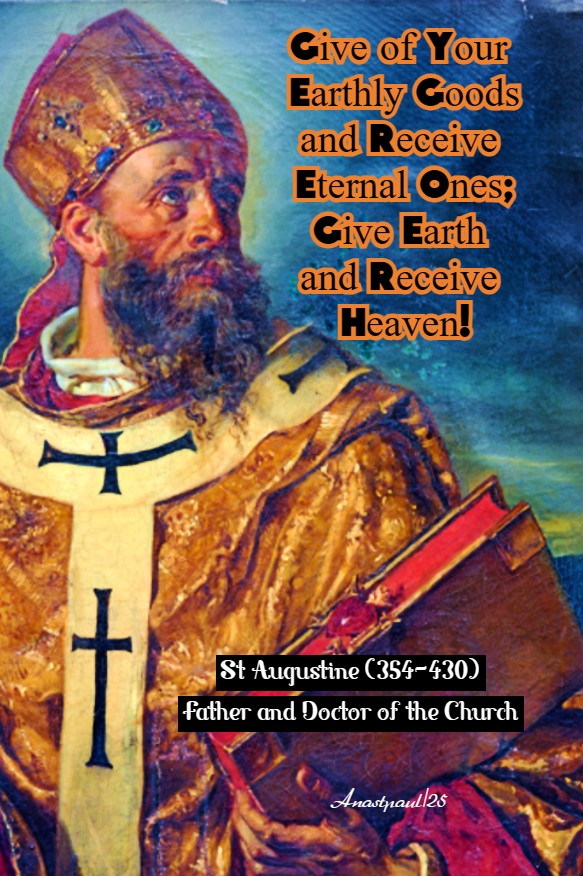
“Give of your earthly goods and receive eternal ones; give earth and receive Heaven!”
St Augustine (354-430) Father and Doctor of the Church
“What is a man’s treasure but the heaping up of profits and the fruit of his toil? For, whatever a man sows, this too will he reap and each man’s gain, matches his toil and where delight and enjoyment are found, there the heart’s desire is attached. Now, there are many kinds of wealth and a variety of grounds for rejoicing – every man’s treasure is that, which he desires. If it is based on earthly ambitions, its acquisition makes men not blessed but wretched. … By distributing what might be superfluous to support the poor, they are amassing imperishable riches, so that what they have discreetly given, cannot be subject to loss. They have properly placed those riches, where their heart is – it is a most blessed thing, to work to increase such riches, rather than to fear that they may pass away.”
St Pope Leo the Great (400-461) ather and Doctor of the Church
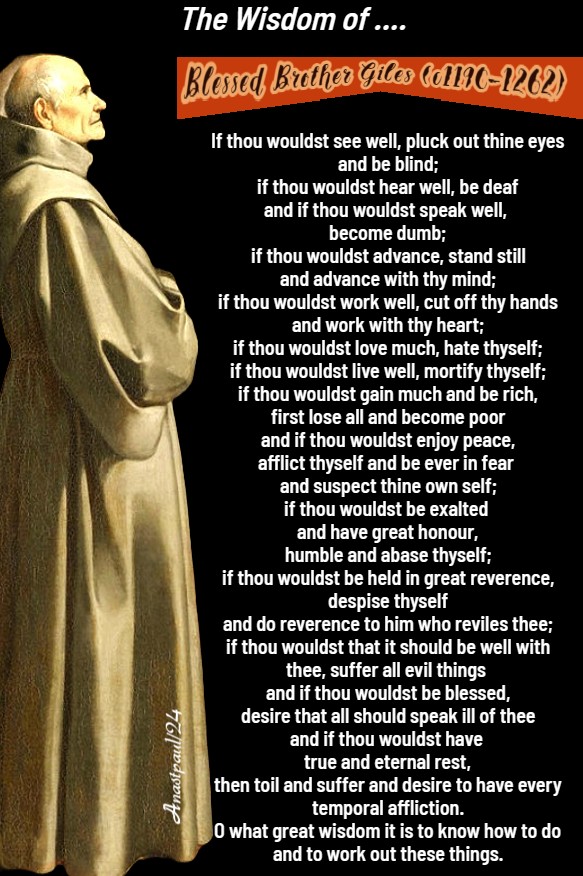
“If thou wouldst see well, pluck out thine eyes and be blind; if thou wouldst hear well, be deaf and if thou wouldst speak well, become dumb; if thou wouldst advance, stand still and advance with thy mind; if thou wouldst work well, cut off thy hands and work with thy heart; if thou wouldst love much, hate thyself; if thou wouldst live well, mortify thyself; if thou wouldst gain much and be rich, first lose all and become poor and if thou wouldst enjoy peace, afflict thyself and be ever in fear and suspect thine own self; if thou wouldst be exalted and have great honour, humble and abase thyself; if thou wouldst be held in great reverence, despise thyself and do reverence to him who reviles thee; if thou wouldst that it should be well with thee, suffer all evil things and if thou wouldst be blessed, desire that all should speak ill of thee and if thou wouldst have true and eternal rest, then toil and suffer and desire to have every temporal affliction. O what great wisdom it is to know how to do and to work out these things.”
Lenten Meditations – 20 March – With Fr Richard Frederick Clarke SJ (1839-1900) Scripture search here: https://www.drbo.org/
“The Sacred Passion of Our Lord Jesus Christ” “Short Meditations for Lent” From “The Devout Year” By Fr Richard Frederick Clarke SJ (1839-1900)
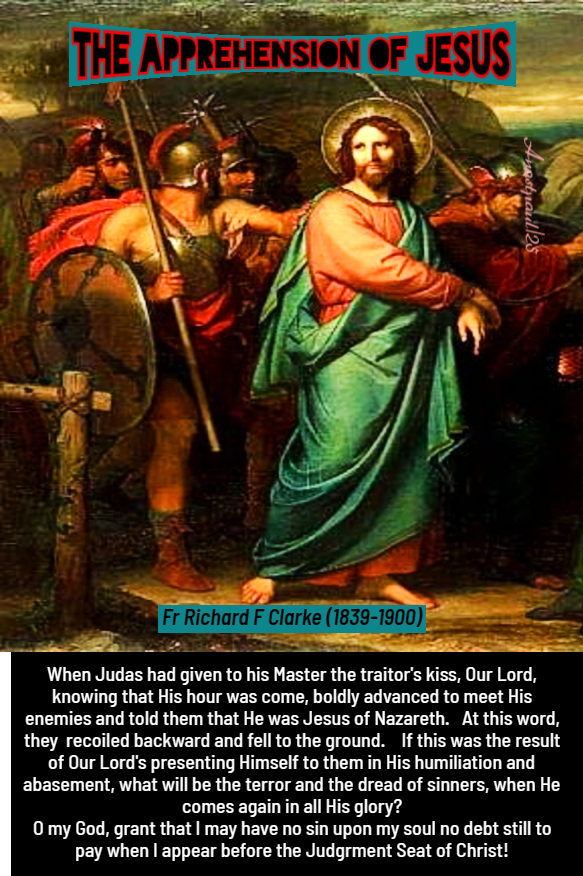
Thursday after the Second Sunday in Lent The Apprehension of Jesus
Read St John xviii:2-11 (Posted at the end)
+1. When Judas had given to his Master the traitor’s kiss, Our Lord, knowing that His hour was come, boldly advanced to meet His enemies and told them that He was Jesus of Nazareth. At this word, they recoiled backward and fell to the ground. If this was the result of Our Lord’s presenting Himself to them in His humiliation and abasement, what will be the terror and the dread of sinners, when He comes again in all His glory? O my God, grant that I may have no sin upon my soul no debt still to pay when I appear before the Judgement Seat of Christ!
+2. The soldiers then advanced to seize Jesus. St Peter, with impetuous courage and loyalty, draws his sword and attackrf the servants of the high -priest and in the affray, cuts off the ear of one of them. But Our Lord rebukes him and bids him put his sword back into the scabbard. His loyalty was natural, not supernatural and it did not endure long in the face of danger. Natural motives, however good, will not serve the cause of God.
+3. When Our Lord was in the hands of His enemies, all the Apostles forsook Him and fled. Not one was found to remain by His side in His abandonment. It was the Will of God that He should suffer alone. “I looked about and there was none to help; I sought and there was none to give aid.” Christ then suffered alone and He can sympathise with that loneliness in suffering which adds so much to its bitterness.
[2]There were together Simon Peter and Thomas, who is called Didymus, and Nathanael, who was of Cana of Galilee, nd the sons of Zebedee and two others disciples. [3] Simon Peter saith to them: I go fishing. They say to him: We also come with thee. And they went forth and entered into the ship and that night. they caught nothing. [4] But when the morning was come, Jesus stood on the shore, yet, the disciples knew not that it was Jesus. [5] Jesus ,therefore, said to them: Children, have you any meat? They answered him: No.
[6] He saith to them: Cast the net on the right side of the ship and you shall find. They cast, therefore and now, they were not able to draw it, for the multitude of fishes. [7] That disciple, therefore, whom Jesus loved, said to Peter: It is the Lord. Simon Peter, when he heard that it was the Lord, girt his coat about him, (for he was naked) and cast himself into the sea. [8] But the other disciples came in the ship, (for they were not far from the land but, as it were two hundred cubits) dragging the net with fishes. [9] As soon then, as they came to land, they saw hot coals lying and a fish laid thereon and bread. [10] Jesus saith to them: Bring hither of the fishes which you have now caught. [11] Simon Peter went up and drew the net to land, full of great fishes, one hundred and fifty-three. And although there were so many, the net was not broken. [John 21:2-11]
One Minute Reflection – 20 March – “The Month of Saint Joseph” – Ferial Day – Thursday in the Second Week in Lent – Jeremias 17:5-10 – Luke 16:19-31 – Scripture search here: https://www.drbo.org/
“The poor man died and was carried by the Angels to Abraham’s bosom. The rich man also died and was buried and in Hades, being in torment, he lifted up his eyes and saw Abraham, far off and Lazarus in his bosom. …” – Luke 16:22-23
REFLECTION – “When I say that God does not incline His ear to the rich man, do not go so far as to think, my friends that God fails to answer those who have gold and silver, servants and lands. If they were born in that state and occupy that class of society, let them call to mind the saying of the Apostle Paul: “Tell the rich in the present world, not to yield to pride” (1Tm 6:17). People who do not yield to pride are poor before God, Who inclines His ear to the poor and needy (Ps 85:1). Indeed, they know their hope does not lie in gold or silver, or in those things, of which they have an abundance, for a time. It suffices that possessions are not causing their loss and that, if they do nothing for their salvation, at least they are not an obstacle to it … Therefore, when someone despises those things which feed one’s pride, he is one of God’s poor and God inclines His ear towards him, for He knows the troubles of his heart.
It is true, my brethren that the poor man Lazarus, covered with sores, who lay at the rich man’s door, was carried by Angels into the bosom of Abraham. This is what we read and believe. Whereas ,the rich man, who was clothed in purple and fine linen and feasted splendidly everyday, was thrown down to the torments of hell.
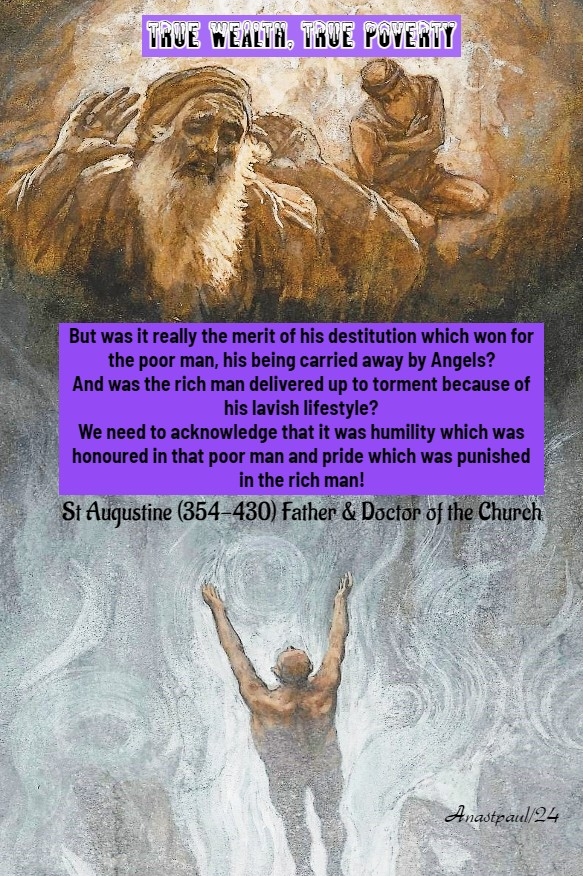
But was it really the merit of his destitution which won for the poor man, his being carried away by Angels? And was the rich man delivered up to torment because of his lavish lifestyle? We need to acknowledge that it was humility which was honoured in that poor man and pride which was punished in the rich man!” – St Augustine (354-430) Father & Doctor of the Church(Discourses on the Psalms 85,3).
PRAYER – In Thy mercy, O Lord, may this hallowing fast enlighten the hearts of Thy faithful people and since Thou have given them the desire to serve Thee, lend a gracious ear to their prayers.Through Jesus Christ, Thy Son our Lord, Who lives and reigns with Thee, in the unity of the Holy Ghost, God, world without end. Amen (Collect).
Our Morning Offering – 20 March – Thursday after the Second Sunday in Lent
Look Down, O Lord By St Cajetan (1480-1547)
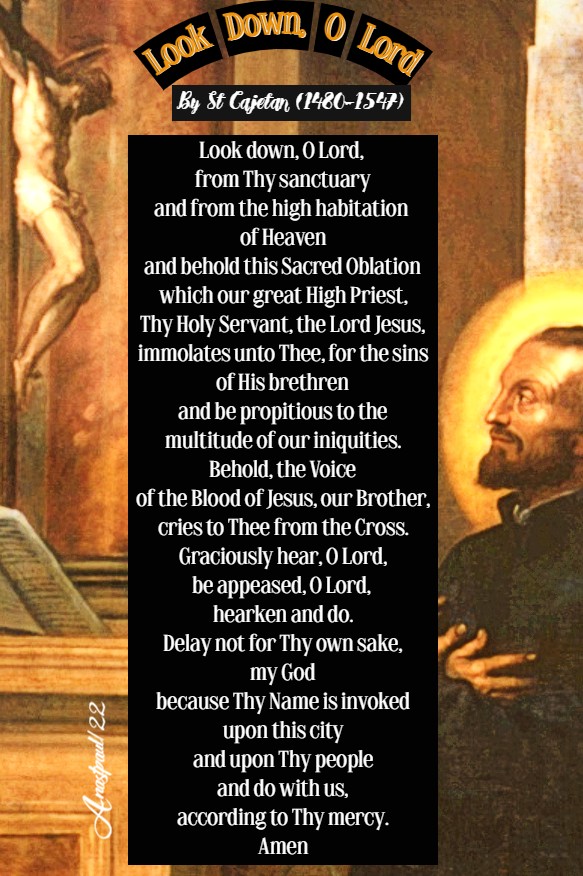
Look down, O Lord, from Thy sanctuary and from the high habitation of Heaven and behold this Sacred Oblation which our great High Priest, Thy Holy Servant, the Lord Jesus, immolates unto Thee, for the sins of His brethren and be propitious to the multitude of our iniquities. Behold, the Voice of the Blood of Jesus, our Brother, cries to Thee from the Cross. Graciously hear, O Lord, be appeased, O Lord, hearken and do. Delay not for Thy own sake, my God because Thy Name is invoked upon this city and upon Thy people and do with us, according to Thy mercy. Amen
Plenary Indulgence on the First Thursday of each month for Communicants visiting the Blessed Sacrament and reciting this prayer. Partial Indulgence of seven years and seven Quarantines, on all other Thursdays. –Pope Pius VII. “Quarantines” signifies a strict Ecclesiastical penance of forty days, performed according to the practice of the early Church. Hence an Indulgence of “Seven Quarantines,” for instance, implies. the remission of as much temporal punishment, as would be blotted out by the corresponding amount of Ecclesiastical Penance i.e. 7 x 40 = 280 days.
Saint of the Day – 20 March – Saint Nicetas (Died c733) Bishop of Apollonias in Bithynia, a region of Asia Minor, Defender of the veneration of holy images. We have no history of his birthplace but he died in exile in c733, presumably of natural causes, although some refer to him as a Martyr. Also known as – Nicetas of Apollonias, … of Bithynia, Niceta.
The Roman Martyrology reads today: “At Apollonia, the Bishop, St Nicetas, who breathed his last in exile, where he had been sent for upholding the veneration of holy images.”
Am unknown Saintly Bishop’s Benediction
The history of the Church preserves the memories of countless figures who, by their courage and dedication, have helped shape Christian doctrine and tradition. Among these, the figure of Saint Nicetas, Bishop of Apollonias, (in modern Turkey) is distinguished as a silent hero of the Faith whose tale, although fragmentary, offers us food for thought and admiration.
Unfortunately, information regarding St Nicetas is limited. The records of Constantinople describes him as a “Most Orthodox” Bishop of Apollonias, who lived during the era of denying the benefits of the veneration of holy images, a turbulent period in which sacred images were the subject of heated controversy and destruction.
Nicetas not only remained faithful to the cult of images but too, suffered harsh persecution for his unshakable faith. His resistance eventually led him to exile, where he died in circumstances which remain unknown.
The precise identification of Apollonias, the City of which Nicetas was the Bishop, presents several difficulties. In fact, there are several Cities with this name in the ancient Christian world. The most widespread tradition places him in Bithynia, a region of Asia Minor. However, some scholars hypothesise that Nicetas may have been the Bishop of another Apolloniad, located in Thrace or Illyria.
The date and circumstances of the death of Saint Nicetas is also uncertain. Some hypothese associate him with the persecution of Leo the Isaurian (717-741), while others place him at the time of Leo the Armenian (813-820), both anti-veneration of holy images.
St Photina & Companions / Martyrs of Rome – 9+ Saints: A group of Christians Martyred together in the persecutions of Nero. We know nothing else about them but the names Photina, Sebastian and Victor, Anatolius, Cyriaca, Joseph, Parasceve, Photis.
Blessed Ambrose Sansedoni OP (1220-1287) Priest and Friar of the Order of Preachers, Preachers, Confessor, Mystic, a powerful and convincing Preacher employed by various Popes as a Diplomatic Peacemaker and that which seems opposed, as a Preacher of the Crusades, Peacemaker. A fellow student with St Thomas Aquinas under St Albert Magnus. His Life: https://anastpaul.com/2023/03/20/saint-of-the-day-19march-blessed-ambrose-sansedoni-of-siena-op-1220-1287-priest/
Anastasius XVI Archippus of Colossi St Benignus of Flay St Cathcan of Rath-derthaighe St Clement of Ireland
Martyrs of Amisus – 8 Saints: A group of Christian women Martyred together in the persecutions of Diocletian. The only details we have are eight of their names – Alexandra, Caldia, Derphuta, Euphemia, Euphrasia, Juliana, Matrona and Theodosia. They were burned to death c 300 in Amisus, Paphlagonia (modern Samsun, Turkey).
Martyrs of San Saba – 20 Saints: Twenty monks who were Martyred together in their monastery by invading Saracens. They were Martyred in 797 when they were burned inside the San Sabas monastery in Palestine.
Martyrs of Syria – 3+ Saints: A group of Christians who were Martyred together in Syria. We know nothing else about them but the names Cyril, Eugene and Paul.
Thought for the Day – 19 March – Meditations with Fr Richard Frederick Clarke SJ (1839-1900)
“Short Meditations for March, St Joseph” From “The Devout Year” By Fr Richard Frederick Clarke SJ (1839-1900)
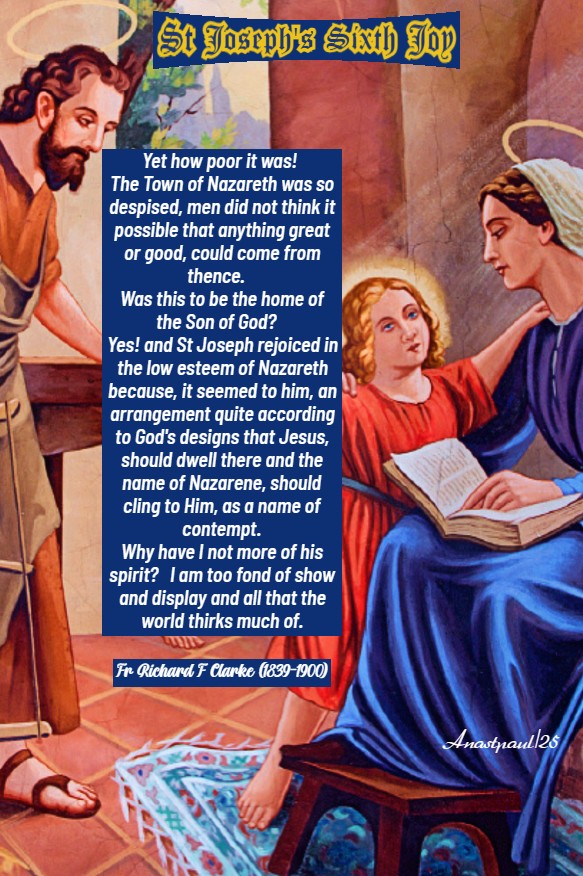
19th Day – St Joseph’s Sixth Joy The Life with Jesus and Mary at Nazareth
+1. When St Joseph found, dangers still threatening the safety of Jesus in the south of Palestine, he at once continued the journey towards Galilee. He was fertile in resource and when one plan failed. another, with God’s assistance, was soon destined to take its place. Here too he teaches me a lesson. If I meet with reverses I am discouraged and inclined to relinquish the task, instead of cheerfully looking out for some fresh means of serving God and accomplishing the work He has entrusted to me.
+2. St Joseph, under God’s direction, journeyed on, to the Town of Nazareth, where he had formerly lived and there, he re-enters the poor little cottage humble and lowly, where he and his holy spouse had formerly dwelt. This, a secret voice told him, is to be his home. How joyfully he took possession of it! Now his wanderings were over and he was to spend the rest of his days in peace in the tranquil home God had prepared for him.
+3. Yet how poor it was! The Town of Nazareth was so despised, men did not think it possible that anything great or good, could come from thence. Was this to be the home of the Son of God? Yes! and St Joseph rejoiced in the low esteem of Nazareth because, it seemed to him, an arrangement quite according to God’s designs that Jesus, should dwell there and the name of Nazarene, should cling to Him, as a name of contempt. Why have I not more of his spirit? I am too fond of show and display and all that the world thirks much of.
Quote/s of the Day – 19 March – “The Month and Feastday of Saint Joseph”
“Saint Joseph was the just man: by his constant fidelity -an effect of justice; by his perfect discretion – a sister to prudence; by his upright conduct – a mark of strength and by his inviolable chastity – a flower of temperance.”
St Albert the Great (1200-1280) Doctor of the Church
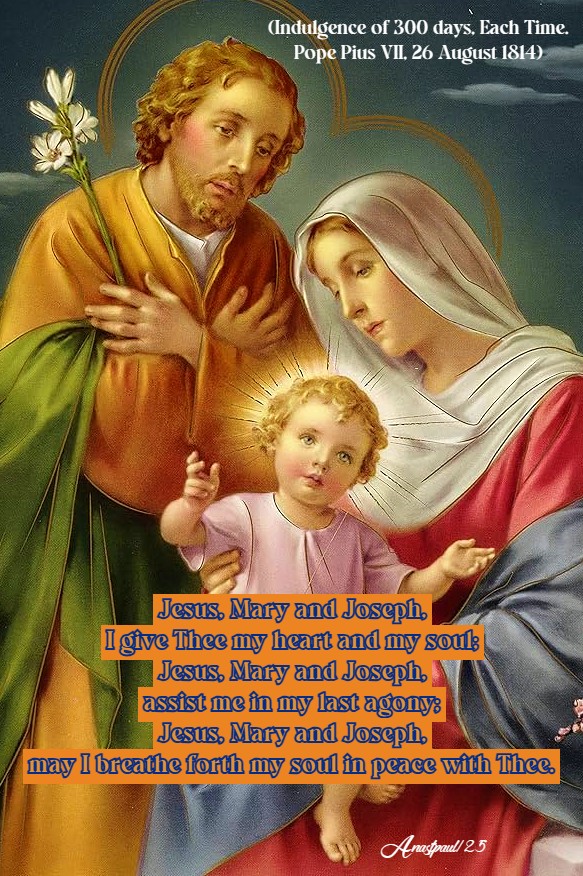
Indulgenced Holy Family Aspiration
“Jesus, Mary and Joseph, I give Thee my heart and my soul; Jesus, Mary and Joseph, assist me in my last agony; Jesus, Mary and Joseph, may I breathe forth my soul in peace with Thee.”
(Indulgence of 300 days, Each Time. Pope Pius VII, 26 August 1814)
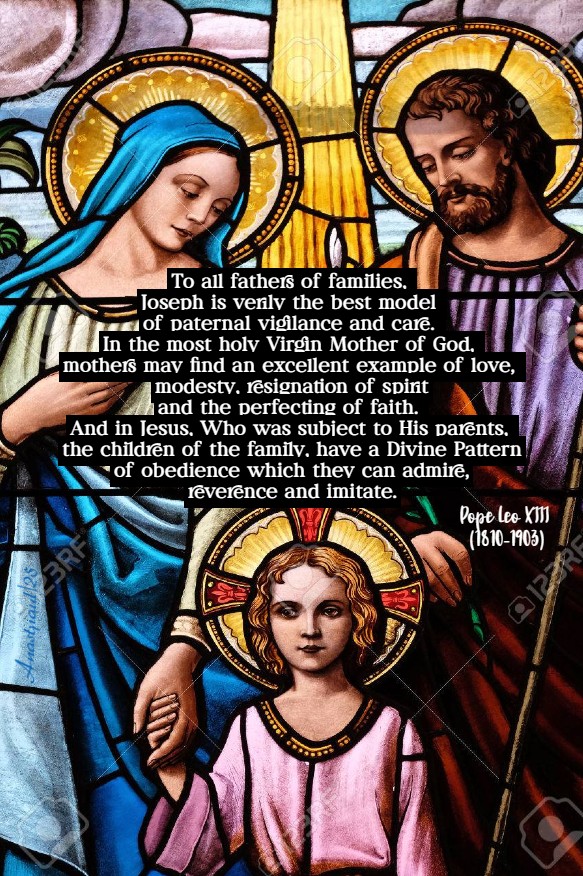
“To all fathers of families, Joseph is verily the best model of paternal vigilance and care. In the most holy Virgin Mother of God, mothers may find an excellent example of love, modesty, resignation of spirit and the perfecting of faith. And in Jesus, Who was subject to His parents, the children of the family, have a Divine Pattern of obedience which they can admire, reverence and imitate.”
Pope Leo XIII (1810-1903)
Apostolic Letter, “Breve Neminem Fugit” 1892
“It is impossible, that he could be denied the favours for which he asks and which we should request him to obtain for us. Let us go to him trustingly but, let us remember, that the surest way of being heard by him, is to imitate his wonderful virtues, especially his humility, his spirit of prayer, his purity and his calm desire always, to do God’s Will.”
Lenten Meditations – 19 March – With Fr Richard Frederick Clarke SJ (1839-1900) Scripture search here: https://www.drbo.org/
“The Sacred Passion of Our Lord Jesus Christ” “Short Meditations for Lent” From “The Devout Year” By Fr Richard Frederick Clarke SJ (1839-1900)
Wednesday after the Second Sunday in Lent The Betrayal
Read St Matthew xxvi:47-50
[47] As He yet spoke, behold Judas, one of the twelve, came, and with him, a great multitude with swords and clubs, sent from the chief priests and the ancients of the people. [48] And he, whobetrayed Him, gave them a sign, saying: ‘Whomsoever I shall kiss, that is He, hold Him fast.’ [49] And forthwith coming to Jesus, he said: ‘Hail, Rabbi.’ And he kissed Him. [50] And Jesus said to him: ‘Friend, whereto art thou come?’ Then they came up and laid hands on Jesus and held Him. [Matthew 26:47-50]
+1. As soon as Jesus had, for the third time, roused the Apostles from their slumber, the tramp of approaching soldiery is heard and presently, a band is seen escorted by the Pharisees and ancients and headed by one, who acts as their guide. Who is it who has pointed out Christ to His foes. Alas! it is none other than the traitor Judas, one of the chosen twelve, who had lived for three years in familiar intercourse with Jesus, listened to His Words of grace, seen His acts of love and mercy. If Judas fell so low, I too am in continual danger. How awful a thing it would be if I too were to turn traitor to Jesus!
+2. Our Lord does not shrink away from Judas as we do from those who we think have treated us ill. On the contrary, He advances to meet him with words of friendship, in spite of the deadly wrong He received. How is it we are so unforgiving, so slow to make friendly advances, so ready to wrap ourselves in our offended dignity? It is because we are so unkind and selfish, so petty, so mean and stingy, so unlike Jesus!
+3. Jesus still loved Judas, sought to win Judas, strove by words of gentle remonstrance to bring him to a sense of his wickedness before it was too late. “Friend , whereto art thou come?” He calls this miserable wretch His friend. Jesus meant what He said; for He is the friend of sinners, even the greatest . He then is my Friend, so why should I ever fear!?
One Minute Reflection – 19 March – “The Month and the Feastday of Saint Joseph” – Ecclesiasticus 45:1-6 – Matthew 1:18-21 – Scripture search here: https://www.drbo.org/
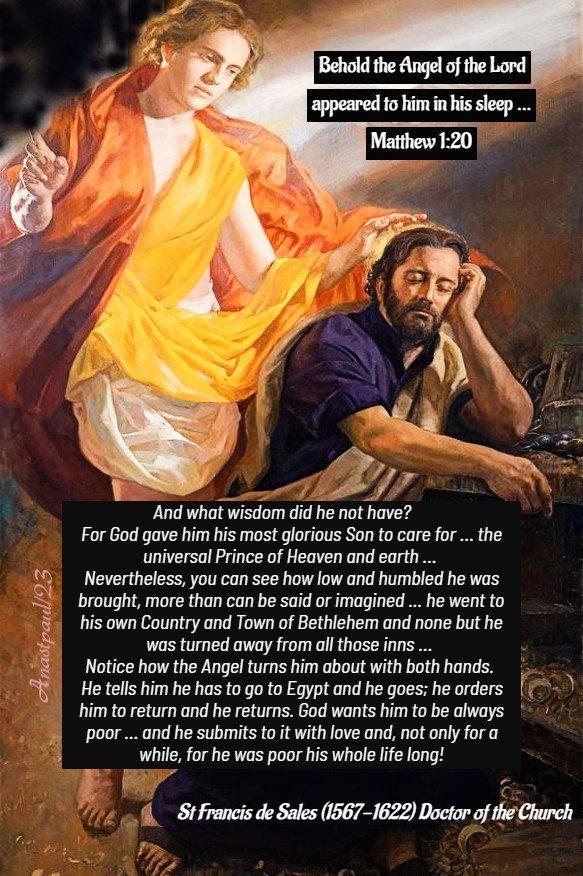
“Behold, the Angel of the Lord appeared to him in his sleep …” – Matthew 1:20
REFLECTION – “How faithful in humility was the great Saint we are celebrating! That cannot be said in all its perfection for, in spite of what he was, in what poverty and lowliness he lived, all the days of his life – a poverty and lowliness beneath which. he kept hidden and concealed, his great virtues and dignity! … Truly, I am free of doubt that the Angels came, beside themselves with admiration, rank upon rank, to behold and wonder at his humility, while he sheltered that dearest Child in the poor workshop where he worked at his employment, so as to feed the little Boy and the mother entrusted to him.
There is no doubt at all that St Joseph was braver than David and wiser that Solomon [who were his ancestors]. Nevertheless, seeing him reduced to the exercise of carpentry, who could have discerned this, unless they were enlightened by a heavenly light, so hidden did he keep the remarkable gifts with which God had favoured him? And what wisdom did he not have? For God gave him his most glorious Son to care for … the universal Prince of Heaven and earth … Nevertheless, you can see how low and humbled he was brought, more than can be said or imagined … he went to his own Country and Town of Bethlehem and none but he was turned away from all those inns … Notice how the Angel turns him about with both hands. He tells him, he has to go to Egypt and he goes; he orders him to return and he returns. God wants him to be always poor … and he submits to it with love and, not only for a while, for he was poor his whole life long!” – St Francis de Sales (1567-1622) Bishop of Geneva and Doctor of the Church (Conferences No 20)
PRAYER – May the merits of Thy most holy Mother’s Spouse help us, we beseech Thee, O Lord, that through his intercession we may receive what we cannot obtain by our own efforts. Through the same Jesus Christ, Thy Son our Lord, Who lives and reigns with Thee, in the unity of the Holy Ghost, God, world without end. Amen (Collect).
Our Morning Offering – 19 March – “The Month and the Feastday of Saint Joseph”
Glorious St Joseph! Prayer for the Intercession of St Joseph in All Our Needs By St Francis de Sales (1567-1622) Doctor Caritatis
Glorious St Joseph, Spouse of Mary, grant us thy paternal protection, we beseech thee, by the Heart of Jesus Christ. O thou, whose power extends to all our necessities and can render possible for us, the most impossible things. Open thy fatherly eyes to the needs of thy children. In the trouble and distress which afflicts us, we confidently have recourse to thee. Deign to take under thy charitable charge this important and difficult matter, cause of our worries. Make its happy outcome be for God’s glory and for the good of His devoted servants. Amen
Saint of the Day – 19 March – Saint John (6th Century) Founder Abbot in Civita-di-Penna, Umbria, Italy, Miracle-worker. Accounts of John’s birthplace differ but he certainly died at his Monastery, dedicated to St Stephen, in Penna, Umbria of natural causes. Also known as – Giovanni/John di Penna, of Panaca, of Parran, the Abbot, the Syrian.
The Roman Martyrology reads today: “At Civita-di-Penna, the birthday of the blessed St Joh, a man of great holiness, who came from Syria into Italy, where he constructed a Monastery and, after having been the spiritual guide of many servants of God for forty-four years, rested in peace, renowned for great virtue.”
Unknown Monk
There is an ancient legendary Vita which states that he was born in Syria in the 6th Century and being persecuted by the heretical monophysites, he fled to Italy. He arrived in the dead of winter, when the trees were bare of leaves and fruit. Some hunters witnessed John sit beside a bare, leafless pear tree which suddenly burst into full bloom due to the holy man’s proximity, supplying him and all who passed by with delicious fruit.
He settled in the locality of Nocera in the Diocese of Spoleto. In this pleasant locality, he founded his own Monastery which he then led as the Abbot for for 44 years.
As the Abbot, he instructed and assisted numerous young Monks to increase in virtue and sanctity, ever ascending the ladder of perfection. John used the instruments of silence and prayer as the greatest means of achieving perfection.
In the Roman Martyrology it is stated that he was the father of numerous servants of God. In the volume of the Biblioteca Sanctorum, under the entry Giovanni di Penna, it is reported that even if the Roman Martyrology indicates him as being from Penna, it seems that this transcription is incorrect, while on various other Italian platforms, he is described as being from Spoleto in Umbria.
Saint John the Abbot is also remembered both in the Martyrology of Adone and in that of Usuardo.
Blessed Clement of Dunblane (1200-1258) Bishop of Dunblane in Scotland, , Priest and Friar of the Order of Preachers, a great and humble carer of the poor and needy, a zealous Administrator but just as much, a shepherd of souls, Reformer, Writer, a highly renowned Preacher and Linguist, a very learned man indeed. Clement was the first member of the Dominican Order in Britain and Ireland to become a Bishop. Born in Scotland in 1200 and died in 1258 in Dunblane, Scotland of natural causes. An Inspiring Life: https://anastpaul.com/2023/03/19/saint-of-the-day-19-march-blessed-clement-of-dunblane-op-1200-1258-bishop/
St Colocer of Saint-Brieuc St Corbasius of Quimperlé St Cuthbert of Brittany St Gemus
Blessed John of Parma OFM (c1209-1289) Priest, 7th Minister General of the Friars Minorfrom (1247–1257) and a noted Theologian. He was known for his attempts to bring back the earlier spirit of the Order after the death of Saint Francis of Assisi. Patronage – of his birthplace, Parma, Italy. His cult was confirmed in 1777 by his Beatification by Pope Pius VI. Blessed John’s Zealous Life: https://anastpaul.com/2024/03/19/saint-of-the-day-19-march-blessed-john-of-parma-ofm-c1209-1289-priest/
St John (6th Century) Abbot in Umbria, Italy St Lactali of Freshford St Landoald of Maastricht St Leontinus of Braga St Leontinus of Saintes Bl Mark of Montegallo St Pancharius of Nicomedia
Martyrs of Sorrento: A group of Three sisters and a brother who were Martyred together. We have little more than their names – Mark, Quartilla, Quintilla and Quintius. They were Martyred in Sorrento, Italy, date unknown.
Thought for the Day – 18 March – Meditations with Fr Richard Frederick Clarke SJ (1839-1900)
“Short Meditations for March, St Joseph” From “The Devout Year” By Fr Richard Frederick Clarke SJ (1839-1900)
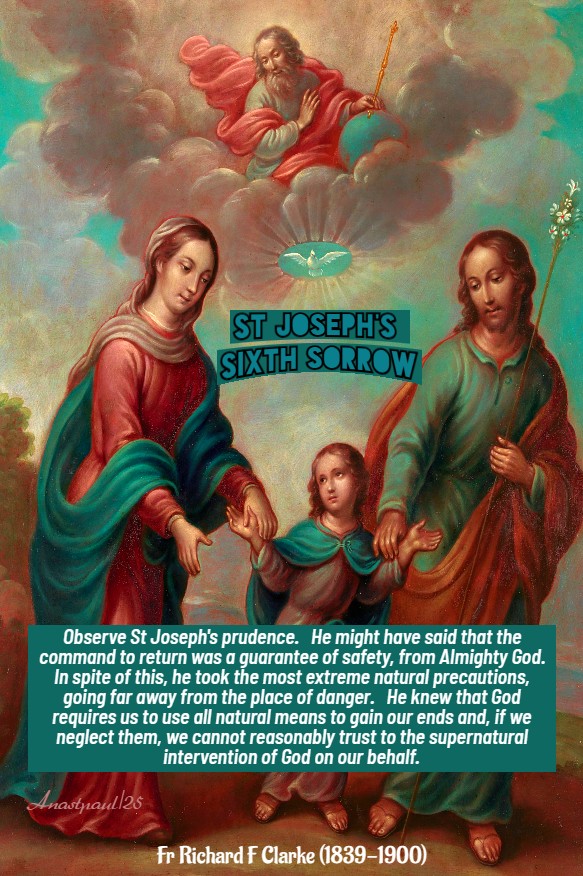
18th Day – St Joseph’s Sixth Sorrow Finding that Archelaus reigned in Judæa
+1. When the appointed time was come , St Joseph received the joyful news – the Holy Family could at length return from their place of exile. An Angel appeared to him by night and informed him that Herod was dead and he might safely return into the land of Israel. But when he arrived there, he found the tyrant had been succeeded by his son, Archelaus and that Judæa, over which he held sway, was, therefore, no safe abode for Jesus and Mary. What a bitter disappointment it must have been!
+2. It seems as if St Joseph had been deceived by Almighty God. He was encouraged to return and now, he found the place of the dead king was occupied by a son, who was not much better than his father Yet, no thought of discontent was harboured in St Joseph’s heart, not the faintest murmur of complaint escaped his lips. His was the true obedience – blind, confiding, unreasoning, uncomplaining obedience to the Will of God. Can I say the same of myself?
+3. Observe St Joseph’s prudence. He might have said that the command to return was a guarantee of safety, from Almighty God. In spite of this, he took the most extreme natural precautions, going far away from the place of danger. He knew that God requires us to use all natural means to gain our ends and, if we neglect them, we cannot reasonably trust to the supernatural intervention of God on our behalf.
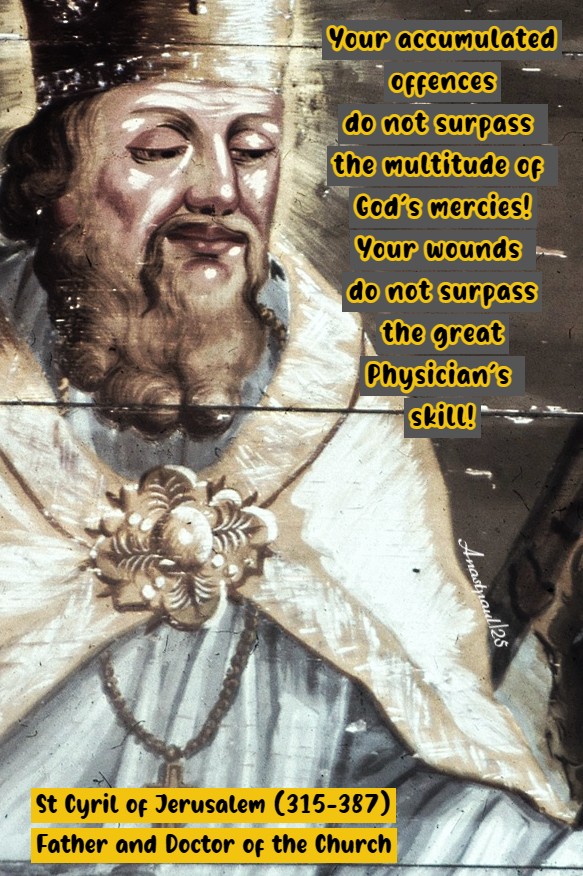
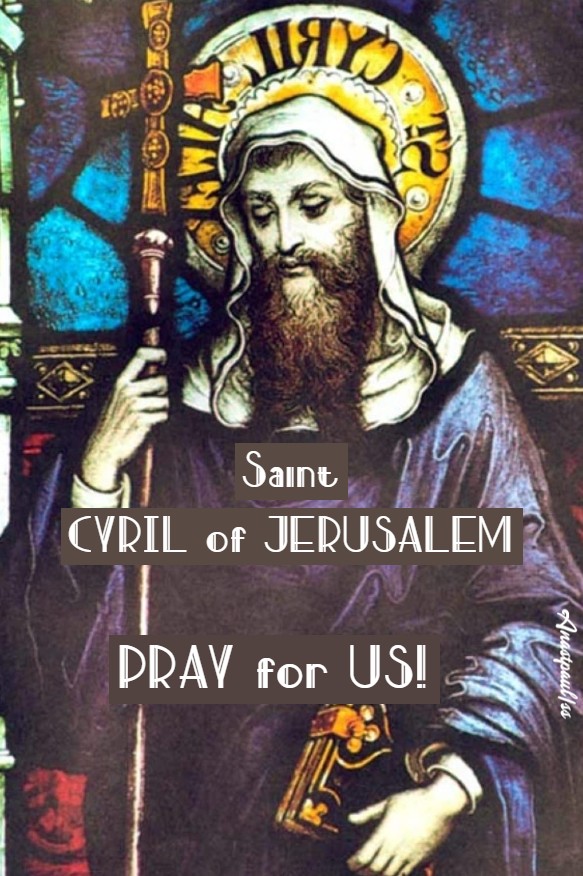
Quote/s of the Day – 18 March – St Cyril of Jerusalem (315-387) Bishop of Jerusalem, Confessor Father & Doctor of the Church
“Your accumulated offences do not surpass the multitude of God’s mercies! Your wounds do not surpass the great Physician’s skill!”
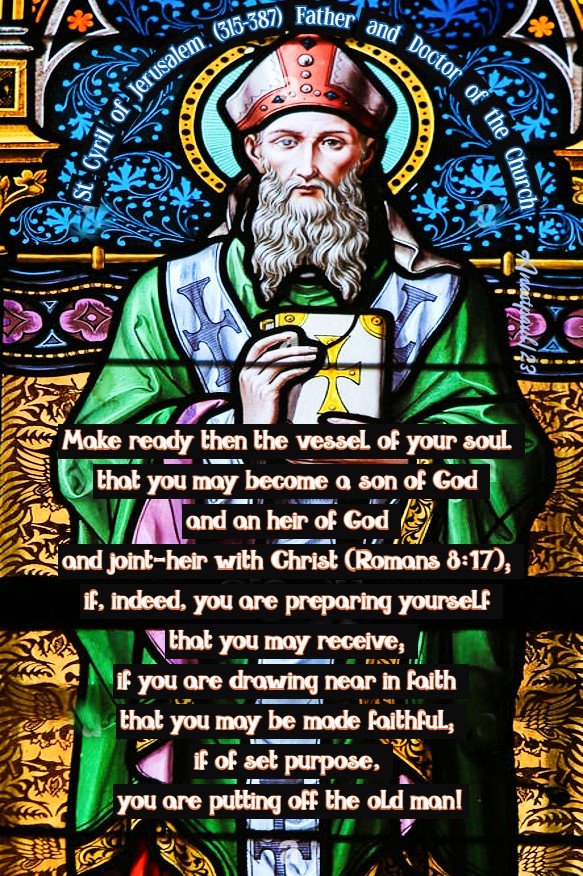
“Make ready then the vessel of your soul that you may become a son of God and an heir of God and joint-heir with Christ (Romans 8:17); if, indeed, you are preparing yourself that you may receive; if you are drawing near in faith that you may be made faithful; if of set purpose, you are putting off the old man!”
“I Am the Bread of Life” John 6:35
“For His Body, has been given to you under the appearance of bread and His Blood, under the appearance of wine, so that, when you have partaken of the Body and Blood of Christ, you might be One Body and One Blood with Him. So shall we become Christ-bearers [“Christophers”]. His Body and Blood are diffused through all our members – see, then, how we become participants in the Divine Nature!”
“A man may even be justified by money. “I was hungry and you gave Me to eat” that certainly was from money. “I was naked and you clothed Me” that too was certainly from money. Do you want to learn how money can become a door to the Kingdom of Heaven? “Go,” Jesus says, “sell what you possess and give to the poor and you will have treasure in Heaven.”
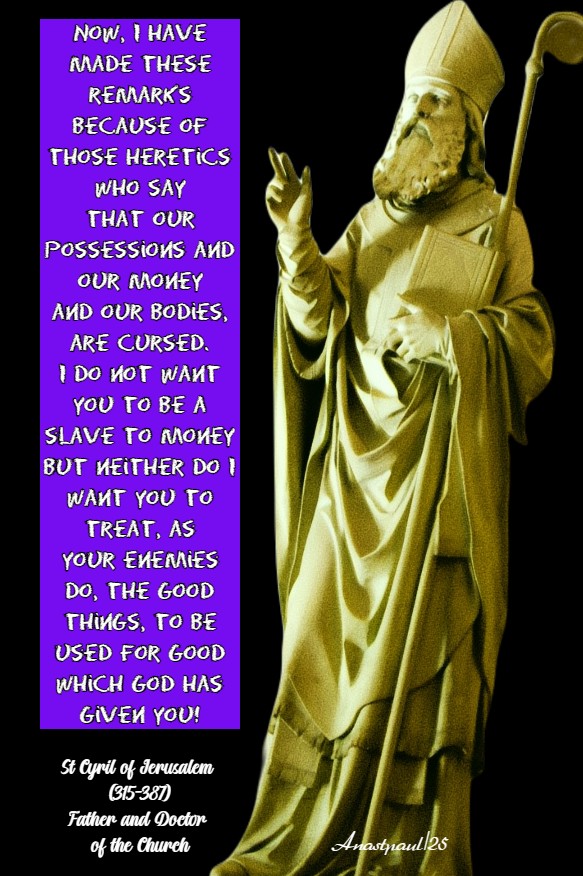
“Now, I have made these remarks because of those heretics who say that our possessions and our money and our bodies, are cursed. I do not want you to be a slave to money but neither do I want you to treat, s your enemies do, the good things, to be used for good which God has given you!”
Lenten Meditations – 18 March – With Fr Richard Frederick Clarke SJ (1839-1900) Scripture search here: https://www.drbo.org/
“The Sacred Passion of Our Lord Jesus Christ” “Short Meditations for Lent” From “The Devout Year” By Fr Richard Frederick Clarke SJ (1839-1900)
Tuesday after the Second Sunday in Lert The Sequel to the Sacred Agony
Read St Mark xiv:41-42
[41] And He cometh the third time and saith to them: Sleep ye now and take your rest. It is enough – the hour is come, behold, the Son of man shall be betrayed into the hands of sinners. [42] Rise, let us go. Behold, he who wilt betray Me is at hand. [Mark 14:41-42]
+1. At length, Our Lord’s mental agony in the Garden was over. He had accepted the Chalice which His heavenly Father had given Him to drink. Now ,He is no longer sad and downcast but, He returns to His Apostles full of vigour and courage. He encounters His Passion almost with eagerness. This is always the result of a perfect submission to the Will of God and absolute confidence in Him! God will always give us the courage to meet every trial and when the time comes, He will impart the strength and energy and light-heartedness which make it easy to face the suffering.
+2.Yet this change had another cause. It was won by prayer, or, rather, Our Lord, as our Divine Example, imparted for our sakes to His human nature, grace, such as earnest prayer alone can obtain from God. This is the secret of all spiritual victories; all are won by persevering prayer! Prayer changes the poor, timid, frightened, shrinking soul, into one brave and strong and ready to do great things for God. Without prayer,we are sure to fail. Am I earnest in prayer?
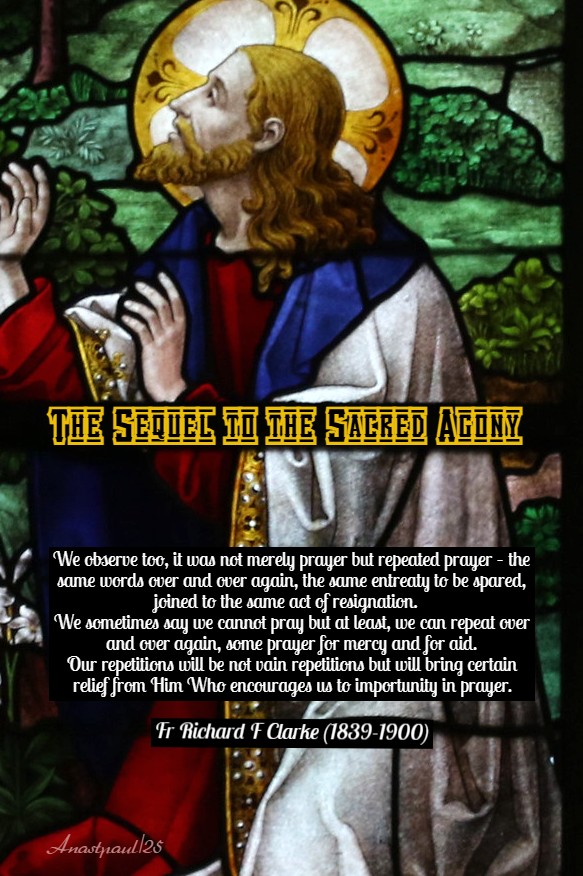
+3. We observe too, it was not merely prayer but repeated prayer – the same words over and over again, the same entreaty to be spared, joined to the same act of resignation. We sometimes say we cannot pray but at least, we can repeat over and over again, some prayer for mercy and for aid. Our repetitions will be not vain repetitions but will bring certain relief from Him Who encourages us to importunity in prayer.
One Minute Reflection – 18 March – “The Month of Saint Joseph” – St Cyril of Jerusalem (315-387) Bishop of Jerusalem, Confessor Father & Doctor of the Church – Ecclesiasticus 39:6-14 – Matthew 10:23-28 – Scripture search here: https://www.drbo.org/
“What you hear whispered, proclaim on the housetops.” … Matthew 10:27
REFLECTION – “He had said previously, “What I tell you in the dark, declare in the light and what you hear whispered, proclaim upon the housetops.” He now explains what follows after this proclamation. The whole world is divided against itself, for the sake of faith in Christ. Every house contains both unbelievers and believers. And a necessary conflict has been sent to break an evil peace. It is written in Genesis, God did a similar thing to the rebellious people who streamed out of the east and rushed to build a tower, by which they meant to reach the heights of Heaven. God divided their languages. For this same reason, David prays in the Psalm, “O God, scatter the peoples who delight in war.” – St Jerome (343-420) Priest, Monk, Translator of the Sacred Scriptures into Latin, Father and one of the original 4 Doctors of the Latin Church (Commentary on Matthew 1)
PRAYER – Grant us, we beseech Thee, Almighty God, through the intercession of the blessed Bishop Cyril, so to acknowledge Thee, the only true God and Jesus Christ Whom Thou have sent, that we may be found worthy to be forever numbered among the sheep who hear His Voice.Through the same Jesus Christ, Thy Son our Lord, Who lives and reigns with Thee, in the unity of the Holy Ghost, God, world without end. Amen (Collect).
Our Morning Offering – 18 March – Tuesday after the Second Sunday in Lent
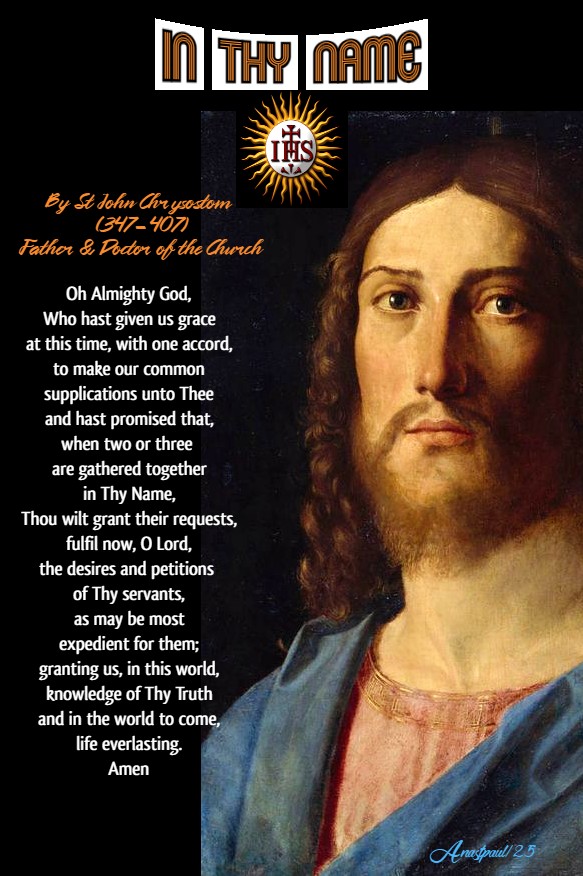
In Thy Name By St John Chrysostom (347-407) Father and Doctor of the Church
Oh Almighty God, Who hast given us grace at this time, with one accord, to make our common supplications unto Thee and hast promised that, when two or three are gathered together in Thy Name, Thou wilt grant their requests, fulfil now, O Lord, the desires and petitions of Thy servants, as may be most expedient for them; granting us, in this world, knowledge of Thy Truth and in the world to come, life everlasting. Amen
Saint of the Day – 18 March – Blessed Christian O’Conarchy (c1100-1186) O.Cist. Abbot, a disciple and then the Archdeacon of the renowned St Malacy O’More (1094 – 1148) , the Bishop and Confessor of Armagh, possibly also the Bishop of Lismore and the Papal Legate of all Ireland, although these latter Offices are unconfirmed. Born in c1100 at Bangor, County Down, Ireland and died in 1186 at Odorney Abbey, Ireland of natural causes. Also known as – Christianus, Giolla Criost Ua Condoirche.
Beyond the fact that Christian was the Abbot of the first Cistercian Monastery established in Ireland, practically nothing at all can be stated with certainty about his life.
The various traditions and legends are confused and conflicting. According to some accounts, he was born at Bangor in Ulster,and some reports say he was the disciple and then, the Archdeacon of St.Malachy the Bishop of Armagh. Christian probably accompanied the Prelate on a visit to Rome, visiting at Clairvaux on their way there.
It is believed that Christian was one of the four disciples of St Malachy, who remained behind at Clairvaux on the homeward journey and who received the Habit from St Bernard himself.
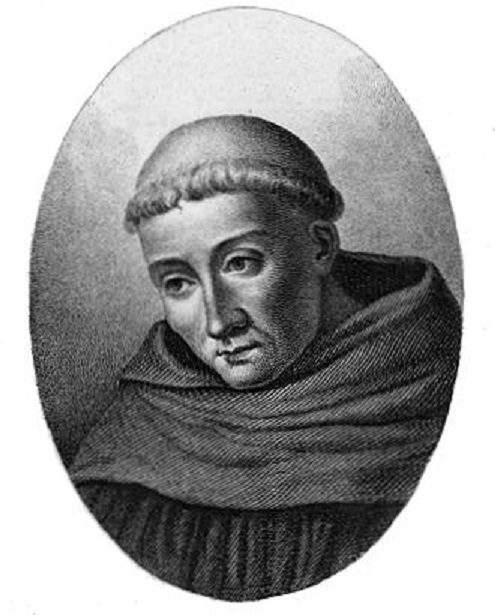
St Bernard
Upon Christian’s return to Ireland, St Malachy was anxious to introduce the Cistercian Order into Ireland and, at his prompting, Christian set about building Mellifont Monastery. In 1142, St Malachy applied to St Bermard to appoint a Superior and to send Monks to fill the new Monastery and St Bernard appointed Christian as the Abbot and sent several French brothers.
The ruins of the Mellifont Monastery built by Blessed Christian under instruction from St Malachy
Christian is said, by some writers, to have become the Bishop of Lismore andthe Papal Legate for Ireland. An ancient anonymous Irish analyst notes the year 1186 as the date of the death of Christian, the illustrious Prelate of Lismore, “formally Legate of Ireland, emulator of the virtues which he saw and heard from his holy father, St Bernard and from the Supreme Pontiff, the venerable man Eugenius, with whom he was in the novitiate at Clairvaux.”
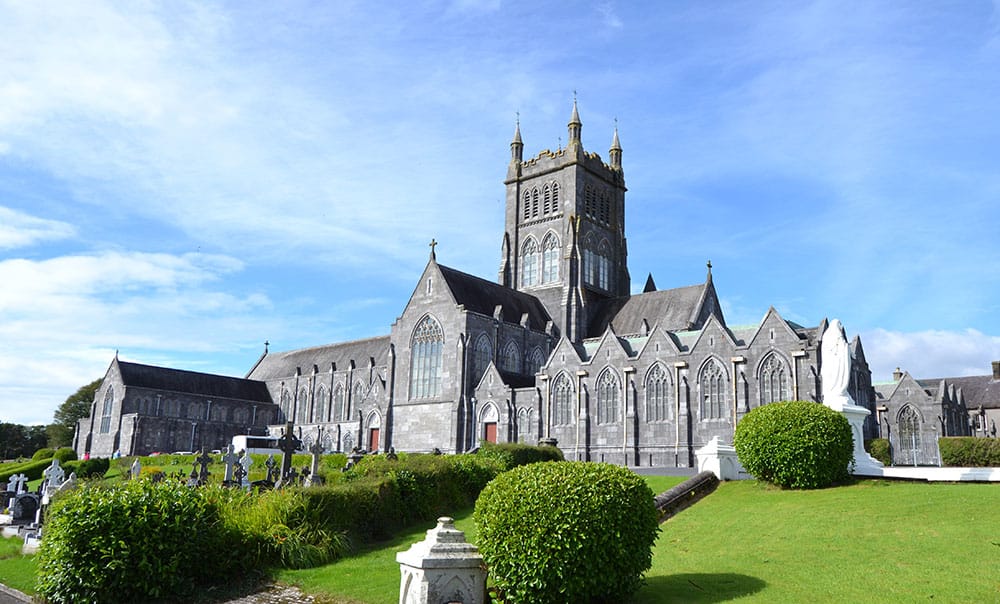
The new Mellifont Monastery built after the reformation
Martyrs of Nicomedia – Commemorates the Christians who were Martyred anonymously, either singly and in small groups, by local pagans in the area of Nicomedia prior to the year 300 and who may have been over-looked in the waves of Diocletian persecutions that resulted in the deaths of thousands.
Thought for the Day – 17 March – Meditations with Fr Richard Frederick Clarke SJ (1839-1900)
“Short Meditations for March, St Joseph” From “The Devout Year” By Fr Richard Frederick Clarke SJ (1839-1900)
17th Day – St Joseph’s Fifth Joy. Seeing the Idols of Egypt Fall to the Ground
+1. When the Holy Family had crossed the desert and arrived at the place of their abode in Egypt, tradition records a miracle. The idols in the temples are said to have fallen prostrate on the very night of their arrival. The news filled Joseph’s heart with joy. The one thought of Joseph’s life was to further the influence of Jesus. His one joy was to see Jesus vanquish His enemies and gather to Himself men of goodwill.
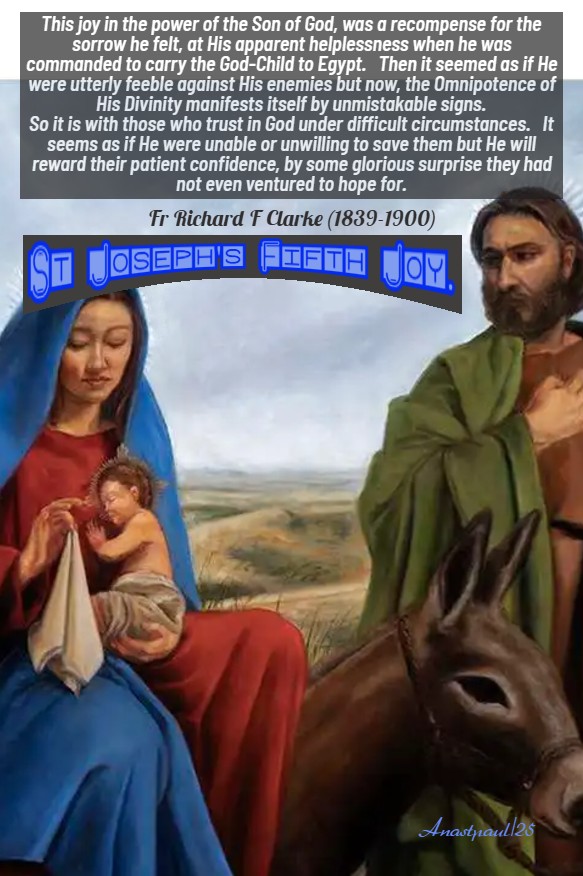
+2. This joy in the power of the Son of God, was a recompense for the sorrow he felt, at His apparent helplessness when he was commanded to carry the God-Child to Egypt. Then it seemed as if He were utterly feeble against His enemies but now, the Omnipotence of His Divinity manifests itself by unmistakable signs. So it is with those who trust in God under difficult circumstances. It seems as if He were unable or unwilling to save them but He will reward their patient confidence, by some glorious surprise they had not even ventured to hope for.
+3. Christ’s task is always to destroy idols. In my heart there are many idols – sloth, sensuality, selfishness, impatience, anger, neglect of religious duties, unkindness to others, self-love, disobedience and worst of all, pride! If Jesus is to dwell within me, these idols must be overthrown and pride above all. It is a difficult task, as long as they hold sway within my heart. O good St Joseph, bring Jesus and His love and cast these hateful itruders which Jesus hates, out of my heart.
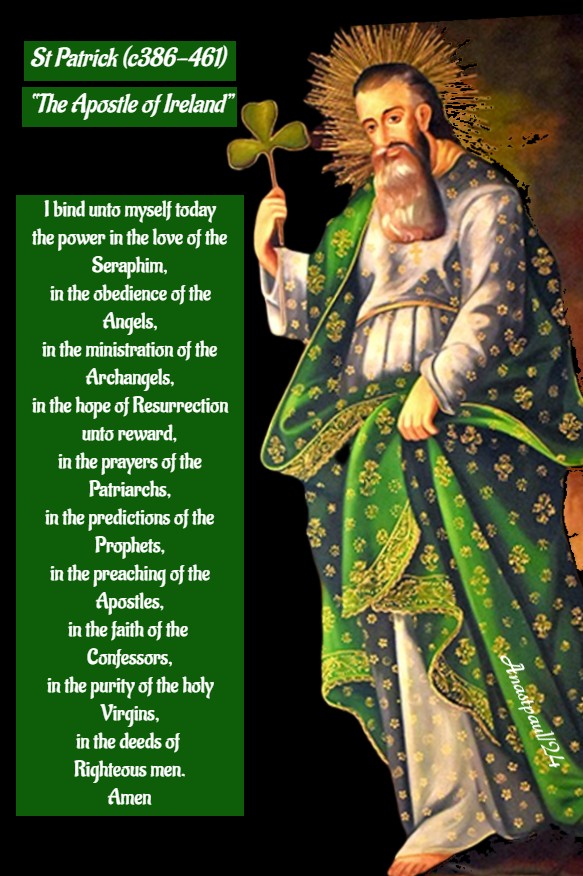
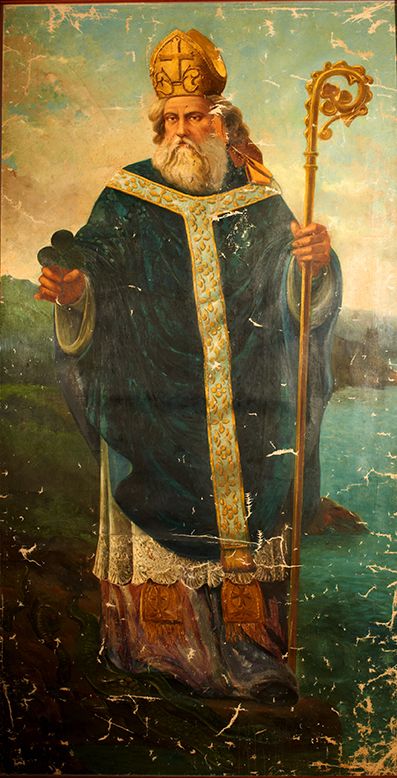
Quote/s of the Day – 17 March – St Patrick (c386-461) “The Apostle of Ireland,” Bishop, Confessor
“The man of God, Patrick, was marvellously favoured with heavenly visions and revelations in prayer. ‘When,’ says his biographer, ‘he everyday, in the Mass, sacrificed the Son to the Father, or devoutly recited the Apocalypse of St John, it was granted to him to see the heavens opened and Jesus standing there, surrounded by a multitude of Angels and whilst he meditated on these great visions, his soul was altogether lost in God.’ Three times in the week the Angel Victor, visited and conversed with him, filling his soul with celestial consolations. The labours of the day, amongst men, seem to have been less arduous than those of the night with God.” (The Life of St Patrick, Apostle of Ireland)
Prayer of St Patrick
I bind unto myself today the power in the love of the Seraphim, in the obedience of the Angels, in the ministration of the Archangels, in the hope of Resurrection unto reward, in the prayers of the Patriarchs, in the predictions of the Prophets, in the preaching of the Apostles, in the faith of the Confessors, in the purity of the holy Virgins, in the deeds of Righteous men. Amen
Lenten Meditations – 17 March – With Fr Richard Frederick Clarke SJ (1839-1900) Scripture search here: https://www.drbo.org/
“The Sacred Passion of Our Lord Jesus Christ” “Short Meditations for Lent” From “The Devout Year” By Fr Richard Frederick Clarke SJ (1839-1900)
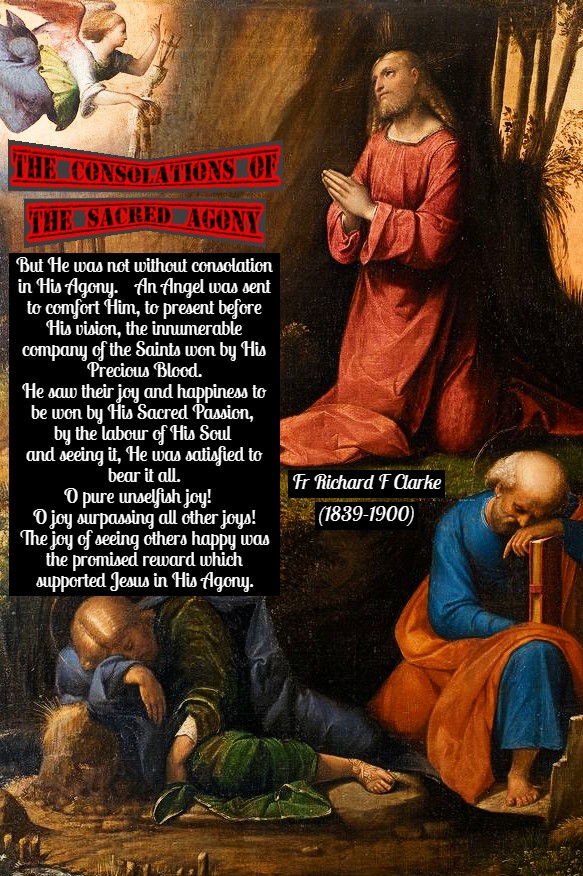
Monday after the Second Sunday in Lent The Consolations of the Sacred Agony
Read St Luke xxii:40-46
[40] And when He was come to the place, He said to them: Pray, lest ye enter into temptation. [41] And He was withdrawn away from them, a stone’s cast and kneeling down, He prayed, [42] Saying – Father, if Thou wilt, remove this chalice from Me but yet, not My Will but Thine be done. [43] And there appeared to Him an Angel from Heaven, strengthening Him. And being in an agony, He prayed the longer. [44] And His sweat became as drops of blood, trickling down upon the ground. [45] And when He rose up from prayer and was come to his disciples, he found them sleeping for sorrow. [46] And he said to them: Why sleep you? arise, pray, lest you enter into temptation. [Luke 22:40-46]
+I. No words can tell, no human heart can conceive, the intensity of the Sacred Agony of Jesus. It would have crushed His very Life, had He not, by means of His Divinity, supported His Sacred Humanity and so enabled it, to suffer more. See Him pale, haggard, scarcely to be recognised in His abasement and His terror! See the sweat of Blood pouring from His Sacred Limbs! Can this be the well-beloved Son of God? My God, make me more contrite at the thought that I have taken part in bringing Thee to this great horror!
+2. But He was not without consolation in His Agony. An Angel was sent to comfort Him, to present before His vision, the innumerable company of the Saints won by His Precious Blood. He saw their joy and happiness to be won by His Sacred Passion, by the labour of His Soul and seeing it, He was satisfied to bear it all. O pure unselfish joy! O joy surpassing all other joys! The joy of seeing others happy was the promised reward which supported Jesus in His Agony.
+3. But He had a still greater and stronger support than this. He beheld the honour and glory which would accrue to His Eternal Father. He saw that all the glory God would reap from His Works, would be as nothing in comparison to this greatest Work, to be wrought by His Eternal Son and seeing this, He was satisfied and more than satisfied. In the beginning of the Book, it is written of Him: “Behold, I come to do Thy Will, O my God. I am content to do it.“” Have I the glory of God at heart as the first and foremost motive of my actions?
One Minute Reflection – 17 March – “The Month of Saint Joseph” – St Patrick (c386-461) “The Apostle of Ireland,” Bishop, Confessor – Ecclesiasticus Sirach 44:16-27 – 45:3-20, Matthew 25:14-23 – Scripture search here: https://www.drbo.org/
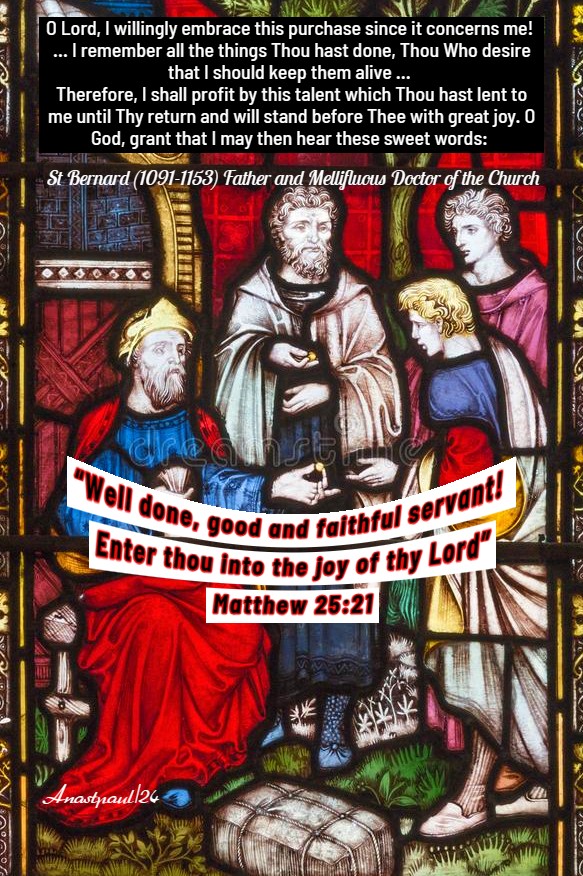
“Well done, good and faithful servant … Enter thou into the joy of thy Lord.”- Matthew 25:21
REFLECTION – “The Word of the Father, Only-begotten Son of God, Sun of Justice (Mal 3:20), is the great Merchant Who has brought us the price of our redemption. It is a truly precious exchange which we can never value sufficiently, when a King, Son of the King Most High, has become the Coin, the Gold has paid our dues, the Just Man is given for the sinner. Truly unmerited mercy, perfectly disinterested love, astonishing goodness …, it is a completely disproportionate purchase, in which the Son of God is delivered up for the servant, the Creator is put to death for the one He has created, the Lord is condemned for His slave.
O Christ, these are Thine Works, Thou Who descended from Heaven’s brightness into our hellish darkness, to bring Light to our gloomy prison. Thou came down from the Right Hand of the Divine Majesty, into our human misery, to redeem the human race, Thou Who descended from the Father’s glory, to death on the Cross, to triumph over death and its author. Thou art the only One and there is no other but Thee Who could have been drawn to redeem us through Thine Own Goodness…
Let all the merchants of Teman (Bar 3:23) withdraw from this place … it is not they but Israel [Thy] beloved whom [Thou hast] chosen, Thou Who hide these mysteries from the wise and prudent and have revealed them to those babes and humble servants of Thine (Lk 10:21) … O Lord, I willingly embrace this purchase since it concerns me!… I remember all the things Thou hast done, Thou Who desire that I should keep them alive … Therefore, I shall profit by this talent which Thou hast lent to me until Thy return and will stand before Thee with great joy. O God, grant that I may then hear these sweet words: “Well done, good and faithful servant! Enter thou into the joy of thy Lord” (Mt 25:21).” – St Bernard O.Cist. (1091-1153) Cistercian Monk, known as the Last Father and the Mellifluous Doctor of the Church (Selected sermons, no 42: The Five Purchases).
PRAYER – O, God, Who graciously sent blessed Patrick, Thy Confessor and Bishop, to preach Thy glory to the nations, grant through his merits and intercession that by Thy mercy, we may be able to accomplish what Thou command. Through Jesus Christ, Thy Son our Lord, Who lives and reigns with Thee, in the unity of the Holy Ghost, God, world without end. Amen (Collect).
Our Morning Offering – 17 March – St Patrick (c386-461) “The Apostle of Ireland,” Bishop, Confessor
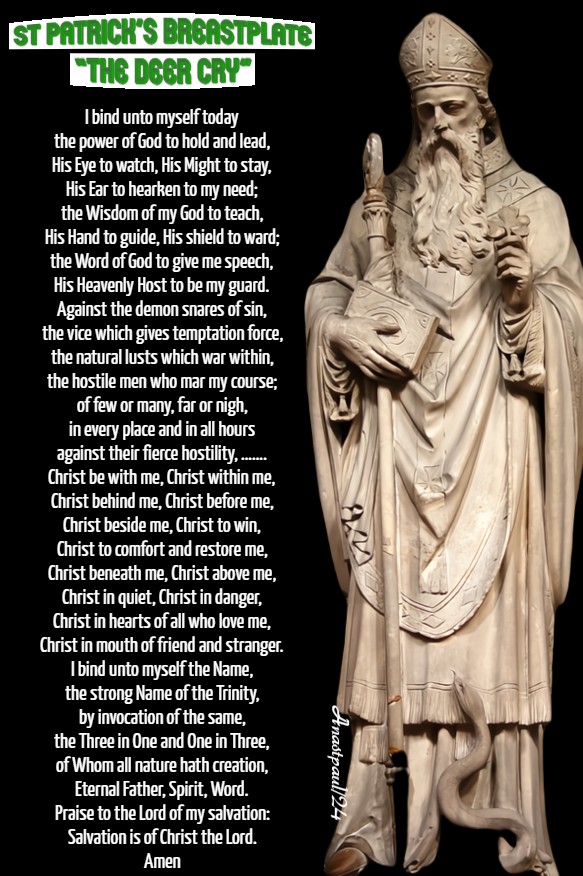
Excerpt from St Patrick’s Breastplate (also known as “The Deer Cry”)
I bind unto myself today the power of God to hold and lead, His Eye to watch, His Might to stay, His Ear to hearken to my need; the Wisdom of my God to teach, His Hand to guide, His shield to ward; the Word of God to give me speech, His Heavenly Host to be my guard. Against the demon snares of sin, the vice which gives temptation force, the natural lusts which war within, the hostile men who mar my course; of few or many, far or nigh, in every place and in all hours against their fierce hostility, ……. Christ be with me, Christ within me, Christ behind me, Christ before me, Christ beside me, Christ to win, Christ to comfort and restore me, Christ beneath me, Christ above me, Christ in quiet, Christ in danger, Christ in hearts of all who love me, Christ in mouth of friend and stranger. I bind unto myself the Name, the strong Name of the Trinity, by invocation of the same, the Three in One and One in Three, of Whom all nature hath creation, Eternal Father, Spirit, Word. Praise to the Lord of my salvation: Salvation is of Christ the Lord. Amen
Saint of the Day – 17 March – St Agricola (498-580) Bishop of Châlon-sur-Saône, Defender of the true Faith against heretics, a zealous shepherd and teacher of his flock, Apostle of the poor and sick, building hospitals and leper colonies. He founded Churches and Monasteries. He was also a Diplomat and Peace-maker against invading barbarian forces and protector his people by his great courage. Agricola cared for his Diocese for 50 years with tireless dedication. He was born in 498 in the region and died there in 580 of natural causes. Patronage – of Châlon-sur-Saône. Also known as – Aregl, Agrele.
The Roman Martyrology reads today: “At Châlon, in France, St Agricola, Bishop.”
Born in 498 to a noble senatorial family, Agricola of Châlon-sur-Saône distinguished himself from a young age for his pious nature and religious fervour. Having received a rigorous education, he developed a keen intelligence and a profound knowledge of the Sacred Scriptures which nourished his vocation to the Divine service.
In 532, he was Consecrated as the Bishop of Châlon-sur-Saône, assuming the leadership of the Diocese with tireless zeal and exemplary dedication.
His Episcopate, which lasted about 50 years, was marked by pastoral activity aimed at caring for the flock entrusted to him. Agricola did his utmost to strengthen the faith of Christians, promoting assiduous preaching, religious instruction and the celebration of the Sacraments. With wisdom and firmness, he fought the rampant heresies, especially Arianism, strenuously defending the orthodox doctrine.
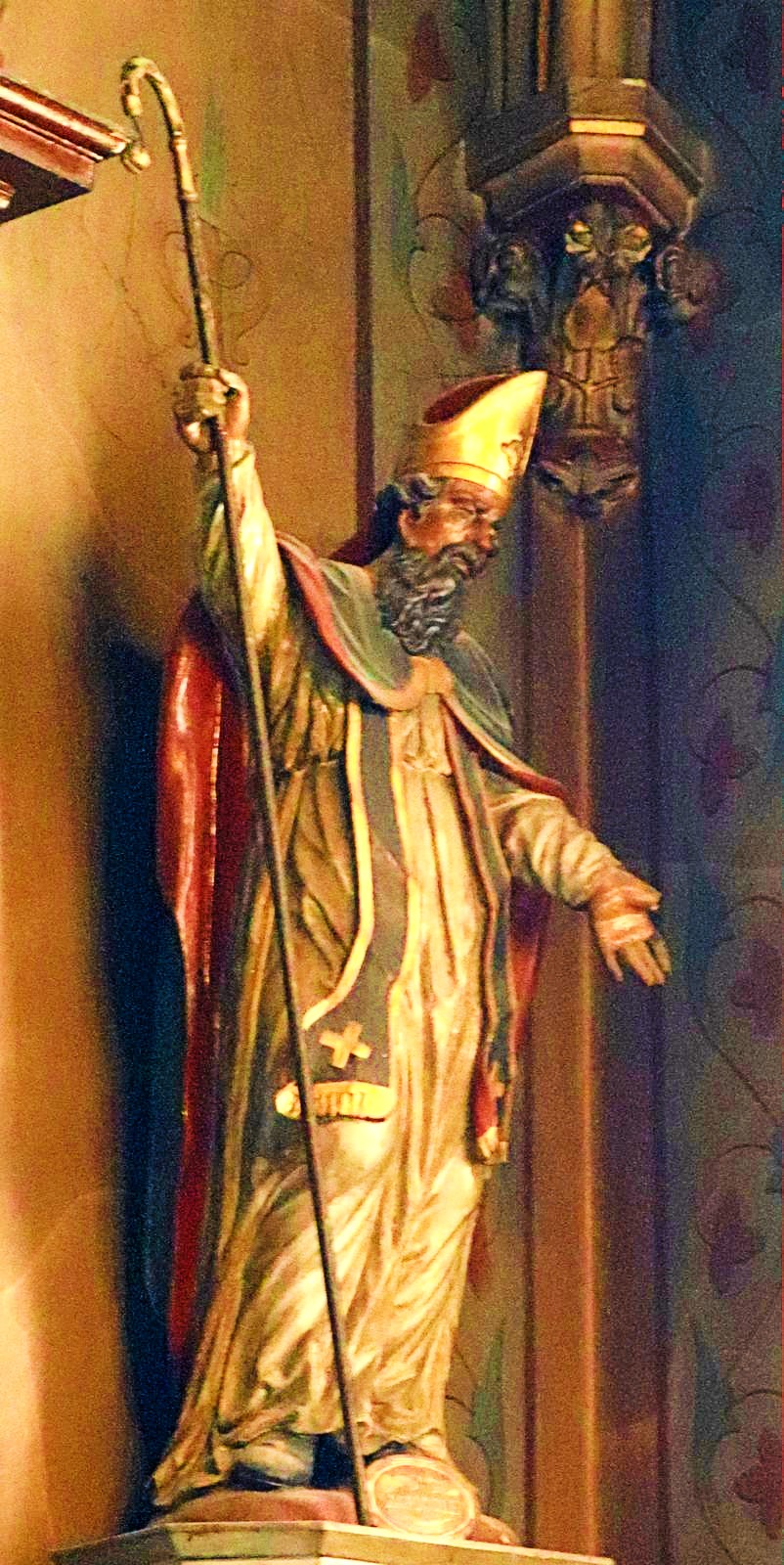
Statue in the Church Saint-Marcel near Châlon-sur-Saône where St Agricola’s FRelics are enshrined
In 535, he participated in the Synod in Arvernis —present-day Clermont-Ferrand— and sent one of his Priests to the Synod in Orléans in 538.
His tenacity and courage were particularly evident in the context of the barbarian invasions which were devastating Europe at that time. Agricola stood as a bulwark of his community, protecting it from the violence and depredations of the barbarians. With skilled diplomacy and tireless commitment, he negotiated with the various invading leaders, obtaining their protection and ensuring the survival of the Diocese.
In addition to his pastoral and civil role, Agricola also distinguished himself for his generosity and charity towards the poor and needy. He promoted the construction of hospitals and leper colonies, offering relief and comfort to the outcasts and the suffering.
His fame for sanctity spread rapidly, attracting pilgrims from all over to Châlon-sur-Saône, who sought his blessing and advice. After a life spent in the service of God and his neighbour, Saint Agricola died peacefully in 580, leaving an indelible legacy of unshakeable faith, adamantine tenacity and loving compassion.
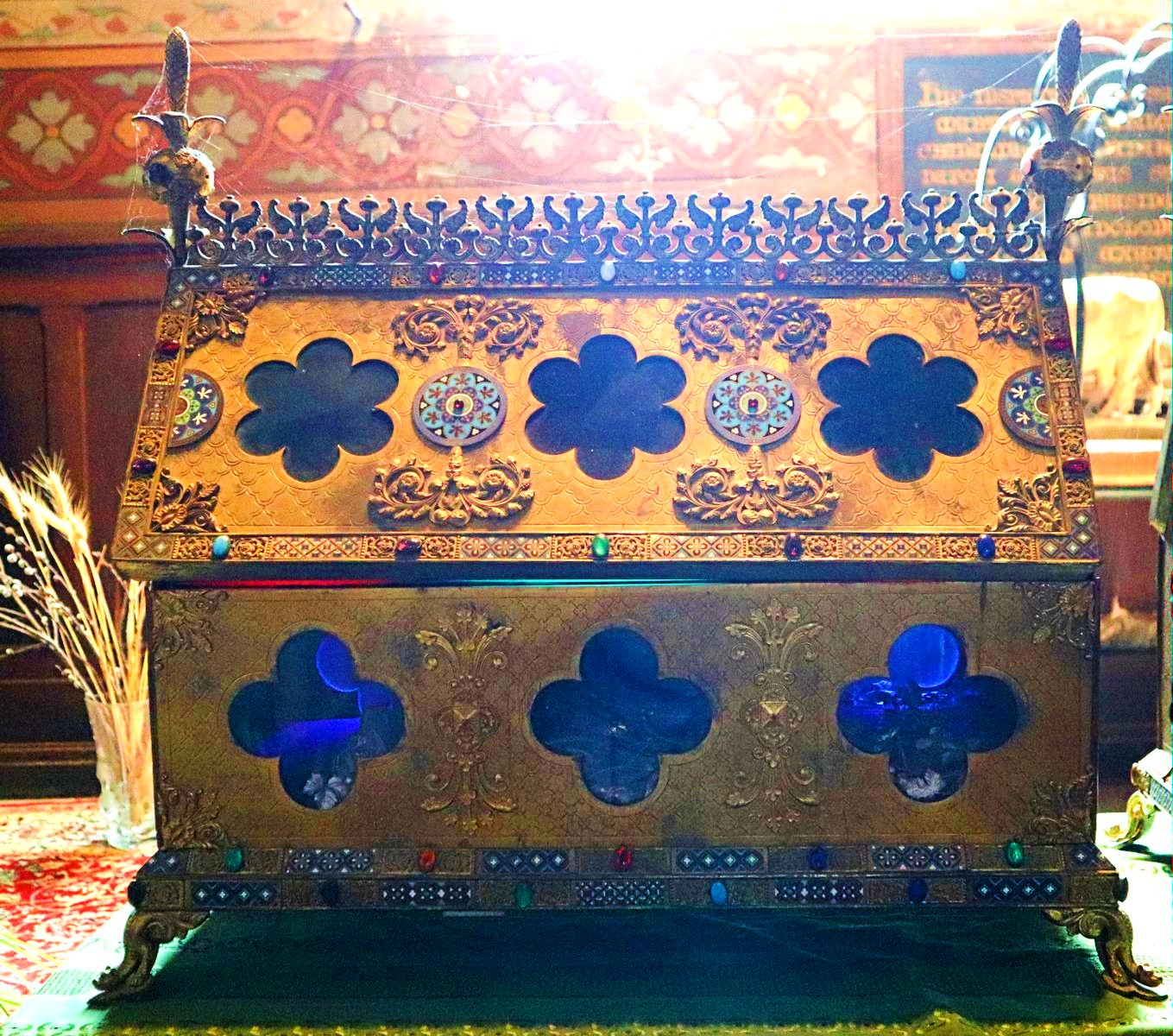
Agricola was buried in the Church of the then Monastery in Saint-Marcel near Châlon-sur-Saône, where his remains were found in 878.
St Joseph of Arimathea (Died 1st Century) “The Secret Disciple of Jesus.” Patronages – of pallbearers, funeral directors, morticians, undertakers, tin miners, tin smiths, Catholic Cemeteries of the Archdiocese of Vancouver, Glastonbury Cathedral. Feast day moved after Vatican II to 31 August “The Secret Disciple of Jesus” https://anastpaul.com/2021/08/31/saint-of-the-day-31-august-saint-joseph-of-arimathea-died-1st-century/
NOVENA to ST JOSEPH DAY EIGHT: Click Link HERE:DAY EIGHT
St Agricola (498-580) Bishop of Châlon-sur-Saône St Alexander St Ambrose of Alexandria
St Llinio of Llandinam St Paul of Cyprus St Stephen of Palestrina St Theodore of Rome St Thomasello St Withburga (Died 743) Abbess, Princess
Martyrs of Alexandria – Also known as Martyrs of Serapis: An unknown number of Christians who were Martyred together by a mob of worshippers of the Graeco-Egyptian sun god Serapis. They were Martyred in c 392 in Alexandria, Egypt.
































You must be logged in to post a comment.