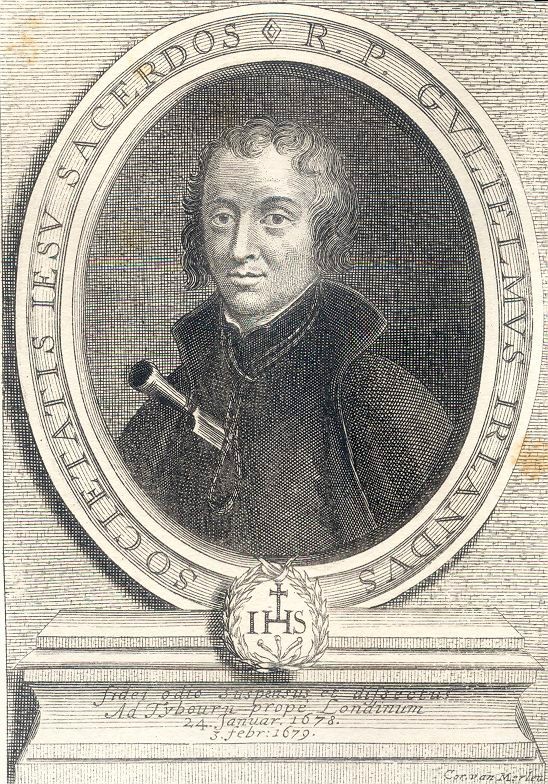
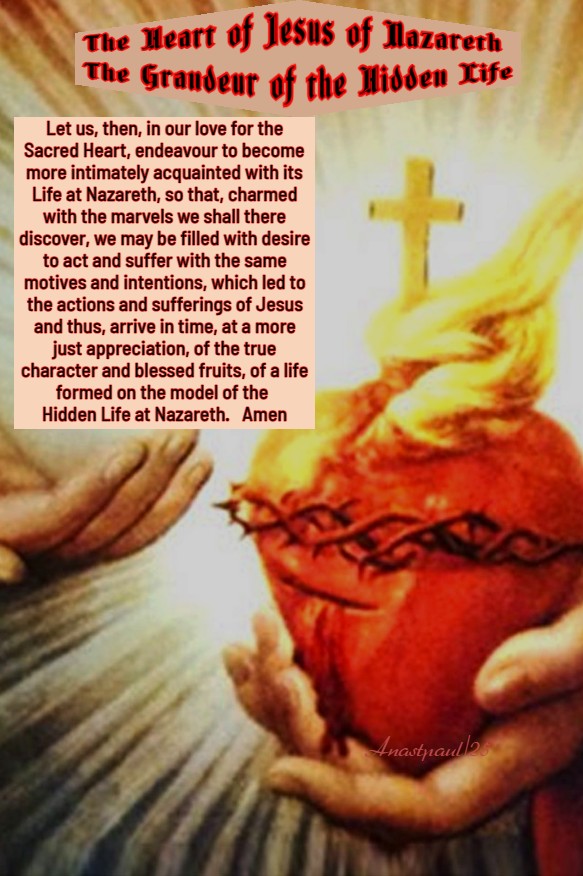
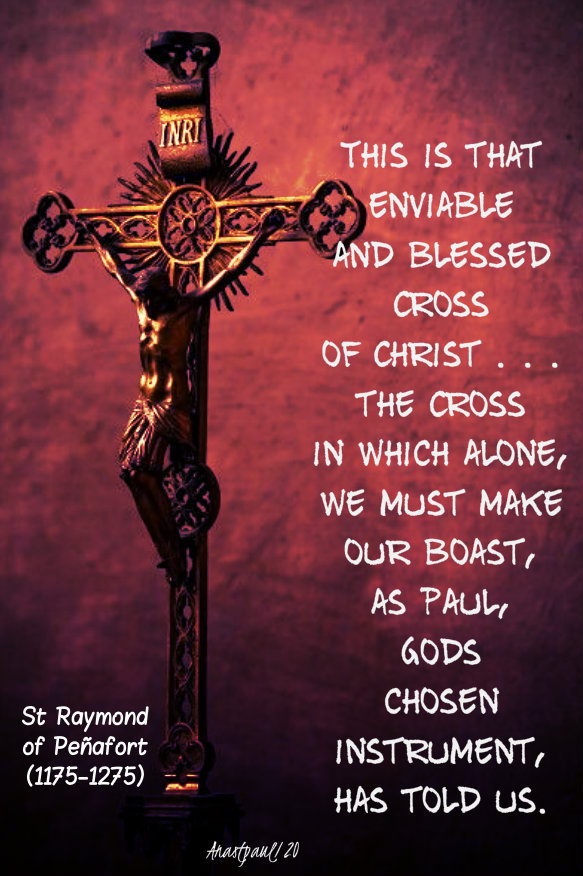
Thought for the Day – 16 August – Meditations with Fr Richard Frederick Clarke SJ (1839-1900)
CHARITY Meditations for a Month
The Resignation of Charity “Charity endureth all things”
The test of our love for anyone, is what we are willing to endure for that person. If we love only a little, we are willing to endure only a little. If we love much, we are willing to endure much. If we love that person, better than we love ourselves, we are pleased to endure, for his sake, that which we would otherwise dread. If we love that person better than we love ourselves, we are pleased to endure, for his sake, that from which we would otherwise shrink. Hence, the test of our supernatural charity, is what we are willing to endure for God and whether ,it is a pleasure for us to endure, positive suffering, for Him.
We would consider it a great privilege, if we were called upon to lay down our lives for the Faith. However, this is a grace we poor ordinary mortals cannot expect and, we must be careful against deluding ourselves, by fancy pictures of the courage we should then display. The real question before us, is whether we willingly suffer the little, disagreeable effects of life, bodily ailments, failures in our projects, neglect or unkindness from others, or undeserved reproaches. It is no use thinking of Martyrdom until we have learnt to bear these!
If I have true charity, I shall take all with joy. Everything I have endured, I would willingly endure again for God’s sake. I would, with His grace, accept even more painful things, for charity endures all things, rather than offend God. Fervent charity would endure all things rather than be unfaithful to one single inspiration which comes from Him, or neglect one single grace which He desires to give us. Here is the test for me. How far can I stand it?
Quote/s of the Day – 16 August – “The Month of the Immaculate Heart of Mary” – St Joachim, Father of the Blessed Virgin Mary – Ecclesiasticus 31:8-11, Matthew1:1-16 – Scripture search here: https://www.drbo.org/
“And Jacob begot Joseph, the husband of Mary and of her was born Jesus, Who is called Christ.”
Matthew 1:16
“That anyone could doubt the right of the holy Virgin to be called the Mother of God, fills me with astonishment. Surely she must be the Mother of God, if our Lord Jesus Christ is God and she gave birth to Him!”
St Cyril of Alexandria (376-444) Father and Doctor of the Church
“Having confidence in thee, O Mother of God, I shall be saved. Being under thou protection, I shall fear nothing. With thy aid, I shall give battle to my enemies and put them to flight, for devotion to thee, is an arm of Salvation.”
St John Damascene (676-749) Father and Doctor of the Church
Hail to Thee, Forever Virgin, Mother of God, By St Methodius of Olympus (Died c311)
Hail to thee forever-Virgin Mother of God, our unceasing joy! for unto thee do I again return. . . . Hail, thou fount of the Son’s love for man. . . . Wherefore, we pray thee, the most excellent among women, who boast in the confidence of thy maternal honours that thou wouldst, unceasingly, keep us in remembrance. O holy Mother of God, remember us, I say, who make our boast in thee and who, in august hymns celebrate thy memory which will ever live and never fade away. Amen
One Minute Reflection – 16 August – “The Month of the Immaculate Heart of Mary” – St Joachim, Father of the Blessed Virgin Mary – Ecclesiasticus 31:8-11; Matthew1:1-16 – Scripture search here: https://www.drbo.org/
“And Jacob begot Joseph, the husband of Mary and of her was born Jesus, Who is called Christ.” – Matthew 1:16
REFLECTION – “The genealogy of Jesus Christ from St Matthew’s Gospel is read to us. It is a custom handed down by holy Church with a beauty and mystery of its own. For behold, how in truth this reading puts before us, at dead of night that ladder, which Jacob saw at night in his sleep (Gn 28:12). Supported on the topmost rung of the ladder, where it reached Heaven, the Lord appeared to Jacob and promised him that his posterity would inherit the earth … Now, as we know, “all these things happened to them in figure” (1 Cor 10:11). The ladder by which the Lord appeared to be supported, prefigured the family-tree of Jesus Christ which the holy Gospel-writer so drew up, as to come through Joseph. It is, by Joseph that our Lord, as a small Child, is supported. Through the Gate of Heaven (Gn 28:17) … that is, through the Blessed Virgin, our Lord, a tiny Child, for our sake, comes crying … The words which Jacob, in his sleep heard the Lord say, “And in thy posterity shall all the nations of the earth be blessed” are fulfilled, by the birth of Christ.
The divine writer, bearing in mind this very point, put the names of Rahab, the prostitute and Ruth, the Moabite, into his genealogy. For he saw that Christ was made flesh, not for the Jews alone but also for the Gentiles, inasmuch as He deigned to accept ancestors from among the Gentiles … Sprung, therefore, from two races, Jew and Gentile, as from two sides of the ladder, the ancestors from their different rungs support Christ our Lord, emerging from Heaven. The holy Angels come up and go down and all the elect are first humbled, to receive faith in His Incarnation that they may be afterward lifted up, to see the glory of His Divinity.” – Rupert of Deutz (c1075- c1130) Benedictine Monk, Theologian and Writer (De Divinis Officiis 3, 18).
PRAYER – O God, Who, willed St Joachim to be the father of Thy Son’s Mother; grant, we beseech Thee that we may ever enjoy the spiritual help of him whose feast we celebrate. Through the same Jesus Christ, Thy Son our Lord, Who lives and reigns with Thee, in the unity of the Holy Ghost, God, world without end. Amen (Collect).
Our Morning Offering – 16 August – “The Month of the Immaculate Heart of Mary” – Feast of St Joachim, Father of the Blessed Virgin Mary
Hymn to St Joachim, Father of the Blessed Virgin Mary From the Liturgical Year, 1907
O Joachim, Father of the Sovereign Maiden, who in all purity gave birth to God, present to the Lord, our petitions and our chaste desires.
Thou knowest, by what angry waves we are here tossed, whom the cruel sea of this world wearies so, Thou knowest how many battles Satan and the flesh, prepare for us.
Now that thou art united , to the holy companies in Heaven, or rather art placed at their head, thou canst do all if thou wilt; for rightly, neither Jesus, thy Grandson, nor Mary, thy daughter, can deny thee aught.
Obtain by thy prayer that our Blessed God may give us pardon and peace that united with thee, we may sweetly sing canticles to Him. Amen
Saint of the Day – 16 August – Blessed Laurence “Loricatus” (Died 1243) Hermit, Pilgrim, Penitent, previously a Soldier. Born in Facciolo, Apulio, Italy and died in 1243 at Subiaco, Italy. “Loricatus” (Latin) meaning wearing Chain Mail.
Laurence served as a Solider as a young man. After accidentally killing a man, perhaps in the course of duty, he was so overcome with remorse that he dedicated himself to a life of penance. The image below by Fra Angelico depicts St Benedict finding a new disciple in his ‘cave.’
After travelling as a pilgrim to the great Shrine of Saint James in Compostella, he became a Hermit at Subiaco, hallowed by St Benedict long before.
Laurence lived as a Hermit in the ruins of the cave where Saint Benedict himself had lived. When pilgrims would leave gifts and offerings for him, he would give these to the poor.
A spiritual master, he began to train a small community of disciples and later wrote a book of prayers. In 1224, his fame attracted a visit from Cardinal Hugolino (later Pope Gregory IX) who persuaded him to abandon his chain mail breastplate.
He died in 1243 after 34 years of eremitical life. He was succeeded by his disciple Amico de Canterano, who had shared his way of life for 24 years. Below is St Benedict’s Monastery at Subiaca beneath which lies the Shrin of our Blessed Laurence.
In 1244, an enquiry into his life and miracles initiated by Pope Innocent IV did not lead to an immediate formal Canonisation but a popular cult flourished which was approved by Pope Pius VI in 1778.
Blessed Laurence’s Relics, including the Manuscript in his own hand and his “Loricatus” Breastplate, are enshrined in St Benedict’s Cave at Subiaco.
Blessed Angelo Agostini Mazzinghi O.Carm. (1385-1438) was an Italian Priest and a professed member of the Carmelite Order. He was a noted Preacher, Prior and Reformer, Teacher of theology and was known for his pious devotion to the Holy Eucharist, the Blessed Virgin Mary and the Carmelite Rule of Life and to the profession of the Gospel. Holy Angelus: https://anastpaul.com/2019/08/16/saint-of-the-day-16-august-blessed-angelo-agostini-mazzinghi-o-carm-1385-1438/
St Arsacius of Nicomedia St Frambaldo Bl Iacobus Bunzo Gengoro Bl Jean-Baptiste Menestrel Bl John of Saint Martha
Blessed Laurence Loricatus (Died 1243) Hermit, Pilgrim, Penitent Bl Magdalena Kiyota Bokusai Bl Maria Gengoro Bl Ralph de la Futaye St Serena Bl Simon Kiyota Bokusai
St Ugolina of Vercelli (c 1239-c 1300) Anchorite, Recluse, Penitent, Spiritual advisor. The very strange story that of this Blessed Ugolina who shut herself in a hermitage, representing herself as a man and remained there for forty-seven years! The aim of her subterfuge was to escape the aims of her father, who wished her to marry. In order not to reveal her secret, she called herself Ugo without revealing her identity to anyone. for nearly fifty years Her Life: https://anastpaul.com/2021/08/16/saint-of-the-day-16-august-saint-ugolina-of-vercelli-c-1239-c-1300/
Martyrs of Palestine – 33 Saints: Thirty-three Christians Martyred in Palestine; they are commemorated in old martyrologies but the date and exact location have been lost.
Thought for the Day – 15 August – Meditations with Fr Richard Frederick Clarke SJ (1839-1900)
CHARITY Meditations for a Month
The Hopefulness of Charity “Charity hopeth all things”
How common and how fatal an evil is discouragement! Half of our enterprises fail,, simply because we become discouraged. More than half of our faults are owing to discouragement. We lose heart and, therefore, fail in the necessary perseverance. We become despondent and seek to console ourselves, by some earthly pleasure or perhaps, sinful indulgence. No general who was discouraged ever won a victory and, no sinner who lost heart, ever became a Saint or even turned to God, as long as the despondency remained.
Yet, it is no easy thing to keep up our courage and our hope. We so often fail and failures are discouraging. We commit so many faults; yet, nothing saps our courage, as much as the consciousness of having done wrong. Then too, there are continual impediments and obstacles in our way, the neglect and indifference shown by others to our work, the opposition we meet and a thousand things more. Too often, these are causes of discouragement to all who are working for God. We ought not to be discouraged by them, for often, difficulties and opposition are the best signs of coming success!
How are we to keep courage and to be always hopeful? The only chance for us lies in our keeping God always before us and forgetting ourselves, as far as possible which depends on the degree of our charity. When self prevails, eventually hope disappears; when God is predominant, hope springs up in our heart, for “Charity hopeth all things.” I shall have strong confidence and a certainty of final success, if I have a fervent charity.
Quote/s of the Day – 15 August – “The Month of the Immaculate Heart of Mary” – The Assumption of the Blessed Virgin Mary into Heaven – Judith 13:22-25; 15:10, Luke 1:41-50 – Scripture search here: https://www.drbo.org/
The Praises of Mary “Assumption” Poem by Saint Anthony
O how wondrous is the dignity of the glorious Virgin! She merited to become the mother of Him who is the strength and beauty of the Angels and the grandeur of all the Saints.
Mary was the seat of our sanctification, that is to say, the dwelling place of the Son Who sacrificed Himself for us.
“And I shall glorify the place where my feet have stood.” The feet of the Saviour signify His human nature. The place where the feet of the Saviour stood was the Blessed Mary, who gave Him His human nature.
Today the Lord glorifies that place, since He has exalted Mary above the choirs of the Angels. That is to say, the Blessed Virgin, who was the dwelling of the Saviour, has been assumed bodily into Heaven.
Mary, our Queen and Mother of Mercy By St Anthony of Padua (1195-1231) Evangelical Doctor of the Church
Mary, our Queen! Holy Mother of God, we beg you to hear our prayer. Make our hearts overflow with Divine grace and resplendent with heavenly wisdom. Render them strong with your might and rich in virtue. Pour down upon us the gift of mercy so that we may obtain the pardon of our sins. Help us to live in such a way as to merit the glory and bliss of Heaven. May this be granted us, by your Son Jesus Who has exalted you above the Angels, has crowned you as Queen and has seated you with Himself forever, on his refulgent throne. Amen.
Mary, Virgin most Blessed Mother of Mercy By St Alphonsus Maria de Liguori (1696-1787) Most Zealous Doctor of the Church (Prayer used as part of the Assumption Novena)
O Mary, Virgin most Blessed and Mother of Our Lord and Redeemer, Jesus Christ, through thy mercy I beseech thee, to come to my aid and to inspire me with such confidence in thy power that I may have recourse to thee, pray to thee and implore thy aid, in all needs of soul and body. Amen
One Minute Reflection – 15 August – “The Month of the Immaculate Heart of Mary” – The Assumption of the Blessed Virgin Mary into Heaven – Judith 13:22-25; 15:10, Luke 1:41-50 – Scripture search here: https://www.drbo.org/
“For behold, as soon as the voice of thy salutation sounded in my ears, the infant in my womb leaped for joy. ” – Luke 1:44
REFLECTION – “Today the Virgin Mary rises gloriously to Heaven. She completes the happiness of Angels and Saints. For it was she whose simple word of greeting made the child in his mother’s womb leap for joy (Lk 1:44). What, then, must have been the rejoicing of the Angels and Saints, when they found themselves able to hear her voice, see her face and rejoice in her blessed presence!
And what a great Feast her glorious Assumption is for us, beloved brethren, what reason for happiness and cause for joy today! Mary’s presence brightens the whole world, so greatly do the heavens shine, lightened by the brilliance of the most holy Virgin. Therefore, it is altogether fitting that the heavens resound with thanksgiving and praise.
Yet, is it not also right that, just as Heaven rejoices in Mary’s presence, we of this world, should mourn her absence? Not at all. Let us not weep, since we have no lasting city here below (Heb 13:14) but seek that to which the Virgin Mary has come today. If even now we are registered among that City’s inhabitants, then, it is fitting that we should call it to mind today … share its joy, participate in the rejoicing which gladdens God’s City today; for today it falls like dew upon our earth. Yes, she, our Queen, has gone before us and has been received with so great a glory that we, her humble servants, may trustfully follow our Sovereign, crying [with the Bride of the Song of Songs]: “Draw us! We will run to the sweet scent of your perfumes!” (cf. Sg 1:3-4). Pilgrims on earth, we have sent our Advocate before us … the Mother of Mercy, who will successfully plead our salvation!” – St Bernard (1091-1153) Cistercian Abbot, Father and Doctor of the Church (1st Sermon for the Assumption).
PRAYER – O Lord, we beseech Thee, forgive the transgressions of Thy servants and, forasmuch as by our own deeds, we cannot please Thee, may we find safety through the prayers of the Mother of Thy Son and our Lord. Through the same Jesus Christ, Thy Son our Lord, Who lives and reigns with Thee, in the unity of the Holy Ghost, God, world without end. Amen (Collect).
Our Morning Offering – 15 August – “The Month of the Immaculate Heart of Mary” – The Assumption of the Blessed Virgin into Heaven
Fly, My Soul, with Mary Fly! By St Alphonsus Maria de Liguori (1696-1787) Most Zealous Doctor (From “The Glories of Mary”) Trans. Redemptoris Fathers, 1931)
Fly, my soul, with Mary fly! Soar beyond the golden sky, Mount to Mary’s throne on high.
Bright the queenly crown she won, Sweet the reign she has begun, As she stands beside her Son. Fly, my soul, with Mary fly.
How endure this long delay? Living here, how can I stay From such beauty far away? Fly, my soul, with Mary fly.
Sad my lot is here below; Who can hope or life bestow? Who will help or pity show? Fly, my soul, with Mary fly.
Saint of the Day – 15 August – Saint Arduinus of Rimini (Died 1009) Priest, Hermit, Monk, Apostle of the needy, a shining light of the imitation of his Lord. Born around the middle of the 10th Century in Rimini, in the district of Romagna in Italy and died at the Monastery of St Gaudenzio in the Town of San Godenzo in 1009 of natural causes. Also known as – Arduino.
St Peter Damian OSB (1007-1072) Cardinal Bishop of Ostia, Father and Doctor of the Church, when he found himself having to demonstrate the validity and efficacy of the Sacraments – even when administered by unworthy Priests and Prelates, – used to cite the example of our Saint Arduinus of Rimini, who had died several decades before but whose memory was still very much alive throughout Romagna.
Arduinus, in fact, had received Priestly Ordination from the Bishop of Rimini, Uberto, a well-known simoniac, who had purchased his Office in exchange for gold. Yet, Ordination by this unworthy Prelate did not prevent Arduinus from living in an exemplary manner and dying in the odour of sanctity.
St Peter Damian, a great opponent of simony, could, therefore, draw arguments from this case in favour of his thesis – that is, that the efficacy of the Sacraments does not depend upon the merits of those who actually administer them – but rather, derives from the Infinite Merits of Christ.
Arduinus was born in Rimini towards the middle of the 10th Century and had been a disciple of the Venerius, the Rector of the Church of St Gregory.
Driven by the desire to reach a greater degree of perfection and sanctity, the master and disciple moved to the plain of Ravenna, finding refuge in the solitary Church of St Apollinarus in Classe, today famous for its luminous architecture and even more so for the precious Byzantine mosaics it houses.
The memory of Arduinus which has been handed down depicts him as a zealous Priest, a rare case in that time of daily celebration of the most Sacred and Holy Mass. His wonderful example could thus prove edifying for the clergy and the faithful. He used to teach, admonish and fight corruption, without fear of arousing the wrath of the powerful. He regularly donated alms to the neediest, contenting himself with surviving on the few remaining scraps. Being a man himself, he often found himself in the grip of temptations and, to overcome them, he used to roll in the nettles.
When Venerius was already old, Arduinus advised him to accept the position of Abbot of St Gaudenzio Monastery in the Town of San Godenzo and he, as an inhabitant Monk, thus became a useful and faithful assistant to his teacher. Below is one of the paintings in the Abbey of San Gaudenzio: The Annunciation attributed to in the Franciabigio, 1500s.
This Abbey had been built in 1028 in honour of Saint Gaudentius, the Hermit Saint who, around the 6th Century, retired to the surrounding mountains to live a life of silence and prayer. Today it is famous for its beautiful Romanesque Church containing wonderful artworks and for Dante’s memories of the first years of his exile.
But, already a thousand years ago, the Abbey of St Gaudentius was an important centre of Benedictine spirituality, active in the manual, spiritual, intellectual and social fields, true to their motto ‘Ora et Labora.’
In this context, in 1009, Saint Arduinus of Rimini died, immediately venerated as a Benedictine Saint, even if it seems he never officially wore the Habit of this Order. (From Italian by Author: Fabio Arduino).
St Alypius of Thagaste (Died 430) Bishop Bishop of the See of Thagaste (in what is now Algeria) in 394, Confessor, Reformer, Defender of the Faith against heresy, Lawyer, teacher, spiritual advisor. He was a lifelong disciple and friend of Saint Augustine of Hippo and joined him in his conversion (in 386; Confessions 8.12.28) and life in Christianity. He is credited with helping establish Augustine’s Monastery in Africa. Most of what is known about him comes from Augustine’s autobiographical Confessions. Biography: https://anastpaul.com/2021/08/15/saint-of-the-dy-saint-alypius-of-thagaste-died-430/
Blessed Alfred of Hildesheim OSB (Died 874) Bishop, Benedictine Monk, Confessor, Founder of Essen Abbey, Hildesheim Cathedral, many Convents, Schools and Seminaries, Royal Spiritual Adviser to the East Frankish King Louis the German, Diplomatic Peacemaker, he was know for his great devotion to the Blessed Virgin Mary. His Lifestory: https://anastpaul.com/2020/08/15/saint-of-the-day-15-august-blessed-alfred-of-hildesheim-osb-died-874-bishop/
Blessed Aimo Taparelli OP (c 1395-1495) Priest and Friar of the Order of Preachers, widower and father, Reformer, spiritual writer. He served as an Inquisitor-General for his Order in the Lombard and Liguria regions of Italy and became a travelling preacher in Northern Italian Cities. His name means “defends the house with the sword.” Aimo was Beatified on 29 May 1856 by Pope Pius IX. Blessed Aimo’s zealous Life: https://anastpaul.com/2022/08/15/saint-of-the-day-15-august-blessed-aimo-taparelli-op-c-1395-1495/
Blessed Alberto Berdini OFM Conv. (1385– 1450) Priest and Friaer of the Friars Minor Conventual, known as the “King of Preachers – Rex Praedicatorum” Disciple and companion of St Bernardine of Siena in his Missionary work in Italy., often called upon to assist in peace discussions between warring Cities. Born in 1385 in Sarteano, Tuscany, Italy and died on 15 August 1450 in Milan, Italy of natural causes. Blessed Albert’s Life: https://anastpaul.com/2023/08/15/saint-of-the-day-14august-blessed-alberto-berdini-ofm-conv-1385-1450/
St Simplician (c320-c401) Archbishop of Milan and Successor of St Ambrose (340-397) Doctor of the Church in the Archdiocese of Milan, Teacher, Catechist, Writer, Mystic. St Ambrose used to call Simplician father, as a sign of spiritual relationship but they were also great friends. Simplician took also an active part in the conversions of both Alypius of Thagaste and Augustine of Hippo. The meeting between Augustine and Simplican occurred in Milan in 386 and it is recorded in Augustine’s Confessions. After his conversion, Augustine also called Simplician father and in 397 he dedicated to Simplician two books on the issue of predestination, known as De Diversis Quaestionibus ad Simplicianum. St Augustine, remembered and referred to him with deep gratitude, calling him the “spiritual father of my soul” and would submit his own writings to him to review and comment. Details of the life of St Simplician here: https://anastpaul.wordpress.com/2017/08/15/saint-of-the-day-15-august-st-simplician-of-milan/
Martyrs of Nicomedia – 3 Saints: Three Christians Martyred together. No details survive but the names – Eutychian, Philip and Straton. They were martyred in Nicomedia, Bithynia (in modern Turkey).
Thought for the Day – 14 August – Meditations with Fr Richard Frederick Clarke SJ (1839-1900)
CHARITY Meditations for a Month
The Faith of Charity “Charity believeth all things”
Faith is a preliminary gift of God, without which, charity is impossible. No-one can do any work which is pleasing in His sight, unless that person believes in God and is ready to accept whatever God has revealed. Works of benevolence are not works of charity, if he who performs them, does not possess this belief. The charity which rests on a feeble faith, will always be itself feeble. He who minimises, in matters of faith, will generally have a minimum of charity. Hence, pray for a loyal readiness to believe, that so you may obtain, an intense charity.
Charity, while it believes all things which God has revealed, is the reverse of credulous. Charity is the bitter enemy of superstition and carefully examines the claims of any doctrine, or the proofs of any fact which are not already vouched for, by authority. It is no act of faith or of charity, to swallow some unauthenticated statement. We should prove all things and hold fast only to that which is good. The Saints never were credulous or given to believe in portents, omens, or apparitions, unless, bearing the mark of the Finger of God.
Charity supplements faith and it strengthens it. The stronger our love of God, the stronger will be our belief in all which He has revealed. When love waxes cold, faith becomes faint. No man ever loses his faith without first wilfully estranging himself from God, by deliberate mortal sin. If I want a strong faith, I must cultivate a fervent charity. My ready acceptance of all God has revealed, will be in proportion, to my love of Him. If I have difficulties in belief, is it because there are gaps and defects in my charity?
Quote/s of the Day – 14 August – “The Month of the Immaculate Heart of Mary” – Vigil of the Assumption
“And some seed fell on good ground” Luke 8:8
“Rejoice, O Mary, House of the Lord, earth trodden by the Footsteps of God… Rejoice, O Paradise more happy than the Garden of Eden, where every virtue has been seeded and where the Tree of Life has grown.”
St Theodore the Studite (750-826) Father, Abbot, Theologian, Writer
“May the Blessed Virgin, unique in her merits, stand in the presence of her Creator interceding always in our favour. She will be radiant in the fullness of glory, she who brought forth, from her virginal womb, the King of glory.”
St Amadeus of Lausanne (1108-1159)
O Mary, Mother of God By St Ephrem (306-373) Father and Doctor of the Church
O Virgin most pure, wholly unspotted, O Mary, Mother of God, Queen of the universe, thou art above all the Saints, the hope of the elect and the joy of all the blessed. It is thou who hast reconciled us with God; thou art the only Refuge of sinners and the safe harbour of those who are shipwrecked; thou art the consolation of the world, the ransom of captives, the health of the weak, the joy of the afflicted and the salvation of all. We have recourse to thee and we beseech thee to have pity on us. Amen.
One Minute Reflection – 14 August – “The Month of the Immaculate Heart of Mary” – Vigil of the Assumption – Ecclesiasticus 24:23-31; Luke 11:27-28 – Scripture search here: https://www.drbo.org/
“Blessed is the womb which bore Thee ” – Luke 11:27”
REFLECTION – “Hail, O favoured one, the Lord is with thee” (Lk 1:28). Could anything transcend the joy which is thine, O Virgin Mary? Could anything surpass this grace?… Truly, thou art “blessed among women” (Lk 1:42), for thou hast changed the condemnation of Eve into a blessing. Because of thee and through thee, Adam, who was hitherto cast down and condemned, received a blessing.
Truly, “thou art blessed among women” for through thee, the blessing of the Father came to mankind and reprieved them from the age-old sentence. Truly, “thou art blessed among women” because through thee, thy ancestors found salvation. Thou were to give birth to the Saviour, Who would win for them, God’s salvation.
Truly, “thou art blessed among women” for without the seed of man thou bore the Fruit Who gives a blessing to the whole earth and frees it from being condemned to produce only thorns.
Truly, “thou art blessed among women” for although thou art a woman like any other woman, thou will, in actual fact, become the Mother of God. If the One to be born of thee is, in truth God Incarnate, thou rightly deserve to be called ‘she who gave birth to God’ inasmuch as thou truly do give birth to God.” – St Sophronius of Jerusalem (c560-638) Bishop, Father of the Church (Sermon for the Annunciation 2).
PRAYER – O God, Who chose for Thy dwelling the virginal womb of the blessed Mary, grant, we beseech Thee that, with the help of her protection, we may with joy, take part in her festival.Through the same Jesus Christ, Thy Son our Lord, Who lives and reigns with Thee, in the unity of the Holy Ghost, God, world without end. Amen (Collect).
Our Morning Offering – 14 August – “The Month of the Immaculate Heart of Mary” –
Prayer in Honour of the Assumption of the Blessed Virgin Mary By Pope Pius XII (1876-1958)
O Immaculate Virgin, Mother of God and Mother of men, we believe with all the fervour of our faith, in thy triumphal Assumption, both body and soul, into Heaven, where thou art acclaimed as Queen by all the Choirs of Angels and all the legions of the Saints. And we unite with them, to praise and bless the Lord, who has exalted thee above all other pure creatures and to offer thee, the tribute of our devotion and our love. Amen
Saint of the Day – 14 August – Blessed Alberto Pandoni OSA (c1200-1274) “The Good Bishop” Bishop of Piacenza (Italy) (1243–1257), Bishop of Ferrara (Italy) (1257–1274), Religious of the Order of the Hermits of St Augustine, Reformer, political crusader and writer. The name Albert means “brilliant nobility.” Born in c1200 in Brescia, Italy and died on 14 August 1274 in Ferrara, Italy of natural causes. Also known as – “The Good Bishop”Alberto of Piacenza, Alberto of Ferrara, Albert… Additional Memorial – 27 July (on some calendars), 2 September (the date of the enshrinement of Blessed Alberto’s Relics
Alberto was born into the Brescia nobility. After his studies, he entered the secular clergy of his City and later became an Religious of the Augustinians. In 1244, Pope Innocent had chosen him for the Episcopal chair of Piacenza, at the time of the greatest splendour of the star of Frederick II, whose Court was in Puglia, in Lucera.
The Bishop of Piacenza’s love for culture is demonstrated by the fact that in 1248 he organised a university-type school in his City to promote good education, called the “Studio Pubblico.” Piacenza thus followed the example of nearby Bologna, a university cenrer of European importance. By educating themselves, the faithful could become aware of their rights and responsibilities, therefore, also of what threatened them, on the level of faith and politics.
The Bishop’s Palace, Piacenza
During his time in Piacenza, apart from his political struggle with the Ghibellines and his attendance at the first Council of Lyons, Alberto also improved the training of Clergy. But his political involvements forced his exile in Rome. His writings which have been lost were aimed at defending the Church’s rights against the invasion of secular interference especially those of Frederucj II the Holy Roman Enperor, hence the reason for his exile to Rome.
In around 1258, Pope Alexander IV Consecrated him as the Bishop of Ferrara, where Alberto remained for 17 yearsuntil his death in 1274.
His pastoral work was such that the people of Ferrara immediately took him to their hearts and gave him their fond love in the title, “The Good Bishop.” It is to Pandoni that Ferrara owes the construction of the Bishop’s Palace in Via Gorgadello and the completion of the Cathedral. In 1270 he gave official approval to the cult of the Blessed Beatrice II d’Este, the daughter of Azzo VII and shortly before his death, he blessed the foundation stone of the Church of St Domenic.
fERRARA cATHEDRAL
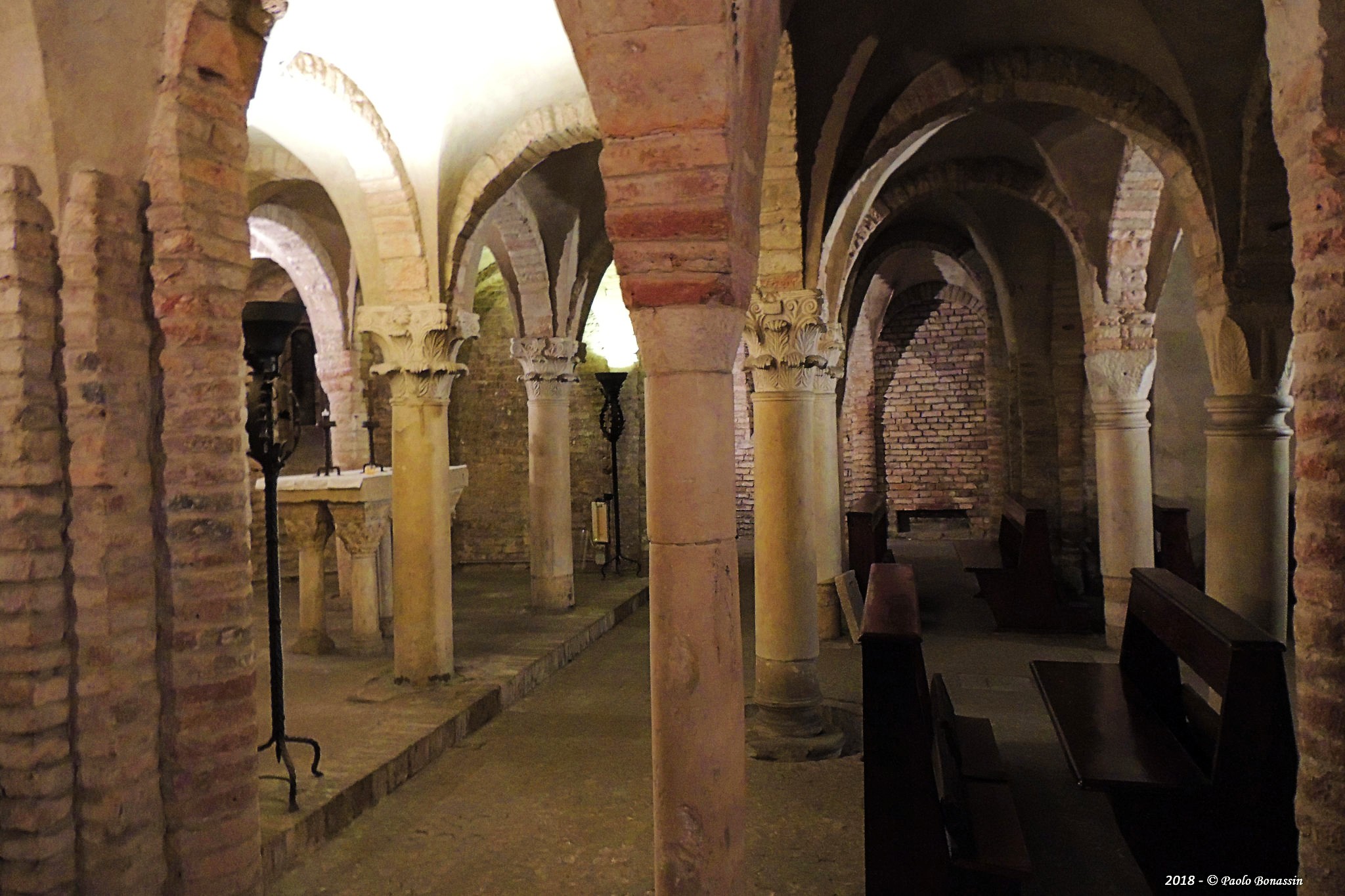
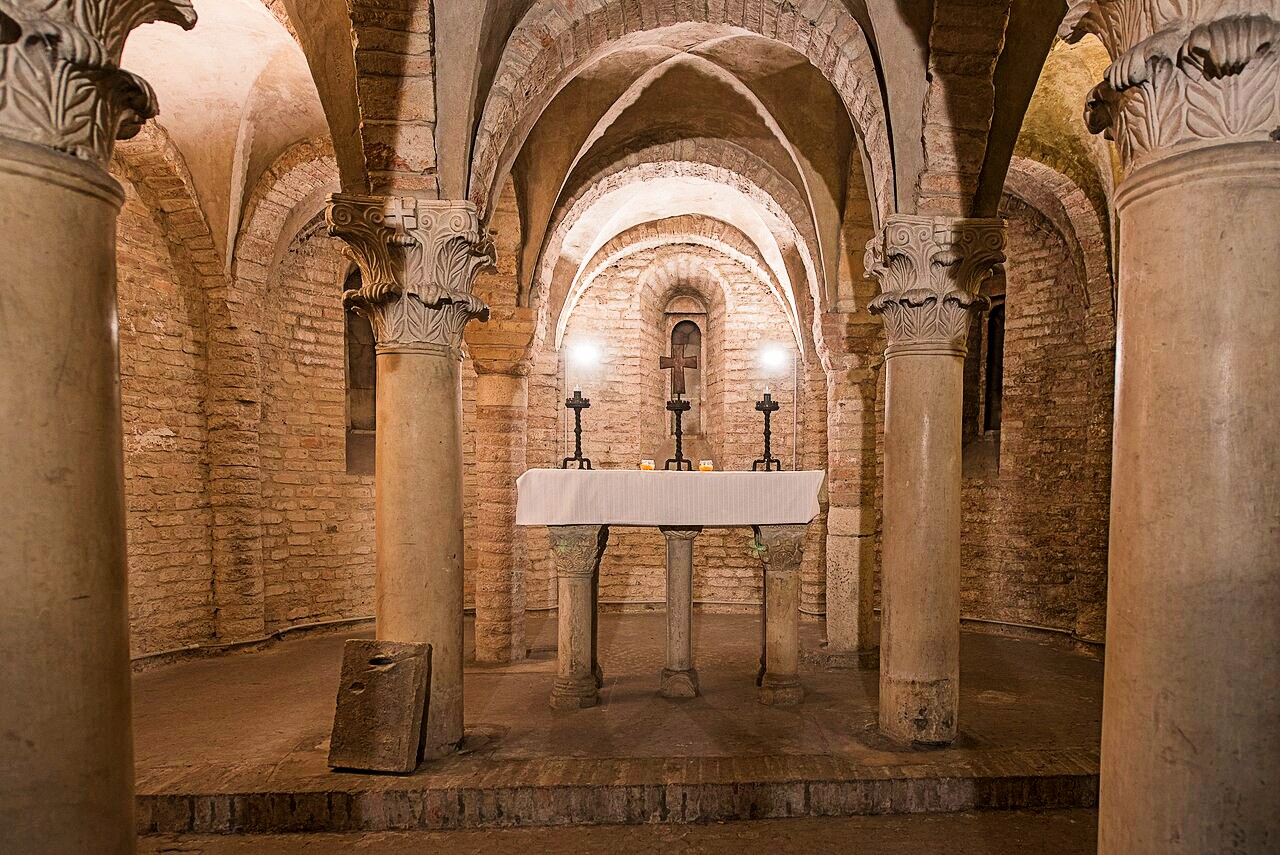
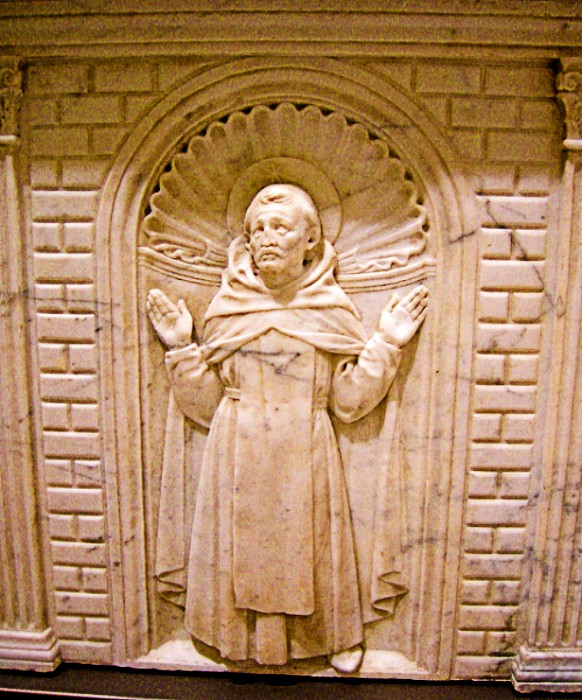
Albertoe was buried, according to his wishes, in the Abbey of St George Outside the Walls. In 1419 his remains were transferred to a 15th Century Sarcophagus which serves as an Altar in St Benedict’s Church.
The veneration of the Blessed Alberto Pandoni, along with that of Saint Maurelio, was revived after the arrival of the Olivetans at the Church of St George (c1415) and after the approval of the cultus “ab immemorabili tempore” (from time immemorial) in the Papal Decree issued by Pope Urban VIII in 1625.
Cardinal Tommaso Ruffo was the Bishop of Ferrara from 1717 to 1738. Ruffo’s time as the Bishop stands out by virtue of his strong personality. He was a Bishop of great determination, a politician and a lover of the arts. Ruffo, who had a liking for celebrations and processions and was well aware of the importance of local and popular devotions, encouraged the cult of our Blessed Alberto by organising and celebrating solemn festivals keeping Blessed Alberto’s cult very much alive and still so it remains.
The Monastery Church of St George Outsdie the Walls in Ferrara
St Eusebius of Rome (Died 357) Priest, Confessor. “At Rome, the birthday of the blessed Priest Eusebius, who for the defence of the Catholic Faith, was shut up in a room of his own house by the Arian Emperor, Constantius, where constantly persevering in prayer for seven months, he rested in peace. His body was removed by the Priests, Gregory and Orosius and buried in the cemetery of Cllistus on the Appian Way.” – Roman Martyrology. His Life: https://anastpaul.com/2020/08/14/saint-of-the-day-14-august-saint-eusebius-of-rome-died-357-priest-confessor/
Bl Aimo Taparelli Blessed Alberto Pandoni OSA (c1200-1274) Bishop
Thought for the Day – 13 August – Meditations with Fr Richard Frederick Clarke SJ (1839-1900)
CHARITY Meditations for a Month
The Sufferings of Charity “Charity beareth all things”
If anyone deserves to be exempt from suffering, it is someone who is full of the spirit of charity. Suffering is indeed necessary to expiate sin, to humble our pride and to show us our own misery. Why should the charitable have to bear all kinds of trials simply because of their charity? Yet so it seems. Generally, the law seems to be – the more charity, the more suffering. Perhaps this is why I have comparatively little to suffer?
Yet, after all, it is reasonable that the charitable should suffer when we remember that the Lord and model of all charity, suffered all things simply because of His charity. What else caused His Agony in the Garden, His cruel Scourging at the Pillar, and His dereliction on the Cross? It was all the result of His Divine Charity. We, therefore,, if we are to follow in His steps, must expect to encounter the same results as a reward for any charity if it resembles His, however remotely. If we are wise, we shall rejoice in any sign that we are to be honoured by sharing our Master’s lot!
These sufferings are a source of joy to all who suffer for Jesus’ sake. He rejoiced to run the course of His Passion because of His longing to see those He loved delivered from bondage. For the joy which was set before Him, He endured the Cross. Thus, charity rejoices to suffer because charity knows those sufferings will obtain for it, in Heaven, the eternal joy of seeing others brought to God by its offering to Him, of all that it holds dear. Even if I have heavy trials, can I flatter myself that my trials are a sign of a high degree of supernatural charity?
Quote of the Day – 13 August – “The Month of the Immaculate Heart of Mary” and the Feast of Our Lady Refuge of Sinners
O Mother Blest By St Alphonsus Maira Liguori (1696-1787) Most Zealous Doctor of the Church Trans. Fr Edmund Vaughn C.SS.R. (1827 – 1908 )
O Mother blest, whom God bestows On sinners and on just, What joy, what hope thou givest those Who in thy mercy trust. Thou are clement, thou are chaste, Mary thou art fair, Of all mothers, sweetest best, none with thee compare.
O heavenly Mother, mistress sweet! it never yet was told that suppliant sinner left thy feet, unpitied, unconsoloed. Thou are clement, thou are chaste, …
O Mother, pitiful and mild, Cease not to pray for me; For I do love thee as a child, And sigh for love of thee. Thou art clement, thou art chaste, …
Most powerful Mother, all men know Thy Son denies thee nought; Thou askest, wishest it, and lo! His power thy will hath wrought. Thou art clement, thou art chaste, …
O Mother blest, for me obtain, Ungrateful though I be, To love that God who first could deign To show such love for me. Thou art clement, thou art chaste, Mary, thou art fair. Of all mothers, sweetest, best, None with thee compare.
One Minute Reflection – 13 August – “The Month of the Immaculate Heart of Mary” – Saints Hippolytus and Cassian (Died c235) Martyrs – Our Lady Refuge of Sinners – Hebrews 10:32-38; Luke 12:1-8 – Scripture search here: https://www.drbo.org/
“Are not five sparrows sold for two farthings? And yet not one of them is forgotten before God. Yes, the very hairs of your head are all numbered. Therefore, do not be afraid, you are of more value than many sparrows.” – Luke 12:6-7
REFLECTION – “It seems to me you ought to resolve to carry out peacefully what you can. Do not worry about all the rest but entrust to Divine Providence that which you are unable to accomplish on your own. What is pleasing to God, is the reasonable care and attention we give, to accomplishing well, whatever business we must undertake through duty. What is not pleasing to God, is anxiety and disquiet of mind. The Lord wants our limitations and weaknesses, to find their support in His Strength; He wants us to hope that His Goodness will complete and perfect the imperfectness of our means.
Those who take on numerous responsibilities, even with an upright and pure intention, must resolve to do simply what lies within their power … If it is necessary to set certain things aside, arm yourselves with patience and do not think that God expects of us what we are unable to do. He does not want a man to distress himself on account of his limitations … there is no need to tire ourselves out excessively. More, if we have laboured to do our best, we can abandon all the rest to Him ,Who has the power to accomplish whatever He will.
May the Divine Goodness always be pleased to communicate His Light of Wisdom to us, so that we may clearly see and firmly accomplish, His good pleasure, for ourselves and for others … so that we may accept from His Hand, whatever He sends us, taking due note of what is the most important – patience, humility, obedience and charity!” – St Ignatius Loyola (1491-1556) Priest, Founder of the Society of Jesus (Letter of 17 November 1555)
PRAYER – Grant, we beseech Thee, O Lord God, unto all Thy servants that they may remain continually in the enjoyment of soundness, both of mind and body and, by the glorious intercession of the Blessed Mary, always a Virgin, may be delivered from present sadness and enter into the joy of Thine eternal gladness. Through Jesus Christ, Thy Son our Lord, Who lives and reigns with Thee, in the unity of the Holy Ghost, God, world without end. Amen (Collect).
Our Morning Offering – 13 August – “The Month of the Immaculate Heart of Mary”
O Immaculate Heart of Mary By St Gertrude the Great (1256-1302)
O Immaculate Heart of Mary, I have nothing in myself to offer thee which is worthy of thee but what thanksgiving I ought I to pay thee, for all the favours which thou hast obtained for me from the Heart of Jesus! What reparation ought I to make thee for all my tepidity, in thy service! I desire to return thee love for love, the only good which I possess, is the Sacred Heart of Jesus, which thou, thyself hast given me. I offer thee this Treasure of Infinite Price, I cannot do more and thou dost not deserve less, at my hand but, receiving from me, this Gift most Precious in thy sight, be pleased, I beseech thee, to accept too, my poor heart which I here offer to thee and I shall be forever blessed. Amen.
Saint/s of the Day – 13 August – Saints Hippolytus and Cassian (Died c235) Martyrs. St Hippolytus is the Patron Saint of – horses, prison guards, officers and workers’ In Austria: Sankt Pölten, Zell am See. In Italy: Bardonecchia, Bibbiena, Cassano Valcuvia, Fogliano di Cascia, Laterina, Rogeno. St Cassian is the Patron Saint of – parish clerks and secretaries, of stenographers (proclaimed on 23 December 1952 by Pope Pius XII), students, teachers, typists. In Italy – Bibbiena, Cassano Valcuvia, Comacchio, Imola, La Salle, Laterina, Macherio, Rogeno, San Casciano dei Bagni, San Casciano in Val di Pesa, San Cassiano a Vico, San Cassiano di Controne, San Cassiano di Moriano, Trecate, the Diocese of Bolzano-Bressanone, the Diocese of Brixenand Imola. Of Mexico City, Mexico, Of Las Galletas, Tenerife, Spain.
The Roman Martyrology reads today: “At Rome, blessed Hippolytus, Martyr, who gloriously confessed the Faith, under the Emperor Decius {mpt Valerian}. After enduring other torments, he was tied by the feet to the necks of wild horses and being cruelly dragged through briars and brambles and having all his body lacerated, he yielded his spirit.” AND: “At Imola, the birthday of St Cassian, Martyr. As he refused to worship idols, the persecutor called the boys whom the Saint taught and who hated him, giving them leave to kill him. The torment suffered by the Martyr was the more grievious, as the hand which inflicted it by reason of its weakness, rendered death more tardy.”
St Hippolytus and St Cassian, (Died c235) Martyrs By Fr Francis Xavier Weninger SJ (1805-1888)
St Hippolytus, an Officer of the body-guard of the Emperor Decius, had been born in the darkness of idolatry but he had become a Christian, with all his household, in consequence of witnessing the many miracles which St Lawrence performedwhile in the prison under his charge.
The Martyrdom of St Hippolytus
He had also been present when the Saint, lying on the red-hot gridiron, endured the most terrible tortures. At the sight of the heroism of St Lawrence, he was filled with the desire to announce himself a Christian but he was prevented by St Lawrence. But when this Martyr had gloriously ended his combat, Hippolytus, with the assistance of a Priest, named Justinus, buried the sacred remains with great devotion and veneration. The Emperor on being informed of it, had Hippolytus seized and brought before him. He asked him if it was true that he had become a Christian? Hippolytus answered firmly: “Yes, I am a Christian and, moreover, resolved to die such.” The emperor, who had always highly esteemed him, endeavoured, first by promises and then by menaces, to induce him to forsake Christ. As, however, all was unavailing, he caused him to be tortured.
He was accordingly stretched on the ground, whipped with scourges and beaten with clubs so fearfully that it was believed he could not survive. But God, by a visible miracle, prolonged his life. Keeping his eyes fixed upon Heaven, he frequently repeated: “I am a Christian, I suffer for Christ’s sake.”
After having been tormented for a long time, he was cast into prison and the Prefect received the order to behead him. Before executing this order, however, he went to the house of Hippolytus to secure his property. Finding the entire household had become Christians, he took them beyond the gates of the City and had them beheaded. Concordia, an old and holy matron, who had been Hippolytus’ nurse, was scourged until she expired because she encouraged the others to remain firm in their faith.
At last, Hippolytus was taken out of prison and fastened to the necks of two horses and dragged by them until he was torn to pieces and his heroic soul was received into the Presence of Him Whom he had so fearlessly confessed.
On the same day, although at another place, St Cassian suffered a Martyrdom of unprecedented cruelty. This Saint, was the Bishop of Brescia but had been banished from his See on account of his faith.
St Cassian
He intended to go to Rome and offer the Pope his services for the salvation of souls in some other place. On his way, he changed his mind and taking up his residence at Imola, a Town in Italy, he resolved to teach children to read and write, hoping that occasion would not be wanting to do good. In this apparently humble position, he was no less zealous than he had been in the administration of his Diocese. He taught the children with love and gentleness and endeavoured to inspire them with respect for the Christian faith, fear and horror of sin and love of virtue and piety.
He continued in this occupation with great zeal for some years, to the great benefit of young and old. Suddenly a terrible persecution of the Christians arose. Cassian was one of the first who were taken prisoners. The tyrant commanded him to sacrifice to the gods. The holy Bishop and teacher refused, as might have been expected and tried to convince the Judge of his fearful blindness in worshipping dumb idols or making gods of godless men.
The tyrant, furious at his arguments, ordered the executioners to strip him of his clothes and tie his hands behind his back and leave him exposed to the mercy of the children whom he had taken such pains to teach. The children, who had been taught that Cassian was a magician and consequently must die, a most painful death, took their sharp iron pencils with which, in those days, they wrote upon their wax tablets and pierced him with them till the blood ran profusely from his veins. This torture lasted long and was extremely painful. The Saint, however, never complained of the ingratitude of his pupils, nor gave a sign of impatience but praised and thanked the Lord until his soul went to Heaven to receive the Crown of Martyrdom.
St John Berchmans SJ (1599-1621) Jesuit Novice – born Jan Berchmans on 13 March 1599 at Driest, Brabant, Belgium and died on 13 August 1621 at Rome, Italy of natural causes. Patronages – Altar Servers, Jesuit novices and students. He had a special devotion to God’s Mother and to him is owed the Little Rosary of the Immaculate Conception. Biography: https://anastpaul.com/2019/08/13/saint-of-the-day-13-august-saint-john-berchmans-sj-1599-1621/
St Anastasius the Monk St Anastasius the Priest
St Benildus Romançon FSC (1805-1862) Teacher of the Brothers of Christian Schools
St Cassian of Todi St Concordia Bl Gertrude of Altenberg St Helen of Burgos St Herulph of Langres Bl John of Alvernia St Junian of Mairé St Ludolph
St Maximus the Confessor (c580-662) Father of the Church, Monk, Abbot, Theologian, Confessor, Scholar, Writer. Also known as St Maximus of Constantinople and St Maximus the Theologian. St Maximus, a man of fearless courage in witnessing to – “confessing” – even while suffering, the integrity of his faith in Jesus Christ, true God and true man, Saviour of the world and of His Holy Catholic Church. His Life: https://anastpaul.com/2020/08/13/saint-of-the-day-13-august-saint-maximus-the-confessor-c-580-662-father-of-the-church/
St Wigbert of Fritzlar (c675-c 746) Born in England, a learned Scholar and Abbot, Missionary, Miracle-worker, gifted with a penetrating understanding of Sacred Scripture as well as the gift of prophecy, companion of St Boniface, the Apostle of Germany. Wigbert was known as a quiet and gentle man and a great teacher. Both St Alcuin and St Bede knew and mentioned him in their historical writings of the times and of the Church. St Bede admired his contempt of this world and his learning. A fascinating and much-admired Saint: https://anastpaul.com/2022/08/13/saint-of-the-day-13-august-st-wigbert-of-fritzlar-c-675-c-746/
Thought for the Day – 12 August – Meditations with Fr Richard Frederick Clarke SJ (1839-1900)
CHARITY Meditations for a Month
The Joy of Charity “Charity rejoiceth in the Truth”
Everything which is done to promote the cause of truth, is a source of sincere joy to those who have, in their hearts, the spirit of true charity. It matters not whether the success is due to their own efforts, or those of others; they are always happy at the advance of truth and the defeat of error. How do I testify my joy when truth prevails, when heresy is crushed, when souls are converted to God? Do I say a Te Deum or Magnificat, or thank God with all my heart on these joyful occasions?
Charity also finds pleasure in the truth being known. It has no wish to conceal anything. Those who have it in their hearts, make no attempt to hide the truth concerning themselves. They are willing to be known as they really are, with all their defects and imperfections. They are even happy their faults should be manifested, as far as the manifestation tends to the glory of God and the edification of their neighbour. I will examine myself to see what progress I have made in charity. Do I rejoice in the truth being known about myself, even in matters which may humble my pride?
Do I rejoice in the truth when I find, I have misjudged or misunderstood my neighbours and they are very different from that which I thought them to be and, far better than myself? Do I rejoice in the truth when I am shown to be incorrect in some opinion and when, others rectify me? Do I rejoice in the truth when I am brought, face-to-face with my own weakness and nothingness and find that I cannot trust in myself but have to trust in God alone?
Quote/s of the Day – 12 August – St Clare (1194-1253) Virgin
“We are to become vessels of God’s compassionate love for others.”
“Our labour here is brief but the reward is eternal. Do not be disturbed by the clamour of the world which passes like a shadow. Do not let false delights of a deceptive world deceive you.”
“Never forget that the way which leads to Heaven is narrow that the gate leading to Life, is narrow and low that there are but few who find it and enter by it and if, there be some, who go in and tread the narrow path, for some time, there are but very few, who persevere therein.”
One Minute Reflection – 12 August – “The Month of the Immaculate Heart of Mary” – St Clare of Assisi (1194-1253) Virgin – 2 Cor inthians 10:17-18; 11:1-2; Matthew 25:1-13 – Scripture search here: https://www.drbo.org/
“But the wise took oil in their vessels” – Matthew 25:4
REFLECTION – “The soul who really loves God and Christ, even if it has done thousands of good works, thinks he has done nothing because of his insatiable hunger for God. Even if he has exhausted the body through fasting and vigils, he believes that he has not yet begun to be virtuous. In spite of the gifts of the Holy Ghost, the heavenly revelations and mysteries, he believes that he has not yet done anything because of his immense and insatiable love of the Lord. In faith and in love, he is always hungry and thirsty.
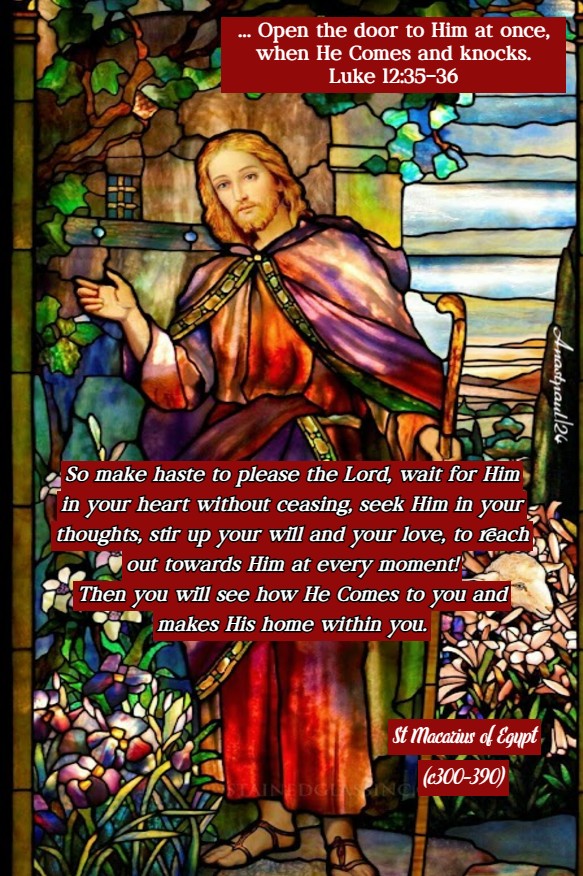
Persevering in prayer, he insatiably desires the mysteries of grace and to acquire every virtue. Wounded by love of the heavenly Spirit, animated by an ardent desire for his heavenly Spouse, he aspires to the grace of perfect, mysterious and ineffable communion with Him, in the sanctification of the Spirit. He is waiting for the veils to fall before His Face and that he might see his Spouse face-to-face, in the spiritual and indescribable Light, that the soul may be united to Him in all certainty, that the soul be transformed into the image of his death. In the soul’s great desire to die for Christ, he awaits, with certainty, his deliverance from sin and from all the darkness of the passions. Thus purified by the Spirit, sanctified in body and soul …, he has been made worthy to welcome the true King, Christ Himself!” – Sermon Attributed to St Macarius of Egypt (c300-390) Monk, Father
PRAYER – Hear us, O God, our Saviour that as we are gladdened by the festival of blessed Clare Thy virgin, so we may learn from it piety and devotion. Through the same Jesus Christ, Thy Son our Lord, Who lives and reigns with Thee, in the unity of the Holy Ghost, God, world without end. Amen (Collect).
Our Morning Offering – 12 August – “The Month of the Immaculate Heart of Mary”
Deign, O Immaculate Virgin By St Paschasius Radbertus (785–865)
Deign, O Immaculate Virgin, Mother most pure, to accept the loving cry of praise which we send up to you from the depths of our hearts. Though they can but add little to your glory, O Queen of Angels, you do not despise, in your love, the praises of the humble and the poor. Cast down upon us a glance of mercy, O most glorious Queen, graciously receive our petitions. Through your immaculate purity of body and mind, which rendered you so pleasing to God, inspire us with a love of innocence and purity. Teach us to guard carefully the gifts of grace, striving ever after sanctity, so that, being made like the image of your beauty, we may be worthy to become, the sharers of your eternal happiness. Amen
Saint of the Day – 12 August – Saint Simplicius of Vercelli (Died c470) the 8th Bishop of Vercelli, Italy. Also called – Simplicio.
In the ancient Eusebian Basilica, now disappeared and replaced by the current Cathedral, the series of the first 40 Bishops of Vercelli could be seen painted in the central nave, starting from St. Eusebius up to Nottingo, who lived from the middle of the 6th Century to around 830. Under each portrait the name of the Bishop represented was written in large letters. The dating of this series of portraits is still being studied.
Of course, the portraits were an authoritative document for the history of the ancient Bishops but due to neglect or old age, they disappeared over the centuries and only 25 names could be read, when the Bishops Bonomius and Ferrerus, at the end of the 16th Century and the beginning of the 17th, wanted to transcribe them, to compose the Episcopal catalogue of the Diocese.
Added to this is the dispersion of the archive documents which occurred during the barbarian invasions, particularly in the Lombard era.
The little which is known about the Bishops of Vercelli, who lived from the middle of the 5th Century to the beginning of the 9th, comes from sepulchral inscriptions, from some local liturgical books, from documents of other Churches and from news of civil history.
Vercelli Cathedral dedicated to St Eusebius
Therefore, even of St Simplicius very little is known, he was the 8th Bishop of Vercelli, as reported by the Episcopal catalogue compiled by the historian F Savio (1898) which corrects the previous ones. Our Saint is one of the Bishops whose name was not clearly legible under the faded effigy.
His Episcopate can be dated around 470, in the difficult period of the barbarian invasions. The historian, Cusano, reported that at the beginning of the 17th Century, his Tomb was discovered with the following inscription: “Simplicius, the 8th Bishop, extraordinarily endowed with the grace of God, shone brightly with the greatest splendour of sanctity.” (“Simplicius Episcopus octavus, mira Dei gratia praeditus, maximo sanctitatis splendeur praeluxit”).
The authoritative “Bibliotheca Sanctorum” catalogues him together with St Discolius, the 4th Bishop of Vercelli because they were probably celebrated on the same day, 12 August, in the local liturgical calendar. (Adapted from the Italian by Author: Antonio Borrelli).
St Eusebius of Milan (Died 462) Archbishop of Milan. Born in Greece (although some sources regard him as Milanese) and died on 12 August 462. He was the Archbishop from 449 until his death. The Roman Martyrology reads: “In Milan, Saint Eusebius, Bishop, who worked diligently for the True Faith and rebuilt the Cathedral destroyed by the Huns.” His Zealous Life of Grace: https://anastpaul.com/2023/08/12/saint-of-the-day-12-august-st-eusebius-of-milan-died-462-bishop/
St Felicissima the Blind St Gracilian St Herculanus of Brescia St Jambert of Canterbury St Julian of Syria
St Macarius of Syria St Merewenna St Micae Nguyen Huy My St Murtagh of Killala St Photinus of Marmora
St Porcarius of Lerins St Simplicius of Vercelli (Died c470) Bishop St Ust
Martyrs of Augsburg – 4 Saints: The mother, Hilaria,and three friends of of Saint Afra ofAugsburg. While visiting the tomb of Saint Afra who were seized by the authorities and Martyred when they visited Afra’s tomb – Digna, Eunomia, Euprepia and Hilaria. They were burned alive c 304.
Martyrs of Rome – 5 Saints: A group of Christians Martyred together in the persecutions of Diocletian. We know little more than their names – Crescentian, Juliana, Largio, Nimmia and Quiriacus. They died in c304 in Rome, Italy and were buried on the Ostian Way outside Rome.
You must be logged in to post a comment.