Posted in ADVENT, SAINT of the DAY

Saint of the Day – 9 December – St Juan Diego Cuauhtlatoatzin (1474-1548)

Saint of the Day – 9 December – St Juan Diego Cuauhtlatoatzin (1474-1548)  – Layman – Marian Visionary.   St Juan was born in 1474 in Tlayacac, Cuauhtitlan (about 15 miles north of modern Mexico City, Mexico) as Cuauhtlatoatzin and he died on 30 May 1548 of natural causes.   He was Beatified on 9 April 1990 by St Pope John Paul II at Vatican City and Canonised on  31 July 2002 – recognition celebrated at the basilica of Our Lady of Guadalupe, Mexico by St Pope John Paul II.   Patronage – Indigenous people.header - st juan diegoJohn-Paul-II-Pope-Canonization-of-Juan-Diego (1)
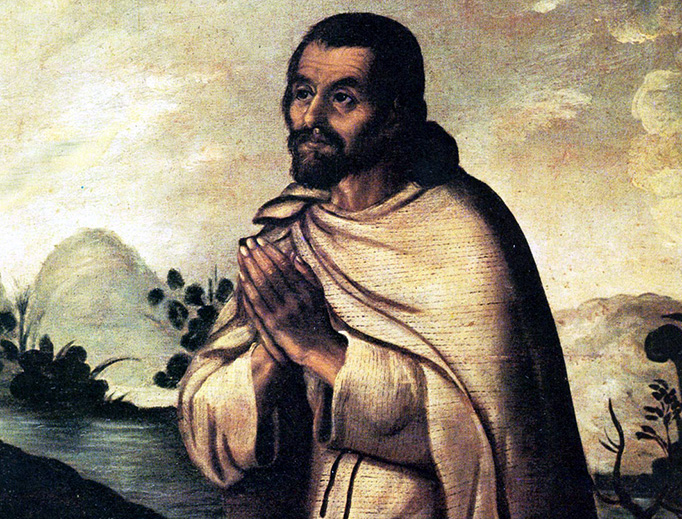
Little is known about the life of Juan Diego before his conversion but tradition and archaelogical and iconographical sources, along with the most important and oldest indigenous document on the event of Guadalupe, “El Nican Mopohua” (written in Náhuatl with Latin characters, 1556, by the Indigenous writer Antonio Valeriano), give some information on the life of the saint and the apparitions.

Juan Diego was born in 1474 with the name “Cuauhtlatoatzin” (“the talking eagle”) in Cuautlitlán, today part of Mexico City, Mexico.   He was a gifted member of the Chichimeca people, one of the more culturally advanced groups living in the Anáhuac Valley.

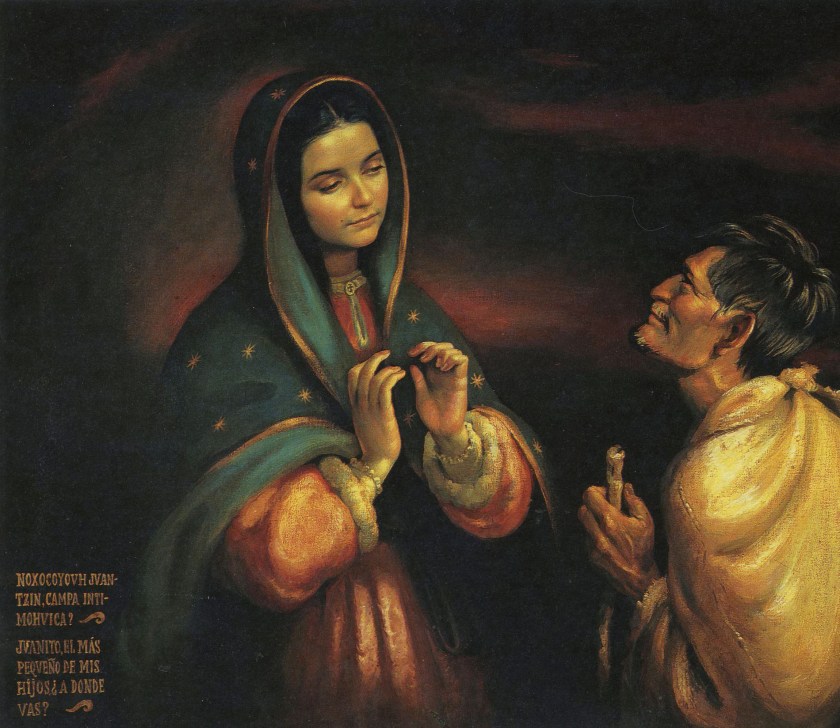
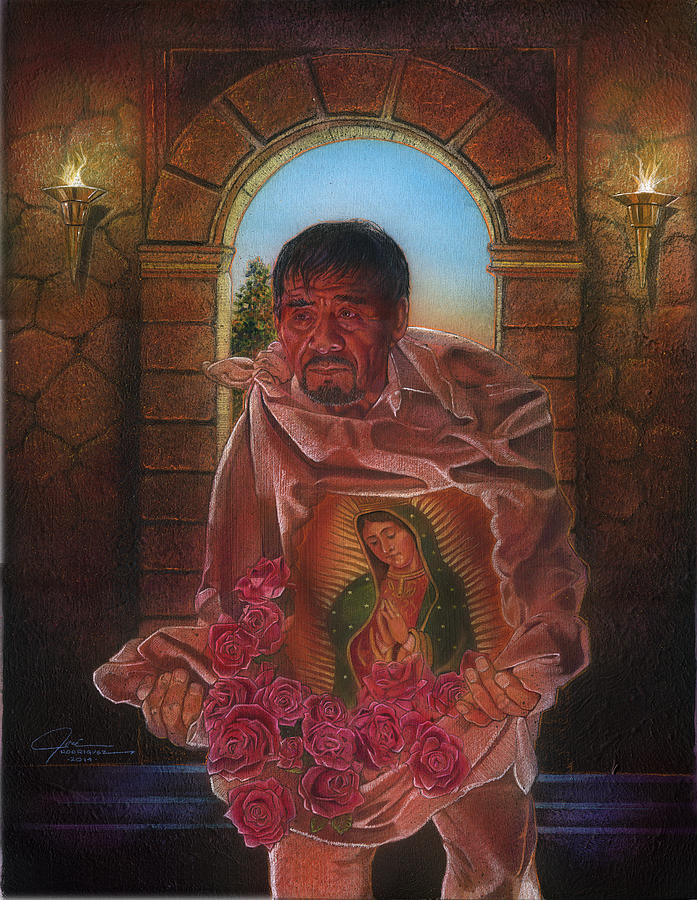
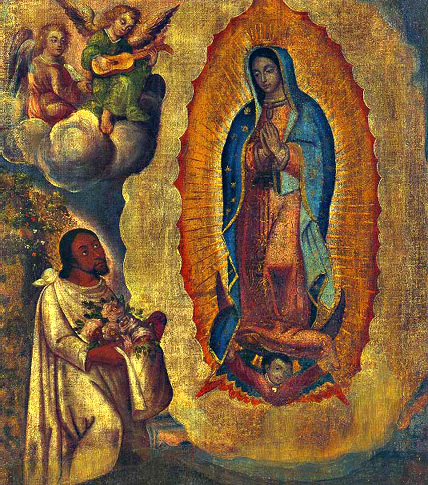
When he was 50 years old he was baptised by a Franciscan priest, Fr Peter da Gand, one of the first Franciscan missionaries.   On 9 December 1531, when Juan Diego was on his way to morning Mass, the Blessed Mother appeared to him on Tepeyac Hill, the outskirts of what is now Mexico City.   She asked him to go to the Bishop and to request in her name that a shrine be built at Tepeyac, where she promised to pour out her grace upon those who invoked her.   The Bishop, who did not believe Juan Diego, asked for a sign to prove that the apparition was true.   On 12 December, Juan Diego returned to Tepeyac. Here, the Blessed Mother told him to climb the hill and to pick the flowers that he would find in bloom.   He obeyed and although it was winter time, he found roses flowering.   He gathered the flowers and took them to Our Lady who carefully placed them in his mantle and told him to take them to the Bishop as “proof”.   When he opened his mantle, the flowers fell on the ground and there remained impressed, in place of the flowers, an image of the Blessed Mother, the apparition at Tepeyac.juan-diego70st-juan-diego-2-jose-rodriguez
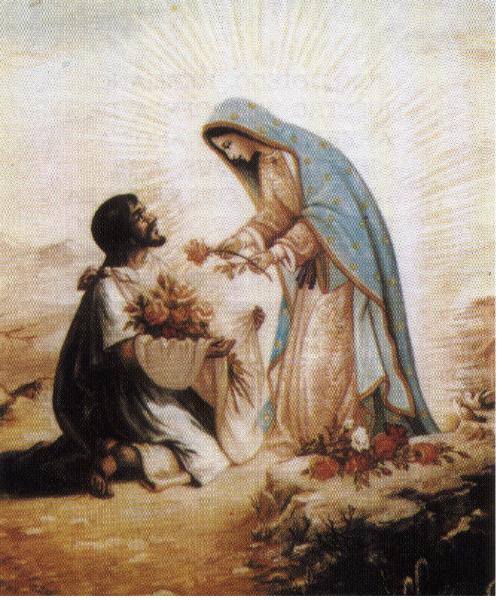
With the Bishop’s permission, Juan Diego lived the rest of his life as a hermit in a small hut near the chapel where the miraculous image was placed for veneration.   Here he cared for the church and the first pilgrims who came to pray to the Mother of Jesus.

Much deeper than the “exterior grace” of having been “chosen” as Our Lady’s “messenger”, Juan Diego received the grace of interior enlightenment and from that moment, he began a life dedicated to prayer and the practice of virtue and boundless love of God and neighbour.   He remained poor, simple, humble and devoted to the Eucharist.   He spent the next 17 years traveling throughout central Mexico, bringing others to the faith and delivering Guadalupe’s message that Mary loves us and wants to help us.  He died in 1548 and was buried in the first chapel dedicated to the Virgin of Guadalupe.   He was beatified on 6 May 1990 by Pope John Paul II in the Basilica of Santa Maria di Guadalupe, Mexico City.

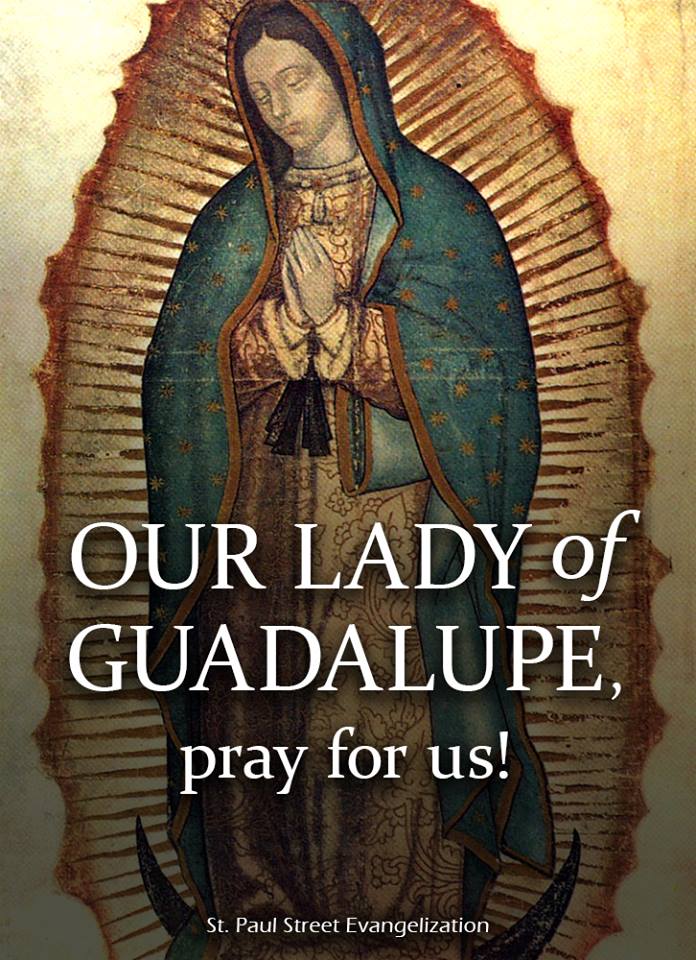
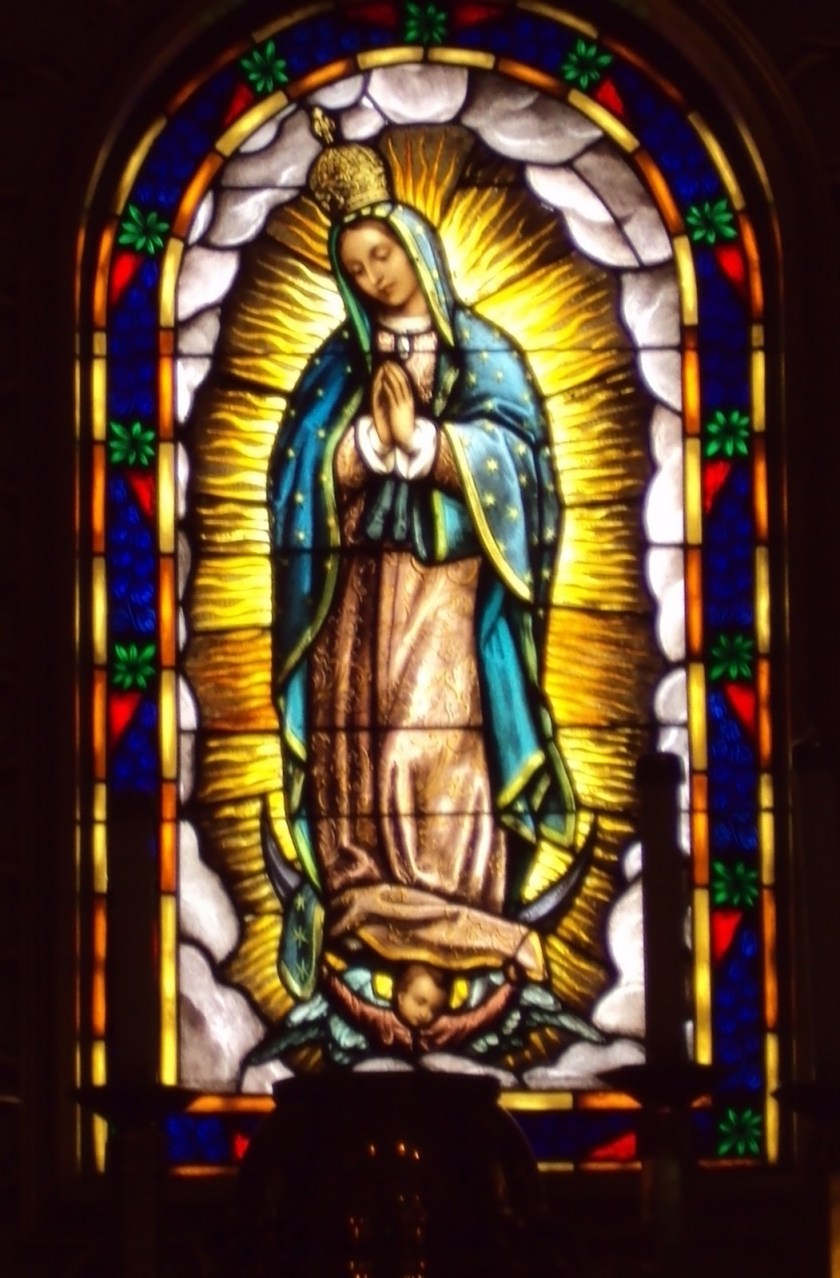
The miraculous image, which is preserved in the Basilica of Our Lady of Guadalupe, shows a woman with native features and dress.   She is supported by an angel whose wings are reminiscent of one of the major gods of the traditional religion of that area. The moon is beneath her feet and her blue mantle is covered with gold stars.   The black girdle about her waist signifies that she is pregnant.   Thus, the image graphically depicts the fact that Christ is to be “born” again among the peoples of the New World and is a message as relevant to the “New World” today as it was during the lifetime of Juan Diego.

Posted in MORNING Prayers, The BLESSED VIRGIN MARY

Thought for the Day – 12 December

Mary’s appearance to St Juan Diego as one of his people is a powerful reminder that Mary and the God who sent her accept all peoples. In the context of the sometimes rude and cruel treatment of the Indians by the Spaniards, the apparition was a rebuke to the Spaniards and an event of vast significance for Native Americans. While a number of them had converted before this incident, they now came in droves. According to a contemporary chronicler, nine million Indians became Catholic in a very short time. In these days when we hear so much about God’s preferential option for the poor, Our Lady of Guadalupe cries out to us that God’s love for and identification with the poor is an age-old truth that stems from the Gospel itself.

Mary’s visit to Guadalupe is a reminder that God will remember his mercy for all people. In Mary’s song of joy, the Magnificat, she praised God because he has put down the mighty, exalted the lowly, filled the hungry and sent the rich away empty.

Our Lady of Guadalupe Pray for us!

our-lady-of-guadalupe-dec-12

Posted in MORNING Prayers, QUOTES of the SAINTS, The BLESSED VIRGIN MARY

One Minute Reflection – 12 December

One Minute Reflection – 12 December

Who is this that comes like the dawn ….. as awe-inspiring as bannered troops?…..Song 6:10

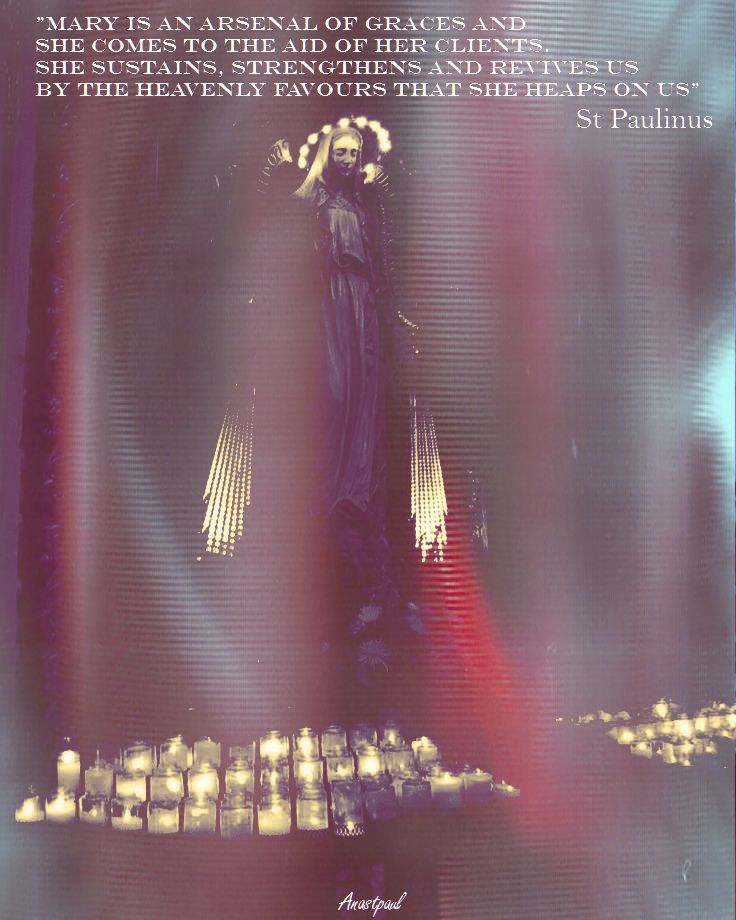
REFLECTION – Mary is an arsenal of graces and she comes to the aid of her clients.  She sustains, strengthens and revives us by the heavenly favours that she heaps on us…..St Paulinus

PRAYER – Lord Jesus Christ my Lord, help me to become a devoted client of Your holy Mother Mary.  Through Your grace, may I receive the spiritual strength she has promised to all her clients. May I, in simplicity, like St Juan Diego, become her vessel to share Your Light of Love throughout my world.   Our Lady of Gaudulupe Pray for us! Amen

1612e3f87071794329d138e32974bd147c403c56972991c450050e0a7f117f66guadalupe2


Posted in SAINT of the DAY, The BLESSED VIRGIN MARY

Saint of the Day – 12 December

Saint of the Day – 12 December – Our Lady of Guadalupe – Our Mother of Guadalupe,
The Madonna of Tepeyac, Tonantzin – First Apparition on 12 December 1531- Approved by the Holy See 12 October 1895, during the Canonical coronation granted by Pope Leo XIII – Patron of Americas; New World, Central America, Mexico, New Mexico, Pojoaque Indian Pueblo, 12 dioceses, 3 cities

Video – https://www.youtube.com/watch?v=xe4Ozm0oENk

The original tilma of Saint Juan Diego, which hangs above the high altar of the Guadalupe Basilica. The suspended crown atop the image dates back to its Canonical Coronation on October 12, 1895. The image is protected by bulletproof glass and low-oxygen atmosphere.

Guadalupe is, strictly speaking, the name of a picture but the name was extended to the church containing the picture and to the town that grew up around the church. It makes the shrine, it occasions the devotion, it illustrates Our Lady. It is taken as representing the Immaculate Conception, being the lone figure of a woman with the sun, moon and star accompaniments of the great apocalyptic sign with a supporting angel under the crescent. The word is Spanish Arabic but in Mexico it may represent certain Aztec sounds.

Its tradition is long-standing and constant and in sources both oral and written, Indian and Spanish, the account is unwavering. The Blessed Virgin appeared on Saturday 9 December 1531 to a 55 year old neophyte named Juan Diego, who was hurrying down Tepeyac hill to hear Mass in Mexico City. She sent him to Bishop Zumárraga to have a temple built where she stood. She was at the same place that evening and Sunday evening to get the bishop’s answer. The bishop did not immediately believed the messenger, had him cross-examined and watched and he finally told him to ask the lady who said she was the mother of the true God for a sign. The neophyte agreed readily to ask for sign desired, and the bishop released him.

Juan was occupied all Monday with Bernardino, an uncle, who was dying of fever. Indian medicine had failed and Bernardino seemed at death’s door. At daybreak on Tuesday 12 December 1531, Juan ran to nearby the Saint James convent for a priest. To avoid the apparition and the untimely message to the bishop, he slipped round where the well chapel now stands. But the Blessed Virgin crossed down to meet him and said, “What road is this thou takest son?” A tender dialogue ensued. She reassured Juan about his uncle, to whom she also briefly appeared and instantly cured. Calling herself Holy Mary of Guadalupe she told Juan to return to the bishop. He asked Mary for the sign he required. She told him to go to the rocks and gather roses. Juan knew it was neither the time nor the place for roses, but he went and found them. Gathering many into the lap of his tilma, a long cloak or wrapper used by Mexican Indians, he came back. The Holy Mother rearranged the roses and told him to keep them untouched and unseen until he reached the bishop. When he met with Zumárraga, Juan offered the sign to the bishop. As he unfolded his cloak the roses, fresh and wet with dew, fell out. Juan was startled to see the bishop and his attendants kneeling before him. The life size figure of the Virgin Mother, just as Juan had described her, was glowing on the tilma. The picture was venerated, guarded in the bishop’s chapel and soon after carried in procession to the preliminary shrine.

The coarsely woven material of the tilma which bears the picture is as thin and open as poor sacking. It is made of vegetable fibre, probably maguey. It consists of two strips, about seventy inches long by eighteen wide, held together by weak stitching. The seam is visible up the middle of the figure, turning aside from the face. Painters have not understood the laying on of the colours. They have deposed that the “canvas” was not only unfit but unprepared and they have marvelled at apparent oil, water, tempera, etc. colouring in the same figure. They are left in equal admiration by the flower-like tints and the abundant gold. They and other artists find the proportions perfect for a maiden of fifteen. The figure and the attitude are of one advancing. There is flight and rest in the eager supporting angel. The chief colours are deep gold in the rays and stars, blue-green in the mantle, and rose in the flowered tunic.

Sworn evidence was given at various commissions of inquiry corroborating the traditional account of the miraculous origin and influence of the picture. Some wills connected with Juan Diego and his contemporaries were accepted as documentary evidence. Vouchers were given for the existence of Bishop Zumárraga’s letter to his Franciscan brothers in Spain concerning the apparitions. His successor, Montufar, instituted a canonical inquiry, in 1556, on a sermon in which the pastors and people were abused for crowding to the new shrine. In 1568 the renowned historian Bernal Díaz, a companion of Cortez, refers incidentally to Guadalupe and its daily miracles. The lay viceroy, Enríquez, while not opposing the devotion, wrote in 1575 to Philip II asking him to prevent the third archbishop from erecting a parish or monastery at the shrine. Inaugural pilgrimages were usually made to it by viceroys and other chief magistrates. Processes, national and ecclesiastical, were laboriously formulated and attested for presentation at Rome, Italy in 1663, 1666, 1723, and 1750.

The clergy, secular and regular, has been remarkably faithful to the devotion towards Our Lady of Guadalupe, the bishops especially fostering it, even to the extent of making a protestation of faith in the miracle a matter of occasional obligation. Pope Benedict XIV decreed that Our Lady of Guadalupe should be the national patron of Mexico and made 12 December a holiday of obligation with an octave, and ordered a special Mass and Office. Pope Leo XIII approved a complete historical second Nocturne, ordered the picture to be crowned in his name and composed a poetical inscription for it. Pope Pius X permitted Mexican priests to say the Mass of Holy Mary of Guadalupe on the twelfth day of every month, and granted indulgences which may be gained in any part of the world for prayer before a copy of the picture.

The place, called Guadalupe Hidalgo since 1822, is three miles northeast of Mexico City. Pilgrimages have been made to this shrine almost without interruption since 1531-1532. A shrine at the foot of Tepeyac Hill served for ninety years and still forms part of the parochial sacristy. In 1622 a rich shrine was erected and in 1709 a newer, even richer one. There are also a parish church, a convent and church for Capuchin nuns, a well chapel, and a hill chapel all constructed in the 18th century. About 1750 the shrine got the title of collegiate, a canonry and choir service being established. It was aggregated to Saint John Lateran in 1754. In 1904 it was created a basilica, with the presiding ecclesiastic being called abbot. The shrine has been renovated in Byzantine style which presents an illustration of Guadalupan history.

eternal_father_painting_guadalupe

An 18th-century hagiographicpainting of God the Father fashioning the image.

401px-brooklyn_museum_-_virgin_of_guadalupe_-_isidro_escamilla_-_overall

Virgin of Guadalupe, 1 September 1824. Oil on canvas by Isidro Escamilla. Brooklyn Museum

guadalupano

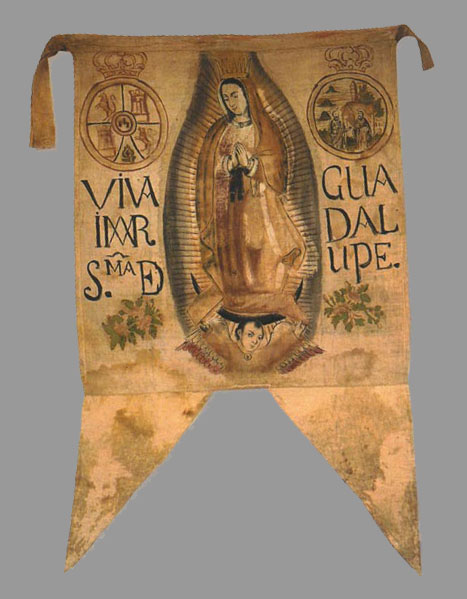
The revolutionary banner carried by Miguel Hidalgo and his insurgent army during the Mexican War of Independence.

apparitions-of-our-lady-of-guadalupefoto3pintura-de-nuestra-senora-virgen-de-guadalupe

Allegory of the papal declaration in 1754 by pope Benedict XIV of Our Lady of Guadalupe patronage over the New Spain in the presence of the viceroyal authorities. Anonymous (Mexican) author, 18th century.

ourladyofguadalupe

Posted in SAINT of the DAY

St Juan Diego’s Tilma – 9 December

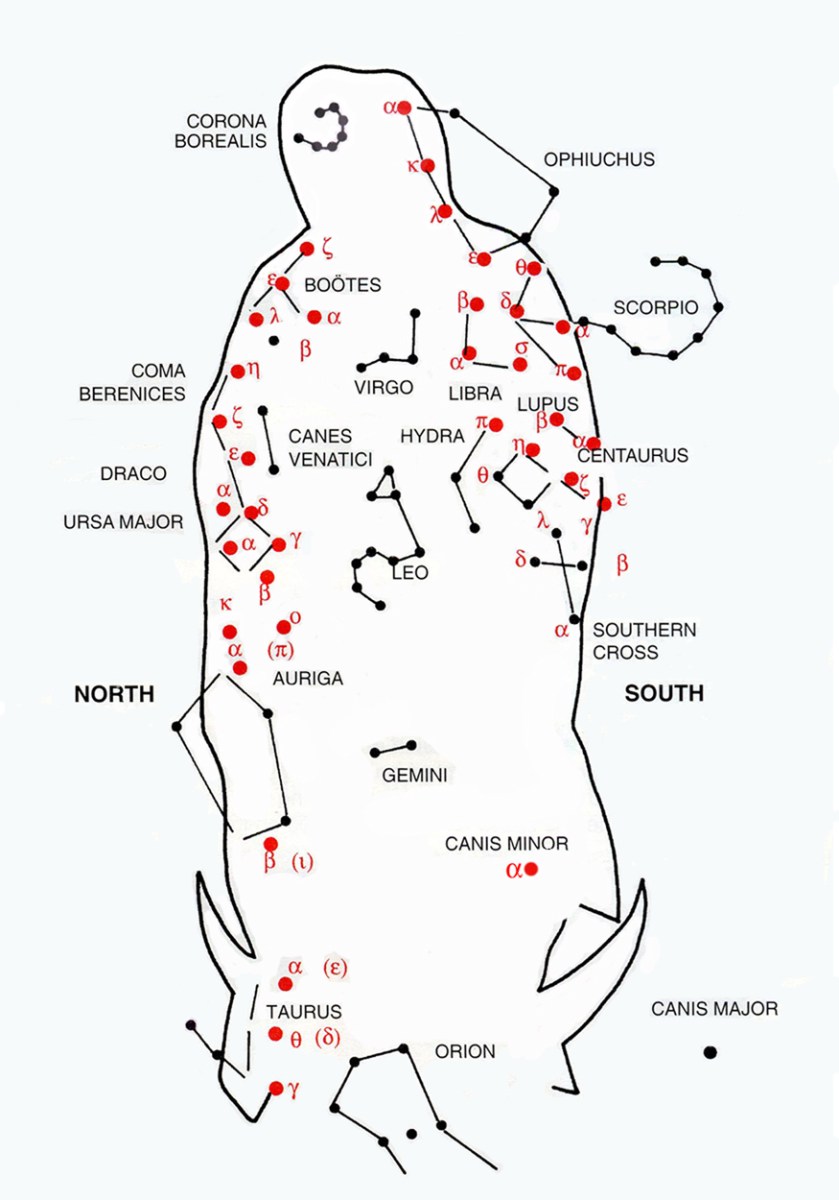
The image of Our Lady of Guadalupe has been the subject of numerous technical studies since 1751 and extensive scientific investigations in recent years, and none of the result offered any sound scientific explanation which, up to this very day, defies science and all human reasoning as it continuous to baffle scientists and even skeptics.

Below are only some of the findings that were drawn from the scientific investigations conducted on the image and the fabric itself which were commissioned by the authorized custodians of the Tilma in the Basilica, and in every case the investigators had direct and unobstructed access to it:

Read all about it here –  http://infallible-catholic.blogspot.co.za/2012/04/miraculous-image-of-our-lady-of.html

Star (1).jpeg