Saint Osith, also known as Osyth, Osgyth, Othith, Ositha, Sythe, a Mercian noblewoman and prioress martyred in the 8th century. Born in Quarrendon, Buckinghamshire, England, she was the daughter of Frithuwald, a sub-king of Mercia in Surrey. Her mother was Wilburh, of the royal house of Mercia. Her parents, with St Erconwald, founded Chertsey Abbey in 675 AD.
Raised in the care of her maternal aunts, St Edith of Aylesbury and Edburga of Bicester, her ambition was to become an abbess, but she was forced by her father into a marriage with Sighere, King of Essex. She is the mother of King Offa of Essex.
While her husband was away on a hunt, Osith persuaded two local bishops to accept her vows as a nun. Upon the king’s return some days later, he reluctantly agreed to her decision and granted her some land at Chich near Colchester, now named after her as St Osyth, where she established a convent, and ruled as first abbess. She was beheaded by Vikings, perhaps because she resisted being carried off.
The holy spring at Quarrendon, is associated with her legend, in which Osith stood up after her execution, picking up her head and walking with it in her hands, to the door of a local convent, before collapsing there.
Veneration of St Osith was widespread across England. Norwich Cathedral and St Albans Abbey had chapels dedicated to her in the Middle Ages.
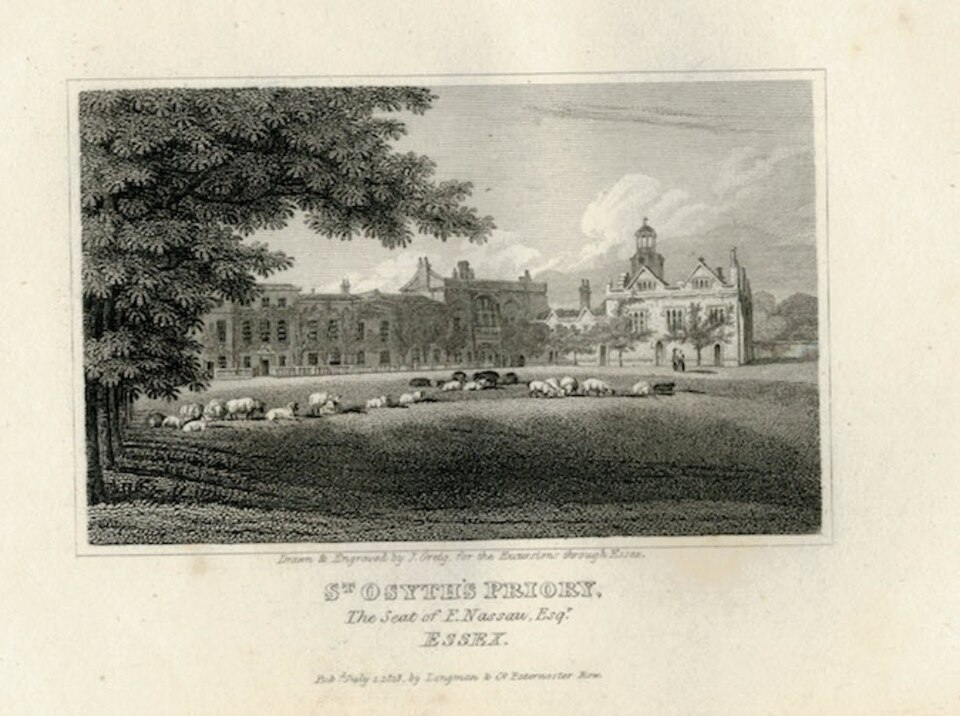
St Osyth Priory, after being stolen by Henry VIII and turned into a manor house for his lackeys
All martyrs from England murdered on 5 October 1588., all beatified by Pope Pius XI.
Blessed William Hartley was an English priest. Born in Wilne, Derbyshire and raised Protestant, he studied at Oxford University and became an Anglican minister before converting to Catholicism. He studied in Rheims, France and was ordained in 1580. Returning to England, he worked with Bl Edmund Campion, ministering to covert Catholics. Arrested in 1582 for being a priest, he was deported but soon returned to England to resume his ministry. He was captured at Holborn, and hanged on 5 October 1588 at Shoreditch, London.
Blessed John Hewett, also known as John Hewitt, John Weldon, John Savell. He was born in York, North Yorkshire, the son of a draper. Educated at Caius College, Cambridge, he studied for the priesthood at Rheims, France, and was ordained in 1586. Returning to England as a covert priest, he used the names Weldon and Savell to hide his identity. Arrested at Grey’s Inn Lane, London, on 10 March 1587 for the crime of priesthood, and hanged on 5 October 1588 at Mile End Green, London.
Blessed Robert Sutton, layman martyr, was a tutor or schoolmaster, born at Kegworth in Leicestershire, who had practiced his profession in Paternoster Row, London. Sometime prior to June 1586, he met there a Mr. Blythe (a.k.a. Oliver Heywoode), an old priest working in the area of Newgate, and converted to Catholicism. He was soon arrested, incarcerated and hanged in 1588 at Clerkenwell, London.
He must of right concede that, although very much might be done before Christ, yet that something more might be done after Christ, since to His times all fullness is attributed.
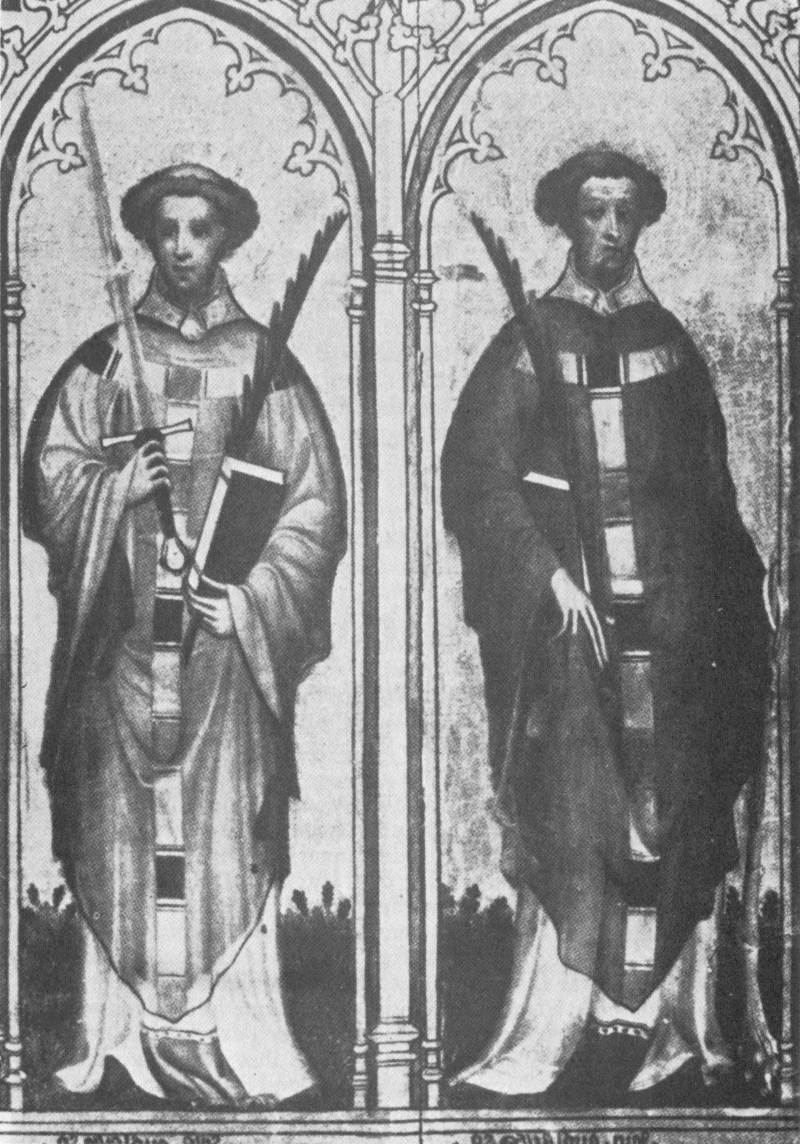
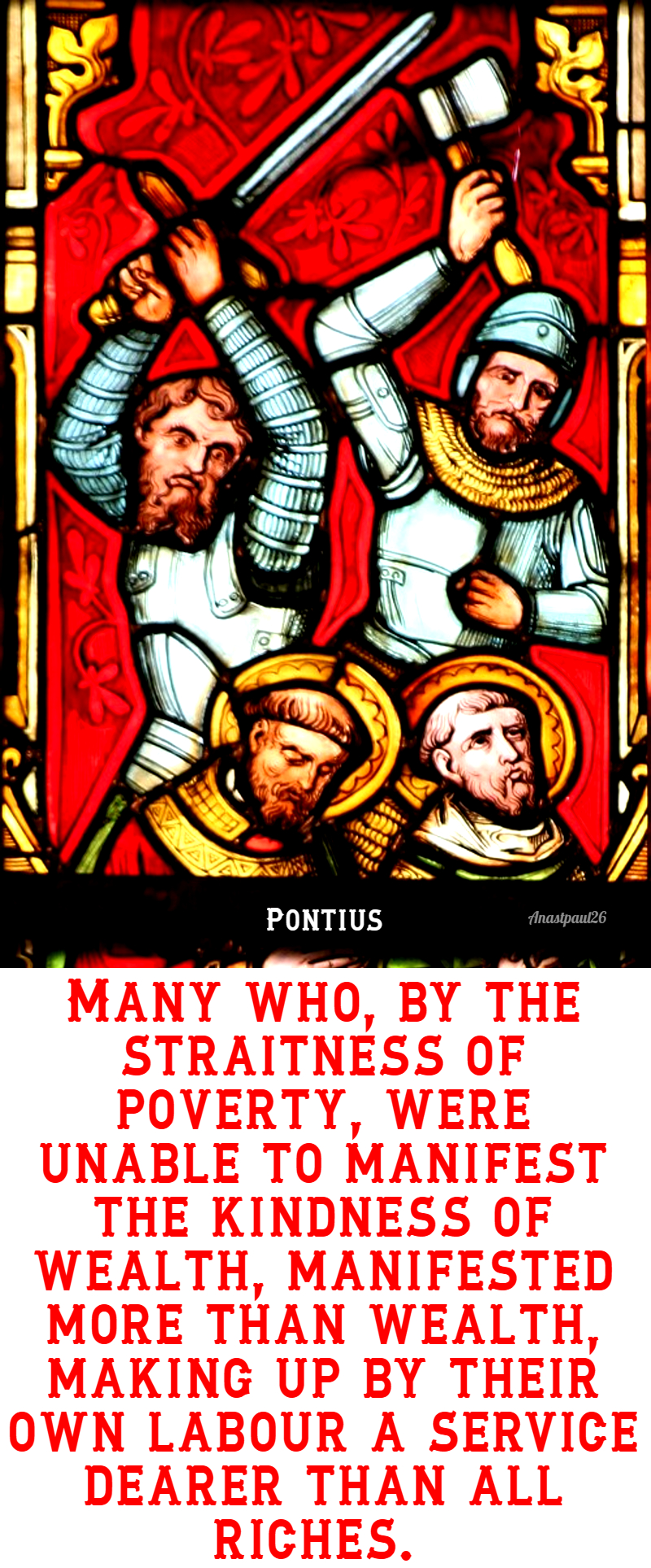
The Two Ewalds (also known as Hewald) were Anglo-Saxon priest-martyrs bearing the same name, who were nicknamed for the difference in their hair colour and complexion.
The two were companions, both natives of Northumbria, England. They spent several years as students in the schools of Ireland. Ewald the Black was the more learned of the two, but both were equally renowned for holiness of life. They were acquainted with St. Willibrord, the Apostle of Friesland, and were animated with his zeal for the conversion of the Germans. Some sources number them among the eleven companions of that saint. They began their mission labours about 690 at Saxony, now part of Westphalia, and covered by the dioceses of Münster, Osnabrück, and Paderborn.
The pagan Saxons, witnessing these activities of the Christian priests and missionaries, began to suspect that the Ewalds planned to convert their over-lord, destroy their temples and supplant their religion. Inflamed with jealousy and anger, they resolved that the Ewalds should die. An uprising followed and both priests were quickly seized. Ewald the White was killed quickly by sword; Ewald the Black was tortured and torn limb from limb, after which both their bodies were cast into the Rhine. This is understood to have happened on 3 October 695 at a place called Aplerbeck, today a district of Dortmund, where a chapel still stands. When the ealdorman heard of what had been done, he became angry and fearful of reprisals, and punished the murderers by putting them to death and burning their villages.
After the priests’ deaths, miracles occured. Their bodies were miraculously carried against the stream for the space of forty miles to the place in which the companions of the Ewalds were residing. As they floated along a heavenly light, like a column of fire, was seen to shine above them. Even the murderers witnessed the miraculous brightness. Moreover, one of the martyrs appeared in vision to the monk Tilmon (a companion of the Ewalds), and told him where the bodies would be found: “that the spot would be there where he should see a pillar of light reaching from earth to heaven”. Tilmon arose and found the bodies, and interred them with the honours due to martyrs. From that time onwards, the memory of the Ewalds was annually celebrated in those parts. A spring of water gushed forth in the place of the martyrdom.
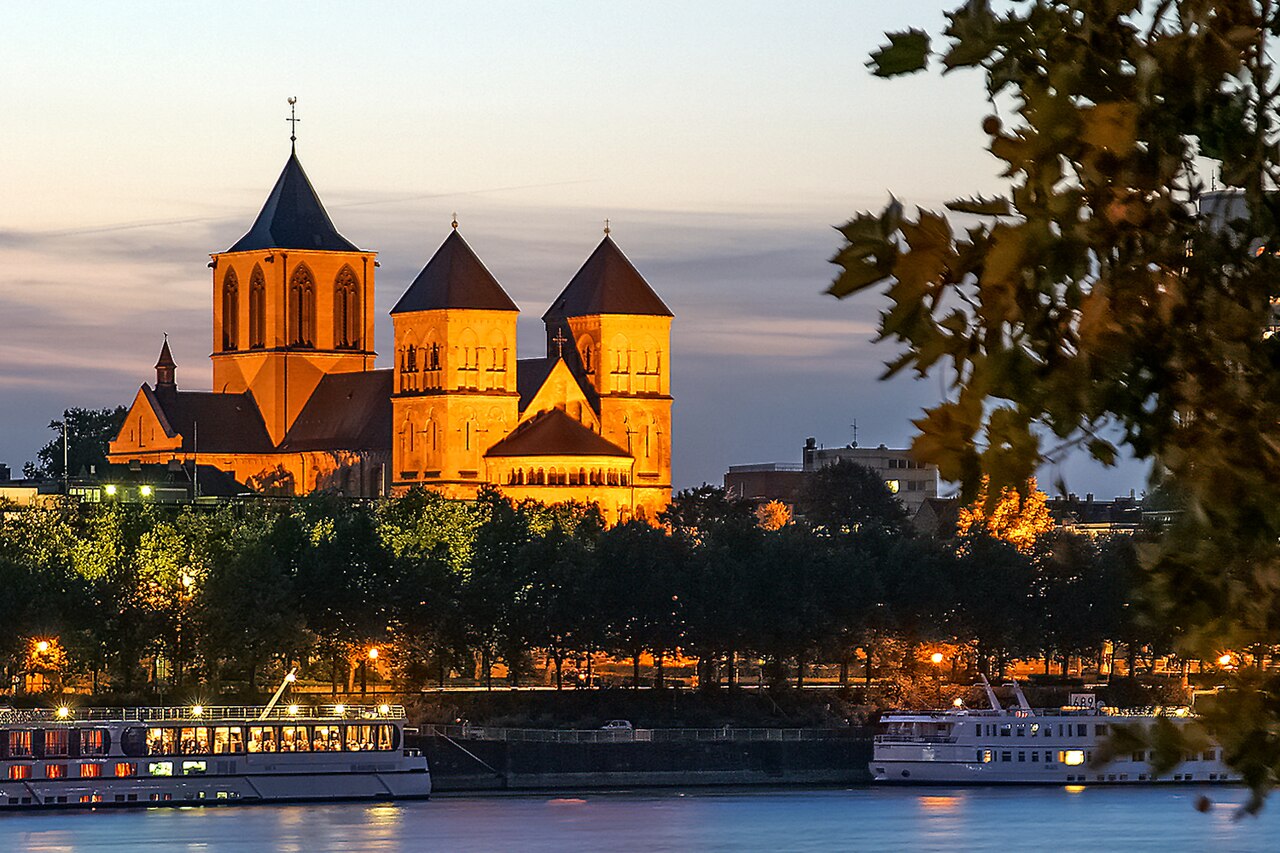
Basilica of St. Cunibert, Cologne
Pepin, Duke of Austrasia, having heard of the wonders that had occurred, caused the bodies to be buried in Cologne, where they were solemnly enshrined in the collegiate church of St. Kunibert. The two Ewalds are honoured as patrons in Westphalia.
Many who, by the straitness of poverty, were unable to manifest the kindness of wealth, manifested more than wealth, making up by their own labour a service dearer than all riches.
Blessed Ralph Crockett & Blessed Edward James were priest martyrs in England, and two of the Martyrs of Douai.
Ralph Crockett was born at Barton, near Farndon, Cheshire in 1522. He was educated at Christ’s College, Cambridge, and then became a schoolmaster in Norfolk for a year before going to Gloucester Hall, Oxford. After a year, he went to Ipswich, where he was a schoolmaster for five years. In 1581, persecutions increased after the death of Edmund Campion, so he withdrew to Cheshire for about two years. In 1584, he left for France, and began studies at the English College then located at Rheims. He was ordained at Rheims in 1585, and continued his studies for a year, but his health being compromised, he asked to return to England. He and three other priests, Thomas Bramston, George Potter, and Edward James, left from Dieppe, but the ship ran ashore 19 April 1586 at Littlehampton, Sussex.
Ralph and Edward, with two others, John Oven and Francis Edwardes, were selected for trial, which took place at Chichester on 30 September 1588. Crockett, James and Edwardes were condemned to death, under the Jesuits, etc. Act 1584, for being priests and coming into the realm; but Oven on taking the Oath of Supremacy was respited.
On1 October 1588. Ralph ascended the scaffold and blessed the crowd in Latin which brought shouts of anger upon him, however he changed into praying in English whereupon the crowd cheered. He and Edward faced their deaths without fear and were executed after absolving each other.
His father Adam, in his later years entered the Catholic Church on the Continent and his descendants remained recusant and continued to practise their Catholic faith in the face of continued persecution.
In 1929 Ralph was beatified by Pope Pius XI.
Edward James was born at Barton, Breaston, near Long Eaton, Derbyshire. He was educated at Derby School, St John’s College, Oxford, the English college at Rheims and the Venerable English College at Rome. In October 1579, he and William Filby sailed from Dover for Calais. The following August, Edward and ten others travelled to the English College, Rome. In October 1583, James was ordained as a priest in Rome by Bishop Thomas Goldwell, the last survivor of the English bishops who had refused to accept the Protestant Revolution.
In early February 1586, James left Rheims for the mission, accompanied by Stephen Rowsham who had been banished from England the year before. They met up with Ralph Crockett in Dieppe. He was captured on board a ship at Littlehampton, Sussex, on 19 April 1586, with three other priests, Thomas Bramston, George Potter, and his fellow martyr, Ralph Crockett, and they were charged with being Catholic priests and coming into the realm of England contrary to an Act of Parliament of 1584. All four were sent to London and put in prison there on 27 April 1586, where they remained for more than two years without trial.
Ralph Crockett, Edward James, John Oven and Francis Edwardes, were sent for trial at Chichester on 30 September 1588. All four were condemned to death for being priests and entering England, but Oven then took the Oath of Supremacy, in accordance with the Act of Supremacy 1559, and was reprieved. On 1 October 1588, the other three were drawn on a hurdle to Broyle Heath, near Chichester, where Edwardes recanted and was also reprieved. Crockett and James continued to refuse to recant and to take the oath.
He was beatified by Pope Pius XI.
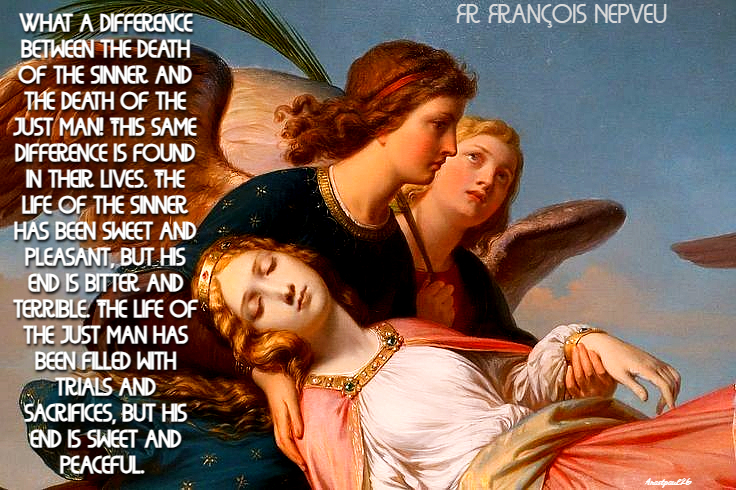
What a difference between the death of the sinner and the death of the just man! This same difference is found in their lives. The life of the sinner has been sweet and pleasant, but his end is bitter and terrible. The life of the just man has been filled with trials and sacrifices, but his end is sweet and peaceful. That which made up the happiness of the sinner during life is his torment at death, but that which made up the pain and suffering of the just man during life is his happiness and consolation at death. The death of the sinner brings an end to the goods and pleasures of time, and plunges him into the evils and sufferings of eternity. The death of the just man brings an end to the evils and sufferings of time, and bids him enter into the goods and pleasures of eternity. What a difference between the death of the sinner and the death of the just man. Which death do you choose?
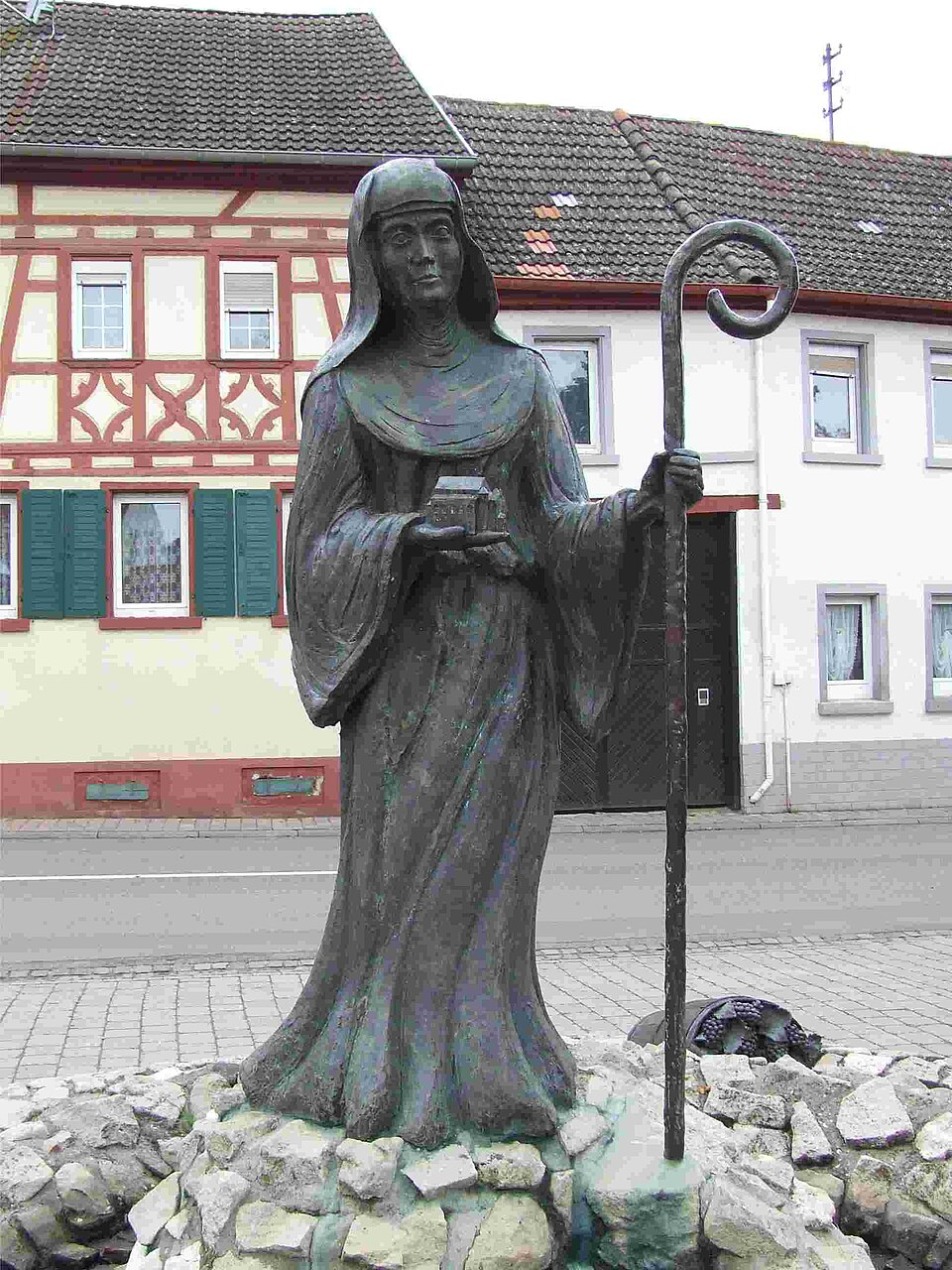
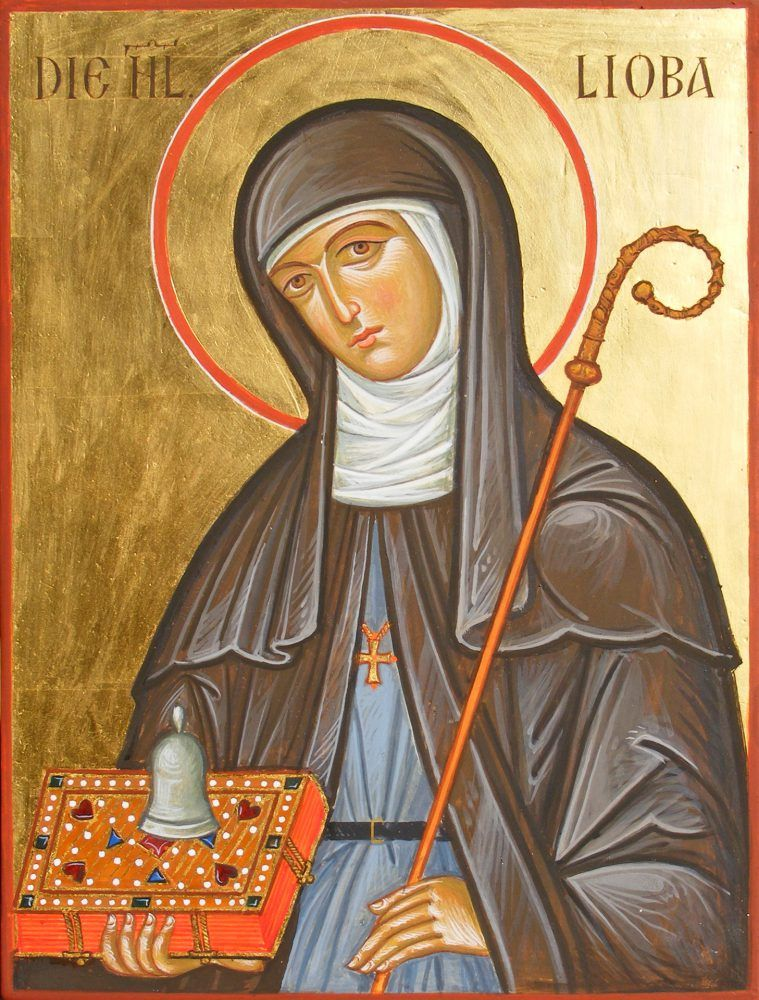
Saint Lioba of Bischofsheim, also known as Lioba of Wimborne, Leoben, Liobgytha, Liobgetha, Truthgeba, was an Anglo-Saxon Benedictine nun born in 710 in Wessex, England as Truthgeba (‘God’s gift’). A relative of Saint Boniface, she was born to noble parents who had long prayed for a child.
She was educated at the convent of Minster-in-Thanet in Wimborne in Dorset, England. She was a nun at Wimborne at a time when Saint Tetta of Wimborne served as abbess.
In 748 Lioba led a group of 30 nuns, one of whom was Saint Agatha of Wimborne, to Germany to help the missionary work of Saint Boniface and found convents. They based their work at Bischofsheim in Würzburg, Franconia, followed the Benedictine Rule, and Lioba served as abbess. This holy woman was noted for her intelligence, her endless optimism and positive attitude for the work, and her constant study of the scriptures. Her work and the houses she founded were instrumental in the conversion of Germany to Christianity.
Lioba retired from her position in 776 only to start another house Schornsheim, Mainz. She visited the court of Charlemagne in Aachen, Germany and became a close friend of Empress Hildegard.
In her later years, she retired with a few other Anglo-Saxon nuns to an estate near Mainz in Schornsheim. The estate was given by Charlemagne for her exclusive use. She died on or about 28 September 782. Saint Boniface’s will had originally designated that Leoba was to be buried in his own tomb. When Lioba died, however, she was placed in a tomb near his. She was acclaimed for many miracles: saving a village from fire; saving a town from a terrible storm by turning aside lightning; protecting the reputation of the nuns in her convent; and saving the life of a fellow nun who was gravely ill – all accomplished through prayer.
Lioba’s grave was the site of many miracles. These miracles include: freeing a man of tightly bound iron rings around his arms and curing a man from Spain of his twitching disorder. Due to these miracles, some of which were witnessed by Rudolf, her relics were translated twice to ensure their safety and are now behind an altar in a church dedicated to Mary and the virgins of Christ in Petersberg near Fulda.
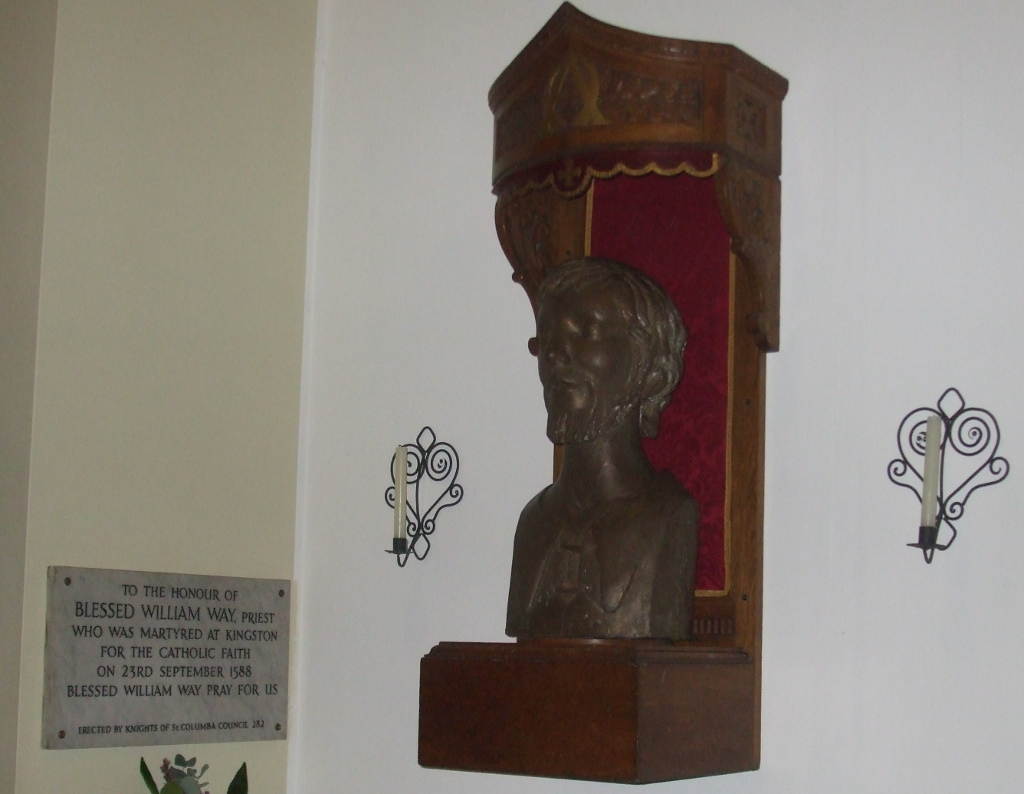
Blessed William Way, was a priest and martyr executed under Elizabeth I. Born in 1560 in Cornwall or Devon, England, William went to France to study for the priesthood since the Protestant revolution in England had closed the seminaries. On 31 March 1584, he received his first tonsure in the Cathedral of Reims from the Cardinal of Guise. On 22 March he was ordained subdeacon, on 5 April deacon, and priest on 18 September 1586, at Laon, probably by Bishop Valentine Douglas, O.S.B
William departed for England on 9 December 1586, and by June 1587, was imprisoned. He was indicted at Newgate in September 1588, for being a Roman Catholic priest. He declined to be tried by a secular judge, whereupon the Bishop of London was sent for. William, refusing to acknowledge him as a bishop or Elizabeth I as head of the church, was immediately condemned as a traitor and to death.
When called to trial at the Sessions in August, “he had so much joy that he seemed past himself”. Way was “hung, drawn and quartered” at Kingston upon Thames on 23rd September 1588.
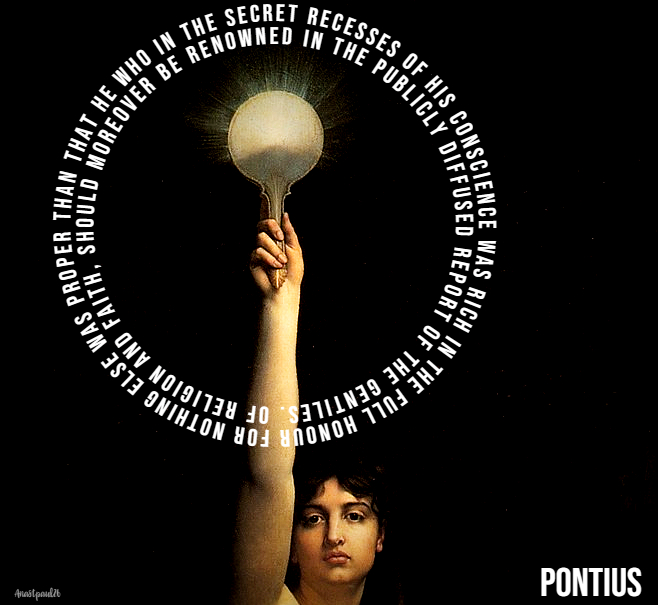
For nothing else was proper than that he who in the secret recesses of his conscience was rich in the full honour of religion and faith, should moreover be renowned in the publicly diffused report of the Gentiles.
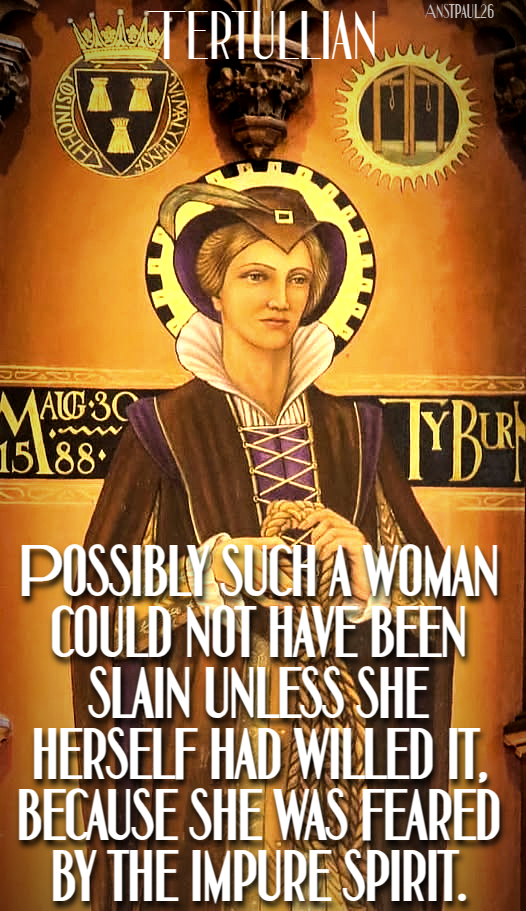
Blessed Margaret Ward, known as the Pearl of Tyburn, a martyr during the reign of Elizabeth I. Margaret was born a gentlewoman in Congleton, Cheshire, in Northwest England, in 1550. Later she travelled to London and went to work in the home of a woman of distinction called Whitall.
Whilst in London she assisted a priest called William Watson, who was imprisoned in the Bridewell prison. Ward befriended the gaoler’s wife, took food to Watson, and smuggled in rope to help Watson escape. She arranged for two Catholic watermen to meet Watson on the Thames below the prison walls; even though he broke his arm and leg during his escape, he was picked up by the watermen, “who rowed him to a safe hiding place”. The rope was traced back to Ward. She was arrested, charged, and tried for “aiding a traitor to escape” and was tortured by being hung by her wrists and beaten for eight days.
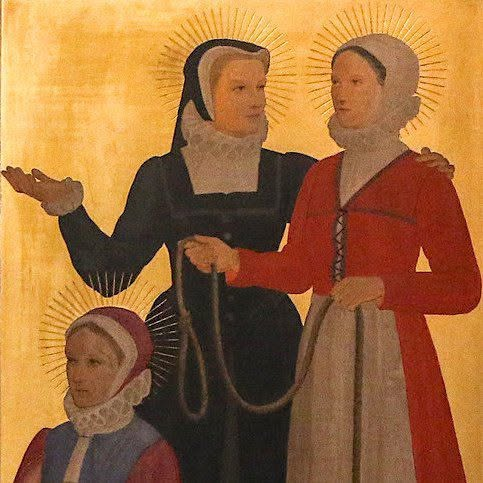
Margaret Clitherow, Anne Line, and Margaret Ward
Blessed Robert Southwell said Ward “was flogged and hung up by the wrists, the tips of her toes only touching the ground, for so long a time that she was crippled and paralyzed, but these sufferings greatly strengthened the glorious martyr for her last struggle”. Blessed John Roche was arrested and tried with Ward. They were offered release if they asked for the queen’s pardon and agreed to “conform to the established Church”, but they refused and were hanged at Tyburn on 30 August 1588. Ward and Roche were beatified in a large group in 1929.
Possibly such a woman could not have been slain unless she herself had willed it, because she was feared by the impure spirit.
Blessed William Lacey, was a martyr of England and a priest. Born in Horton, West Riding, Yorkshire, he married a widow and both his step-sons became Jesuits.
He distinguished himself as a lawyer and as an ardent Catholic, using his house as a refuge for the much-oppressed Catholics of the time, being one of those gentlemen whose house was open to priests that came from the colleges abroad. Having been advised by them that he could not in good conscience attend Protestant churches, his absence was noted and he was forced to give up his position. He was subject to repeated fines, until he had to leave his home and stay with friends, but never long in one place. For fourteen years he suffered persecution for his faith, which included imprisonment at Hull. After the death of his wife, he went abroad and arrived at Reims, 22 June 1580. On 25 September following he went on to Pont-à-Mousson, and thence to Rome, where he obtained a dispensation. The dispensation was necessary as Lacy had been married twice.
He arrived at Douai in 1577 and, after the transference of the English College to Reims, was ordained priest on Holy Saturday, 1579. On his return to England in August he seems to have found a refuge with Robert Dymoke, hereditary Champion of England (d. in Lincoln gaol for his faith, 11 Sept 1580), at Scrivelsby, Lincolnshire. He was eventually arrested, 8 August, 1582. After condemnation the two martyrs shared one cell in a turret till 10 August, when Blessed Richard was moved to an underground dungeon.
York’s ‘Tyburn’ at Knavesmire, where the martyrs were executed
He was executed at Knavesmaire, just outside of York with Blessed Richard Kirkman. They are both members of the 158 Douai Martyrs.
My son, my son, remember eternal life; look up to Heaven and see the One Who reigns there; life is not taken from thee, it is exchanged for a better one.
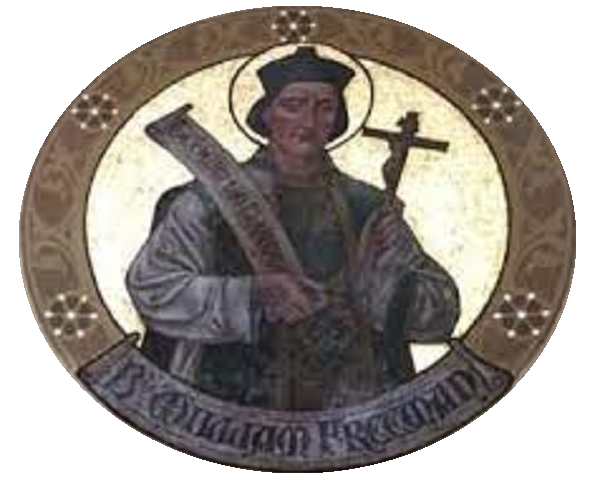
Blessed William Freeman, priest and martyr. He was born at Manthorp near York in 1558; educated at Oxford, and died at Warwick on the 13th of August, 1595. He is one of 136 martyrs who were beatified by Pius XI in 1929.
His parents were recusants, but for a while he pretended to be Anglican. This changed when he went to live in London, where he witnessed the martyrdom of Blessed Edward Stransham at Tyburn in 1586. The death of his fellow Blessed changed his life the same way Bl Edmund Campion’s had changed Bl Henry Walpole’s and Bl Philip Howard’s, converting him to the Faith. He left England and was ordained priest in 1587 at Reims.
Returning to England in 1589, he worked for six years on the borders of Warwickshire, and met many people who were contemporaries or friends of Shakespeare. In January, 1595, in Stratford-on-Avon he was arrested, and spent seven months in prison. He denied his priesthood, but also refused all friendly offers to escape, not wishing to lose his opportunity of martyrdom. Owing to the treachery of a fellow-prisoner, William Gregory, he was at last sentenced as a seminary priest and in spite of a protest of loyalty, was put to the death of a traitor (hanging, drawing, quartering) at Warwick.
Bl Edward Stransham, Bl Henry Walpole and Bl Philip Howard were also beatified by Pius XI in 1929.
Saint Jaenbert (Jaenberht, Janbriht, Janibert, Jambert, Lambert, Lanbriht, Genegberht) Jænberht was a medieval monk, and later the abbot, of St Augustine’s Abbey, Canterbury. He came from a prominent family in the kingdom of Kent, and a kinsman of his, Eadhun, was an official of King Egbert II of Kent. In 760 he was elected Abbot of St. Augustine’s, Canterbury, and blessed by Archbishop Bregwin. When the archbishop died he was buried at Christ Church, and Jaenbert asserted the rights of his own abbey as the traditional burying-place with such vigour that the monks of Christ Church elected him archbishop to avoid his appeal to Rome, thus showing the great strength of his personality and will.
Canterbury Cathedral seen from St Augustine’s Abbey
As archbishop, he had a difficult relationship with King Offa of Mercia, who at one point confiscated lands from the archbishopric. By 787, some of the bishoprics under Canterbury’s supervision were transferred to the control of the newly created Archbishopric of Lichfield. Jænberht also presided over church councils in England and minted silver coins, thus making him the earliest Archbishop of Canterbury whose coinage has been preserved. The saint was renowned for his wisdom and sound judgment. He was sought after by both clergy and laity for his advice and guidance on matters of faith and morals. Jambert was the thirteenth prelate of the primal see of England and was noted for his patronage of monasteries and the poor.
St Augustine’s Abbey
He died on 12 August, 792, of natural causes, and was buried in the abbey church of St Augustine’s Abbey in Canterbury.
Saint Sidwell, also known as Sidwella, was a virgin saint from Devon, in England. She is the patroness of Exeter and sister of Saint Urith and Saint Juthwara. A Saxon living in Exeter in the 8th century, her father was a wealthy landowner named Benna, who died leaving his daughter in the care of a cruel stepmother, who was jealous of her beauty and virtue and coveted her inheritance.
The girl often left the city to bring food to the villagers working the fields outside the city walls. The Catalogus Sanctorum Pausantium in Anglia says she was beheaded by a couple of corn reapers, hired to do so by her stepmother. They cut off her head with a scythe, and where her head came to rest, water sprang up. A shaft of light shone over the site for three nights. She was buried at St Sidwells. Her ghost was seen carrying her severed head and putting it back on her shoulders at the spot where she was later buried. The spring became the Well of St Sidwell, and was a place of pilgrimage in Anglo-Saxon and Norman England.
The Church of St Sidwell, located just outside the site of Exeter’s east gate, still exists, and one of the main streets in Exeter is Sidwell Street.
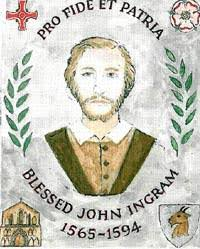
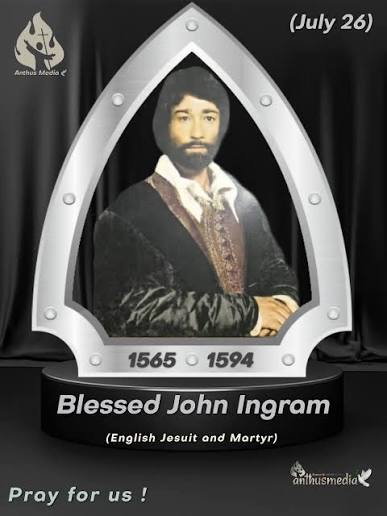
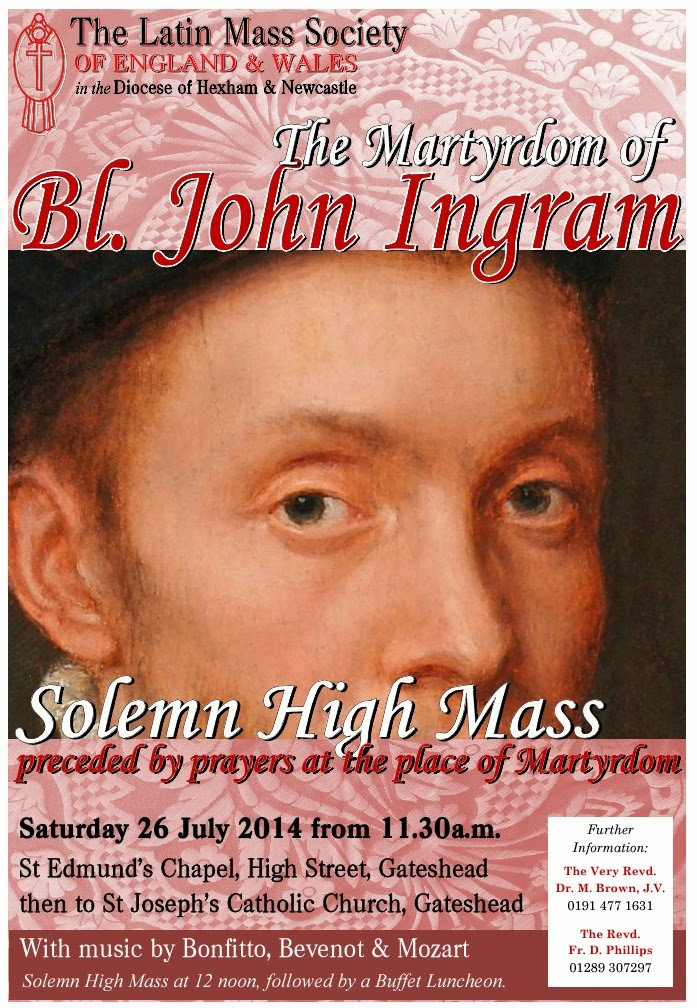
John Ingram, born in 1565 at Stoke Edith, Herefordshire, England. Son of Anthony Ingram of Wolford, Warwickshire, and Dorothy, daughter of Sir John Hungerford. He was an English Jesuit and martyr who was executed in Gateshead on 26 July 1594, during the reign of Elizabeth I, aged 29.
He was educated at Worcestershire and the New College, Oxford, England and was an adult convert to Catholicism. After graduating from there at 17 years old, he left England for Douai, then he attended the English College at Rheims, France; the Jesuit College at Pont-a-Mousson, France; and the English College Seminary, in Rome. On the way to Rheims he and three other young men were waylaid and held for ransom by a troop of Calvinist mercenaries in the pay of Francis, Duke of Anjou.
The first mention of Ingram is in a letter from William Allen, Principal at Rheims, to the rector of the English College in Rome: Even at the very moment of my writing to you bad tidings come of four young students. On their way to this college from Douai, they were robbed, and are still held captive, by the soldiery of my lord, the brother of his Majesty, and a large sum of money is demanded of us for their ransom. Meanwhile the soldiers are dragging their unhappy victims from town to town, and from province to province, in the direction of their camp in Belgium. God knows how much we shall have to pay to redeem them, for letters from the Mayor and Corporation of Rheims in their favour have been entirely without effect.”
But the four young men, John Ingram, Richard Haward, Thomas Heath and Christopher Haywood, managed to escape and made their way to Rheims, arriving, in a state of the utmost destitution during October and November 1582. On 10 June 1585, he took the oath of commitment to return to England as a Missionary Priest and took minor orders. John was ordained at Rome in 1589.
Sent on a mission to Scotland in 1592, he was supported by Lords Huntly, Angus, and Erroll, the Abbot of Dumbries, and Sir Walter Lindsay of Balgavies. To get there John traveled to Abbeville in France, then doubled back to Brussels where he said Mass in a secret chapel run by the Jesuits, and thence to Antwerp where he visited the Carthusian church and said Mass. There he abandoned his clerical garb and dressed as a layman. This circuitous route was possibly to obscure his intentions and identity, from the network of spies maintained by the English Government, who were always on the lookout for priests. John lived for 18 months as resident chaplain to the household of Sir Walter Lindsay, in the guise of a steward, ministering to the local faithful. He converted many people to the faith.
He lived under a number of aliases, but when Sir Walter Lindsay fled to Spain after angering the king by his own allegiance to the Faith, John fled south and to evade pursuit, slipped across the English border on 25 November 1593. He rested for some hours at Wark-on-Tweed and then traveled downriver seeking a means to cross back into Scotland but he was apprehended by the English border guards near Norham Castle.
Strenuous efforts were made by Scottish supporters to secure his release, one laird claiming Ingram as his own son, and others offering the substantial ransom of a thousand crowns for his release. This only confirmed the English belief that they had captured someone of significant importance, as up till then they were not certain whether he was a priest or some other enemy of the state.
He was imprisoned for his faith at Berwick, Durgam, York, and the Tower of London. Tortured in the Tower for the names of other “traitorous” Catholics, he gave away nothing, ministered to and encouraged his fellow prisoners, and still wrote 20 Latin epigrams that have survived.
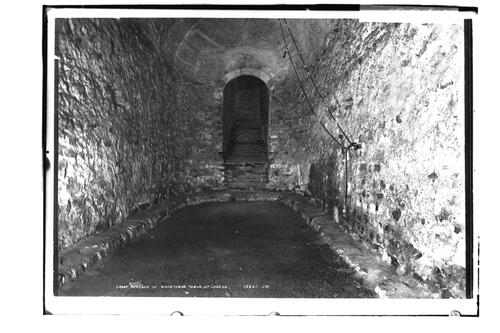
Ingram arrived at the Tower of London on Holy Saturday, 17 April 1593, and later wrote:
Rocks are quarried, the entrails of the earth, That Dives may have living rock for his tomb. No tomb seek I; and yet shall there be a living tomb
For my lifeless body — the carrion-crow.
He was severely tortured by priest hunter Richard Topcliffe. Hung by the joints of his fingers and arms, he was in extreme pain for so long that the feeling of his senses was taken completely from him. He was often put to the rack, but would give no information about persons and places. When he and another priest were moved to York, Ingram was in solitary confinement in a stinking vault of a locked jakehouse for four days, without either a bed to lie on or a stool to sit on. From York, he was transported to Newcastle and imprisoned in the Newgate prison there for four night. A woman visitor to the prison was struck by the serenity and joy of the priest, who said that he had good cause to be merry because his wedding day being at hand, the bridegroom must be glad, for within ten days he hoped to enjoy his Spouse. She remarked that it was true his hope was good, but his banquet was deadly; but he answered that the reward was sweet. The serenity and courage of John Ingram is reflected in two letters he wrote from prison to his friends or fellow prisoners in the same prison: “I look for my trial on Thursday and consequently for my death in God’s honour ( …) in my pained body; my spirit is not pained, nor in any disaster, distress or durance.”
Tower of London cell
Someone in Scotland offered the English Government a thousand crowns to spare Ingram’s life, but he was convicted with Saint John Boste and Saint George Swallowell (the other two Durham Martyrs), for the high crime of priesthood.
When he was asked what he had to say that he should not receive judgement, he made this answer, “I say that I am a priest, and that my exercise and practice of priesthood cannot be made treason by any Christian law; and I beseech God to forgive both you and them that make it otherways. And I do with all my heart forgive you, and all my accusers and persecutors, and so I beseech God to have mercy upon me, and to strengthen me with patience and constancy in mine agony.”
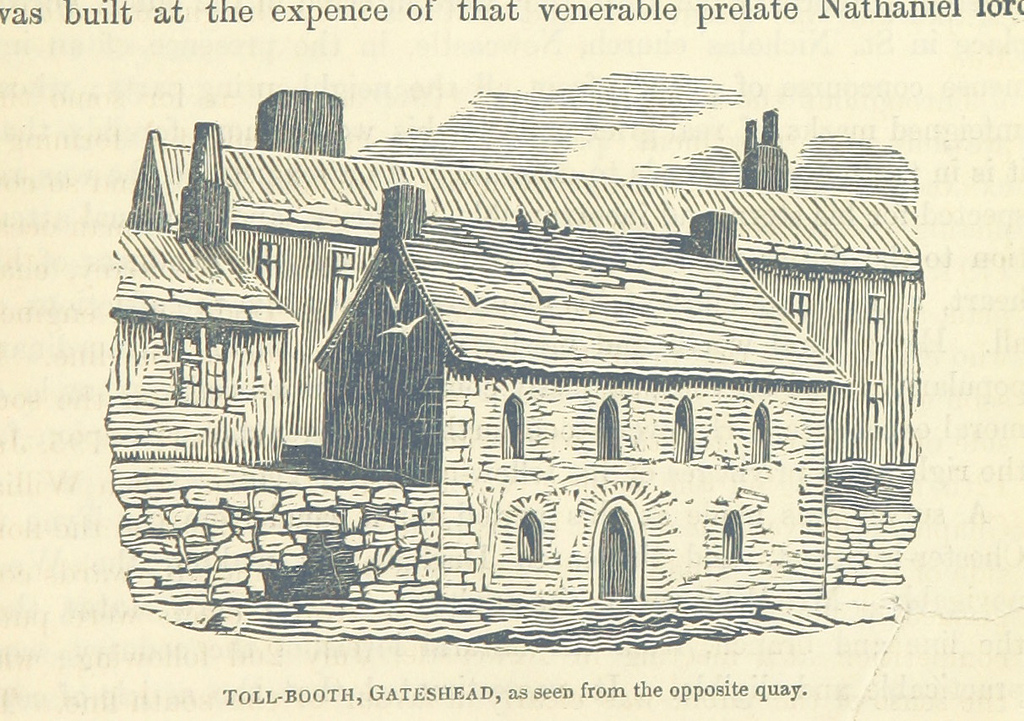
Immediately prior to his execution, he was held for a short while in the Toll-Booth in Gateshead, a small local gaol very close to the place of execution. Holtby gives an account of Ingram’s preparations, the prayers he said, his words to the bystanders, and of the execution itself:
“I take God and his holy angels to the record, that I die only for the holy Catholic faith and religion, and do rejoice and thank God with all my heart that hath made me worthy to testify my faith therein, by the spending of my blood in this manner.”
He was asked to pray for the Queen and he prayed to God that she might long reign to his glory, and that it might please him to procure her to live and die a good Catholic Christian prince. With rope around his neck he said more prayers, ending with the psalm Miserere mei Deus, after which, making the sign of the Cross and saying, “In manus tuas“, the ladder was turned; and being dead, he was cut down, bowelled, and quartered. His severed head was placed on a spike and displayed on the bridge across the Tyne.
The Toll-Booth
In Rome, at the English College, when the news of his martyrdom reached them, the staff and students sang the Te Deum in the college chapel and wrote against his name “Martyro insigni coronatus“.
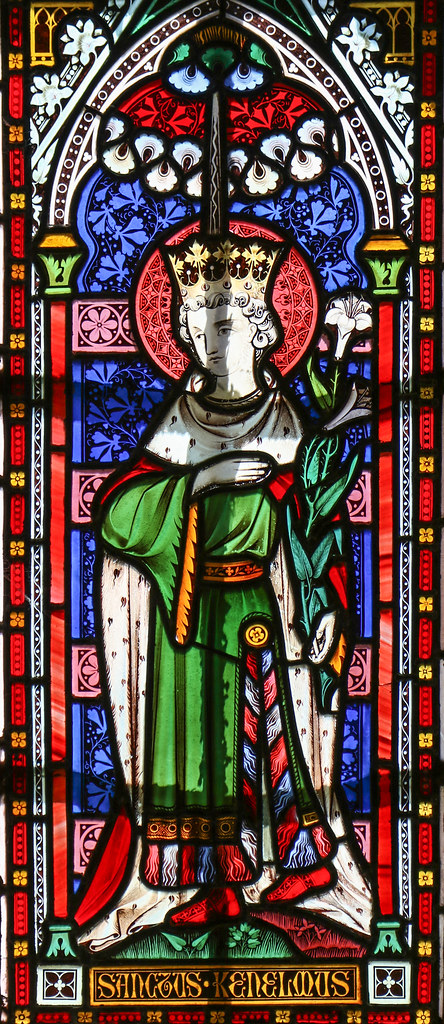
Saint Kenelm or Cynehelm, is an Anglo-Saxon saint, venerated throughout medieval England, and mentioned in the Canterbury Tales (The Nun’s Priest’s Tale, lines 290–301. William of Malmesbury, writing in the 12th century, recounted that “there was no place in England to which more pilgrims travelled than to Winchcombe on Kenelm’s feast day”.
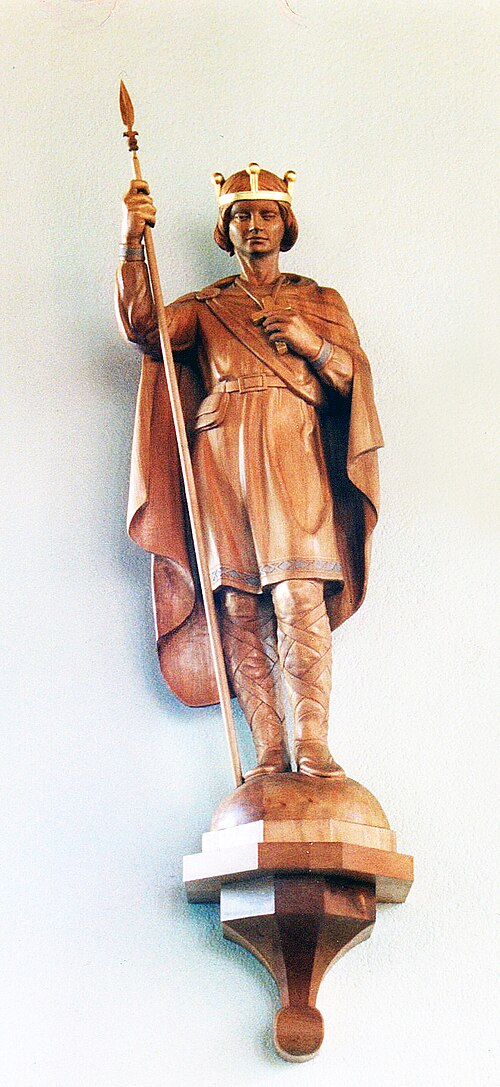
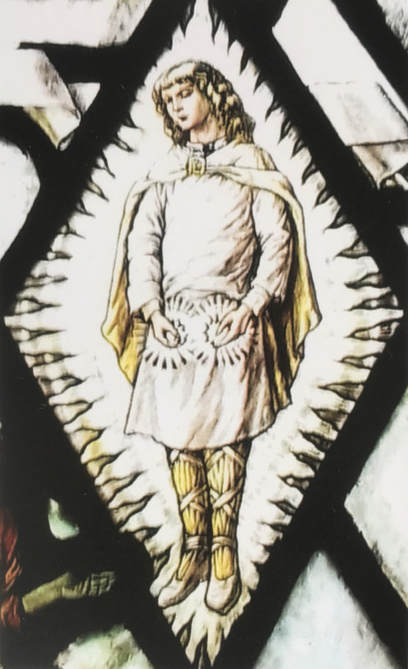
Saint Kenelm was the son of Cenwulf, King of Mercia (796–821). According to 12th-century documents from Winchcombe Abbey, King Kenelm ascended the throne at the age of seven. He was beheaded at the instigation of his sister Cwenthryth, who wanted to take the throne, and his body was buried in an unmarked spot in Clent Forest, south of Birmingham. Saint Kenelm’s soul is said to have then risen in the form of a dove carrying a scroll. It flew to Rome, where it left the scroll at the feet of Saint Hierarch Pascal, Bishop of Rome. The message on the scroll read: ‘Down in a cow meadow, under a thorn, with his head missing, lies poor Kenelm, born king.’ Saint Pascal then wrote to the Archbishop of Canterbury, who commissioned a group of monks to search for the king’s body. The discovery of his body led to the establishment of a chapel at the site, marked by miraculous events, including the ringing of church bells by themselves, and the emergence of a healing spring at the point where the exhausted monks struck the ground with their staffs.
While searching, the monks saw a pillar of light shining above a bush in Worcestershire. Buried beneath it, they found the body of Saint Kenelm. The monks transported his relics to Winchcombe Abbey, where they were kept and remained there for several hundred years, where miracles were reported. Wells marked the course of his body from the Clent Hills.
His sister, Queen Cwenthryth, was reading a Psalter when she heard the bells ringing unaided by human hands. When she was told that her brother’s body had been found, she cried ‘If that be true, may both my eyes fall upon this book.” Her eyes immediately fell from her head upon the book. She and her lover were put to death, and their bodies cast into a ditch.







You must be logged in to post a comment.