
St John Eudes – The Admirable Heart of Mary
Mary’s Heart, The Garden of Eden Part 2
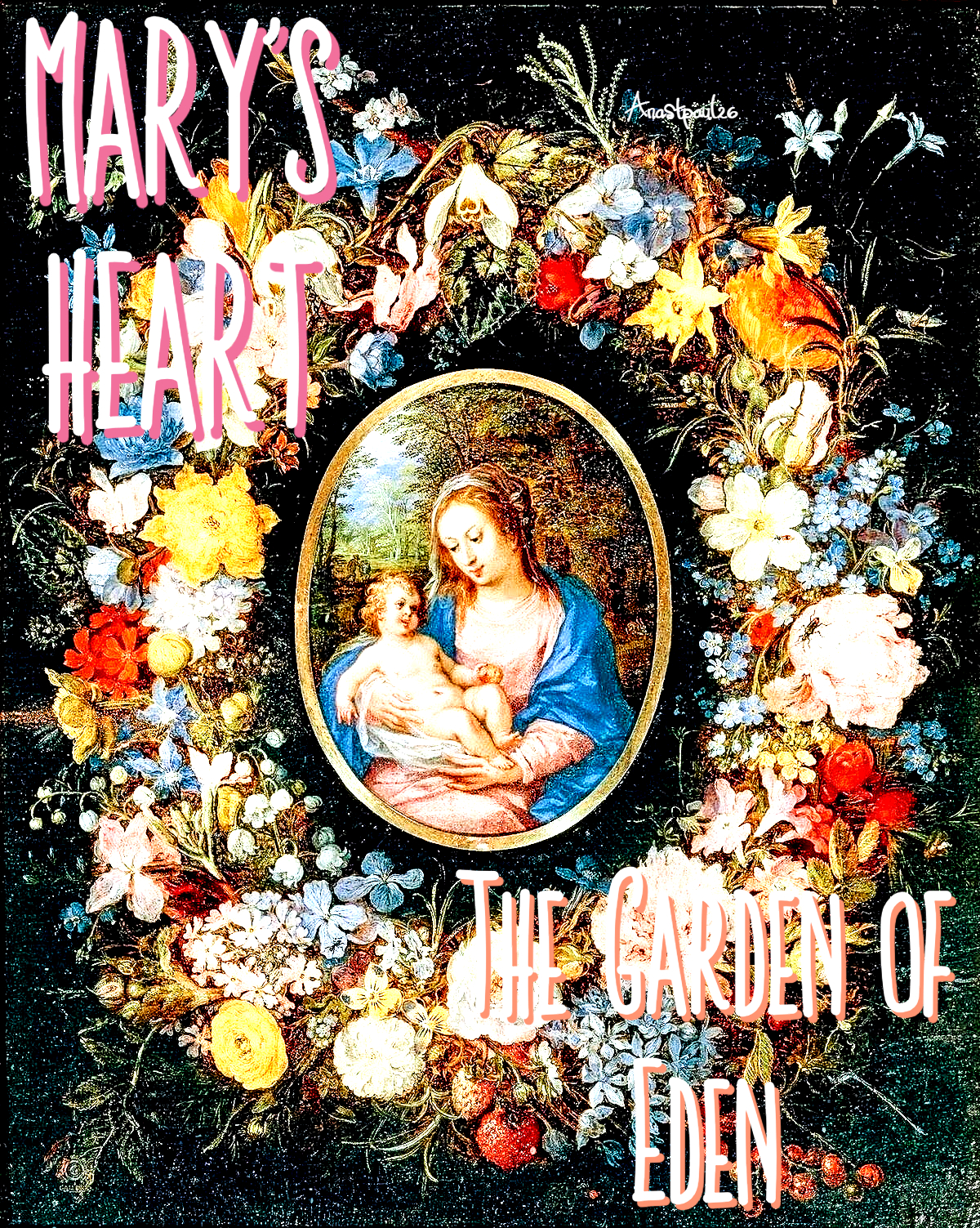
Such then are the trees to be found in the first’and the second gardens of Eden. Are any flowers to be found there? Sacred Scripture does not mention the presence of any blossoms in the first garden; yet who can doubt that a garden of delight must have contained flowers in great abundance? It is certain, however, that the garden of Jesus is filled with heavenly flowers, the most beautiful and sweet-scented imaginable. The Heart of Christ’s Mother is a celestial flower-bed dotted with the holy blossoms of all Christian virtues, immortal flowers, which never fade, whose ravishing beauty and delightful fragrance remain in every season. They fill the universe with their sweet perfume and give joy to the Angels, yea, even, to God Himself. They are at once flowers and fruits, for the Holy Ghost inspires the words: “My flowers are the fruit of honour and riches.”
The Eternal King adorns His garden with these flowers, and by means of their divine fragrance attracts innumerable hearts to Himself. He eats of these fruits, which are among the choicest viands of His heavenly table, and gives them as nourishment to His children. He assures us, moreover, that He takes His rest and refreshment in the works of mercy which are among the first flowers of His garden: “This is my rest, refresh the weary, and this is my refreshing.” So also does He feast with delight on the other acts of virtue which proceed from devoted hearts, and especially from the perfect Heart of His glorious Mother. With them He nourishes and strengthens the souls of His children.
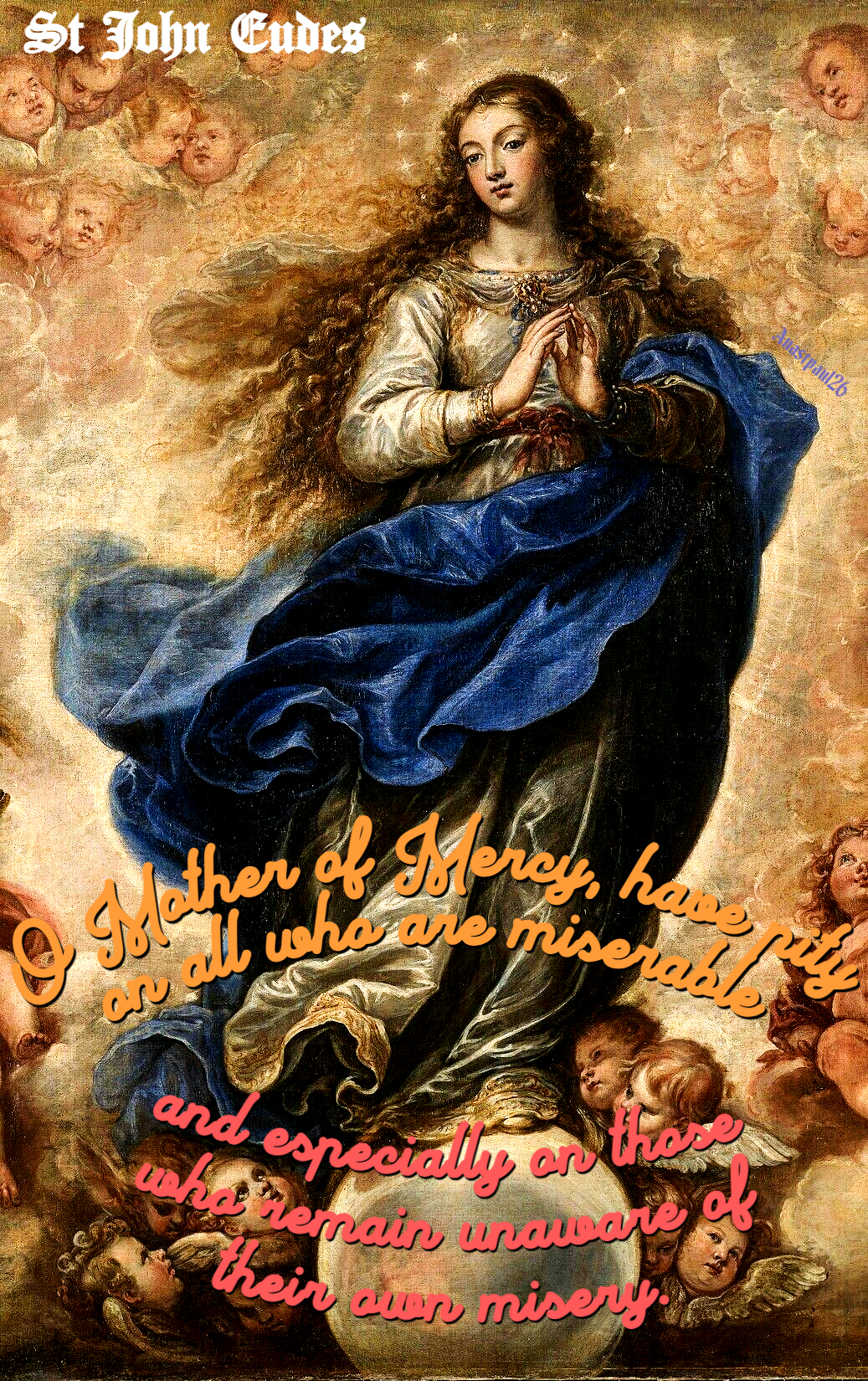
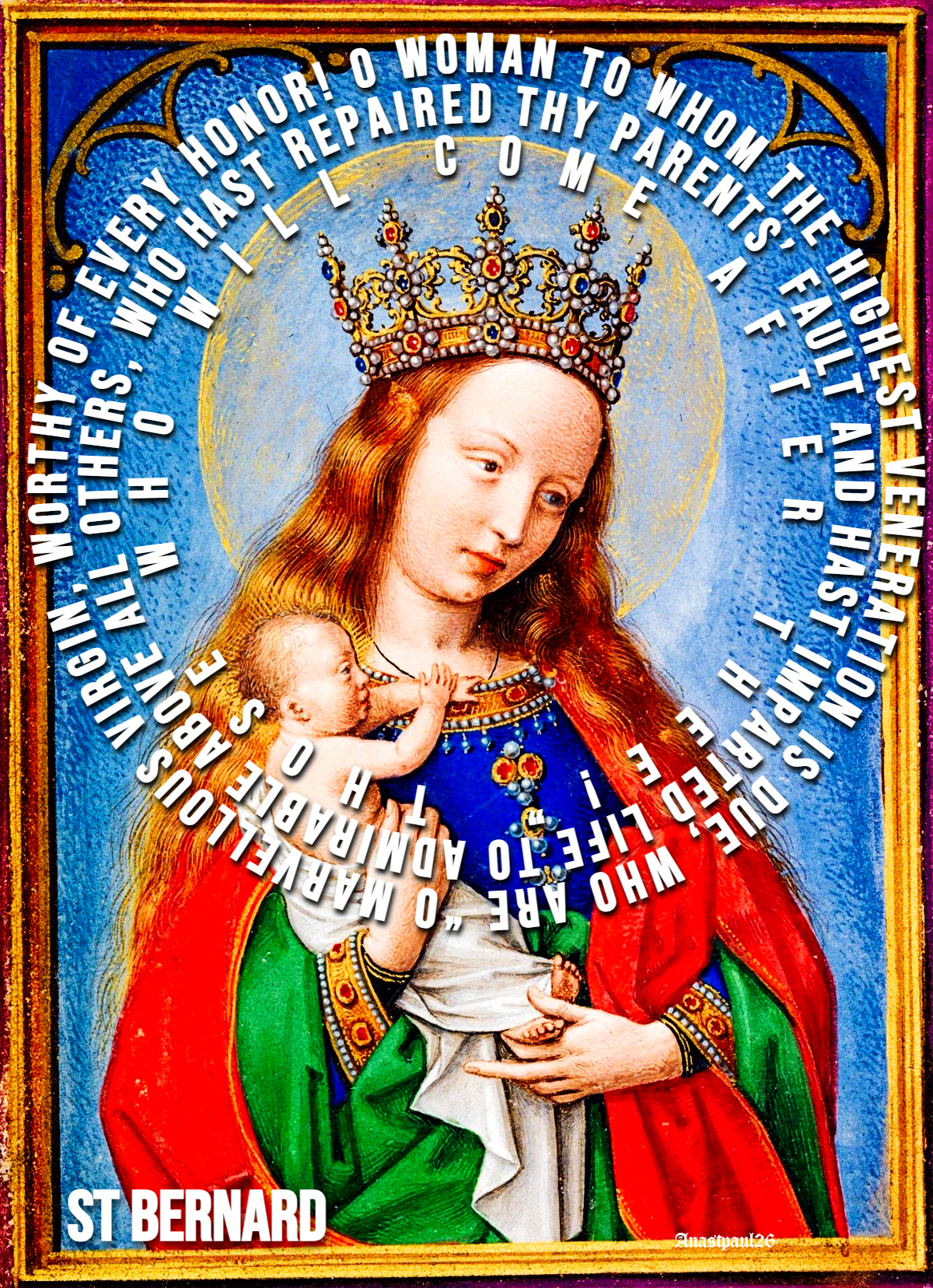
This is what God meant when He said that He came into His garden, ate His honey and drank His wine with milk, and then invited His friends and children o eat, drink and be inebriated with Him. Among the flowers in Mary’s Garden for her divine Spouse, St. Bernard admires especially the perfume of violets, the whiteness of lilies and brilliant color of the roses. Here are his words: “Thou art an enclosed garden, O Mother of God, wherein we cull all kinds of flowers. Among them, we gaze with particular admiration on thy violets, thy lilies and thy roses, which fill the House of God with their sweet fragrance. Thou art, O Mary, a violet of humility, a lily of chastity, and a rose of charity.” We may add: “Thou art, O Mary, a carnation of mercy, a double carnation,-because thy wondrous Heart is filled with mercy and compassion, not only for our corporal infirmities, but still more for our spiritual misery, which is infinitely more painful and complex than our bodily ills can ever be. O Mother of Mercy, have pity on all who are miserable, and especially on those who remain unaware of their own misery.”
And now I go on to another object to be envisioned in the earthly paradise. In the second chapter of Genesis, we read that God brought to the first man the animals and the birds He had created that Adam might give them suitable names, as a sign of his dominion over them and of their dependence on him. We may now ask if any qualities of the Heart of the Queen of Heaven can have been symbolized by such humble things as animals and birds? Yes, and this should not surprise you, since her Son, Who is God Himself, willed to be represented by oxen, sheep, lambs, and several other beasts which, under the Old Law, were sacrificed to God.
What, then, is represented by the animals and birds subjected by God to the dominion of Adam in Paradise? They represent the natural passions that have their seat in the corporal and physical heart of man. These passions are of two kinds, that is, the more earthly and animal instincts, such as anger, hatred, fear, sadness, aversion, distrust, which are represented by the animals, and the more spiritual emotions, such as love, desire, hope, courage and joy typified by the birds.
All these passions existed as we have seen, in the Heart of the Blessed Virgin Mary, Just as they are found in the hearts of all children of Adam, but she enjoyed the great privilege that in her Heart they were completely subject to reason, just as the savage beasts were under the complete con-trol of Adam in the earthly paradise. The spirit of Christ, the new man, reigned so perfectly in Mary’s Heart and so absolutely ruled her passions, that they never experienced any motivation contrary to the will of God. She never employed them except under the guidance of God’s Holy Spirit and for the glory of His Divine Majesty. She never loved anything besides God; she never desired anything except to please Him; she feared nothing save to displease Him. All the difficult tasks she undertook were accomplished in His service and for His glory, the sole cause of her joy, even as the offence and dishonor afforded Him by sin were the only motives of her hatred, her aversion, and her anger. So truly were her natural passions uplifted and almost annihilated towards the world and all worldly objects and concerns, even with regard to herself and her own interests, that her emotions existed and vibrated only for what was pleasing to Him who possessed, animated and directed them in all thoughts. From this we learn that the Heart of the Blessed Virgin Mary was truly the Earthly Paradise, in which there was no war, trouble or disorder of any kind, but peace, tranquility and marvellous order, combined with ceaseless praise and adoration of the God who had established His throne in this Paradise.
Now let us study the gardeners. In the first terrestrial paradise, Adam was appointed “to dress it, and to keep it,” but instead of cherishing his beautiful garden, he sold it to his arch-enemy the serpent, for a mere taste of the forbidden fruit. Instead of cultivating the Garden of Eden, Adam brought sin into it, filling it with thorns and thistles. What an unfaithful guardian! What a wicked gardener!
But in the second Paradise, the enclosed garden of the Heart of Mary, the gardener is Wisdom, eternal, watchful and faithful, and the three assistant gardeners are Love, which digs and prepares the soil to receive the seed of heavenly inspiration, Grace which sows the seed, and Patience that cultivates it to fruition by perseverance. Thus the flowers of Mary’s heart grow ever more beautiful, more admirable to us and more delightful to God, while the fruits of her garden multiply a hundred thousandfold.
In the first garden, God pronounced sentence upon the serpent: “The woman shall crush thy head and thou shalt lie in wait for her heel.” In the garden of Mary’s heart, this pronouncement was fulfilled. Her Immaculate Conception crushed original sin, her sanctity routed the powers of evil, and her love obtained the commutation of our death sentence, bringing us the Saviour of the world.
Man, having rebelled against God in the first paradise, was driven from that garden and banished forever with all his posterity, and at the gate was placed an angel with a flaming sword in his hand to prevent the children of Adam from re-entering the Garden of Eden. From this we learn that to enter and share the second paradise, namely the pure heart of the Mother of the new Adam, we must cease to be sons of Adam and become children of Jesus Christ, that is, our old life must die. This death seems fearful; the sword of the cherubim is terrifying; yet actually it is a sword of love, which wounds, or even slays the blessed, in order to heal their souls and make them live the life of God. “Precious in the sight of the Lord is the death of his saints” ” says Sacred Scripture, meaning the death that is not death but the beginning of eternal life.

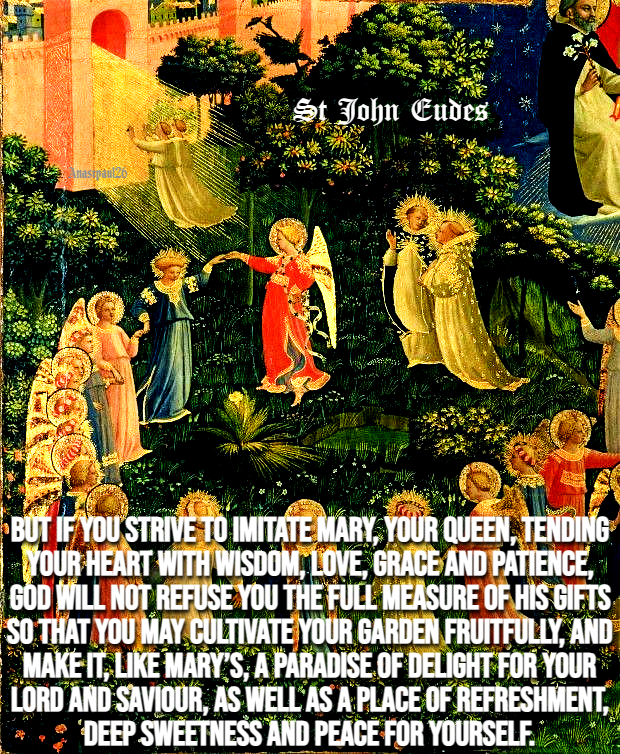
Now that I have shown you, dear reader, the admirable Heart of Mary as the garden of delectation of the God-Man, I would warn you that your own heart must be one of two things, either a hell of torment for yourself, or a paradise of delights for you and for Jesus Christ. If you banish sin and self-love from the garden of your heart, opening wide the door to grace and to the King of Virtue, He will enter in and find repose in that place. If you drive away grace and mortification, letting sin grow in your garden, then the demons will enter and make it their abode, a veritable hell instead of paradise. But if you strive to imitate Mary, your Queen, tending your heart with wisdom, love, grace and patience, God will not refuse you the full measure of His gifts so that you may cultivate your garden fruitfully, and make it, like Mary’s, a paradise of delight for your Lord and Saviour, as well as a place of refreshment, deep sweetness and peace for yourself.



You must be logged in to post a comment.