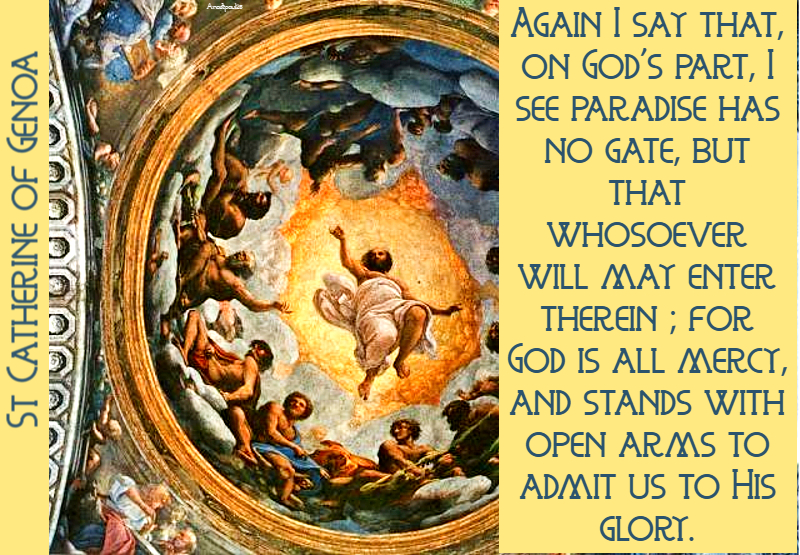
Again I say that, on God’s part, I see paradise has no gate, but that whosoever will may enter therein ; for God is all mercy, and stands with open arms to admit us to His glory. But still I see that the Being of God is so pure (far more than one can imagine), that should a soul see in itself even the least mote of imperfection, it would rather cast itself into a thousand hells than go with that spot into the presence of the Divine Majesty. Therefore, seeing purgatory ordained to take away such blemishes, it plunges therein, and deems it a great mercy that it can thus remove them.
No tongue can express, no mind can understand, how dreadful is purgatory. Its pain is like that of hell ; and yet (as I have said) I see any soul with the least stain of imperfection accept it as a mercy, not thinking it of any moment when compared with being kept from its Love. It appears to me that the greatest pain the souls in purgatory endure proceeds from their being sensible of something in themselves displeasing to God, and that it has been done voluntarily against so much goodness ; for, being in a state of grace, they know the truth, and how grievous is any obstacle which does not let them approach God.
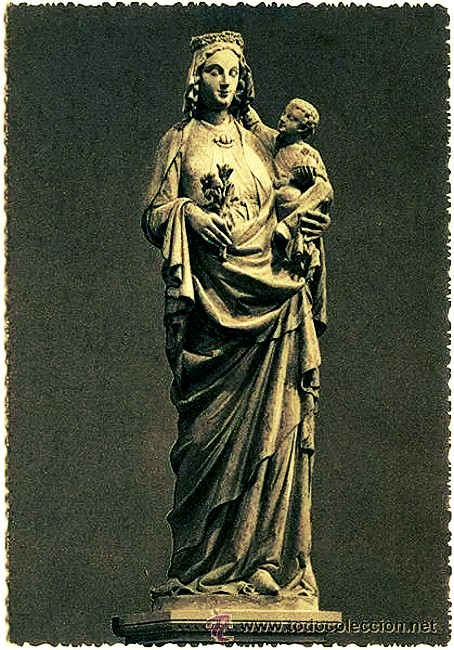
Notre-Dame de Bellefontaine / Our Lady of the Blessed Fountain, Bellefontaine, France (12th Century) – 8 November:
It was sometime in the 13th century when a man, who was hunting near the Benedictine Abbey, severely injured his hand. The injury was so severe, that the man feared that he might lose his life from the loss of blood which would not cease. Having with him a bowl, he filled it with fresh water he found nearby and placed his hand in it as he prayed devotedly to the Blessed Virgin Mary for her intervention The man’s faith was rewarded, as the hunter looked at his hand to witness the wound miraculously close as if he had never been injured at all.
In recognition of the miracle, he later returned to site, bringing with him, a Statue of the Blessed Virgin. When the news of the miracle became widely known. it attracted many pilgrims from all over Europe. Thus, starting in the 13th century, the Statue of the Virgin was venerated under the title of Notre-Dame-de-Bellefontaine. A small chapel was also built around the Statue of the Virgin Mary.
Shortly before the coming of the French Revolution, a church was built, whose care was entrusted to a local hermit. The Statue of the Blessed Virgin miraculously escaped the revolutionary turmoil and the place remained a place of celebration for the faithful of the two neighbouring counties. The nearby Benedictine Abbey, which had been founded at the end of the eleventh century, was plundered and confiscated by the state during the Revolution and then sold in the year 1791. In 1794 some of the buildings were set ablaze and the rest of the Abbey left in ruins. Some of the property was purchased on 17 january 1817, by a Trappist Monk, Urban Guillet and it once again became a flourishing Monastery.
The pool from which the hunter obtained the water still exists and is now protected behind a metal grate. There is also a modern statue of the Blessed Virgin Mary located in a grotto nearby, as the original statue disappeared during the fighting and chaos of World War I. Its current whereabouts is unknown.
Blessed John Duns Scotus OFM (c 1265-1308) Doctor Subtilis (Subtle Doctor) Franciscan Priest and Friar, Theologian, Philosopher, Lecturer – known as “The minstrel of the Word Incarnate” and “Defender of Mary’s Immaculate Conception”.
St Gervadius St Giuse Nguyen Ðình Nghi
St Godfrey of Amiens OSB (1066–1115) Bishop of Amiens, Reformer, Apostle of Prayer and Charity, Penitent.
St Gregory of Einsiedeln St John Baptist Con Bl Maria Crucified Satellico St Martinô Tho St Martinô Ta Ðuc Thinh St Maurus of Verdun St Moroc of Scotland St Phaolô Nguyen Ngân St Tysilio of Wales St Willehad of Bremen (Died 789) Bishop Confessor St Wiomad of Trèves — All Deceased Dominicans
All Saints of the Diocese of Evry: A regional memorial of all the saints and beati of the calendar who have a connection to the Diocese of Evry-Corbeil-Essonnes, France. • Blessed Isabella of France, founded the Longchamp monastery • Blessed Nicolas Gaudreau, pastor of Vert-le-Petit • Blessed Pierre Bonse, pastor of Massy • Our Lady of Good Guard, patron saint of the diocese, venerated in Longpont-sur-Orge, France • Saint Corbinian, born in Saint-Germain-lès-Arpajon • Saint Denis of Paris, evangelizer of part of Essonne and revered ni Longpont-sur-Orge • Saint Eloi, who lived in Chilly-Mazarin • Saint Germain of Paris • Saint William of Bourges, son of Count Baldwin IV of Corbeil • Saint William of Aebelholt, pastor of Brunoy • Saint Wulfran of Sens, born in Milly-la-Forêt • Blessed Nativelle, vicar of Longjumeau • Blessed René Le Bris, pastor of Bris-sous-Forges • Saint Spire of Bayeux, whose relics are in Corbeil in the cathedral that bears his name All Saints of Wales
Augustinian Martyrs of Spain
Four Crowned Martyrs: Saint Castorus, Saint Claudius, Saint Nicostratus and Saint Simpronian. Skilled stone carvers in the 3rd century quarries. Martyred when they refused to carve an idol of Aesculapius for Diocletian. They were drowned in the River Sava in 305. Patronages – against fever, cattle, sculptors, stone masons, stonecutters.
Martyred in the Spanish Civil War • BlessedAntolín Pablos Villanueva • BlessedLaureano Pérez Carrascal • BlessedManuel Sanz Domínguez • BlessedMaximino Serrano Sáiz
Saint Gervadius, also known as Garnat, Garnet, Gernad, Gerardin, Gerardine, Gernard, Gernardius, Gervat, was a tenth century Irish hermit at at Kenedor and Holyman Head in Scotland, where he lived in a cave. He may have moved to Scotland to escape Viking raids on his home country. He would light torches at night to warn ships away from the dangerous rocks along the shore. His cave survived into the 19th century, being a place of pilgrimage before being quarried out. Once when he needed wood to complete construction of a church, a great storm struck upriver of him, washing enough timber down river to finish the work.
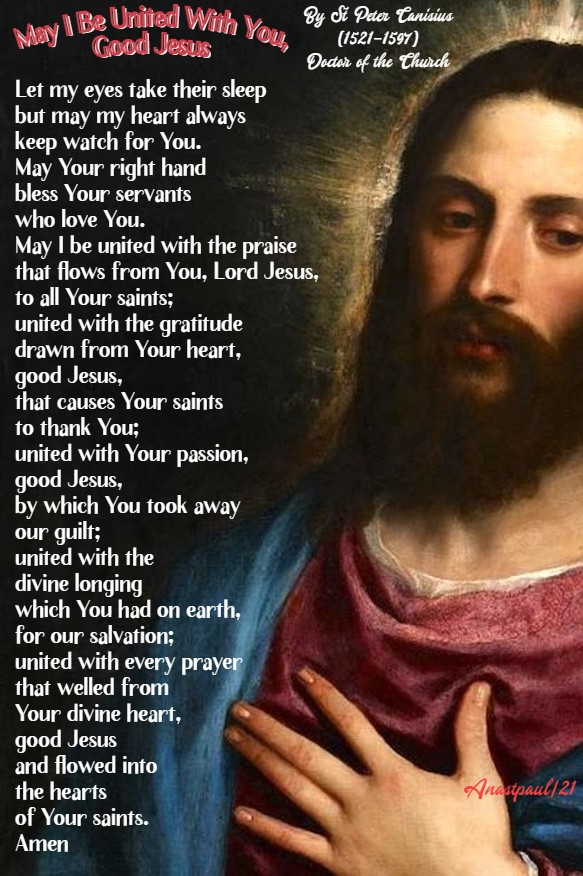
May I Be United With You, Good Jesus St Peter Canisius (1521-1597) Doctor of the Church
Let my eyes take their sleep but may my heart always keep watch for You. May Your right hand bless Your servants who love You. May I be united with the praise that flows from You, Lord Jesus, to all Your saints; united with the gratitude drawn from Your heart, good Jesus, that causes Your saints to thank You; united with Your passion, good Jesus, by which You took away our guilt; united with the divine longing which You had on earth, for our salvation; united with every prayer that welled from Your divine heart, good Jesus and flowed into the hearts of Your saints. Amen
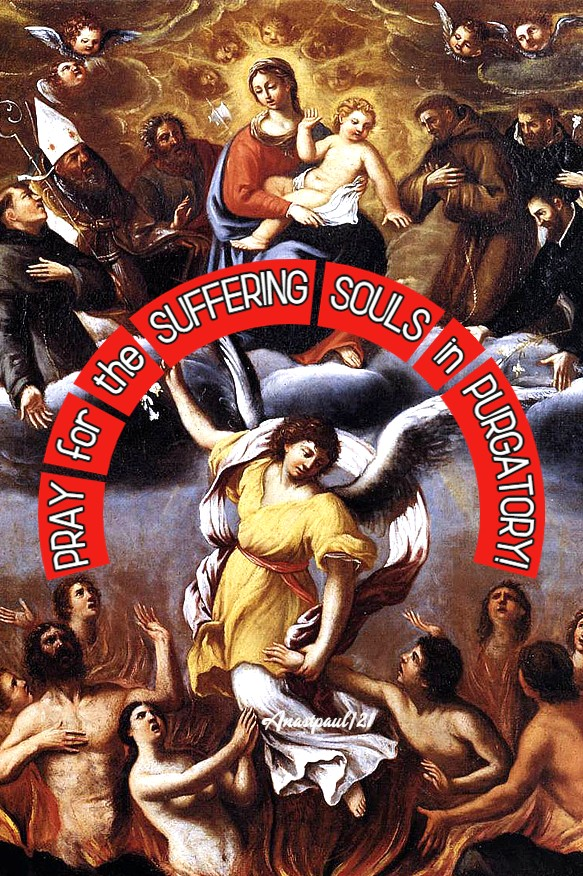
One Minute Reflection – 8 November – “Pray for the Holy Souls in Purgatory” – Readings: Jer 29:11-12; 29:14, Ps 84:2, Col 3:12-17,Matt 13:24-30
And the servants of the householder came and said to him, ‘Sir, did you not sow good seed in your field? How then does it have weeds?’ He said to them, ‘An enemy has done this.’
Matt 13:24-30
REFLECTION – It happened not long ago that a follower of Lucifer had a dispute with a son of the Church. His loquacity was odious and the language he employed most abusive. For he declared that the world belonged to the devil, and, as is commonly said by them at the present day, that the Church was turned into a brothel. His opponent on the other hand, with reason indeed, but without due regard to time and place, urged that Christ did not die in vain, and that it was for something more than a Sardinian cloak of skins that the Son of God came down from heaven. To be brief, the dispute was not settled when night interrupted the debate, and the lighting of the street-lamps gave the signal for the assembly to disperse. The combatants therefore withdrew, almost spitting in each other’s faces, an arrangement having been previously made by the audience for a meeting in a quiet porch at daybreak. Thither, accordingly, they all came, and it was resolved that the words of both speakers should be taken down by reporters.
2. When all were seated, Helladius the Luciferian said, I want an answer first to my question. Are the Arians Christians or not?
Orthodoxus. I answer with another question, Are all heretics Christians?
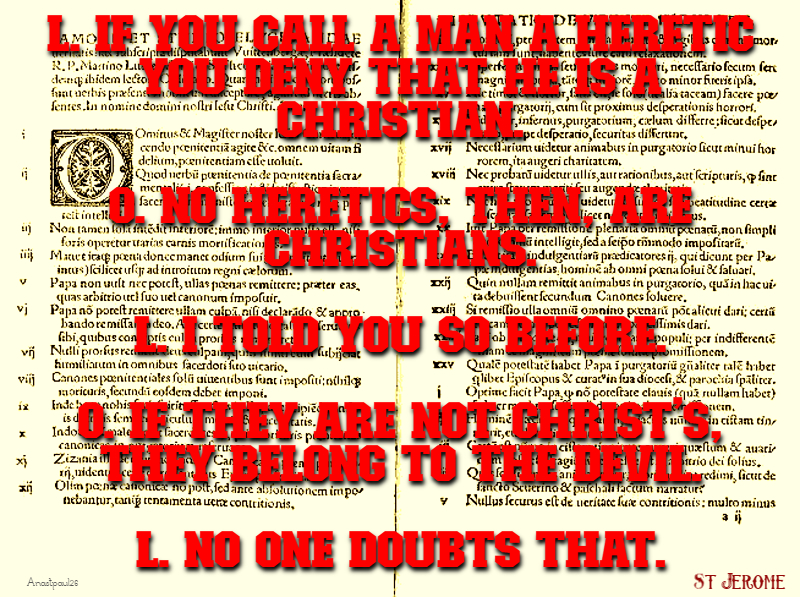
L. If you call a man a heretic you deny that he is a Christian.
O. No heretics, then, are Christians.
L. I told you so before.
O. If they are not Christ’s, they belong to the devil.
L. No one doubts that.
St Jerome
Ninety-five Theses, by Martin Luther
PRAYER – O Lord our God, grant that we may not so much seek to be consoled as to console, to be understood as to understand, to be loved as to love and to be only good influences to our neighbour. May the prayers of the Blessed Virgin, all the Saints and Angels, ever intercede for the Church Militant and the Church Suffering, Amen.
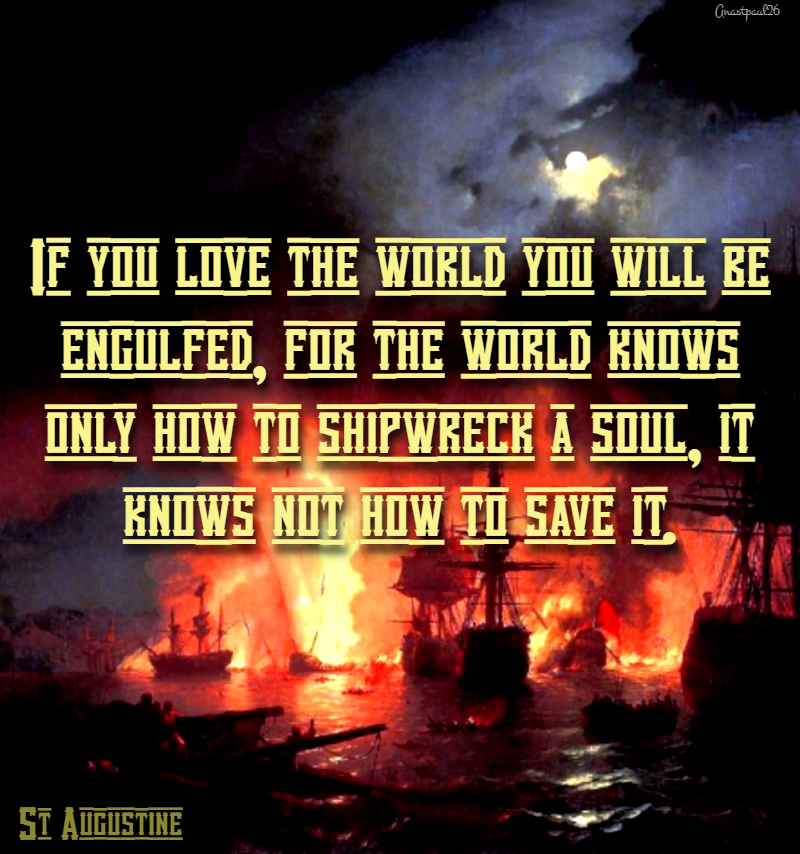
If you love the world you will be engulfed, for the world knows only how to shipwreck a soul, it knows not how to save it.
St Augustine
What are the miseries which worldlings have to endure? Alas! everything seems to conspire to make them groan without being allowed too complain.
Pere Croiset SJ
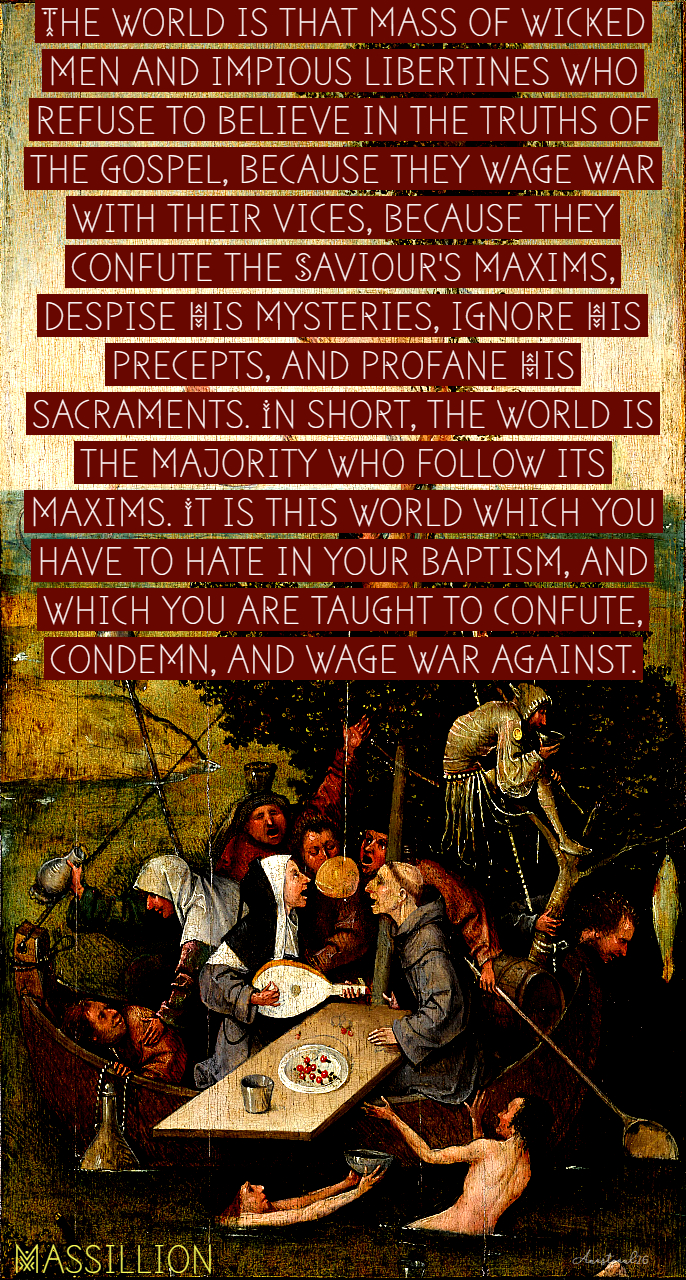
The world is that mass of wicked men and impious libertines who refuse to believe in the truths of the gospel, because they wage war with their vices, because they confute the Saviour’s maxims, despise His mysteries, ignore His precepts, and profane His sacraments. In short, the world is the majority who follow its maxims. It is this world which you have to hate in your baptism, and which you are taught to confute, condemn, and wage war against.
Massillion
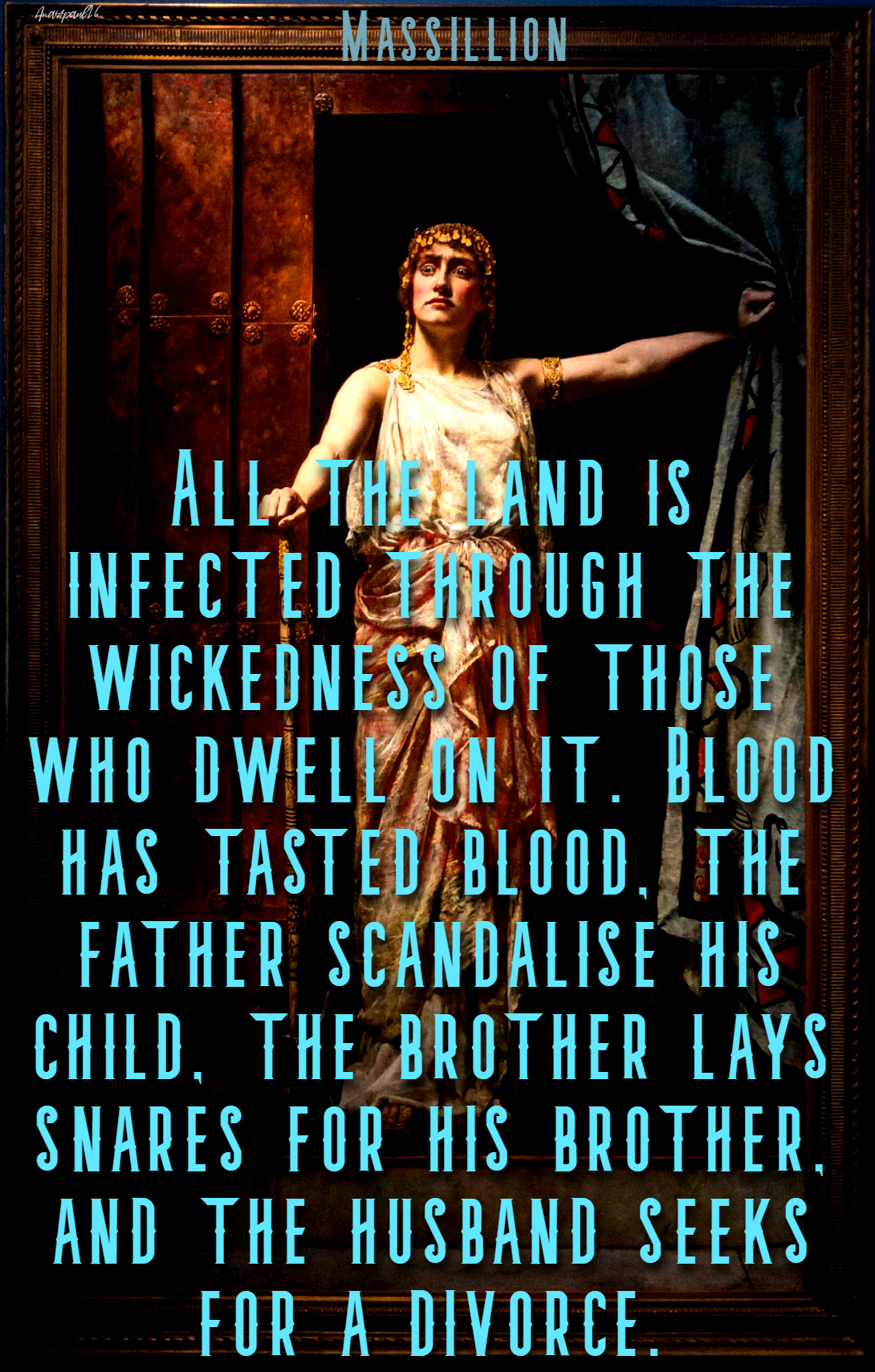
All the land is infected through the wickedness of those who dwell on it. Blood has tasted blood, the father scandalise his child, the brother lays snares for his brother, and the husband seeks for a divorce.
Massillion
The chains that bind us to the world, are pleasing to look at but hard to bear, the harm they inflict is certain, the pleasure they promise very doubtful, Those who wear them are ever busy, but never exempt from dread. Those who follow the maxims of the world experience nothing but misery.
St Augustine
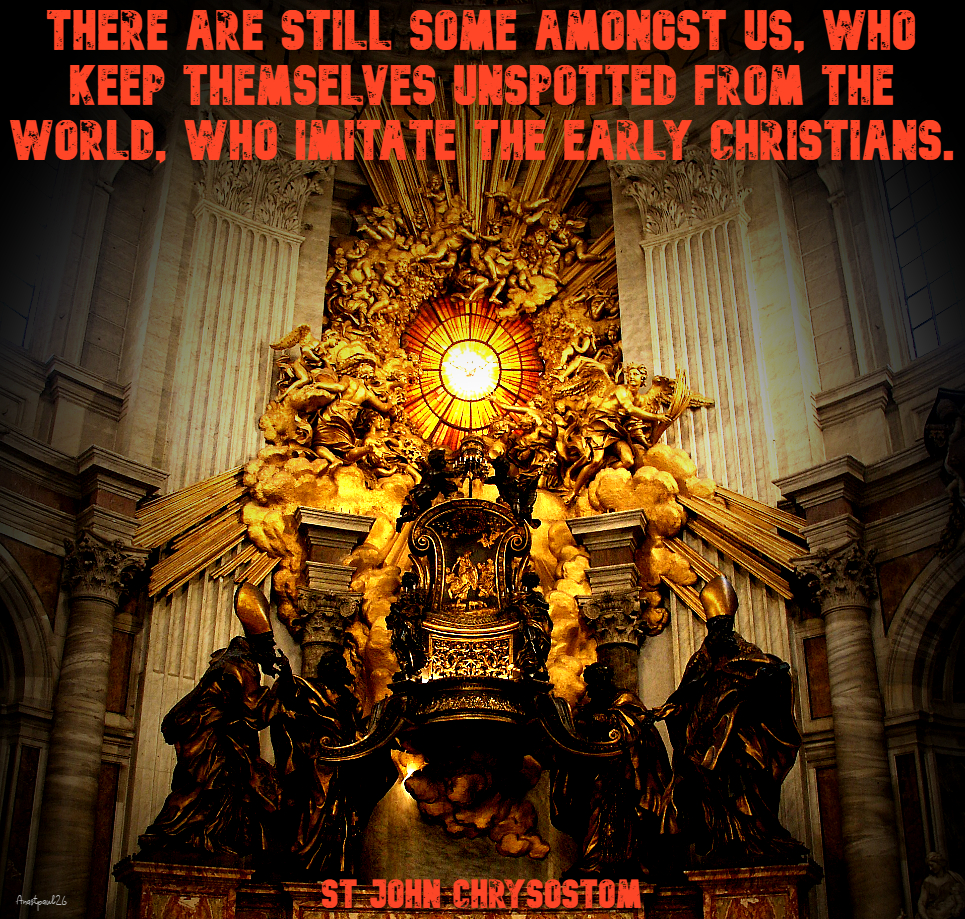
There are still some amongst us, who keep themselves unspotted from the world, who imitate the early Christians.
As the soul cleansed and purified finds no place wherein to rest but God, this being its end by creation, so the soul in a state of sin finds no place for it but hell, this being its end by the appointment of God. No sooner, then, does the soul leave the body in mortal sin than it goes straight to hell as to its allotted place, with no other guide than the nature of sin ; and should a soul not find itself thus prevented by the justice of God, but excluded altogether from His appointment, it would endure a still greater hell for God’s appointment partakes of His mercy, and is less severe than the sin deserves ; as it is the soul, finding no place suited to it, nor any lesser pain provided for it by God, casts itself into hell as into its proper place.
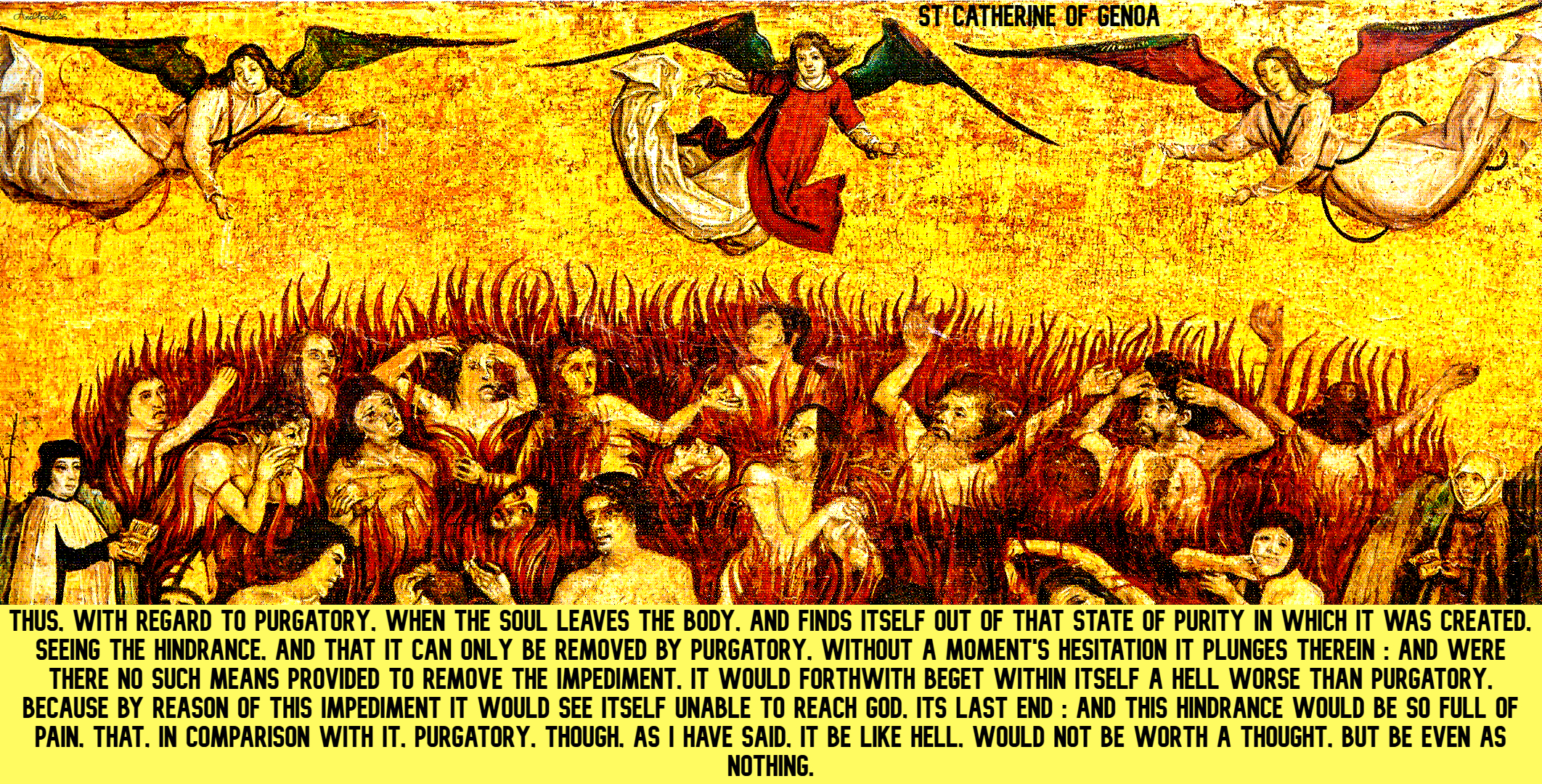
Thus, with regard to purgatory, when the soul leaves the body, and finds itself out of that state of purity in which it was created, seeing the hindrance, and that it can only be removed by purgatory, without a moment’s hesitation it plunges therein : and were there no such means provided to remove the impediment, it would forthwith beget within itself a hell worse than purgatory, because by reason of this impediment it would see itself unable to reach God, its last end : and this hindrance would be so full of pain, that, in comparison with it, purgatory, though, as I have said, it be like hell, would not be worth a thought, but be even as nothing.
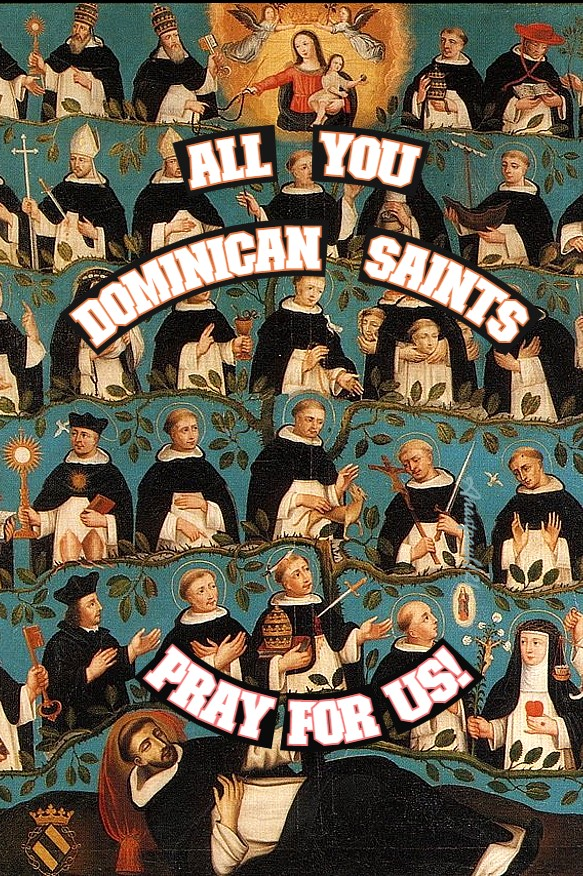
The Feast of All Saints of the Order of Preachers: “Fountain of all holiness, you stirred up in our holy brothers and sisters an extraordinary love of truth, conformity to Christ crucified, and a thirst for the salvation of souls: may we imitate them in offering you thanks on account of the way of life they gave us.” — From the Intercessions at Lauds for the feast of All Saints of the Order of Preachers.
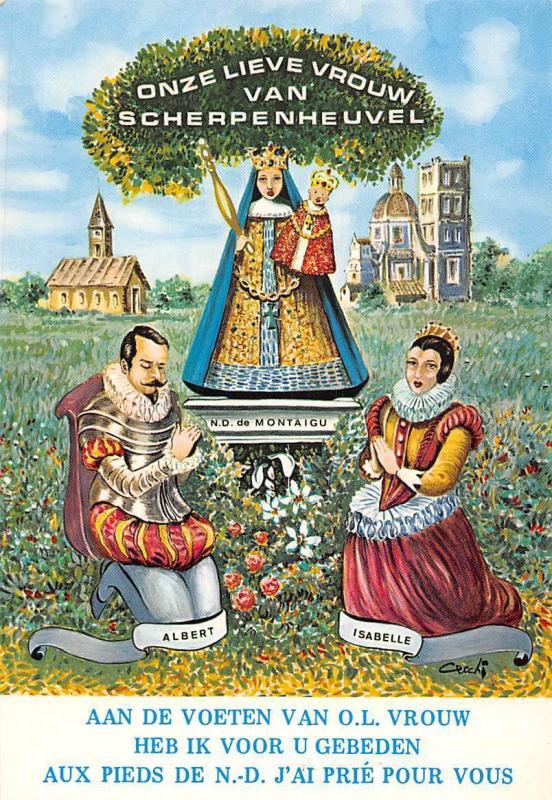
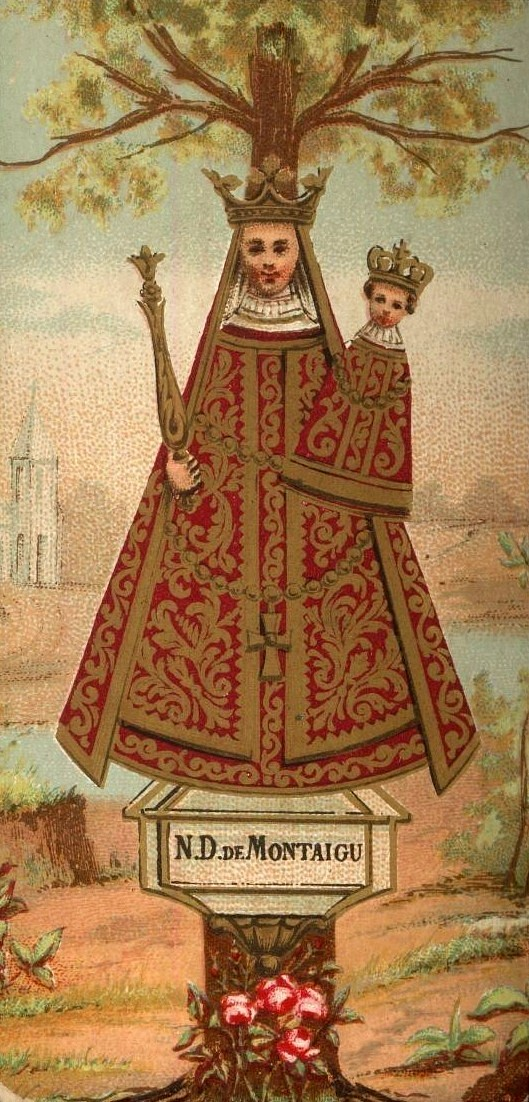
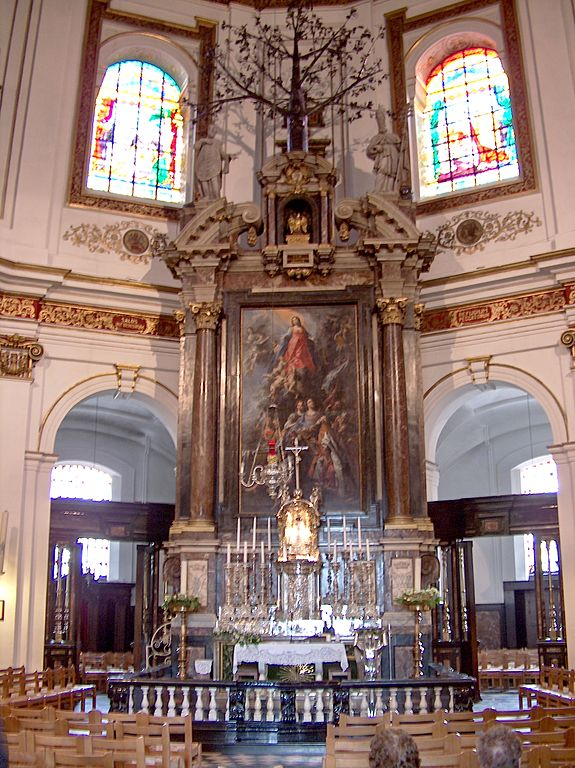
Onze Liewe Vrou van Scherpenheuvel / Our Lady of Scherpenheuvel Scherpenheuvel-Zichem, Belgium (17th Century) – Commemorated on the First Sunday after the Feast of All Saints
For many years the Marian cult on the Scherpenheuvel (“Sharp Hill”) centred at an oak tree on top of the hill. According to the foundation legend, a shepherd noticed that the image had fallen to the ground and decided to take it home. When he had lifted it, he discovered he was unable to move. As the herd did not return in the evening, his master became concerned and went to look for the shepherd. Only by restoring the Statue to its original place in the oak tree, could the master release the shepherd, thereby discovering the spiritual importance of the site.
The inhabitants of the nearby Town of Zichem would frequent the site in the second half of the sixteenth century whenever they were in need of the intercession of the Blessed Mother.
After an official enquiry in 1604 Mathias Hovius, Archbishop of Mechelen, approved the cult of Scherpenheuvel . The approval was accompanied by the publication of a collection of miracles ascribed to the intercession of the Virgin of Scherpenheuvel, issued in Dutch, French and Spanish. An English translation followed in 1606. Philip Numan, who had authored the collection, produced two more editions (1605 and 1606) as well as three more collections (1613-1614, 1617 and 1617-1618) in short succession. Latin versions were later published too. According to these publications, close to 700 miracles were credited to the intercession of Our Lady of Scherpenheuvel, in the course of the seventeenth century. The Latin collections, in particular, caused a lot of controversy among theologians, with Calvinist authors ridiculing the whole idea of miraculous intercession by the Saints.
Meanwhile, it had been decided in 1602, to remove the Statue from the oak tree and house it in a small wooden Chapel nearby. Within the year, the Chapel proved too small and was replaced by a modest stone edifice. Its foundation stone was laid on 13 July 1603 by Count Frederik van den Bergh on behalf of the Archdukes Albert and Isabella. From that point on, the Archdukes showed great interest in the development of the Shrine. Attributing the recent relief of the besieged Town of ‘s-Hertogenbosch to the intercession of the Virgin, Albert and Isabella made their first pilgrimage to Scherpenheuvel on 20 November 1603. It would soon become a yearly pilgrimage that took place in May or June and lasted the nine days of a novena.
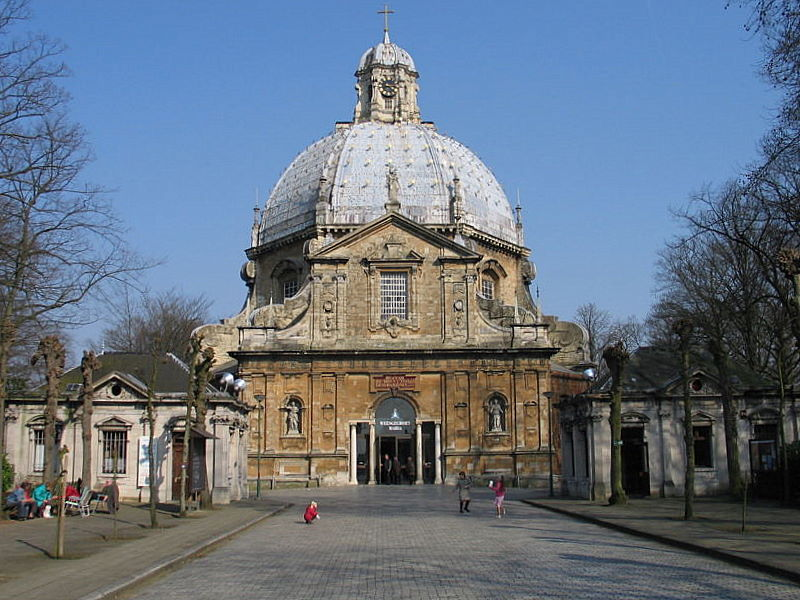
Under the patronage of the Archdukes, the emerging Shrine was raised to the status of a Town in 1605 and of an independent Parish in 1610. Their support helped to ensure the grant of a Papal Indulgence on 16 September 1606, the feast of Our Lady of Sorrows. Shortly after reaching a cease-fire with the United Provinces, on 28 August 1607, Albert and Isabella announced that they would build a vast Church and surround it with a planned and fortified Town. The foundation stone of the third and present Church was laid by them in person, on 2 July 1609, the Feast of the Visitation.
The iconographical decoration of the Basilica is particularly rich. The recurrent use of the number seven (in the shape of the Church and the Town, the number of Altars outside and inside, the shape of the stars on the dome) recalls the cult of the Seven Sorrows of the Virgin.
The image of Our Lady of Scherpenheuvel was solemnly crowned by Cardinal Victor-Auguste-Isidor Deschamps on behalf of the BlessedPope Pius IX on 25 August 1872.
Fifty years later, on 2 May 1922, Pope Pius XI raised the Shrine to the status of a Minor Basilica.
St Athenodorus of Neo-Caesarea St Auctus of Amphipolis St Baud of Tours St Blinlivet St Congar St Engelbert of Cologne (c 1185-1225) Archbishop Martyr St Ernest of Mecca St Florentius of Strasburg St Gebetrude of Remiremont St Herculanus of Perugia St Hesychius of Mytilene St Hieron of Mytilene St Hyacinth Castañeda Puchasons St Lazarus the Stylite St Nicander of Mytilene St Peter Ou St Prosdocimus of Padua St Prosdocimus of Rieti St Raverranus of Séez St Rufus of Metz St Taurion of Amphipolis St Thessalonica of Amphipolis St Tremorus of Brittany St Vincent Liem
Blessed Peter Ou, also known as Peter Wu Gousheng, Wu Gousheng, Wu Guosheng Petrus, was a Chinese martyr. He was born in 1768 at Longping in Guizhou Province, China, to a pagan family, and was one of the first converts made by missionaries to his area.
Known from his youth for his sense of justice, his quick defense of the poor and oppressed; his outspoken frightened people in his traditionalist region. A husband and self-made businessman, he owned and ran a large hotel. Naturally enthusiastic, Peter tossed out his household idols, and preached Christianity to anyone who came by. He became the lay leader of the converts in his district, and took the name Peter at baptism. He worked as a catechist for missionaries in Sichuan; instrucing 600 people in Christianity.
He was arrested on 3 April 1814 during a violent backlash against the faith. Although imprisoned and tortured to break him from his faith, he worked to inspire faith in his fellow prisoners, and led prayer services in the cells. He was condemned to death and strangled on 7 November 1814 for refusing to step on a crucifix.
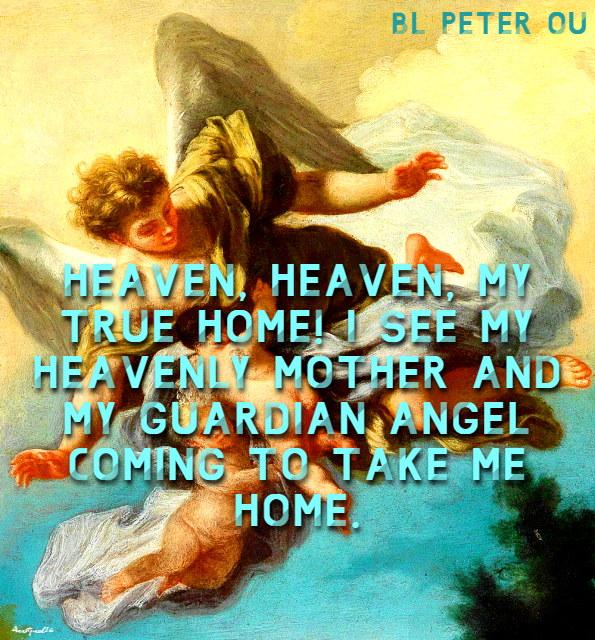
Heaven, heaven, my true home! I see my heavenly Mother and my guardian angel coming to take me home.
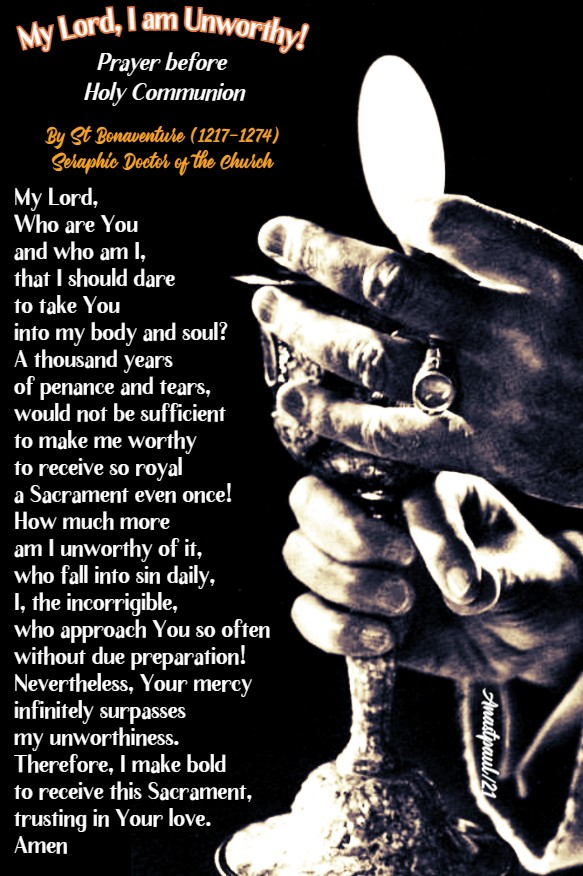
My Lord, I am Unworthy! Prayer before Holy Communion By St Bonaventure (1217-1274) Seraphic Doctor of the Church
My Lord, Who are You and who am I, that I should dare to take You into my body and soul? A thousand years of penance and tears, would not be sufficient to make me worthy to receive so royal a Sacrament even once! How much more am I unworthy of it, who fall into sin daily, I, the incorrigible, who approach You so often without due preparation! Nevertheless, Your mercy infinitely surpasses my unworthiness. Therefore, I make bold to receive this Sacrament, trusting in Your love. Amen
One Minute Reflection – 7 November – Readings: Sedulius, Ps 44:2, Ecclus 24:14-16, Luke 11:27-28
At that time, as Jesus was speaking to the multitudes, a certain woman from the crowd lifted up her voice and said to Him, Blessed is the womb that bore You, and the breasts that nursed You. But He said, Rather, blessed are they who hear the word of God and keep it.
Luke 11:27-28
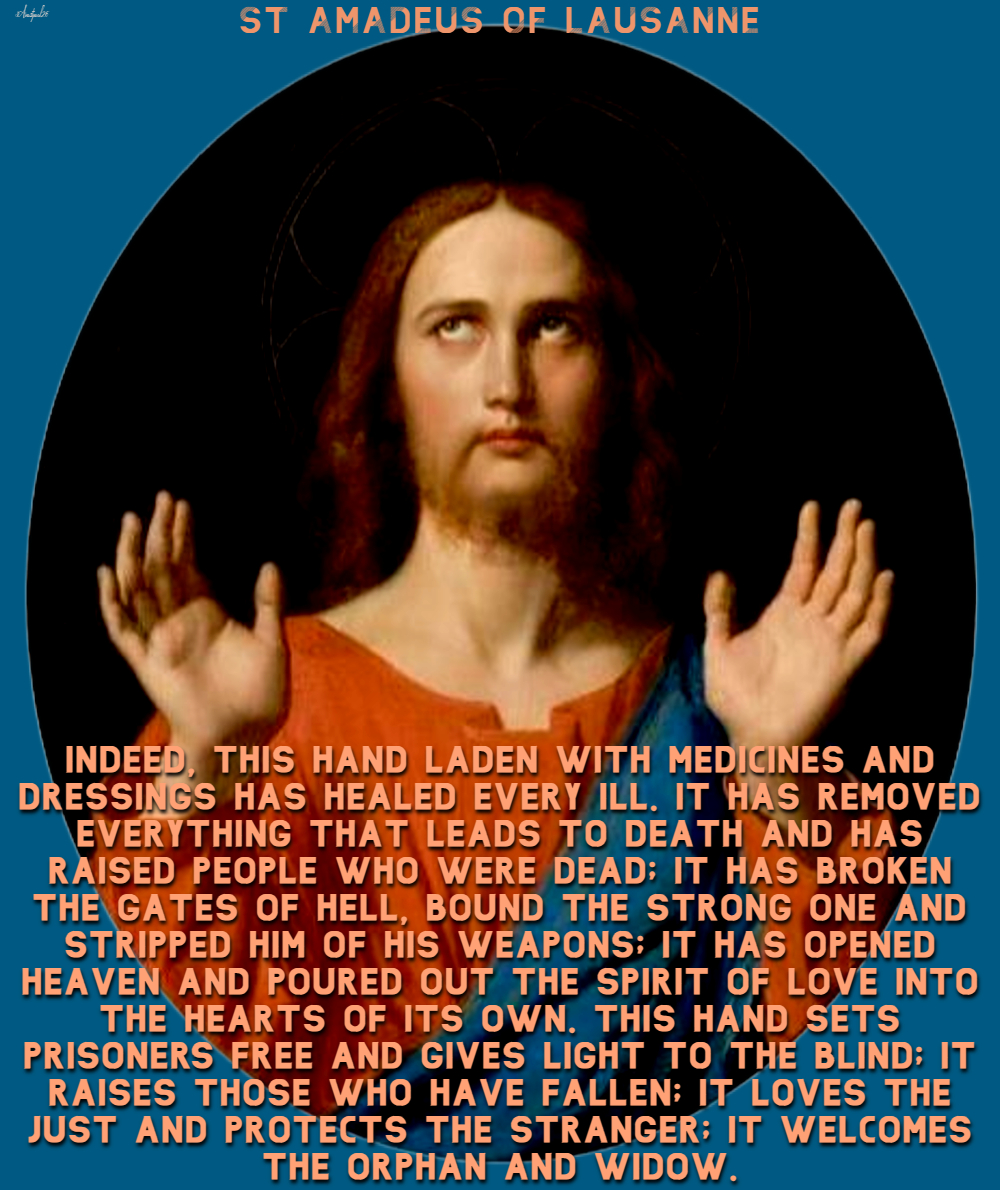
REFLECTION – May your hand be ready to help me! The Father’s beloved Son is he whom we call the hand of God, he through whom God created all things. This hand intervened when it took our flesh, not simply without injury to his mother, but still more, according to the prophet’s testimony, by taking on himself all our sicknesses and bearing our sufferings.
Indeed, this hand laden with medicines and dressings has healed every ill. It has removed everything that leads to death and has raised people who were dead; it has broken the gates of hell, bound the strong one and stripped him of his weapons; it has opened heaven and poured out the Spirit of love into the hearts of its own. This hand sets prisoners free and gives light to the blind; it raises those who have fallen; it loves the just and protects the stranger; it welcomes the orphan and widow. It snatches from temptation those in danger of giving way to it, restores with its comforting those who suffer; it gives joy back to the afflicted and shelters the weary in its shade; it writes for those desiring to meditate its Law and touches and blesses the hearts of those who pray, strengthening them in love by its touch; it makes them progress and persevere in their works. Finally, it leads them to their homeland; it brings them back to the Father.
For if it has become flesh it is so that it may draw man through a man, joining our flesh to his flesh so as lovingly to bring back to God, the almighty and invisible Father, the straying sheep. Because this sheep had fallen in the flesh by abandoning God, the mystery of this hand’s Incarnation had to guide it, to lift it up and lead it back to the Father
St Amadeus of Lausanne
PRAYER – Lord God, Your Son has shown us the way. As we follow in His steps, may we never wander from the path that leads to life. Renew the wonders of Your grace in our hearts so that neither death nor life may separate us from Your love. Holy Father, as You were glorified by the life and death of all the Dominican Saints and Blesseds, grant that by their prayers, we may receive Your grace to give first to You and then to our neighbour in complete love and service. Through our Lord, Jesus Christ, with You in union with the Holy Spirit, one God for all eternity, amen.
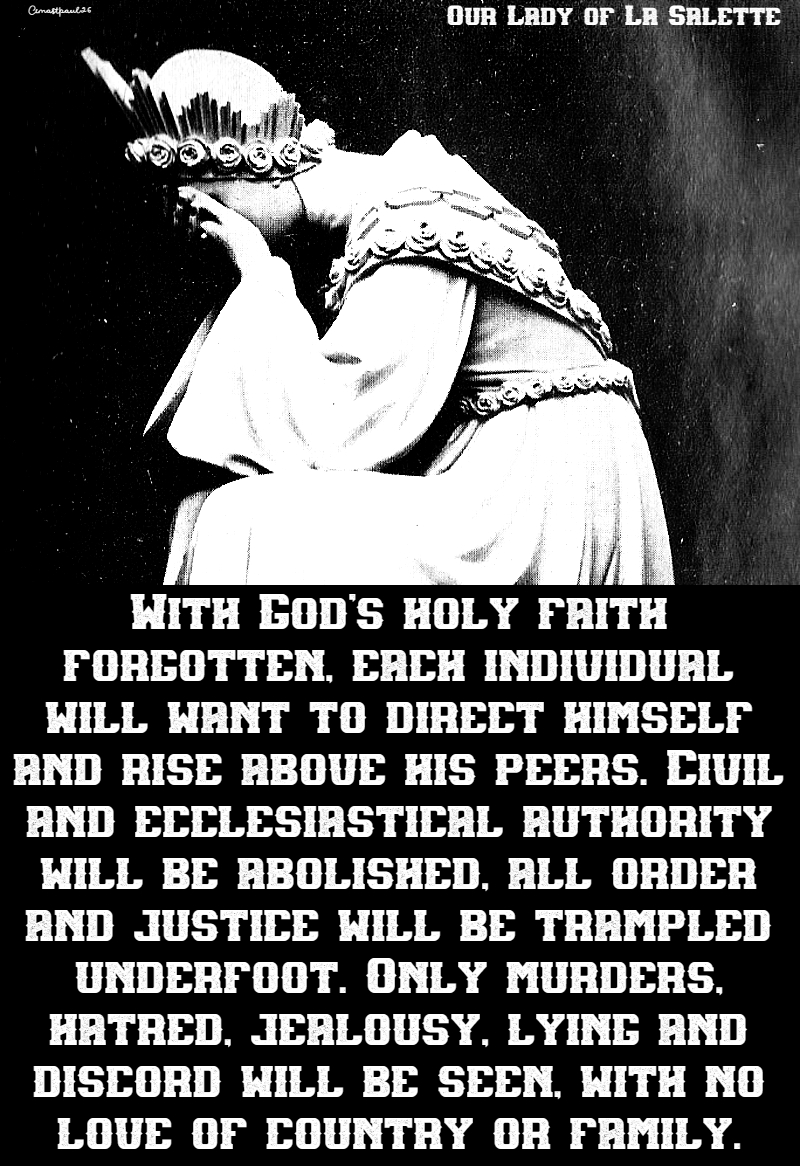
With God’s holy faith forgotten, each individual will want to direct himself and rise above his peers. Civil and ecclesiastical authority will be abolished, all order and justice will be trampled underfoot. Only murders, hatred, jealousy, lying and discord will be seen, with no love of country or family.
Our Lady of La Salette
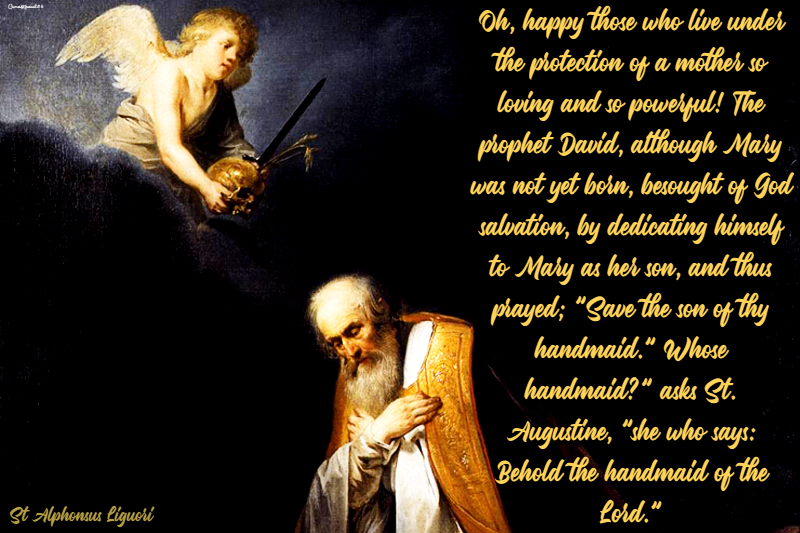
Oh, happy those who live under the protection of a mother so loving and so powerful! The prophet David, although Mary was not yet born, besought of God salvation, by dedicating himself to Mary as her son, and thus prayed; “Save the son of thy handmaid.” Whose handmaid?” asks St. Augustine, “she who says: Behold the handmaid of the Lord.”
St Alphonsus Liguori
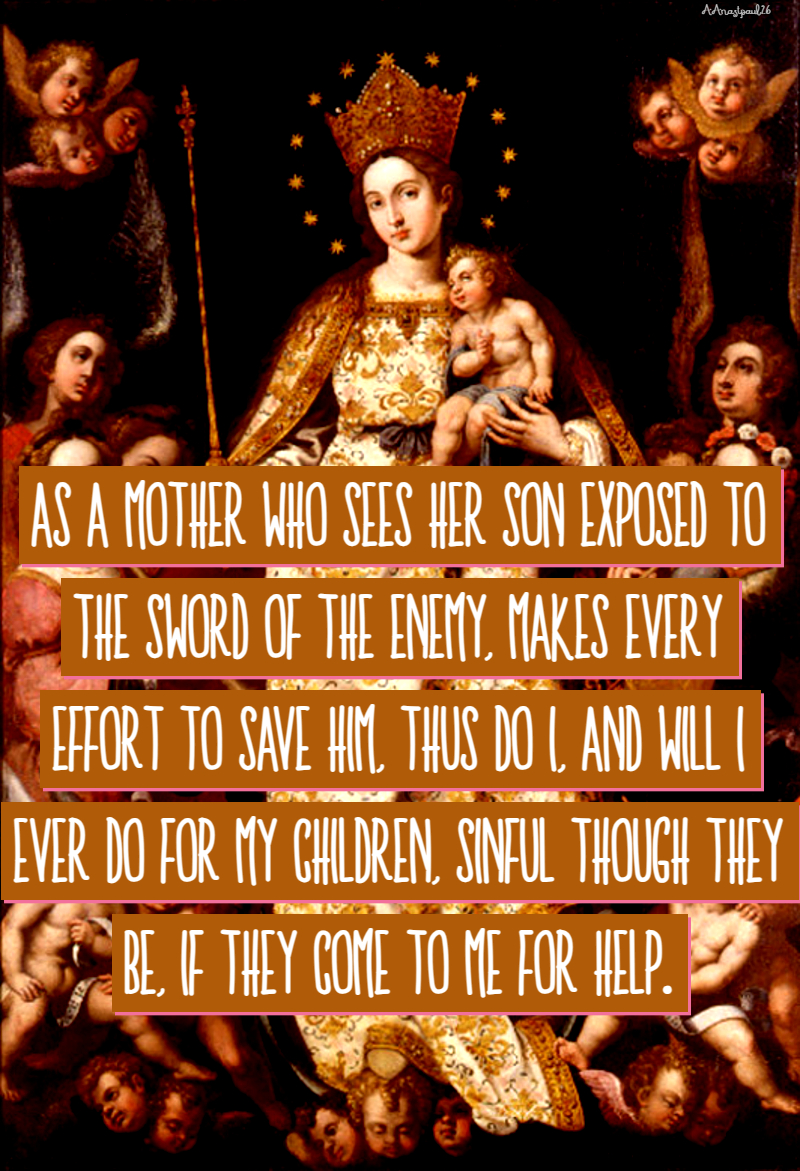
As a mother who sees her son exposed to the sword of the enemy, makes every effort to save him, thus do I, and will I ever do for my children, sinful though they be, if they come to me for help.
The Blessed Virgin to St Bridget
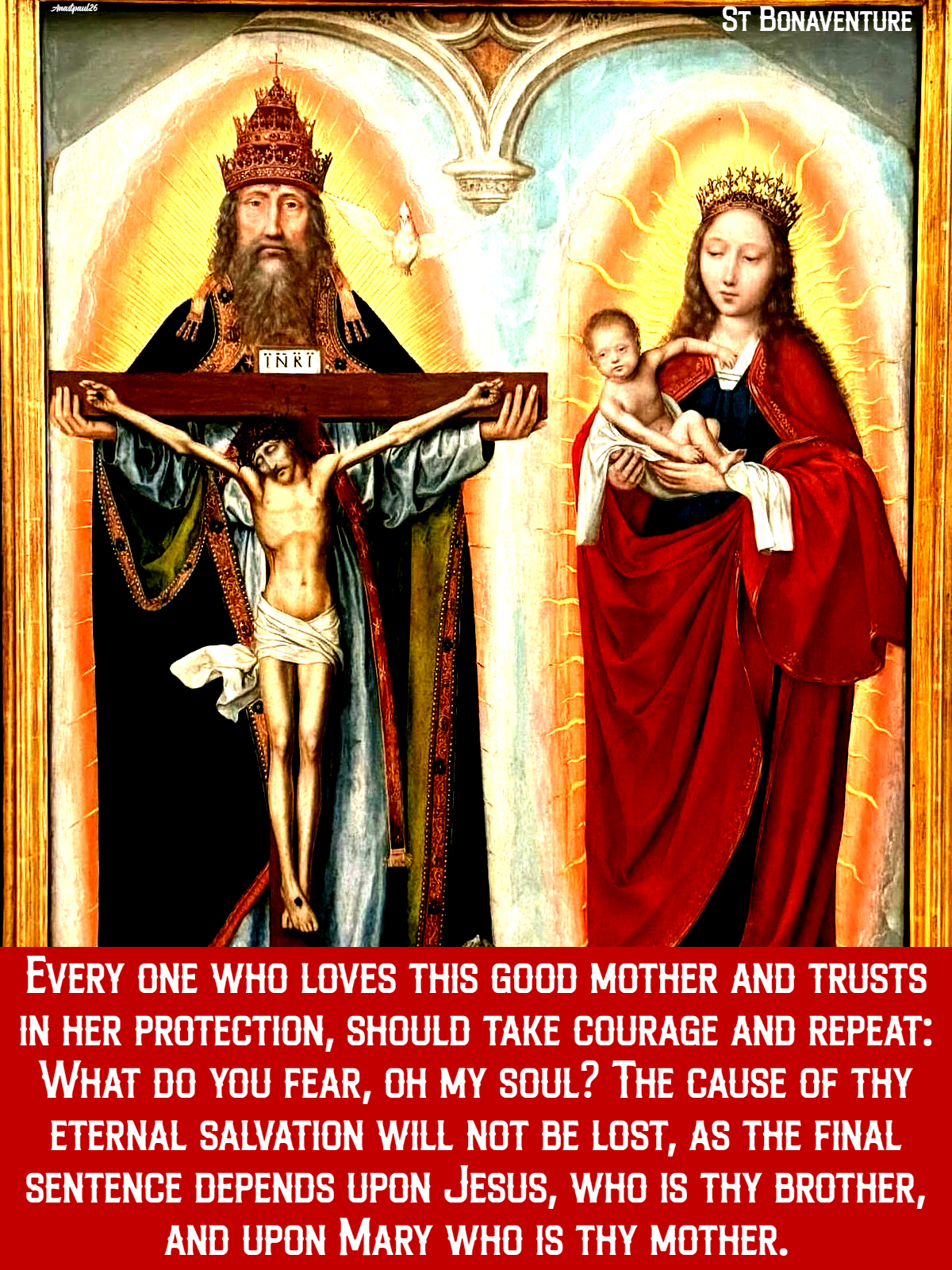
Every one who loves this good mother and trusts in her protection, should take courage and repeat: What do you fear, oh my soul? The cause of thy eternal salvation will not be lost, as the final sentence depends upon Jesus, who is thy brother, and upon Mary who is thy mother.
St Bonaventure
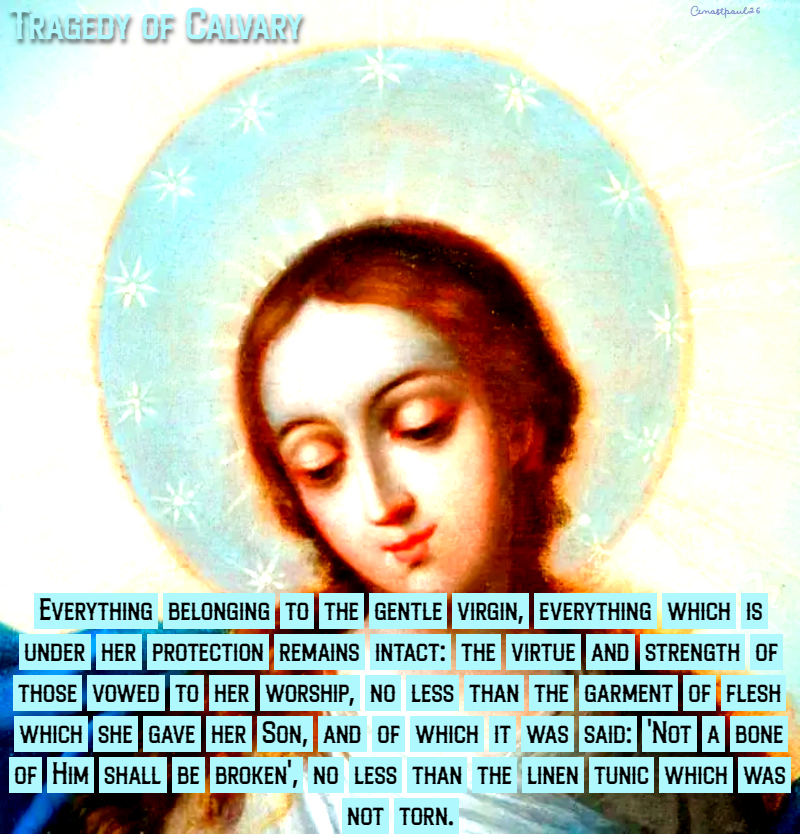
Everything belonging to the gentle virgin, everything which is under her protection remains intact: the virtue and strength of those vowed to her worship, no less than the garment of flesh which she gave her Son, and of which it was said: ‘Not a bone of Him shall be broken’, no less than the linen tunic which was not torn.
Tragedy of Calvary
Then he began again to talk with his sweet mother Mary, and repeating the word, ‘mother, mother’, he tranquilly expired, like a child falling asleep in the arms of its mother. Soon after, it was revealed to a devout religious that he had already entered paradise.
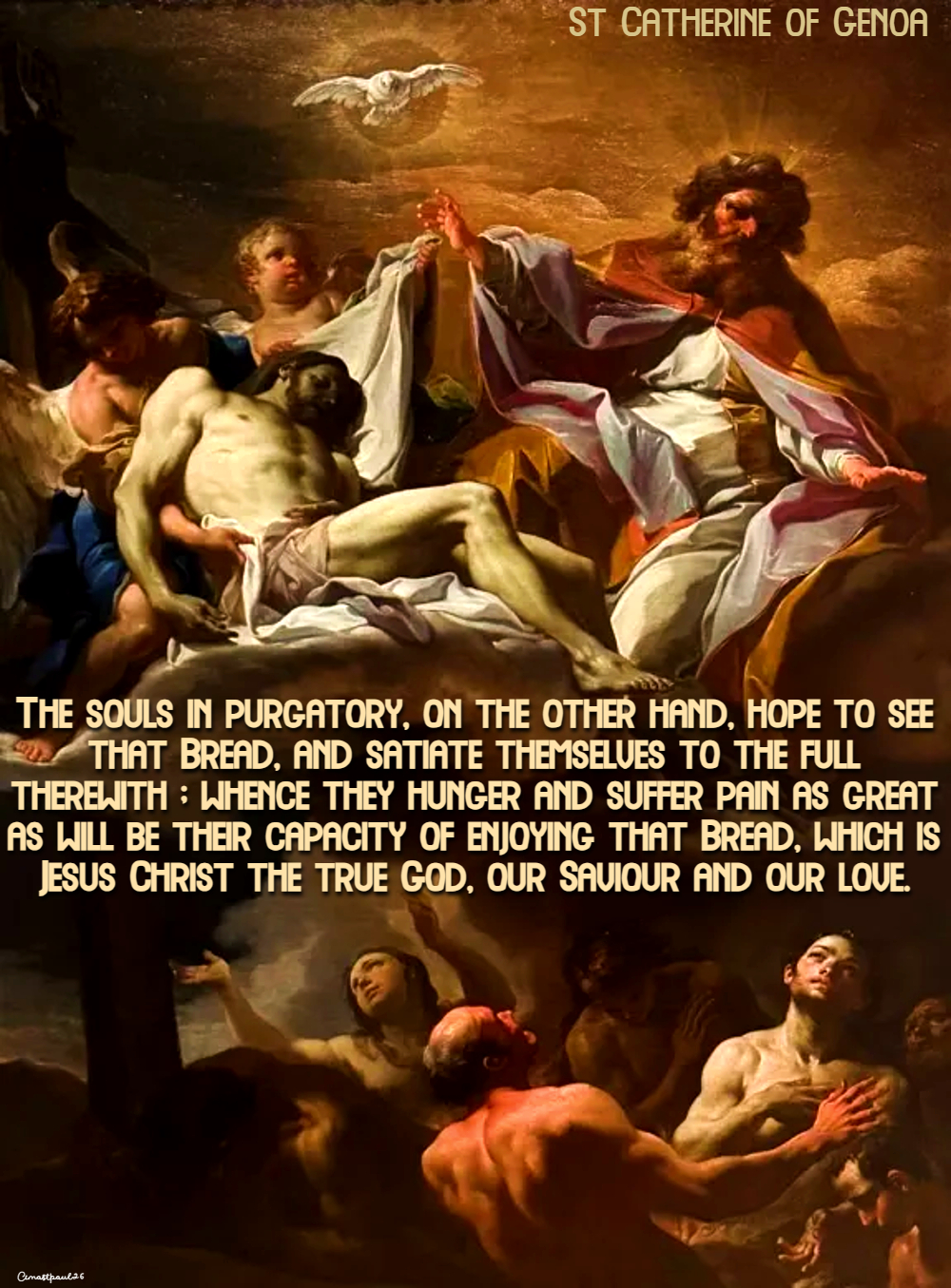
Let us suppose that there existed in the world but one loaf of bread to satisfy the hunger of every creature, and that the mere sight of it could do this. In such a case a man, having naturally, if in good health, a desire for food, would find himself, so long as he was kept from dying or falling sick, growing more and more hungry; for his craving would continue undiminished, he would know that the bread, and nothing but the bread, could satisfy him, and not being able to reach it, would remain in intolerable pain ; the nearer he got to the bread without seeing it the more ardently would he crave for it, and would direct himself wholly towards it, as being the only thing which could afford relief ; and if he were assured that he never could see the bread he would have within him a perfect hell, and become like the damned, who are cut off from all hope of ever seeing God their Saviour, who is the true Bread.
The souls in purgatory, on the other hand, hope to see that Bread, and satiate themselves to the full therewith ; whence they hunger and suffer pain as great as will be their capacity of enjoying that Bread, which is Jesus Christ the true God, our Saviour and our love.
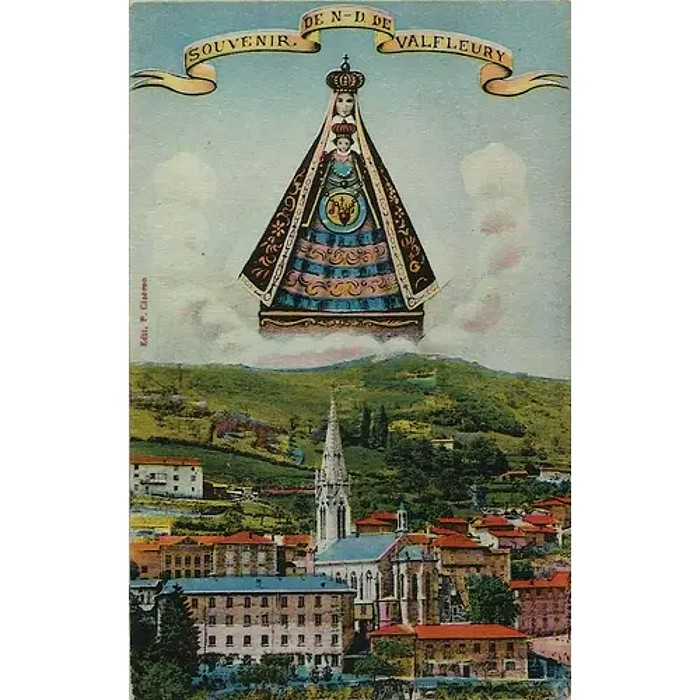
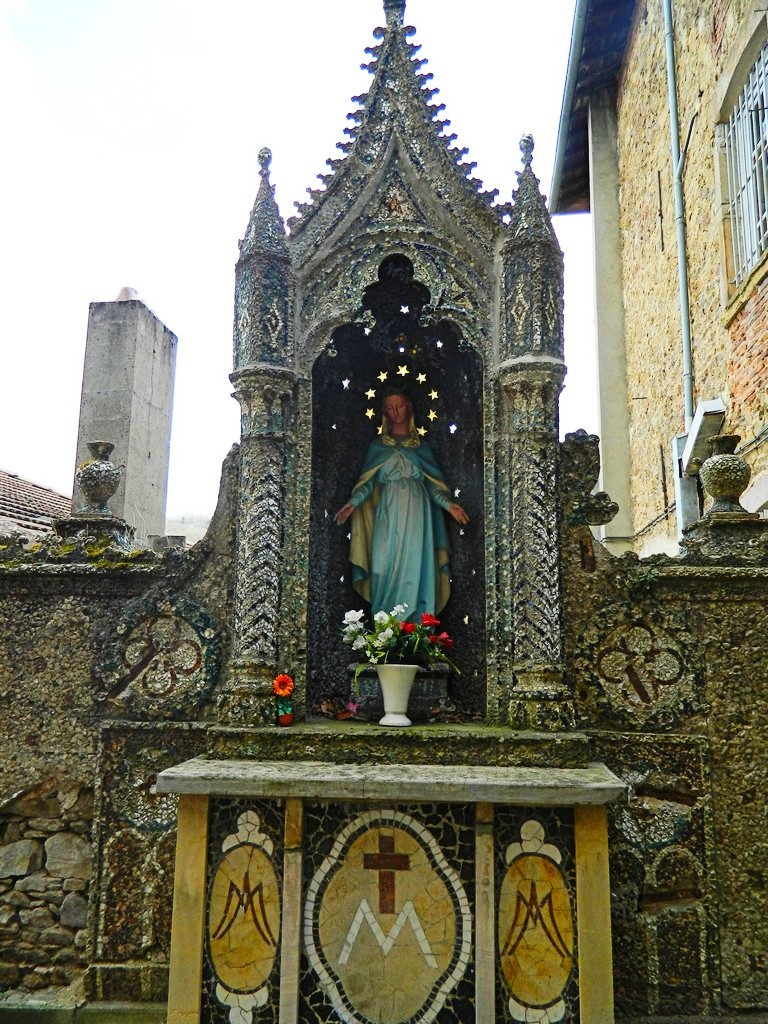
Notre-Dame de Valfleury / Our Lady of Valfleury, France (800) – 6 November:
The title traces its origins to the image of the Black Madonna at Valfleury (Loire), France, near St Etienne and St Chamond south of Lyons and is venerated annually on 6 November.
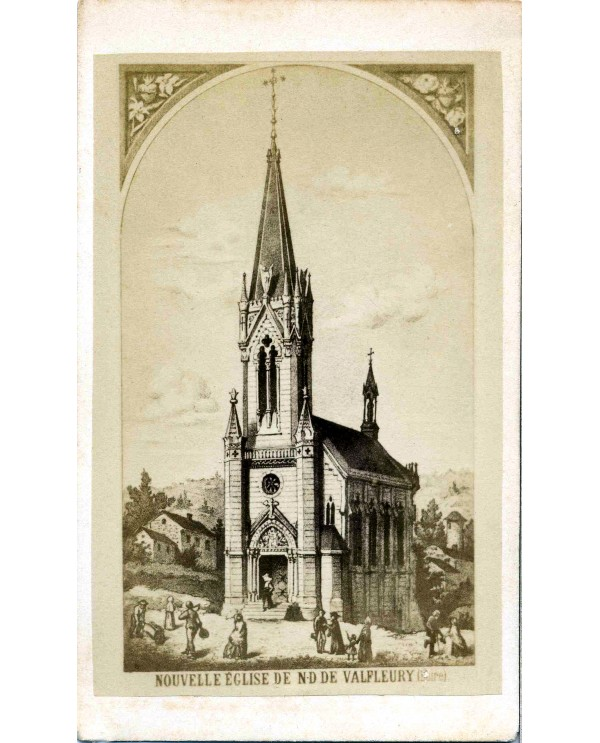
The original Statue, in wood, dates to Christmas 800 when the image was found in a broom bush. Pilgrimages began as early as the eighth century, almost ceased entirely during the years of the plagues that struck the region and resumed in earnest again in 1629. The Shrine is a Church partially underground that had appeared in the written records by the end of the tenth century. Entrance to the Church is at the base of a massive rock formation, on top of which, stands the Romanesque tower of the 12th century and steeple. Among the unique features of the Church are 22 steps cut from the rock inside the entrance. A number of frescoes depict eventS in Christ’s life. The miraculous cures of a child on a pilgrimage was reported to have occurred in the Chapel in 1842. In 1854, Pope Pius IX granted the pilgrimage of Vals, a plenary indulgence.
Benedictine Monks established a priory there and called the place “valley flowers.” In 1625, the Congregation of Saint Vincent de Paul succeeded them. They established a mission house and took care of the pilgrimage Church which replaced the original Shrine and was erected in 1809.
St Atticus St Barlaam of Novgorod Bl Beatrice of Olive Bl Christina of Stommeln St Demetrian of Cyprus St Edwen of Northumbria St Efflam of Brittany St Emilian of Faenza St Erlafrid of Hirschau St Felix of Fondi St Felix of Genoa St Felix of Thynissa St Illtyd St Israel of Limoges
St Leonard of Reresby Bl Leonianus of Autun St Melaine of Rennes St Paul of Constantinople St Pinnock St Severus of Barcelona Bl Simon of Aulne St Stephen of Apt St Theobald of Dorat
St Valentine of Genoa St Victor Chumillas-Fernández St Winnoc of Wormhoult (Died 716/717) Abbot — Martyrs of Antioch – 10 saints: Ten Christians murdered together by Arabs after their seizure of Antioch, Syria. No names or other details about them have come down to us. 637 in Antioch, Syria.
Martyrs of Gaza – 9 saints: A group of Christian soldiers who were captured by Saracens invading the area of Gaza in Palestine. When the men continued to profess their Christianity, they were executed. We know the names of some of the martyrs – Himerius, John (2 of them), Kallinikos (Callinoco), Paul, Peter, Stephen and Theodore (2 of them). They were beheaded in Gaza, Palestine.
Martyrs of Spain – 498 saints and beati: – Martyred Franciscan Capuchins of Barcelona – 26 beati Martyred Vincentians of Spain – 14 beati
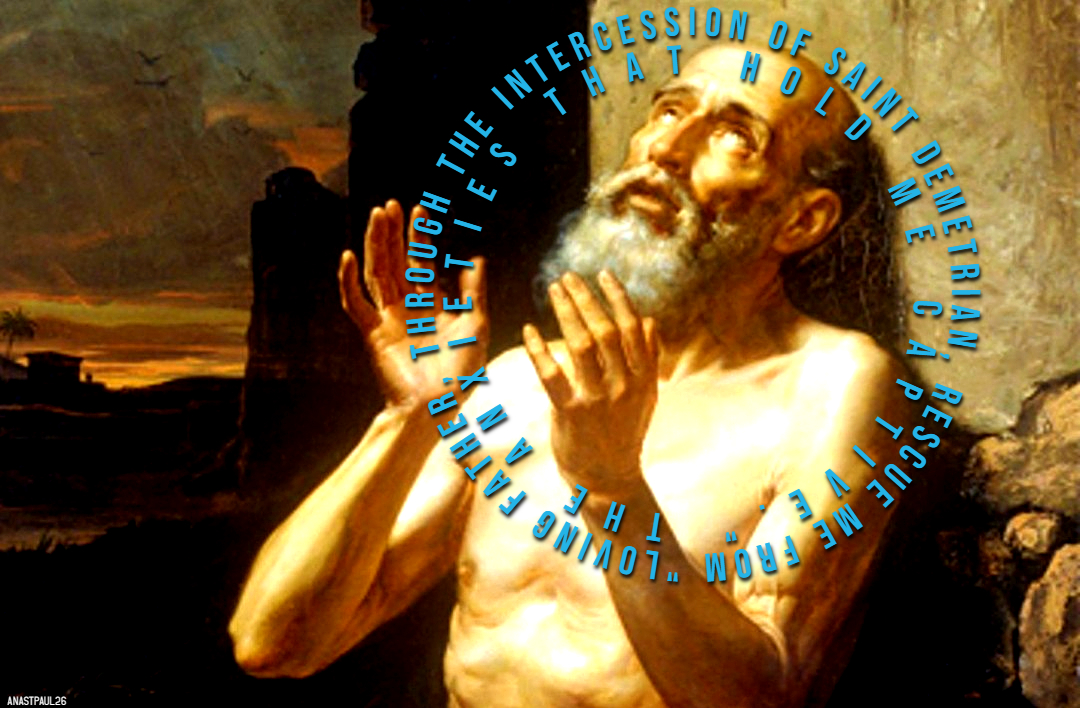
Saint Demetrian of Cyprus was a priest and monk and bishop in Cyprus in the ninth and tenth centuries. Born in Sika on Cyprus, he at first he resisted the appointment as bishop. Not wanting to exchange his quiet monastic life for a busy episcopal office in the city, he fled, and was hidden in a cave by a friend. Ultimately, however, his friend became uncomfortable with the situation, and Demetrian was convinced to return to the city and embrace his appointment. He served as bishop of Chytri for twenty-five years, from 885 until his death, and is acknowledged as that office’s most famous inhabitant.
Near the end of his life he saved a group of Christians from Muslims when the latter invaded and took captives to sell as slaves. Despite his advanced age, Demetrian followed them on the road and pleaded desperately for their release. Miraculously, the Muslims were persuaded and they released the captives to him.
Venerated as a patron saint of prisoners, Demetrian is also invoked by a prayer: “Loving Father, through the intercession of Saint Demetrian, rescue me from the anxieties that hold me captive.”
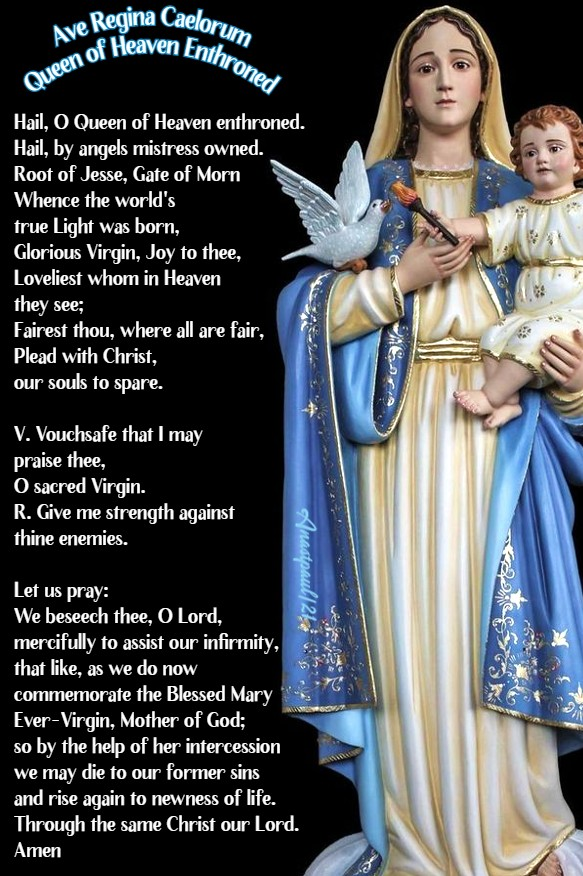
Hail, O Queen of Heaven enthroned. Hail, by angels mistress owned. Root of Jesse, Gate of Morn Whence the world’s true Light was born, Glorious Virgin, Joy to thee, Loveliest whom in Heaven they see; Fairest thou, where all are fair, Plead with Christ, our souls to spare.
V. Vouchsafe that I may praise thee, O sacred Virgin. R. Give me strength against thine enemies.
Let us pray: We beseech thee, O Lord, mercifully to assist our infirmity, that like, as we do now commemorate the Blessed Mary Ever-Virgin, Mother of God; so by the help of her intercession we may die to our former sins and rise again to newness of life. Through the same Christ our Lord. Amen
“Ave Regina caelorum” is one of the Marian antiphons said or sung in the Liturgy of the Hours at the close of compline. In the Roman Breviary as revised by Pope Pius V in 1569 it was assigned for this use from compline of 2 February until compline of Wednesday of Holy Week. The original author is unknown – it has been found in a manuscript from the twelfth-century. It has been set to music by various composers including Hyden and many others.
One Minute Reflection – 10 November – “Month of the Holy Souls in Purgatory” – Readings: Jer 29:11-12; 29:14, Ps 84:2, Phil 3:17-21; 4:1-3, Matt 9:18-26
At that time, as Jesus was speaking to the crowds, behold, a ruler came up and worshipped Him, saying, “Lord, my daughter has just now died; but come and lay Your hand upon her, and she will return to life.”
Matt 9:18-26
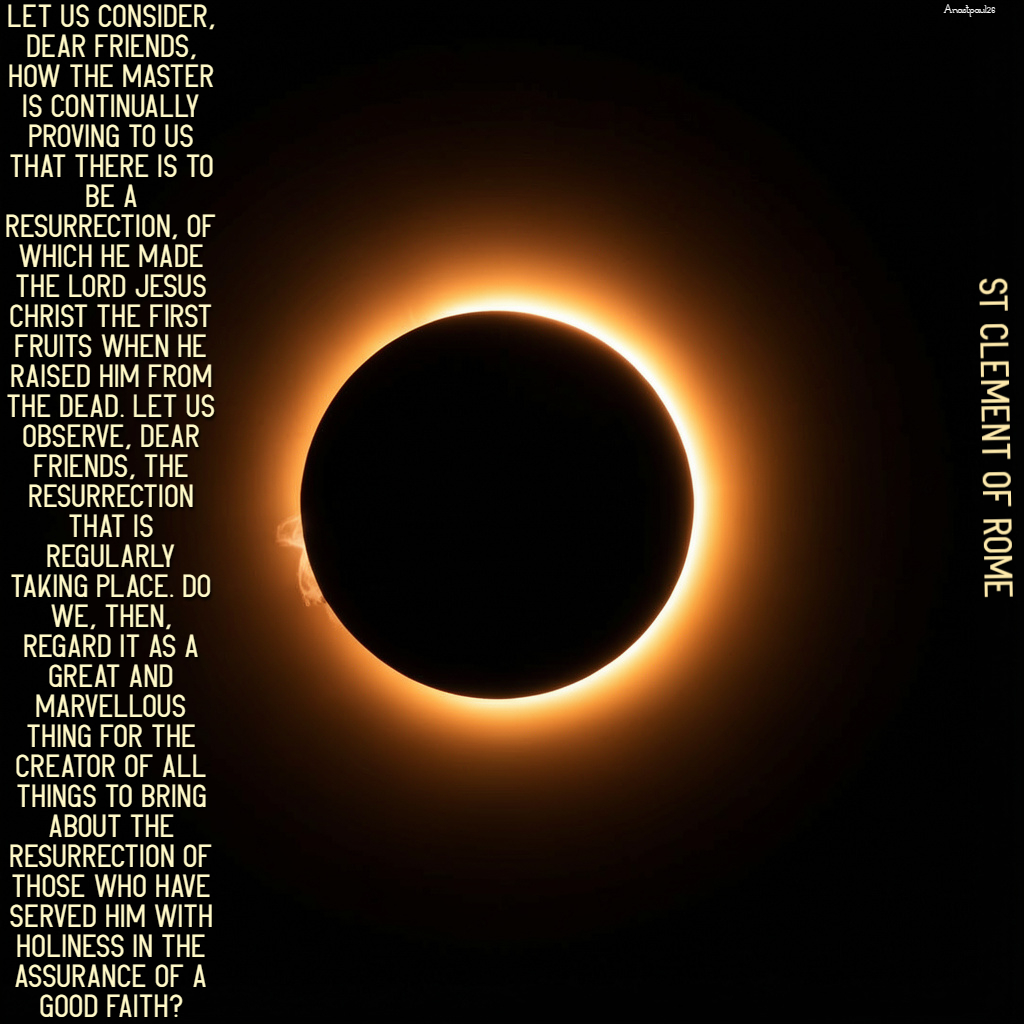
REFLECTION – Let us consider, dear friends, how the Master is continually proving to us that there is to be a resurrection, of which he made the Lord Jesus Christ the first fruits when he raised him from the dead. Let us observe, dear friends, the resurrection that is regularly taking place. Day and night show us a resurrection; night falls asleep, day arises; day departs, night comes on. Let us take the crops; how and in what way does the sowing take place? The sower goes out and sows each seed in the ground. They fall into the ground dry and bare, and decay; then from their decay the greatness of the Master’s providence raises them up, and from a single grain many spring up and bear fruit. Do we, then, regard it as a great and marvellous thing for the Creator of all things to bring about the resurrection of those who have served him with holiness in the assurance of a good faith?
With this hope, then, let our souls be bound to him that is faithful to his promises and upright in his judgments. He who has commanded us not to lie will much more not lie himself. For nothing is impossible to God except lying. So let faith in him be rekindled in us, and let us understand that all things are possible to him.

With his majestic word he constituted all things and with a word he can overturn them. When he pleases, and as he pleases, he will do everything, and none of the things he has decreed will pass away. All things are in his sight and nothing has escaped his Providence.
St Clement of Rome
PRAYER – Lord God, You built Your Church on the firm foundation of the Apostle Peter and You promised that the gates of hell would never overcome it. So too, may we trust in Your power, that by our faith we may receive the grace to withstand the enemy who will not prevail against us. May we always serve You in our brother and may your Holy Spirit grant us the grace of fortitude to withstand our temptations and thus gain eternal life, supported by the prayers of all the Angels, Saints and our Blessed Mother Mary. Through Christ, in the unity of the Holy Ghost, God now and forever, amen.
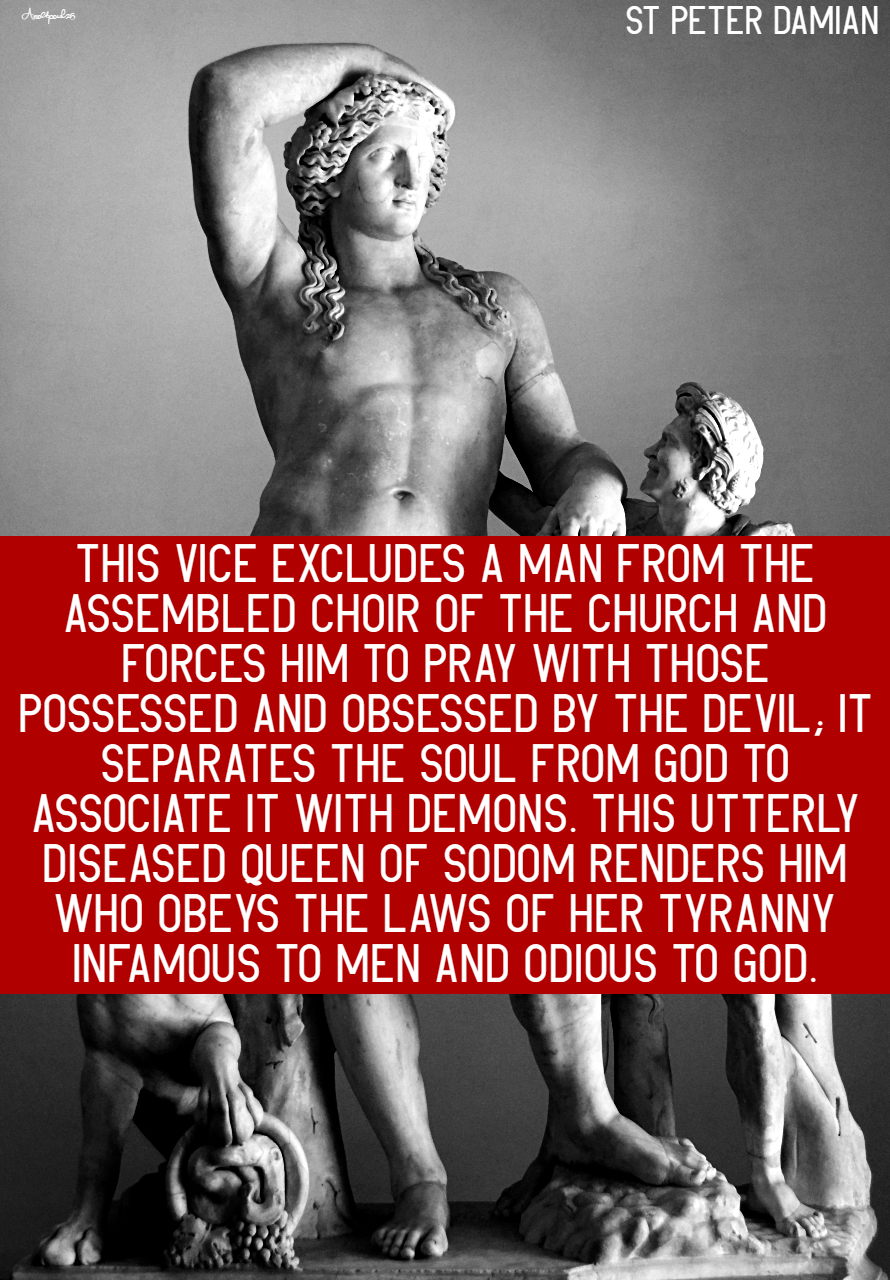
This vice excludes a man from the assembled choir of the Church and forces him to pray with those possessed and obsessed by the devil; it separates the soul from God to associate it with demons. This utterly diseased queen of Sodom renders him who obeys the laws of her tyranny infamous to men and odious to God.
St Peter Damian
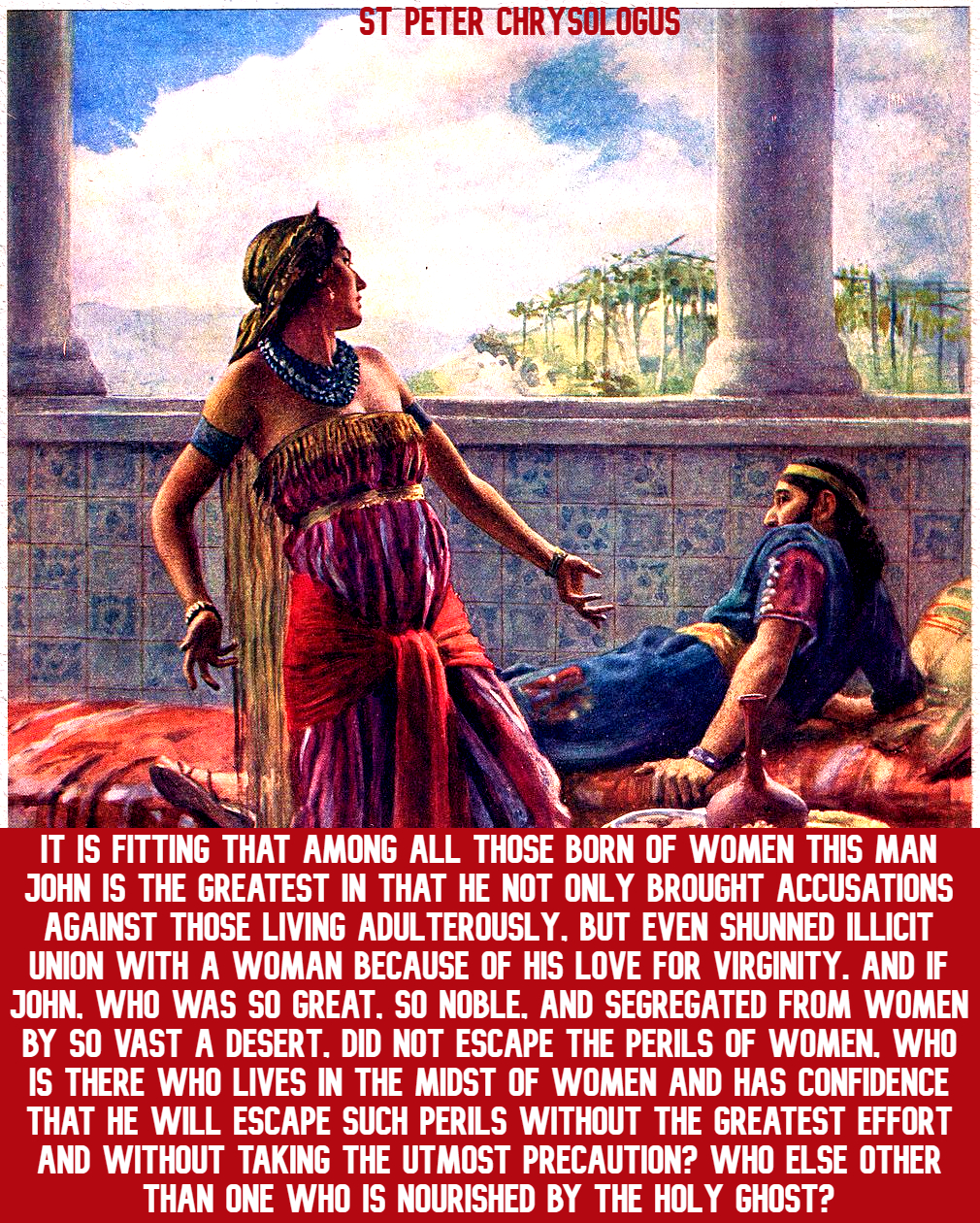
It is fitting that among all those born of women this man John is the greatest in that he not only brought accusations against those living adulterously, but even shunned illicit union with a woman because of his love for virginity. And if John, who was so great, so noble, and segregated from women by so vast a desert, did not escape the perils of women, who is there who lives in the midst of women and has confidence that he will escape such perils without the greatest effort and without taking the utmost precaution? Who else other than one who is nourished by the Holy Ghost?
St Peter Chrysologus
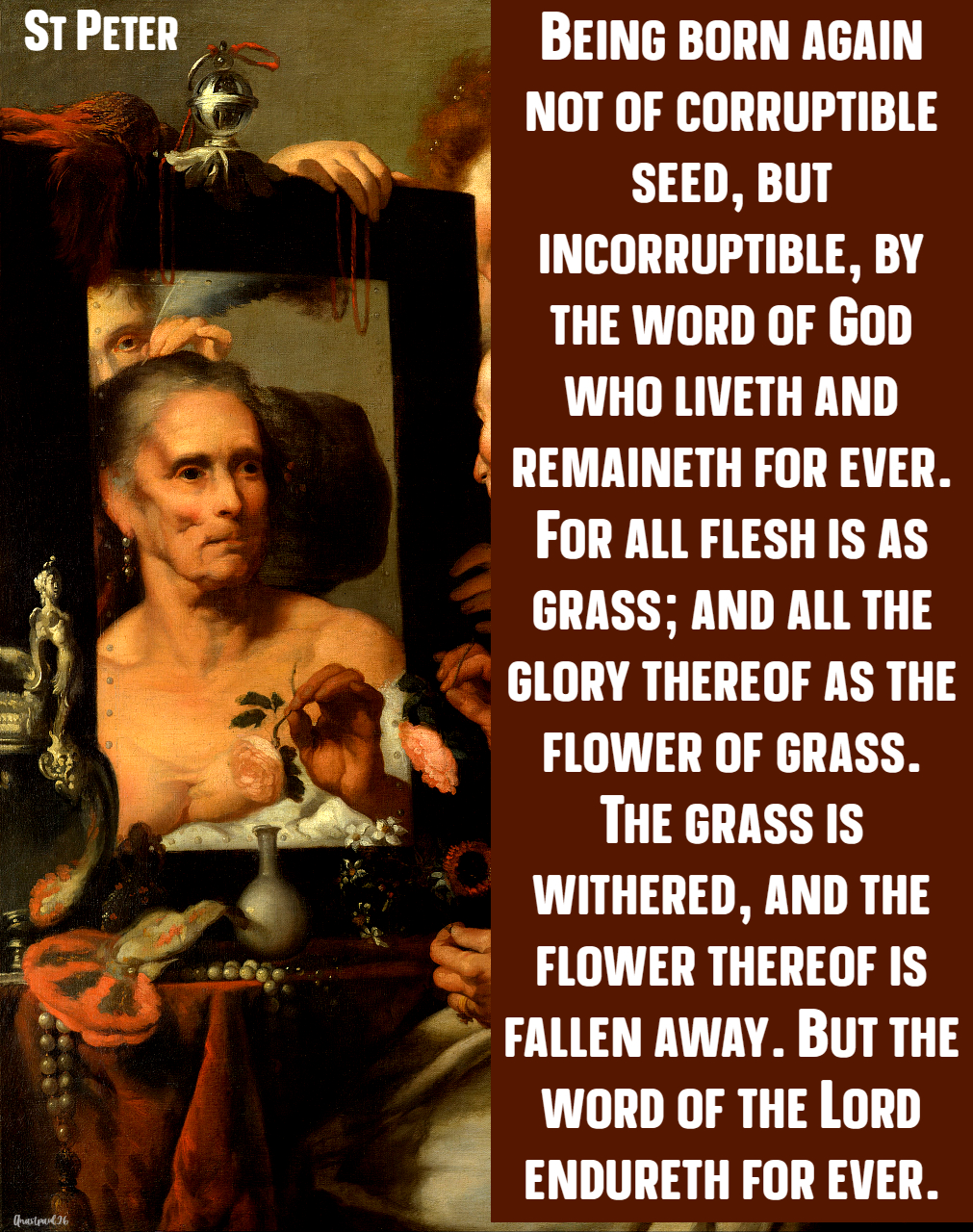
Being born again not of corruptible seed, but incorruptible, by the word of God who liveth and remaineth for ever. For all flesh is as grass; and all the glory thereof as the flower of grass. The grass is withered, and the flower thereof is fallen away. But the word of the Lord endureth for ever.
St Peter
I say then that the Blood does harm to him who receives it unworthily, not through defect of the Blood, nor of the minister, but through his own evil disposition and defect inasmuch as he has befouled his mind and body with such impurity and misery, and has been so cruel to himself and his neighbour.
The Dialogue of St Catherine of Siena
Continue on your way and you will shortly be in Hell! You cannot endure the faults of your neighbour because he is too tiresome; you do not like his company. Go away, unhappy people, you are but hypocrites, you have only a false religion, which, whatever good you are doing, will lead you to Hell.
St John Vianney
Fornications, and adulteries, and perjuries will fill the land; sorceries, and incantations, and divinations will follow after these with all force and zeal. And, on the whole, from among those who profess to be Christians will rise up then false prophets, false apostles, impostors, mischief-makers, evil-doers, liars against each other, adulterers, fornicators, robbers, grasping, perjured, mendacious, hating each other. The shepherds will be like wolves; the priests will embrace falsehood; the monks will lust after the things of the world; the rich will assume hardness of heart; the rulers will not help the poor; the powerful will cast off all pity; the judges will remove justice from the just, and, blinded with bribes, they will call in unrighteousness.
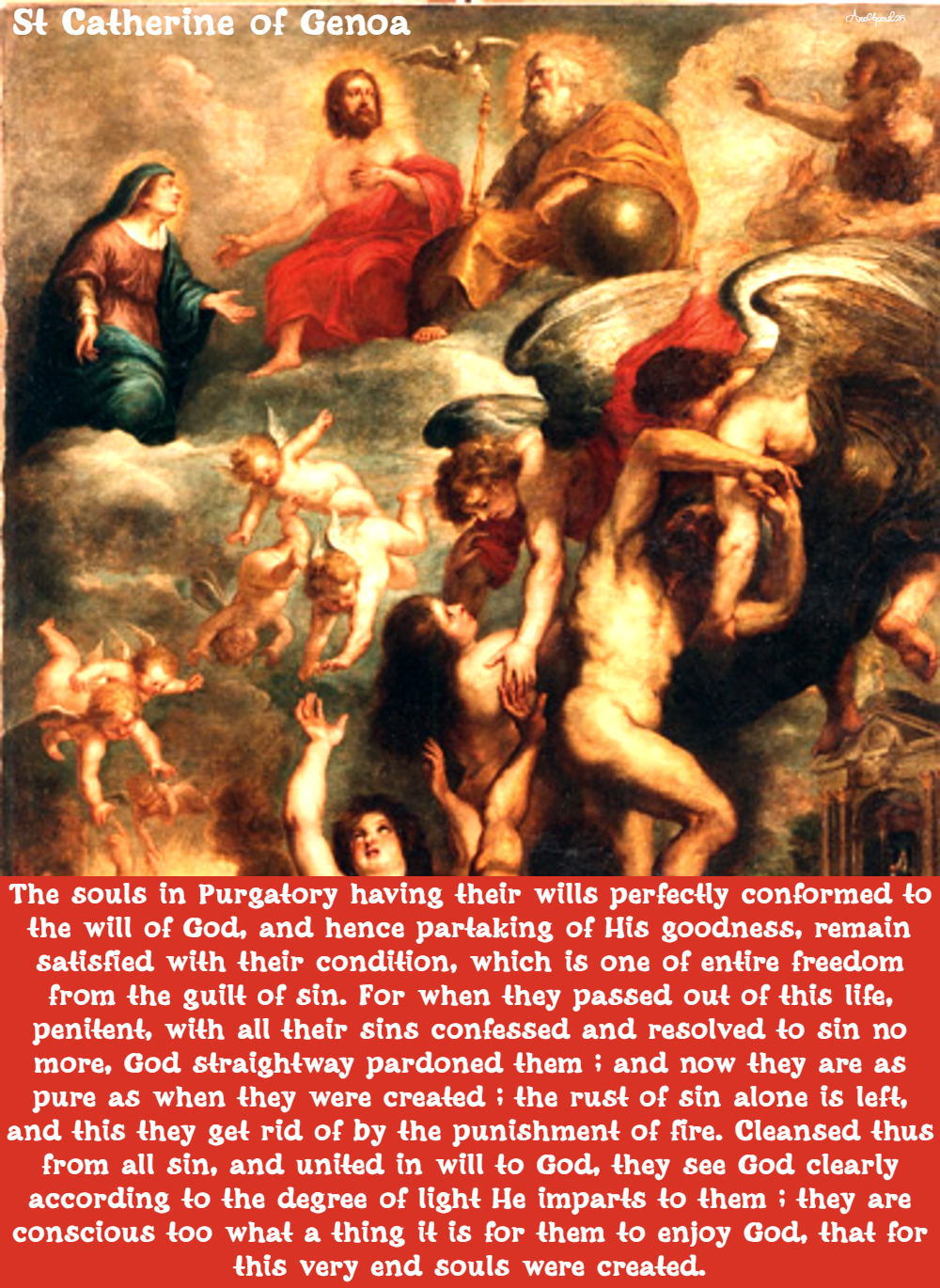
The souls in Purgatory having their wills perfectly conformed to the will of God, and hence partaking of His goodness, remain satisfied with their condition, which is one of entire freedom from the guilt of sin. For when they passed out of this life, penitent, with all their sins confessed and resolved to sin no more, God straightway pardoned them ; and now they are as pure as when they were created ; the rust of sin alone is left, and this they get rid of by the punishment of fire. Cleansed thus from all sin, and united in will to God, they see God clearly according to the degree of light He imparts to them ; they are conscious too what a thing it is for them to enjoy God, that for this very end souls were created.
Again, there is in them a conformity of will so uniting them to God, so drawing them to Him through that natural instinct whereby God is, as it were, bound up with the soul, that no description, no figure, no example can give a clear idea of it as it is actually felt and apprehended by inward consciousness ; nevertheless I will mention something like it which suggests itself to me.
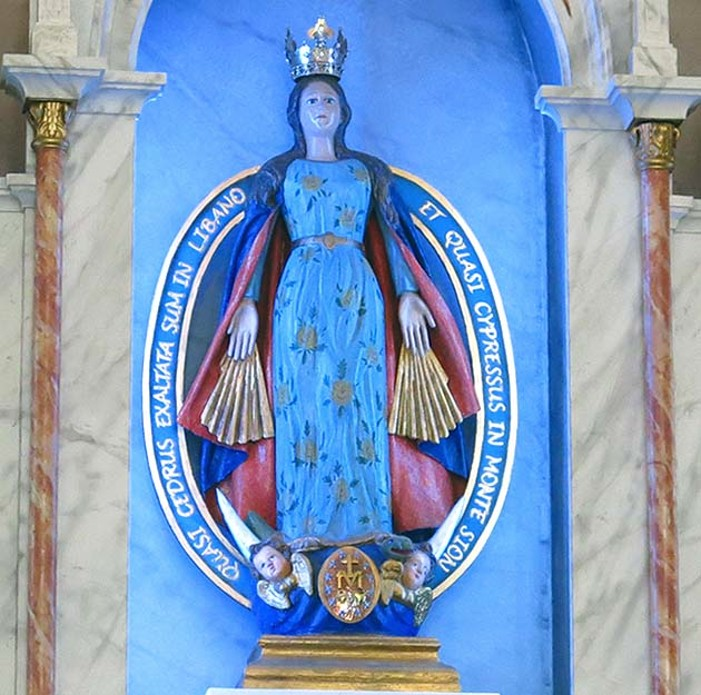
Nossa Senhora da Medalha Milagrosa / Our Lady of the Miraculous Medal, Monte Sião, Brazil (1939) – 5 November now moved to 27 November:
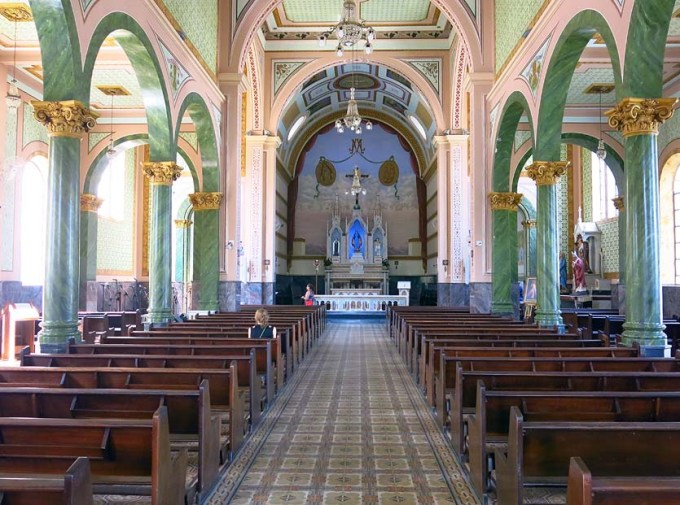
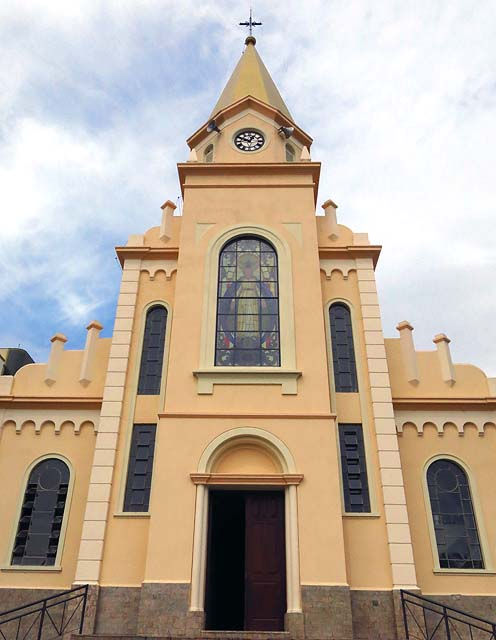
The first Church in Monte Sião appeared in 1849, dedicated to Our Lady of the Miraculous Medal, built by the founder of the place, Antonio Bernardes de Souza. The official Consecration of the Church took place on 13 April 1850. In the Parish of Father Luigi Cocoresi, from 1883 to 1890, more precisely in 1881, the Chapel was replaced by the Parish Church, built on top of in in the same square. The new Church was also built of clay based on strips of sawn wood.
In the parish administration of Fr. José Eugênio de Faria – Fr Zequinha – in 1934, the construction of the current Mother Church began, which is located in the same place as the previous two.
The Church’s architecture resembles the style of Roman art from the 12th century and the main Altar is entirely carved in wood, where the centenary image of the Patron Saint, the Blessed Mother, can be seen. The image of Our Lady of the Miraculous Medal, which adorns the main Altar, was brought to Monte Sião around 1860 and came from Portugal, through a Portuguese farmer, Mr João Pereira Batista Machado, who would have funded both its acquisition and the transportation. The image arrived at the Port of Rio de Janeiro and was brought to the City on the back of animals, inside a cargo jack and wrapped in dry corn husk.
In 1937, at the request of the Bishop, the image was removed from the Altar and sent to a Chapel in the countryside, claiming that the Statue looked too modern.
The faithful greatly missed the Statue in the Igreja Matriz. It was then, that between 1937 and 1939, the City of Monte Sião was inflicted by a period of great drought. There was rain in every other City but not there. The people then associated the lack of rain with the absence of the Statue of their Patron and went to intercede with the Parish Priest, to bring the Statue back. On 5 November 1939, the Statue was allowed to return. The day was sunny and a procession was held to honour the Patroness.
When the Statue reached the City, the first drops began to fall and then a heavy rain, soaking everyone. This was called the rain miracle and after that, everything went smoothly. The Statue underwent a restoration in the year 2015, which returned all the original features to the image, which had been lost with previous restorations.
Although the Feast was 5 November it was moved to co-incide with the official Feast of the Miraculous Medal, 27 November, which is a local public holiday, when it is celebrated after a Novena between 18 and 26 November, with a Mass in honour of the Patron , the Blessed Maria of the Miraculous Medal.
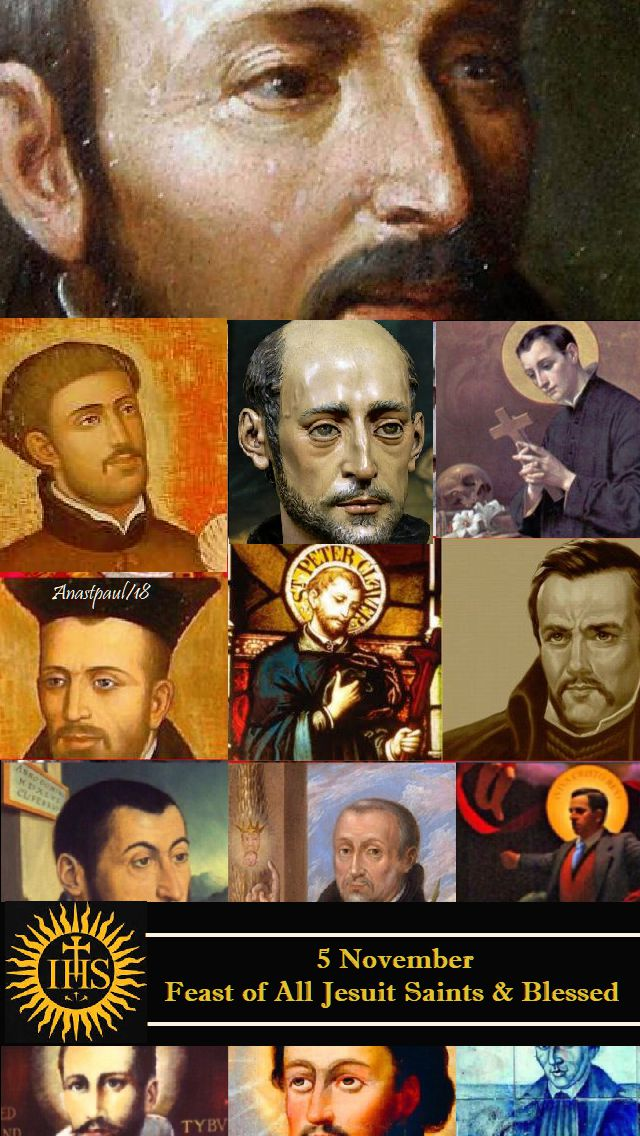
The Society of Jesus, commonly known as the Jesuits, was Founded in 1534 by Saint Ignatius Loyola (1491-1556) at Montmartre, Paris, France. A body of clerics regular organised for Apostolic work, following a religious rule and relying on alms for their support. It was the chief instrument of the Catholic Reformation. Pope Paul III approved the new rule in 1540 and Ignatius was elected the first general of the order in 1541. The constitutions, drafted by him and based on his Spiritual Exercises were adopted in 1558. It was the first order which enjoined by its constitutions devotion to the cause of education. The ministry of the Society consists chiefly in preaching. teaching catechism. administering the sacraments. conducting missions in parishes, taking care of parishes. organising pious confraternities, teaching in schools of every grade, writing books, pamphlets, periodical articles, going on foreign missions and special missions when ordered by the current Holy Father, to whom they take a vow of total obedience. Our current Holy Father, Pope Francis is a Jesuit and has jokingly wondered aloud who is boss of whom in his Order. The general resides at Rome, Italy and has a council of assistants. The motto of the Society is Ad Majorem Dei Gloriam (For the greater glory of God).
St Augustine of Terracina Bl Bernhard Lichtenberg St Bertille (c 629-c 703) Abbess St Canonica St Comasia St Ðaminh Mau St Dominator of Brescia St Elizabeth St Domninus the Physician St Epistemis St Eusebius of Terracina St Felix of Terracina St Fibitius St Galation St Gerald of Beziers Bl Gomidas Keumurjian Bl Gregory Lakota St Guetnoco St Guido Maria Conforti St Hermenegild St Idda St Juan Antoni Burró Mas St Juan Duarte Martín St Kanten St Kea St Laetus of Orleans St Magnus of Milan St Mamete St Marco of Troia Bl María del Carmen Viel Ferrando Bl Simon Ballachi St Spinulus of Moyen-Moûtier St Sylvanus of Syria St Zachary — Martyrs of Caesarea Maritima – 4 saints: Four young Christian men who were martyred together in the persecutions of Maximian – Aussenzius, Philotheus, Timothy and Theotimus. They were martyred in the arena at Caesarea Maritima, Palestine.
Martyred in the Spanish Civil War: • Blessed Juan Antoni Burró Mas • Blessed Juan Duarte Martín • Blessed María del Carmen Viel Ferrando
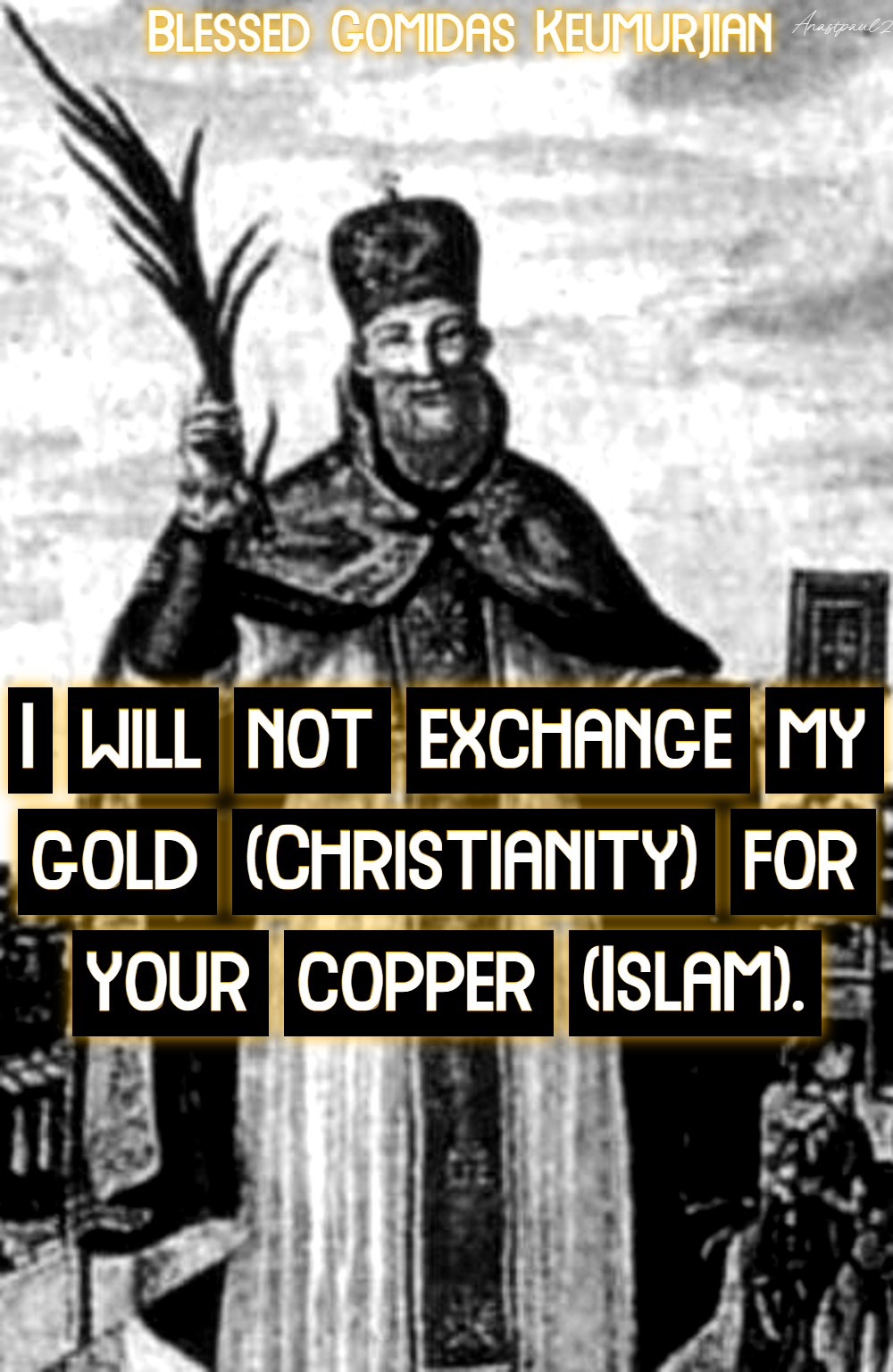
Blessed Gomidas Keumurjian, also known as Gomida Keumurgian, Cosma de Carboniano, was a martyr. Originally a priest in the Armenian church, in 1696 he and his family made complete submission to the authority of Rome. His preaching attracted large audiences of not only Armenians, but also Ottoman Greeks and so many Muslims that he had to regularly preach sermons in Turkish. This angered the Armenian officials. Some of them falsely accused Gomidas of being a spy for Rome, which led to his arrest and execution by Turkish authorities.
At the insistence of the Armenian Apostolic Patriarch of Constantinople, Gomidas was tried before an Islamic court and sentenced to death by the Qadi for treason against the Ottoman Sultan and for secretly baptizing Muslims. Gomidas, however, was offered a full pardon and his immediate release in return for his conversion to Islam. The other eight priests with him immediately accepted the offer of pardon in exchange for conversion to Islam, and only Gomidas refused, saying, “I will not exchange my gold for your copper.”
Accompanied by his wife and children and a crowd of three thousand witnesses, Gomidas was led out of prison on 5 November 1707 to the Samatya quarter of Istanbul. Like the many other martyred priests under the Caesars, he was followed to the place of execution by his wife and children. His wife encouraged him to remain firm, while his sister, Irena, begged him not to bereave his family. Irena urged her brother to instead pretend to convert to Islam, while remaining a crypto-Christian. Unmoved, he continued until he reached the crossroads called Parmak Kapu, where he was ordered to kneel. Gomidas did so, facing Jerusalem, much to the dismay of the crowd, who repeatedly called in vain for him to turn and face Mecca instead. When the executioner approached with a drawn sword and also urged him to save his life through conversion to Islam, he replied, “No, do your work”, and began reciting the Nicene Creed in the Classical Armenian liturgical language. His prayer only ceased when he was beheaded.
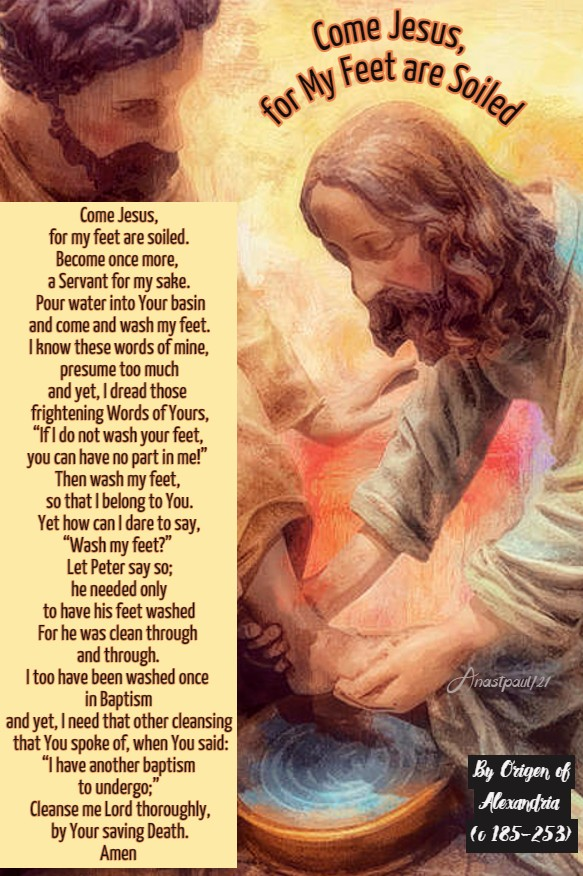
Come Jesus, for My Feet are Soiled By Origen of Alexandria (c 185-253)
Come Jesus, for my feet are soiled. Become once more, a Servant for my sake. Pour water into Your basin and come and wash my feet. I know these words of mine, presume too much and yet, I dread those frightening Words of Yours, “If I do not wash your feet, you can have no part in me!” Then wash my feet, so that I belong to You. Yet how can I dare to say, “Wash my feet?” Let Peter say so; he needed only to have his feet washed For he was clean through and through. I too have been washed once in Baptism and yet, I need that other cleansing that You spoke of, when You said: “I have another baptism to undergo;” Cleanse me Lord thoroughly, by Your saving Death. Amen
One Minute Reflection – 5 November – “Month of the Holy Souls in Purgatory” – Readings: Jer 29:11-12; 29:14, Ps 84:2, Phil 3:17-21; 4:1-3, Matt 9:18-26
He said, “Begone, the girl is asleep, not dead.” And they laughed Him to scorn. But when the crowd had been put out, He went in and took her by the hand; and the girl arose.
Matt 9:18-26
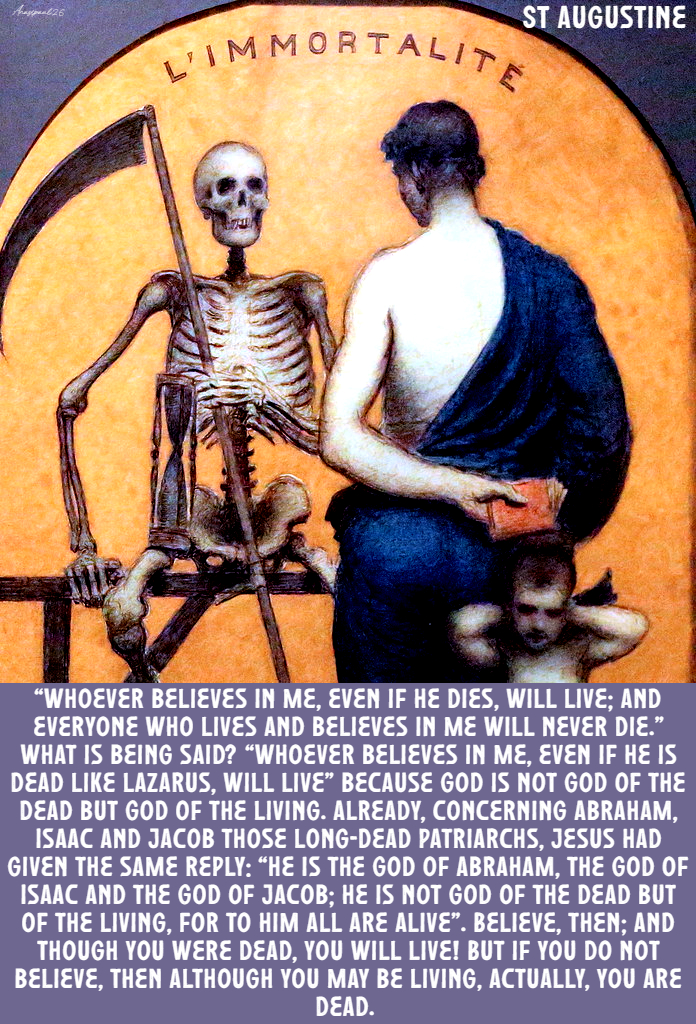
REFLECTION – “Whoever believes in me, even if he dies, will live; and everyone who lives and believes in me will never die.” What is being said? “Whoever believes in me, even if he is dead like Lazarus, will live” because God is not God of the dead but God of the living. Already, concerning Abraham, Isaac and Jacob those long-dead patriarchs, Jesus had given the same reply: “He is the God of Abraham, the God of Isaac and the God of Jacob; he is not God of the dead but of the living, for to him all are alive”. Believe, then; and though you were dead, you will live! But if you do not believe, then although you may be living, actually, you are dead. From where comes death in the soul? From the fact that faith is no longer there. From where comes the death of the body? From the fact that the soul is no longer there. The soul’s soul is faith.
“Whoever believes in me, even though he die in body will be alive in soul until the body itself rises again to die no more. And whoever lives in the flesh and believes in me, although he must die in his body for a season, will not die for ever because of the life of the Spirit and immortality of the resurrection.”

That is what Jesus' reply to Martha meant: “Do you believe this?” “Yes, Lord,” she answered, “I have come to believe that you are the Messiah, the Son of God, the one who is coming into the world. Believing this, I have believed you are the resurrection; I have believed you are the life; I have believed that whoever believes in you, though he die, will live; I have believed that whoever lives and believes in you will never die eternally.”
St Augustine
PRAYER – Lord God, teach us humility, to give and not to count ever the cost to ourselves, to take the lowest part and the back seat – teach us Lord, to strive and not to seek for glory, save for that of Your Kingdom. Let us see Your Face, His Face, He our Teacher, our Saviour in the face of all those in most need. May all those great Jesuit Saints standing before that Face, pray for us! We ask this through Jesus Christ, our Lord, who we beg, have mercy on us all, who seek rewards for our own sakes, amen.
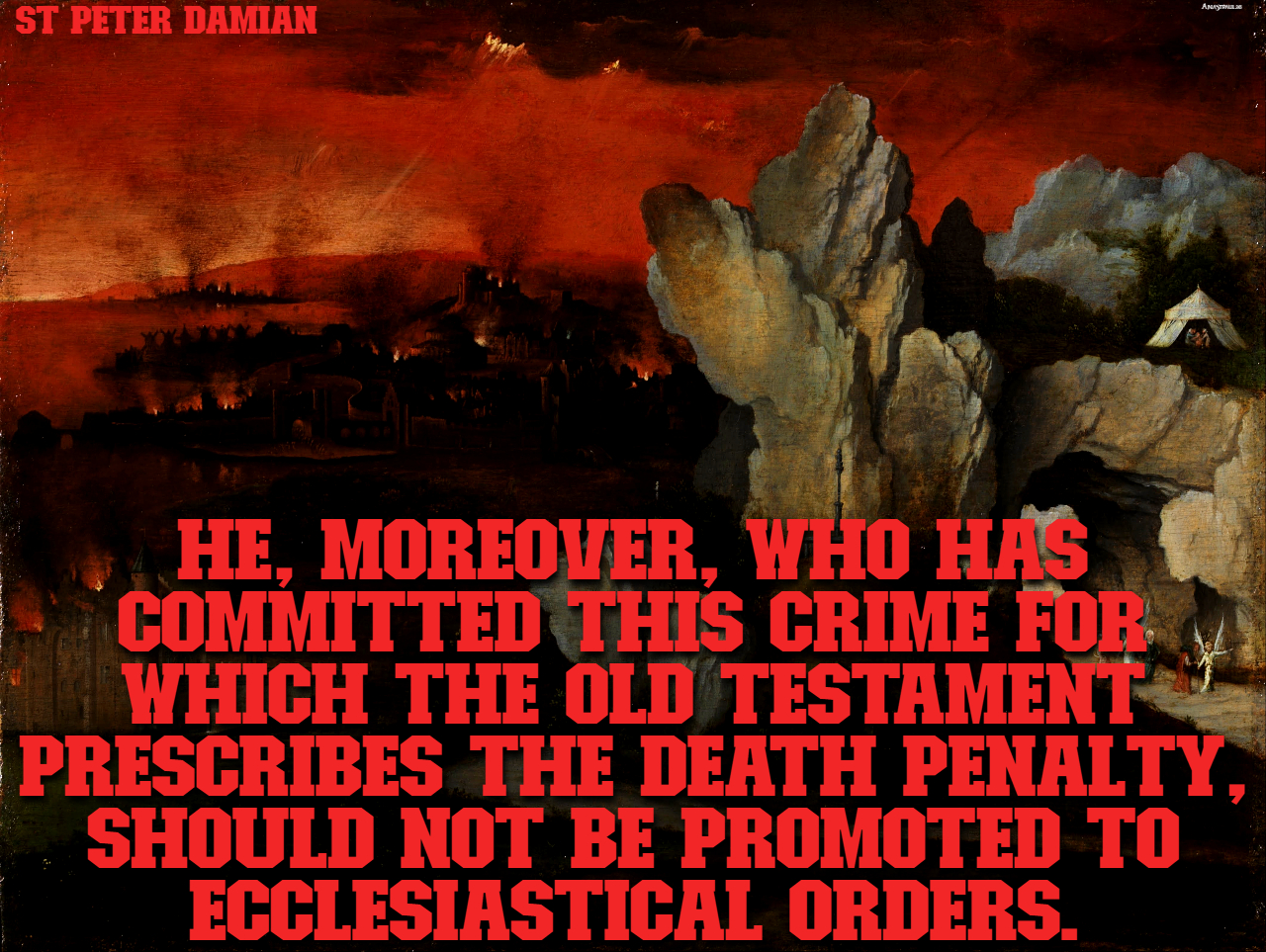
He, moreover, who has committed this crime for which the Old Testament prescribes the death penalty, should not be promoted to ecclesiastical orders.
St Peter Damian
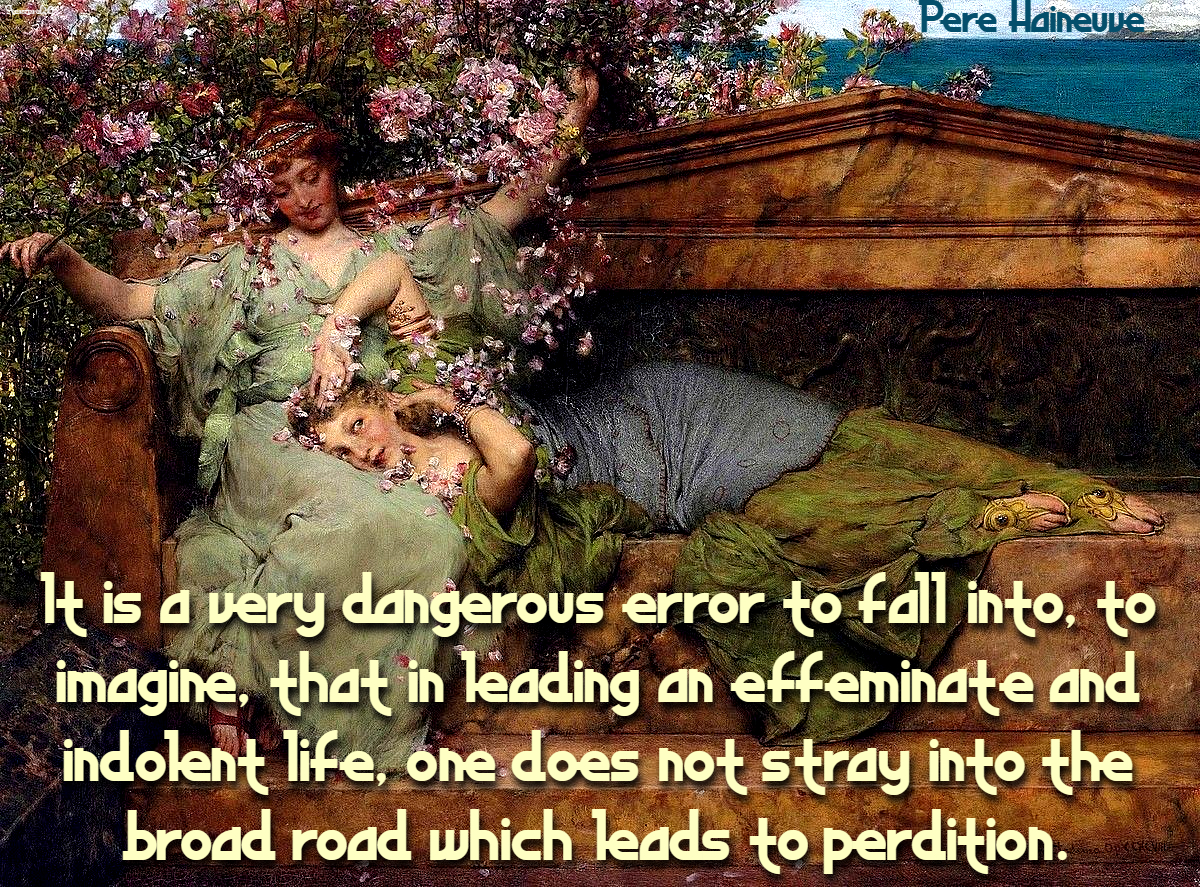
It is a very dangerous error to fall into, to imagine, that in leading an effeminate and indolent life, one does not stray into the broad road which leads to perdition.
Pere Haineuve
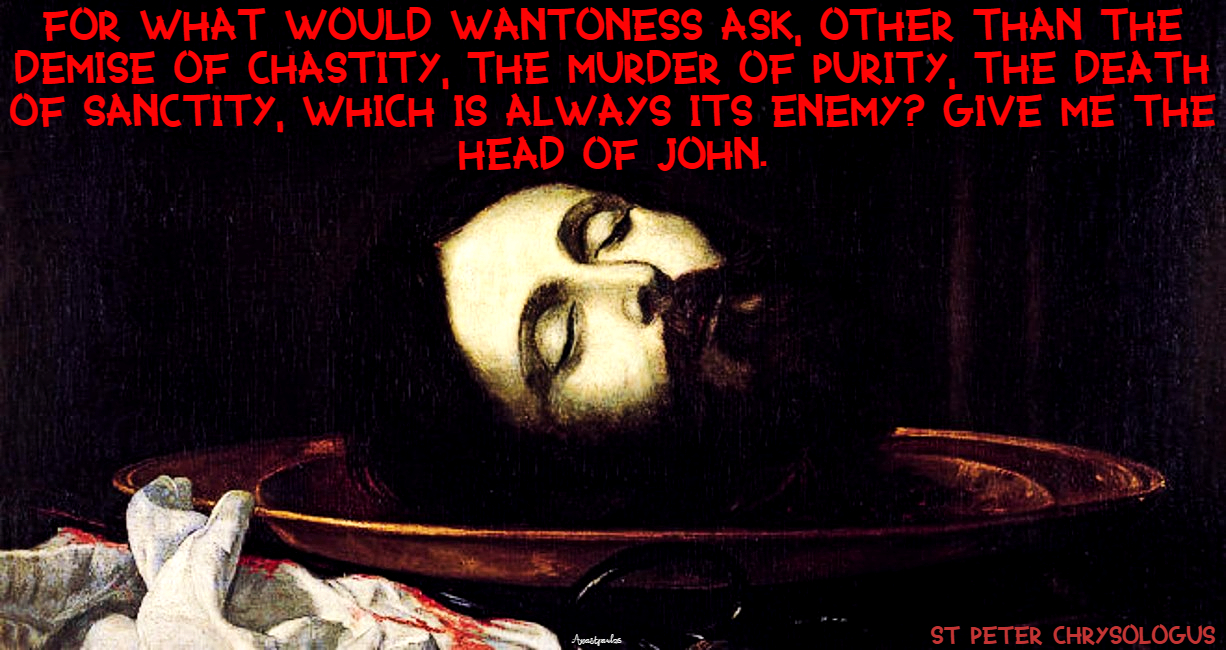
For what would wantoness ask, other than the demise of chastity, the murder of purity, the death of sanctity, which is always its enemy? Give me the head of John.
St Peter Chrysologus
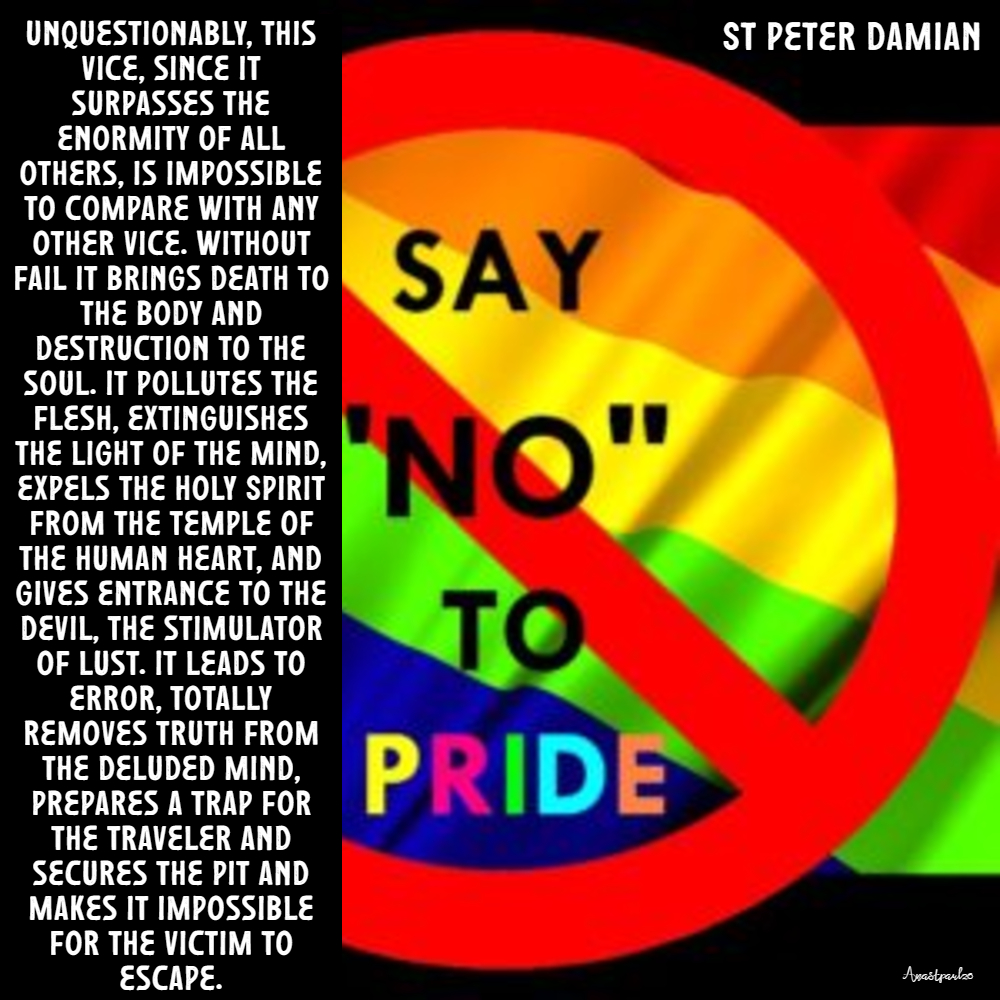
Unquestionably, this vice, since it surpasses the enormity of all others, is impossible to compare with any other vice. Without fail it brings death to the body and destruction to the soul. It pollutes the flesh, extinguishes the light of the mind, expels the Holy Spirit from the temple of the human heart, and gives entrance to the devil, the stimulator of lust. It leads to error, totally removes truth from the deluded mind, prepares a trap for the traveler and secures the pit and makes it impossible for the victim to escape.
St Peter Damian
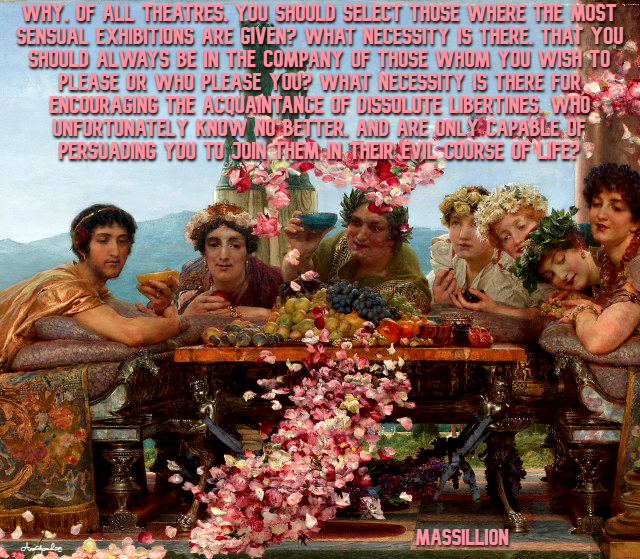
Why, of all theatres, you should select those where the most sensual exhibitions are given? What necessity is there, that you should always be in the company of those whom you wish to please or who please you? What necessity is there for encouraging the acquaintance of dissolute libertines, who unfortunately know no better, and are only capable of persuading you to join them in their evil course of life?
Massillion
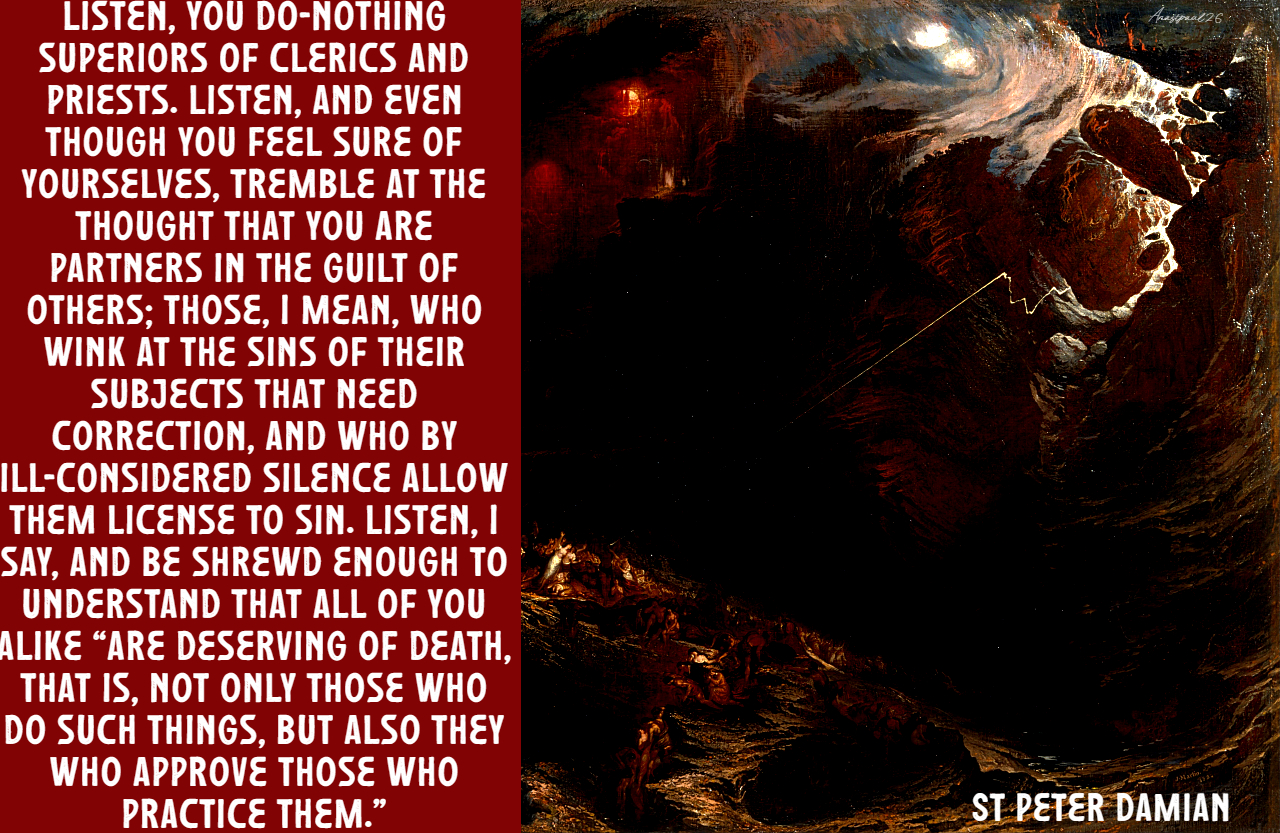
Listen, you do-nothing superiors of clerics and priests. Listen, and even though you feel sure of yourselves, tremble at the thought that you are partners in the guilt of others; those, I mean, who wink at the sins of their subjects that need correction, and who by ill-considered silence allow them license to sin. Listen, I say, and be shrewd enough to understand that all of you alike “are deserving of death, that is, not only those who do such things, but also they who approve those who practice them.”
From what has been said, it is clear that the guilt of sin consists in the perverse opposition of the will to the will of God, and that so long as the will continues thus evilly perverse the guilt will continue. For those, then, in hell, who have departed this life with an evil will, there is no remission of sin, neither can be, be cause there can be no more change of will. In passing out of this life the soul is fixed for good or evil according to its deliberate purpose at the time ; as is written, “Where shall I find thee (that is, at the hour of death, with a will either to sin or sorry for sin and penitent), there will I judge thee : ” and this judgment is final ; because after death the will can never again be free, but must remain fixed in the condition in which it was found at the moment of death.
The souls in hell having been found at the moment of death with a will to sin, have with them an infinite degree of guilt ; and the punishment they suffer, though less than they deserve, is yet, so far as it exists, endless. But the souls in purgatory have only the punishment for sin, and not its guilt ; for the guilt was effaced at the moment of death, in that they were found then deploring their sins and penitent for having offended the Divine Goodness ; so their punishment has a limit, and goes on diminishing in duration, as has been said.
O misery above every misery ! and so much the greater because men in their blindness consider it so little. The punishment of the damned is not, indeed, infinite in amount ; for the sweet goodness of God sheds the rays of His mercy even in hell. A man who has died in mortal sin deserves a punishment infinite in pain and infinite in duration ; but God in His mercy has made it infinite only in duration, and has limited the amount of pain. He might most justly have given them a far greater punishment than He has. O how perilous is a sin committed through malice ! for hardly does a man repent of it ; and not repenting, his guilt remains, and will remain, so long as there is any affection for the sin committed, or any purpose of committing it afresh.
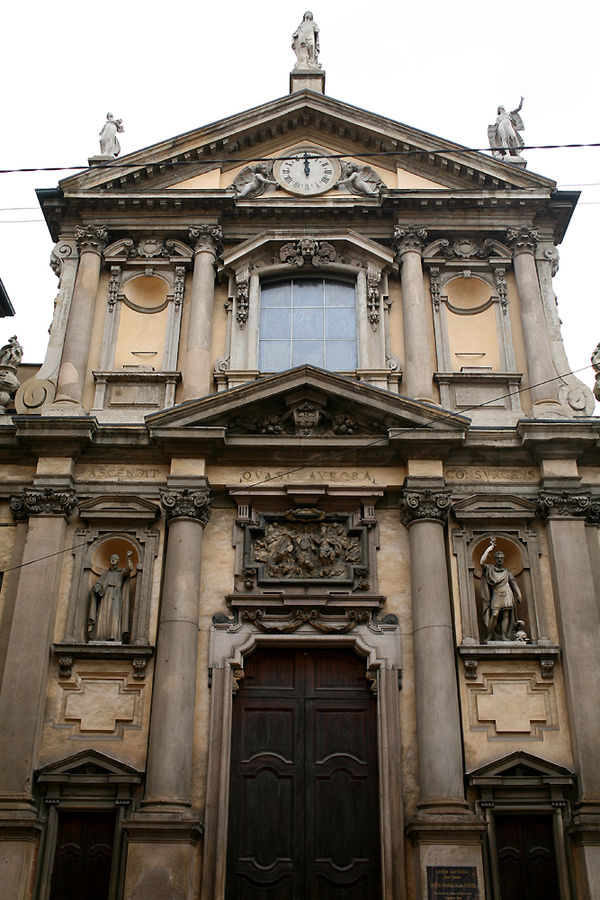
Santa Maria alla Porta Luigi / Our Lady of Port Louis, Milan, Italy – 4 November:
The ancient City of Milan, Italy, has had three completely different systems of walls defending the City throughout the ages. The oldest walls were Roman, built in the Republican and Imperial eras. The second wall was built in the 12th century, shortly after the City was razed by Frederick Barbarossa. The third, and final wall system was built in the 16th century by the Spanish rulers of Milan. Even though in most places there is little left of the walls, the gates, or “ports” contributed to the layout of the City as the streets passed through the gates from a central hub. The Roman gates were Porta Romana, Porta Ticinese, Porta Vercellina and so on, with each wall having gates with a variety of names. None of them, however, has had the name of Porta Luigi There is no Church in Milan to St. Louis and I can find no reference to this feast of Mary, that was once famous enough to have a date on the calendar. (https://www.roman-catholic-saints.com/our-lady-of-port-louis.html).
I (Ana) have found a Church called “Santa Maria alla Porta” (Holy Mary at the Gate), see below, which dates from very early times, certainly before the 12th Century. Although a Church already stood in the same Milanese location since before the year 1105, the present Church was erected in 1652 under Spanish rule.
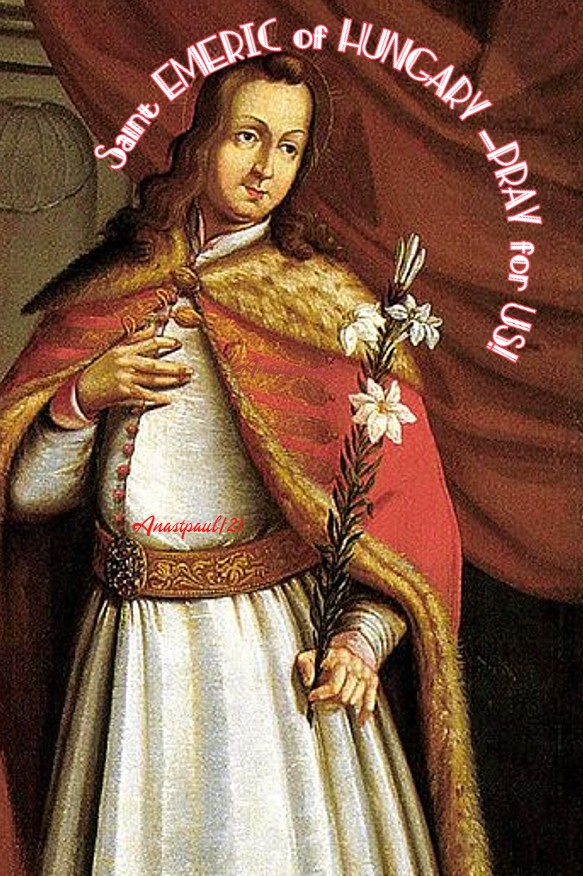
St Agricola of Bologna St Amandus of Avignon St Amandus of Rodez St Birstan St Clarus the Hermit St Clether St Emeric of Hungary (c 1007-1031) Confessor, Prince and heir to the Hungarian Throne, Son of St Stephen, King of Hungary
Bl Frances d’Amboise St Gerard de Bazonches St Gregory of Burtscheid Bl Helen Enselmini Bl Henry of Zweifalten St Hermas of Myra Bl Joan Antoni Burró Mas St Joannicus of Mount Olympus St John Zedazneli St Modesta of Trier St Nicander of Lycia St Patrobas St Perpète St Philologus St Pierius St Proculus of Autun Bl Teresa Manganiello St Vitalis of Bologna
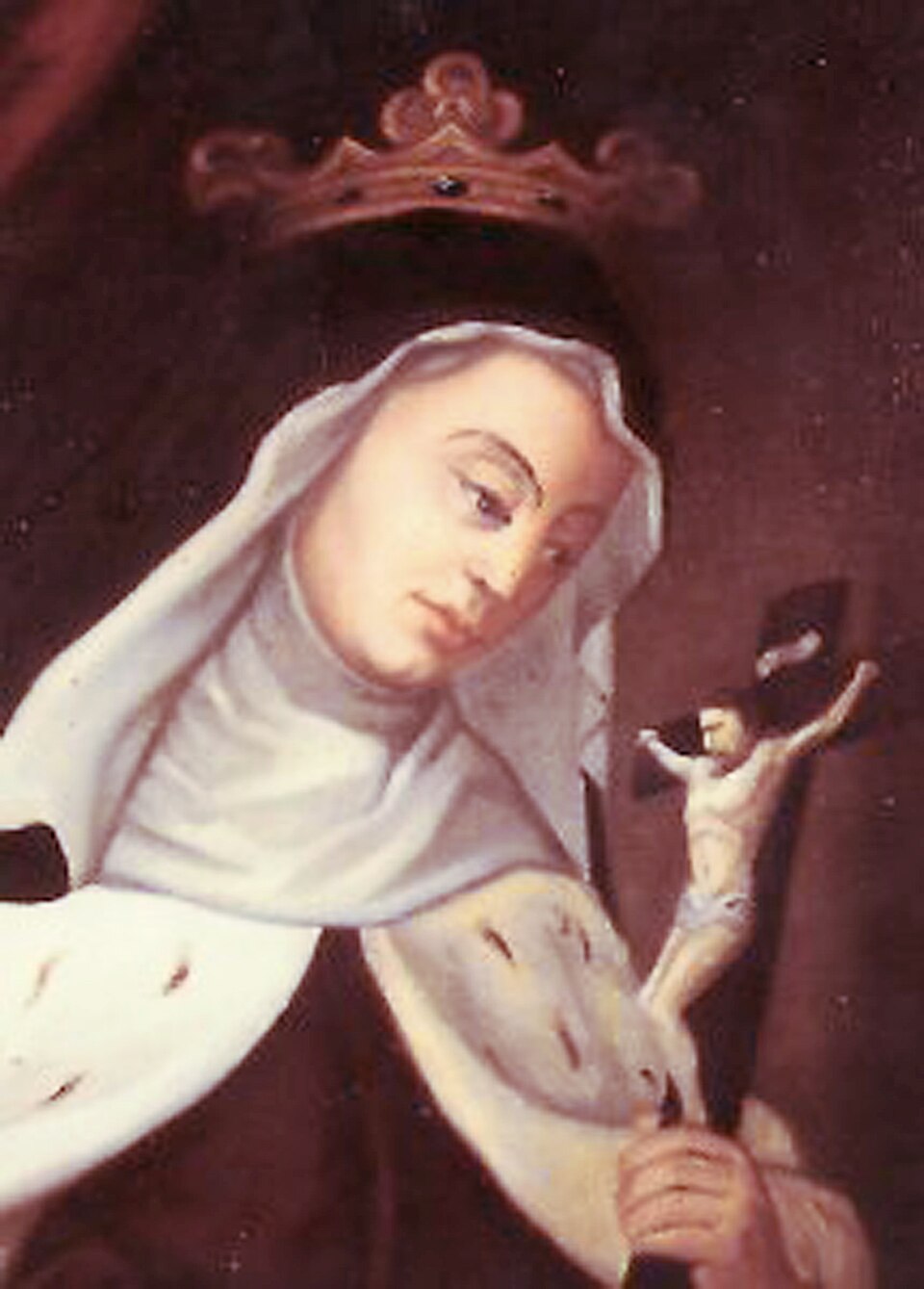
Blessed Frances d’Amboise, also known as Francisca de Amboise, Françoise d’Amboise, was a daughter of Louis d’Amboise, Viscount de Thouars, and the Duchess of Brittany, being married to Peter II, Duke of Brittany at age 15.
Born on 28 September 1427 in Thouars, Deux-Sèvres, France, her marriage was not a happy one, and Peter sometimes abused her, but Frances softened Peter over the years, and he assisted in her charitable work. She established a Poor Clare convent at Nantes, France, and worked for the canonization of Saint Vincent Ferrer. She supported the Dominican convent at Nantes. Widowed in 1457, she entered into a conflict with King Louis XI who wanted to marry her, but ultimately was able to devote herself to religious life. Frances joined the Carmelite nuns at Bondon on 25 March 1468, making her final vows in 1469. She was a spiritual student of Blessed John Soreth. After working in the infirmary for a while, she was elected prioress for life in 1473. She is considered the foundress of the Carmelite nuns in France.
She died on 4 November 1485 at Les Couêts, Nantes, France of natural causes, and while in a religious ecstasy. Miracles were reported at her tomb. Her body had to be moved to save it during the Huguenot wars, and again in the French Revolution. She was beatified on 16 July 1863 by Pope Pius IX.
Almighty God, Thou hast generously made known to human beings, the Mysteries of Thine Life through Jesus Christ Thy Son in the Holy Ghost. Enlighten my mind to know these Mysteries which Thy Church treasures and teaches. Move my heart to love them and my will, to live in accord with them. Give me the ability to teach this Faith to others, without pride, without ostentation and without personal gain. Let me realise that, I am simply Thy instrument, for bringing others to the knowledge of the wonders Thou hast done for all Thy creatures. Help me to be faithful to this task Thou hast entrusted to me. Amen
One Minute Reflection – 4 November – “Month of the Holy Souls in Purgatory” – Readings: Sir 45:30, Ps. 131:1, Sir 44:16-27; 45:3-20, Matt 25:14-23
The Lord made a covenant of friendship with him, and made him a prince; that he should possess the dignity of priesthood forever.
Sir 45:30
REFLECTION – May those who have been disinherited of wealth learn from the Church that, according to the judgment of God himself, poverty is not a disgrace, and that there is no need to blush with shame if you have to earn your daily bread through work. Jesus Christ Our Lord confirmed this by his example, he who for the salvation of men “made himself poor though he was rich.” He who was the Son of God and God himself wanted to be taken for the son of a worker in the eyes of the world. He went so far as to spend a large part of his life in doing paid work. “Is this not the carpenter, the son of Mary?”
Whoever keeps his eyes on the divine model will understand that true human dignity and excellence dwells in a person’s habits, that is to say, in his virtue. Virtue is the common patrimony of mortals; it is available to everyone, to the small and to the great, the poor and the rich. Wherever they are seen, virtue and merit alone will obtain the reward of eternal beatitude. Even more, it seems that God’s heart is more inclined towards the less fortunate classes. Jesus Christ calls the poor blessed. With love he invites all who suffer and weep to come to him so that he might console them; he embraces with a more tender charity those who are small and oppressed. These teachings are certainly given in order to humble the haughty soul of the rich and to make him more compassionate, to raise the courage of those who suffer and to inspire them with trust.
PopeLeo XIII
PRAYER – Lord God, in Your wisdom, You created us, by Your providence You rule us, penetrate our inmost being with Your holy light, so that our way of life, may always be one of faithful service to You. With great love we thank You for the great gifts You shower upon us and for being our Father, who seeks and finds us when we are lost. Grant that by the intercession of St Charles Borromeo and St Emeric, we may ever seek to stay true to our baptism. Through Jesus, our Lord, with the Holy Spirit, God forever, amen.
And to one he gave five talents, to another two, and to another one, to each according to his particular ability, and then he went on his journey.
Matt 25:14-23
God is content if we do all we can to love Him in our sphere of life, and He asks for nothing more. You sometimes regret that you cannot practice great austerities, which no doubt are due to Him for our past sins. Supply for these in another way, replace those fastings and watchings by fervent acts of love, He requires nothing more.
Paul Segneri
If you are always ready to do His will and to submit to it, then be sure that you love Him. Conformity to the will of God also makes a man happy as God, who is happiness itself.
Le Pere Nepveu
They reverenced even the scourges which God had sent to chasten them. The early Christians blessed the hands that struck them.
Massillon
According to St Augustine, the Divine Word falls on a weak and sensitive element, and it becomes a sacrament. This word also falls on impure hearts, and it makes them chaste, on the wicked, and makes them saints. It finds them in sin, and it converts them to God.
La Pere Antoine de la Porte
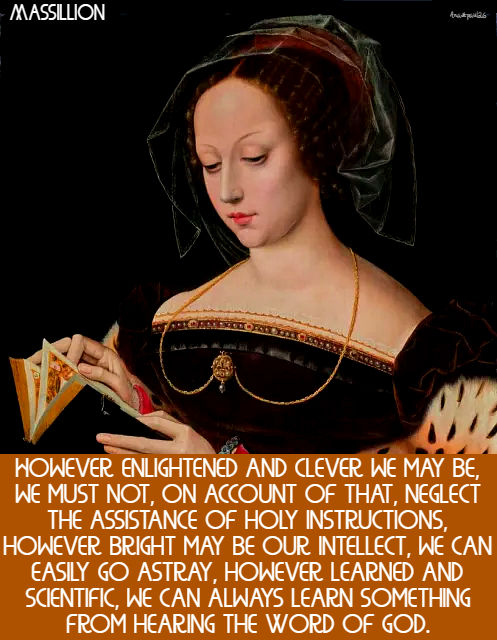
However enlightened and clever we may be, we must not, on account of that, neglect the assistance of holy instructions, however bright may be our intellect, we can easily go astray, however learned and scientific, we can always learn something from hearing the Word of God.
Massillion
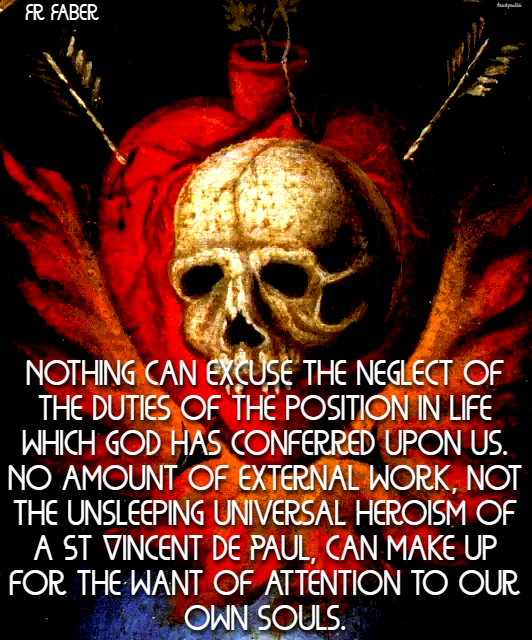
Nothing can excuse the neglect of the duties of the position in life which God has conferred upon us. No amount of external work, not the unsleeping universal heroism of a St Vincent de Paul, can make up for the want of attention to our own souls.







You must be logged in to post a comment.