The Holy Father’s
Prayer Intention
for OCTOBER 2019A Missionary “Spring” in the Church
That the breath of the Holy Spirit
engender a new
missionary “spring”
in the church.
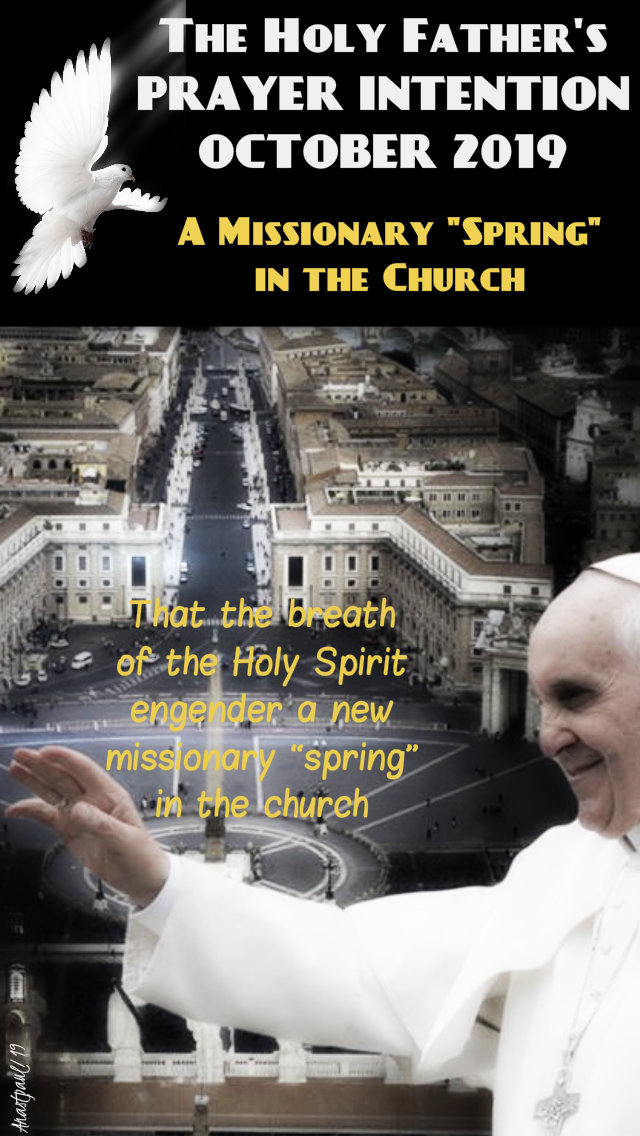
The Holy Father’s
Prayer Intention
for OCTOBER 2019A Missionary “Spring” in the Church
That the breath of the Holy Spirit
engender a new
missionary “spring”
in the church.

Current scholarship traces the development of the Rosary to the High Middle Ages period. The month of October each year is dedicated to the Most Holy Rosary. This is primarily due to the fact that the liturgical feast of Our Lady of the Rosary is celebrated annually on 7 October. It was instituted to honour the Blessed Virgin Mary in gratitude for the protection that she gives the Church in answer to the praying of the Rosary by the faithful.
The feast was introduced by Pope St Pius V (1504-1572) in the year 1571 to commemorate the miraculous victory of the Christian forces in the Battle of Lepanto on 7 October 1571. The pope attributed more to the “arms” of the Rosary than the power of cannons and the valour of the soldiers who fought there.
Legend tells us that the Rosary as a form of prayer was given to St Dominic (1170-1221) by Mary, the Mother of Our Lord, who entrusted it to him as an aid in the conflicts with the Albigensians. The Dominican pope, St Pius V, did much to further the spread of the Rosary and it thereafter became one of the most popular devotions in Christendom. It was the same Pope St Pius V, who in 1569 officially approved the Rosary in its present form with the Papal Bull, Consueverunt Romani Pontifices. It had been completed by the addition of the second half of the “Hail Mary” and the “Glory be to the Father” at the conclusion of each mystery.
In the Middle Ages it came into being in various medieval monasteries as a substitute for the Divine Office for the lay monks and devout lay persons, who did not know how to read. Instead of the 150 psalms, they would pray 150 “Our Fathers” counting them on a ring of beads known as the crown or “corona.” With the growth of popularity of Marian devotion in the twelfth century, the “Psalter of the Blessed Virgin Mary” developed now substituting 150 “Hail Marys” in place of the “Our Fathers.”
The 150 “Hail Marys” were subsequently subdivided into fifteen decades by the young Dominican friar, Henry Kalkar (1328-1408), with each decade referring to an event in the life of Jesus and Mary. The Dominican, Alanus de Rupe (1428-1478) further divided the episodes in the history of salvation into the joyful, sorrowful and glorious mysteries. He also attributed the origin of the Rosary, then known as the “Psalter of the Blessed Virgin” to St Dominic and thus spurred the Dominican Order to make the Apostolate of the Rosary their special concern. The Dominicans have, since then, promulgated the Rosary with notable results.
The practice of dedicating the entire month of October to the Holy Rosary developed toward the end of the last century. Pope Leo XIII (papacy: 1878-1903) strongly promoted the increase of devotion to the Blessed Mother by encouraging the constant use of the Rosary. Beginning on 1 September 1883, with Supremo Apostolatus Officio, he wrote a total of eleven encyclicals on the Rosary, ending with Diuturni Temporis in 1898.
Many other popes have contributed to help increase devotion to the Rosary by their writings. In the recent past, St Pope Paul VI ( papacy: 1963-1978) devoted the last section of his Apostolic Exhortation MARIALIS CULTUS to the Angelus and the Rosary (MC 40-55). In this document, he wrote that “the Rosary retains an unaltered value and intact freshness.” (MC, 41)
The Rosary is primarily a scriptural prayer. This can be summarised by the traditional phrase used by Pope Pius XII (papacy: 1939-1958) that the Rosary is “a compendium of the entire Gospel” (AAS 38 [1946] p. 419). The Rosary draws its mysteries from the New Testament and is centred on the great events of the Incarnation and Redemption.
St John Paul II called the Rosary his favourite prayer, in which we meditate with Mary upon the mysteries which she as a mother meditated on in her heart (Lk. 2:19) (Osservatore Romano, 44; 30 Oct. 1979) and, as we know, added the five Luminous Mysteries in his Encyclical, Rosarium Virginis Mariae, in 2002.
In this month of October, let us consider this beautiful prayer of the Rosary as a means that we too can use in order to draw closer to Jesus and Mary by meditating on the great mysteries of our salvation.
Adapted from an article by Father Matthew R Mauriello (1996)
Thought for the Day – 1 October – The Memorial of Saint Thérèse of the Child Jesus, OCD (1873 – 1897) Virgin and Doctor of the Church
An excerpt from her autobiography
Since my longing for martyrdom was powerful and unsettling, I turned to the epistles of Saint Paul in the hope of finally finding an answer. By chance, the twelfth and thirteenth chapters of the first epistle to the Corinthians caught my attention and, in the first section, I read that not everyone can be an apostle, prophet or teacher, that the Church is composed of a variety of members and, that the eye cannot be the hand. Even with such an answer revealed before me, I was not satisfied and did not find peace.
I persevered in the reading and did not let my mind wander, until I found this encouraging theme – Set your desires on the greater gifts. And I will show you the way which surpasses all others. For the Apostle insists that the greater gifts are nothing at all without love and that this same love is surely the best path leading directly to God. At length I had found peace of mind.
When I had looked upon the mystical body of the Church, I recognised myself in none of the members, which Saint Paul described and, what is more, I desired to distinguish myself more favourably within the whole body. Love appeared to me to be the hinge for my vocation. Indeed, I knew that the Church had a body composed of various members but in this body the necessary and more noble member was not lacking, I knew that the Church had a heart and that such a heart, appeared to be aflame with love. I knew that one love drove the members of the Church to action, that if this love were extinguished, the apostles would have proclaimed the Gospel no longer, the martyrs would have shed their blood no more. I saw and realised, that love sets off the bounds of all vocations, that love is everything, that this same love, embraces every time and every place. In one word, that love is everlasting.
Then, nearly ecstatic with the supreme joy in my soul, I proclaimed –
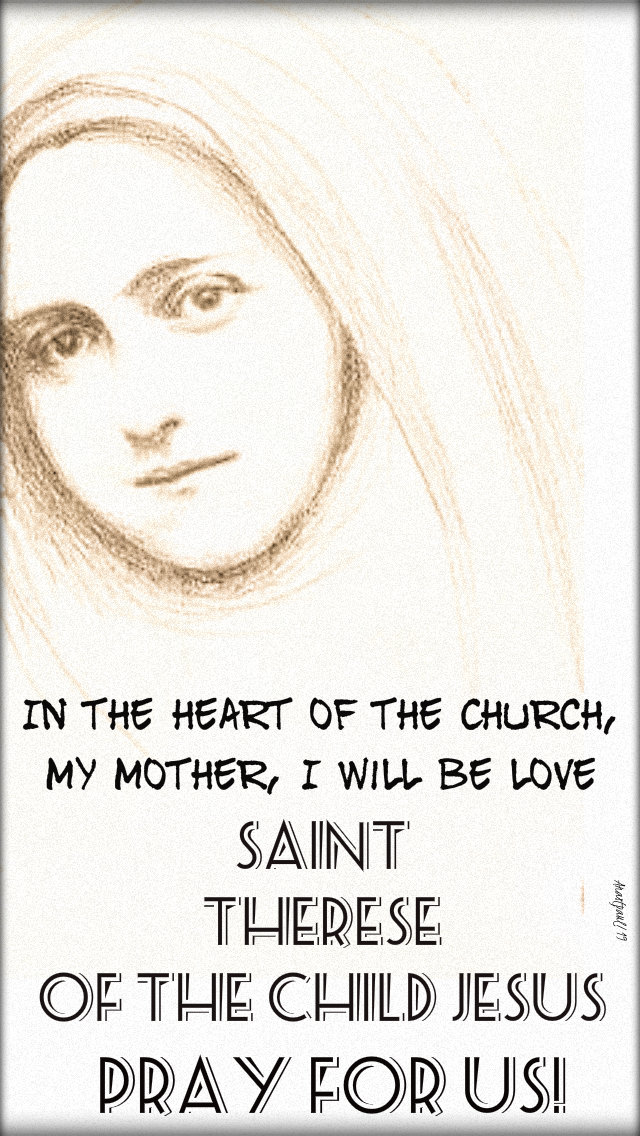
O Jesus, my Love, at last I have found my calling, my call is love. Certainly I have found my place in the Church and You gave me that very place, my God. In the heart of the Church, my mother, I will be love and thus, I will be all things, as my desire finds its direction.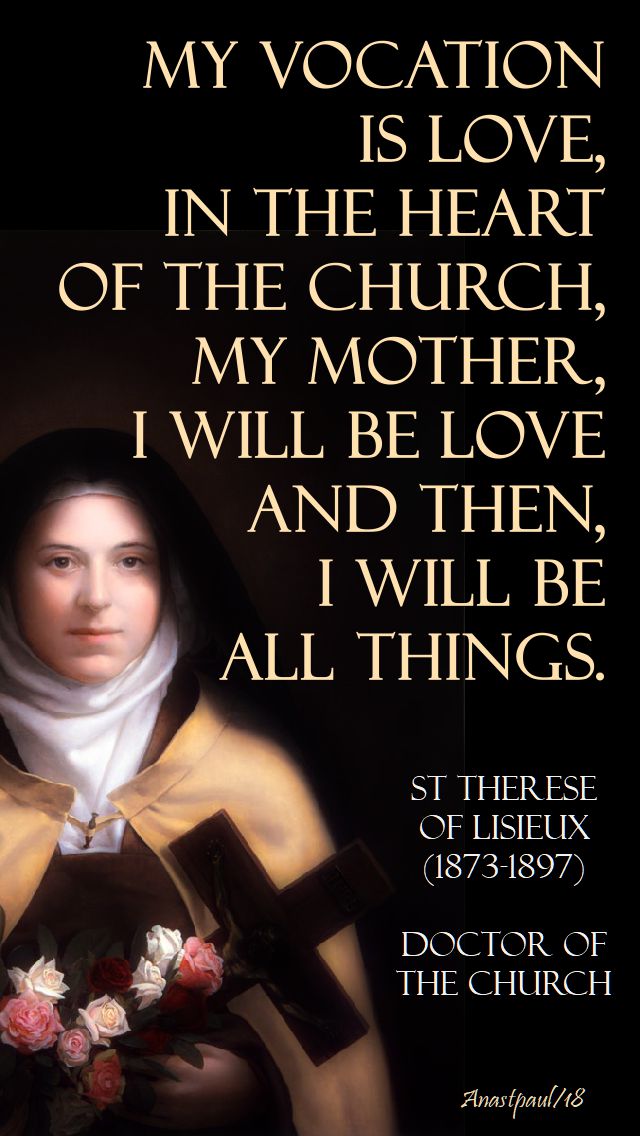
Quote of the Day – 1 October – The Memorial of Blessed Juan de Palafox Mendoza (1600–1659)
“He who finds himself benefiting without books
finds himself in solitude without comfort,
on a mountaintop without company,
on a path without a walking stick,
in the darkness without a guide.”
For Quotes by St Thérèse of the Child Jesus:
https://anastpaul.com/2018/10/01/quote-s-of-the-day-1-october-the-memorial-of-st-therese-of-lisieux-o-c-d-1873-1897-doctor-of-the-church/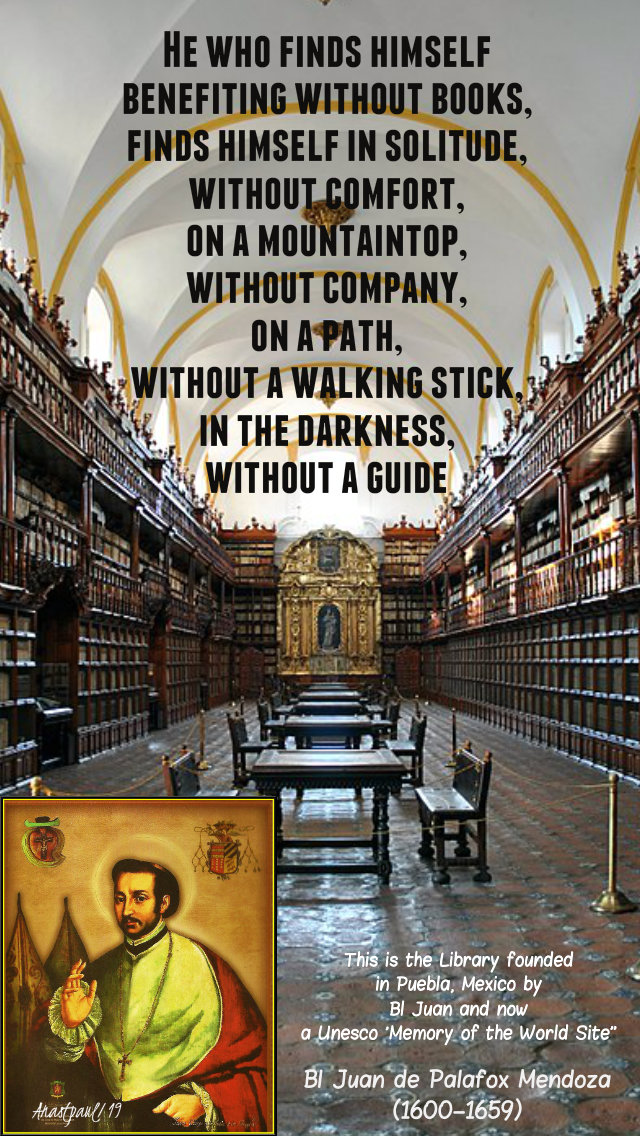
One Minute Reflection – 1 October – Tuesday of the Twenty Sixth week in Ordinary Time, Year C, Gospel: Luke 9:51–56 and The Memorial of St Thérèse of the Child Jesus OCD (1873 – 1897) Doctor of the Church
“Lord, do you want us to bid fire come down from heaven and consume them?” But he turned and rebuked them. … Luke 9:54-55
REFLECTION – “When someone has been made worthy to taste God’s love, he usually forgets everything else by reason of its sweetness. For once that person has tasted that love, anything visible seems of no interest. The soul joyfully draws near to the beautiful love of all people without distinction. It is never troubled by their weaknesses, which do not frighten it. Just like the blessed apostles who, in the midst of all the evils which they had to bear from their torturers were completely incapable of hating them and did not tire of loving them, this was shown by the fact that, in the end, they even bore death so as to meet them again one day in heaven.
And yet these were the very same people who, a little earlier, had begged Christ to make fire come down from heaven on the Samaritans, who had only refused to welcome them in their village. But once they had received the gift of tasting God’s love, they were made perfect even to the point of loving the wicked.” … St Isaac the Syrian (c 613-c 700) – Spiritual Discourses, 2nd Series, no. 10,36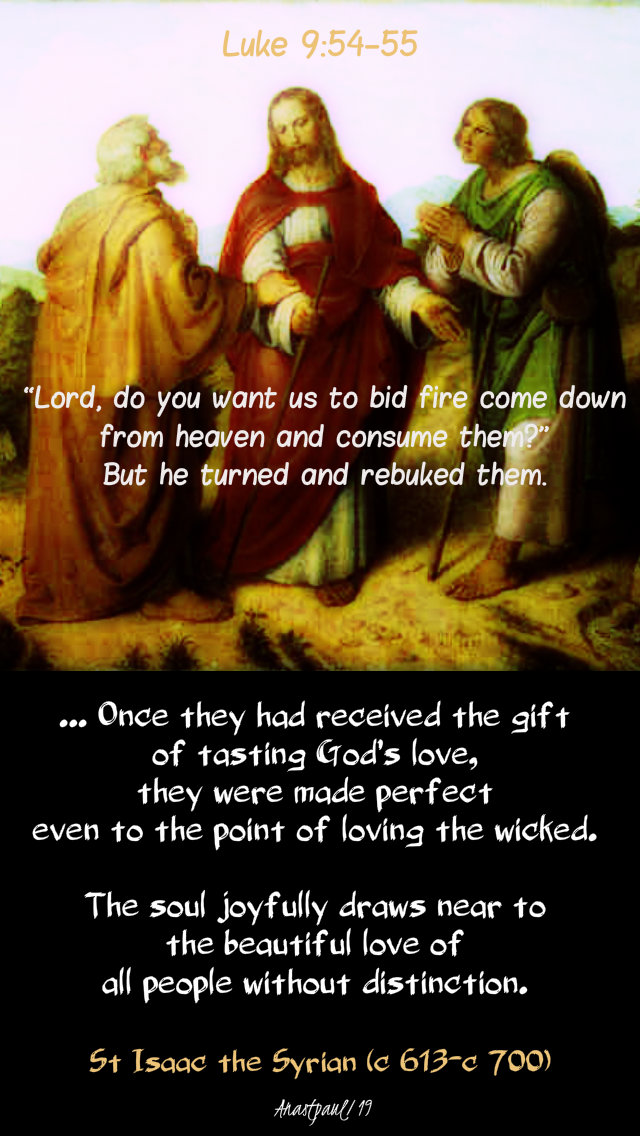
PRAYER – God, our Father, Your promised Your Kingdom to the little ones and the humble of heart. May we love You and our neighbour, even those who hate us. Give us grace to walk confidently in the way of St Thérèse, so that helped by her prayers, we may see Your eternal glory. Through Christ our Lord, in the unity of the Holy Spirit, one God forever, amen
Our Morning Offering – 1 October – The Memorial of St Thérèse of the Child Jesus OCD (1873 – 1897)
O Jesus, dear Holy Child
By St Thérèse of the Child Jesus
O Jesus,
dear Holy Child,
my only treasure,
I abandon myself
to Thy every whim.
I seek no other joy
than that of calling forth
Thy sweet Smile.
Vouchsafe to me the graces
and the virtues of
Thy Holy Childhood,
so that on the day
of my birth into Heaven
the Angels and Saints
may recognise in Thy Spouse:
Thérèse of the Child Jesus.
Amen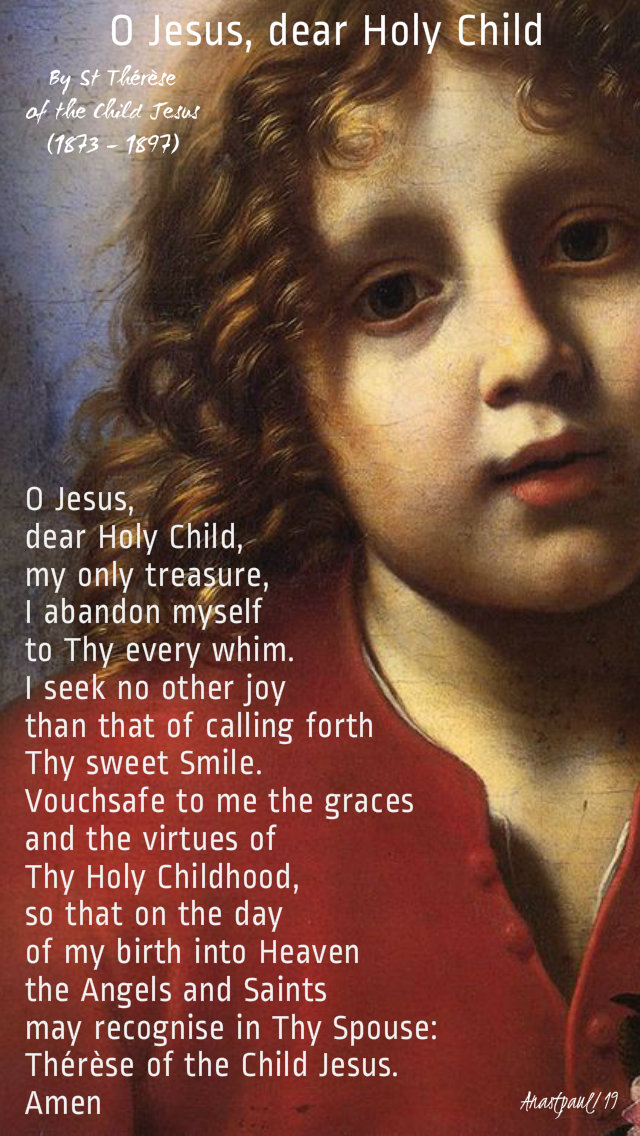
Saint of the Day – 1 October – Blessed Juan de Palafox Mendoza (1600–1659) Bishop, Spanish politician, Administrator, Prolific Writer, defender of the Mexican peoples – born Juan de Palafox y Mendoza on 24 June 1600 in Fitero, Navarra, Spain and died on 1 October 1659 in Osma, Soria, Spain of natural causes. Patronages – Dioceses of Puebla de los Ángeles and Osma-Soria. Palafox was the Bishop of Puebla (1640−1655) and the interim Archbishop of Mexico (1640−1642). He also held political office, from 10 June 1642 to 23 November 1642 as the Viceroy of New Spain. He lost a high-profile struggle with the Jesuits in New Spain, resulting in a recall to Spain, to the minor Diocese of Osma in Old Castile. Although a cause was opened for his Beatification shortly after he died in 1659, he was not Beatified until 2011.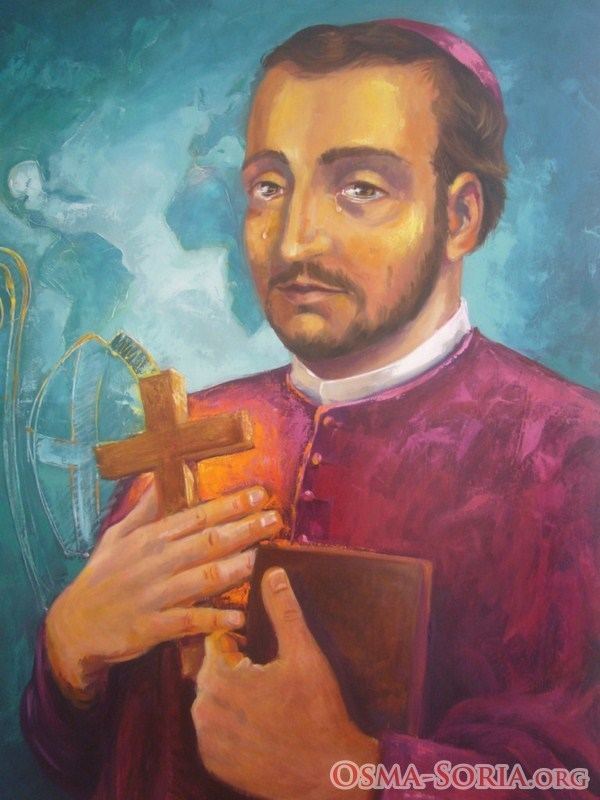
Blessed Juan was born in Navarre, Spain, Juan Palafox de Mendoza was the natural son (“a child of transgression”) of Jaime de Palafox, the Marquis of Ariaza, of the Aragonese nobility. His mother became a Carmelite nun. He was taken in by a family of millers who gave him the name “Juan” and raised him for ten years, after which his father recognised him and had him educated at Alcalá and Salamanca.
In 1626 he was a deputy of the nobility in the Cortes de Monzón and later a prosecutor at the Council of War and a member of the Council of the Indies, the chief administrative body for administration of the overseas territories of the Spanish Empire.
He was ordained in 1629 and became the chaplain of Maria of Austria, Holy Roman Empress, the sister of King Philip IV of Spain. He accompanied her on her various trips around Europe.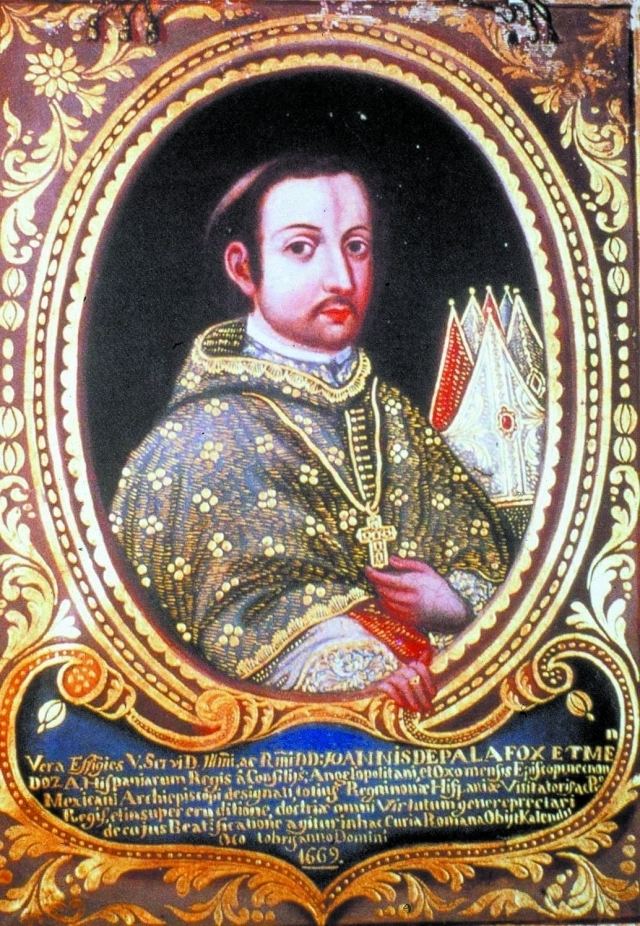
In 1639 Philip IV nominated him and Pope Urban VIII appointed him, as Bishop of Puebla de los Ángeles in viceroyal Mexico. Puebla de los Ángeles was the second largest city in the Viceroyalty of New Spain (vice-royal México) then and is the present day City of Puebla. He was consecrated at Madrid on 27 December 1639.
As bishop, Palafox arrived in Veracruz on 24 June 1640. He was in the company of the new Viceroy of New Spain, Diego López Pacheco, 7th Duke of Escalona, whom he had gotten to know during the voyage. Palafox was also named Visitador (royal inspector, representative of the king), to investigate the two previous viceroys. He served as Bishop of Puebla from 1640 to 1655 and as interim Archbishop of Mexico from 1642 to 1643.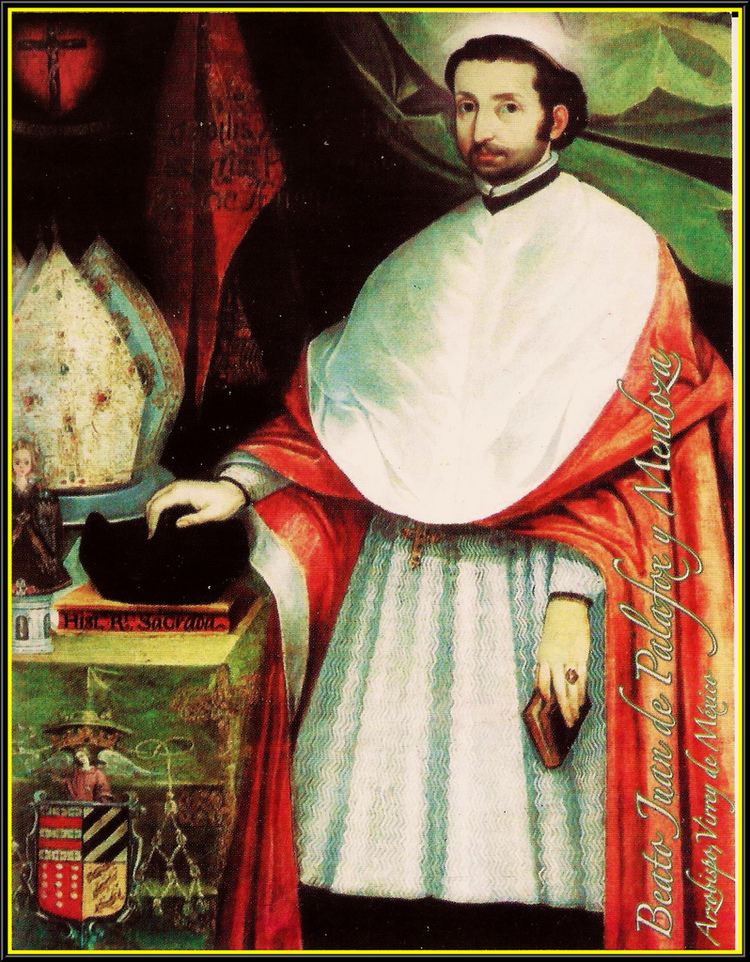
Palafox is known for being a prolific writer, a political thinker, a defender of the Mexico’s indigenous people during Colonial times, and a fair yet deeply religious man. “Historians highlight Palafox’s intelligence, integrity, activity, intellectual preparation and will, defining him as ‘one of the most brilliant men of his generation,’” says Jorge Fernández Díaz, third vice president of the Congress of Deputies, the lower house of Spain’s legislature. His writings were published in 15 volumes in Madrid in 1762.
“[Palafox is] probably the most interesting and maybe the most important figure in the whole history of 17th century Mexico.”
In Puebla, Palafox made his mark in both church and state affairs. He established the Dominican convent of St Agnes, the colleges of St Peter and St Paul and the girls school Immaculate Conception. He pushed for administrative reform within the diocese and for the completion of the city’s Cathedral, which was dedicated 1649. He also held several political offices, including that of the viceroy of New Spain in 1642.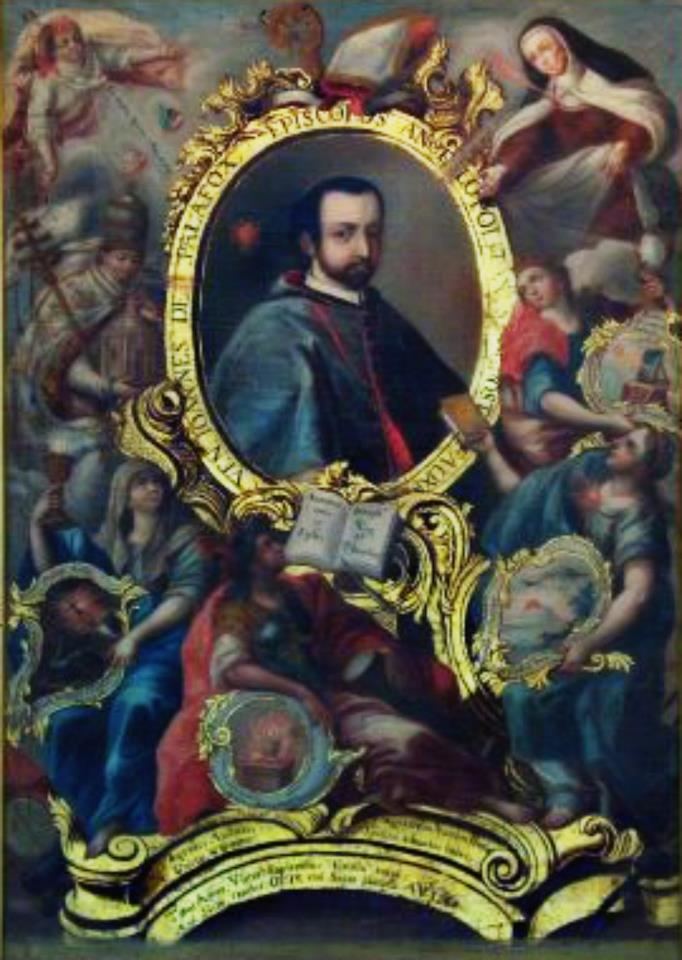
“He was a superior man for his century, a classic in our language [Spanish] whose numerous texts were written with an elegant and eloquent style and have resulted in twelve thick volumes,” notes University of Salamanca researcher Águeda Rodríguez Cruz in a 2010 bulletin for the International Institute for Higher Education in Latin America and the Caribbean. 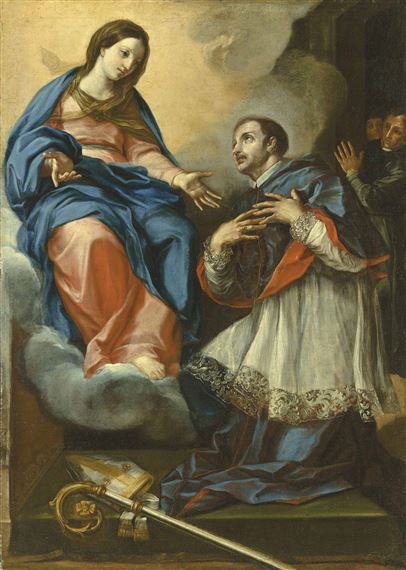 Quoting her colleague, professor Antonio Heredia, she adds: “[Palafox] was robust in his work, although of a sensitive condition, a spender but mean with it, legalistic, while with an ascetic of sensitive piety, an expert and executor in law and politics, while at a mystic at the same time, a man of war and noise, while pacific and fond of silence, active, while contemplative; indebted, while punctual with his duties … a man of great contrasts, like life itself.”
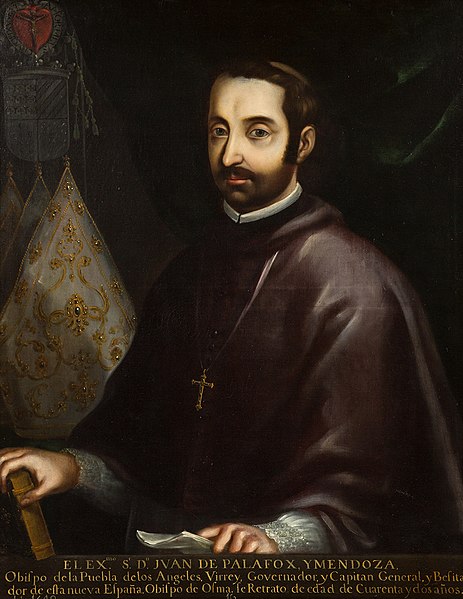
His greatest legacy is a secular one – the Palafox Library in Puebla. Founded in 1646, the Biblioteca Palafoxiana was the first public library established in the Americas. Located inside what was once the seminary of St. John’s College — now home to Puebla’s cultural centre — the library preserves 45,058 volumes dating from just before until just after the Colonial era. Many of its works are of global importance. These include original copies of Hartmann Schedel’s Nuremberg Chronicle (1493), which charts human history according to the Bible in words and more than 2,000 illustrations – Andreas Vesalius’s On the Fabric of the Human Body (1555), a seven-volume tome that revolutionised the study of anatomy with detailed diagrams based on actual observation and dissection and books printed in Mexico before 1600, including Alonso Molina’s Vocabulary in Castilian and Mexican, essentially the earliest New World dictionary.
The bookshelves consist of finely carved cedar, wild sunflower and white pine. The library is also noteworthy for its sheer beauty. The bookshelves, commissioned by Bishop Francisco Fabián y Fuero in 1773 (and expanded to include a third level in the 1800s), consist of finely carved cedar, wild sunflower and ayacahuite, a native white pine. A three-story gold altar at the far end of the room features an oil painting of Virgen of Trapani, which is believed to be modelled after the 14th-century sculpture attributed to Italian sculptor Nino Pisano.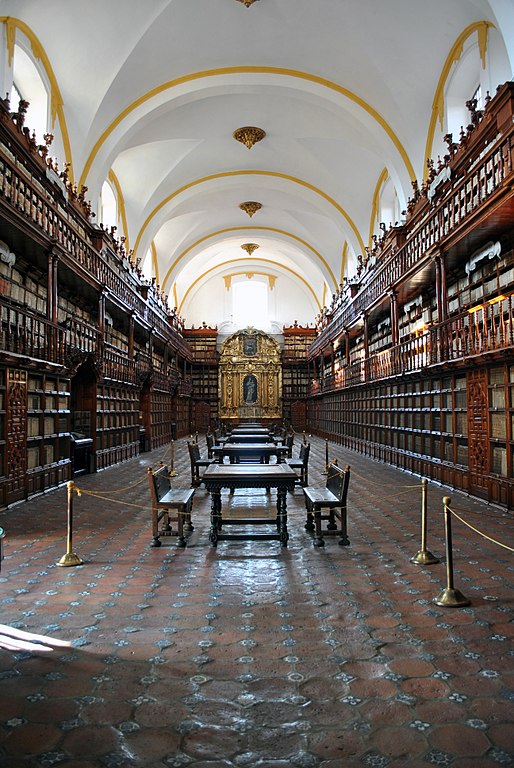
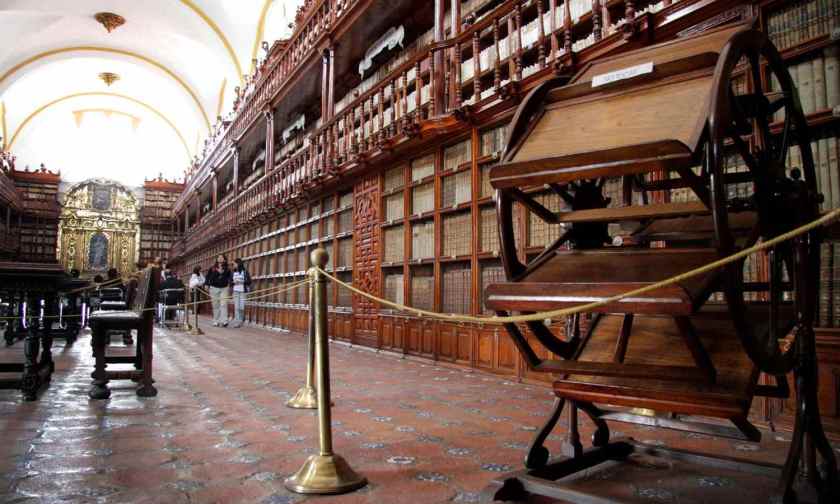
In 1981, the Mexican government declared the library a historic monument. In 2005, UNESCO added the Biblioteca Palafoxiana to the Memory of the World list, formally recognising its international significance. In 2010, after five years of work by 30 specialists, the first digital catalogue of the library’s complete contents was released, some 3,000 copies of the interactive disk were distributed to other libraries, universities, and research institutions. At the time, Elvia Carrillo Velázquez, a director for ADABI, the national book-preservation group that helped to create the archive, told El Universal newspaper that the interactive disc “provides access to culture and, above all, makes public knowledge part of the history of the printed word.”
This seems to be exactly what Palafox intended. A sign at the library’s entrance bears his words from 1646: “He who finds himself benefiting without books, finds himself in solitude without comfort, on a mountaintop without company, on a path without a walking stick, in the darkness without a guide. This gave me the desire to leave the library of books I’ve collected since I served his majesty the King, which is one of the best I’ve seen in Spain, ancillary to those of the church and in part and in public form, so that it may be used by all professions and people.”
Blessed Juan was Beatified by Pope Benedict XVI on 5 June 2011. His recognition celebrated at the Cathedral of La Asunción, El Burgo de Osma, Spain by Cardinal Angelo Amato.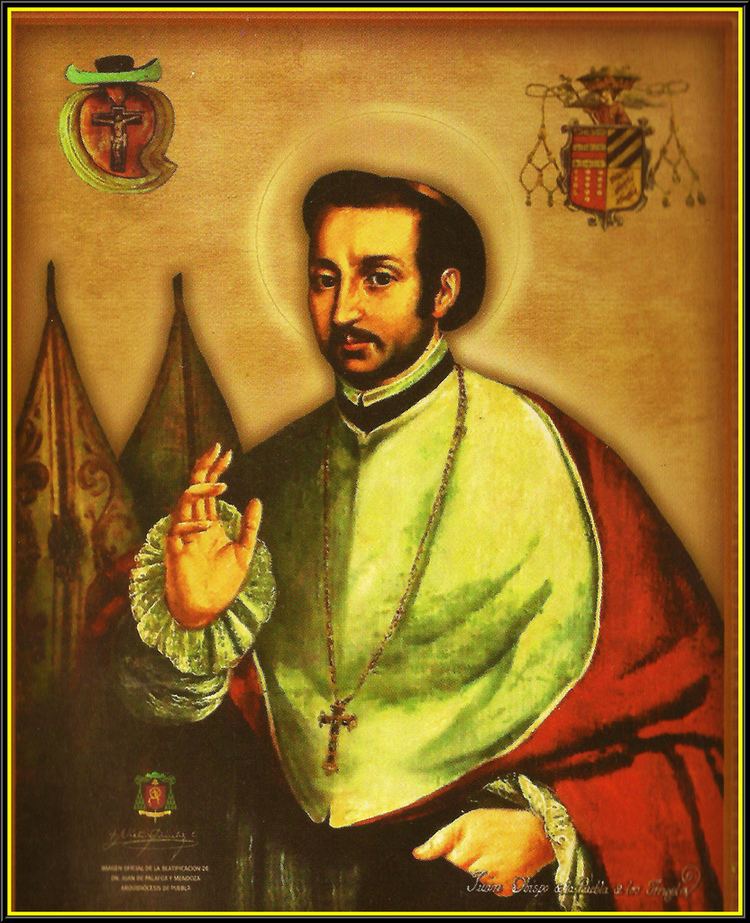
St Thérèse of Lisieux/St Thérèse of the Child Jesus and the Holy Face/The Little Flower O.C.D. (1873 – 1897) Doctor of the Church (Memorial)
Biography:
https://anastpaul.com/2018/10/01/saint-of-the-day-st-therese-of-lisieux-o-c-d-1873-1897-doctor-of-the-church/
St Aizan of Abyssinia
St Albaud of Toul
Bl Andrew Sushinda
Bl Antoni Rewera
St Aretas of Rome
St Bavo of Ghent
Bl Cecilia Eusepi
Bl Christopher Buxton
St Crescens of Tomi
St Dodo
Bl Dominic of Villanova
Bl Edward James
St Evagrius of Tomi
St Fidharleus
Bl Gaspar Fisogiro
St Gregory the Illuminator
St John Kukuzelis
Bl John Robinson
Bl Juan de Palafox Mendoza (1600–1659)
St Julia of Lisbon
Bl Luigi Maria Monti CFIC “Sons of the Immaculate Conception” (1825-1900)
About Blessed Luigi: https://anastpaul.wordpress.com/2017/10/01/saint-of-the-day-1-october-blessed-luigi-maria-monti-1825-1900/
St Maxima of Lisbon
Bl Nikita Budka
St Piaton of Tournai
St Priscus of Tomi
Bl Ralph Crockett
Bl Robert Widmerpool
Bl Robert Wilcox
St Romanos the Melodist
St Sazan of Abyssinia
St Verissimus of Lisbon
St Virila
St Wasnulf
—
Martyred in the Spanish Civil War:
• Blessed Carmelo Juan Pérez Rodríguez
• Blessed Higinio Mata Díez
• Blessed Juan Mata Díez
• Blessed Álvaro Sanjuán Canet
• Blessed Florencia Caerols Martínez
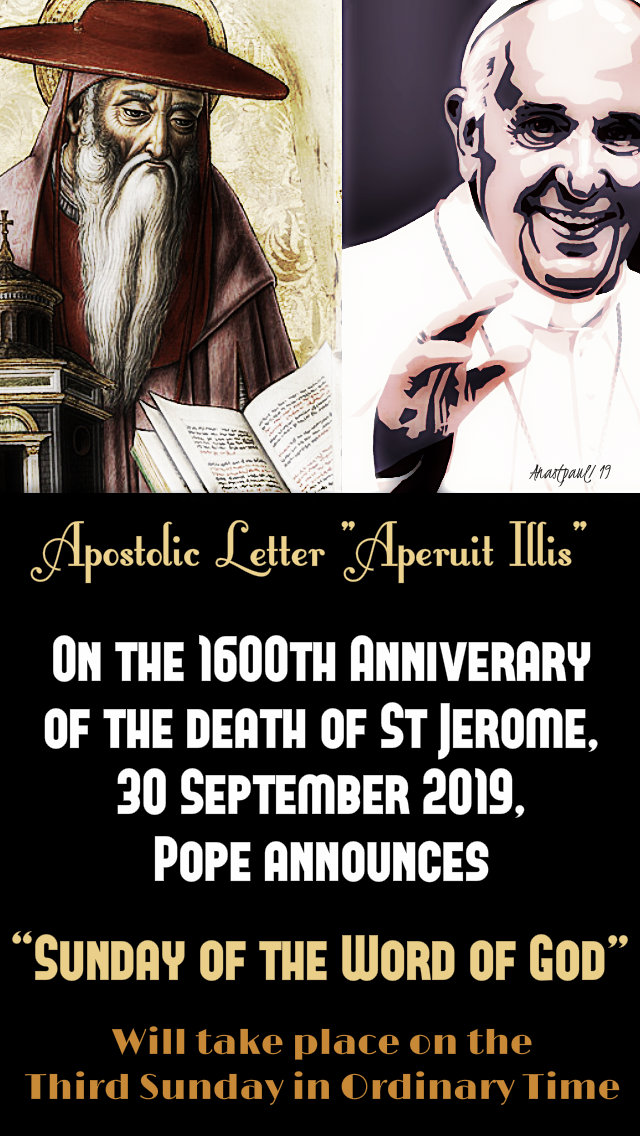
Today, 30 September 2019, the 1600th Anniversary of the death of St Jerome, Pope Francis announced and instated via his Apostolic Letter Aperuit Illis, the Third Sunday in Ordinary Time to be the “Sunday of the Word of God” in order to promote a closer relationship with holy Scripture and its dissemination in the world.
“A day devoted to the Bible should not be seen as a yearly event but, rather, a yearlong event, for we urgently need to grow in our knowledge and love of the Scriptures and of the Risen Lord,”
May the Sunday of the Word of God help his people to grow in religious and intimate familiarity with the sacred Scriptures. For as the sacred author taught of old: “This word is very near to you ,it is in your mouth and in your heart for your observance” (Dt 30:14).
Given in Rome, at the Basilica of Saint John Lateran, on 30 September 2019, the liturgical Memorial of Saint Jerome, on the inauguration of the 1600th anniversary of his death.
http://press.vatican.va/content/salastampa/en/bollettino/pubblico/2019/09/30/190930c.html
Novena to Our Lady of the Rosary – Day Three – 30 September
To Our most holy Mother.
To you do we pray first with heartfelt thanks
for those who have said YES to the Father.
Help them to trust in you and your son, Jesus,
in all the challenges that they face.
Teach them patience in all things
and to accept all that happens
and when it happens, in God’s time.
We join them in total consecration to you.
Reclaim us all as you own
and mould us in all ways necessary
to conform to God’s will.
We love you, Mother Mary,
Help us all!
My dearest Mother Mary, behold me, your child, in prayer at your feet.
Accept this Holy Rosary, which I offer you in accordance with your requests at Fatima, as a proof of my tender love for you, for the intentions of the Sacred Heart of Jesus, in atonement for the offences committed against your Immaculate Heart and for this special favour which I earnestly request in my Rosary Novena: ………………………….. (Mention your request).
I beg you to present my petition to your Divine Son.
If you will pray for me, I cannot be refused.
I know, dearest Mother, that you want me
to seek God’s holy Will concerning my request.
If what I ask for should not be granted,
pray that I may receive that which will be of greater benefit to my soul.
I offer you this spiritual Bouquet of Roses because I love you.
I put all my confidence in you,
since your prayers before God are most powerful.
For the greater glory of God and for the sake of Jesus,
your loving Son, hear and grant my prayer.
Sweet Heart of Mary, be my salvation.
Our Lady of the Rosary,
pray for our Holy Mother Church
and for our country.
Our Lady of Fatima,
obtain for humanity a lasting peace.
Sweet Heart of Jesus,
be my love.
Sweet Heart of Mary,
at the hour of my death,
lead me home.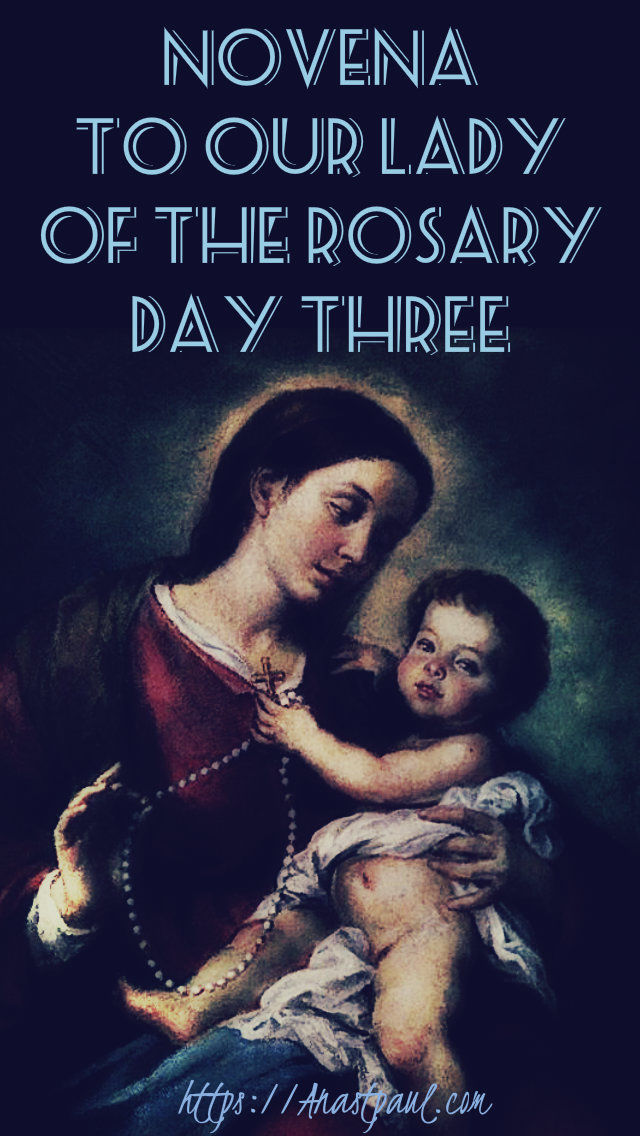
Thought for the Day – 30 September – The Memorial of Saint Jerome, Priest, Father and Doctor of the Church (347-419)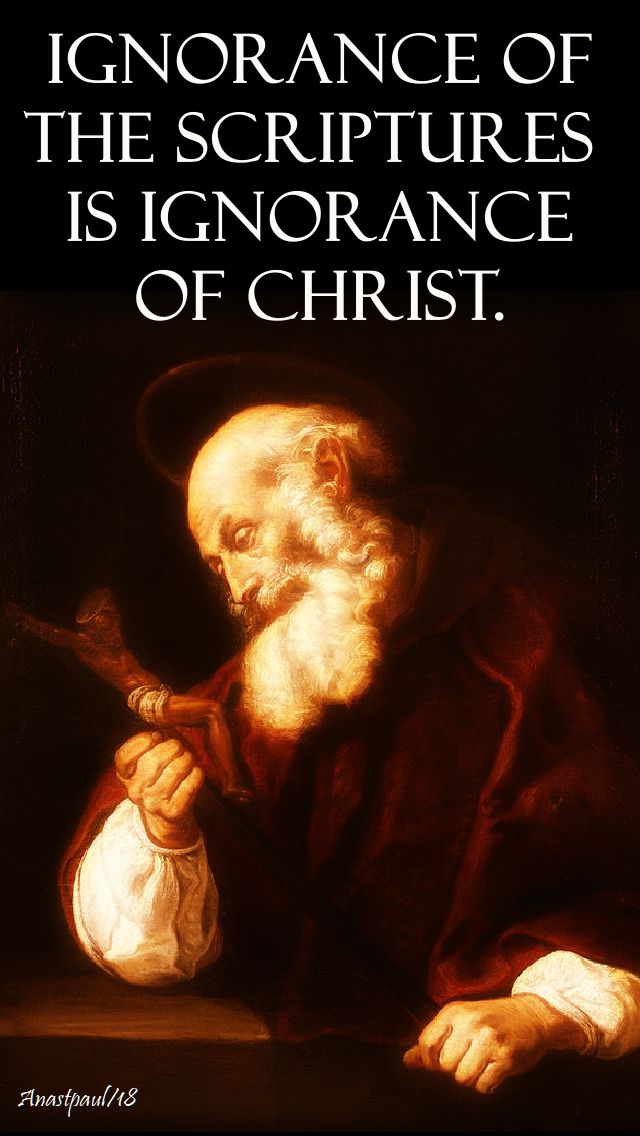
An excerpt from his Commentary on Isaiah
“I interpret as I should, following the command of Christ – search the Scriptures and seek and you shall find. Christ will not say to me what He said to the Jews: You erred, not knowing the Scriptures and not knowing the power of God. For if, as Paul says, Christ is the power of God and the wisdom of God and if the man who does not know Scripture does not know the power and wisdom of God, then ignorance of Scripture is ignorance of Christ.
Therefore, I will imitate the head of a household who brings out of his storehouse things both new and old and says to his spouse in the Song of Songs: I have kept for you things new and old, my beloved. In this way permit me to explain Isaiah, showing that he was not only a prophet but an evangelist and an apostle as well. For he says about himself and the other evangelists – How beautiful are the feet of those who preach good news, of those who announce peace. And God speaks to him as if he were an apostle – Whom shall I send, who will go to my people? And he answers: Here I am; send me.
No-one should think, that I mean to explain, the entire subject matter of this great book of Scripture, in one brief sermon, since it contains all the mysteries of the Lord. It prophesies that Emmanuel is to be born of a virgin and accomplish marvellous works and signs. It predicts His death, burial and resurrection from the dead as the Saviour of all men. I need say nothing about the natural sciences, ethics and logic. Whatever is proper to holy Scripture, whatever can be expressed in human language and understood by the human mind, is contained in the book of Isaiah. Of these mysteries the author himself testifies when he writes – You will be given a vision of all things, like words in a sealed scroll. When they give the writings to a wise man, they will say – Read this. And he will reply: I cannot, for it is sealed. And when the scroll is given to an uneducated man and he is told: Read this, he will reply: I do not know how to read.
Should this argument appear weak to anyone, let him listen to the Apostle – Let two or three prophets speak and let others interpret, if, however, a revelation should come to one of those who are seated there, let the first one be quiet. How can they be silent, since it depends on the Spirit who speaks through His prophets whether they remain silent or speak? If they understood what they were saying, all things would be full of wisdom and knowledge. But it was not the air vibrating with the human voice that reached their ears but rather, it was God speaking within the soul of the prophets, just as another prophet says: It is an angel who spoke in me and again, Crying out in our hearts, Abba, Father and I shall listen to what the Lord God says within me.”
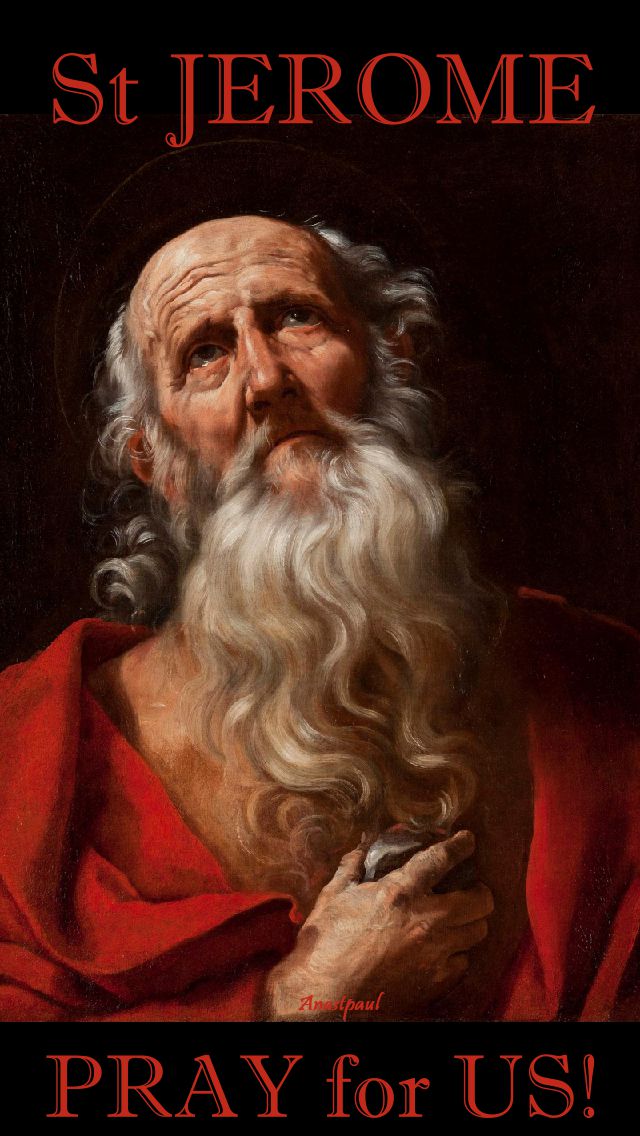
Quotes of the Day – 30 September – The Memorial of Saint Jerome (347-419), Priest, Father and Doctor of the Church
“The Scriptures are shallow enough,
for a babe to come and drink,
without fear of drowning
and deep enough,
for theologians to swim in,
without ever reaching the bottom.”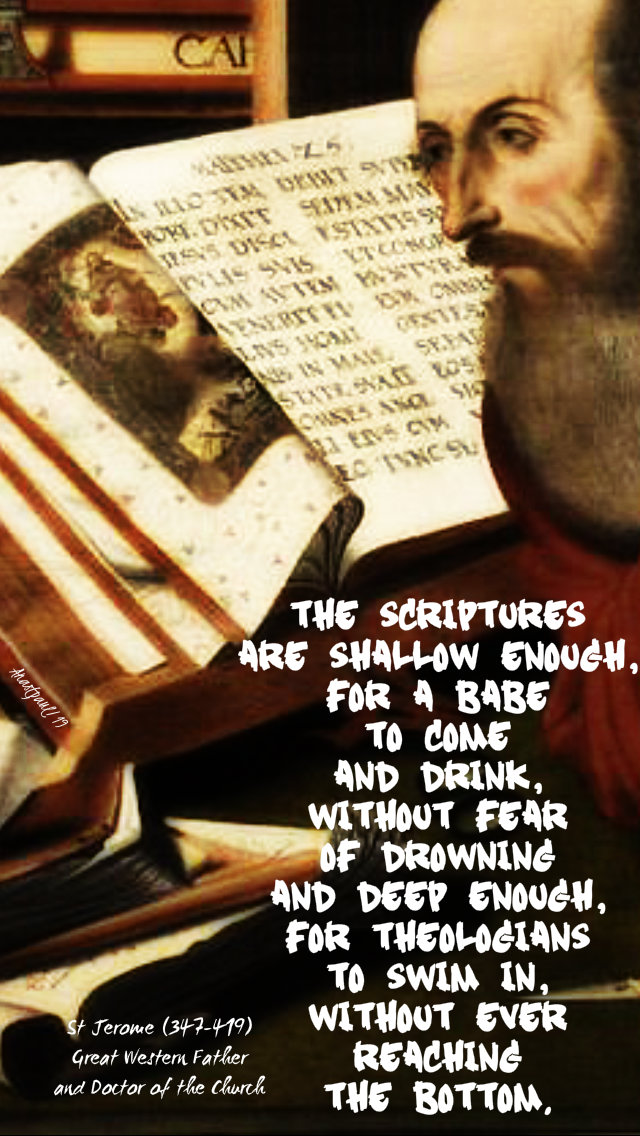
“Make knowledge of the Scripture your love …
Live with them,
meditate on them,
make them the sole object
of your knowledge
and inquiries.”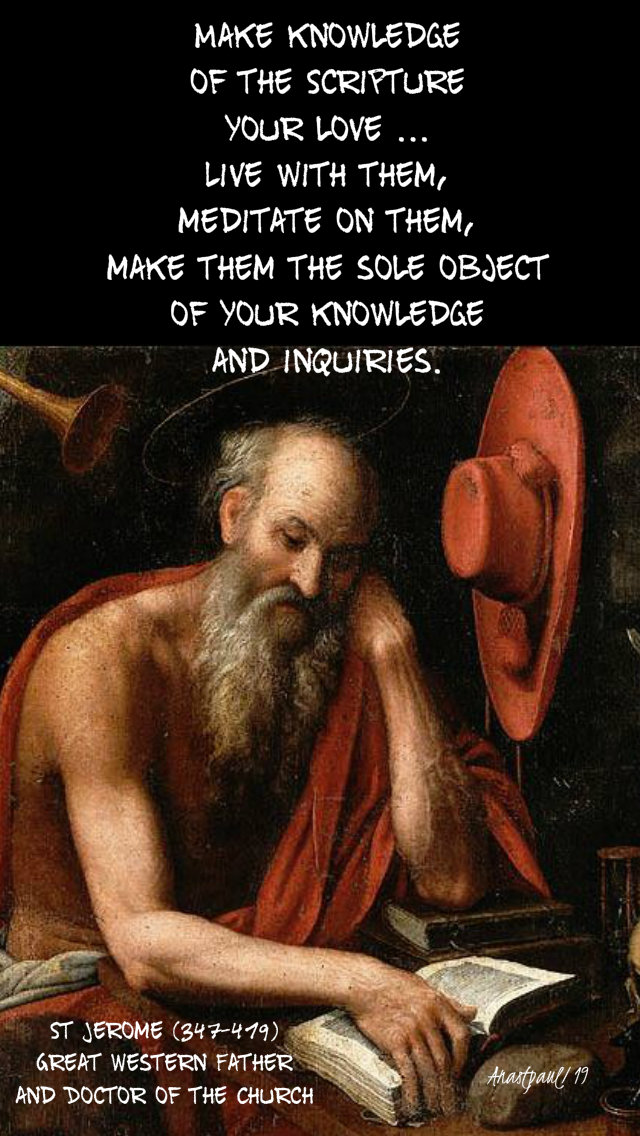
“A false interpretation of Scripture,
causes, that the Gospel of the Lord,
becomes the gospel of man,
or, which is worse,
of the devil!”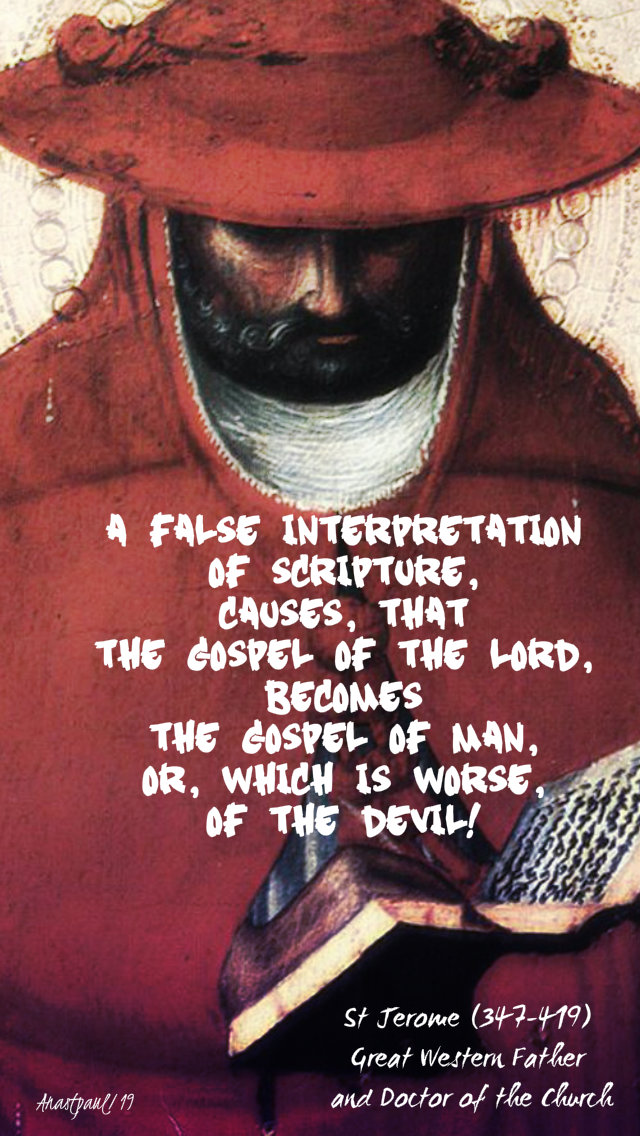
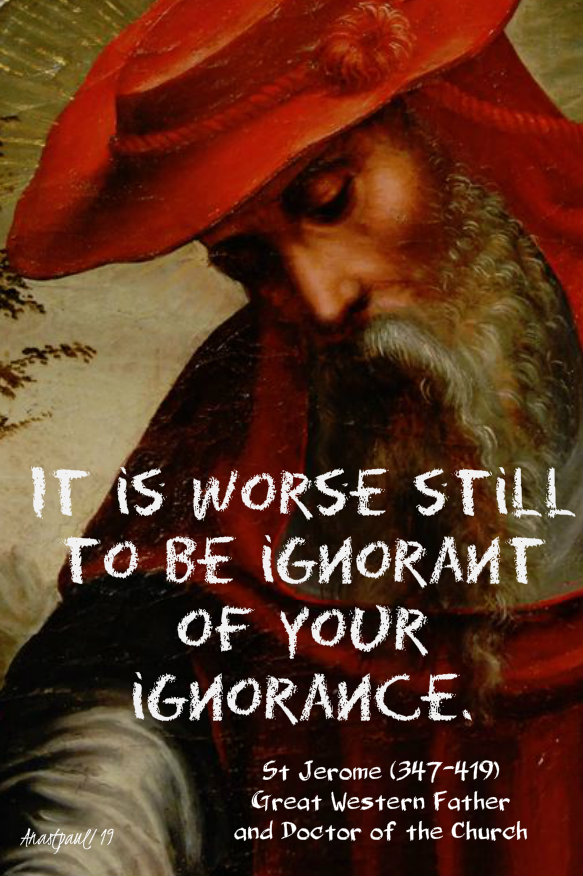
“It is worse still
to be ignorant
of your ignorance.”
Many more here:
Quote/s of the Day – 30 September – Memorial of St Jerome (347-419) Father and Doctor
One Minute Reflection – 30 September – Monday of the Twenty Sixth week in Ordinary Time, Year C, Gospel: Luke 9:46–50 and The Memorial of St Gregory the Illuminator (c 257 – c 331)
“Whoever receives this child in my name receives me and whoever receives me, receives him who sent me, for he who is least among you all, is the one who is great.” … Luke 9:48
REFLECTION – “The passion and lust of pride attacked some of the holy apostles. The mere argument about who of them was the greatest is the mark of an ambitious person, eager to stand at the head of the rest. Christ, who did not sleep, knows how to deliver. He saw this thought in the disciple’s mind, springing up, in the words of Scripture, like some bitter plant. He saw the weeds, the work of the wicked sower. Before it grew up tall, struck its root down deep, grew strong and took possession of the heart, He tears up the evil by the very root. In what way does the Physician of souls amputate pride’s passion? How does He deliver the beloved disciple from being the prey of the enemy and from a thing hateful to God and man? “He took a child,” it says, “and set it by him.” He made the event a means of benefiting both the holy apostles themselves and us their successors. This illness, as a rule, preys upon all those who are in any respect superior to other people.
What kind of type and representation did He make the child He had taken? He made the child a representation of an innocent and humble life. The mind of a child is empty of fraud and his heart is sincere. His thoughts are simple. He does not covet rank and does not know what is meant by one man being higher than another is. Christ brought forward the child as a pattern of simplicity and innocence and set him by Him. He showed him as in an object lesson, that He accepts and loves those who are like the child. He thinks they are worthy of standing at His side, as being like-minded with Him and anxious to walk in His steps.” … St Cyril of Alexandria (376-444) Father and Doctor of the Church – Commentary on Luke, Homily 54
PRAYER – Dear and Holy God, let us offer You all our daily struggles against sin and evil. Grant us the strength to resist all forms of idolatry, to seek only You and never to allow the honour of this world to seduce us. Sustain us ever more with Your word and help us to find in it, the source of life. May the Prayers of St Gregory the Illuminator, help us on the path of holiness. We ask this through Jesus our Lord, with the Holy Spirit, one God forever, amen.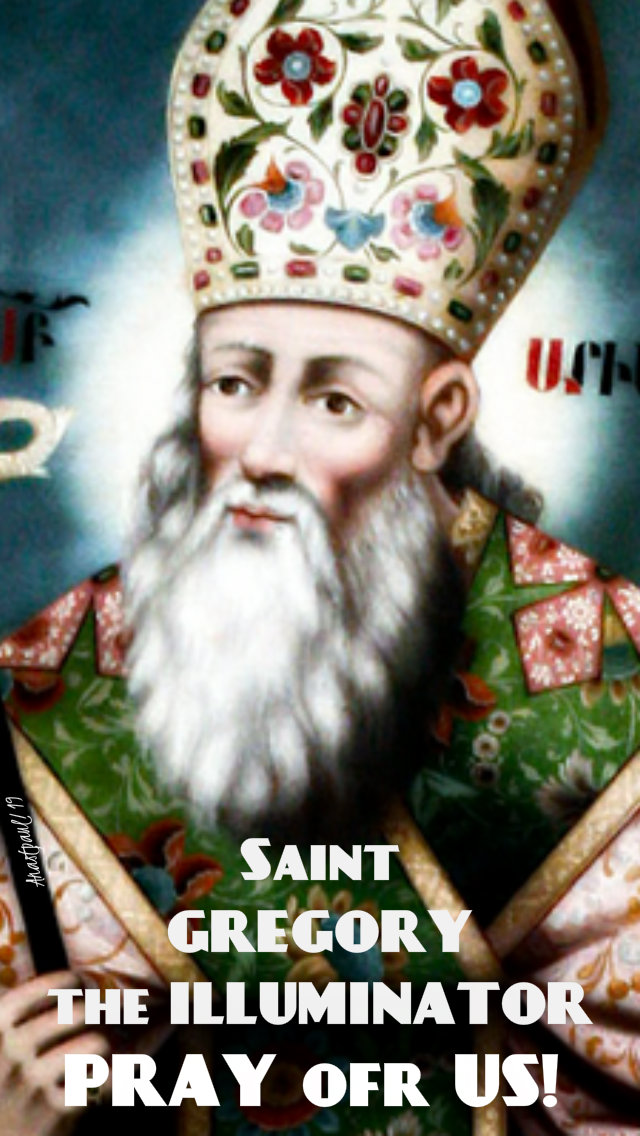
Our Morning Offering – 30 September – Monday of the Twenty Sixth week in Ordinary Time, Year C and The Memorial of St Jerome (347-419) Father and Doctor of the Church
O Lord, show Your mercy to me
By St Jerome (347-419)
O Lord, show Your mercy to me
and gladden my heart.
I am like the man on the way to Jericho
who was overtaken by robbers,
wounded and left for dead.
O Good Samaritan,
come to my aid.
I am like the sheep that went astray.
O Good Shepherd,
seek me out and bring me home
in accord with Your will.
Let me dwell in Your house
all the days of my life
and praise You for ever and ever
with those who are there.
Amen
Saint of the Day – 30 September – Saint Gregory the Illuminator (c 257 – c 331) – “Apostle to Armenia” and “Father of Armenia”- Bishop, First Patriarch of the Armenian Church, Missionary, Wonder-worker – born Grigor Lusavorich in c 257 and died in c 331 of natural causes. Also known as Gregory the Enlightener. Patronage – Armenia.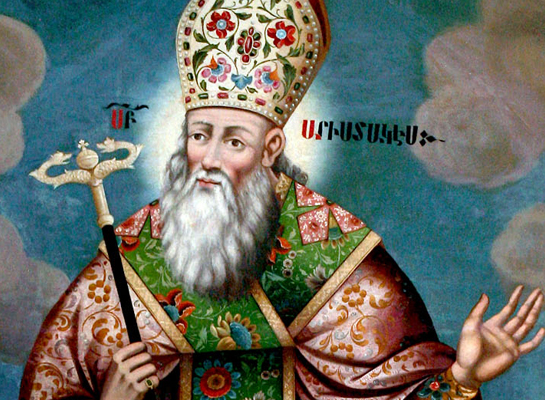
The life of Saint Gregory was first recounted in a biography dating to c 460 and the more or less contemporary History of the Armenians by Agathangelos. The saint’s was born in and around Parthia between 239 to 257. He was the son of Anak Partev the Parthian, who, being in the pay of the rival Sasanian Empire in Persia (224-651), infamously murdered the Armenian king Khosrov of Kadj. The Lusavorich family was both wealthy and influential but they were all wiped out by the revenging relatives of Khosrov. Fortunately for Gregory, he, the sole survivor of the purge, was whisked away by his nanny to the safety of Cappadoccia.
Gregory was raised as a Christian and attended a Greek Christian school. On returning to Armenia, Gregory gained a position as a palace functionary at the court of the Armenian king. There he protested the pagan religion of the period and refused to participate in its rites. The reigning monarch was Tiridates IV (Trdat III or IV), or Tiridates the Great as he would become known and he had the troublesome Gregory imprisoned, tortured and thrown into the terrible Khor Virap prison at Artashat. Known as the “pit of oblivion,” nobody ever returned from Khor Virap.
When out hunting, Tiridates often behaved like a beast, hence the legend that he was transformed into a boar. A King, who was loved by his people and especially his sister, Khosrovidought, tried in vain to return him to his senses. Khosrovidought had a dream, seeing Gregory coming out of the dungeon and healing her brother! This was especially ironic, as the illness had only manifested itself following the king’s orders to murder a group of Christian nuns who had fled persecution in Rome. Khosrovidought told the people at the Court of her dream and revealed that Gregory was living and was the only man in the world who could cure the King. As Tiridat’s condition worsened his courtiers went to the pit and to their great surprise heard a feeble “yes” to the question: “Gregory, are you still alive?” For St Gregory had been in the pit for 13 years! They lowered the rope and out came a man with a long beard and soiled clothes. But his darkened face was wrapped in an aura of light. After dressing him properly,they took him to the presence of Tiridat. Moved by a powerful force which he could not control, Tiridat knelt down before his prisoner. Gregory, putting his hands on the King’s head, prayed for him. There,upon Tiridat was cured and became a new man. He said to Gregory: “Your God is my Go, your religion is my religion.” Gregory lifted him up and embraced him. From that moment, until their death, they remained faithful friends and worked together, each in his own way for the establishment of the Kingdom of God in Armenia, beginning in the year 301.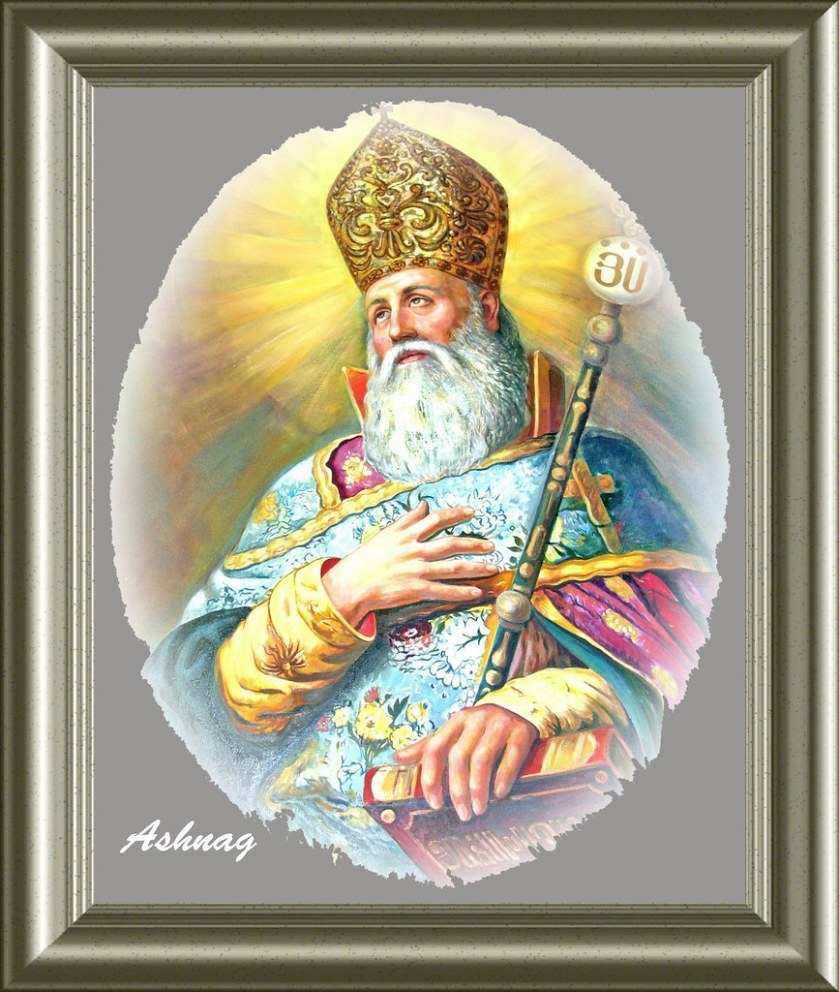
Gregory first converted the people in the capital city and in its neighbourhood. There were no bishops or clergymen left in the country, because of the severe persecutions by Tiridat. Thus, Gregory could not find people in holy orders to baptise the neophytes. Gregory himself was still a layman. Therefore, the Royal Council decided to send Gregory back to Cæsarea to be ordained as a Priest and then Bishop of Armenia.
Armenia did became a Christian state and it was a momentous moment in the country’s history as the historian RG Hovannisian here explains:
“The conversion of Armenia to Christianity was probably the most crucial step in its history. It turned Armenia sharply away from its Iranian past and stamped it for centuries with an intrinsic character, as clear to the native population, as to those outside its borders, who identified Armenia almost at once as the first state to adopt Christianity.”
Armenia thus became the first nation to adopt Christianity as its official religion.
As soon as Gregory returned to Armenis as the first Bishop (Katholikos) he set about formally establishing the Christian Church. Tiridates gave Saint Gregory up to 15 provinces of territory to establish the Armenian Church. The old pagan temples were torn down and the sites were converted to Christian ones and the whole nation was obliged to embrace the new faith. Churches and monasteries sprang up everywhere, including at the Khor Virap, Gregory’s home for so long, which was eventually converted into a monastery. The Armenian aristocracy quickly followed the royal family’s example and many noble families converted to Christianity.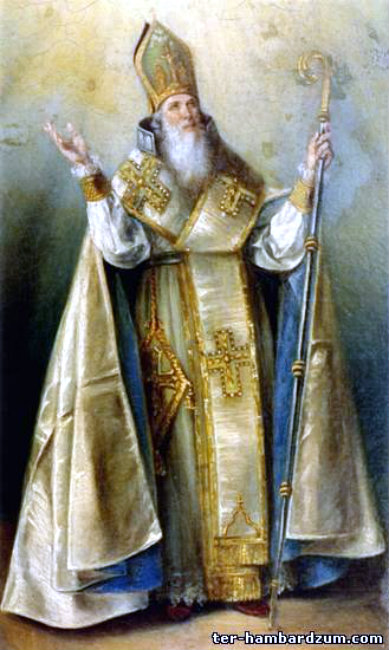
Later in life, Gregory retired to the seclusion of the cave of Mane in northwestern Armenia where he lived as an ascetic. Gregory died there of old age around 331. The former bishop’s remains were buried at Tordan on the Euphrates River in the western province of Daranaghik, although later his bones would become prized relics in various churches across the country.
St Gregory governed the Armenian Church for about 25 years. He diligently worked for the internal organisation of the Church. His descendants carried on his work, notably his younger son Aristakes, who, known for his asceticism, was the next bishop and who attended the First Ecumenical Council of Nicaea in 325 as St Gregory was too old.
Many Churches were built in his honour but perhaps the most celebrated was the cathedral at Ani built by the great architect Trdat for King Gagik (1001-1010).
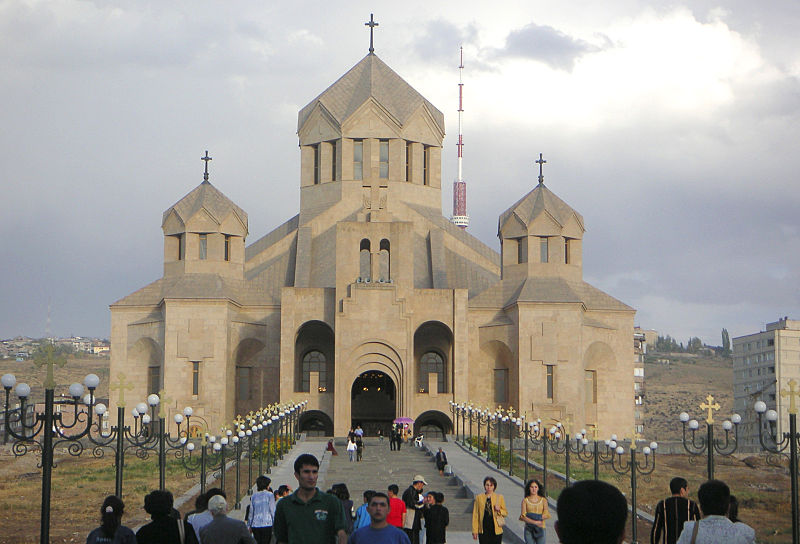
He is commemorated as a Canonised Saint by all the ancient churches of the East and of the West, including the Greek Orthodox and the Roman Catholic Churches. The Armenian Church has set aside three holy days in honour of St Gregory, commemorating three of the main events of his life – firstly, his sufferings and entrance into the dungeon, secondly, His release from the dungeon and the conversion of Armenia to Christianity, thirdly, the discovery of his relics.

On St Pope John Paul II’s historic trip in 2001 to Armenia to mark the 1700th of the conversion of the Armenian nation to Christianity, he became inspired by a visit to Khor-Virab where Saint Gregory was confined. As a result, a statue of Saint Gregory the Illuminator now stands (unveiled on 19 January 2005) in the Vatican’s last remaining niche along the walls of Saints leading to St Peter’s Basilica in Rome. Almost 2,5 metres tall, it is situate at the site where visitors wait to climb the cupola. Thousands of visitors now wait under the gentle gaze of St Gregory the Illuminator of Armenia. See the Statue below.

On 26 June 2016, Pope Francis visited Armenia and made a special pilgrimage to the Church and Monastery, where St Gregory’s pit was located. It is here, in one of the Armenian Church’s most sacred places, that Francis concluded his trip. After being welcomed by the Monastery’s superior, the he and the Pope made their way down the small stairs to the room where St Gregory had been held in captivity for 13 years. There, they lit a candle in veneration. They then entered the adjacent chapel in procession and prayed in Armenian and in Italian. Finally, the Pope and Abbot Karekin went out onto the terrace overlooking Ararat and released two doves, in the direction of the Biblical mountain, which is now beyond the border in Turkey.
St Jerome (Memorial) (347-419) Father and Doctor
St Jerome, here:
https://anastpaul.com/2018/09/30/saint-of-the-day-30-september-st-jerome-347-419-father-and-doctor-of-the-church-2/
AND:
https://anastpaul.wordpress.com/2017/09/30/saint-of-the-day-30-september-st-jerome-347-419-father-and-doctor-of-the-church/
St Amatus of Nusco
St Antoninus of Piacenza
St Castus of Piacenza
St Colman of Clontibret
Bl Conrad of Urach
St Desiderius of Piacenza
St Enghenedl of Anglesey
St Eusebia of Marseilles
Saint Francis Borgia SJ (1510-1572) – Biography:
https://anastpaul.com/2017/10/10/saint-of-the-day-10-october-st-francis-borgia-s-j-1510-1572/
(This post made on 10 October 2017, is on the incorrect date. His feast day was moved to today in 1969. Today, 30 September is the day of his death.)
Bl Frederick Albert
Saint Gregory the Illuminator (c 257 – c 331)
St Honoratus of Canterbury
St Ismidone of Die
Bl Jean-Nicolas Cordier
St Laurus
St Leopardus the Slave
Bl Ludwik Gietyngier
St Midan of Anglesey
St Simon of Crépy
St Ursus the Theban
St Victor the Theban
—
Martyrs of Valsery Abbey: An unknown number of Premonstratensian monks at the Abbey of Notre-Dame de Valsery, Picardie, France who were martyred by Calvinists. They were martyred in 1567 at Valsery, Pircardy, France
Novena to Our Lady of the Rosary – Day Two – 29 September
The joy of the Spirit, which was in the heart of Jesus and Mary, is ours in the experience of sincere prayer.
1. We pray for the gift of the Holy Spirit for the leaders of the Church and all the baptised, that we may walk faithfully the way of Jesus Christ.
2. We pray for a deep devotion to Mary, the Mother of Jesus
and in our prayer to her know that we are primarily opening our hearts to the God of love.
3. We pray for those who are oppressed by war and poverty,that they
may take courage from God who loves us constantly and unconditionally.
Let us pray to the Lord.
My dearest Mother Mary, behold me, your child, in prayer at your feet.
Accept this Holy Rosary, which I offer you in accordance with your requests at Fatima, as a proof of my tender love for you, for the intentions of the Sacred Heart of Jesus, in atonement for the offenses committed against your Immaculate Heart and for this special favour which I earnestly request in my Rosary Novena: ………………………….. (Mention your request).
I beg you to present my petition to your Divine Son.
If you will pray for me, I cannot be refused.
I know, dearest Mother, that you want me
to seek God’s holy Will concerning my request.
If what I ask for should not be granted,
pray that I may receive that which will be of greater benefit to my soul.
I offer you this spiritual Bouquet of Roses because I love you.
I put all my confidence in you,
since your prayers before God are most powerful.
For the greater glory of God and for the sake of Jesus,
your loving Son, hear and grant my prayer.
Sweet Heart of Mary, be my salvation.
Our Lady of the Rosary,
pray for our Holy Mother Church
and for our country.
Our Lady of Fatima,
obtain for humanity a lasting peace.
Sweet Heart of Jesus,
be my love.
Sweet Heart of Mary,
at the hour of my death,
lead me home.
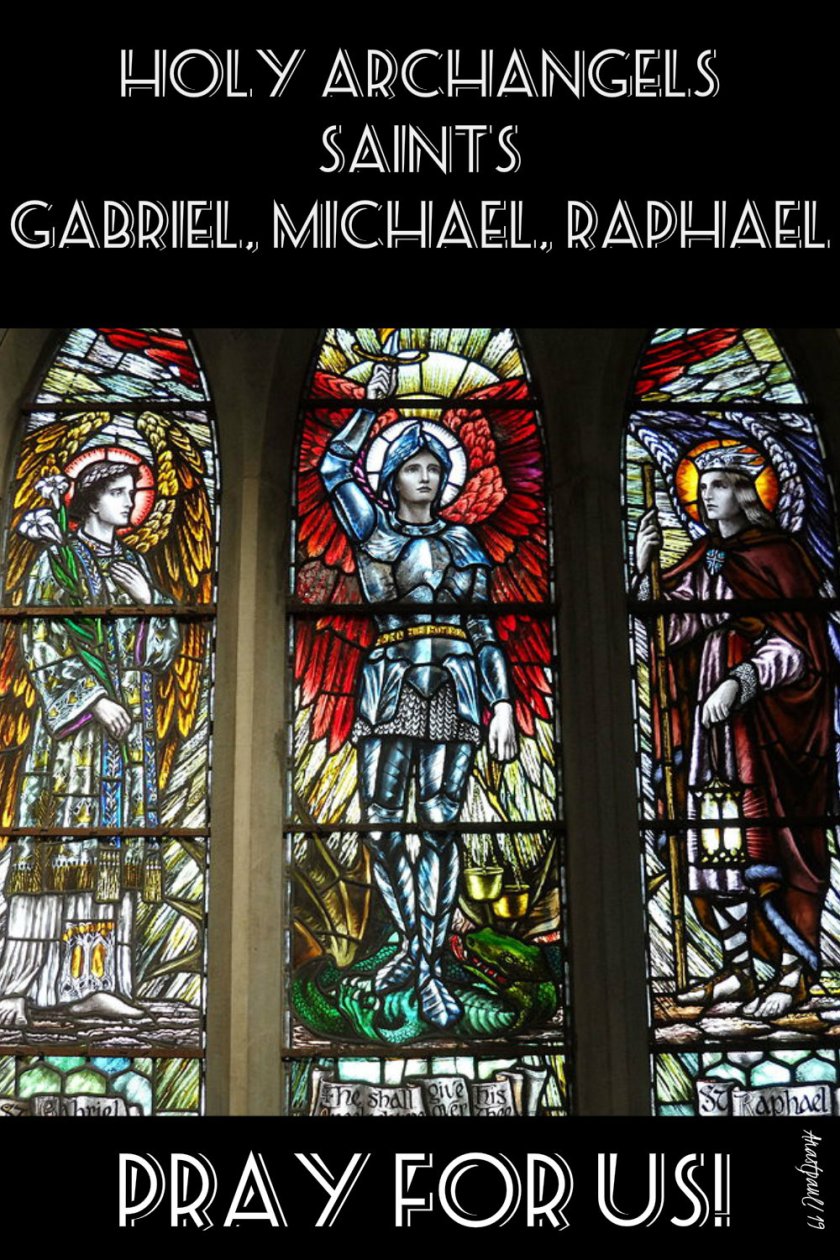
Thought for the Day – 29 September – Twenty Sixth Sunday in Ordinary Time, Year C, Gospel: Luke 16:19–31 and The Feast of Sts Michael, Gabriel and Raphael
And he called out, ‘Father Abraham, have mercy upon me and send Lazarus to dip the end of his finger in water and cool my tongue, for I am in anguish in this flame.’ … Luke 16:24
St John Chrysostom explains the point of the parable, to his congregation, by having Abraham speak the following words about Lazarus, to the rich man.
“When you were living in your wealth, when you were free to see at your own will, you did not choose to see him. Why do you have such keen sight now? Was he not at your gate? How could you avoid seeing him? When he was near you, did you not see him and now, do you see him from a distance, even across such a chasm? … The man whom you passed by a thousand times, whom you did not want to see – now do you seek to have him sent to you for your salvation? …
And where are your cup bearers? … Where are your flatterers? Where is your vanity? Where is your presumption? Where is your buried gold? Where are your moth-eaten garments? Where is the silver which you valued so highly? Where are your ostentation and your luxury? They were leaves – winter seized them and they are all withered up. They were a dream – and when day came, the dream departed. They were a shadow – the truth came and the shadow fled away …
When we hear, let us be afraid, my beloved, lest we also see the poor and pass them by, lest instead of Lazarus there be many to accuse us hereafter.”
Sermon 6 on Lazarus and the Rich Man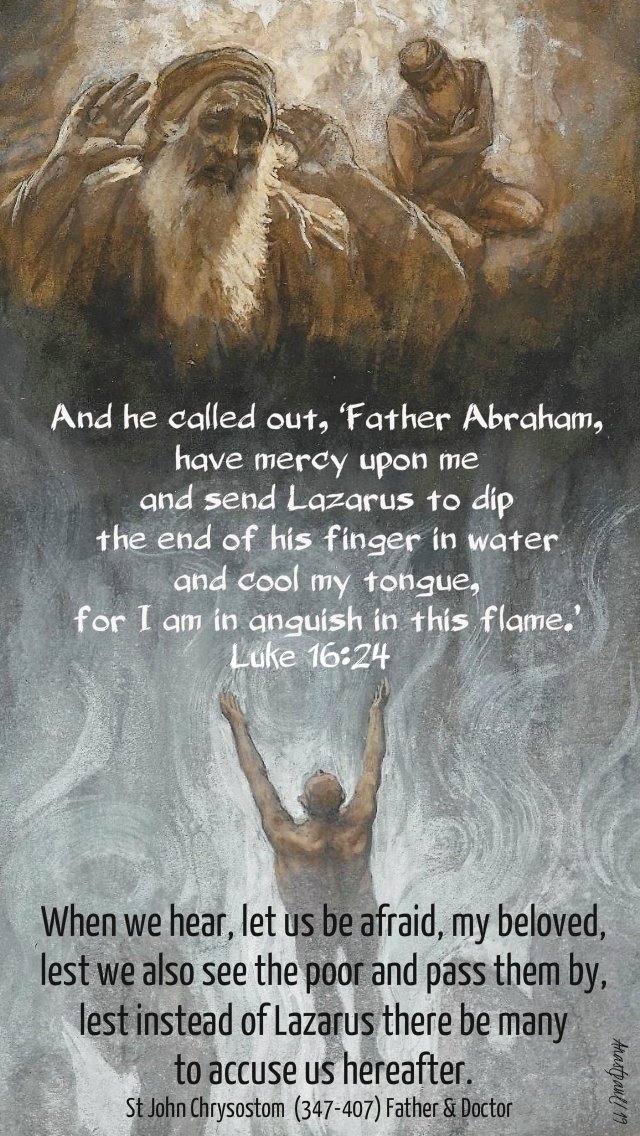
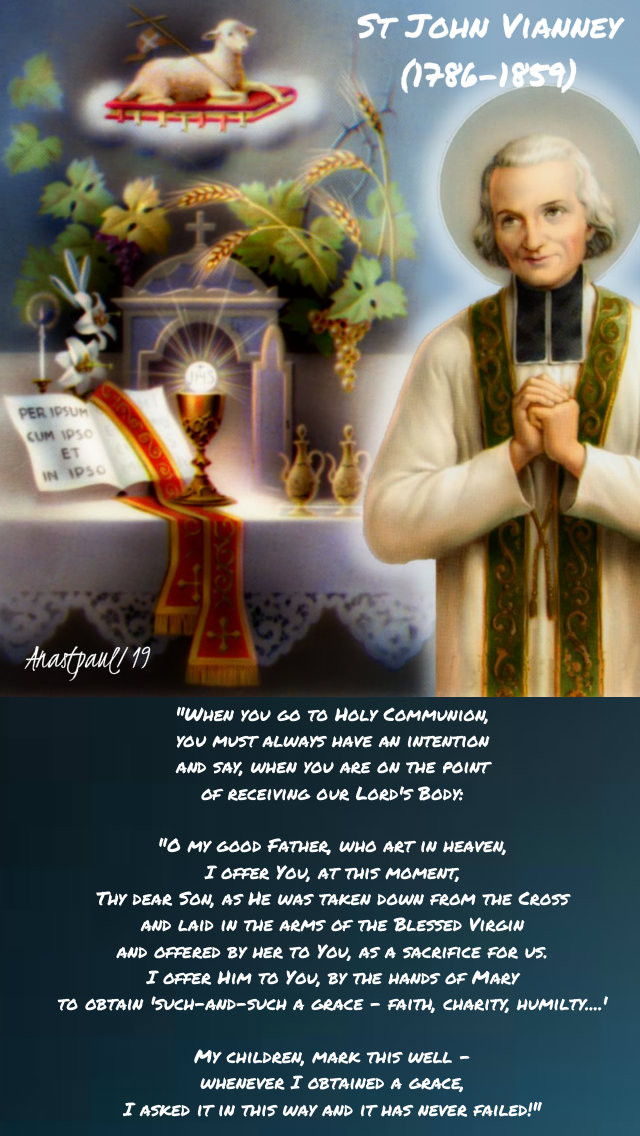
Sunday Reflection – 29 September – Twenty Sixth in Ordinary Time, Year C
“When you go to Holy Communion, you must always have an intention and say, when you are on the point of receiving our Lord’s Body:
“O my good Father, who art in heaven,
I offer You, at this moment,
Thy dear Son, as He was taken down from the Cross
and laid in the arms of the Blessed Virgin
and offered by her to You, as a sacrifice for us.
I offer Him to You, by the hands of Mary
to obtain ‘such-and-such a grace – faith, charity, humilty….’My children, mark this well – whenever I obtained a grace, I asked it in this way and it has never failed!”
Quote of the Day – 29 September – The Feast of Sts Michael, Gabriel and Raphael
“As our souls move our bodies … so there are Spiritual Intelligences which move those wonderful and vast portions of the natural world which seem to be inanimate and, as the gestures, speech and expressive countenances of our friends around us, enable us to hold intercourse with them, so, in the motions of universal Nature, in the interchange of day and night, summer and winter, wind and storm, fulfilling His word, we are reminded of the blessed and dutiful Angels ….
Every breath of air and ray of light and heat, every beautiful prospect, is, as it were, the skirts of their garments, the waving of the robes of those, whose faces see God in heaven.”
(To be Canonised on 13 October this year)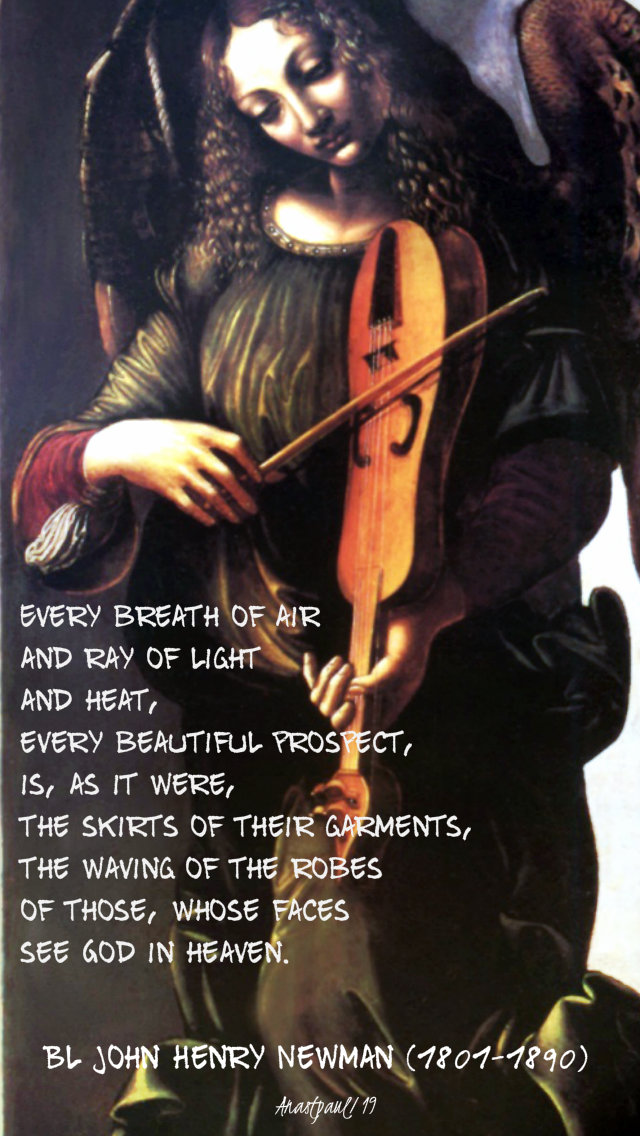
One Minute Reflection – 29 September – Twenty Sixth Sunday in Ordinary Time, Year C, Gospel: Luke 16:19–31 and The Feast of Sts Michael, Gabriel and Raphael
The poor man died and was carried by the angels to Abraham’s bosom. The rich man also died and was buried and in Hades, being in torment, he lifted up his eyes and saw Abraham far off and Lazarus in his bosom. … Luke 16:22-23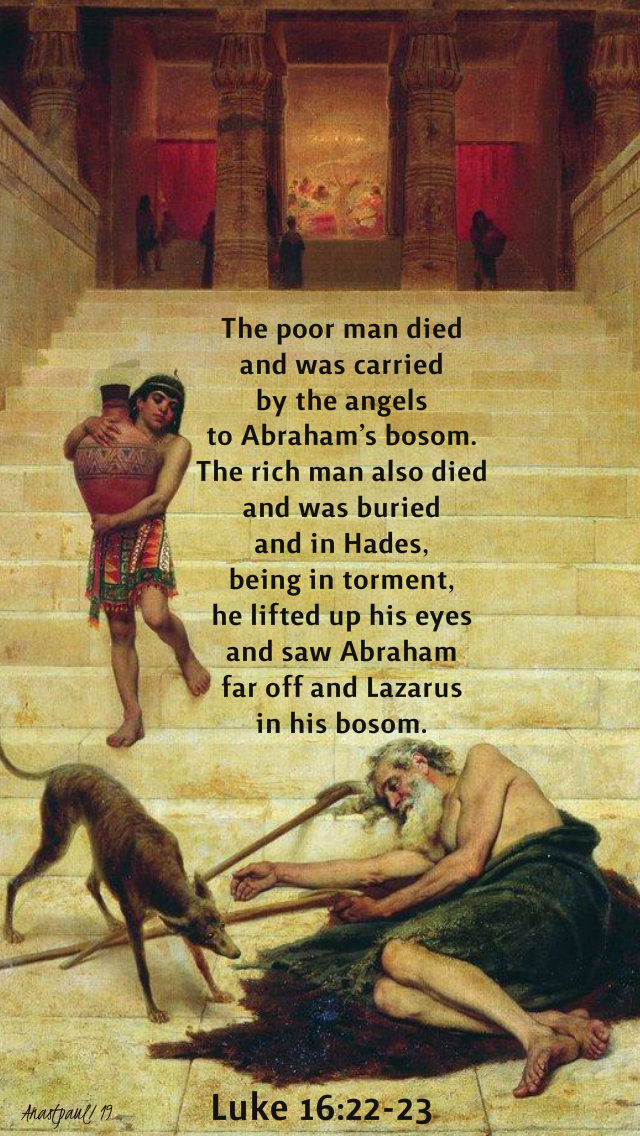
REFLECTION – “Was that poor man welcomed by the angels solely on account of his poverty? And the rich man, was he delivered up to torment by fault of his wealth alone? No. Let us clearly understand that it was humility that was honoured in the poor man and pride condemned in the rich.
This is the proof, briefly, that it was not his wealth but his pride for which the rich man deserved his punishment. So then, the poor man was carried into the bosom of Abraham, yet Scripture says of Abraham that he had much gold and silver and was rich on earth (Gn 13:2). If every rich man is sent into torment, how is it that Abraham could precede the poor man so as to welcome him into his bosom? It was because, in the midst of his wealth, Abraham was poor, humble, respectful and obedient to all God’s commands. He held his riches in so little esteem that, when God asked it of him, he consented to offer in sacrifice the son for whom these riches were destined (Gn 22:4).
Learn to be poor and needy, then, whether you possess something in this world or whether you don’t possess anything. Because we find beggars full of pride and rich people who confess their sins. “God resists the proud” whether they are covered with silk or with rags but “he gives grace to the humble” (Jas 4:6) whether or not, they have possessions in this world. God looks at what is within, it is there He assesses, there He examines.” … Saint Augustine (354-430) Father & Doctor of the Church – Discourses on the psalms, Ps 85 [86]; CCL 39, 1178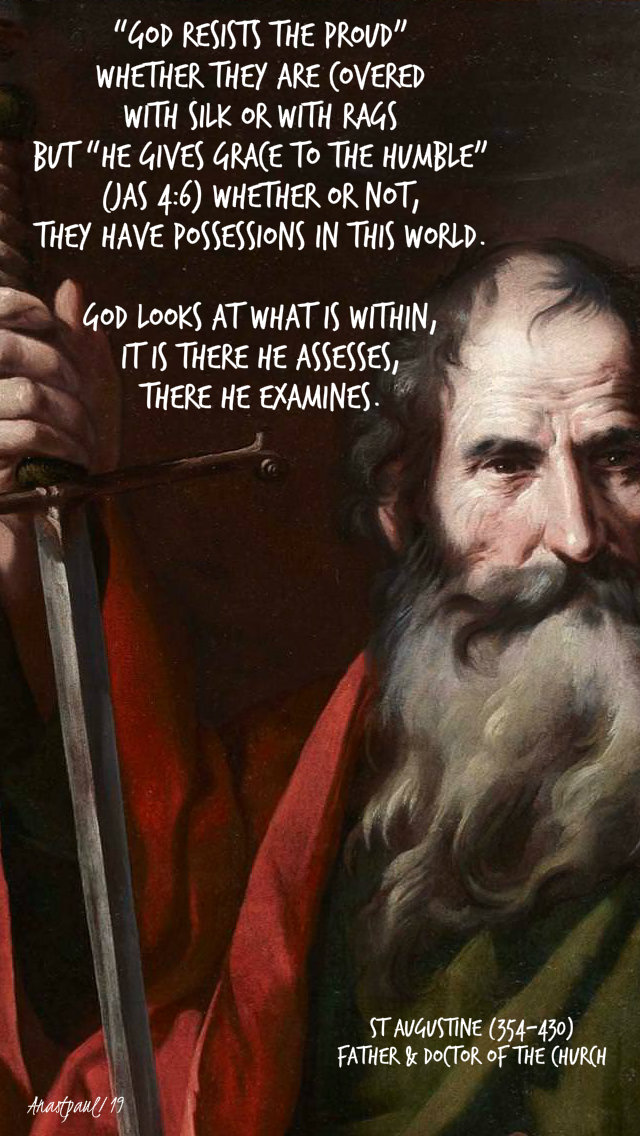
PRAYER – Dear and Holy God, let us offer You all our daily struggles against sin and evil. Grant us the strength to resist all forms of idolatry, to seek only You and never to allow the material goods of this world to seduce us . Sustain us ever more with Your word and help us to find in it, the source of life. Grant that the angels who always minister to You in heaven may defend us during our life on earth and protect us from evil. Grant this, through our Lord Jesus Christ, Your Son, in union with the Holy Spirit, one God forever and ever. Amen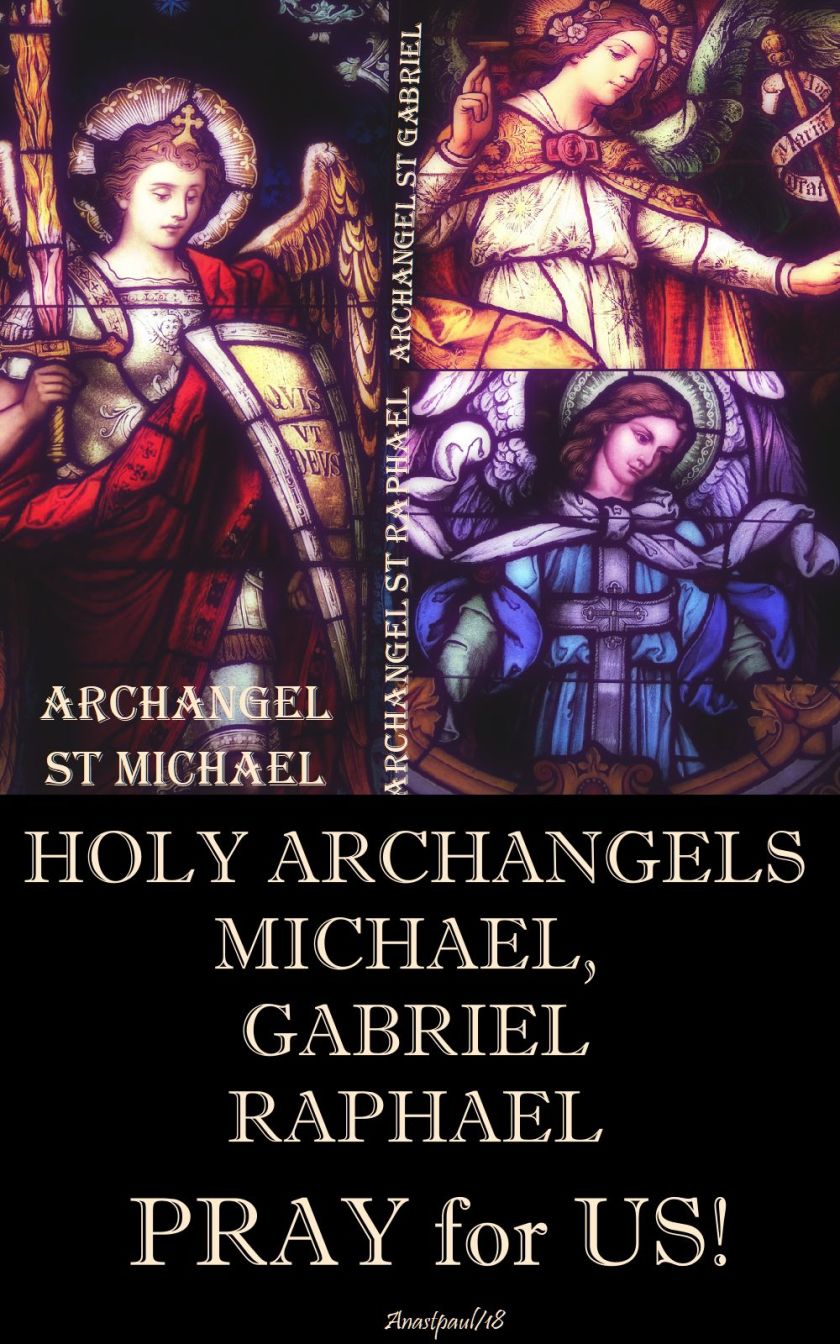
Our Morning Offering – 29 September – Twenty Sixth Sunday in Ordinary Time, Year C
Anima Christi
By St Ignatius Loyola SJ (1491-1556)
Soul of Christ, sanctify me.
Body of Christ, save me.
Blood of Christ, inebriate me.
Water from the side of Christ, wash me.
Passion of Christ, strengthen me.
O Good Jesus, hear me.
Within Your wounds hide me.
Permit me not to be separated from You.
From the wicked foe, defend me.
At the hour of my death, call me
and bid me come to You
That with Your saints, I may praise You
Forever and ever.
Amen
This prayer attracts an Indulgence of 300 days, or of 7 years, if recited after Holy Communion.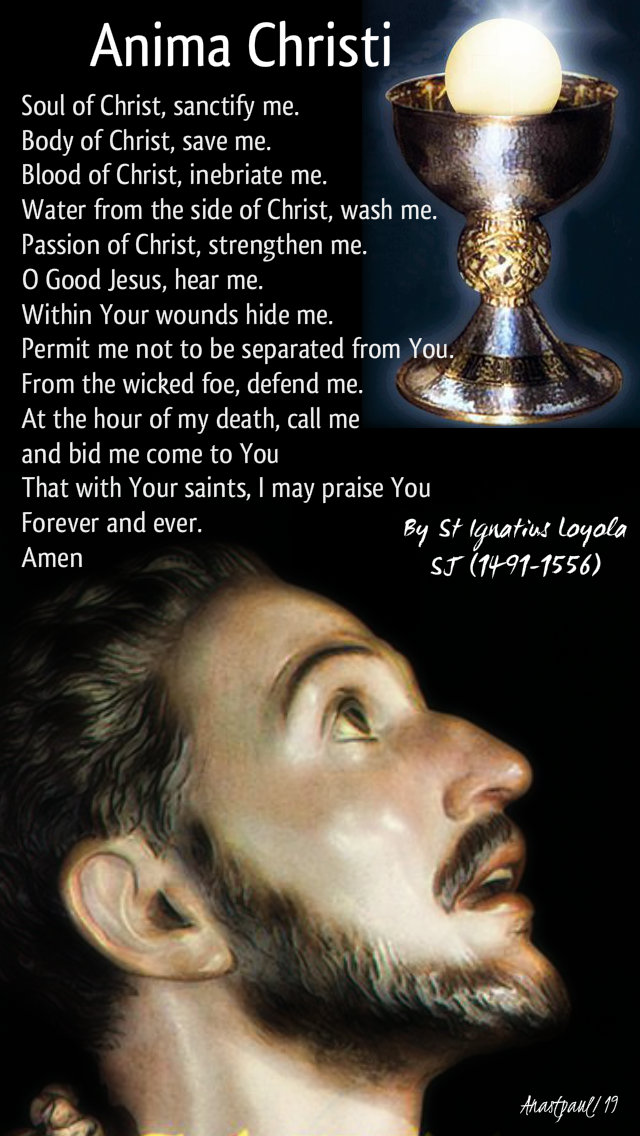
Saint of the Day – 29 September – Blessed Jean de Montmirail / Baron de Montmirail, O. Cist. (1165 – 1217) Cistercian Monk, Apostle of the Sick and Afflicted – also known as Seigneur de Montmirail on the Marne, John de Monte Mirabiliborn – born in 1165 in France and died on 29 September 1217 at Longpoint abbey of natural causes, where his tomb now resides.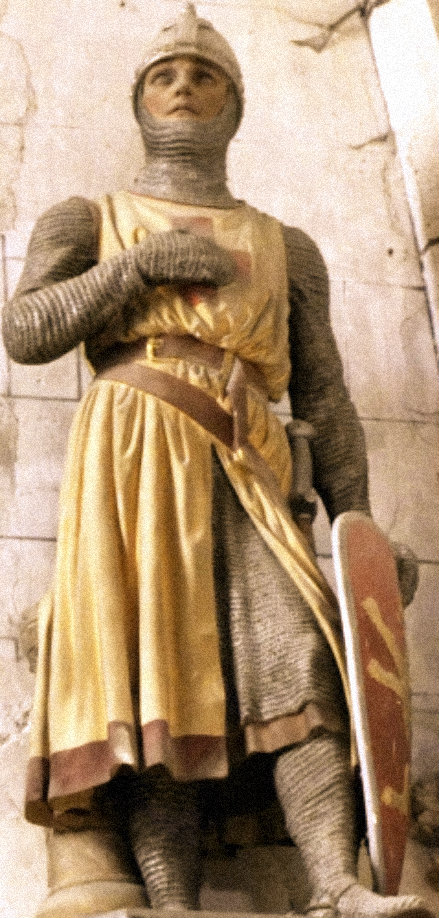
Blessed Jean was the son of André de Montmirail, Lord of Montmirai and Hildiarde d’Oisy of Cambrai. He was given a religious upbringing by his mother and was well educated. He became the first Lord of Condé.
While young, he embraced a military career and was presented at the Royal Court, as constable of France, where he formed a lasting friendship with Philip Augustus (who later became King Philip II of France). He became, not only the friend and favourite of the King but also later his adviser. On one occasion, Jean was even said to have saved Philip’s life. The dissipations of court life led him to neglect the training of his youth, even his marriage with Helvide de Dampierre, sister of Guy II of Dampierre, failed to effect a change. King Philip II later decorated him with the title of Baron.
In his thirtieth year he met Jobert, Prior of St-Etienne de Montmirail and experienced a conversion. He built a hospital for the sick of all kinds but the objects of his predilection were the lepers and those hopelessly afflicted. He wore a hair-shirt, frequently passing entire nights in prayer. After a while, he entered the Cistercian monastery of Longpont, after having distributed among the poor all his possessions not needed by his wife and family. He was abused for his decision by his former friends. Even members of his own family disapproved of his abandonment of honour and wealth for poverty and subjection.
He died at Longpont on 29 September 1217.
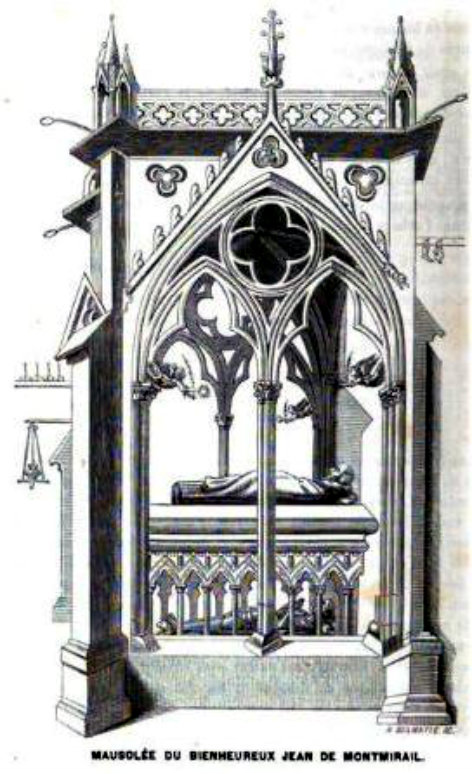
Miracles were wrought at his tomb and attracted pilgrims. By the 1230s, John was being venerated as a miracle-working saint. Pope Leo XIII granted a special office in his honour for the diocese of Soissons. He was Beatified in 1891 by Pope Leo XIII. Below is his tomb and an engraving of his Mausoleum – 1641.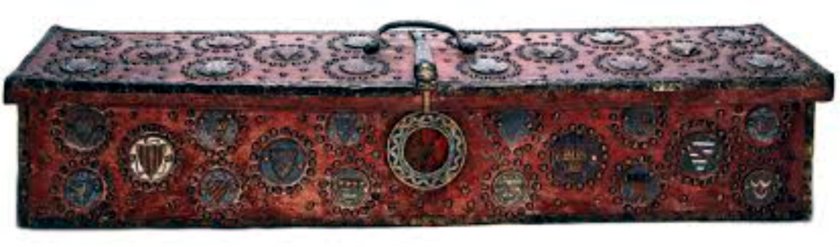
Twenty Sixth Sunday in Ordinary Time, Year C +2019
St Gabriel the Archangel (Feast)
St Michael the Archangel (Feast)
St Raphael the Archangel (Feast)
About the three Archangels here: https://anastpaul.wordpress.com/2017/09/29/saints-of-the-day-feast-of-the-three-archangels-29-september/
Bl Alericus
St Anno of Eichstätt
St Casdoe of Persia
St Catholdus of Eichstätt
Bl Charles of Blois
St Dadas of Persia
St Diethardus of Eichstätt
St Fraternus of Auxerre
St Gabdelas of Persia
St Grimoaldus of Pontecorvo
St Gudelia
St Guillermo Courtet
Bl Jean de Montmirail / Baron de Montmirail, O. Cist. (1165 – 1217)
Bl John of Ghent
St Lazaro of Kyoto
St Liutwin of Trier
Bl Luigi Monza (1898 – 1954)
Biography:
Saint of the Day – 29 September – Blessed Luigi Monza (1898 – 1954)
St Miguel de Aozaraza
St Quiriacus of Palestine
St Rene Goupil
St Rhipsime
Bl Richard Rolle
St Sapor of Persia
St Theodota of Thrace
St Vicente Shiwozuka de la Cruz
—
Martyrs of Thrace – 3 saints: Three Christian men murdered in Thrace for their faith. They are – Eutychius, Heracleas and Plautus.
Martyred in the Spanish Civil War:
• Blessed Antonio Arribas Hortigüela
• Blessed Antonio Martínez López
• Blessed Dario Hernández Morató
• Blessed Francesc de Paula Castelló Aleu
• Blessed Francisco Edreira Mosquera
• Blessed José Villanova Tormo
• Blessed Pau Bori Puig
• Blessed Vicente Sales Genovés
• Blessed Virgilio Edreira Mosquera
Novena to Our Lady of the Rosary – Day One – 28 September
Day One – We pray for the Holy Church
and our personal intention:
To Mary, Mother of God and our Mother,
who sees how the Catholic Faith
is assailed by the devil and the world,
To Thy protection, we entrust ourselves .
Kindly offer to Thy Divine Son our resolutions and
obtain from Him the graces necessary for us
to keep them unto the end.
Amen
Daily Prayer along with our Daily Rosary:
My dearest Mother Mary, behold me, your child, in prayer at your feet.
Accept this Holy Rosary, which I offer you in accordance with your requests at Fatima, as a proof of my tender love for you, for the intentions of the Sacred Heart of Jesus, in atonement for the offences committed against your Immaculate Heart and for this special favour which I earnestly request in my Rosary Novena:
………………………….. (Mention your request).
I beg you to present my petition to your Divine Son.
If you will pray for me, I cannot be refused.
I know, dearest Mother, that you want me
to seek God’s holy Will concerning my request.
If what I ask for should not be granted,
pray that I may receive that which will be of greater benefit to my soul.
I offer you this spiritual Bouquet of Roses because I love you.
I put all my confidence in you,
since your prayers before God are most powerful.
For the greater glory of God and for the sake of Jesus,
your loving Son, hear and grant my prayer.
Sweet Heart of Mary, be my salvation.
Our Lady of the Rosary,
pray for our Holy Mother Church
and for our country.
Our Lady of Fatima,
obtain for humanity a lasting peace.
Sweet Heart of Jesus,
be my love.
Sweet Heart of Mary,
at the hour of my death,
lead me home.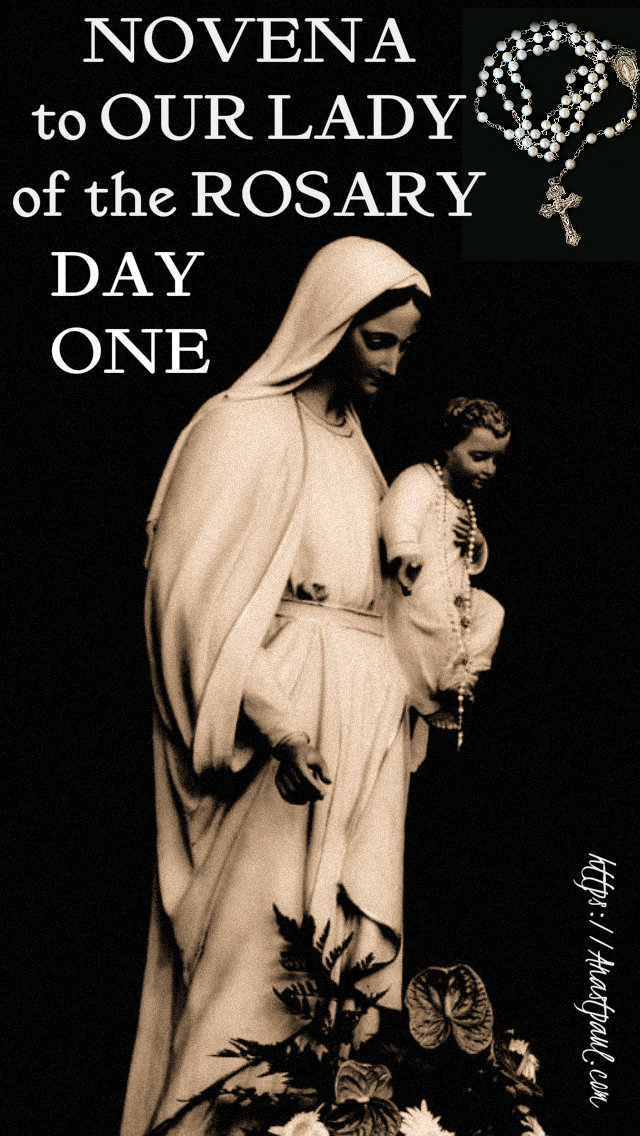
Thought for the Day – 28 September – The Memorial of St Lorenzo Ruiz (1600-1637) Martyr
“The Lord Jesus by His blood truly redeemed His servants, gathered from every race, tongue, people and nation, to make them a royal priesthood for our God. The sixteen blessed martyrs, by the exercise of their priesthood—that of baptism or of Holy Orders—performed the greatest act of worship and love of God by the sacrifice of their blood united with Christ’s own Sacrifice of the Cross. In this way they imitated Christ the priest and victim in the most perfect way possible for human creatures. It was at the same time an act of the greatest possible love for their brethren, for whose sake we are all called to sacrifice ourselves, following the example of the Son of God who sacrificed Himself for us.
4. This is what Lorenzo Ruiz did. Guided by the Holy Spirit to an unexpected goal after an adventurous journey, he told the court that he was a Christian and must die for God and wοuld give his life for him a thousand times!
(Had I many thousands of lives I would offer them all for him.
Never shall I apostatise.
You may kill me if that is what you want. To die for God—such is my will.)
Here we have him summed up, here we have a description of his faith and the reason fοr his death. It was at this moment that this young father of a family, professed and brought to completion, the Christian catechesis that he had received in the Dominican Friars’ school in Binondo, a catechesis that cannot be other than Christ-centred, by reason both of the mystery it contains and the fact that it is Christ who teaches through the lips of His messenger.
5. The example of Lorenzo Ruiz, the son of a Chinese father and Tagala mother, reminds us that everyone’s life and the whole of one’s life must be at Christ’s disposal. Christianity means daily giving, in response to the gift of Christ who came into the world so that all might have life and have it to the full. Or, as so aptly expressed in the theme of my visit to this country – To die for the faith is a gift to some, to live the faith is a call for all.
Dearly beloved, amidst the efforts needed for our own Christian lives and for spreading the light of Christ throughout Asia and the whole world, let us look today to these zealous martyrs who give us deep assurance and fresh hope when they tell us – “In all this we are more than conquerors because of him who has loved us.” And this is the mystery we celebrate today – the love of Jesus Christ, who is the light of the world. Amen.”

Quote of the Day – 28 September – The Memorial of St Lorenzo Ruiz (1600-1637) Martyr
“I am a Catholic and wholeheartedly do accept death for God.
Had I a thousand lives, all these to Him, shall I offer.”
“Never shall I apostatise.
You may kill me,
if that is what you want.
To die for God—such is my will.”

One Minute Reflection – 28 September – Saturday of the Twenty-fifth week in Ordinary Time, Year C, Gospel: Luke 9:43–45 and the Memorial of St Lorenzo Ruiz (1600-1637) Martyr
“Let these words sink into your ears, for the Son of man is to be delivered into the hands of men.” But they did not understand this saying and it was concealed from them ... Luke 9:44-45
REFLECTION – “Of all Christ’s miracles and mighty acts, it is this one that far exceeds the limits of human wonder. It goes far beyond the weak power of the human mind to perceive or comprehend, how it is supposed to believe, that the divine majesty, that very Word of the Father (Jn 1:1) and Wisdom of God in which “all things were created, visible and invisible” (cf. Col 1:15), was held within the confines of the man who appeared in Judaea and, even more, that the Wisdom of God entered into the womb of a woman and was born a baby, who cried and wailed just like all little babies. And it is further reported that He suffered the anguish of death, as He Himself admitted by saying: “My soul is very sorrowful, even to death” (Mt 26:38 par) and in the end, He was led to that death which is reputed to be the most shameful among men, even though he did rise again on the third day…
To present this to human ears and explain it in words far surpasses our poor merits… Indeed the explanation of this mystery is probably beyond the grasp even of the whole creation of heavenly powers.” … Origen (c 185-253) Priest, Theologian, Father – Treatise on First Principles
PRAYER – Holy God, help me to amend my life constantly and be sincerely converted to You. Let me seek Your interests rather than my own and be ever more closely united with You. Send Your Spirit of understanding to enkindle our minds but most of all, fill us with Your grace of faith, that whether we understand or not, our love and obedience, is our only guide. St Lorenzo Ruiz, you obeyed to death for Christ, your beloved, please pray for us. We make our prayer through Christ our Lord, in the unity of the Holy Spirit, God for all eternity, amen.
Our Morning Offering – 28 September – Saturday of the Twenty-fifth week in Ordinary Time, Year C – A Marian Saturday and nearly the end of the Month of The Sorrows of the Blessed Virgin
What Can I Say, Merciful Lady?
St Anselm (1033-1109)
Doctor of the Church
My most merciful Lady,
what can I say about the fountains
that flowed from your most pure eyes
when you saw your only Son before you,
bound, beaten and hurt?
What do I know of the flood
that drenched your matchless face,
when you beheld your Son, your Lord
and your God,
stretched on the cross without guilt,
when the flesh of your flesh
was cruelly butchered by wicked me?
How can I judge what sobs
troubled your most pure breast
when you heard,
“Woman, behold your son,”
and the disciple,
“Behold, your Mother,”
when you received as a son
the disciple in place of the Master,
the servant for the Lord?
Amen
Saint of the Day – 28 September – St Lorenzo Ruiz (1600-1637) First Saint and Protomartyr of the Philippines – Layman, Husband and Father, Marian devotee – born in 1600 at Binondo, Manila, Philippines and died on 29-30 September 1637 at Nagasaki, Japan by being crushed over a period of three days while hanging upside down. Patronages – The Philippines, Filipinos, Overseas Filipino Workers and migrant workers, the poor, separated families, Filipino youth, Chinese-Filipinos, Filipino Altar servers, Tagalogs, Archdiocese of Manila.
Lorenzo Ruiz was born in Binondo, Manila, to a Chinese father and a Filipino mother who were both Catholic. His father taught him Chinese while his mother taught him Tagalog.
Ruiz served as an altar boy at the Binondo Church. After being educated by the Dominican friars for a few years, Ruiz earned the title of escribano (calligrapher) because of his skilful penmanship. He became a member of the Confraternity of the Most Holy Rosary. He married Rosario, a native and they had two sons and a daughter. The Ruiz family led a generally peaceful, religious and content life.
In 1636, whilst working as a clerk for the Binondo Church, Ruiz was falsely accused of killing a Spaniard. Ruiz sought asylum on board a ship with three Dominican priests – Saint Antonio Gonzalez, Saint Guillermo Courtet, and Saint Miguel de Aozaraza; a Japanese priest, Saint Vicente Shiwozuka de la Cruz and a lay leper, Saint Lázaro of Kyoto. Ruiz and his companions sailed for Okinawa on 10 June 1636, with the aid of the Dominican fathers.
The Tokugawa Shogunate was persecuting Christians by the time Ruiz had arrived in Japan. The missionaries were arrested and thrown into prison and after two years, they were transferred to Nagasaki to face trial by torture. The group endured many and various cruel methods of torture.
On 27 September 1637, Ruiz and his companions were taken to Nishizaka Hill, where they were tortured by being hung upside-down over a pit. This form of torture was known as tsurushi in Japanese or “gallows and pit” in Spanish. The method, alleged to have been extremely painful, had the victim bound, one hand was always left free so that the individual may signal their desire to recant, leading to their release. Despite his suffering, Ruiz refused to renounce Christianity and died from eventual blood loss and suffocation. His body was cremated, with the ashes thrown into the sea.
According to Latin missionary accounts sent back to Manila, Ruiz declared these words upon his death:
Ego Catholicus sum et animo prompto paratoque pro Deo mortem obibo.
Si mille vitas haberem, cunctas ei offerrem.
I am a Catholic and wholeheartedly do accept death for God.
Had I a thousand lives, all these to Him shall I offer.
St Lorenzo was Beatified on 18 February 1981, during St Pope John Paul II’s papal visit to the Philippines. It was the first beatification ceremony to be held outside the Vatican in history. He was Canonised by the same pope at the Vatican on 18 October 1987, making him the first Filipino saint. The Canonisation miracle involved the healing Cecily Alegriae Policarpio from cerebral paralysis.


You must be logged in to post a comment.