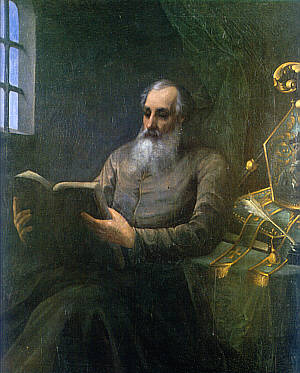
Blessed Gomidas Keumurjian, also known as Gomida Keumurgian, Cosma de Carboniano, was a martyr. Originally a priest in the Armenian church, in 1696 he and his family made complete submission to the authority of Rome. His preaching attracted large audiences of not only Armenians, but also Ottoman Greeks and so many Muslims that he had to regularly preach sermons in Turkish. This angered the Armenian officials. Some of them falsely accused Gomidas of being a spy for Rome, which led to his arrest and execution by Turkish authorities.
At the insistence of the Armenian Apostolic Patriarch of Constantinople, Gomidas was tried before an Islamic court and sentenced to death by the Qadi for treason against the Ottoman Sultan and for secretly baptizing Muslims. Gomidas, however, was offered a full pardon and his immediate release in return for his conversion to Islam. The other eight priests with him immediately accepted the offer of pardon in exchange for conversion to Islam, and only Gomidas refused, saying, “I will not exchange my gold for your copper.”
Accompanied by his wife and children and a crowd of three thousand witnesses, Gomidas was led out of prison on 5 November 1707 to the Samatya quarter of Istanbul. Like the many other martyred priests under the Caesars, he was followed to the place of execution by his wife and children. His wife encouraged him to remain firm, while his sister, Irena, begged him not to bereave his family. Irena urged her brother to instead pretend to convert to Islam, while remaining a crypto-Christian. Unmoved, he continued until he reached the crossroads called Parmak Kapu, where he was ordered to kneel. Gomidas did so, facing Jerusalem, much to the dismay of the crowd, who repeatedly called in vain for him to turn and face Mecca instead. When the executioner approached with a drawn sword and also urged him to save his life through conversion to Islam, he replied, “No, do your work”, and began reciting the Nicene Creed in the Classical Armenian liturgical language. His prayer only ceased when he was beheaded.




You must be logged in to post a comment.