Posted in AUGUST - The Immaculate Heart of Mary

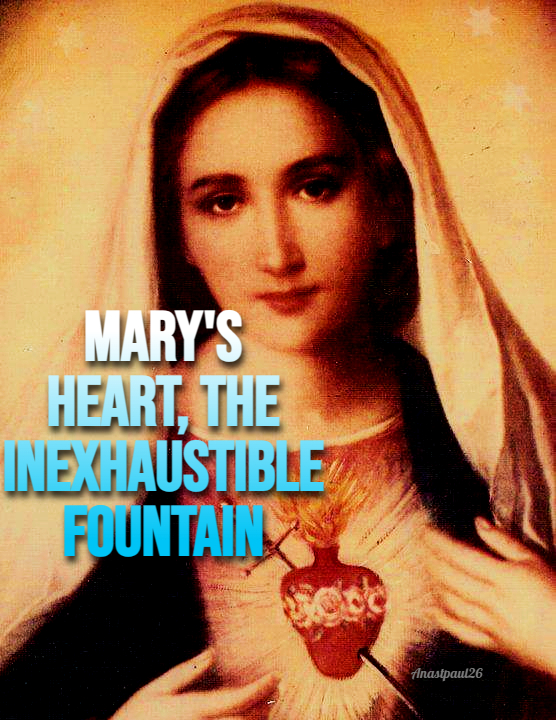
Thought for the Day – 10 August – Mary’s Heart, The Inexhaustible Fountain

St John Eudes – The Admirable Heart of Mary

Mary’s Heart, The Inexhaustible Fountain Part 1

The fourth symbolic picture of Our Lady’s most blessed Heart is the wonderful fountain that God caused to spring from the ground at the beginning of the world, as described in the second chapter of Genesis. “A spring rose out of the earth, watering all the surface of the earth.” St. Bonaventure tells us that this fountain was a figure of the Blessed Virgin Mary. “She was prefigured in the fountain that sprang from the earth.” But we have equal reason to say that this represented her Heart, which is truly a living fountain whose heavenly waters irrigate not only the whole earth, but every created thing in Heaven as well as on earth. Mary is the sealed fountain of the holy Spouse, which her divine Bridegroom calls “a fountain sealed up,” for it remained sealed not only against the world, the devil and every kind of sin, but it was closed even to the Cherubim and Seraphim, who could not penetrate the marvellous secrets or comprehend the inestimable treasures hidden by God in Our Lady’s pure Heart.

All we can say is that Mary’s immaculate Heart is a fountain of light, a fountain of holy and blessed water, a fountain of living and life-giving water, a fountain of milk and honey and a fountain of wine. It is the source of a great river, nay, of four miraculous streams, and finally, it is the source of an infinity of blessings and goodness.

The Heart of Mary, as well as her name, which means “enlightened” or “the one who enlightens,” and also “star of the sea,” is indeed a true fountain of light. Holy Church considers and honors her as the resplendent door of pure light; Tu porta lucis fulgida, and salutes her as the portal through which divine Light entered the world: Salve porta, ex qua mundo lux est orta. Truly the Heart of Mary is the fountain of the sun, because Mary is the Mother of the Sun of Justice, and this divine Sun is the fruit of Mary’s Heart.

Mary’s Heart is a fountain of water, but one of blessed, holy and precious water. I here speak of the innumerable tears that poured from this sacred fountain and, united with those of the Redeemer Himself, cooperated in our redemption. O Mary, how many streams of tears have flowed from thine eyes, with their source in thy loving, charitable, devoted and merciful Heart! Tears of love, tears of charity, tears of joy, of sorrow and of compassion! How often did not the ardent love of the maternal Heart for thy infinitely lovable Son cause thee to shed bitter tears, beholding Him so little loved, so much hated, offended and dishonored by the majority of men, although it was the duty of man to serve Him? How often thy burning charity for souls caused thee to weep because through their own malice, millions of precious souls would be lost, notwithstanding all that He did and suffered in order to save them? How many times have the holy angels witnessed tears of sublime devotion coursing down thy beautiful face, as thou wast absorbed in holy communion with the Divine Majesty? All the saints were granted the gift of tears, which could not possibly have been wanting in the Mother of Sorrows who has assured us that she possesses the fulness of gifts bestowed on all the saints.

The most pure Heart of Mary is also a fountain of living water, which means a fountain of grace. This ought not to astonish us, for the Archangel Gabriel declared long ago that the Mother of the Saviour was full of grace, gratia plena, and the Church calls her Mater gratiae, Mother of Grace, and Mater divinae gratiae, Mother of Divine Grace. The Angelic Doctor, St. Thomas, affirms that Our Lady is so full of grace that out of her abundance she can dispense graces to all men.

Posted in MARIAN TITLES

Santa Maria della Querce / Our Lady of the Oak, Lucignano, Arezzo, Tuscany, Italy (1417) and Memorials of the Saints – 8 August

Santa Maria della Querce / Our Lady of the Oak, Lucignano, Arezzo, Tuscany, Italy (1417) – 8 August, Third Saturday of September:

In 1417 Feliciano Batone painted a fresco of the Pietà on a wayside Shrine beneath a great oak . Fifty years later, there was a surge in devotion to the Madonna of the Oak after the story circulated that on 8 August 1467, a man from Siena, running from his enemies, stopped there to pray to Mary, who made him invisible to his pursuers.

A small wooden Chapel was built to protect the image and Consecrated that year. Located on a hill northeast of the old City centre, beyond the Medici Fortress and the cemetery, the present Church was designed by Giorgio Vasari in 1558 and Consecrated in 1617.

On the third Sunday of September, near the feast of the Sorrowful Mother on S15 September, Lucignano celebrates St. Mary of the Oak with religious services, food, games and fireworks.

St Aemilian of Cyzicus
St Altman of Passau (c 1020 – 1091) Bishop

Ven Antonio/Margil of Jesus OFM (1657-1726)

St Cyriacus/Cyriac the Martyr (Died c 303) Deacon, Miracle-worker. One of the Fourteen Holy Helpers.

St Eleutherius of Constantinople
St Ellidius
St Famianus of Compostela
St Gedeon of Besancon
St Hormisdas of Persia
Bl John Felton

Bl John Fingley
St Largus
St Leobald of Fleury
St Leonidas of Constantinople
St Marinus of Anzarba

St Mummolus of Fleury
St Myron the Wonder Worker
St Paulus Ge Tingzhu
St Rathard of Diessen
St Severus of Vienne
St Sigrada
St Smaragdus
St Ternatius of Besançon
St Ultan of Crayke
Bl William of Castellammare di Stabia
Bl Wlodzimierz Laskowski

Martyrs of Albano – 4 saints: Four Christians who were martyred together, and about we today know little more than their names – Carpóforo, Secondo, Severiano and Vittorino. They were martyred in Albano, Italy – their remains are interred in the San Senator cemetery, on the Appian Way, 15 miles from Rome, Italy.

Martyrs of Rome – 5 saints: Five Christians martyred together; we know nothing else about them but the names – Ciriaco, Crescenziano, Giuliana, Memmia and Smaragdus. They were martyred at the 7 mile marker, on the Via Ostia, Rome, Italy.

Martyred in the Spanish Civil War – Martyrs of El Saler – 5 beati: Five nuns, all members of the Sisters of the Pious Schools, all teachers, and all martyred together in the Spanish Civil War.
• Antonia Riba Mestres
• Maria Baldillou Bullit
• María Luisa Girón Romera
• Nazaria Gómez Lezaun
• Pascuala Gallén Martí
They were martyred on 8 August 1936 in El Saler, Valencia, Spain.

Martyred in the Spanish Civil War:
Bl Cruz Laplana Laguna
Bl Fernando Español Berdie
Bl Leoncio López Ramos
Bl Manuel Aranda Espejo
Bl Mariano Pina Turón
Bl Pedro Álvarez Pérez

Posted in AUGUST - The Immaculate Heart of Mary

Novena to Our Lady of the Assumption – Day Three – 8 August

Novena to Our Lady of the Assumption

DAY THREE

Daily Prayer:
Lord Jesus Christ,
Thou has destroyed the power of death
and given the hope of eternal life,
for body and soul.
Thou granted Thy Mother
a special place in Thy glory
and did not allow decay to touch her body.
As we rejoice in the Assumption
of the Blessed Virgin Mary,
grant us renewed confidence
in the victory of life over death.
Amen.

Day 3:
O Mother, Assumed into Heaven
because thou shared in all the mysteries
of our Redemption here below,
Jesus has crowned thee with glory.
With thy most glorious and powerful intercession,
help us O loving Mother
and present to Jesus our request.
…………………………………
(Mention your request)
O Queen assumed into Heaven, pray for us.
Amen

Posted in AUGUST - The Immaculate Heart of Mary

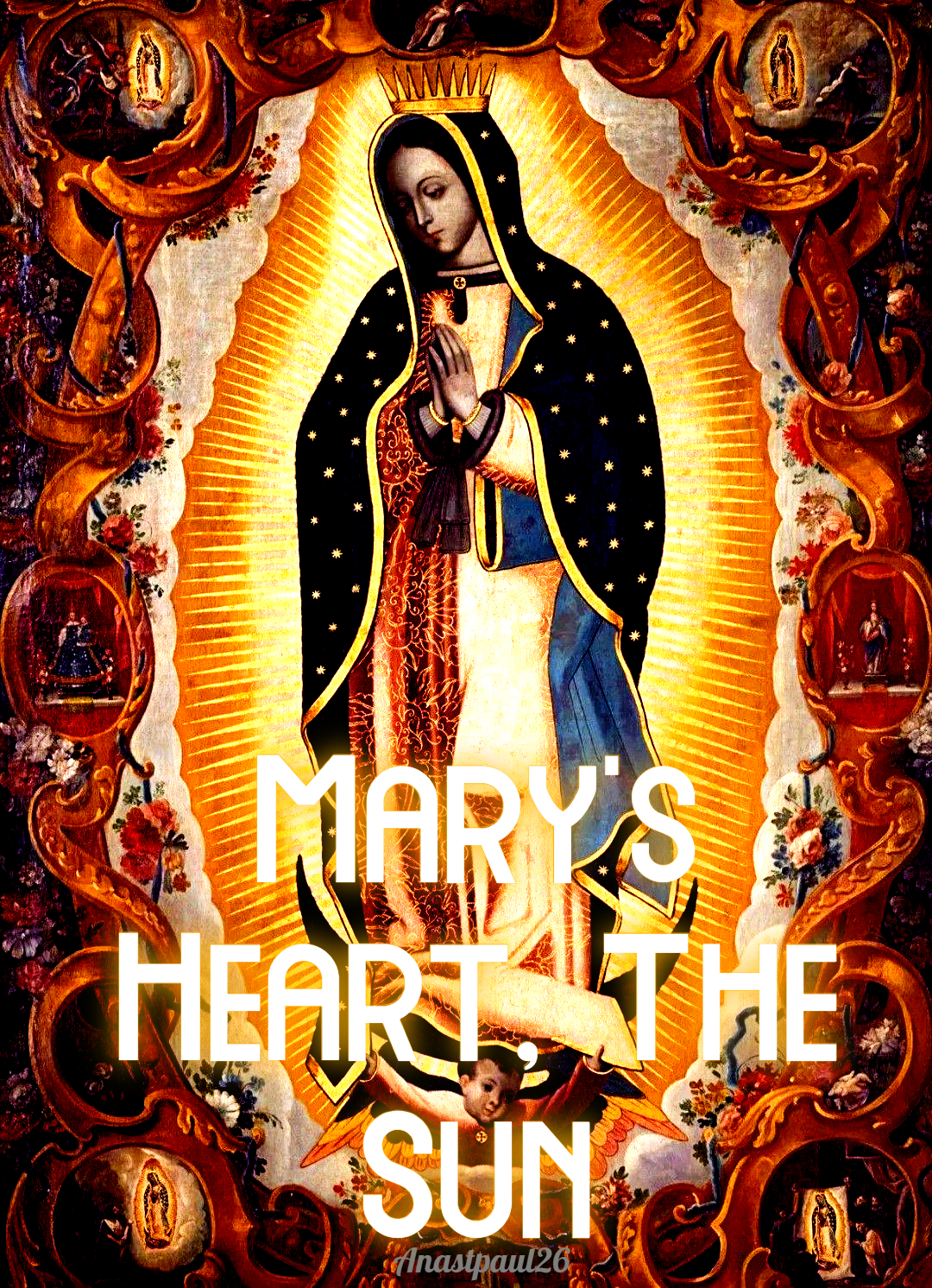
Thought for the Day – 8 August – Mary’s Heart, The Sun

St John Eudes – The Admirable Heart of Mary

Mary’s Heart, The Sun

The sun is the second symbolic picture which God, the Creator of heaven and earth, has deigned to give us of the Immaculate Heart of the Queen ~ of heaven and earth. God did not create the natural sun, our wonderful luminary, merely to enlighten our material world; He made it also to be a representation of the excellent perfections which shine in the luminous Heart of the world’s Sovereign Lady.

We should remember that the infinite power of God has divided this great universe into three different states or orders, namely the state of nature, the state of grace and the state of glory. His divine wisdom has nevertheless established such a perfect bond, relationship and resemblance among these three states and among the beings existing in these orders that whatever is in the order of nature is an image-of the things belonging to the order of grace, and whatever belongs to the order of nature and grace is a figure of what is to be seen in the state of glory.

Hence, the sun, which is truly the heart of the visible world, and the most beautiful and glowing gem of nature, gives us, in spite of its dazzling light, only a very faint shadow of our heavenly Sun, the Heart of the Mother of God.

Sacred Scripture calls the sun an admirable vessel, the work of the Sovereign Lord. “An admirable instrument, the work of the Most High. Great is the Lord that made him,” But we can say of the most excellent Heart of the Mother of God that it is an incomparable masterpiece of God’s almighty hand. It is a compendium of all the marvels He has worked in pure creatures, and will be the eternal object of the admiration and delight of angels and men. Great indeed is He who made it, because His divine magnificence appears in her admirable Heart more clearly than in all the other wonderful things of nature, grace and glory.
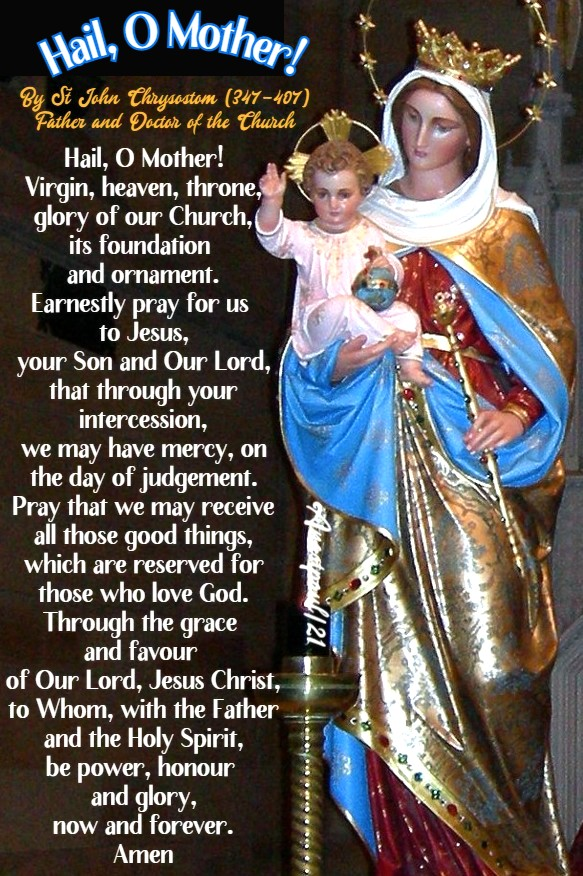
Mary’s Heart is surrounded, filled, penetrated by light, and her light is incomparably more brilliant and radiant than all the lights of the celestial spaces. It is all light, and after God, it is the first source of the lights which shine in the firmament of the Church. “I made that in the heavens there should rise light that never faileth.”

Yes, hers is indeed the heart of the entire world, the heart of Heaven and earth, the heart of the Church Militant, Suffering and Triumphant, since the Holy Spirit bids us sing: Vitam datam per Virginem, gentes redemptae plaudite. “All ye nations, redeemed by the Precious Blood of Jesus Christ, rejoice, sing the praises of your Redeemer and His glorious Mother! You were condemned to eternal death, and the Son of Mary has made you free; the Mother of Jesus has restored life to you, even eternal life, by giving you her Son, who is Life essential and the source of all life.”

The solar sun has been in perpetual motion since its creation in space, and it travels so rapidly that mathematicians calculate its speed to be over one million leagues an hour. Similarly, the holy Heart of Mary, from the moment of her Immaculate Conception, has been completely kept in motion by love for God and charity towards mankind. As long as Mary, the admirable Sun of Light and Purity, was on earth, she sped or rather flew with such celerity on the path of sanctity that the speed of our material sun is simply a shadow and a figure by comparison. For this holy Sun, Mary’s immaculate Heart, progressed incomparably farther in the mystical and supernatural way of the world of grace than the material sun which revolves around our visible world.

St. Germanus of Constantinople calls the Heart of Mary the happiness of the entire world. Commune mundi gaudium. And St. John Damascene says that it is an ocean of inexhaustible delight: Gaudii pelagus inexhaustum.

“Take away the sun that enlightens our material world,” says St. Bernard, “what will become of day or light? Take away Mary, the Star of the Sea, or take away the Heart of Mary, the true Sun of the Christian World, and what would be left? Without Mary’s radiance, nothing is left but enveloping darkness, the shadow of death and the frightful night of the grave.”

Posted in AUGUST - The Immaculate Heart of Mary

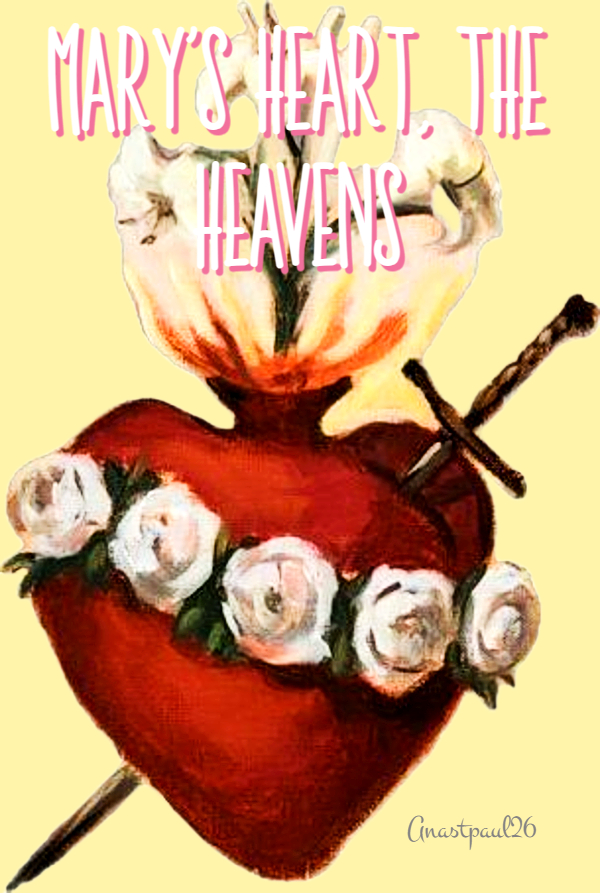
Thought for the Day – 7 August – Mary’s Heart, the Heavens

St John Eudes – The Admirable Heart of Mary

Mary’s Heart, the Heavens

The first symbolic picture of the Admirable Heart of Mary which the Eternal Father has given to us is the heavens. Mary’s pure Heart is truly a heaven of which the sky over our heads is a mere shadow and image. It is a heaven exalted above all others, of which the Holy Ghost speaks when He says that the Saviour of the World went out from a heaven surpassing all others in excellence, when He came on earth to redeem mankind.

The heavens are called the special work of God’s hands: “The heavens are the works of thy hands,” but the Heart of the Mother of God is the unequalled masterpiece of His omnipotence, His unfathomable wisdom and His infinite goodness. The Admirable Heart of Mary is an empyrean heaven, that is, a Heaven all fire and flames, ever burning with the fire and flames of celestial love, holier and more ardent than the love of the Seraphim and of the greatest Saints who dwell in the empyrean heaven.

Yes, the most holy Heart of the Queen of Angels is the Heaven of Heavens for three significant reasons.

First of all, Jesus Christ is truly the Heaven of the Blessed Trinity. The Holy Ghost assures us that the fulness of the Divinity abides in Him: “For in him dwelleth all the fullness of the Godhead,” and this same Jesus has forever fixed His dwelling in the Blessed Heart of His most worthy Mother. This must not surprise us, for Sacred Scripture reveals that even in this present life, He maintains His dwelling in the hearts of all who believe in Him with a firm and perfect faith. We can therefore conclude that, as our most lovable Saviour is Himself a Heaven, possessing no abode more glorious and delightful, next to the adorable bosom of His Eternal Father, than the Heart of His holy Mother, which is itself a Heaven, He is truly Heaven dwelling within a heaven. In this way, the Heart of the Mother of Jesus can be said to be the Heaven of Heaven.

Secondly, Mary’s Immaculate Heart is the Heaven of Heaven because the spotless Virgin is really a heaven considered in her own person. This is the quality ascribed to her by the Holy Ghost, according to a learned and holy writer: “From heaven the Lord hath looked upon the earth.” As this commentator explains it, “the Lord, dwelling in the Blessed Virgin Mary, as in a heaven, has turned the eyes of His mercy towards the earth, that is, towards sinners.” Then the same author goes on to say that this marvellous Virgin is a heaven because, as all living things in the order of nature receive their life from the influence of heaven, so does Holy Church teach us that the life of grace is given to us through the Blessed Virgin Mary: Vitam datam per Virginem.”

Thirdly, the Admirable Heart of Mary is the Heaven of Heaven, because, as St. Bernard says, it contains the entire Church, which is called in Sacred Scripture the Kingdom of Heaven, and because all the children of the Church receive through Mary the life of grace. Who will contradict me if I add that Our Lady will forever carry all the inhabitants of heaven in her inmost Heart, which becomes the Heaven of Heaven, and a true Paradise of the Elect, in which they find the fullness of delight and joy, due to the inconceivable love for each soul which consumes her maternal Heart? Thus the blessed will forever sing: Sicut laetantium omnium nostrum habitatio est in corde tuo, sancta Dei Genetrix. O holy Mother of God, thy boundless charity has so vastly extended thy maternal Heart that it has become like a great city, or rather an immense heaven, full of ineffable consolations and unspeakable joys for thy beloved children, whose happy dwelling it shall be for all eternity.

Present our requests to the Mother of grace and mercy. Through the intercession of her Heart, most exalted, yet most tender, we shall obtain the graces that we need to become pleasing in the sight of the celestial majesty of God,

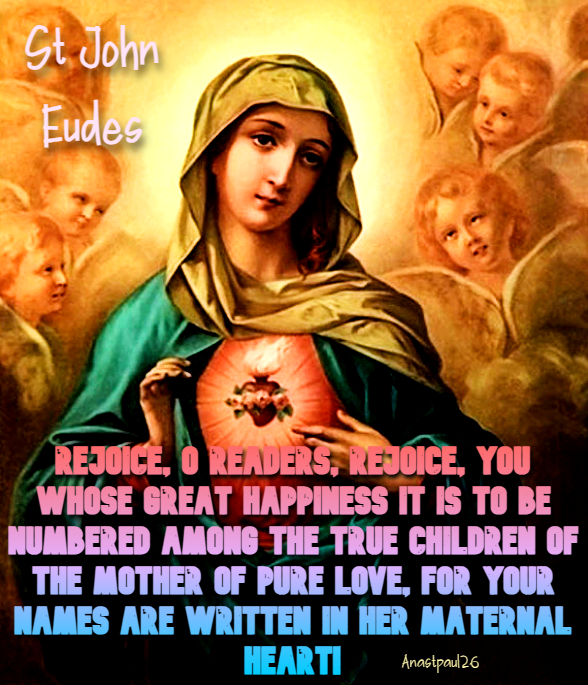
Rejoice, O readers, rejoice, you whose great happiness it is to be numbered among the true children of the Mother of pure love, for your names are written in her maternal Heart! Lift up your eyes and your hearts to that beautiful heaven! It is there that your hearts will find light, strength, powerful aid in the battle of life, guidance and succor, and above all inspiration to love your Creator and Redeemer, the Lord of Heaven, strongly, purely and above all things.

Posted in MARIAN TITLES

Our Lady of Schiedam and the Memorials of the Saints – 7 August

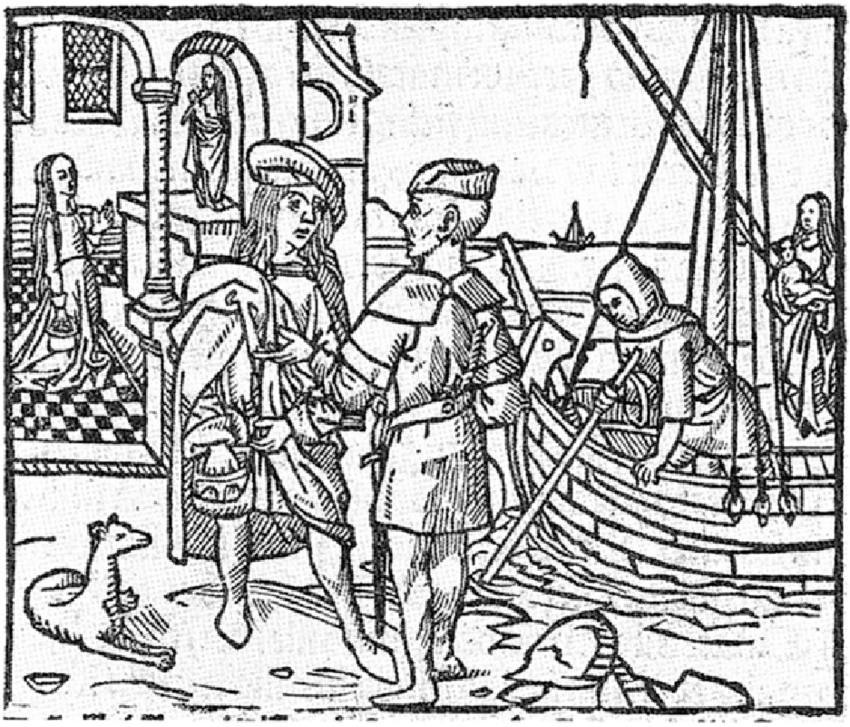
Our Lady of Schiedam is a statue of Our Lady in Holland, the Netherlands.  A merchant stole this image with the intention of selling it at a fair at Antwerp, but no matter what he attempted, he could never leave port.  Frightened by this miracle, he restored the image, and it was solemnly transported to the Church of St. John the Baptist.

Our Lady of Schiedam in the boat and church

It was at the shrine of Our Lady of Schiedam that the mystic, St. Lidwina spent whole nights in prayer. Early in her life, Lidwina was drawn toward the Mother of God and prayed a great deal before this miraculous image.  The Mother of God revealed to her the extent of suffering Christ would ask her to endure, but likewise assured her that she, Mary, would sustain her through her grace and intercessory power. The Blessed Virgin was true to her word, as was St. Lidwina in accepting the will of God in imitation to Our Lady’s Fiat.

St Cajetan (1480-1547) (Optional Memorial) Known as the “Father of Providence” and the “Huntsman of Souls” – Founder of the Theatine Order – Priest, Confessor, Reformer, Doctor of Civil and Canon Law, Diplomat, Mystic, Miracle Worker, apostle of the sick and the poor.

St Afra of Augsburg
Bl Agathangelus Nourry

St Albert of Trapani O.Carm. (c 1240-1307) Carmelite Priest, Confessor, Preacher, Evangeliser, apostle of prayer and a devout servant of the Blessed Virgin and the Passion of Christ. St Teresa of Jesus (1515-1582) and St Mary Magdalene de Pazzi (1566-1607) were especially devoted to him, the Bl Baptist Spagnoli (1447–1516) composed a sapphic ode in his honour.

Bl Cassian Vaz Lopez-Neto
St Claudia of Rome
St Donat
St Donatian of Chalons-sur-Marne

St Donatus of Arezzo (Died 362) Bishop and possibly a Martyr, Confessor, Miracle-worker.

St Donatus of Besancon
Bl Edmund Bojanowski
Bl Edward Bamber
St Faustus of Milan
St Hilarinus of Ostia
St Hyperechios
Bl John Woodcock
Bl Jordan Forzatei
St Julian of Rome
St Miguel de la Mora
Bl Nicholas Postgate
St Peter of Rome
Bl Thomas Whitaker
Blessed Vincent de L’Aquila OFM (c 1435-1504)
St Victricius of Rouen

Martyred Deacons of Rome – 6 saints: A group of deacons who were martyred with Pope Saint Sixtus II. We know nothing about them but their names and their deaths – Agapitus, Felicissimus, Januarius, Magnus, Stephen and Vincent. They were
beheaded on 6 August 258 in a cemetery on the Appian Way, Rome, Italy.

Martyrs of Como – 6 saints: A group of Christian soldiers in the imperial Roman army. Martyred in the persecutions of Maximian. We know little else but the names – Carpophorus, Cassius, Exanthus, Licinius, Secundus and Severinus. c.295 on the north side of Lake Como, near Samolaco, Italy. Their relics in the church of San Carpoforo, Como, Italy.

Martyred in the Spanish Civil War: 10 Beati
Bl Dalmacio Bellota Perez
Bl Diodorus Hernando Lopez
Bl Francisco Gargallo Gascón
Bl Luis Villanueva Montoya
Bl María del Carmen Zaragoza y Zaragoza
Bl María Rosa Adrover Martí
Bl Rafaél Severiano Rodríguez Navarro
Bl Tomás Carbonell Miquel

Posted in Our MORNING Offering

Our Morning Offering – 5 August – Concórdi lætítia

Our Morning Offering – 5 August – “Month of the Immaculate Heart of Mary” – The Memorial of the Dedication of Mary Major, Our Lady of the Snows

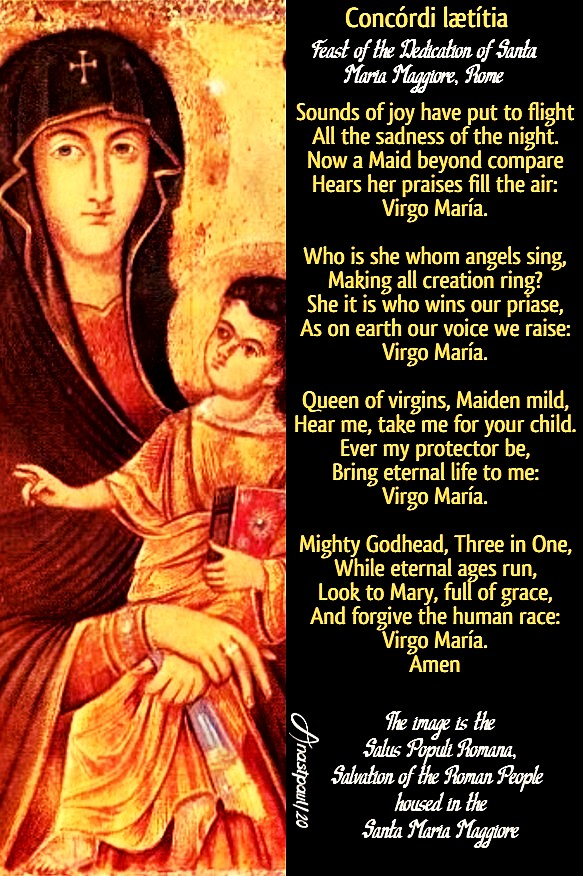
Concórdi lætítia
Harmonious Joy

Sounds of joy have put to flight
All the sadness of the night.
Now a Maid beyond compare
Hears her praises fill the air:
Virgo María.

Who is she whom angels sing,
Making all creation ring?
She it is who wins our priase,
As on earth our voice we raise:
Virgo María.

Queen of virgins, Maiden mild,
Hear me, take me for your child.
Ever my protector be,
Bring eternal life to me:
Virgo María.

Mighty Godhead, Three in One,
While eternal ages run,
Look to Mary, full of grace,
And forgive the human race:
Virgo María.
Amen

Posted in AUGUST - The Immaculate Heart of Mary

Thought for the Day – 5 August – The Divine Heart of Mary

St John Eudes – The Admirable Heart of Mary

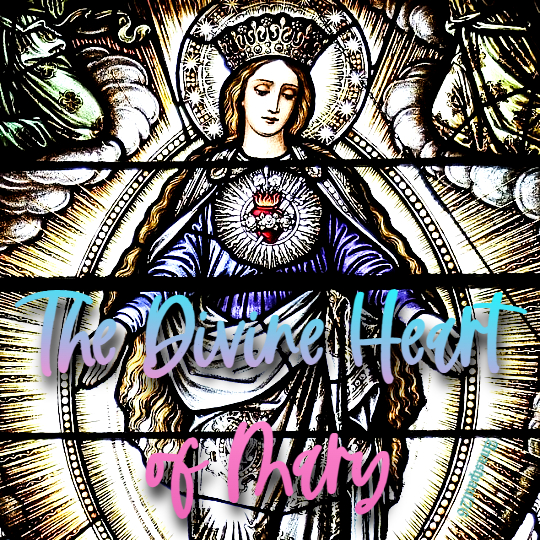
The Divine Heart of Mary

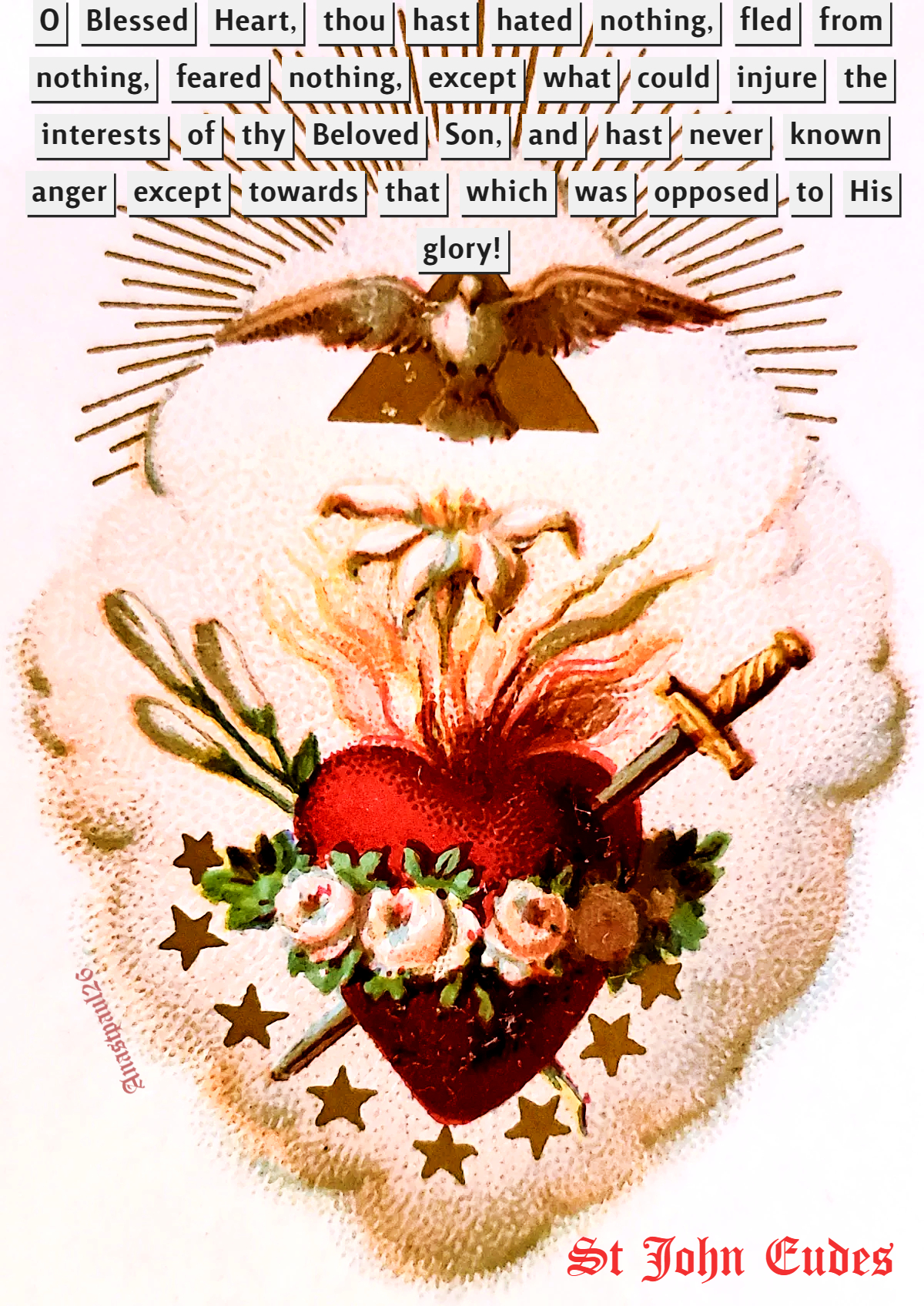
Jesus Christ, the Heart of the Eternal Father, is the Heart of His Holy Mother. Is not the heart the principle of life? And what is the Son of God to His dear Mother? He always was and will be forever the heart of her heart, the soul of her soul, the spirit of her spirit, and the sole principle of all the movements, uses and functions of her most holy life. St. Paul tells us that it is not himself who lives but Jesus Christ who lives in him. Our Lord is the life of all Christians: so who could doubt that He abides in His holy Mother, and that He is the life of her life, the heart of her heart, in a union incomparably more excellent even than with St. Paul and the other faithful saints?

Let us listen to what Our Lady revealed to St. Brigid: “My Son was truly my Heart to me. When He left my bosom to be born, it seemed as though half of my Heart were going forth from me. When He suffered, I felt His pain as though my Heart endured the identical sorrows and torments that He endured. When my Son was being scourged and torn with whips, my Heart was scourged and whipped with Him. When Hel ooked at me from the Cross, and I at Him, two streams of tears gushed from my eyes; and when He saw me oppressed with sorrow, He experienced such violent anguish at my desolation that the pain caused by His sorrow was my sorrow as His Heart was my Heart. Because Adam and Eve together betrayed the world for one, single forbidden fruit, so did my beloved Son wish that I should cooperate with Him in redeeming it with one Heart, quasi cum uno Corde.

Jesus lives in her soul and in her body, and in each faculty of her body and soul. He lives in her entirely, which means that whatever is in Jesus is also in Mary. His Heart abides in her heart, His soul in her soul, His spirit in her spirit. The memory, intellect and will of Jesus are alive in the memory, intellect and will of Mary; his interior and exterior senses in her interior and exterior senses. His passions in her passions; His virtues, mysteries and divine attributes are living in her Heart. Nay, more than living, they hold sovereign sway, producing inconceivably marvellous effects and impressing a living image of themselves as her Heart mirrors His Sacred Heart.

This veneration of Mary means honoring the corporeal Heart, the spiritual Heart and the divine Heart of Jesus, who are also the Hearts, or rather, the one and only Heart of Mary. It means giving glory to Our Lord, Jesus Christ, who is the Heart of the Eternal Father, and has willed to become the Heart of His Holy Mother. If Holy Church celebrates an annual feast in honor of the chains of St. Peter, the Prince of the Apostles, how great a solemnity does not the august Heart of the Queen of Apostles deserve!

Posted in MARIAN TITLES

Madonna dell’Apparizione / Our Lady of the Apparition, Pellestrina, Italy (1716) and Memorials of the Saints – 4 August

Madonna dell’Apparizione / Our Lady of the Apparition, Pellestrina, Italy (1716) – 4 August:

The Sanctuary of Madonna dell’Apparizione in Pellestrina was built in July 1717, a year after the appearance of the Madonna on the island. The event of 4 August 1716, the Feast day of St Dominic, was in fact confirmed true by canonical process: – a young boy from Pellestrina met a woman who advised him to tell the parish priest to celebrate Mass and to pray for the salvation of Venice, which, at that time, was besieged by the Turks. The following day, at the same hour of the Apparition, the Venetians won the Battle of Petrovaradin against the Turks.

Throughout the entire year the Sanctuary is a destination for many pilgrims and devotees in search of grace and even today, on 4 August in Pellestrina, the Madonna dell’Apparizione and the victory of Venice is celebrated over three days.

St Dominic de Guzman OP (1170-1221) (Memorial) Founder of the Dominican Order of Preachers – Priest, Founder, Confessor, Teacher, Preacher, Mystic, Miracle-Worker, Apostle of the Holy Rosary. At Dominic’s baptism, Blessed Joan, his Mother, saw a star shining from his chest, which became another of his symbols in art, and led to his patronage of astronomy. The Roman Martyrology states today: “At Bologna, St Dominic, Confessor, Founder of the Order of Friars Preachers, most renowned for sanctity and learning. He preserved his chastity unsullied to the end of his life and by his great merits, raised three persons from the dead. After having repressed heresies by his preaching and instructed many in the religious and Godly life, he rested in peace on the 6th of this month. His Feast, however, is celebrated on this day by decree of Pope Paul IV.

St Agabius of Verona
St Aristarchus of Thessalonica (1st Century)
St Crescentio of Rome
St Eleutherius of Bithynia
St Epiphanes of Besançon
St Euphronius of Tours (c 530-573) Bishop
St Francesc Mercader Rendé

St Hyacinth of Rome
St Ia of Persia
St Isidore of Besançon
St Lua of Limerick
St Onofrio of Panaia
St Perpetua of Rome
St Protasius of Cologne
St Rainerio of Split
St Sithney (Died c 529)
St Tertullinus of Rome
Bl William Horne

Posted in ONE Minute REFLECTION

One Minute Reflection – 3 August – An open breach

One Minute Reflection – 3 August – “Month of the Immaculate Heart of Mary” – Readings: Ps 54:17-20; 54:23, Ps 54:2-3, 1 Cor. 12:2-11, Luke 18:9-14

At that time, Jesus spoke this parable to some who trusted in themselves as being just and despised others.

Luke 18:9-14

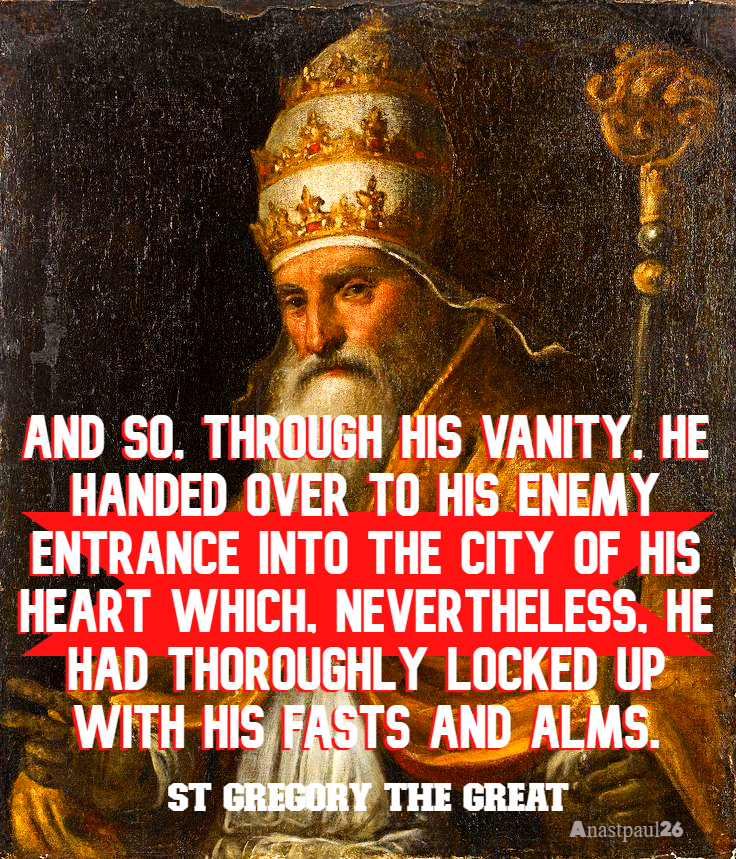
REFLECTION – With what precaution the Pharisee, who went up to the Temple to pray and who had fortified the citadel of his soul, claimed to fast twice a week and give the tenth of all he earned. When he said: “My God, I thank you,” it is very clear he had brought along every imaginable precaution with which to defend himself. However, he leaves one place open and exposed to the enemy by adding: “Because I am not like this publican here”. And so, through his vanity, he handed over to his enemy entrance into the city of his heart which, nevertheless, he had thoroughly locked up with his fasts and alms.

All other precautions are useless, then, when there remains in us some opening by which the enemy might enter. That Pharisee had conquered gluttony with abstinence; he had overcome avarice with generosity. But how much work for the sake of this victory had been made useless by a single vice? by the breach of a single sin?

This is why we ought not simply to think about doing good but watch carefully over our thoughts to keep them pure in our good deeds. For if they are a source of vanity or pride in our hearts then we are only fighting for a glory that is vain, not for that of our Creator.

Saint Gregory the Great (Moralia 76)

PRAYER – Lord our God, the Light and Creator of Light, grant that faithfully pondering on all that is holy, we may ever live in the splendour of Your presence. May we live in Your Presence, withstand the winds of the world and grow daily in faith. By the help and intercession of athe loving and Immaculate Heart of Mary You may never permit us to separate ourselves from You and thus we may come, to completion in You, Through Jesus Christ with the Holy Spirit, one God forever, amen.
Posted in Our MORNING Offering

Our Morning Offering –3 August – Blessed Virgin Mary, Receive Our Gratitude

Our Morning Offering –3 August – “Month of the Immaculate Heart of Mary”

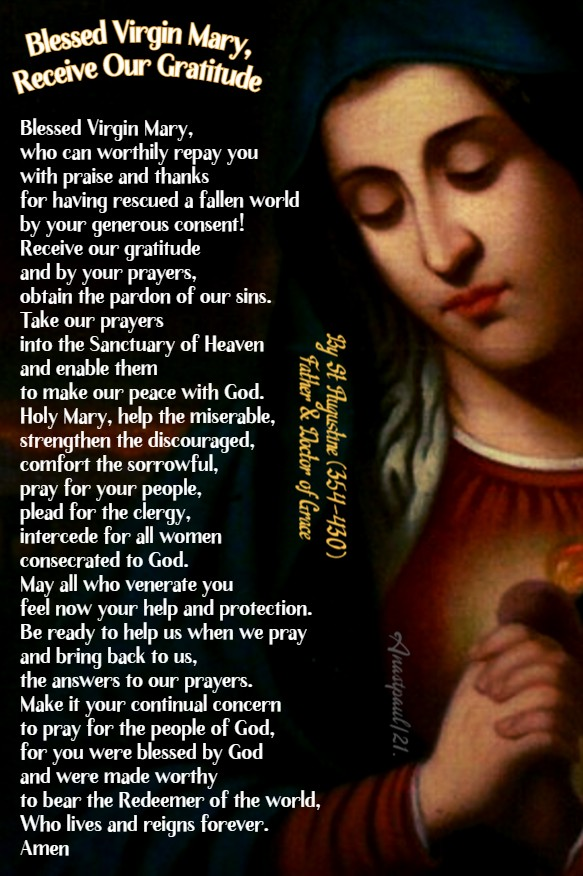
Blessed Virgin Mary,
Receive Our Gratitude
By St Augustine (354-430)
Father & Doctor of Grace

Blessed Virgin Mary,
who can worthily repay you
with praise and thanks
for having rescued a fallen world
by your generous consent!
Receive our gratitude
and by your prayers,
obtain the pardon of our sins.
Take our prayers into the Sanctuary of Heaven
and enable them to make our peace with God.
Holy Mary, help the miserable,
strengthen the discouraged,
comfort the sorrowful,
pray for your people,
plead for the clergy,
intercede for all women consecrated to God.
May all who venerate you
feel now your help and protection.
Be ready to help us when we pray
and bring back to us,
the answers to our prayers.
Make it your continual concern
to pray for the people of God,
for you were blessed by God
and were made worthy
to bear the Redeemer of the world,
Who lives and reigns forever.
Amen

Posted in ONE Minute REFLECTION

One Minute Reflection – 2 August – “O God, be merciful to me a sinner”

One Minute Reflection – 2 August – “Month of the Immaculate Heart of Mary” – Readings: Ps 54:17-20; 54:23, Ps 54:2-3, 1 Cor. 12:2-11, Luke 18:9-14

I tell you, this man went back to his home justified rather than the other; for everyone who exalts himself shall be humbled, and he who humbles himself shall be exalted.

Luke 18:9-14

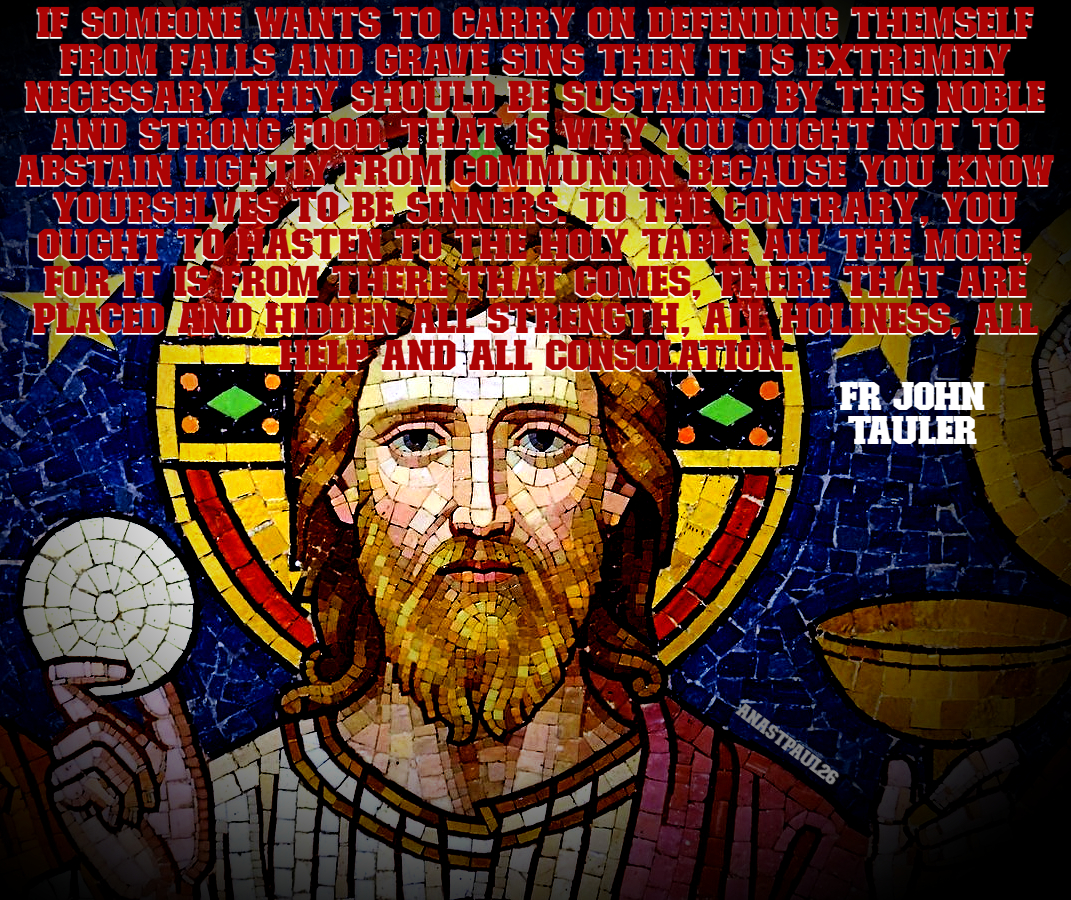
REFLECTION – Dear Sisters, be assured of this, truly, if I were to find someone who really possessed the publican’s feelings, who genuinely took themself for a sinner, so long as that person had a desire to be good while in this feeling of humility. I would give the body of our Lord to them every other day with a good conscience! If someone wants to carry on defending themself from falls and grave sins then it is extremely necessary they should be sustained by this noble and strong food. That is why you ought not to abstain lightly from communion because you know yourselves to be sinners. To the contrary, you ought to hasten to the holy table all the more, for it is from there that comes, there that are placed and hidden all strength, all holiness, all help and all consolation.

But you are not to judge those who don’t do this either… You should bear no judgment so as not to become like the Pharisee who glorified himself and condemned the man standing behind him. Watch yourselves against that as from the loss of your souls; watch yourselves against the dangerous sin of condemnation.

When someone reaches the heights of all perfection nothing has ever been more necessary to them than to plunge into the lowest depths and penetrate to to the roots of humility. This was why the publican, having acknowledged the ultimate depths of his lowliness to the point of not daring any more to raise his eyes to heaven, was raised up on high since “he went back to his house justified”.

Father John Tauler (1300-1361)

PRAYER – Forgive the sins of Your people Lord and since of ourselves, we are unable to do what pleases You, lead us on the way of salvation in Your divine Son who lives in us and gives us life. May the prayers of the Immaculate Heart of Mary, and most zealous Saint Alphonsus Liguori, help us to constantly meditate on Your eternal sustenance. Through, our Lord Jesus Christ, who lives and reigns with You and the Holy Spirit, God forever and ever, amen.
Posted in MARIAN TITLES

Feast Saint Peter in Chains, the Portiuncula Indulgence, Nuestra Señora de las Mercedes / Our Lady of Mercy, Barcelona, Spain (1218) and Memorials of the Saints – 1 August

Month of the Immaculate Heart of Mary

Feast Saint Peter in Chains

Portiuncula Indulgence:
An Indulgence which may be gained in any Church so designated by the Bishop, by all the faithful who, after Confession and Holy Communion, visit such Churches between noon of 1 August and midnight of 2 August, or on the Sunday following. The Indulgence is toties quoties and is applicable to the souls in Purgatory.

Nuestra Señora de las Mercedes / Our Lady of Mercy, Barcelona, Spain (1218,) Founding of the Mercedarian Order – 1 August, 24 September :

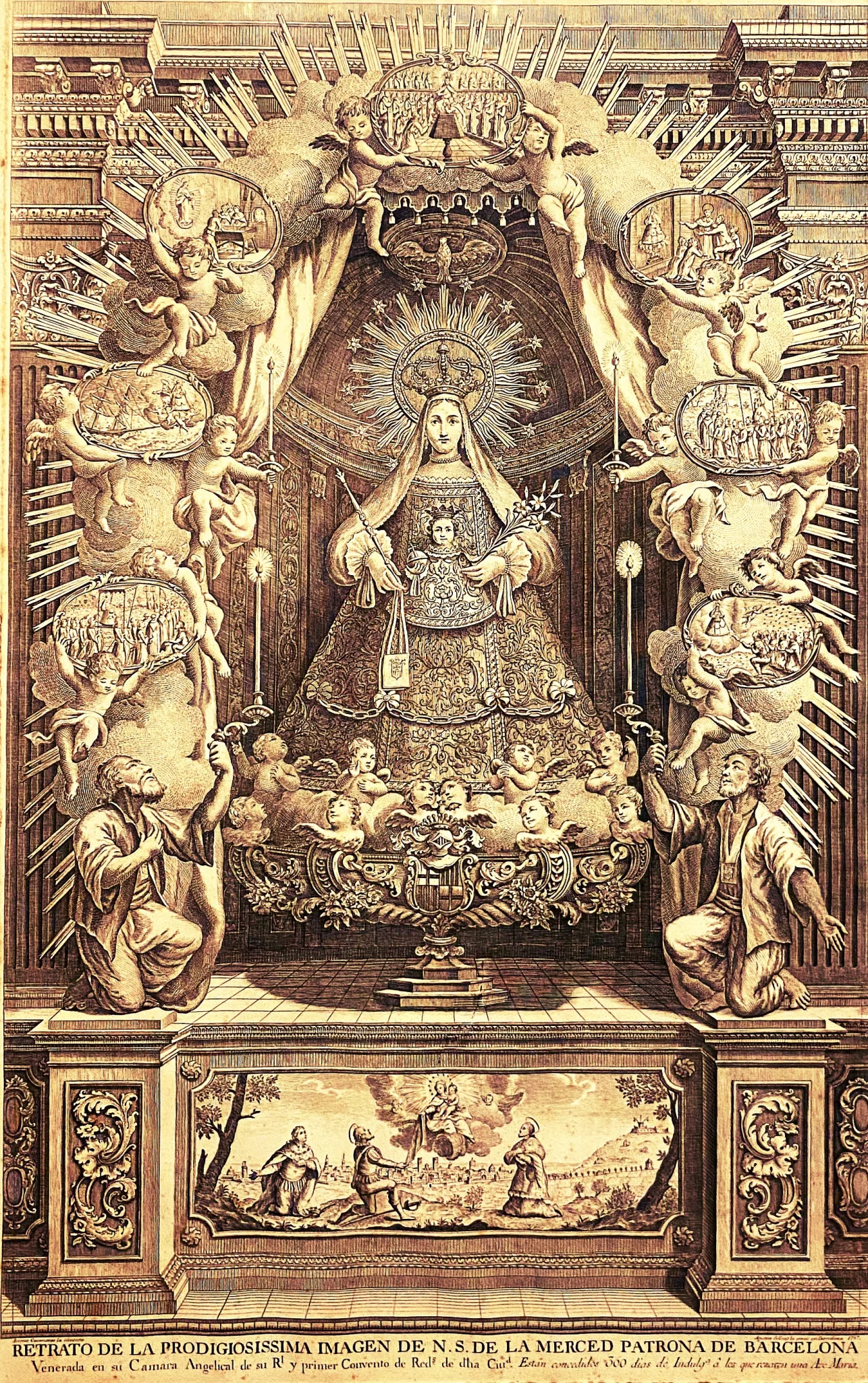
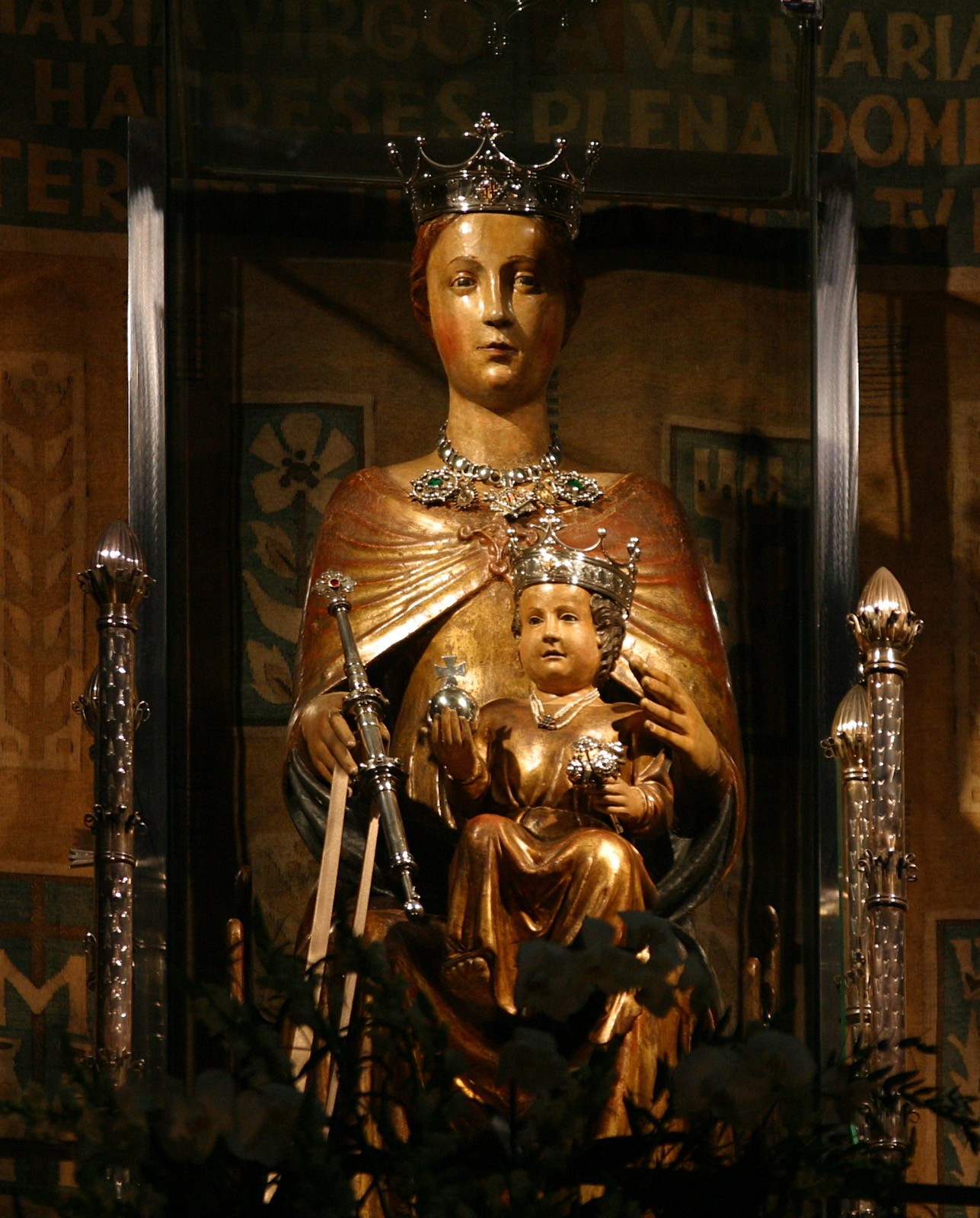
On 1 August of 1218, St Peter Nolasco, St Raymund of Penafort and James, King of Aragon, each had a vision of the Virgin Mary asking them to found a religious Order devoted to freeing Christian captives from the Muslims, who still held much of Spain. The Order of the Blessed Virgin Mary of Mercy grew quickly, collecting alms for ransom and sometimes offering themselves in exchange for prisoners. The Statue of the Mother of God of Mercy in Barcelona (below) dates from the 1300s. She became the City’s Patron after saving it from a plague of locusts in 1687. Before the counter-reformation, the Mercedarian Order celebrated the Feast of Our Lady of Ransom on 1 August, the date when she showed St. Peter Nolasco their white habit. The Vatican changed the date to 24 September when it extended the feast to entire Church in 1696. Since Vatican II, Catholic observance of Our Lady of Mercy’s day is limited to places and organisations that claim her as Patron.
Meanwhile, the Mercedarians have changed their mission to teaching and chaplaincy and the Barcelona soccer team visits the Basilica of La Mercè after victories in thanksgiving for her help. Her fiesta in Barcelona is a spectacular sequence of processions, dances, music, games and fireworks.

St Adela Mardosewicz
Bl Aleksy Sobaszek
St Alexander of Perga
St Almedha
St Arcadius
St Attius of Perga
St Buono
St Brogan
St Charity
St Ethelwold of Winchester (c 912-984) Bishop
St Exuperius of Bayeux
St Faith
St Faustus
St Felix of Gerona
St Friard
Bl Giovanni Bufalari
St Hope
St Jadwiga Karolina Zak
St Jonatus
St Justin of Paris
St Kenneth of Wales
St Leontius of Perga
St Maur
St Nemesius of Lisieux
Bl Orlando of Vallombrosa
St Peregrinus of Modena
St Rioch
Bl Rudolph
St Secundel
St Secundus of Palestrina
St Sophia
St Verus of Vienne

Holy Maccabees: Jewish dynasty which began with the rebellion of Mathathias and his five sons against the Syrian king, Antiochus IV (168 BC) and ruled the fortunes of Israel until the advent of Herod the Great. Syrian attempts to force Greek paganism on the Jews, the profanation of the Temple at Jerusalem and the massacre which followed, brought the nation to arms under Mathathias, a priest of the sons of Joarib. At the death of Mathathias, Judas Machabeus, his third son, drove the Syrians and Hellenists out of Jerusalem, rededicated the Temple and began an offensive and defensive alliance with the Romans. Before the treaty was concluded, however, Judas, with 800 men, risked battle at Laisa with an overwhelming army of Syrians under Bacchides, and was slain. He was succeeded in command by his youngest brother, Jonathan (161 BC). Jonathan defeated Bacchides, revenged the death of his brother and made peace with Alexander who had usurped the throne of Demetrius, the successor to Antiochus. A period of peace followed in which Jonathan ruled as high priest in Jerusalem but Tryphon, who was plotting for the throne of Asia, treacherously captured him at ptolemais and later put him to death. The captaincy of the armies of Israel then fell to Simon, the second son of Mathathias. Under him the land of Juda flourished exceedingly. He obtained the complete independence of the country and a grateful people bestowed upon him the hereditary kingship of the nation. His rule marked five years of uninterrupted peace. He was treacherously slain by his son-in-law, Ptolemy, about the year 135 BC After Simon the race of the Machabees quickly degenerated. In 63 BC the Romans thought it necessary to interfere in the fratricidal war between Hyrcanus II and Aristobulus II. With this interference and the advent of Herod the Great the sceptre passed forever from the land of Juda. The story of the Machabees is written in the two books of the Old Testament which bear that name.

Martyrs of Nowogrodek – 11 beati: A group of eleven Holy Family of Nazareth nuns who were murdered by the Nazi Gestapo in exchange for 120 condemned citizens of Nowogrodek, Belarus who were scheduled for revenge killings. They are –
• Adela Mardosewicz
• Anna Kukolowicz
• Eleonora Aniela Józwik
• Eugenia Mackiewicz
• Helena Cierpka
• Jadwiga Karolina Zak
• Józefa Chrobot
• Julia Rapiej
• Leokadia Matuszewska
• Paulina Borowik
• Weronika Narmontowicz
They were machine-gunned by firing squad on 1 August 1943 by the Gestapo about three miles outside Novogrudok (Nowogródek), Hrodzyenskaya voblasts’, in Nazi occupied Belarus and buried on the site of the execution in a common grave. One of their surviving sisters, Maria Malgorzata Banas, located the grave on 19 March 1945 and tended to it until her death in 1966. Their relics have since been re-interred in a common sarcophagus in the chapel of the Novograd Farny Church (the Church of the Transfiguration, also known as Biala Fara or the White Church).

Posted in ONE Minute REFLECTION

One Minute Reflection – 1 August – “Blessed are those who hear the word of God and observe it”

At that time, as Jesus was speaking to the multitudes, a certain woman from the crowd lifted up her voice and said to Him, Blessed is the womb that bore You, and the breasts that nursed You. But He said, Rather, blessed are they who hear the word of God and keep it.

Luke 11:27-28

REFLECTION – “Happy the one who bore you and she who nursed you at the breast.” How great is the devotion, how great the faith are expressed in the words of this woman in the gospel. Whereas scribes and Pharisees put the Lord to the test and blaspheme against him, this woman acknowledges his incarnation before them all with such loyalty and confesses it with such assurance that she undoes the calumny of her contemporaries and the false faith of heretics to come. Offending against the works of the Holy Spirit, Jesus’ contemporaries deny he is really the Son of God, consubstantial with the Father. Later on people also denied that Mary ever-Virgin had, through the working of the Holy Spirit, provided the substance of her flesh to the Son of God, who would be born with a truly human body. They denied he was really Son of man with the same nature as his mother. But the apostle Paul condemns this opinion when he says of Jesus that he was “born of a virgin, subject to the Law”. For, conceived in the womb of the Virgin, he took his flesh, not out of nothing, nor from some other source, but from the body of his mother. Otherwise it would not be correct to call him truly Son of man.

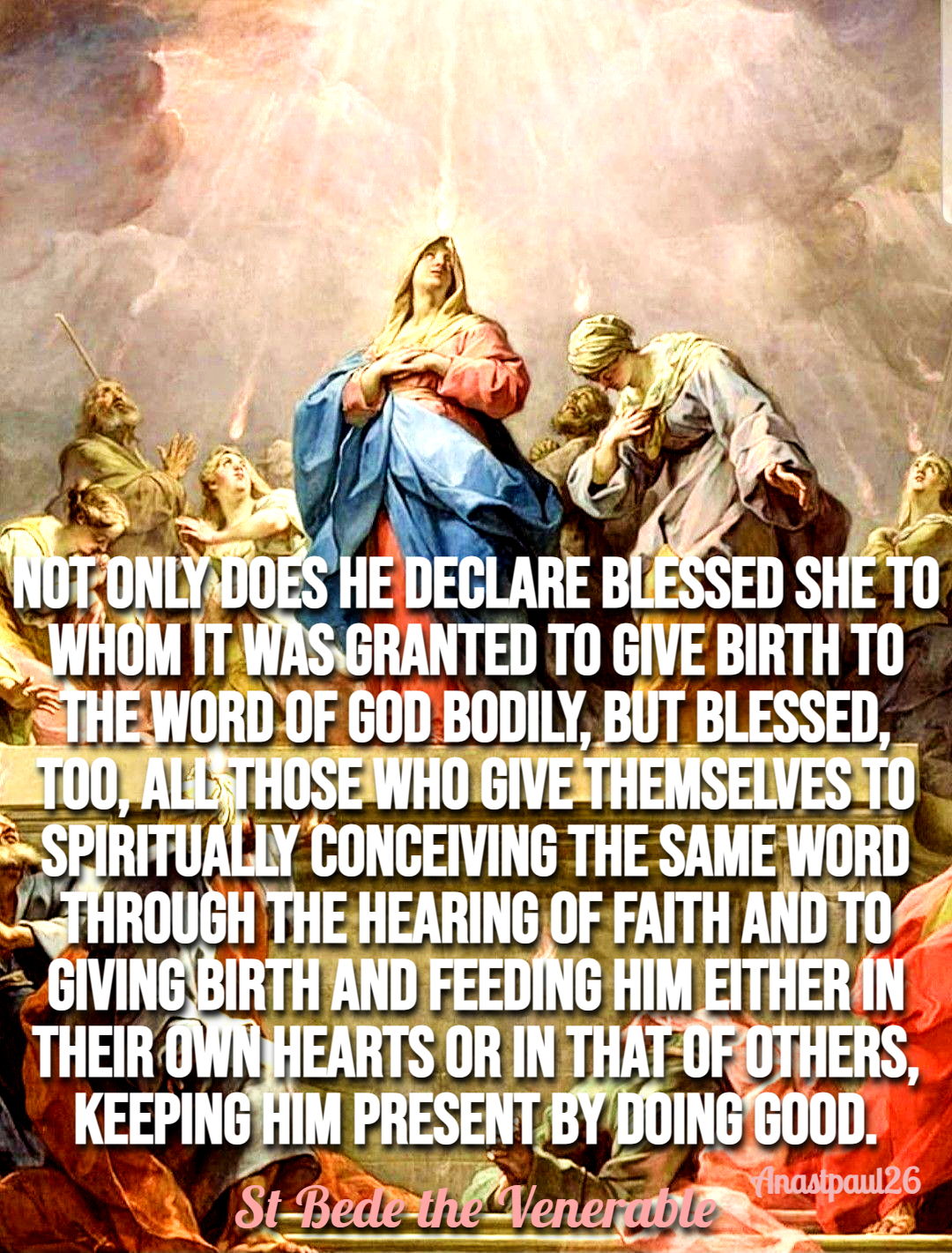
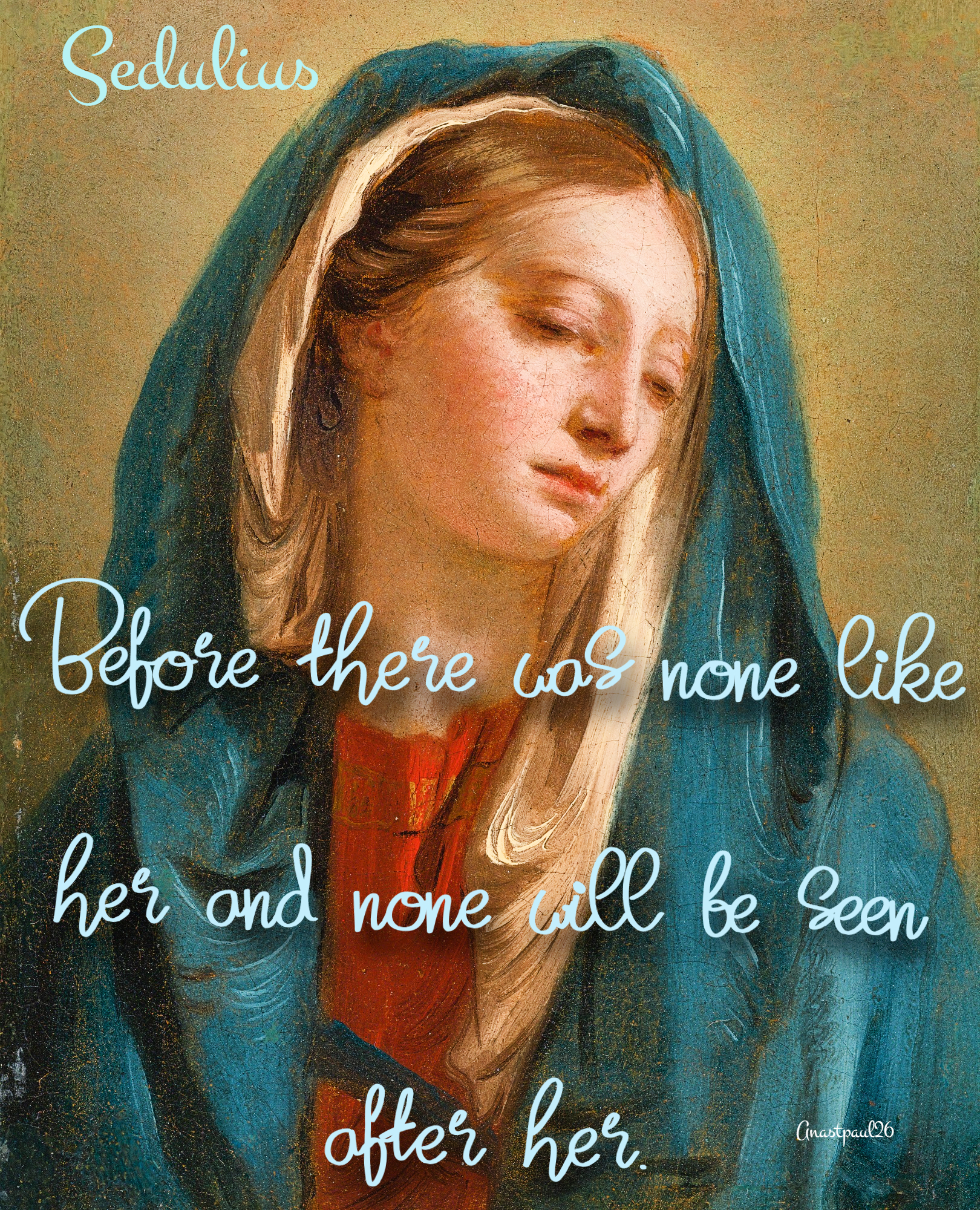
O truly happy mother who, in the words of the poet: “has given birth to the King who, through all ages, rules heaven and earth. She has the joy of motherhood and the honor of virginity. Before there was none like her and none will be seen after her”. Nevertheless the Lord adds: “Happy, rather, are those who hear the Word of God and keep it”. The Savior gives magnificent confirmation to this woman’s testimony. Not only does he declare blessed she to whom it was granted to give birth to the Word of God bodily, but blessed, too, all those who give themselves to spiritually conceiving the same Word through the hearing of faith and to giving birth and feeding him either in their own hearts or in that of others, keeping him present by doing good.

Saint Bede the Venerable (Homily on St Luke)

PRAYER – Forgive the sins of Your people Lord and since of ourselves, we are unable to do what pleases You, lead us on the way of salvation in Your divine Son who lives in us and gives us life. May the prayers of Mary, His Mother help us to constantly meditate on His eternal sustenance. He is our food, our Lord Jesus Christ, who lives and reigns with You and the Holy Spirit, God forever and ever, amen.

Posted in AUGUST - The Immaculate Heart of Mary

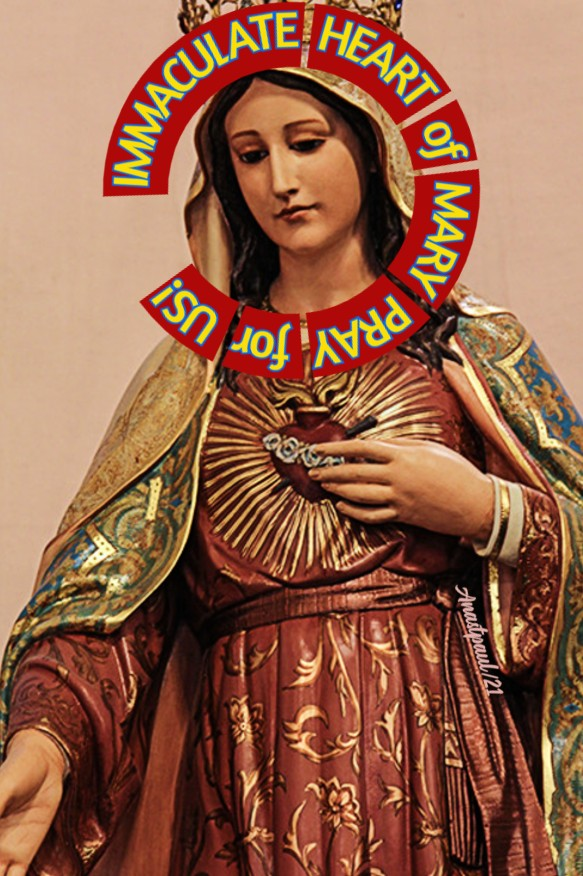
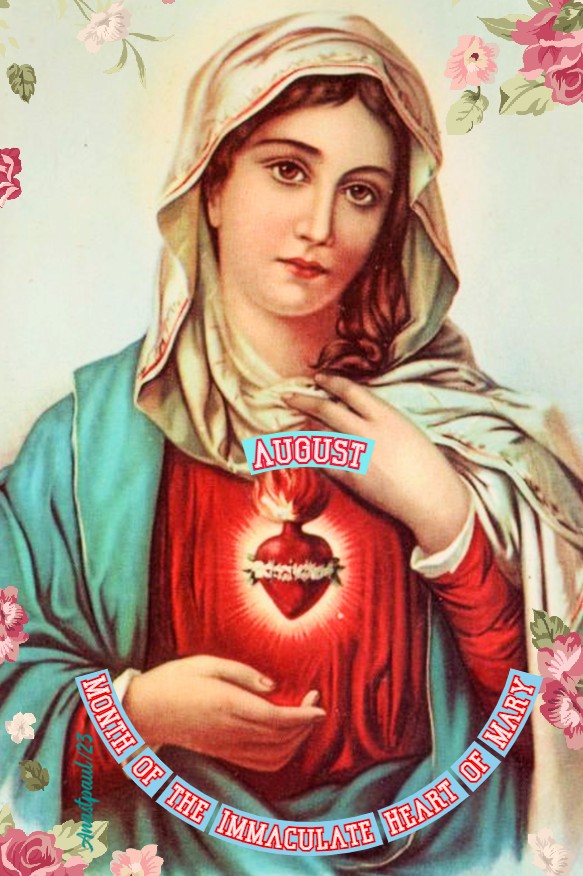
AUGUST – The Month of the Immaculate Heart of Mary

Do not be surprised if I say that the virginal Heart of this Mother of Fair Love is an admirable Heart indeed. Mary is admirable in her divine Maternity because as St. Bernardine of Siena says, “to be Mother of God is the miracle of miracles,” miraculum miraculorum.

But the august Heart of Mary is also truly admirable, for it is the principle of her divine Maternity and of the wonderful mysteries this privilege implies.

Of Mary’s admirable Heart I shall attempt to speak in this book although to speak and write worthily of the holy Heart of God’s own Mother one would need a heart of fire. To know and proclaim the perfections of the noble Heart of the Queen of Angels one should have the intellect of a cherub and the flaming love of a seraph. Nay more, it would be necessary to possess the mind, the heart, the tongue and the hand of Jesus Christ, the King of all hearts, to understand, honor, proclaim or commit to writing the treasures of sanctity contained in the holy Heart of Mary, the worthiest, most royal and most marvellous of all hearts after the most adorable Heart of our Saviour Himself.

Mary is truly admirable in all her perfections and in all her virtues?
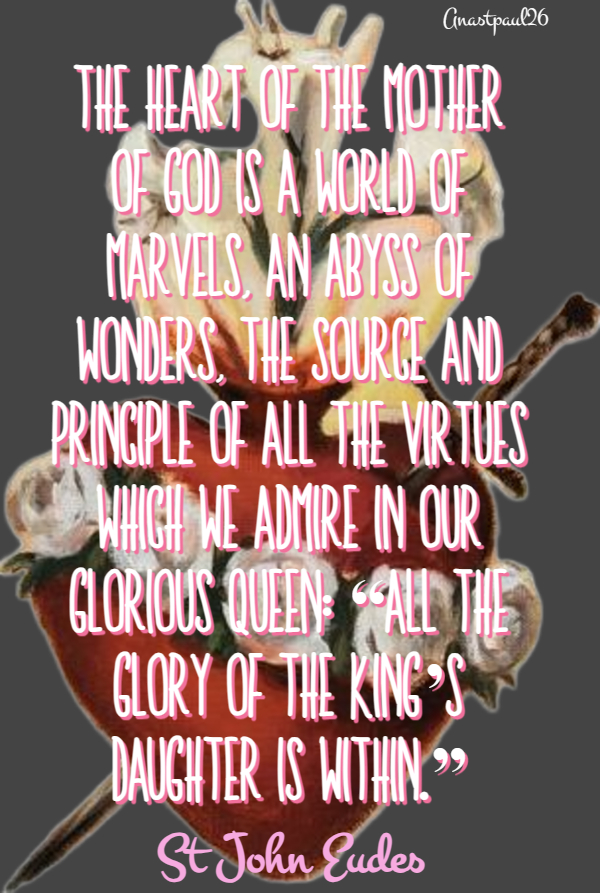
But what is most admirable in her is her virginal heart. The heart of the
Mother of God is a world of marvels, an abyss of wonders, the source and principle of all the virtues which we admire in our glorious Queen: “All the glory of the king’s daughter is within.”

St John Eudes

Posted in AUGUST - The Immaculate Heart of Mary

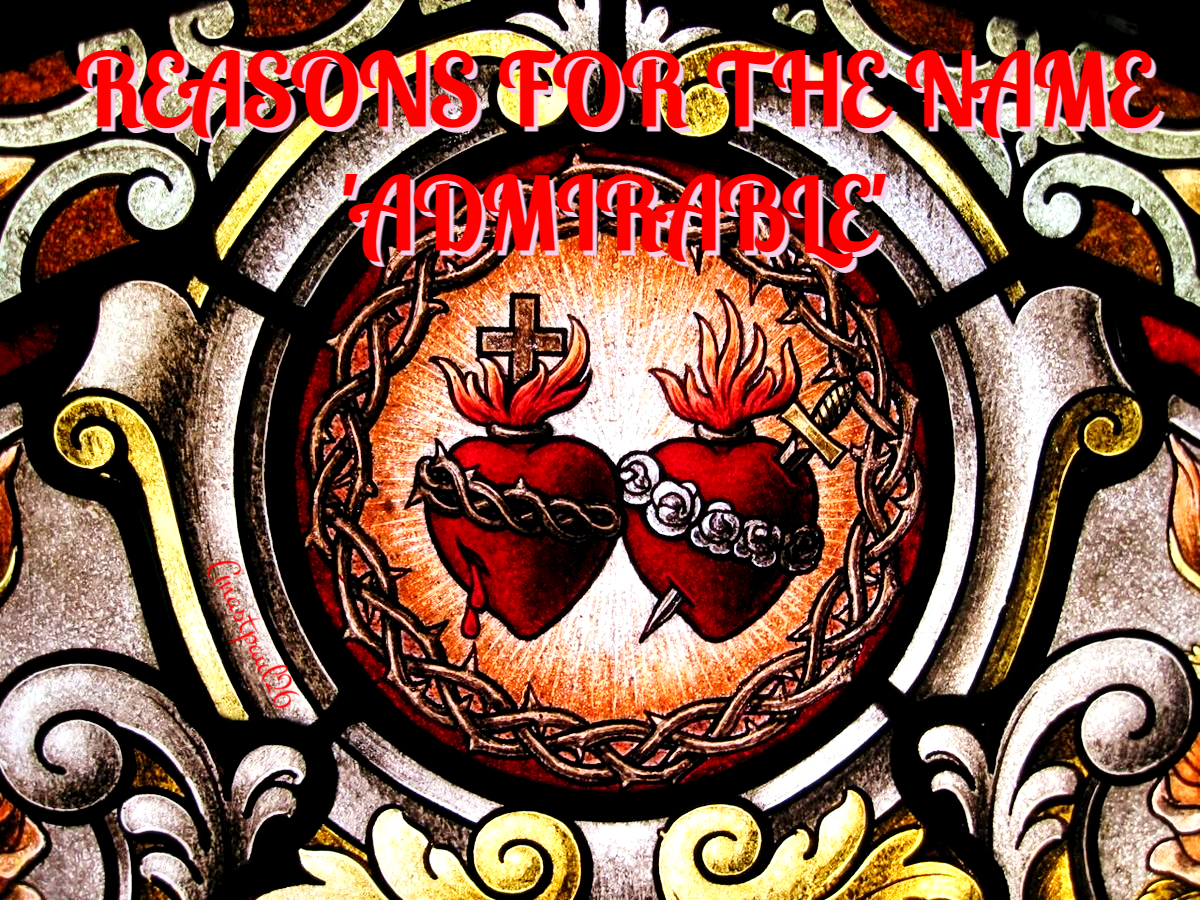
Thought for the Day – 1 August – Reasons for the name ‘Admirable’

St John Eudes – The Admirable Heart of Mary

Reasons for the name ‘Admirable’

Jesus Christ, the Only-Begotten Son of God, chose the incomparable Virgin Mary from among all creatures to be His Mother and deigned to be nourished and governed by her. In His infinite goodness He also gave her to us to be our Queen, our Mother and our sure Refuge in all our needs. He therefore wishes us to honor her as He honors her and to love her as He loves her.

According to the Apostle St. Paul, Christ is the Head of His Mystical Body, the Church, and we are the members. We must therefore be animated by His Spirit; we must follow His inspirations, walk the path He has traced, and continue, as it were, His life on earth by practising the virtues which were His own. It follows that our devotion to His Holy Mother must be a continuation of His devotion to her. We must be filled with the sentiments of respect, submission and affection which He entertained for her on earth and still entertains in heaven. Mary always held and will hold forever the first place in the Sacred Heart of her Divine Son; she always was and will never cease to be the first object of His love after the Eternal Father; and so He wishes that, next to God, she should be the principal object of our devotion. For this reason, after the veneration we owe to the Divine Majesty of God, we cannot render a greater service to Jesus Christ or do anything more pleasing to Him than to serve and honor His most worthy Mother.

Among the divinely inspired passages of Sacred Scripture I select one from the twelfth chapter of the Apocalypse, which is a compendium of all the great things that can be said or thought of our marvellous Queen. “A great sign appeared in heaven: A woman clothed with the sun, and the moon under her feet, and on her head a crown of twelve stars.”

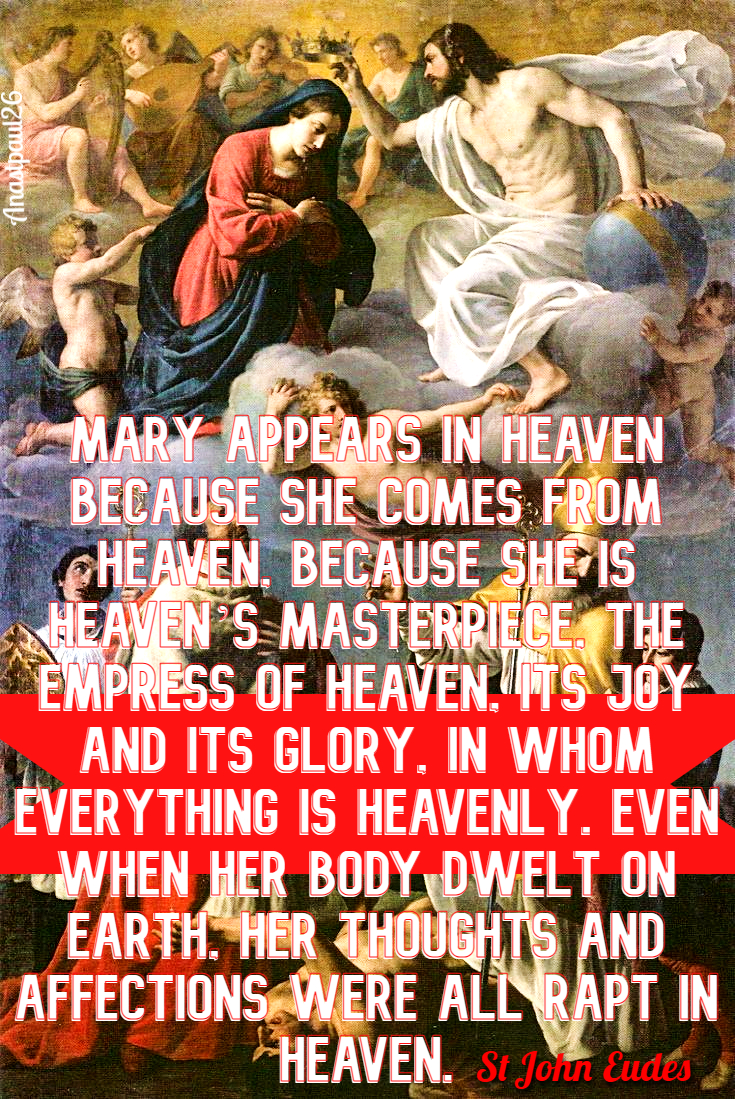
What is this great sign? Who is this miraculous woman? St. Epiphanius, St. Augustine, St. Bernard and many other holy doctors agree that the woman is Mary, the Queen among women, the Sovereign of angels and men, the Virgin of virgins. She is the woman who bore in her chaste womb the perfect man, the God-Man. “A woman shall compass a man.” Mary appears in heaven because she comes from heaven, because she is heaven’s masterpiece, the Empress of Heaven, its joy and its glory, in whom everything is heavenly. Even when her body dwelt on earth, her thoughts and affections were all rapt in heaven.

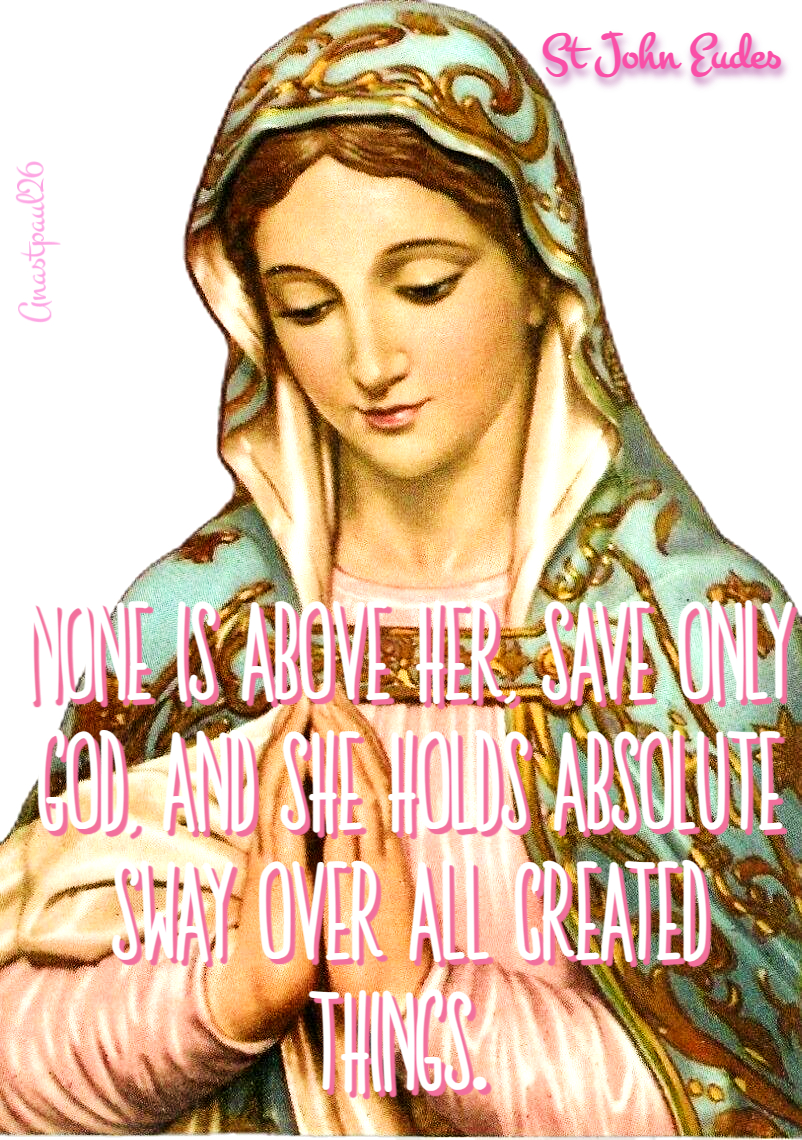
She is clothed with the eternal Sun of the Godhead and with all the perfections of the Divine Essence, which surround, fill and penetrate her to such an extent that she has become transformed, as it were, into the power, goodness and holiness of God. She has the moon under her feet to show that the entire world is beneath her. None is above her, save only God, and she holds absolute sway over all created things.

Posted in Our MORNING Offering

Our Morning Offering – 31 July – Hail, O Mother!

Our Morning Offering – 31 July – “Month of the Precious Blood” and Mary’s Day

Hail, O Mother!
By St John Chrysostom (347-407)
Father and Doctor of the Church

Hail, O Mother!
Virgin, heaven, throne, glory of our Church,
it’s foundation and ornament.
Earnestly pray for us to Jesus,
your Son and Our Lord,
that through your intercession,
we may have mercy on the day of judgement.
Pray that we may receive, all those good things
which are reserved for those who love God.
Through the grace and favour of Our Lord, Jesus Christ,
to Whom, with the Father and the Holy Spirit,
be power, honour and glory,
now and forever.
Amen

Posted in MARIAN TITLES

Madonna dei Miracoli / Holy Mary of Miracles, Morbio Inferiore, Ticino, Switzerland (1594) and Memorials of the Saints – 29 July

Madonna dei Miracoli / Holy Mary of Miracles, Morbio Inferiore, Ticino, Switzerland (1594) – 29 July:

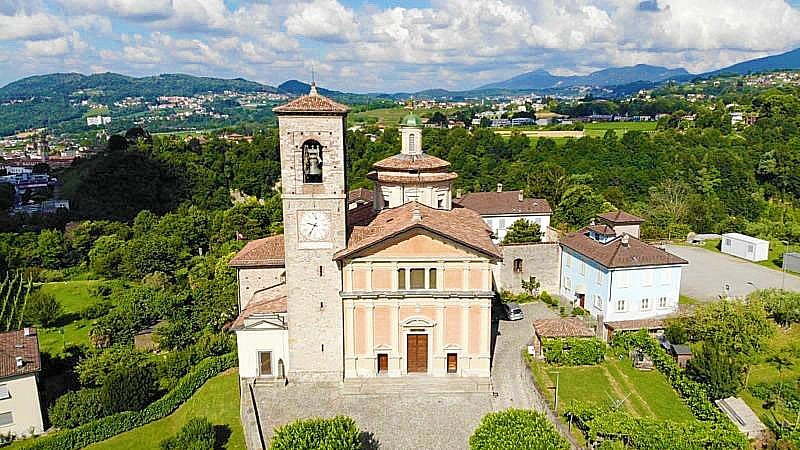
Where the Sanctuary of Morbio now stands, a castle stood centuries ago, attested in 1198 and destroyed in the first half of the sixteenth century. Only the ruins of a Chapel, dedicated to St Bernardino of Siena, transformed over time into a pile of rubble, buried by weeds, brambles and thorns., remained. Surrounded by ivy and fortunately well preserved, remained the Fresco in the Chapel, depicting the Virgin with the Child.

The history of the Sanctuary of Holy Mary of Miracles began on 29 July 1594. It was a Friday when the two mothers with their daughters, Catherine and Angela , respectively ten and seven years old, travelled to Morbio to entreat the assistance of Fr Gaspare Basbetrini. They were sick girls, tormented by the devil and had travelled to Morbio, to ask for the blessing of Don Gaspare Barberini, the assistant Priest at Morbio, who was well-known as an Exorcist. However, sadly for the pilgrims, Fr Basbetrini was absent.

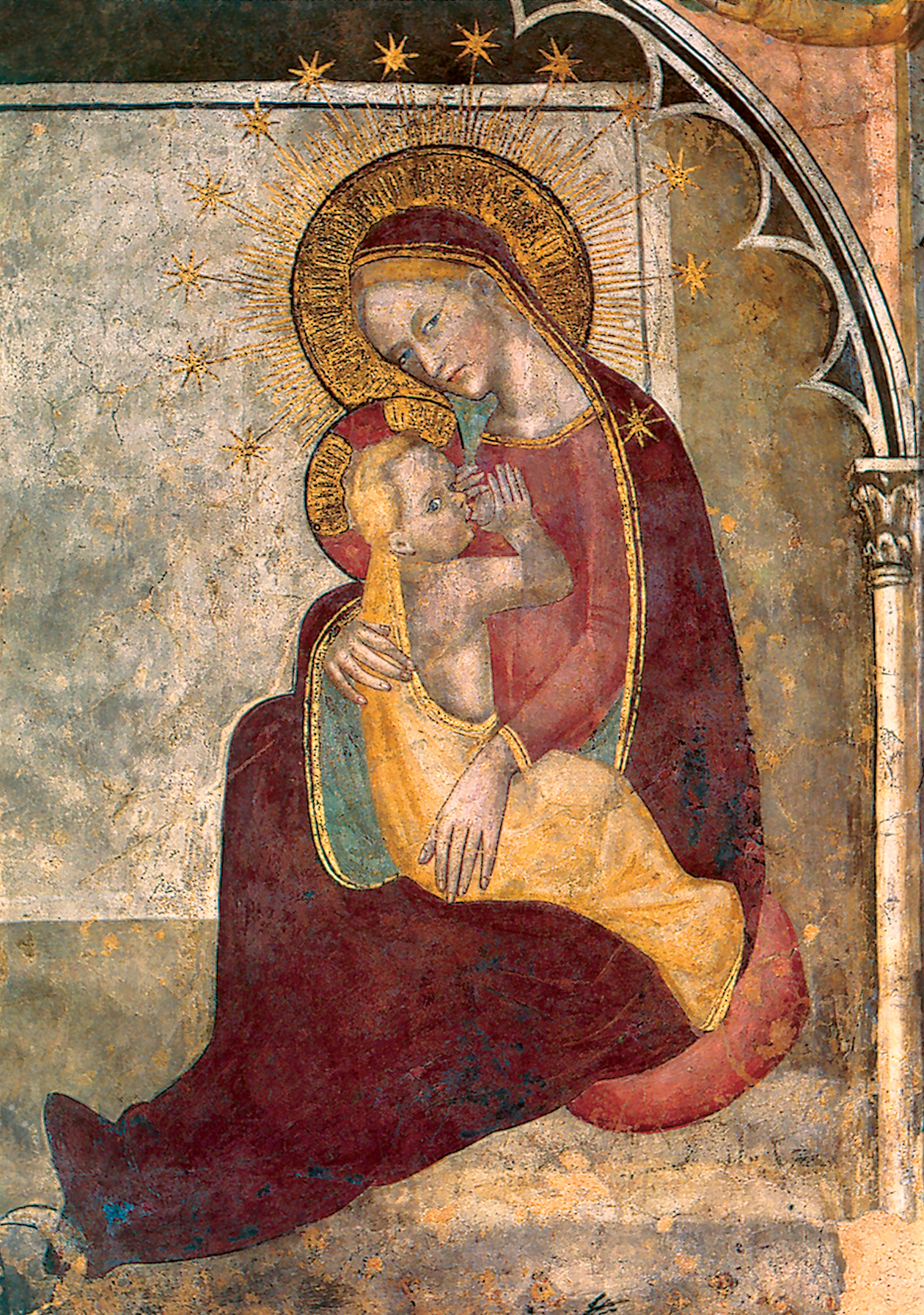
To the tiredness of the journey and the sadness of illness, the bitterness of disappointment was added. Among the ruins of the ancient castle the little group of supplicants waited and discovered on the crumbling and crumbling walls, the faded remains of a fresco depicting the Virgin in a deeply maternal position nursing Baby Jesus.

The two mothers knelt before the Virgin with their daughters and prayed in deep sadness and devotion for the intercession of the Holy Mother to come to the aid of the sick children.

And then the miracle happened. Those two poor simple and innocent creatures were cured. This is Morbio’s miracle – the Madonna appeared to the two little girls and cureds them of all their illnesses, dispelling any demonic presence within them.

Our Lady spoke to the elder girl, Catherine and instructed her to tell the Bishop that the Church should be rebuilt and that the Holy Rosary must be said everyday.

Eight days after the event, on 5 August 1594, the episcopal curia of Como, whose ecclesiastical jurisdiction also extended to the southern regions of Ticino, instructed the regular canonical process, which recognized, upon the sworn deposition of the main eyewitnesses, the truth of what happened and their prodigious and supernatural nature.

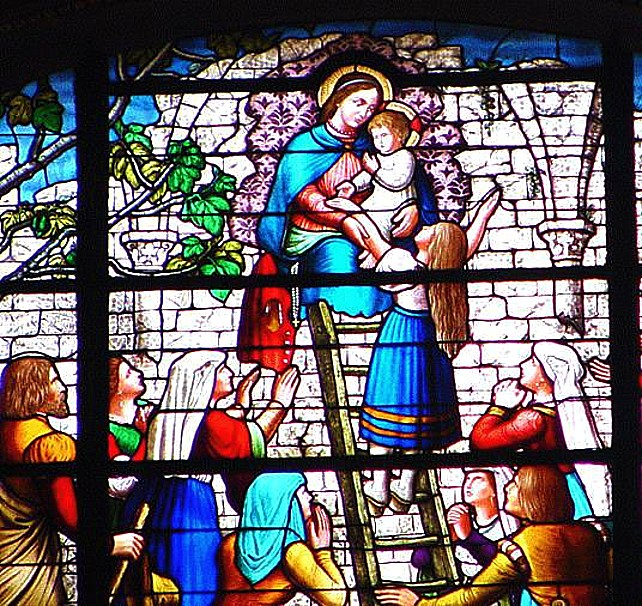
A stained-glass window, located at the top of the apse and placed at the beginning of this century, illustrates and reminds those who enter the Sanctuary of this miracle. Catherine is depicted on a ladder, with her arms outstretched, listening in front of the image of the Madonna dei Miracoli. At the foot of the ladder, Angela, the other sick girl, is lying asleep.

In a short while an Oratory was built on the site to recite the Rosary and celebrate Mass there, as the Madonna had said to Catherine, while on 29 July 1595, the Anniversary of the apparition and the miracle, the first stone was blessed and laid for the construction of the Sanctuary, Consecrated on 16 May 1631 by the Bishop of Como, Msgr Filippo Archinti.

St Martha (Memorial) – Sister of Saint Lazarus and Saint Mary of Bethany. Friend of Jesus and hostess to Him in her house. May have been part of an early mission to France.

St Antony
St Beatrix of Rome
Bl Beatrix of Valfleury
St Callinicus of Paphlagonia
Bl Charles-Antoine-Nicolas Ancel
St Faustinus of Rome
St Faustinus of Spello
St Felix of Rome
St John Baptist Luo Tingyin
St John the Soldier
Bl José Calasanz Marqués
St Joseph Zhang
St Kilian of Inishcaltra
St Lek Sirdani
Bl Luis Bertran
St Lupus of Troyes
Bl Mancius of the Cross
St Martha Wang
St Olaf II
St Olaus of Sweden
St Paulus Chen Changpin
Bl Petrus of Saint Mary
St Pjetër Çuni
St Prosper of Orleans
St Rufo of Rome
St Seraphina
St Serapia of Syria
St Simplicius of Rome
St Sulian

Blessed Pope Urban II (c 1035-1099) Bishop of Rome from 1088 until his death, Carthusian Abbot, Confessor

St William Pinchon of Saint Brieuc (1180-1234) Bishop of Saint Brieuc, Confessor

Four Anonymous Martyrs

Martyrs of Calanda – 8 beati: A group of Dominican priests and friars who were martyred over the course of a day in the same town by the same group of anti-Christian forces in the Spanish Civil War.
• Antonio Manuel López Couceiro
• Felicísimo Díez González
• Gumersindo Soto Barros
• Lamberto María de Navascués de Juan
• Lucio Martínez Mancebo
• Matías Manuel Albert Ginés
• Saturio Rey Robles
• Tirso Manrique Melero
They were martyred on 29 July 1936 in Calanda, Teruel, Spain I.

Martyrs of Lleida – 12 beati: Carmelites of the Ancient Observance novices, friars and priests who were all martyred together in the Spanish Civil War.
• Àngel Prat Hostench
• Eliseo Maneus Besalduch
• Gabriel Escoto Ruiz
• Ginés Garre Egea
• Joan Maria Puigmitjà Rubió
• Joan Prat Colldecarrera
• Josep Solé Rovira
• Lluis Fontdecava Quiroga
• Manuel Serrano Buj
• Miquel Soler Sala
• Pere Dorca Coromina
• Pere Ferrer Marín
They were martyred on 29 July 1936 in Clot dels Aubens, Cervera, Lleida, Spain.

Martyred in the Spanish Civil War: Thousands of people were murdered in the anti-Catholic persecutions of the Spanish Civil War from 1934 to 1939.
• Blessed Bartolomé Rodríguez Soria

Martyrs of Rome – 23 saints
Eugene
Flora the Martyr
Lucilla
Theodore

Posted in Our MORNING Offering

Our Morning Offering – 24 July – Virgin Full of Goodness, Mother of Mercy

Our Morning Offering – 24 July – “Month of the Most Precious Blood”

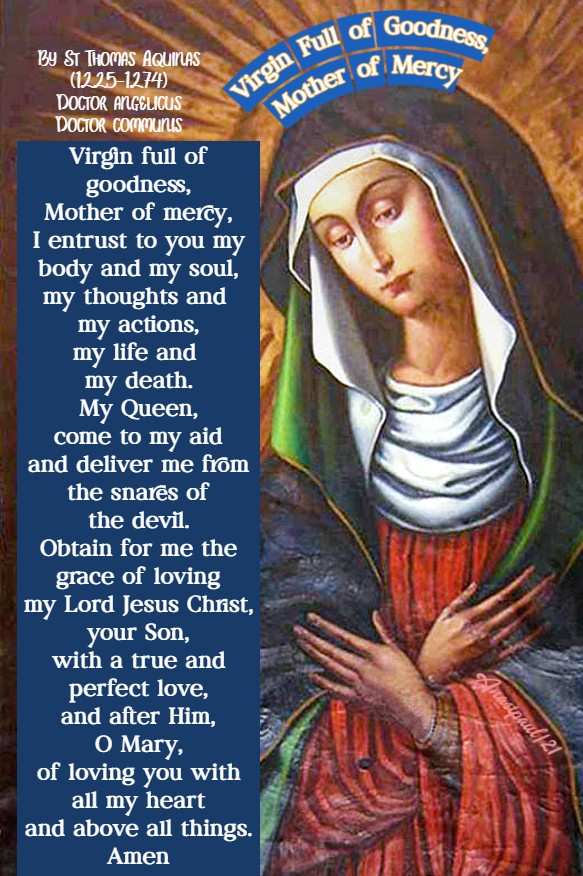
Virgin Full of Goodness,
Mother of Mercy
By St Thomas Aquinas (1225-1274)
Doctor angelicus

Doctor communis

Virgin full of goodness,
Mother of mercy,
I entrust to you my body and my soul,
my thoughts and my actions,
my life and my death.
My Queen,
come to my aid
and deliver me from the snares of the devil.
Obtain for me the grace of loving
my Lord Jesus Christ, your Son,
with a true and perfect love,
and after Him,
O Mary,
of loving you with all my heart
and above all things.
Amen.

Posted in ONE Minute REFLECTION

One Minute Reflection – 24 July – “The person who is trustworthy in very small matters is also trustworthy in great ones”

And the master commended the unjust steward, in that he had acted prudently; for the children of this world, in relation to their own generation, are more prudent than the children of the light.

Luke 16:1-9

REFLECTION – You should know where your own existence comes from, breath, intellect, and what is most precious of all: knowledge of God; from where comes hope of the kingdom of heaven and of beholding the glory that, at present, you see only dimly as in a mirror but that, tomorrow, you will see in all its purity and brilliance. From whence does it come that you are a child of God, inheritor along with Christ and, dare I say it, that you yourself are a god ? Where does all this come from, and through whom ?

Again, to speak only of things of lesser importance, those that are obvious: who granted you sight of the beauty of the heavens, the movement of the sun, the cycle of the moon, the countless stars and, in it all, the harmony and order governing them? Who gave you the rain, the cultivation of the land, food, art, laws, cities, a civilized life, close relationships with people like yourself ?

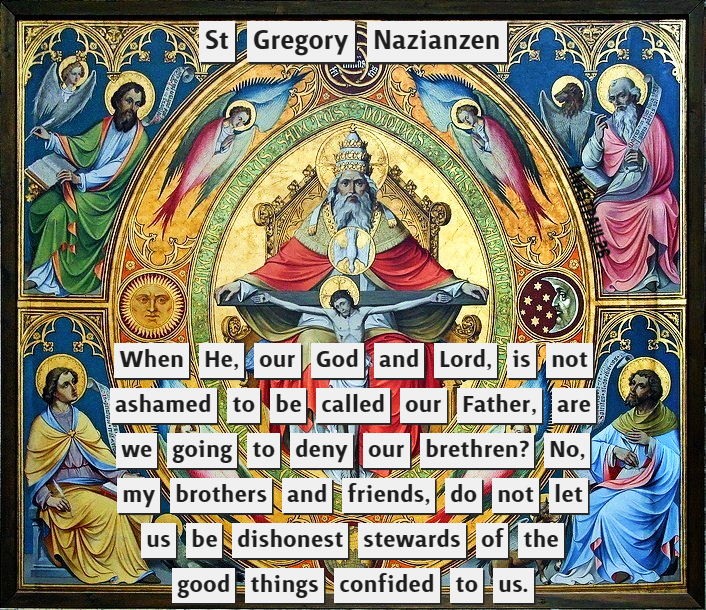
Isn't it from He who, before all else and in return for all His gifts, requires of you to love humankind? When He, our God and Lord, is not ashamed to be called our Father, are we going to deny our brethren? No, my brothers and friends, do not let us be dishonest stewards of the good things confided to us.

St Gregory Nazianzen (Homily 14, On love for the poor)

PRAYER – All-powerful and ever-living God, splendour of true light and never-ending day, chase away the night of sin and fill our minds with the glory of Your coming. Take away our heart of stone and give us a heart of flesh, help us in our battle with sin and the devil. By our prayers, Your holy sacraments and the strength of the Holy Spirit, may we be ever vigilant of the evil one. Hear the prayers of our Queen and Mother, the Blessed Virgin of Mercy on our behalf dear Lord. We make our prayer through Christ, our Lord with the Holy Spirit, one God forever, amen.

Posted in MARIAN TITLES

Madonna di Altino / Our Lady of Altino, Albino, Bergamo, Lombardy, Italy (1496) and Memorials of the Saints – 23 July

Madonna di Altino / Our Lady of Altino, Albino, Bergamo, Lombardy, Italy (1496) – 23 July:

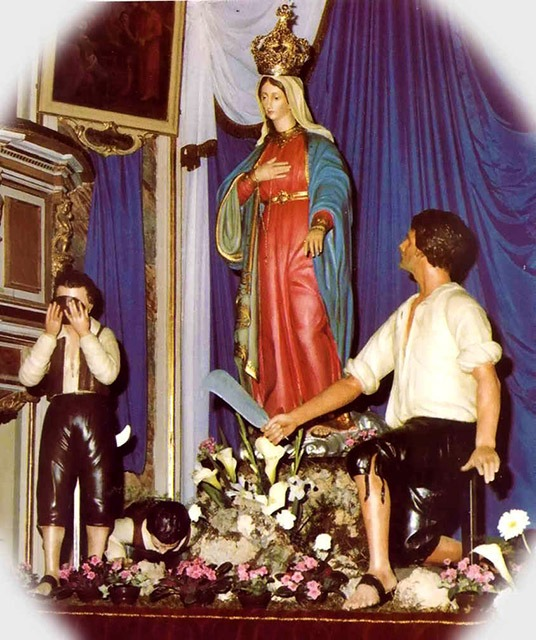
On 23 July 1496, during a heatwave and drought,Quinto Foglia and his two little boys were walking from their home in Vall’Alta to the wooded slopes of Monte Altino, where they worked making charcoal. Stricken with thirst and afraid for his children, Quinto prayed to the Madonna. She appeared and told him to strike a rock with his staff. When he did, a spring surged forth. The next day, people began building a little Chapel, which was completed on 5 September 1496. In 1865 a statuary group depicting the apparition was installed in the Sanctuary. On 23 July 1919, in thanksgiving for her protection during World War I, the Madonna’s Statue was solemnly crowned. The Shrine celebrates its feast with an evening procession on 22 July and solemn Mass on 23 July, the anniversary of both the apparition and the crowning.

St Anne of Constantinople

St Apollonaris (1st Century) Bishop Martyr, Disciple of St Peter

Blessed Vasil/Basil Hopko (1904-1976) Greek Catholic Bishop and Martyr.

Bl Beaudoin of Beaumont
St Conan of Cornwall
Bl Emilio Arce Díez
St Eugene of Rome
St Herundo of Rome
Blessed Giovanna of Orvieto OP (c 1264-1306) Virgin, Tertoary of the Order of Preachers, Mystic, Stigmatist

St John Cassian (c 360- c 435) Priest, Monk, Theologian, Writer, Founder., Father of the Church.

Bl Josep Sala Picó
Bl Juan de Luca
Bl Juan de Montesinos
Bl Leonard da Recanati

Blessed Margarita María López de Maturana (1884-1934) known as “Mother Margarita” – Religious, Foundress of the Mercedarian Missionaries of Berriz.

Bl Pedro Ruiz de los Paños Angel
St Phocas the Gardener
St Primitiva of Rome
St Rasyphus of Macé
St Rasyphus of Rome
St Ravennus of Macé
St Redempta of Rome
St Romula of Rome
St Severus of Bizye
St Theophilus of Rome
St Trophimus of Rome
St Valerian of Cimiez
Bl Wojciech Gondek

Martyrs of Barcelona – 7 beati: Seven Christians, some lay people, some members of the Missionaries of the Sacred Hearts of Jesus and Mary and some of the Franciscan Daughters of Mercy, who were martyred in two groups on the same day in the Spanish Civil War.
• Catalina Caldés Socías
• Francesc Mayol Oliver
• Miquel Pons Ramis
• Miquela Rul-Làn Ribot
• Pau Noguera Trías
• Prudència Canyelles Ginestà de Aguadé
• Simó Reynés Solivellas
23 July 1936 in Barcelona, Spain. They were Beatified on 28 October 2007 by Pope Benedict XVI.

Martyrs of Bulgaria: An unknown number of Christians killed for their faith during the 9th century war between the Greek Emperor Nicephorus and the Bulgars.

Martyrs of Carabanchel Bajo – 9 beati: A group of nine Passionist priests, brothers and clerics who were martyred together in the Spanish Civil War.
• Anacario Benito Nozal
• Felipe Ruiz Fraile
• Felipe Valcobado Granado
• José Osés Sainz
• José Ruiz Martinez
• Julio Mediavilla Concejero
• Laurino Proaño Cuesta
• Manuel Pérez Jiménez
• Maurilio Macho Rodríguez
22 July 1936 in Carabanchel Bajo, Madrid, Spain.

Martyrs of Horta – 10 beati: A lay woman and nine Minim nuns who were martyred together in the Spanish Civil War.
• Ana Ballesta Gelmá
• Dolors Vilaseca Gallego
• Josefa Pilar García Solanas
• Josepa Panyella Doménech
• Lucrecia García Solanas
• Maria Montserrat Ors Molist
• Mercè Mestre Trinché
• Ramona Ors Torrents
• Teresa Ríus Casas
• Vicenta Jordá Martí
23 July 1936 at the Sant Genís dels Agudells highway, Horta, Barcelona, Spain.

Martyrs of Manzanares – 5 beati: Five Passionist clerics who were martyred together in the Spanish Civil War.
• Abilio Ramos y Ramos
• Epifanio Sierra Conde
• José Estalayo García
• Vicente Díez Tejerina
• Zacarías Fernández Crespo
They were shot on 23 July 1936 in Manzanares, Ciudad Real, Spain

Posted in ONE Minute REFLECTION

One Minute Reflection – 23 July – I am in your midst as he who serves

One Minute Reflection – 23 July – “Month of the Most Precious Blood”

The kings of the Gentiles lord it over them, and they who exercise authority over them are called Benefactors. But not so with you. On the contrary, let him who is greatest among you become as the youngest, and him who is the chief as the servant.

Luke 22:24-30

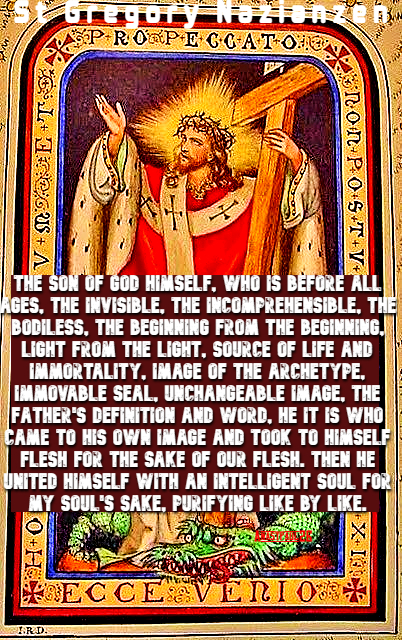
REFLECTION – The Son of God himself, who is before all ages, the invisible, the incomprehensible, the bodiless, the beginning from the beginning, light from the light, source of life and immortality, image of the archetype, immovable seal, unchangeable image, the Father’s definition and Word, he it is who came to his own image and took to himself flesh for the sake of our flesh. Then he united himself with an intelligent soul for my soul’s sake, purifying like by like. He took to himself all that is human, except sin… He who enriches others becomes poor. He took to himself the poverty of my flesh so that I might obtain the riches of his godhead. He who is full empties himself. He emptied himself of his godhead for a brief time so that I might share in his fulness.

What is this wealth of goodness ? What is this mystery that touches me ? I received the divine image and I did not keep it. He receives my flesh to save the image and grant immortality to the flesh. This, his second communion with us, is far more marvellous than the first… It was necessary that holiness be conferred on man through the humanity God took to himself. In this way, conquering the tyrant by force, he freed us and led us back to himself through his Son, the mediator. The Son brought this about to the honour of the Father to whom, in all things, he is seen to defer.

St Gregory Nazianzen (Homily no.45)

PRAYER – A pure heart create for me O God, put a steadfast spirit within me! Lord God, bestow a full measure of Your grace to us. Keep us within in the path of Your commandments, help us to work on the earth of our souls, rooting out the weeds and casting forth the stones of malice. Grant that by the prayers of our Blessed and Merciful Mother, we may succeed in attaining sanctity. Through Christ, our Lord, in union with the Holy Spirit, one God, forever, amen.

Posted in ONE Minute REFLECTION

One Minute Reflection – 20 July – Share your bread with the hungry

Share your bread with the hungry, shelter the oppressed and the homeless; clothe the naked when you see them, and do not turn your back on your own.

Isa 58:7-11

REFLECTION – We should not reject those goods that may potentially be of use to our neighbor. It is in the nature of possessions to be possessed and that of goods to spread good. God intended them for man’s well being. Our goods lie in our hands like tools, instruments that we can put to good use so long as we know how to wield them… Nature has made a servant of wealth, not a mistress. So we shouldn’t decry it since it is neither good not bad in itself but completely neutral. We ourselves are alone responsible for the use, good or bad, which we make of it. Our minds, our consciences are entirely set free from disposing as they choose of the goods entrusted to them. What we should destroy are not our goods but the covetousness that perverts their use. When we have acquired integrity then we shall know how to use them with integrity. Those goods we are told to get rid of we should understand to be the unregulated desires of the soul. You gain nothing from depriving yourself of your money if you remain rich in unregulated desires.

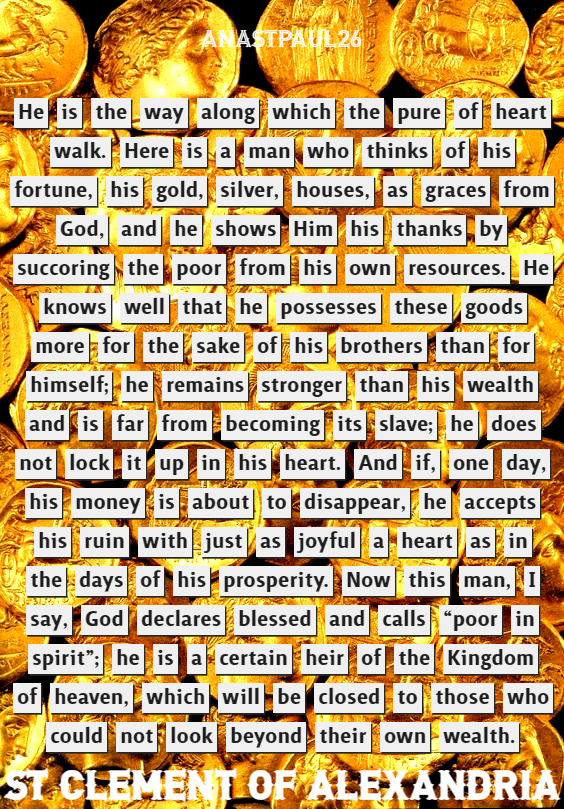
See how the Lord conceived of the use of external goods: we need to detach ourselves, not from the money that enables us to live, but from the forces that cause us to use it badly, namely sicknesses of the soul. We need to purify our souls, that is to say, make them poor and naked and, in that state, listen to the Lord’s call: “Come, follow me.” He is the way along which the pure of heart walk. Here is a man who thinks of his fortune, his gold, silver, houses, as graces from God, and he shows Him his thanks by succoring the poor from his own resources. He knows well that he possesses these goods more for the sake of his brothers than for himself; he remains stronger than his wealth and is far from becoming its slave; he does not lock it up in his heart. And if, one day, his money is about to disappear, he accepts his ruin with just as joyful a heart as in the days of his prosperity. Now this man, I say, God declares blessed and calls “poor in spirit”; he is a certain heir of the Kingdom of heaven, which will be closed to those who could not look beyond their own wealth.

St Clement of Alexandria (Homily “How can the rich be saved?”)

PRAYER – Almighty Father, You made us Your children, You called us from all ages and You formed us by Holy Mother Church. Grant, we pray, that by Your grace, we may be ever faithful to her and be guided by Your Holy Spirit of love. O God, may Your Mother and ours and Your holy Angels and Saints intercede for us that, being made imitators of the Lord’s Passion, we may merit to be co-heirs of His Kingdom. Who lives and reigns with You in the unity of the Holy Spirit, one God, forever, amen.

Posted in MARIAN TITLES

Nuestra Señora de Zocueca / Our Lady of Zocueca, Bailén, Jaén, Andalucía, Spain (1808) and Memorials of the Saints – 20 July

Nuestra Señora de Zocueca / Our Lady of Zocueca, Bailén, Jaén, Andalucía, Spain (1808 – 20 July:

Around 1150, Mozarabic Christians built a rudimentary Chapel near the Rumblar River, the Guadalquivir tribuitary that waters this region in southern Spain, at a place called Zocueca. When Alfonso VII reconquered the area in 1155, people gave thanks to the Virgin at the Shrine. In the 1400s it was was rebuilt, and from this period the graceful, standing Gothic Statue of the Mother and Child seems to date, although tradition holds it to be older than the first Chapel.

During the cholera epidemic of 1681, the people vowed to hold an annual feast in honour of the Virgin, preceded by a day of fasting, if she would save them. The promise has been kept on 5 August ever since. The Chapel was re-decorated in Baroque style in the 1700s.

In 1808, people again thanked the Virgin of Zocueca for her help during the Battle of Bailén, the first Spanish victory against Napoleon. Annually since 1810, the municipality commemorates the battle with a series of civil, patriotic, and religious events from 17-22 July, reaching their greatest splendour on the 20th, when the Patroness, the Virgin of Zocueca, goes through the City streets in procession. Another event in her honour, the romería or pilgrimage, takes place on the last Sunday in September in thanks for her help in ending a plague of locusts which threatened the region’s crops in the late 1800s. Men carry the Statue, bristling with decorations, on their shoulders from its usual home in the Church of the Incarnation in Bailén, to the Sanctuary four miles distant, where overnight vigil is kept before a sunrise Mass. In 1925, the Virgin of Zocueca was proclaimed “Captain General” and her Statue given a military sash. After the Statue burned in the Civil War, religious sculptor Jose Maria Alcacer made a replica, blessed on 5 August1954.

St Apollinaris of Ravenna – Disciple of St Peter – Bishop Martyr (Optional Memorial)

Bl Anne Cartier
St Ansegisus
St Aurelius of Carthage
St Cassian of Saint Saba
St Chi Zhuze
St Elijah the Prophet

St Elswith

Blessed Gregory Lopez (1542-1596) “The Mystery Man” – Hermit, Spiritual Advisor, Writer. Around 1585, word of a “Mystery Man” began to leak into Mexico City, a strange hermit who lived out in the lonely valley of Guesteca, who walked miles to go to Mass, lived totally subject to “Lady Poverty” and had travelled from the Shrine of Our Lady of Guadalupe in Spain (which dates from 712), to her Shrine in Mexico (which dates from 1531).

St Jerome Emiliani (1486–1537) Layman, Founder of the Somascan Fathers

St Joseph Barsabbas the Just (1st Century) Disciple of Jesus, Bishop, Martyr

St José María Díaz Sanjurjo

St Margaret of Antioch (3rd century) Virgin Martyr. Margaret is one of the Fourteen Holy Helpers and is one of the Saints who spoke to St Joan of Arc.

St Maria Fu Guilin
St Mère
St Paul of Saint Zoilus
St Rorice of Limoges
St Severa of Oehren
St Severa of Saint Gemma
St Wulmar

Martyrs of Corinth – 22 saints: 22 Christians who were martyred together. We know nothing else about them but the names – • Appia • Calorus • Cassius • Celsus • Cyriacus • Donatus • Emilis • Felix • Fructus • Magnus • Maximus • Nestita • Partinus • Pasterus • Paul • Romanus • Spretus • Tertius • Theodolus • Ueratia • Valerian • Victor. They were martyred in Corinth, Greece.

Martyrs of Damascus – 16 saints: 16 Christians who were martyred together. We know the names of six of then, but no details about any of them – Cassia, Julian, Macrobius, Maximus, Paul and Sabinus. They were martyred in Damascus, Syria, date unknown.

Martyrs of Seoul – 8 saints: Eight lay native Koreans in various states of life who were murdered together for their faith.
• Anna Kim Chang-gum
• Ioannes Baptista Yi Kwang-nyol
• Lucia Kim Nusia
• Magdalena Yi Yong-hui
• Maria Won Kwi-im
• Martha Kim Song-im
• Rosa Kim No-sa
• Theresia Yi Mae-im
They were martyred on 20 July 1839 at the Small West Gate, Seoul, South Korea

Martyrs of Zhaojia – 3 saints: Married lay woman and her two daughters in the apostolic vicariate of Southeastern Zhili, China. During the persecutions of the Boxer Rebellion, the three of them hid in a well to avoid being raped. They were found, dragged out, and killed for being Christian. Martyrs. They were – Maria Zhao Guoshi (mother), Maria Zhao and Rosa Zhao (sisters). They were martyred in late July 1900 in Zhaojia, Wuqiao, Hebei, China.

Martyrs of Zhujiahe – 4 saints: Two Jesuit missionary priests and two local lay people who supported their work who were martyred together in the Boxer Rebellion during and immediately after Mass.
• Léon-Ignace Mangin
• Maria Zhu Wushi
• Paul Denn
• Petrus Zhu Rixin
They were martyred on 20 July 1900 in church in Zhujiahe, Jingxian, Hebei, China

Martyred in the Spanish Civil War:
• Blessed Abraham Furones y Furones
• Blessed Antoni Bosch Verdura
• Blessed Francisca Aldea y Araujo
• Blessed Jacinto García Riesco
• Blessed Joan Páfila Monllaó
• Blessed Josep Tristany Pujol
• Blessed Matías Cardona-Meseguer
• Blessed Rita Josefa Pujalte y Sánchez
• Blessed Vicente López y López

Posted in MARIAN TITLES

Nuestra Señora del Milagro / Our Lady of the Miracle, Lima, Peru (1630) and Memorials of the Saints – 19 July

Nuestra Señora del Milagro / Our Lady of the Miracle, Lima, Peru (1630) – 19 July and 27 November:

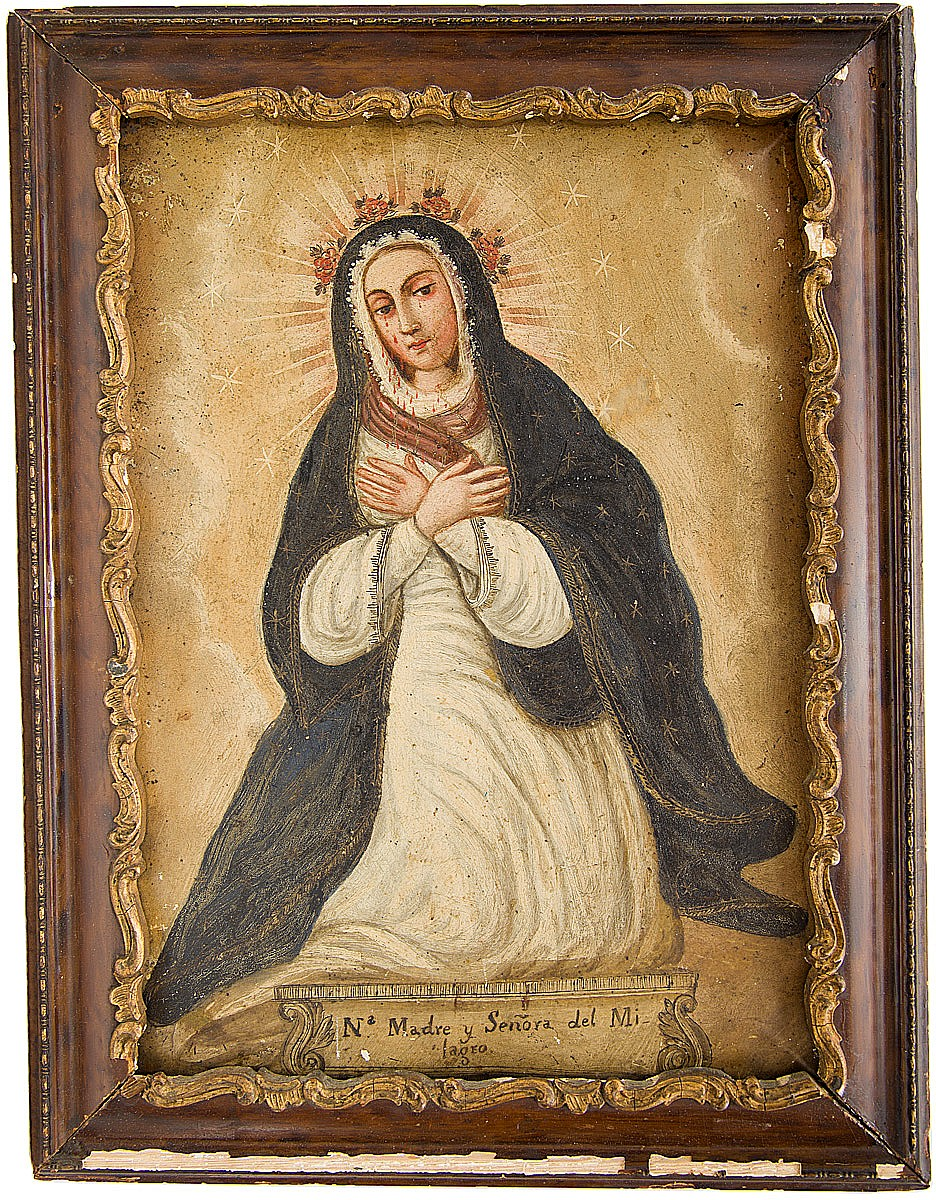
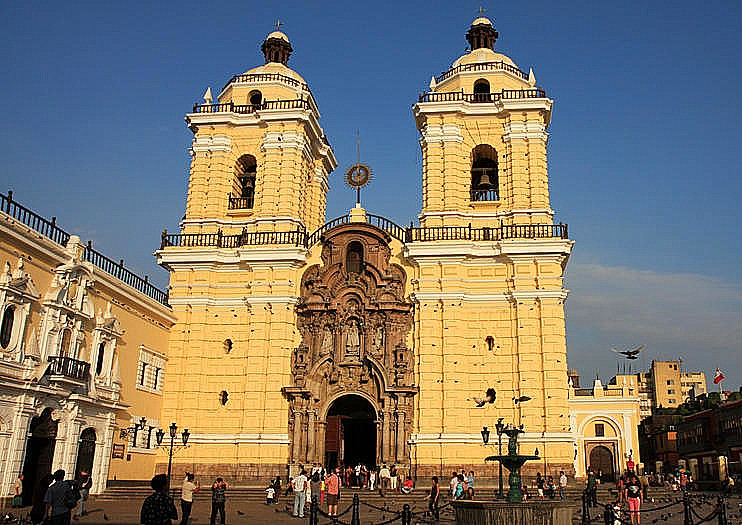
The Franciscan Friars who accompanied the Conquest to Peru hung an image of the Immaculate Conception over the door of their first Church in Lima. On missionary journeys around the region, they would take the image, “La Misionera,” with them. They were in Cusco, the Inca capital, on 23 May 1536 when, during the rebellion of Manco Inca against the two-year Spanish regime, natives trapped many Spaniards in a hut and set fire to the straw roof. La Misionera was seen by all to leave her place inside and to appear above the burning building together with Santiago (St.James the Greater). The fire ceased and all were saved. In honour of this event, the Spanish built the Church of the Triumph, now an adjunct of the Cusco Cathedral.

Back in Lima, after the Franciscans surrounded the little Chapel with a big Monastery complex, the image over the door was gradually forgotten. By the 1600s, it had one regular devotee, a poor woman. One day she heard the Virgin speak: “You alone, daughter, among all the people here, visit me and pray to me. One day I will repay you.” After the woman told saintly Brother Juan Gomez, he often remarked, “Lima does not recognise the great good it has in this miraculous image, but soon it will know.”

On 27 November 1630, when most of the people of Lima were attending a bullfight in the main plaza, a violent earthquake struck the City. All were terrified, for it seemed certain that they would perish. But those near the Franciscan Church saw the image of Our Lady turn in the direction of the Blessed Sacrament, with her hands held in suppliant gesture. Abruptly, the earthquake stopped.

Several hours later, at vespers that evening, while the populace was leaving the Church, the image, in full view of all present, returned to its original position, when the Marian hymn Tota Pulchra was intoned. This painting shows the Virgin kneeling in prayer, with her arms crossed upon her breast, presumably interceding for Lima.

Now called “Our Lady of the Miracle,” the image was given a magnificent new Church. In 1835, the church burned down. Only the image remained intact. On J19 une 1953, the Papal Nuncio crowned the miraculous image The feast of Our Lady of the Miracle is on 27 November the anniversary of the 1630 earthquake and today the Crowning is honoured each year.

St Ambrose Autpertus
Bl Antonio of Valladolid
St Aurea of Cordoba
St Arsenius the Great (c 354-c 449) Deacon, Hermit, Desert Father.
Bl Bernhard of Rodez
St Daria of Constantinople
St Epaphras of Colosse
St Felix of Verona

St John Plessington (c 1637-1679) Martyr, Priest. Also celebrated on 25 October as one of the Forty Martyrs of England and Wales.

St Macrina the Younger (c 327-379) Virgin, Ascetic. With charm and grace, St Macrina ruled the roost in a family of saints. St Basil the Elder and St Emmelia, her parents, had ten children including the younger St Basil the Great (329-379) Father and Doctor of the Church, St Gregory of Nyssa (c 335–C 395) Father of the Church and St Peter of Sebaste Bishop (c 340–391). As the eldest child, Macrina exercised a formative influence on her more famous brothers and even on her mother.

St Martin of Trier
St Michael the Sabaitè
Bl Pascasio of Lyon

St Peter Crisci of Foligno TOSF (c 1243-1323) called a “Fool for Christ” – Franciscan Tertiary, Penitent, Hermit, Pilgrim, Beggar, Preacher.

St Romain of Ryazan
St Pope Symachus
St Vicente Cecilia Gallardo

Martyrs of Meros – 3 saints: Three Christians tortured and martyred together in the persecutions of emperor Julian the Apostate and governor Almachio. We know nothing else about them but the names – Macedoniuis, Tatian and Theodule.
They were burned to death on an iron grill in Meros, Phrygia (in modern Turkey).

Martyrs of China: 3 Beati
Elisabeth Qin Bianshi Elisabeth
Ioannes Baptista Zhu Wurui
Simon Qin Chunfu

Posted in ONE Minute REFLECTION

One Minute Reflection – 18 July – This is My commandment, that you love one another as I have loved you

This is My commandment, that you love one another as I have loved you.

John 15:12-16

REFLECTION – Since all of our Lord’s sacred utterances contain com­mandments, why does he say about love as if it were a special commandment: “This is my commandment, that you love one another?” It is because every commandment is about love, and they all add up to one commandment be­cause whatever is commanded is founded on love alone. As a tree’s many branches come from one root, so do many virtues come forth from love alone. The branch which is our good works has no sap unless it remains attached to the root of love. Our Lord’s commandments are then both many and one: many through the variety of the works, one in their root which is love.

Our Lord himself instructs us to love our friends in him, and our enemies for his sake. That per­son truly possesses love who loves his friend in God and his enemy for God’s sake.

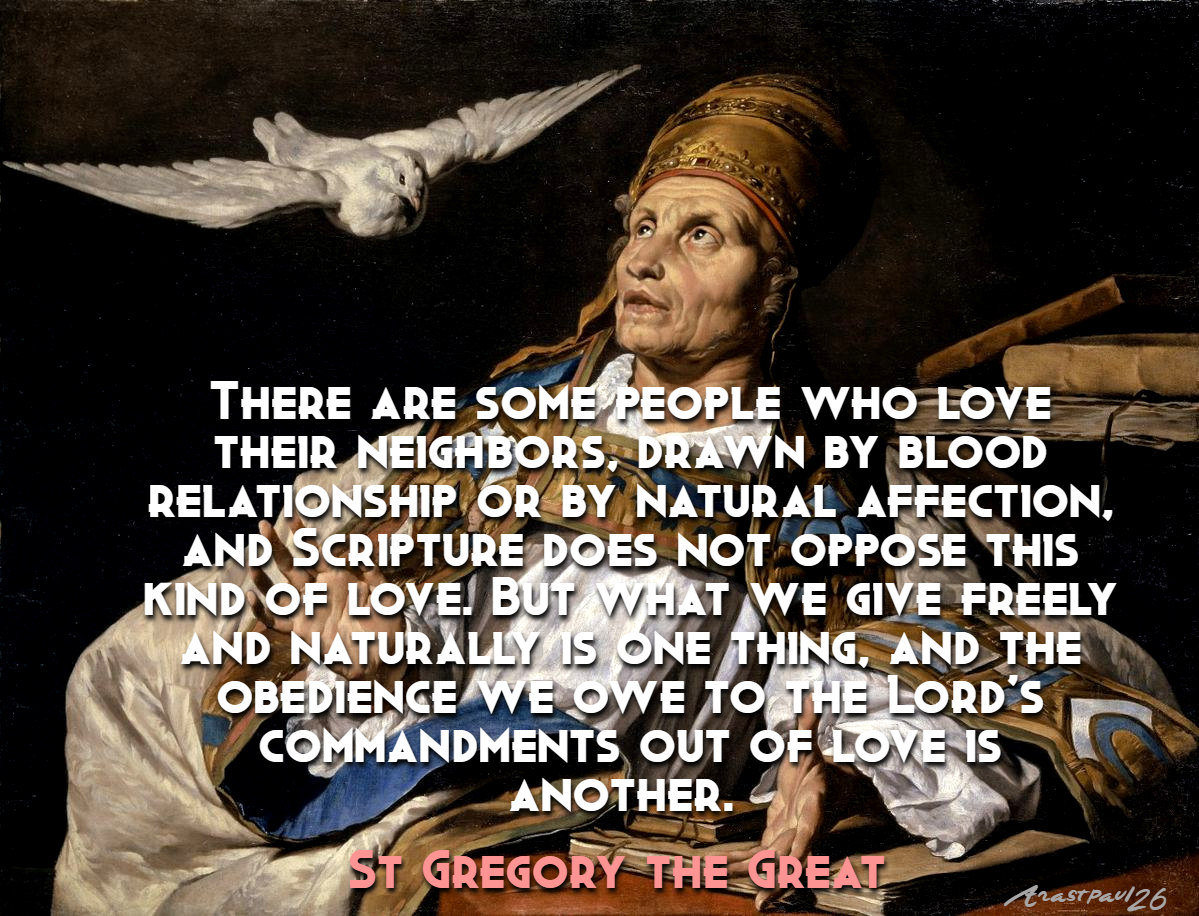
There are some people who love their neighbors, drawn by blood relationship or by natural affection, and Scripture does not oppose this kind of love. But what we give freely and naturally is one thing, and the obedience we owe to the Lord’s commandments out of love is another. Those I’ve mentioned indisputably love their neighbors… but their love does not come from spiritual but from natural motives. Therefore when the Lord said: “This is my commandment, that you love one another”, he added immediately: “Just as I have loved you,” meaning, “You must love for the same reason that I have loved you.”

Saint Gregory the Great ( Homilies on the Gospels, no. 27)

PRAYER – O Lord Jesus, I adore you wounded on the Cross, having drunk vinegar and gall. I beg you, that your wounds may be the remedy of my soul. Amen. Our Father. Hail Mary.

Posted in MARIAN TITLES

Madonna dell’Umiltà / The Madonna of Humility, Pistoia, Tuscany, Italy (1490), Madonna della Campitelli / Our Lady of Campitelli, Italy (524) and Memorials of the Saints – 17 July

Madonna dell’Umiltà / The Madonna of Humility, Pistoia, Tuscany, Italy (1490) – 17 July

Madonna della Campitelli / Our Lady of Campitelli, Italy (524) – 17 July and 2 February:

The Sanctuary of Sancta Maria in Campitelli is one of the most celebrated of Rome. It is dedicated to the Blessed Virgin Mary, and is located on the Piazza di Campitelli in Rome, Italy.

There is venerated at the Church a precious image that was transported from the portico of the palace of the Roman matron, Galla Patrizia Seveath, to whom the Virgin herself appeared on 17 July 524. The icon is only 25 centimeters high. Mention is made of the miraculous appearance by Pope Gregory the Great. The image is known as Our Lady in the Portico, or the Madonna del Portico.

The Church where the icon was kept was known as Santa Galla Antiqua and it used to be located just north of the Piazza Bocca della Verita and west of the Via Petroselli. It was destroyed by Mussolini under pretext that the street should be widened.

In the year 1618 the congregation was transferred to a new Church known as Santa Maria in Campitelli, finished in 1667. The work of the Shrine is that of the architect Rainaldi. The new edifice was erected by vote of the people in thanksgiving for the preservation of the city from the pestilence of 1656 and was designed in the Baroque style. There are tall columns on the façade of the church that were intended to include statues, although the statues were never completed as originally planned.

The icon of Our Lady of Campitelli is surrounded by an ornate Shrine behind the High Altar and there is a stairway behind the display that allows a closer inspection of the famous Icon. It is not open to the general public.

Many times the sacred image of Our Lady of Campitelli has been carried in procession through the streets of Rome – the people invoking Mary’s protection against pestilence, epidemics and earthquakes. This image is also invoked under the title of Our Lady of Security and two feasts are commemorated in Mary’s honour – 17 July and 2 February.

St Alexius of Rome (Died early 5th Century) Hermit, Mystic, beggar – known as “the Man of God.”

St Andrew Zorard OSB (c 980 – c 1008) Hermit, Monk, Missionary
Bl Arnold of Himmerod
Bl Bénigne
Bl Biagio of the Incarnation

Bl Carlos de Dios Murias OFM Conv (1945-1976) Priest Martyr
St Cynllo
St Ennodius of Pavia
St Fredegand of Kerkelodor
St Generosus
St Gorazd
St Hedwig, Queen of Poland
St Hyacinth of Amastris
St Kenelm
St Pope Leo IV

St Magnus Felix Ennodius
St Marcellina
St Nerses Lambronazi

St Petrus Liu Zeyu
Bl Sebastian of the Holy Spirit
Bl Tarsykia Matskiv
St Theodosius of Auxerre
St Theodota of Constantinople
St Turninus

Martyrs of Compiegne (16 beati): Sixteen Blessed Teresian Martyrs of Compiègne. Eleven Discalced Carmelite nuns, three lay sisters and two lay women servants who were martyred together in the French Revolution. They were the earliest martyrs of the French Revolution that have been recognised.
• Angelique Roussel • Anne Pelras • Anne-Marie-Madeleine Thouret • Catherine Soiron • élisabeth-Julitte Vérolot • Marie Dufour • Marie Hanniset • Marie-Anne Piedcourt • Marie-Anne-Françoise Brideau • Marie-Claude-Cyprienne Brard • Marie-Françoise de Croissy • Marie-Gabrielle Trezel • Marie-Geneviève Meunier • Marie-Madeleine-Claudine Lidoine • Rose-Chretien de Neuville • Thérèse Soiron •
They were guillotined on 17 July 1794 at the Place du Trône Renversé (modern Place de la Nation) in Paris, France.

Martyrs of Scillium (12 saints): A group of twelve Christians martyred together, the final deaths in the persecutions of Emperor Marcus Aurelius. Upon their conviction for the crime of being Christians, the group was offered 30 days to reconsider their allegiance to the faith; they all declined. Their official Acta still exist. Their names –
• Acyllinus • Cythinus • Donata • Felix • Generosa • Januaria • Laetantius • Narzales • Secunda • Speratus • Vestina • Veturius
They were beheaded on 17 July 180 in Scillium, Numidia (in North Africa).

Posted in Our MORNING Offering

Our Morning Offering – 17 July – Deign, O Immaculate Virgin

Our Morning Offering – 17 July – “Month of the Most Precious Blood”

Deign, O Immaculate Virgin
By St Paschasius Radbertus (785–865)

Deign, O Immaculate Virgin,
Mother most pure,
to accept the loving cry of praise
which we send up to you
from the depths of our hearts.
Though they can but add little to your glory,
O Queen of Angels,
you do not despise, in your love,
the praises of the humble and the poor.
Cast down upon us a glance of mercy,
O most glorious Queen,
graciously receive our petitions.
Through your immaculate purity of body and mind,
which rendered you so pleasing to God,
inspire us with a love of innocence and purity.
Teach us to guard carefully the gifts of grace,
striving ever after sanctity, so that,
being made like the image of your beauty,
we may be worthy to become,
the sharers of your eternal happiness.
Amen

Posted in ONE Minute REFLECTION

One Minute Reflection – 17 July – By their fruits you will know them

One Minute Reflection – 17July – “Month of the Most Precious Blood” – Readings: Ps 46:2, Ps 46:3, Rom 6:19-23, Matt 7:15-21

By their fruits you will know them.

Matt 7:15-21

REFLECTION Vice mimics virtue, and the tares strive to be thought wheat, growing like the wheat in appearance, but being detected by good judges from the taste. The devil also transfigures himself into an angel of light; not that he may reascend to where he was, for having made his heart hard as an anvil, he has henceforth a will that cannot repent; but in order that he may envelope those who are living an Angelic life in a mist of blindness, and a pestilent condition of unbelief. Many wolves are going about in sheep’s clothing, their clothing being that of sheep, not so their claws and teeth: but clad in their soft skin, and deceiving the innocent by their appearance, they shed upon them from their fangs the destructive poison of ungodliness.

We have need therefore of divine grace, and of a sober mind, and of eyes that see, lest from eating tares as wheat we suffer harm from ignorance, and lest from taking the wolf to be a sheep we become his prey, and from supposing the destroying Devil to be a beneficent Angel we be devoured: for, as the Scripture says, he goes about as a roaring lion, seeking whom he may devour. This is the cause of the Church's admonitions, the cause of the present instructions, and of the lessons which are read.

St Cyril of Jerusalem (Catechetical Lecture 4:1)

PRAYER – Lord God, in Your wisdom You created us, by Your Providence, You rule us. Penetrate our inmost being with Your holy light so that our way of life may always be one of faithful service and childlike trust in You. Grant that by the intercession of our most Holy and Blessed Virgin Mother, we may always follow behind Your Son, obey His Words and grasp His hand, to lead us to You, Through Jesus Christ our Lord with the Holy Spirit, one God now and for all eternity, amen

Posted in MARIAN TITLES

Our Lady of Mount Carmel, Nuestra Señora del Carmen (Rute, Córdoba, Andalucía, Spain) (17th Century) and Memorials of the Saints – 16 July

Our Lady of Mount Carmel -Mary is said to have given the Scapular to an early Carmelite named Saint Simon Stock. (Optional Memorial)

The Brown Scapular of Our Lady of Mount Carmel

Nuestra Señora del Carmen (Rute, Córdoba, Andalucía, Spain) (17th Century) 16 July, 13 February – Patron of Rute:

By order of Pope Pius XI, Our Lady of Mount. Carmel was proclaimed Patron of the Town of Rute in southern Spain on 13 February1924. Her beloved image goes back to the late 1600s, when Luisa Roldán (La Roldana) of Seville carved the head and hands. Made to be dressed, the Statue did not have a proper body until the 1960s.

It occupies a neo-baroque setting over the High Altar, also of the 1960s. Rute honours its Patron several times a year. The anniversary celebration lasts three days, culminating on 13 February with Mass, presentations to the Chief of the Brotherhood and the Fiesta Queen of gifts made for the Virgin, and a ceremony of kissing the Scapular of Our Lady of Mount. Carmel. Her liturgical feast day, 16 July is the focus of another three-day celebration. On the last Sunday of June, the procession is held, when the Statue goes in procession through the neighbourhood to the main Parish Church of Santa Catalina Mártir. Another triduum is celebrated around the feast of the Assumption, 14-16 August.

Bl André de Soveral
St Andrew the Hermit
St Antiochus of Sebaste
Bl Arnold of Clairvaux
Bl Arnold of Hildesheim

Blessed Arnulf of Hildesheim
St Athenogenes of Sebaste

St Bartholomew of Braga OP – Archbishop of Braga also known as Bl Bartholomew of the Martyrs (Bartolomeu Fernandez dei Martiri Fernandes) (1514-1590) Portuguese Dominican Friar and Priest, Writer, Theologian, Advisor, Teacher and Catechetical writer, Apostle of Charity founding a series of hospitals and hospices in Braga and surrounds.

St Benedict the Hermit

Blessed Ceslaus Odrowaz OP (c 1184– 1242) (Brother of St Hyacinth) Priest and Friar of the Order of Preachers, Confessor, Spiritual Advisor, miracle-worker.

Bl Claude Beguignot
Bl Domingos Carvalho
St Domnin
St Domnio of Bergamo
Bl Dorothée-Madeleine-Julie de Justamond
St Elvira of Ohren
St Eugenius of Noli
St Faustus
St Faustus of Rome and Milan
St Fulrad of Saint Denis
St Generosus of Poitou
St Gobbán Beg
St Gondolf of Saintes
St Grimoald of Saintes
St Helier of Jersey
Bl Irmengard
Bl John Sugar
St Landericus of Séez
Bl Madeleine-Françoise de Justamond
Bl Marguerite-Rose de Gordon
Bl Marguerite-Thérèse Charensol
Bl Marie-Anne Béguin-Royal
Bl Marie-Anne Doux

St Marie-Madeline Postel (1756-1846) Religious Sister and Founder of the Sisters of Christian Schools of which she is the Patron, Teacher, Franciscan tertiary.

Bl Marie-Rose Laye
Bl Milon of Thérouanne
Bl Nicolas Savouret
Bl Ornandus of Vicogne
St Paulus Lang Fu
St Reinildis of Saintes ( c 630 – c 700) Virgin, Laywoman, Martyr
Bl Robert Grissold
Bl Simão da Costa
St Sisenando of Cordoba
St Tenenan of Léon
St Teresia Zhang Heshi
St Valentine of Trier
St Vitalian of Capua
St Vitaliano of Osimo
St Yangzhi Lang

Martyrs of Antioch – 5 saints: Five Christians who were martyred together. No details about them have survived by the names – Dionysius, Eustasius, Maximus, Theodosius and Theodulus. They were Martyred in Antioch, Syria, date unknown.