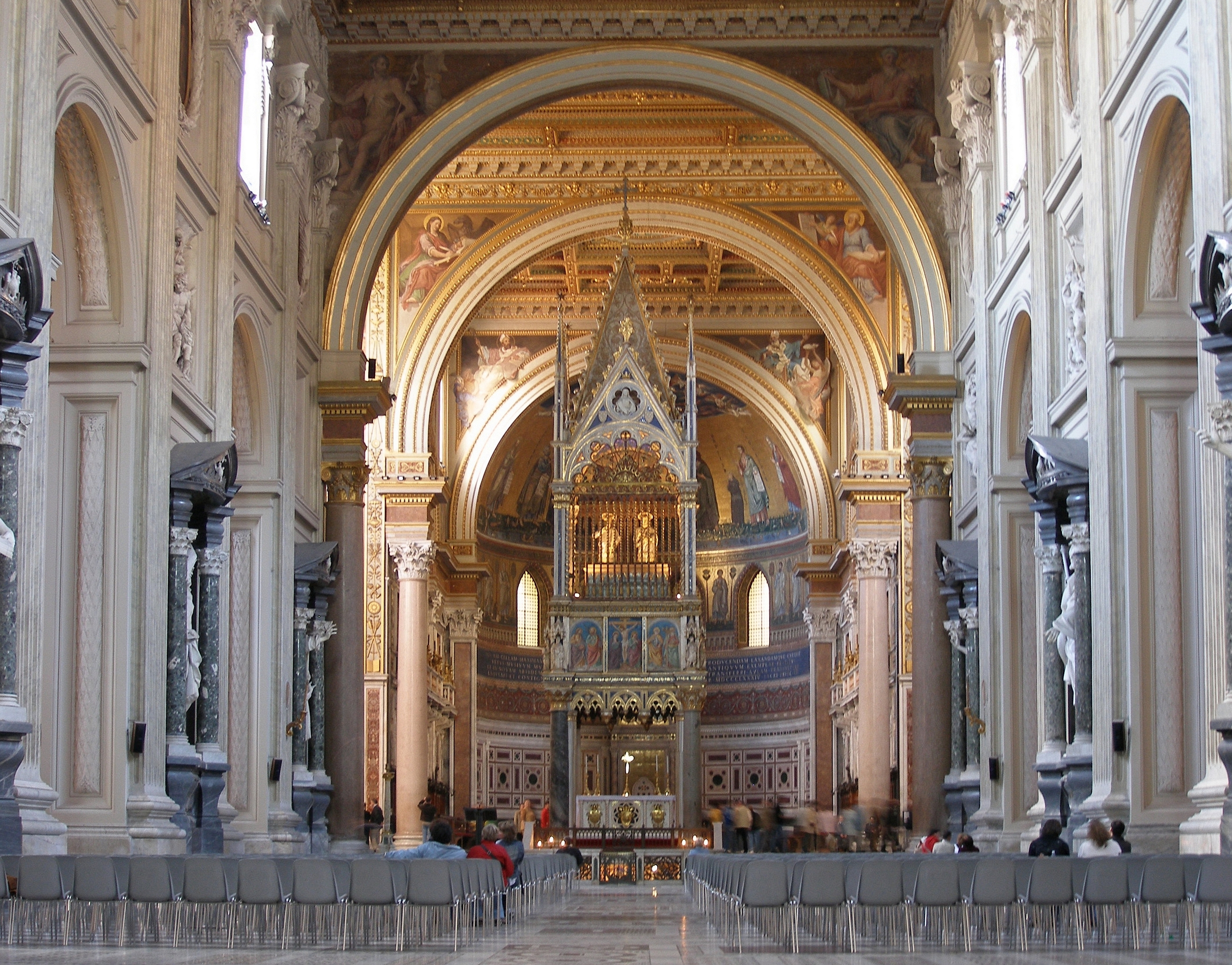
Dedication of The Archbasilica of the Most Holy Saviour and of Saints John the Baptist and John the Evangelist in the Lateran (Feast):
The oldest and first in rank of the four Basilicas of Rome. The name is derived from the Laterani family, on the site of whose Palace the Basilica stands. King Constantine presented this Palace to the Church. Its annual celebration throughout the Latin Church is a sign of love and unity with the Papacy and Pope.
The original Church building, probably adapted from the hall of the palace, was dedicated to the Saviour and from its splendour was known as the Basilica Aurea. Though several times destroyed and rebuilt, the Basilica retained its ancient form, being divided by rows of columns into aisles and having an atrium with colonnades. The restoration of the 17th century changed its appearance.
A monastery was formerly between the Basilica and the City wall of which the cloister still remains. The original apse survived until 1878, when it was destroyed and a deeper apse built. The ancient mosaics have been preserved The high Altar, which is of wood and is believed to have been used by Saint Peter, is now encased in marble. In the upper part of the baldachinum are the heads of the Apostles, Peter and Paul. The Baptistery is an octagonal edifice with porphyry columns. The font is of green basalt. This Basilica has been the Cathedral of Rome since the 4th century.
Santa Maria la Real de la Almudena / Our Lady of Almudena, Madrid, Spain (712) – 9 Novemnber:
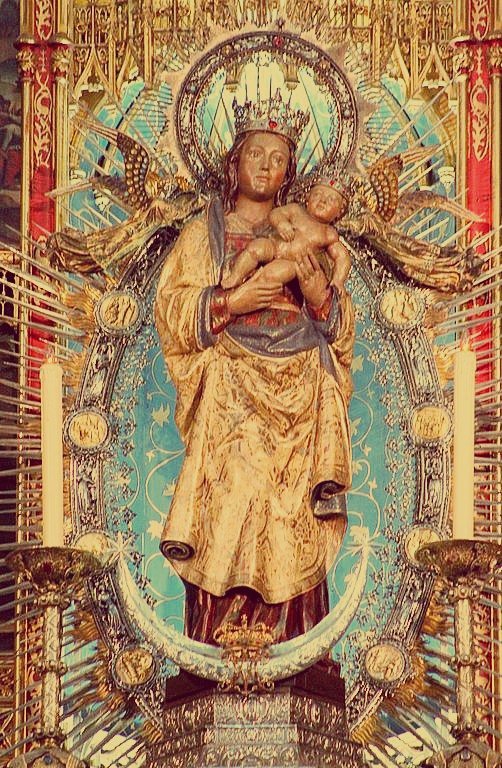
The Virgin of Almudena is a medieval icon of the Virgin Mary, Mother of God. The image is the advocation of the Virgin that serves as a Patroness of Madrid, Spain.
Intriguingly, however, its name derives from the Arabic term of Al Mudayna, or the citadel. There are various legends regarding the Statue. One of the historical legends is that in 712, prior to the capture of the Town by the advancing Muslim forces, the inhabitants of the Town secreted the image of the Virgin, for its own protection, inside the walls surrounding the town. In the 11th century, when Madrid was reconquered by the King Alfonso VI of Castile, the Christian soldiers endeavoured to find the Statue. After days of prayer, the spot on the wall hiding the icon crumbled, revealing the Statue. Another legend is that as Christian soldiers approached the Town, they had a vision of Mary imploring them to allow her to lead them into the City. Again the miraculous crumbling of the wall occurred, with the Statue showing an entry route through the walls.
The Cathedral of Madrid is dedicated to this advocation of the Virgin and her feast day, 9 November, is a major holiday in Madrid.
St Agrippinus of Naples
St Alexander of Salonica
St Aurelius of Riditio
St Benignus of Armagh
St Eustolia
St Francisco José Marín López de Arroyave
Blessed Gabriel Ferretti OFM (1385-1456) Priest
Bl George Napper
Bl Gratia of Cattaro
Bl Helen of Hungary
Bl Henryk Hlebowicz
St Jane of Segna
Blessed Ludovico Morbioli (1433-1485) Penitent, Preacher, Ascetic.
St Justo Juanes Santos
St Luigi Beltrame Quattrocchi
St Luis Morbioli
St María de la Salud Baldoví Trull
Bl María del Carmen of the Child Jesus
St Pabo
St Sopatra
St Theodore Stratelates
St Ursinus of Bourges
St Valentín Gil Arribas
St Vitonus of Verdun
—
Martyrs of Constantinople – 3 saints: A group of ten Christians who tried to defend an image of Jesus over the Brazen Gate of Constantinople from an attack by Iconoclasts during the persecutions of emperor Leo the Isaurian. The group of was seized by soldiers, condemned by judges for opposing the emperor, and martyred. The only details that have survived are three of their names – Julian, Marcian and Maria. They were martyred in 730 at Constantinople (modern Istanbul, Turkey).
Martyred in the Spanish Civil War:
• Blessed Anastasio Garzón González
• Blessed Francisco José Marín López de Arroyave
• Blessed Justo Juanes Santos
• Blessed María de la Salud Baldoví Trull
• Blessed Valentín Gil Arribas


You must be logged in to post a comment.