Our Morning Offering – 2 November – “The Month of the Holy Souls in Purgatory”
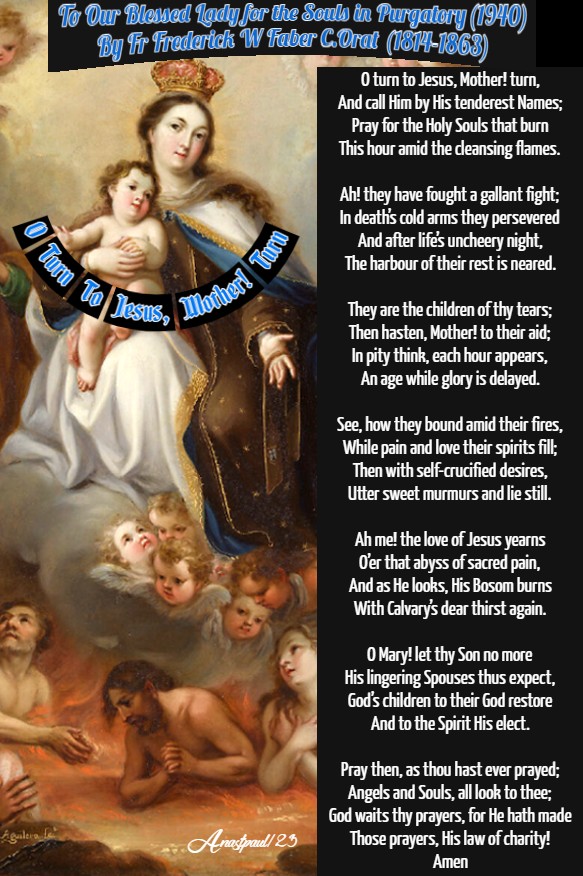
O Turn To Jesus, Mother! Turn To Our Blessed Lady for the Souls in Purgatory (1940) By Fr Frederick W Faber C.Orat (1814-1863)
O turn to Jesus, Mother! turn, And call Him by His tenderest Names; Pray for the Holy Souls that burn This hour amid the cleansing flames.
Ah! they have fought a gallant fight; In death’s cold arms they persevered And after life’s uncheery night, The harbour of their rest is neared.
In pains beyond all earthly pains, Favourites of Jesus! there they lie, Letting the fire wear out their stains And worshipping God’s purity.
Spouses of Christ they are, for He Was wedded to them by His blood And Angels o’er their destiny In wondering adoration brood.
They are the children of thy tears; Then hasten, Mother! to their aid; In pity think, each hour appears, An age while glory is delayed.
See, how they bound amid their fires, While pain and love their spirits fill; Then with self-crucified desires, Utter sweet murmurs and lie still.
Ah me! the love of Jesus yearns O’er that abyss of sacred pain, And as He looks, His Bosom burns With Calvary’s dear thirst again.
O Mary! let thy Son no more His lingering Spouses thus expect, God’s children to their God restore And to the Spirit His elect.
Pray then, as thou hast ever prayed; Angels and Souls, all look to thee; God waits thy prayers, for He hath made Those prayers, His law of charity! Amen
Saint of the Day – 2 November – Blessed John Bodey (1549-1583) Layman, Martyr, Husband and Schoolmaster. Born in 1549 at Wells, Somerset, England and died on 2 November 1583 at Andover, England by being hanged, drawn and quartered for the crime of being a Catholic and refusing to accept Elizabeth I, Queen of England, as the Head of the Church. Blessed John was Beatified on 15 December 1929 together with Blessed John Slade (feast day 30 October), by Pope Pius XI. Additional Memorial – 29 October as one of the Martyrs of Douai, 1 December as one of the Martyrs of Oxford University
John was born in Wells, England, the son of a wealthy merchant and former Mayor. He studied at Winchester and then at Oxford and became an Oxford Fellow of New College, in 1568 at the age of 19. In 1576, John, along with seven others, was deprived of his fellowship for being a Roman Catholic by the Anglican Bishop of Winchester.
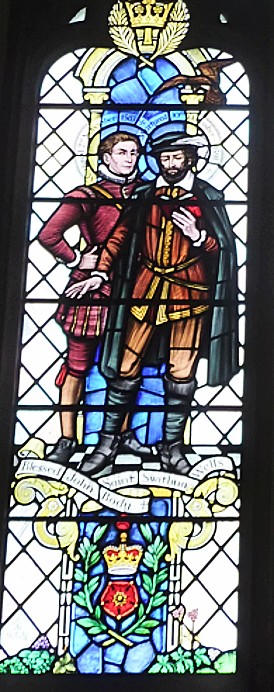
Bl John Bodey left and St Swithun Wells, right at Winchester Catholic Cathedral
In 1577, John travelled to Douay College to study Civil Law but returned to England in February, 1578 when he discovered that his studies could reap no benefits in England as Catholics were forbidden to practice the Legal Profession in any way or under any circumstances.
In 1580, John, by this time married and a schoolmaster, was arrested for continuing to practice the Catholic Faith and rejecting England’s newly-established heretical Church of England or the Anglican Church under the supreme power of the Royal leader.
He was kept in iron shackles in the prison as a “dangerous” prisoner, at Winchester, for three years, which he called his “school of patience.” In 1583 he was tried for treason, both for being a faithful Roman Catholic and for repudiating King Henry VIII’s claim of Royal supremacy of the Church in England, over and above that of the Holy Father in Rome. He was condemned to death in April, 1583, together with John Slade, a fellow layman. There was, apparently, a protest that this Sentence was unjust and illegal, leading to a retriel. But, the two holy men were condemned again—at Andover, Hampshire, in August 1583. Their bravery and perseverance in suffering so impressed their fellow inmates and even the guards that more than one conversion was made – by both Johns, by their virtue and charity!
After the Second Trial – Blessed John Bodey wrote, on behalf of Blessed John Slade and himself:
“We consider that iron for this cause, borne on earth, shall surmount gold and precious stones in Heaven. This is our mark this is our desire. In the mean season we are threatened daily and do look still, when the hurdle shall be brought to the door. I beseech you, for God’s sake that we want not the good prayers of you all for our strength, our joy and our perseverance unto the end. … From our school of patience the 16th September 1583.”
John Bodey was hanged, drawn and quartered at Andover on 2 November 1583. At his Martyrdom, Bodey kissed the halter, saying, “O blessed chain, the sweetest chain and richest that ever came about any man’s neck” and when told he died for treason, exclaimed:
“Indeed, I have been sufficiently censured, for I have been condemned twice; if you may make the hearing of a Blessed Mass – treason, or the saying of an Ave Maria – treason, you may make what you please – treason! … but, I have committed no treason, although, indeed, I suffer the punishment due to treason.”
He then exhorted the people to obey Queen Elizabeth as their worldly ruler: “I acknowledge her as my Lawful Queen in all temporal causes and none other … Ye shall understand, good people all, I suffer death, not for not granting her Majestie to be supreme head of Christ’s Church in England which I may not and will not grant; I pray God long to preserve her Majestie in tranquility over you, even Queen Elizabeth, your Queen and mine; I desire you to obey none other.”
He died saying:
“Jesu, Jesu, esto mihi, Jesu!” “Jesus, Jesus, be for me, Jesus!”
His mother arranged a great feast upon the occasion of her son’s happy death, to which she invited her neighbours, rejoicing at his death as at his marriage, by which his soul was happily and eternally espoused to the Lamb!
Blessed John’s brother Gilbert, was arrested with Alexander Briant on 28 April 1581. He was scourged at Bridewell and afterwards confined in prison. He was released on bail and when not called to appear, escaped to Rheims.
All Souls Day – The Commemoration of All the Faithful Departed: Commemoration of the faithful departed in Purgatory. Abbot Odilo of Cluny instituted it in the Monasteries of his congregation in 998, other religious orders took up the observance and it was adopted by various Diocese and gradually by the whole Church. The Office of the Dead must be recited by the clergy on this day and Pope Benedict XV granted to all Priests, the privilege of saying three Masses of requiem –
St Ambrose of Agaune St Ambrose of Agaune St Amicus of Fonte Avellana St Amicus of Rambone St Baya of Scotland St Domninus of Grenoble St Erc of Slane St Eustochium of Tarsus St George of Vienne
Blessed John Bodey (1549-1583) Layman, Martyr
St Jorandus of Kergrist St Justus of Trieste St Marcian of Chalcis
Martyrs of Isfahan – 5+ Saints: Acindynus, Pegasius and Anempodistus were Persian priests who were imprisoned, tortured, interrogated and Martyred in the persecutions of king Sapor II of Persia; he considered any Christian to be a Roman spy and anti-Persian.
Martyrs of Sebaste – 10 Saints: A group of ten soldiers in the imperial Roman army of Emperor Licinius Licinianus who were executed together for refusing to burn incense as a sacrifice to the emperor. The only details that have survived are five of their names – Agapius, Cartherius, Eudoxius, Styriacus and Tobias. They were burned at the stake in 315 in Sebaste (in modern Turkey).
1 November The Month of “The Holy Souls in Purgatory” or of “The Church Suffering” or “The Faithful Departed”
“It is, therefore, a holy and wholesome thought to pray for the dead that they may be loosed from sins.“
2 Machabees 12:46
The faithful who recite prayers or perform other devout exercises in supplication for the faithful departed during the Month of November, may gain: An Indulgence of 3 years once a day, on each day of the Month. A Plenary Indulgence on the usual conditions, if they perform these devotions DAILY for the ENTIRE Month of November. The De Profundis and Requiem aeternam, of themselves, attract a further 100 days Partial Indulgence.
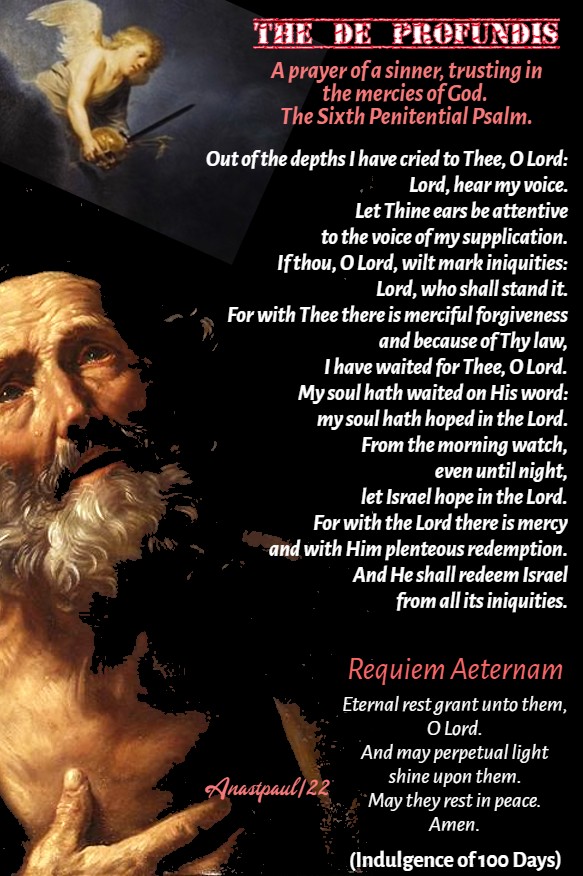
The De Profundis Psalm 129
A prayer of a sinner, trusting in the mercies of God. The Sixth Penitential Psalm.
Out of the depths I have cried to Thee, O Lord: Lord, hear my voice. Let Thine ears be attentive to the voice of my supplication. If thou, O Lord, wilt mark iniquities: Lord, who shall stand it. For with Thee there is merciful forgiveness and because of Thy law, I have waited for Thee, O Lord. My soul hath waited on His word: my soul hath hoped in the Lord. From the morning watch, even until night, let Israel hope in the Lord. For with the Lord there is mercy and with Him plenteous redemption. And He shall redeem Israel from all its iniquities.
(Eternal rest or “Requiem aeternam”) Eternal rest grant unto them, O Lord. And may perpetual light shine upon them. May they rest in peace. Amen.
(Indulgence of 100 Days)
*Psalm 129 in Douay Rheims
Pope Clement XII. was the first who, in order to move the piety of Christians to pray for the souls in Purgatory, granted, by a Brief of 4 August 1736, Coelestes Ecclesiae thesauros – i. The Indulgence of 100 days to all the faithful, everytime that, at the sound of the bell, at the first hour after the evening Ave Maria, they say devoutly, on their knees the psalm De profundis, with a Requiem aAternamat the end of, it. (The evening Ave Maria in Rome varies with the season; it is commonly taken as 6 o’clock.) ii. A Plenary Indulgence to those who perform this pious exercise, for a year, at the hour appointed, once in the year, on any one day, after Confession and Communion. Those who do not know by heart the De Profundis, may gain these Indulgences by saying, in the way already mentioned for the De profundis, one Pater Noster and one Ave Maria, with the Requiem Aeternam. Observe also, that the aforesaid Clement XII. declared, on 12 December 1736, that these Indulgences might be gained by saying the De Profundis etc, as above, although, according to the custom of a particular Church or place, the “signal for the dead,” as it is called, be given by the sound of the bell either before, or after one hour after the evening Ave Maria. Pope Pius VI, by a Rescript of 18 March 1781, granted the above-named Indulgences to all the faithful, who should chance to dwell in any place where no bell for the dead is sounded and who, shall say the De Profundis or Pater Noster, as aforesaid, about the time specified above.
Thought for the Day – 1 November – Meditations with Antonio Cardinal Bacci (1881-1971)
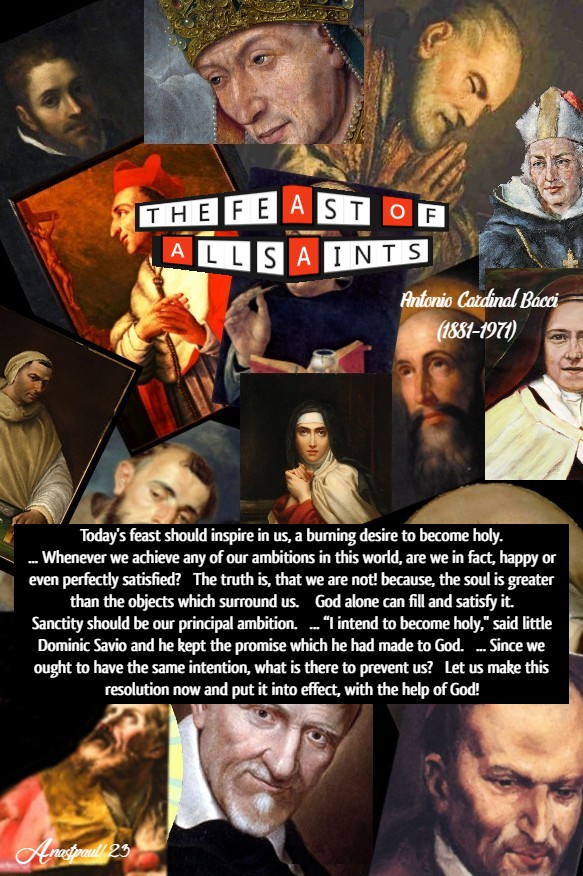
The Feast of All Saints
“Today’s feast should inspire in us, a burning desire to become holy. Men long for many things in this world, things which are often useless and, even sinful. They desire riches, pleasure, honours, success and material comfort. These things may be lawful but, they cannot satisfy the human heart, which is made for God. Whenever we achieve any of our ambitions in this world, are we in fact, happy or even perfectly satisfied? The truth is, that we are not! because, the soul is greater than the objects which surround us. God alone can fill and satisfy it.
Sanctity should be our principal ambition. We should yearn to be more closely united to God, so that His Divinity may be reflected in our thoughts and in our actions. If we enjoy God’s friendship, we shall become more like God and shall be lifted up above petty mundane considerations. Perhaps, we doubt our ability to reach such a high spiritual level? Even so, we should, nevertheless, desire to reach it and, not just in a passing and indifferent manner but, constantly and actively. We should keep our desire alive by repeating it to ourselves and by continually praying for God’s grace to fulfil it. “I intend to become holy,” said little Dominic Savio and he kept the promise which he had made to God. Many people have formed the same resolution, both desert hermits and University professors, both humble workmen and rulers of nations. Since we ought to have the same intention, what is there to prevent us? Let us make this resolution now and put it into effect, with the help of God!”
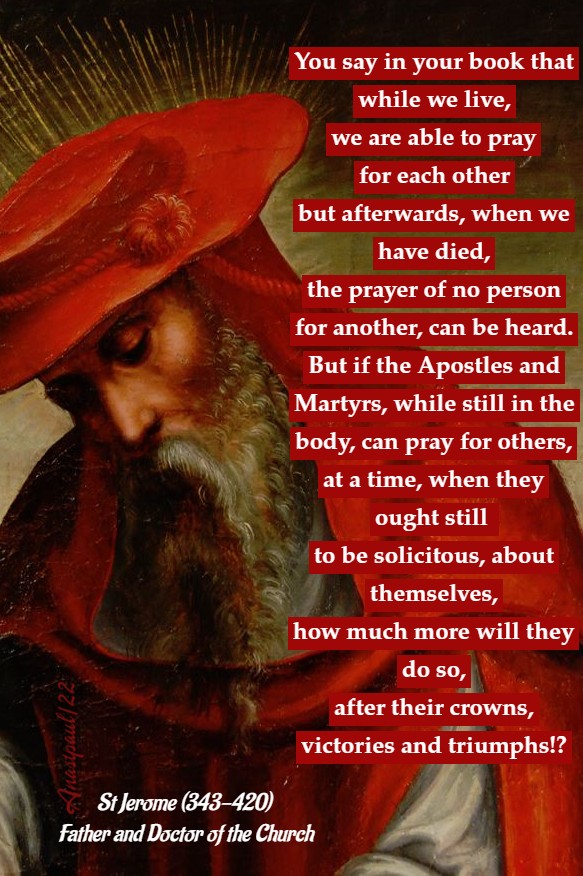
“You say in your book that while we live, we are able to pray for each other but afterwards, when we have died, the prayer of no person for another, can be heard. But if the Apostles and Martyrs, while still in the body, can pray for others, at a time, when they ought still to be solicitous, about themselves, how much more will they do so, after their crowns, victories and triumphs!?”
St Jerome (343-420) Father and Doctor of the Church
“At His Transfiguration Christ showed His disciples, the splendour of His Beauty, to which He will shape and colour, those who are His : ‘He will reform our lowness configured to the Body of His Glory.”
St Thomas Aquinas OP (1225 – 1274) Angelic Doctor of the Church
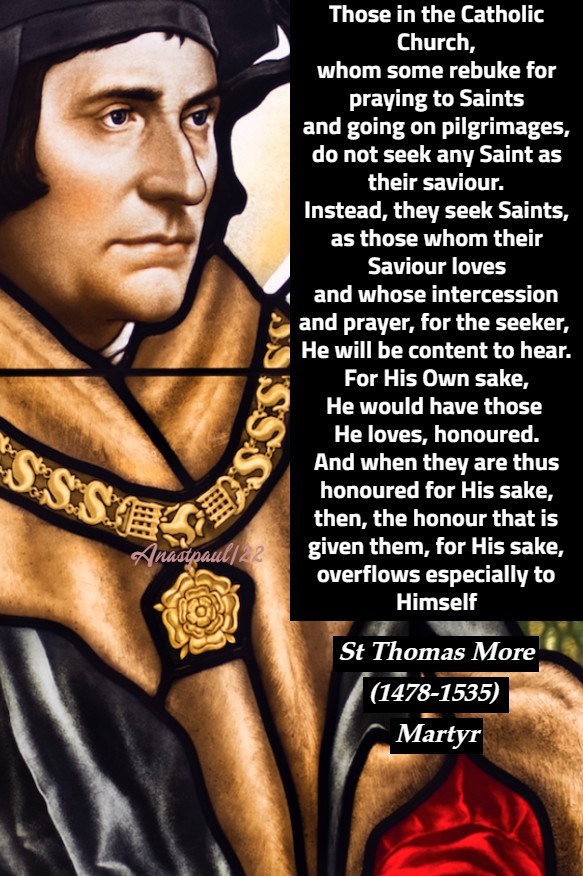
“Those in the Catholic Church, whom some rebuke for praying to Saints and going on pilgrimages, do not seek any Saint as their saviour. Instead, they seek Saints, as those whom their Saviour loves and whose intercession and prayer, for the seeker, He will be content to hear. For His Own sake, He would have those He loves, honoured. And when they are thus honoured for His sake, then, the honour that is given them, for His sake, overflows especially to Himself.”
St Thomas More 1478-1535) Martyr
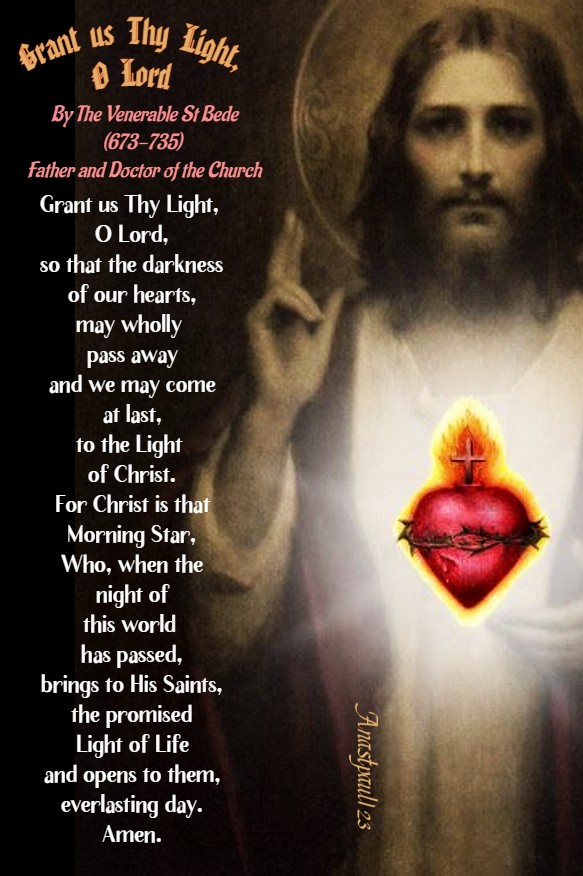
Grant us Your Light, O Lord By The Venerable St Bede (673-735) Father and Doctor of the Church
Grant us Your light, O Lord, so that the darkness of our hearts, may wholly pass away and we may come at last, to the Light of Christ. For Christ is that morning star, who, when the night of this world has passed, brings to His saints, the promised light of life and opens to them, everlasting day. Amen
One Minute Reflection – 1 November – “The Month of the Holy Souls in Purgatory” – All Saints Day – Apocalypse 7:2-12, Matthew 5:1-12 – – Scripture search here: https://www.drbo.org/
“Be glad and rejoice for your reward is very great in Heaven.” – Matthew 5:12
REFLECTION – “Dearly beloved, let us anxiously attend to all that concerns the profession of our common life, “keeping the unity of the spirit in the bond of peace,” by “the grace of our Lord Jesus Christ and the love of God and the imparting of the Holy Spirit ”(Eph 4,3; 2 Cor 13:13). From the love of God comes the unity of the spirit; from the grace of our Lord Jesus Christ comes the bond of peace; from the imparting of the Holy Spirit, comes that communion which is necessary to those who live in common. …
“I believe, 0 Lord, in the Holy Ghost, the holy Catholic Church, the Communion of Saints” (Credo). This is my hope, this is my trust, this is my confidence, this is the whole of my security in the professing of my faith. … If I am allowed, O Lord, to “love Thee and love my neighbour,” (Mt 22:37-39) although my merits are small and few, yet will my hopes reach beyond them. I am confident that the merits of the Saints will help me by the communion of charity, so that the Communion of Saints will make up for my insufficiency and imperfection. … Let charity expand our hope, as far as the Communion of Saints, in the sharing of merits and rewards but the sharing of the latter belongs to the future, for it is the sharing in the glory which shall be revealed in us.
Since, then, there are three communions – the first of nature, which includes the sharing of guilt … the second of grace and the third, of glory. By the communion of grace, that of nature begins to be remade and the sharing of guilt to be excluded but, by the communion of glory, that of nature will be perfectly restored and the communion of anger, will be entirely excluded, when “God will wipe away every tear from the eyes” of the Saints (Is 25:8; Rv 21:4). Then, among all the Saints, there will be “one heart and one soul” and “all things will be in common”when God will be “all in all” (Acts 4:2; 1 Cor 15:28). That we may all arrive at this communion and that we all may be one, “the grace of our Lord Jesus Christ and the love of God, and the imparting of the Holy Spirit be with us all forever. Amen.” – Baldwin of Forde O.Cist ( c 1125–1190) Cistercian Abbot, Bishop, then Archbishop of Canterbury (Treatise on the common life).
PRAYER – Almighty, eternal God, Who granted us to honour the merits of all Thy Saints in a single solemn festival, bestow on us, we beseech Thee, through their manifold intercession, that abundance of Thymercy for which we yearn. Through Jesus Christ, Thy Son our Lord, Who lives and reigns with Thee, in the unity of the Holy Ghost, God, world without end. Amen (Collect).
Our Morning Offering – 1 November – “The Month of the Holy Souls in Purgatory”
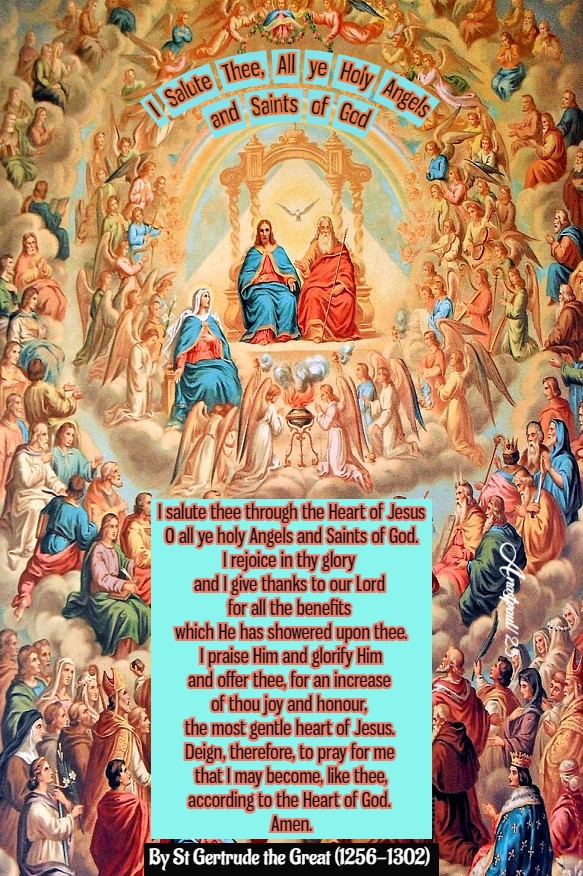
I Salute Thee, All ye Holy Angels and Saints of God By St Gertrude the Great (1256-1302)
I salute thee through the Heart of Jesus, O all ye holy Angels and Saints of God. I rejoice in thy glory and I give thanks to our Lord for all the benefits which He has showered upon thee. I praise Him and glorify Him and offer thee, for an increase of thou joy and honour, the most gentle heart of Jesus. Deign, therefore, to pray for me that I may become, like thee, according to the Heart of God. Amen.
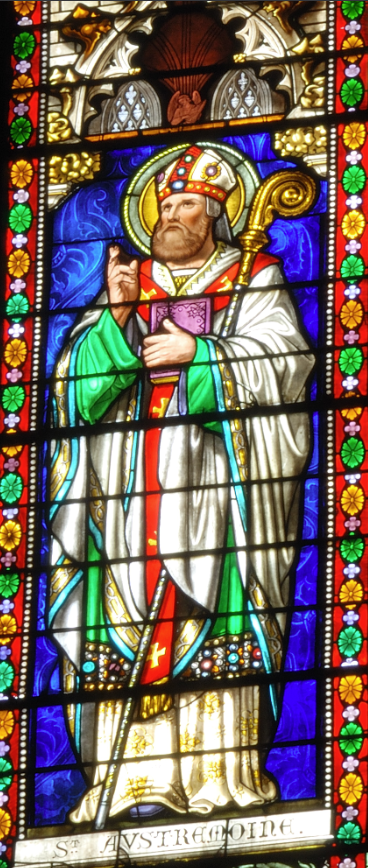
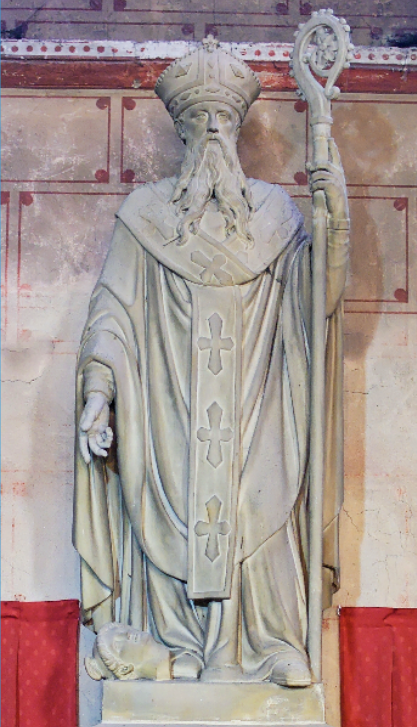
Saint of the Day – 1 November – Saint Austremonius (3rd-4th Century) Bishop of Clermont, France, and Apostle of Auvergne, Missionary. Born in the 3rd Century and died in the early 4th Century of natural causes. Patronage – the Archdiocese of Clermont. Also known as – Austromoine, Stramonius, Stremonius.
The Roman Martyrology reads today: “At Clermont in Auvergne, France, Saint Austremonius, the first Bishop of that City.”
Stained glass of St Austremonius at the Church of Saint-Eutrope in Clermont
Most of what is known about our Saint Austremonius, is deduced from a few brief sentences in the writings of St Gregory of Tours. According to this authorit, he was one of the seven Bishops sent from Rome into Gaul during the years in the mid 3rd Century.
Stained glass of St Austremonius at the Church of Saint-Eutrope in Clermont
He laboured tirelessly for the conversion of the pagans in Auvergne and is believed to have been the first Bishop of Clermont. Another tradition states that Austremonius was martyred by a Jewish rabbi for converting the man’s son, however this is not repeated in the Martyrology.
Also sent to preach the Gospel in Gaul were Gatien to Tours, Trophimus to Arles, Paul to Narbonne, Saturninus to Toulouse, Denis to Paris and Martial to Limoges.
At Clermont St Austremonius converted the Senator Cassius of Clermont and the pagan priest Victorinus. He also sent St Serenus to Thiers, St Marius to Salers and Antoninus into other parts of Auvergne, to further the evangelisation of Gaul. A tradition states that Saint Austremonius instructed St Nectarius of Auvergne to Christianise the peoples living on the plain of Limagne.
Austremonius was a contemporary of the three Bishops of Aquitaine, who attended the Council of Arles in 314.
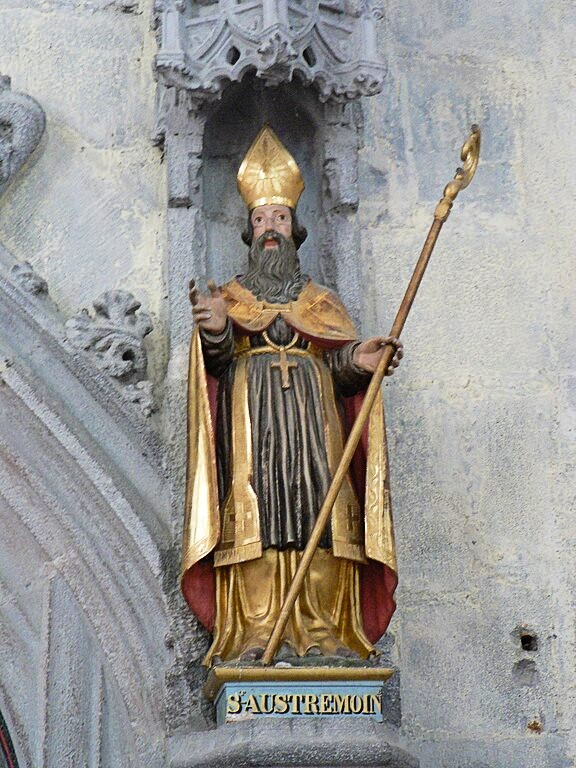
Statue of St Austremonius, Apostle and Bishop of Auvergne. Church Saint-Austremonius at Issoire, Auvergne, France.
Veneration of Saint Austremonius found its origin in a biography of the Saint written in the 10th Century in the Abbey of Mozac, where his body was transferred in 761. The Vita was rewritten and amplified by the Monks of Issoire, who retained the Saint’s head as a Relic. There is a further elaborated Vita of the late 11th Century. The tomb was opened in 1197.
Crypt at the Abbey of Mozac, a former Cluniac Monastery near Riom in Auvergne, France.
St Gregory of Tours, who was born in Auvergne in 544 and was well versed in the history of that country, looks upon St Austremonius as one of the seven envoys who, about evangelised Gaul. He relates how the body of our Saint was first interred at Issoire, being there the object of great veneration, before the body, though not the head, was translated to Clermont, where he is greatly venerated as the Patron of that Diocese.
Statue of St Austremonius at the Abbey Church of Mozac
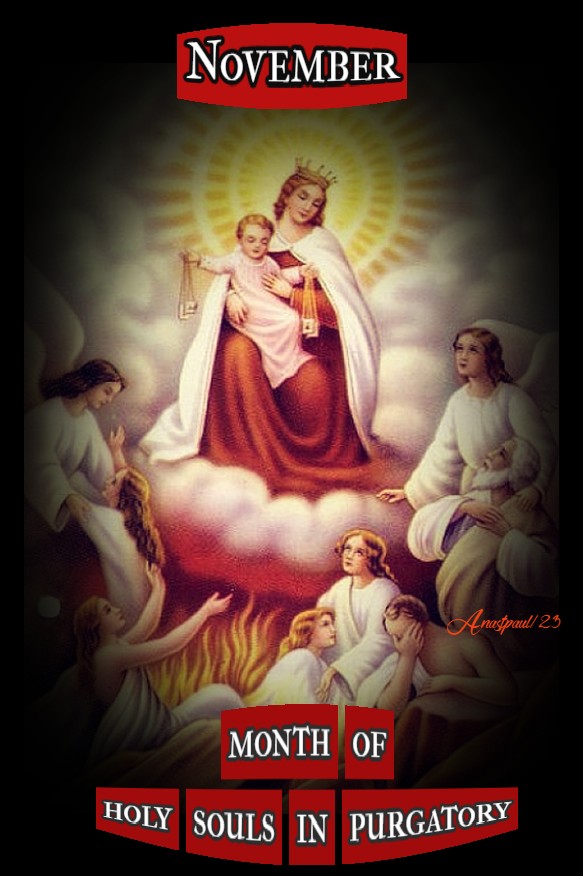
November “The Month of the Holy Souls in Purgatory”
All Saints Day – (a Holy Day of Obligation) Instituted to honour all the saints, known and unknown. It owes its origin in the Western Church to the dedication of the Roman Pantheon in honour of the Blessed Virgin Mary and all the Martyrs by Pope Saint Boniface IV in 609, the anniversary of which was celebrated at Rome on 13 May. Pope Saint Gregory III Consecrated a Chapel in the Vatican Basilica in honour of All Saints, designating 1 November as their feast. Pope Gregory IV extended its observance to the whole Church. It has a Vigil and Octave and is a Holy Day of Obligation – the eve is popularly celebrated as Hallowe’en. Patronage – Arzignano, Italy. ABOUT: https://anastpaul.com/2019/11/01/solemnity-of-all-saints-1-november/ AND: https://anastpaul.com/2018/11/01/1-november-solemnity-of-all-saints/ AND: https://anastpaul.wordpress.com/2017/11/01/1-november-the-feast-of-all-the-saints/
St Austremonius (3rd-4th Century) Bishop and Apostle of Auvergne St Benignus of Dijon St Cadfan St Caesarius of Africa St Caesarius of Damascus St Ceitho St Cledwyn of Wales Bl Clemens Kyuemon St Cyrenia of Tarsus St Dacius of Damascus St Deborah the Prophetess St Dingad Bl Dionysius Fugixima St Floribert of Ghent St Gal of Clermont St Genesius of Lyon St Germanus of Montfort St Harold the King St James of Persia St John of Persia St Julian of Africa St Juliana of Tarsus St Lluís Estruch Vives St Marcel of Paris St Mary the Slave St Mathurin St Meigan St Nichole St Pabiali of Wales Bl Pere Josep Almató Ribera Auras St Peter Absalon Bl Peter Paul Navarra Bl Petrus Onizuka Sadayu St Rachel the Matriarch
Thought for the Day – 31 October – Meditations with Antonio Cardinal Bacci (1881-1971)
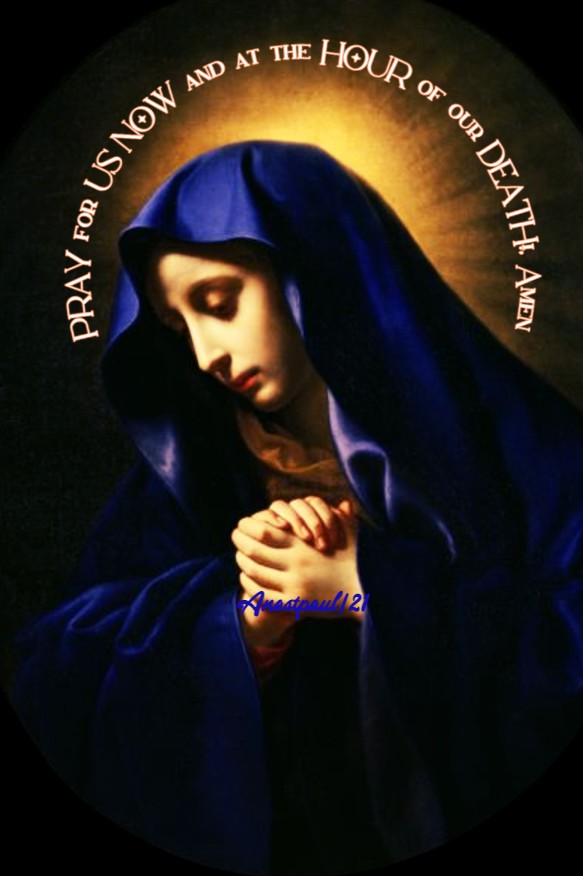
“Month of the Holy Rosary” “Pray for Us … at the Hour of Our Death”
“We have come to the end of this month, which we have dedicated to Mary and her blessed Rosary. Let us remember, however, that apart from this Month of October, we should dedicate our whole lives to her, up to our final moment of death. We are always in need of Mary’s patronage and intercession with God. Let us always have recourse to her, therefore, especially in danger and in suffering but, most especially, at the decisive moment of death, for this is the moment on which eternity depends. This day will arrive sooner or later but, it will certainly come, “at an hour that you do not expect” (Lk 12:40).
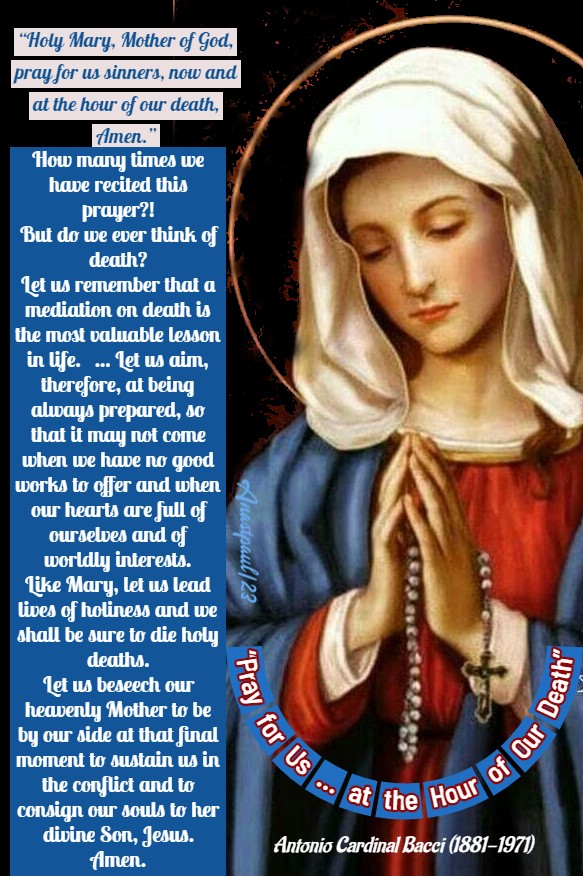
In the second part of the Hail Mary, the Church places on our lips, these words of supplication: “Holy Mary, Mother of God, pray for us sinners, now and at the hour of our death, Amen.” How many times we have recited this prayer?! But do we ever think of death? Let us remember that a mediation on death is the most valuable lesson in life. One day, we shall find ourselves face-to-face with God, drawing our last breath on earth. It may be on a sick bed, it may be in the middle of a street – we do not know. It may be after a long illness at the end of which we are comforted by the Holy Sacraments and blessed by a Priest, or it may be quite unexpected. But, it is certain that death will come. Let us aim, therefore, at being always prepared, so that it may not come when we have no good works to offer and when our hearts are full of ourselves and of worldly interests. Like Mary, let us lead lives of holiness and we shall be sure to die holy deaths. Let us beseech our heavenly Mother to be by our side at that final moment to sustain us in the conflict and to consign our souls to her divine Son, Jesus. Amen.”
Quote/s of the Day – 31 October – “The Month of the Most Holy Rosary and of the Angels” – Goodbye October
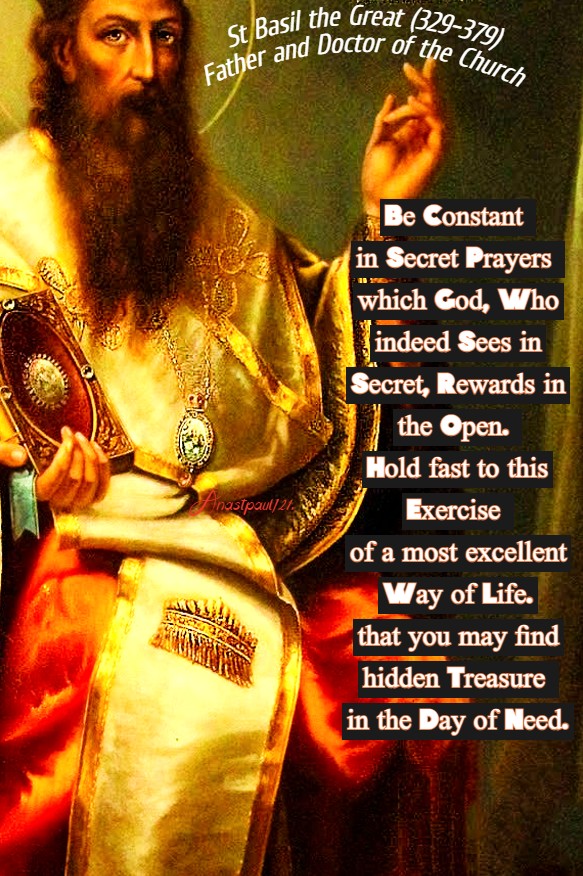
“Be constant in secret prayers which God, Who indeed sees in secret, rewards in the open. Hold fast to this exercise of a most excellent way of life. that you may find hidden treasure in the day of need.”
St Basil the Great (329-379) Father and Doctor of the Church
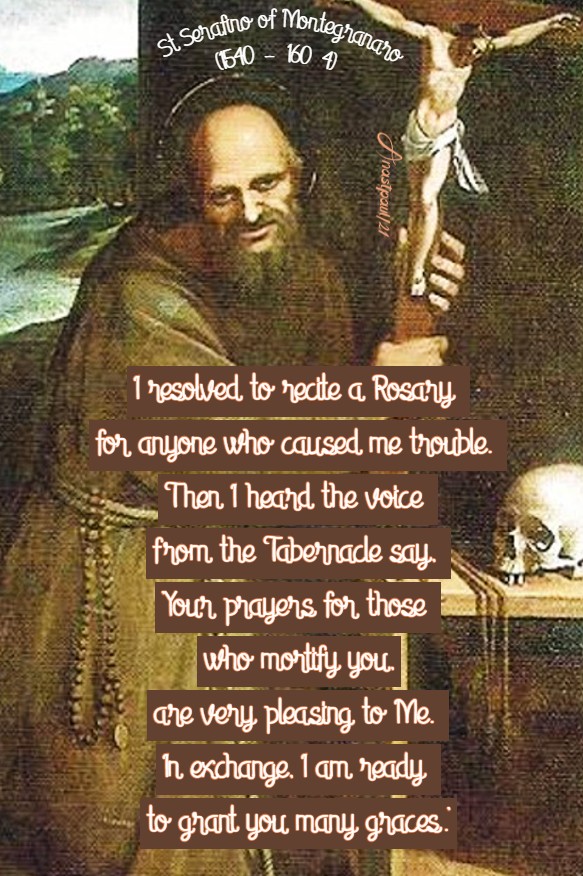
“… [I] resolved to recite a Rosary for anyone who caused me trouble. Then I heard the Voice from the Tabernacle say, ‘Your prayers for those who mortify you, are very pleasing to Me. In exchange, I am ready to grant you many graces.‘”
St Serafino of Montegranaro (1540-1604)
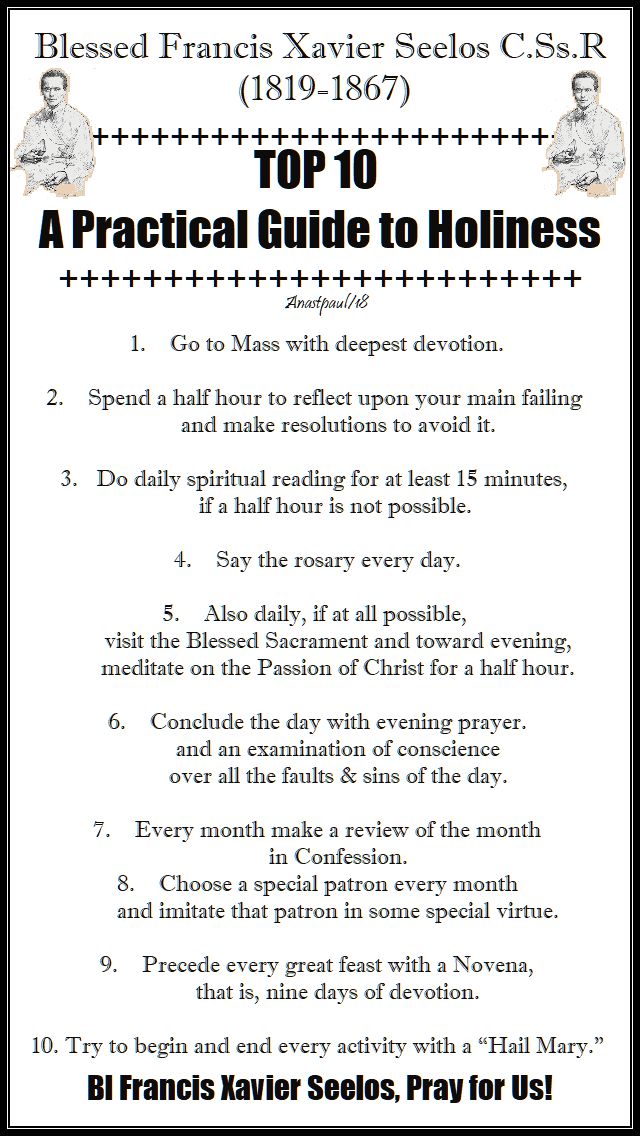
TOP 10 Practical Guide to Holiness
Go to Mass with deepest devotion.
Spend a half hour to reflect upon your main failing and make resolutions to avoid it.
Do daily spiritual reading for at least 15 minutes, if a half hour is not possible.
Say the Rosary everyday.
Also daily, if at all possible, visit the Blessed Sacrament and toward evening, meditate on the Passion of Christ for a half hour.
Conclude the day with evening prayer and an examination of conscience over all the faults & sins of the day.
Every month make a review of the month in confession.
Choose a special Patron every month and imitate that Patron in some special virtue.
Precede every great feast with a novena, that is, nine days of devotion.
Try to begin and end every activity with a “Hail Mary.”
Bl Francis Xavier Seelos (1819-1867)
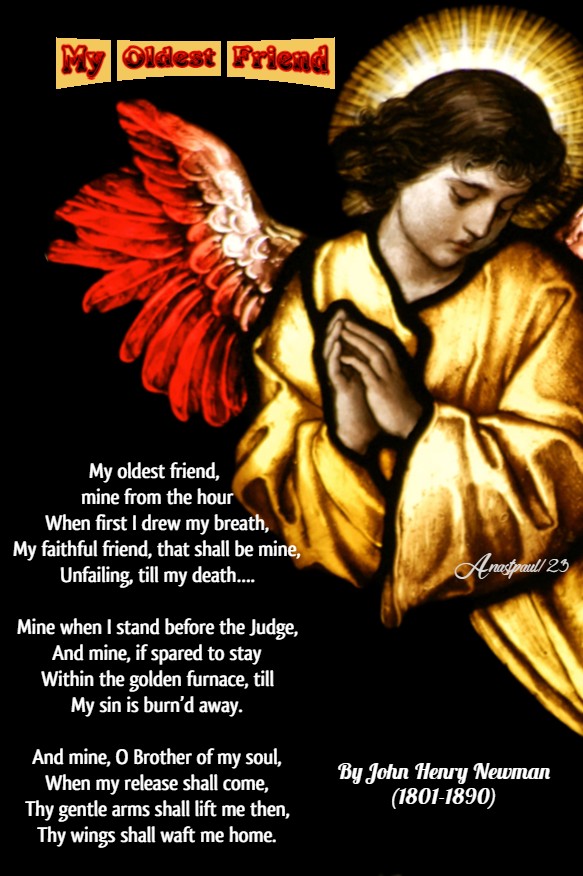
My Oldest Friend By John Henry Newman (1801-1890)
My oldest friend, mine from the hour When first I drew my breath, My faithful friend, that shall be mine, Unfailing, till my death….
Mine when I stand before the Judge, And mine, if spared to stay Within the golden furnace, till My sin is burn’d away.
And mine, O Brother of my soul, When my release shall come, Thy gentle arms shall lift me then, Thy wings shall waft me home.
One Minute Reflection – 31 October – “The Month of the Most Holy Rosary and of the Angels” – Vigil of All Saints – Apocalypse 5:6-12, Luke 6:17-23 – Scripture search here: https://www.drbo.org/
“And He, lifting up His eyes on His disciples, said: Blessed are you …” – Luke 6:20
REFLECTION – “Lord Jesus Christ, to teach us the summit of virtue, You ascended the mountain with Your disciples and taught them the Beatitudes and highest virtues, promising them the rewards applicable to each. Grant that my weakness may hear Your Voice, that I may apply myself, through their practice, to acquire the merit of the virtues, so that by Your Mercy, I may receive the promised reward. As I consider the payment, do not let me refuse the effort of the labour. Make my hope of eternal salvation, sweeten the bitterness of the cure, inflaming my soul with the splendour of Your work. Out of the wretched person I am, create one of the blessed; from the blessedness here below, lead me, by Your Grace, to the blessedness of the homeland.
Come, Lord Jesus Christ, in search of Your servant, seeking Your erring and exhausted sheep. Come, Spouse of the Church, in search of Your lost coin. Come, Father of mercies, welcome the prodigal son returning to You. Come, then, Lord, for You are the only One, able to call back the sheep that has strayed, to find the lost drachma, to reconcile the runaway son. Cone, that there may be salvation on earth and joy in Heaven! Turn me towards Youself and grant that I may carry out a true and perfect repentance, so that I may become an occasion for joy, among the Angels. Sweetest Jesus, I pray You, by the immensity of Your Love for me, a sinner, grant that I may love You alone, above all things, that I may be consoled by none but You, my sweetest God!” – Ludolph of Saxony (c1300-1378) Monk, Theologian, Writer, Dominican then a Carthusian (Prayers to Jesus Christ).
PRAYER – Multiply Thy grace upon us, O Lord our God and grant that by following in holiness of life, those whose glorious festival we anticipate, we may attain to their bliss. Through Jesus Christ, Thy Son our Lord, Who lives and reigns with Thee, in the unity of the Holy Ghost, God, world without end. Amen (Collect).
Our Morning Offering – 31 October – “The Last Day Month of the Most Holy Rosary and of the Angels”
O Mother Blest By St Alphonsus Maira Liguori (1696-1787) Most Zealous Doctor of the Church Trans. Fr Edmund Vaughn C.SS,R, (1827 – 1908 )
O Mother blest, whom God bestows On sinners and on just, What joy, what hope thou givest those Who in thy mercy trust. Thou are clement, thou are chaste, Mary thou art fair, Of all mothers, sweetest best, none with thee compare.
O heavenly Mother, mistress sweet! it never yet was told that suppliant sinner left thy feet, unpitied, unconsoloed. Thou are clement, thou are chaste, …
O Mother, pitiful and mild, Cease not to pray for me; For I do love thee as a child, And sigh for love of thee. Thou art clement, thou art chaste, …
Most powerful Mother, all men know Thy Son denies thee nought; Thou askest, wishest it, and lo! His power thy will hath wrought. Thou art clement, thou art chaste, …
O Mother blest, for me obtain, Ungrateful though I be, To love that God who first could deign To show such love for me. Thou art clement, thou art chaste, Mary, thou art fair. Of all mothers, sweetest, best, None with thee compare.
Saint of the Day – 31 October – Saint Arnulf of Novalesa OSB (Died c840) (Ordo Sancti Benedicti – OSB) Monk, Martyr. Also known as – Arnolfo, Arnulfo. Additional Memorial – 13 March on some calendars.
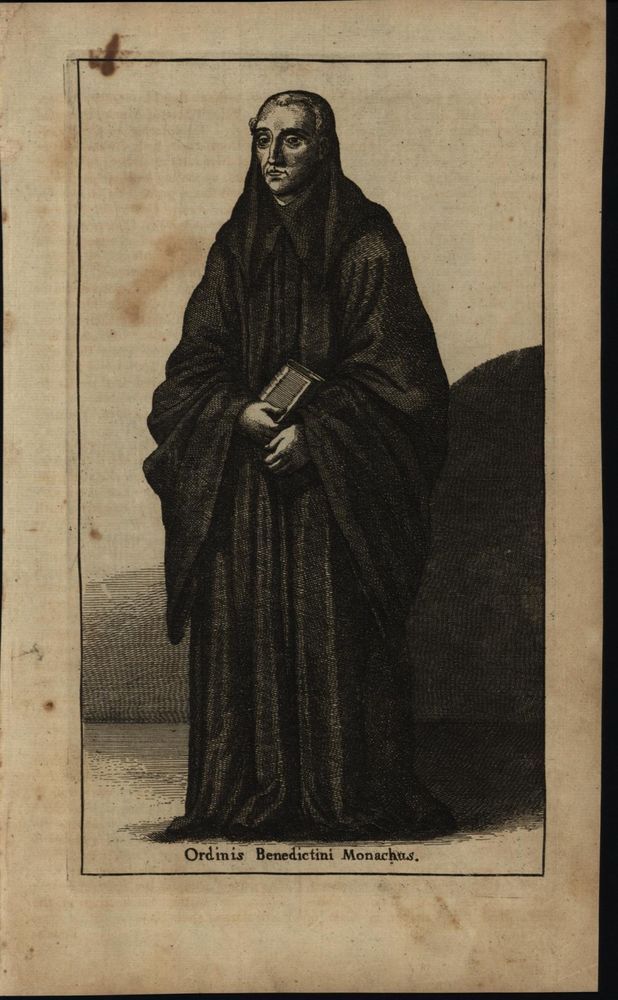
A Benedictine Monk
Arnulf was a Benedictine Monk in the Benedictine Monastery of Novalesa in Piedmont, Italy. It was located at the foot of the Alps and at the mouth of the Susa Valley on the Italian side of Mont Cenis in the Piedmont region of Northern Italy and boasted a large community of 500 Monks.
Arnulf is said to have been murdered around 840 by the Saracens, the medieval term for Muslims. His and Saint Heldrad ‘s Relics were transferred to the Parish Church in Novalesa upon the arrival of the French troops in 1794. His memorial day is 31 October, together with St Heldrad (on the Benedictine calendar) but St Heldrad is remembered on 13 March on the universal calendar.
The still active Abbey today
Some sources date his Martyrdom to the early 10th Century, which seems likely. In 906 Italy was invaded by the Saracens. A group of them moved from Frassineto (near today’s Saint-Tropez) in the direction of the Monastery in Novalesa. Abbot Donniverto heard of the impending danger, so together with most of the Monks he made it to safety in the Church of Sts Andrew and Clement (today’s Consolata) in Turin and brought with him the most sacred, indispensable and valuable objects as well as manuscripts from the library. The Saracens looted the Monastery and set fire to the buildings.
Some Monks from Novalesa had sought shelter in the Monastery of Oulx in the Susa Valley on the present border with France but there they were discovered and slaughtered. Two Monks escaped, Saints Justus and Flavian, who hid in a cave in the Arbour above Beaulard. From there they saw the Martyrdom of their brothers and that Angels brought their souls to Heaven. Then, they decided to go down into the Valley again and join their fellow brothers, where they too suffered Martyrdom. The Novalesa Monastery was rebuilt only in the 11th Century.
Vigil of All Saints Day or All Hallow’s Eve: Eve of the Feast of All Hallows, that is, All Saints Day. Halloween is a day on which many quaint customs are revived. It is popular in the United States and Scotland and in the US has become the second largest secular holiday of the year.
St Wolfgang of Regensburg (c934 –994) “The Great Almoner,” Bishop, Monk, Missionary, Ascetic, Apostle of Charity. He is regarded as one of the three great German Saints of the 10th Century, the other two being Saint Ulrich and Saint Conrad of Constance. He was Canonised in 1052 by Pope Leo IX. St Wolfgang’s life: https://anastpaul.com/2019/10/31/saint-of-the-day-31-october-saint-wolfgang-of-regensburg-c-934-994/
Thought for the Day – 30 October– Meditations with Antonio Cardinal Bacci (1881-1971)
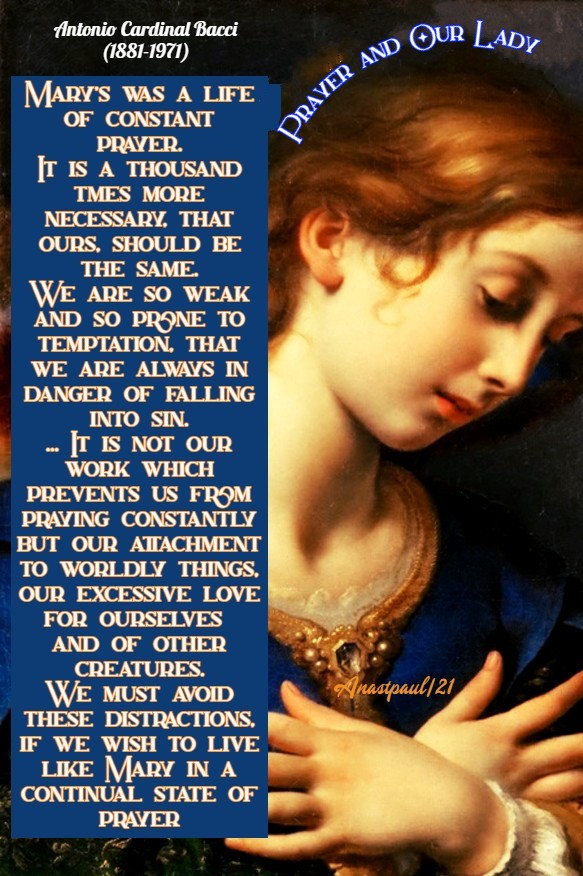
“The Month of the Most Holy Rosary” Prayer and Our Lady
“Mary’s was a life of constant prayer. It is a thousand tmes more necessary, that ours, should be the same. We are so weak and so prone to temptation, that we are always in danger of falling into sin. “Without me, you can do nothing,” (Jn 15:5) Jesus tells us. “I am the vine, you are the branches. If anyone does not abide in me, he shall be cast outside as the branch and wither.” (Ibid). “Ask and it shall be given to you; seek and you shall find; knock and it shall be opened to you ” (Mt 7:7). In short, Jesus asks us to pray. He wants us to pray because He wants to give us His graces.
about:blank
We cannot object that it is impossible for us to pray all the time because we have to work and fulfil other obligations. The work, which has first claim on us, is the service of God, which is prayer. Secondly, we can pray in tbe course of our daily work and of our different occupations, by offering to God, everything which we do. No matter what we are doing, we can raise our minds to God in an act of love and so remain always, close to Him.
It is not our work which prevents us from praying constantly but our attachment to worldly things, our excessive love for ourselves and of other creatures. We must avoid these distractions, if we wish to live like Mary in a continual state of prayer. ”
Quote/s of the Day – 30 October – Philippians 1:6-11, Matthew 22:15-21 – Scripture search here: https://www.drbo.org/
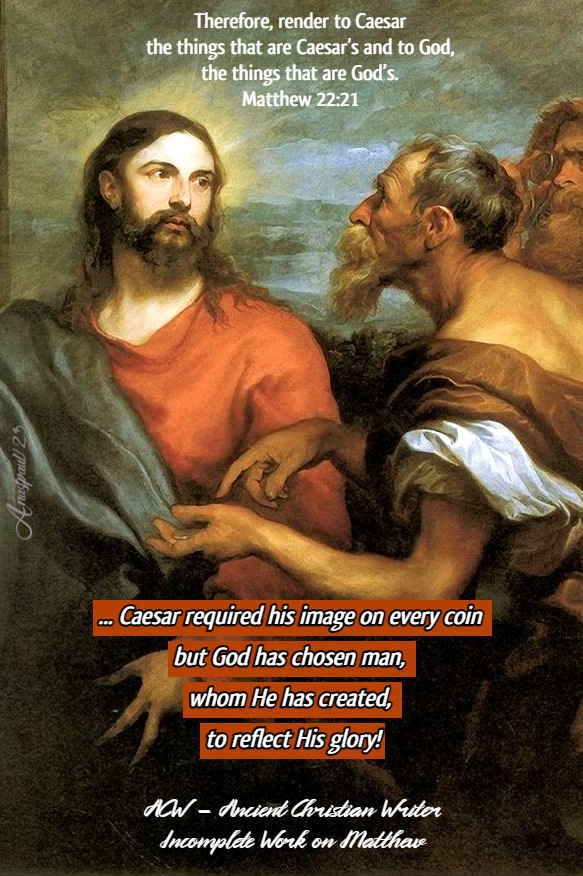
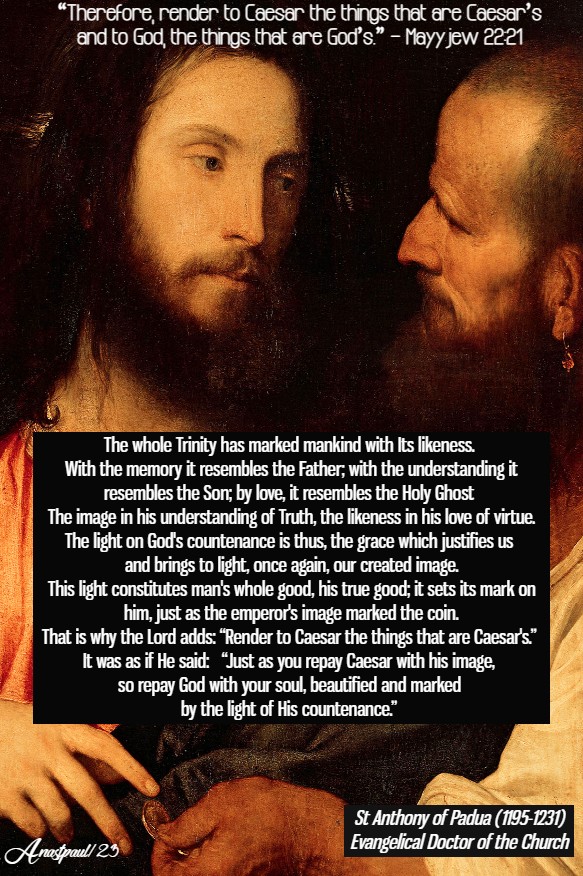
“Therefore, render to Caesar the things that are Caesar’s and to God, the things that are God’s.”
Matthew 22:21
“… Caesar required his image on every coin but God has chosen man, whom He has created, to reflect His glory!”
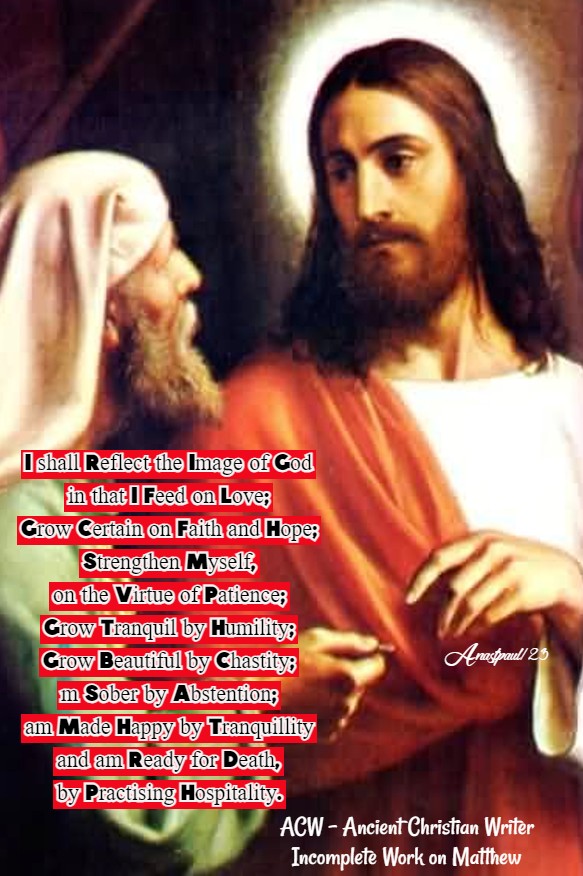
“I shall reflect the image of God in that I feed on love; grow certain on faith and hope; strengthen myself, on the virtue of patience; grow tranquil by humility; grow beautiful by chastity; am sober by abstention; am made happy by tranquillity and am ready for death, by practising hospitality.”
ACW – Ancient Christian Writer Incomplete Work on Matthew
One Minute Reflection – 30 October – Resumed Mass of Sunday – Philippians 1:6-11, Matthew 22:15-21 – Scripture search here: https://www.drbo.org/
“And Jesus said to them, “Whose likeness and inscription is this?” They said, “Caesar’s.” Then he said to them, “Therefore, render to Caesar the things that are Caesar’s and to God, the things that are God’s.” – Matthew 22:20-21
REFLECTION – “Just as this coin bears the image of Caesar, so our soul is in the image of the Blessed Trinity, as one of the Psalms says: “The light of Thy countenance, has been imprinted upon us” (4:6 LXX) … Lord, the light of Your countenance that is to say, the light of Your grace that sets Your image within us and makes us become like You, has been imprinted upon us, imprinted in our rational faculty which is the highest power of our soul and receives this light as wax receives the mark of a seal. God’s countenance is our reason because, just as we recognise someone by his face, so we recognise God through the mirror of reason. However, this reason has been deformed by human sin, since sin sets us against God. The grace of Christ has put our reason right. Hence, the Apostle Paul says to the Ephesians: “Be renewed in your minds” (4:23). The light in question, in the Psalm [above], is thus the grace which restores God’s image imprinted in our nature …
The whole Trinity has marked mankind with Its likeness. With the memory it resembles the Father; with the understanding it resembles the Son; by love, it resembles the Holy Ghost … From the beginning of creation man was made “in the image and likeness of God” (Gn 1:26). The image in his understanding of Truth, the likeness in his love of virtue. The light on God’s countenance is thus, the grace which justifies us and brings to light, once again, our created image. This light constitutes man’s whole good, his true good; it sets its mark on him, just as the emperor’s image marked the coin.That is why the Lord adds: “Render to Caesar the things that are Caesar’s.” It was as if He said: “Just as you repay Caesar with his image, so repay God with your soul, beautified and marked by the light of His countenance.”– St Anthony of Padua (1195-1231) Franciscan, Evangelical Doctor of the Church (Sermons for Sundays and Feasts of the Saints).
PRAYER – O God, our refuge and our strength, the very source of holiness, heed the devout prayers of Thy Church and grant that what we seek in faith, we may obtain in fact. Through Jesus Christ, Thy Son our Lord, Who lives and reigns with Thee, in the unity of the Holy Ghost, God, world without end. Amen (Collect).
Our Morning Offering – 30 October – Resumed Mass of Sunday –
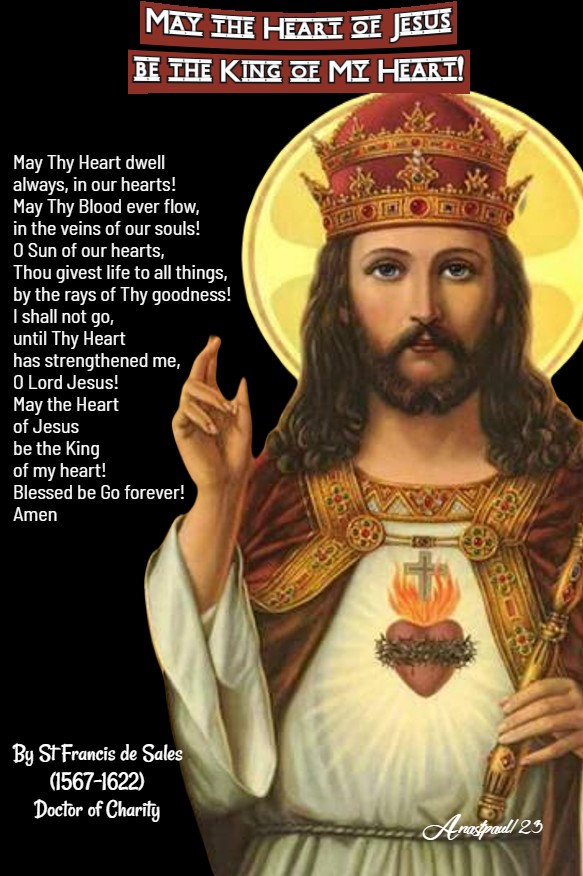
May the Heart of Jesus be the King of My Heart! By St Francis de Sales (1567-1622) Doctor of Charity
May Thy Heart dwell always, in our hearts! May Thy Blood ever flow, in the veins of our souls! O Sun of our hearts, Thou givest life to all things, by the rays of Thy goodness! I shall not go, until Thy Heart has strengthened me, O Lord Jesus! May the Heart of Jesus be the King of my heart! Blessed be Go forever! Amen
Saint of the Day – 30 October – Blessed John Slade (Died 1583) Layman Martyr, Tutor. Born in Manston, Dorsetshire, England and died by being hanged, drawn and quartered on 30 October 1583 at Winchester, England. Beatified on 15 December 1929 by Pope Pius XI. Additional Memorials – 29 October as one of the Martyrs of Douai, 1 December as one of the Martyrs of Oxford University.
The Roman Martyrology: “At Winchester in England, blessed John Slade, Martyr, who was hanged on the gallows and cruelly disemboweled for having refused the power of Queen Elizabeth I in spiritual matters.”
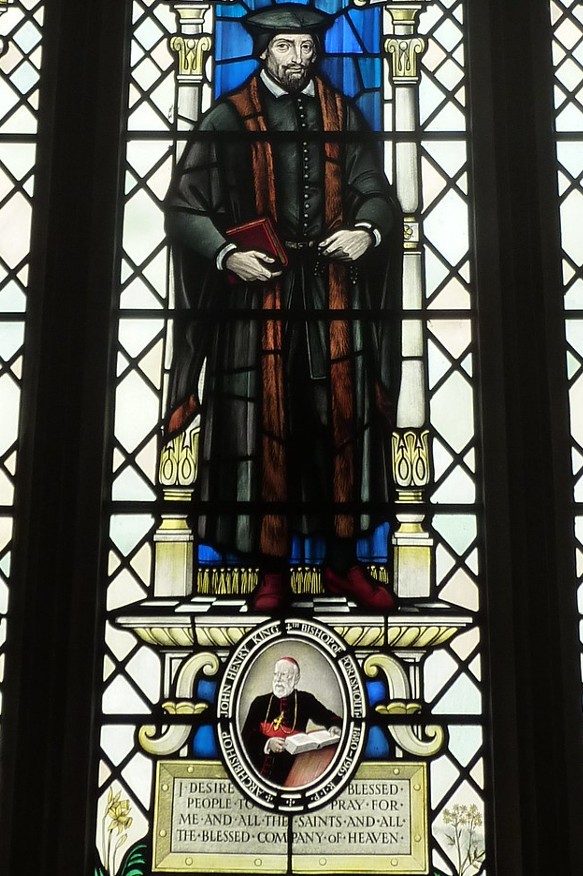
This window resides at the Winchester Catholic Cathedral. Below is Archbishop John Henry King – Photographer “Granpic” on Flickr
John Slade attended the New College, Oxford until, being expelled for being Catholic, he travelled to Douai to continue his study of Civil Law. However, since as a Catholic he was not permitted to practice the role of a Lawyer in England, he became a Tutor to the children of a gentleman’s household in Dorset.
On 30 October 1583, the Blessed John Slade, a Tutor from Dorset, was arrested as a “very dangerous Papist” and imprisoned in Winchester prison with Blessed John Bodey (1549-1583). They were held in iron shackles as “dangerous” prisoners. They were condemned in April, 1583 accused of High Treason for denying the Royal Supremacy over the Church of Our Lord Jesus Christ. There was, apparently, a protest against this Sentence claiming it to be unjust and illegal, leading to a retried. But, the two holy men were condemned again—at Andover, Hampshire, in August 1583.
After the Second Trial – Blessed John Bodey wrote, on behalf of Blessed John Slade and himself to a leading protestant theologian, one with whom he had prior discussions and debates:
“We consider that iron for this cause, borne on earth, shall surmount gold and precious stones in Heaven. This is our mark this is our desire. In the mean season we are threatened daily and do look still, when the hurdle shall be brought to the door. I beseech you, for God’s sake that we want not the good prayers of you all for our strength, our joy and our perseverance unto the end. … From our school of patience the 16th September 1583.”
Our Martyr today, Blessed John Slade, led from Winchester Prison to the public Square, knelt beside the Gallows which had been erected there, drew the Sign of the Cross on it, kissed it and then said, as he climbed the steps:
“I have come here to die for the Faith of all generations!”
A few days later the Blessed John Bodey too was hanged. Before dying he kissed the rope that had been placed around his neck exclaiming: “Jesus! Jesus! Jesus!”
St Germanus of Capua (Died c 541) Bishop of Capua, Italy, Confessor, Papal Legate. St Germanus was a close friend of St Benedict of Nursia. The Roman Martyrology states: St Germanus, Bishop and Confessor, a man of great sanctity, whose soul, at the hour of death, was seen by St Benedict taken to heaven by angels. His Life: https://anastpaul.com/2020/10/30/saint-of-the-day-30-october-saint-germanus-of-capua-died-c-541/
St Herbert of Tours Blessed John Slade (Died 1583) Layman Martyr
St Lucanus of Lagny St Marcellus the Centurion St Marcian of Syracuse St Maximus of Cumae St Nanterius of Saint-Mihiel Bl Raymond of Cardona St Saturninus of Cagliari St Serapion of Antioch St Talarica of Scotland Bl Terrence Albert O’Brien St Theonestus of Philippi (Died 425) Bishop, Martyr St Zenobia of Aegea St Zenobius of Aegea
Martyrs in Africa: A group of 100 to 200 Christians murdered in the early persecutions and about whom we know nothing except that they died for their faith.
Thought for the Day – 29 October – Meditations with Antonio Cardinal Bacci (1881-1971)
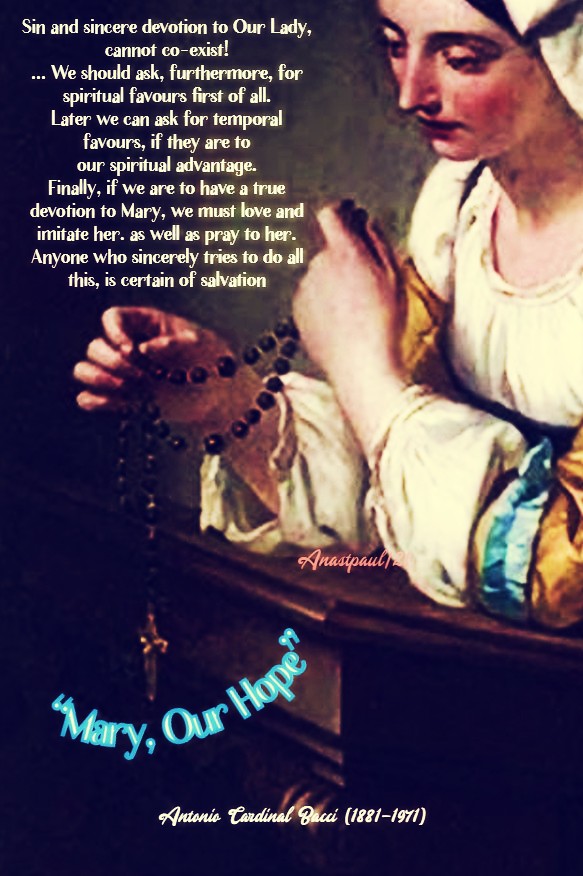
“Month of the Holy Rosary” “Mary, Our Hope”
“These expressions of confidence in Mary’s powerful intercession, should not lead us astray, however. They hold good with absolute certainty, only for those who have true devotion to Mary. Even if they are sinners, such clients of Mary, must have at least the good intention of changing their lives and never offending God again. Sin and sincere devotion to Our Lady, cannot co-exist! “Relinquish every intention of sinning.” St Gregory VII wrote to the Princess Matilde, “and you will find Mary more eager to help you than any earthly mother” (Lib 1, Ep 47).
We should ask, furthermore, for spiritual favours first of all. Later we can ask for temporal favours, if they are to our spiritual advantage.
Finally, if we are to have a true devotion to Mary, we must love and imitate her. as well as pray to her. Anyone who sincerely tries to do all this, is certain of salvation!”
Quote/s of the Day – 29 October – Christ the King – Colossians 1:12-20. John 18:33-37
“Wake up then, believer and note what is stated here: “In my Name.” That [Name] is Christ Jesus. Christ signifies King, Jesus signifies Saviour. Therefore, whatever we ask for that would hinder our salvation, we do not ask in our Saviour’s Name and yet, He is our Saviour, not only when He does what we ask but also, when He does not. When He sees us ask anything to the disadvantage of our salvation, He shows Himself our Saviour by not doing it. The physician knows whether what the sick person asks for, is to the advantage or disadvantage of his health. And [the physician] does not allow what would be harmful to him, although the sick person himself, desires it. But the physician looks to his final cure.”
St Augustine (354-430) Father and Doctor of Grace of the Church
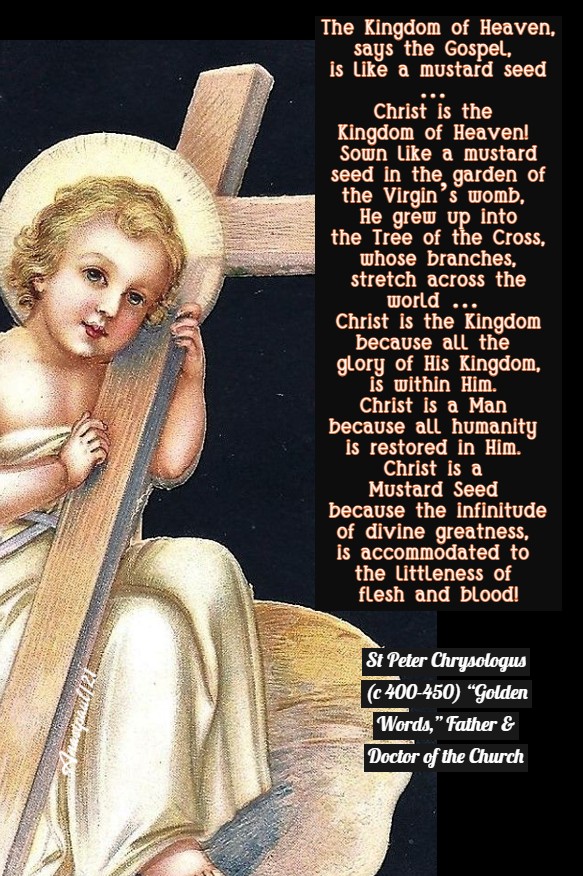
“The Kingdom of Heaven, says the Gospel, is like a mustard seed … Christ is the Kingdom of Heaven! Sown like a mustard seed in the garden of the Virgin’s womb, He grew up into the Tree of the Cross, whose branches, stretch across the world … Christ is the Kingdom because all the glory of His Kingdom, is within Him. Christ is a Man because all humanity is restored in Him. Christ is a Mustard Seed because the infinitude of Divine greatness, is accommodated to the littleness of flesh and blood!”
St Peter Chrysologus (c 400-450) “Golden Words” Father & Doctor of the Church
Jesus is Our King By Estelle White (1925-2011) Convert, Musician, Hymnist.
Crown Him, the Virgin’s Son, The God Incarnate born, Whose arm those crimson trophies won Which now His brow adorn. Awake, my soul, and sing Of Him Who died for thee; And hail Him as thy glorious King Through all Eternity.
Crown Him, the Lord of Love; Behold His bands and side,– Rich wounds, still visible above In beauty glorified: No Angel in the sky Can fully bear that sight, But downward bends His burning eye At mysteries so bright.
Crown Him, the Lord of Peace, Whose power a sceptre sways From pole to pole, that wars may cease, Absorbed in prayer and praise: His reign shall know no end, And round His pierced feet Fair flowers of Paradise extend Their fragrance ever sweet.
One Minute Reflection – 29 October – Christ the King – Colossians 1:12-20. John 18:33-37 – Scripture search here: https://www.drbo.org/
“My Kingdom is not of this world. If my Kingdom were of this world, My servants would certainly strive that I should not be delivered to the Jews …” – John 18:36
REFLECTION – “ Listen everyone, Jews and Gentiles… Listen all the kingdoms of the earth! I am not preventing you from ruling over this world, “My Kingdom is not of this world.” (Jn 18:36) So do not be afraid with that senseless fear which seized Herod when My birth was announced to him… “No,” the Savior says, “My Kingdom is not of this world.” May you not be made cruel by fear. It is true that the Son of God, speaking of the Father, says in a prophecy: “Through Him, I was established as King on Zion, His holy mountain.” (Ps 2:6) But that Zion and that mountain, are not of this world.
And what is His Kingdom? It is they who believe in Him, those to whom He says: “You are not of the world, just as I Am not of the world.” But He, nevertheless, wants them to be in the world; He prays to His Father: “I am not asking Thee to take them out of the world but, to protect them from the evil one.” (Jn 17:15) For He did not say: “My Kingdom is not in this world,” but rather: “It is not OF this world.If My Kingdom were OF this world, My followers would be fighting to keep Me from being handed over.”
For His Kingdom really is here on earth until the end of the world, until the harvest of weeds mingled with the good seed (Mt 13:24.)… ButHis Kingdom is not from here, for He is like a traveller in this world. To those over whom He reigns, He says: “You do not belong to the world but I have chosen you out of the world.” (Jn 15:19) So they did belong to this world when they were not yet His Kingdom and they belonged to the prince of this world (Jn 12:3)… All who are born of Adam’s sinful race belong to this world; all who were reborn in Jesus Christ belong to His Kingdom and no longer belong to this world.For “God has rescued us from the power of darkness and transferred us into the Kingdom of His beloved Son.” (Col 1:13).” – St Augustine (354-430) Father and Doctor of Grace(Tractate 115 on the Gospel of John ) [Translated from the French].
PRAYER – Almighty and eternal God, Who willed to restore all things in Thy beloved Son, the King of the Universe, graciously grant that the peoples of the earth torn asunder by the wound of sin, may submit to His most gentle rule. Who lives and reigns with Thee, in the unity of the Holy Ghost, God, world without end. Amen (Collect).
Our Morning Offering – 29 October – Christ the King
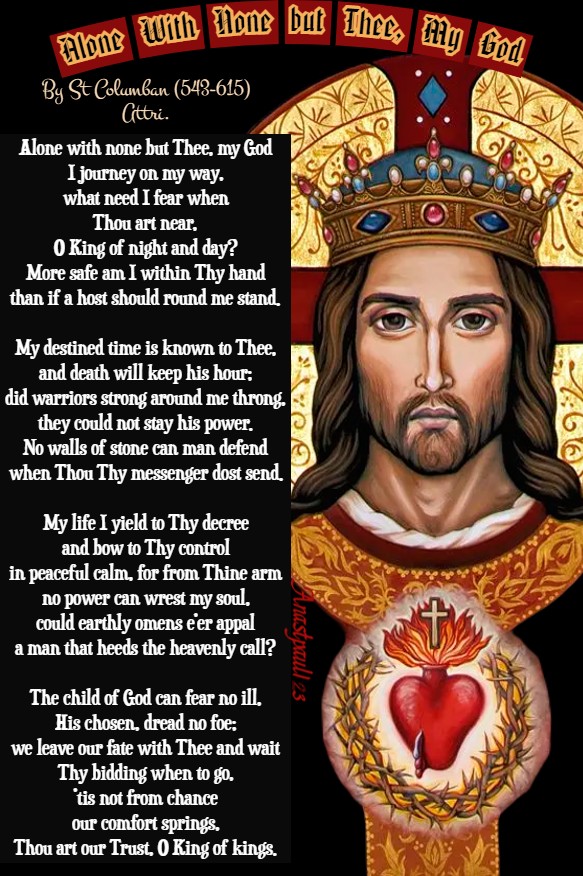
Alone With None but Thee, My God Attri. St Columban (543-615)
Alone with none but Thee, my God I journey on my way, what need I fear when Thou art near, O King of night and day? More safe am I within Thy hand than if a host should round me stand.
My destined time is known to Thee, and death will keep his hour; did warriors strong around me throng, they could not stay his power. No walls of stone can man defend when Thou Thy messenger dost send.
My life I yield to Thy decree and bow to Thy control in peaceful calm, for from Thine arm no power can wrest my soul, could earthly omens e’er appal a man that heeds the heavenly call?
The child of God can fear no ill, His chosen, dread no foe; we leave our fate with Thee and wait Thy bidding when to go, ’tis not from chance our comfort springs, Thou art our Trust, O King of kings.
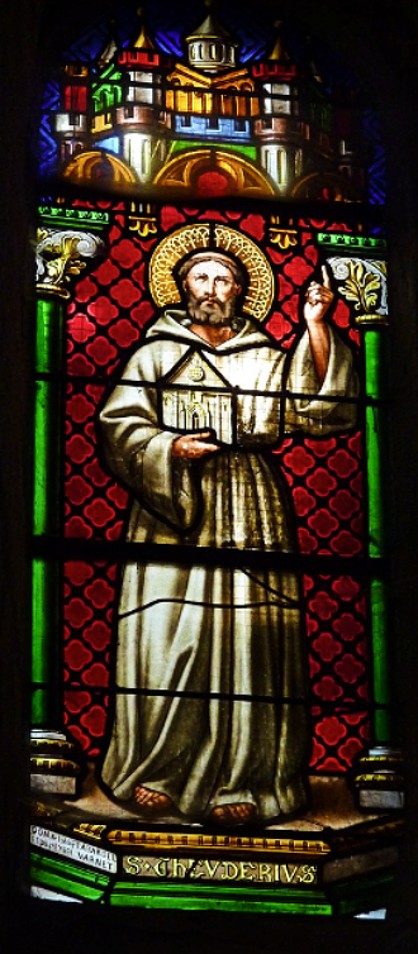
Saint of the Day – 29 October – Saint Theodore of Vienne (Died c575) Priest, Monk, Founder Abbot of the Monastery of Saint Laurence , Recluse, Miracle-worker. Spiritual student of Saint Caesarius of Arles (470-542). Born in Arcisse, near Saint-Chef, Dauphiné, France and died in c575 in the Church of Saint Lawrence, in Vienne, France of natural causes. Also known as – Chef, Theudère, Theudar, Teuderio, Teodario, Theuderius, Theodorius.
The Roman Martyrology states: “At Vienne, the departure from this world of blessed Theodore, Abbot.”
Theodore, a young man of one of the best families of the City of Vienne, by the interior call of the Holy Ghost, forsook the world and. having long exercised himself in the most perfect practices of a monastic life. under the direction of Saint Cæsarius at Arles, returned to his own country and, being joined by several disciples, built for them first cells and afterwards a Monastery near the City of Vienne in Dauphine.
It was a custom in the most regular Monasteries that the Hebdomadarian Priest who celebrated the community Mass, spent the week in which he discharged that function, in the closest retirement in his cell and in holy contemplation and austere penance, both that he might be better prepared to offer daily, the tremendous Sacrifice, and that he might more faithfully, acquit himself of his mediatorship, between God and his people.
It was also a peculiar custom in the sixth Century at Vienne that a Monk was chosen, of whose sanctity the people entertained a high opinion, who should voluntarily lead the life of a recluse, being walled up in a cell and spending his whole time in fasting, praying and weeping, to implore the Divine mercy in favour of himself and his country. This practice would have been an abuse and superstition, if any person, relying on the prayers of others, were themselves more remiss in prayer or penance. Saint Theodore was chosen for this penitential state, which obligation he willingly took upon himself and discharged with so much fervour as to seem desirous to set no bounds to his tears and mortifications. An extraordinary gift of miracles made his name famous in the whole country.
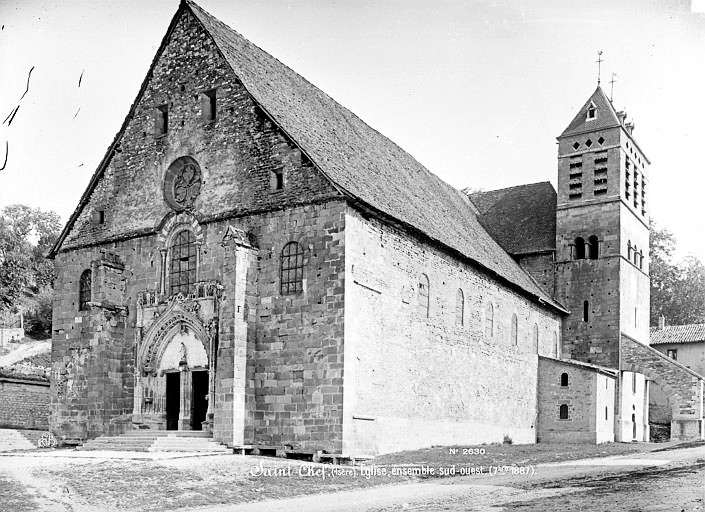
Theodore died about the year 575 and was buried in the Monastery of Saint Laurence which he had founded. His Relics were translated to a collegiate Church of which he is the Titular Patron and which gives the name of Saint Chef to the Village where it stands, eight leagues from Vienne. This Saint is named in the Roman Martyrology.
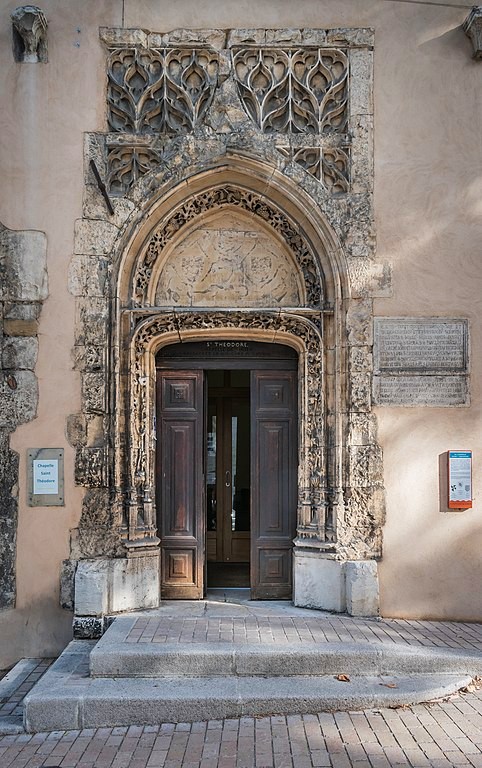
Entrance to the Church of St Theodore
Saint Theodore is celebrated in the Diocese of Grenoble-Vienne on 29 October. The Village of Sainte-Chef was originally called Sainte-Theudère but the Village may be called Sainte-Chef today because of a tradition that the head (The French word ‘chef’ comes from Latin ‘caput’ [head]) of the Saint was kept there.
Christ the King: “Therefore, by our Apostolic authority, we appoint the Feast of Our Lord Jesus Christ the King, annually, on the last Lord’s day in the Month of October, that is to say, on the Sunday which immediately precedes the Feast of All Saints, to be observed everywhere in the world. Likewise we enjoin, that the dedication of the human race to the Most Sacred Heart of Jesus be annually renewed upon that selfsame day.”
St Abraham of Rostov St Anne of Mount Olympus St Colman of Kilmacduagh St Dodone of Wallers-en-Fagne St Donatus of Corfu St Ermelinda of Meldaert St Eusebia of Bergamo St Felician of Carthage St Honoratus of Vercelli St John of Autun St Kennera St Mary of Edessa St Narcissus of Gerona
St Sigolinus of Stavelot St Stephen of Cajazzo St Terence of Metz St Theodore of Vienne (Died c575) Abbot St Zenobius of Sidon
Martyrs of Douai – 160 Saints and Beati: 160 Priests, Laymen and Religious who studied at the English College in Douai, France, then returned to minister to covert Catholics in England during a period of government persecution of the Church and were murdered for their work.
Martyrs of Lucania – 4 Saints: A group of Christians executed together for their faith. Only their names have survived – Felician, Hyacinth, Lucius and Quintus. Their Martyrdom occurred in Lucania, southern Italy.
Thought for the Day – 28 October – Meditations with Antonio Cardinal Bacci (1881-1971)
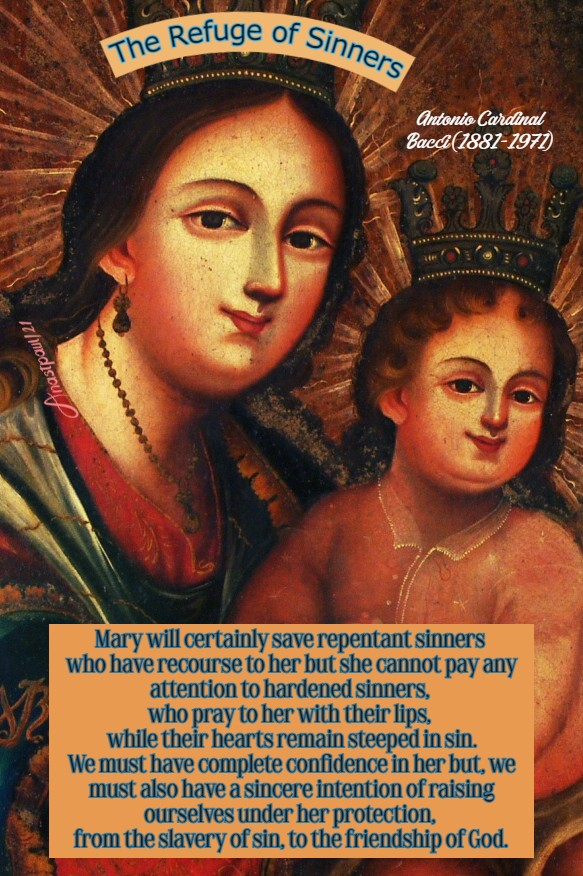
“Month of the Holy Rosary” “The Refuge of Sinners”
“Mary is called, the Star of Sea because, as St Thomas Aquinas says, “even as sailors are guided into port, by means of a star, so Christians are guided towards Heaven, by means of Mary, .” (Opuse, 7). This absolute guarantee of the protection of our heavenly Mother, should increase our trust in her and lead us to turn towards her in every difficulty and temptation. It should not, however, result in an unhealthy attitude of spiritual inactivity, a passive dependence on Mary’s favours, without any co-operation on our part. Such behaviour would be the height of filial ingratitude. Mary will certainly save repentant sinners who have recourse to her but she cannot pay any attention to hardened sinners, who pray to her with their lips, while their hearts remain steeped in sin. We must have complete confidence in her but, we must also have a sincere intention of raising ourselves under her protection, from the slavery of sin, to the friendship of God.”
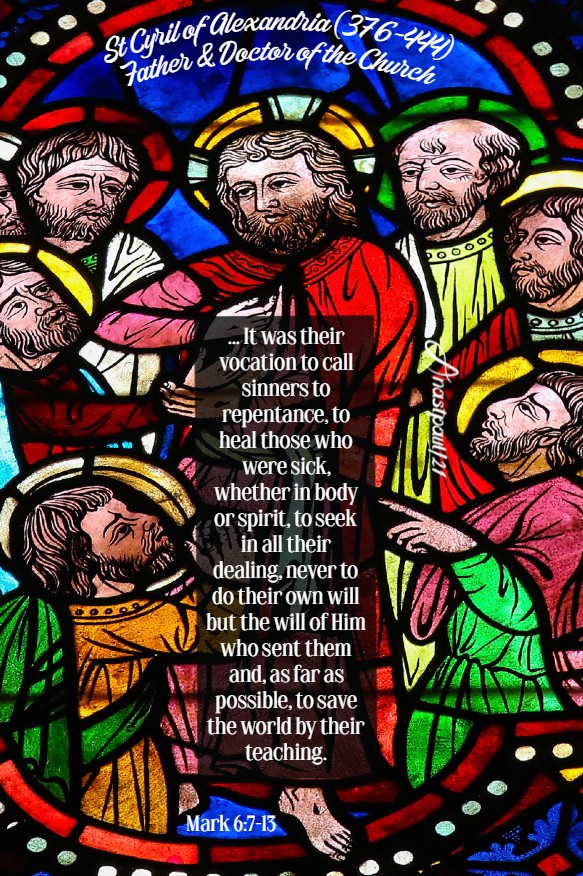
Quote/s of the Day – 28 October – The Feast of Saints Simon and Jude, Apostles
“… It was their vocation to call sinners to repentance, to heal those who were sick, whether in body or spirit, to seek in all their dealing, never to do their own will but the will of Him who sent them and, as far as possible, to save the world by their teaching.”
St Cyril of Alexandria (376-444) Bishop, Father & Doctor of the Church
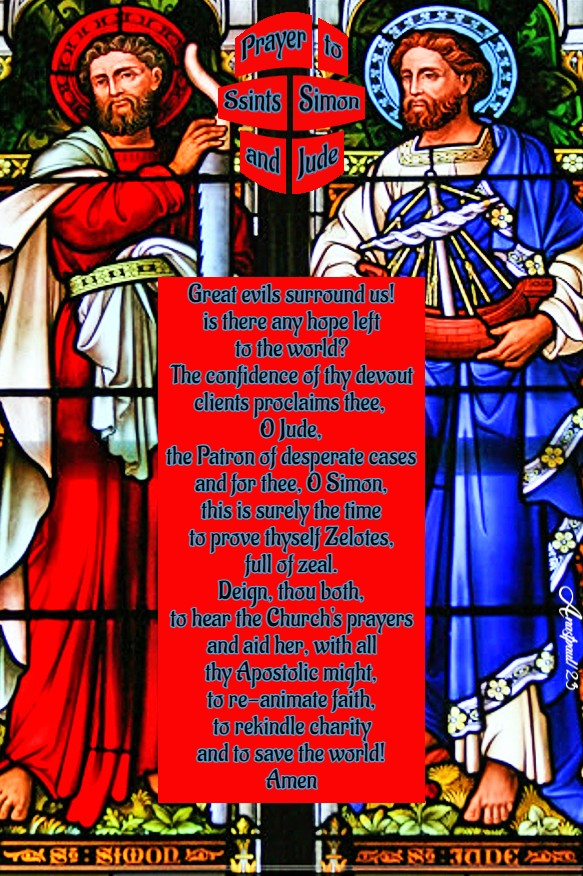
Prayer to Sts Simon and Jude From the Liturgical Year, 1903
Great evils surround us! is there any hope left to the world? The confidence of thy devout clients proclaims thee, O Jude, the Patron of desperate cases and for thee, O Simon, this is surely the time to prove thyself Zelotes, full of zeal. Deign, thou both, to hear the Church’s prayers and aid her, with all thy Apostolic might, to re-animate faith, to rekindle charity and to save the world! Amen
























You must be logged in to post a comment.