Posted in OCTOBER - The HOLY ROSARY and The HOLY ANGELS

Thought for the Day – 19 October – Novenas in honour of the holy Angels

The Glories of the Holy Angels

Venerable Henri Boudon, Archdeacon of Evreux

To make Novenas in honour of the holy Angels—to take certain days to honour them—and to celebrate their Feasts with particular devotion.

The Catholic Church teaches, that we should not superstitiously attach ourselves to certain numbers; but there are some mysterious ones, consecrated by the piety of the faithful, which she sanctions and authorizes as that of three, which is the number of the holy Trinity; that of forty, which is the number of days our Lord spent in the wilderness; that of nine, which corresponds with the number of the angelic Choirs.

Any devotion practised for nine days is termed a Novena. St. Teresa was very partial to this practice, as she herself tells us. It is most useful to perform such a one in honour of the Angels; we ourselves have seen miraculous things effected by it.

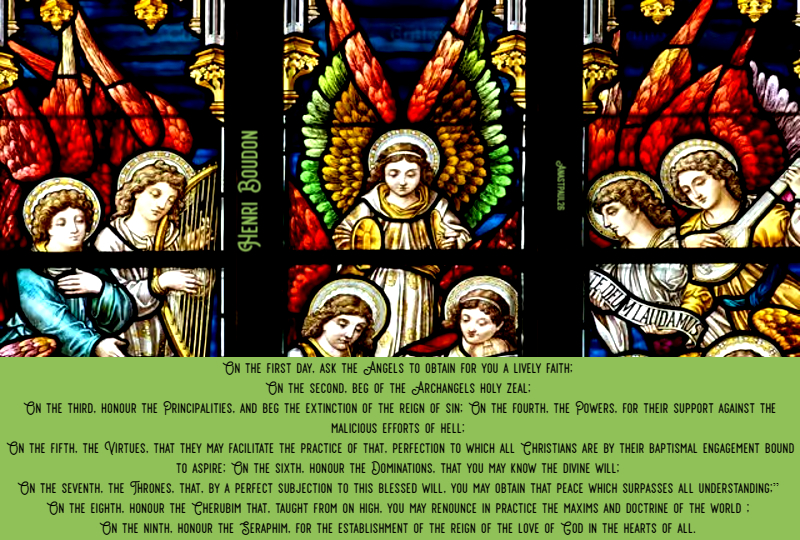
It may be as follows : the first day, honour the Angels of the last Choir by some prayer— nine Gloria Patris, for example—and ask them for the grace or favour you want; and thus ascend to all the choirs successively. If your object be the graces peculiar to each Choir, you can on the first day, ask the Angels to obtain for you a lively faith; on the second, beg of the Archangels holy zeal; on the third, honour the Principalities, and beg the extinction of the reign of sin; on the fourth, the Powers, for their support against the malicious efforts of hell; on the fifth, the Virtues, that they may facilitate the practice of that, perfection to which all Christians are by their baptismal engagement bound to aspire; on the sixth, honour the Dominations, that you may know the divine will; on the seventh, the Thrones, that, by a perfect subjection to this blessed will, you may obtain that peace which surpasses all understanding;” on the eighth, honour the Cherubim that, taught from on high, you may renounce in practice the maxims and doctrine of the world ; and, finally, on the ninth, honour the Seraphim, for the establishment of the reign of the love of God in the hearts of all.

This devotion of Novenas is also a useful preparation for the feasts of our Lord and his blessed Mother, as well as of the Angels. It may consist of any pious practice, as of nine acts of mortification, nine genuflections, nine visits to the Holy Sacrament, or nine Ave Marias, a devotion which our Lord revealed to St. Mechtilde. It is well to commence by receiving the Holy Sacraments, that our souls being cleansed from sin, God may be more ready to hear and grant our requests. Thus much for the devotion of the Novena.

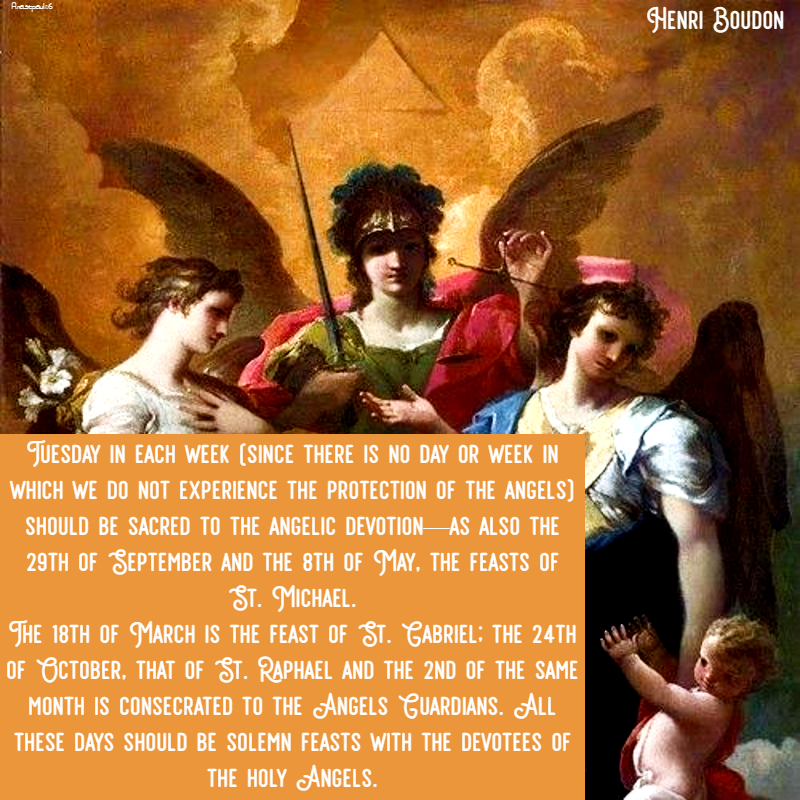
Tuesday in each week (since there is no day or week in which we do not experience the protection of the angels) should be sacred to the angelic devotion—as also the 29th of September and the 8th of May, the feasts of St. Michael. In Normandy, they devote the 16th of October to honour the apparition of this glorious Archangel on the Mount of Tornbe, commonly called Mount St. Michael. The church built there in his honour is frequented by crowds of pilgrims on this day, and numberless miracles are operated by his intercession.

The 18th of March is the feast of St. Gabriel; the 24th of October, that of St. Raphael and the 2nd of the same month is consecrated to the Angels Guardians. All these days should be solemn feasts with the devotees of the holy Angels. They would do well to prepare for them by some act of mortification, (St. Francis fasted forty days to prepare for the feast of St. Michael,) or by the Novena, and to celebrate the feast itself by approaching the Sacraments, reciting the Office of and Litany and Beads of these blessed Spirits, each one according to his time and devotion.

Behold another way of honouring the Angels : when about to celebrate the festival of a Saint, form the intention of honouring his or her guardian; thus you will keep a perpetual holiday in honour of the Angels. Love to visit churches and altars dedicated to them; you will thereby obtain, through their intercession, the most precious gifts and graces.
Posted in Uncategorized

Thought for the Day – 17 October – The Seven Spirits

The Glories of the Holy Angels

Venerable Henri Boudon, Archdeacon of Evreux

PRACTICE FOURTH

To have a great Devotion to the Seven Spirits who are before the Throne.

The Holy Scriptures assure us, that there are seven of the holy Angels specially appointed to assist before the Throne, and stand continually in the presence of the Most High. In the 1st chapter of the Apocalypse, grace and peace are given in the name of these sublime Spirits. We only know the names of three of them—St. Michael, St. Gabriel, St. Raphael. Some say that the fourth is called Uriel, of whom there is mention made in the Book of Esdras. E.

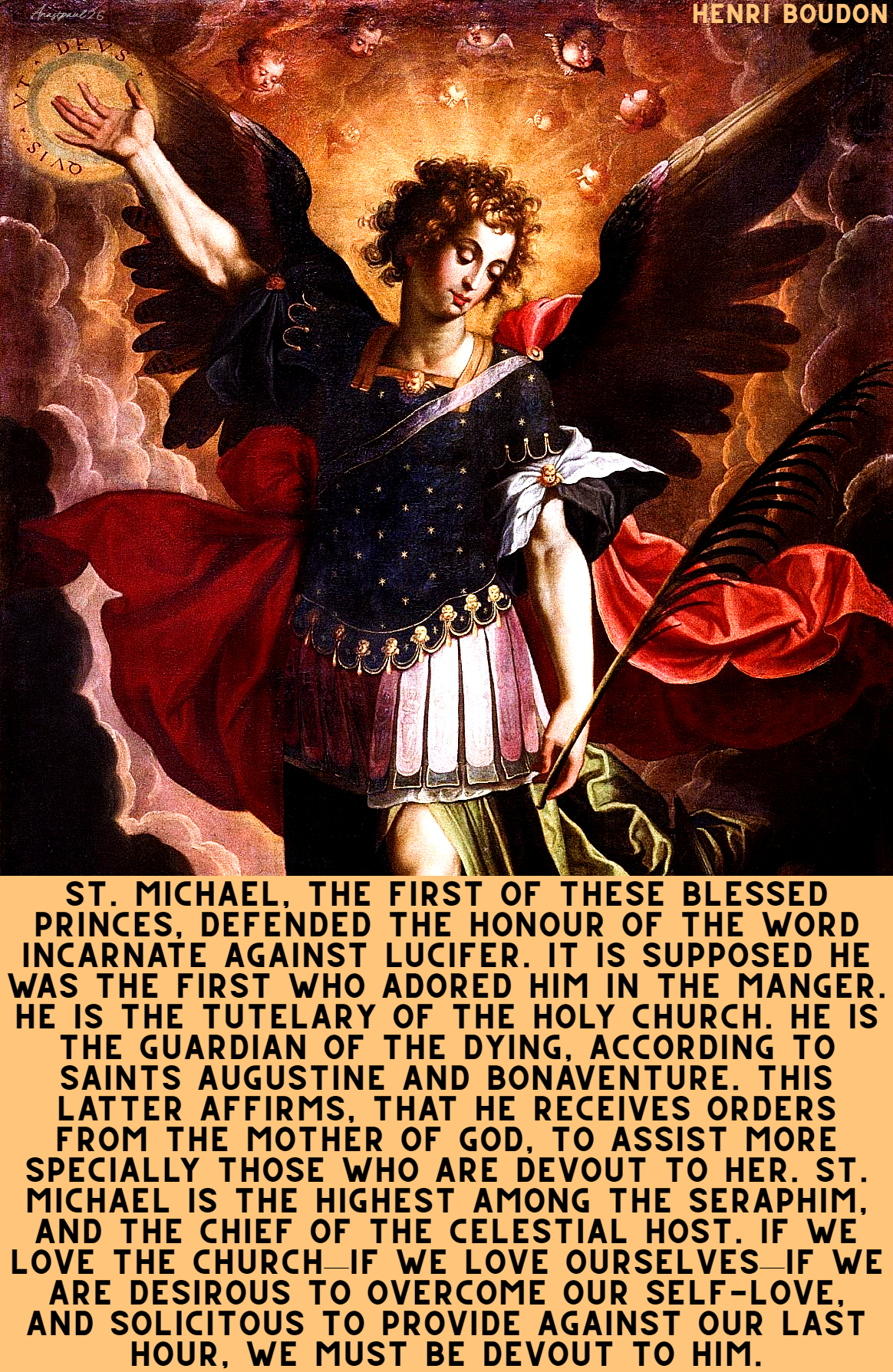
But to say something of each in particular: St. Michael, the first of these blessed princes, defended the honour of the Word incarnate against Lucifer. It is supposed he was the first who adored him in the manger. He is the tutelary of the holy Church. He is the guardian of the dying, according to Saints Augustine and Bonaventure. This latter affirms, that he receives orders from the Mother of God, to assist more specially those who are devout to her. St. Michael is the highest among the Seraphim, and the chief of the celestial host. If we love the Church—if we love ourselves—if we are desirous to overcome our self-love, and solicitous to provide against our last hour, we must be devout to him.

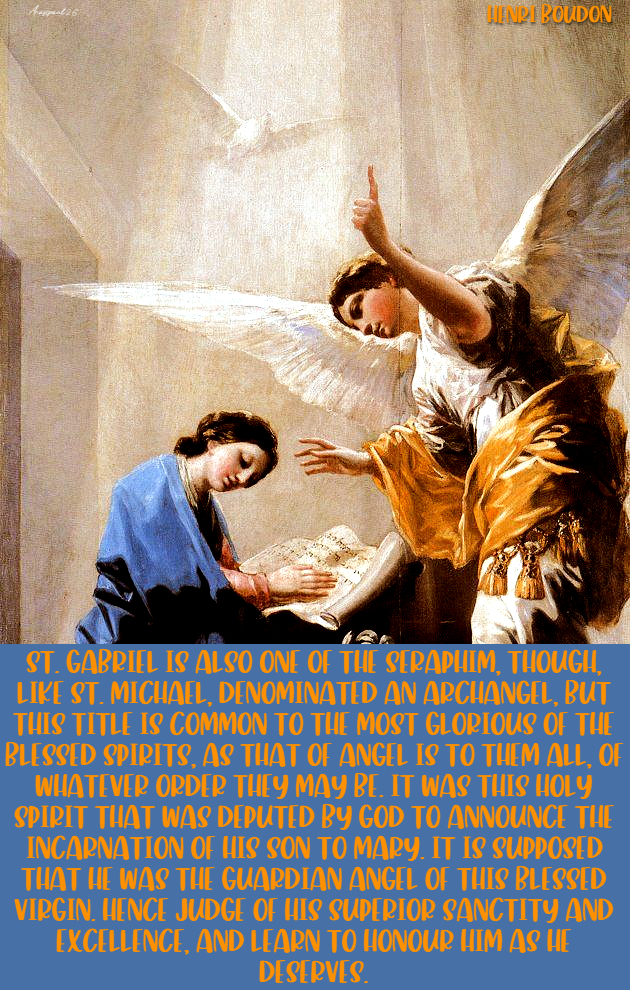
St. Gabriel is also one of the Seraphim, though, like St. Michael, denominated an archangel, but this title is common to the most glorious of the blessed Spirits, as that of Angel is to them all, of whatever order they may be. It was this holy spirit that was deputed by God to announce the incarnation of his Son to Mary. It is supposed that he was the Guardian Angel of this blessed Virgin. Hence judge of his superior sanctity and excellence, and learn to honour him as he deserves.

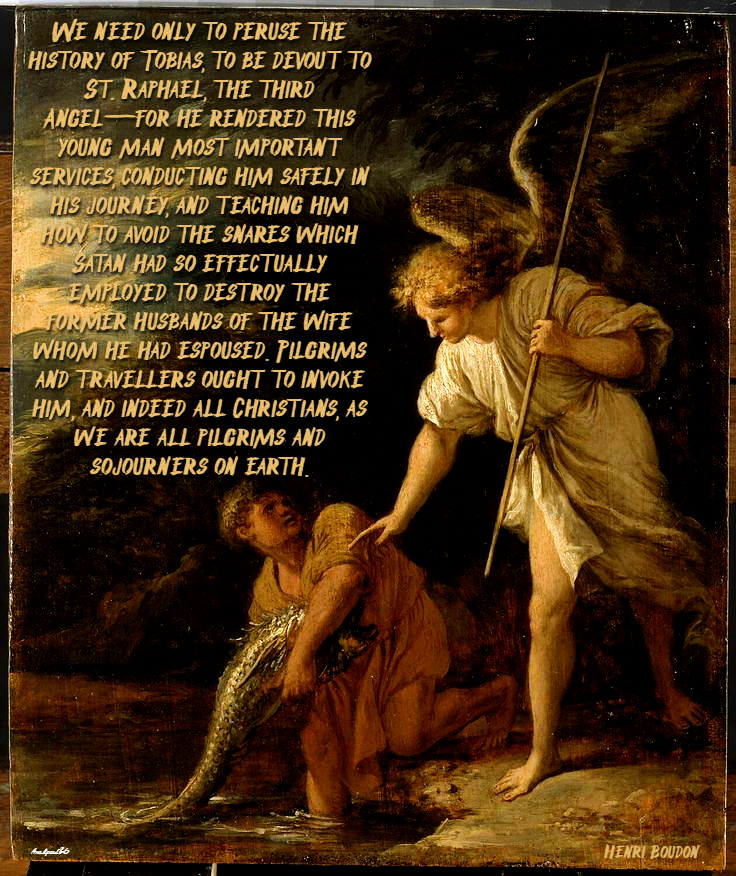
We need only to peruse the history of Tobias, to be devout to St. Raphael, the third Angel—for he rendered this young man most important services, conducting him safely in his journey, and teaching him how to avoid the snares which Satan had so effectually employed to destroy the former husbands of the wife whom he had espoused. Pilgrims and travellers ought to invoke him, and indeed all Christians, as we are all pilgrims and sojourners on earth.

Let us honour all these blessed Seven—let us be but truly devout to them let us beg their prayers, in order that we may avoid the seven capital sins, and obtain the seven gifts of the Holy Ghost.

Posted in OCTOBER - The HOLY ROSARY and The HOLY ANGELS

Thought for the Day – 14 October – Devotion to the First Choir

The Glories of the Holy Angels

Venerable Henri Boudon, Archdeacon of Evreux

PRACTICE FIRST

To have a singular Devotion to the holy Spirits of the First Choir—the Angels, Archangels, and Principalities.

The third or last Hierarchy of the Holy Angels is formed of three Choirs Angels, Archangels, and Principalities. They are particularly applied to the affairs of kingdoms and provinces, and in general to all that regards the happiness of man. Their goodness and kindness is so great, that we can never make them a suitable return. The principalities are so called, says St. Gregory, because they are the princes of the other two choirs, and communicate to them those lights and intelligences which they receive from the higher Hierarchies. The Archangels watch over kingdoms and provinces and the Angels are appointed the guardians of men.

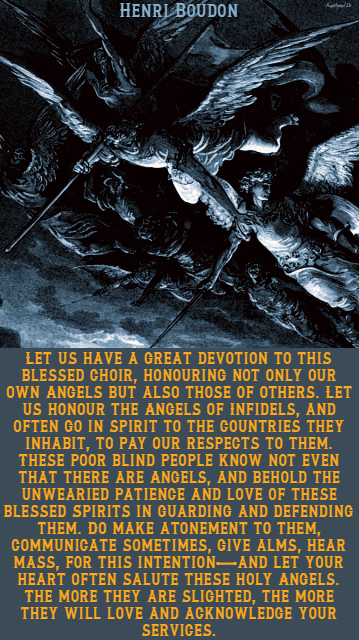
Let us have a great devotion to this blessed choir, honouring not only our own Angels but also those of others. Let us honour the Angels of Infidels, and often go in spirit to the countries they inhabit, to pay our respects to them. These poor blind people know not even that there are Angels, and behold the unwearied patience and love of these blessed Spirits in guarding and defending them. Do make atonement to them, communicate sometimes, give alms, hear mass, for this intention—and let your heart often salute these holy Angels. The more they are slighted, the more they will love and acknowledge your services. If a great king, in the revolt of his subjects, received considerable services from foreigners, he would not fail to acknowledge them gratefully, when reinstated in his dominions : hence judge what you may expect from the princes of the celestial realm. Do the same for the Angels of Heretics—for those of uninstructed Catholics, the greater number of whom know as little about these holy Spirits, as Pagans and Infidels. Pray for their conversion, that knowing the adorable Jesus, whom God has sent, and Mary his amiable mother, they may also know and honour the Angels.

Be devout to the Angels of your friends; these often render you services, which you would not receive from your own guardian. As, in the number of your friends, your confessor holds the first place, honour particularly his Angel, and pray him to bear on his mind a perfect knowledge of the designs of God on those whom he directs. Honour the Angels of your parents, relations, benefactors, and- of all with whom you have to do; they have more part than you think in the favours you receive by means of those persons. Be devout to the Angels of your enemies—it is the true way to gain them—or, if God wills that you should suffer the effects of their hatred, it is the best means of obtaining grace to love them cordially and make a good use of your sufferings. In fine, revere the Angels of the Sovereign Pontiff, the Bishops, the Clergy, and all persons in authority—that they may fitly discharge their obligations.

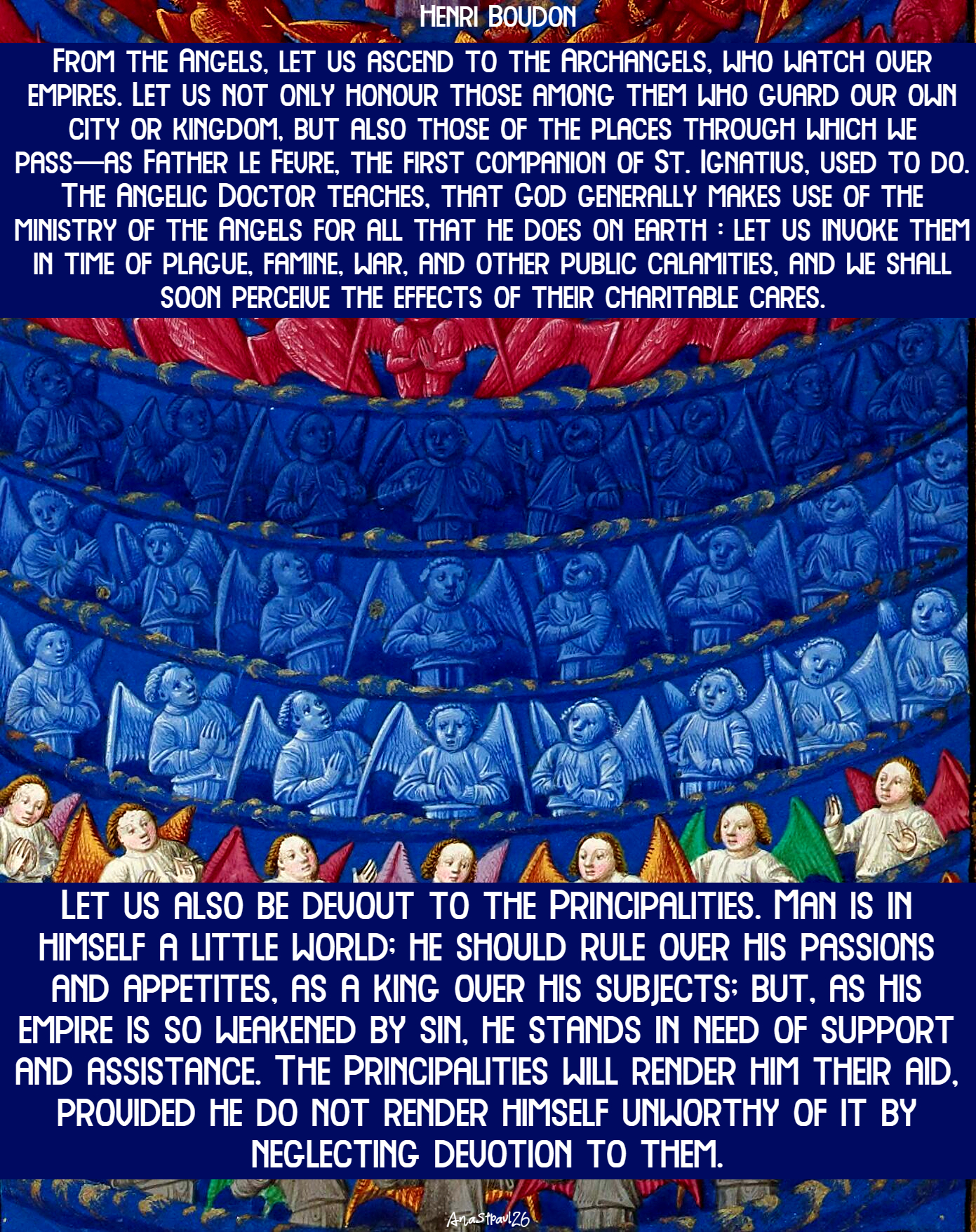
From the Angels, let us ascend to the Archangels, who watch over empires. Let us not only honour those among them who guard our own city or kingdom, but also those of the places through which we pass—as Father le Fevre, the first companion of St. Ignatius, used to do. The Angelic Doctor teaches, that God generally makes use of the ministry of the Angels for all that he does on earth : let us invoke them in time of plague, famine, war, and other public calamities, and we shall soon perceive the effects of their charitable cares.

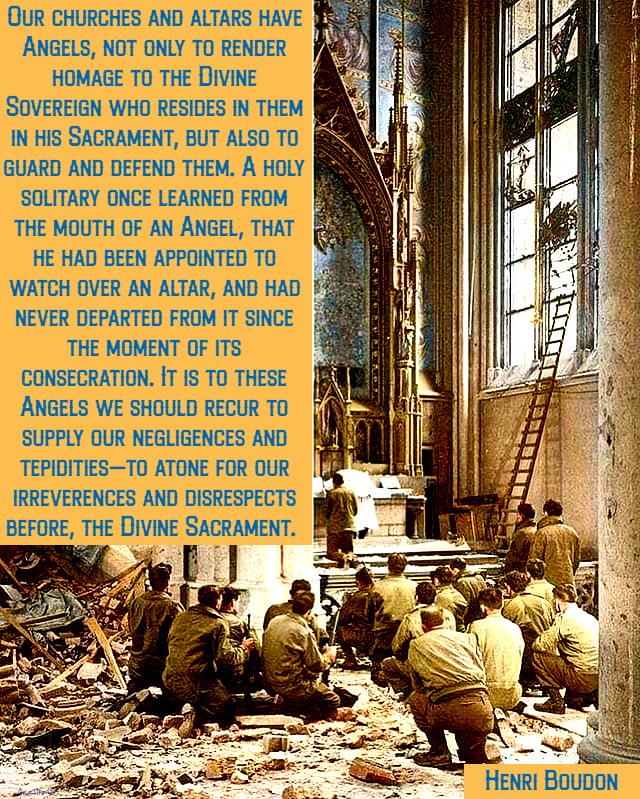
Our churches and altars have Angels, not only to render homage to the Divine Sovereign who resides in them in his Sacrament, but also to guard and defend them. A holy solitary once learned from the mouth of an Angel, that he had been appointed to watch over an altar, and had never departed from it since the moment of its consecration. It is to these Angels we should recur to supply our negligences and tepidities—to atone for our irreverences and disrespects before, the Divine Sacrament. It is well to unite in the love and homage which they continually render to it, and like the Psalmist, to “sing canticles of praise to our God in the presence of his Angels.”

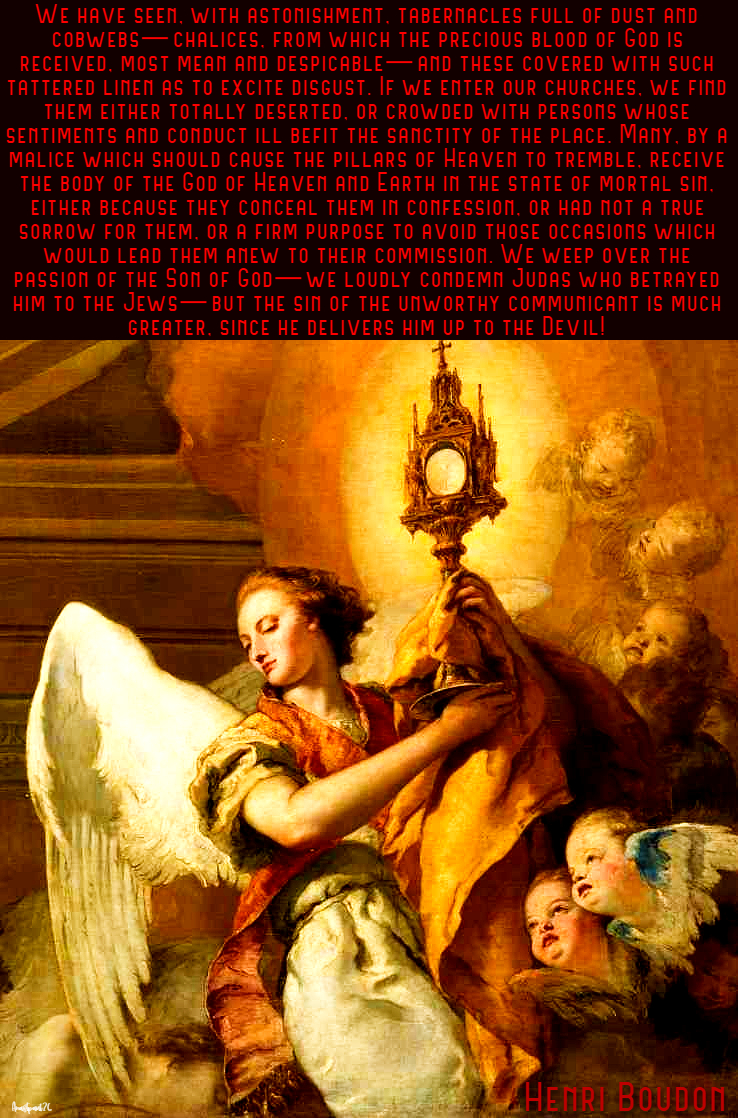
O my Lord and my God! here permit me to bewail, in the presence of your Divine Majesty, the deplorable blindness of Christians, who are the children of light, regarding your holy Sacrament. Is it then true, that they still believe you to be really present in this adorable mystery and behave as they do ? We are seized with horror when we reflect on the irreverences committed against you by Heretics and Infidels but those offered to you by Christians, who profess themselves ready to sacrifice their lives in defence of this adorable truth, are inconceivable. We have seen, with astonishment, tabernacles full of dust and cobwebs—chalices, from which the precious blood of God is received, most mean and despicable—and these covered with such tattered linen as to excite disgust. If we enter our churches, we find them either totally deserted, or crowded with persons whose sentiments and conduct ill befit the sanctity of the place. This is not all—the sufferings which love has imposed on our Sovereign stop not here. Many, by a malice which should cause the pillars of Heaven to tremble, receive the body of the God of Heaven and Earth in the state of mortal sin, either because they conceal them in confession, or had not a true sorrow for them, or a firm purpose to avoid those occasions which would lead them anew to their commission. We weep over the passion of the Son of God—we loudly condemn Judas who betrayed him to the Jews—but the sin of the unworthy communicant is much greater, since he delivers him up to the Devil!

O ! Angels of Paradise ! I address myself to you—knowing the obduracy of men, inspire them with all that respect for the adorable body of your Sovereign, which they are capable of conceiving—give them a knowledge of the dispositions with which it should be received:—that this abominable crime, this sin more hellish than human, may be no more committed. Inspire the rich to provide churches and altars, with suitable decorations—and repair, by your unceasing homage, the insults which have been offered to this mystery of inconceivable love.

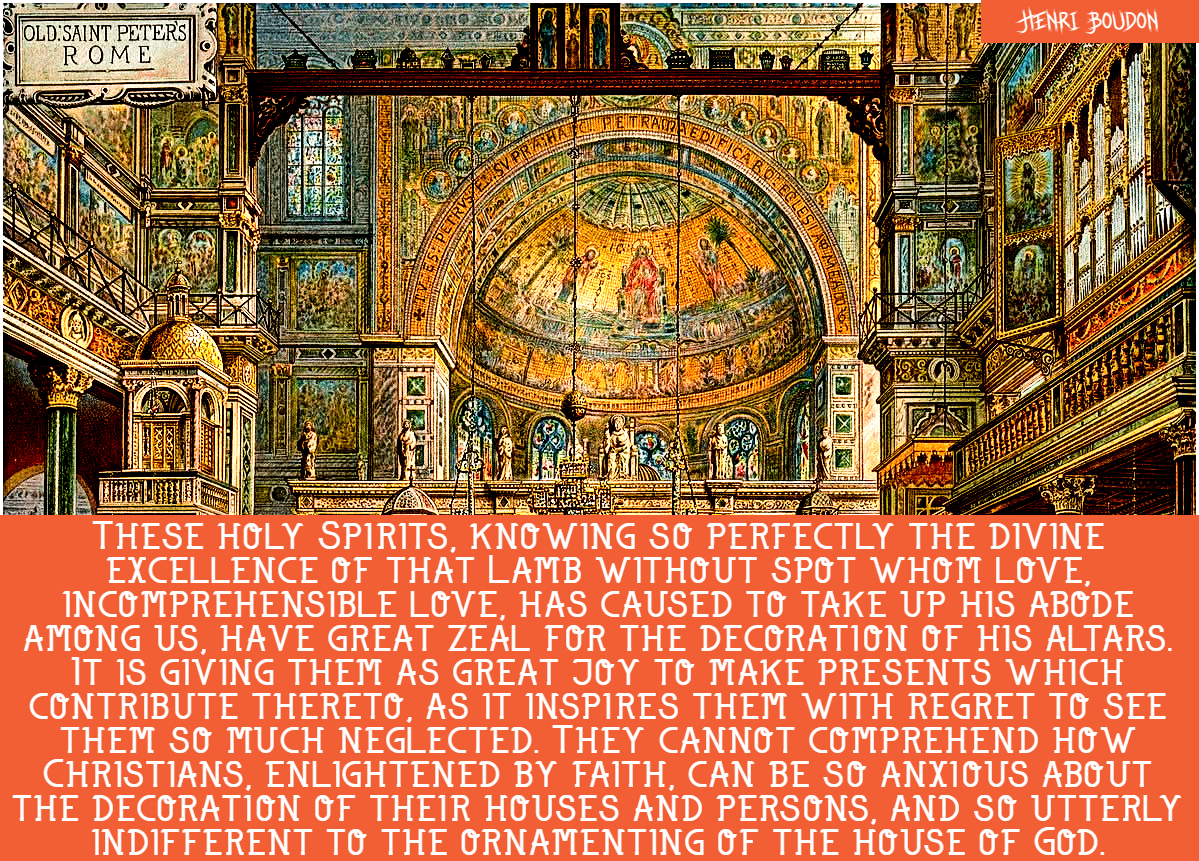
These holy Spirits, knowing so perfectly the divine excellence of that Lamb without spot whom love, incomprehensible love, has caused to take up his abode among us, have great zeal for the decoration of his altars. It is giving them as great joy to make presents which contribute thereto, as it inspires them with regret to see them so much neglected. They cannot comprehend how Christians, enlightened by faith, can be so anxious about the decoration of their houses and persons, and so utterly indifferent to the ornamenting of the house of God.

Let us also be devout to the Principalities. Man is in himself a little world; he should rule over his passions and appetites, as a king over his subjects; but, as his empire is so weakened by sin, he stands in need of support and assistance. The Principalities will render him their aid, provided he do not render himself unworthy of it by neglecting devotion to them.

Posted in OCTOBER - The HOLY ROSARY and The HOLY ANGELS

Thought for the Day – 6 October – All Men are assisted by the Angels

The Glories of the Holy Angels
Venerable Henri Boudon, Archdeacon of Evreux

MOTIVE FOURTH
All Men are assisted by the Angels


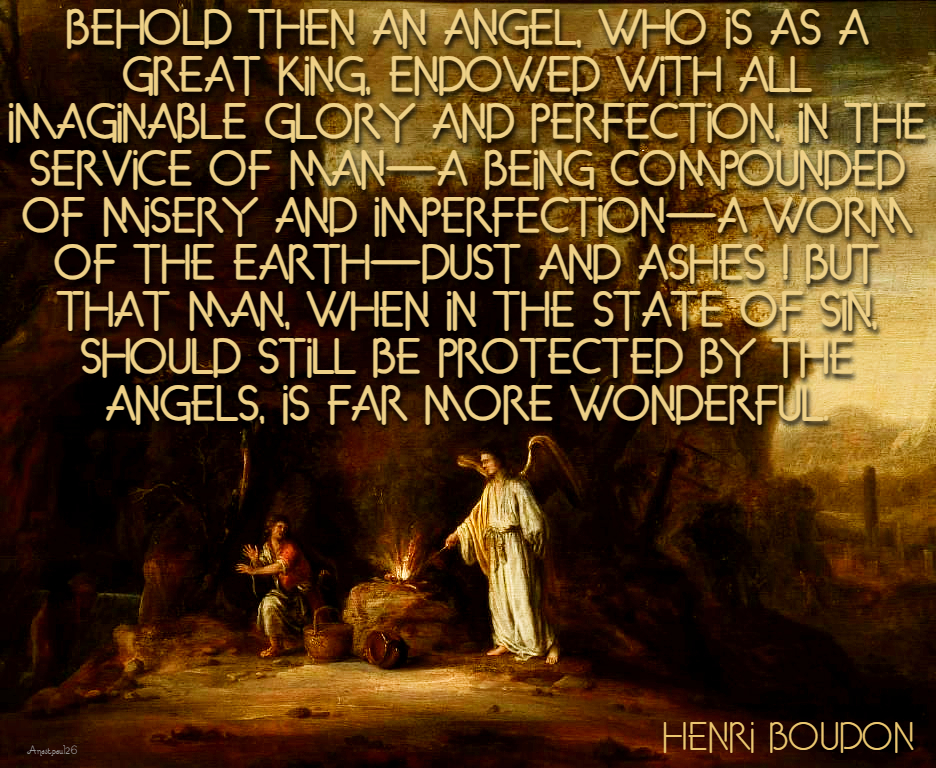
It is unnecessary to seek any other motive to love God than love itself—as our Lord revealed to Mother Magdalen of St. Joseph, a Carmelite religious. But why does God love men so much? Let it be published among the nations, says St. Bernard, and let them confess that the Lord has determined to treat them magnificently. O my God ! what is man, that you condescend to give him your only Son, to send him your Holy Spirit, and depute your Angels to guard and defend him ! ‘ Behold then an Angel, who is as a great king, endowed with all imaginable glory and perfection, in the service of man—a being compounded of misery and imperfection—a worm of the earth—dust and ashes ! But that man, when in the state of sin, should still be protected by the Angels, is far more wonderful. If we say we have no sin, we deceive ourselves: the greatest saints have fallen, through weakness or inadvertence, into venial faults— and would to God that there were no greater committed Hell itself being less terrible than a single offence against the Divine Majesty; but, alas ! men in general have little horror of mortal sin, and easily fall into it.

The Angels, though struck with amazement at these diabolical excesses, are nevertheless not deterred from assisting these unhappy beings. O soul! who readest these truths, is it not wonderful that the blessed Spirits should lend their aid to those who offend God, considering the knowledge they possess of his unspeakable greatness ? Is it not amazing that they are content to remain with those who every day trample on the blood of their God, “and make void the sufferings by which they have been redeemed.’

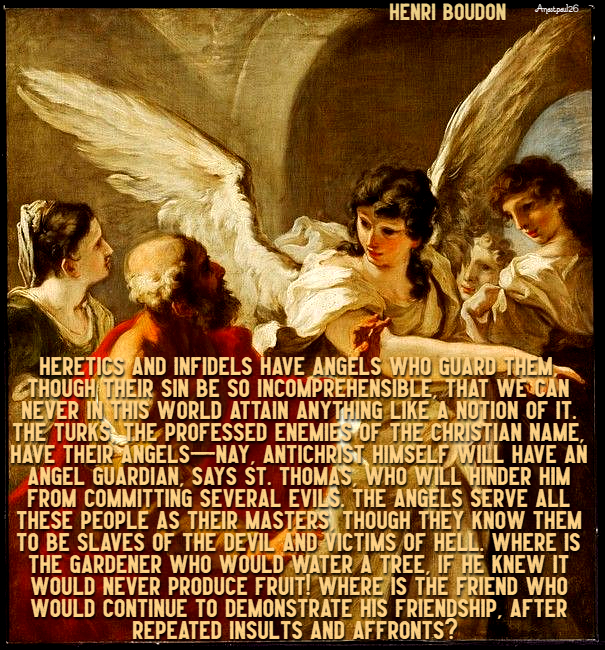
Let us go further : Heretics and Infidels have Angels who guard them, though their sin be so incomprehensible, that we can never in this world attain anything like a notion of it. The Turks, the professed enemies of the Christian name, have their Angels—nay, Antichrist himself will have an Angel Guardian, says St. Thomas, who will hinder him from committing several evils. The Angels serve all these people as their masters, though they know them to be slaves of the devil and victims of hell. Where is the gardener who would water a tree, if he knew it would never produce fruit! Where is the friend who would continue to demonstrate his friendship, after repeated insults and affronts ? Yet all the injuries, revolts, contempt and ingratitude of men diminish not in the least degree the charity of these blessed Spirits. They go to seek them in the forests of Canada, in the remotest deserts, in the most gloomy caverns, at the extremities of the earth.

You would say that they are beside themselves with love for men, who have nothing of man but the shape and appearance, their lives being wholly earthly and sensual. These celestial beauties give their affections to deformity itself, and yet meet with no other return than ingratitude and contempt. How shocking—how deplorable!

Posted in OCTOBER - The HOLY ROSARY and The HOLY ANGELS

Thought for the Day – 3 October – The Glories of the Holy Angels

DEVOTION TO THE HOLY ANGELS

By Venerable Henri Boudon, Archdeacon of Evreux

MOTIVE THE FIRST
The admirable perfections of these Blessed Spirits

We have already said, and again repeat, that the perfection of the Angels is like to an immense sea without shore or bottom. Enlightened souls feel that all they can say of them is nothing, their greatness being above the reach of human thought. The angelic nature contains in itself a world of perfections: but if we add to it the consideration of their grace and glory, it is truly admirable. However perfect human nature may become, it is still, as faith teaches, very inferior to the angelic nature. A certain theologian has asserted, (although indeed it be not the common opinion,) that the least of the Angels exceeds in glory the greatest of the saints—and he grounded his opinion on this text of the Holy Scripture, “He who is least in the kingdom of heaven is greater than John the Baptist.”

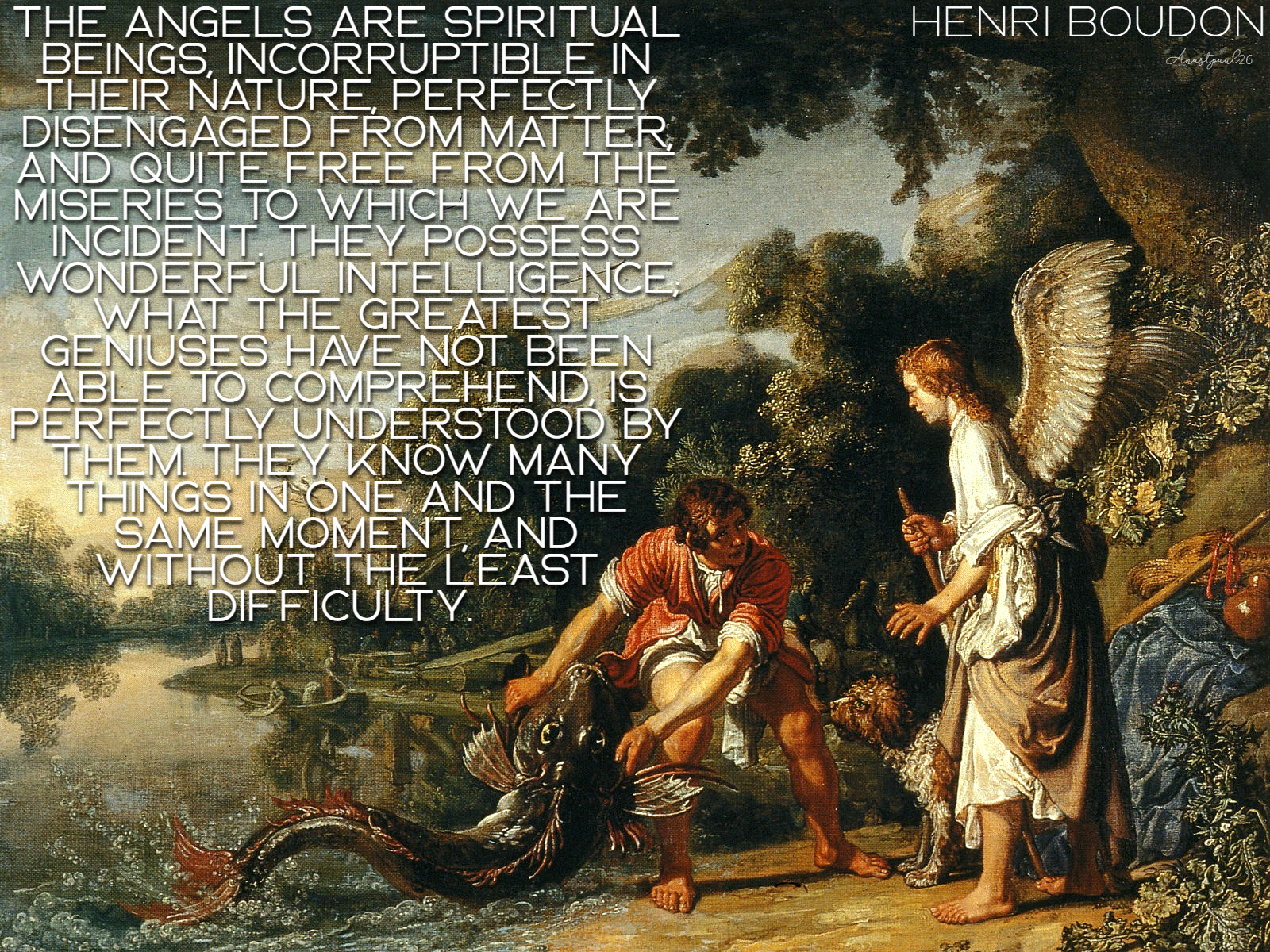
The Angels are spiritual beings, incorruptible in their nature, perfectly disengaged from matter, and quite free from the miseries to which we are incident. They possess wonderful intelligence; what the greatest geniuses have not been able to comprehend, is perfectly understood by them. They know many things in one and the same moment, and without the least difficulty. Their manner of understanding is not like ours; at the first sight which they have of a thing, they know its whole import, and all its consequences—hence they are called by excellence “Intelligences.” Scripture, to declare to us this admirable faculty of theirs, says that they are clothed in burning fire. In the Apocalypse they are represented in the habits of the ancient pontiffs, to give us to understand, that to these holy spirits the most sacred mysteries of religion are revealed, and as if enveloped in clouds, their lights being too brilliant for our weak vision. The most learned men are ignorant, if compared with these pure intelligences.

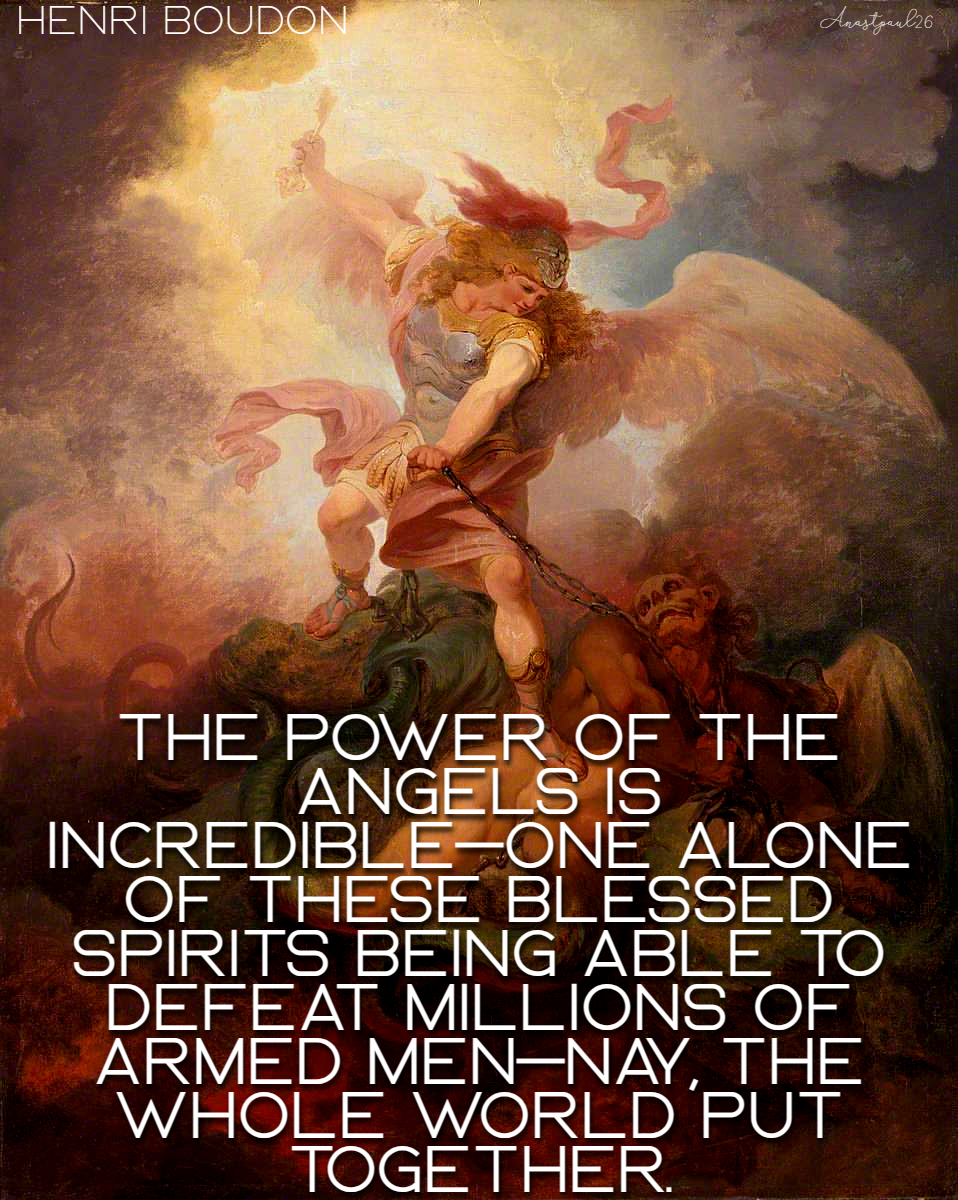
The power of the Angels is incredible—one alone of these blessed spirits being able to defeat millions of armed men—nay, the whole world put together. [We are told in the Book of Kings, that an Angel slew in one night 85,000 of the Assyrians the enemies of the people of God.] They can make the winds blow, the rain fall, the thunder roar: they can raise tempests, cause earthquakes, give abundance and famine, cure and inflict all sorts of maladies, and operate many other things, almost in a moment. It is to mark their celerity that they are painted with wings; it surpasses that of the wind : in an instant, they can pass from one end of the world to the other —being thus, in some sense, everywhere, as Tertullian says.

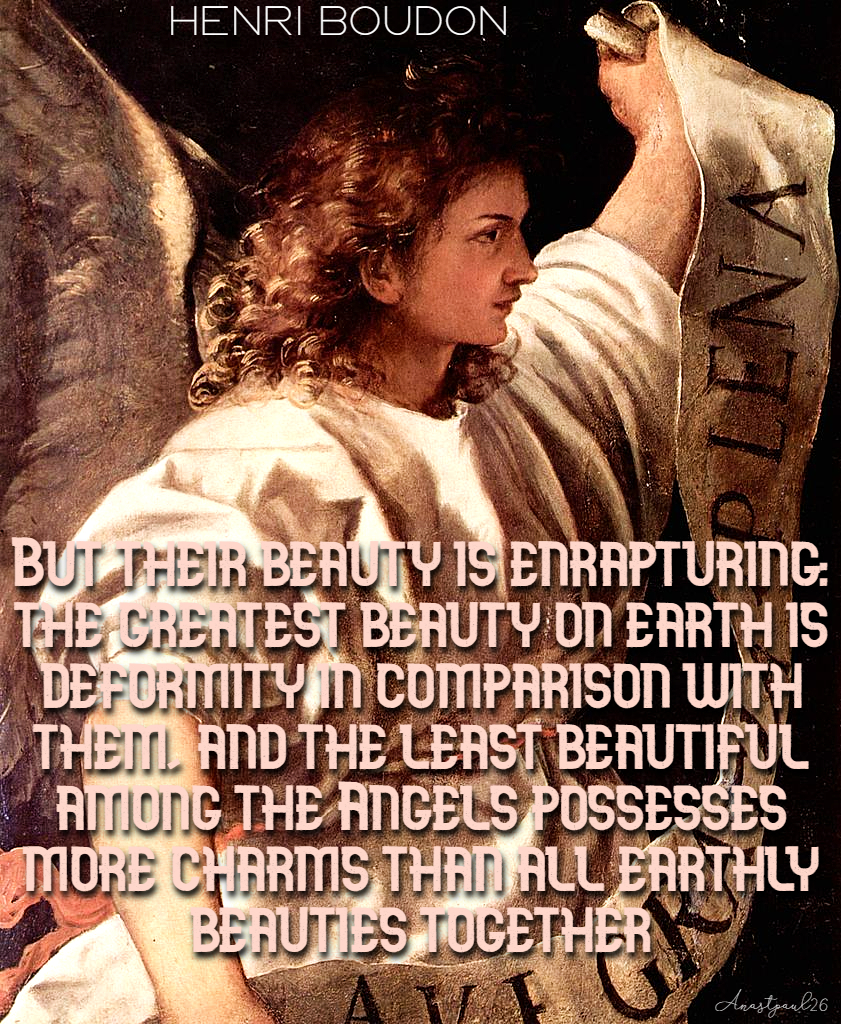
But their beauty is enrapturing: the greatest beauty on earth is deformity in comparison with them, and the least beautiful among the Angels possesses more charms than all earthly beauties together. Here the mind is lost in the contemplation of an infinity of beauties, which are to be found among the angelic choirs; for if the least of the Angels be so charming, and if they be so numerous, my God! what beauty is to be seen in the holy Sion ! To give us some idea of this truth, St. Anselm says, that if God put an Angel in the sun’s orbit, and environed him with as many suns as there are stars, and permitted the blessed spirit to emit in a borrowed form a single ray of his glory, it would at once eclipse all the splendour of the suns, and render them invisible.

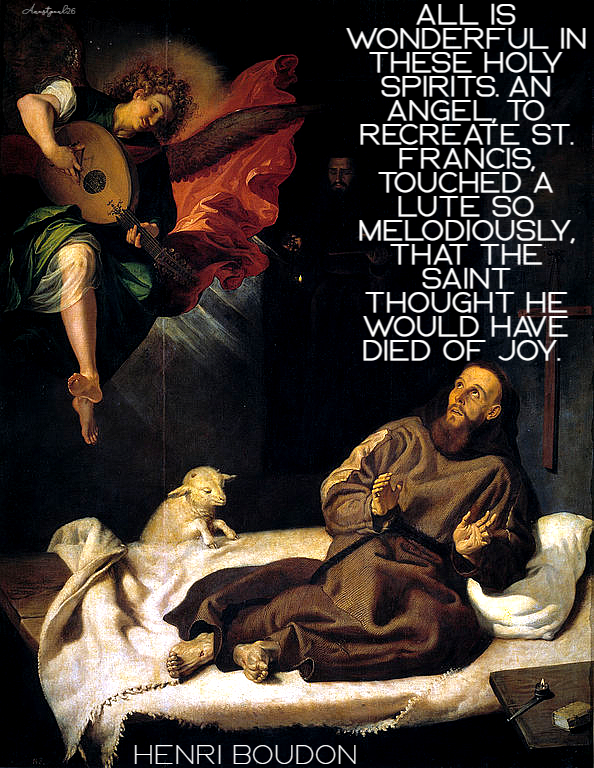
All is wonderful in these holy spirits. An Angel, to recreate St. Francis, touched a lute so melodiously, that the saint thought he would have died of joy.

The greatness of these blessed spirits is without baseness—their science without ignorance—their light without darkness— their power without weakness—their beauty without defect—their love without inconstancy—their peace without trouble—their action continual, yet without fatigue— their happiness without alloy—their felicity complete, and without admixture of any evil. Jacob having had a vision of an Angel, says that he had seen the Lord face to face. Will not the consideration of all these perfections of the Angels excite you to love them? You who are so prone to love whatever is beautiful, and noble, and perfect? This truth merits deep consideration, the glory of God, the author of all these excellencies and perfections being concerned in it.

Posted in ArchAngels and Angels, OCTOBER - The HOLY ROSARY and The HOLY ANGELS

Thought for the Day – 2 October – An Exhortation to the Love and Honour of the Holy Angels

AN EXHORTATION TO THE LOVE AND HONOUR OF THE HOLY ANGELS

The science of the sage, says the Holy Ghost, is like in its abundance to an inundation of waters : for, as the land is sometimes overspread by the swelling of the sea over its boundaries—so the mind of a Christian is sometimes so penetrated with the lights of faith, that it is absorbed in wonder and amazement. This assertion is fully verified in the knowledge which revelation gives of the Holy angels. However slightly we consider what it teaches of them, we discover so many and such powerful reasons to love these blessed Spirits, that we cannot refuse to do so.

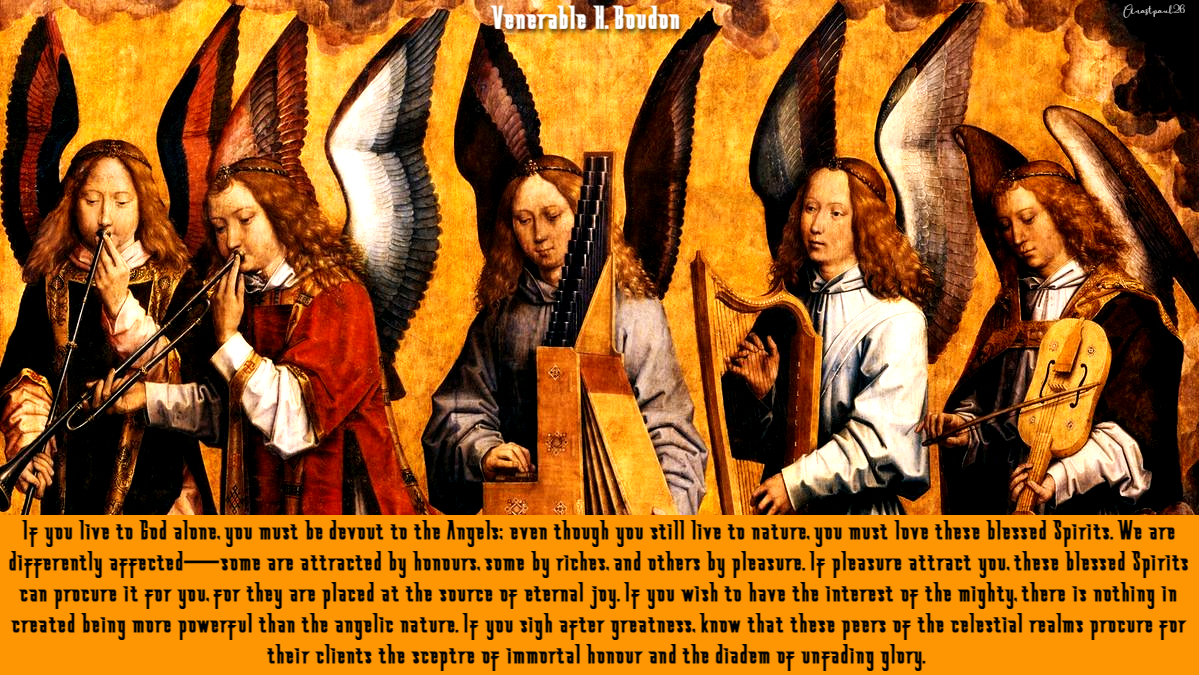
All possible motives concur in pressing you to love these Spirits of love. If you regard God, you must love his Angels; if you regard yourself, you must love the Angels. Pure love commands it— interested love requires it—God alone wishes it— the holy Virgin and all the Saints desire it. If you live to God alone, you must be devout to the Angels; even though you still live to nature, you must love these blessed Spirits. We are differently affected—some are attracted by honours, some by riches, and others by pleasure. If pleasure attract you, these blessed Spirits can procure it for you, for they are placed at the source of eternal joy. If you wish to have the interest of the mighty, there is nothing in created being more powerful than the angelic nature. If you sigh after greatness, know that these peers of the celestial realms procure for their clients the sceptre of immortal honour and the diadem of unfading glory.

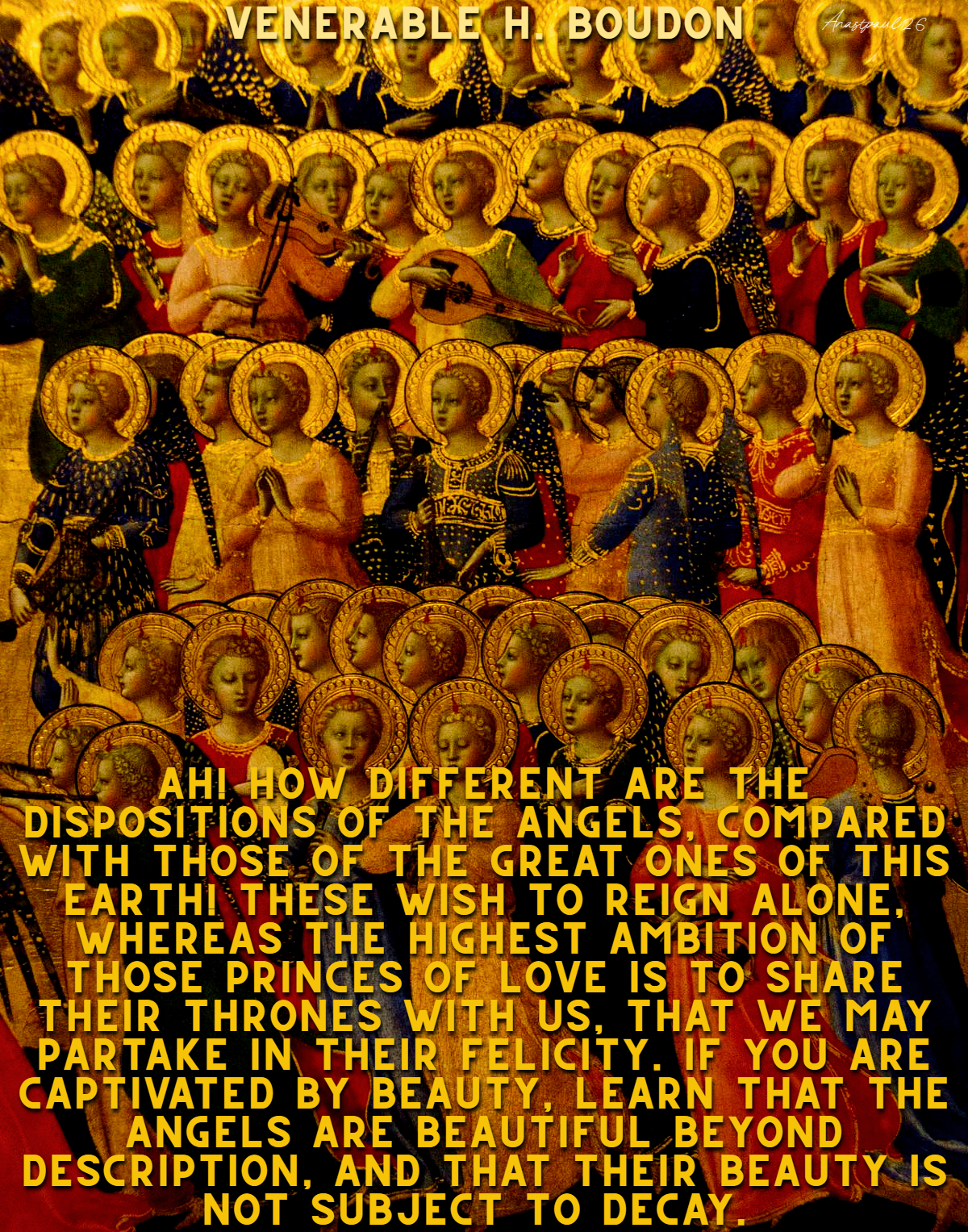
Ah! how different are the dispositions of the Angels, compared with those of the great ones of this earth! These wish to reign alone, whereas the highest ambition of those princes of love is to share their thrones with us, that we may partake in their felicity. If you are captivated by beauty, learn that the Angels are beautiful beyond description, and that their beauty is not subject to decay. Besides, the love and constancy of these amiable friends are incomparable ; the former includes every species of love—the latter is so great that whatever ingratitude we evince towards them, they seem to overlook it, incessantly watching over all that concerns us, defending us against our enemies, and rendering us every service. If you are of those souls who act by the movements of grace, and live to God alone, you must love the Angels. If the motive of the will of God influence you, you must be devout to them, since these blessed Spirits are the objects of his complacency and the masterpieces of his love.

If the kings of the earth were willing to receive you into their friendship, surely you would not refuse it. Now, consider that it depends on yourself to form an eternal alliance with the heavenly Princes, and by their influence to be one day crowned with them in the celestial empire.

Love the Angels, apostolic men ! for they are the missionaries of paradise.

Love the Angels, preachers of the world, they are profoundly skilled in the science of eternity.

Love the Angels, priests! for it is by their ministry the divine oblation is made.

Love the Angels, religious ! those admirable spirits are always retired in God.

Love the Angels, seculars ! those good intelligences pity you in the dangers to which you are continually exposed.

Love the Angels, married persons! the succour afforded Tobias by the Archangel Raphael, evinces the care of your state.

Love the Angels, widows and orphans! they are indefatigable in providing for persons in distress.

Love the Angels, virgins; again I say to you, love the Angels ! they are great friends of virginity, being charmed to see frail mortals live on earth as they live in heaven.

Love the Angels, just souls ! they are infallible guides in the way to God

Love the Angels, sinners ! they will obtain your pardon.

Love the Angels, afflicted souls! they are the consolation of the miserable, and the help of the distressed.

Love the Angels, ye rich and great! they will teach you that nothing is worth regarding but eternity.

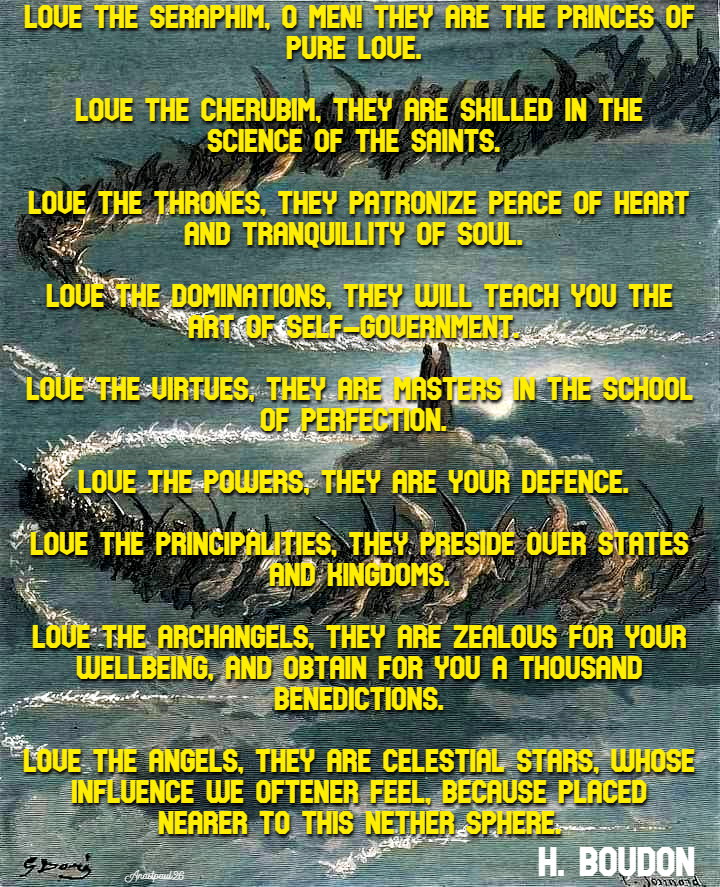
Love the Seraphim, O men! they are the princes of pure love.

Love the Cherubim, they are skilled in the science of the saints.

Love the Thrones, they patronize peace of heart and tranquillity of soul.

Love the Dominations, they will teach you the art of self-government.

Love the Virtues, they are masters in the school of perfection.

Love the Powers, they are your defence.

Love the Principalities, they preside over states and kingdoms.

Love the Archangels, they are zealous for your wellbeing, and obtain for you a thousand benedictions.

Love the Angels, they are celestial stars, whose influence we oftener feel, because placed nearer to this nether sphere.

Henceforward be all love for those blessed spirits, who so ardently love you. Bless them, my God! those who are devout to your Angels. Bless those who on reading this poor little work will give themselves to this devotion. Bless them with the benedictions of the just, making them walk in your ways. Bless them with the benediction of Abraham, the spirit of sacrifice—with the benediction of Isaac, the spirit of conformity— with the spirit of Jacob, the spirit of lively faith Bless them -with the benediction of the elect. Bless them with the benediction of the Angels, making them sharers in your neverending joys ! Great and august Queen of Paradise, bless them with your protection that, being all united in seeking the interest of God alone, God alone may reign in their hearts for ever. Amen.

Posted in MARIAN TITLES

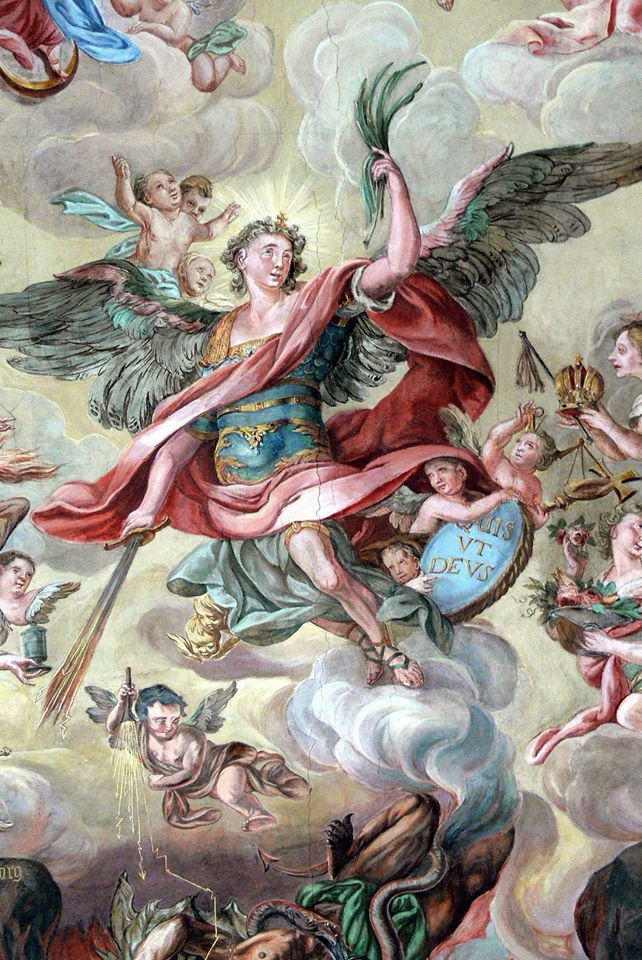
The Dedication of St Michael (Feast), the Three Archangels, Madonna di Tirano / Our Lady of Tirano, Sondrio, Lombardy, Italy (1504) and Memorials of the Saints – 29 September

The Dedication of St Michael (Feast)

THIS festival has been kept with great solemnity on the 29th of September ever since the Fifth Century and was certainly initially celebrated in Apulia in 493. The Dedication of the famous Church of St Michael on Mount Gargano, in Italy, gave occasion to the institution of this feast in the West, which is hence called in the Martyrologies of St Jerome, St Bede and others, ‘The Dedication of St Michael.’
About the Apparition of St Michael at Mount Gargano in 492

The Dedication of St Michael’s Church in Rome, which was performed by Pope Boniface IV. in 610 and that of several other Churches in the West, in honour of this Archangel, were also performed on this same day.

The name Michaelmas comes from a shortening of “Michael’s Mass,” in the same style as Christmas (Christ’s Mass) and Candlemas (Candle Mass, the Mass where traditionally the candles to be used throughout the year would be blessed).During the Middle Ages, Michaelmas was celebrated as a Holy Day of Obligation but this tradition was abolished in the 18th century.

The Church gives to St Michael four offices:

  1. To fight against Satan.
  2. To rescue the souls of the faithful from the power of the enemy, especially at the hour of death.
  3. To be the champion of God’s people, the Jews in the Old Law, the Christians in the New Testament; therefore, he is the Patron of the Church and of the Orders of Knights during the Middle Ages.
  4. To call away from earth and bring men’s souls to judgement.

St Gabriel the Archangel (Feast)
St Michael the Archangel (Feast)
St Raphael the Archangel (Feast)

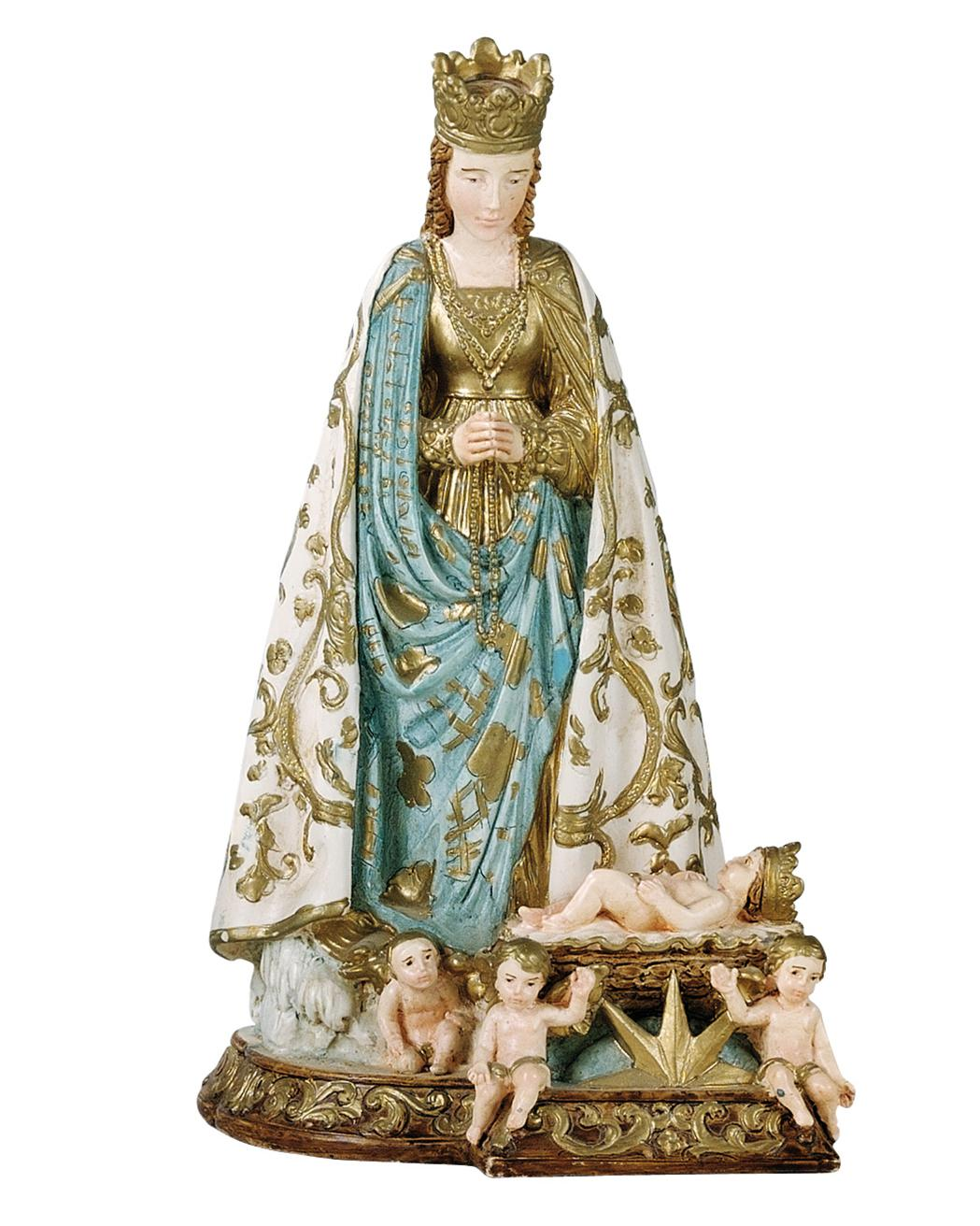
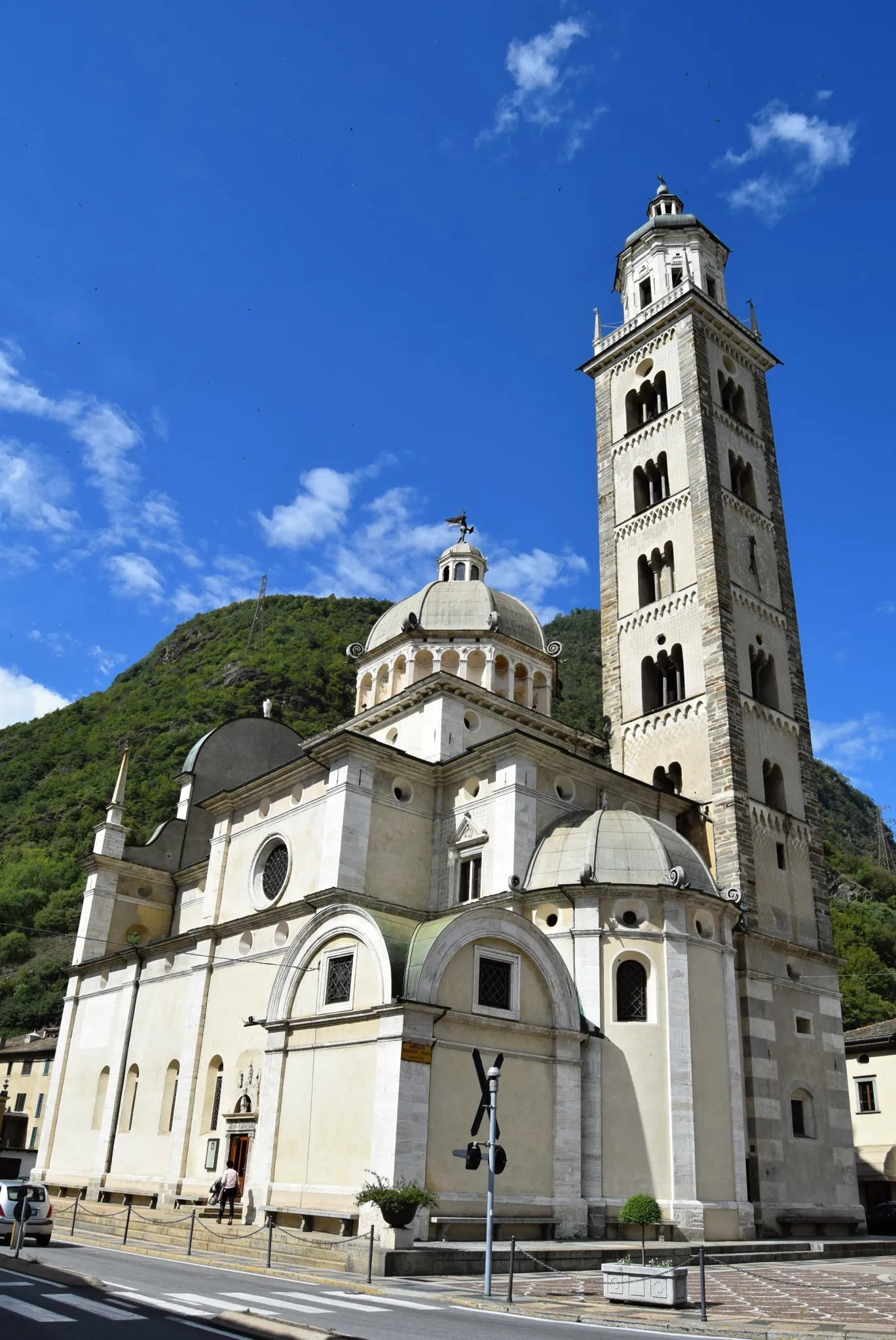
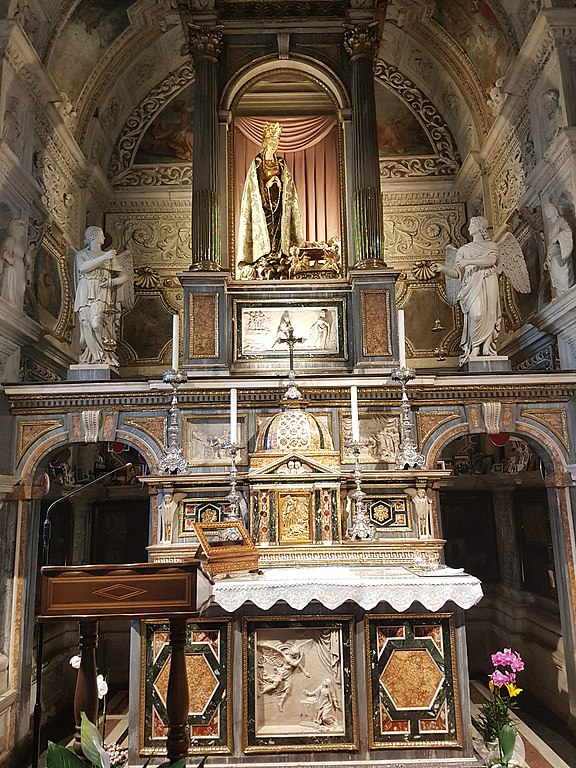
Madonna di Tirano / Our Lady of Tirano, Sondrio, Lombardy, Italy (1504) – 29 September:

The Sanctuary of the Madonna of Tirano stands on the Swiss-Italian border, where the Virgin appeared to Mario Omodei on 29 September 1504, promising an end to the plague which was decimating the region, if a Church in her honour would be built, on the spot outside the City walls. The epidemic subsided and the townspeople placed the first stone of the Sanctuary on 25 March 1505.

Because of its crossroads location, it has always drawn pilgrims from throughout Europe.

The Virgin’s Statue was part of a silver-clad grouping executed by woodcarver G Angelo Mayno around 1520. Napoleonic raiders stripped off the precious metal and destroyed the other Statues.

In 1946 Pope Pius XII proclaimed the Blessed Virgin of Tirano “special heavenly Patron of all Europe.”

Bl Alericus
St Anno of Eichstätt
St Casdoe of Persia
St Catholdus of Eichstätt

Blessed Charles de Blois TOSF (1319–1364) Duke of Brittany French nobleman, Knight, ascetic, Franciscan tertiary.

St Dadas of Persia
St Diethardus of Eichstätt
St Fraternus of Auxerre
St Gabdelas of Persia
St Grimoaldus of Pontecorvo
St Gudelia
St Guillermo Courtet

Blessed Jean de Montmirail / Baron de Montmirail, O. Cist (1165 – 1217) Cistercian Monk, Apostle of the Sick and Afflicted.

Bl John of Ghent
St Lazaro of Kyoto
St Liutwin of Trier

St Miguel de Aozaraza
St Quiriacus of Palestine
St Rene Goupil
St Rhipsime
Bl Richard Rolle
St Sapor of Persia
St Theodota of Thrace
St Vicente Shiwozuka de la Cruz
—
Martyrs of Thrace – 3 saints: Three Christian men murdered in Thrace for their faith. They are – Eutychius, Heracleas and Plautus.

Martyred in the Spanish Civil War:
• Blessed Antonio Arribas Hortigüela
• Blessed Antonio Martínez López
• Blessed Dario Hernández Morató
• Blessed Francesc de Paula Castelló Aleu
• Blessed Francisco Edreira Mosquera
• Blessed José Villanova Tormo
• Blessed Pau Bori Puig
• Blessed Vicente Sales Genovés
• Blessed Virgilio Edreira Mosquera