Quote/s of the Day – 23 May – Wednesday in the 7th Week of Ordinary Time, Year B – Today’s Readings: James 4:13-17, Psalm 49:2-3, 6-11, Mark 9:38-40
Speaking of: Living and Preaching the Gospel
But Jesus said, “Do not forbid him; for no one who does a mighty work in my name, will be able, soon after, to speak evil of me. For he that is not against us, is for us.
Mark 9:39-40
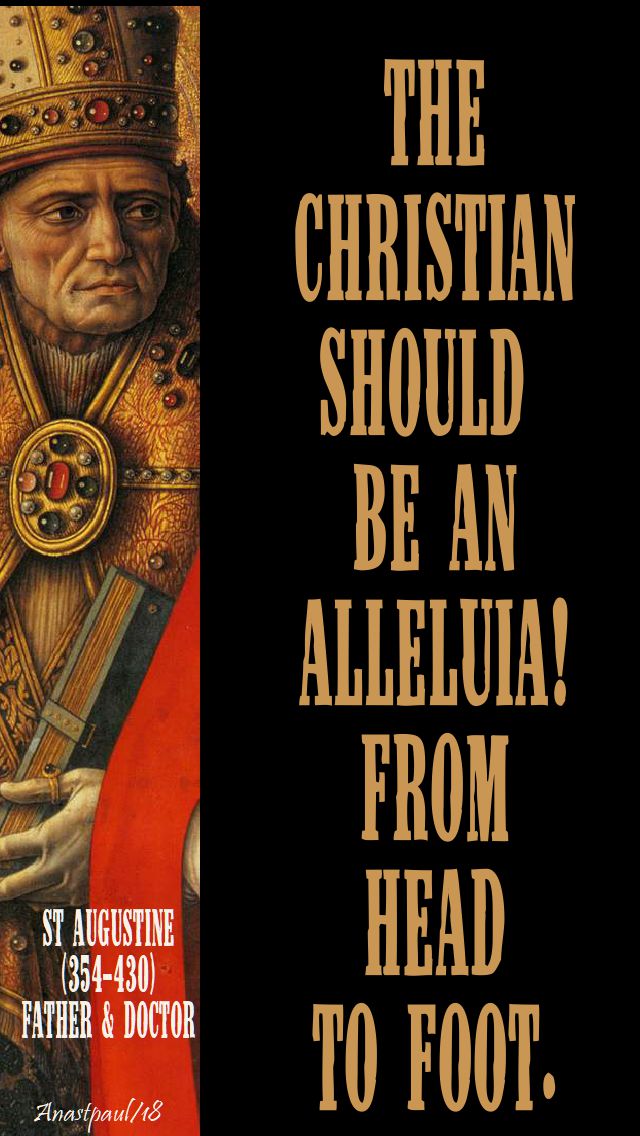
“The Christian should be an Alleluia! from head to foot”
St Augustine (354-430) Father & Doctor
“Cook the truth in charity, until it tastes sweet.”
St Francis de Sales (1567-1622) Doctor of Charity
“We must speak to them with our hands, before, we try to speak, with our lips.”
St Peter Claver S.J. (1580-1654)
“If I’m not willing, to change my schedule, so that I can, spend time with Jesus, than I’m not really, a disciple of His.”
“If you follow Jesus, you’re going to get into some trouble!”
Quote/s of the Day – 15 May – Tuesday of the Seventh Week of Eastertide
“Speaking of : The Holy Spirit
“Come O Holy Spirit, Come!” Pope Francis
“Let us be guided by the Holy Spirit. Allow Him to speak to our hearts and He will tell us this: God is Love!”
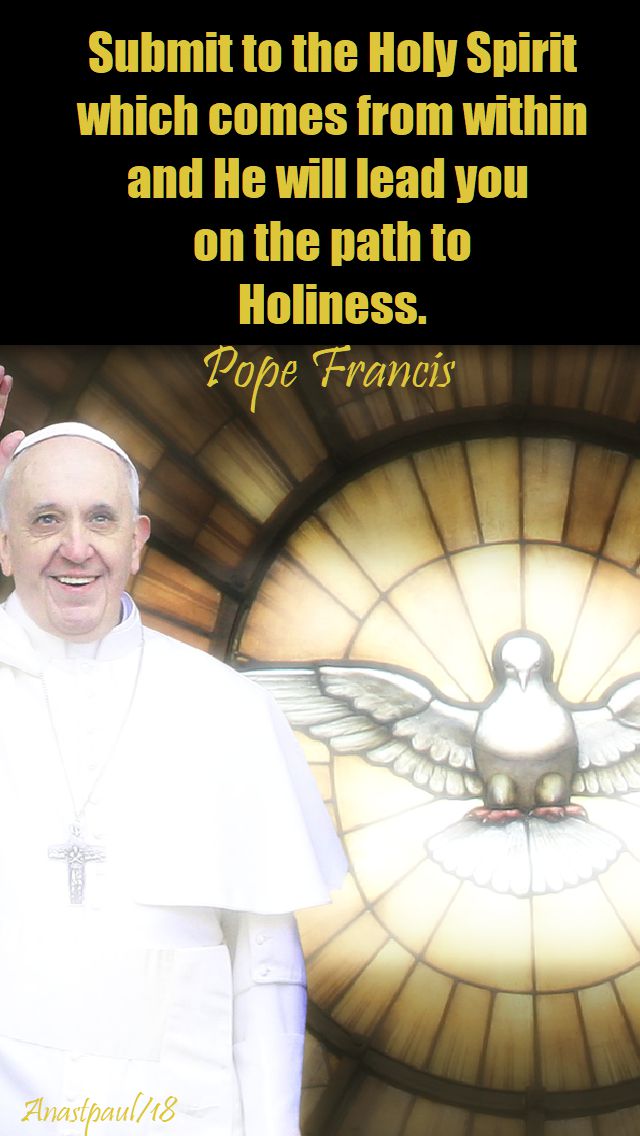
“Submit to the Holy Spirit which comes from within and He will lead you on the path to Holiness.”
“The Holy Spirit upsets us because He moves us, makes us walk, pushes the Church forward.”
“Let us renew each day our trust in the workings of the Holy Spirit and open our hearts to His inspiration.”
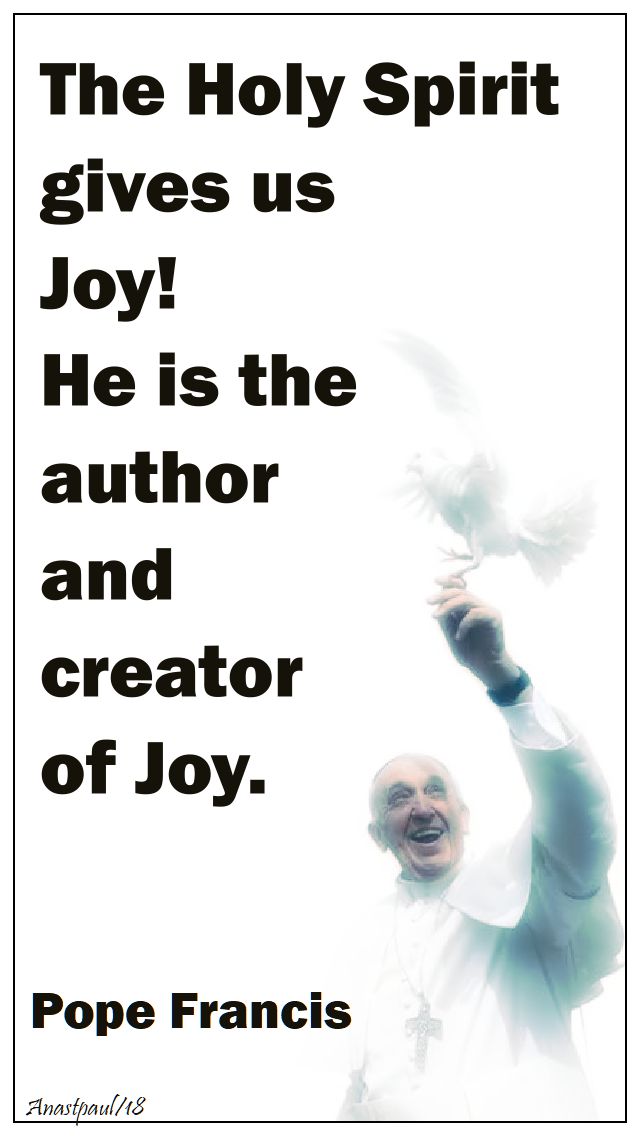
“The Holy Spirit gives us Joy! He is the author and creator of Joy.”
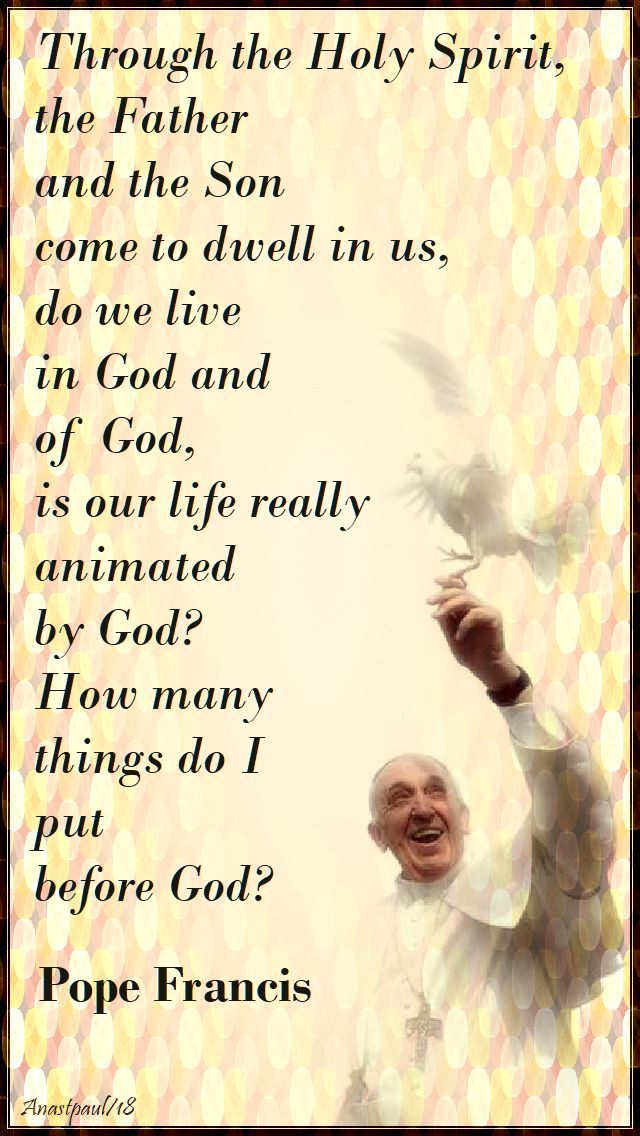
“Through the Holy Spirit, the Father and the Son come to dwell in us, do we live in God and of God, is our life really animated by God? How many things do I put before God?”
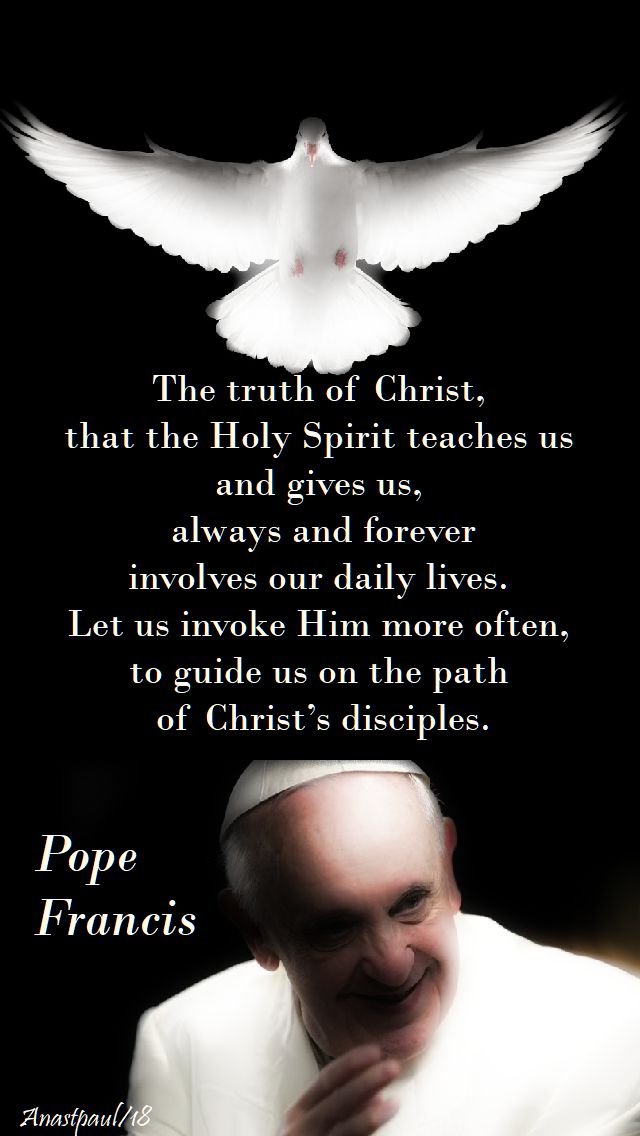
“The truth of Christ, that the Holy Spirit teaches us and gives us, always and forever, involves our daily lives. Let us invoke Him more often, to guide us on the path of Christ’s disciples.”
“Holy Spirit may my heart be open to the Word of God, may my heart be open to good, may my heart be open to the beauty of God, every day.”
Quote/s of the Day – 9 May “Mary’s Month!” – Wednesday of the Sixth Week of Eastertide and the Memorial of Blessed Theresa of Jesus/Karolina Gerhardinger (1797-1879)
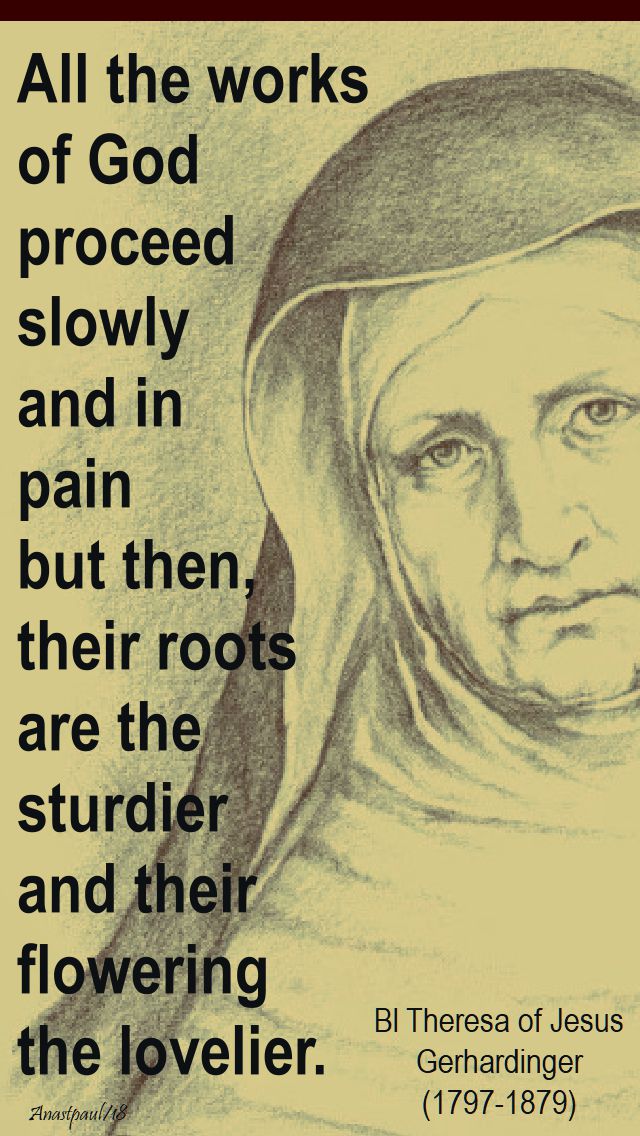
“All the works of God proceed slowly and in pain but then, their roots are the sturdier and their flowering the lovelier.”
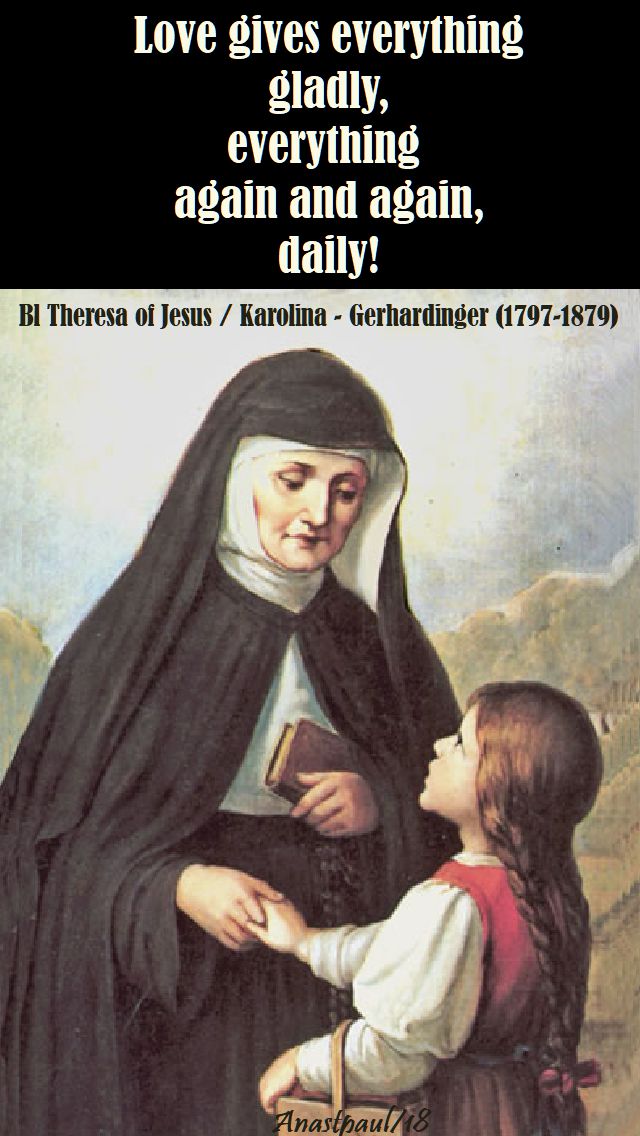
“Love gives everything gladly, everything again and again, daily!”
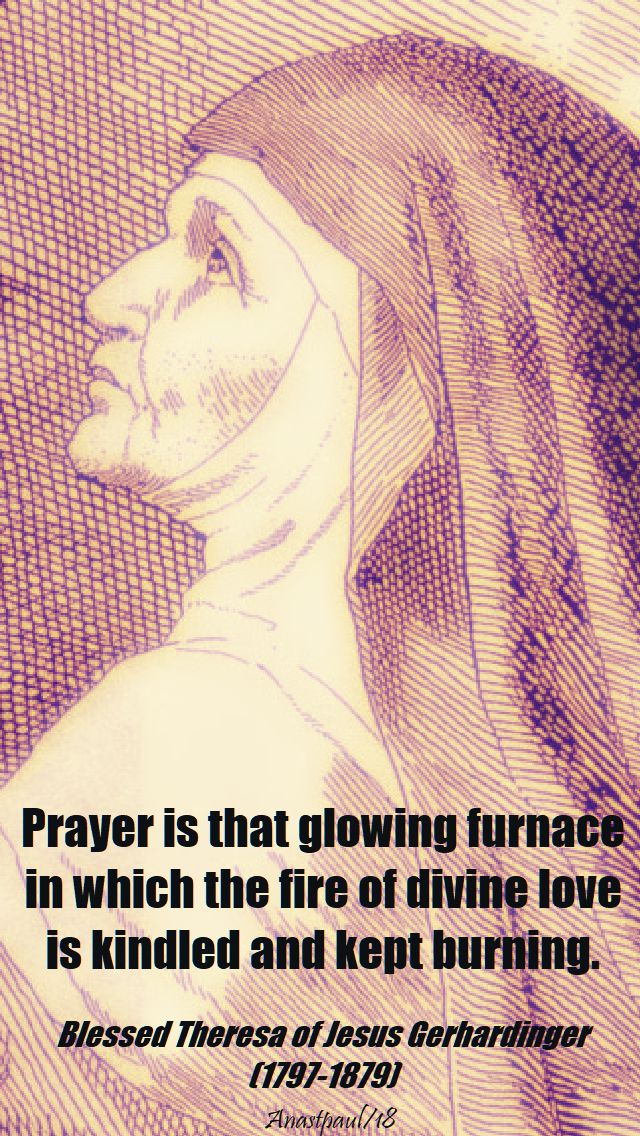
“Prayer is that glowing furnace in which the fire of divine love is kindled and kept burning.”
Blessed Theresa of Jesus/Karolina Gerhardinger (1797-1879)
Quote/s of the Day – 4 May – Friday of the Fifth Week of Eastertide: Today’s Gospel John 15:12-17
Speaking of: LOVE
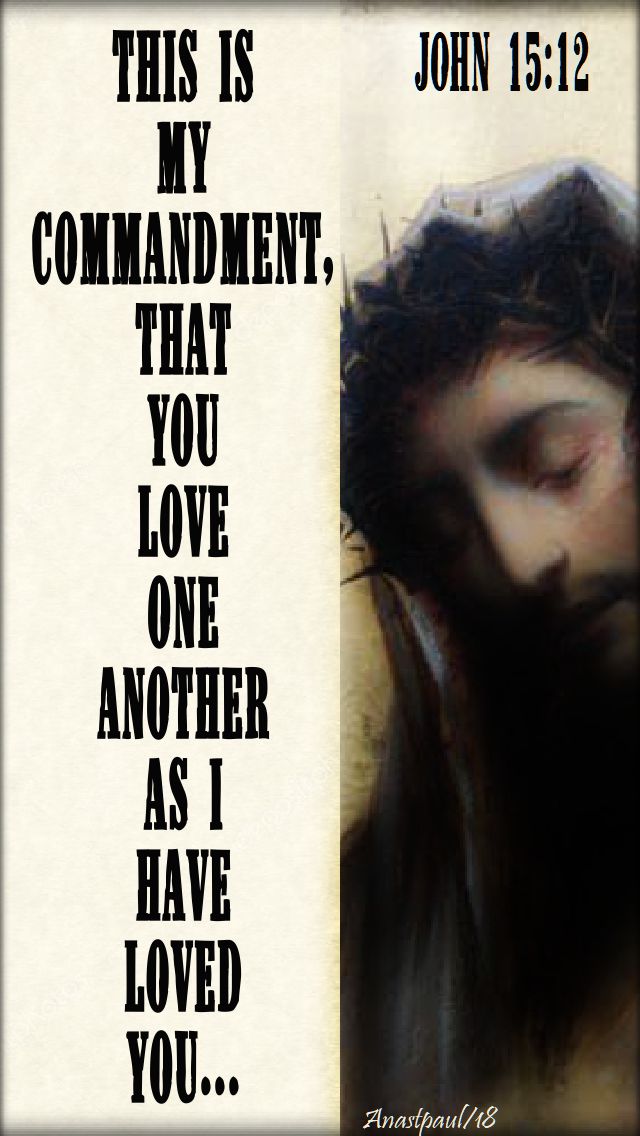
“This is my commandment, that you love one another as I have loved you…
John 15:12
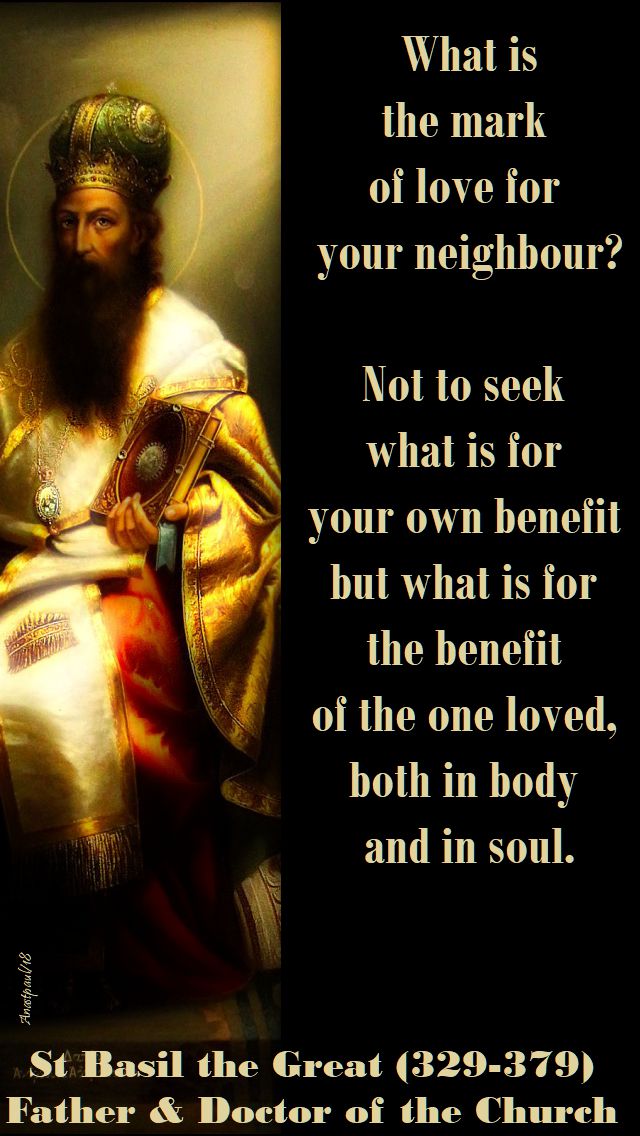
“What is the mark of love for your neighbour? Not to seek what is for your own benefit but what is for the benefit of the one loved, both in body and in soul.”
St Basil the Great (329-379) Father & Doctor of the Church
“Love is watchful. Sleeping, it does not slumber. Wearied, it is not tired. Pressed, it is not straitened. Alarmed, it is not confused but like a living flame, a burning torch, it forces its way upward and passes unharmed through every obstacle.”
“Nothing is sweeter than love, nothing stronger or higher or wider; nothing is more pleasant, nothing fuller and nothing better in heaven or on earth, for love is born of God and cannot rest except in God, Who is above all created things.”
Thomas a Kempis (1380-1471) – Imitation of Christ
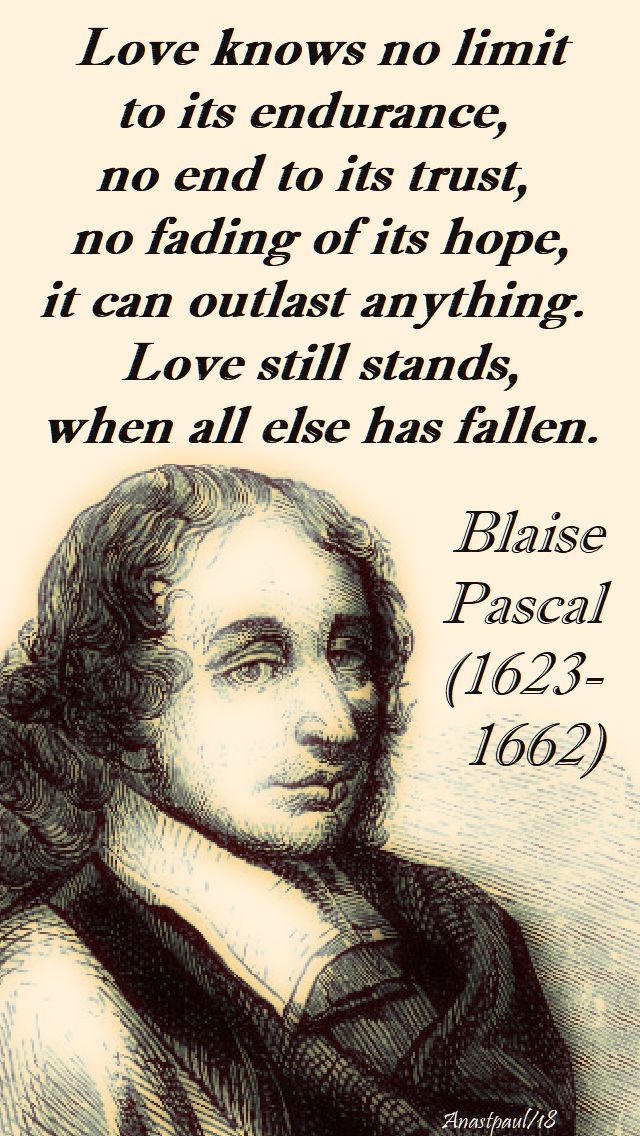
“Love knows no limit to its endurance, no end to its trust, no fading of its hope, it can outlast anything. Love still stands, when all else has fallen.”
Quote/s of the Day – 3 May – Thursday of the Fifth Week of Eastertide and the Feast of Sts Philip and James Apostles and Martyrs
Speaking of: Seeking Augustine
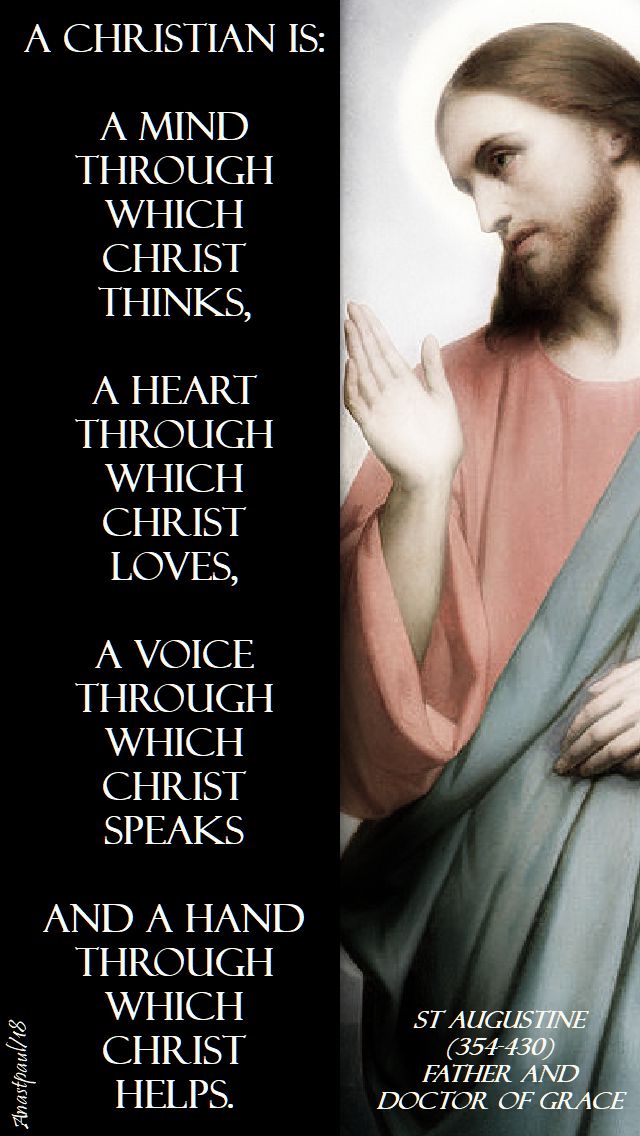
A Christian is: a mind through which Christ thinks, a heart through which Christ loves, a voice through which Christ speaks and a hand through which Christ helps.
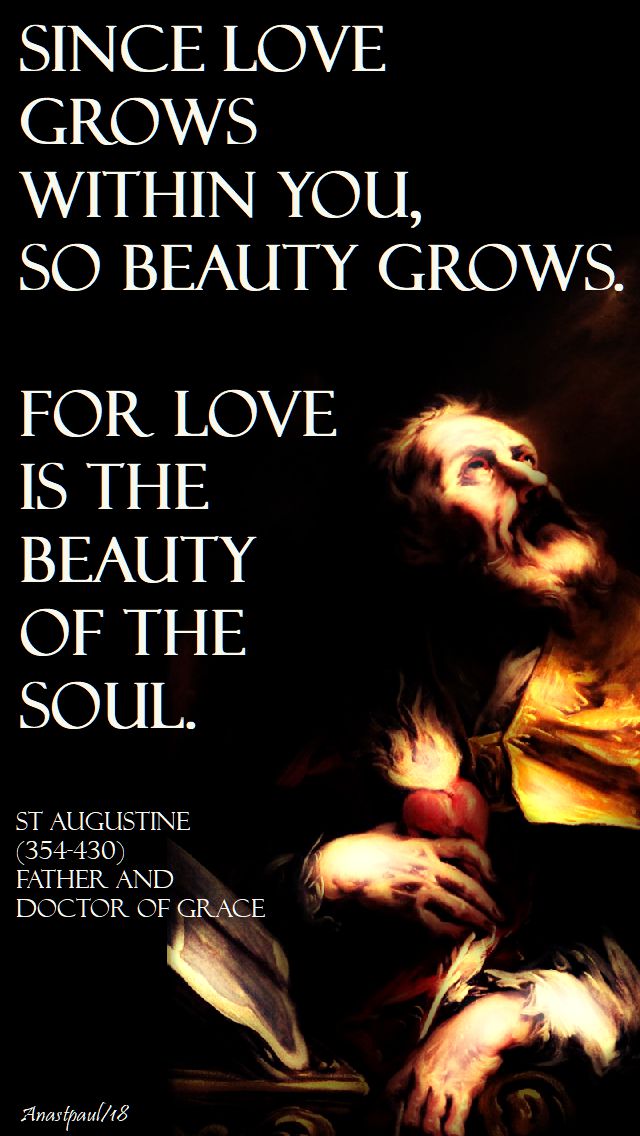
Since love grows within you, so beauty grows. For love is the beauty of the soul.
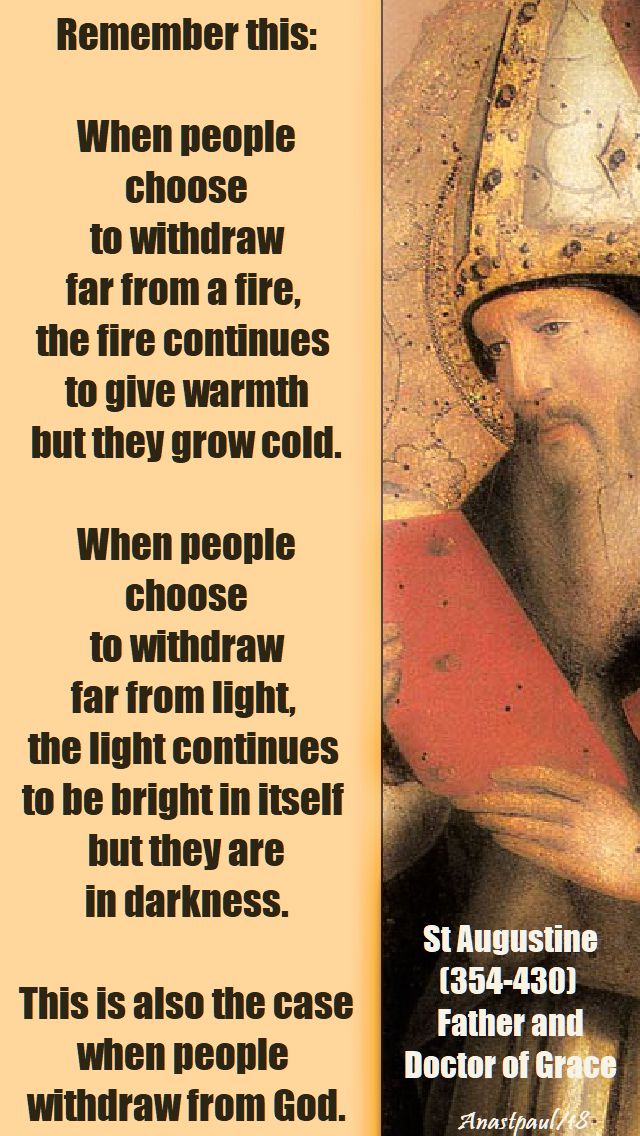
Remember this. When people choose to withdraw far from a fire, the fire continues to give warmth but they grow cold. When people choose to withdraw far from light, the light continues to be bright in itself but they are in darkness. This is also the case when people withdraw from God.
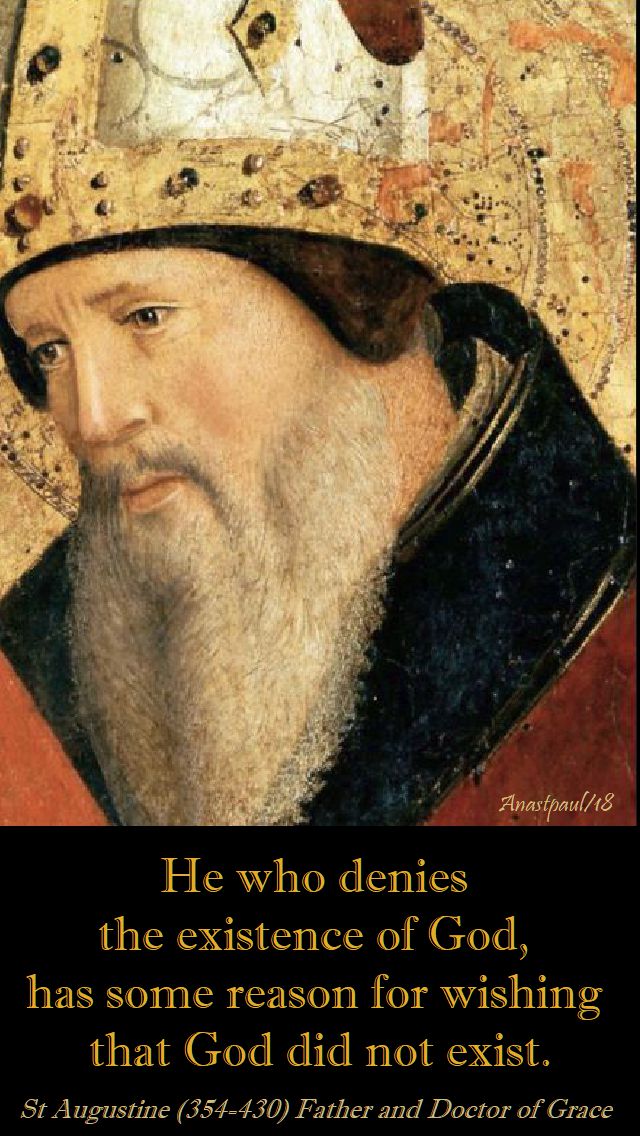
He who denies the existence of God, has some reason for wishing that God did not exist
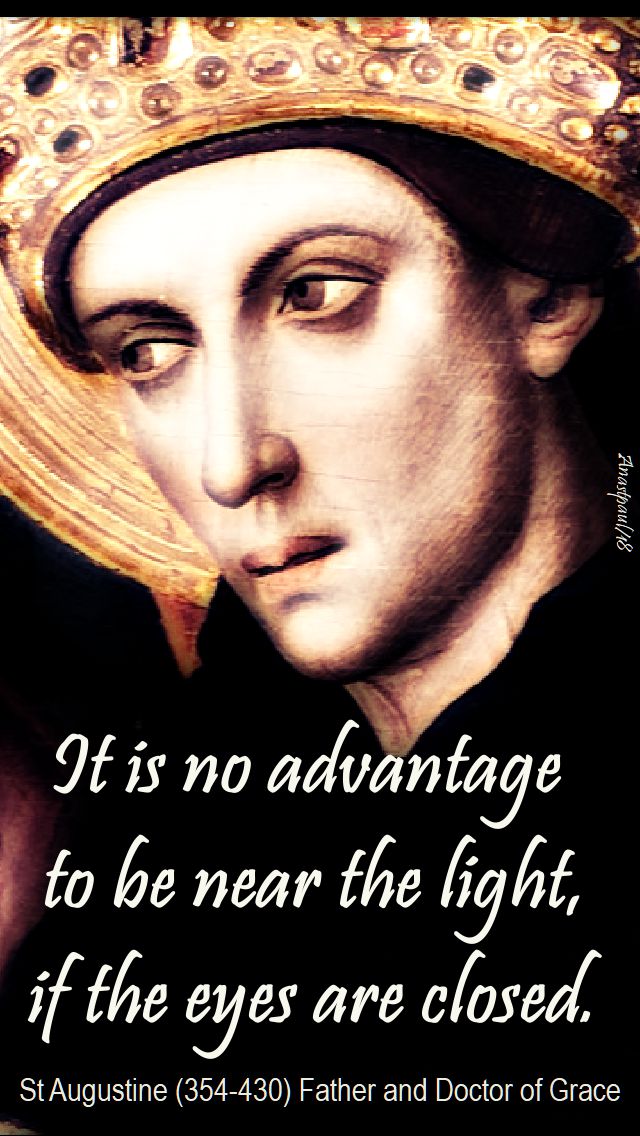
It is no advantage to be near the light, if the eyes are closed.
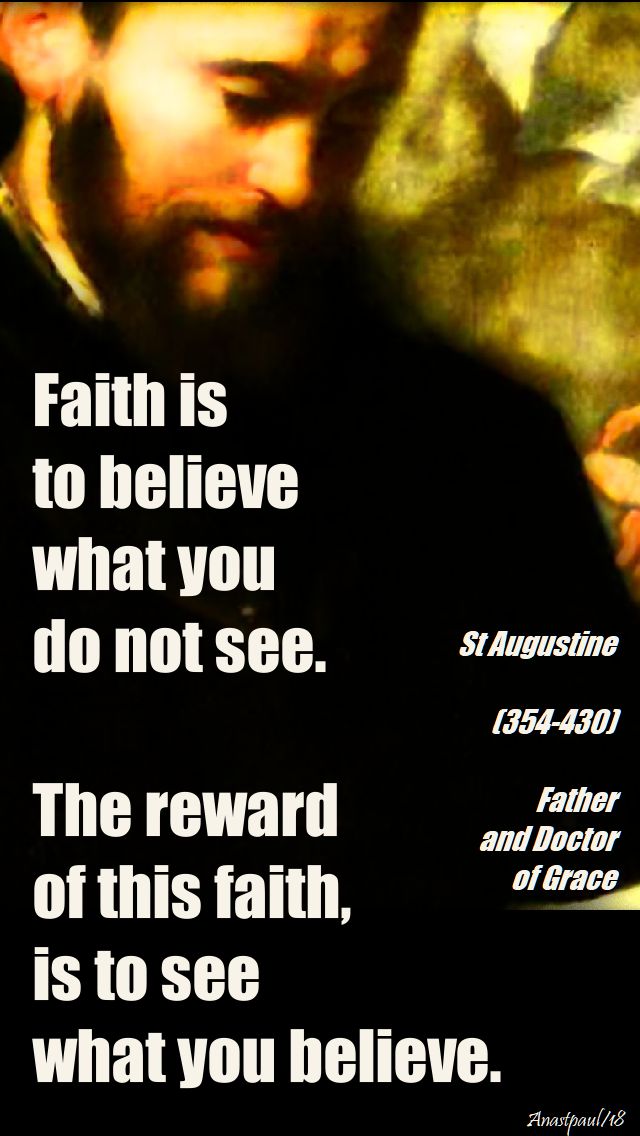
Faith is to believe what you do not see. The reward of this faith, is to see what you believe.
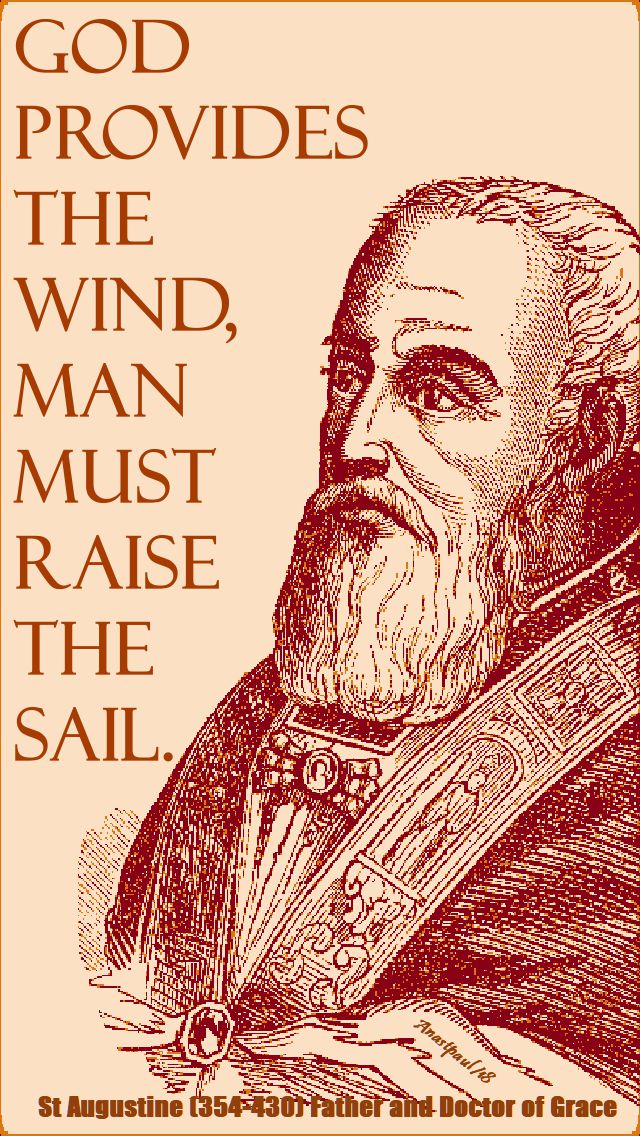
God provides the wind, man must raise the sail.
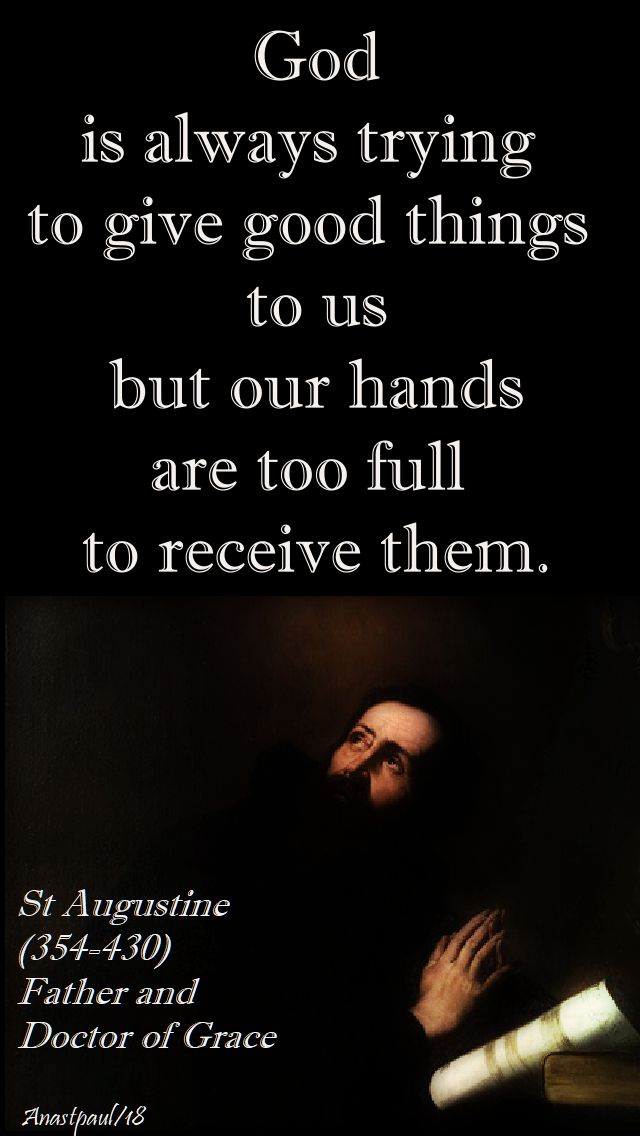
God is always trying to give good things to us but our hands are too full to receive them.
Quote/s of the Day – 30 April – Monday of the Fifth Week of Eastertide and the Memorial of St Joseph Benedict Cottolengo (1786-1842) – known as “The Labourer of Divine Providence”.
Speaking of: Recognising God’s Hand
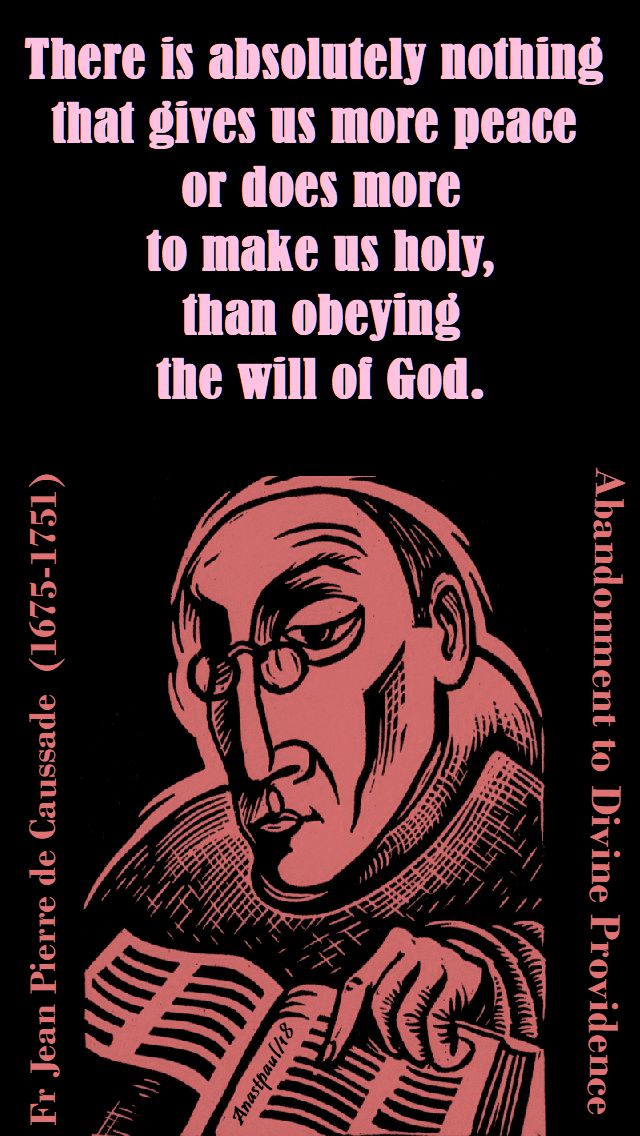
“There is absolutely nothing that gives us more peace, or does more to make us holy, than obeying the will of God.”
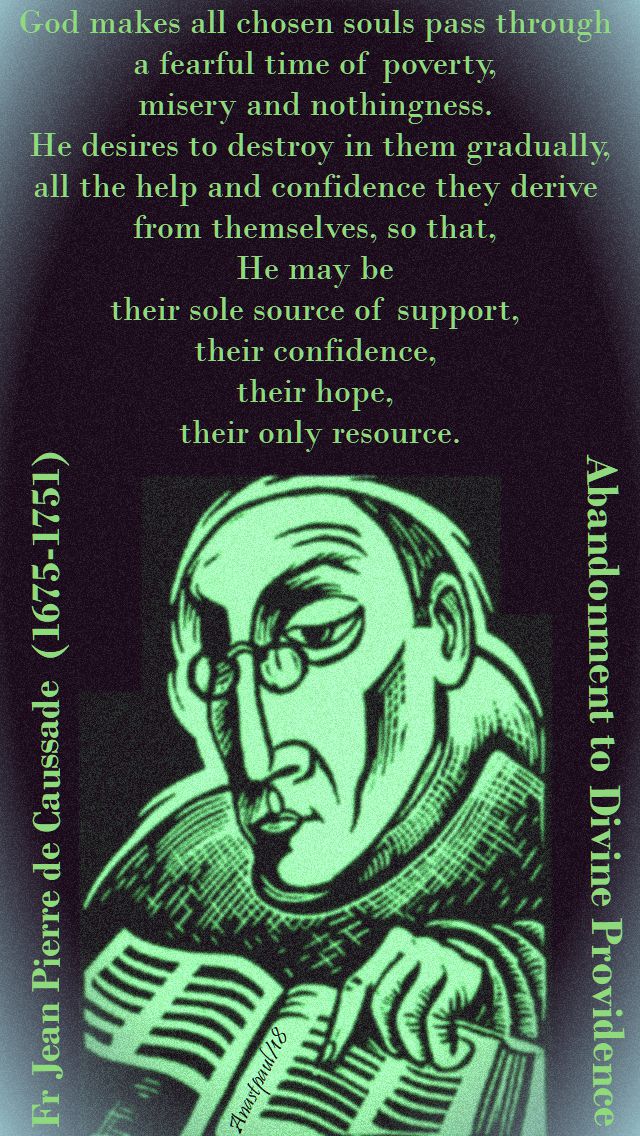
“God makes all chosen souls, pass through a fearful time of poverty, misery and nothingness. He desires to destroy in them gradually, all the help and confidence they derive from themselves, so that He may be their sole source of support, their confidence, their hope, their only resource.”
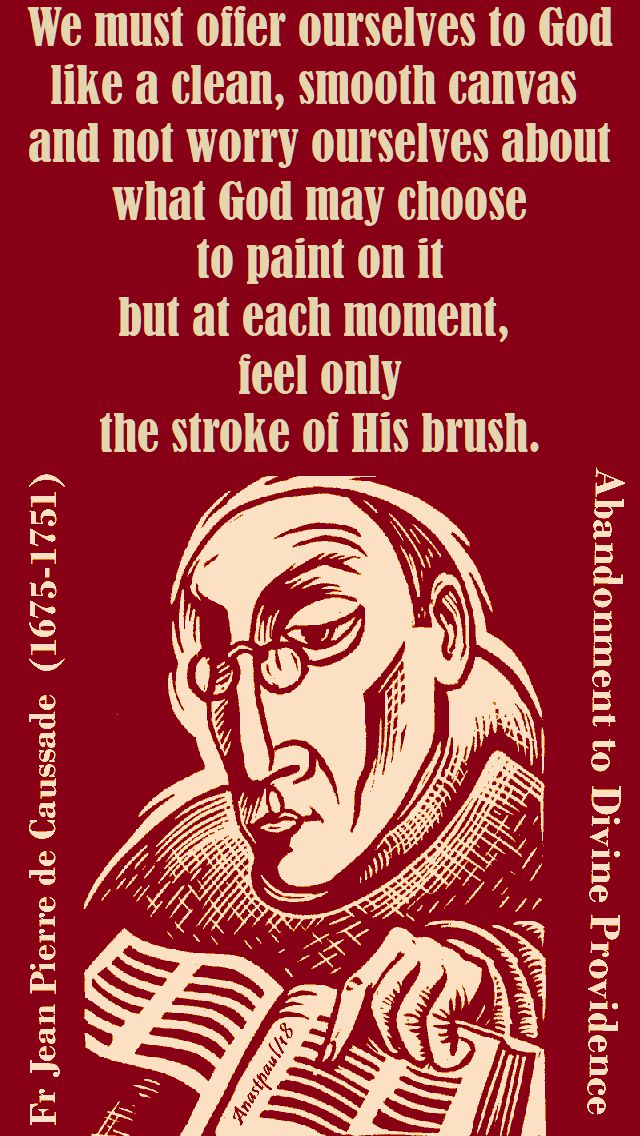
“We must offer ourselves to God like a clean, smooth canvas and not worry ourselves about what God may choose to paint on it but at each moment, feel only, the stroke of His brush.”
Fr Jean Pierre de Caussade (1675-1751)
‘Abandonment to Divine Providence’
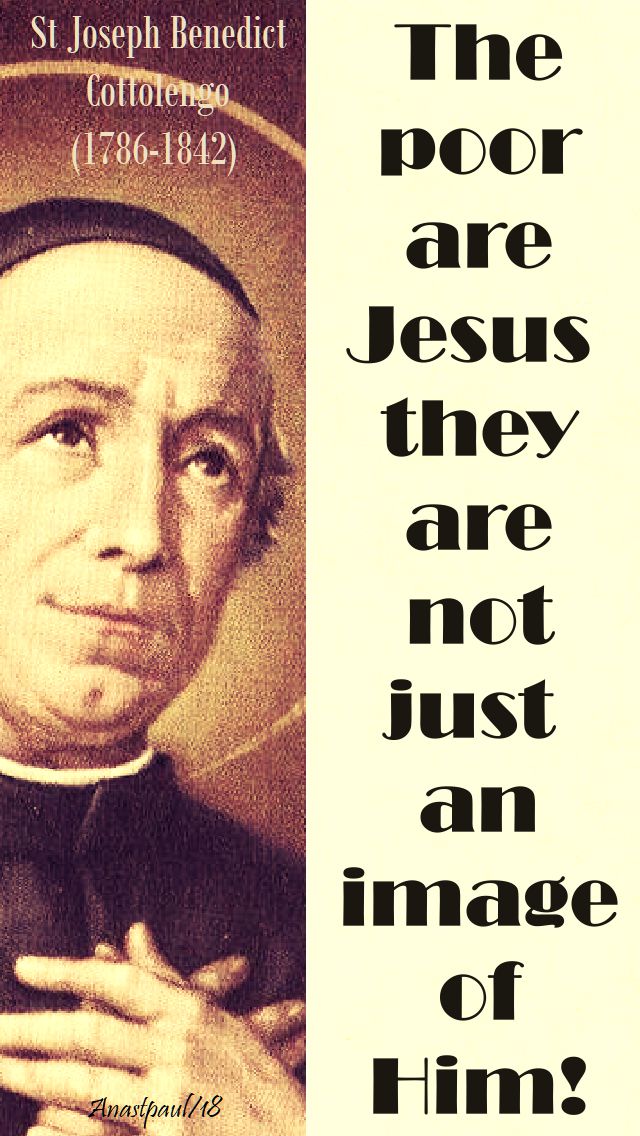
“The poor are Jesus they are not just an image of Him.”
St Joseph Benedict Cottolengo (1786-1842)
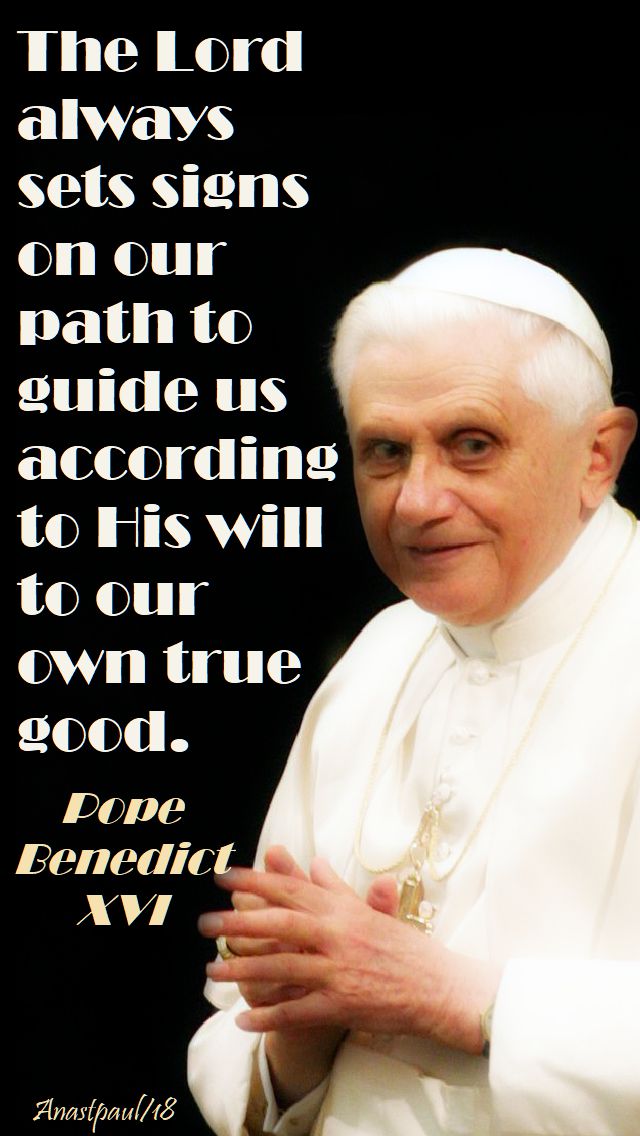
“The Lord always sets signs on our path to guide us according to His will, to our own true good.”
Pope Benedict XVI
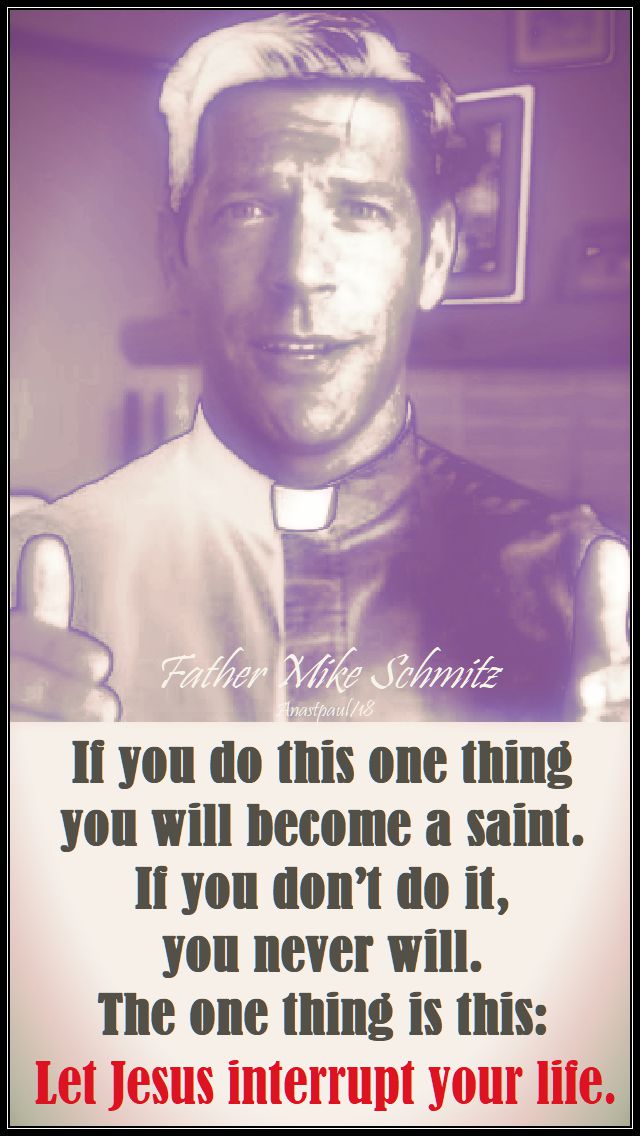
“If you do this one thing you will become a saint. If you don’t do it, you never will. The one thing is this: Let Jesus interrupt your life.”
Quote/s of the Day – 29 April – Fifth Sunday of Eastertide and the Memorial of St Catherine of Siena (1347-1380) Doctor of the Church
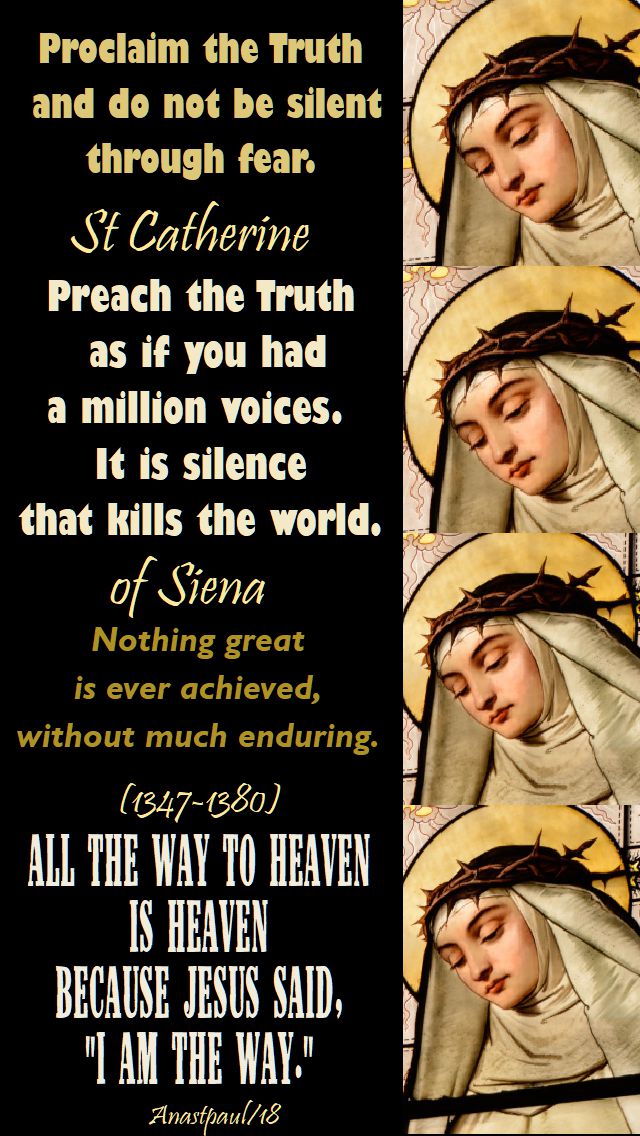
“Proclaim the Truth and do not be silent through fear.”
“Preach the Truth as if you had a million voices. It is silence that kills the world.”
“Nothing great is ever achieved, without much enduring.”
“All the way to heaven is heaven because Jesus said, “I am the way.”
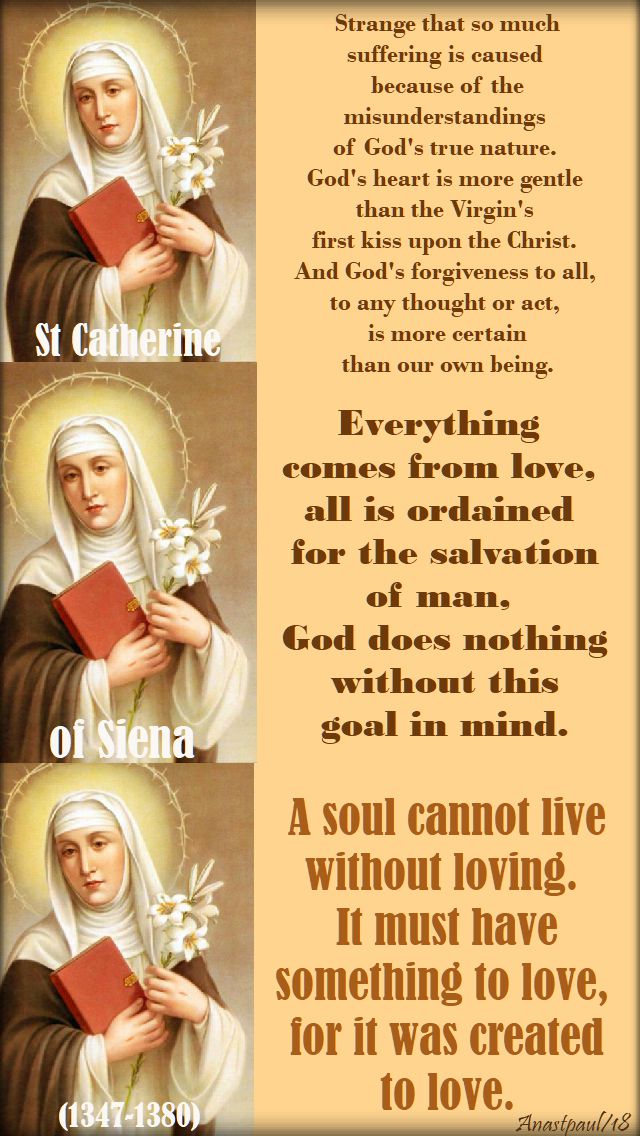
“Strange that so much suffering is caused because of the misunderstandings of God’s true nature. God’s heart is more gentle than the Virgin’s first kiss upon the Christ. And God’s forgiveness to all, to any thought or act, is more certain than our own being.”
“Everything comes from love, all is ordained for the salvation of man, God does nothing without this goal in mind.”
“A soul cannot live without loving. It must have something to love, for it was created to love.”
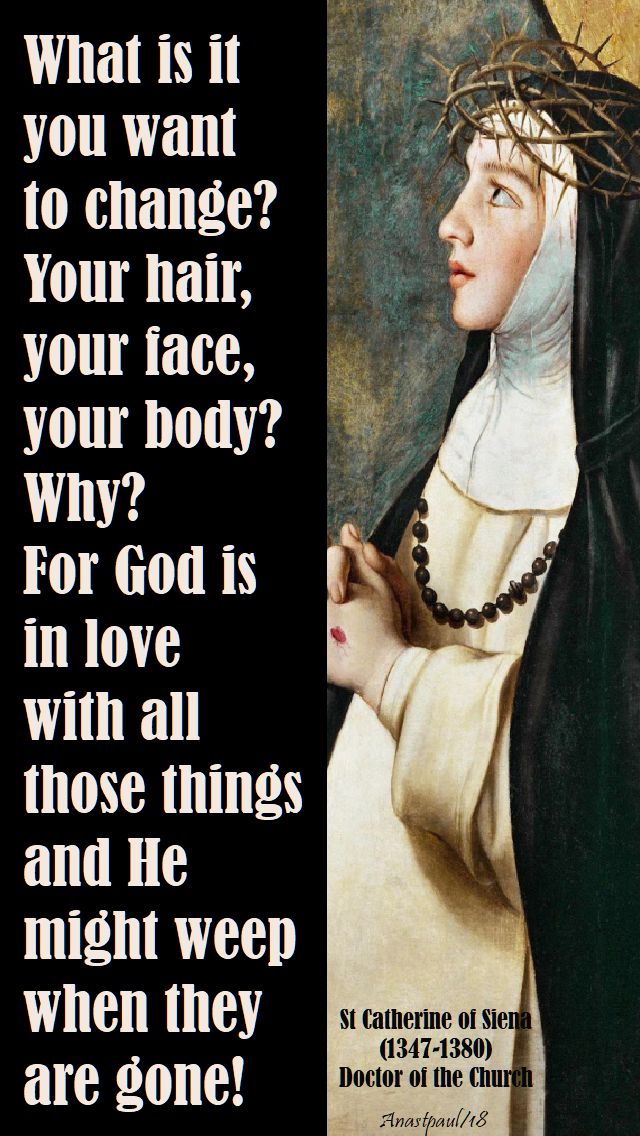
“What is it you want to change? Your hair, your face, your body? Why? For God is in love with all those things and He might weep when they are gone!”
St Catherine of Siena (1347-1380) Doctor of the Church
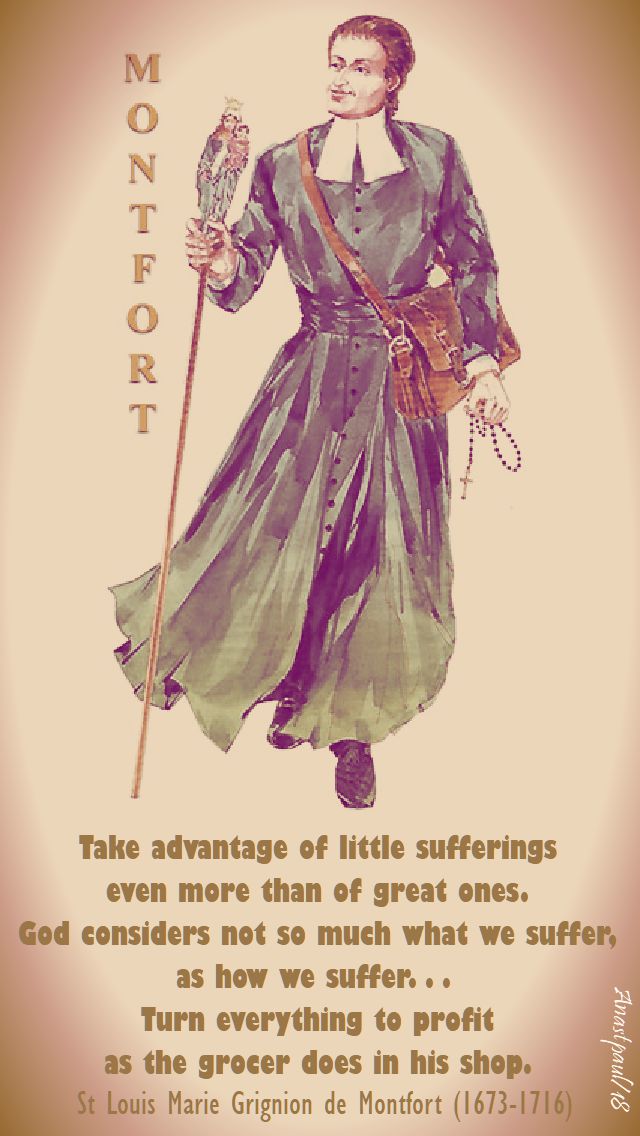
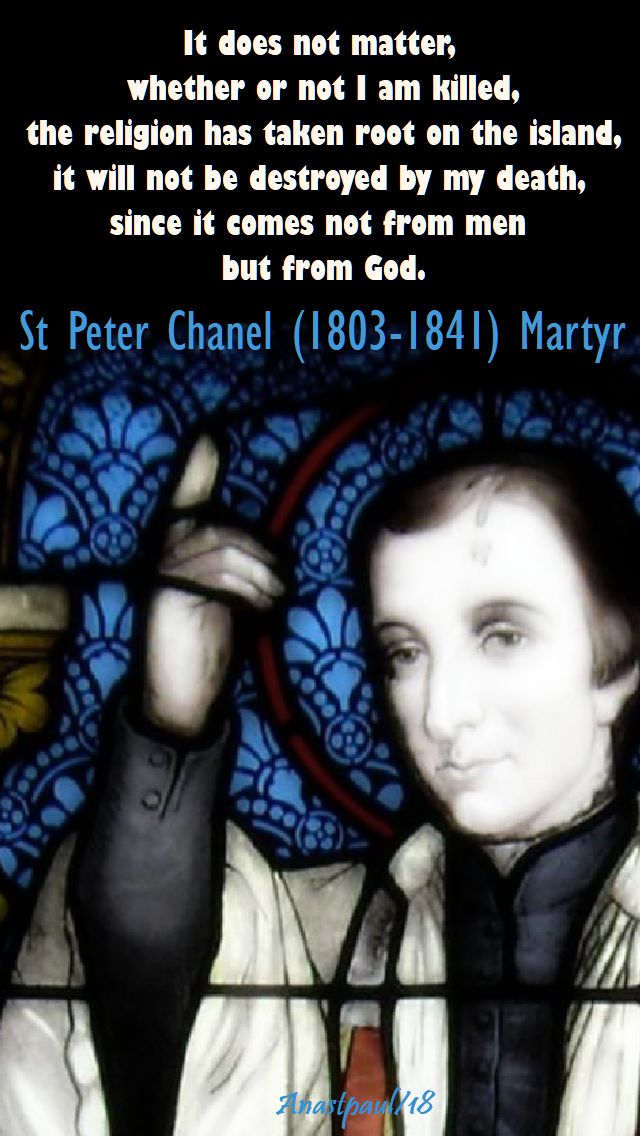
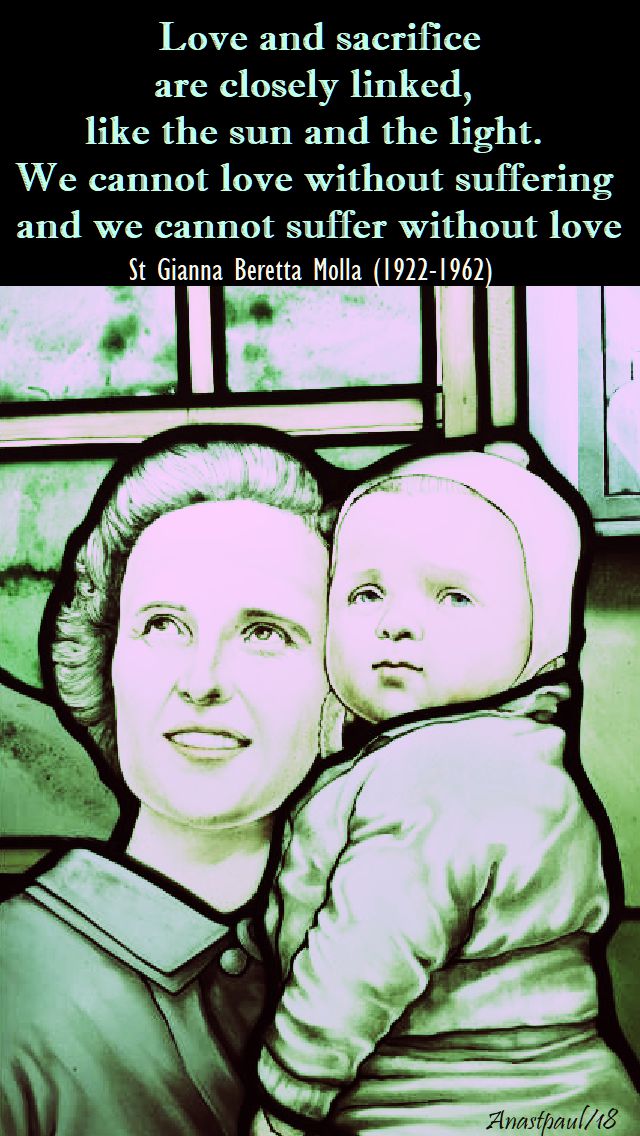
Quote/s of the Day – 28 April – The Memorial of St Pope Pius V (1504-1572), St Louis Marie Grignion de Montfort (1673-1716), St Peter Chanel (1803-1841) Martyr and St Gianna Beretta Molla (1922-1962)
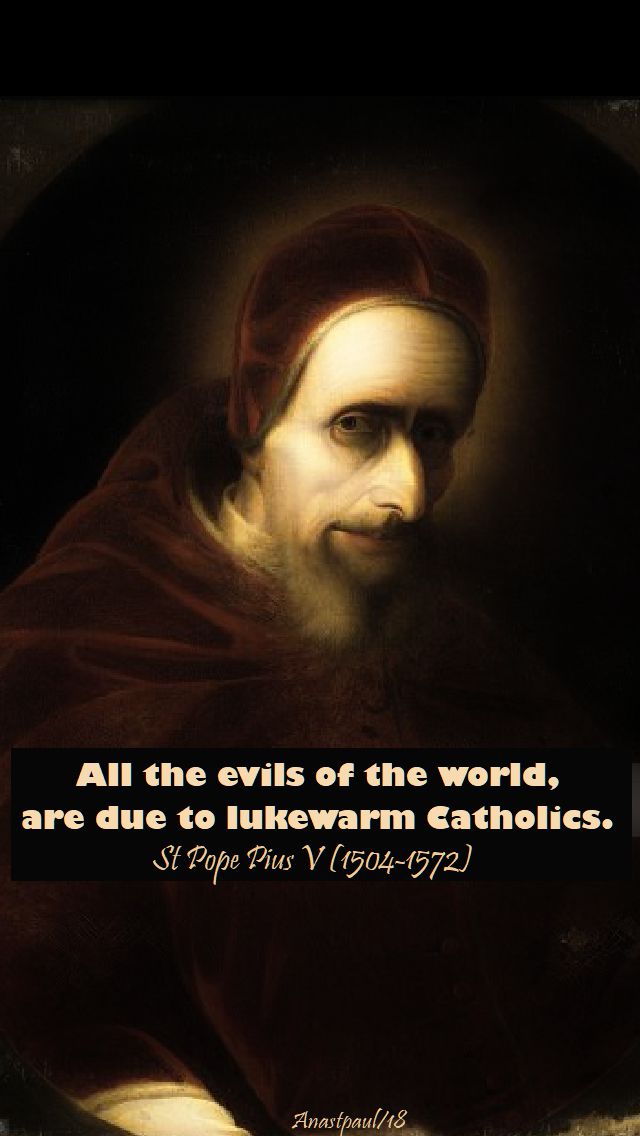
“All the evils of the world, are due to lukewarm Catholics.”
St Pope Pius V
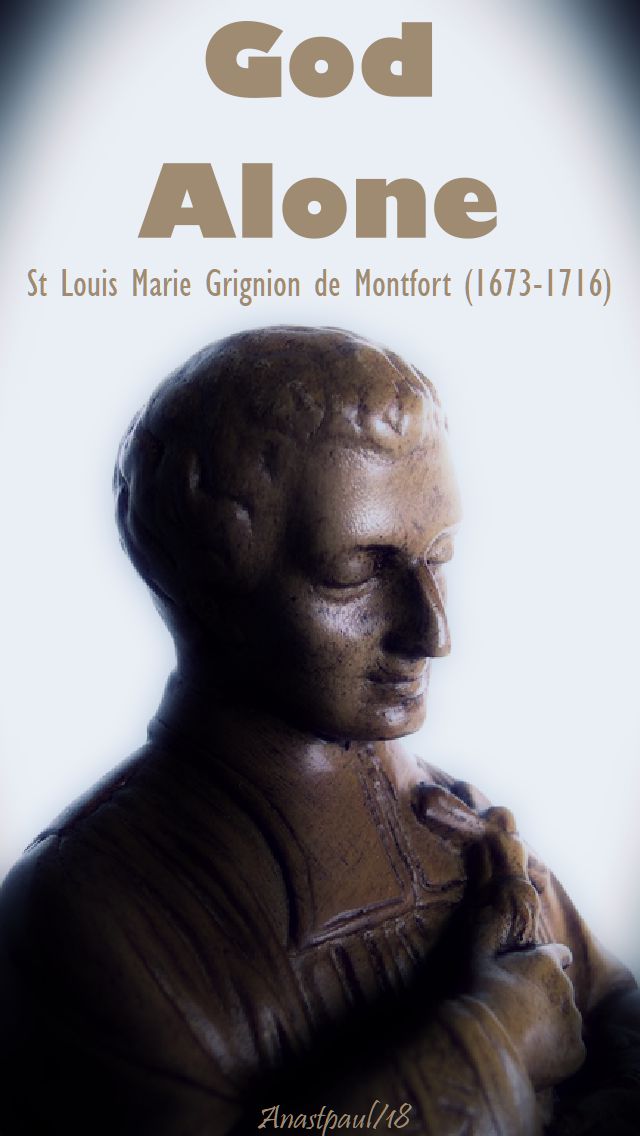
“God Alone”
“Take advantage of little sufferings even more than of great ones. God considers not so much what we suffer, as how we suffer. . . Turn everything to profit as the grocer does in his shop.”
St Louis Marie Grignion de Montfort (1673-1716)
“It does not matter, whether or not I am killed, the religion has taken root on the island, it will not be destroyed by my death, since it comes not from men but from God.”
St Peter Chanel (1803-1841) Martyr
“Our body is a cenacle, a monstrance: through its crystal the world should see God.”
“Love and sacrifice are closely linked, like the sun and the light. We cannot love without suffering and we cannot suffer without love.”
Quote/s of the Day – 26 April – Thursday of the Fourth Week of Eastertide and the Memorial of St Rafael Arnáiz Barón (1911-1938)
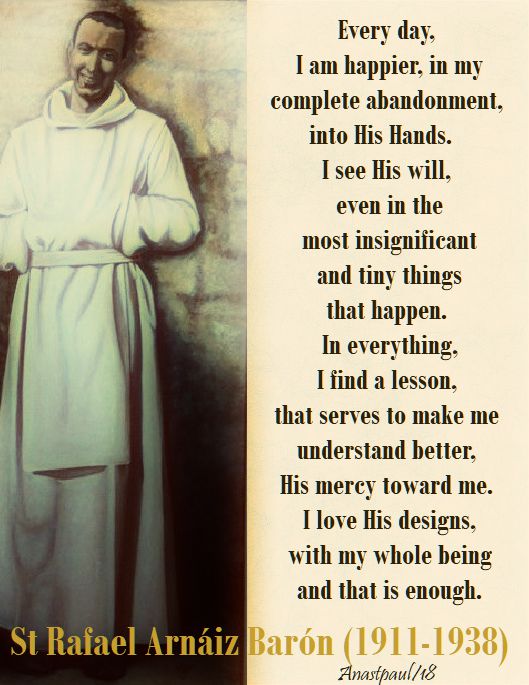
“Every day, I am happier, in my complete abandonment, into His Hands. I see His will, even in the most insignificant and tiny things that happen. In everything I find a lesson, that serves to make me understand better, His mercy toward me. I love His designs, with my whole being and that is enough.
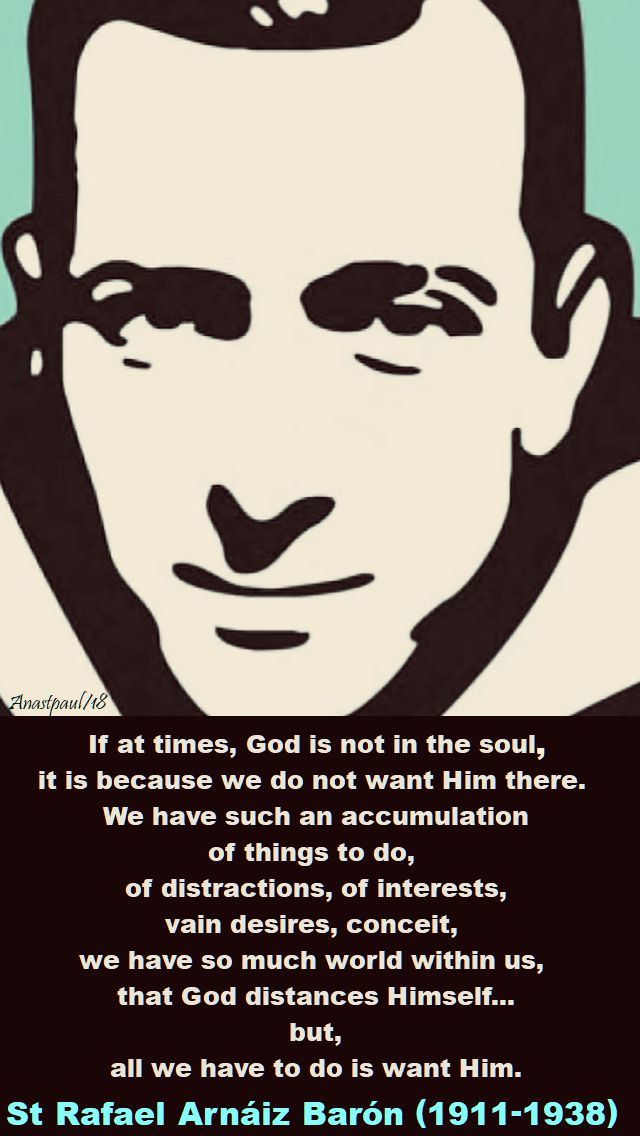
If at times, God is not in the soul, it is because we do not want Him there. We have such an accumulation of things to do, of distractions, of interests, vain desires, conceit, we have so much world within us, that God distances Himself… but, all we have to do is want Him.
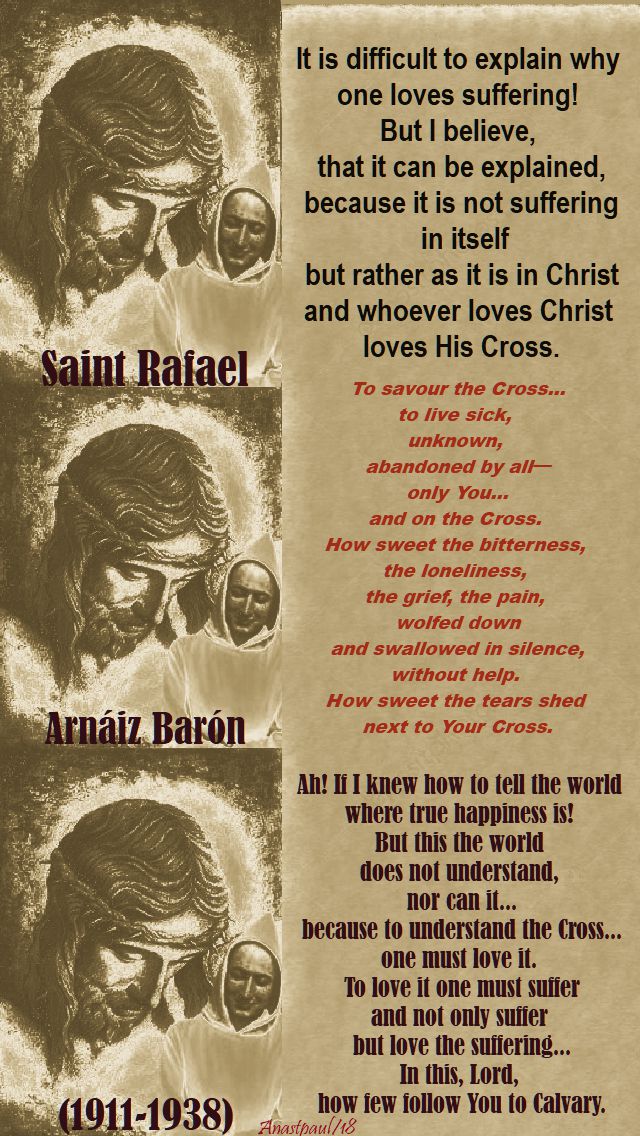
It is difficult to explain why one loves suffering! But I believe, that it can be explained, because it is not suffering in itself but rather as it is in Christ and whoever loves Christ loves His Cross.
To savour the Cross…to live sick, unknown, abandoned by all— only You…and on the Cross. How sweet the bitterness, the loneliness, the grief, the pain, wolfed down and swallowed in silence, without help. How sweet the tears shed next to Your Cross.
Ah! If I knew how to tell the world where true happiness is! But this the world does not understand, nor can it… because to understand the Cross…one must love it. To love it one must suffer and not only suffer but love the suffering… In this, Lord, how few follow You to Calvary.”
Thought for the Day – 25 April – Wednesday of the Fourth Week of Easter and the Feast of St Mark the Evangelist
Today we celebrate St Mark, the Evangelist, the first Gospel writer and the friend of Sts Peter and Paul, the cousin of St Barnabas and our Father in faith – our friend too, a chosen member of the Catholic Church who has gone before to show us the way. Mark knew there would be difficulties for believers in every age, for the persecution of the early Church was the beginning “of the labour pains” (13:8), since “the Gospel must first be preached to all nations” (13:10). He has given us a moving story of how God works in mysterious ways and shown us in the actions of Jesus how to be patient in our faith even in the most troubling circumstances, for “he is going before you to Galilee; there you will see him as he told you” (16:7). This narrative could only have been created by someone who himself knew suffering, the pain of unfulfilled hopes and the sorrow of untimely death. His faith made him write about it. His hope makes it so convincing! Let us listen to Pope Benedict on being a Catholic today, now, in the world we live in!
Chosen: I think it is worth reflecting on this word. We are chosen. God has always known us, even before our birth, before our conception, God wanted me as a Christian, as a Catholic, He wanted me as a priest. God thought of me, He sought me among millions, among a great many, He saw me and He chose me. It was not for my merits, which were non-existent but out of His goodness; He wanted me to be a messenger of His choice, which is also always a mission, above all a mission and a responsibility for others. Chosen: we must be grateful and joyful for this event. God thought of me, he chose me as a Catholic, me, as a messenger of His Gospel, as a priest. In my opinion it is worth reflecting several times on this and coming back to this fact of His choice; He chose me, He wanted me, now I am responding.
Perhaps today we are tempted to say: we do not want to rejoice at having been chosen, for this would be triumphalism. It would be triumphalism to think that God had chosen me because I was so important. This would really be erroneous triumphalism. However, being glad because God wanted me is not triumphalism. Rather, it is gratitude and I think we should relearn this joy: God wanted me to be born in this way, into a Catholic family, he wanted me to know Jesus from the first. What a gift to be wanted by God so that I could know His face, so that I could know Jesus Christ, the human face of God, the human history of God in this world! Being joyful because He has chosen me to be a Catholic, to be in this Church of His, where subsistit Ecclesia unica; we should rejoice because God has given me this grace, this beauty of knowing the fullness of God’s truth, the joy of his love.
Chosen: a word of privilege and at the same time of humility. However “chosen” — as I said — is accompanied by the word “parepidemois”, exiles, foreigners. As Christians we are dispersed and we are foreigners: we see that Christians are the most persecuted group in the world today, because it does not conform, because it is a stimulus, because it opposes the tendencies to selfishness, to materialism and to all these things.
Christians are certainly not only foreigners; we are also Christian nations, we are proud of having contributed to the formation of culture, there is a healthy patriotism, a healthy joy of belonging to a nation that has a great history of culture and of faith. Yet, as Christians, we are always also foreigners — the destiny of Abraham, described in the Letter to the Hebrews. As Christians we are, even today, also always foreigners. In the work place Christians are a minority, they find themselves in an extraneous situation; it is surprising that a person today can still believe and live like this. This is also part of our life: it is a form of being with the Crucified Christ, this being foreigners, not living in the way that everyone else lives, but living — or at least seeking to live — in accordance with His Word, very differently from what everyone says. And it is precisely this that is characteristic of Christians. They all say: “But everyone does this, why don’t I?” No, I don’t, because I want to live in accordance with God. St Augustine once said: “Christians are those who do not have their roots below, like tree, but have their roots above and they do not live this gravity in the natural downwards gravitation”.Let us pray the Lord that he help us to accept this mission of living as exiles, as a minority, in a certain sense, of living as foreigners and yet being responsible for others and, in this way, reinforcing the goodness in our world.
This is faith: touching Christ with the hand of faith, with our heart and thus entering into the power of His life, into the healing power of the Lord. And let us pray the Lord, that we may touch Him more and more, so as to be healed. Let us pray that He will not let us fall, that He too may take us by the hand and thus preserve us for true life….
Thought for the Day – 24 April – Tuesday of the Fourth Week of Eastertide and the Memorial of St Mary Euphrasia Pelletier (1796-1868)
Sorrow and joy alternated almost without interruption in Angers and the new houses. There were difficulties connected with each of the foundations, entailing a great deal of hard work. Throughout these hardships, St Mary Euphrasia endured and embraced them, and said “Great crosses bring great graces.”
Ardent prayer sustained her. “Pray, be silent and hope”became her motto. She loved to repeat: “I belong to every country where there are souls to be saved.” Her work of saving them was going on apace and souls were bought at a great price.
Mary Euphrasia’s last years were very lonely. Labour, enterprises, intense activities, physical and moral sufferings were steadily taking a toll on the Foundress’ strength. She was almost seventy-two years of age when she breathed her last on 24 April 1868, the Friday after Good Shepherd Sunday. “Goodbye my daughters, goodbye dear Institute” were her last words.
Mary Euphrasia founded, in her lifetime, 110 houses on every continent. Today, the Mission Partners of the Good Shepherd (Sisters and Lay) are present in more than 70 countries, embracing the world with their zeal for the salvation of all people. A year after the death of Mary Euphrasia, the Ceylon (Sri Lanka) mission was founded. From Ceylon, the Good Shepherd Sisters came to Singapore in 1939 and reached Malaysia in 1956.
It is not easy to sum up the life of Mary Euphrasia. Perhaps it is best understood in terms of her own wish for her Sisters: “You will effect no good, my dear Sisters … until you become animated with the thoughts, sentiments and affections of the Good Shepherd” and “Live His way of life!”
Quote/s of the Day – 24 April – Tuesday of the Fourth Week of Eastertide and the Memorial of St Mary Euphrasia Pelletier (1796-1868)
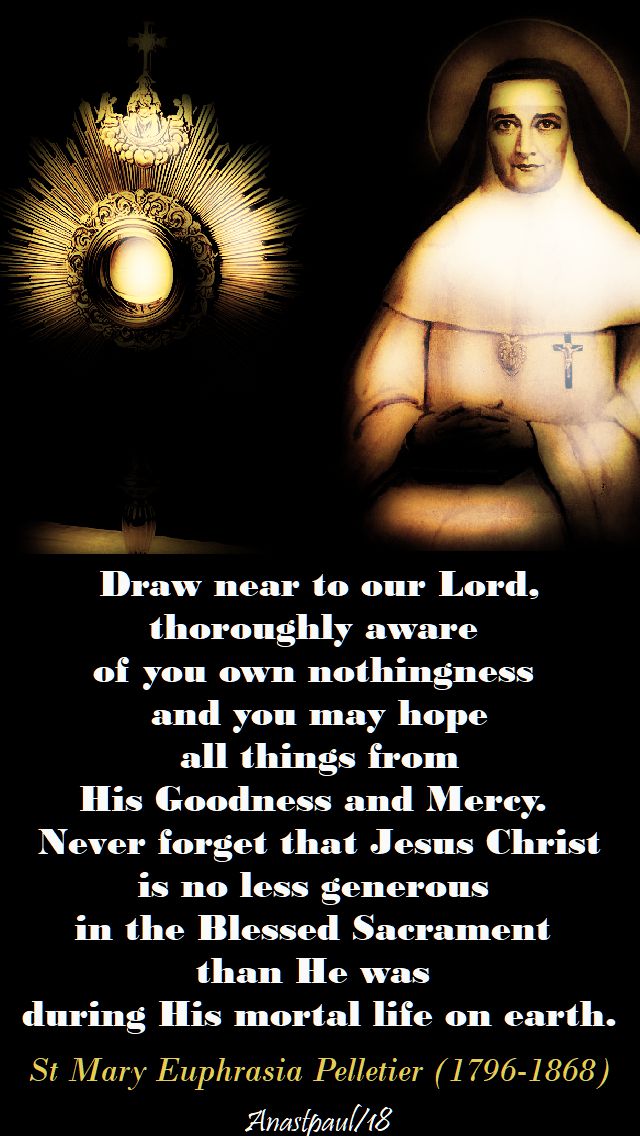
“Draw near to our Lord, thoroughly aware of you own nothingness and you may hope all things from His Goodness and Mercy. Never forget that Jesus Christ is no less generous in the Blessed Sacrament than He was during His mortal life on earth.”
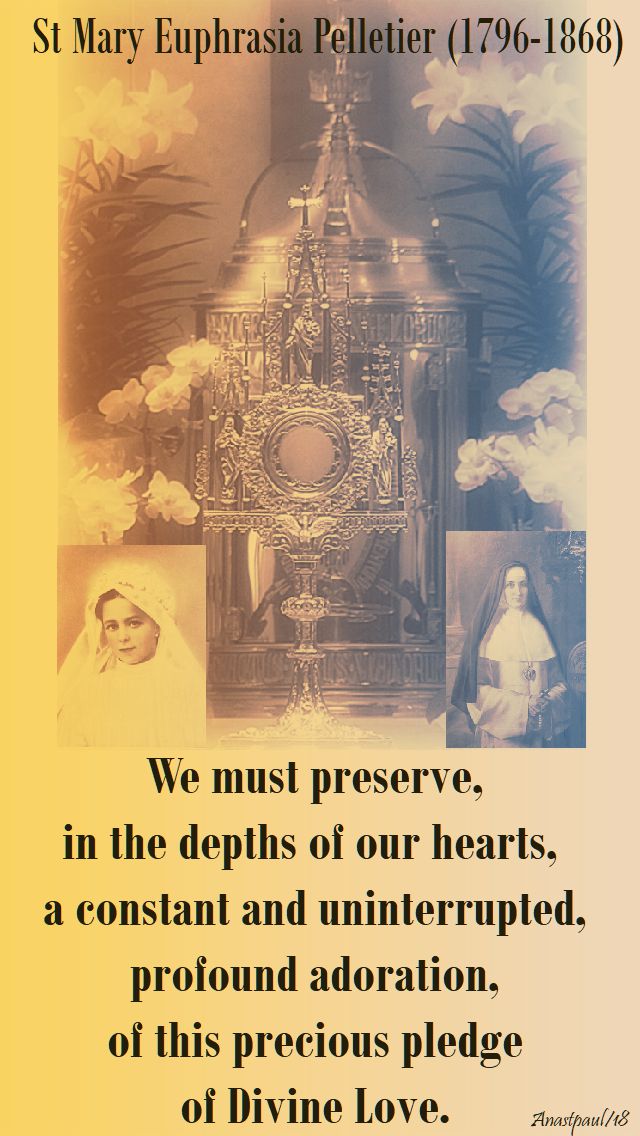
“The Blessed Sacrament is the first and supreme object of our worship. We must preserve, in the depths of our hearts, a constant and uninterrupted, profound adoration, of this precious pledge, of Divine Love.”
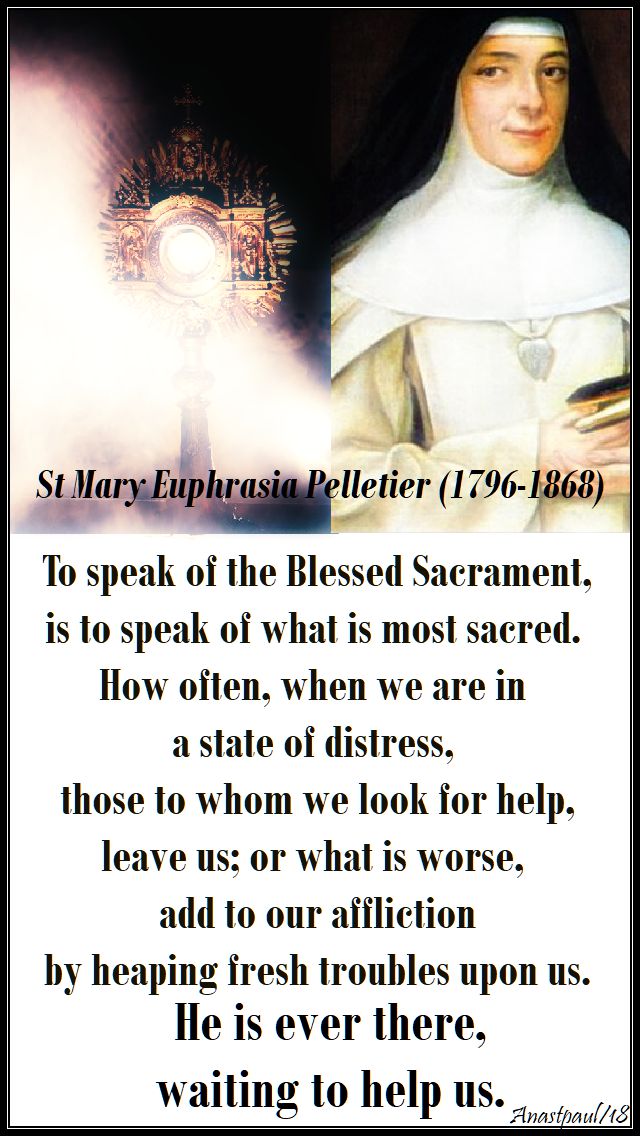
“To speak of the Blessed Sacrament, is to speak of what is most sacred. How often, when we are in a state of distress, those to whom we look for help leave us; or what is worse, add to our affliction by heaping fresh troubles upon us. He is ever there waiting to help us.”
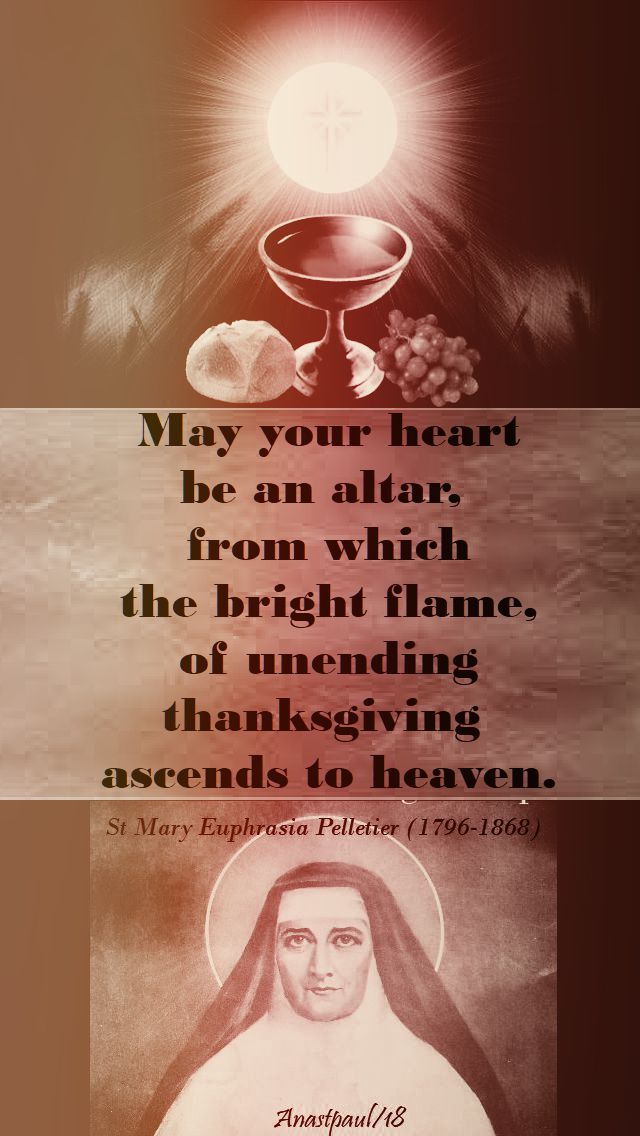
“May your heart be an altar, from which the bright flame, of unending thanksgiving ascends to heaven.”
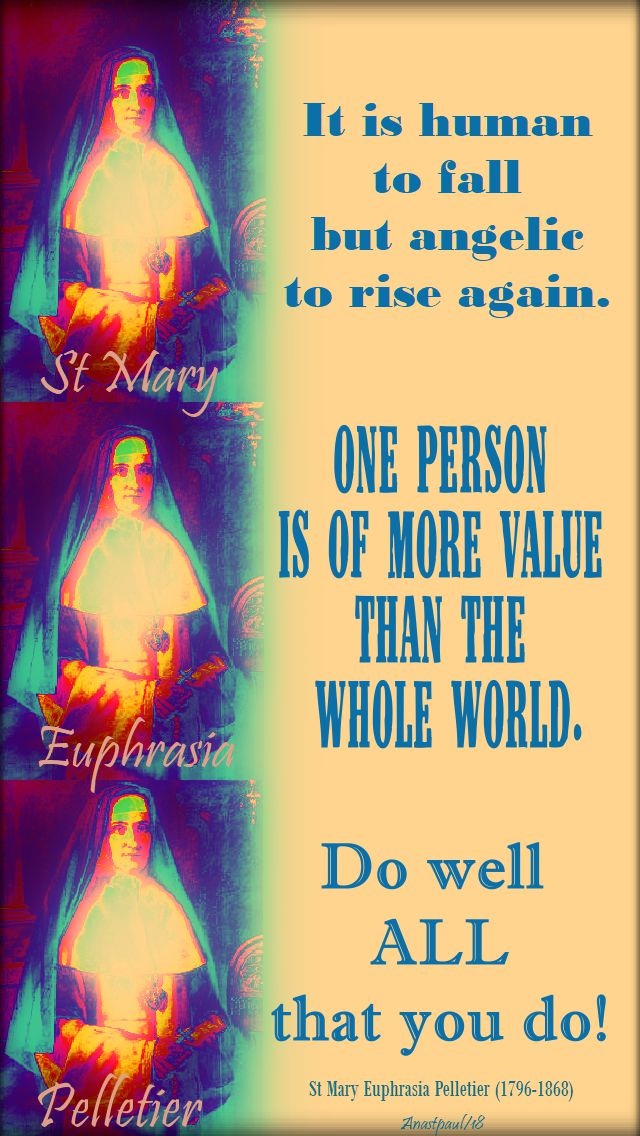
“It is human to fall but angelic to rise again.”
“One person is of more value than the whole world.”
One Minute Reflection – 24 April – Tuesday of the Fourth Week of Eastertide and the Memorial of St Mary Euphrasia Pelletier (1796-1868)
In brotherly love, let your feelings of deep affection for one another, come to expression and regard others as more important than yourself...Romans 12:10
REFLECTION – “If you always love one another, if you always uphold one another, you will be capable of working wonders!”…St Mary Euphrasia Pelletier
PRAYER – Lord, by Your grace, we are made one in mind and heart. Give us a love for what You command and a longing for what You promise, so that, amid this world’s changes, our hearts may be one with each other and be set on the world of lasting joy. May the prayers of St Mary Euphrasia on our behalf, help us to achieve holy love for all Your children and our brothers. Through Jesus Christ our Lord in the unity of the Holy Spirit, one God forever, amen.
Quote/s of the Day – 23 April – Monday of the Fourth Week of Eastertide
“Speaking of Love, Life & Virtue”
“He that is kind is free, though he is a slave; he that is evil is a slave, though he be a king.”
St Augustine (354-430) Doctor of Grace
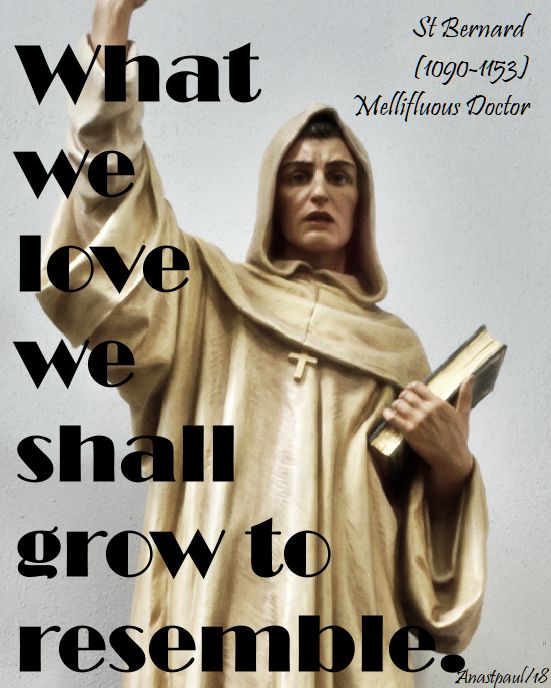
“What we love we shall grow to resemble.”
St Bernard of Clairvaux (1090-1153) Mellifluous Doctor
“The creator of the heavens obeys a carpenter; the God of eternal glory listens to a poor virgin. Has anyone ever witnessed anything comparable to this? Let the philosopher no longer disdain from listening to the common labourer; the wise, to the simple; the educated, to the illiterate; a child of a prince, to a peasant.”
St Anthony of Padua (1195-1231) Evangelical Doctor
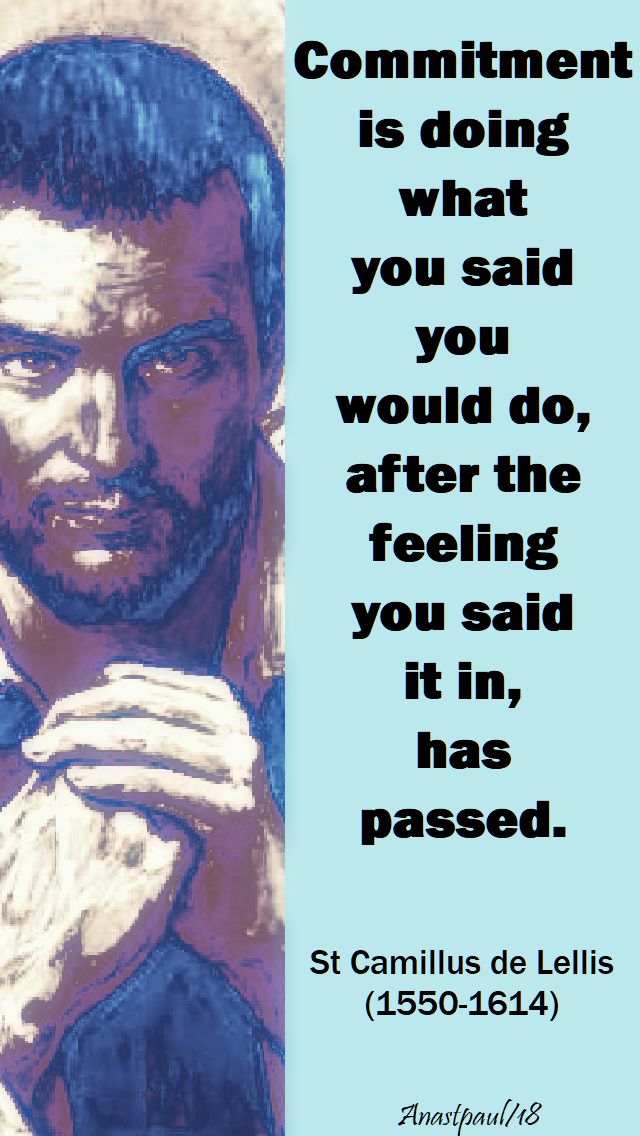
“Commitment is doing what you said you would do, after the feeling you said it in, has passed.”
St Camillus de Lellis (1550-1614)
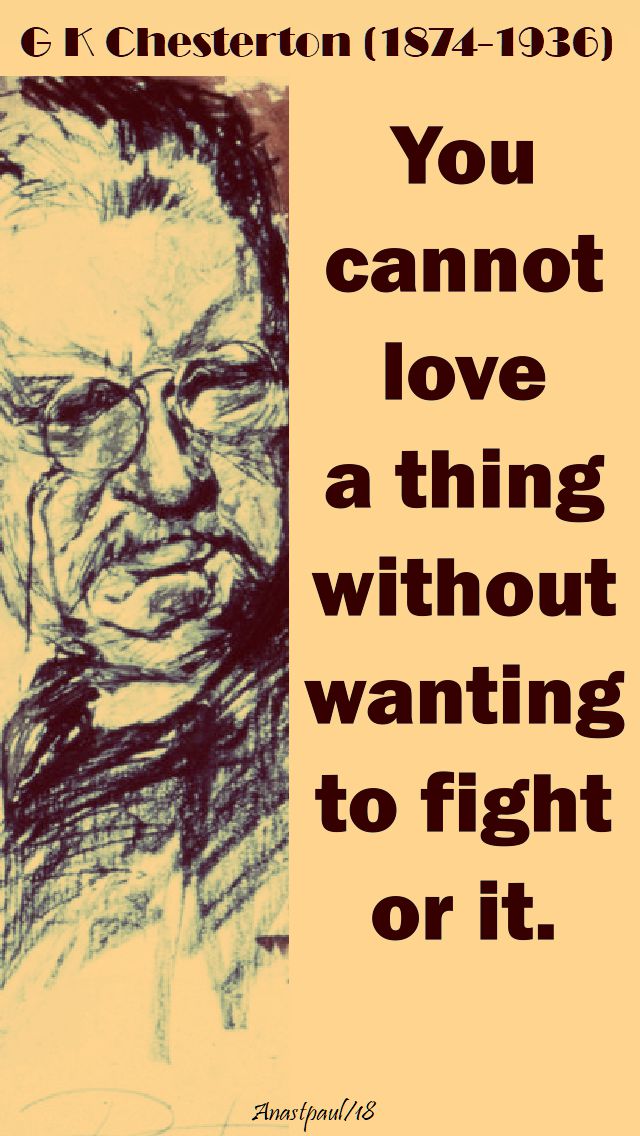
“You cannot love a thing without wanting to fight for it.”
G K Chesterton (1874-1936)
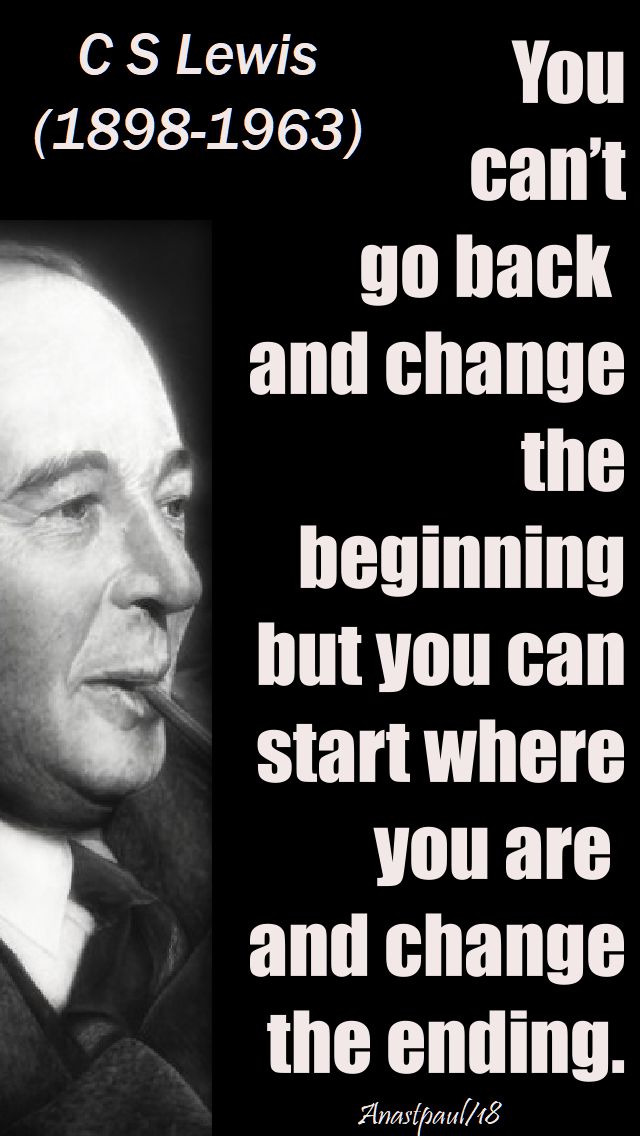
“You can’t go back and change the beginning but you can start where you are and change the ending.”
C S Lewis (1898-1963)
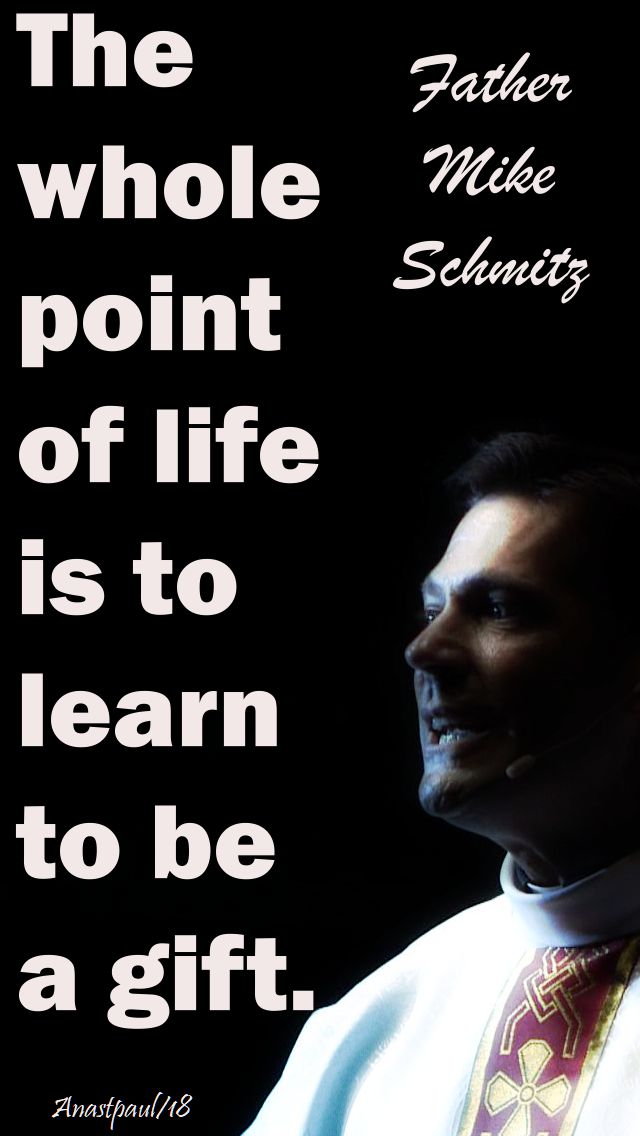
“The whole point of life is to learn to be a gift.”
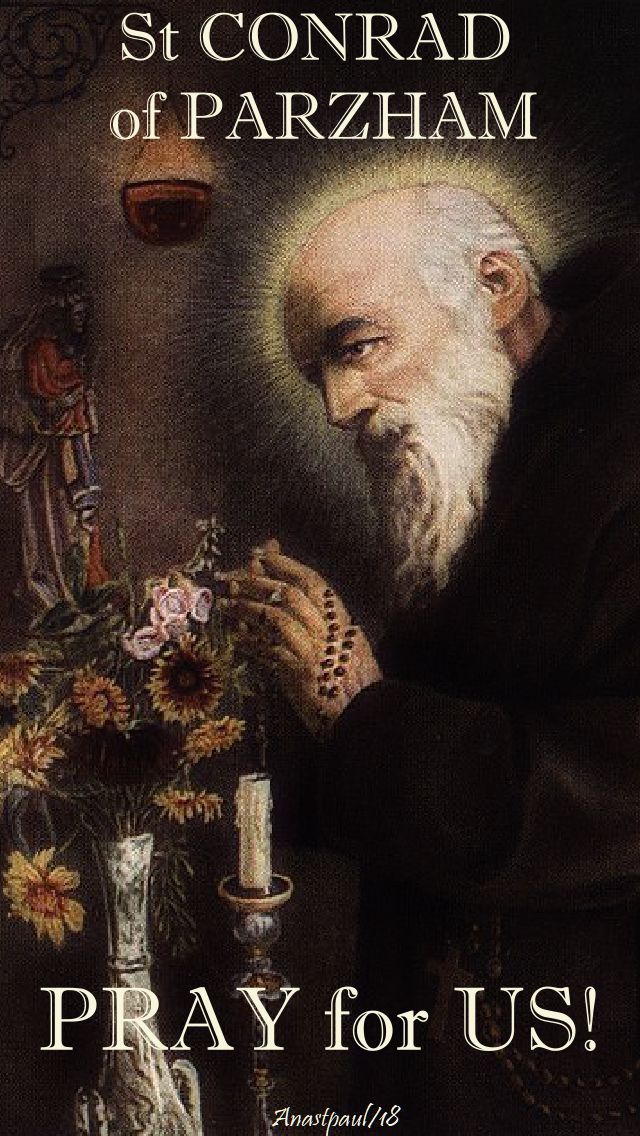
Thought for the Day -21 April – Saturday of the Third Week of Eastertide and the Memorial of St Conrad of Parzham OFM Cap. (1818-1894)
Resolutions of St Conrad whilst a Novice
1. I resolve in the first place to remain continually
in the presence of God
and to ask myself frequently if I would do this or that,
if my confessor or superior were watching me
and especially if God and my guardian angel were present.
2. I resolve to ask myself, whenever I have to encounter crosses of suffering,
“Conrad, why have you come here?”
3. I resolve to avoid leaving the friary, as far as possible,
unless it be out of love for my neighbour, obedience, reasons of health,
a pious pilgrimage or some other good cause.
4. I resolve to foster fraternal charity in myself and in others.
Therefore, I resolve to take care never to say an unkind word.
I resolve to bear up patiently with the defects and weaknesses of others
and as far as possible, to hide them, with the mantle of charity,
unless I am in duty bound, to manifest them, to someone,
who is in a position to correct them.
5. I resolve to observe silence conscientiously.
I resolve to speak briefly and so avoid many pitfalls
and be better able to converse with God.
6. When at table I resolve to place myself in the presence of God,
as far as I can, to remain recollected and to pass up my favorite dishes
so as to practice a hidden form of mortification.
I resolve not to eat between meals, unless ordered to do so,
under obedience.
7. I resolve to answer the first call of the bell unless legitimately hindered.
8. I resolve to avoid, as far as possible, conversing with the opposite sex
unless obedience imposes duties on me which make it necessary to speak with women.
In that case I resolve to be very reserved and maintain custody of the eyes.
9. I resolve to carry out orders punctually and to the letter.
I resolve especially to make every effort to conquer my own will in all things.
10. I resolve to force myself to pay close attention to minor details
and as far as possible avoid every imperfection.
I resolve to observe the holy rule faithfully
and not to depart from it a hairsbreadth, come what may.
11. I resolve to cultivate a deep devotion to the Blessed Virgin Mary
and strive to imitate her virtues.
Quote/s of the Day – 21 April – Saturday of the Third Week of Eastertide, the Memorial of St Anselm (1033-1109) Doctor of the Church and of St Conrad of Parzham OFM Cap. (1818-1894)
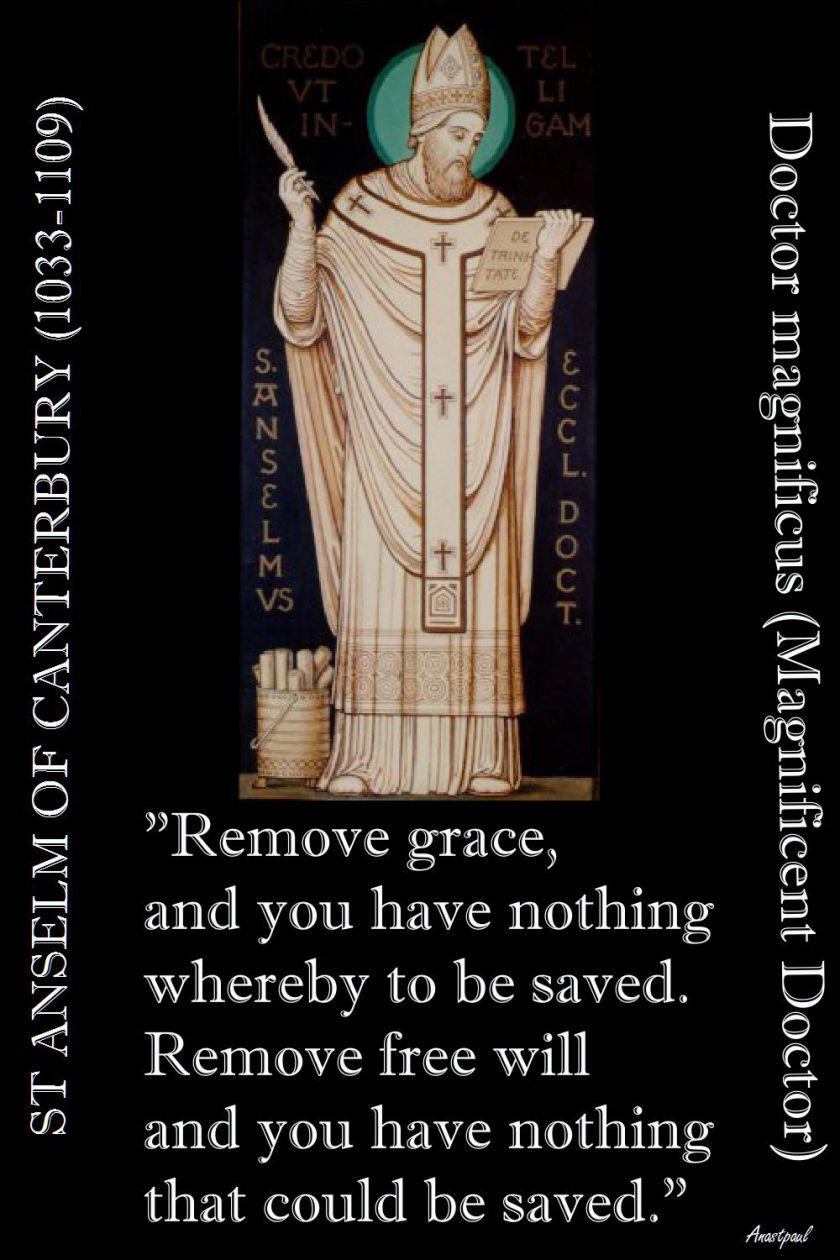
“Remove grace and you have nothing whereby to be saved. Remove free will and you have nothing that could be saved.”
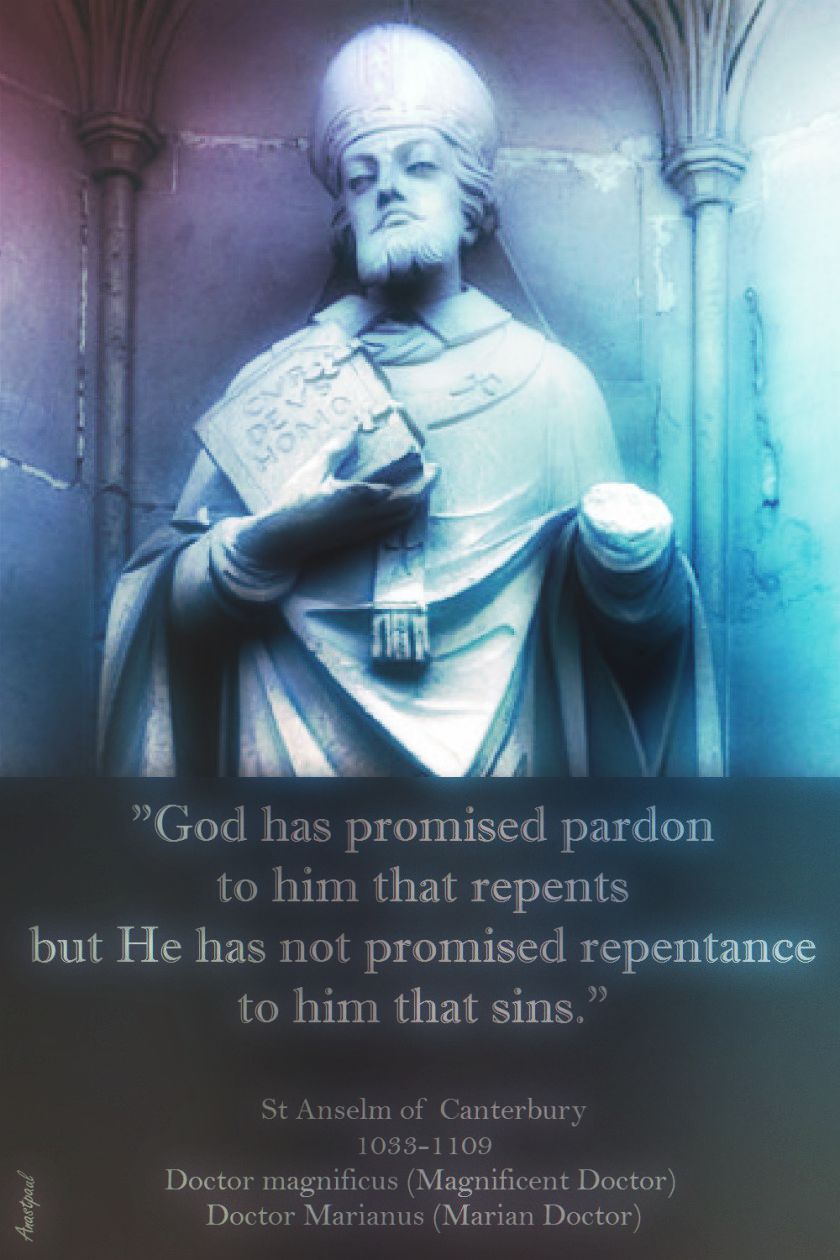
“God has promised pardon to him that repents but he has not promised repentance to him that sins.”
St Anselm (1033-1109) Doctor of the Church
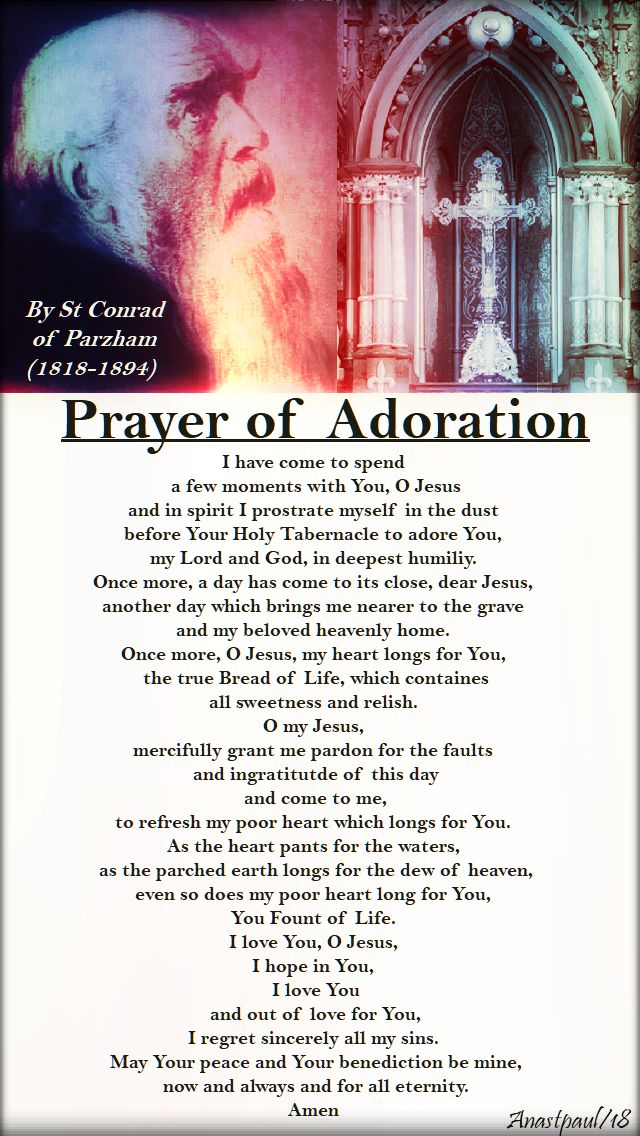
Prayer of Adoration and Repentance/Night Prayer By St Conrad of Parzham (1818-1894)
I have come to spend a few moments with You, O Jesus and in spirit I prostrate myself in the dust before Your Holy Tabernacle to adore You, my Lord and God, in deepest humility. Once more, a day has come to its close, dear Jesus, another day which brings me nearer to the grave and my beloved heavenly home. Once more, O Jesus, my heart longs for You, the true Bread of Life, which contains all sweetness and relish. O my Jesus, mercifully grant me pardon for the faults and ingratitude of this day and come to me, to refresh my poor heart which longs for You. As the heart pants for the waters, as the parched earth longs for the dew of heaven, even so does my poor heart long for You, You Fount of Life. I love You, O Jesus, I hope in You, I love You and out of love for You, I regret sincerely all my sins. May Your peace and Your benediction be mine, now and always and for all eternity. Amen
Quote/s of the Day – 19 April – Thursday of the Third Week of Eastertide
“Speaking of: Becoming a Saint”
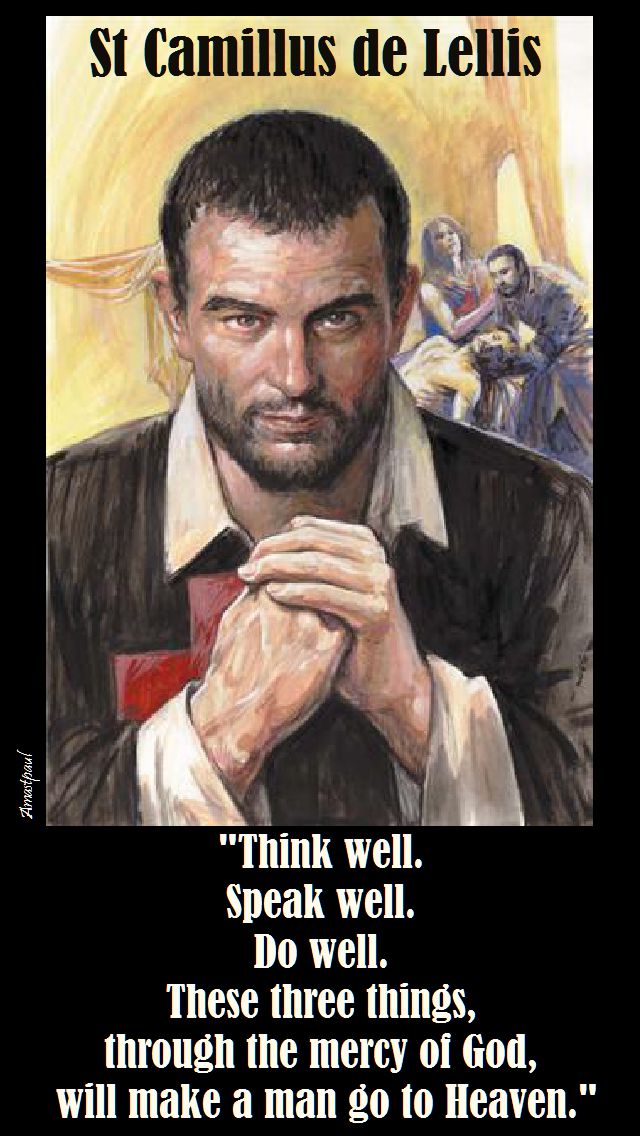
“Think well. Speak well. Do well. These three things, through the mercy of God, will make a man go to Heaven.”
St Camillus de Lellis (1550-1614)
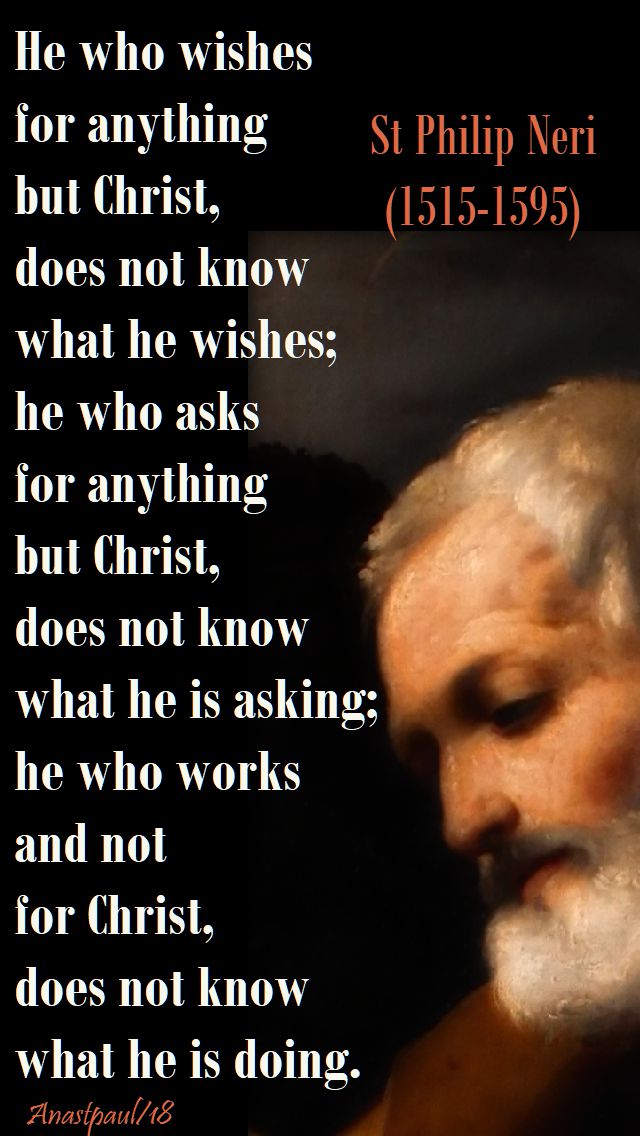
“He who wishes for anything but Christ, does not know what he wishes; he who asks for anything but Christ, does not know what he is asking; he who works and not for Christ, does not know what he is doing.”
St Philip Neri (1515-1595)
“The great saint may be said, to mix all his thoughts with thanks. All goods look better, when they look like gifts.”
G K Chesterton (1874-1936)
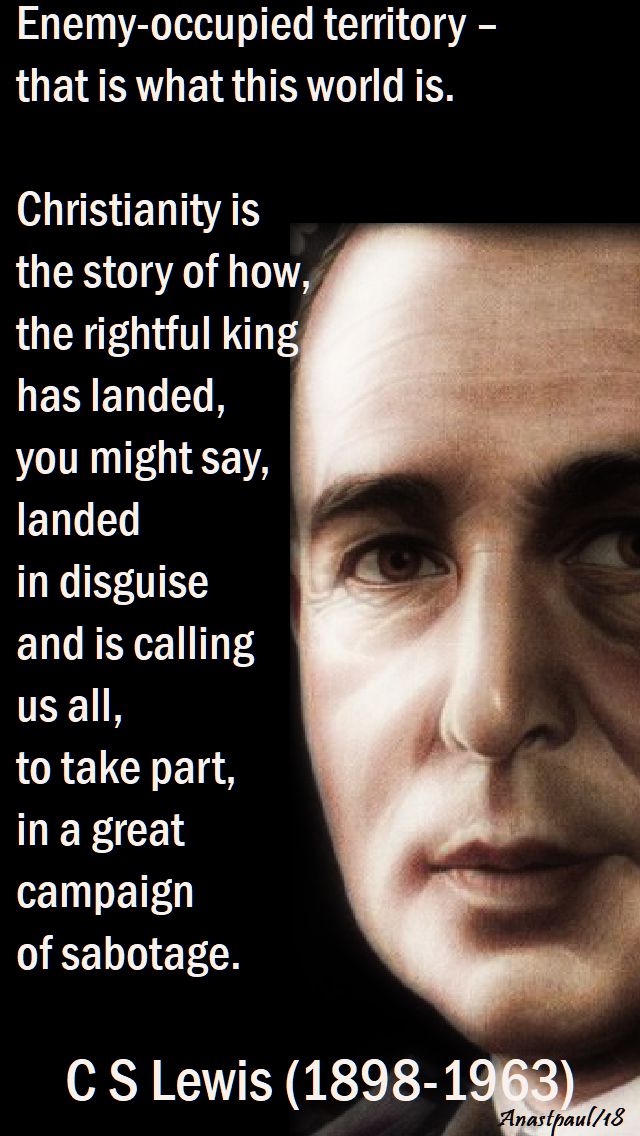
“Enemy-occupied territory – that is what this world is. Christianity is the story of how, the rightful king has landed, you might say landed in disguise and is calling us all, to take part, in a great campaign of sabotage.”
C S Lewis (1898-1963)
“What people don’t realise, is how much Christianity costs. They think faith is a big electric blanket, when of course, it is the cross.”
Flannery O’Connor (1925-1964)
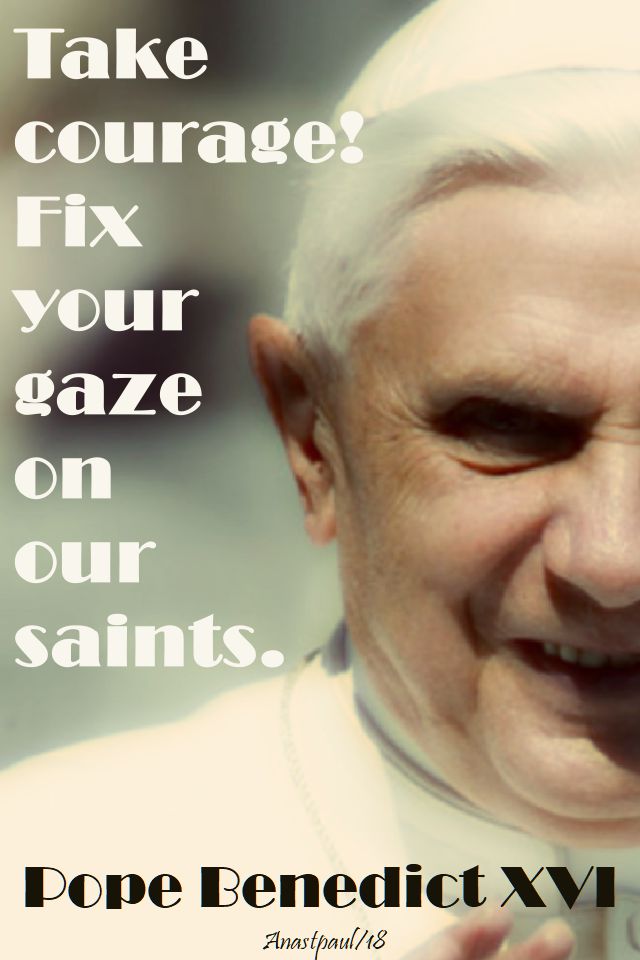
“Take courage! Fix your gaze on our saints.”
Pope Benedict XVI
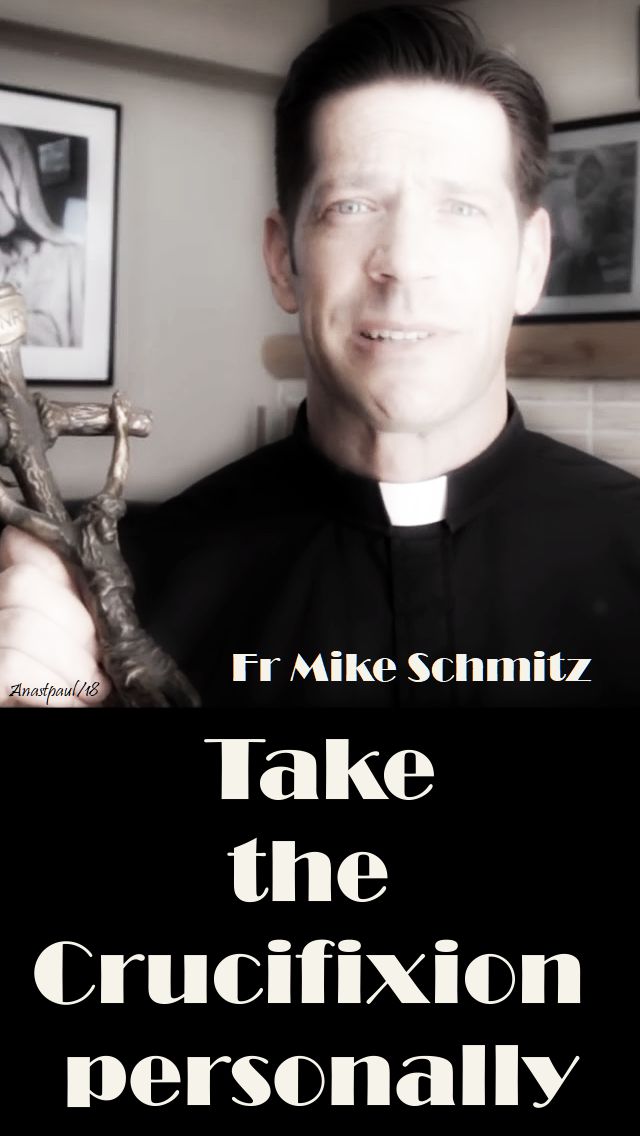
“Take the Crucifixion personally.”
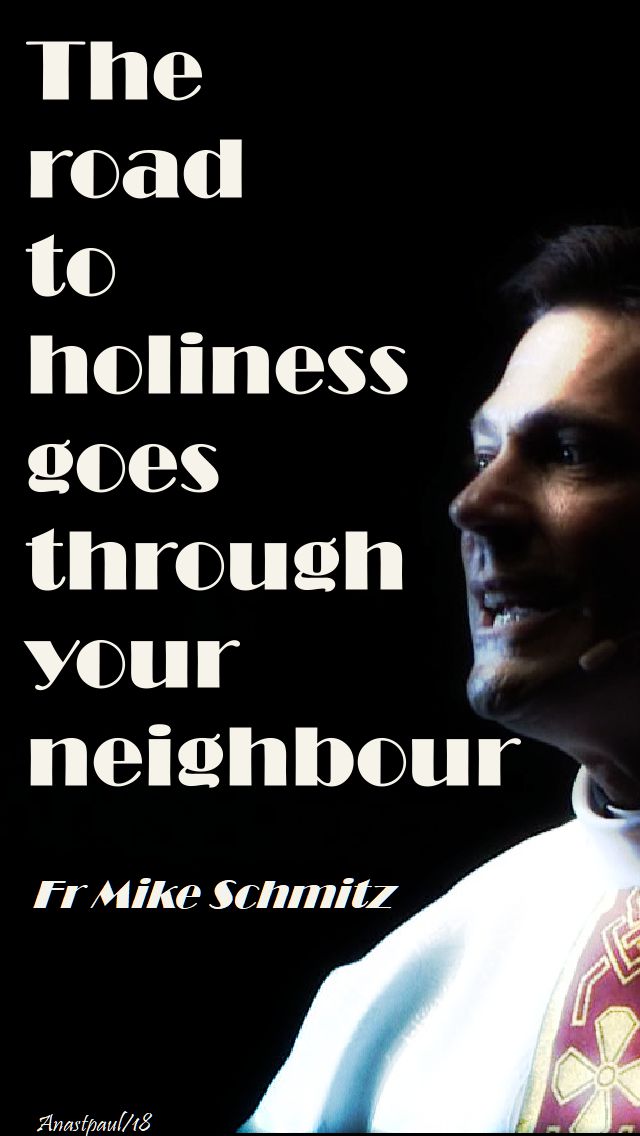
“The road to holiness goes through your neighbour.”
Quote/s of the Day – 16 April – Monday of the Third Week of Eastertide and the Memorial of St Bernadette Soubirous (1844-1879)
“Nothing is anything anymore to me, everything is nothing to me, only Jesus! Neither things, nor persons, neither ideas, nor emotions, neither honour, nor sufferings. Jesus is for me honour, delight, heart and soul.”
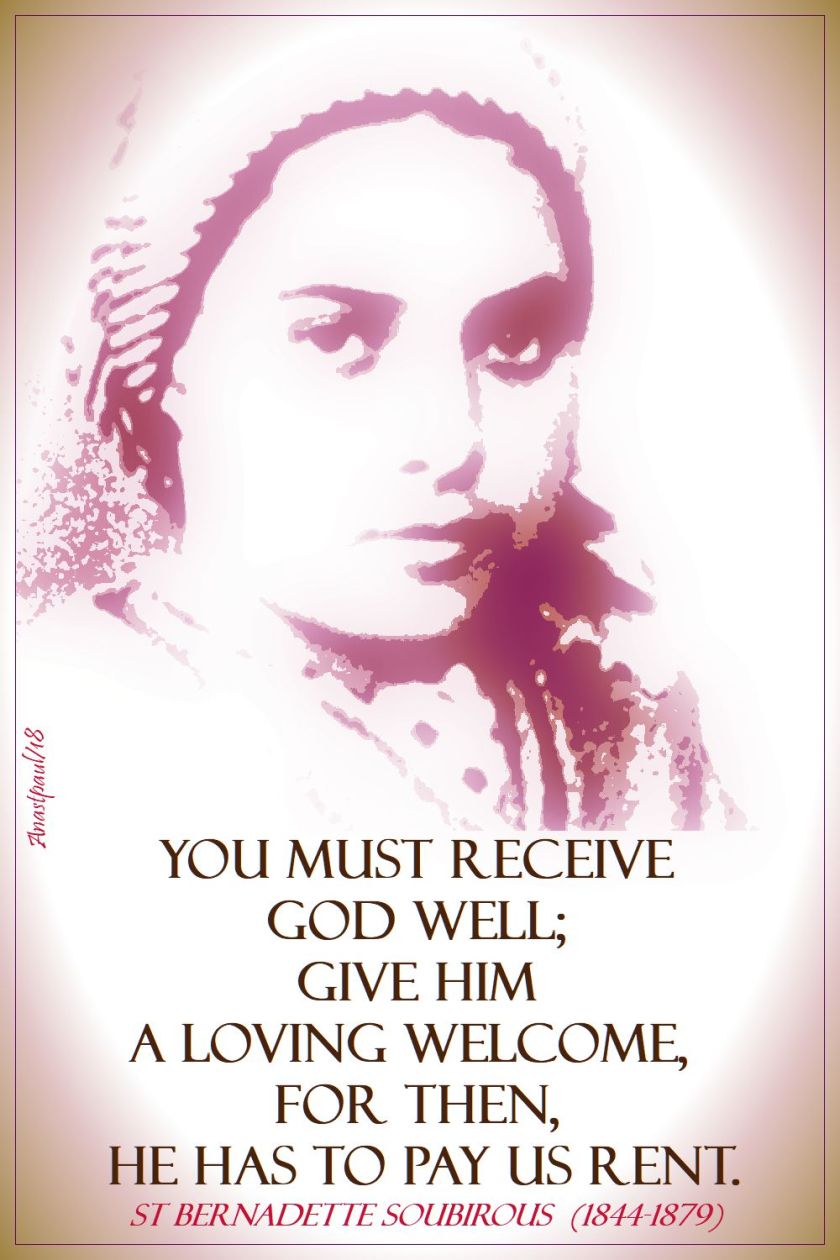
“You must receive God well – give Him a loving welcome, for then, He has to pay us rent.”
Quote/s of the Day – 13 April – Friday of the Second Week of Eastertide “Just Random”
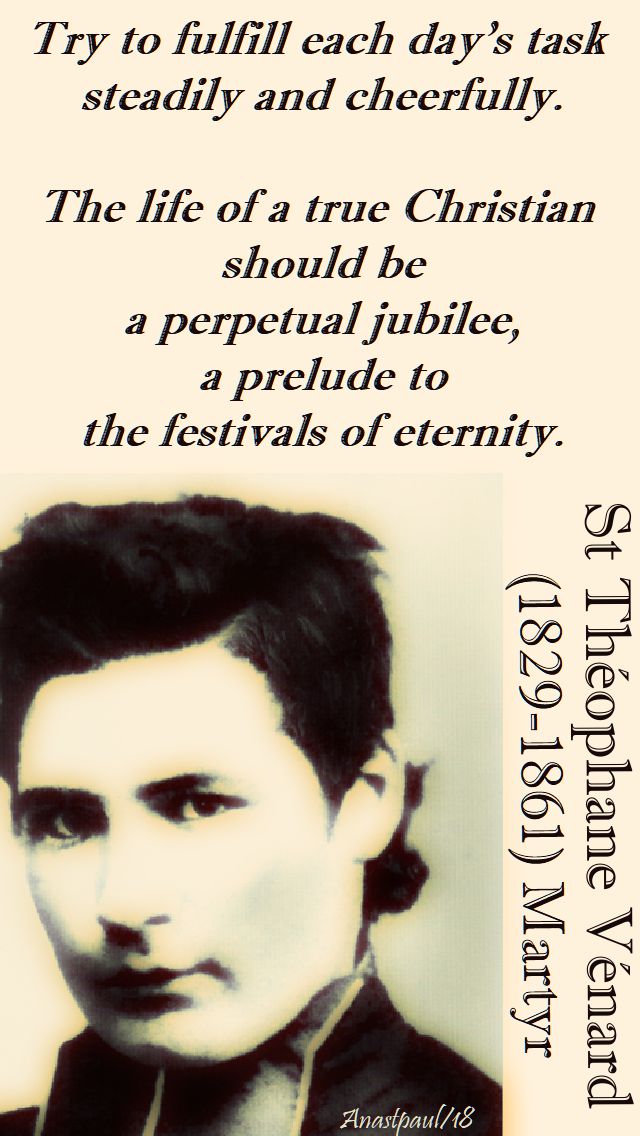
Try to fulfil each day’s task steadily and cheerfully. The life of a true Christian should be a perpetual jubilee, a prelude to the festivals of eternity.
St Théophane Vénard (1829-1861) Martyr
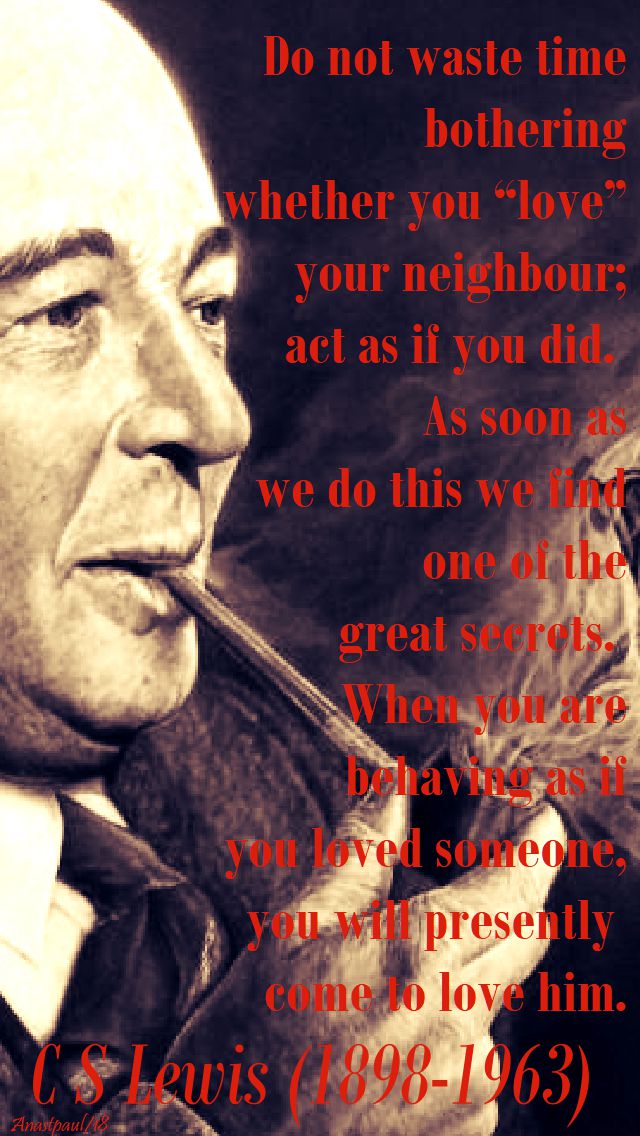
Do not waste time bothering whether you “love” your neighbour; act as if you did. As soon as we do this we find one of the great secrets. When you are behaving as if you loved someone, you will presently come to love him.
C S Lewis (1898-1963)
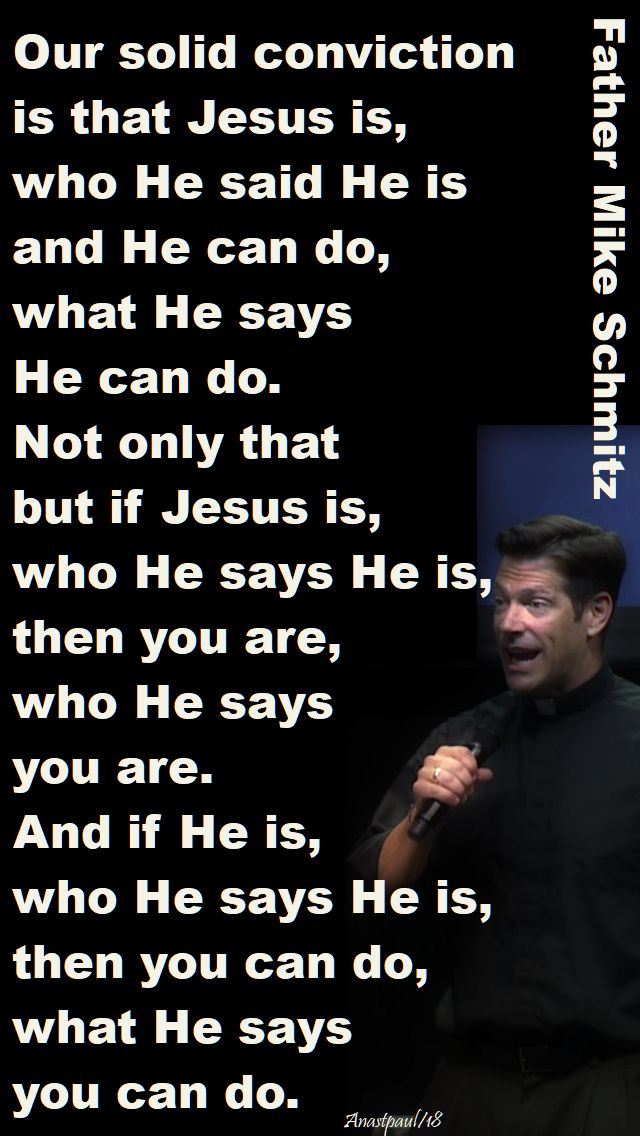
Our solid conviction is that Jesus is who He said He is and He can do what He says He can do. Not only that but if Jesus is, who He says He is, then you are, who He says you are. And if He is who He says He is, then you can do what He says you can do.
One Minute Reflection – 13 April – Friday of the Second Week of Eastertide
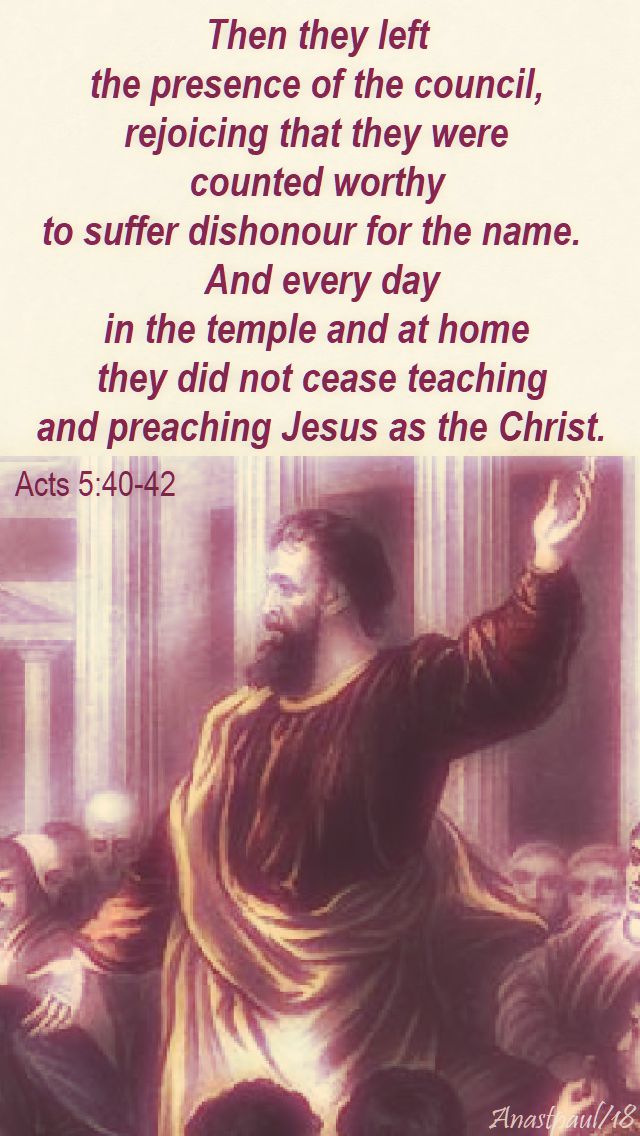
…”for if this plan or this undertaking is of men, it will fail; but if it is of God, you will not be able to overthrow them. You might even be found opposing God!”… Then they left the presence of the council, rejoicing that they were counted worthy to suffer dishonour for the name. And every day in the temple and at home they did not cease teaching and preaching Jesus as the Christ…Acts 5:38,40-42
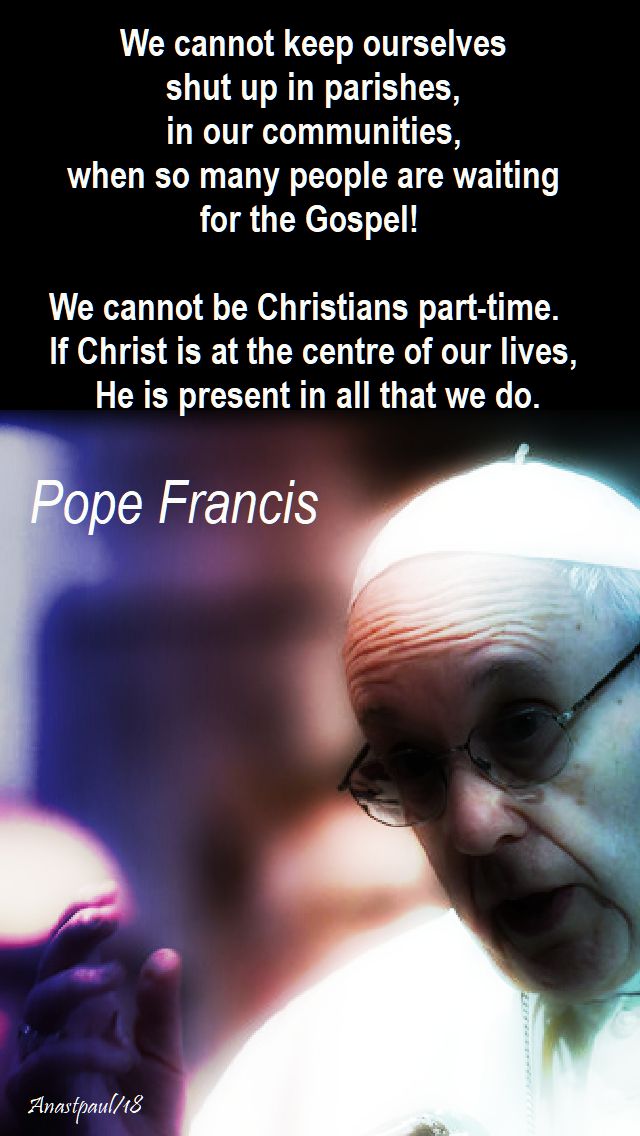
REFLECTION – “We cannot keep ourselves shut up in parishes, in our communities, when so many people are waiting for the Gospel! We cannot be Christians part-time. If Christ is at the centre of our lives, He is present in all that we do.”…Pope Francis
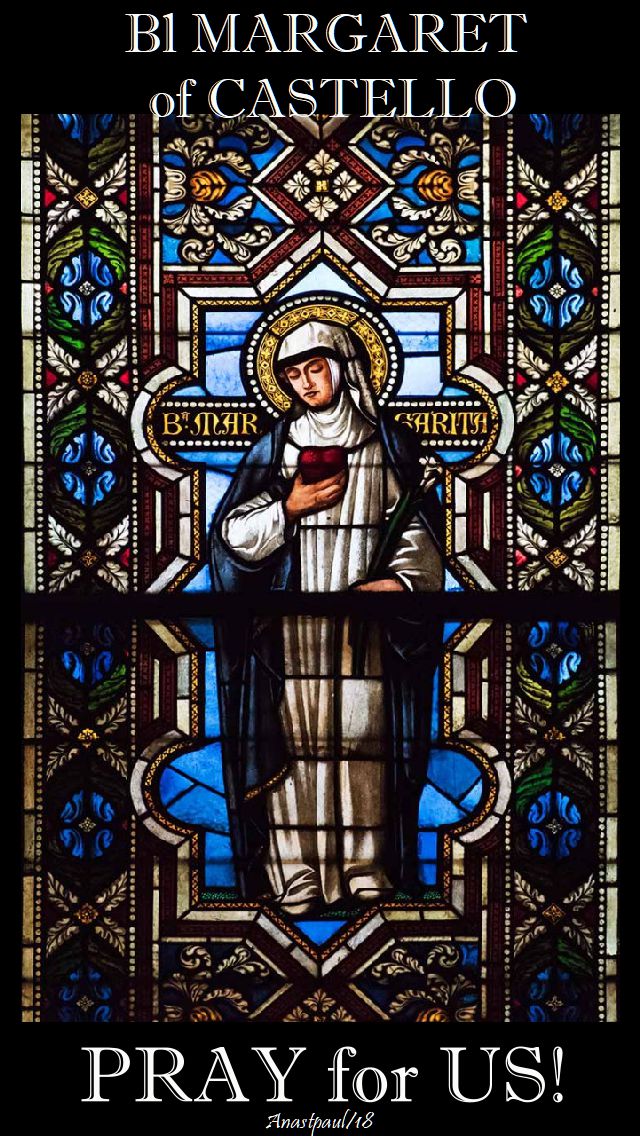
PRAYER – Almighty, ever-living God, grant us the grace to bear the hardships of this life with a steadfast mind, even as You strengthened the Apostles and all the Saints after them, whom no threats could daunt, no pains or penalties break. Dear sweet St Margaret of Castello, you who disregarded your own sufferings to help those who suffer more, pray for us! Through Jesus our Lord, in the unity of the Holy Spirit, one God forever, amen.
Thought for the Day – 9 April – Low Monday of Eastertide
St Augustine of Hippo – The Easter Alleluia
This excerpt on the Easter Alleluia from St Augustine is a wonderful explanation of the joy of the Easter Season. Just as Lent was a season of penance, so the fifty days of Easter is a season of praise and song, an anticipation for the age to come in heavenly glory.
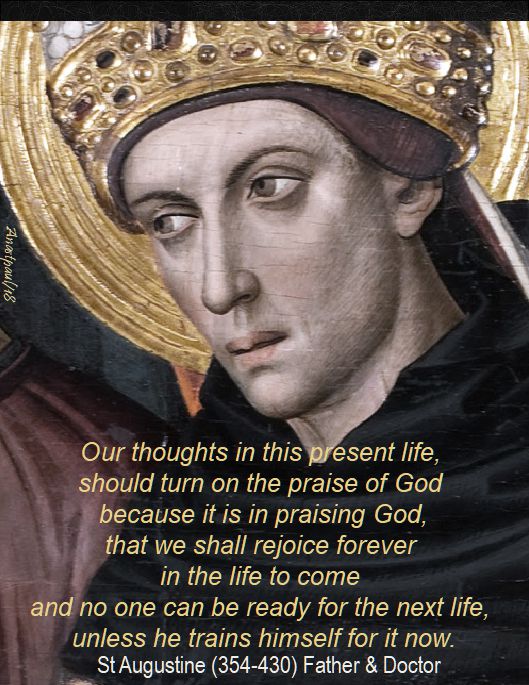
“Our thoughts in this present life, should turn on the praise of God because it is in praising God, that we shall rejoice forever in the life to come and no one can be ready for the next life, unless he trains himself for it now.
So we praise God during our earthly life and at the same time we make our petitions to Him. Our praise is expressed with joy, our petitions with yearning. We have been promised something we do not yet possess and because the promise was made by one who keeps His word, we trust Him and are glad; but insofar as possession is delayed, we can only long and yearn for it. It is good for us to persevere in longing until we receive what was promised and yearning is over, then praise alone will remain.
Because there are these two periods of time – the one that now is, beset with the trials and troubles of this life and the other yet to come, a life of everlasting serenity and joy – we are given two liturgical seasons, one before Easter and the other after. The season before Easter signifies the troubles in which we live here and now, while the time after Easter which we are celebrating at present, signifies the happiness that will be ours in the future. What we commemorate before Easter is what we experience in this life; what we celebrate after Easter points to something we do not yet possess. This is why we keep the first season with fasting and prayer but now the fast is over and we devote the present season to praise. Such is the meaning of the Alleluia we sing.
Both these periods are represented and demonstrated for us in Christ our head. The Lord’s passion depicts for us our present life of trial – shows how we must suffer and be afflicted and finally die. The Lord’s resurrection and glorification show us the life that will be given to us in the future.
Now therefore, brethren, we urge you to praise God. That is what we are all telling each other when we say Alleluia. You say to your neighbour, “Praise the Lord!” and he says the same to you. We are all urging one another to praise the Lord and all thereby doing what each of us urges the other to do. But see that your praise comes from your whole being; in other words, see that you praise God, not with your lips and voices alone but with your minds, your lives and all your actions.
We are praising God now, assembled as we are here in church; but when we go on our various ways again, it seems as if we cease to praise God. But provided we do not cease to live a good life, we shall always be praising God. You cease to praise God only when you swerve from justice and from what is pleasing to God.
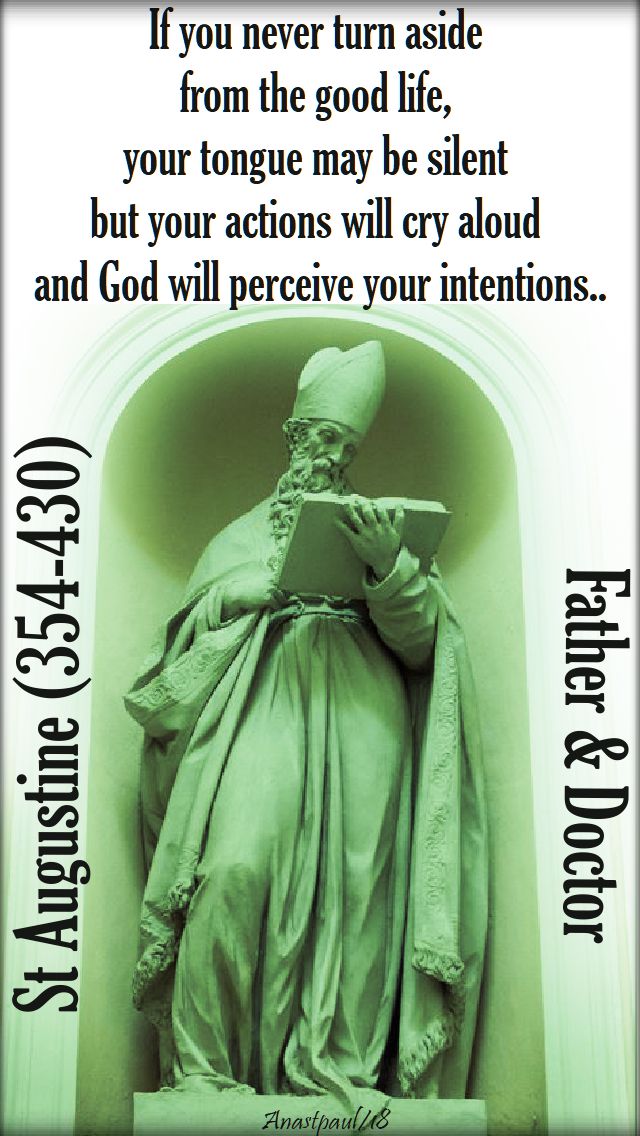
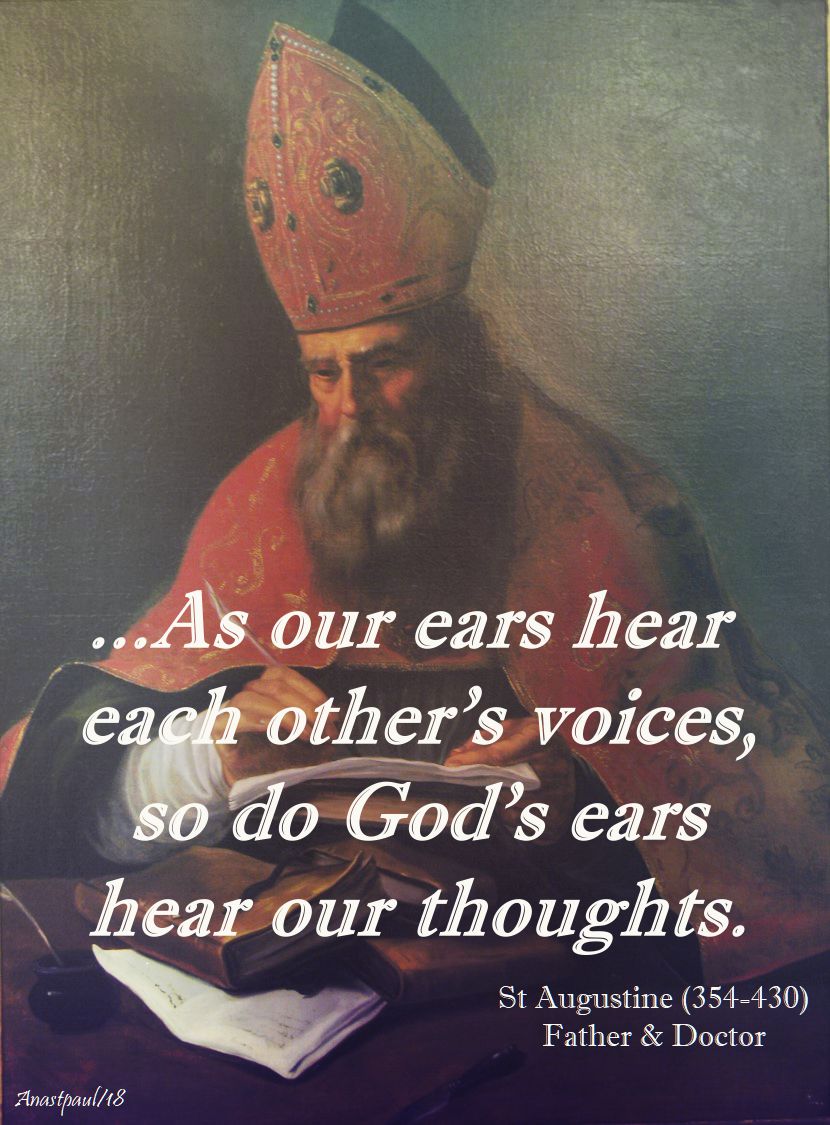
If you never turn aside from the good life, your tongue may be silent but your actions will cry aloud and God will perceive your intentions; for as our ears hear each other’s voices, so do God’s ears hear our thoughts.”
This excerpt on the Alleluia as the song of the Easter Season of praise comes from St. Augustine’s discourse on the Psalms (Ps. 148, 1-2: CCL 40, 2165-2166).
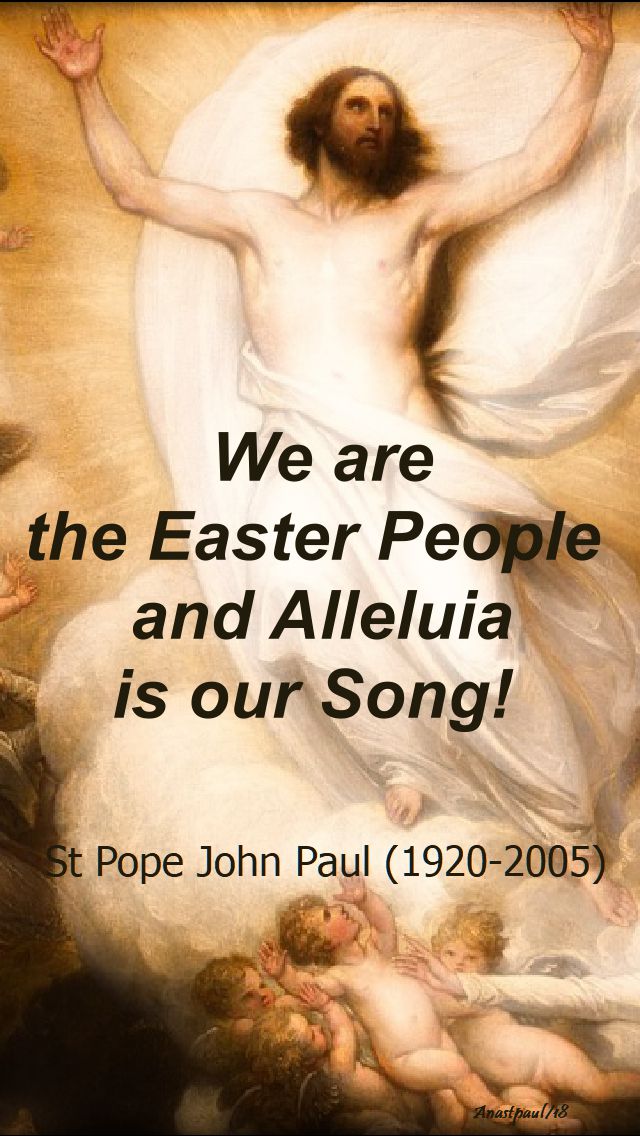
We are the Easter People and Alleluia is our Song!
Quote/s of the Day – 7 April – Easter Saturday and the Memorial of St John Baptiste de La Salle (1651-1719)
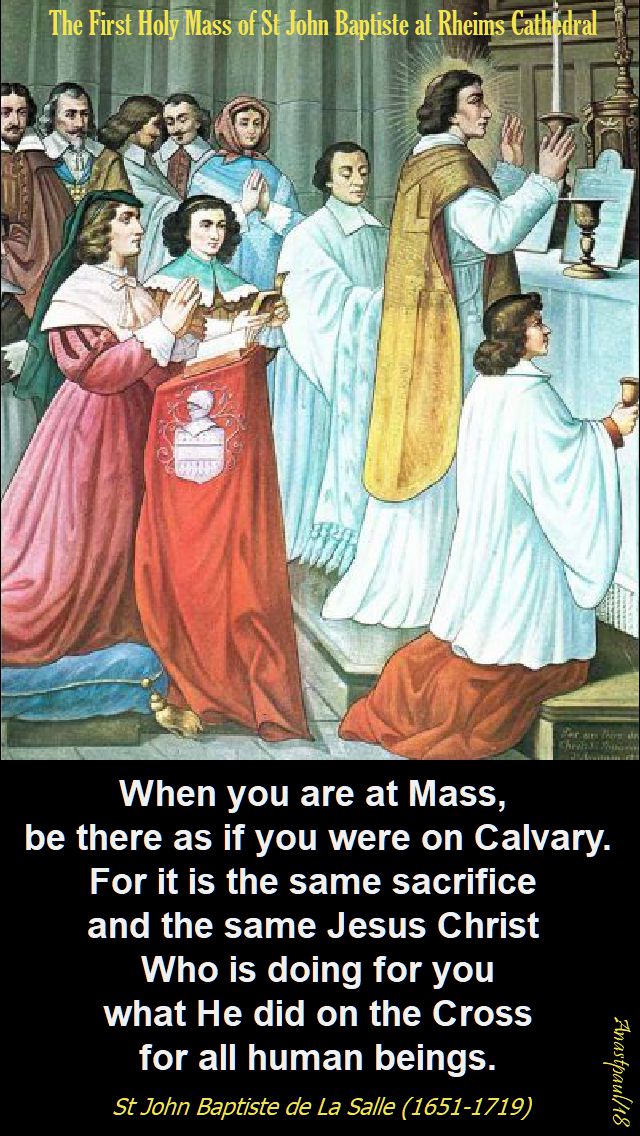
“When you are at Mass, be there as if you were on Calvary. For it is the same sacrifice and the same Jesus Christ Who is doing for you what He did on the Cross for all human beings.”
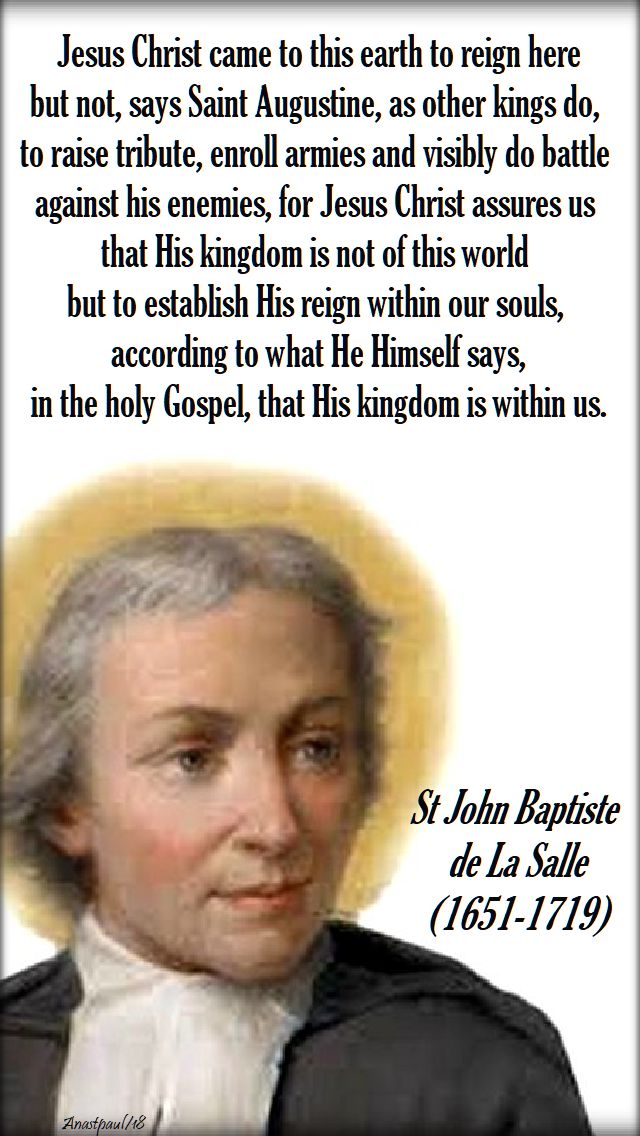
“Jesus Christ came to this earth to reign here but not, says Saint Augustine, as other kings do, to raise tribute, enroll armies and visibly do battle against his enemies, for Jesus Christ assures us that His kingdom is not of this world but to establish His reign within our souls, according to what He Himself says, in the holy Gospel, that His kingdom is within us.”
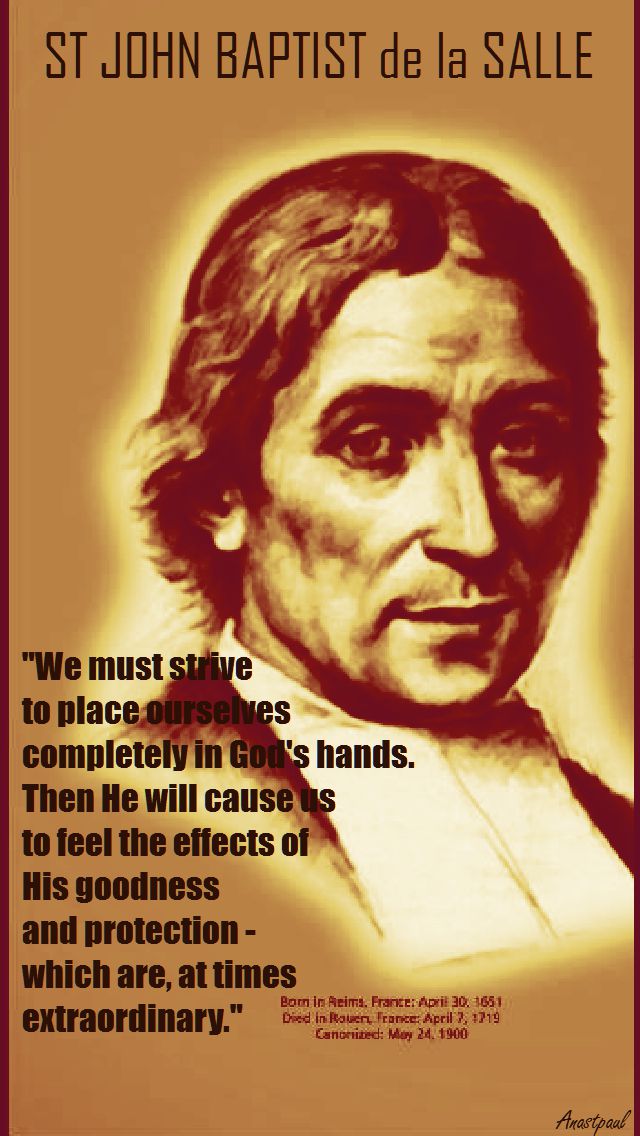
“We must strive to place ourselves completely in God’s hands. Then He will cause us to feel the effects of His goodness and protection – which are, at times extraordinary.”
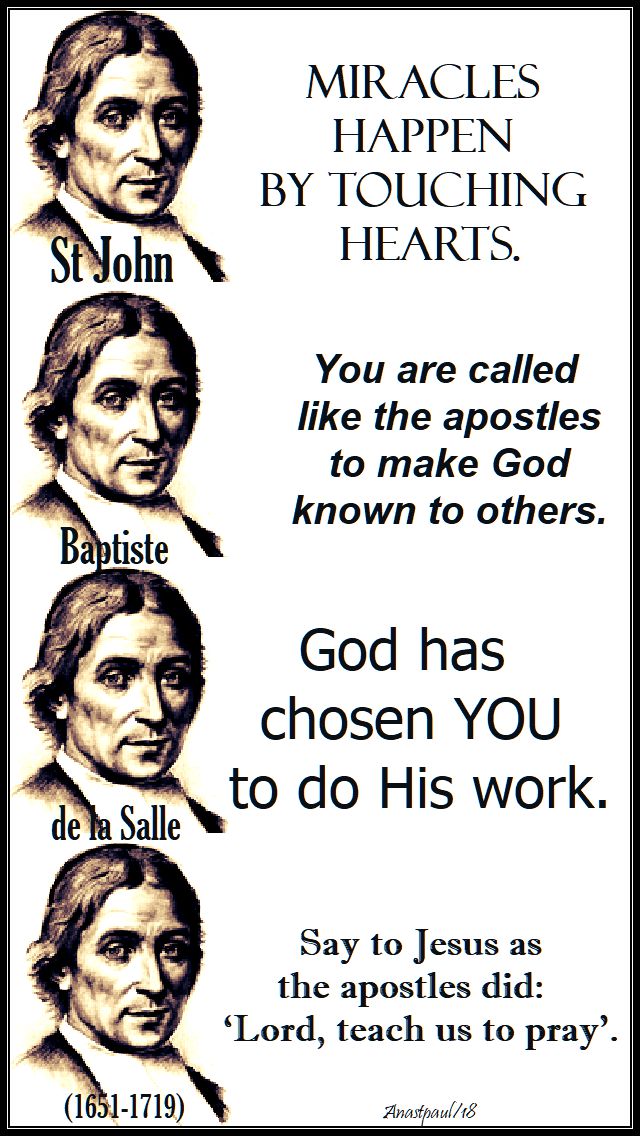
“Miracles happen by touching hearts.”
“You are called like the apostles to make God known to others.”
“God has chosen you to do his work.”
“Say to Jesus as the apostles did: ‘Lord, teach us to pray’.“
Quote/s of the Day – 6 April – Easter Friday the Sixth day in the Easter Octave
“Speaking of Love”
“Nothing is sweeter than love, nothing stronger or higher or wider; nothing is more pleasant, nothing fuller and nothing better in heaven or on earth, for love is born of God and cannot rest except in God, Who is above all created things.”
“Love is watchful. Sleeping – it does not slumber. Wearied – it is not tired. Pressed – it is not straitened. Alarmed – it is not confused but like a living flame, a burning torch, it forces its way upward and passes unharmed, through every obstacle.”
Thomas à Kempis (1380-1471) The Imitation of Christ
“What does love look like? It has the hands to help others. It has the feet to hasten to the poor and needy. It has eyes to see misery and want. It has the ears to hear the sighs and sorrows of men. That is what love looks like.”
St Augustine of Hippo (354-430) Father & Doctor
“The proof of love is in the works. Where love exists, it works great things. But when it ceases to act, it ceases to exist.”
St Pope Gregory the Great (540-604) Father & Doctor
“The Eucharist is the Sacrament of Love; It signifies Love, It produces love. The Eucharist is the consummation of the whole spiritual life.”
St Thomas Aquinas (1225-1274) Doctor angelicus / Doctor communis
Love knows no limit to its endurance, no end to its trust, no fading of its hope, it can outlast anything. Love still stands, when all else has fallen.
Blaise Pascal (1623-1662)
“The person who does not decide to love forever will find it very difficult to really love, even for one day.”
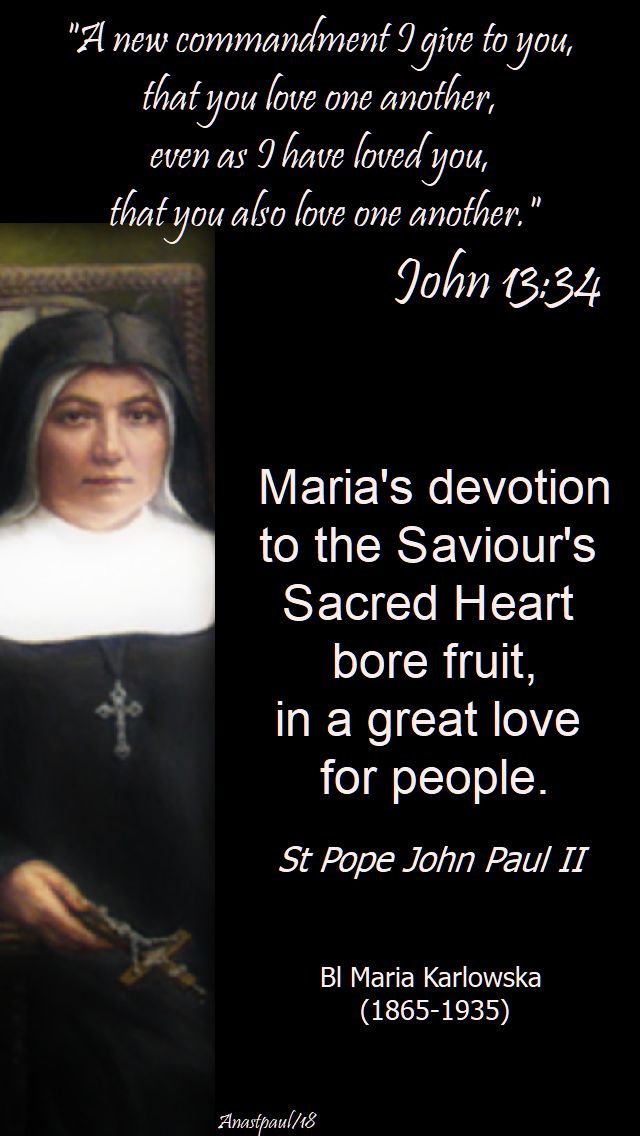
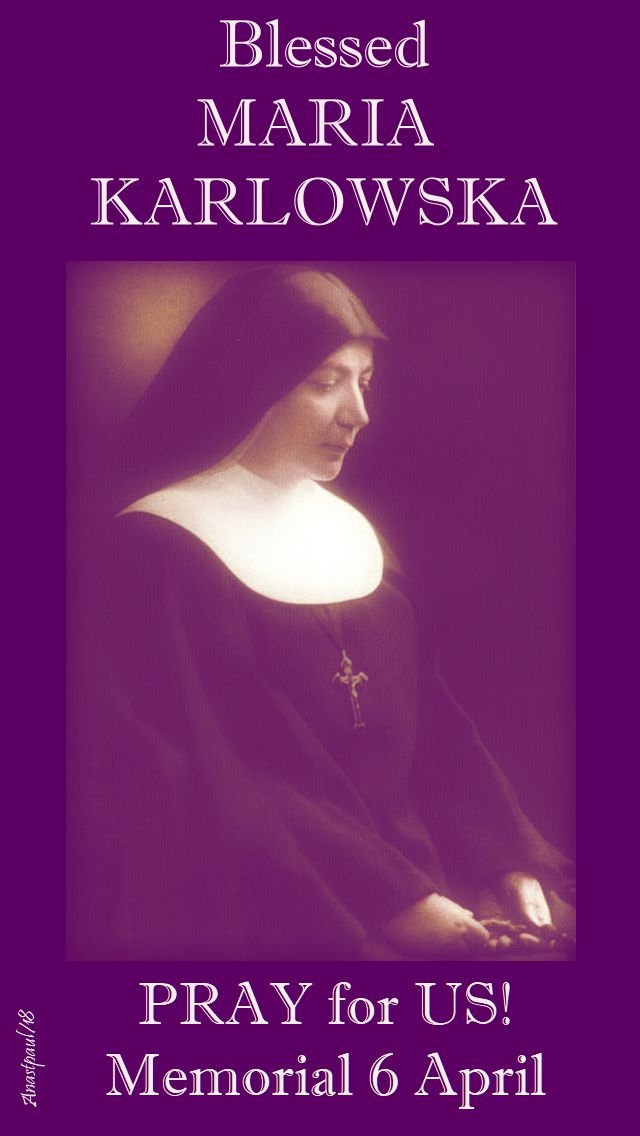
One Minute Reflection – 6 April – Easter Friday & The Memorial of Bl Maria Karlowska (1865-1935)
“A new commandment I give to you, that you love one another, even as I have loved you, that you also love one another.”…John 13:34
REFLECTION – “[She] worked as a true Samaritan among women, suffering great material and moral deprivation. Her devotion to the Saviour’s Sacred Heart bore fruit, in a great love for people. Thanks to this love she restored to many souls the light of Christ and helped them to retain their lost dignity.” … St Pope John Paul II at the Beatification on 6 June 1997
PRAYER – Dear Jesus, take away our hearts of stone and replace them with Your loving heart. Help us to radiate You to all we meet. Blessed Maria Karlowska, your heart was the heart of Christ, please pray for us, amen.
Thought for the Day – 3 April – Easter Tuesday in the Easter Octave
On the Spiritual Resurrection of the Children of God
If you be risen with Christ, mind the things that are above, not the things that are upon the earth. – Colossians 3
Let us represent to ourselves Jesus Christ, rising glorious from the Sepulchre.
“Faith in the Risen One is faith in something that has really taken place. Today, it is still true, that Christianity is neither legend nor fiction, not mere exhortation nor mere solution. Faith stands on the firm basis of reality that has actually taken place. Today too, in the words of Scripture, we can as it were, touch the Lord’s glorified wounds and say, with Thomas, in gratitude and joy – My Lord and my God! (Jn 20:28)
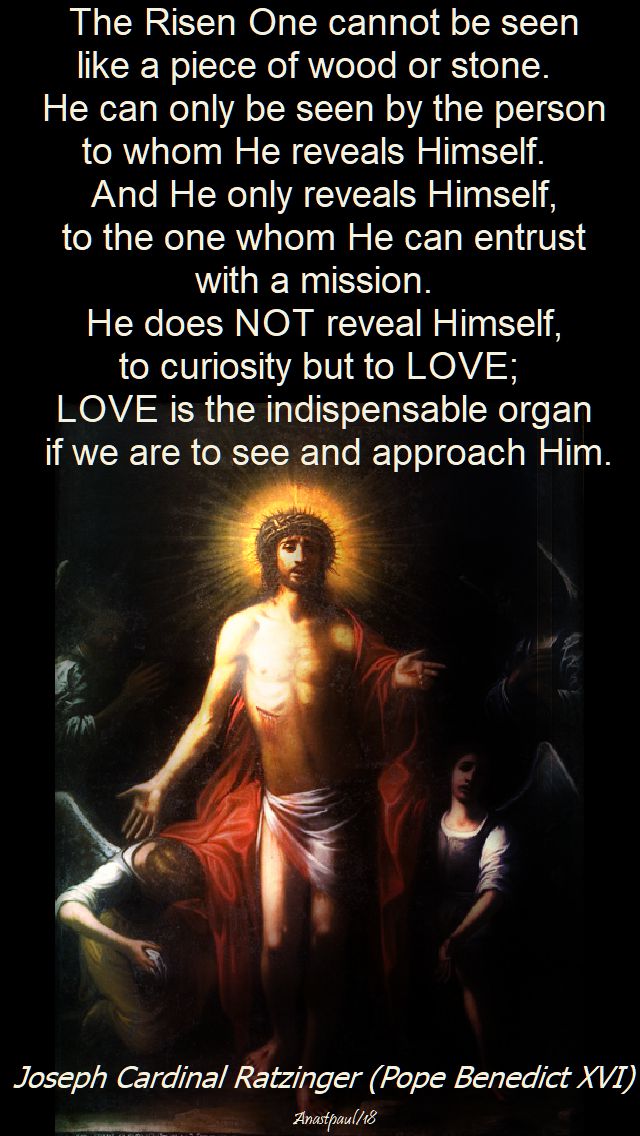
One question, however, continually arises at this point. Not everyone saw the Risen Jesus. Why not? Why did He not go in triumph to the Pharisees and Pilate to show them that He was alive and to let them touch His scars? But in asking such a question, we are forgetting that Jesus was not a resuscitated corpse like Lazarus and the boy of Naim. They were allowed to return once more, to their erstwhile biological life, which sooner or later, would have to end, after all, with death. What happened in Jesus’ case, was quite different – He did not return to the old life but began a new one, a life that is ultimate, no longer subject to nature’s law of death but standing in God’s freedom and hence final and absolute. A life, therefore, that is no longer part of the realm of physics and biology, although it has integrated matter and nature into itself on a higher plane. And that is why it is no longer within the ambit of our senses of touch and sight. The Risen One cannot be seen like a piece of wood or stone. He can only be seen by the person to whom He reveals Himself. And He only reveals Himself, to the one whom He can entrust with a mission. He does NOT reveal Himself, to curiosity but to LOVE; LOVE is the indispensable organ if we are to see and approach Him.”
Joseph Cardinal Ratzinger (Pope Benedict XVI)
The Word of the Witnesses – Seek that Which is Above (1985)
Quote/s of the Day – 3 April – Tuesday in the Easter Octave Speaking of ….. Seeking Sanctity from the Wisdom of St Augustine
Lord, teach me to know You and to know myself.
A Christian is: a mind through which Christ thinks, a heart through which Christ loves, a voice through which Christ speaks and a hand through which Christ helps.
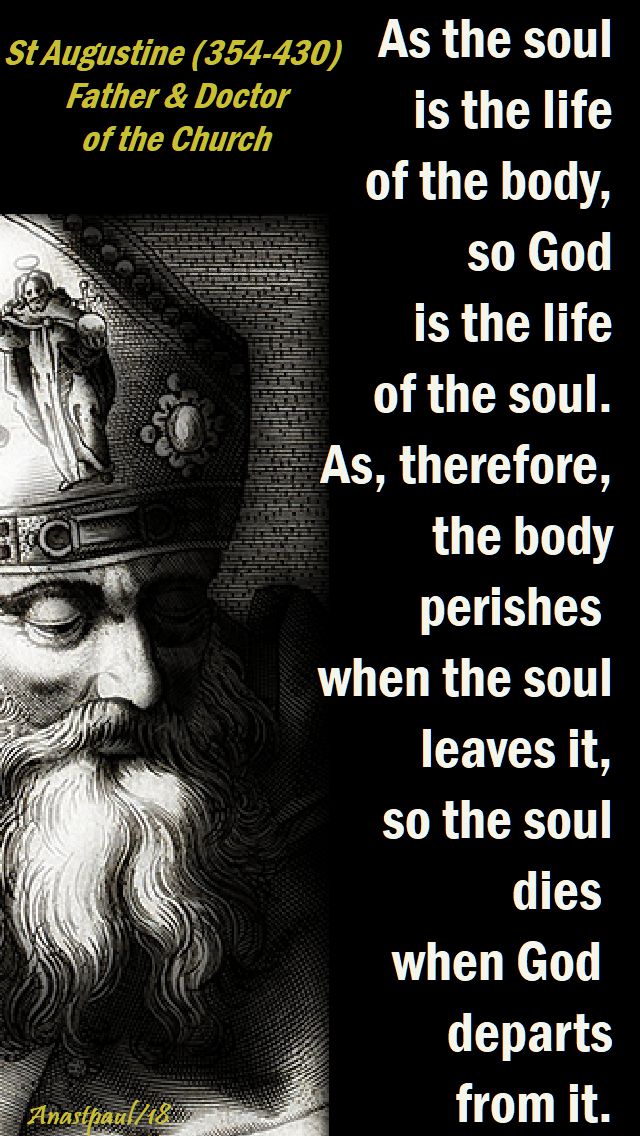
As the soul is the life of the body, so God is the life of the soul. As, therefore, the body perishes when the soul leaves it, so the soul dies when God departs from it.
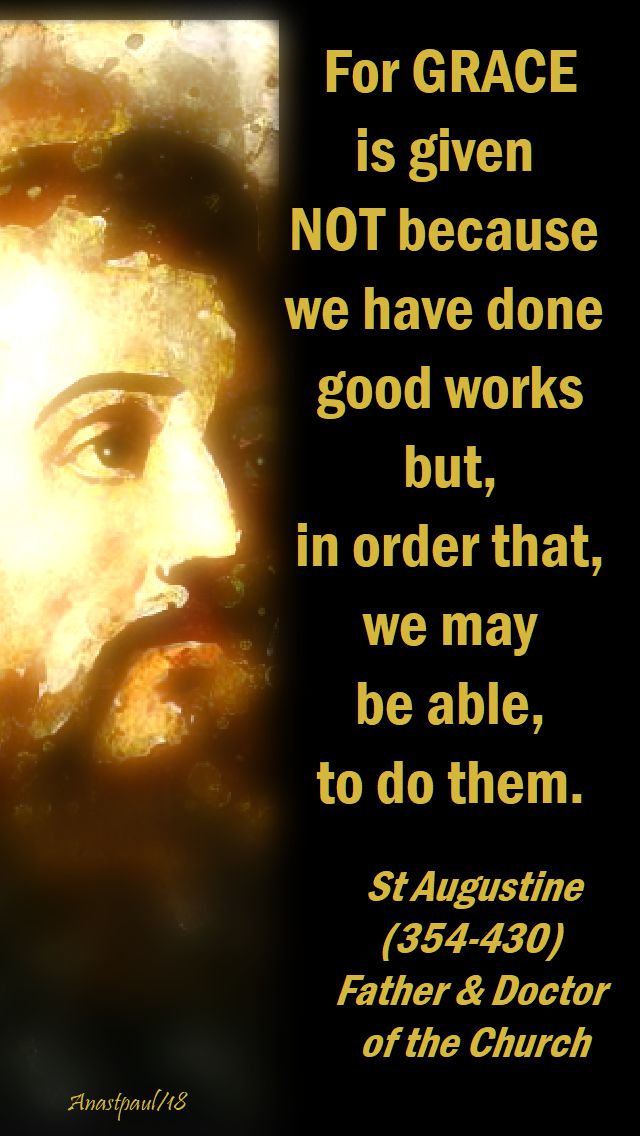
For grace is given not because we have done good works but in order that, we may be able, to do them.
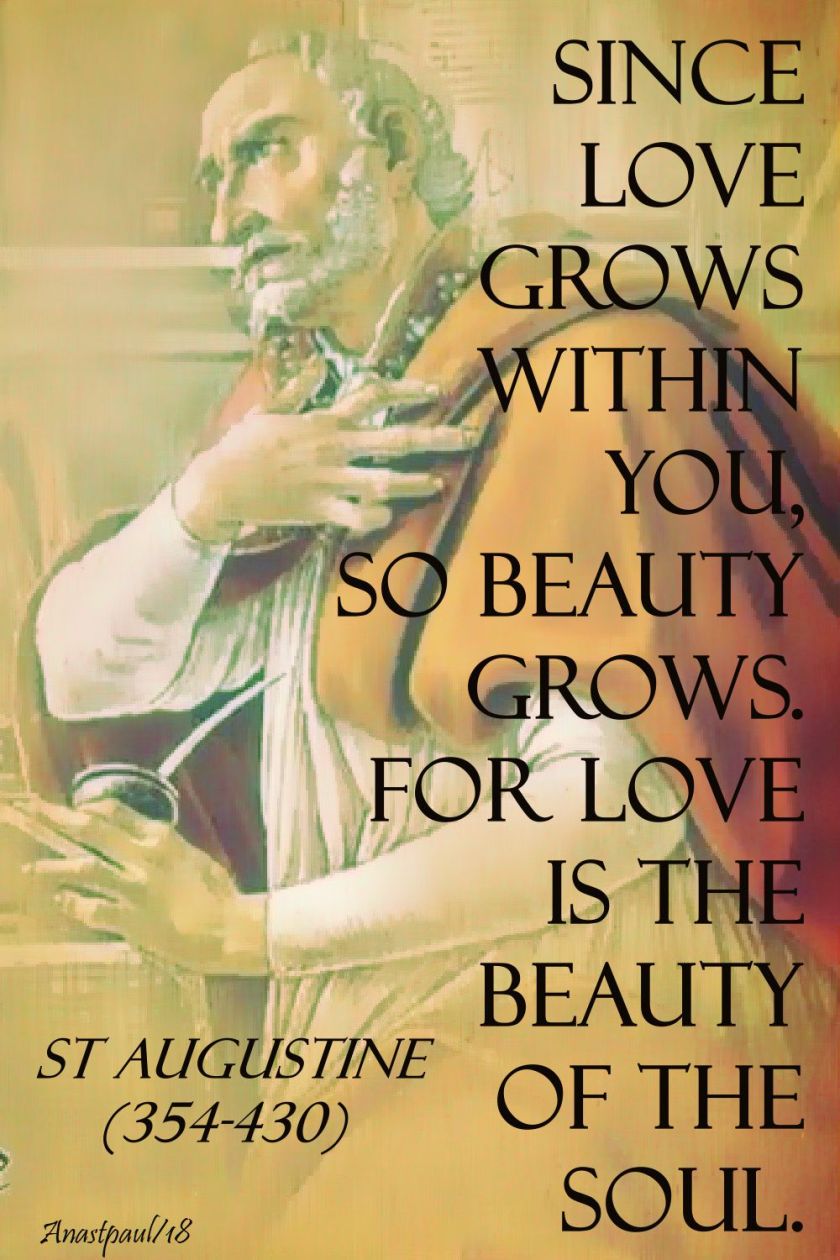
Since love grows within you, so beauty grows. For love is the beauty of the soul.
St Augustine (354-430) Father & Doctor of the Church
Thought for the Day – Easter Monday of the Easter Octave – 2 April 2018
The Resurrection of Jesus Christ is the Figure of our spiritual resurrection.
“So they departed quickly from the tomb with fear and great joy, and ran to tell his disciples. And behold, Jesus met them and said, “Hail!” And they came up and took hold of his feet and worshiped him. Then Jesus said to them, “Do not be afraid; go and tell my brethren to go to Galilee, and there they will see me.”… Matthew 28:8-10
Let us represent to ourselves anew, the glory of the Sepulchre of Jesus.
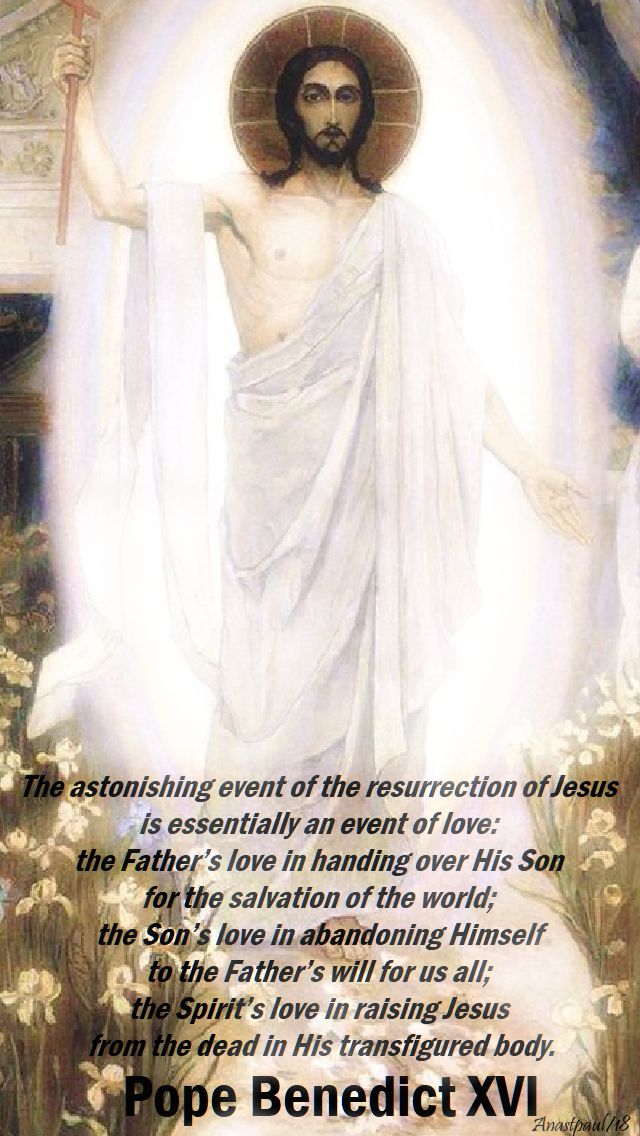
“In this way we enter the depths of the Paschal mystery. The astonishing event of the resurrection of Jesus is essentially an event of love: the Father’s love in handing over His Son for the salvation of the world; the Son’s love in abandoning Himself to the Father’s will for us all; the Spirit’s love in raising Jesus from the dead in His transfigured body. And there is more: the Father’s love which “newly embraces” the Son, enfolding Him in glory; the Son’s love returning to the Father in the power of the Spirit, robed in our transfigured humanity. From today’s solemnity, in which we relive the absolute, once-and-for-all experience of Jesus’s Resurrection, we receive an appeal to be converted to Love; we receive an invitation to live by rejecting hatred and selfishness and to follow with docility in the footsteps of the Lamb that was slain for our salvation, to imitate the Redeemer who is “gentle and lowly in heart”, who is “rest for our souls” (cf. Mt 11:29).”
Pope Benedict 23 March 2008
Adorable Lord, bestow on us grace to rise spiritually, by leaving the tomb of indifference, to lead a life of fervour.
At Easter we recall the words God spoke to Moses concerning the Paschal solemnity: For it is the Phase – that is, the Passage – of the Lord. Now we celebrate the Passage of our Lord from Death to Life and think upon our own passage from a life of tepidity to one of fervour, from an imperfect to a holy life. Jesus, in leaving the Tomb, disengaged Himself from the winding-sheet in which His Sacred Body had been wrapped; this should make us understand that we must extricate ourselves from the imperfections and bad habits, which for so long a time have kept out souls bound and motionless for good. If we rise with Jesus and set ourselves free from the paralysed state in which our evil inclinations have retained us, they will infallibly disappear. Our Risen Lord was clothed with the power of agility to teach us to despise all resistance of nature, to pass quickly out of its reach, to triumph over every obstacle and that our souls should tend upwards to Him alone. If we are indeed risen with Christ we shall seek the things that are above and our whole being will be spiritualised, responding with agility to the promptings not of nature, but of grace. May we be enabled fully to enter into the Mystery of the Resurrection-Life of Jesus and to receive the plenitude of His favours, offered to us at this time especially.
Jesus, in rising from the Sepulchre, clothed in light, wills that we should understand what is the beauty of a soul disengaged from the ties of nature and renewed in the spiritual life. The soul, like Jesus, becomes luminous, the Holy Spirit enlightens it interiorly, by filling it with the knowledge of divine things; it is possessed of a lustrous beauty and its virtues shine visibly, contributing to the edification of others. By the impassibility of the Body of Jesus, we comprehend that grace raises the soul, by means of holy courage, above temptations; it renders it invulnerable against the darts of the enemies of its salvation and gives it the power of mastering its downward tendencies. Such are the happy privileges granted to His faithful ones, who lovingly enter into the spirit of the Mystery of Easter. Sufferings indeed we must still endure, for we are still on this side of the grave but if they serve only to raise us near to Jesus, we may be said to share already in the effects of His impassibility. We range ourselves therefore around Him, to rejoice at the sight of the glory He received in His Resurrection and to honour the marvellous capabilities of His Adorable Body, by rendering ourselves worthy, by our fervour, to participate in them spiritually.
O my Saviour, I thank You for the favour You accord me, permitting me to partake in the glorious privileges of the new life You began. Make me to be entirely renewed in the spirit of my mind so that, freed from the servitude of sense and natural affections, I may rise constantly towards You, with a pure and generous heart.
Aided by the grace Jesus bestows, I will endeavour to reproduce spiritually in myself, the capabilities observable in His Sacred Humanity after the Resurrection.
If by the Spirit, you mortify the deeds of the flesh, you shall live.
Father de Brant, Growth in the Knowledge of Our Lord volume 2, 1882
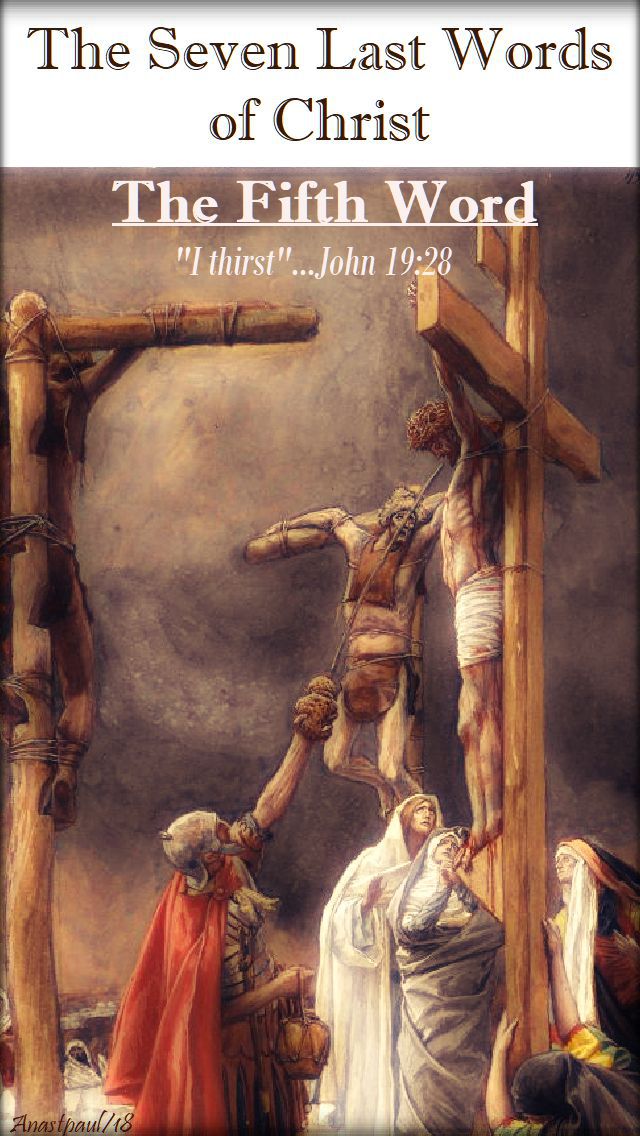
Devotion of The Seven Last Words of Christ – The Fifth Word – 30 March – Good Friday morning 2018
The Seven Last Words of Christ
The Seven Last Words of Christ refer, not to individual words but to the final seven phrases that Our Lord uttered as He hung on the Cross. These phrases were not recorded in a single Gospel but are taken from the combined accounts of the four Gospels. Greatly revered, these last words of Jesus have been the subject of many books, sermons and musical settings.
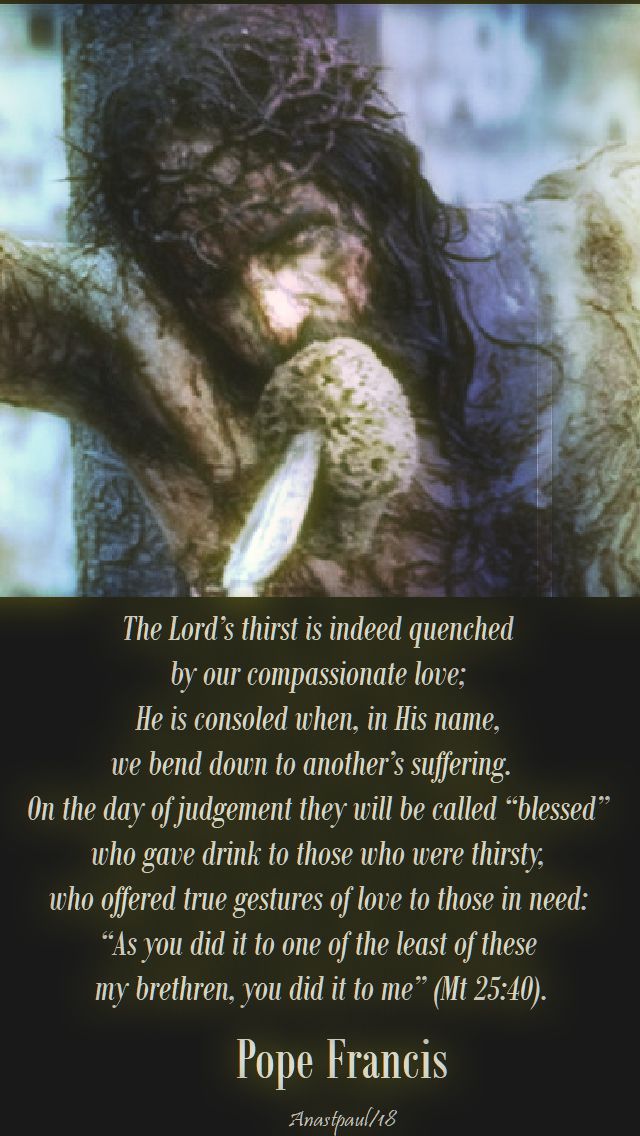
“Love is not loved”: this reality, according to some accounts, is what upset Saint Francis of Assisi. For love of the suffering Lord, he was not ashamed to cry out and grieve loudly (cf. Fonti Francescane, no. 1413). This same reality must be in our hearts as we contemplate Christ Crucified, He who thirsts for love. Mother Teresa of Calcutta desired that in the chapel of every community of her sisters the words “I thirst” would be written next to the crucifix. Her response was to quench Jesus’ thirst for love on the Cross through service to the poorest of the poor. The Lord’s thirst is indeed quenched by our compassionate love; He is consoled when, in His name, we bend down to another’s suffering. On the day of judgement they will be called “blessed” who gave drink to those who were thirsty, who offered true gestures of love to those in need: “As you did it to one of the least of these my brethren, you did it to me” (Mt 25:40).”
Pope Francis
The Fifth Word
“I thirst” (John 19:28)
Gospel: After this, Jesus knew that everything had now been completed and, so that the scripture should be completely fulfilled, he said: I thirst. A jar full of sour wine stood there; so, putting a sponge soaked in the wine on a hyssop stick, they held it up to his mouth….John 19:28-29
During Our Lord’s Passion, He was twice offered a drink. This first was a mixture of wine and myrrh. This Our Lord refused because it was commonly given to condemned criminals to deaden pain. His Passion and Death would have been rendered worthless if He had allowed anything to mitigate the pain He was about to suffer. The second drink He was offered was sour wine or vinegar. This He drank. In doing so, He drank deeply of the cup which He had begged His Father to remove from Him in the Garden. He drank the last dregs of the cup of our punishment.
Lord God, Your Only Begotten Son drank deeply of the cup of iniquity for my sake. If I were to try to drink the same draft by myself, I would not be able to survive. It is only with Your help that I can hope to drink of my own bitter draught and survive. Help me to turn away from the sweetness of the world and accept the bitter drink that is punishment for my sins. I beg You to send me the grace and strength required to accept this bitter cup. Let not my will be done, but Thine. Amen.
Prayer of Abandonment to God’s Providence
My Lord and my God:
into your hands I abandon the past and the present and the future,
what is small and what is great,
what amounts to a little and what amounts to a lot,
things temporal and things eternal.
Amen. Our Father. Hail Mary. Glory Be.

















 So we praise God during our earthly life and at the same time we make our petitions to Him. Our praise is expressed with joy, our petitions with yearning. We have been promised something we do not yet possess and because the promise was made by one who keeps His word, we trust Him and are glad; but insofar as possession is delayed, we can only long and yearn for it. It is good for us to persevere in longing until we receive what was promised and yearning is over, then praise alone will remain.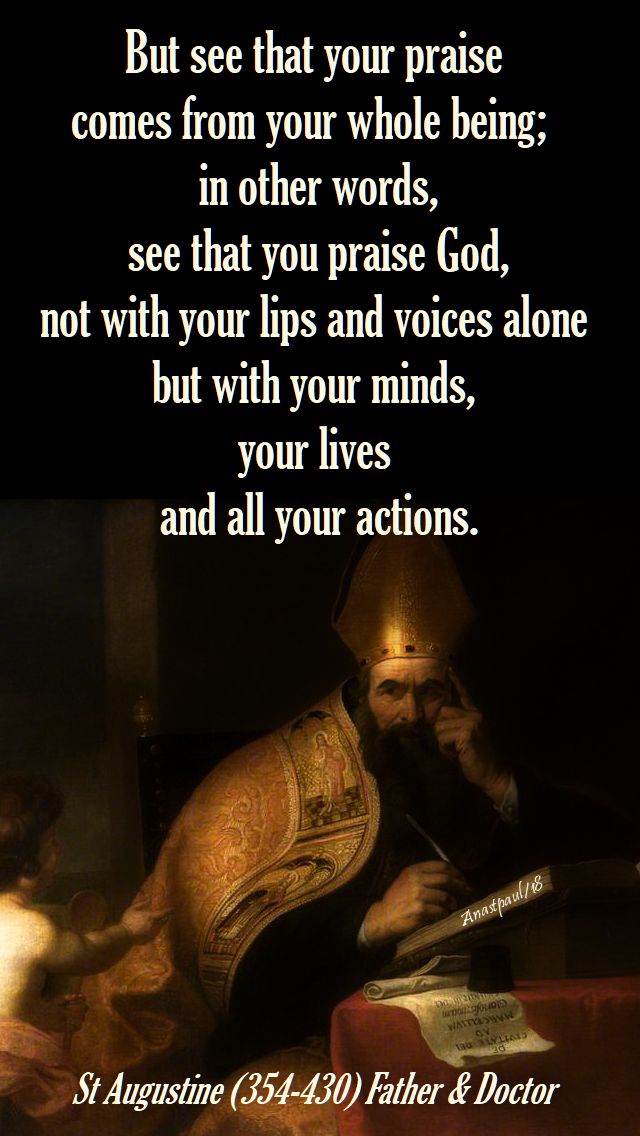




You must be logged in to post a comment.