
Boris and Gleb (or Glev), whose Christian names were Roman and David, were the first saints canonized in Kievan Rus’ after its Christianization. Sons of Saint Vladimir I of Kiev and Anne of Constantinople, great-grandsons of Saint Olga of Kiev.
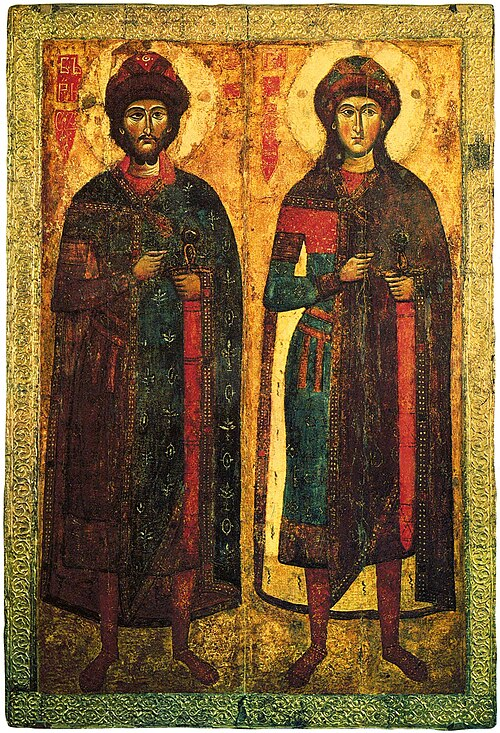
They were younger children of Vladimir the Great, who favored them over his other children. Boris married and ruled the town of Rostov. Gleb, ruled the easternmost town of Murom. Born shortly before the Baptism of Rus’, the brothers were brought up to be pious Christians. Boris, the older of the two, loved to read the Sacred Scriptures, the works of the Holy Fathers, and especially, the lives of saints. Under their influence, St. Boris developed a fervent desire to emulate the spiritual struggles of these holy heroes, and often prayed that the Lord make him worthy of such an honor. Both excelled in charity and kindness, emulating the example of their father, Saint Vladimir, who was merciful towards the needy, the sick, and the indigent.
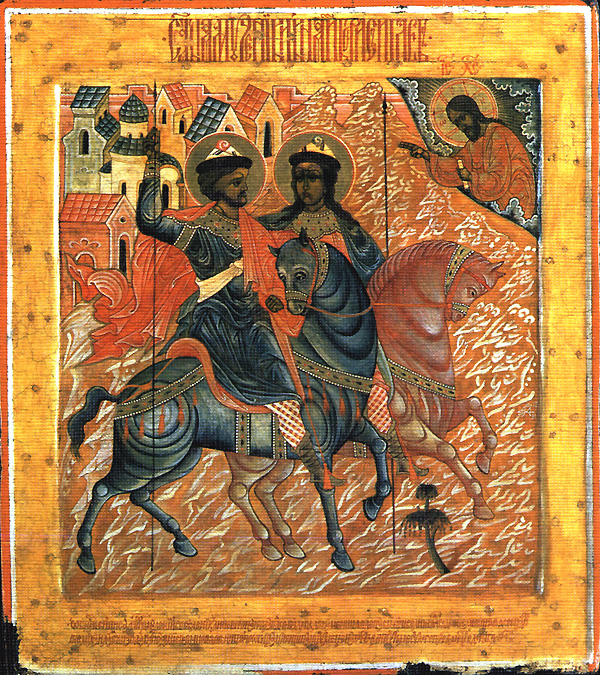
The brothers were murdered during the Kievan succession crisis of 1015–1019. The Primary Chronicle, which relates their lives, says their brother, Sviatopolk the Accursed, plotted their assassinations. Boris learnt of his father’s death upon his return with the Rus’ army to Alta. Upon being informed of Sviatopolk’s accession to the throne and urged to replace him, Boris replied: “Be it not for me to raise my hand against my elder brother. Now that my father has passed away, let him take the place of my father in my heart.”
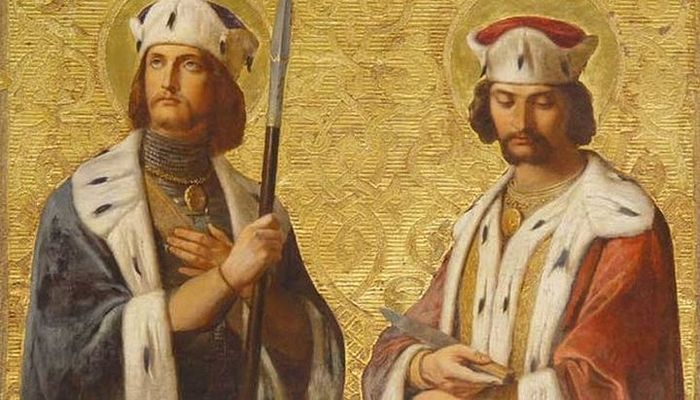
“If he (Sviatopolk) spills my blood and resolves to kill me, I will be a martyr before my Lord. I will not resist, for it is written, “God resisteth the proud, and gives grace to the humble.” (Boris’s words)
Despite his brother’s acquiescence, Sviatopolk sent men to execute him. When they arrived they heard him chanting psalms and praying before an icon of Christ. He asked the Lord to strengthen him for the suffering he was about to endure. He also prayed for Sviatopolk, asking God not to count this against him as sin. Boris and his Hungarian manservant, George, were stabbed to death with spears while asleep in a tent. Later, the prince was discovered still breathing in a bodybag being transported to Kiev, but the Viking men sent to murder him, ended his life with the thrust of a sword.
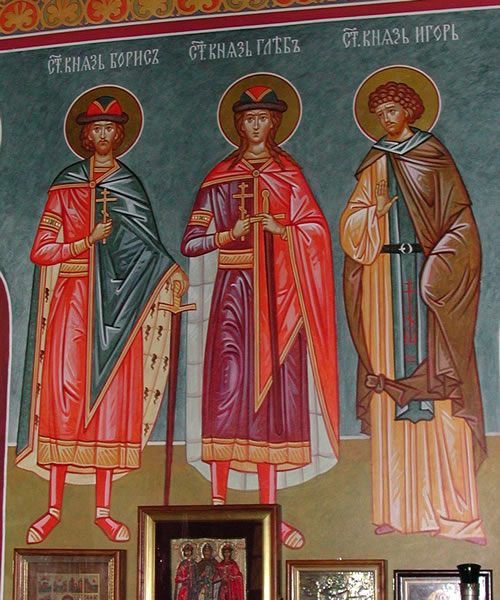
Gleb believed his father was still alive and rushed to his father’s deathbed. On the way, the saint’s brother, Yaroslav, learnt of Sviatopolk’s treachery and urged Gleb not to meet him. His boat was seized near Smolensk, and in the middle of praying to God, Gleb was assassinated by his own cook, Torchin, who cut his throat with a kitchen knife.
In 1020 another of Vladimir’s sons, Yaroslav, usurped Sviatopolk, and then buried the bodies of Boris and Gleb in the church of Saint Basil at Vyshgorod. Miracles were reported at their tomb, and it became a site of pilgrimage.
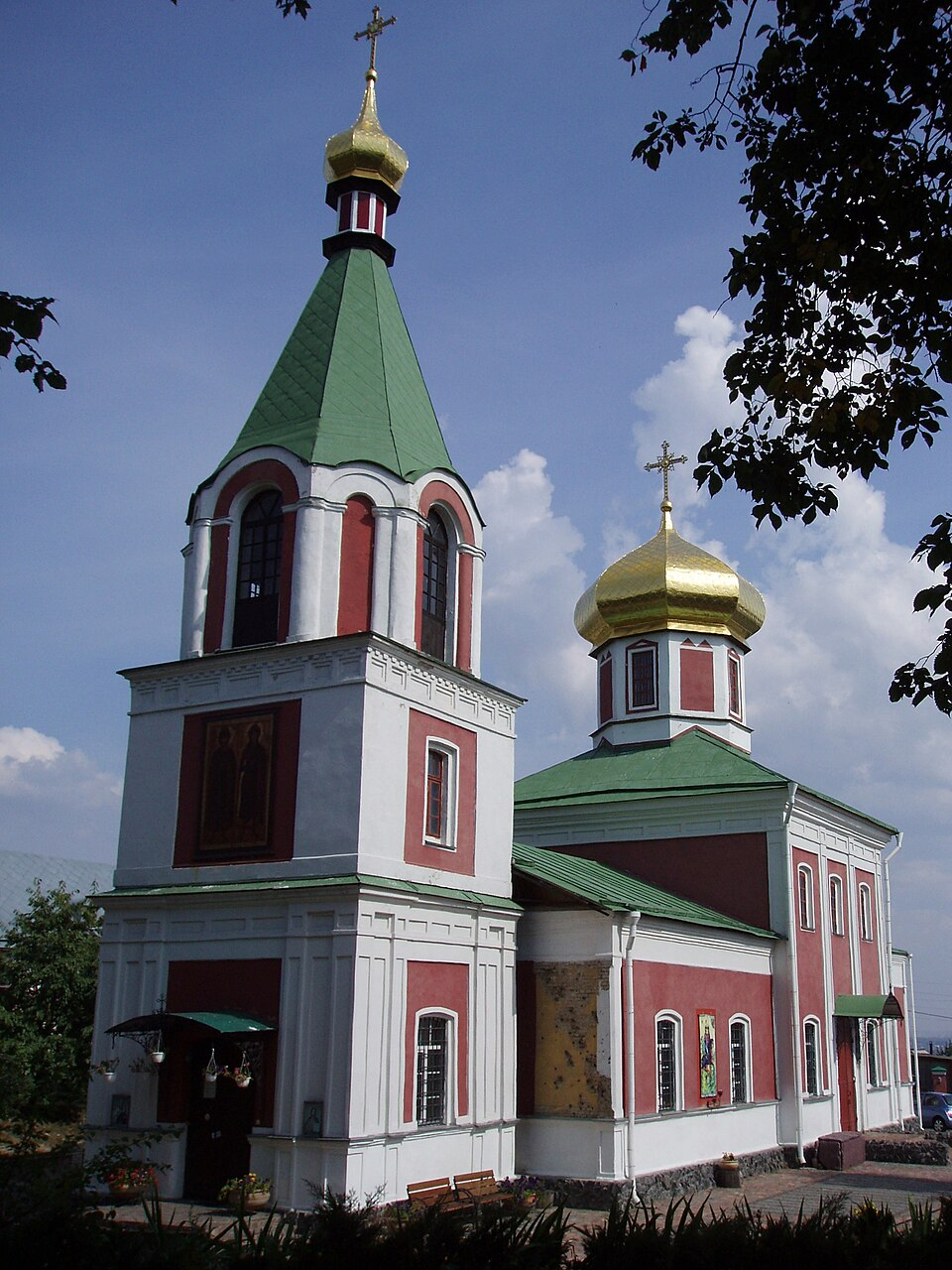
The rebuilt church in Vyshhorod
The highest motives were attributed to the brothers’ resignation – unwillingness to repel injustice to themselves by force, and violently oppose an elder brother and thus embroil their people in a civil war. Not martyrs in the traditional sense, the Russian Church perceived them as “passion bearers” – blameless men who did not wish to die but refused to defend themselves, thus voluntarily submitting to death like Christ.
They were canonized in 1724 by Pope Benedict XIII (cultus confirmed) and their patronage is princes. In iconography Boris is depicted in princely attire. He most often holds a cross in his hands — a symbol of martyrdom and humility. He is often shown together with his brother Gleb; Boris’s seniority is indicated by the presence of a moustache or beard.


One thought on “Saint/s of the Day – 24 July – Saints Boris and Gleb”