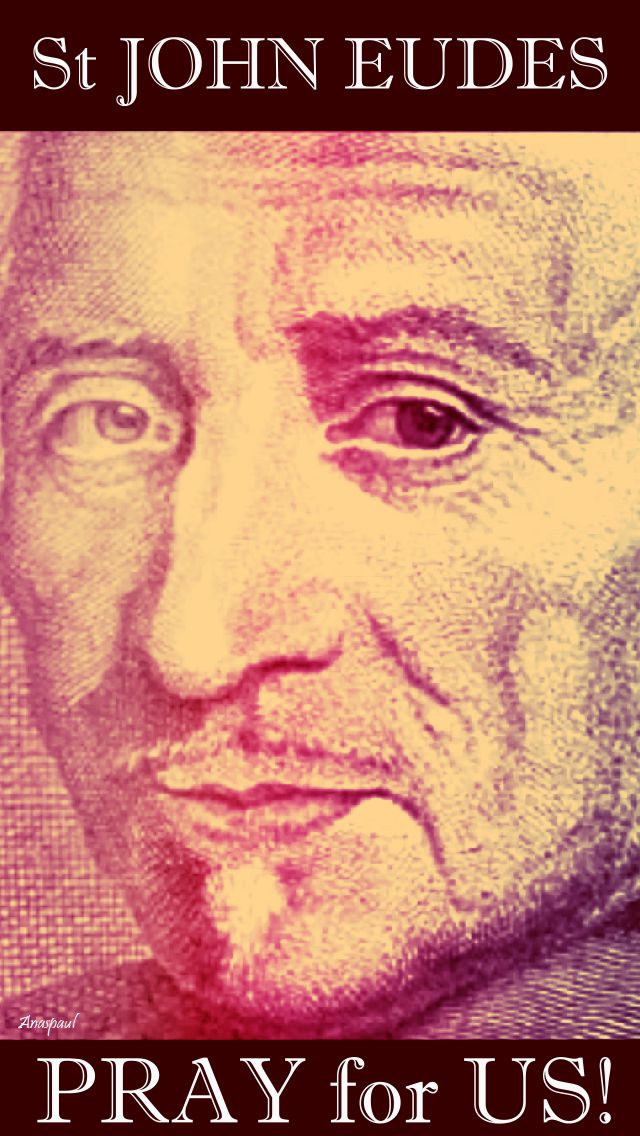
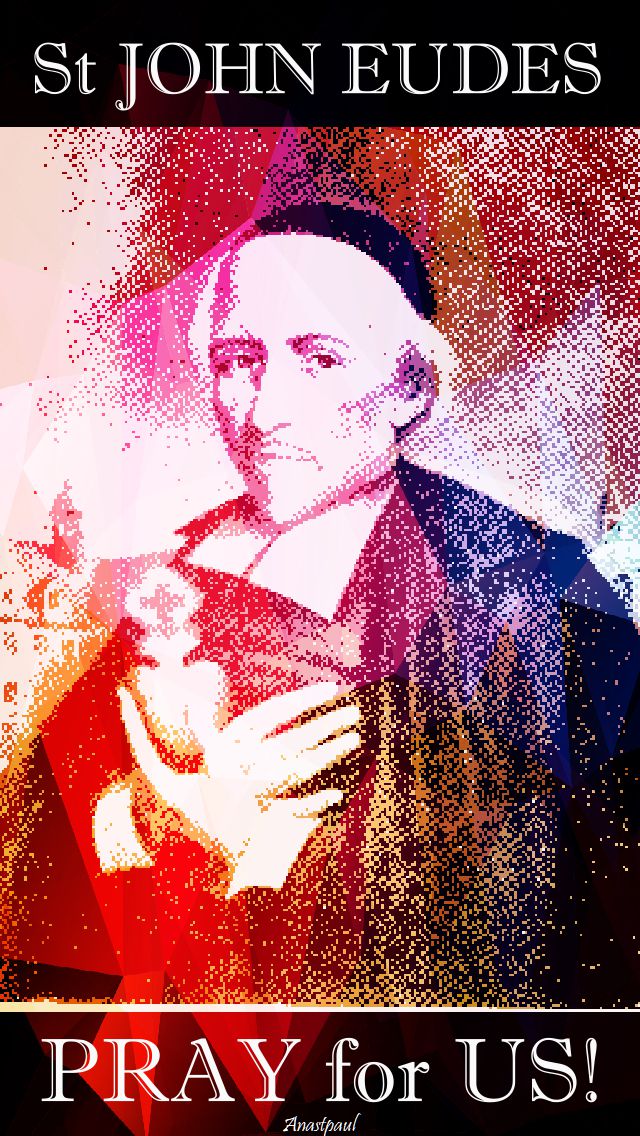
Thought for the Day – 19 August – The Memorial of St John Eudes “Apostle of Two Hearts”
How little we know where God’s grace will lead. Born on a farm in northern France, John died at 79 in the next “county” or department. In that time he was a religious, a parish missionary, founder of two religious communities and a great promoter of the devotion to the Sacred Heart and the Immaculate Heart of Mary.
He joined the religious community of the Oratorians and was ordained a priest at 24. During severe plagues in 1627 and 1631, he volunteered to care for the stricken in his own diocese. Lest he infect his fellow religious, he lived in a huge cask in the middle of a field during the plague. At age 32, John became a parish missionary. His gifts as preacher and confessor won him great popularity. He preached over 100 parish missions, some lasting from several weeks to several months.
Holiness is the wholehearted openness to the love of God. It is visibly expressed in many ways but the variety of expression has one common quality: concern for the needs of others. In John’s case, those who were in need were plague-stricken people, ordinary parishioners, those preparing for the priesthood, prostitutes and all Christians called to imitate the love of Jesus and his mother. ( Fr Don Miller OFM)
Quotes of the Day – 19 August – The Memorial of St John Eudes “Apostle of Two Hearts”
“Faith is a beam, radiating from the face of God.”
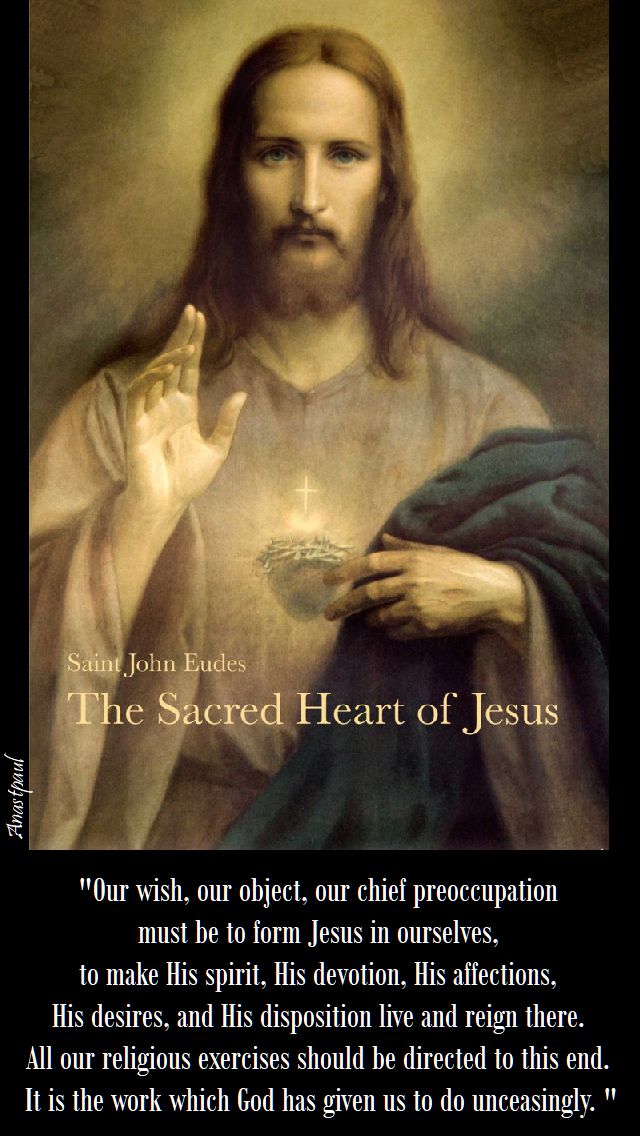
“Our wish, our object, our chief preoccupation must be to form Jesus in ourselves, to make His spirit, His devotion, His affections, His desires and His disposition live and reign there. All our religious exercises should be directed to this end. It is the work which God has given us to do unceasingly. “
“The Christian life is a continuation and completion of the life of Christ in us. We should be so many Christs here on earth, continuing His life and His works, labouring and suffering in a holy and divine manner in the spirit of Jesus.”
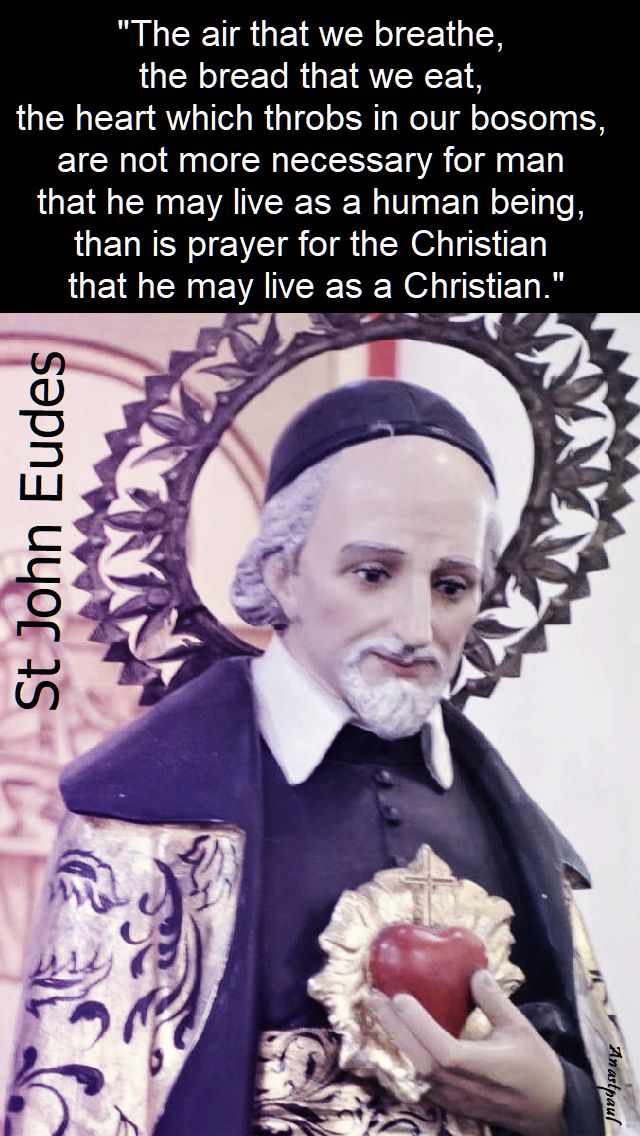
“The air that we breathe, the bread that we eat, the heart which throbs in our bosoms, are not more necessary for man that he may live as a human being, than is prayer for the Christian that he may live as a Christian.”
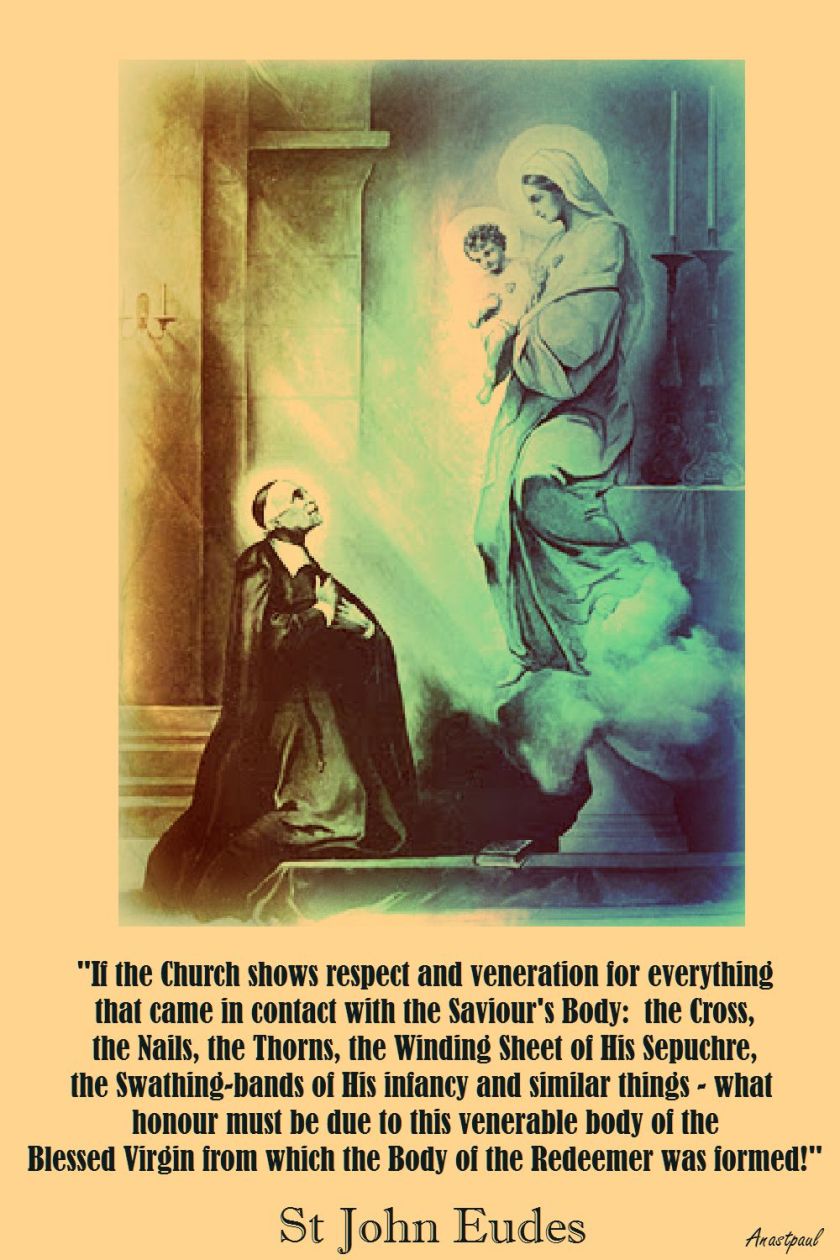
““If the Church shows respect and veneration for everything that came in contact with the Saviour’s Body: the Cross, the Nails, the Thorns, the Winding Sheet of His Sepuchre, the Swathing-bands of His infancy and similar things – what honour must be due to this venerable body of the Blessed Virgin from which the Body of the Redeemer was formed!”
One Minute Reflection – 19 August – The Memorial of St John Eudes “Apostle of Two Hearts”
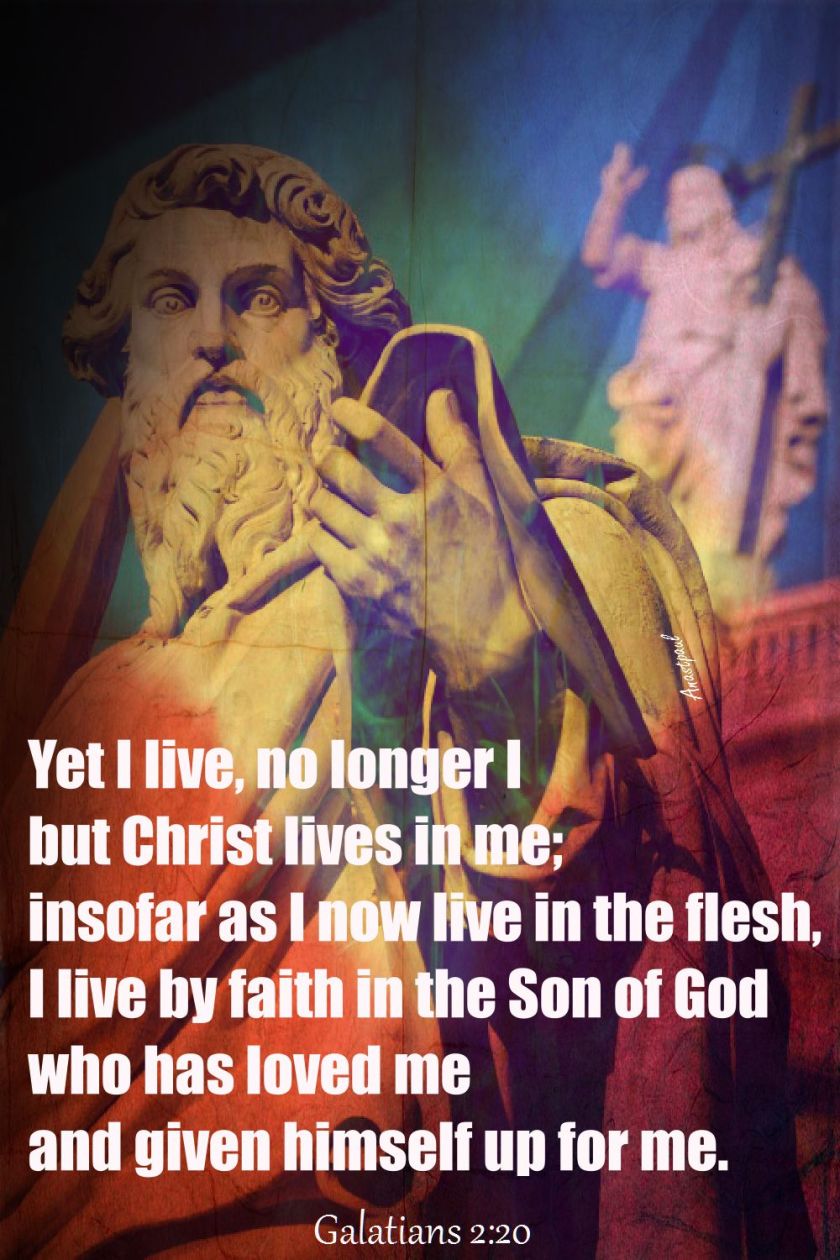
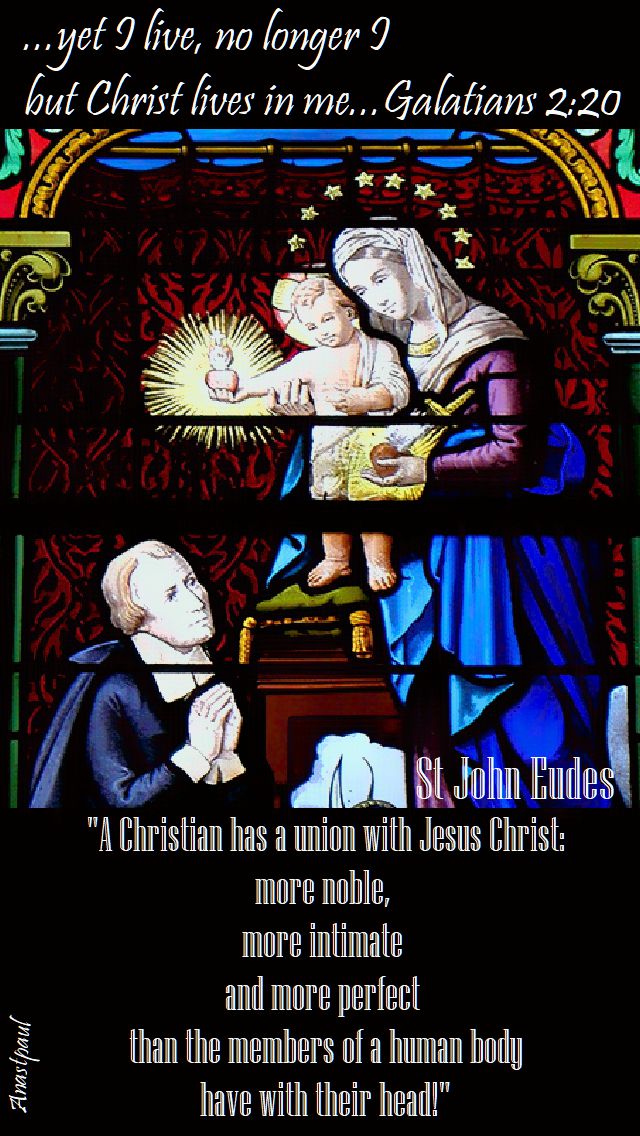
…yet I live, no longer I but Christ lives in me….Galatians 2:20
REFLECTION – “A Christian has a union with Jesus Christ:
more noble,
more intimate
and more perfect
than the members of a human body
have with their head!”
PRAYER – Father of mercies and God of all consolation, You gave us the loving Heart of Your own beloved Son, because of the boundless love by which You have loved us, which no tongue can describe. May we render You a love that is perfect with hearts made one with His. Grant, we pray, that our hearts may be brought to perfect unity: each heart with the other and all hearts with the Heart of Jesus….and may the rightful yearnings of our hearts find fulfillment through Him: Our Lord Jesus Christ, Your Son, who lives and reigns with You in the unity of the Holy Spirit, one God, forever and ever. – Collect from Saint John Eudes’ Mass, Gaudeamus, 1668 St John Eudes, Pray for us! amen.
Saint of the Day – 19 August – St John Eudes -(1601-1680 “Apostle of Two Hearts” (14 November 1601 at Ri, Normandy, France – 19 August 1680 at Caen, Normandy, France) – Beatified on 25 April 1909 by Pope Pius X and Canonised on 31 May 1925 by Pope Pius XI. Confessor, Priest, Missionary, Founder, Preacher, Writer, he founded the Congregation of Jesus and Mary and the Order of Our Lady of Charity and was the author of the propers for the Mass and Divine Office of the Sacred Hearts of Jesus and Mary. Patronage – of the Diocese of Baie-Comeau, Québecl. Attributes – Priest’s garments with the Sacred Heart.
Eudes was born in 1601 on a farm near the village of Ri, in Normandy, the son of Isaac and Martha Eudes. After studying with the Jesuits at Caen, Eudes joined the Oratorians on 25 March 1623. His masters and models in the spiritual life were Pierre de Bérulle and the mystic Charles de Condren. As a student of de Bérulle, Eudes is a member of the French School of Spirituality. The French School was not a system or philosophy, but a highly Christocentric approach to spirituality, characterized by a sense of adoration, a personal relationship with Jesus, and a rediscovery of the Holy Spirit.
Eudes was ordained a priest on 20 December 1625. Immediately after his ordination, he came down with an illness that kept him bedridden for a year. During severe plagues in 1627 and 1631, he volunteered to care for the stricken in his own diocese. He went about Normandy committing himself to the sick, administering the sacraments, and burying the dead. To avoid infecting his colleagues, he lived in a huge cask in the middle of a field during the plague.
At age 32, Eudes became a parish missionary, preached over 100 parish missions, throughout Normandy, Ile-de-France, Burgundy and Brittany. He was called by Jean-Jacques Olier “the Prodigy of his Age”.
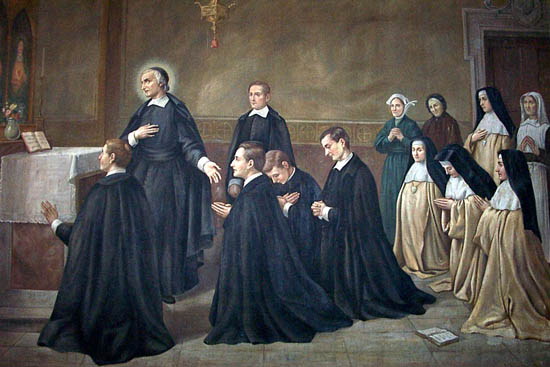
He saw that parish priests needed support in becoming men of prayer and action. He held conferences for them in which he outlined their duties. Later, John started his own society of priests called the Congregation of Jesus and Mary. The members were dedicated to promoting good seminary training, which would form Christlike priests.
Christian love impelled John to feel compassion for the women who were trying to escape prostitution. He wanted a place for them to live, a refuge from their former way of life. To serve the women in these refuges, he established a society of religious women called the Congregation of Our Lady of the Refuge. It now serves the needs of troubled girls around the world.
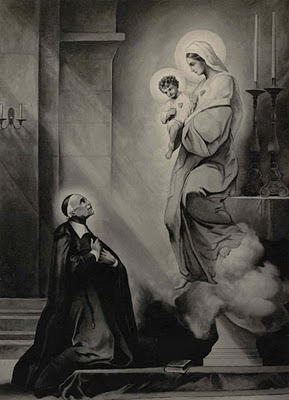
Influenced by the teaching of the French school and St. Francis de Sales, especially as set out in the Treatise on the Love of God, and also by the revelations of St. Gertrude and St. Mechtilde, he was the theoretician, so to speak, of devotion to the Sacred Heart and explained the expressions of his predecessors. Won over to devotion to the Heart of Jesus by Bérulle’s devotion to the Incarnate Word, he combined with it the gentleness and devotional warmth of St. Francis de Sales. He changed the somewhat individual and private character of the devotion into a devotion for the whole Church by writing for the benefit of his communities an Office and a Mass, which were later approved by several bishops before spreading throughout the Church. For this reason, Pope Leo XIII, in proclaiming his virtues heroic in 1903, gave him the title of “Author of the Liturgical Worship of the Sacred Heart of Jesus and Holy Heart of Mary”.
Eudes dedicated the seminary chapels of Caen and Coutances to the Sacred Heart. The feast of the Holy Heart of Mary was celebrated for the first time in 1648 and that of the Sacred Heart of Jesus in 1672, each as a double of the first class with an octave. He composed various prayers and rosaries to the Sacred Hearts. His book “Le Cœur Admirable de la Très Sainte Mère de Dieu” is the first book ever written on the devotion to the Sacred Hearts.
Founder Statue at St Peter’s Rome
Eudes taught the mystical unity of the hearts of Jesus and Mary and wrote, his most famous works are – Devotion to the Adorable Heart of Jesus and The Admirable Heart of the Most Holy Mother of God:
“You must never separate what God has so perfectly united. So closely are Jesus and Mary bound up with each other that whoever beholds Jesus sees Mary; whoever loves Jesus, loves Mary; whoever has devotion to Jesus, has devotion to Mary.”
The most striking characteristic of the teaching of St. John Eudes on Devotion to the Sacred Heart—as indeed of his whole teaching on the spiritual life—is that Christ is always its centre.
St John died a month after finishing The Admirable Heart of the Most Holy Mother of God, of natural causes on 19 August 1680 at Caen, Normandy, France.
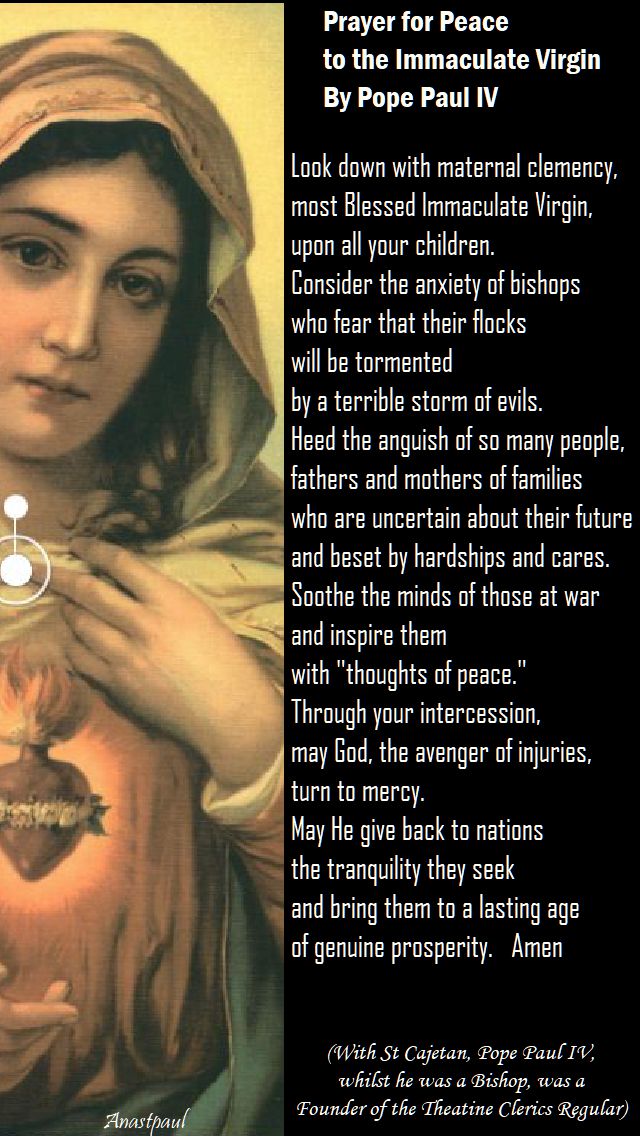
Prayer for Peace to the Immaculate Virgin By Pope Paul IV
Look down with maternal clemency,
most Blessed Immaculate Virgin,
upon all your children.
Consider the anxiety of bishops
who fear that their flocks
will be tormented by a terrible storm of evils.
Heed the anguish of so many people,
fathers and mothers of families
who are uncertain about their future
and beset by hardships and cares.
Soothe the minds of those at war
and inspire them with “thoughts of peace.”
Through your intercession,
may God, the avenger of injuries,
turn to mercy.
May He give back to nations
the tranquility they seek
and bring them to a lasting age
of genuine prosperity. Amen
(Juan Pedro Carrafa, Bishop of Chieti, who became Pope Paul IV,
was a friend of and one of the Founders with, our Saint today,
St Cajetan of the Theatine Clerics Regular)
Thought for the Day – 3 August – August the Month of the Immaculate Heart of Mary
Pope Paul VI said: “Mary offers a calm vision and a reassuring word to the people of our time, torn as we often are between anguish and hope, defeated as we can be by our own limitations and assailed by limitless aspirations, troubled in our minds and divided in our hearts, uncertain as we face the riddle of death, oppressed at times by loneliness, yet yearning for company and fellowship, a prey to boredom and disgust. Mary shows the victory of hope over anguish, of fellowship over solitude, of peace over anxiety, of joy and beauty over boredom and disgust, of eternal vision over earthly perceptions, of life over death.” (cf Marialis Cultus, 57)
Mary offers us a firm eschatological assurance and hope that God is in charge, through His Son, in His Holy Spirit.
Our love of Mary and devotion to her “fits into the only worship that is rightly called Christian, because it takes its origin and effectiveness from Jesus Christ, finds its complete expression in Christ and leads us through Christ in the Holy Spirit to the Father.” (Marialis Cultus, Introduction)
“Do whatever he tells you” (John 2:5) are the last recorded words of Mary in Scripture. It is her message yesterday, today and forever. It is the hallmark of genuine spirituality, Christian behaviour and commitment to her son.
“Ask our Mother Mary, in whose heart we can find repose and peace, Mary who was full of the Holy Spirit, to nurture and foster the growth of the life of Jesus that is present in us by his Holy Spirit, so we can say that we not only belong to Jesus Christ and His Church but that we have become the Body of Christ because Christ lives in us and the love of Christ impels us to stay faithful as trustworthy stewards and disciples through all the competing pressures of life!” (Bishop Peter Ingham )
Catholic Devotion for the Month of August: The Immaculate Heart of Mary
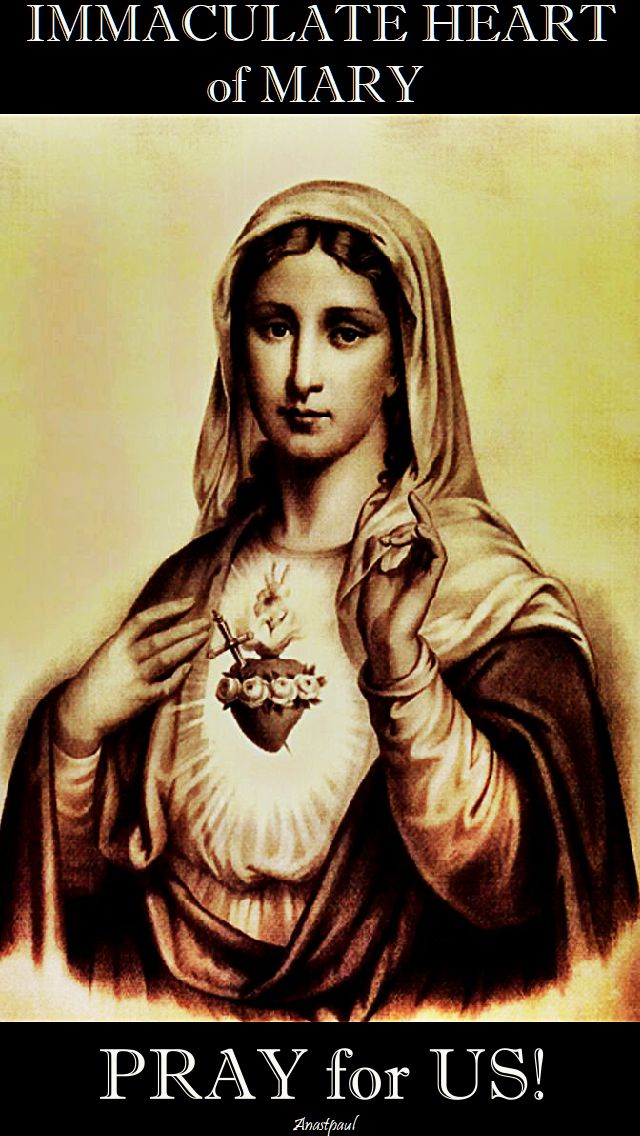
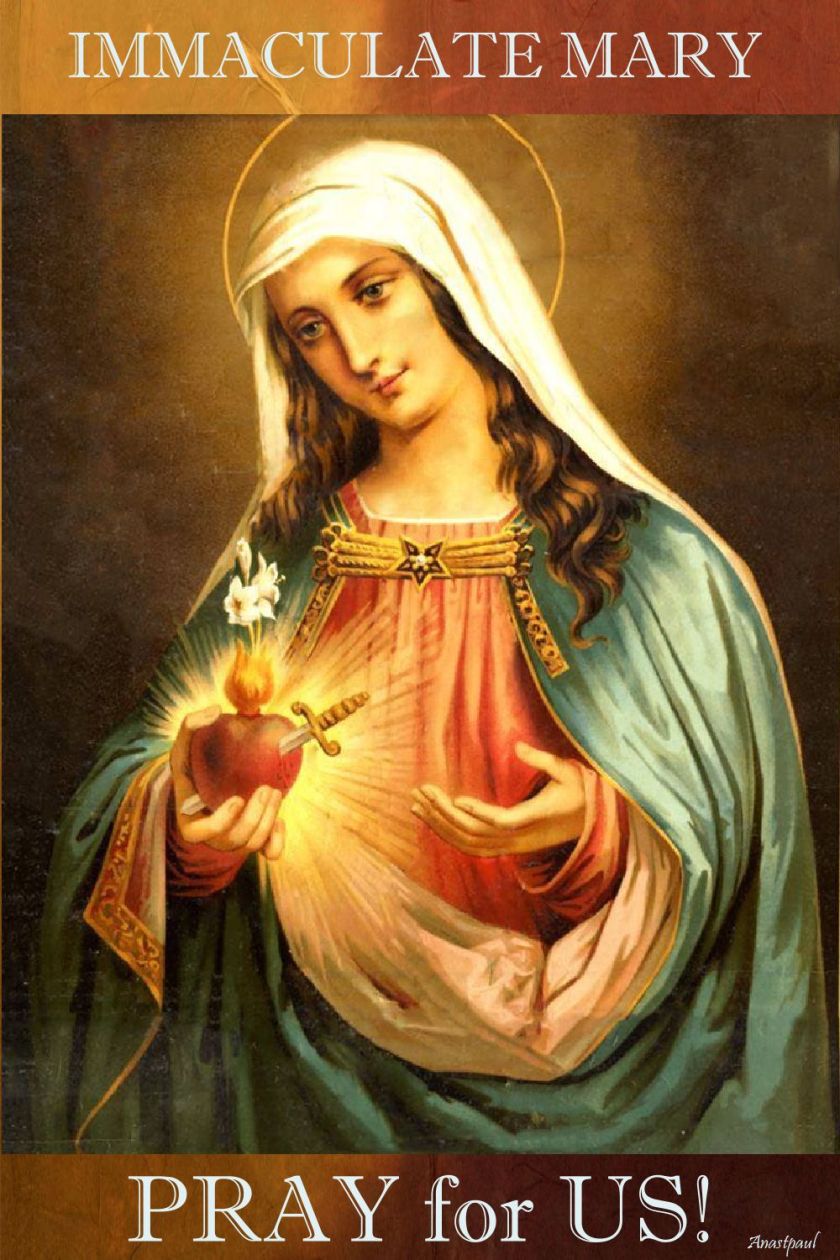
The month of August is dedicated to the Immaculate Heart. Since the 16th century Catholic piety has assigned entire months to special devotions. The month of August is traditionally dedicated to the Immaculate Heart of Mary. The physical heart of Mary is venerated (and not adored as the Sacred Heart of Jesus is) because it is united to her person and is the seat of her love (especially for her divine Son), virtue and inner life. Such devotion is an incentive to a similar love and virtue. Just as the Sacred Heart represents Christ’s love for mankind, the Immaculate Heart represents the desire of the Blessed Virgin to bring all people to her Son.
This devotion has received new emphasis in this century from the visions given to Lucy Dos Santos, oldest of the visionaries of Fatima, in her convent in Tuy, in Spain, in 1925 and 1926. In the visions Our Lady asked for the practice of the Five First Saturdays to help make amends for the offenses committed against her heart by the blasphemies and ingratitude of men. The practice parallels the devotion of the Nine First Fridays in honour of the Sacred Heart.
In the midst of the second world war Pope Pius XII put the whole world under the special protection of our Saviour’s Mother by consecrating it to her Immaculate Heart and in 1944 he decreed that in the future the whole Church should celebrate the feast of the Immaculate Heart of Mary. This is not a new devotion. In the seventeenth century, St. John Eudes preached it together with that of the Sacred Heart; in the nineteenth century, Pius VII and Pius IX allowed several churches to celebrate a feast of the Pure Heart of Mary. Pius XII instituted today’s feast of the Immaculate Heart of Mary for the whole Church, so as to obtain by her intercession “peace among nations, freedom for the Church, the conversion of sinners, the love of purity and the practice of virtue”(Decree of May 4, 1944). On October 31, 1942, Pope Pius XII made a solemn Act of Consecration of the Church and the whole world to the Immaculate Heart. Let us remember this devotion year-round, but particularly through the month of August.
Saint of the Day – 14 July – St Camillus de Lellis MI (1550-1614) Confessor, Priest and Founder, Apostle of the Sick, ((25 May 1550 at Bocchiavico, Abruzzi, Naples, Italy – 14 July 1614 at Genoa, Italy of natural causes). He was Canonised on 29 June 1746 by Pope Benedict XIV. Patronages – against illness, sickness or bodily ills; sick people (proclaimed on 22 June 22 1886 by Pope Leo XIII), hospitals, hospital workers, nurses, Abruzzi, Italy.
Founder of the Order of Clerks Regular, Ministers of the Infirm (abbreviated as M.I.), better known as the Camillians.
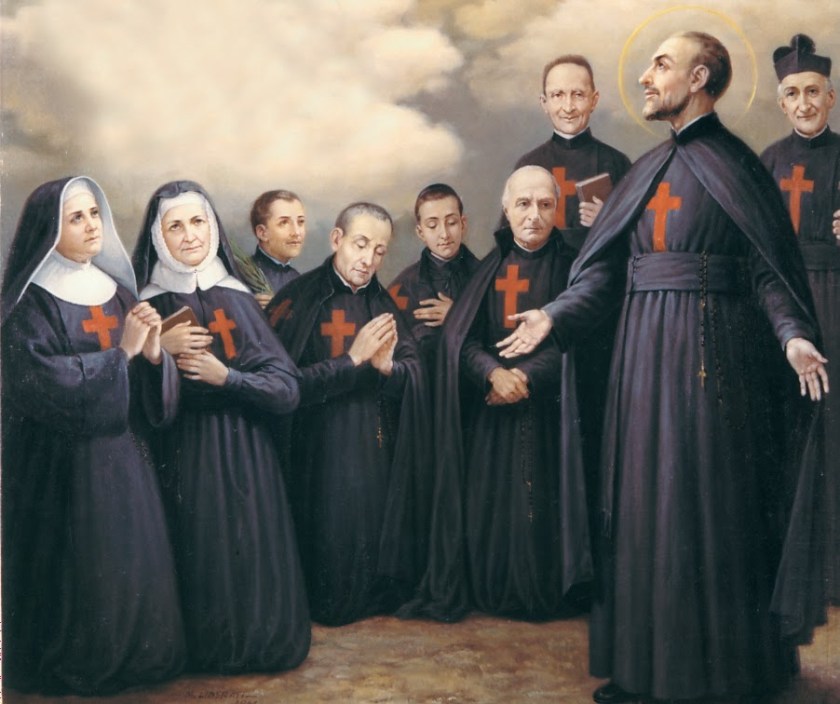
His experience in wars led him to establish a group of health care workers who would assist soldiers on the battlefield. The large, red cross on their cassock remains a symbol of the Congregation today. Camillians continue to identify themselves with this emblem on their habits, a symbol universally recognized today as the sign of charity and service. This was the original Red Cross, hundreds of years before the International Red Cross and Red Crescent Movement was formed.
During the Battle of Canizza in 1601, while Camillians were helping with the wounded, the tent in which they were tending to the sick and in which they had all of their equipment and supplies was completely destroyed and burned to the ground. Everything in the tent was destroyed except the red cross of a religious habit belonging to one of the Camillians who was ministering to the wounded on the battlefield. This event was taken by the Camillans to manifest divine approval of the Red Cross of St Camillus.
Members of the Order also devoted themselves to victims of Bubonic plague. It was due to the efforts of the brothers and supernatural healings by de Lellis that the people of Rome credited de Lellis with ridding the city of a great plague and the subsequent famine. For a time, he became known as the “Saint of Rome”.
De Lellis’ concern for the proper treatment of the sick extended to the end of their lives. He had come to be aware of the many cases of people being buried alive, due to haste and ordered that the Brothers of his Order wait fifteen minutes past the moment when the patient seemed to have drawn his last breath, in order to avoid this. St Camillus Church and Museum in Italy http://himetop.wikidot.com/camillus-de-lellis-church-and-museum
Camillus de Lellis was born on May 25, 1550, at Bucchianico (now in Abruzzo, then part of the Kingdom of Naples). His mother, Camilla Compelli de Laureto, was nearly fifty when she gave birth to him. His father was an officer in both the Neapolitan and French royal armies and was seldom home. De Lellis had his father’s temper and, due to her age and retiring nature, his mother felt unable to control him as he grew up. She died in 1562. As a consequence he grew up neglected by the family members who took him in after her death. Tall for his age, at 16 De Lellis joined his father in the Venetian army and fought in a war against the Turks.
After a number of years of military service, his regiment was disbanded in 1575. De Lellis was then forced to work as a labourer at the Capuchin friary at Manfredonia; he was constantly plagued, however, by a leg wound he received while in the army, which would not heal. Despite his aggressive nature and excessive gambling, the guardian of the friary saw a better side to his nature and continually tried to bring that out in him. Eventually the friar’s exhortations penetrated his heart and he had a religious conversion in 1575. He then entered the novitiate of the Capuchin friars. His leg wound, however, had continued to plague him and was declared incurable by the physicians, thus he was denied admission to that Order.
He then moved to Rome where he entered the Hospital of St. James (possibly founded by the Hospitaller Knights of St. James), which cared for incurable cases. He himself became a caregiver at the hospital and later its Director. In the meantime, he continued to follow a strict ascetic life, performing many penances, such as constant wearing of a hairshirt. He took as his spiritual director and confessor, the popular local priest, Philip Neri, who was himself to found a religious congregation and be declared a saint.
De Lellis began to observe the poor attention the sick received from the staff of the hospital. He was led to invite a group of pious men to express their faith through the care of the patients at the hospital. Eventually he felt called to establish a religious community for this purpose and that he should seek Holy Orders for this task. Neri, his confessor, gave him approval for this endeavour and a wealthy donor provided him with the income necessary to undertake his seminary studies.
He was ordained on Pentecost of 1584 by Lord Thomas Goldwell, Bishop of St Asaph, Wales and the last surviving Catholic bishop of Great Britain. Camillus then retired from his service at the hospital and he and his companions moved to the Hospital of the Holy Ghost, where they assumed responsibility for the care of the patients there.
In 1586 Pope Sixtus V gave the group formal recognition as a congregation and assigned them the Church of St. Mary Magdalene in Rome, which they still maintain. In 1588 they expanded to Naples and in 1594 St Camillus led his Religious to Milan where they attended to the sick of the Ca’ Granda, the main hospital of the city. A memorial tablet in the main courtyard of the Ca’ Granda commemorates his presence there.
Pope Gregory XV raised the Congregation to the status of an Order, equivalent with the mendicant orders, in 1591. At that time they established a fourth religious vow unique to their Order: “to serve the sick, even with danger to one’s own life.”
Throughout his life De Lellis’ ailments caused him suffering but he allowed no one to wait on him and would crawl to visit the sick when unable to stand and walk. It is said that Camillus possessed the gifts of healing and prophecy. He resigned as Superior General of the Order in 1607 but continued to serve as Vicar General of the Order. By that time, communities of the Order had spread all throughout Italy, even as far as Hungary. He assisted in a General Chapter of the Order in 1613, after which he accompanied the new Superior General on an inspection tour of all the hospitals of the Order in Italy. In the course of that tour, he fell ill. He died in Rome in 1614 and was entombed at the Church of St. Mary Magdalene.
Thought for the Day – 24 June – Feast of the Immaculate Heart of Mary
“It was through the body of a young, Jewish girl, living in a tiny village called Nazareth, that Jesus, the divine Word, was made flesh. Mary belonged to that part of the people of Israel, who awaited the Lord’s coming with expectation and longing. She had no doubt read about His coming in the Old Testament Scriptures and prayed for it. But she had no idea how it would come about. Most Israelites thought the Messiah would manifest Himself gloriously.
When the Archangel Gabriel announced to Mary that she was to be the “door’ through which the long awaited desire of the nations would be fulfilled, she must have been astonished: “Hail, O favored one, the Lord is with you! … You will conceive in your womb and bear a son, and you shall call His name Jesus” (Lk 1.28-31). A new life – filled with risks – opened before her. According to the Church’s tradition, Mary, in an exceptional gesture for a Jewish woman, had decided “not to know man” (Lk 1.34). She had discerned virginity to be God’s will. Her Immaculate Heart – the Feast we keep this day – prompted a total giving of herself to God and included the gift of both her body and her heart. Reassuring her that God had not disdained her vow, Gabriel told Mary that, like the glory of God coming upon the ark, so would the Spirit overshadow her. The young “handmaid of the Lord” contemplated the Angel’s words. She treasured them in her heart. Her response, known as her fiat – “let it be done to me as you say” (Lk 1.38) – shows that she entrusted herself fully to God’s designs. She chose to forgo her own plans for God’s. Through her fiat, the Word of God took flesh in the tabernacle of her womb…..
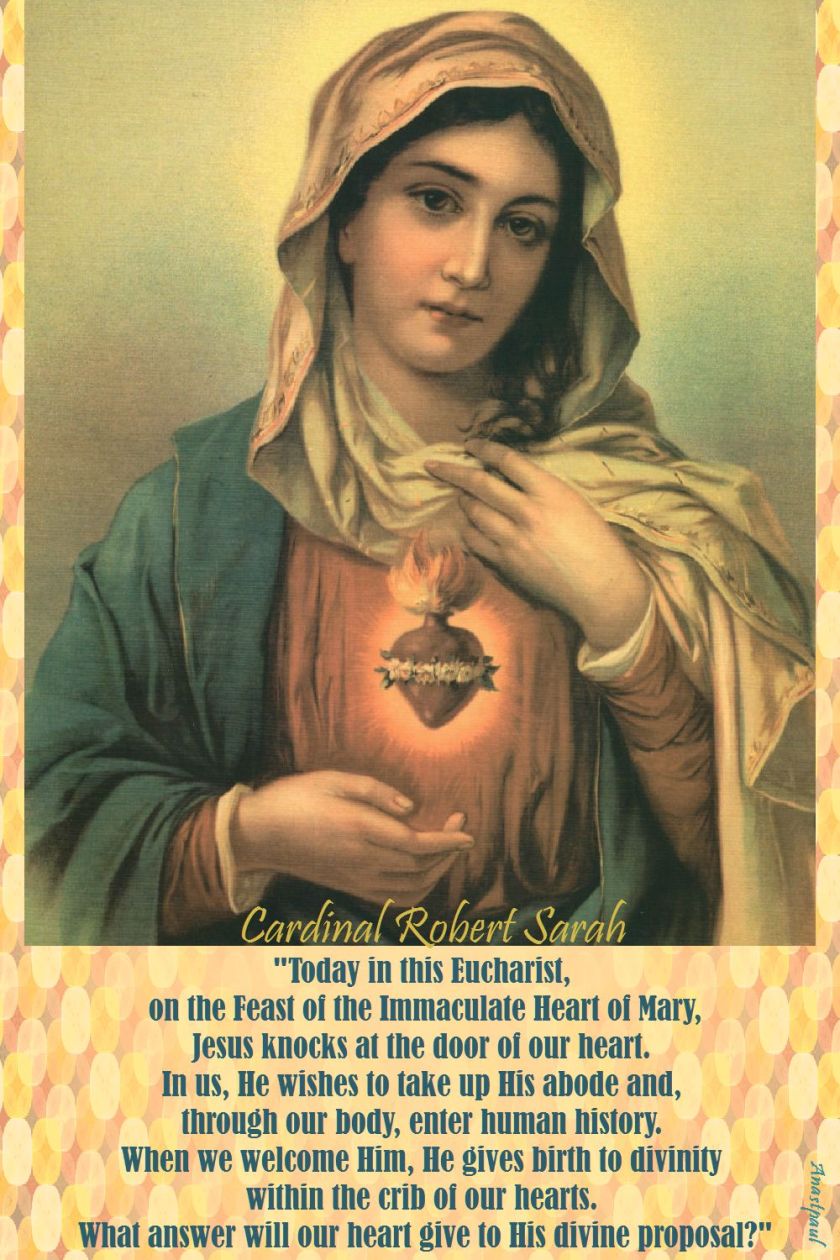
Today in this Eucharist, on the Feast of the Immaculate Heart of Mary, Jesus knocks at the door of our heart. In us, He wishes to take up His abode and, through our body, enter human history. When we welcome Him, He gives birth to divinity within the crib of our hearts. What answer will our heart give to His divine proposal?”…..Cardinal Robert Sarah (16 June 2012)
Quote/s of the Day – 24 June 2017 – The Solemnity of the Birthday of St John the Baptist and the Feast of the Immaculate Heart of Mary
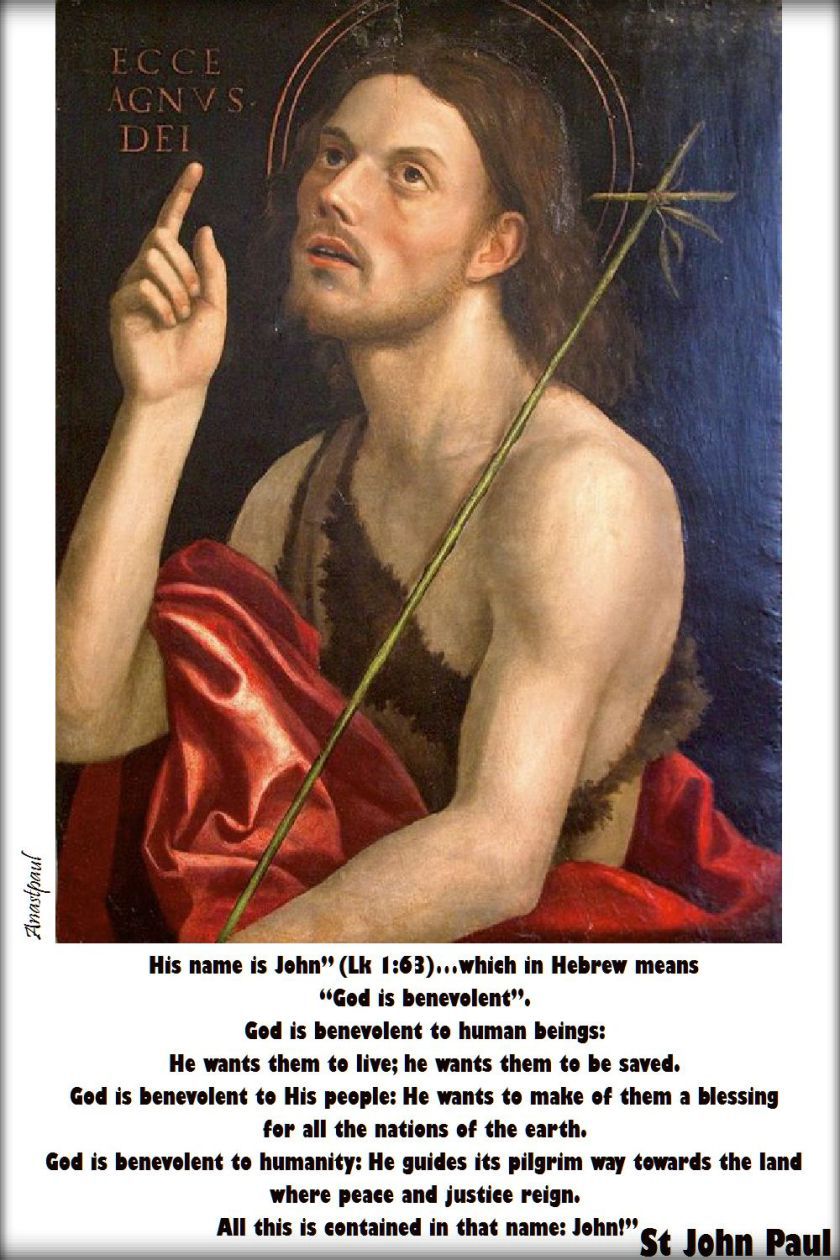
“His name is John” (Lk 1:63)…which in Hebrew means “God is benevolent”. God is benevolent to human beings: He wants them to live; he wants them to be saved. God is benevolent to His people: He wants to make of them a blessing for all the nations of the earth. God is benevolent to humanity: He guides its pilgrim way towards the land where peace and justice reign. All this is contained in that name: John!”…St John Paul (24 June 2001)
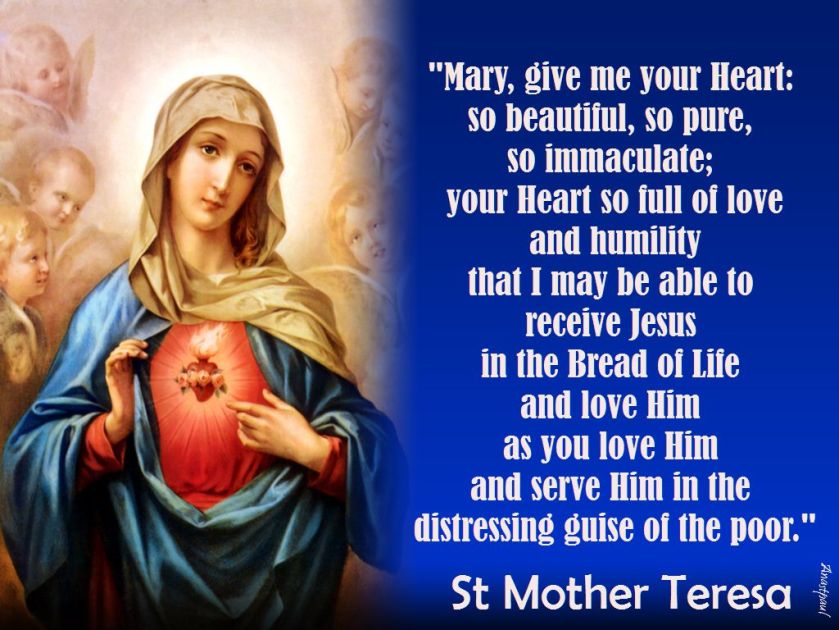
“Mary, give me your Heart: so beautiful, so pure, so immaculate; your Heart so full of love and humility that I may be able to receive Jesus in the Bread of Life and love Him as you love Him and serve Him in the distressing guise of the poor.”
–St Mother Teresa
O Heart of Jesus pierced for our sins
and giving us Your Mother on Calvary!
O Heart of Mary pierced by sorrow
and sharing in the sufferings of your divine Son
for our redemption!
O sacred union of these Two Hearts!
Praised be the God of Love who united them together!
May we unite our hearts and every heart
so that all hearts may live in unity and in imitation
of that sacred unity which exists in these Two Hearts.
Triumph, O Sorrowful and Immaculate Heart of Mary!
Reign, O Most Sacred Heart of Jesus!
– in our hearts, in our homes and families,
in the hearts of those who as yet do not know You
and in all nations of the world.
Establish in the hearts of all mankind the sovereign triumph
and reign of your Two Hearts so that the earth may resound
from pole to pole with one cry:
Blessed forever be the Most Sacred Heart of Jesus
and the Sorrowful and Immaculate Heart of Mary!
Obtain for me a greater purity of heart
and a fervent love of the spiritual life.
May all my actions be done for the greater glory of God
in unions with the divine heart of Jesus
and the Immaculate Heart of Mary.
Hear and answer our prayers and intentions
according to Your most merciful will. Amen
Celebrating the Solemnity of the Most Sacred Heart of Jesus – 23 June 2017
Excerpts from “To Be Loved by a Sacred Heart” – St Josemaria Escriva “Christ is Passing By,” no. 162
“That Christ has come to us with a heart made of flesh tells us a lot about how the Sacred Heart loves us and about the kind of love we need. We are loved by any number of hearts during our earthly lives but one alone among them we call Sacred. We know how it feels to be loved by fallen people—by those who try but cannot love perfectly. But what it is to be loved by a Sacred Heart?
At the outset of the last supper, the Lord gets down on His hands and knees and washes the feet of His disciples. “Do you understand this?” He asks them. Before He tells the Apostles about union with Him, about the great commandment of love, about His joy, Jesus first shows them what it all “looks” like.
“Do you understand this?” This is perhaps the ultimate question as we reflect on what it means to be loved by the Sacred Heart. Perhaps the answer will be an honest, “No, Lord, I do not understand your love for me,” and that could be nearer the truth than anything. “I don’t understand what God is doing on His hands and knees wiping the dirt off of my feet. If I were Jesus, I wouldn’t treat me like He treats me. I wouldn’t be so tolerant and forgiving. I wouldn’t keep on loving someone like me.”
But to spend our lives in contemplation of His love for us, as the apostles surely did, is what will bring us ever closer to the source of the Love that constantly reaches into our lives, showing itself to be subtle, selfless and inexhaustible. If the fire, thorns and blood are the divinely revealed gauge of divine love in a human heart, then the more I welcome His tireless forgiveness, His unflinching friendship in the face of my infidelity, the more I will appreciate the mystery of divine charity which the Sacred Heart reveals.
Now we see imperfectly, in part but the part we do see should teach us why He needed to come to us with a heart of flesh, like ours.”
Friday 23 June 2017 Blessed and Holy Solemnity of the Most Sacred Heart of Jesus – (Friday after the Second Sunday after Pentecost)
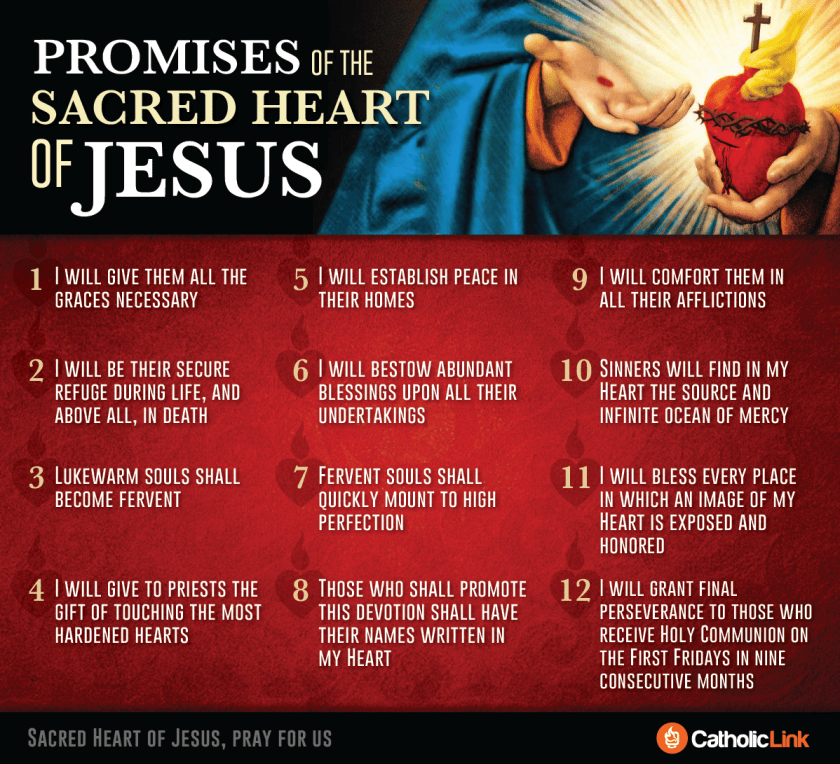
The Twelve Promises of the Sacred Heart – given to St. Margaret Mary Alacoque:
1. I will give them all the graces necessary for their state of life.
2. I will give peace in their families.
3. I will console them in all their troubles.
4. They shall find in My Heart an assured refuge during life and especially at the hour of death.
5. I will pour abundant blessings on all their undertakings.
6. Sinners shall find in My Heart the source and infinite ocean of mercy.
7. Tepid souls shall become fervent.
8. Fervent souls shall speedily rise to great perfection.
9. I will bless the homes in which the image of My Sacred Heart shall be exposed and honoured.
10. I will give to priests the power to touch the most hardened hearts.
11. Those who propagate this devotion shall have their name written in My Heart, and it shall never be effaced.
12. The all-powerful love of My Heart will grant to all those who shall receive Communion on the First Friday of nine consecutive months the grace of final repentance; they shall not die under My displeasure, nor without receiving their Sacraments; My Heart shall be their assured refuge at that last hour.
“And He showed me that it was His great desire of being loved by men and of withdrawing them from the path of ruin into which Satan hurls such crowds of them, that made Him form the design of manifesting His Heart to men, with all the treasures of love, of mercy, of grace, of sanctification and salvation which It contains, in order that those who desire to render Him and procure for Him all the honour and love possible, might themselves be abundantly enriched with those Divine treasures of which this Heart is the source. He should be honoured under the figure of this Heart of flesh and Its image should be exposed … He promised me that wherever this image should be exposed with a view to showing It special honour, He would pour forth His blessings and graces. This devotion was the last effort of His love that He would grant to men in these latter ages, in order to withdraw them from the empire of Satan which He desired to destroy, and thus to introduce them into the sweet liberty of the rule of His love, which He wished to restore in the hearts of all those who should embrace this devotion.”
—St. Margaret Mary
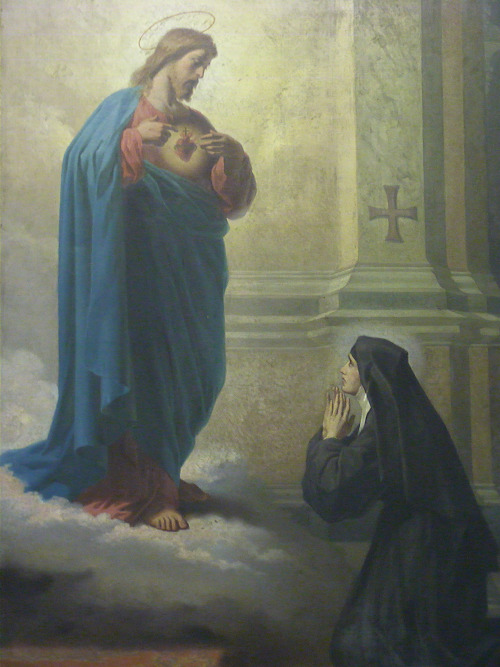
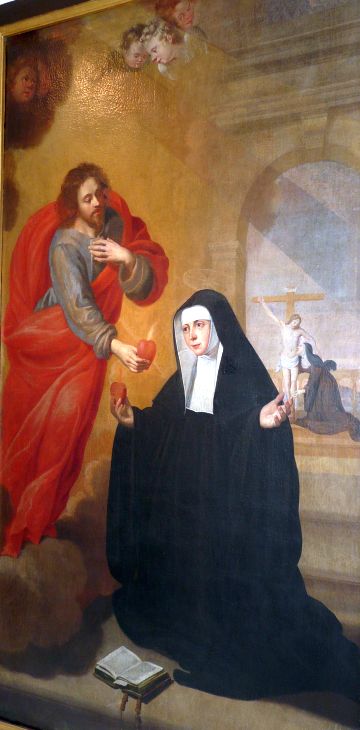
This Act of Consecration to the Sacred Heart of Jesus was composed by St. Margaret Mary Alacoque, a 17th Century French nun and mystic, pictured above, who saw our Lord in numerous visions. She was instrumental in spreading devotion to His Sacred Heart after He conveyed His wish for her to do so. In one vision she actually saw Jesus’ Sacred Heart with flames protruding from it to show His great love for us! The burning love He showed her from His Sacred Heart certainly must have inspired her.
Clearly, our Lord wishes us to join our will to His in love for Him and each other on our earthly pilgrimage to Heaven. And what better way than to appeal to our hearts, where our most sincere feelings and desires reside.
So too with Jesus, who we must remember, as man as well as God comes to us in Communion at Mass and in Adoration before the Blessed Sacrament with His heart filled with immense love and longing for us! As our Lord said in the Gospels “I am the vine; you are the branches. Whoever abides in me and I in him, bears much fruit. For without me, you can do nothing” (John 15:5).
Jesus once told St. Margaret Mary something quite similar when He said “Without me you can do nothing, but I will never let you lack help as long as you keep your weakness and nothingness buried in My strength.”
Our Lord wishes us to approach Him for help and love in humility, even when we’re feeling most uncertain or useless. Don’t be afraid to offer up your own weaknesses and anxieties to Him! He’ll be more than happy to fill your “nothingness” with His awesomeness! And the best places are after receiving Him and in Eucharistic Adoration, where His Heart is calling you!
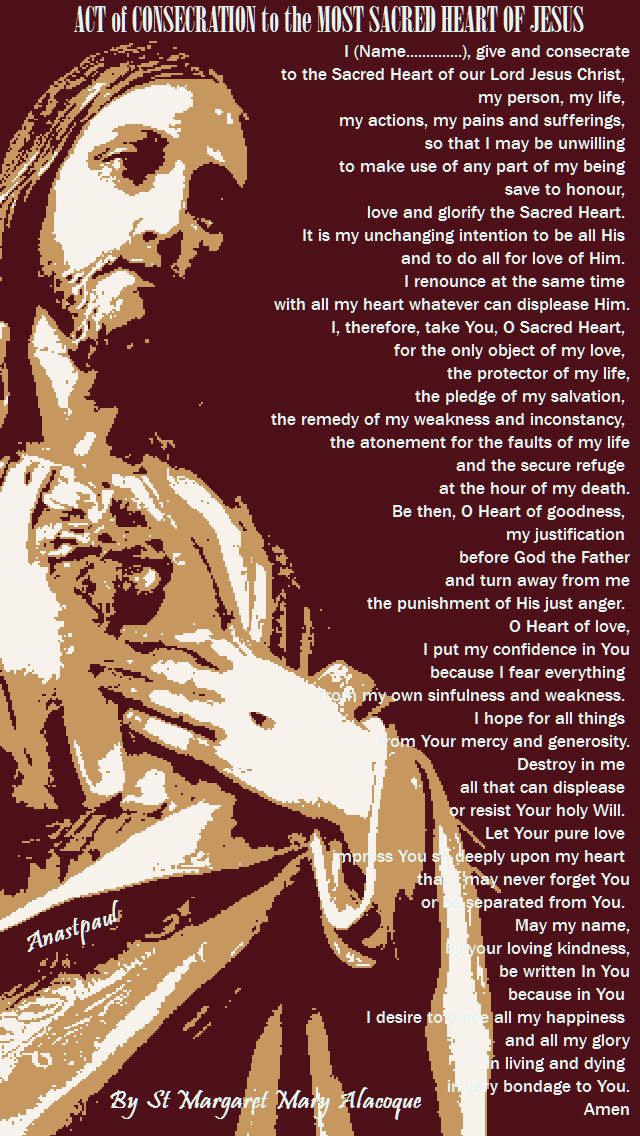
ACT of CONSECRATION to the MOST SACRED HEART OF JESUS by ST MARGARET MARY ALACOQUE
I (Name…………..), give and consecrate to the Sacred Heart of our Lord Jesus Christ,
my person, my life, my actions, my pains and sufferings,
so that I may be unwilling to make use of any part of my being
save to honour, love and glorify the Sacred Heart.
It is my unchanging intention to be all His
and to do all for love of Him.
I renounce at the same time with all my heart whatever can displease Him.
I, therefore, take You, O Sacred Heart,
for the only object of my love,
the protector of my life,
the pledge of my salvation,
the remedy of my weakness and inconstancy,
the atonement for the faults of my life
and the secure refuge at the hour of my death.
Be then, O Heart of goodness,
my justification before God the Father
and turn away from me the punishment of His just anger.
O Heart of love, I put my confidence in You
because I fear everything from my own sinfulness and weakness.
I hope for all things from Your mercy and generosity.
Destroy in me all that can displease or resist Your holy Will.
Let Your pure love impress You so deeply upon my heart
that I may never forget You or be separated from You.
May my name, by your loving kindness,
be written In You
because in You I desire to place all my happiness
and all my glory in living and dying in very bondage to You.
Amen
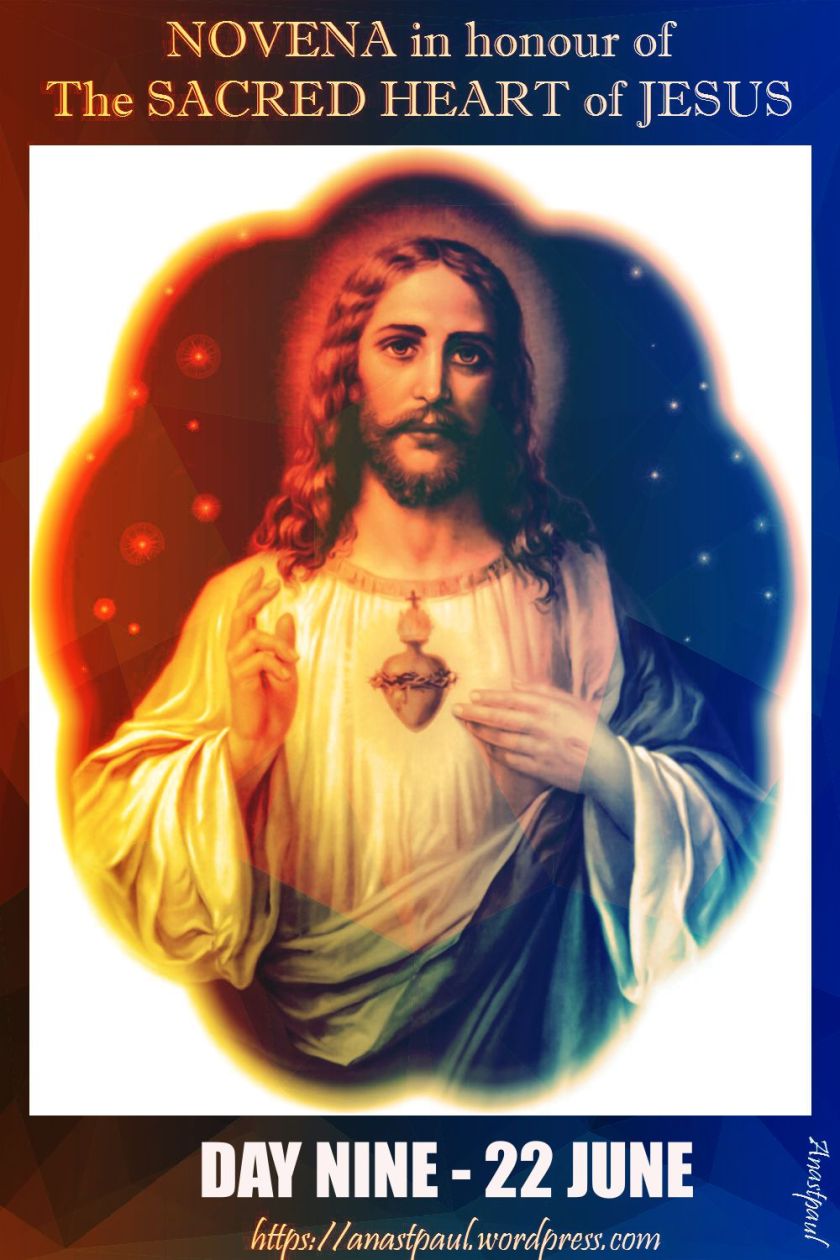
NOVENA in honour of the SACRED HEART of JESUS – DAY NINE –22 JUNE
By St Alphonsus Liguori (1696-1787) Most Zealous Doctor Published in 1758 from THE HOLY EUCHARIST
MEDITATION IX. The Faithful Heart of Jesus.
Oh, how faithful is the beautiful heart of Jesus towards those whom He calls to His love: He is faithful Who hath called you, Who also will perform.’ [1 Thess. v. 24].
The faithfulness of God gives us confidence to hope all things, although we deserve nothing. If we have driven God from our heart, let us open the door to Him and He will immediately enter, according to the promise He has made: If anyone open to Me the door, I will come in to him, and will sup with him. [Apoc. iii. 20]. If we wish for graces, let us ask for them of God, in the name of Jesus Christ and He has promised us that we shall obtain them: If you shall ask the Father anything in My name, He will give it you. [John xvi. 23]. If we are tempted, let us trust in His merits and He will not permit our enemies to strive with us beyond our strength: God is faithful, Who will not suffer you to be tempted above that which you are able. [1 Cor. x. 13].
Oh, how much better it is to have to do with God than with men! How often do men promise and then fail, either because they tell lies in making their promises, or because, after having made the promise, they change their minds: God is not as man, says the Holy Spirit, that He should lie; or as the Son of Man, that He should be changed. [Num. xxiii. 19]. God cannot be unfaithful to His promises, because, being Truth itself, He cannot lie; nor can He change His mind, because all that He wills is just and right. He has promised to receive all that come to Him, to give help to him that asks it, to love him that loves Him; and shall He then not do it? Hath He said, then, and will He not do it? [Ibid.].
Oh, that we were as faithful with God as He is with us! Oh, how often have we, in times past, promised Him to be His, to serve Him and love Him and then have betrayed Him, and, renouncing His service, have sold ourselves as slaves to the devil! Oh, let us beseech Him to give us strength to be faithful to Him for the future! Oh, how blessed shall we be if we are faithful to Jesus Christ in the few things that He commands us to do; He will, indeed, be faithful in remunerating us with infinitely great rewards and He will declare to us what He has promised to His faithful servants: Well done, good and faithful servant; because thou hast been faithful over a few things, I will place thee over many things; enter thou into the joy of thy Lord. [Matt. xxv. 21].
LET US PRAY – DAY NINE
Oh, that I had been as faithful towards You, my dearest Redeemer,
as You have been faithful to me.
Whenever I have opened my heart to You,
You have entered in, to forgive me and to receive me into Your favour.
Whenever I have called You, You have hastened to my assistance.
You have been faithfu1 with me
but I have been exceedingly unfaithful towards You.
I have promised You my love and then have many times refused it to You,
as if You, my God, Who has created and redeemed me,
were less worthy of being loved than Your creatures
and those miserable pleasures for which I have forsaken You.
Forgive me, O my Jesus. I know my ingratitude and abhor it.
I know that You are infinite goodness;
Who deserves an infinite love, especially from me,
whom You have so much loved,
even after all the offences I have committed against You.
Ah, no, my Love, have pity on me;
suffer me not to forsake You again
and then to damn myself, as I should deserve, to Hell.
O loving and faithful heart of Jesus, inflame, I beseech You, my miserable heart,
so that it may burn with love for You, My Jesus.
It seems to me that now I love You but I love You but little.
Make me love You exceedingly
and remain faithful to You until death.
I ask of You this grace, together with that of always praying to You for it.
Grant that I may die, rather than ever betray You again.
O Mary, my Mother, help me to be faithful to your Son. Amen.
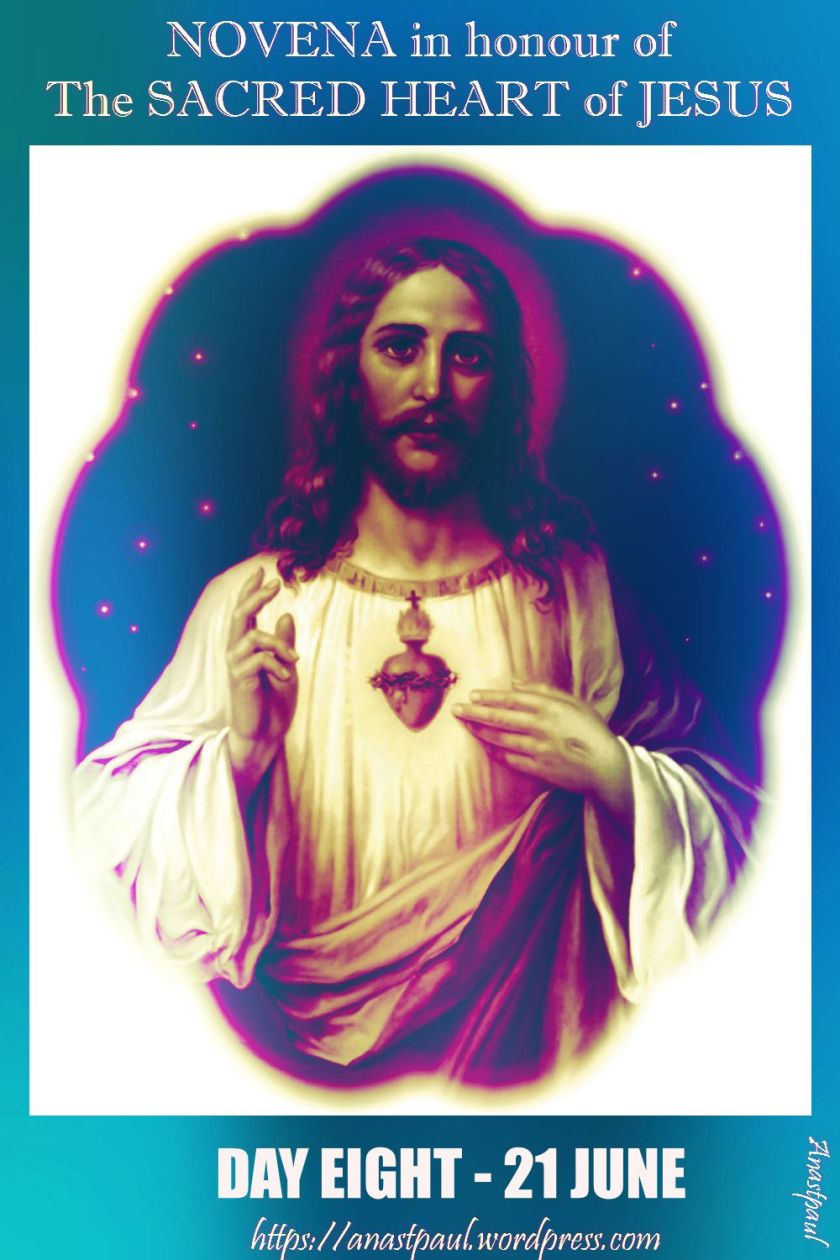
NOVENA in honour of the SACRED HEART of JESUS – DAY EIGHT –21 JUNE
By St Alphonsus Liguori (1696-1787) Most Zealous Doctor Published in 1758 from THE HOLY EUCHARIST
MEDITATION VIII. The Despised Heart of Jesus.
There is not a greater sorrow for a heart that loves, than to see its love despised: and so much the more when the proofs given of this love have been great, and, on the other hand, the ingratitude great.
If every human being were to renounce all his goods and to go and live in the desert, to feed on herbs, to sleep on the bare earth, to macerate himself with penances and at last give himself up to be murdered for Christ’s sake, what recompense could he render for the sufferings, the Blood, the life that this great Son of God has given for his sake? If we were to sacrifice ourselves every moment unto death, we should certainly not recompense in the smallest degree the love that Jesus Christ has shown us, by giving Himself to us in the most Holy Sacrament. Only conceive that God should conceal Himself under the species of bread to become the food of one of His creatures!
But, O my God, what recompense and gratitude do men render to Jesus Christ? What but ill-treatment, contempt of His laws and His maxims, —– injuries such as they would not commit towards their enemy, or their slave, or the greatest villain upon earth. And can we think of all these injuries which Jesus Christ has received and still receives every day and not feel sorrow for them? And not endeavour, by our love, to recompense the infinite love of His Divine heart, which remains in the most Holy Sacrament, inflamed with the same love towards us and anxious to communicate every good gift to us and to give Himself entirely to us, ever ready to receive us into His heart whenever we go to Him? Him that cometh to Me, I will not cast out. [John vi. 37].
We have been accustomed to hear of the Creation, Incarnation, Redemption, of Jesus born in a stable, of Jesus dead on the Cross. O my God, if we knew that another man had conferred on us any of these benefits, we could not help loving him. It seems that God alone has, to to say, this bad luck with men, that, though He has done His utmost to make them love Him, yet He cannot attain this end, and, instead of being loved, He sees Himself despised and neglected. All this arises from the forgetfulness of men of the love of God.
LET US PRAY – DAY EIGHT
O Heart of Jesus, abyss of mercy and love,
how is it that, at the sight of the goodness You hast shown me and of my ingratitude, I do not die of sorrow? You, O mv Saviour, after having given me my being,
have given me all Your Blood and Your life, giving Yourself up for my sake, to ignominy and death;
and, not content with this,
You have invented the mode of sacrificing Yourself every day for me in the Holy Eucharist,
not refusing to expose Yourself to the injuries which You receive, and which You foresaw,
in this Sacrament of love.
O my God, how can I see myself so ungrateful to You without dying with contrition!
O Lord, put an end, I pray You, to my ingratitude,
by wounding my heart with Your love and making me entirely Yours.
Remember the Blood and the tears that You shed for me, and forgive me.
Oh, let not all Your sufferings be lost upon me.
But though You have seen how ungrateful and unworthy of Your love I have been,
yet You didst not cease to love me even when I did not love You.
Grant that this day may be the day of my thorough conversion;
so that I may begin to love You and may never cease to love You, my sovereign good.
Make me die in everything to myself,
in order that I may live only for You and that I may always burn with Your love.
O Mary, your heart was the blessed altar
that was always on fire with Divine love:
my dearest Mother, make me like you;
obtain this from your Son,
Who delights in honouring and pleasing you,
by denying you nothing that you ask of Him. Amen
I will be away for a few days but you will find the Sacred Heart Novena in your Inbox as well as the Consecration Prayer on the feast day of the Sacred Heart of Jesus.
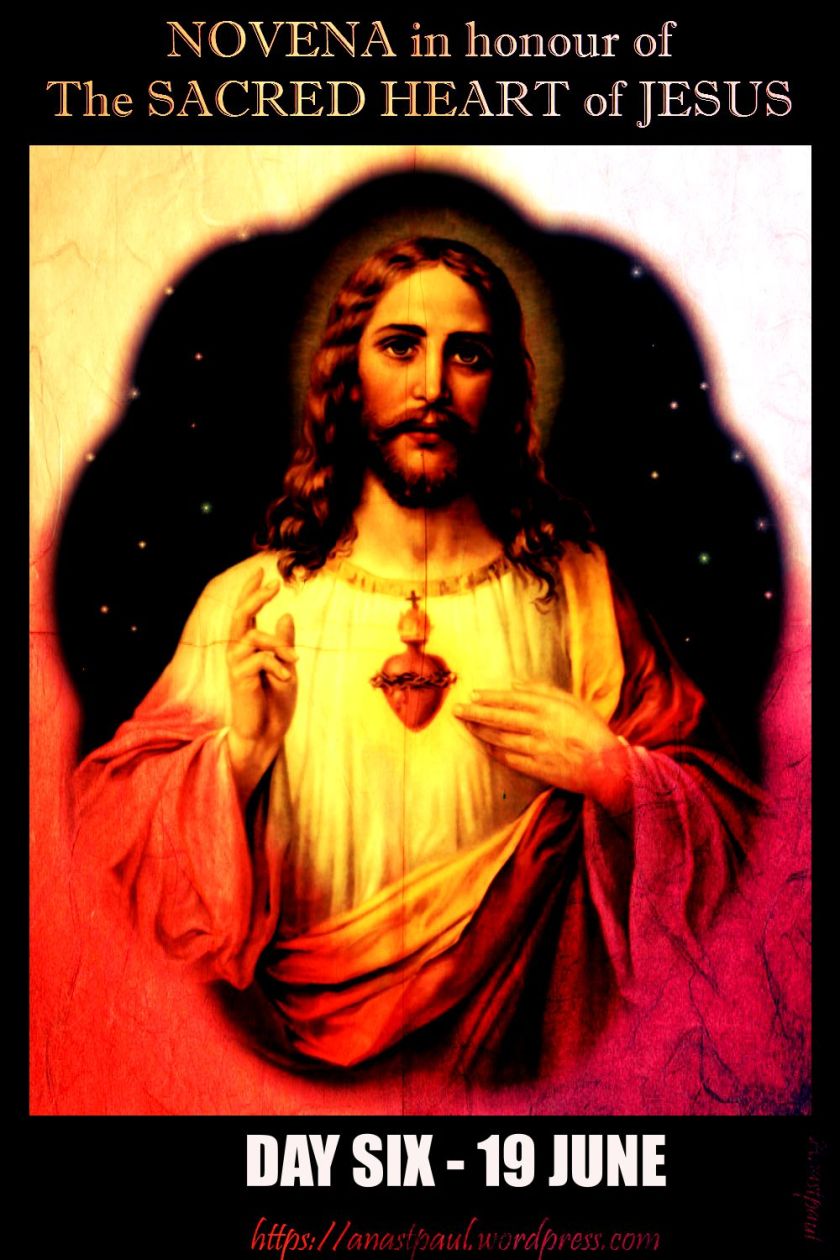
NOVENA in honour of the SACRED HEART of JESUS – DAY SIX – 19 JUNE
By St Alphonsus Liguori (1696-1787) Most Zealous Doctor Published in 1758 from THE HOLY EUCHARIST
MEDITATION VI. The Generous Heart of Jesus.
It is the characteristic of good-hearted people to desire to make everybody happy and especially those most distressed and afflicted. But who can ever find one who has a better heart than Jesus Christ? He is infinite goodness and has therefore a sovereign desire to communicate to us His riches: With Me are riches, that I may enrich them that love Me. [Prov. viii. 18, 21]
He for this purpose made Himself poor, as the Apostle says, that He might make us rich: He became poor for your sakes, that through His poverty you might be rich. [2 Cor. viii. 9]. For this purpose also He chose to remain with us in the most Holy Sacrament, where He remains constantly with His hands full of graces, to dispense them to those who come to visit Him. For this reason also He gives Himself wholly to us in Holy Communion, giving us to understand from this that He cannot refuse us any good gifts, since He even gives Himself entirely to us: How hath He not also, with Him, given us all things? [Rom. viii. 32]
For in the heart of Jesus we receive every good, every grace that we desire: In all things you are made rich in Christ. . . so that nothing is wanting to you in any grace. [1 Cor. 1. 5, 7]. And we must understand that we are debtors to the heart of Jesus for all the graces we have received —–graces of redemption, of vocation, of light, of pardon, the grace to resist temptations and to bear patiently with contradictions; for without His assistance we could not do anything good: Without Me you can do nothing. [John xv. 5]. And if hitherto, says our Saviour, you have not received more graces, do not complain of Me, but blame yourself, who has neglected to seek them of Me: Hitherto you have not asked anything; . . . ask, and you shall receive. [John xvi. 24]. Oh, how rich and liberal is the heart of Jesus towards everyone that has recourse to Him! Rich unto all that call upon Him. [Rom. x. 12]. Oh, what great mercies do those souls receive who are earnest in asking help of Jesus Christ. David said, For Thou, O Lord, art sweet and mild, and plenteous to all who call upon Thee. [Ps. lxxxv. 5]. Let us therefore always go to this heart, and ask with confidence, and we shall obtain all we want.
LET US PRAY – DAY SIX
Ah, my Jesus,
You have not refused to give me Your Blood and Your life
and shall I refuse to give You my miserable heart?
No, my dearest Redeemer, I offer it entirely to You.
I give You all my will – will You accept it and dispose of it at Your pleasure?
I can do nothing and have nothing
but I have this heart which You have given me
and of which no one can deprive me.
I may be deprived of my goods, my blood, my life but not of my heart.
With this heart I can love You;
with this heart I will love You.
I beseech You, O my God, teach me a perfect forgetfulness of myself.
I feel in myself a determination to please You
but in order to put my resolve iinto execution,
I expect and implore help from You.
It depends on You, O loving heart of Jesus,
to make my poor heart entirely Yours.
Oh, grant that my heart may be all on fire with the love of You,
even as Yours is on fire with the love of me.
Grant that my will may be entirely united to Yours
and from this day forth Your holy will may be the rule of all my actions,
of all my thoughts and of all my desires.
I trust, O my Saviour, that You will not refuse me Your grace,
to fulfill this resolution which I now make prostrate at Your feet,
to receive with submission whatever You may ordain for me, as well in life, as in death.
Blessed art you, O Immaculate Mary,
who had your heart always and entirely united to the heart of Jesus;
obtain for me, O my Mother,
that in future I may wish and desire that which Jesus wills and you will. Amen
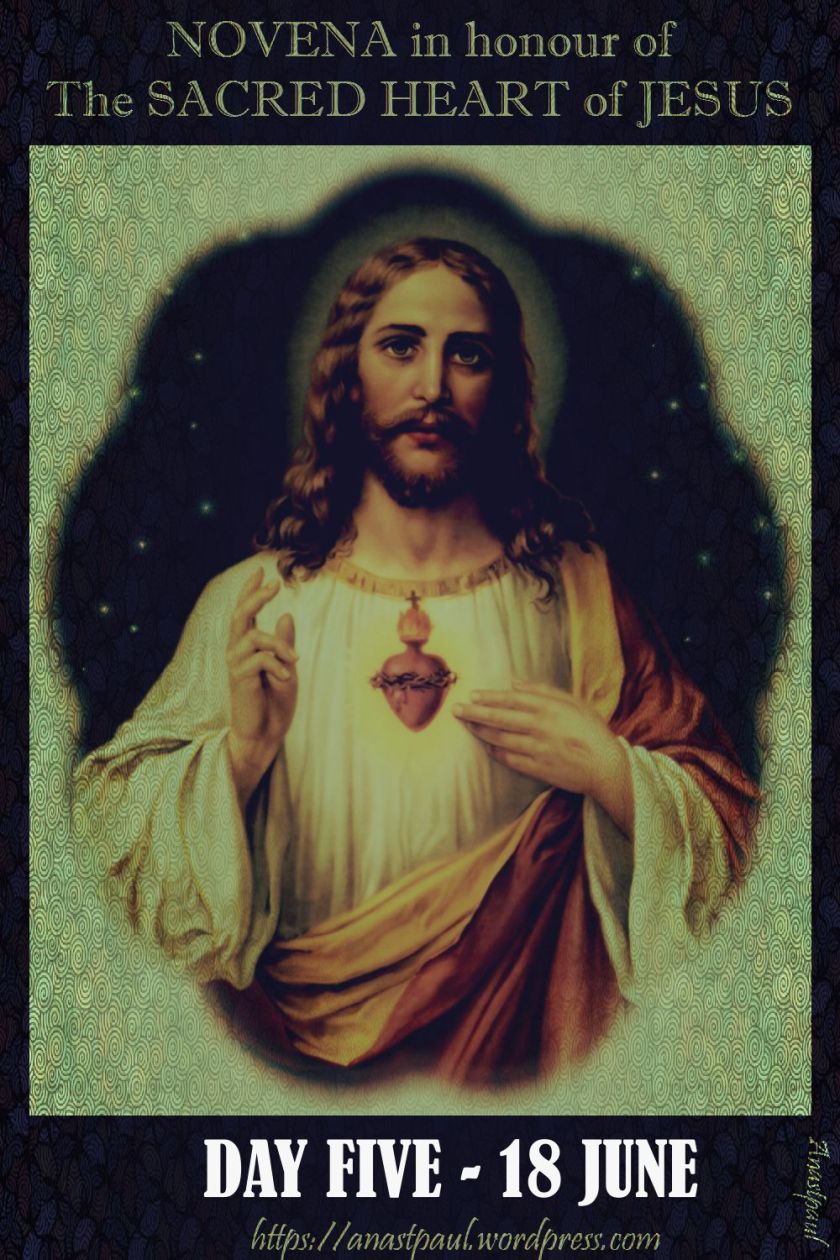
NOVENA in honour of the SACRED HEART of JESUS – DAY FIVE – 18 JUNE
By St Alphonsus Liguo (1696-1787) Most Zealous Doctor Published in 1758 in “THE HOLY EUCHARIST”
MEDITATION V. The Compassionate Heart of Jesus.
Where shall we ever find a heart more compassionate or tender than the heart of Jesus, or one that had a greater feeling for our miseries?
This pity induced Him to descend from Heaven to this earth; it made Him say that He was that good shepherd Who came to give His life to save His sheep. In order to obtain the pardon of our sins, He would not spare Himself but would sacrifice Himself on the Cross, that by His sufferings He might satisfy for the chastisement that we have deserved. This pity and compassion makes Him say even now: Why will ye die, O house of Israel? return ye, and live. [Ezek. xviii. 31]. O men, He says, my poor children, why will you damn yourselves by flying from Me? Do you not see that by separating yourselves from Me you are hastening to eternal death? I desire not to see you lost; do not despair; as often as you wish to return, return and you shall recover your life: Return, and live.
This compassion even makes Him say that He is that loving Father Who, though He sees Himself despised by His son, yet, if that son returns a penitent, He cannot reject him but embraces him tenderly and forgets all the injuries He has received: I will not remember all his iniquities. [Ibid. 22]. It is not thus that men behave; for though they may forgive, yet they nevertheless retain the remembrance of the offence received and feel inclined to revenge themselves and even if they do not revenge themselves, because they fear God, at least they always feel a great repugnance against conversing and entertaining themselves with those persons who have vilified them.
O my Jesus, You pardon the penitent sinners and never refuse in this world to give them everything in Holy Communion during their life and everything in the other world, even in Heaven, with eternal glory, without retaining the slightest repugnance towards being united to the soul that has offended You, for all eternity. Where, then, is there to be found a heart so amiable and compassionate as Yours, O my dearest Saviour?
LET US PRAY – DAY FIVE
O compassionate heart of my Jesus, have pity on me:
“Most sweet Jesus, have mercy on me.”
I say so now and beseech You to give me the grace always to say to You,
“Most sweet Jesus, have mercy on me.”
Even before I offended You, O my Redeemer,
I certainly did not deserve any of the favours You bestowed upon me.
You created me,
You have given me so much light and knowledge
and all without any merit of mine.
But after I had offended You. I not only did not deserve Your favour
but I deserved to be forsaken by You and cast into Hell.
Your compassion has made You wait for me
and preserve my life even when I had offended You.
Your compassion has enlightened me and offered me pardon;
it has given me sorrow for my sins and the desire of loving You
and now I hope from Your mercy to remain always in Your grace.
O my Jesus Your mercy which I implore of You
is that You would grant me light
and strength to be no longer ungrateful towards You.
No, my Jesus; I love You and I will always love You
and this is the mercy which I hope for and seek from You “Permit me not to be separated from You, permit me not to be separated from You.”
And I beseech you also, O Mary my Mother,
help me not to be ever again separated from my God.
Amen
Thought for the Day – 18 June – The Solemnity of Corpus Christi
“A word that ought to cover many a Catholic with shame and confusion once came from the lips of a person raised in Protestant tenets and surroundings: “If I believed in the real presence of Jesus in the Eucharist, I should spend all my life before a tabernacle and no power could tear me away from it.”
Does this not suffice to put to shame our little generosity in visiting Jesus in the Blessed Sacrament?
Let us pay Him a visit every day, even when only a short one is possible, particularly if it is our happiness to live with Him under the same roof. Let us not pass by a church where He is kept in the tabernacle, without entering at least for a moment, or without making at least a spiritual visit.
We can multiply spiritual visits at any time, amid our daily occupations and when we awake at night – a practice which growing love will more and more cogently urge upon us. Because after all, who can enchain love? Who can resist the heart? Who can separate what love has joined? Who can prevent, what obstacle can impede our hearts from living in perpetual adoration at the feet of Jesus in the Blessed Sacrament?
“Where thy treasure is,” said Jesus, “there they heart also will be.” If the Holy Eucharist is our treasure, our heart will live in the tabernacle.”…Fr Jose Guadalupe Trevino (The Holy Eucharist)
ACT OF SPIRITUAL COMMUNION
My Jesus,
I believe that You
are present in the Most Holy Sacrament.
I love You above all things
and I desire to receive You into my soul.
Since I cannot at this moment
receive You sacramentally,
come at least spiritually into my heart. I embrace You as if You were already there and unite myself wholly to You. Never permit me to be separated from You. Amen.
Quote/s of the Day – The Solemnity of the Body and Blood of Christ
“How I loved the feasts!…. I especially loved the processions in honour of the Blessed Sacrament. What a joy it was for me to throw flowers beneath the feet of God!… I was never so happy as when I saw my roses touch the sacred Monstrance…” – from St. Therese’s Autobiography Story of A Soul
“It is invaluable to converse with Christ and leaning against Jesus’ breast like His beloved disciple, we can feel the infinite love of his Heart. We learn to know more deeply the One who gave Himself totally, in the different mysteries of His divine and human life, so that we may become disciples and in turn enter into this great act of giving, for the glory of God and the salvation of the world. Through adoration, the Christian mysteriously contributes to the radical transformation of the world and to the sowing of the Gospel. Anyone who prays to the Saviour draws the whole world with him and raises it to God. Those who stand before the Lord are therefore fulfilling an eminent service. They are presenting to Christ all those who do not know Him or are far from Him; they keep watch in His presence on their behalf!”
– from St PopeJohn Paul II’s 1996 letter to the Bishop of Liege, written on the occasion of the 750th anniversary of the first celebration of the Feast of Corpus Christi
“When you have received Him, stir up your heart to do Him homage, speak to Him about your spiritual life, gazing upon Him in your soul where He is present for your happiness; welcome Him as warmly as possible, and behave outwardly in such a way, that your actions may give proof to all of His Presence.” – St. Francis de Sales
One Minute Reflection – 18 June – Feast of Corpus Christi
He who abides in me and I in him, he it is that bears much fruit, for apart from me you can do nothing……John 15:5
REFLECTION – “Eternal happiness begins now for the Christian who is comforted with the definitive manna of the Eucharist. The old life has gone forever. Let us leave everything behind us so that everything will be new, “our hearts, our words and our actions.” This is the Good News. News, because it speaks to us of a deep love which we never could have dreamed of. Good, because there is nothing better than uniting ourselves to God, the greatest Good of all. It is Good News, because in an inexplicable way it gives us a foretaste of heaven.”……….St Josemaria Escriva (Christ is passing By – On the Feast of Corpus Christ No 153)
PRAYER – In response to Your Presence, O Lord,
I offer You my presence.
In response to Your silence,
I offer You my silence.
In response to the gaze of Your Eucharistic Face,
I offer You my eyes.
In response to Your Eucharistic Heart,
I offer You every heartbeat of mine.
In response to the mystery of Your Eucharistic poverty,
I offer You my poverty.
My one desire is to remain before You
even as You remain before me
in this the Sacrament of Your Love.
(Benedictines of Perpetual Adoration)
NOVENA in honour of the SACRED HEART of JESUS – DAY FOUR – 17 JUNE
By St Alphonsus Liguori (1696-1787) Most Zealous Doctor Published in 1758 from THE HOLY EUCHARIST
MEDITATION IV. The Sorrowful Heart of Jesus.
It is impossible to consider how afflicted the heart of Jesus was for love of us and not to pity Him. He Himself tells us that His heart was overwhelmed with such such sorrow, that this alone would have sufficed to take His life away and to make Him die of pure grief, if the virtue of His Divinity had not, by a miracle, prevented His death: My soul is sorrowful even unto death. [Mark xiv. 34]
The principal sorrow which afflicted the heart of Jesus so much was not the sight of the torments and infamy which men were preparing for Him but the sight of their ingratitude towards. His immense love. He distinctly foresaw all the sins which we should commit after all His sufferings and such a bitter and ignominious death. He foresaw, especially, the horrible insults which men would offer to His adorable heart, Which He has left us in the Most Holy Sacrament as a proof of His affection. O my God, what affronts has not Jesus Christ received from men in this Sacrament of love? One has trampled Him under foot, another has thrown Him into the gutters, others have availed themselves of Him to pay homage to the devil!
And yet the sight of all these insults did not prevent Him from leaving us this great pledge of His love. He has a sovereign hatred of sin; but still it seems as if His love towards us had overcome the hatred He bore to sin, since He was content to permit these sacrileges, rather than to deprive the souls that love Him of this Divine food. Shall not all this suffice to make us love a heart that has loved us so much?
Has not Jesus Christ done enough to deserve our love? Ungrateful that we are, shall we still leave Jesus forsaken on the altar, as the majority of men do? And shall we not unite ourselves to those few souls who acknowledge Him and melt with love more even than the torches melt away which burn round the ciborium? The heart of Jesus remains there, burning with love for us; and shall we not, in His Presence, burn with love for Jesus?
LET US PRAY – DAY FOUR
My adorable and dearest Jesus,
behold at Your feet one who has caused
so much sorrow to Your amiable Heart.
O my God, how could I grieve this Heart,
Which has loved me so much
and has spared nothing to make Itself loved by me?
But console Yourself, I will say, O my Saviour,
for my heart having been wounded, through Your grace,
with Your most holy love, feels now so much regret
for the offences I have committed against You,
that it would die of sorrow.
Oh; who will give me, my Jesus,
that sorrow for my sins which You felt for them in Your life!
Eternal Father, I offer You the sorrow
and abhorrence Your Son felt for my sins;
and, for His sake, I beseech You to give me so great a sorrow
for the offences I have committed against You,
that I may lead an afflicted and sorrowful life
at the thought of having once despised Your love.
And You, O my Jesus, do You give me, from this day forth,
such a horror of sin, that I may abhor even the lightest faults,
considering that they displease You,
Who does not deserve to be offended much or little,
but deserves an infinite love.
My beloved Lord, I now detest everything that displeases You
and in future I will love only You
and that which You love.
Oh, help me, give me the strength,
give me the grace to invoke Youo constantly, O my Jesus
and always to repeat to You this petition:
My Jesus, give me Your love. give me Your love, give me Your love.
And you, most holy Mary,
obtain for me the grace to pray to you continually
and to say to you, O my Mother, make me love Jesus Christ.
Amen
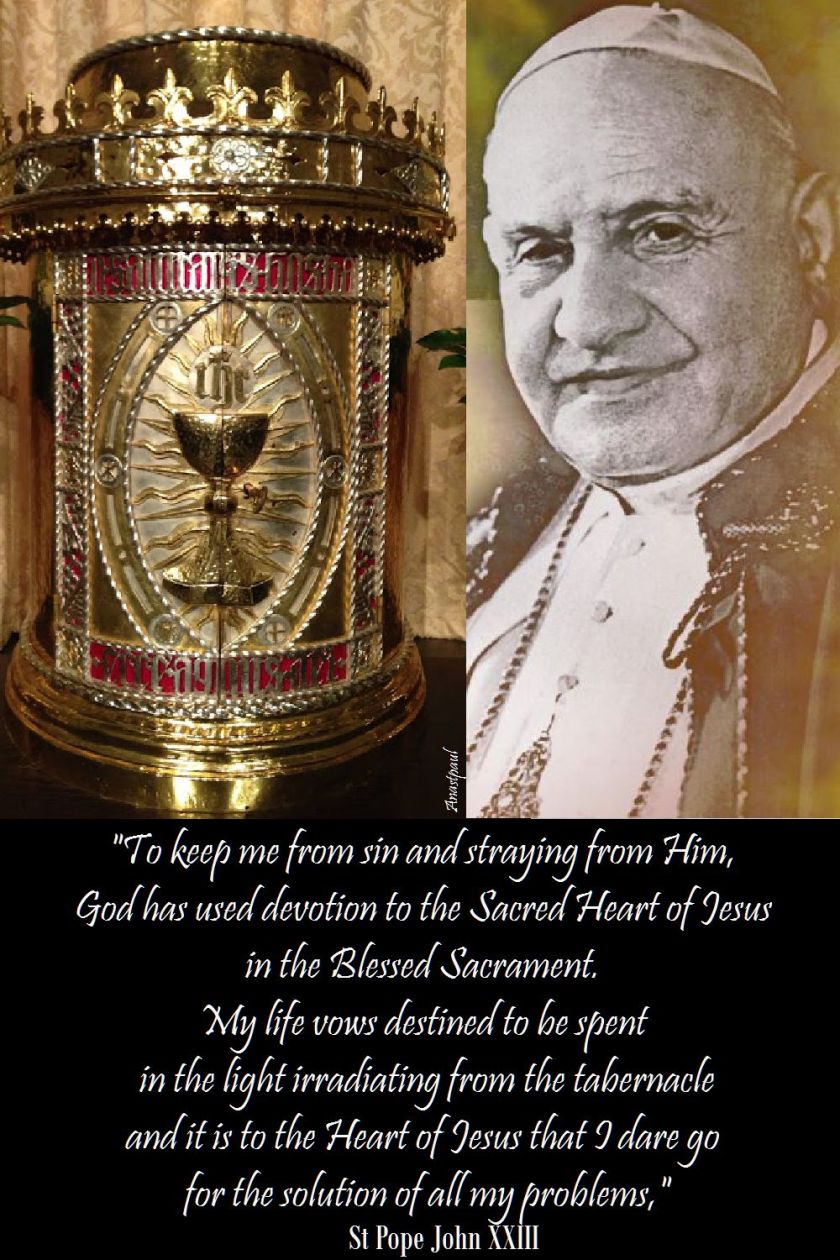
“To keep me from sin and straying from Him, God has used devotion to the Sacred Heart of Jesus in the Blessed Sacrament. My life vows destined to be spent in the light irradiating from the tabernacle and it is to the Heart of Jesus that I dare go for the solution of all my problems,”
Be my Strength, O Sacred Heart! By St Margaret Mary Alacoque
O Sacred Heart of Jesus,
I fly to You,
I unite myself with You,
I enclose myself in You!
Receive my call for help, O my Saviour,
as a sign of my horror of all within me
contrary to Your holy love.
Let me die rather a thousand times,
than consent to sin against You!
Be my strength, O God –
defend me,
protect me.
I am Yours and desire forever to be Yours!
Amen
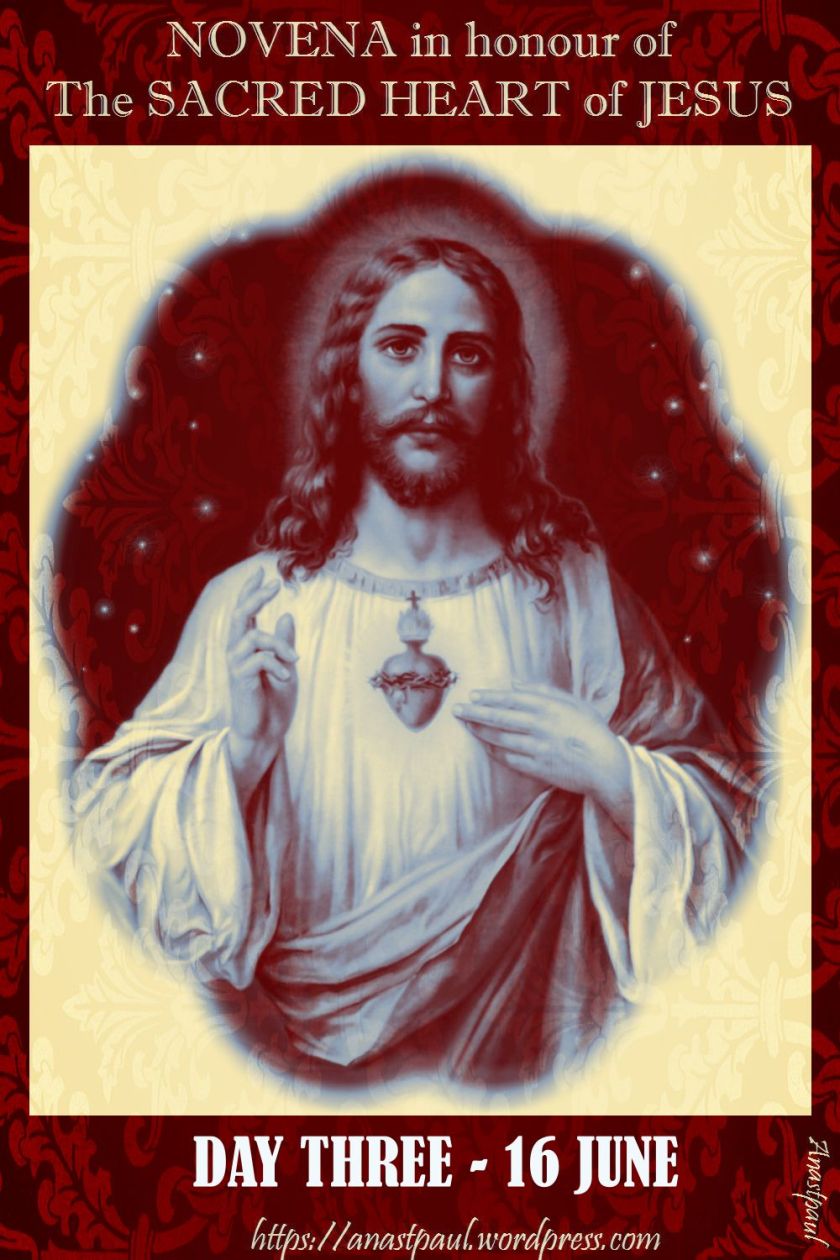
NOVENA in honour of the SACRED HEART of JESUS – DAY THREE – 16 JUNE
By St Alphonsus Liguori (1696-1787) Most Zealous Doctor Published in 1758 from THE HOLY EUCHARIST
MEDITATION III. The Heart of Jesus Christ Panting to be Loved.
Jesus has no need of us; He is equally happy, equally rich, equally powerful with or without our love; and yet, as St. Thomas says, [Opusc. 63, c. 7] He loves us so, that He desires our love as much as if man was His God, and His felicity depended on that of man. This filled holy Job with astonishment: What is man that Thou shouldst magnify him or why dost Thou set Thy heart upon him? [Job vii. 17]
What! Can God desire or ask with such eagerness for the love of a worm? It would have been a great favour if God had only permitted us to love Him. If a vassal were to say to his king, “Sire, I love you,” he would be considered impertinent. But what would one say if the king were to tell his vassal, “I desire you to love me”? The princes of the earth do not humble themselves to this; but Jesus, Who is the King of Heaven, is He Who with so much earnestness demands our love: Love the Lord thy God with thy whole heart. [Matt. xxii. 37] So pressingly does He ask for our heart: My son, give Me thy heart. [Prov. xxiii. 26] And if He is driven from a soul, He does not depart but He stands outside of the door of the heart and He calls and knocks to be let in: I stand at the gate and knock. [Apoc. iii. 20] And He beseeches her to open to Him, calling her sister and spouse: Open to Me, My sister, My love. [Cant. v. 2] In short, He takes a delight in being loved by us, and is quite consoled when a soul says to Him, and repeats often, “My God, my God, I love Thee.”
All this is the effect of the great love He bears us. He who loves necessarily desires to be loved. The heart requires the heart; love seeks love: “Why does God love, but that He might be loved Himself,” [In Cant. s. 83] said St. Bernard; and God Himself first said, What doth the Lord thy God require of thee, but that thou fear the Lord thy God, . . . and love Him? [Deut. x. 12] Therefore He tells us that He is that Shepherd Who, having found the lost sheep, calls all the others to rejoice with Him: Rejoice with Me, because I have found My sheep that was lost. [Luke xv. 6] He tells us that He is that Father Who, when His lost son returns and throws himself at His feet, not only forgives him, but embraces him tenderly. He tells us that he that loves Him not is condemned to death: He that loveth not abideth in death. [l John iii. 14] And, on the contrary, that He takes him that loves Him and keeps possession of him: He that abideth in charity, abideth in God, and God in him. John iv. 16] Oh, will not such invitations, such entreaties, such threats, and such promises move us to love God, Who so much desires to be loved by us?
LET US PRAY – DAY THREE
My dearest Redeemer,
I will say to You, with St. Augustine,
You command me to love You
and threaten me with Hell if I do not love You;
but what more dreadful Hell, what greater misfortune,
can happen to me than to be deprived of Your love!
If, therefore, You desire to frighten me,
You should threaten me only that I should live without loving You;
for this threat alone will frighten me more than a thousand hells.
If, in the midst of the flames of Hell, the damned could burn with Your love,
O my God, Hell itself would become a paradise;
and if, on the contrary, the blessed in Heaven could not love You,
Paradise would become hell. Thus St. Augustine expresses himself.
I see, indeed, my dearest Lord,
that I, on account of my sins, did deserve to be forsaken by Your grace
and at the same time condemned to be incapable of loving You;
but still I understand that You continue to command me to love You
and I also feel within me a great desire to love You.
This my desire is a gift of Your grace and it comes from You.
Oh, give me also the strength necessary to put it into execution
and make me, from this day forth, say to You earnestly
and from the bottom of my heart
and to repeat to You always,
“My God, I love You, I love You, I love You.”
You desire my love; I also desire Yours.
Blot out, therefore, from Your remembrance, O my Jesus.
the offences that in past times I have committed against You;
let us love each other henceforth forever.
I will not leave You and You will not leave me.
You will always love me and I will always love You.
My dearest Saviour, in Your merits I place my hope;
oh, make Yourself my beloved forever
and be loved greatly,
by a sinner who has offended You greatly.
O Mary, Immaculate Virgin,
help me and beseech Jesus for me. Amen
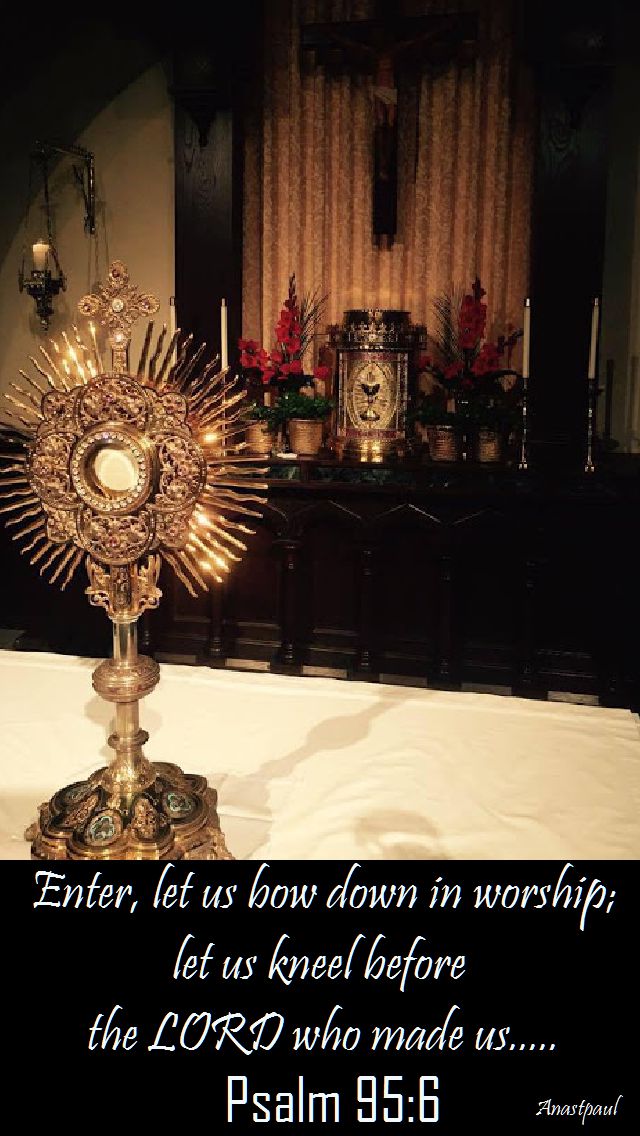
Enter, let us bow down in worship;
let us kneel before the LORD who made us….Psalm 95:6
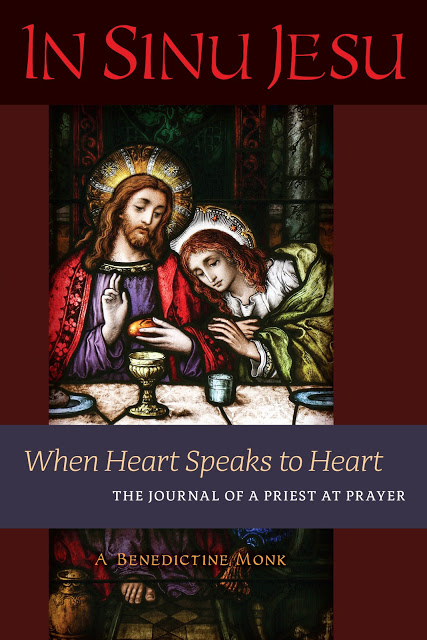
REFLECTION – “The practice of adoration is not difficult.
It is a gentle abiding in My presence,
a resting in the radiance of My Eucharistic Face,
a closeness to My Eucharistic Heart.
Words, though sometimes helpful, are not necessary,
nor are thoughts.
What I seek from one who would adore Me in spirit and in truth
is a heart aflame with love,
a heart content to abide in my presence,
silent and still,
engaged only in the act of loving Me
and of receiving My love.
Though this is not difficult,
it is, all the same,
my own gift
to the soul who asks for it.
Ask, then, for the gift of adoration.”…………..From In Sinu Iesu, The Journal of a Priest
PRAYER – Lord Jesus, in all my trials and difficulties, let me have recourse to You through Your Eucharistic and Sacred Heart. Grant me the grace of Adoration and consolation offered by You to all who will abide in You, grant me the grace of of just loving You and through You, finding peace and rest. Give me Yourself dear Lord. Amen
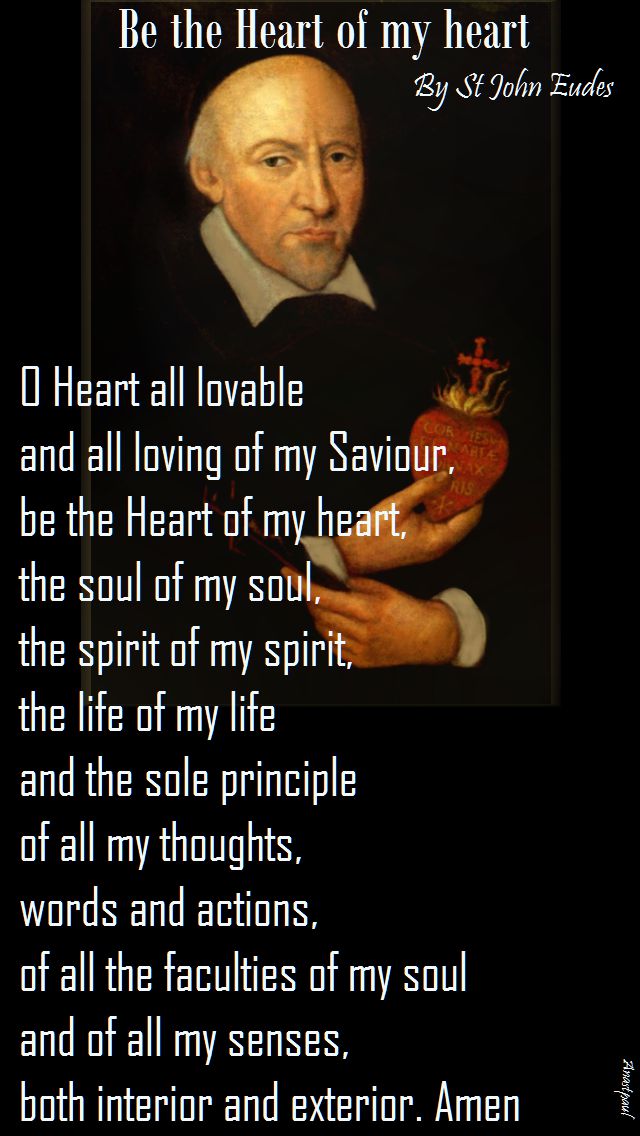
O Heart all lovable
and all loving of my Saviour,
be the Heart of my heart,
the soul of my soul,
the spirit of my spirit,
the life of my life
and the sole principle of all my thoughts,
words and actions,
of all the faculties of my soul
and of all my senses,
both interior and exterior. Amen
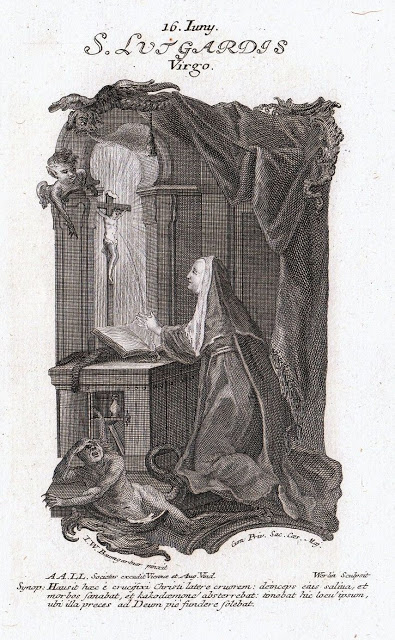
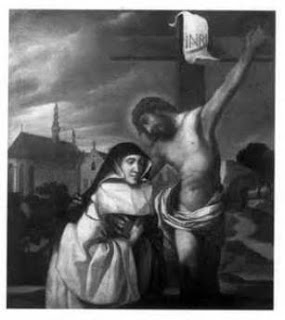
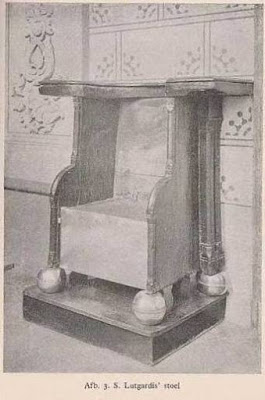
Saint of the Day – 16 June – St Lutgarde of Aywières (1182-1246 –The first known female stigmatic of the Church and one of the first promoters of devotion to the Sacred Heart – Religious, Mystric, Miracle-Worker, Stimatist, Visionary (1182 at Tongres, Limburg, Belgium – 16 June 1246 at Aywieres (modern Awirs), Belgium of natural causes, just as night office began on the Saturday night following Feast of the Holy Trinity) Her relics were transferred to Ittre, Belgium on 4 December 1796 to avoid destruction in the French Revolution. Patronages – birth, childbirth, blind people, againts blindness, disabled, handicapped of physically challenged people, Belgium, Flanders, Belgium. Attributes – • woman with Christ showing her His wounded side, blind Cistercian abbess, Cistercian nun being blinded by the Heart of Jesus, Cistercian to whom Christ extends his hand from the cross, woman in attendance when Christ shows his Heart to the Father
When Lutgarde was twelve, her parents placed her in the care of the Benedictine sisters at St. Catherine’s monastery near Liège, Belgium. The convent allowed visitors and young men came to court the beautiful young woman. Once when an ardent fellow and Lutgarde were talking, Christ appeared to her. Opening His garment, Christ showed Lutgarde the wound in His side bleeding as if recently opened and He said to her, “Do not seek any longer the caresses of unseemly love. Contemplate here what you should love and why you should love it. Here, I pledge to you are the delights of total purity, which will follow it.”When the confused young man tried to resume their conversation, Lutgarde chased him off. “Get away from me, you fodder of death,” she said, “for I have been overtaken by another lover.”
St. Lutgarde made unusually rapid progress in the spiritual life. She opened herself fully to Christ in prayer and He favoured her with an intimate experience of His presence. He gave her gifts of healing and of understanding the convent’s Latin prayers. But she asked him to take them back because both kept her from focusing on loving Him. Then the Lord said to her, “What do You want?” “I want Your heart,” she said. “No, rather it is Your heart that I want,” replied the Lord. “So be it, Lord,” said Lutgarde, “so long as Your heart’s love is mingled with mine and I have and hold my heart in You. For with You as my shield, my heart is secure for all time.”
St Lutgarde spent nine years in St. Catherine’s convent and she was elected to be Superioress of the community there. The year was 1205, when the saint was twenty-three years old. Far from being flattered or pleased by her elevation to this dignity, Lutgarde regarded it as a disaster. Indeed, it seems to have moved her to look elsewhere and to seek some other Order. She thought St. Catherine’s could provide her with sufficient opportunities for living as a contemplative as long as she was an obscure member of the community but not when she took her place at its head. While taking up her role as Superior, it was natural that her thoughts should turn to the austere Cistercian nuns, commonly known as Trappists, who had by this time, many flourishing convents in the Low Countries.
She asked the advice of a learned preacher of Liege, Jean de Lierre, who urged her to give up her post as prioress and leave the Benedictine Order for the Cistercian convent of Aywieres, (Awirs) which had recently been founded near Liege but had been transferred to a site in Brabant, near the village of Lillois. She was very reluctant to accept this particular choice because French was spoken in Brabant and she felt it would be unwise to enter a convent where she would not understand the language of her superiors or spiritual directors. Meanwhile, Christ Himself intervened and spoke the following words to her: “It is My will that you go to Aywieres, and if you do not go, I will have nothing more to do with you.” As if this were not enough, Lutgarde was also admonished by a saintly friend, who has since been venerated as St. Christine “the Admirable” who told her to go to Aywieres and so with no further possibility of doubt as to the convent of the Cistercian Order to which she was called, Lutgarde left St. Catherine’s without consulting her community and went to Aywieres.
When the nuns of St. Catherine’s discovered their loss, they were inconsolable, but it was too late to do anything about it. Lutgarde, in her turn, prayed earnestly for the peace of the community she had left and was assured by the Blessed Virgin that her prayers would be answered. Indeed, Thomas of Cantimpre ends the first book of his life of St. Lutgarde with the comment: “The indubitable effect of these prayers is to be seen even today [some fifty years later] in the community of St. Catherine’s. For this particular convent continues to grow in fervour more than ever, and to increase, at the same time, in temporal prosperity.”
Three times she fasted for periods of seven years, subsisting only on bread and liquids. The saint dedicated each fast for the Lord’s purposes: once for Lutgarde of Aywières the conversion of heretics, a second time for the salvation of sinners and a final time for Emperor Frederick II, who was threatening the church. Before her death she prophesied the latter’s demise, which occurred in 1250.
St Lutgardis is considered one of the leading mystics of the 13th century.[ A life of Lutgardis, Vita Lutgardis, was composed less than two years after her death by Thomas of Cantimpre, a Dominican friar and a theologian of some ability. Lutgardis was venerated at Aywières for centuries and her relics were exhumed in the 16th century. Works of art depicting the saint include a baroque statue of Lutgardis on the Charles Bridge by Matthias Braun in Prague and a painting by Goya.
Thomas Merton, in his biography of the Saint, reports that she had a particular devotion to St. Agnes, the Roman virgin martyr. She was one day praying to St. Agnes when “suddenly a vein near her heart burst, and through a wide open wound in her side, blood began to pour forth, soaking her robe and cowl.” She then sank to the floor and “lost her senses.” She was never known to have been wounded in this way again but it is known that she kept the scar until the end of her life. This took place when she was twenty-nine years old. Witnesses to this event were two nuns, one named Margaret, the other Lutgarde of Limmos, who washed the Saint’s clothes.
Thomas Merton also tells that on many occasions, this saintly Cistercian, in meditating on Christ’s Passion, would fall into ecstasy and sweat blood. A priest who had heard of this sweat of blood watched for an opportunity to witness it himself. One day he found her in ecstasy, leaning against a wall, her face and hands dripping with blood. Finding a pair of scissors, he managed to snip off a lock of the Saint’s hair which was wet with blood (he did so thinking to have proof of the event and also to have the lock of hair as a relic) As he stood marveling at the blood on the lock of hair, the Saint suddenly came to herself. Instantly the blood vanished; not only from her face and hands but also from the lock in his hands and also the blood that was on his hands! Thomas Merton writes “At this, the priest was so taken aback that he nearly collapsed from astonishment.”
St. Lutgarde spent four decades at Aywières entirely devoted to the heart of Christ. Five years before her death, that is, in 1241, St. Lutgarde received the revelation that she would enter heaven on the third Sunday after Pentecost, when the Gospel of the Great Marriage Feast would be sung. She died in 1246.
NOVENA in honour of the SACRED HEART of JESUS – DAY TWO – 15 JUNE
By St Alphonsus Liguori (1696-1787) Most Zealous Doctor Published in 1758 from THE HOLY EUCHARIST
MEDITATION II. The Loving Heart of Jesus.
Oh, if we could but understand the love that burns in the heart of Jesus for us! He has loved us so much, that if all men, all the Angels and all the Saints were to unite, with all their energies, they could not arrive at the thousandth part of the love that Jesus bears to us. He loves us infinitely more than we love ourselves, He has loved us even to excess: They spoke of His decease (excess) which He was to accomplish in Jerusalem. [Luke ix. 31] And what greater excess of love could there be than for God to die for His creatures? He has loved us to the greatest degree: Having loved His own . . . He loved them unto the end; [John, xiii. 1] since, after having loved us from eternity, —–for there never was a moment from eternity when God did not think of us and did not love each one-of us: I have loved thee with an everlasting love, [Jer. xxxi, 3]—–for the love of us. He made Himself Man and chose a life of sufferings and the death of the Cross for our sake. Therefore He has loved us more than His honur, more than His repose and more than His life; for He sacrificed everything to show us the love that He bears us. And is not this an excess of love sufficient to stupefy with astonishment the Angels of Paradise for all eternity?
This love has induced Him also to remain with us in the Holy Sacrament as on a throne of love; for He remains there under the appearance of a small piece of bread, shut up in a ciborium, where He seems to remain in a perfect annihilation of His majesty, without movement and without the use of His senses; so that it seems that He performs no other office there than that of loving men.Love makes us desire the constant presence of the object of our love. It is this love and this desire that makes Jesus Christ reside with us in the Most Holy Sacrament. It seemed too short a time to this loving Saviour to have been only thirty-three years with men on earth; therefore, in order to show His desire of being constantly with us, He thought right to perform the greatest of all miracles, in the institution of the Holy Eucharist. But the work of redemption was already completed, men had already become reconciled to God; for what purpose, then, did Jesus remain on earth in this Sacrament? Ah, He remains there because He cannot bear to separate Himself from us, as He has said that He takes a delight in us.
Again, this love has induced Him even to become the food of our souls, so as to unite Himself to us and to make His heart and ours as one: He that eateth My Flesh and drinketh My Blood, abideth in Me and I in him. [John, vi. 57] O
wonder! O excess of Divine love! It was said by a servant of God, if anything could shake my faith in the Eucharist, it would not be the doubt as to how the bread could become flesh, or how Jesus could be in several places and confined into so small a space, because I should answer that God can do everything; but if I were asked how He could love men so much as to make Himself their food, I have nothing else to answer but that this is a mystery of faith above my comprehension and that the love of Jesus cannot be understood. O love of Jesus, do Thou make Thyself known to men and do Thou make Thyself loved!
LET US PRAY – DAY TWO
O adorable heart of my Jesus, heart inflamed with the love of men,
heart created on purpose to love them,
how is it possible that You can be despised
and Your love so ill corresponded to by men?
Oh, miserable that I am, I also have been one of those ungrateful ones
that have not loved You.
Forgive me, my Jesus, this great sin of not having loved You,
Who are so amiable and Who has loved me so much
that You can do nothing more to oblige me to love You.
Grant me the grace to love You.
O Love of my Jesus; You are my Love.
O burning heart of my Jesus, inflame my heart also.
Do not permit me in future, even for a single moment,
to live without Your love; rather kill me, destroy me;
do not let the world behold the spectacle of such horrid ingratitude
as that I, who have been so beloved by You
and received so many favours and lights from You,
should begin again to despise Your love.
I trust in the Blood that You have shed for me,
that I shall always love You and that You will always love me
and that this love between You and me will not be broken off for all eternity.
O Mary, Mother of fair love,
you who desires so much to see Jesus loved,
bind me, unite me to your Son;
but bind me to Him, so that we may never again be separated. Amen
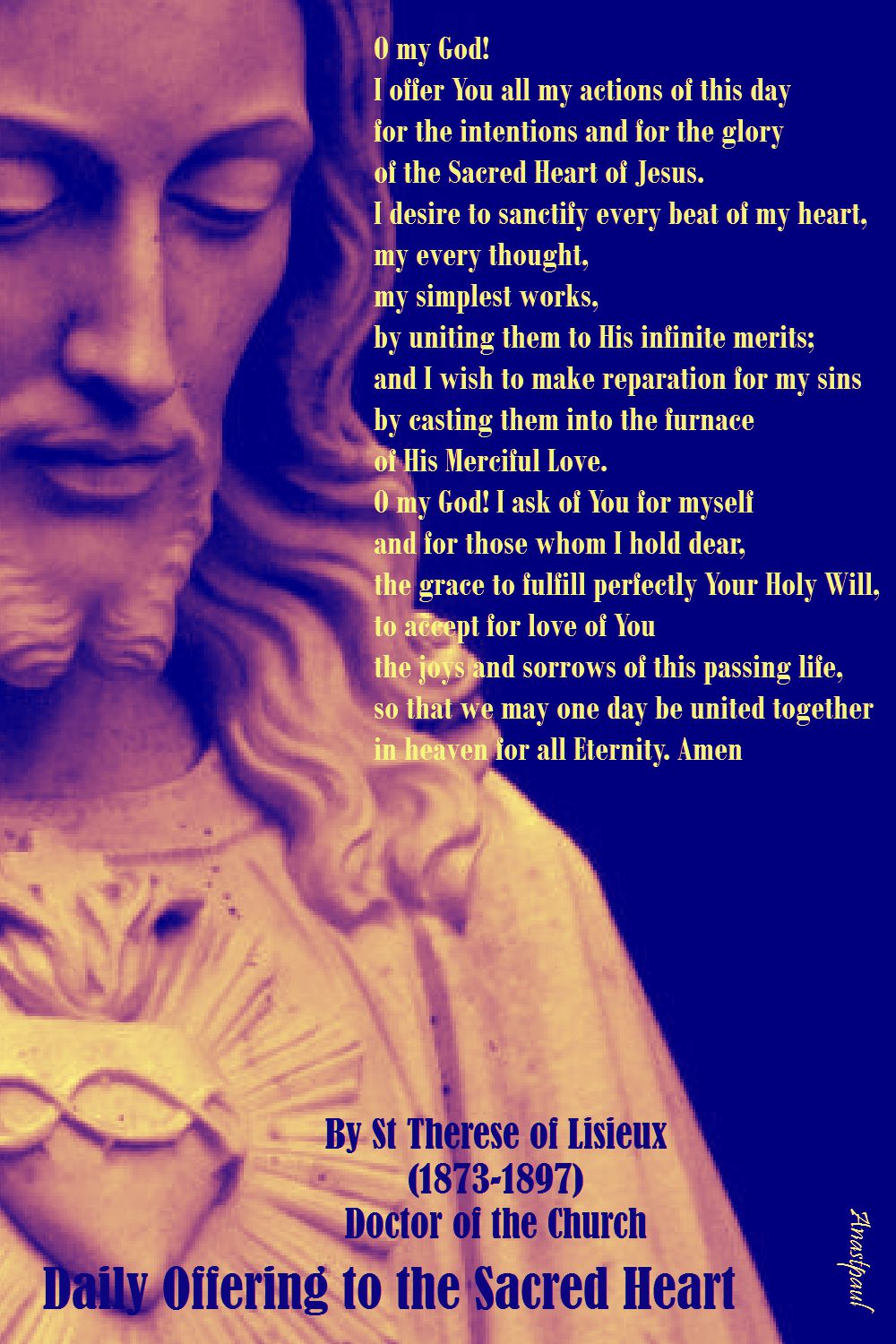
Daily Offering to the Sacred Heart By St Therese of Lisieux (1873-1897) Doctor of the Church
O my God!
I offer You all my actions of this day
for the intentions and for the glory
of the Sacred Heart of Jesus.
I desire to sanctify every beat of my heart,
my every thought,
my simplest works,
by uniting them to His infinite merits;
and I wish to make reparation for my sins
by casting them into the furnace
of His Merciful Love.
O my God! I ask of You for myself
and for those whom I hold dear,
the grace to fulfill perfectly Your Holy Will,
to accept for love of You
the joys and sorrows of this passing life,
so that we may one day be united together
in heaven for all Eternity. Amen





















You must be logged in to post a comment.