The Holy Father’s
Prayer Intention
for
DECEMBER 2019The Future of the Very Young
That every country
take the measures necessary,
to prioritise the future of the very young,
especially those who are suffering.
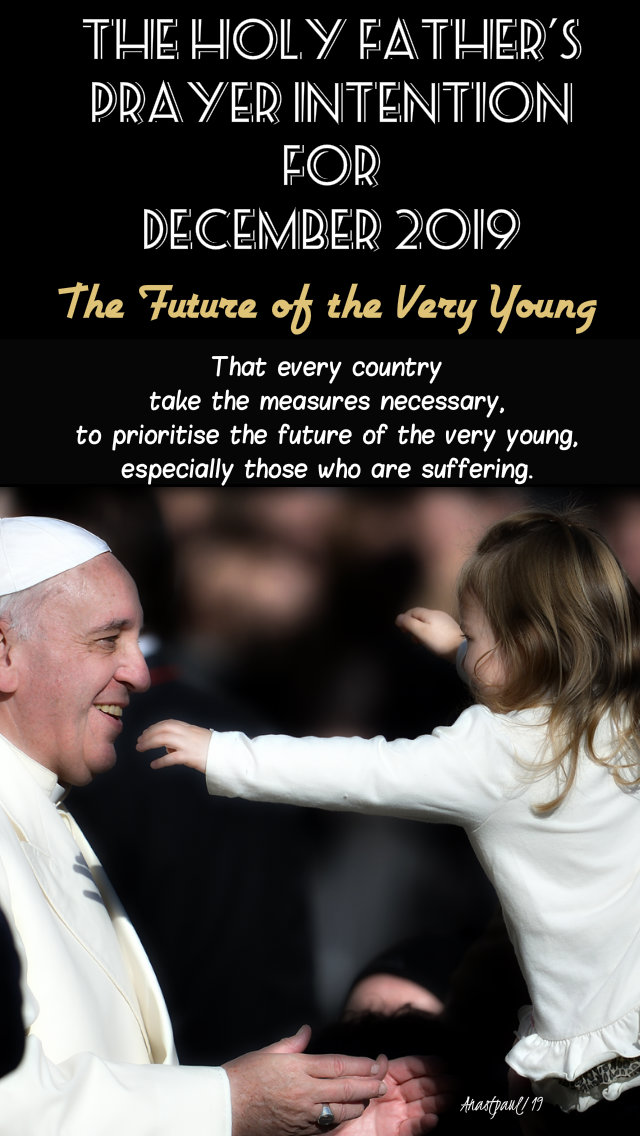
The Holy Father’s
Prayer Intention
for
DECEMBER 2019The Future of the Very Young
That every country
take the measures necessary,
to prioritise the future of the very young,
especially those who are suffering.
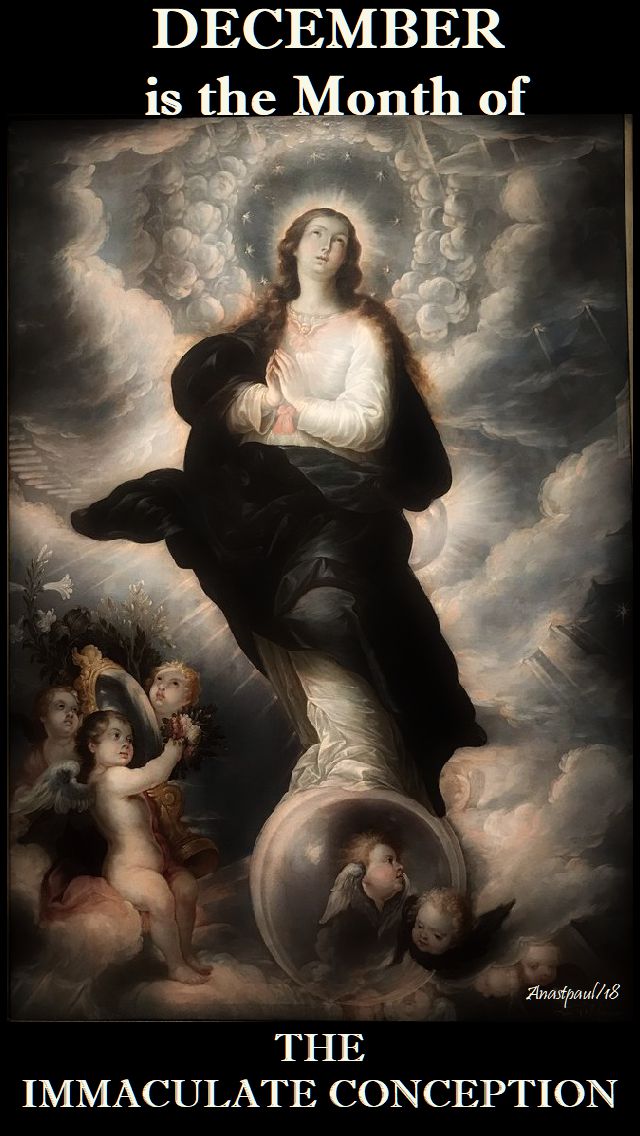
During Advent, as we prepare for the birth of Christ at Christmas, we also celebrate one of the great feasts of the Catholic Church. The Solemnity of the Immaculate Conception (8 December-moved to 8 December in 2019) is not only a celebration of the Blessed Virgin Mary but a foretaste of our own redemption.
In keeping the Blessed Virgin free from the stain of sin from the moment of her conception, God presents us with a glorious example of what mankind was meant to be. Mary is truly the second Eve, because, like Eve, she entered the world without sin. Unlike Eve, she remained sinless throughout her life—a life that she dedicated fully to the will of God. The Eastern Fathers of the Church referred to her as “without stain” (a phrase that appears frequently in the Eastern liturgies and hymns to Mary), in Latin, that phrase is immaculatus: “immaculate.”
The Immaculate Conception was not, as many people mistakenly believe, a precondition for Christ’s act of redemption but the result of it. Standing outside of time, God knew that Mary would humbly submit herself to His will and in His love for this perfect servant, He applied to her at the moment of her conception the redemption, won by Christ, that all Christians receive at their Baptism.
It is appropriate, then, that the Church has long declared the month in which the Blessed Virgin not only was conceived but gave birth to the Saviour of the world, as the Month of the Immaculate Conception.
The star of Mary Immaculate shines down on the path of Advent….
What person is more luminous than Mary?
Who can be for us, better than her, the star of hope,
the sunrise that proclaims the day of salvation?
Pope Benedict XVI
Holy light on earth’s horizon,
Star of hope to those who fall,
Light amid a world of shadows,
Dawn of God’s design for all.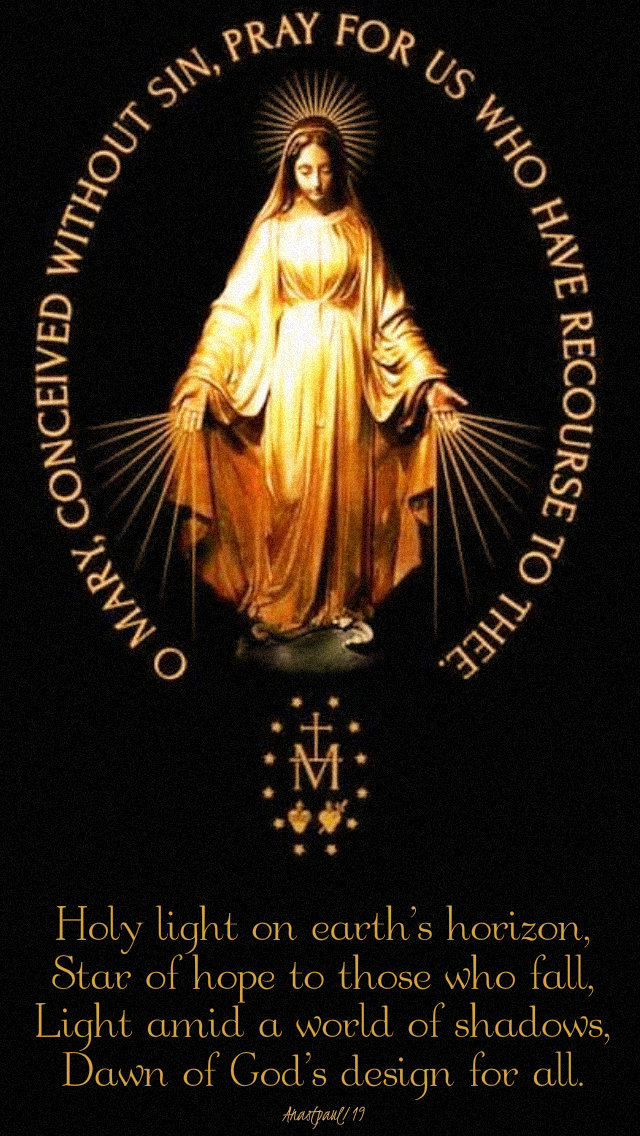
Mary, Virgin of Advent, may we always walk with you in the light of the Lord, Jesus, the fruit of your womb! Amen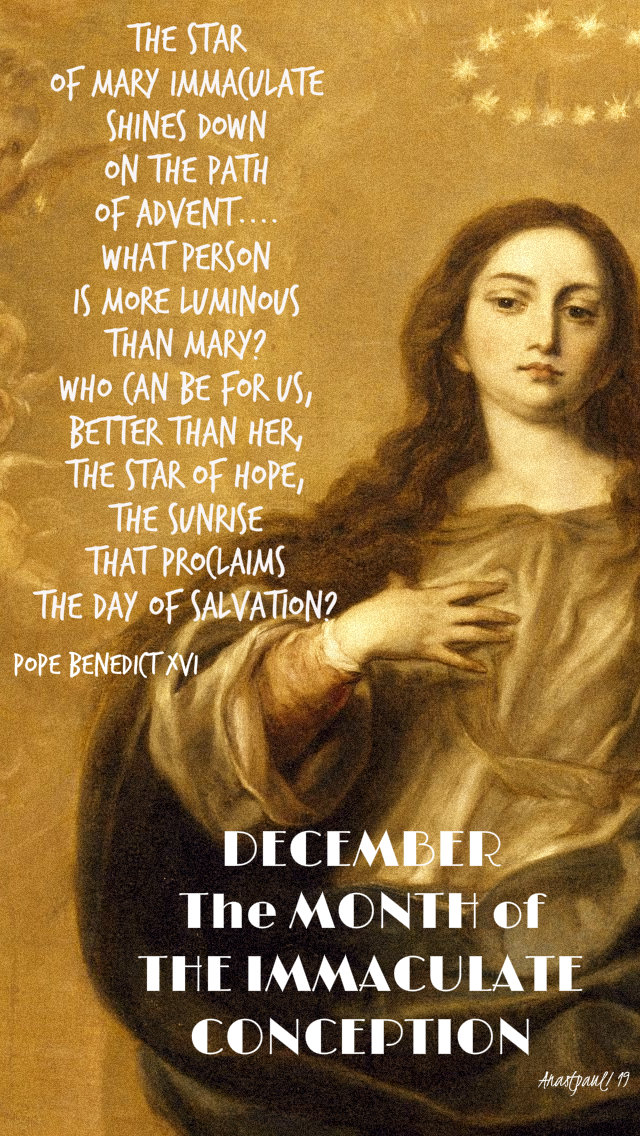
Thought for the Day – 1 December – The First Sunday of Advent, Year A
An excerpt from Catechetical Instruction, Catechesis 15
We do not preach only one coming of Christ but a second as well, much more glorious than the first. The first coming was marked by patience, the second will bring the crown of a divine kingdom.
In general, whatever relates to our Lord Jesus Christ has two aspects. There is a birth from God before the ages and a birth from a virgin at the fullness of time. There is a hidden coming, like that of rain on fleece and a coming before all eyes, still in the future.
At the first coming He was wrapped in swaddling clothes in a manger. At His second coming He will be clothed in light as in a garment. In the first coming He endured the cross, despising the shame; in the second coming He will be in glory, escorted by an army of angels. We look then beyond the first coming and await the second. At the first coming we said – Blessed is He who comes in the name of the Lord. At the second we shall say it again, we shall go out with the angels to meet the Lord and cry out in adoration – Blessed is He who comes in the name of the Lord.
The Savior will not come to be judged again, but to judge those by whom he was judged. At His own judgement He was silent, then He will address those who committed the outrages against Him when they crucified Him and will remind them – You did these things and I was silent.
His first coming was to fulfil His plan of love, to teach men by gentle persuasion. This time, whether men like it or not, they will be subjects of His kingdom by necessity. Malachi the prophet speaks of the two comings. And the Lord whom you seek will come suddenly to His temple – that is one coming.
Again he says of another coming – Look, the Lord almighty will come and who will endure the day of His entry, or who will stand in His sight? Because he comes like a refiner’s fire, a fuller’s herb and He will sit refining and cleansing.
These two comings are also referred to by Paul in writing to Titus – The grace of God the Saviour has appeared to all men, instructing us to put aside impiety and worldly desires and live temperately, uprightly and religiously in this present age, waiting for the joyful hope, the appearance of the glory of our great God and Saviour, Jesus Christ. Notice how he speaks of a first coming for which he gives thanks and a second, the one we still await.
That is why the faith we profess has been handed on to you in these words: He ascended into heaven and is seated at the right hand of the Father and He will come again in glory to judge the living and the dead and His kingdom will have no end.
Our Lord Jesus Christ will therefore come from heaven. He will come at the end of the world, in glory, at the last day. For there will be an end to this world and the created world will be made new.
Grant, almighty Father,
that when Christ comes again,
we may go out to meet Him,
bearing the harvest of good works,
achieved by Your Grace.
We pray, that He will receive us
into the company of the saints
and call us into the Kingdom of Heaven.
Through Christ, our Lord,
with the Holy Spirit,
God for all eternity,
Amen
Quote/s of the Day – 1 December – The Memorial of St Edmund Campion (1540-1581) and Bl Charles of Jesus de Foucauld (1858-1916) Both Martyrs
“To be a Catholic is my greatest glory.”

“In order to save us,
God came to us
and lived among us,
from the Annunciation
to the Ascension,
in a close and familiar way.
God continues to come to us
and to live with us
in a close and familiar way,
each day and at every hour,
in the holy Eucharist.
So we too must go
and live among
our brothers and sisters
in a close and familiar way.”
“Whether our life
be that of Nazareth,
the Public Life
or the Desert…
it should cry the Gospel..”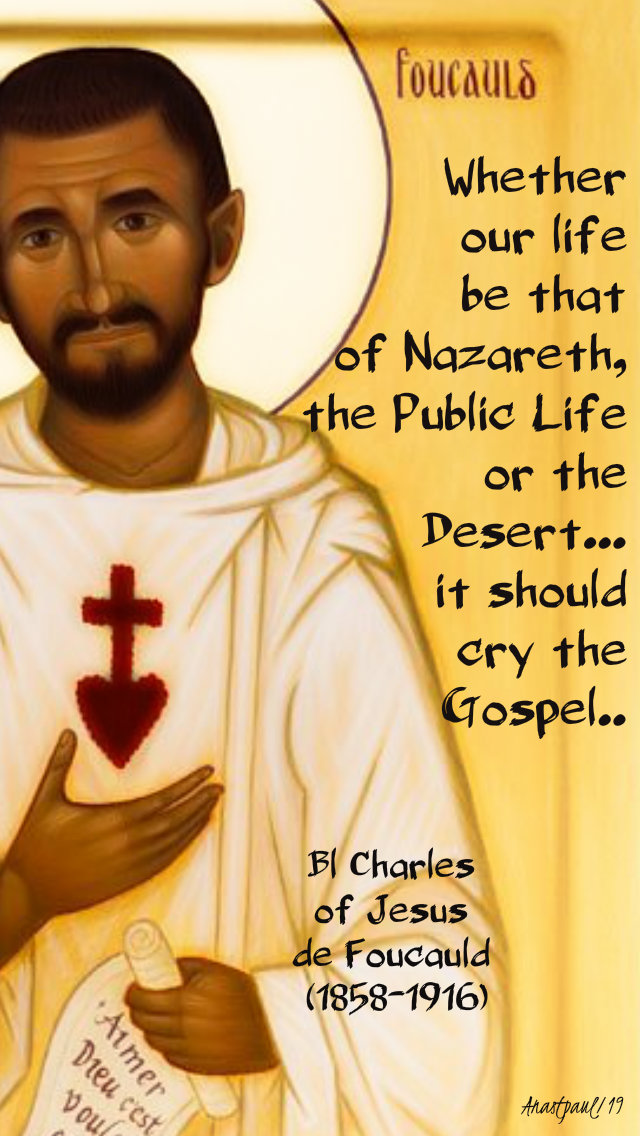
“To pray,
is to think about Jesus
and love Him.
The more we love,
the better we pray.”
“God who is infinite, all powerful,
has become man,
the least of men.
My way is always to seek the lowest place,
to be as little as my Master,
to walk with Him,
step-by-step as a faithful disciple.
My way, is to live with my God
who lived this way all His life
and, who has given me,
such an example,
from His very birth.

Sunday Reflection – 1 December – The First Sunday of Advent, Year A and the Memorial of Bl Charles of Jesus de Foucauld (1858-1916) Martyr
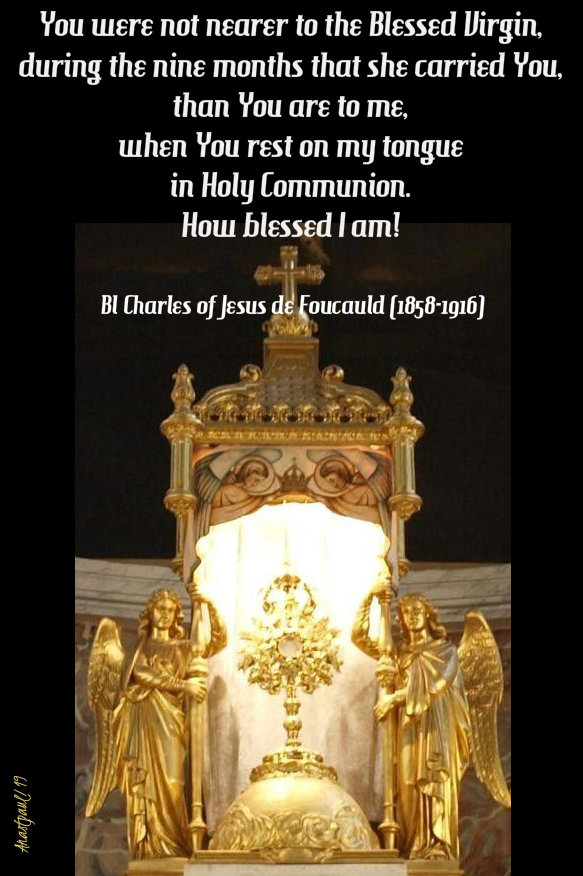
Lord Jesus, You are in the Holy Eucharist. You are there a yard away in the Tabernacle. Your body, Your soul, Your human nature, Your divinity, Your whole being is there, in its twofold nature. How close You are, my God, my Saviour, my Spouse, My Beloved!
You were not nearer to the Blessed Virgin during the nine months that she carried You, than You are to me, when You rest on my tongue in Holy Communion. You were no closer to the Blessed Virgin and St Joseph in the caves at Bethlehem, or in the flight into Egypt, or at any moment of that divine family life, than you are to me at this moment – and so many others – in the Tabernacle.
Mary… was no closer to you when she sat at your feet at Bethany, than I am here, at the foot of this altar. You were no nearer to Your apostles when you were sitting in the midst of them than You are to me now, my God. How blessed I am!
Advent Reflection – 1 December – The First Sunday of Advent, Year A –
Isaiah 2:1-5, Psalm 122:1-9, Romans 13:11-14, Matthew 24:37-44
“So too, you also must be prepared,
for at an hour you do not expect,
the Son of Man will come.”
Matthew 24:44
St Bernard (1091-1153)
Doctor of the Church
Sermons 4 and 5 for Advent
“It is only right, my brothers, to celebrate our Lord’s coming with all possible devotion, so greatly does His comfort gladden us… and His love burn within us. But do not just think about His first coming when He came “to seek and save the lost” (Lk 19:10), think, too, of that other coming when He will come to take us with Him. I should like to see you constantly occupied in meditating on these two comings… “resting among the sheepfolds” (Ps 68[67]:14), for they are the two arms of the Bridegroom in which the Bride of the Song of Songs took her rest: “His left arm is under my head and his right arm embraces me” (2:6)…
But there is a third coming between the two to which I have just referred and those who know of it, can rest in it for their greater happiness. The other two are visible but this one is not. In the first, “ the Lord has appeared on earth and has spoken to us” (Bar 3:38)… in the last, “all mankind shall see the salvation of God” (Lk 3:6; Is 40:5)… But the one that comes between them is secret, it is that in which the elect alone see the SavioUr within themselves and their souls find salvation.
In His first coming, Christ came in our flesh and in our weakness; in His coming in the midst of time, He comes in Spirit and power; in His final coming, He will come in His glory and majesty. But it is by the strength of the virtues, that we attain to glory, as it is written: “The Lord, the king of armies, he is the king of glory” (Ps 24[23]:10) and, in the same book: “That I may see your power and your glory” (Ps 63[62]:3). And so the second coming is like a road leading from the first to the last. In the first, Christ has been our redemption, in the last, He will appear as our life, in His coming between, He is our rest and our consolation.”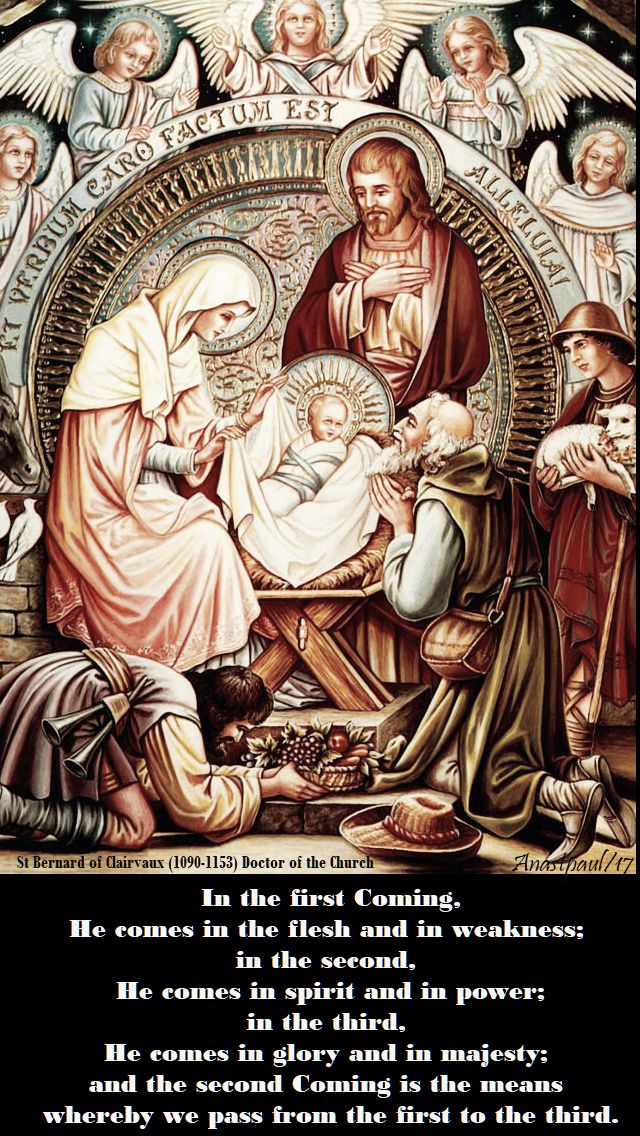
Prayer for the Advent Wreath
Lord, our God,
we praise You for Your Son, Jesus Christ,
for He is Emmanuel, the Hope of all people.
He is the Wisdom that teaches and guides us.
He is the Saviour of us all.
O Lord,
let Your blessing come upon us
as we light the first (purple) candle of this wreath.
May the wreath and its light
be a sign of Christ’s promise of salvation.
May He come quickly and not delay.
We ask this through Christ, our Lord.
Amen.
Waiting
We light a advent candle today, a small dim light against a world that often seems forbidding and dark. But we light it because we are a people of hope, a people whose faith is marked by an expectation that we should always be ready for the coming of the Master. The joy and anticipation of this season is captured beautifully in the antiphons of hope from the monastic liturgies:
See! The ruler of the earth shall come,
the Lord who will take from us the heavy burden of our exile
The Lord will come soon, will not delay.
The Lord will make the darkest places bright.
We must capture that urgency today in the small flame of our candle. We light the candle because we know that the coming of Christ is tied to our building of the kingdom. Lighting the flame, feeding the hungry, comforting the sick, reconciling the divided, praying for the repentant, greeting the lonely and forgotten – doing all these works hastens His coming.
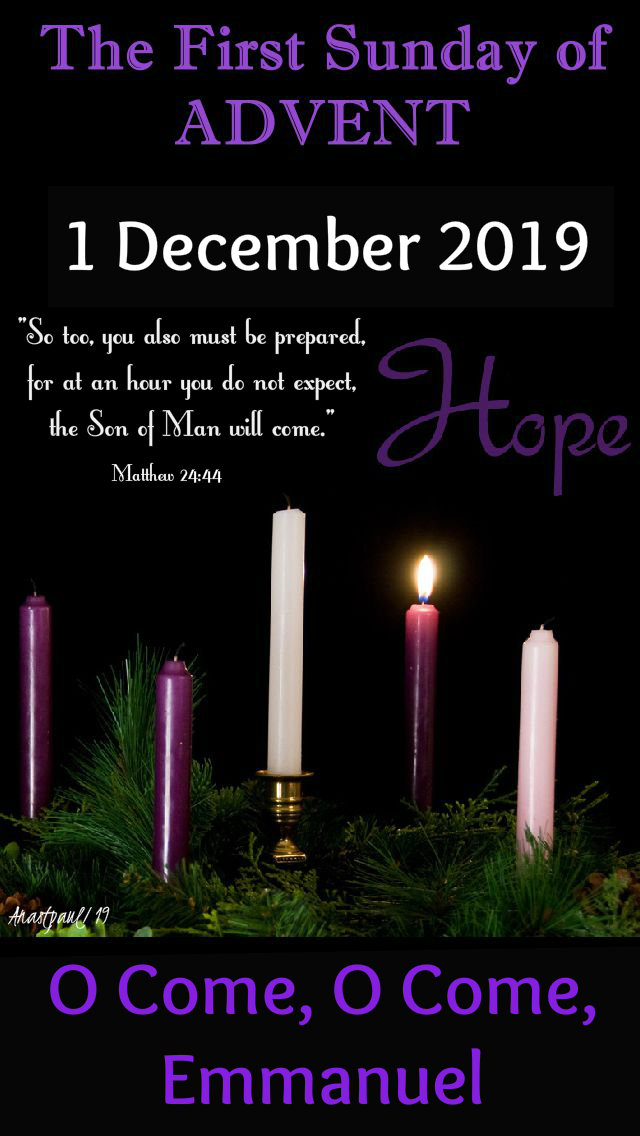
Our Morning Offering – 1 December – First Sunday of Advent, Year A
Come, O Long-Expected Jesus
Breviary Lauds Hymn
First Sunday Advent
Come, O long-expected Jesus,
Born to set Thy people free,
From our fears and sins release us,
Let us find our rest in Thee.
Israel’s strength and consolation,
Hope of all the earth Thou art,
Dear desire of every nation,
Joy of every longing heart.
Born Thy people to deliver,
Born a child and yet a king,
Born to reign in us forever,
Now Thy gracious kingdom bring.
By Thine own eternal Spirit
Rule in all our hearts alone,
By Thine all-sufficient merit
Raise us to Thy glorious throne.
Saint of the Day – 1 December – Blessed John of Vercelli OP (c 1205-1283) – Dominican Priest and Friar, Sixth Master General of the Order of Preachers, Founder of the The Society of the Holy Name, Canon lawyer, Professor – born in c 1205 at Mosso Santa Maria, Italy as Giovanni Garbella and died in September 1283 at Montpelier, France of natural causes.
John Garbella was born early in the 13th century, somewhere near Vercelli. He studied at Paris and was ordained priest before 1229. He taught canon law at the University of Paris. While he was professor there, Blessed Jordan of Saxony (who was a friend of Saint Albert the Great) came to Paris and John saw one after another of his best pupils desert their careers to join the Dominicans. He seems to have considered them quite objectively, without reference to himself, until one day he had an interior voice that spoke to him that it was God’s will for him to join the Dominicans. No one can say that John did not respond with alacrity – he dropped everything and ran down the street. “Let me go; I am on my way to God!” Jordan received him happily and gave him the habit.
In 1232, John was sent to Vercelli to establish a convent there. He built this and several other convents in Lombardy as houses of regular observance. While provincial of Lombardy, he also became inquisitor. It was a particularly difficult moment. His brother in religion, St Peter of Verona, had just been killed by the heretics in Como. The entire countryside was in a state of war, with roving bands of heretics and robbers. It was the task of the new inquisitor to try to bring order out of this chaos and what John did was remarkable, considering the situation. In spite of his heavy labours, which included the supervision of 600 friars in 28 different cities (he reached them only by walking), John of Vercelli established the ideals of study and regular observance in all of his houses.
But it was also, the good fortune of John of Vercelli to live in an age that was well peopled by saints. He formed a close friendship with Saint Louis, the king of France. Several of his tasks in the order, particularly the Commission on the Program of Studies, he shared with Saint Albert the Great, Saint Thomas Aquinas and Peter of Tarentaise (the future Pope Innocent V). In such company one would need to have a superior set of talents – John did.
In 1264 the chapter of the order met at Paris. Blessed Humbert had resigned as master general of the order. John went to the chapter hoping that he could resign as provincial of Lombardy. Instead of escaping one office, he fell heir to a still more difficult one. He was elected master general in 1264 and served in that capacity until 1283. John was then a man in his sixties and was, moreover, handicapped by a crippled leg. However, he accepted the office which would require him to walk, not only all over Lombardy but all over Europe. It took a brand of courage and obedience that was little short of heroic.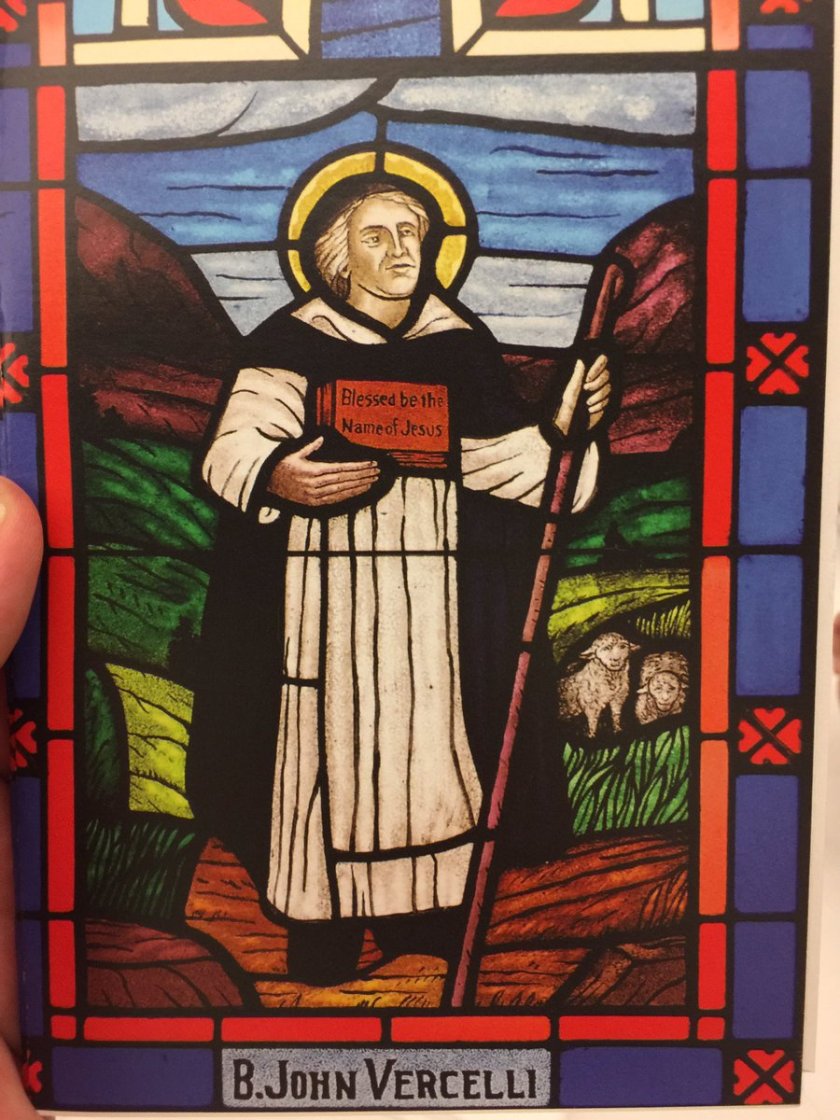
During the generalate of John of Vercelli, the relics of Saint Dominic were transferred to the new tomb that had been prepared for it by Nicholas of Pisa. When the transfer was made, John of Vercelli fixed his seal on the tomb, the seals were still intact on their examination in 1946. During the translation of the relics, according to the account in the Vitae Fratrum, when the body of Saint Dominic was exposed to view, the head was seen to turn towards John of Vercelli. John, embarrassed, moved to another part of the church and gave his place to a cardinal. Whereupon, the head of Saint Dominic was seen by all to turn again in John’s direction!
On the death of Clement IV, John of Vercelli was very nearly elected pope. Being warned of the possibility, he fled in fright. However, his good friend Cardinal Visconti, was elected and took the name Gregory X. He appointed John as legate on several different missions.
He was commissioned by the pope to draw up the Schema for the second ecumenical council of Lyons in 1274–that council to which Saint Thomas Aquinas was hurrying when death found him on the road. At the council John distinguished himself for his assistance by offering to the council the talents of his best men. At the council, he accepted for the Dominican Order the special commission of promoting reverence for the Holy Name of Jesus and fighting blasphemy, which was, in that day as in ours, a prevalent vice. He can thus be considered the founder of the Holy Name Society, even though the Confraternity was not formed until 1432.
Several precious relics were suitably enshrined by John of Vercelli. These included several thorns from the Crown of Our Lord, which had been given him by Saint Louis of France. The cord of Saint Thomas, with which he had been guided by the angels and which he had worn until death, was given into the care of the master general, who gave it to the convent of Vercelli for safe keeping.
John’s career was rapidly reaching its end. In 1279, he presided over the famous chapter of Paris at which the order made the doctrine of Saint Thomas officially its own. The following year, he laid the foundations of the Church of Santa Maria Sopra Minerva. One of his last official acts was to provide for a work on the instruction of novices (Benedictines, Dorcy).
He was buried at the Dominican convent at Montpelier but his tomb was desecrated by Calvinists in 1562 and his body disappeared. He was Beatified in 1903 by Pope Pius X (cultus confirmed), 1909 elevated him to the honours of the altar.
First Sunday of Advent, Year A +2019
St Agericus of Verdun
St Agnofleta
St Alexander Briant
Bl Alphonsine Anuarite Nengapeta
St Ambon of Rome
St Ananias of Arbela
St Ansanus the Baptizer
Bl Antony Bonfadini
Bl Bruna Pellesi
St Candida of Rome
St Candres of Maestricht
St Cassian of Rome
St Castritian of Milan
Bl Charles of Jesus/de Foucauld OCSO (1858-1916)
Blessed Charles why are you not a Saint yet! –
https://anastpaul.com/2018/12/01/saint-of-the-day-1-december-blessed-charles-of-jesus-charles-de-foucauld-1858-1916/
Bl Christian of Perugia
St Constantine of Javron
St Declan
St Didorus
St Domnolus of Le Mans
St Edmund Campion SJ (1540-1581 aged 41) Martyr
About dear St Edmund:
https://anastpaul.wordpress.com/2016/12/01/saint-of-the-day-1-december/
St Eligius
St Evasius of Asti
St Filatus of Rome
St Florence of Poitiers
St Florentius
St Grwst
St Jabinus of Rome and Companions
Bl John Beche
Blessed John of Vercelli OP (c 1205-1283)
Bl Kazimierz Tomasz Sykulski
St Latinus of Rome
St Leontius of Fréjus
Bl Liduina Meneguzzi
St Lucius of Rome
Bl Maria Clara of the Child Jesus
St Marianus
St Marina of Rome
St Martinus
St Nahum the Prophet
St Natalia of Nicomedia
St Olympiades
St Proculus of Narni
St Ralph Sherwin
St Resignatus of Maastricht
Bl Richard Langley
St Rogatus of Rome
St Simon of Cyrene
St Superatus of Rome
St Ursicinus of Brescia
—
Martyrs of Oxford University: A joint commemoration of all the men who studied at one of the colleges of Oxford University, and who were later martyred for their loyalty to the Catholic Church during the official persecutions in the Protestant Reformation. They are:
• Blessed Edward James • Blessed Edward Powell • Blessed Edward Stransham • Blessed George Napper • Blessed George Nichols • Blessed Hugh More • Blessed Humphrey Pritchard • Blessed James Bell • Blessed James Fenn • Blessed John Bodey • Blessed John Cornelius • Blessed John Forest • Blessed John Ingram • Blessed John Mason • Blessed John Munden • Blessed John Shert • Blessed John Slade • Blessed John Storey • Blessed Lawrence Richardson • Blessed Mark Barkworth • Blessed Richard Bere • Blessed Richard Rolle de Hampole • Blessed Richard Sergeant • Blessed Richard Thirkeld • Blessed Richard Yaxley • Blessed Robert Anderton • Blessed Robert Nutter • Blessed Robert Widmerpool • Blessed Stephen Rowsham • Blessed Thomas Belson • Blessed Thomas Cottam • Blessed Thomas Pilcher • Blessed Thomas Plumtree • Blessed Thomas Reynolds • Blessed William Filby • Blessed William Hart • Blessed William Hartley • Saint Alexander Briant • Saint Cuthbert Mayne • Saint Edmund Campion • Saint John Boste • Saint John of Bridlington • Saint John Roberts • Saint Ralph Sherwin • Saint Thomas Garnet • Saint Thomas More
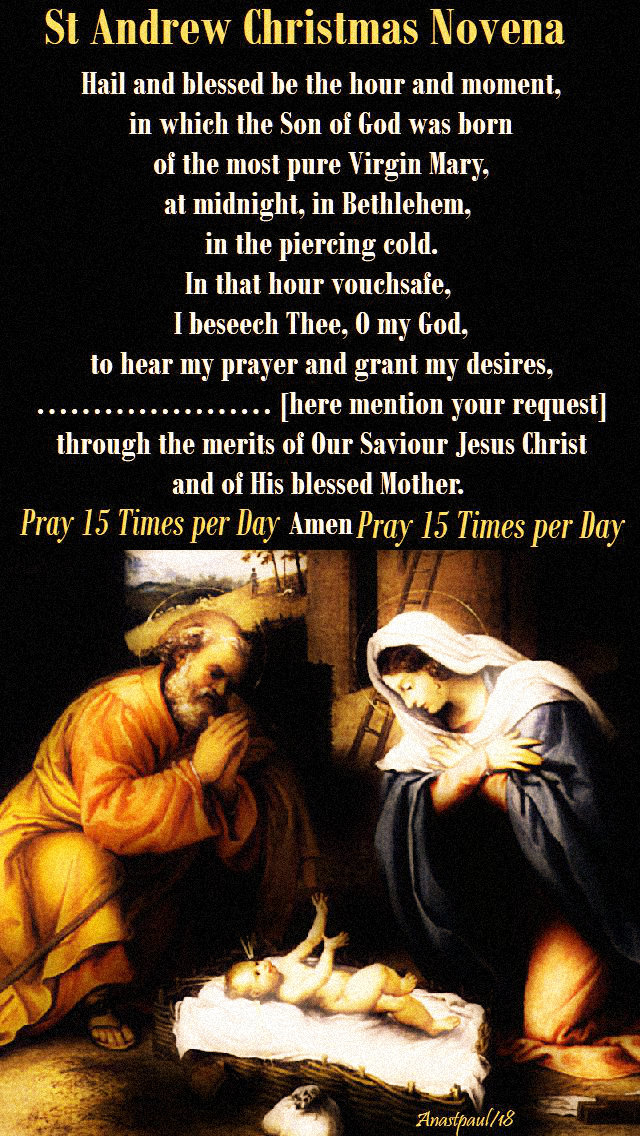
The St Andrew Christmas Novena – The Christmas Anticipation Prayer
Pray 15 Times each day.
Let us Pray!
Hail and blessed be the hour and moment,
in which the Son of God was born
of the most pure Virgin Mary,
at midnight, in Bethlehem,
in the piercing cold.
In that hour vouchsafe,
I beseech Thee, O my God,
to hear my prayer and grant my desires,
………………… [here mention your request]
through the merits of Our Saviour Jesus Christ
and of His blessed Mother.
Amen
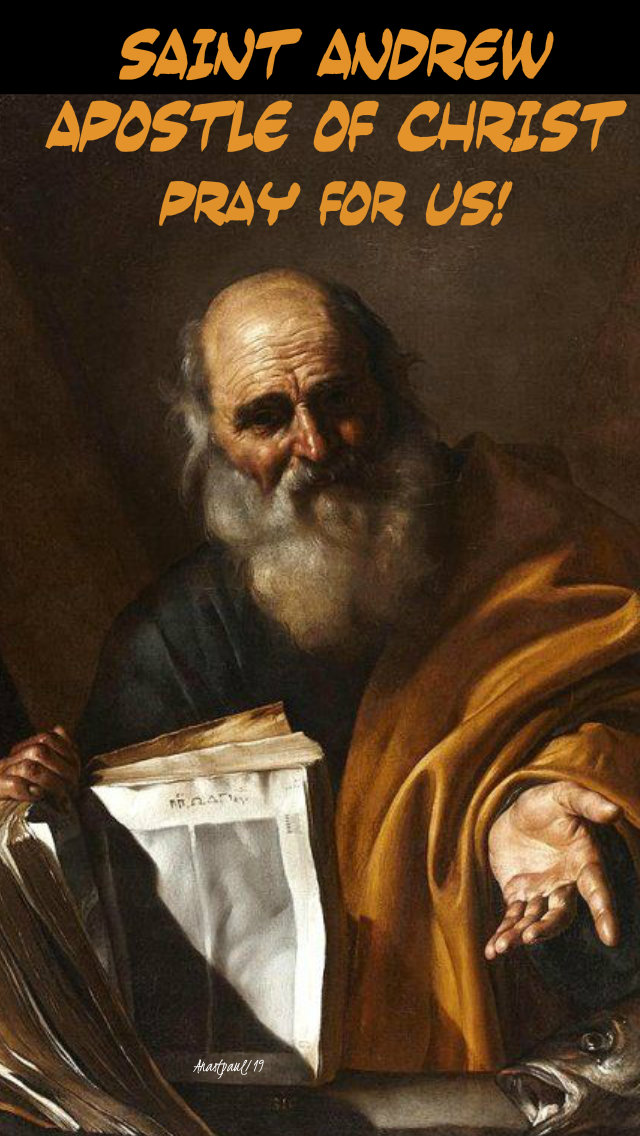
Thought for the Day – 30 November – The Feast of St Andrew, Apostle of Christ, Martyr for Christ
“St Andrew was the first convert among the Apostle; he was especially in our Lord’s confidence; thrice is he described as introducing others to Him; [but] he is little known in history; while the place of dignity and the name of highest renown, have been allotted to his brother Simon, whom he was the means of bringing to the knowledge of his Saviour ….
These men, are not necessarily, the most useful men in their generation, not the most favoured by God, who made the most noise in the world and who seem to be principals in the great changes and events recorded in history ….
His marvellous Providence works beneath a veil, which speaks but an untrue language. And, to see Him who is the Truth and the Life, we must stoop underneath it and so, in our turn, hide ourselves from the world.”
Quote of the Day – 30 November – The Feast of St Andrew, Apostle of Christ, Martyr on the Cross for Christ
This is what the Apostle is claimed to have said on that occasion, according to an ancient story (which dates back to the beginning of the sixth century), entitled The Passion of Andrew:
“Hail, O Cross, inaugurated by the Body of Christ and adorned with His limbs as though they were precious pearls. Before the Lord mounted you, you inspired an earthly fear. Now, instead, endowed with heavenly love, you are accepted as a gift.
Believers know of the great joy that you possess and of the multitude of gifts you have prepared. I come to you, therefore, confident and joyful, so that you too may receive me, exultant as a disciple of the One who was hung upon you…. O blessed Cross, clothed in the majesty and beauty of the Lord’s limbs!…
Take me, carry me far from men and restore me to my Teacher, so that, through you, the One who redeemed me by you, may receive me.
Hail, O Cross, yes, hail indeed!”

One Minute Reflection – 30 November – The Feast of St Andrew, Apostle of Christ, Gospel: Matthew 4:18–22
“Follow me and I will make you fishers of men” … Matthew 4:19
REFLECTION – “The call reaches them in the middle of their daily activity – the Lord reveals Himself to us, not in an extraordinary or impressive way but in the everyday circumstances of our life. There we must discover the Lord and there, He reveals Himself, makes His love felt in our heart and there — with this dialogue with Him in the everyday circumstances of life — He changes our heart. The response of the four fishermen is immediate and willing – “Immediately they left their nets and followed him” (v. 20). On the shores of the lake, in an inconceivable land, the first community of disciples of Christ was born. May the knowledge of these beginnings give rise in us to the desire to bear Jesus’ word, love and tenderness in every context, even the most difficult and resistant. To carry the Word to all the peripheries! … Pope Francis – Angelus, 22 January 2017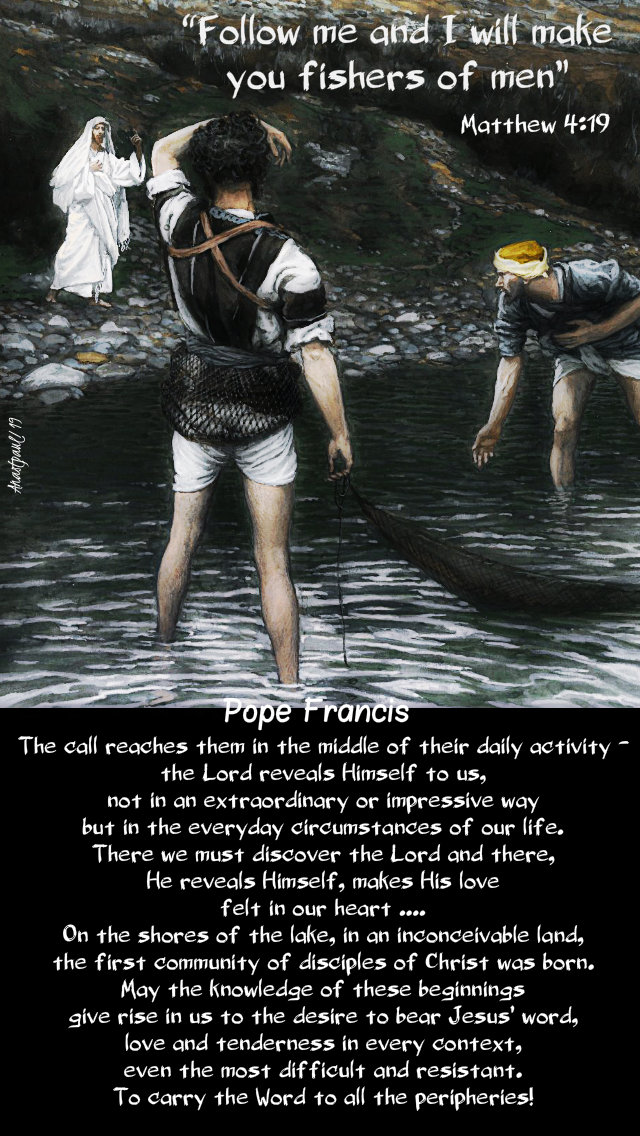
PRAYER – Lord, in Your kindness hear our petitions. You called Andrew the Apostle, to preach the Gospel and guide Your Church in faith. May he always be our friend in Your presence, to help us with his prayers. We ask this through our Lord Jesus Christ, Your Son, who lives and reigns with You and the Holy Spirit, one God, forever and ever. Amen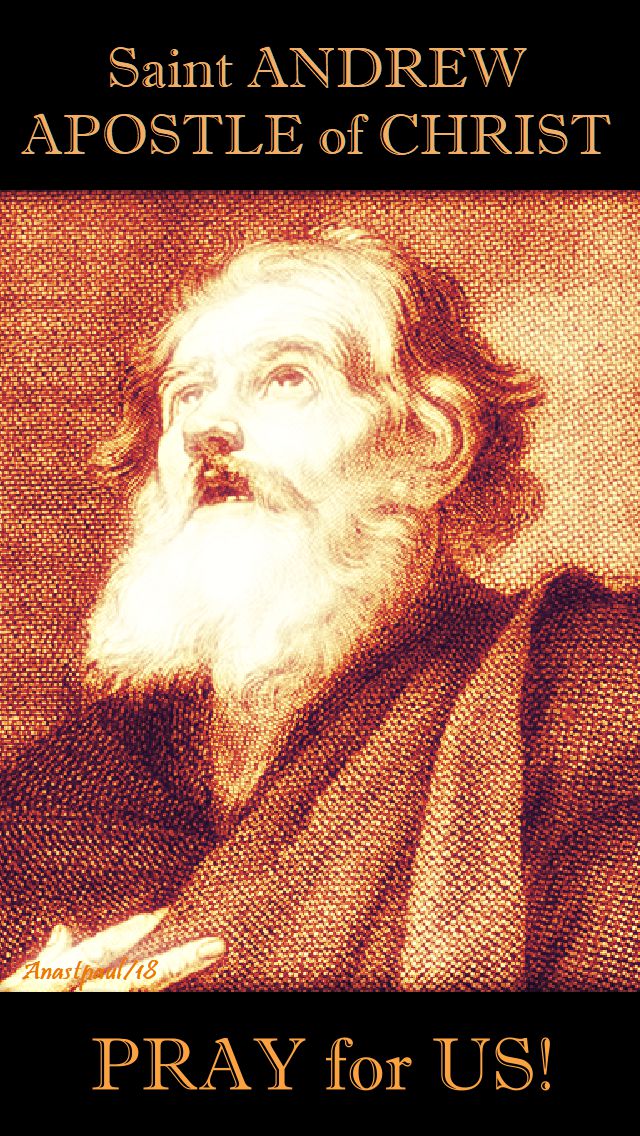
Our Morning Offering – 30 November – The Feast of St Andrew, Apostle of Christ and Martyr
Great Saint Andrew Friend of Jesus
By Frederick Oakley (1802-1880)
(Frederick Oakley was an Anglican minister
who converted to Catholicism)
Great Saint Andrew friend of Jesus,
Lover of His glorious Cross,
Quickly at the master’s bidding,
Called from ease to pain and loss,
Sweet Saint Andrew, Simon’s brother,
Like him started life anew,
Gladly spread the holy gospel
Which from word of God he drew.
Blessed Saint Andrew, noble herald,
True apostle, martyr bold,
Who, by deeds his words confirming,
Sealed with blood the truth he told.
Never was a crown more glorious,
Never prize to heart so dear,
As to him the Cross of Jesus
When its promised joys drew near.
Loved Saint Andrew, Scotland’s patron,
Watch thy land with heedful eye,
Rally round the Cross of Jesus
All her storied chivalry!
To the Father, Son and Spirit,
Fount of sanctity and love,
Give we glory, now and ever,
With the saints who reign above.
Feast of St Andrew, Apostle of Christ, Martyr – 30 November
Saint Andrew was the brother of the Apostle Peter and like his brother was born in Bethsaida of Galilee (where the Apostle Philip was also born). While his brother would eventually overshadow him as the first among the apostles, it was Saint Andrew, a fisherman like Peter, who (according to the Gospel of John) introduced Saint Peter to Christ.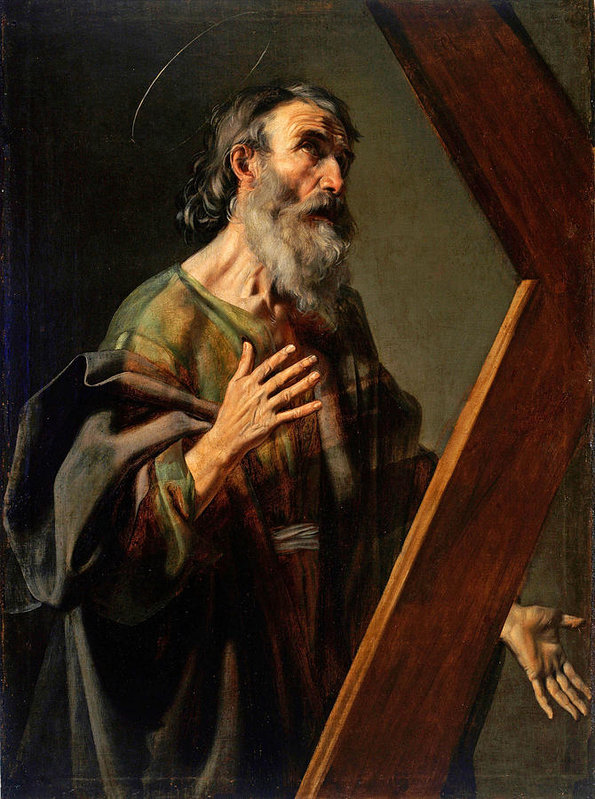
St Andrew was a fisherman who lived in Galilee during the time of Jesus. He followed John the Baptist and listened to his teachings. One day, John saw Jesus walking along the road. John said to his followers, “Behold the Lamb of God.” He told his followers to go and talk to Jesus. He wanted them to know that Jesus was the One for whom they had been waiting. Andrew and another disciple followed Jesus and spent an afternoon with him. Early the next day Andrew found Simon Peter, his brother and told him, “We have found the Messiah.”
Both men gave up their work as fishermen to become apostles of Jesus. Andrew was one of the first to be called. He seemed to take delight in bringing others to Jesus. 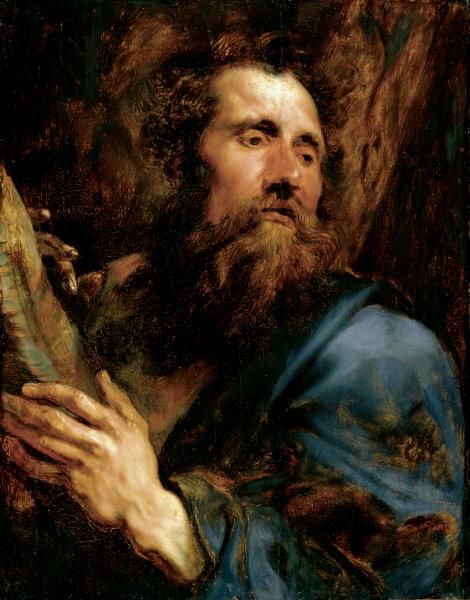
Andrew was the one who told Jesus about the little boy who had the loaves of bread and the fish, the beginning of a meal that fed more than five thousand people.
It was Andrew and Philip whom the Greeks approached when they wanted to see Jesus. These events indicate that Andrew was a man who was easy to approach, a man you could trust.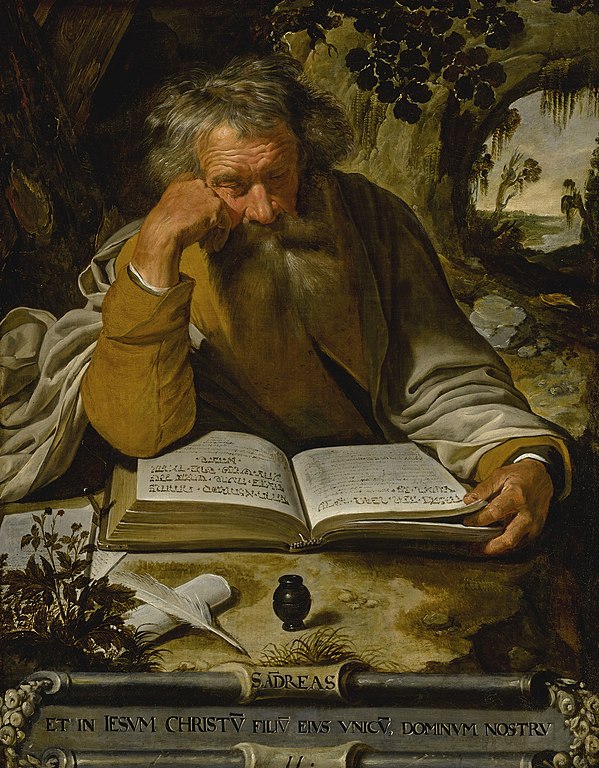
Like the other apostles, Andrew became a missionary. He preached about Jesus in the area around the Black Sea. Tradition tells us he preached in northern Greece, Turkey and Scythia (now the southern part of Russia).
Tradition places Saint Andrew’s martyrdom on 30 November of the year 60 (during the persecution of Nero) in the Greek city of Patras. A medieval traditional also holds that, like his brother Peter, he did not regard himself as worthy of being crucified in the same manner as Christ and so he was placed on an X-shaped cross, now known (especially in heraldry and flags) as a Saint Andrew’s Cross. The Roman governor ordered him bound to the cross rather than nailed, to make the crucifixion and thus Andrew’s agony, last longer.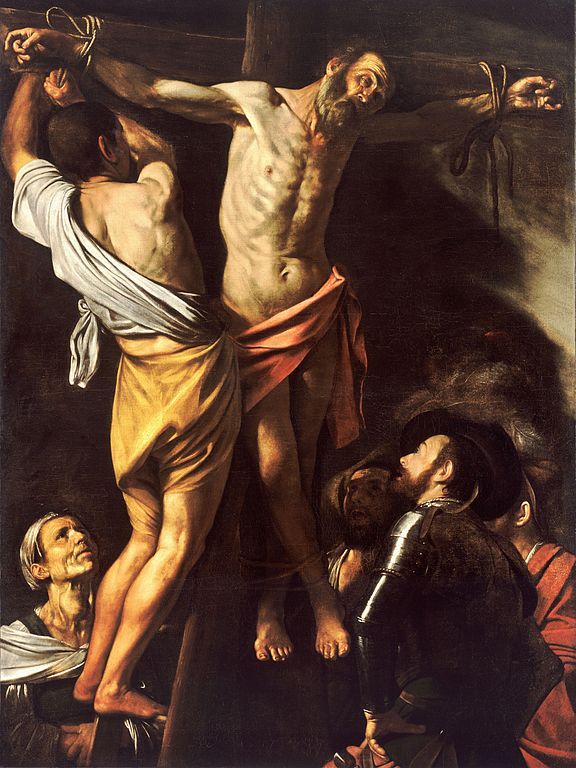
Because of his patronage of Constantinople, Saint Andrew’s relics were transferred there around the year 357. Tradition holds that some relics of Saint Andrew were taken to Scotland in the eighth century, to the place where the town of S. Andrews stands today. In the wake of the Sack of Constantinople during the Fourth Crusade, the remaining relics were brought to the Cathedral of Saint Andrew in Amalfi, Italy. In 1964, in an attempt to strengthen relations with the Ecumenical Patriarch in Constantinople, Pope Paul VI returned all relics of Saint Andrew that were then in Rome to the Greek Orthodox Church.
Every year since then, the Pope has sent delegates to Constantinople for the feast of Saint Andrew (and, in November 2007, Pope Benedict himself went), just as the Ecumenical Patriarch sends representatives to Rome for the 29 June feast of Saints Peter and Paul (and, in 2008, went himself). Thus, like his brother Saint Peter, Saint Andrew is in a way a symbol of the striving for Christian unity.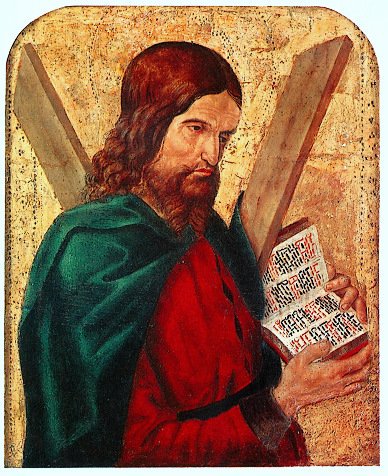
St Andrew’s Feast takes pride of place in the Liturgical Calendar, for in the Roman Catholic calendar, the liturgical year begins with Advent and the First Sunday of Advent is always the Sunday closest to the Feast of Saint Andrew. Though Advent can begin as late as 3 December, Saint Andrew’s feast, today is traditionally listed as the first Saint’s day of the liturgical year, even when the First Sunday of Advent falls after it—an honour commensurate with Saint Andrew’s place among the apostles The tradition of praying the Saint Andrew Christmas Novena 15 times each day from the Feast of Saint Andrew until Christmas flows from this arrangement of the calendar.
The name “Andrew” is a Greek name meaning “courageous” or “manly.” St Andrew lived up to his name.
St Andrew, pray that we live up to the name “Christian”!
St Andrew’s Patronages are here:
https://anastpaul.com/2018/11/30/saint-of-the-day-30-november-st-andrew-apostle-of-christ-martyr/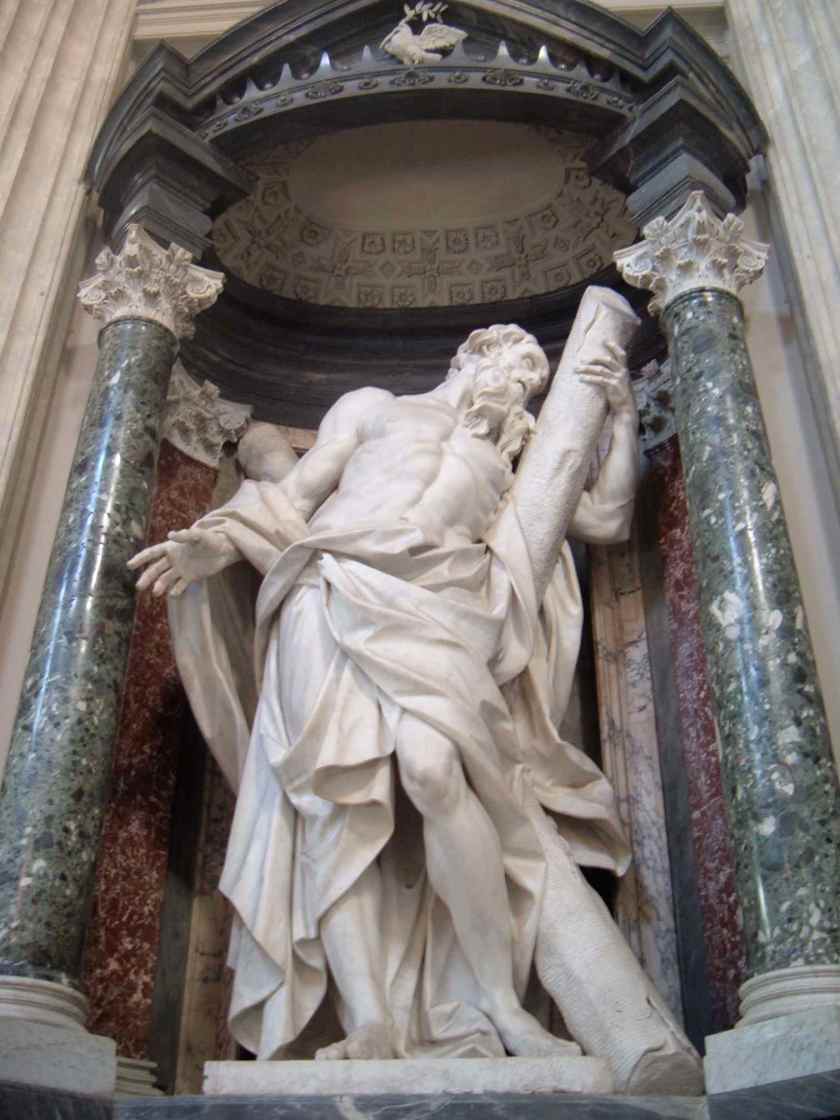
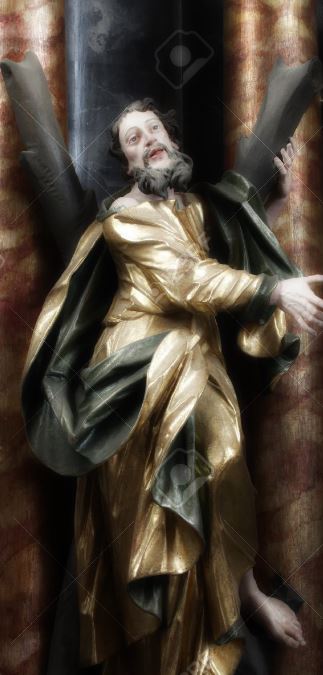
St Andrew the Apostle (Feast)
St Andrew!
https://anastpaul.com/2018/11/30/saint-of-the-day-30-november-st-andrew-apostle-of-christ-martyr/
St Abraham of Persia
Bl Alexander Crow
St Anders of Slagelse
Bl Andrew of Antioch
Bl Arnold of Gemblours
St Castulus of Rome
St Constantius of Rome
St Crider of Cornwall
St Cuthbert Mayne
St Domninus of Antioch
St Euprepis of Rome
Bl Everard of Stahleck
Bl Frederick of Regensburg
St Galganus
St Isaac of Beth Seleucia
Bl Joscius Roseus
St Joseph Marchand
St Justina of Constantinople
Bl Ludwik Gietyngier
St Mahanes the Persian
St Maura of Constantinople
St Merola of Antioch
St Mirocles of Milan
St Sapor
St Simeon of Persia
St Thaddeus Liu Ruiting
St Trojan
St Tudwal of Tréguier
Bl William de Paulo
Zosimus the Wonder Worker
—
Martyrs of Saxony – 6 saints: Missionaries who worked with Saint Willehad of Bremen. Martyrs. – Attroban, Benjamin, Emmingen, Folkard, Gerwald and Grisold. They were martyred on 30 November 782 at River Weser, Lawer Saxony, Germany.
Martyred in the Spanish Civil War – Martyred Augustinians of Madrid – 51 beati and Martyred Hospitallers of Madrid – 7 beati – Thousands of people were murdered in the anti-Catholic persecutions of the Spanish Civil War from 1934 to 1939.
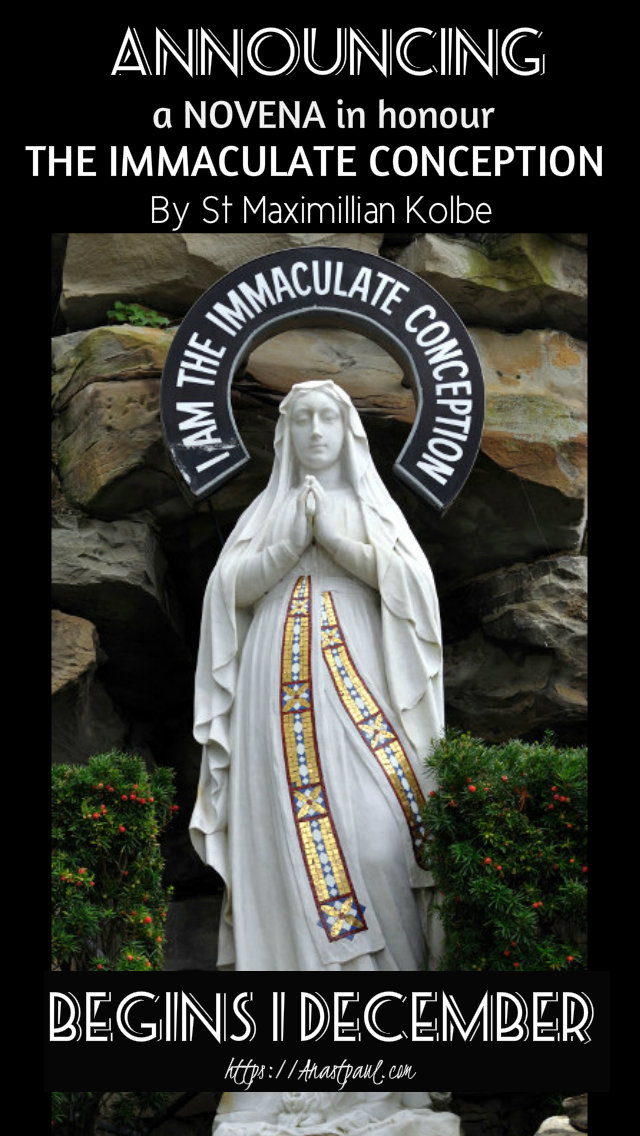
Announcing a Novena in honour of the Immaculate Conception
Begins 1 DecemberAs the Feast of the Immaculate Conception is moved forward by one day this year, from 8 to 9 December, due to the 8th being the 2nd Sunday of Advent, we will start the Novena a day later than usual.
This year we will use Reflections and Meditations from St Maximillian Kolbe.
See you there!
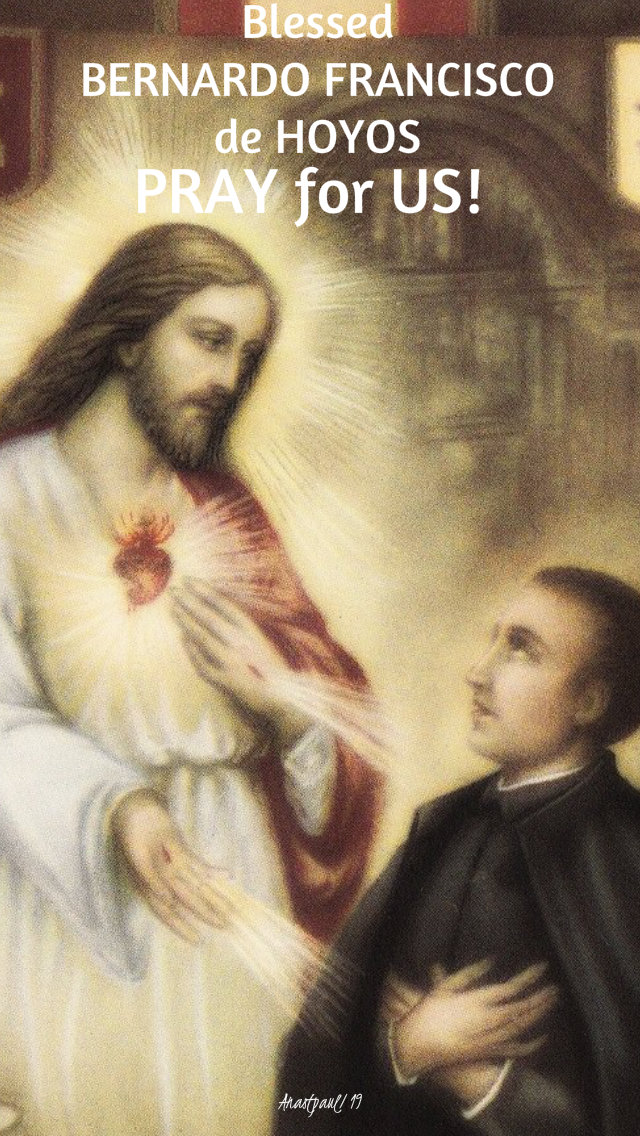
Thought for the Day – 29 November – The Memorial of Blessed Bernardo Francisco de Hoyos SJ (1711-1735) – First apostle of devotion to the Sacred Heart of Jesus in Spain.

Today’s young Saint and Mystic, Blessed Bernardo’s devotion led him to the most exquisite union with the Sacred Heart of Jesus … the spiritual marriage. Yes. It is no less strange however, that the Word, left His Father, to become one with man, to become Bread from Heaven.
I read someplace that Bl Bernardo’s intercession is especially helpful to those who struggle with the vice of impurity. I think Bernardo’s devotion to the Sacred Heart – the complete surrender of all his affections – is an antidote to all impurity. The grace of espousal seems to me, to be similar to the consummate love of Jesus in the Eucharist for us, whereby He gives us His body, blood, soul and divinity at every Communion. Isn’t it like that? Isn’t that total union what we are called to? At every Communion – even when I feel nothing, see nothing, hear nothing – it seems especially then, that faith supplies.
I never had experiences such as those Bl Bernardo participated in – I’m just grateful to be able to be recollected after each Communion and sometimes, to receive immense consolation too. Knowing He is there and I am with Him. I like the way Bl Bernardo put it: “I see that everything in my heart is moving towards God, drawn like iron to a magnet. It desires only God, searches only for God and longs only for God….” For Bernardo, that was his constant state – and he remained faithful to the graces he received. For me, perhaps this desire is only imperfectly experienced in the thanksgiving after Communion. Which is why I never want to waste those moments of recollection.
“Always holding my right hand, the Lord had me occupy the empty throne, then He fitted on my finger a gold ring…. “May this ring be an earnest of our love. You are Mine and I am yours. You may call yourself and sign Bernardo de Jesus, thus, as I said to my spouse, Santa Teresa, you are Bernardo de Jesus and I am Jesus de Bernardo. My honour is yours, your honor is Mine. Consider My glory that of your Spouse, I will consider yours, that of My spouse. All Mine is yours and all yours is Mine. What I am by nature you share by grace. You and I are one!” – The Visions of Bernard Francis De Hoyos, S.J. by Henri Bechard, S.J.
In the ascetic-mystical life of the saints, God Himself purifies the soul of disordered passions in and through purifying trials and temptations. Thus proving true Christ’s words, ‘what is impossible for man is possible for God.’ Blessed Bernardo was no exception.
As Catholics, we are not at all surprised by the ‘mystical marriage of today’s young Saint with Jesus’. However, it seems the rest are prone to think this an unusual and strange occurrence and regard it as an aberration, so please if you search Blessed Bernardo you might be horrified at some nasty statements – don’t be – you know the better part!
For “I am in You and You are in Me”
Quote/s of the Day – 29 November – Friday of the Thirty Fourth week in Ordinary Time, Year C, Gospel: Luke 21:29–33
“The issue is now clear.
It is between light and darkness
and every one must choose his side.”

“Each and everyone of us,
at the end of the
journey of life,
will come,
face to face
with either one
or the other
of two faces…
And one of them,
either, the
merciful face of Christ
or the
miserable face of Satan,
will say,
“Mine, mine.”
May we be Christ’s!”

“Many who plan
to seek God
at the eleventh hour
die at 10:30.”

Lord Jesus, May we Seek Your Face
By Pope Benedict XVI
Lord Jesus,
grant us restless hearts,
hearts which seek Your Face.
Keep us from the blindness of heart
which sees only the surface of things.
Give us the simplicity and purity
which allows us to recognise
Your Presence in the world.
When we are not able
to accomplish great things,
grant us the courage
which is born of humility and goodness.
Impress Your Face on our hearts.
May we encounter You along the way
and show forth Your image to the world.
Amen
One Minute Reflection – 29 November – Friday of the Thirty Fourth week in Ordinary Time, Year C, Gospel: Luke 21:29–33 and the Memorial of Blessed Bernardo Francisco de Hoyos SJ (1711-1735)
“But my words will not pass away….” …Luke 21:33
REFLECTION – “The Word of God makes us change our concept of realism. Indeed, the realist is the one who recognises in the Word of God, the foundation of all things. As you see these things happening, you know that the Kingdom of God is near (Lk 21:31). Now the word is not simply audible, not only does it have a voice, now the word has a face, one which we can see – that of Jesus of Nazareth.” …. Pope Benedict XVI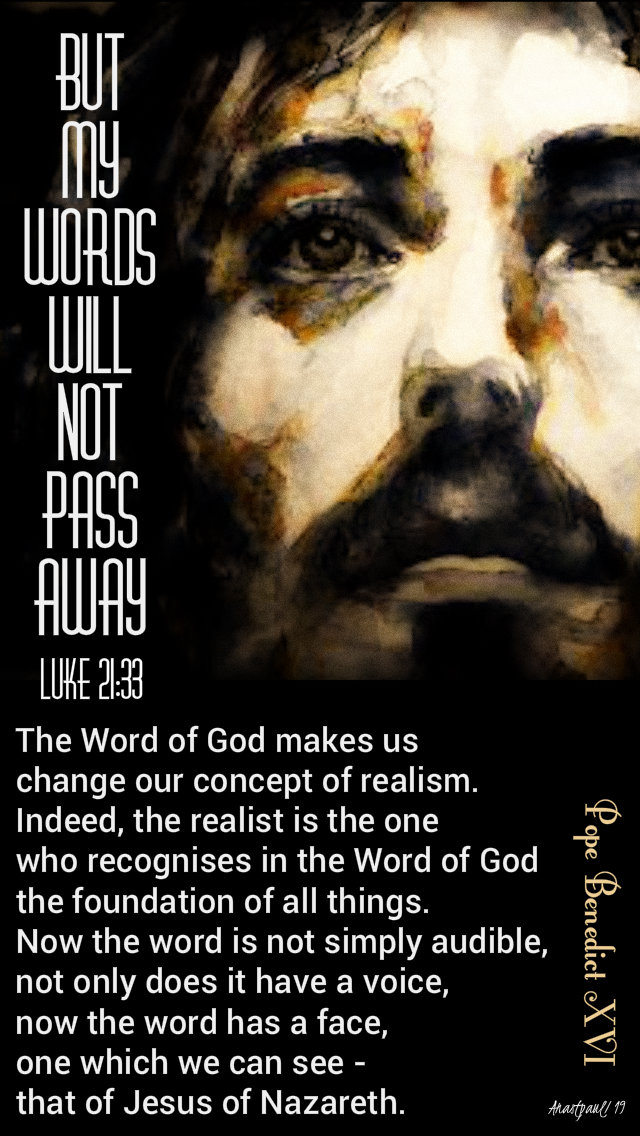
PRAYER – Lord God, open our hearts to Your grace and the Light of Your word. Let it go before us and be with us, open our eyes to see and our hearts to love, that we may always be intent upon doing Your will and following Your Word which has the Face of Your dearly beloved Son, Jesus our Saviour. Please hear the prayers of the beloved of Heart of Jesus, Blessed Bernardo de Hoyos on our behalf. We make our prayer through Jesus our Lord, with the Holy Spirit, God forever, amen.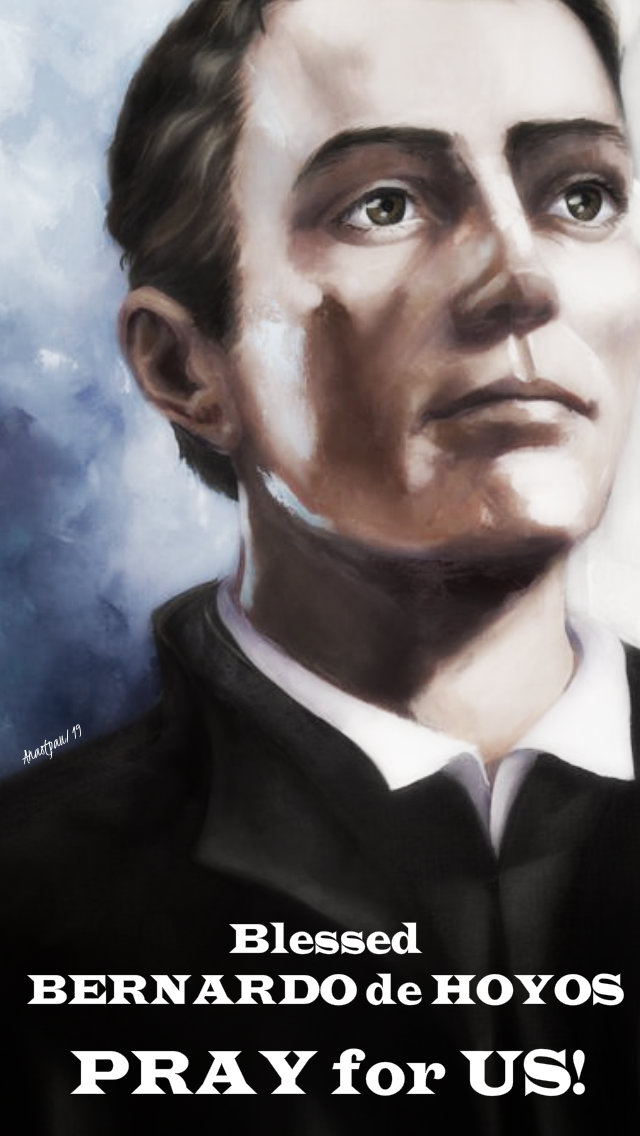
Our Morning Offering – 29 November – Friday of the Thirty Fourth week in Ordinary Time, Year C and the Memorial of Blessed Bernardo Francisco de Hoyos SJ (1711-1735)
O Christ Jesus,
When All is Darkness
By St Ignatius Loyola (1491-1556)
O Christ Jesus,
when all is darkness
and we feel our weakness
and helplessness,
give us the sense of Your presence,
Your love
and Your strength.
Help us to have perfect trust
in Your protecting love
and strengthening power,
so that nothing may frighten or worry us,
for, living close to You,
we shall see Your hand,
Your purpose,
Your will through all things.
Amen
Saint of the Day – 29 November – Blessed Bernardo Francisco de Hoyos SJ (1711-1735) Professed Priest of the Society of Jesus, Mystic, Apostle of the Sacred Heart – born on 21 August 1711 at Torrelobatón, Valladolid, Kingdom of Spain (1711-08-21) and died on 29 November 1735, Valladolid, Spain of natural causes (typhoid), aged 24. The miracle for his Beatification involved a young lady with typhoid.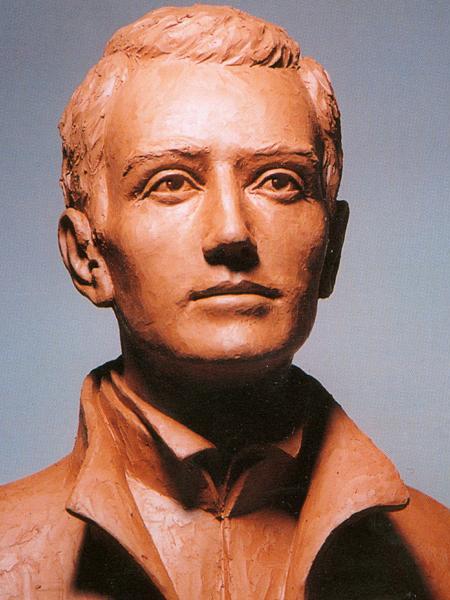
Bernardo Francisco de Hoyos de Seña was born on 21 August 1711 to Don Manuel de Hoyos and Doña Francisca de Seña. His father worked at the town hall at Torrelobatón near Valladolid. He was baptised on 6 September in his local parish church in the names of “Bernardo Francisco Javier.” He was named in honour of Saint Bernard of Clairvaux and Saint Francis Xavier. He received his Confirmation in 1720.
On 11 July 1726, a not quite fifteen year old Bernardo Francisco de Hoyos y Seña crossed the threshold of the Jesuit novitiate of the Province of Castile. Straightaway he chose the Flemish Saint John Berchmans SJ as his model and intercessor. 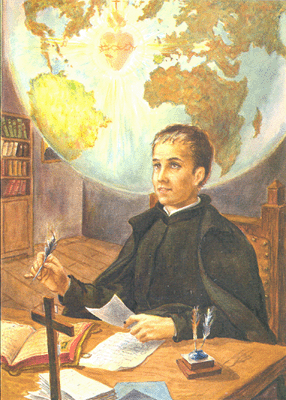 At his profession on 12 July 1728, he heard Our Lord say to him: “From today on I will unite Myself more intimately to you because of my love for you.” Our Lord, His Virgin Mother, Saint Ignatius, Saint Teresa of Avila and other celestial visitors manifested themselves to the young Jesuit, conversed with him, counselled him and encouraged him. In 1726 both Aloysius Gonzaga SJ and Stanislaus Kostka SJ were Canonised by Pope Benedict XIII. The two became models of holiness for the Jesuit priest, as well as John Berchmans who was already on the course for Canonisation.
On 10 August 1729, the Saviour, covered with His Precious Blood, appeared to Bernardo, and showing him the wound in His Side, said, “Rejected by humanity, I come to find my consolation with chosen souls.” Bernardo’s experience closely resembles that of Saint Margaret Mary Alacoque fifty-three years earlier in the Visitation Monastery of Paray-le-Monial in France.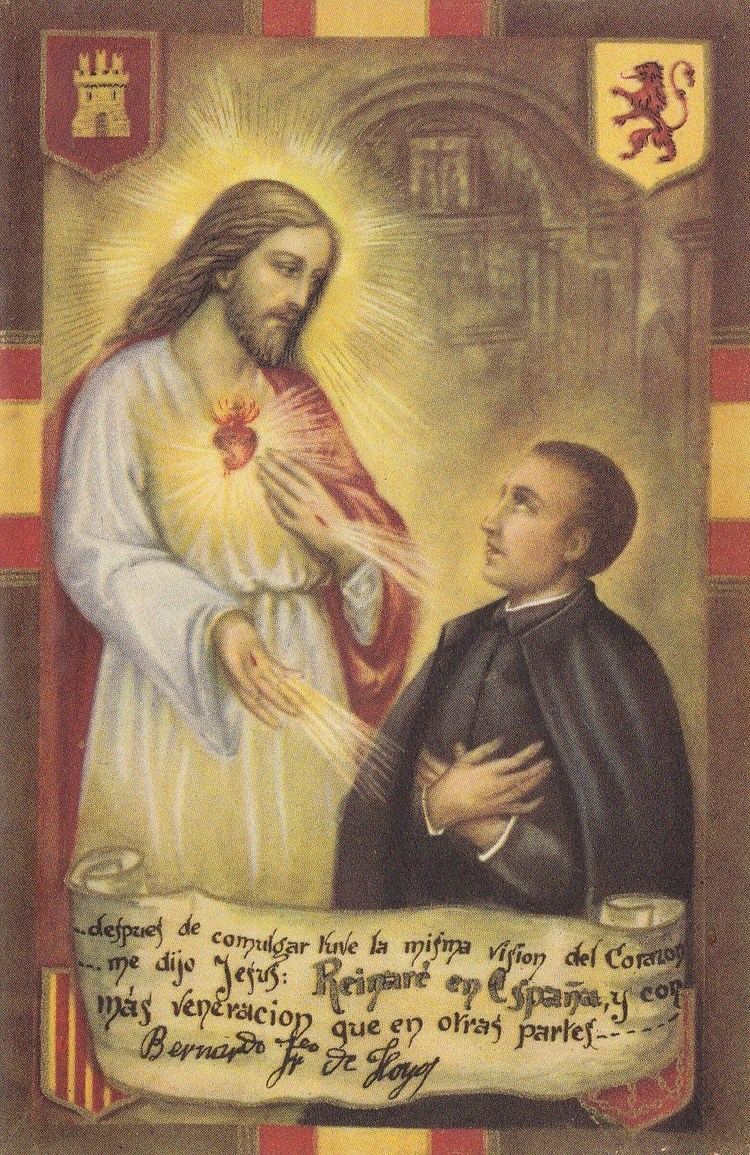
Bernardo was ordained a priest on 2 January 1735, for which he had to obtain special permission due to his young age. Saint John the Evangelist and Saint Francis de Sales, mystically present at the ordination, served as his “godfathers” in the priesthood. In that same year he wrote:
Hitherto I had great confidence in my prayers and petitions, depending on the intercession of the Heart of Jesus, at present I have no doubt about obtaining whatsoever I ask, if it is for the greater glory of God. I am convinced that at the altar, the Eternal Father can refuse me nothing . . . I find myself with views like that of Venerable Father La Colombière concerning the greatness of this sacrifice. Here I am as if I were triumphant, for it seems to me not only that I am making reparation for myself and for the whole world but that the Eternal Father is my debtor.
Now and again, during Mass . . . a word of the Eternal Father has assured me of the satisfaction He takes in His Son and in His Heart and how this satisfaction may embolden me, even at the sight of my sins and ingratitude, to presume as much as I fancy, for all is contained in the merits of Jesus, whose minister I am and whose place I take.”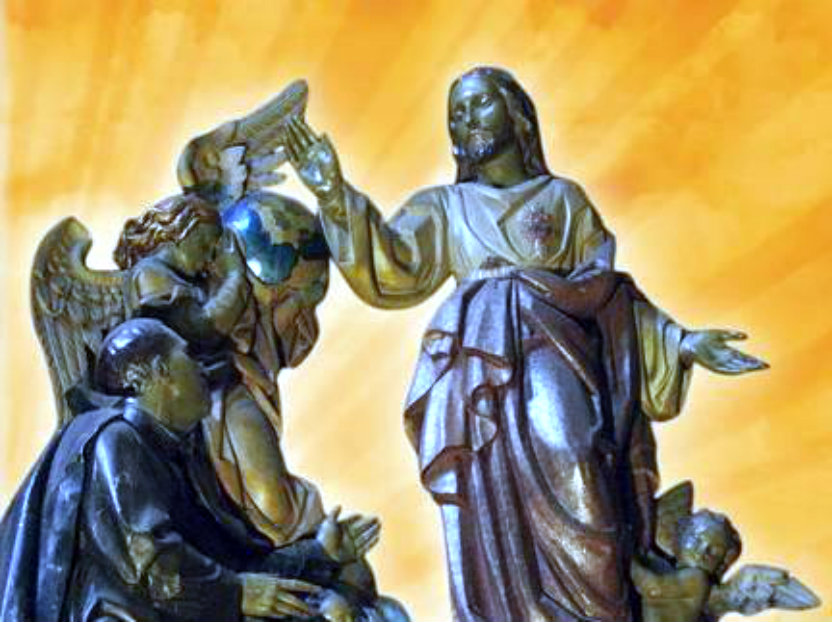
Father Bernardo de Hoyos died on 29 November 1735 at the age of twenty-four. He left behind the memory of his brief but fruitful ministry as a priest, the reputation of a charism for delivering souls from the vice of impurity – his book, The Hidden Treasure, published under the name of Father John de Loyola and a wealth of detailed accounts of his mystical experiences of the Heart of Jesus.
On 17 January 2009, the Holy Father, Pope Benedict XVI, met with the Prefect of the Congregation for the Causes of Saints, Archbishop Angelo Amato, S.D.B. The Pope authorised the promulgation of a number of decrees, among them the recognition of a miracle attributed to the Servant of God Bernardo Francisco Hoyos.
On 19 April 2010, Father Bernardo Francisco de Hoyos was beatified in Valladolid, Spain. The ceremony was presided over by Archbishop Angelo Amato, prefect of the Congregation for the Causes of Saints. In addition to nearly a 1,000 priests and more the 20,000 faithful, approximately fifty bishops and cardinals attended the ceremony. The new Blessed’s liturgical memorial was confirmed for today, the anniversary of his death.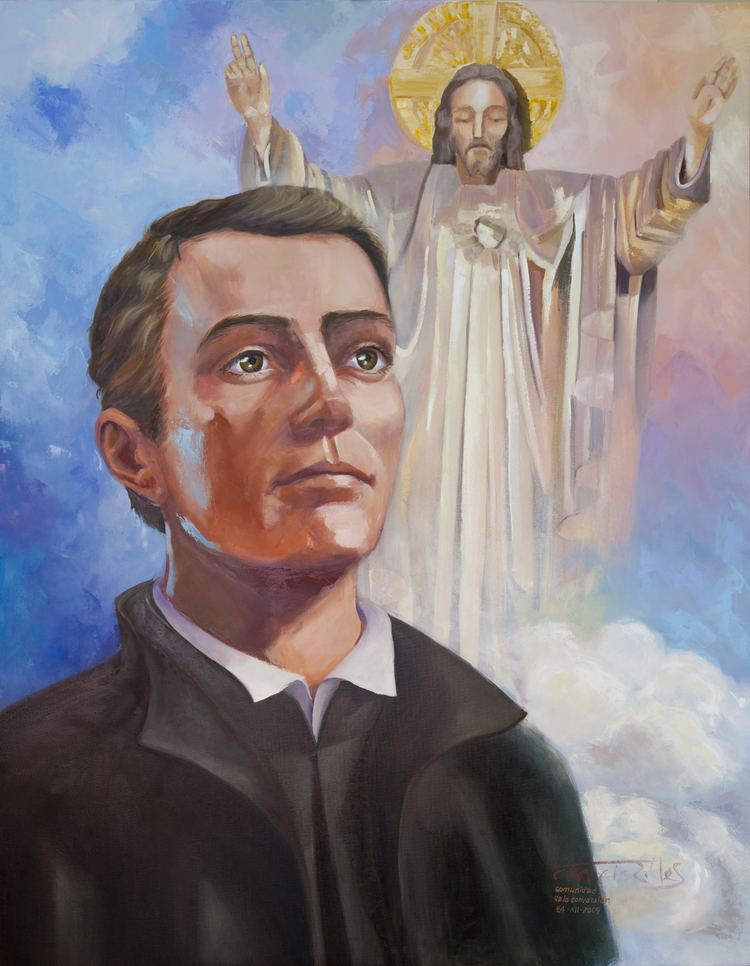
All Saints of the Seraphic Order (Franciscan): the Church celebrates the many Franciscan saints who followed in the footsteps of St Francis. It is a special day for all Franciscans to celebrate the feast of ‘All the Saints of the Seraphic Order.’
St Francis of Assisi prayed the following prayer:
“O Lord Jesus Christ, two favours I beg of You before I die. The first is that I may, as far as it is possible, feel in my soul and in my body the suffering in which You, O gentle Jesus, sustained in Your bitter passion. And the second favour is that I, as far as it is possible, may receive in my heart that excessive charity by which You, the Son of God, were inflamed and which actuated You willingly to suffer so much for us sinners.”
In response to his earnest prayer, the Lord appeared in the form of a seraph, or a six-winged angel (They are usually considered the highest order of angelic beings, immediately above the Cherubim and their special duty is to love God).
Then Jesus bestowed on St Francis the wounds of His suffering. St Francis had been marked with the love of Christ, the stigmata. St Francis died two years later in 1226, leaving the world the Franciscan Order, which became synonymous with the Seraphic Order. To this day, seraph wings and seraphs are symbolic of the Franciscan Order.
The final Rule of life for Franciscan friars was also approved on this day in 1223. To commemorate this and all the saintly examples produced in the Franciscan Order, on this day all the saints of the Seraphic order are remembered at Franciscan churches.
Our Lady of Beauraing/Our Lady of the Golden Heart:
Appeared multiple occasions between 29 November 1932 and 3 January 1933 On 2 February 1943, Bishop Andre Marie Charue authorised public devotion to Our Lady of Beauraing. On 2 July 1949 the Bishop declared that the Queen of Heaven had truly appeared to the children. Pilgrims flock to the small town of Beauraing, province of Namur (Belgium) and many cures are claimed. She is celebrated under this title on 29 November.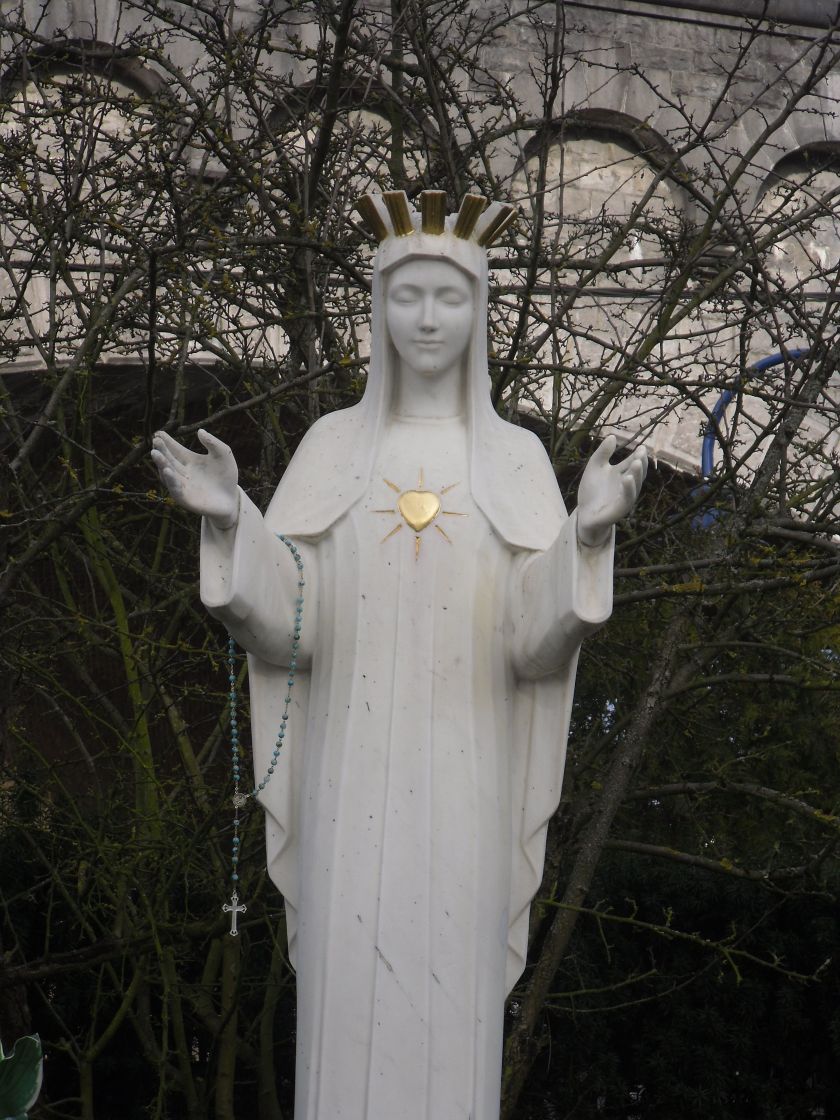
Bl Alfredo Simón Colomina
Bl Bernardo Francisco de Hoyos Seña SJ (1711-1735)
St Blaise of Veroli
St Brendan of Birr
St Demetrius of Veroli
Bl Denis of the Nativity
Bl Edward Burden
St Francesco Antonio Fasani OFM Conv (1681 – 1742)
His story:
https://anastpaul.com/2018/11/29/saint-of-the-day-29-november-st-francesco-antonio-fasani-1681-1742-29-november/
Bl Frederick of Ratisbon
Bl George Errington
St Hardoin of Brittany
St Illuminata of Todi
St James of Saroug
Bl Jutta of Heiligenthal
St Paphnutius of Heracleopolis
St Paramon
St Philomenus of Ancyra
St Radbod of Utrecht
Bl Redemptorus of the Cross
St Sadwen of Wales
St Saturninus of Rome
St Saturninus of Toulouse
St Sisinius of Rome
St Walderic of Murrhardt
Bl William Gibson
Bl William Knight
Dear American Friend,
On your Thanksgiving Day, I wanted to be sure to remind you of this:
“You are greatly appreciated!”
There is no greater blessing God has given me than the people that support, pray and join me in my mission to advance the Gospel and the teachings of the Catholic Church, in communion with our Saints.
Thank you.
I pray you are reminded not just today but every day,
of how grateful I am for you all.
May God bless you and your beloved families.
Ana
Breathing Catholic
We thank you, Father,
for the gift of Jesus, Your Son,
who came to our earth
and lived in a simple home.
We have a greater appreciation
of the value and dignity
of the human family
because He loved
and was loved within its shelter.
Bless us this day.
may we grow in love,
for each other in our family
and so give thanks to You,
who are the Maker of all human families
and our abiding peace.
Amen
St Andrew’s Christmas Novena – Begins on St Andrew’s Feast Day – 30 November
Just a reminder of this beautiful Catholic tradition 
The Feast of Saint Andrew has always been closely associated with the beginning of Advent as it is on 30 November, around the First Sunday of Advent. In light of that fact, a prayer was developed as a daily preparation for Christmas and took 30 November as its starting point.
It is sometimes called the Christmas Novena, St Andrew’s Novena, St Andrew’s Christmas Prayer, or the Christmas Anticipation Prayer.
It is a beautiful prayer that focuses on the moment of Christ’s birth and can act as an inspiring meditation for Advent and of course, we pray for our own intentions – 15 times a day – God is listening! The prayer is customarily prayed 15 times a day, as a family, it is most efficacious to pray it five times before and after mealtimes, alternating the family members.
Let us prepare our hearts to welcome Christ, our Saviour and Redeemer and pray the “Christmas Novena.”
Hail and blessed be the hour and moment
in which the Son of God was born
of the most pure Virgin Mary,
at midnight, in Bethlehem, in the piercing cold.
In that hour vouchsafe,
I beseech Thee, O my God,
to hear my prayer and grant my desires,
………………… [here mention your request]
through the merits of Our Saviour Jesus Christ
and of His blessed Mother.
Amen
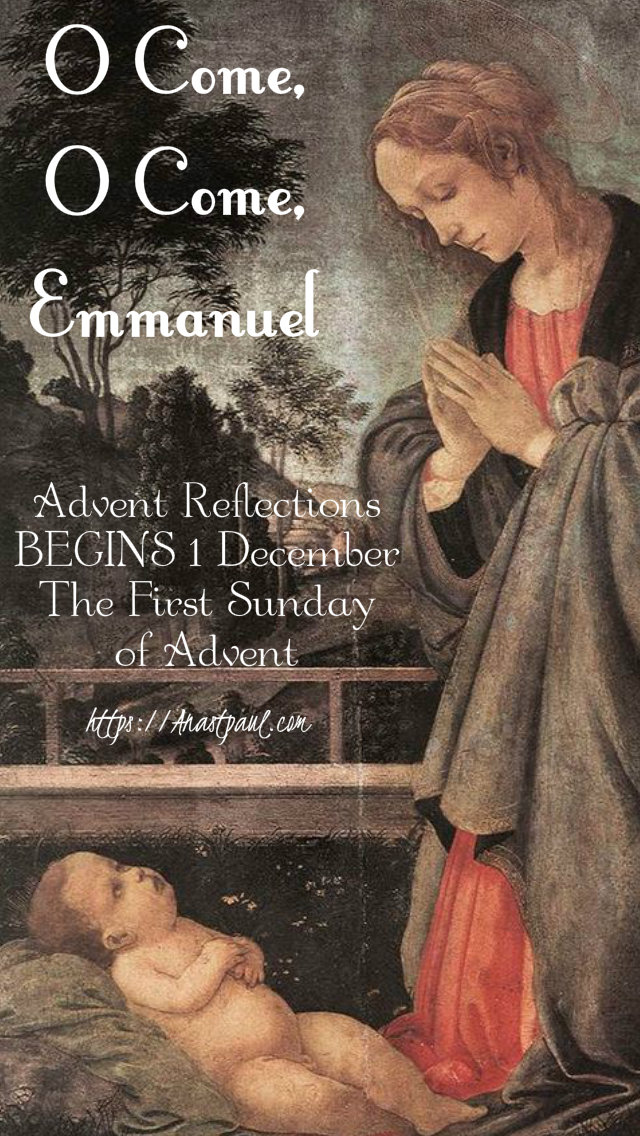
Thought for the Day – 28 November – It’s time to Hope! Advent is nearly upon us
This year, as before, I will post daily Advent Reflections drawn from diverse Saints and Holy people – please join me in prayer and in awakening our souls to hope.
In one of his Christmas stories Charles Dickens tells of a man who lost his emotional memory, that is, he lost the whole chain of feelings and thoughts he had acquired in the encounter with human suffering. This extinction of the memory of love is presented to him as liberation from the burden of the past but it becomes clear, immediately, that the whole person has been changed, now, when he meets with suffering, no memories of kindness are stirred within him… Since his memory has dried up, the source of kindness within him has also disappeared. He has become cold and spreads coldness around him.
Goethe deals with the same ideas as Dickens, in his account of the first celebration of the feast of Saint Roch in Bingen, after the long interruption caused by the Napoleonic wars. He observes the people as they press, tightly packed, through the church past the image of the saint and he watches their faces – the faces of the children and the adults are shining, mirroring the joy of the festal day. But with the young people, Goethe reports, it was otherwise. They went past unmoved, indifferent, bored. And he gives an illuminating explanation – they were born in evil times, had nothing good to remember and consequently had nothing to hope for. In other words, it is only the person who has memories who can hope. The person who has never experienced goodness and kindness simply does not know what such things are.
Recently a counsellor who spends much of his time talking with people on the verge of despair, was speaking in similar terms about his own work, if his client succeeds in recalling a memory of some good experience, he may once again be able to believe in goodness and thus relearn hope, then there is a way out of despair. Memory and hope are inseparable. To poison the past does not give hope, it destroys its emotional foundations.
Sometimes Charles Dickens’ story strikes me as a vision of contemporary experience. This man who let himself be robbed of the heart’s memory by the delusion of a false liberation — do we not find him with us today, in a generation whose past has been poisoned by a particular program of liberation that has stifled hope? When we read of the pessimism with which our young people look toward the future, we ask ourselves, Why? Is it that, in the midst of material affluence, they have no memory of human goodness that would allow them to hope? By outlawing the emotions, by satirising joy, have we not trampled on the root of hope?
These reflections bring us straight to the significance of the Christian season of Advent. For Advent is concerned with that very connection between memory and hope which is so necessary to man. Advent’s intention is to awaken the most profound and basic emotional memory within us, namely, the memory of the God Who became a Child. This is a healing memory, it brings hope. The purpose of the Church’s year is continually to rehearse her great history of memories, to awaken the heart’s memory so that it can discern the star of hope. All the feasts in the Church’s calendar are events of remembrance and hence events of hope. These events, of such great significance for mankind, which are preserved and opened up by faith’s calendar, are intended to become personal memories of our own life history, through the celebration of holy seasons by means of liturgy and custom. Our personal memories are nourished by mankind’s great memories, in turn, it is only by translating them into personal term,s that these great memories are kept alive. Man’s ability to believe always depends in part on faith having become dear on the path of life, on the humanity of God having manifested itself through the humanity of men. No doubt each of us could tell his own story here as to what the various memories of Christmas, Easter or other festivals mean in his life.
It is the beautiful task of Advent, to awaken in all of us, memories of goodness and thus to open doors of hope.
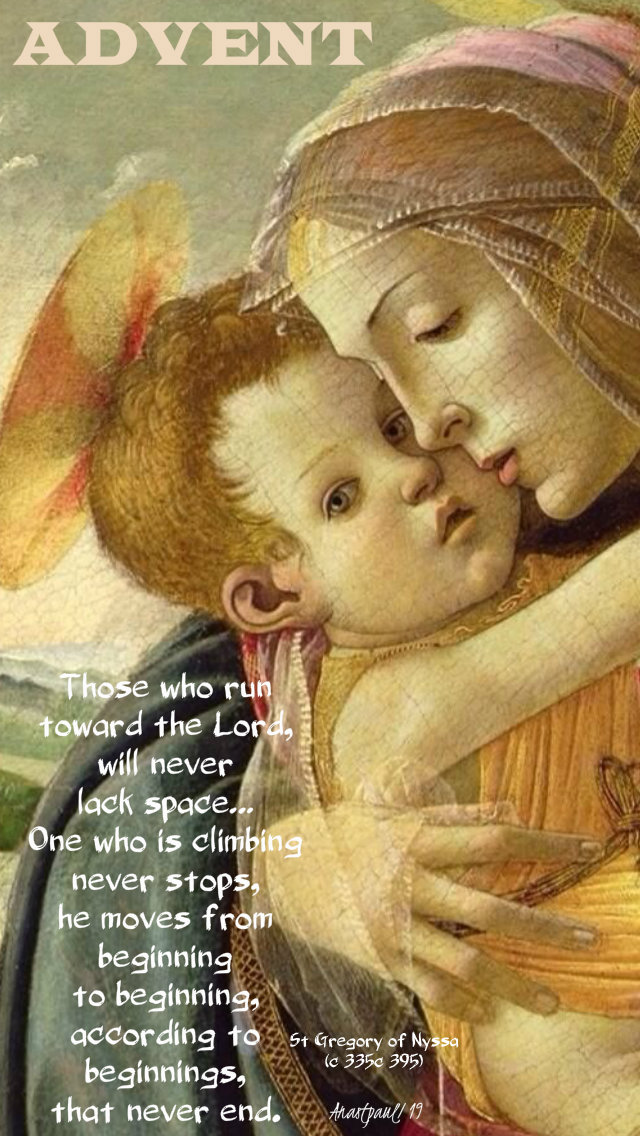
“Those who run
toward the Lord,
will never lack space…
One who is climbing
never stops,
he moves from
beginning to beginning,
according to beginnings,
that never end.”
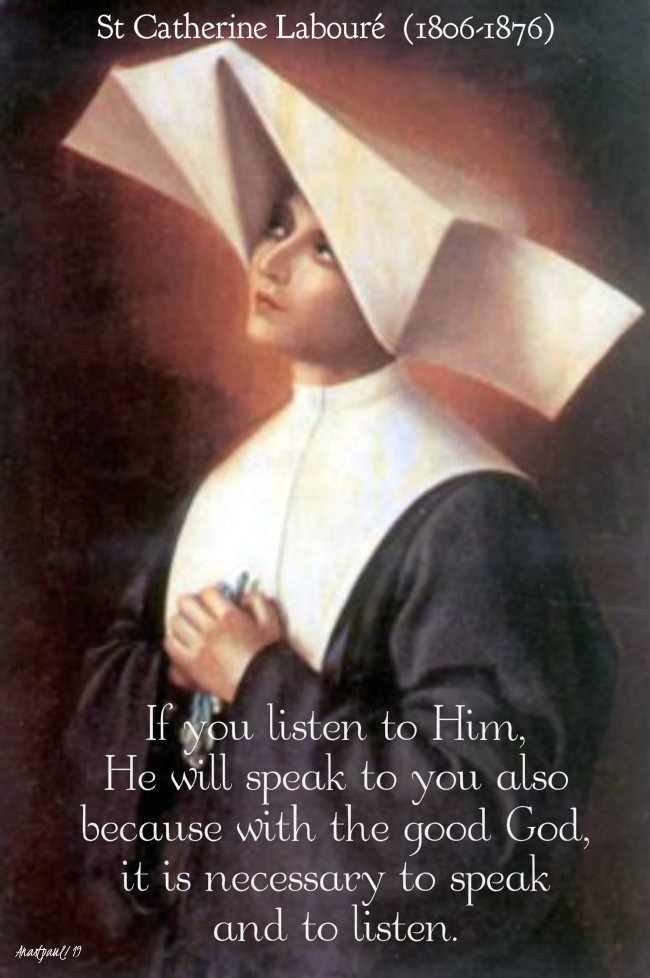
Quote of the Day – 28 November – The Memorial of St Catherine Labouré DC (1806-1876)
“If you listen to Him,
He will speak to you also
because with the good God,
it is necessary to speak
and to listen.”
One Minute Reflection – 28 November – Thursday of the Thirty Fourth week in Ordinary Time, Year C, Gospel: Luke 21:20–28
“Now when these things begin to take place, look up and raise your heads, because your redemption is drawing near.”…Luke 21:28
REFLECTION – “When we think of the end of time, with all of our sins, with our history, let us think of the banquet which will be freely offered us and let us lift up our heads. Do not give way to depression. Hope! Reality is ugly. There are many, many people, cities and people, so many people who are suffering; many wars, so much hatred, so much envy, so much spiritual worldliness and so much corruption. Yes, it’s true! All of this will fall!
Let us ask the Lord for the grace to be prepared for the banquet that awaits us, always with our heads held high.”…Pope Francis – Santa Marta, 27 November 2014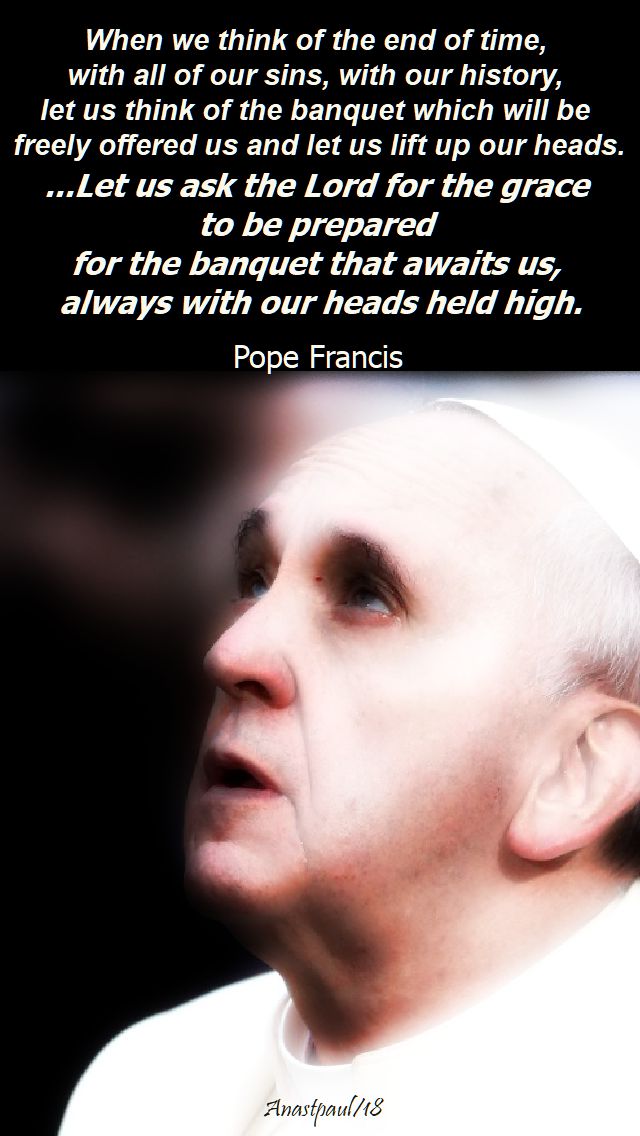
PRAYER – Lord God, creator of all Light and creator of all good, grant that we may look up to You always and know that by Your Light and your goodness we are safe in this world of corruption. May the Light of our Lord Jesus, make the path He has set out bright and clear and may the prayers of St James of the Marches be a help in our struggle. Lead us, Lord, in Your kindness and mercy to the banquet which awaits us. We make our prayer through Christ our Lord, with the Holy Spirit, God forever, amen.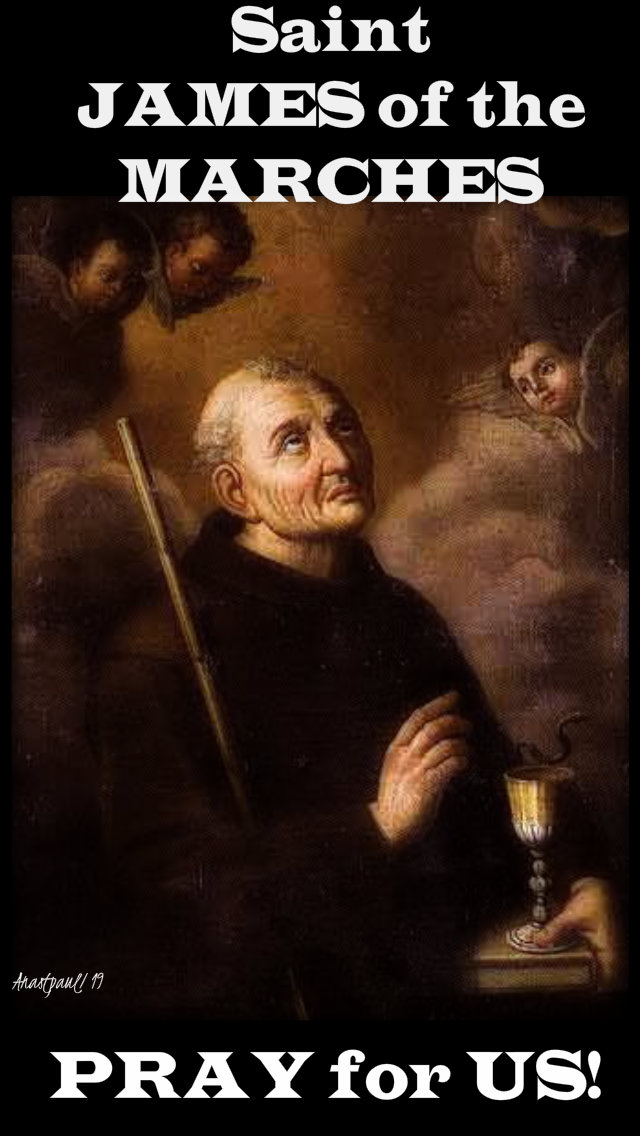
Our Morning Offering – 28 November – The Memorial of St James of the Marches OFM Conv (1391-1476)
Beloved and Most Holy
Word of God
By St James of the Marches (1391-1476)
Beloved and most holy Word of God!
You enlighten the hearts of the faithful,
You satisfy the hungry,
console the afflicted.
You make the souls of all,
productive of good
and cause all virtues to blossom.
You snatch souls
from the devil’s jaw.
You make the wretched holy
and men of earth,
citizens of heaven!
Amen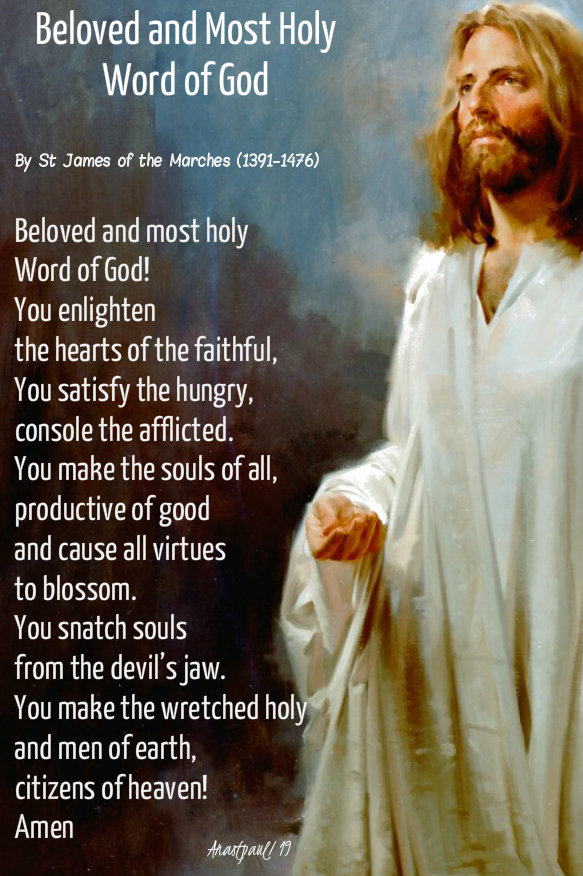
Saint of the Day – 28 November – Saint James of the Marches OFM Conv. (1391-1476) Franciscan Priest, brilliant Preacher, Penitent, Reformer, Writer, Papal legate, Inquisitor, founder of several monasteries in Bohemia, Hungary and Austria – born on 1 September 1391 at Monteprandone, March of Ancona, Italy as Domenico meaning “of the Lord” (from Latin, Dominus) Gangala and died on 28 November 1476 at Naples, Italy. Patronages – Monteprandone, co-patron of Naples, Italy, of children. His body is incorrupt.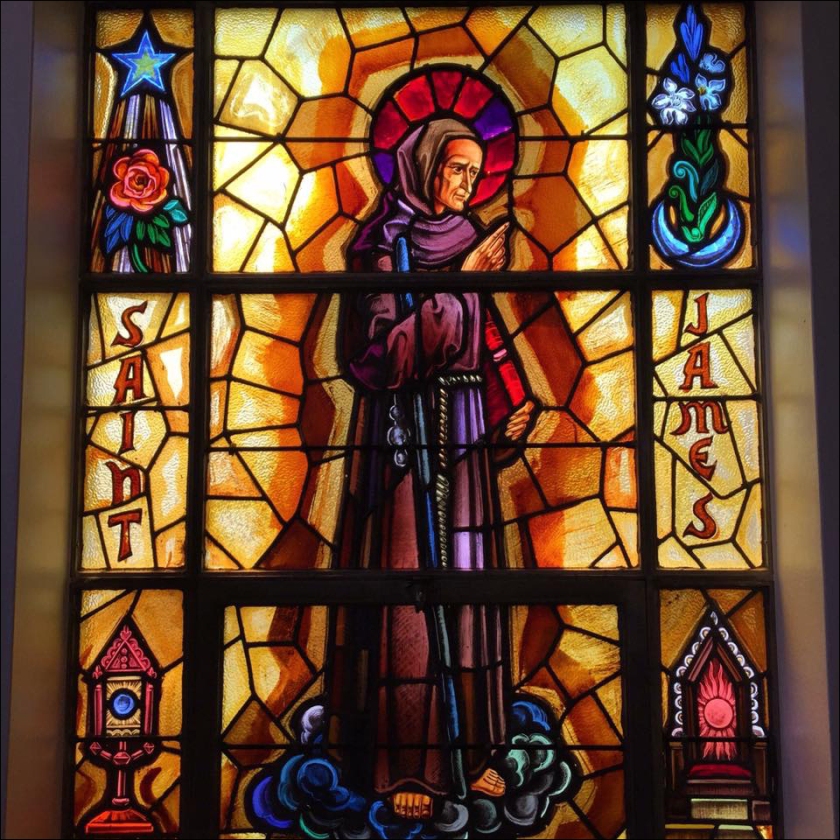
Domenico was born into an extremely poor family at Montebrandone (in the Marche of Ancona), in central Italy along the Adriatic Sea. Unfortunately, his cruel father abused him and James left home as a boy. He placed himself under the care of his uncle, a priest. Through the generosity of his uncle, Domenico was educated in nearby towns of Ascoli and Offida.
At the University of Perugia he took the degree of Doctor of Canon and Civil Law. He began his career in Florence as tutor in a noble family and as judge. On one occasion, while travelling to Assisi for his work, he went to pray in the church of the Portiuncula, St Mary of the Angels. Inspired by the friars he witnessed there and by the example of St Francis, Domenico decided to enter the Franciscan Order. In 1416, at 23 years of age, he became a novice, taking the religious name of James.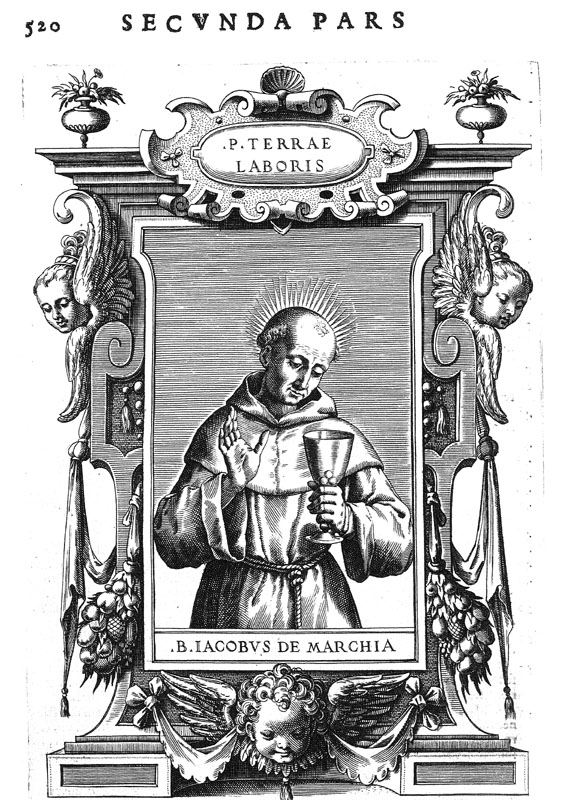
Studying under Saint Bernardino of Siena (1380-1444), James was widely recognised for his oratory, delivering both forceful and effective sermons and converting thousands of souls. Ordained at age twenty seven, James was sent on mission with Saint John Capistrano (1603-1663), travelling throughout Italy, German, Bohemia, Poland, and Hungary.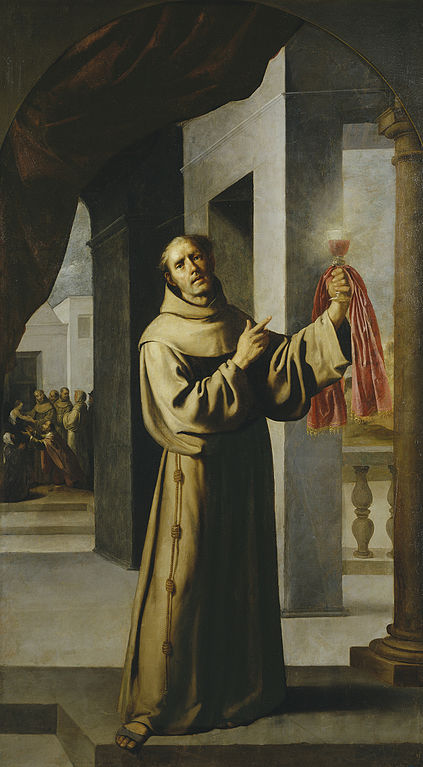
Noting his orthodoxy, Pope Saint Martin V appointed him inquisitor to root out heretical sects that were growing in power throughout Italy. He continued his travels, preaching, working against heresy and attempting to reconcile various branches of the Franciscan Order. He attended the Council of Florence in 1438, working diligently to reconcile the Eastern and Latin Churches, with little success.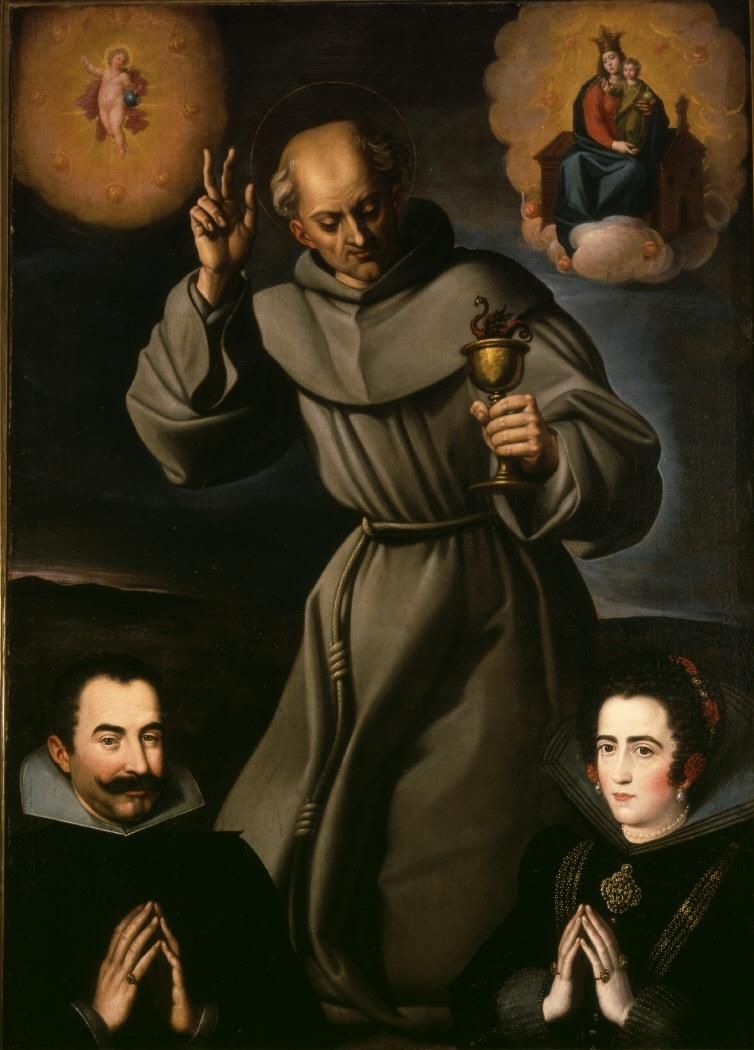
Elected Bishop of Milan, James humbly declined the position, preferring to continue his itinerant lifestyle, travelling, preaching and confirming the truth of Church doctrine. Saint James preached every day for 40 years, beginning on the date of his ordination and ending on the date of his death. He preached a message of penance, which he also put into practice. James slept only three hours each evening and fasted nine months of the year. Thinly dressed, always in the same tattered brown robe, he always wore underneath his habit either a rough hair shirt or an iron coat of mail armed with short sharp spikes.and susceptible to illness, Saint James ate little, giving all he had to the needy. As he grew older and his health began to observably fail, Pope Martin V ordered him to eat regularly, as a public service, so that he could continue his ministry. Charitable, Saint James instituted several montes pietatis, (literally, “mountains of money”) which provided low-interest loans to all who needed them.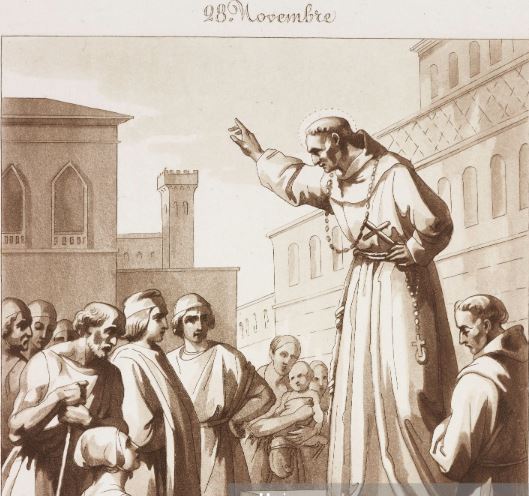
James took his vows seriously. Due to his promise of poverty, he travelled on foot everywhere he went. He pulled a small wagon by hand, which contained all his possessions – a bible, a prayer book, some theological works, liturgical vestments and vessels. He personally hand-copied most of the few books he owned and he wore just his threadbare habit. He took the practice of obedience very seriously, as well. In fact, on one occasion, he received an order from his superior to go abroad while lifting a cup to his mouth to drink. He immediately set it down and left without drinking, as he was afraid of losing the merit of obedience by the least delay.
Under Pope Callistus III, in 1455, he was appointed an arbiter on the questions at issue between the Conventuals and Observants. His decision was published 2 February 1456 in a papal bull, which pleased neither part.
In 1462, James became the subject of the Inquisition. In a sermon, he preached his theological opinion on the Blood of Christ, stating that the blood shed during Christ’s passion was not hypostatically united to the divinity of Christ during the three days of his burial. The case was controversial, and James was summoned to appear before the Dominican inquisitor, which he refused. Eventually, James appealed to the Holy See, after which a silence was imposed upon both the Dominican inquisitors and the Franciscans. No decision was ever reached.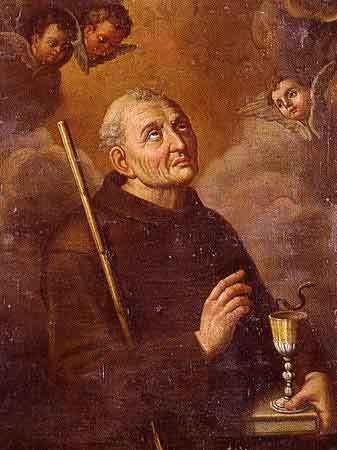
Saint James spent the last three years of his life at Naples and died there on 28 November 1476. His funeral was attended by the Pope, the king of Naples, the royal court, many clergy and countless laypersons. James’s body remained in the Franciscan church of Santa Maria la Nova in Naples for over five centuries until 2001 when it was finally transferred to his birthplace of Monteprandone. There his incorrupt body remains exposed for the faithful to venerate. 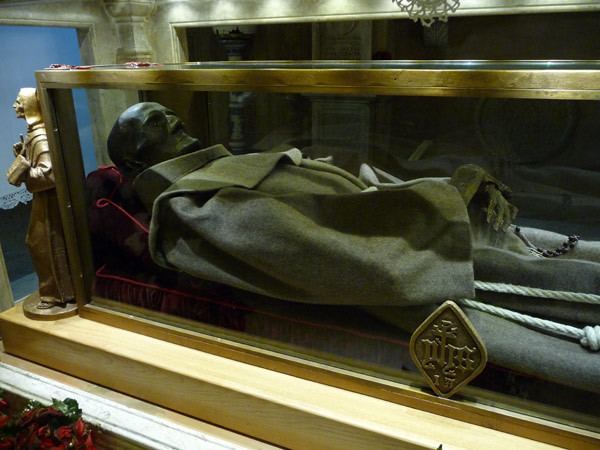
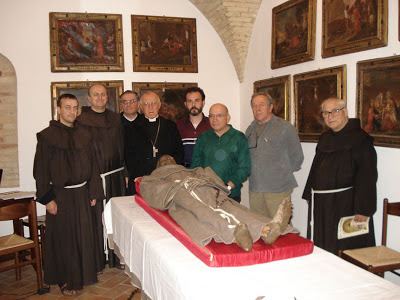
Pope Urban VIII Beatified him on 12 August 1624, and St James of the Marches was Canonised on 10 December 1726 by Pope Benedict XIII.
He is generally represented as a Franciscan holding a chalice and a veil. His emblem is a chalice from which a snake is escaping – an allusion to the endeavours of certain heretics to poison him. Numerous miracles have been reported through his intercession, both while he lived and subsequent to his death.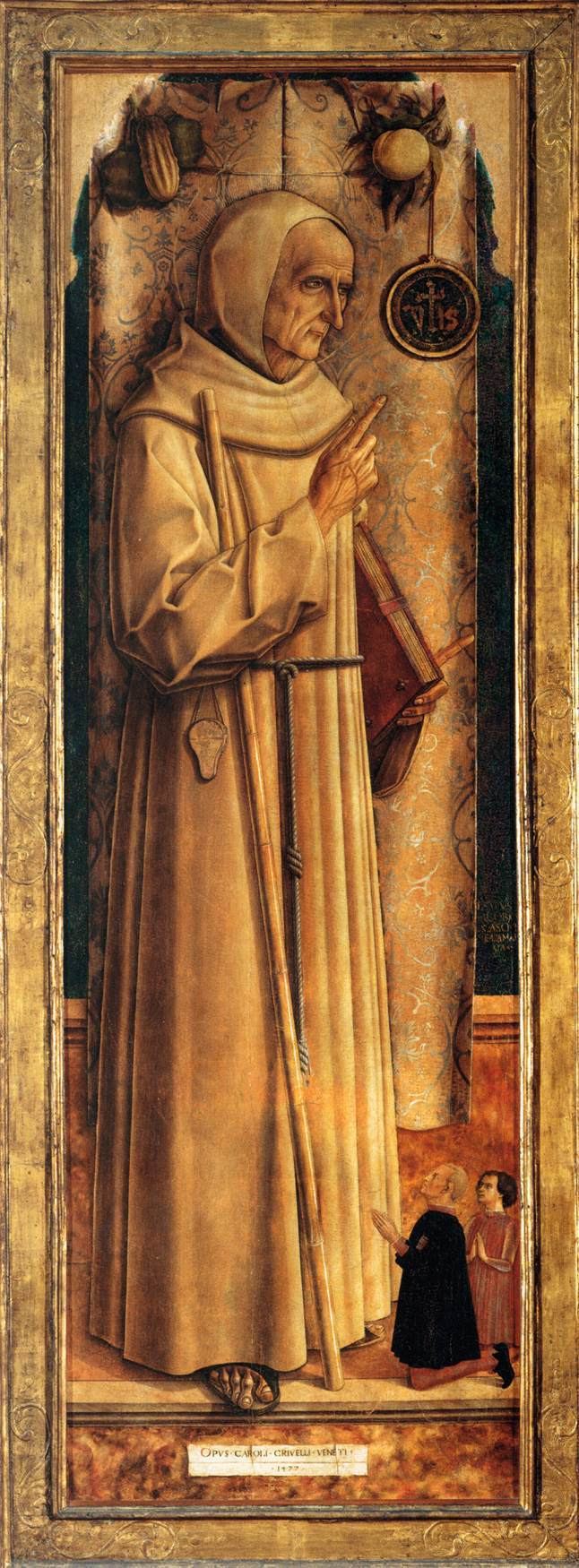


You must be logged in to post a comment.