St Rusicola of Arles
St Rufinus of Marsi
St Susanna of Rome
St Taurinus of Evreux
Bl Theobald of England and Companion
St Tiburtius of Rome
Bl William Lampley
—
Martyred in the Spanish Civil War
Bl Armando Óscar Valdés
Bl Benjamín Fernández de Legaria Goñi
Bl Carlos Díaz Gandía
Bl Rafael Alonso Gutiérrez
Bl Ramon Rosell Laboria
Thought for the Day – 10 August – Meditations with Antonio Cardinal Bacci (1881-1971)
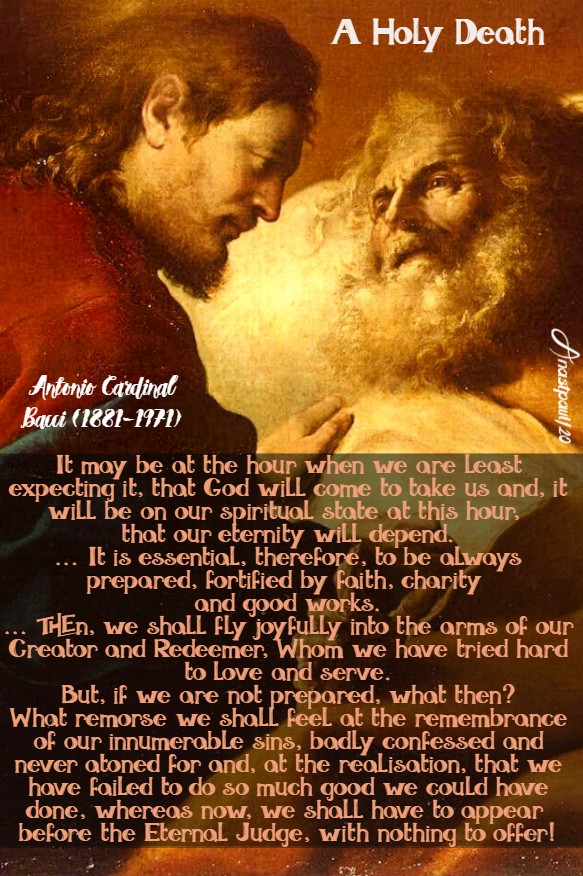
A Holy Death
“Now and again, it is useful for Christians to dedicate a day to meditation on the subject of death.
It is useful, because, it is easy to regard our own death as something theoretical and remote, whereas in fact, we ought always to be prepared to die, since it is “at any hour that you do not expect, the Son of Man is coming” (Lk 12:40).
It may be at the hour when we are least expecting it, that God will come to take us and, it will be on our spiritual state at this hour, that our eternity will depend.
We know neither when nor where death will surprise us.
It may be today, it may be in a few years.
It may come suddenly, or maybe after a long illness.
We may be in bed or in the middle of a street, in hospital or at home.
Finally, we may be resigned, comforted by the presence of a Priest and by the reception of the last sacraments, or we may be alone and deprived of these consolations.
It is essential, therefore, to be always prepared, fortified by faith, charity and good works.
If we are really prepared, it will not matter when, where, or how death comes, for it will be to us, like the good Sister death of St Francis of Assisi.
It will release us from this corrupt mortal flesh and open to us the gates of everlasting happiness.
Then, we shall fly joyfully into the arms of our Creator and Redeemer, Whom we have tried hard to love and serve.
But, if we are not prepared, what then?
How bitter it will be to have to leave the world to which we have become so attached.
What remorse we shall feel at the remembrance of our innumerable sins, badly confessed and never atoned for and, at the realisation, that we have failed to do so much good we could have done, whereas now, we shall have to appear before the Eternal Judge, with nothing to offer!”
“If anyone serves me, he must follow me and where I am, there will my servant be also.”
John 12:26
“The Lord is near do not be anxious about anything.”
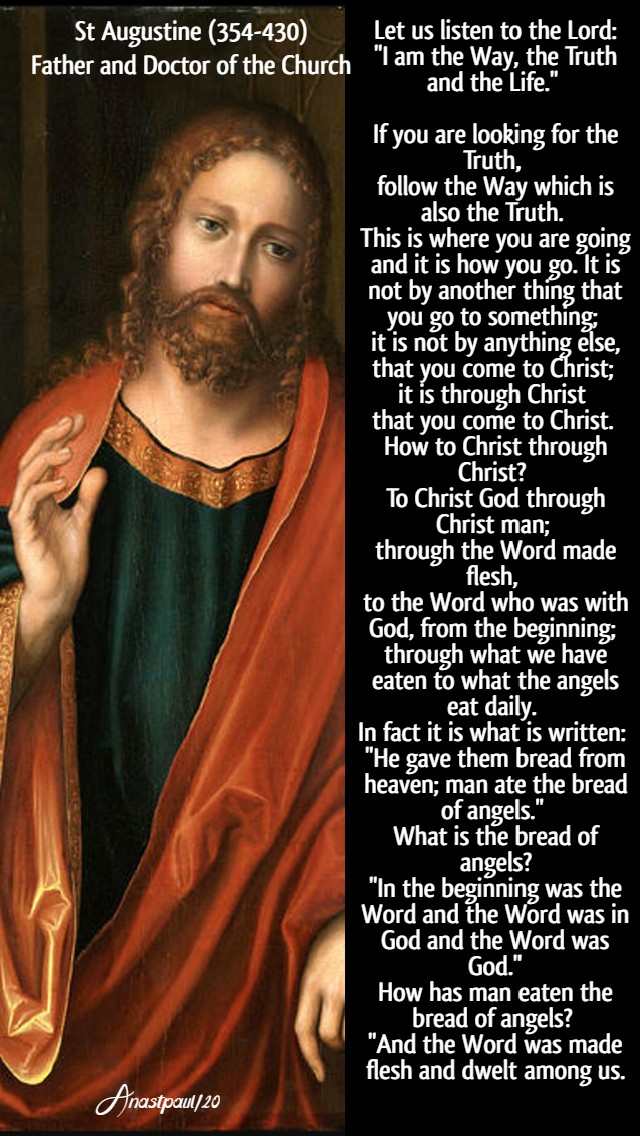
“Let us listen to the Lord: “I am the Way, the Truth and the Life” (Jn 14:6). If you are looking for the Truth, follow the Way which is also the Truth. This is where you are going and it is how you go. It is not by another thing that you go to something; it is not by anything else that you come to Christ; it is through Christ that you come to Christ. How to Christ through Christ? To Christ God through Christ man; through the Word made flesh, to the Word who was with God, from the beginning; through what we have eaten to what the angels eat daily. In fact it is what is written: “He gave them bread from heaven; man ate the bread of angels” (Ps 77[78]:24-25). What is the bread of angels? “In the beginning was the Word and the Word was in God and the Word was God” (Jn 1:1-3). How has man eaten the bread of angels? “And the Word was made flesh and dwelt among us.”
St Augustine (354-430) Father and Doctor of Grace
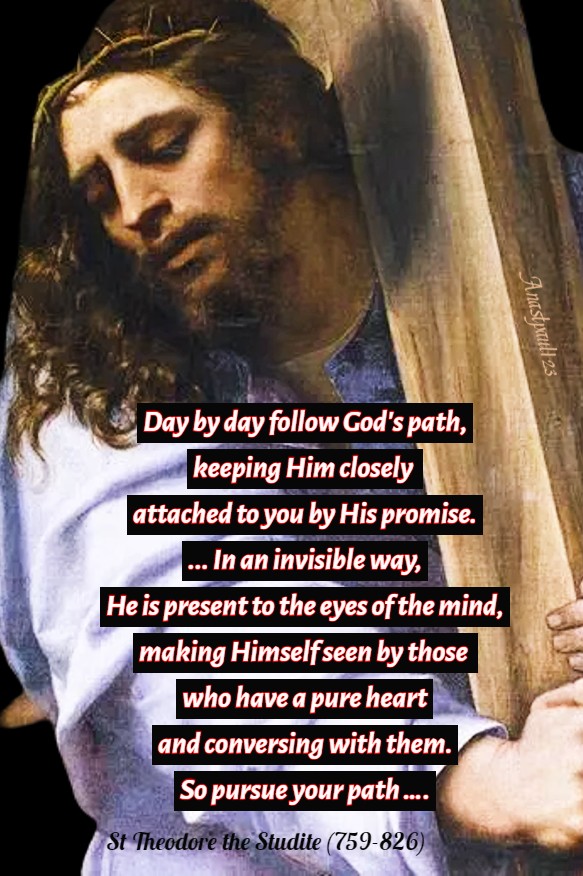
“Day by day follow God’s path, keeping Him closely attached to you by His promise. In fact, He Himself said, through the mediation of His apostles, to all those who seek His will and His testimonies that He would be with them, until the end of the world (Mt 28:20) where paths and footsteps will be unknown (cf Ps 76:20), as the divine David said in his songs. Yet, in an invisible way, He is present to the eyes of the mind, making Himself seen by those who have a pure heart and conversing with them. So pursue your path …. “
St Theodore the Studite (759-826) Monk and Theologian at Constantinople
Catechesis 11
“Jesus is happy to come with us, as Truth is happy to be spoken, as Life to be lived, as Light to be lit, as Love is to be loved, as Joy to be given, as Peace to be spread.”
St Francis of Assisi (1181/2–1226)
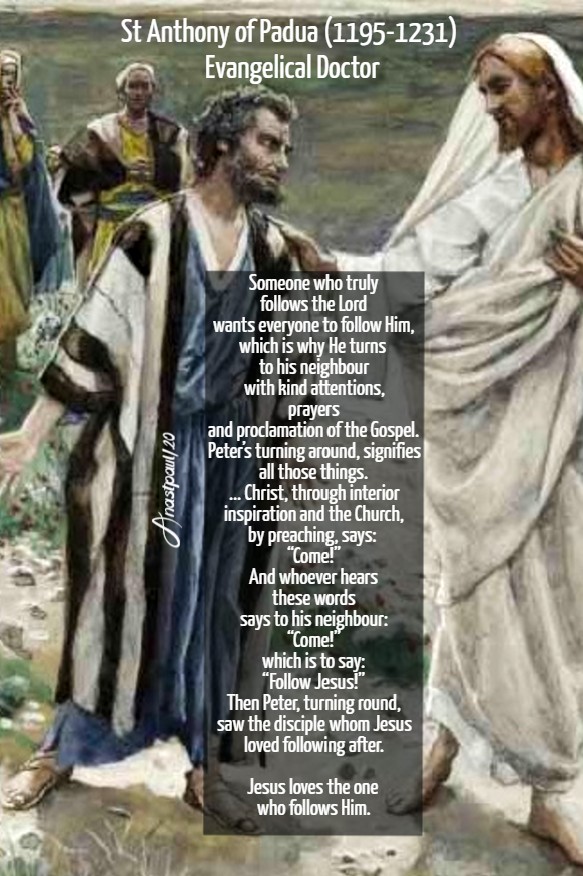
“Someone who truly follows the Lord wants everyone to follow Him, which is why He turns to his neighbour with kind attentions, prayers and proclamation of the Gospel. Peter’s turning around, signifies all those things. … Christ, through interior inspiration and the Church, by preaching, says: “Come!” And whoever hears these words says to his neighbour: “Come!” which is to say: “Follow Jesus!” Then Peter, turning round, saw the disciple whom Jesus loved following after. Jesus loves the one who follows Him.”
St Anthony of Padua (1195-1231) Evangelical Doctor
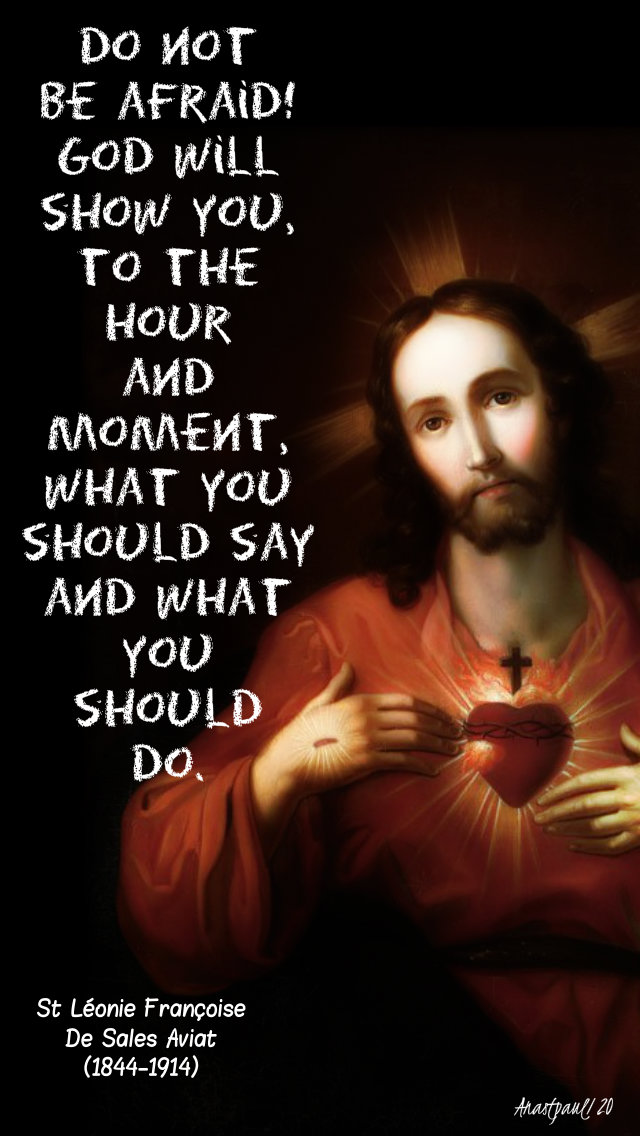
“Do not be afraid! God will show you, to the hour and moment, what you should say and what you should do.”
St Léonie Françoise De Sales Aviat (1844-1914)
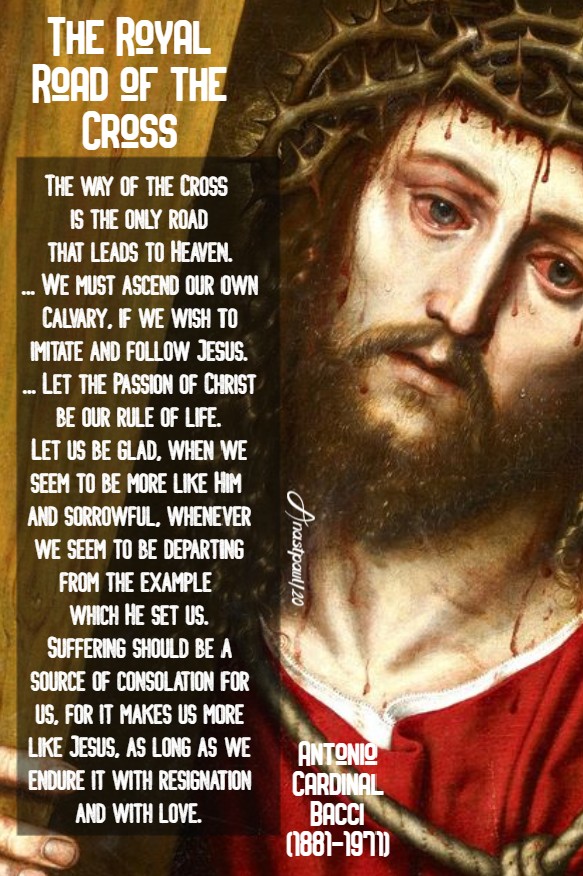
“The way of the Cross is the only road that leads to Heaven. Consequently, a man who refuses to take this road cannot reach Heaven. … We must ascend our own Calvary, if we wish to imitate and follow Jesus. … Let the Passion of Christ be our rule of life. Let us be glad, when we seem to be more like Him and sorrowful, whenever we seem to be departing from the example which He set us. Suffering should be a source of consolation for us, for it makes us more like Jesus, as long as we endure it with resignation and with love.”
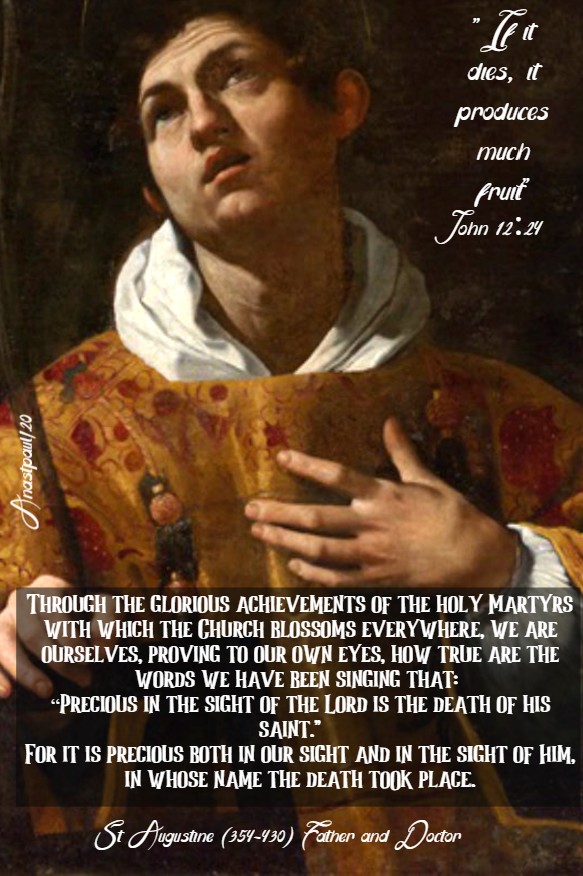
REFLECTION – “Through the glorious achievements of the holy Martyrs with which the Church blossoms everywhere, we are ourselves, proving to our own eyes, how true are the words we have been singing that: “Precious in the sight of the Lord is the death of his saints” (Ps 116[115]:15). For it is precious both in our sight and in the sight of Him, in whose name the death took place.
But the price of those deaths is the death of one man. How many deaths did that one man purchase by His death, for, if He had not died, the grain of wheat would not be multiplied? You heard His words when He drew near His passion, that is when He was drawing near to our redemption: “Unless a grain of wheat falls into the earth and dies, it remains alone but if it dies, it bears much fruit.” On the Cross He carried out a vast transaction; there the purse of our price was unfastened and, when His side was opened by the lance of the soldier, there streamed the price for the redemption of the whole earth (cf. Jn 19:34).
Now the faithful ones and Martyrs have been purchased but the faithfulness of the Martyrs has been proved – their blood is the proof … “As Christ laid down his life for us, so we ought to lay down our lives for the brethren” (1Jn 3:16). In another place it is stated: “At a grand table you have sat; now carefully consider what has been put before you, since it is your duty to prepare for such things” (cf. Prv 23:1). That table is great where the Lord of the table is Himself the meal. No-one feeds guests with Himself as food but this is exactly what the Lord Christ does, He, Himself is the host who invites; He, Himself is the food and the drink. Therefore, the Martyrs have recognised what they were eating and drinking so as to be able to repay such gifts. But whence can they make such return unless He who first paid the cost, supplies the source from which restitution may be made? That is the reason for the Psalm, where we sing what is written: “Precious in the sight of the Lord is the death of his saints.” ... St Augustine (354-430) Bishop of Hippo (North Africa), St Augustine (354-430) Father and Doctor – Sermon 329, for the Feast of the Martyrs, 1-2 ; PL 38, 1454
PRAYER – Lord God, You inspired St Lawrence with so ardent a love that his life was renowned for the service of Your people and his death for the splendour of his Martyrdom. Help us to love what he loved and to live as he showed us. St Lawrence, Martyr for Christ and His Church, pray for us. Through our Lord, Jesus Christ, in union with the Holy Spirit, one God forever and ever amen.
Our Morning Offering – 10 August – “Month of the Immaculate Heart of Mary” – Feast of Saint Lawrence, Deacon and Martyr
O Mary, my Queen By St Louis de Montfort (1673-1716)
O Mary, my Queen,
I cast myself into the arms of your mercy.
I place my soul and body
in your blessed care
and under your special protection
from this world.
I entrust to you
all my hopes and consolations,
all my anguish and misery,
my life and the end of my life.
Through your most holy intercession
and through your merits,
grant that all my works
may be directed and carried out
in accord with your will
and the will of your divine Son.
Amen
Saint of the Day – 10 August – Blessed Arcangelo Placenza da Calatafimi OFM (c 1390-1460), Franciscan Friar, Priest, Hermit, Mystic, Penitent – born in c 1390 in Calatafimi, Sicily, Italy and died on 10 August 1460 in Alcamo, Sicily, Italy of natural causes. Also known as Archangelus Piacentini.
Arcangelo was born at Calatafimi, (province and Diocese of Trapani), in about 1390 to the local noble family of the Placenza.
He was known as a quiet and pious child and thus, it was no surprise, when he left his paternal home and went to live as a hermit in a cave near the Church of Santa Maria dei Giubino in Sicily. Here, he experienced frequent apparitions of the Virgin, who would appear him over a cypress while he was praying.
After the news of the apparitions and miracles spread, the place became increasingly frequented by believers and relatives tried to persuade him to give up his solitary life. But his reputation for holiness spread far and wide and the young hermit attracted would-be spiritual students. In search of peace and tranquillity to focus his soul on meditation, Arcangelo moved to Alcamo, Sicily.
We can run but we always have to take ourselves with us and thus his reputation went with him and he was asked to assist in the restoration of the neglected old hospital of Sant’Antonio. He did and then spent much of his time there caring for the sick. The rest of his time was spent in a cave near the present Church of Holy Mary of Jesus (Alcamo) to pray and do penitence.
However, Pope Martin V, working to restore Papal authority, decreed that all hermits in Sicily should join approved religious orders and so Arcanglo joined the Franciscans in Palermo, receiving the habit from Blessed Matthew of Girgenti.
After becoming a Priest, the Blessed Matteo Guimerà from Agrigento, his immediate superior, gave him the right to open new Convents. Arcangelo returned to the hospital of sant’Antonio in Alcamo, to open a Convent. He was also was elected provincial Vicar of his Order and devoted himself to preaching.
He led both his brothers and the faithful by his example, supported Franciscans throughout Sicily, the Bishopric in Alcamo and spent his last days helping Blessed Matteo.
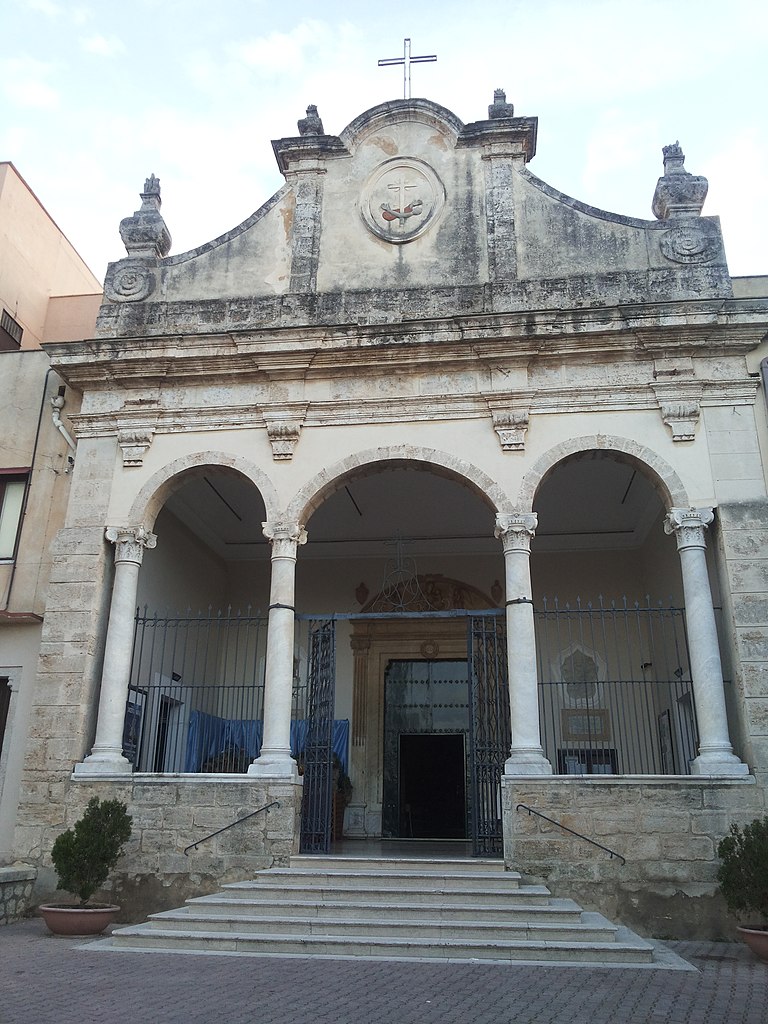
He lived in the convent of Santa Maria di Gesù in Alcamo (see below) until his death in 1460.
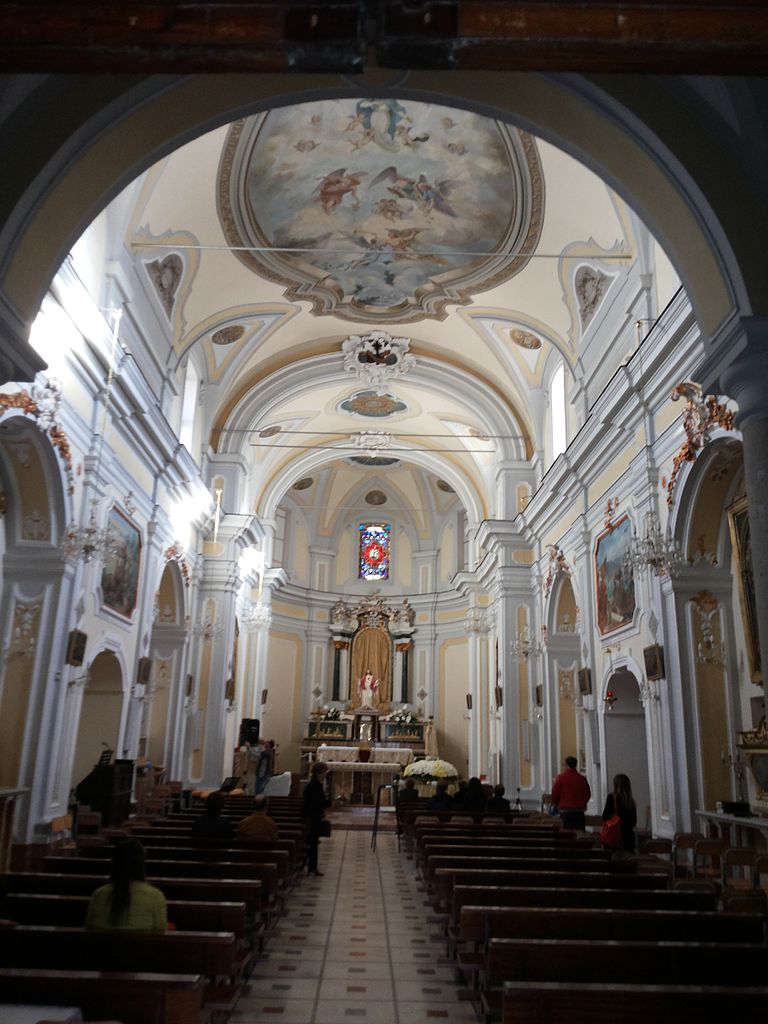
His body is kept in an ebony urn placed above the Altar of Saint Conrad, in the Chiesa di Santa Maria di Gesù.
Urn with the mortal remains of the Blessed Arcangelo Placenza from Calatafimi, kept inside the Church of Saint Mary of Jesus in Alcamo.
Pope Gregory XVI proclaimed him blessed, thanks to the many miracles attributed to him, on 9 September 1836.
The figure of Arcangelo Piacentini from Calatafimi is still very much evident and revered in our days, especially in the western areas of Sicily.
St Agathonica of Carthage
St Agilberta of Jouarre Bl Amadeus of Portugal OFM (1420–1482) Biography: https://anastpaul.com/2018/08/10/saint-of-the-day-blessed-amadeus-of-portugal-o-f-m-1420-1482/ Blessed Arcangelo Placenza da Calatafimi OFM (c 1390-1460)
St Aredius of Lyon
St Asteria of Bergamo
Bl Augustine Ota
St Bassa of Carthage
St Bessus
St Bettelin St Blane (Died 590) His Life: https://anastpaul.com/2019/08/10/saint-of-the-day-10-august-st-blane-died-590/
Bl Claude-Joseph Jouffret de Bonnefont
St Deusdedit the Cobbler
Bl Edward Grzymala
Bl Franciszek Drzewiecki
Bl Francois François
St Gerontius
Bl Hugh of Montaigu
Bl Lazare Tiersot
St Paula of Carthage
St Thiento of Wessobrunn
—
Martyrs of Alexandria – 260+ saints: A large number of Christians who died in Alexandria, Egypt between 260 and 267 in the persecutions of Decius and Valerian, whose names have not come down to us and who are commemorated together.
Martyrs of Rome – 165 saints: Group of 165 Christians martyred in the persecutions of Aurelian. 274 in Rome, Italy.
Martyred in the Spanish Civil War:
• Blessed Antonio González Penín
• Blessed José Toledo Pellicer
• Blessed José Xavier Gorosterratzu Jaunarena
• Blessed Juan Martorell Soria
• Blessed Pedro Mesonero Rodríguez
• Blessed Victoriano Calvo Lozano
Thought for the Day – 9 August – Meditations with Antonio Cardinal Bacci (1881-1971)
The Mystery of Life
“Life,” said the poet Tommaseo, “is only a remembrance, a hope and a passing moment.”
How true this is.
This life which preoccupies us so much, is only a point of time which continually passes and evades us.
We live on memories and on hopes but, in reality, our life is no more than an elusive period of time, flowing into the ocean of eternity.
Yesterday, we did not exist and tomorrow, we shall be no more.
Yesterday, God called us forth from nothingness and tomorrow, He will summon us from this fleeting existence, in order to reward or punish us in eternity.
It is the great mystery of life, that so much depends on a vanishing moment of time.
We have two alternatives.
We can direct our course in life towards God, in which case, we shall one day be happy with Him forever.
Or, we can travel in the opposite direction in pursuit of sensual satisfaction and transitory worldly success, in which case, we shall one day be rejected by God and shall be doomed to everlasting unhappiness.
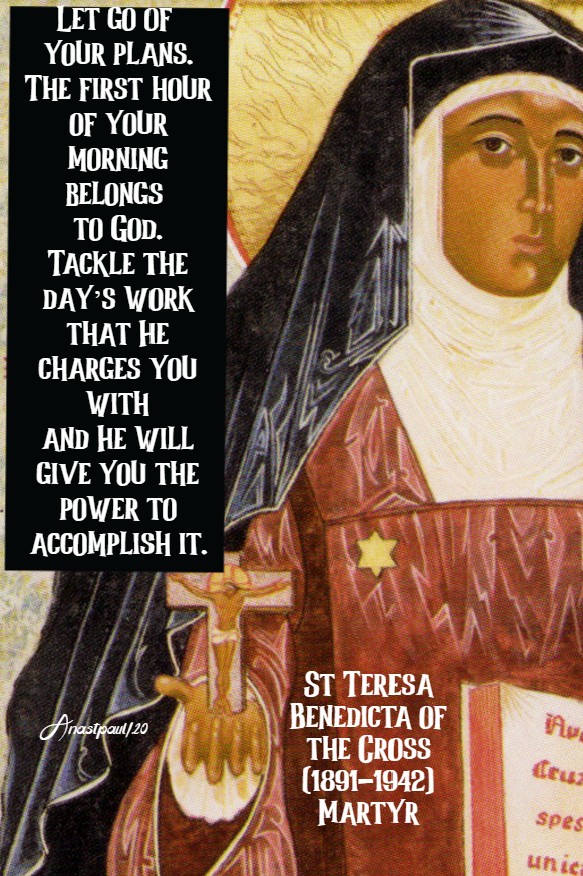
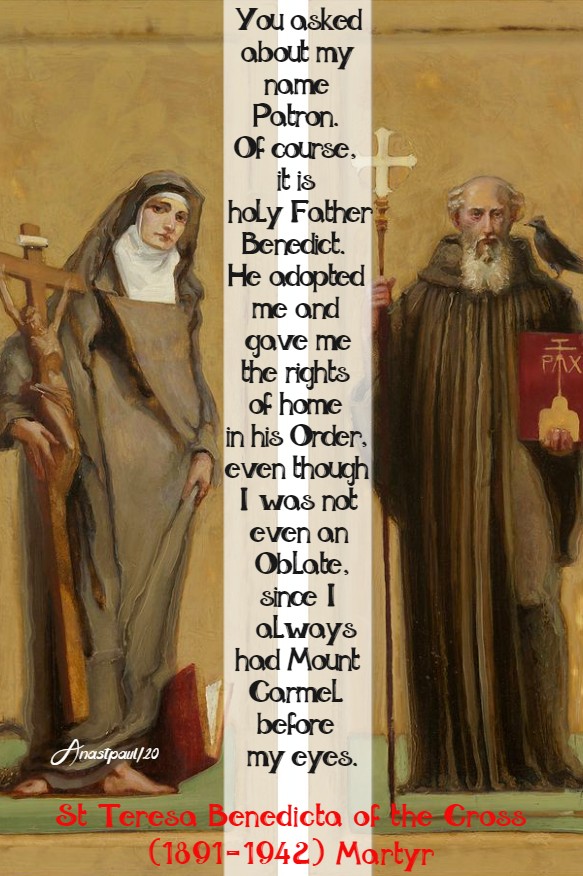
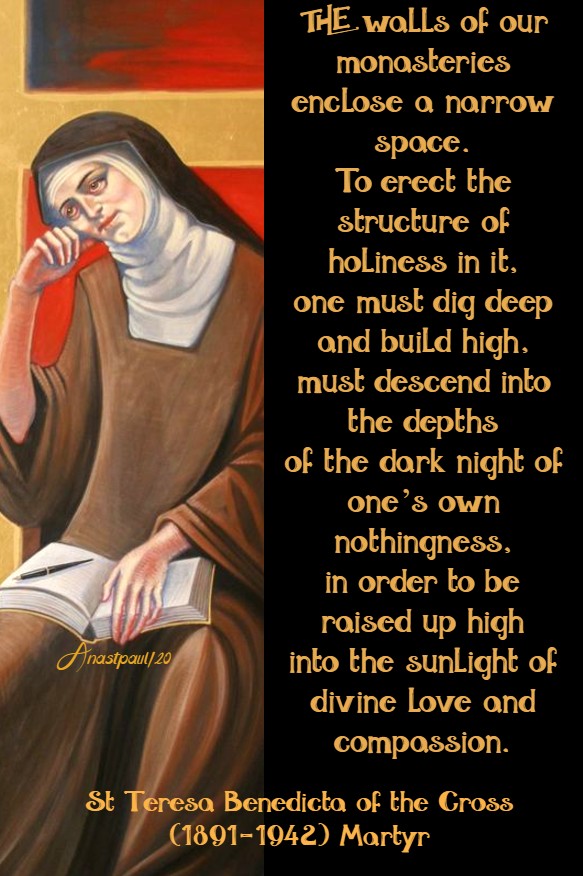
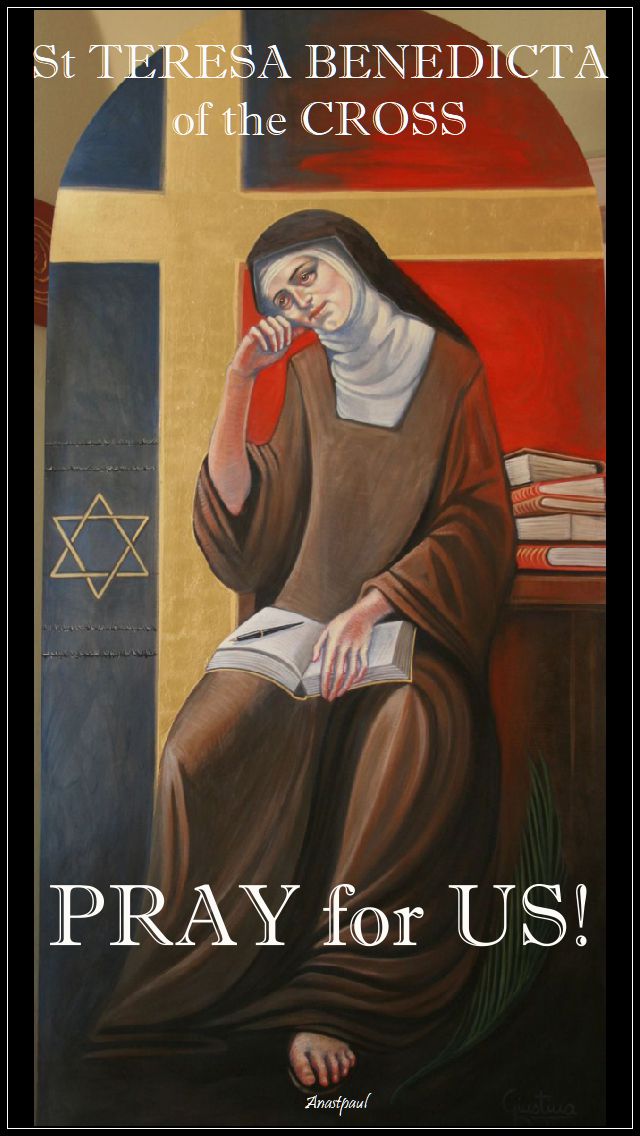
Quote/s of the Day – 9 August – The Memorial of St Teresa Benedicta of the Cross/Edith Stein (1891-1942) Martyr
“Let go of your plans. The first hour of your morning belongs to God. Tackle the day’s work that He charges you with and He will give you the power to accomplish it.”
“You asked about my name-patron. Of course, it is holy Father Benedict. He adopted me and gave me the rights of home in his Order, even though I was not even an Oblate, since I always had Mount Carmel before my eyes.”
“The walls of our monasteries enclose a narrow space. To erect the structure of holiness in it, one must dig deep and build high, must descend into the depths of the dark night of one’s own nothingness, in order to be raised up high into the sunlight of divine love and compassion.”
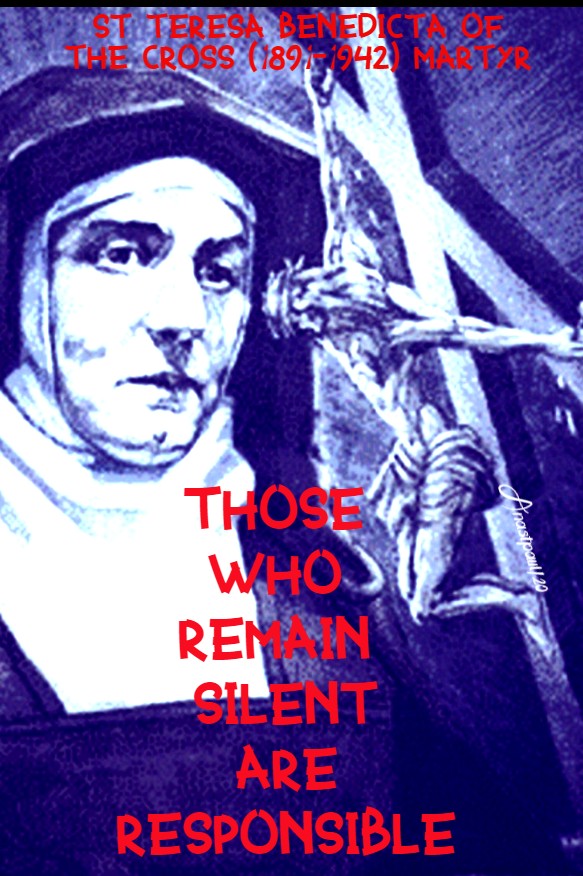
“Those who remain silent are responsible.”
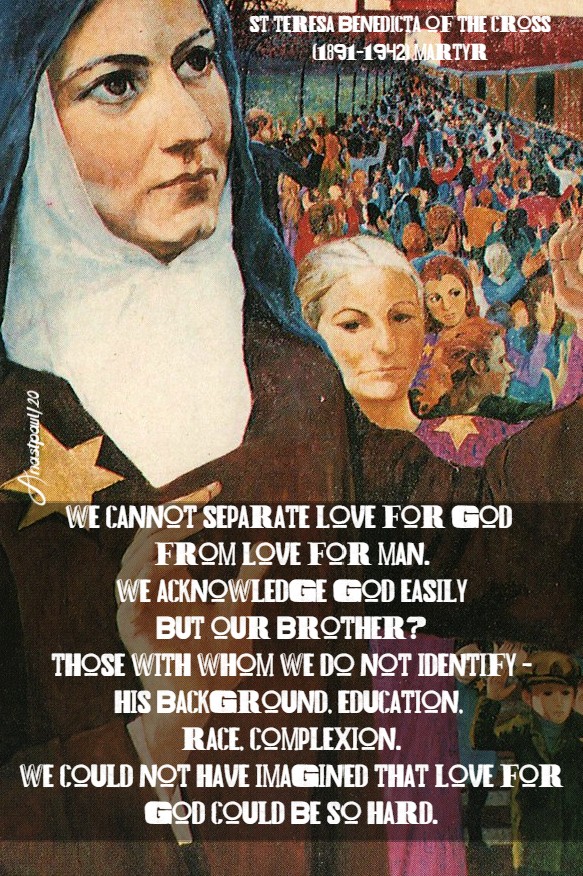
“We cannot separate love for God from love for man. We acknowledge God easily but our brother? Those with whom we do not identify – his background, education, race, complexion. We could not have imagined that love for God could be so hard.”
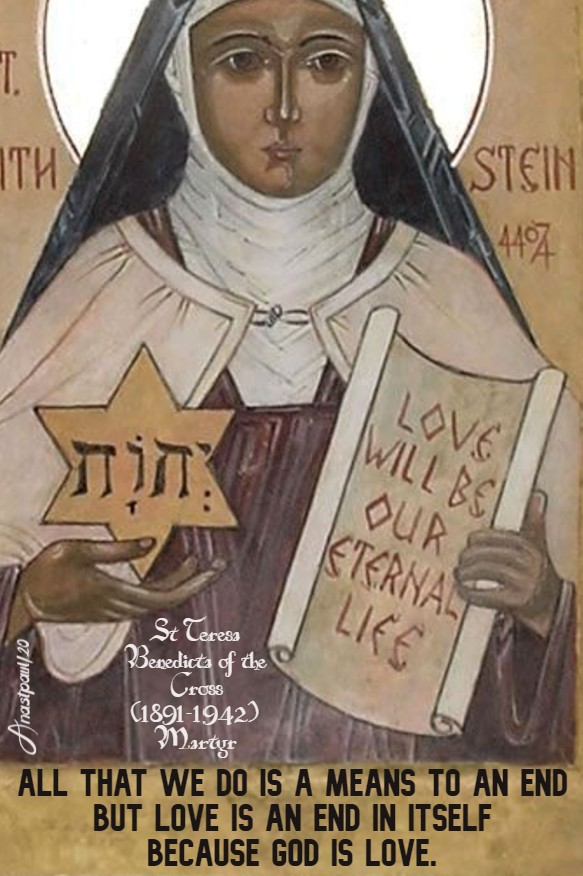
“All that we do is a means to an end but love is an end in itself because God is love.”
Sunday Reflection –9 August – Nineteenth Sunday in Ordinary Time
“The Joy of the Eucharist, all through Life!”
St John Vianney (1786-1859)
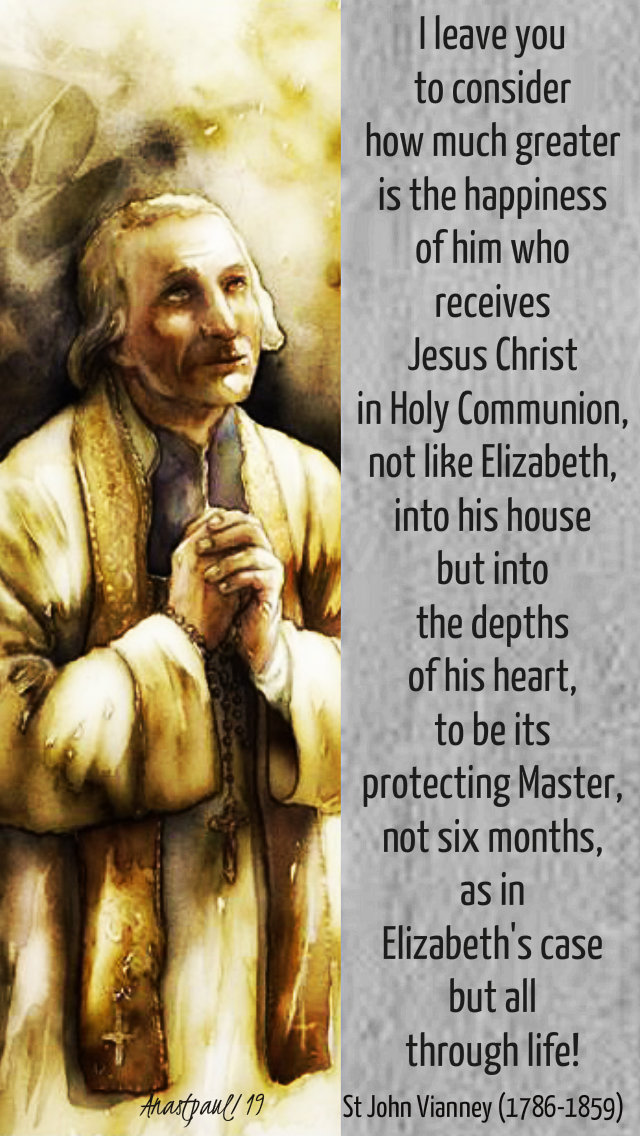
“When Jesus entered the house of St Elizabeth, although He was imprisoned in Mary’s womb, He sanctified both mother and child and Elizabeth exclaimed, “Whence comes so great a happiness to me, that the Mother of my God deigns to come to me?”
I leave you to consider how much greater is the happiness of him who receives Jesus Christ in Holy Communion, not like Elizabeth, into his house but into the depths of his heart, to be its protecting Master, not six months, as in Elizabeth’s case but all through life!”
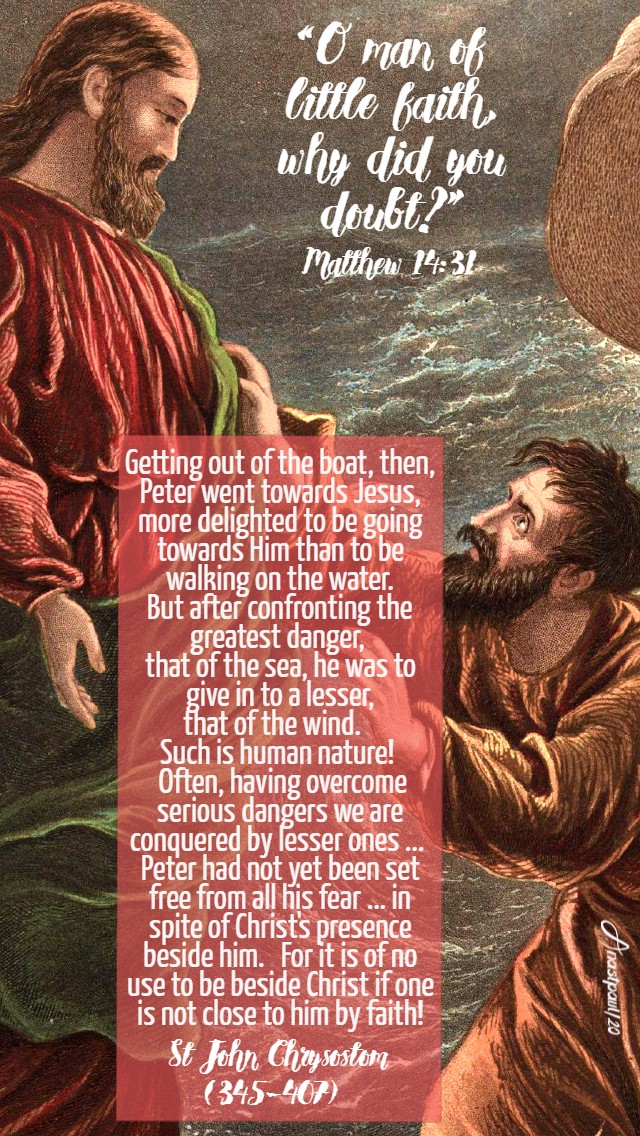
“O man of little faith, why did you doubt?” … Matthew 14:31
REFLECTION – “Once again the disciples are a plaything of the waves and a storm, similar to the first one (Mt 8:4), hurls itself against them. The first time, however, they had Jesus with them, whereas this time they are alone and left to themselves. … I think this was because our Saviour wanted to stir their sleeping hearts and, by throwing them into a panic, he inspired in them a strong desire for His presence and kept the remembrance of Him constantly in their mind. Hence, He did not come to their help at once but “during the fourth watch of the night he came towards them, walking on the sea”. …
Peter, ever volatile, always getting in before the other disciples, said: “Lord, if it is you, command me to come to you on the water” … He didn’t say, “Command me to walk on the water” but “come to you,” for there was none who loved Jesus so much as he. He did the same thing after the Resurrection – unable to bear moving as slowly as the others in the boat, he jumped into the water to get there before them and satisfy his love for Christ. … Getting out of the boat, then, Peter went towards Jesus, more delighted to be going towards Him than to be walking on the water. But after confronting the greatest danger, that of the sea, he was to give in to a lesser, that of the wind. Such is human nature! Often, having overcome serious dangers we are conquered by lesser ones … Peter had not yet been set free from all his fear … in spite of Christ’s presence beside him. For it is of no use to be beside Christ if one is not close to him by faith. This is what emphasises the distance separating master from the disciple …
“O man of little faith, why did you doubt?” So if Peter’s faith had not faltered he would have resisted the wind without difficulty. And the proof of this is that Jesus grasped Peter while leaving the wind to continue blowing … Just as the mother bird supports with her wings, as it is about to fall, the fledgling that has prematurely left the nest and draws it back into the nest, so does Christ with regard to Peter.” … St John Chrysostom (345-407) Bishop of Constantinople, Father and Doctor of the Church – Homilies on Saint Matthew’s Gospel, no. 50, 1-2
PRAYER – Lord our God, the Light and Creator of Light, grant that faithfully pondering on all that is holy, we may ever live in the splendour of Your presence. May we live in Your Presence, withstand the winds of the world and grow daily in faith. By the help and intercession of St Teresa Benedicta, You may never permit us to separate ourselves from You and thus we may come, to completion in You, Through Jesus Christ with the Holy Spirit, one God forever, amen.
Our Morning Offering – 9 August – Nineteenth Sunday in Ordinary Time
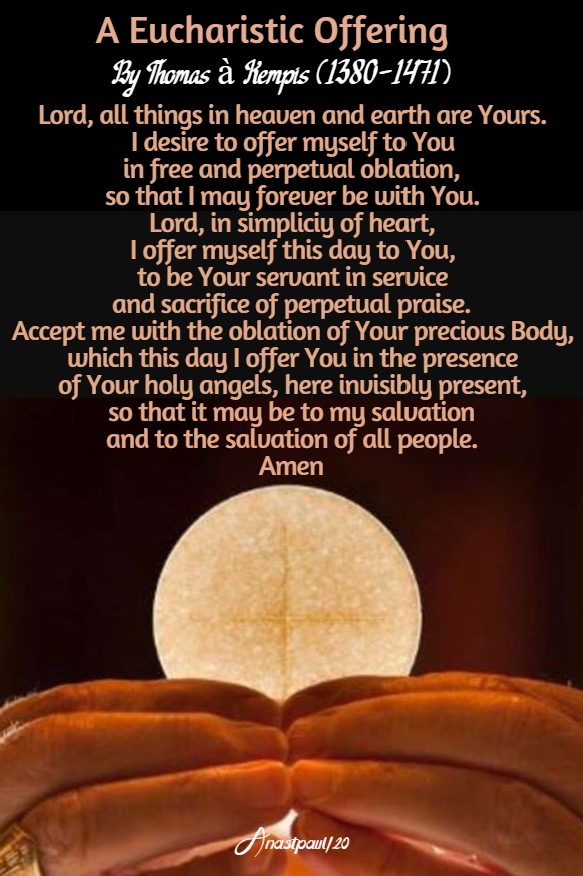
A Eucharistic Offering By Thomas à Kempis (1380-1471)
Lord, all things in heaven and earth are Yours.
I desire to offer myself to You
in free and perpetual oblation,
so that I may forever be with You.
Lord, in simpliciy of heart,
I offer myself this day to You,
to be Your servant in service
and sacrifice of perpetual praise.
Accept me with the oblation of Your precious Body,
which this day I offer You in the presence
of Your holy angels, here invisibly present,
so that it may be to my salvation
and to the salvation of all people.
Amen
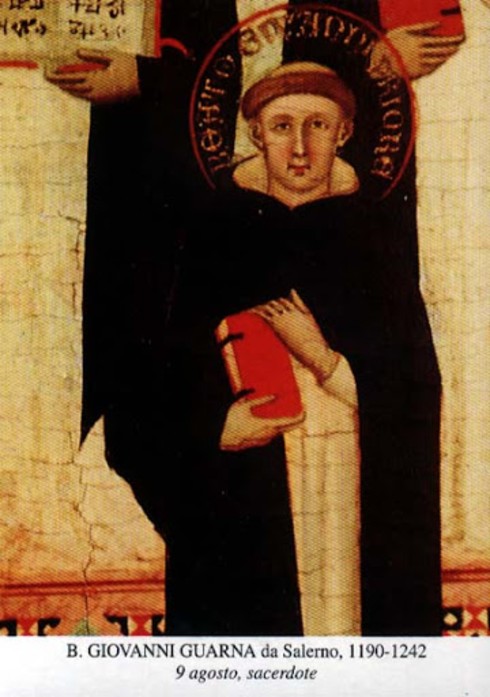
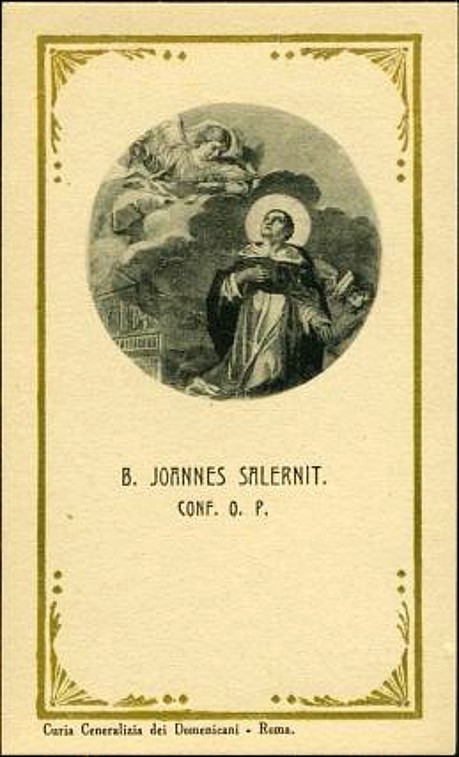
Saint of the Day – 9 August – Blessed John of Salerno OP (c 1190-1242) Dominican Friar and Priest, Confessor, Defender of the Faith, Superior with outstanding administrative and fatherly skills, miracle-worker, Pope Gregory IX commissioned him to deal with the heretical sect known as the Patarines – born in c 1190 at Salerno, Italy and died in 1242 of natural causes.
Although Father Touron failed to give a sketch of this distinguished Friar Preacher in his First Disciples of Saint Dominic, it is certain that he belonged to them and that he was an outstanding character in the noble galaxy. Some authors say that John was a scion of the noted Guana family and connected with the Norman princes who long reigned over the former kingdoms of Naples and Sicily. Whilst they do not give the date of his birth, practically all hold that he first saw the light of day at Salerno, some thirty miles south of Naples; that he studied at the University of Bologna and that he entered the Order in that educational centre. With one or two exceptions who give this honour to Blessed Reginald of Orleans, the writers maintain he received the habit from Saint Dominic himself. The year 1219 is the date assigned for the ceremony.
Evidently John was then a mature man, for he was soon placed at the head of twelve other confrères sent to establish the Order in Florence. A few date this commission in 1219 but 1220 is the time ordinarily given. The choice of him for superior, in so important a city, confirms the statement that his rare virtue, which he had practiced from early youth, made a strong impression on Saint Dominic. Although very small of stature, the future blessed, possessed a mighty mind and a courage that nothing could awe. Doubtless these qualities also appealed to the holy father, who seemed to judge of the characters ‘ of men almost by intuition, for an able, fearless leader was needed in Florence. Dominic and John are said to have been intimate, trustful friends-no doubt, a relationship born of grace. That the Saint formed a correct estimate of his young disciple, is shown by the fact that, our blessed soon became one of the most influential Friar Preacher in Italy.
A curious story is told about the first house of the fathers at Florence. It was built, so it would seem, by one Deodate del Dado (possibly a merchant) who wished to make restitution for his dishonesty by devoting it to religious purposes. Situated in the “plain of Ripoli”, two or three miles from the city limits, on the way to Arezzo, it was better suited for a contemplative order than for one of the apostolic character of Saint Dominic’s. Mamachi thinks another community had occupied it. Be that as it may, it was free when the builder beard of the wonderful preaching of the holy man from Caleruega, in Bologna. So he hurried to that city, attended one of the Saint’s sermons and then offered the place to him. Some writers say that the offer was accepted at once and the delighted donor accompanied the first missionaries back to Florence.
When the fathers arrived at the hermitage of Ripoli and saw its lonely, remote location, some of them likely wondered if their prayerful, mortified superior might intend to sacrifice the active side of their institute, which they had seen brought so prominently to the fore in Bologna, to the retired and cloistered side. They did not have long to wait before learning his views. Although the house was small, John of Salerno felt that it would suffice for a start. The first few days he spent in setting the place in order. Then he called the community together, and made known his plan of action. The life of a Friar Preacher, he said, is that of an energetic apostolate. They had come to humble Hipoli, not for their own sakes but for the spiritual welfare of the faithful in the Province of Tuscany. The work would commence on the morrow and every man would be expected to do his duty.
Day by day, the little handful of soul harvesters left their hermitage at an early hour, in bands of two, that they might preach the word of God in Florence or elsewhere. In all thing,s the diminutive superior, with a great mind and magnanimous soul, set the example, as well as led the way, which he would have the others follow. They assembled the people in churches, public squares, market places, open plains — wherever they could procure an audience. In the evening, unless too far away, they returned to their quiet abode for prayer and meditation.
Proud, cultivated Florence was stirred to the very core by the eloquence and zeal of the new religious, in whose lives there seemed to be naught of the worldly. The effect of their sermons was enhanced by the patience with which they trudged afoot back and forth between Ripoli and the city. They were on every tongue-in every mind. Their preaching was discussed in public, no less than in private. Repentant Deodate seems to have taken care of their secluded home while they were absent, as well as to have contributed towards their maintenance. No doubt he was happy in the realisation that his work of reparation bore such rich fruit.
Among the band of missioners, men of God though they all were, John of Salerno shone especially for his oratory, virtue and quest for souls. None of them appeared quite so heroic as he. Whilst his example, fatherly government and kindly admonition ever urged his confrères on in their exertions, his fine judgement and tact won the confidence of the faithful. All this combined with his superb scholarship and rare devotion to bring him the affection of the Archbishop, John di Velletri, together with that of the vast majority of the Diocesan clergy. Indeed, our Friar Preacher had every qualification for a perfect superior and a successful fisherman of men. Thus, it is no matter for wonder, that he was retained at the helm of his Order in one of Italy’s most beautiful cities, yet ever a maelstrom of political intrigue.
Saint Dominic is said to have been so impressed with the reports of the good’ effected by his brethren in Florence, that he paid them at least one visit and was delighted with their fervour and zeal. Their benefactor, Deodate, seems to have lived less than a year after they settled in his hermitage. His death deprived them of their principal source of support. This misfortune, together with the fatigue of walking back and forth each day between the city and the “plain of Ripoli,” caused the Florentines to obtain permission for them to use the hospice of Saint Pancratius, which stood at the side of the Church of the same name within the municipal limits, until a more suitable place could be obtained for them. John of Salerno gladly acceded to the proposal and moved his community thither at once, for this more convenient location would be of great aid to his friars in their work.
From the Saint Pancratius’ house, the fathers were soon transferred to Saint Paul’s. There, however, as was but natural, objections against their presence were raised by the clergy stationed at that church. John and his companions, while continuing their labours, bore all difficulties with admirable patience. Fortunately, no doubt in answer to their prayers, providence came to their aid. A Father Foresio, rector of Santa Maria Novella, touched by their virtue, zeal and forbearance, offered them his Church, together with the buildings attached to it, on condition that they would pay a moderate allowance each year for his support. Our blessed, in his capacity as superior, gratefully accepted the generous offer. Cardinal Ugolino, the Papal legate whom we have so often seen in the role of a friend of the Order and Archbishop di Velletri warmly approved of the project.
Santa Maria Novella passed into the hands of the Friars Preacher, on 8 November 1221. Thus John of Salerno became the founder of the great convent at Florence, which was destined to become one of the most historic and beautiful, in a religious institute, renowned for it’s learning and deeds, as well as for its cultivation of the artistic. Many noted clergymen were trained and educated there. Not a few of Italy’s most famed painters, sculptors and architects were employed there. It is still an object of delightful study for artists from every part of the world. Because of it’s exquisite decorations, Michaelangelo was wont to call it “The Bride.”
Florence had become one of the strongholds of the new Manicheans in Italy, whence their evil influence spread throughout Tuscany. They hesitated at nothing for the propagation of their destructive principles. In the subject of our sketch they met with a relentless foe. Day and night he opposed them, whether by deed or word. Never was he known to quail before their threats or attacks. His fearless action and preaching not only produced the most salutary effects but even won for him, the name of “hammer of heretics.” He must ever rank high amongst those brave Friars Preachers who helped to free the Italian Peninsula from the dangers of Manicheanism and Albigensianism.
The persuasive eloquence of the man of God, combined with the odour of his sanctity and the fire of his zeal, drew many and brilliant subjects into his Order. They came from numerous places but especially from Florence, Prato and Pistoia. Among them was the noted Hugh of Sesto, a Canon at Saint Paul’s who had led the opposition to the friars at that church. Others who should not be omitted were – Roderic, a Canon at Saint Peter’s, James Rabacante, who later succeeded John of Salerno as Prior of Santa Maria Novella, Ottavente di Nerli, Roger Calcagni, who became the first Papal inquisitor at Florence and Bishop of Castro; Father Buoninsegna, a Martyr at Antioch, who is commonly called blessed, Ambrose of Rimini, a celebrated preacher who became Bishop of his native city, Thomas Morandi, honoured with the mitre of Fano and Aldobrandini Cavalcanti, entrusted with the charge of the Diocese of Orvieto. We might mention more but those given above suffice to show the character of those whom the early disciple brought into his institute.
Blessed John had a special gift for governing others. He seemed to read dispositions almost as he would read a book. In all things he showed himself a father, brother, friend and servant to those under his charge. He dominated their wills by kindness, quickened their zeal by his own, directed them along the path of perfection by his example and gentle words. The love which he bore them merited the affection which they gave him.
Whatever he did, the man of God was doubtless guided by the lessons which he had received from Saint Dominic. He had lived under the our blessed Dominic at Bologna, had met him in Florence and, of course, had come in contact with him at the general chapter of 1221. Some writers say he was the Saint’s travelling companion on several apostolic journeys. However, such was his love for the Order’s Founder that he no sooner received word of his serious illness, than he started in all haste for Bologna, where he arrived just in time to receive the dying man’s last blessing and the assurance that he would be more helpful to the infant institute in heaven than he could be on earth. Such is the importance which one saint attaches to the word of another, that we are justified in believing those of Dominic must have acted as an inspiration for Blessed John of Salerno the rest of his life.
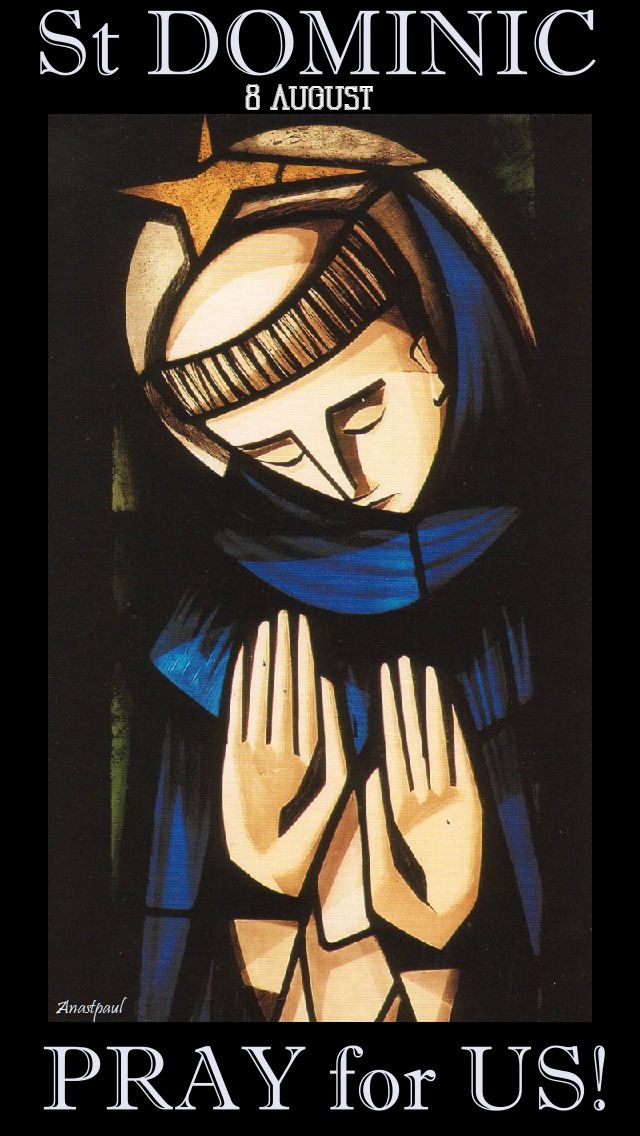
St Dominic
God enriched the soul of this early disciple with many choice graces. One of the things which greatly aided him in the spiritual direction of others, whether in his Order or without it, was the faculty often accorded him of reading their consciences. Many a time did he make known to his penitents, sins which they had forgotten. This gift, quite naturally, increased his influence and he was careful to use it only for the spiritual betterment of those who sought his aid. Not a few miracles were also attributed to him but these he did all in his power to conceal.
There is an adage which tells us that the ways of God are not the ways of man. Rare is it, that providence does not permit even the most faithful servants of Christ to be tried in the crucible of temptation but, as Saint Paul assures us, the temptation is always accompanied with the grace necessary to overcome it. So it was with John of Salerno. There were those who sought to lead him from the path of virtue. Yet his resistance not merely saved him from sin, it issued unto his greater glory before God and man. It made him “the good odour of Christ” even unto the conversion of those who thirsted for his ruin.
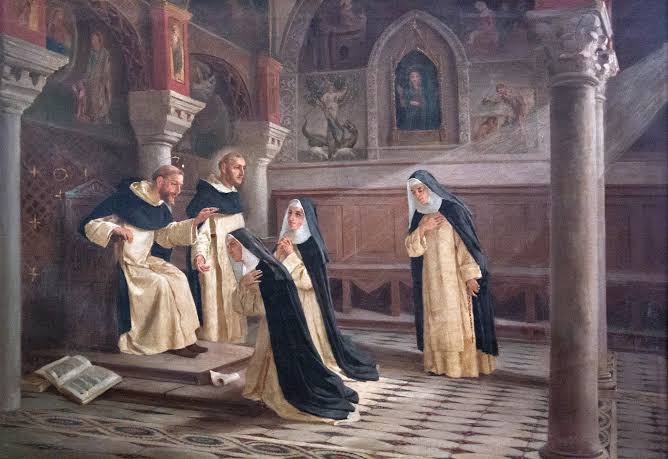
Among our Friar Preacher’s notable works for the benefit of religion in Tuscany must be placed the establishment of the first community of Dominican Sisters in the province. These he started in the hermitage of Ripoli, built by Deodate del Dado, sometime after the fathers had left it. He had great faith in the prayers of these holy women and trusted to their intercession as an aid to the success of his work and that of his friars. In later years, because the neighbourhood of Florence became infested with brigands, these sisters moved into the city. There, they divided into two communities. One of them retained the old title of Ripoli, while the other took the name of Saint Dominic. Both long continued to edify the Florentines by their saintly lives and to bring blessings on the Church of the municipality by their perpetual prayers
So laboured on Blessed John of Salerno until the end of his useful life. Father John Caroli and other earlier writers speak of his toil and his heroic virtue in terms of the highest praise. They tell how he was loved and venerated, how his fellow friars mourned his death and how the people of Florence turned out in a body for his funeral but, they give us no further indication of it’s date, than to say that it happened after many years of faithful labour.
Our blessed was buried with great honour in the Church of Santa Maria Novella, where his tomb immediately became a place of pilgrimage for the faithful. A number of miracles were attributed to him. It would seem that there were several translations of his relies, one of which doubtless took place when his body was removed from the old church to the new. On these occasions the faithful of the city and neighbouring places came in immense crowds to pay honour to one, whom they held in deep veneration. The last and possibly the most notable, ceremony of the kind took place on 18 February 1571. At this date his relics were placed in a tomb and chapel specially dedicated to his memory. Pope Pius VI, who reigned from 1775 to 1799, officially ratified the cult to John, permitted his Order to say Mass and the Divine Office in his honour and appointed 9 August as his feast day.
St Amor of Franche-Comté
St Autor of Metz
St Bandaridus of Soissons
St Bonifacia Rodriguez Castro St Candida Maria de Jesus Cipitria y Barriola (1845-1912) Biography:
St Claude Richard
St Domitian of Châlons
Bl Falco the Hermit
St Firmus of Verona
Bl John Norton Blessed John of Salerno OP (c 1190-1242) Dominican Friar and Priest
Bl John Talbot
St Marcellian of Civitavecchia
Bl Michal Tomaszek
St Nathy
St Numidicus of Carthage
St Phelim
Bl Richard Bere
St Romanus Ostiarius
St Rusticus of Sirmium
St Rusticus of Verona
St Secundian of Civitavecchia
St Stephen of Burgos
Bl Thomas Palaser
St Verian of Civitavecchia
Bl Zbigniew Adam Strzalkowski
—
Martyrs of Civitavecchia: Three Christians martyred together in the persecutions of Decius. We know little more than the names – Marcellian, Secundian and Verian. 250 near Civitavecchia, Italy.
Martyrs of Constantinople: 10 saints: A group of ten Christians who were arrested, tortured and executed for defending an icon of Christ in defiance of orders from Emperor Leo the Isaurian. We know the names of three, but nothing else about them – Julian, Marcian and Mary. They were beheaded in Constantinople.
Martyred in the Spanish Civil War:
Bl Antonio Mateo Salamero
Bl Faustino Oteiza Segura
Bl Florentín Felipe Naya
Bl Florentino Asensio Barroso
Bl Francisco López-Gasco Fernández-Largo
Bl Guillermo Plaza Hernández
Bl Joan Vallés Anguera
Bl José María Garrigues Hernández
Bl Josep Figuera Rey
Bl Josep Maria Aragones Mateu
Bl Julián Pozo Ruiz de Samaniego
Bl Mateo Molinos Coloma
Bl Narcís Sitjà Basté
Thought for the Day – 8 August – Meditations with Antonio Cardinal Bacci (1881-1971)
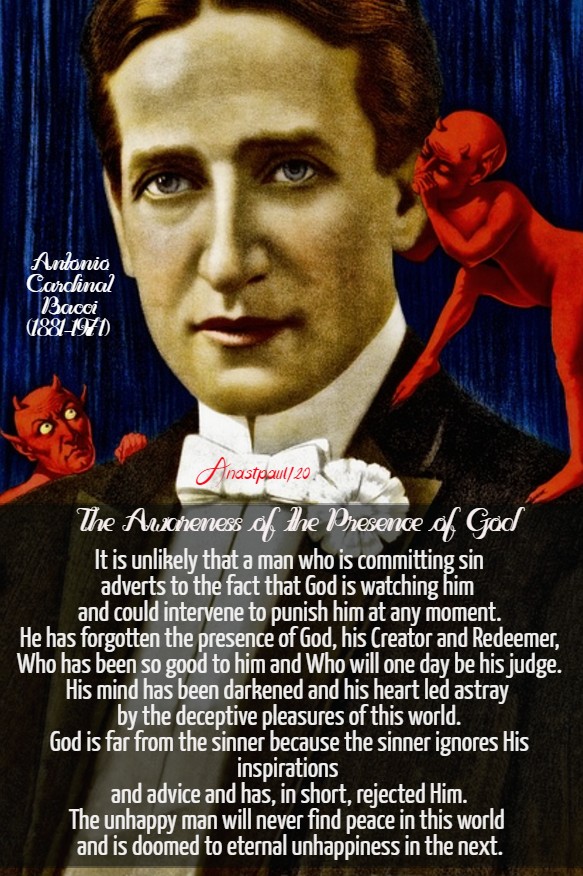
The Awareness of the Presence of God
“The cultivation of a continual awareness of the presence of God is such a useful practice that many writers regard it as the fundamental principle of the spiritual life.
As St Alphonsus de’Liguori points out, it obliges us to do three thing:
(1) To preserve ourselves completely free from sin;
(2) To practise virtue, in every possible way and
(3) To seek a closer and more loving contact with God (Al Servizio Divino, III, 1,3).
The realisation of the presence of God is a particularly good way of subduing our passions and conquering temptation. “If we were always aware of God’s presence within us,” writes St Thomas Aquinas, “we should never, or hardly ever, sin” (Opusc 58, c 2).
It is unlikely that a man who is committing sin adverts to the fact that God is watching him and could intervene to punish him at any moment.
He has forgotten the presence of God, his Creator and Redeemer, Who has been so good to him and Who will one day be his judge.
His mind has been darkened and his heart led astray by the deceptive pleasures of this world.
God is far from the sinner because the sinner ignores His inspirations and advice and has, in short, rejected Him.
The unhappy man will never find peace in this world and is doomed to eternal unhappiness in the next.
“If we remained always in the presence of God,” wrote St John Chrysostom, “we should neither conceive, nor do anything evil” (Homil 8, ad, Phil 2).”
Quote/s of the Day – 8 August – Saturday of the Eighteenth week in Ordinary Time, Readings: Habakkuk 112-2, 4, Psalm 9:8-13, Matthew 17:14-20
“If you have faith” – Matthew 17:20
“If I only touch his garment, I will be made well.” Jesus turned, and seeing her he said, “Take heart, daughter, your faith has made you well.” And instantly the woman was made well.”
Matthew 9:21-22
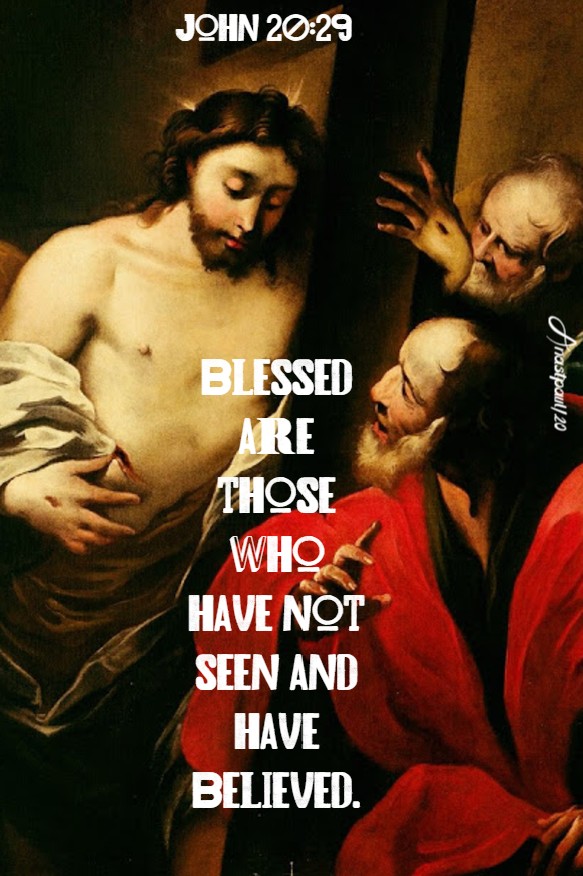
Jesus said to him, “Have you come to believe because you have seen me? Blessed are those who have not seen and have believed.”
John 20:28-29
“Elizabeth says: ‘Blessed are you because you have believed.’ You also are blessed, because you have heard and believed. A soul that believes, both conceives and brings forth the Word of God and acknowledges His works.”
St Ambrose of Milan (340-397)
Great Latin Father and Doctor of the Church
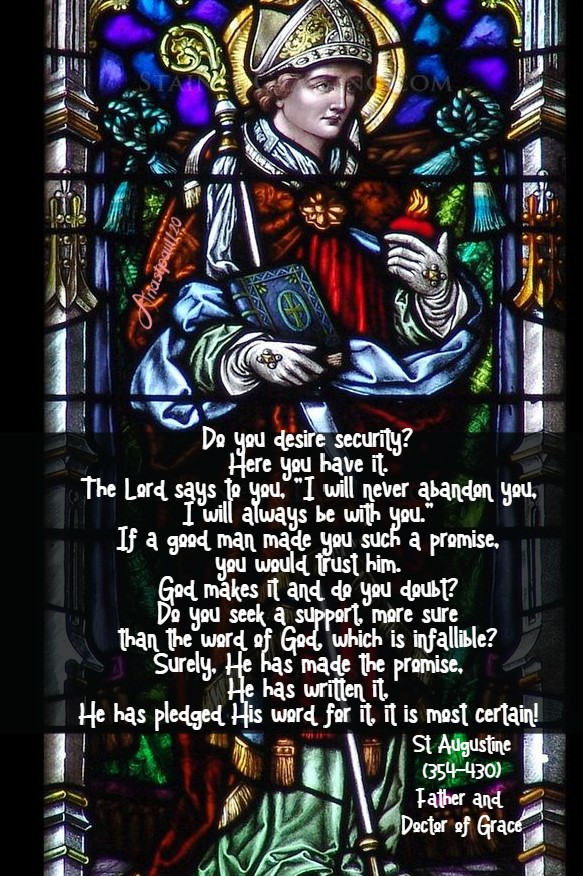
“Do you desire security? Here you have it. The Lord says to you, “I will never abandon you, I will always be with you.” If a good man made you such a promise, you would trust him. God makes it and do you doubt? Do you seek a support, more sure than the word of God, which is infallible? Surely, He has made the promise, He has written it, He has pledged His word for it, it is most certain!”
“To one who has faith, no explanation is necessary. To one without faith, no explanation is possible.”
St Thomas Aquinas (1225-1274)
Doctor Angelicus, Doctor Communis
“Paul says: I appeal to you by the mercy of God, to present your bodies as a sacrifice, living and holy. The prophet said the same thing: Sacrifice and offering you did not desire but you have prepared a body for me. Each of us is called to be both a sacrifice to God and His priest. Do not forfeit what divine authority confers on you. Put on the garment of holiness, gird yourself with the belt of chastity. Let Christ be your helmet, let the cross on your forehead be your unfailing protection. Your breastplate, should be the knowledge of God, that He Himself has given you. Keep burning continually, the sweet smelling incense of prayer. Take up the sword of the Spirit. Let your heart be an altar. Then, with full confidence in God, present your body for sacrifice. God desires, not death but faith. God thirsts, not for blood but for self-surrender. God is appeased, not by slaughter but by the offering of your free will.”
St Peter Chrysologus (c 400-450)
Bishop, Father & Doctor of the Church
“Doctor of Homilies”
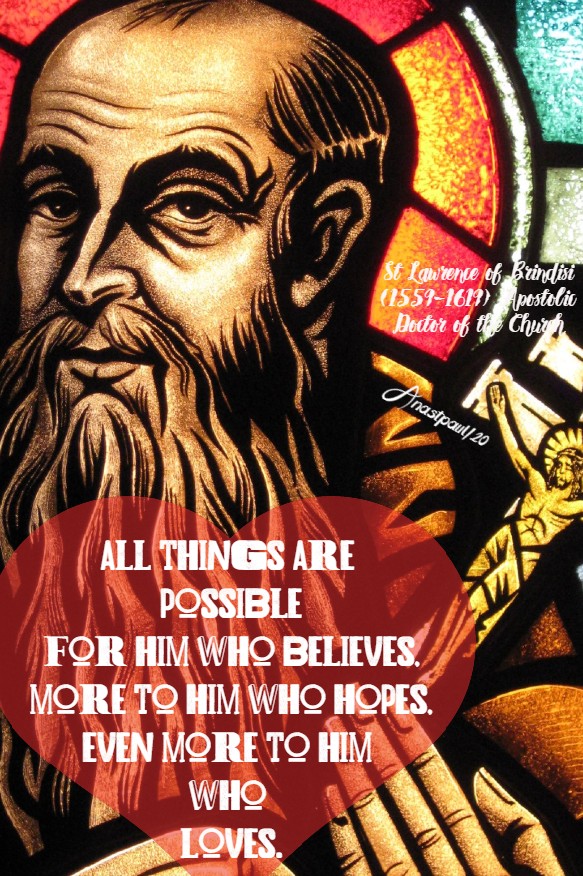
“All things are possible for him who believes, more to him who hopes, even more to him who loves.”
St Lawrence of Brindisi(1559-1619)
Apostolic Doctor of the Church
“Faith is like a bright ray of sunlight. It enables us to see God in all things, as well as, all things in God.”
St Francis de Sales (1567-1622)
Doctor of Charity
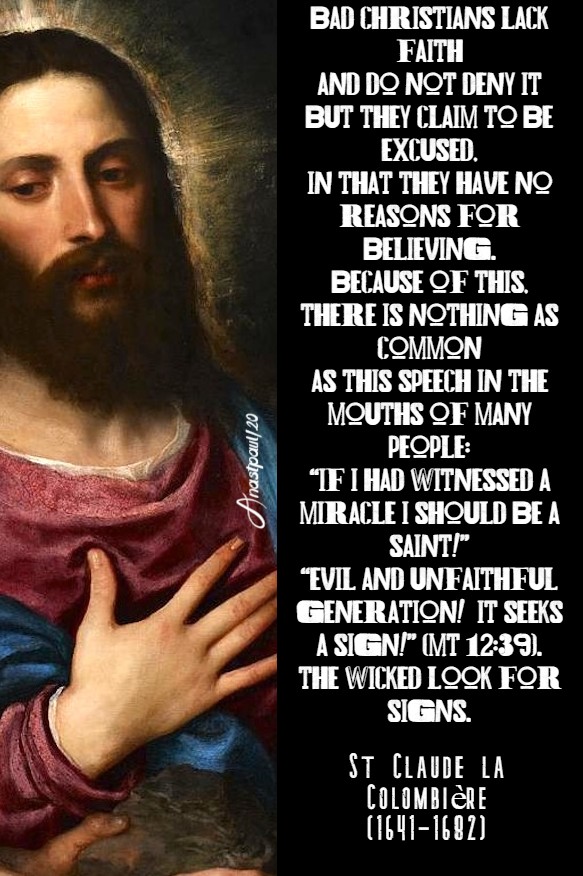
“Bad Christians lack faith and do not deny it but they claim to be excused, in that they have no reasons for believing. Because of this, there is nothing as common as this speech in the mouths of many people: “If I had witnessed a miracle I should be a saint!” “Evil and unfaithful generation! It seeks a sign!” (Mt 12:39). The wicked look for signs.”
St Claude la Colombière SJ (1641-1682)
Apostle of the Sacred Heart of Jesus
One Minute Reflection – 8 August – Saturday of the Eighteenth week in Ordinary Time, Readings: Habakkuk 112-2, 4, Psalm 9:8-13, Matthew 17:14-20 and the Memorial of St Cyriacus the Martyr, Deacon (Died c 303) One of the Fourteen Holy Helpers and of St Dominic (1170-1221)
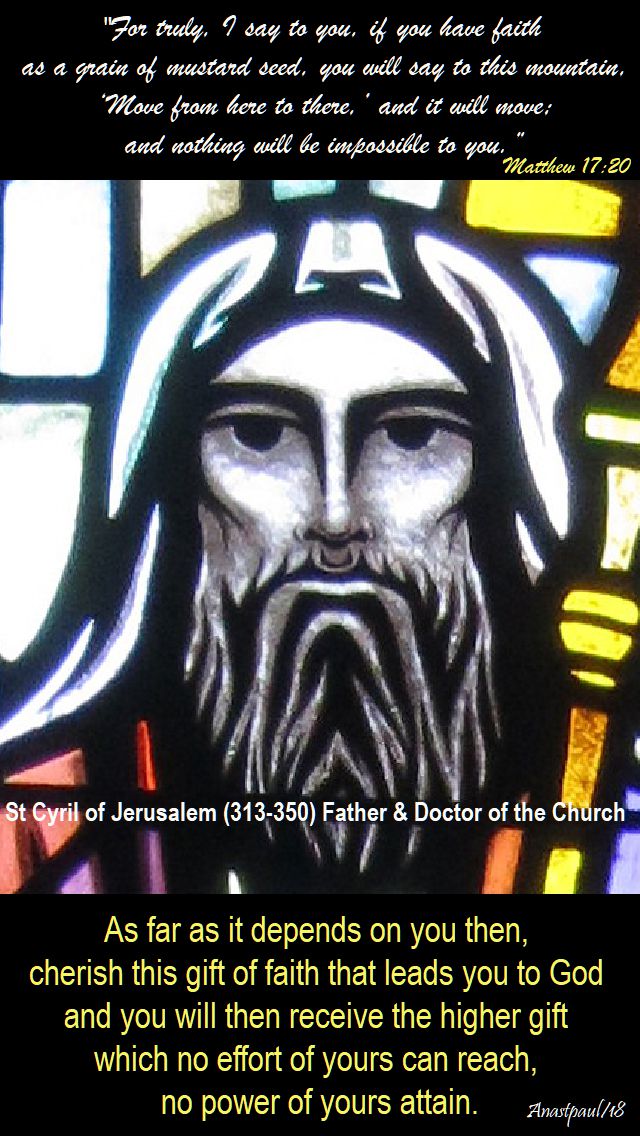
He said to them, “Because of your little faith. For truly, I say to you, if you have faith as a grain of mustard seed, you will say to this mountain, ‘Move from here to there,’ and it will move; and nothing will be impossible to you.”… Matthew 17:20
REFLECTION – “The word “faith” has one syllable but two meanings. First of all it is concerned with doctrine and it denotes the assent of the soul to some truth. Faith in this sense brings blessing and salvation to the soul, as the Lord said: “He who hears my word and believes in him who sent me, has eternal life.” (Jn 5:24)…
The word “faith” has a second meaning – it is a particular gift and grace of Christ. “To one is given through the Spirit the utterance of wisdom and to another the utterance of knowledge according to the same Spirit, to another faith by the same Spirit, to another gifts of healing” (1Cor 12:8-9). Faith in the sense of a particular divine grace conferred by the Spirit is not, then, primarily concerned with doctrine but with giving a person powers, quite beyond their natural capability. Whoever has this faith will say to a mountain: “Move from here to there” and it will move and anyone who can in fact say these words through faith and “believes without hesitation that they will come to pass,” (Mk 11:23) receives this particular grace. It is to this kind of faith that the Lord’s words refer – “If you have faith as a grain of mustard seed.” Now, a mustard seed is small in size but its energy thrusts it upwards with the force of fire. Small are its roots, great the spread of its boughs and once it is fully grown the birds of the air find shelter in its branches (Mt 13:32). So too, in a flash, faith can produce the most wonderful effects in the soul.
Enlightened by faith the soul gazes at the glory of God so far as human nature allows and, even before the consummation of all things, ranging beyond the boundaries of the universe, it has a vision of the judgement and of God making good the rewards he promised. As far as it depends on you then, cherish this gift of faith that leads you to God and you will then receive the higher gift which no effort of yours can reach, no power of yours attain.”…St Cyril of Jerusalem (313-350) Bishop of Jerusalem, Father & Doctor of the Church (Baptismal Catechesis 5)
PRAYER – Holy God, grant we pray, Your Holy Spirit of love and divine grace to grow ever more in faith. By our prayers and love for You and our neighbour, may we merit Your divine assistance. Lord Jesus, help us to dwell often on the manner in which we are following You. Let us strive each day to become more and more like You in all things and, to become beacons of Your Light, to all the world. St Cyriacus Martyr for Christ, you who were and are a light to all, pray for us and may the prayers of St Dominic assist us in our day and may his zeal be our inspiration to always fight the good fight,amen.
Our Morning Offering –8 August – “Month of the Immaculate Heart of Mary” – Saturday of the Eighteenth week in Ordinary Time
Mary Our Strength By Venerable Pope Pius XII (1876-1958) (Pontiff 1939-1958)
O Virgin, fair as the moon,
delight of the angels and saints in heaven,
grant that we may become like you
and that our souls may receive a ray of your beauty,
which does not decline with the years
but shines forth into eternity.
O Mary, sun of heaven,
restore life where there is death
and enlighten spirits, where there is darkness.
Turn your countenance to your children
and radiate on us your light and your fervour.
O Mary, powerful as an army,
grant victory to our ranks.
We are very weak
and our enemy rages with uttermost conceit.
But under your banner
we are confident of overcoming him. ….
Save us, O Mary,
fair as the moon,
bright as the sun,
awe-inspiring as an army set in battle array
and sustained not by hatred
but by the ardour of love.
Amen
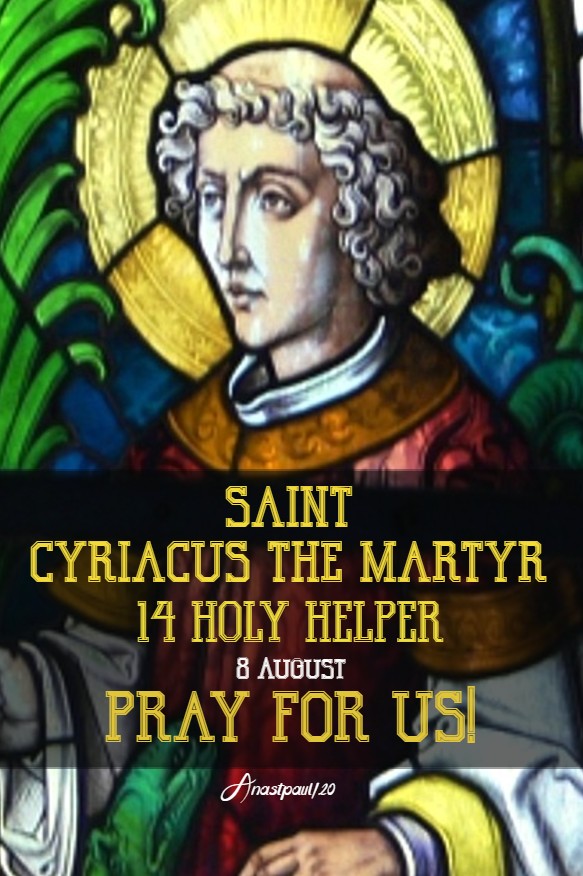
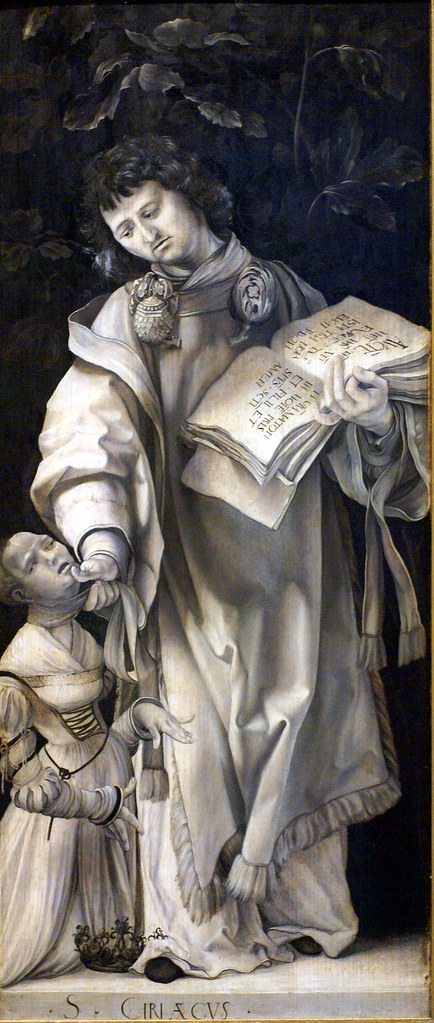
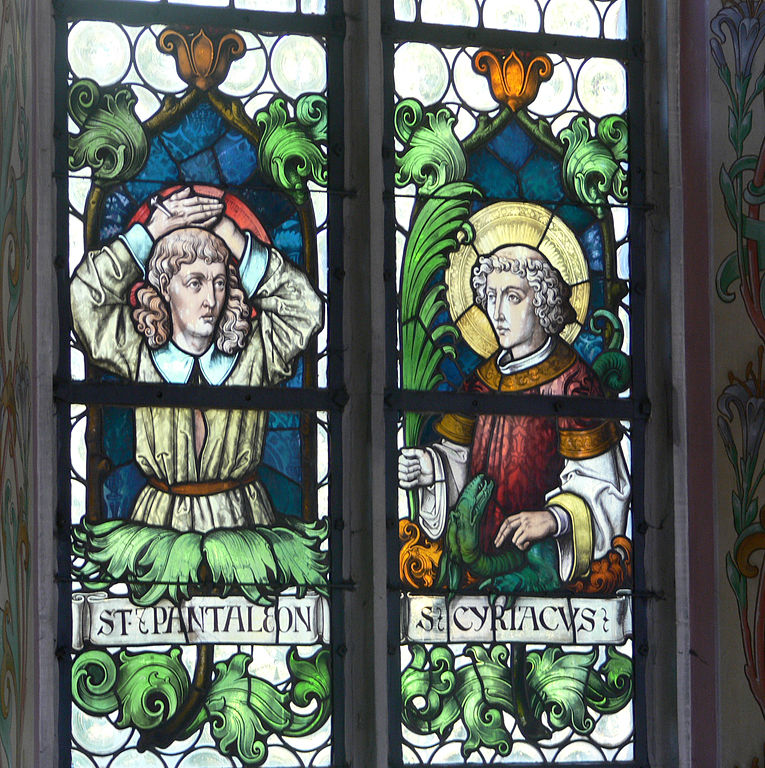
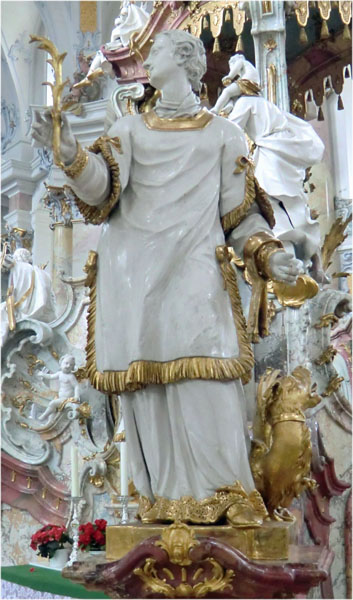
Saint of the Day – 8 August – Saint Cyriacus (also called St Cyriac) the Martyr, Deacon (Died c 303) One of the Fourteen Holy Helpers, Confessor, Miracle-worker – born in the 3rd Century and died by being tortured and beheaded in 303 on the Salarian Way, Rome, Italy. Patronages – against diabolical possession, against eye disease, against temptations (especially at time of death), Altidona, Italy, Saint-Cierges, Vaud, Switzerland.
Emperor Maximin in token of his gratitude to Diocletian, who had ceded the western half of his empire to him, ordered the building of that magnificent structure in Rome, whose ruins are still known as the “Baths of Diocletian.” The Christians, imprisoned for the Faith, were compelled to labour under cruel overseers at this building. A zealous Christian Roman, touched with pity at this moving spectacle, resolved to employ his means in improving the condition of these poor victims of persecution.
Among the Deacons of the Roman Church at that time, was one by the name of Cyriacus, who was distinguished by his zeal in the performance of all good works. He, with two companions, Largus and Smaragdus, the pious Roman selected for the execution of his plan. Cyriacus devoted himself to the work with great ardour. One day, whilst visiting the labourers to distribute food amongst them, he observed a decrepit old man, who was so feeble that he was unable to perform his severe task. Filled with pity, Cyriacus offered to take his place. The aged prisoner consenting, the merciful Deacon thenceforth performed the arduous labour of the building.
Saint Cyriacus, by the Master of Meßkirch.
After some time he was discovered and cast into prison. There he again found opportunity to exercise his zeal. Some blind men who had great confidence in the power of his prayer, came to ask him for help in their affliction and he restored their sight. He and his companions spent three years in prison and during that time he healed many sick and converted a great number of heathens from the darkness of paganism.
Then, Emperor Diocletian’s little daughte, became possessed by an evil spirit and no-one was able to deliver her from it. To the idolatrous pagan priests who were called, the evil spirit declared that he would leave the girl only when commanded to do so by Cyriacus, the Deacon. He was hastily summoned and prayed and made the Sign of the Cross over the girl and the evil spirit departed. The Emperor loved his daughter, therefore, he was grateful to the holy Deacon and presented him with a house, where he and his companions might serve their God unmolested by their enemies.
St Cyriacrus heals Diocletian’s daughter
About this time, the daughter of the Persian King, Sapor was attacked by a similar malady and when he heard what Cyriacus had done for Diocletian’s daughter, he wrote to the Emperor, asking him to send the Christian Deacon. It was done and Cyriacus, on foot, set out for Persia. Arriving at his destination, he prayed over the girl and the evil spirit left her. On hearing of this miracle, four hundred and twenty heathens were converted to the Faith. These, the Saint instructed and Baptised and then set out on his homeward journey.
St Cyriacus by Mattias Grunewald
Upon his return to Rome, he continued his life of prayer and good works. But when Diocletian soon afterward left for the East, his co-emperor Maximin seized the opportunity to give vent to his hatred for the Christians and renewed their persecution. One of the first victims was Cyriacus. He was loaded with chains and brought before the judge, who first tried blandishments and promises to induce him to renounce Christ and to sacrifice to the idols but in vain. Then the Confessor of Christ was stretched on the rack, his limbs torn from their sockets and be was beaten with clubs. His companions shared the same tortures. Finally, when the Emperor and the judge were convinced that nothing would shake the constancy of the holy Martyrs, they were beheaded. They gained the crown of glory in March 303.
In the life of St Cyriacus, two virtues shine forth in a special manner; his love of God and his charity toward his fellow men. His love of God impelled him to sacrifice all, even his life, for His sake, thereby fulfilling the commandment: “Thou shalt love the Lord thy God with thy whole heart and with thy whole soul and with thy whole mind” [Matt. 12: 37]. A greater love of God no man can have, than giving his life for Him.
St Cyriacus also fulfilled the other commandment, of which Our Lord declared, “And the second is like to this: Thou shalt love thy neighbour as thyself” [Matt. 12: 39]. He helped his fellow Christians to bear their burdens, relieved them in their sufferings, assisted and encouraged them by word and deed and edified them by his example. His sole aim was to do good to all men, mindful of the words of the Royal Prophet: “Blessed is he that understands concerning the needy and the poor” [Ps. 40: 2]. He was so imbued with the virtue of charity, that he was disposed even to sacrifice his life for the relief and assistance of others.
How shall we justify our unfeeling hardness of heart, by which we seek every trifling pretence to exempt us from the duty of aiding the unfortunate? Remember the threat of the apostle, “Judgement without mercy to him that hath not done mercy” [James 2: 13].
O GOD, Who grants us joy by the remembrance of Thy blessed Martyrs Cyriacus, Largus, and Smaragdus, grant, we beseech Thee, that we, by celebrating their memory, may imitate their fortitude in suffering. Through Christ our Lord. Amen
St Cyriacus/Cyriac the Martyr, Deacon (Died c 303) One of the Fourteen Holy Helpers
St Eleutherius of Constantinople
St Ellidius
St Famianus of Compostela
St Gedeon of Besancon
St Hormisdas of Persia
Bl John Felton
Bl John Fingley
St Largus
St Leobald of Fleury
St Leonidas of Constantinople
St Marinus of Anzarba St Mary of the Cross/ Mary MacKillop (1842-1909) – the first Australian born Saint Biography:
St Mummolus of Fleury
St Myron the Wonder Worker
St Paulus Ge Tingzhu
St Rathard of Diessen
St Severus of Vienne
St Sigrada
St Smaragdus
St Ternatius of Besançon
St Ultan of Crayke
Bl William of Castellammare di Stabia
Bl Wlodzimierz Laskowski
—
Martyrs of Albano – 4 saints: Four Christians who were martyred together, and about we today know little more than their names – Carpóforo, Secondo, Severiano and Vittorino. They were martyred in Albano, Italy – their remains are interred in the San Senator cemetery, on the Appian Way, 15 miles from Rome, Italy.
Martyrs of Rome – 5 saints: Five Christians martyred together; we know nothing else about them but the names – Ciriaco, Crescenziano, Giuliana, Memmia and Smaragdus. They were martyred at the 7 mile marker, on the Via Ostia, Rome, Italy.
Martyred in the Spanish Civil War – Martyrs of El Saler – 5 beati: Five nuns, all members of the Sisters of the Pious Schools, all teachers, and all martyred together in the Spanish Civil War.
• Antonia Riba Mestres
• Maria Baldillou Bullit
• María Luisa Girón Romera
• Nazaria Gómez Lezaun
• Pascuala Gallén Martí
They were martyred on 8 August 1936 in El Saler, Valencia, Spain and Beatified on 11 March 2001 by Pope John Paul II.
Martyred in the Spanish Civil War:
Bl Cruz Laplana Laguna
Bl Fernando Español Berdie
Bl Leoncio López Ramos
Bl Manuel Aranda Espejo
Bl Mariano Pina Turón
Bl Pedro Álvarez Pérez
Thought for the Day – 7 August – Meditations with Antonio Cardinal Bacci (1881-1971)
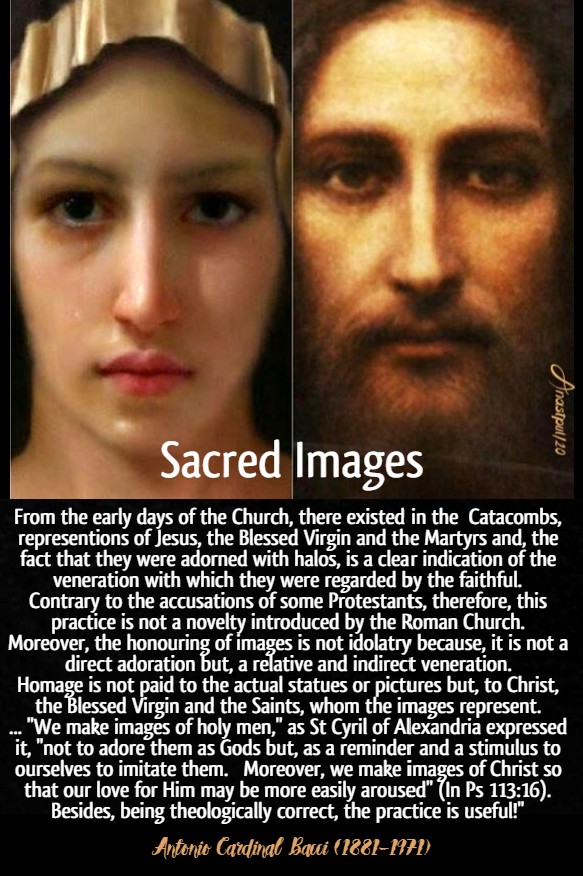
Sacred Images
“There are two extremes to be avoided in venerating the images of Christ and the Saints.
In emulation of the ancient heresy of the Iconoclasts, there are some, who regard the veneration of images as a superstitious and idolatrous practice.
In support of their view, they quote from the Book of Exodus: “You shall not carve idols for yourselves … you shall not bow down before them or worship them” (Ex 20:4-5).
The equivocation is obvious.
This prohibition refers to the images of false gods, not to the images of Saints.
It is the worship of idols which is forbidden, not devotion to the Saints.
There are examples in the Old Testament of the veneration of images and symbols, indicating the presence of God, such as the Ark of the Covenant, adorned by “two cherubim of beaten gold,” (Ex 25:18) and the bronze serpent mounted by Moses on a pole in the desert (Num 21:8).
From the early days of the Church, there existed in the Catacombs, representations of Jesus, the Blessed Virgin and the Martyrs and, the fact that they were adorned with halos, is a clear indication of the veneration with which they were regarded by the faithful.
The historian Eusebius, specifically mentions a bronze statue erected in honour of the Saviour, before which, the faithful prayed and were sometimes awarded with miracles.
Contrary to the accusations of some Protestants, therefore, this practice is not a novelty introduced by the Roman Church.
Moreover, the honouring of images is not idolatry because, it is not a direct adoration but, a relative and indirect veneration.
Homage is not paid to the actual statues or pictures but, to Christ, the Blessed Virgin and the Saints, whom the images represent.
“The images of Christ, of the Virgin Mother of God and of other Saints, are to be kept with honour in places of worship especially and, to them due honour and veneration is to be paid – not because it is believed that there is any divinity or power intrinsic to them, for which they are reverenced, nor because it is from them that something is sought, nor that a blind trust is to be attached to images as it once was, by the Gentiles who placed their hope in idols but, because the honour which is shown to them, is referred to the prototypes which they represent”(Council of Trent, Session 25).
The cult of images has, therefore, a solid theological foundation. “We make images of holy men,” as St Cyril of Alexandria expressed it, “not to adore them as Gods but, as a reminder and a stimulus to ourselves to imitate them. Moreover, we make images of Christ so that our love for Him may be more easily aroused” (In Ps 113:16).
Besides, being theologically correct, the practice is useful!”
Quote/s of the Day – 7 August – The Memorial of St Albert of Trapani O.Carm. (c 1240-1307) and St Cajetan (1480-1547)
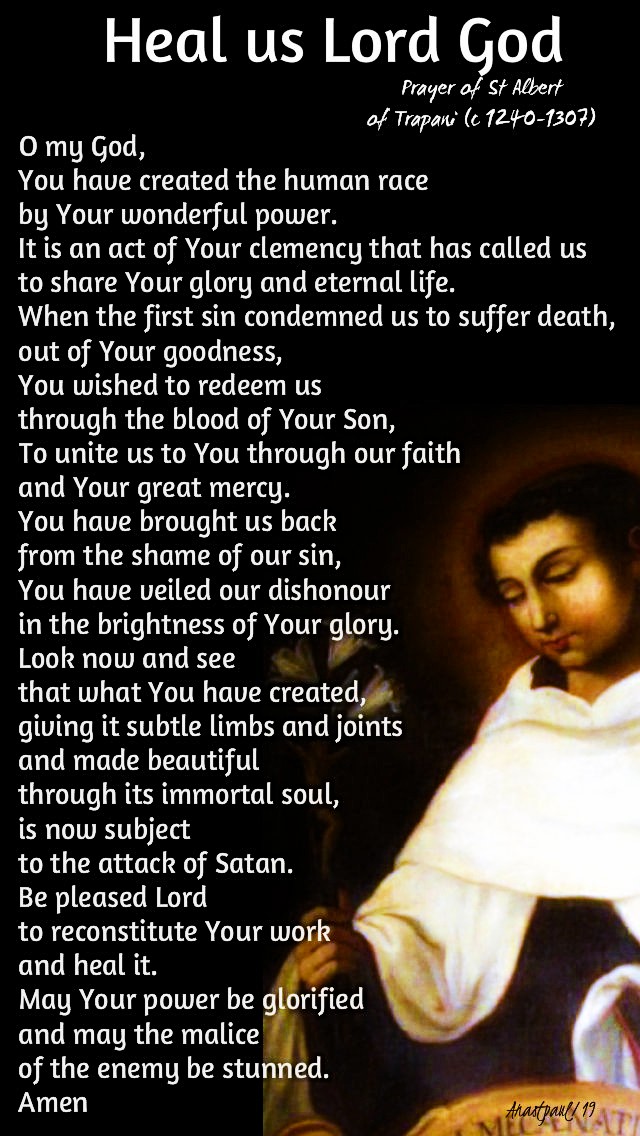
Heal us Lord God Prayer of St Albert of Trapani O.Carm. (c 1240-1307)
O my God,
You have created the human race
by Your wonderful power.
It is an act of Your clemency that has called us
to share Your glory and eternal life.
When the first sin condemned us to suffer death,
out of Your goodness,
You wished to redeem us
through the blood of Your Son,
To unite us to You through our faith
and Your great mercy.
You have brought us back
from the shame of our sin,
You have veiled our dishonour
in the brightness of Your glory.
Look now and see that what You have created,
giving it subtle limbs and joints
and made beautiful through its immortal soul,
is now subject to the attack of Satan.
Be pleased Lord
to reconstitute Your work and heal it.
May Your power be glorified
and may the malice of the enemy be stunned.
Amen
St Albert of Trapani (c 1240-1307)
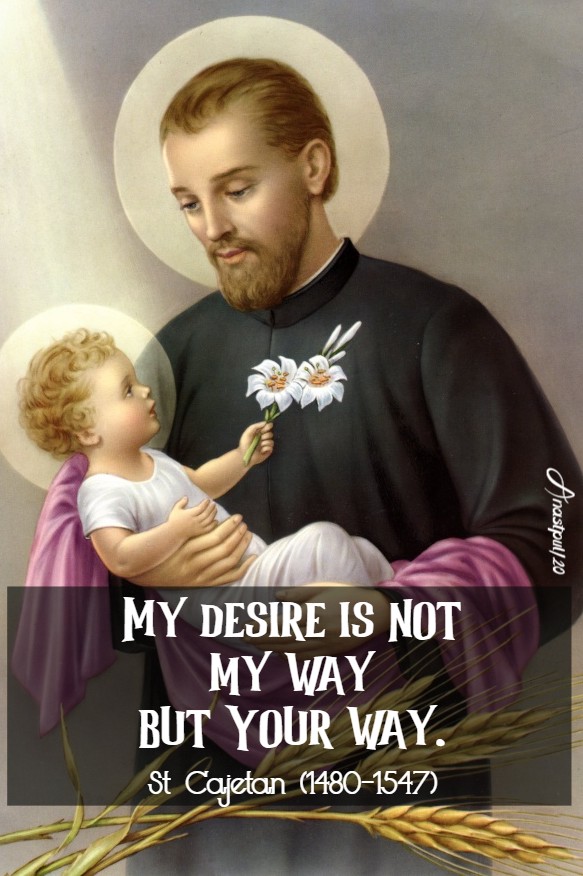
“My desire is not my way but Your way.”
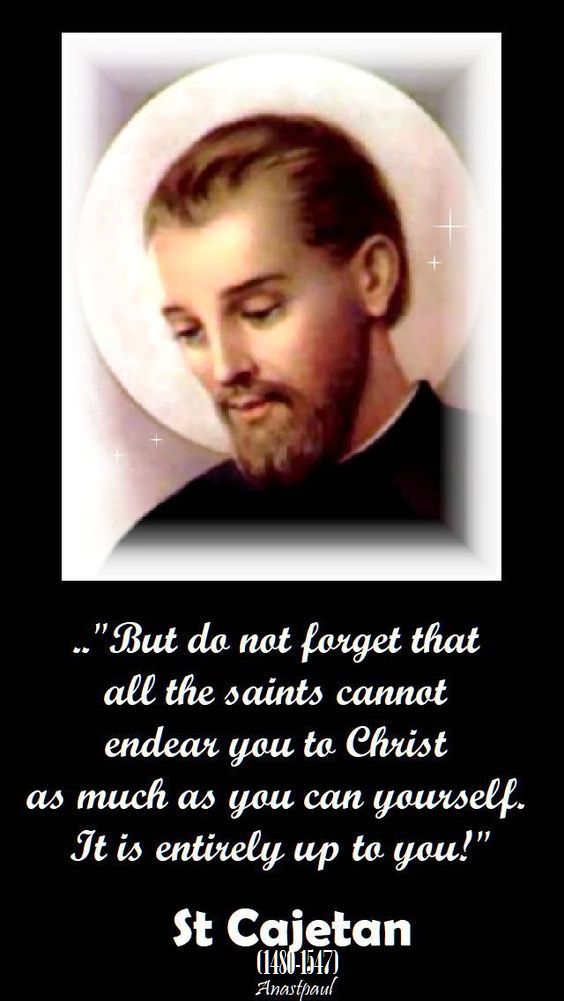
“I am a sinner and do not think much of myself; I have recourse to the greatest servants of the Lord, that they may pray for me to the blessed Christ and His Mother. But do not forget, that all the saints cannot endear you to Christ as much as you can yourself. It is entirely up to you!”
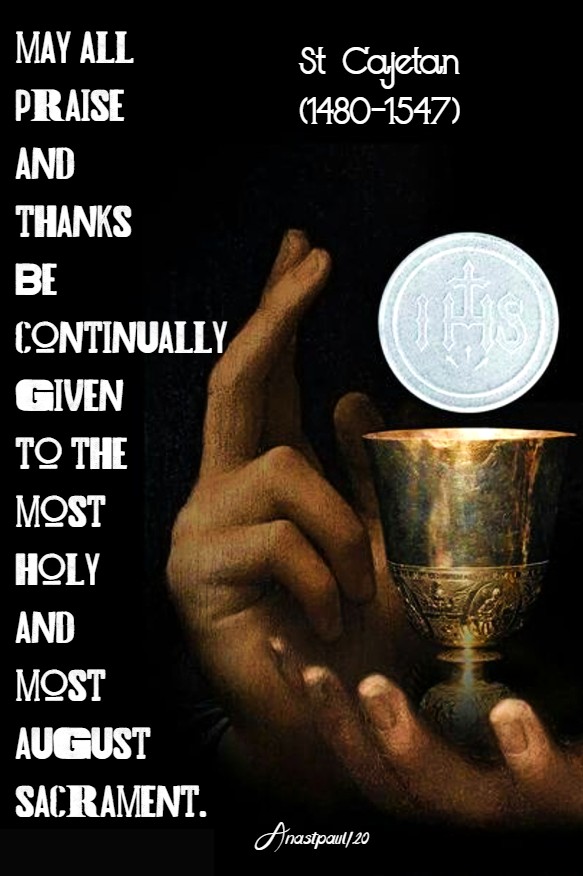
“May all praise and thanks be continually given to the Most Holy and Most August Sacrament.”
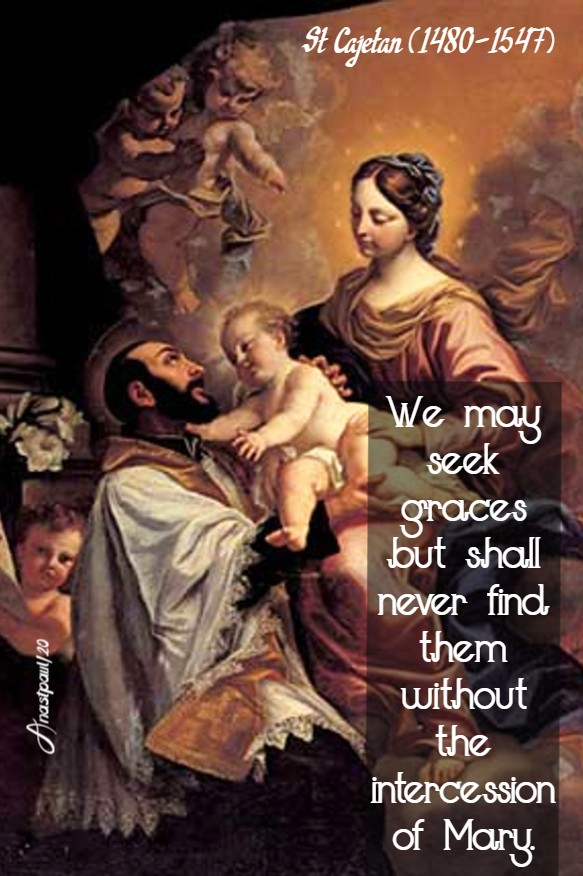
“We may seek graces but shall never find them without the intercession of Mary.”
One Minute Reflection – 7 August – “Month of the Immaculate Heart of Mary” – Friday of the Eighteenth week in Ordinary Time, Readings: Nahum 1:15; 2, 2; 3, 1-3, 6-7 (2, 1, 3; 3,1-3, 6-7), Responsorial psalm Deuteronomy 32:35-36, 39-41, Matthew 16:24-28 and the Memorial of St Donatus of Arezzo (Died 362) Bishop
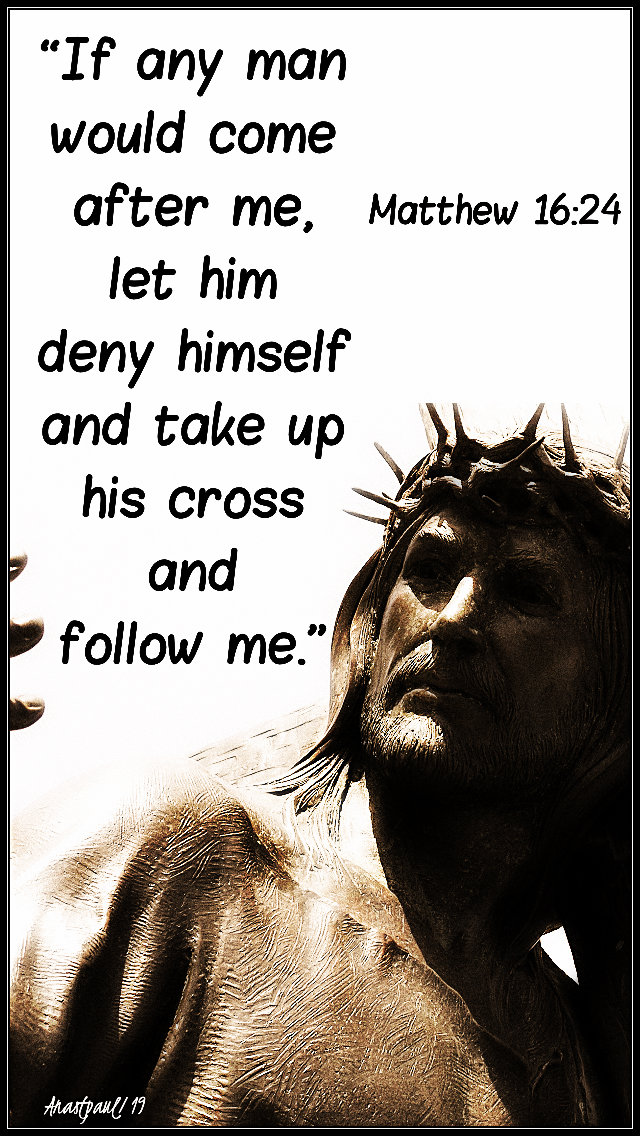
“If any man would come after me, let him deny himself and take up his cross and follow me.” … Matthew 16:24
REFLECTION – “At the responsory: “See, the Lord our protector comes, the Holy One of Israel,” Gertrude understood, that if someone applies himself, with all his heart, to desire that his whole life be governed, in prosperity and adversity, according to the most laudable will of God, then by such thoughts, by God’s grace, he would be giving as much honour to God, as one would give to an emperor in placing the imperial crown on his head. …
She saw the Lord walking along a path, pleasant to behold, with fairest flowers and verdure but narrow and lined with dense hedges bristling with sharp thorns. She saw that He seemed to be preceded by a cross which parted the thorns and made the way wider and easier. With a serene expression on His face, turning toward those who belonged to Him, He invited them to follow Him, saying: “Whoever wishes to come after me, let him deny himself and take up his cross and follow me…” (Mt 16:24).
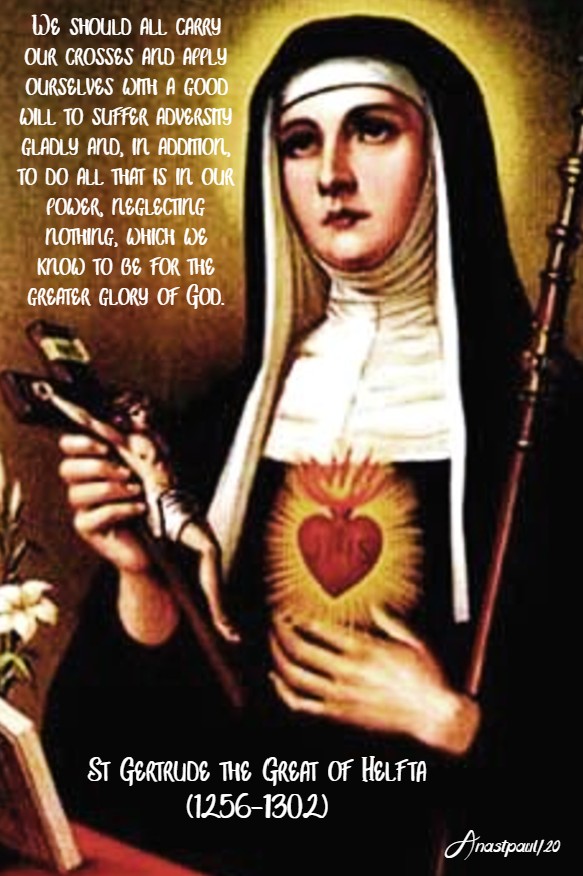
From this she knew that the cross of each, is his own personal trial. For example, for some souls obedience is a cross when they are obliged to do what is contrary to their wishes. For others, to be burdened with infirmity, which acts as a restraint and so on. We should all carry our crosses and apply ourselves with a good will to suffer adversity gladly and, in addition, to do all that is in our power, neglecting nothing, which we know to be for the greater glory of God.” … St Gertrude of Helfta/the Great (1256-1302) Benedictine nun – The Herald of Divine Love, Book III, SC 143
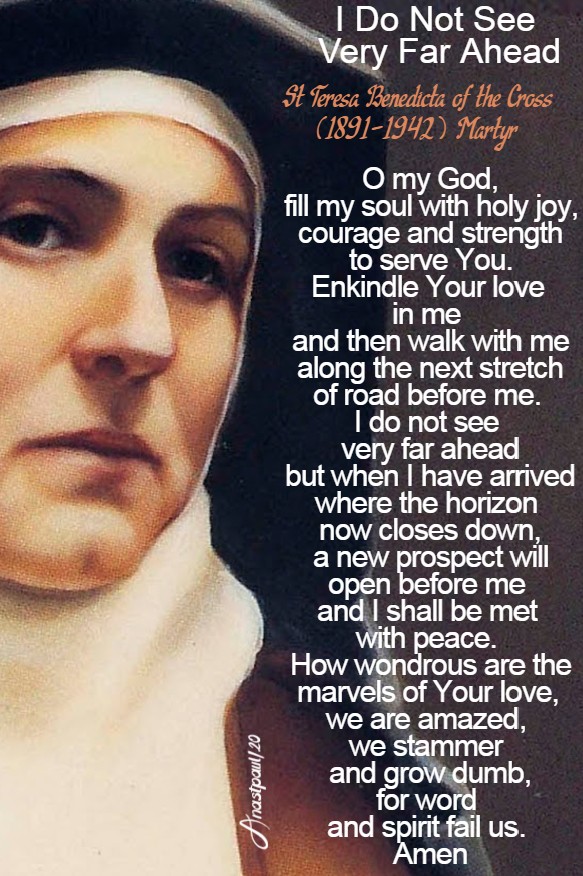
PRAYER – “O my God, fill my soul with holy joy, courage and strength to serve You. Enkindle Your love in me and then walk with me along the next stretch of road before me. I do not see very far ahead but when I have arrived where the horizon now closes down, a new prospect will open before me and I shall be met with peace. How wondrous are the marvels of Your love, we are amazed, we stammer and grow dumb, for word and spirit fail us. Amen” … St Teresa Benedicta of the Cross (1891-1942) Martyr St Donatus of Arezzo, Pray for us!
Our Morning Offering – 7 August – “Month of the Immaculate Heart of Mary” – Friday of the Eighteenth week in Ordinary Time
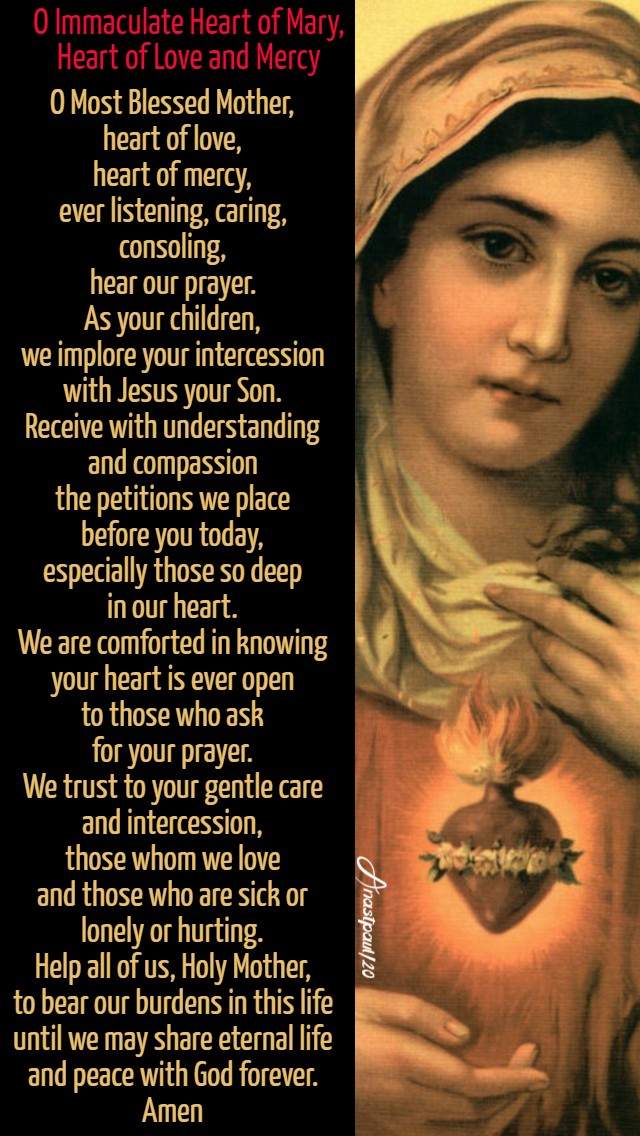
O Immaculate Heart of Mary, Heart of Love and Mercy
O Most Blessed Mother,
heart of love,
heart of mercy,
ever listening, caring, consoling,
hear our prayer.
As your children,
we implore your intercession
with Jesus your Son.
Receive with understanding
and compassion
the petitions we place before you today,
especially those so deep in our heart.
We are comforted in knowing
your heart is ever open
to those who ask for your prayer.
We trust to your gentle care and intercession,
those whom we love
and those who are sick or lonely or hurting.
Help all of us, Holy Mother,
to bear our burdens in this life
until we may share eternal life
and peace with God forever.
Amen
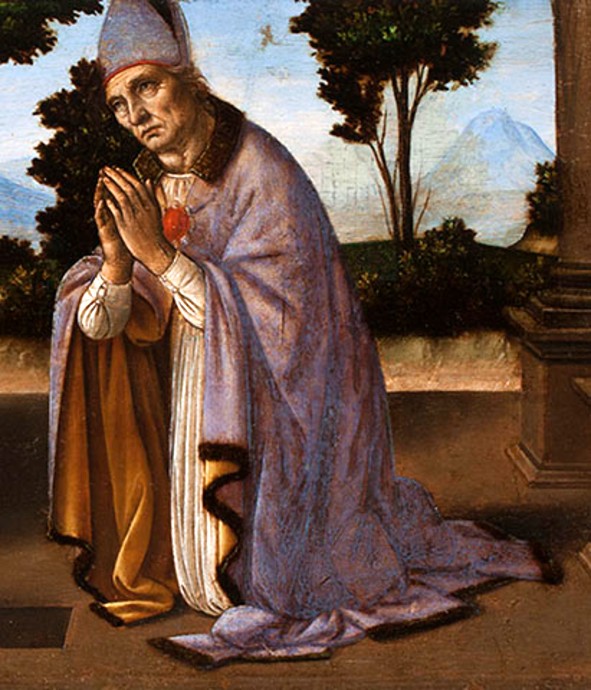
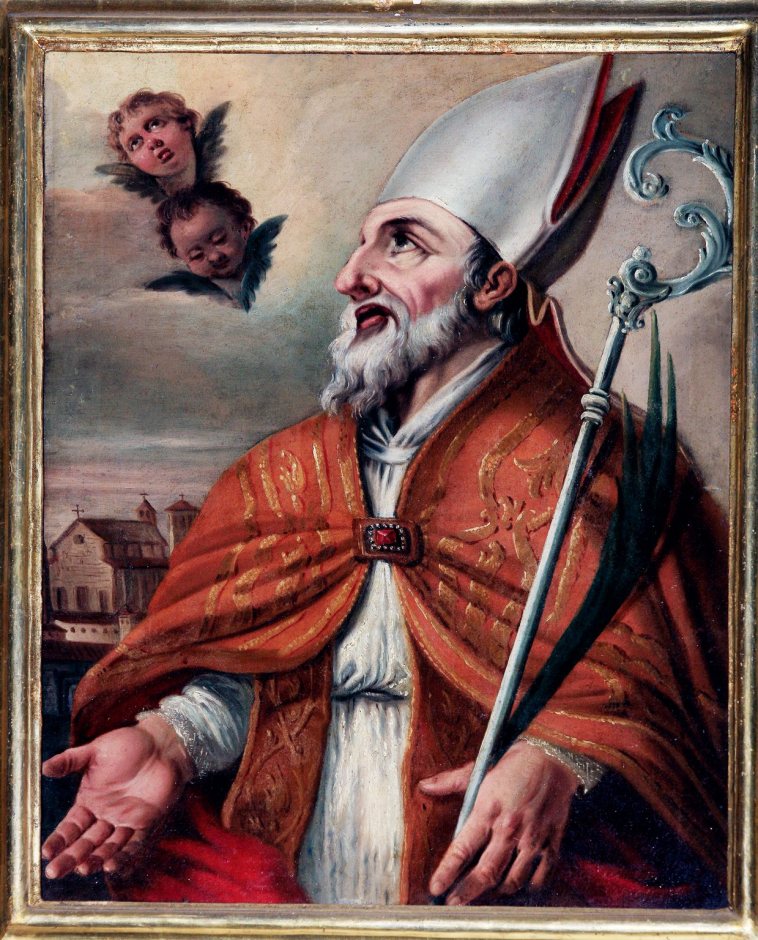
Saint of the Day – 7 August – Saint Donatus of Arezzo (Died 362) Bishop and Martyr, Confessor, Miracle-worker – born in Nicomedia (part of modern Turkey) and died on 7 August in 362. Patronages – Arezzo, Italy, Diocese of Arezzo, Italy, Diocese of Arezzo-Cortona-Sansepolcro, Italy, Cavriglia, Italy, epileptic, bakers, Contursi Terme, Acerno, Anzi, Castel di Ieri, Castel del Monte, Fossacesia, Guardiagrele, Pinerolo, Ranzo, San Donato di Lecce, Montesano Salentino, San Donato di Ninea, San Donato Milanese, San Donato Val di Comino, Soveria Simeri, Val della Torre, Villa Martelli, Monteforte Cilento (Salerno) all in Italy.
A Passio of Donatus’ life was written by a Bishop of Arezzo, Severinus. He calls Donatus a Martyr, although Donatus is described as a Bishop and Confessor of the faith in ancient sources and not as a Martyr. An early hagiography of Donatus was already known to Gregory the Great.
According to Severinus’ account, as a child Donatus came to Rome with his family from Nicomedia. According to Severinus’ account, Donatus was educated by a Priest named Pymenius. His friend and companion in these religious studies, was a boy named Julian –who would later become Emperor Julian the Apostate. Julian rose to the position of sub-deacon; Donatus became a lector. Saint Peter Damian would later write in his Sermones that “in the field of the Lord two sprigs, Donatus and Julian, grow together but one will become a cedar of Paradise, the other coal for the eternal flames of Hell.”
On 4 February 362, Julian promulgated an edict to guarantee freedom of religion. This edict proclaimed that all the religions were equal before the law and that the Roman Empire had to return to its original religious eclecticism, according to which the Roman State did not impose any religion on its provinces. Christian chroniclers considered that it had as it’s purpose, the restoration of paganism at the expense of Christianity.
Catholic tradition states that Julian also persecuted individual Christians and that Donatus’ parents, as well as his teacher Pymenius, would die during these persecutions. Donatus escaped to Arezzo and would work with a Monk named Hilarian, to preach the Christian faith, as well as perform penances and miracles. Severinus’ Passio states that Donatus brought back to life a woman named Euphrosina; fought and slew a dragon who had poisoned the local well; gave sight back to a blind woman named Syriana and, exorcised a demon that had been tormenting Asterius, the son of the Roman prefect of Arezzo.
Donatus was Ordained a Deacon and then Priest by Saint Satyrus of Arezzo, Bishop of that city and continued to preach in the city and in the surrounding region. At the death of Satyrus, Donatus was appointed Bishop by Pope Julius I. A man named Anthimus was Donatus’ deacon.
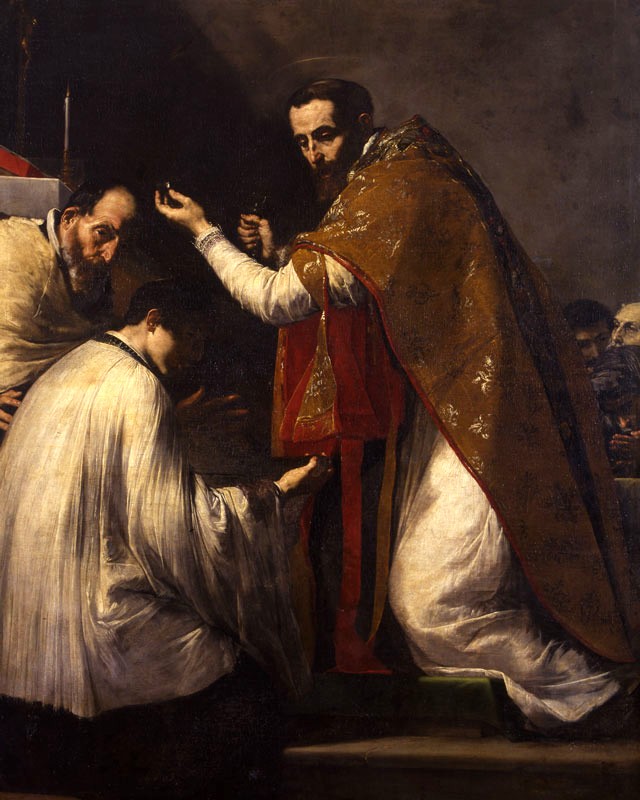
During a celebration of Mass, at the moment of the giving of Communion, in which a glass chalice was being administered, some pagans entered the church and shattered the chalice in question. Donatus, after intense prayer, collected all of the fragments and joined them together. There was a piece missing from the bottom of the cup, miraculously, however, nothing spilled from the cup. Astounded, seventy-nine pagans converted to Christianity.
St Donatus and the Miracle of the Chalice by Jose de Ribera
A month after this episode, the prefect of Arezzo, Quadratian, arrested Hilarian the Monk and Donatus. Hilarian was Martyred on 16 July 362 and Donatus was beheaded on 7 August at Arezzo.
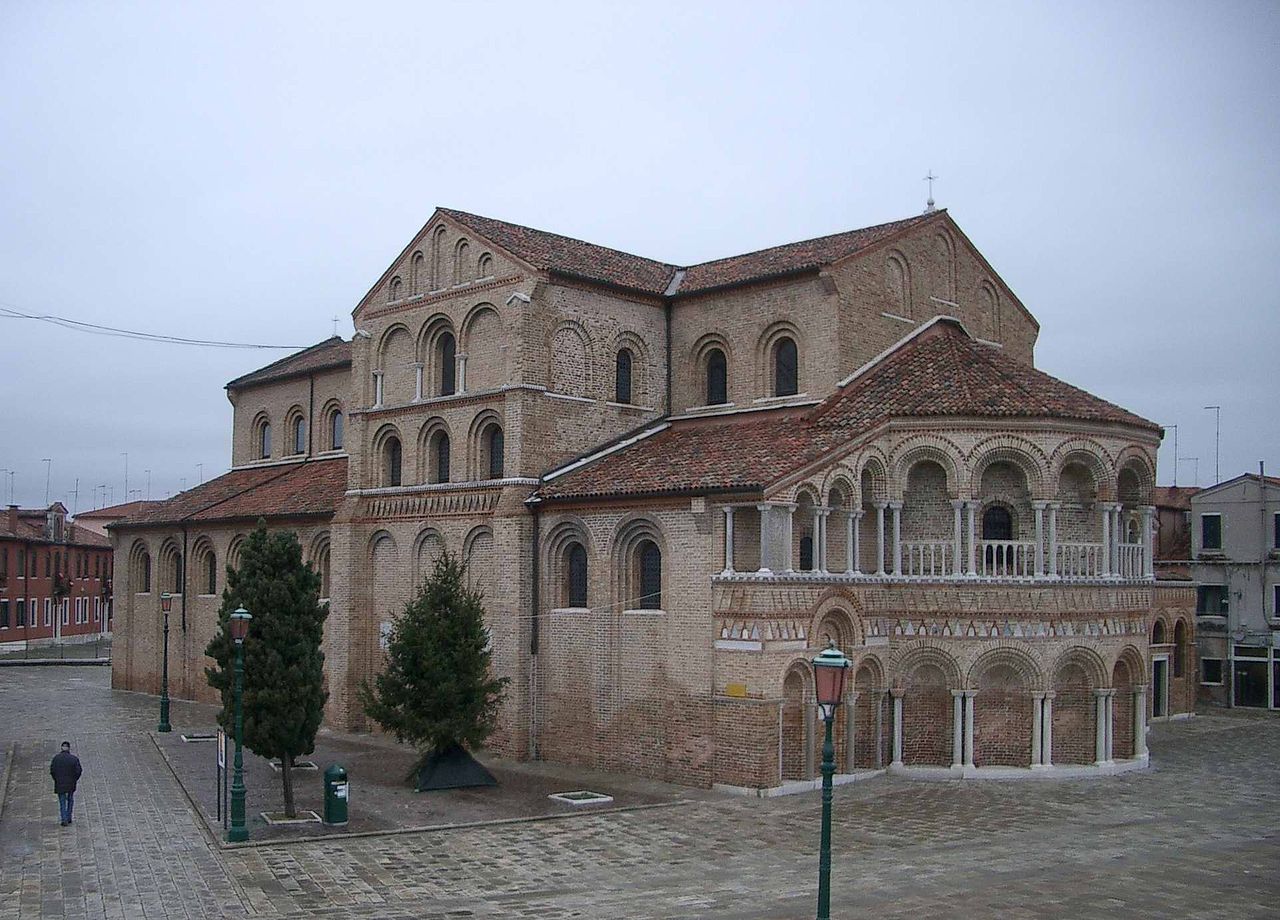
In 1125, some of Donatus’ relics (and those of the alleged dragon said to have been killed by the saint) were brought to the Church of Santa Maria and San Donato on the island of Murano, near Venice.
Church of Santa Maria and San Donato on the island of Murano, near Venice.
A large silver reliquary bust of Donatus from the 13th century is now found in the National Museum at Naples.
The Patron Saints of Guardiagrele are Donatus of Arezzo and Saint Emidius. Annually between 6 and 8 August, there is a festival celebrating these saints in which the effigy of Donatus is paraded around the streets of Guardiagrele.
In the Cathedral dedicated to St Donatus and where some of his relics lie together with a Shrine to him, there is a magnificent “Arch” depicting his life and miracles.
St Afra of Augsburg
Bl Agathangelus Nourry St Albert of Trapani O.Carm. (c 1240-1307) His Life: https://anastpaul.com/2019/08/07/saint-of-the-day-7-august-saint-albert-of-trapani-o-carm-c-1240-1307/
Bl Cassian Vaz Lopez-Neto
St Claudia of Rome
St Donat
St Donatian of Chalons-sur-Marne St Donatus of Arezzo (Died 362) Bishop and possibly a Martyr
St Donatus of Besancon
Bl Edmund Bojanowski
Bl Edward Bamber
St Faustus of Milan
St Hilarinus of Ostia
St Hyperechios
Bl John Woodcock
Bl Jordan Forzatei
St Julian of Rome
St Miguel de la Mora
Bl Nicholas Postgate
St Peter of Rome
Bl Thomas Whitaker
Bl Vincent de L’Aquila
St Victricius of Rouen
—
Martyred Deacons of Rome – 6 saints: A group of deacons who were martyred with Pope Saint Sixtus II. We know nothing about them but their names and their deaths – Agapitus, Felicissimus, Januarius, Magnus, Stephen and Vincent. They were
beheaded on 6 August 258 in a cemetery on the Appian Way, Rome, Italy.
Martyrs of Como – 6 saints: A group of Christian soldiers in the imperial Roman army. Martyred in the persecutions of Maximian. We know little else but the names – Carpophorus, Cassius, Exanthus, Licinius, Secundus and Severinus. c.295 on the north side of Lake Como, near Samolaco, Italy. Their relics in the church of San Carpoforo, Como, Italy.
Martyred in the Spanish Civil War: 10 Beati
Bl Dalmacio Bellota Perez
Bl Diodorus Hernando Lopez
Bl Francisco Gargallo Gascón
Bl Luis Villanueva Montoya
Bl María del Carmen Zaragoza y Zaragoza
Bl María Rosa Adrover Martí
Bl Rafaél Severiano Rodríguez Navarro
Bl Tomás Carbonell Miquel
Thought for the Day – 6 August – Meditations with Antonio Cardinal Bacci (1881-1971)
How to Remain Aware of the Presence of God
“It is useful to consider the ways in which we can develop a constant and effective awareness of the Presence of God. The first way in which we can do this, is by cultivating a lively faith, which will help us to see God everywhere. “Do not I fill heaven and earth, saith the Lord?” (Jer 23:24).
This kind of faith should deepen our sense of God’s Presence and inspire in us sentiments of love and gratitude, which will guide us in all our actions. We cannot expect that we shall be able to remain in a state of constant contemplation of God, for this is the privilege enjoyed by the blessed in Heaven, for whom faith has been replaced by the Beatific Vision. We must be satisfied with exciting in ourselves, as often as possible, the active awareness of God’s Presence. This should be a quiet and peaceful process, not involving undue mental effort or anxiety.
We should be able to attend quite naturally to our work and other obligations and, we should be helped and consoled in this, by directing our thoughts to God from time to time, in order to offer ourselves to Him. This can easily be done by means of frequent ejaculatory prayer, by renewing, at regular intervals, our intention of doing everything for the love of God and by being prepared to endure, in complete acceptance of the Divine Will, all the hardships and trials of the day. Whenever it is possible moreover, we should escape from the care and confusion of the world into a quiet Church. Here we can kneel in the Real Presence of Jesus in the Blessed Eucharist and express, in intimate prayer, our love for Him and our desire to serve Him.”
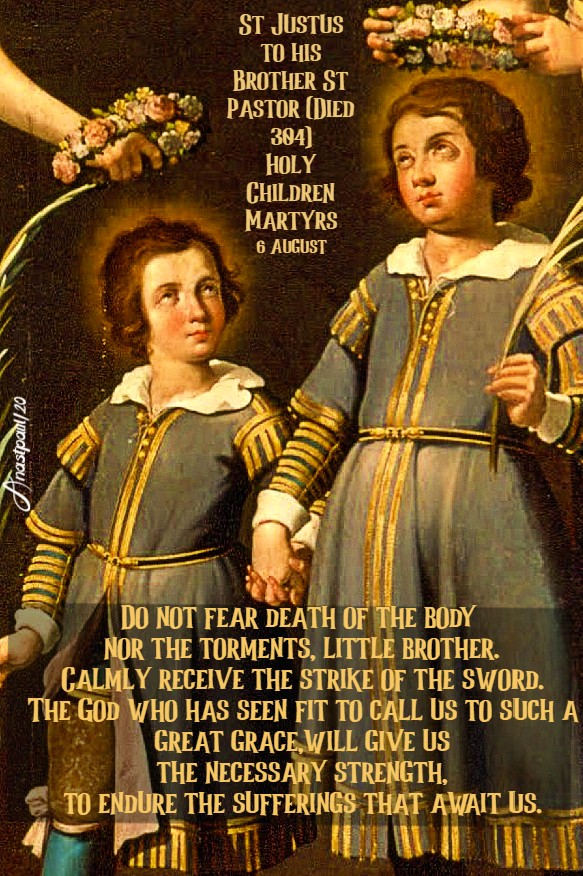
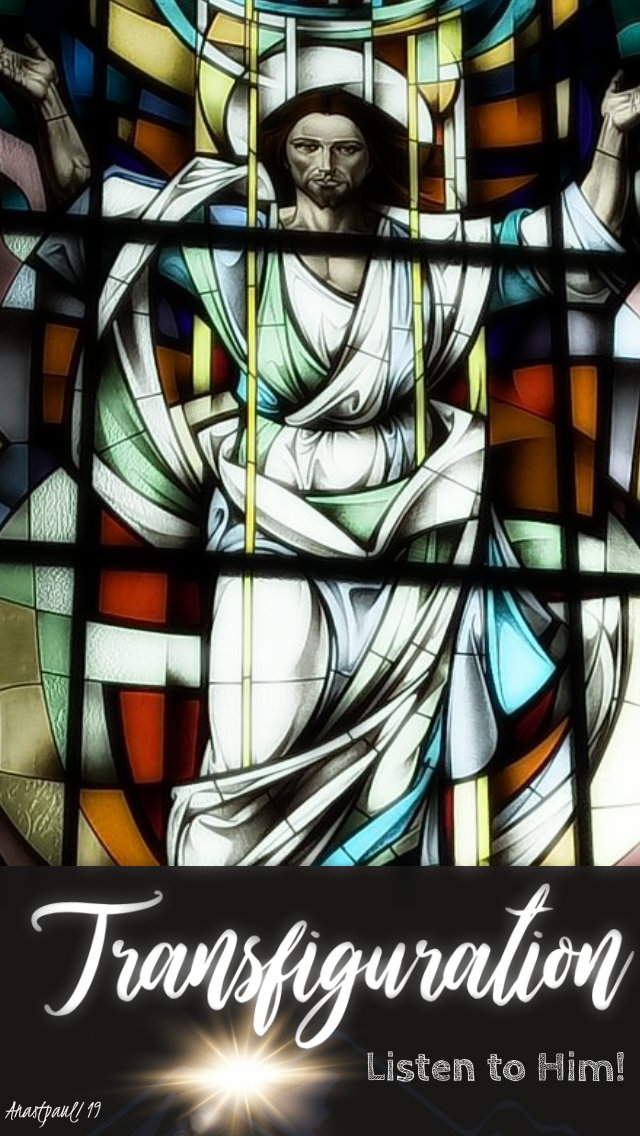
Quote/s of the Day – 6 August – Feast of the Transfiguration of the Lord and the Memorial of Justus and Pastor – The Holy Martyred Children of Alcala de Henares in Spain (Died 304)
“Do not fear death of the body nor the torments, little brother. Calmly receive the strike of the sword. The God who has seen fit to call us to such a great grace, will give us the necessary strength, to endure the sufferings that await us.”
St Justus to his Brother St Pastor (Died 304) Holy Children Martyrs
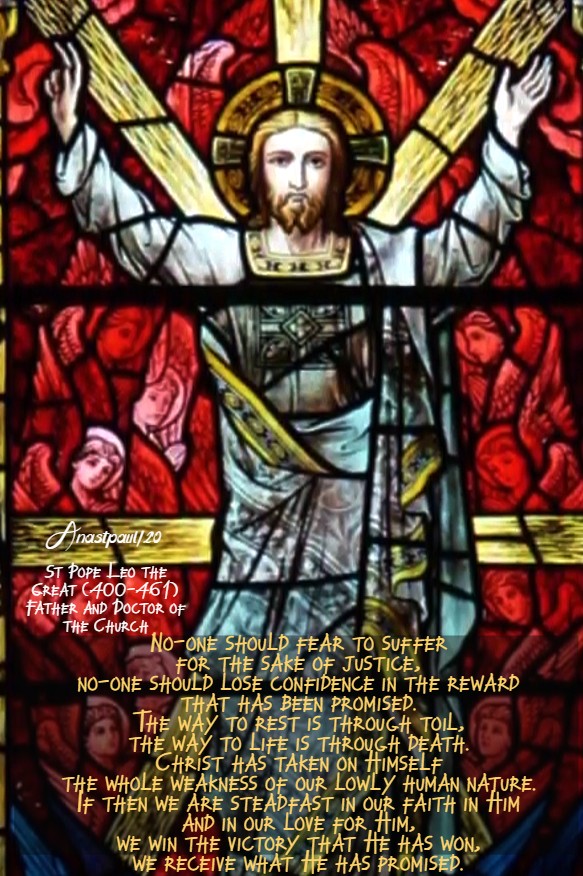
“No-one should fear to suffer for the sake of justice, no-one should lose confidence in the reward that has been promised. The way to rest is through toil, the way to life is through death. Christ has taken on Himself the whole weakness of our lowly human nature. If then we are steadfast in our faith in Him and in our love for Him, we win the victory that He has won, we receive what He has promised.”
St Pope Leo the Great (400-461)
Father and Doctor of the Church
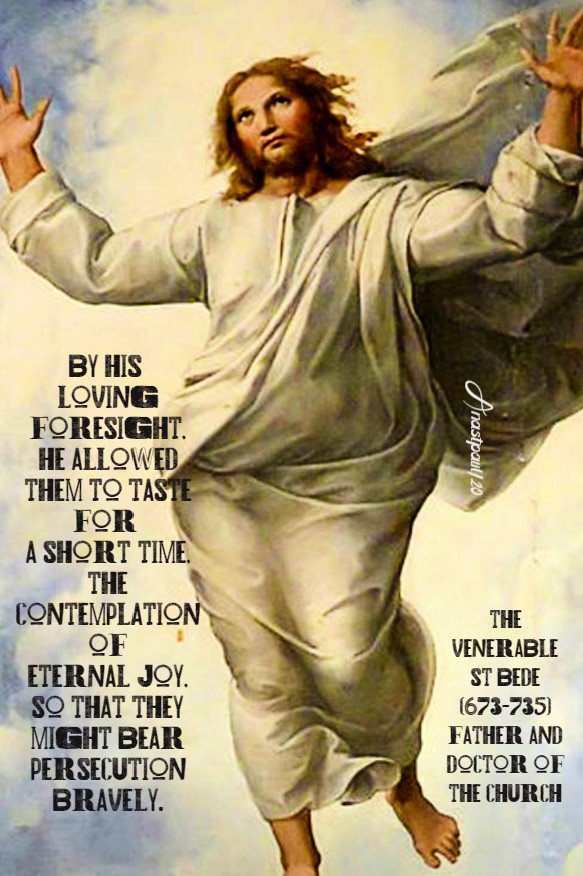
“By His loving foresight, He allowed them to taste for a short time, the contemplation of eternal joy, so that they might bear persecution bravely.”
The Venerable St Bede (673-735) Father and Doctor of the Church
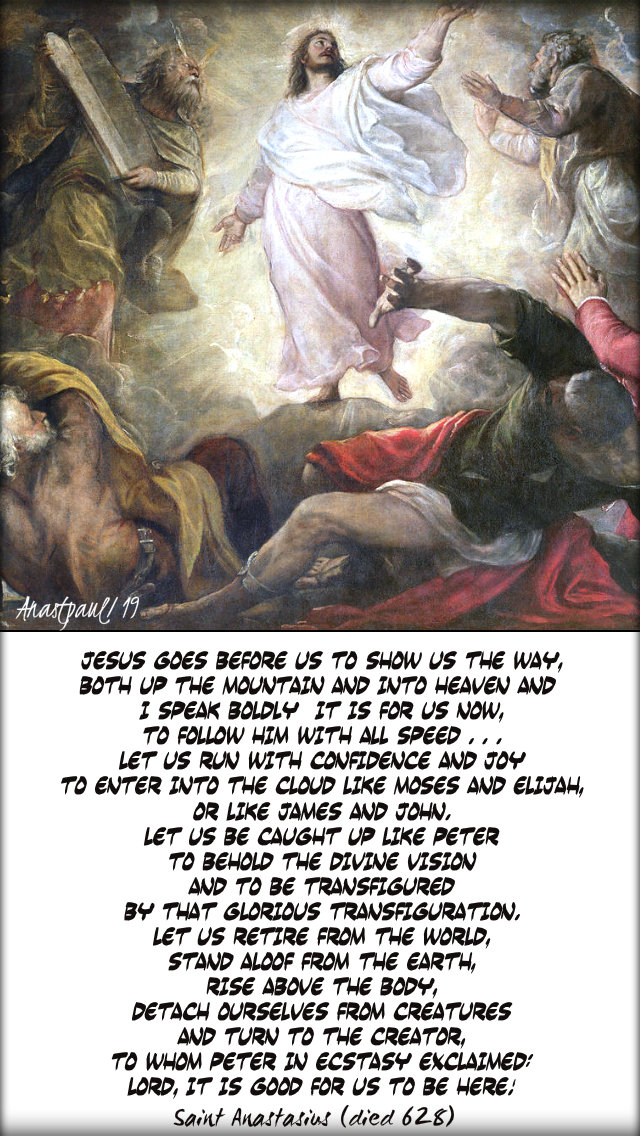
“Jesus goes before us to show us the way, both up the mountain and into heaven and — I speak boldly — it is for us now, to follow him with all speed . . . Let us run with confidence and joy to enter into the cloud like Moses and Elijah, or like James and John. Let us be caught up like Peter to behold the divine vision and to be transfigured by that glorious transfiguration. Let us retire from the world, stand aloof from the earth, rise above the body, detach ourselves from creatures and turn to the Creator, to whom Peter in ecstasy exclaimed: ‘Lord, it is good for us to be here.’”
St Anastasius (Died 628)
“At His Transfiguration Christ showed His disciples, the splendour of His beauty, to which He will shape and colour those who are His: ‘He will reform our lowness configured to the body of his glory.’”
St Thomas Aquinas (1225 – 1274) Doctor of the Church
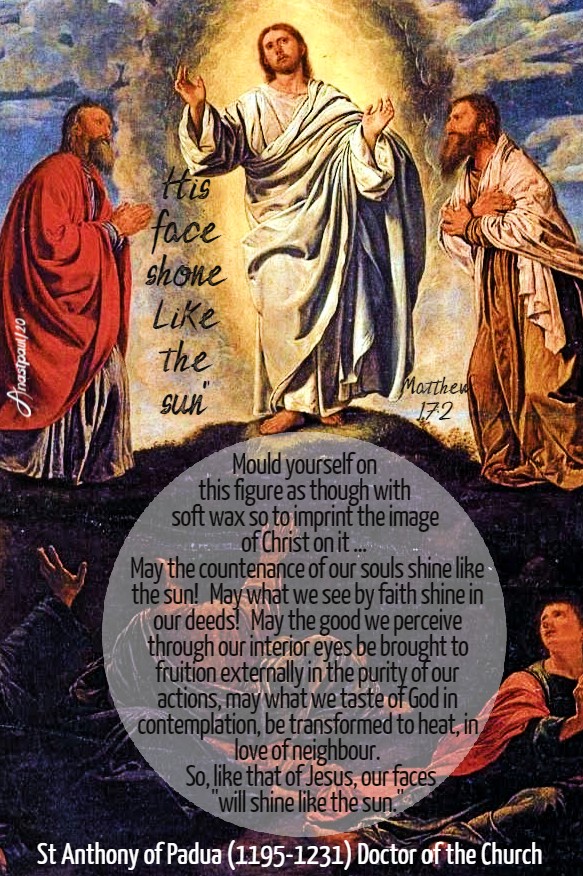
REFLECTION – “He was transfigured before them” (Mt 17:2). Mould yourself on this figure as though with soft wax so to imprint the image of Christ on it, of whom it is said: “His face shone like the sun and his clothes became white as snow.” In this passage you should keep in mind four things – the face, the sun, the clothing and the snow. In the front of the head, which is called a man’s face, there are three senses that are ordered and disposed in a wonderful way. These are sight, smell, taste. In the same sort of way, in the face of our souls, there are the vision of faith, the smell of discretion and the taste of contemplation. (…)
In the sun there is brightness, whiteness and heat. The brightness of the sun accords perfectly with the vision of faith that, together with the clarity of its light, perceives and believes invisible realities. May the countenance of our souls shine like the sun! May what we see by faith shine in our deeds! May the good we perceive through our interior eyes be brought to fruition externally in the purity of our actions, may what we taste of God in contemplation, be transformed to heat, in love of neighbour. So, like that of Jesus, our faces “will shine like the sun.” … St Anthony of Padua (1195-1231) Doctor of the Church – Sermon for Septuagesima Sunday
PRAYER – Father, at the Transfiguration in glory of Your only-begotten Son, You confirmed the mysteries of faith by the witness to Jesus of the prophets Moses and Elijah. You foreshadowed what we shall be when You bring our sonship to its perfection. Grant that by listening to the voice of Jesus, we may become heirs with Him, who lives and reigns with You and the Holy Spirit, God forever and may Mary, our tender and caring Mother, help us to be bright rays of the saving light of her Son Jesus. Amen
Our Morning Offering – 6 August – “Month of the Immaculate Heart of Mary”- Feast of the Transfiguration of the Lord
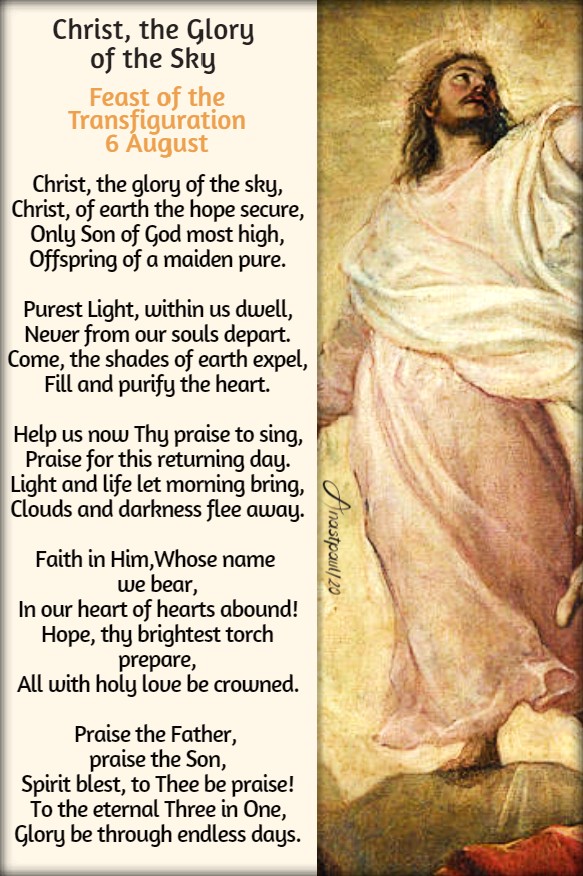
Christ, the Glory of the Sky By Fr Angelus Silesius (1624-1677) Trans Robert Campbell (1814-1868)
Christ, the glory of the sky,
Christ, of earth the hope secure,
Only Son of God most high,
Offspring of a maiden pure.
Purest Light, within us dwell,
Never from our souls depart.
Come, the shades of earth expel,
Fill and purify the heart.
Help us now Thy praise to sing,
Praise for this returning day.
Light and life let morning bring,
Clouds and darkness flee away.
Faith in Him,Whose name we bear,
In our heart of hearts abound!
Hope, thy brightest torch prepare,
All with holy love be crowned.
Praise the Father, praise the Son,
Spirit blest, to Thee be praise!
To the eternal Three in One,
Glory be through endless days.
Fr Angelus Silesius ( c 1624 – 9 July 1677), born Johann Scheffler and also known as Johann Angelus Silesius, was a German Catholic Priest and Physician, known as a Mystic and religious poet.
Robert Campbell (19 December 1814 – 29 December 1868) was a Scottish advocate and hymn writer. Brought up as a Presbyterian, he later joined the Roman Catholic Church. He translated the Latin texts of various hymns and wrote many others. He is remembered for such hymns as “At the Lamb’s high feast we sing”, “Come, pure hearts, in sweetest measures”, “Ye Choirs of New Jerusalem” and “Ye servants of a martyr’d God” which all appeared in the first edition of Hymns Ancient & Modern in 1861.









 Among them was the noted Hugh of Sesto, a Canon at Saint Paul’s who had led the opposition to the friars at that church. Others who should not be omitted were – Roderic, a Canon at Saint Peter’s, James Rabacante, who later succeeded John of Salerno as Prior of Santa Maria Novella, Ottavente di Nerli, Roger Calcagni, who became the first Papal inquisitor at Florence and Bishop of Castro; Father Buoninsegna, a Martyr at Antioch, who is commonly called blessed, Ambrose of Rimini, a celebrated preacher who became Bishop of his native city, Thomas Morandi, honoured with the mitre of Fano and Aldobrandini Cavalcanti, entrusted with the charge of the Diocese of Orvieto. We might mention more but those given above suffice to show the character of those whom the early disciple brought into his institute.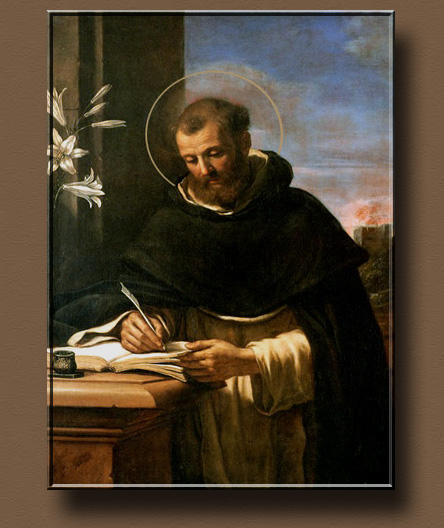















You must be logged in to post a comment.