Quote/s of the Day – 19 July – “Month of the Most Precious Blood” – The Sixteenth Sunday of the Year in Ordinary Time, Year A, Readings: Wisdom 12:13, 16-19, Psalm 86:5-6,9-10, 15-16, Romans 8:26-27, Matthew 13:24-43
Hell
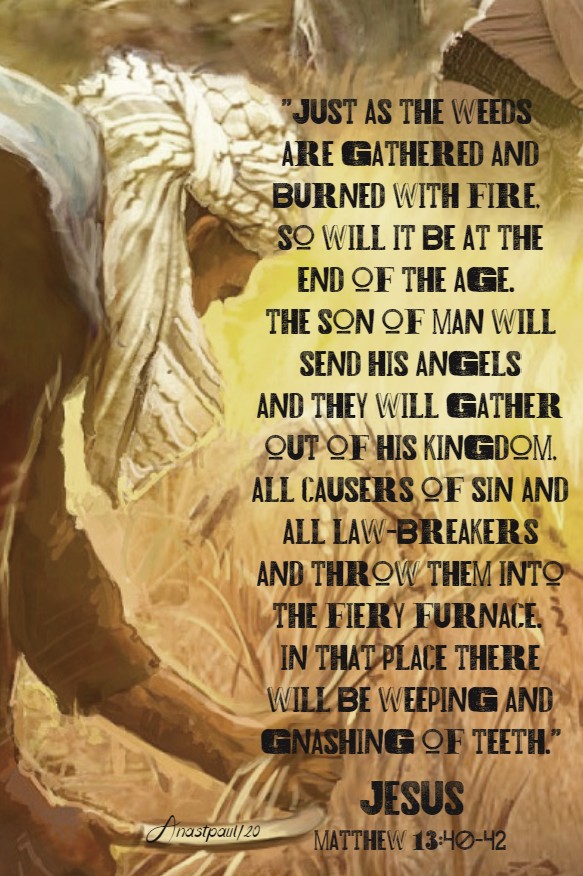
“Just as the weeds are gathered and burned with fire, so will it be at the end of the age. The Son of Man will send his angels and they will gather out of his kingdom, all causers of sin and all law-breakers and throw them into the fiery furnace. In that place there will be weeping and gnashing of teeth.”
Jesus
Matthew 13:40-42
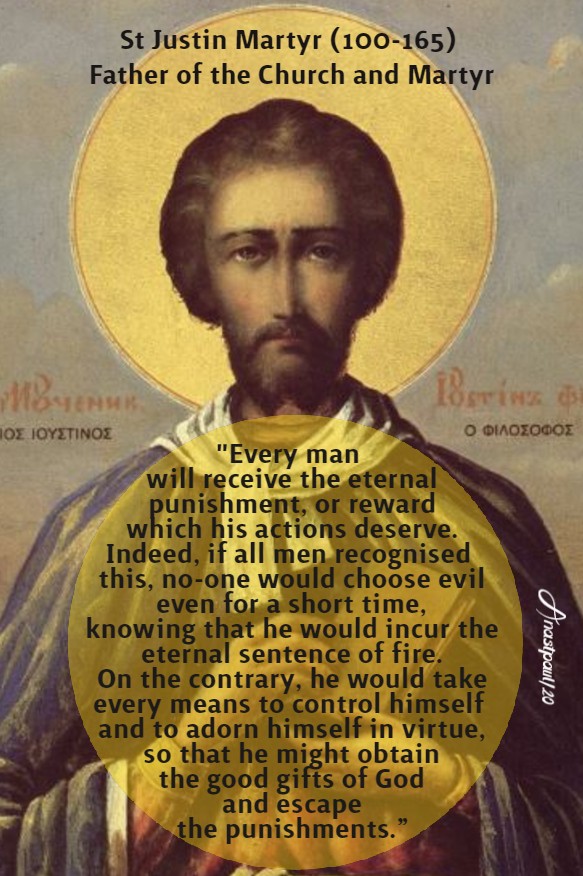
“Every man will receive the eternal punishment, or reward which his actions deserve. Indeed, if all men recognised this, no-one would choose evil even for a short time, knowing that he would incur the eternal sentence of fire. On the contrary, he would take every means to control himself and to adorn himself in virtue, so that he might obtain the good gifts of God and escape the punishments.”
St Justin Marytr (100-165)
Father of the Church and Martyr
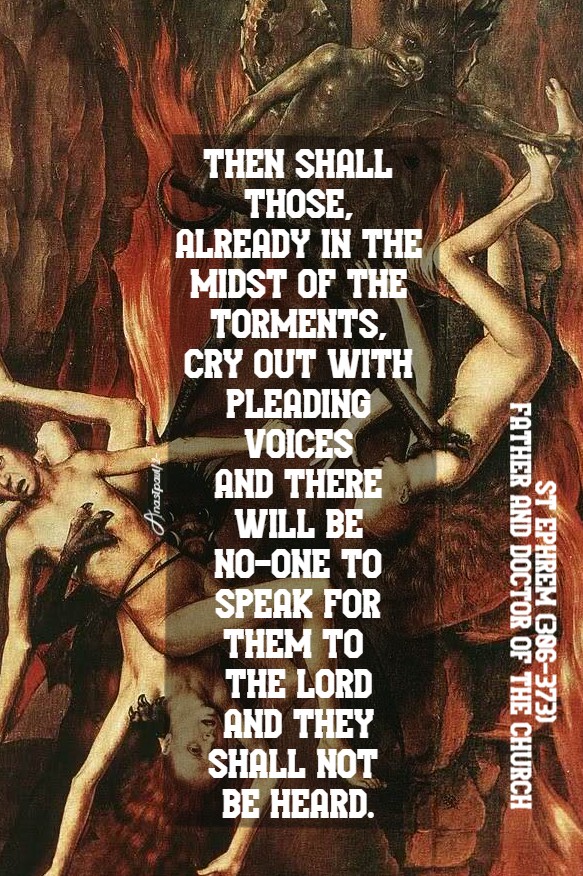
“Then shall those, already in the midst of the torments, cry out with pleading voices and there will be no-one to speak for them to the Lord and they shall not be heard.”
St Ephrem (306-373)
Father and Doctor of the Church
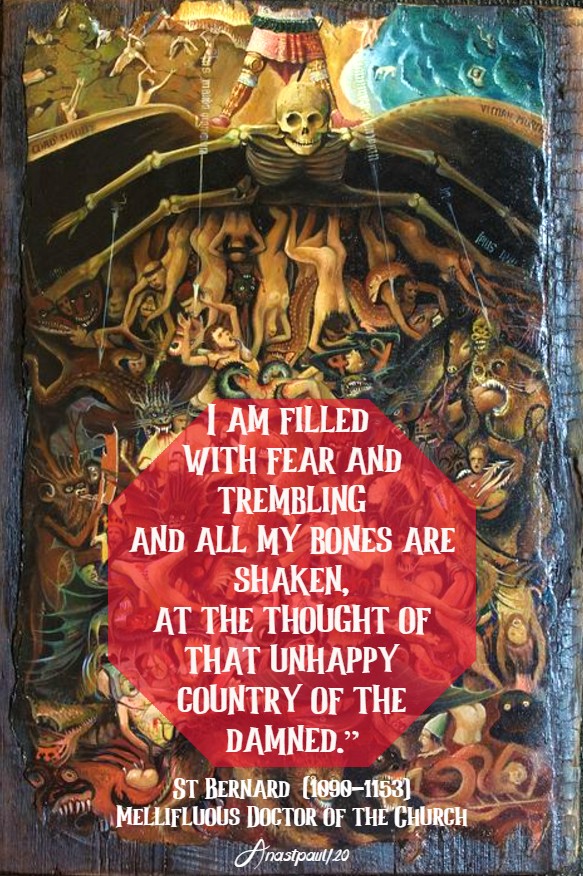
“I am filled with fear and trembling and all my bones are shaken, at the thought of that unhappy country of the damned.”
St Bernard (1090-1153)
Mellifluous Doctor of the Church
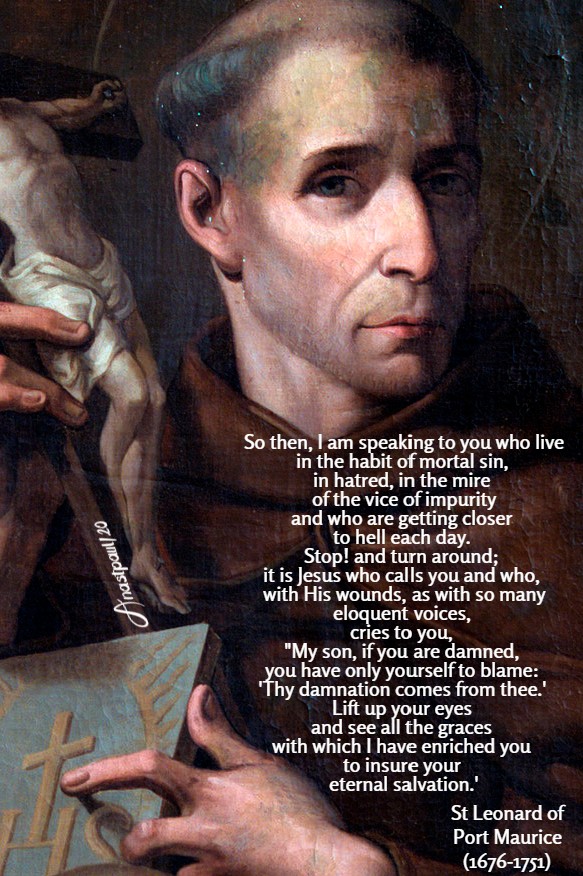
“So then, I am speaking to you who live in the habit of mortal sin, in hatred, in the mire of the vice of impurity and who are getting closer to hell each day. Stop! and turn around; it is Jesus who calls you and who, with His wounds, as with so many eloquent voices, cries to you, “My son, if you are damned, you have only yourself to blame: ‘Thy damnation comes from thee.’ Lift up your eyes and see all the graces with which I have enriched you to insure your eternal salvation.'”
St Leonard of Port Maurice (1676-1751)
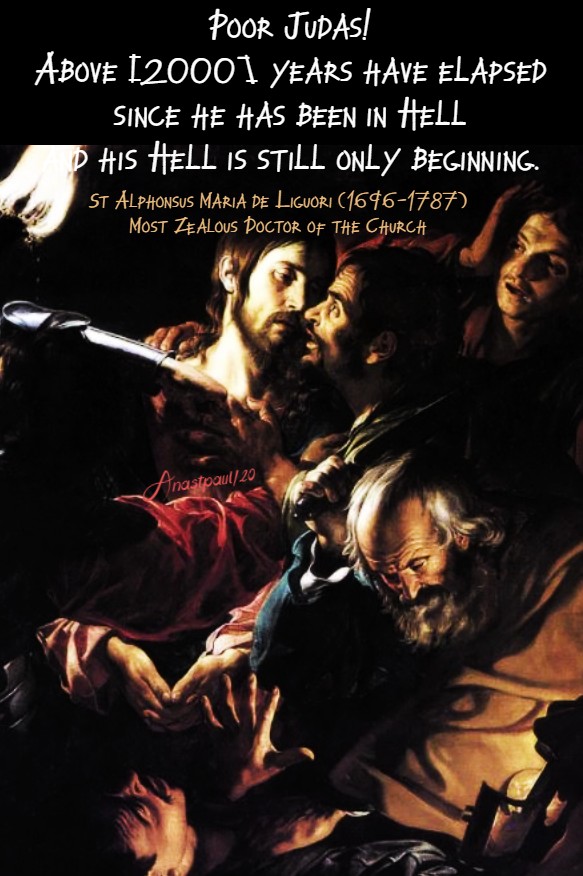
“Poor Judas! Above [2000] years have elapsed since he has been in Hell and his Hell is still only beginning.”
St Alphonsus Maria de Liguori (1696-1787)
Most Zealous Doctor of the Church
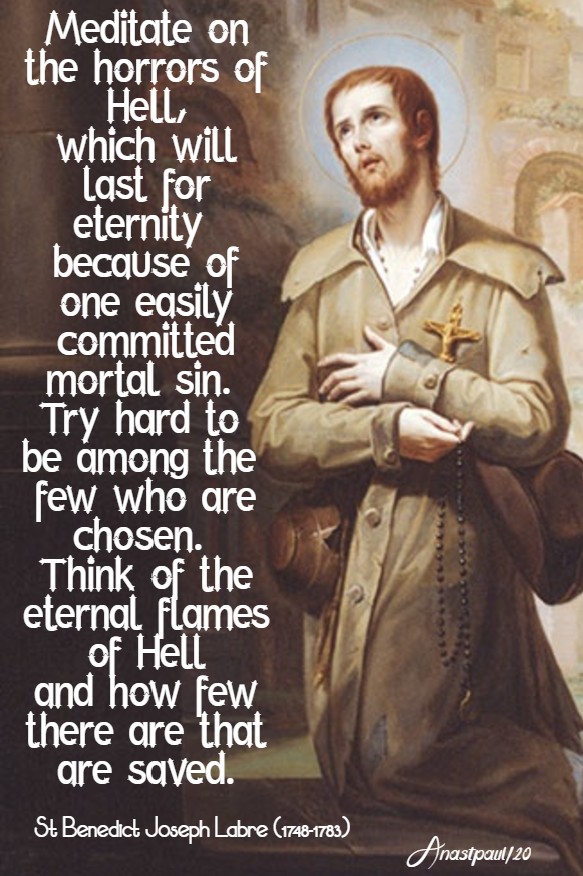
“Meditate on the horrors of Hell, which will last for eternity because of one easily-committed mortal sin. Try hard to be among the few who are chosen. Think of the eternal flames of Hell and how few there are that are saved.”
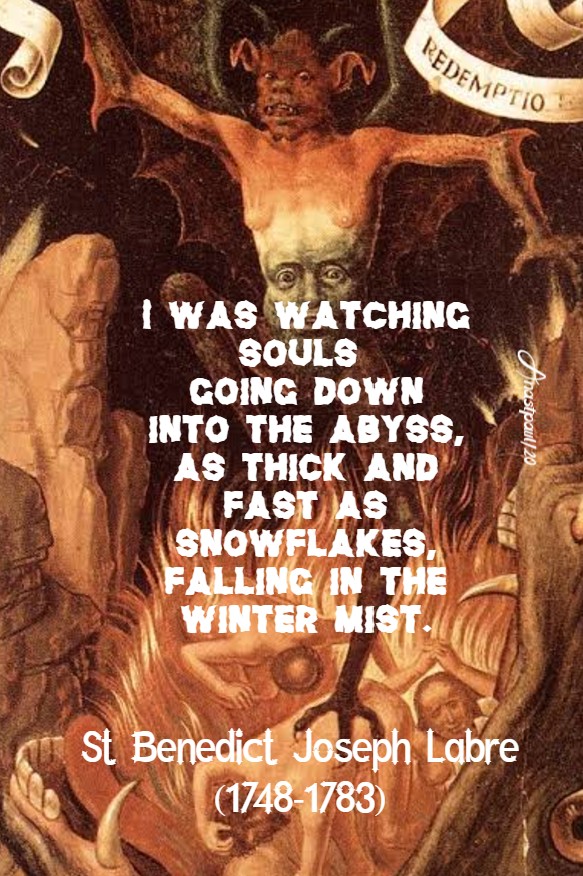
“I was watching souls going down into the abyss, as thick and fast as snowflakes, falling in the winter mist.”
St Benedict Joseph Labre (1748-1783)
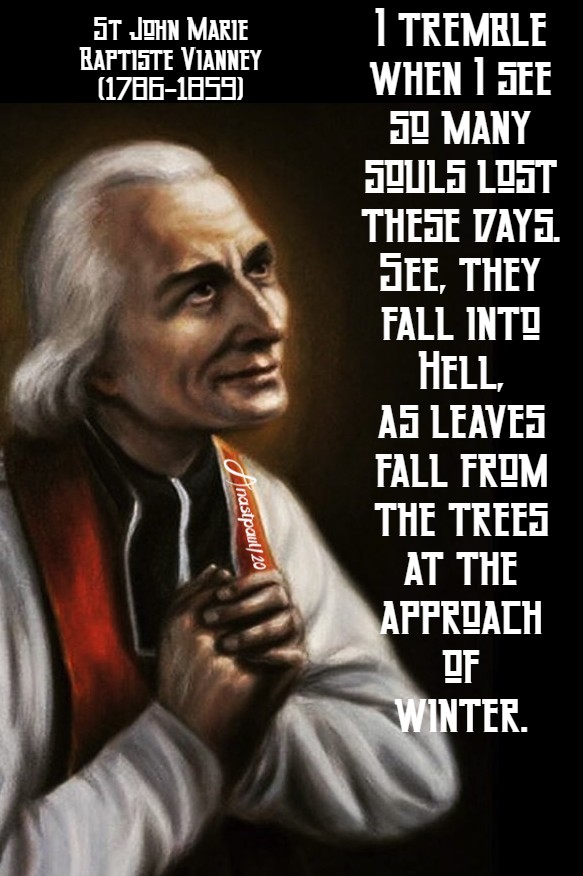
“I tremble when I see so many souls lost these days. See, they fall into Hell, as leaves fall from the trees at the approach of winter.”
St John Marie Baptiste Vianney (1786-1859)
“The natural fire that we see during this life has great power to burn and torment. Yet this is not even a shadow of the fire of Hell.”
Sunday Reflection – 19 July – “Month of the Most Precious Blood” – The Sixteenth Sunday of the Year in Ordinary Time
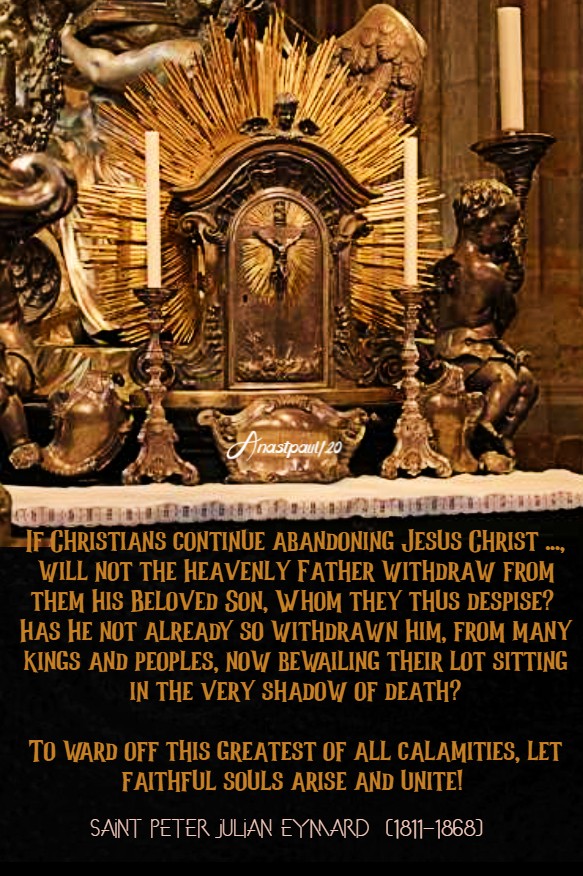
“If Christians continue abandoning Jesus Christ in His temple, will not the Heavenly Father withdraw from them, His Beloved Son, Whom they thus despise? Has He not already so withdrawn Him from many kings and peoples, now bewailing their lot sitting in the very shadow of death?
To ward off this greatest of all calamities, let faithful souls arise and unite! Let them become adorers in spirit and in truth of Jesus Christ in the Most Blessed Sacrament!
Let them form a guard of honour around the Sovereign of Kings. And a devoted court around the God of love.”
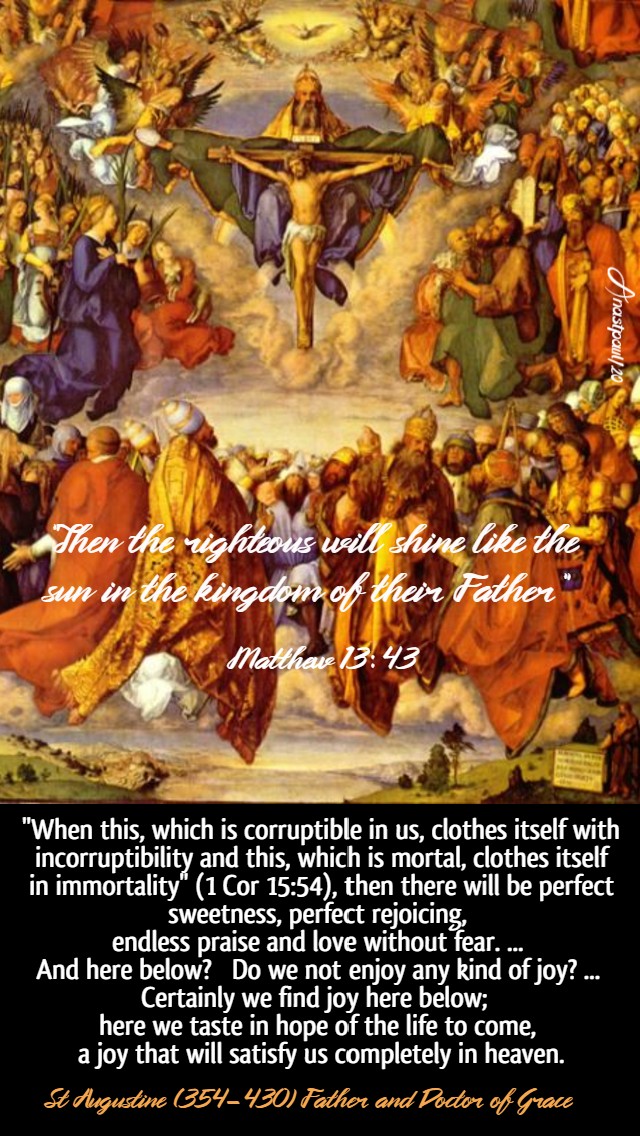
“Then the righteous will shine like the sun in the kingdom of their Father” … Matthew 13:43
REFLECTION –“When this, which is corruptible in us, clothes itself with incorruptibility and this, which is mortal, clothes itself in immortality” (1 Cor 15:54), then there will be perfect sweetness, perfect rejoicing, endless praise and love without fear. … And here below? Do we not enjoy any kind of joy? … Certainly we find joy here below; here we taste in hope of the life to come, a joy that will satisfy us completely in heaven.
However, the wheat has much to bear in the midst of the darnel. The seed is mixed up with the straw and the lily grows among the thorns. … And indeed, what is it that was spoken to the Church? “As a lily among thorns, so is my beloved among my maidens” (Sg 2:2). It said, “Among my maidens” and not among foreigners. O Lord, what are the consolations you give us? What the comfort? Or rather, what the alarm? Are you calling your own maidens “thorns”? By their behaviour they are thorns, He answers, but maidens through my sacraments. …
But where is the Christian to take refuge, then, if he is not to groan in the midst of false brethren? Where is he to go? What is he to do? Is he to fly away to the desert? Occasions for falling will follow him. Will he who is doing so well, separate himself to the extent, of not putting up with a single one of his brothers? What about him, then? Supposing nobody was able to put up with him before his conversion? … So if, under the pretext of making progress, he cannot bear with anyone else, by this very fact it is clear, he hasn’t progressed as yet. Pay careful attention to these words: “Bear with one another through love, striving to preserve the unity of the Spirit through the bond of peace” (Eph 4:2-3). Isn’t there anything in you that another has to bear?” … St Augustine (354-430) Father and Doctor of Grace – Discourses on the Psalm, Ps 99, 8-9
PRAYER – Father and almighty God, You have given Your Son to redeem us with complete and absolute love and mercy. He has taken our flesh and given Himself to us and extended endless mercy for all time. He has taught us the path of love and mercy. Grant, we pray, that our hearts may grieve and repent with true sorrow. And may the prayers of His Mother and ours, the Most Holy and Pure Virgin, assist us to extend love and mercy to all. We make our prayer through the merits of His saving love and the Holy Spirit, one God now and forever, amen.
Our Morning Offering – 19 July – “Month of the Most Precious Blood” – The Sixteenth Sunday of the Year in Ordinary Time
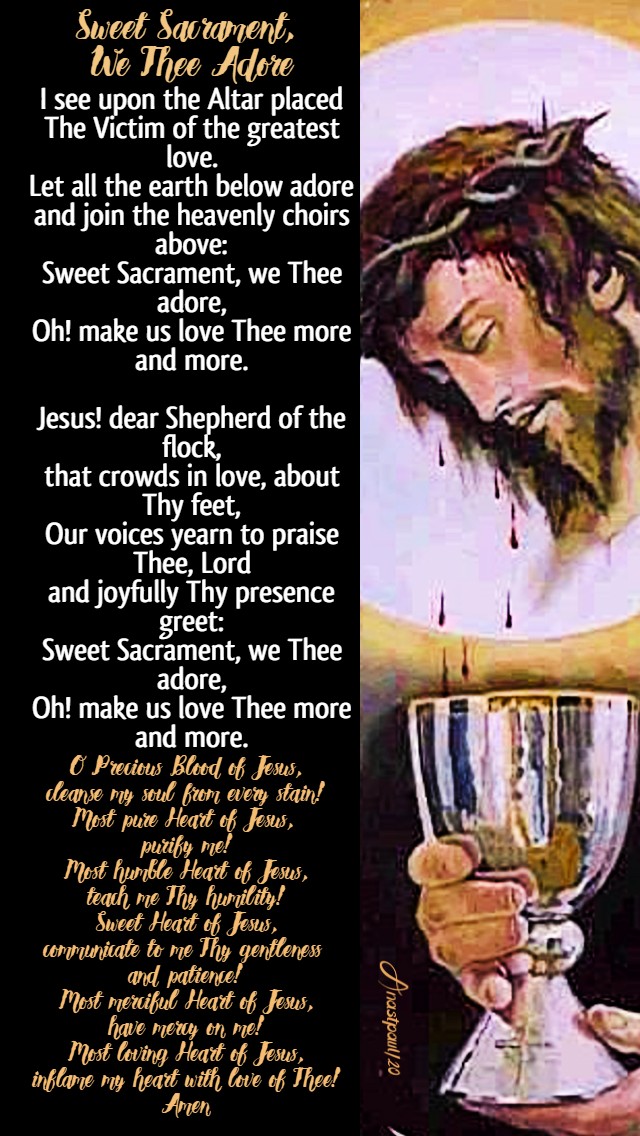
Sweet Sacrament, We Thee Adore
I see upon the Altar placed
The Victim of the greatest love.
Let all the earth below adore
and join the heavenly choirs above:
Sweet Sacrament, we Thee adore,
Oh! make us love Thee more and more.
Jesus! dear Shepherd of the flock,
that crowds in love, about Thy feet,
Our voices yearn to praise Thee, Lord
and joyfully Thy presence greet:
Sweet Sacrament, we Thee adore,
Oh! make us love Thee more and more.
O Precious Blood of Jesus, cleanse my soul from every stain! Most pure Heart of Jesus, purify me! Most humble Heart of Jesus, teach me Thy humility! Sweet Heart of Jesus, communicate to me Thy gentleness and patience! Most merciful Heart of Jesus, have mercy on me! Most loving Heart of Jesus, inflame my heart with love of Thee! Amen
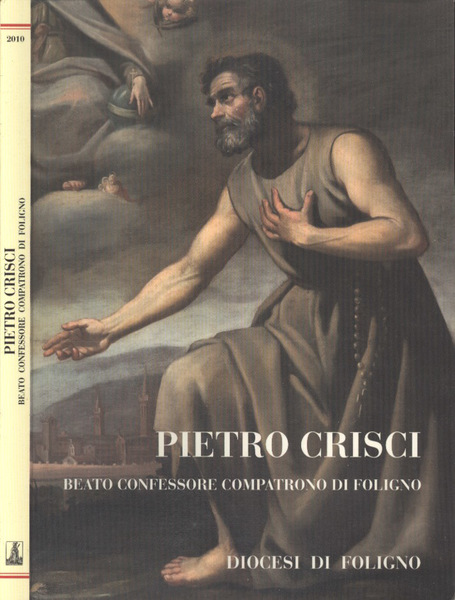
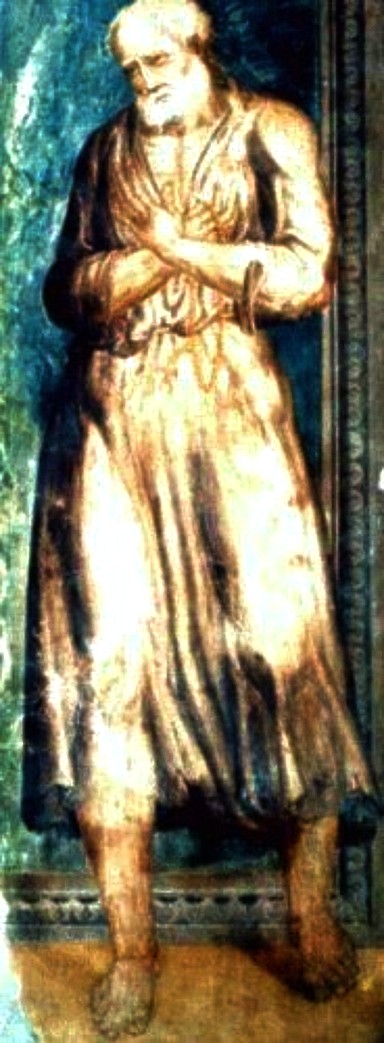
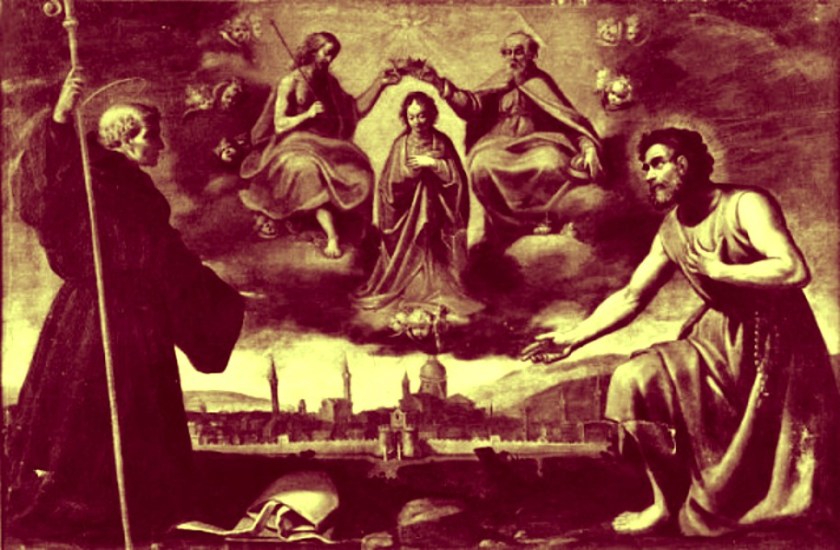
Saint of the Day – 19 July – St Peter Crisci of Foligno TOSF (c 1243-1323) Franciscan Tertiary, Penitent, Hermit, Pilgrim, Beggar, Preacher – called a “Fool for Christ” – born in c 1243 in Foligno and died on 19 July 1323 in the Cathedral of Foligno, Umbria, Italy of natural causes.
Peter Crisci, who was born in c 1243 in Foligno of a good family, sold his inheritance when he was about 30 and gave the proceeds to the poor. From this point, he dressed in sacking and lived as a Hermit in a cell in the campanile of the Cathedral (now the Cell of St Peter Crisci). He regularly preached in the Cathedral and became highly venerated.
He was regarded as a madman in some quarters. While saintly laymen like St Francis had been acceptable in the 13th century, they were generally only accepted in the 14th century when they had the patronage of the mendicant orders. Peter therefore received the attentions of the Inquisition but he was judged to be orthodox. Not all of his compatriots treated him kindly, for example, St Angela of Foligno records that, before her conversion (in 1285), “I used to make fun of a certain Petruccio but now I could not do otherwise than follow his example.”
Peter died in his cell in 1323 and was buried in the Cathedral.
Bishop Giovanni Angeletti (1364-92) commissioned a life of the Blessed Peter Crisci from the Dominican Brother Giovanni Gorini di San Geminiano. The first indication that a cult dedicated to the Blessed Peter Crisci emerged in Foligno dates to 1381, when the existence of a fair held on the anniversary of his death was first documented.
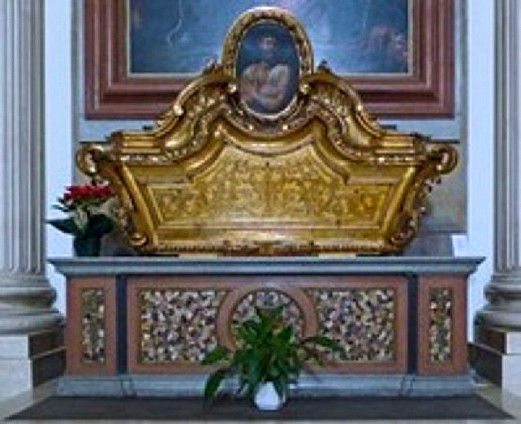
Tomb of St Peter
The cult seems to have been encouraged by Ugolino III Trinci (1386-1415) and it was probably at his instigation, that Pope Boniface IX granted indulgences (in either 1391 or 1400, according to different readings of the damaged document) to those praying before the relics “in festo sancti Petri”. (Boniface IX granted similar indulgences in respect of Blessed James of Bevagna, despite the fact that neither of these men had been Canonised.)
It is likely that pilgrims attracted by these relics would also have visited the Cell of St Peter in the campanile. The frescoes there are dated on stylistic grounds to the decade in which the indulgences were granted. The kneeling donor depicted in the fresco of the mystic marriage of St Catherine at the back o the arch in which Peter Crisci slept may well be Ugolino III Trinci. (The cell now forms part of the Museo Diocesano).
Thought for the Day – 18 July – Meditations with Antonio Cardinal Bacci (1881-1971)
Our Passions
“Our Passions are not essentially sinful.
They can open the way to evil but, they can also lead us towards perfection.
Everything depends on how we control and direct them.
They are impulses which are, at the same time valuable and, dangerous.
Human nature was wounded as a result of original sin.
The soul was disobedient to God and the lower faculties rebelled against right reason.
Hence, the disturbance of our passions.
What should our attitude be in regard to this problem?
Should we suppress or obliterate our passions, as some of the Stoics would have done?
It is, in fact, impossible to do this, for our passions are innate natural forces which cannot be destroyed.
What we should do, is guide and control them.
If the dykes are burst, a strongly flowing river can cause havoc but, if it’s course is wisely directed, it irrigates the soil and makes it fertile.
It is the same with our natural inclinations, which “can be used to form a saint but, can also make a brigand” (Mariano Cordovani OP, Breviario Spirituale, p88).
A man with a fiery and aggressive temperament, can use his natural impulses under God’s guidance, to combat vice in himself and in others.
One who is haughty and ambitious by nature, can convert his ambition into a quest for the true and lasting glory of Heaven.
Finally, a passionate man who feels the need to love and to be loved, can find a partial remedy in Christian friendship.
Most of all, however, he can find repose in the love of God.”
Quote/s of the Day – 18 July – “Month of the Most Precious Blood” – Saturday of the Fifteenth Week in Ordinary Time, Year A, Readings: Micah 2:1-5, Psalm 10:1-4, 7-8, 14, Matthew 12:14-21
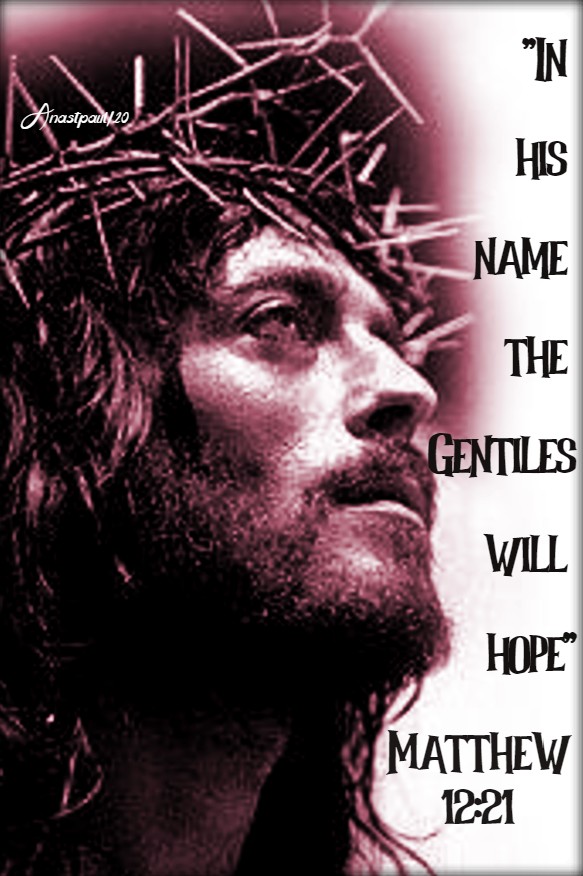
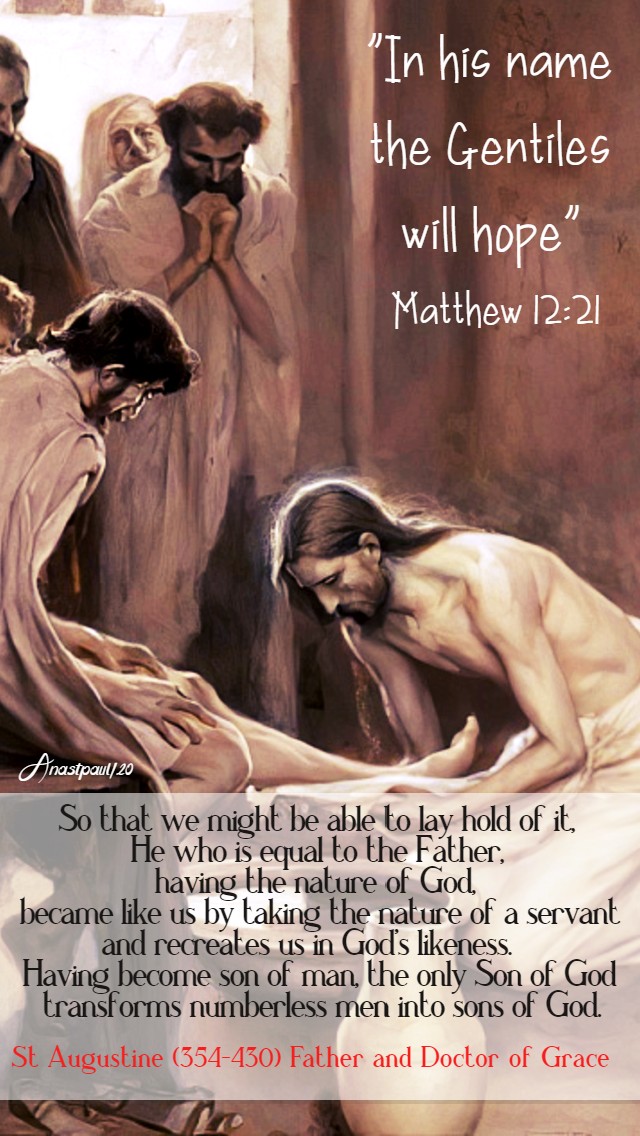
“In his name the Gentiles will hope”
Matthew 12:21
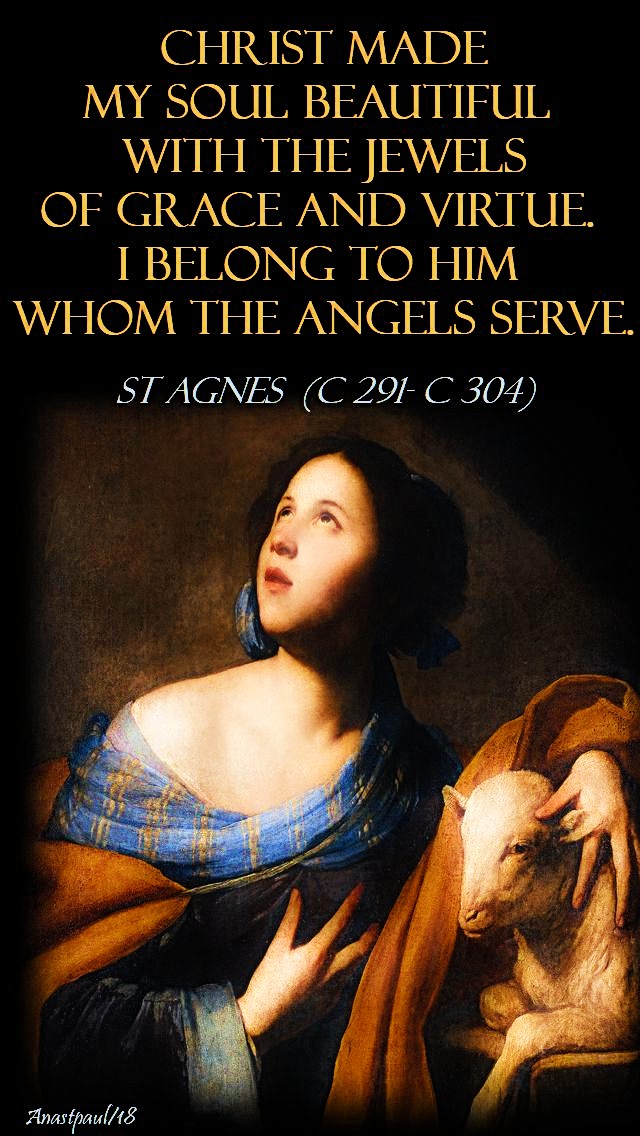
“Christ made my soul beautiful with the jewels of grace and virtue. I belong to Him whom the angels serve.”
St Agnes (c 291- c 304) Virgin and Martyr
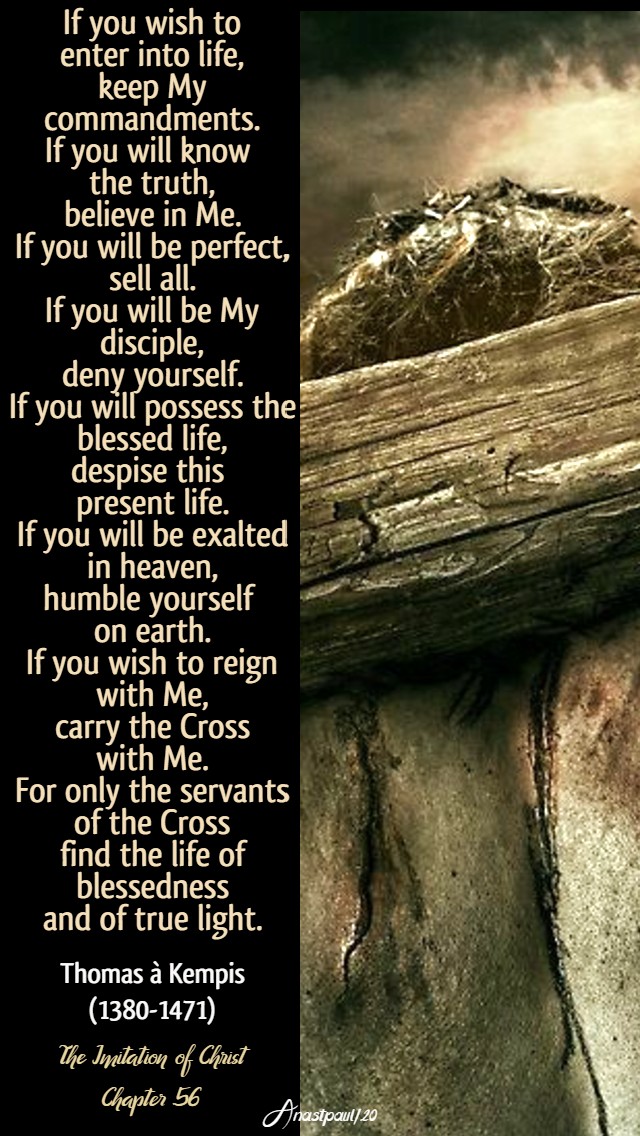
“If you wish to enter into life, keep My commandments. If you will know the truth, believe in Me. If you will be perfect, sell all. If you will be My disciple, deny yourself. If you will possess the blessed life, despise this present life. If you will be exalted in heaven, humble yourself on earth. If you wish to reign with Me, carry the Cross with Me. For only the servants of the Cross find the life of blessedness and of true light.”
Thomas à Kempis (1380-1471)
The Imitation of Christ Chapter 56
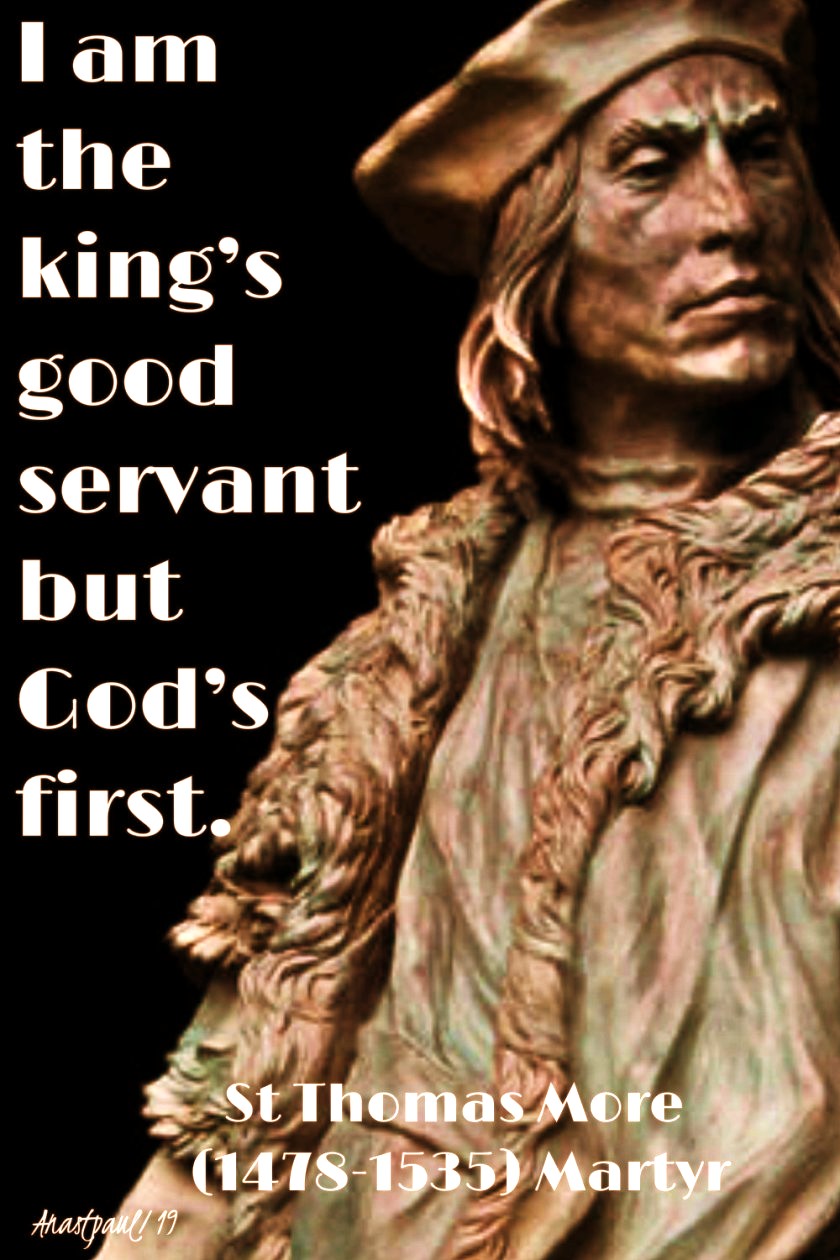
“I am the king’s good servant but God’s first.”
St Thomas More (1478-1535)
Martyr
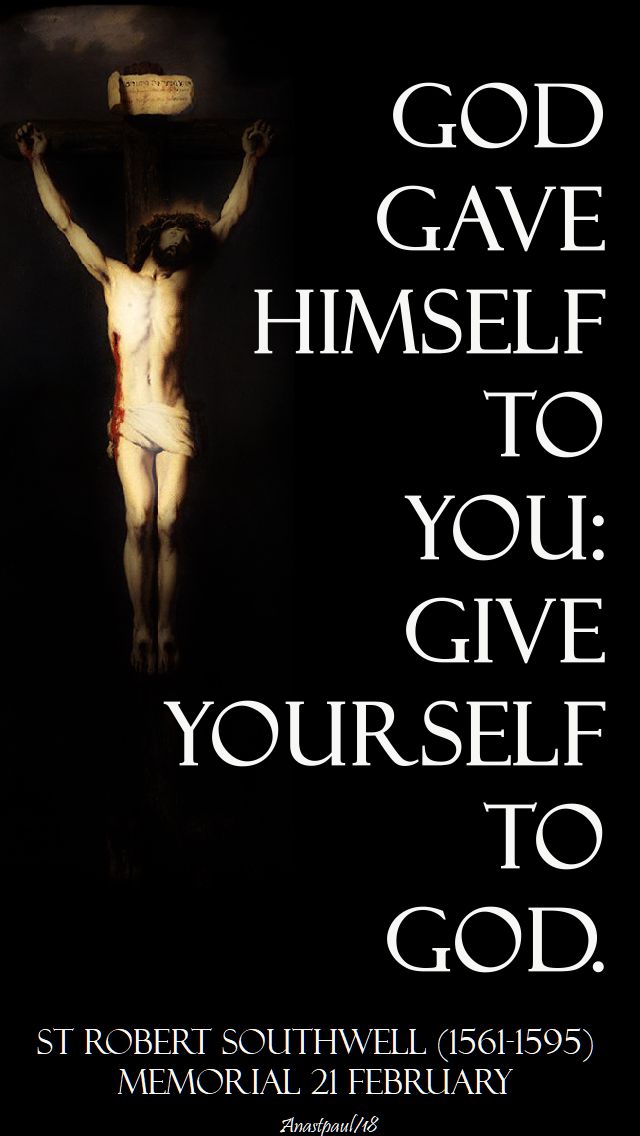
“God gave Himself to you: give yourself to God.”
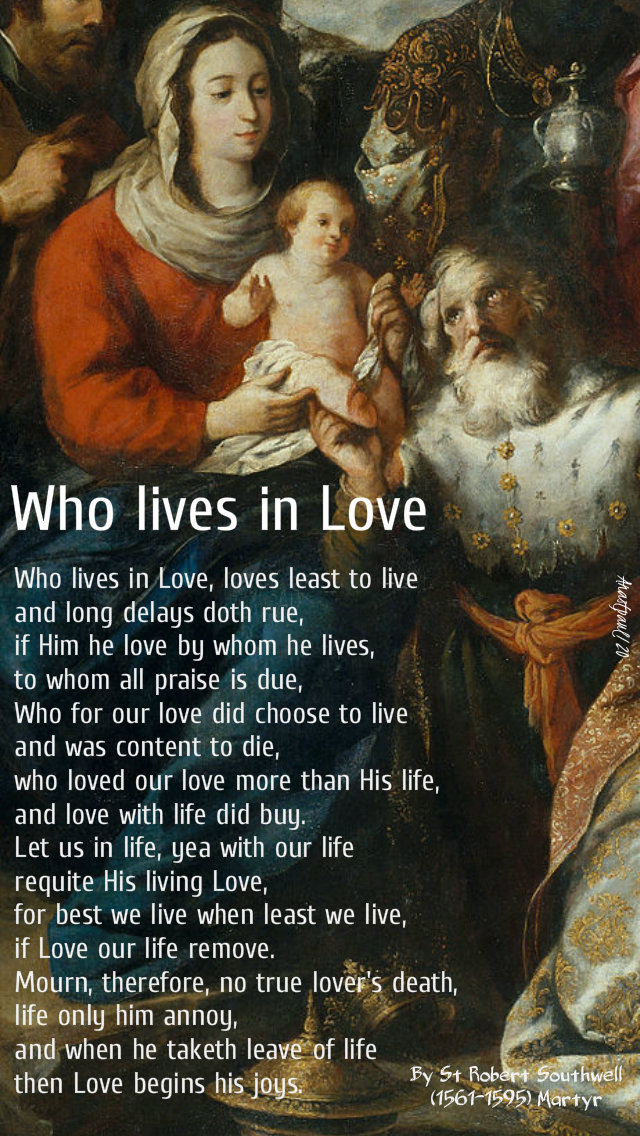
Who lives in Love, loves least to live and long delays doth rue, if Him he love by whom he lives, to whom all praise is due, Who for our love did choose to live and was content to die, who loved our love more than His life, and love with life did buy. Let us in life, yea with our life requite His living love, for best we live when least we live, if Love our life remove. Mourn, therefore, no true lover’s death, life only him annoy, and when he taketh leave of life then Love begins his joys.
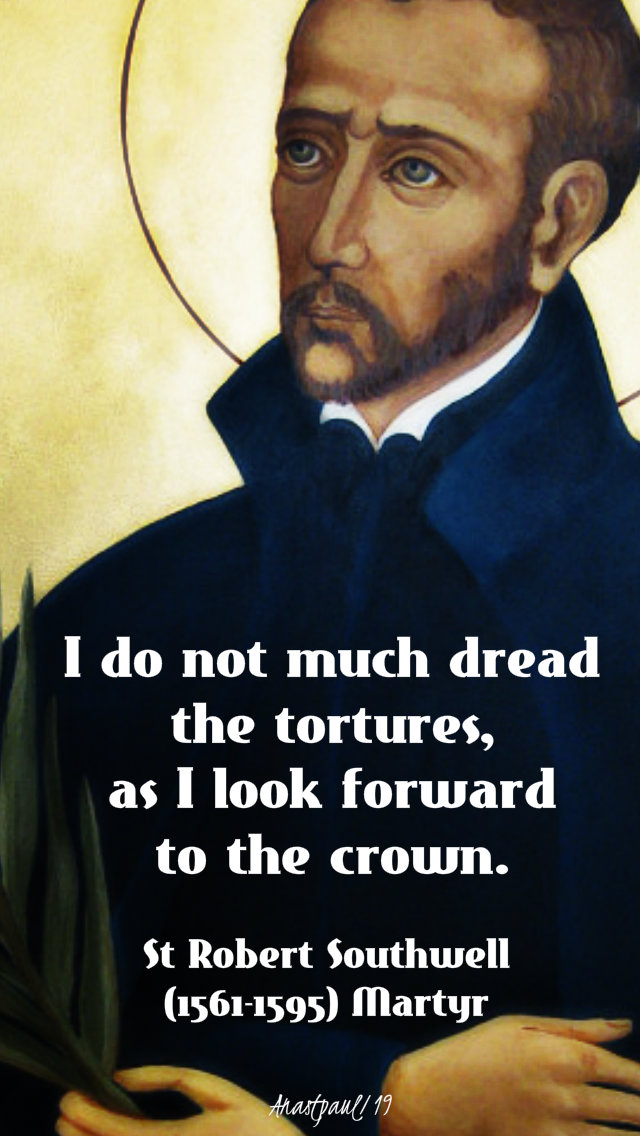
“I do not much dread the tortures, as I look forward to the crown.”
St Robert Southwell (1561-1595) Martyr
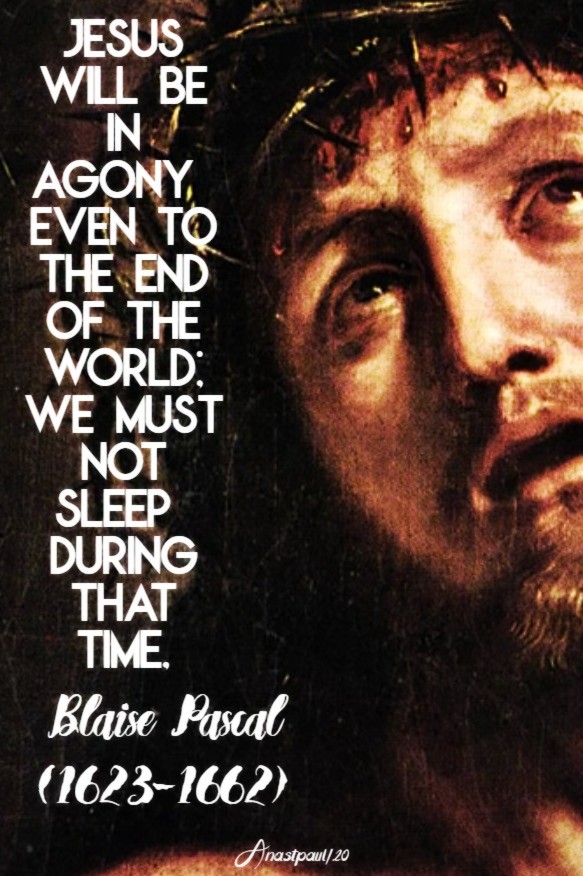
“Jesus will be in agony even to the end of the world; we must not sleep during that time”
One Minute Reflection – 18 July – “Month of the Most Precious Blood” – Saturday of the Fifteenth Week in Ordinary Time, Year A, Readings: Micah 2:1-5, Psalm 10:1-4, 7-8, 14, Matthew 12:14-21and the Feast of Our Lady of Good Deliverance
“In his name the Gentiles will hope” … Matthew 12:21
REFLECTION – “Who among us can know all the treasures of wisdom and knowledge hidden in Christ and buried within the poverty of His flesh? For, “for your sake he became poor although he was rich, so that by his poverty, you might become rich” (2 Cor 8:9). Since He came in order to assume our mortal condition and lay low death itself, He appeared as one who was poor. But He who has promised us distant riches has by no means lost those, from which He is kept away. “How great is his abundant goodness which he keeps in store for those who fear him, he satisfies those who hope in him” (cf. Ps 31[30]:20). …
So that we might be able to lay hold of it, He who is equal to the Father, having the nature of God, became like us by taking the nature of a servant and recreates us in God’s likeness. Having become son of man, the only Son of God transforms numberless men into sons of God. And after having sustained His servants by His own visible nature of a servant, He sets them free to contemplate the nature of God. For “we are God’s children; what we shall be has not yet been revealed. We do know that when it is revealed we shall be like him, because we shall see him as he really is” (1 Jn 3:2). For in what do these treasures of wisdom and knowledge and these divine riches consist? In what is this abundant goodness? All we know is, that it is this, that satisfies us.” … St Augustine (354-430) Father and Doctor of Grace – Sermon 194 ; PL 38, 1016
PRAYER – Lord God, in Your wisdom You created us, by Your Providence, You rule us. Penetrate our inmost being with Your holy light so that our way of life may always be one of faithful service and childlike trust in You. Grant that by the intercession of Our Lady of Good Deliverance, we may always follow behind Your Son and grasp His hand, to lead us to You, Through Jesus Christ our Lord with the Holy Spirit, one God, forever, amen.
Our Morning Offering – 18 July – Saturday of the Fifteenth Week in Ordinary Time and a Marian Saturday
O Mother of Jesus and my Mother By St John Henry Newman (1801-1890)
O Mother of Jesus and my Mother,
let me dwell with you, cling to you
and love you with ever-increasing love.
I promise the honour,
love and trust of a child.
Give me a mother’s protection,
for I need your watchful care.
You know better than any other
the thoughts and desires of the Sacred Heart.
Keep constantly before my mind
the same thoughts,
the same desires,
that my heart may be filled with zeal
for the interests of the Sacred Heart
of your Divine Son.
Instil in me a love of all that is noble,
that I may no longer be easily turned to selfishness.
Help me, dearest Mother,
to acquire the virtues that God wants of me,
to forget myself always,
to work solely for Him,
without fear of sacrifice.
I shall always rely on your help
to be what Jesus wants me to be.
I am His; I am yours, my good Mother!
Give me each day your holy and maternal blessing
until my last evening on earth,
when your Immaculate Heart
will present me to the heart of Jesus in heaven,
there to love and bless you
and your divine Son for all eternity.
Amen
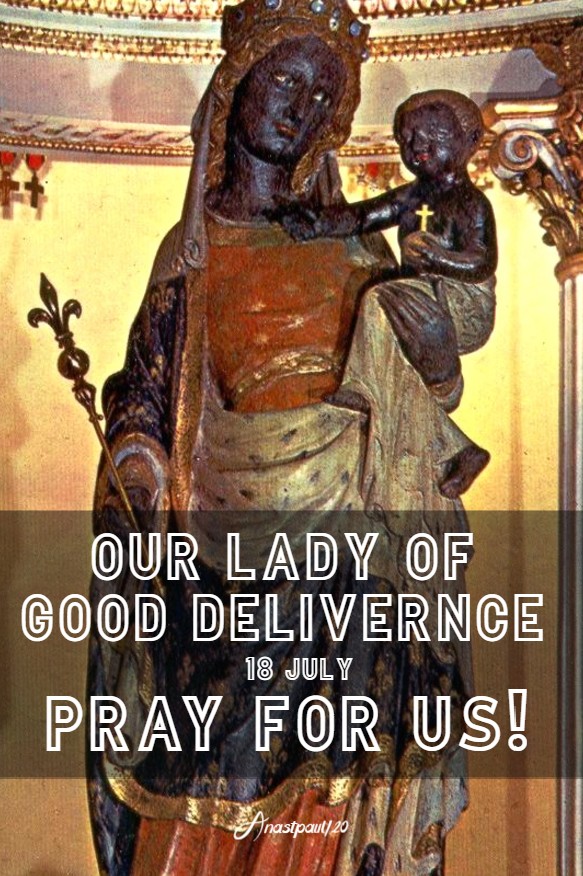
Saint of the Day – 18 July – Our Lady of Good Deliverance, also known as the “Black Madonna of Paris.” The statue dates from the 14th century, replacing an 11th-century version. It is 150 centimeters (59 in) tall, and made from painted limestone. The Virgin wears a white veil and dark blue mantle ornamented with fleur-de-lis over a red robe.
France, known as “the Eldest Daughter of the Church” is a country rooted in Catholicism, where her love of the faith is depicted in it’s magnificent Cathedrals, literature, sacred music, artistic works of paintings, frescoes and sculptures. Prayer books contain Illuminations penned in gold leaf and plant colours and the very air holds the fragrance of religion. In France, Marian devotion runs deep in the hearts of the faithful. One of the first recorded apparitions of our Lady was at Le-Puy, France in the year 70. A Shrine at LePuy was erected and has drawn many saints and faithful throughout the centuries. Today in France, there is still a distinct dedication to Our Lady of Good Deliverance. This devotion refers to a classic fourteenth century gothic statue of the Virgin holding the Child Jesus, both coal black in colour.
A Confraternity in honour of Our Lady of Good Deliverance was established in 1533 by a Priest , Fr Jean-Jacques Olier SS (1608 – 1657) (Founder of the Sulpicians – Congregation of the Holy Spirit). Fr Jean-Jacques was “greatly pious, devoted to Our Lady with strong affection, in the service of the Queen of Angels.” The Confraternity numbered thousands of members, which included aristocratic and common members alike, including the King and Queen of France, Louis XIII and Anne of Austria. The society was dedicated to honour God and his “very dignified Mother, the glorious Virgin Mary to keep a singular devotion alive in all real Christian men and women.” The group organised processions and aided prisoners, paying their debts when possible. Our Lady of Good Deliverance was invoked in all needs, tragedies and sufferings, spiritual and temporal.
Our Lady of Good Deliverance used to stand in the Church Saint-Etienne-des-Grès in the Latin Quarter but that Church was destroyed during the Revolution and all its content sold.
An exterior view of Saint-Étienne-des-Grès as it appeared before the French Revolution, taken from Book Three of Tableau historique et pittoresque de Paris by Jacques Bins, comte de Saint-Victor.
Madame de Carignan, a pious rich lady bought the Statue and venerated her in her private home until she was arrested during the Reign of Terror (a period of 11 months following the Revolution, which cost 20-40,000 people their lives.) In jail she used to pray to Our Lady of Good Deliverance with others who had been arrested for their faith, in particular the Sisters of St Thomas. When all of them survived and were freed in 1806, Madame gave the Black Virgin to the Sisters. The statue is still located in the Chapel of the Congregation of the Sisters of St Thomas of Villeneuve in Neuilly-sur-Seine, see below. The Sisters of St Thomas pray every day in the chapel on behalf of families, the sick, religious vocations, those who have entrusted themselves to the Virgin, and peace in the world.
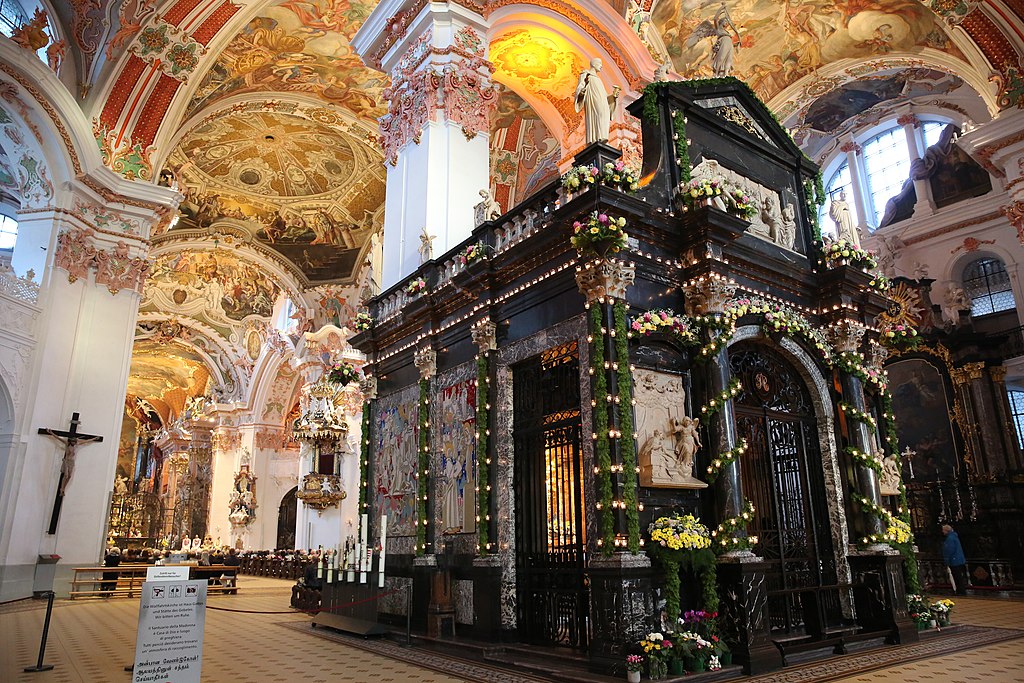
The Chapel of Grace, E#insiedeln
Our Lady of Good Deliverance was invoked as a helper in all kinds of calamities and suffering, whether of a spiritual or material nature. She was also called upon as the Victorious One in the fight against the Huguenots and other heretics.
The great Saints of Paris, most notably St Vincent de Paul and St Francis de Sales prayed before her.
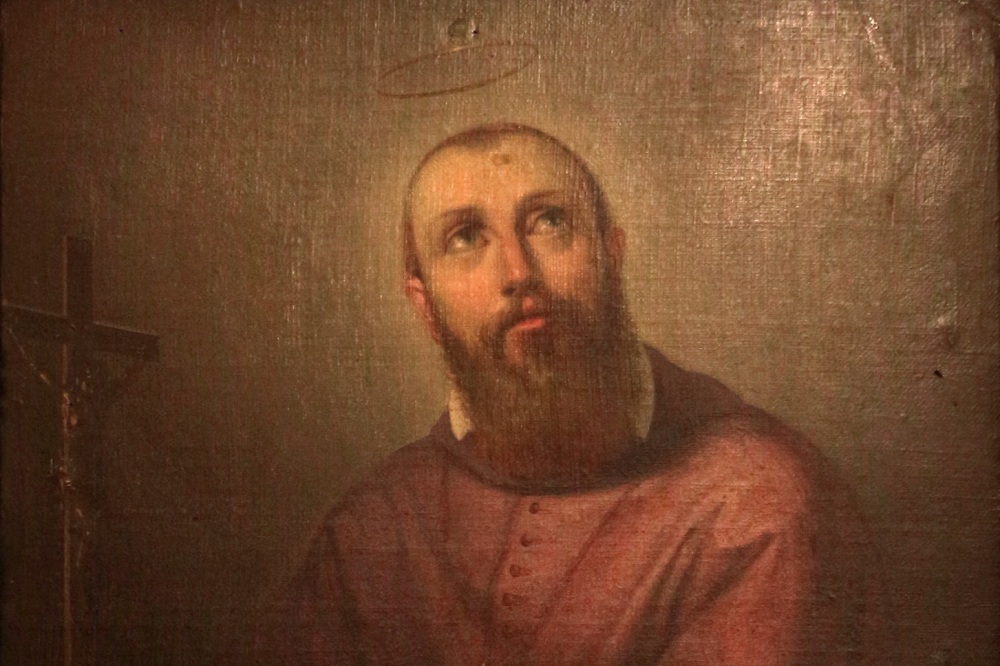
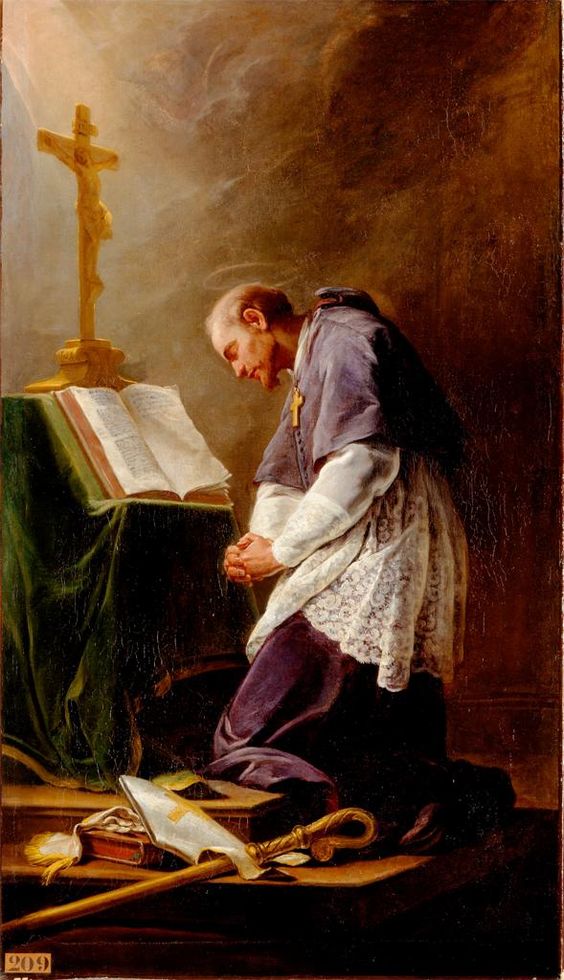
The de Sales family were members of the minor nobility and staunch Catholics but young St Francis de Sales fell victim to the religious turmoil of his age. The question of predestination, the hottest point of contention between Catholic and Calvinist theologians, tormented him while he was a student in Paris. In his distress over the uncertain fate of his soul he cried out to God, “Whatever happens, Lord, may I at least love you in this life if I cannot love you in eternity.”At the age of 18, while studying at the Jesuit run Collège de Clermont at the University of Paris, according to the book The Spirit of St. Francis de Sales, by Jean-Pierre Camus:
“…The evil spirit was permitted by God to insinuate into his mind the terrible idea that he was one of the number of the damned. This delusion took such possession of his soul, that he lost his appetite, was unable to sleep and day-by-day grew more wasted and languid. His tutor and director, noticing how his health was affected and how pale, listless and joyless he had become, often questioned him as to the cause of his dejection and evident suffering but his tormentor, who had filled his mind with this delusion, being what is called a dumb devil, the poor youth could give no explanation.
For one whole month he suffered this mental torture, this agony of soul. He had lost all the sweetness of divine love but not, happily, his fidelity to it. He looked back with happy tears to the happy time when he was, as it were, inebriated with that sweetness, nor did any ray of hope illumine the darkness of that night of despair. In late December, at last, led by a divine inspiration, he entered a Church to pray that this agony might pass. On his knees before the Statue of the Blessed Virgin, Our Lady of Good Deliverance, he implored the assistance of the Mother of Mercy with tears and sighs and the most fervent devotion.”
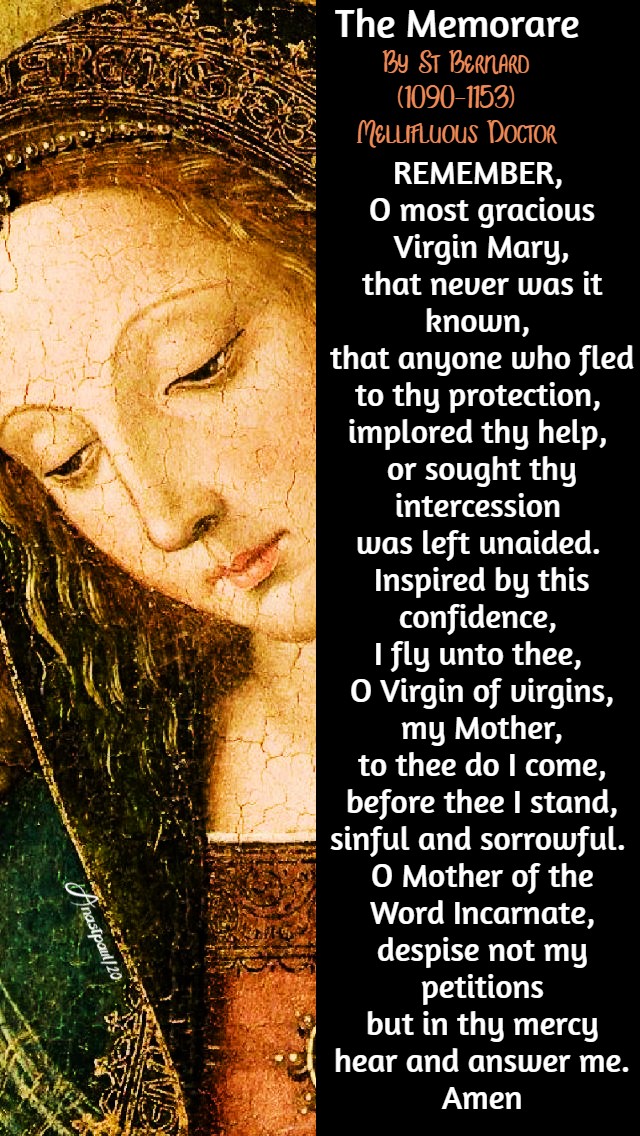
According to De Sales’ Selected Letters, the “torment of despair came to a sudden end” as he knelt in prayer before the statue of Our Lady of Good Deliverance at the church of Saint-Étienne-des-Grès, Paris, saying the Memorare. Francis credited the Blessed Virgin with “saving him from falling into despair or heresy”thereafter, he “recited the Memorare day after day” and she “did not leave him unaided.”
Not long after this event another Priest with great love for Our Mother, who ministered to the poor and to prisoners in Paris, especially those condemned to death, spread the fame of this prayer. He was Fr Claude Bernard (23 December 1588 – 23 March 1641). Known as “Le Pauvre Prêtre” “The Poor Priest,” he is primarily remembered as the populariser of the Memorare, over 200,000 copies of which he distributed by leaflets printed in various languages.
Notable pilgrims to Our Lady of Good Deliverance—some before the Revolution, some after—have included Fr Claude Bernard, Fr Jean-Jacques Olier, St John Bosco, Blessed Prosper Guéranger and St Madeleine Sophie Barat RSCJ (1779 – 1865).
The Memorare
Remember, O most gracious Virgin Mary, that never was it known, that anyone who fled to thy protection, implored thy help, or sought thy intercession, was left unaided. Inspired by this confidence, I fly unto thee, O Virgin of Virgins, my Mother. To thee do I come, before thee I stand, sinful and sorrowful. O Mother of the Word Incarnate, despise not my petitions but in thy mercy hear and answer me. Amen
Notre-Dame-de-Bonne Délivrance / Our Lady of Good Deliverance: 18 July
Since the 1000s, the Church of Saint-Etienne-des-Grès in the old Latin Quarter of Paris had a chapel to Our Lady of Good Deliverance, where, across the centuries, pilgrims sought the Virgin’s help in their of sufferings. During the Wars of Religion and counter-Reformation, her Confraternity had 12,000 members, including the King and Queen of France.
St Goneri of Treguier
St Gundenis of Carthage
Bl Herveus
Bl Jean-Baptiste de Bruxelles
St Marina of Ourense
St Maternus of Milan
St Minnborinus
St Pambo of the Nitrian Desert
St Philastrius of Brescia
St Rufillus of Forlimpopoli
St Scariberga of Yvelines St Simon (Szymon) of Lipnica (1435/1440-c 1482) His Story: https://anastpaul.com/2019/07/18/saint-of-the-day-18-july-saint-simon-of-lipnica-1435-1440-c-1482/
St Theneva
St Theodosia of Constantinople
—
Martyrs of Silistria – 7 saints: Seven Christians who were martyred together. No details about them have survived but the names – Bassus, Donata, Justus, Marinus, Maximus, Paulus and Secunda. They were martyred in Silistria (Durostorum), Moesia (in modern Bulgaria), date unknown.
Martyrs of Tivoli – 8 saints: A widow, Symphorosa and her seven sons ( Crescens, Eugene, Julian, Justin, Nemesius, Primitivus and Stracteus) martyred in Tivoli, Italy in the 2nd-century persecutions of Hadrian.
Thought for the Day – 17 July – Meditations with Antonio Cardinal Bacci (1881-1971)
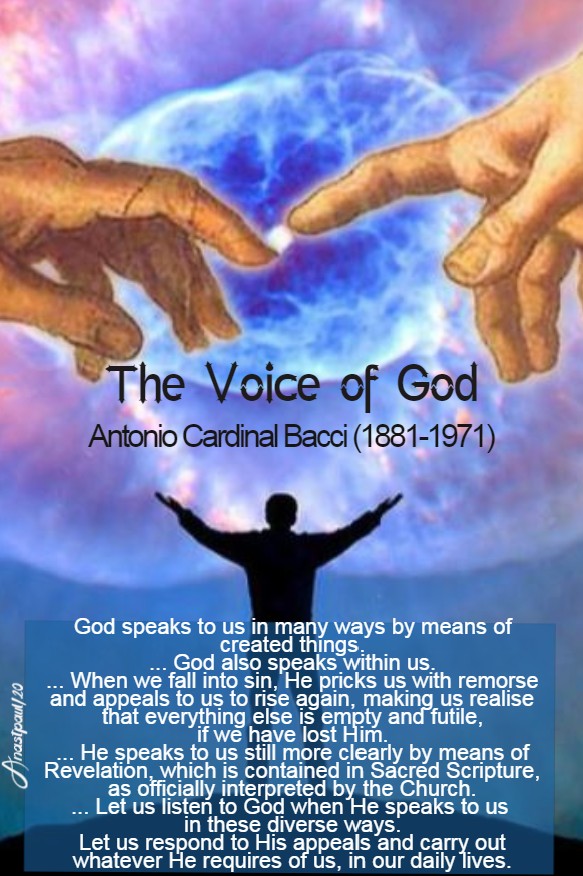
The Voice of God
“God speaks to us in many ways by means of created things.
We see His glory in the stars of the firmament, (Cf Ps 13:2), in the seas, mountains and valleys and in the trees and flowers.
St Therese was once examining the petals of a flower, when she exclaimed: “How good thou art, O God!”
God also speaks within us.
Sometimes, He sees how absorbed we are in worldly affairs and He stirs up, in us, a restlessness and a longing for Heaven.
When we fall into sin, He pricks us with remorse and appeals to us to rise again, making us realise that everything else is empty and futile, if we have lost Him.
He speaks to us still more clearly by means of Revelation, which is contained in Sacred Scripture, as officially interpreted by the Church.
The revealed Word of God has always been with us to answer the searchings of the human heart and to allay it’s anxieties.
The Gospel is as new and as illuminating today, as yesterday.
It is a book which we should study reverently and diligently, in order to solve our personal problems and the problems of mankind.
Let us listen to God when He speaks to us in these diverse ways.
Let us respond to His appeals and carry out whatever He requires of us, in our daily lives.”
Quote/s of the Day – 7 July – “Month of the Most Precious Blood” – Friday of the Fifteenth Week in Ordinary Time, Year A, Readings: Isaiah 38:1-6, 21-22, 7-8, Responsorial psalm Isaiah 38:10-12, 16, Matthew 12:1-8
‘Take Christ’
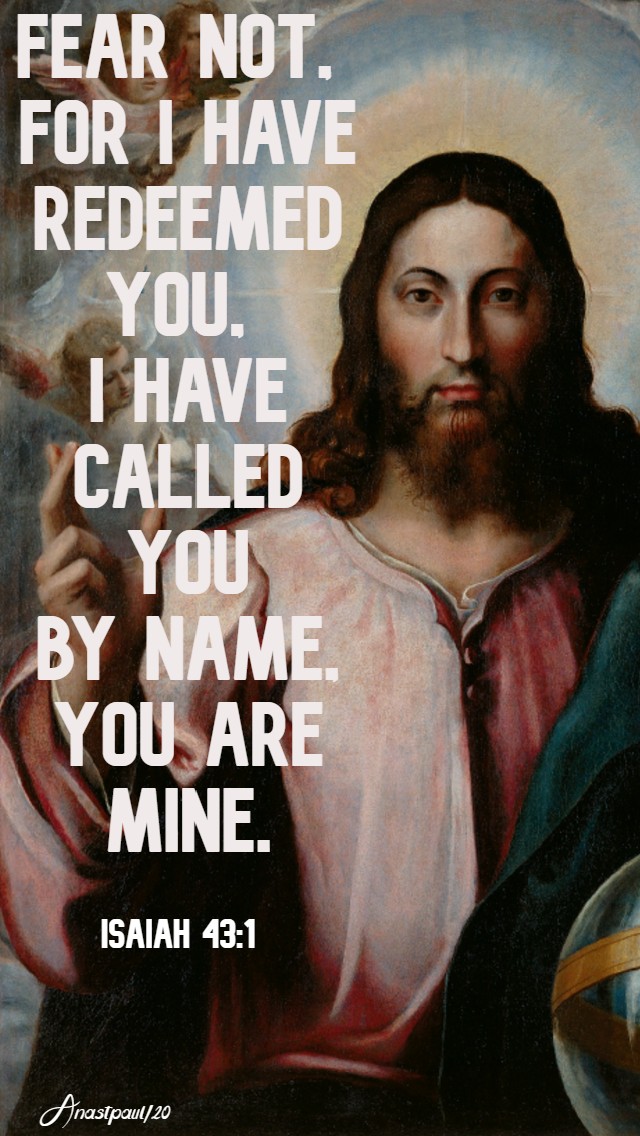
“Fear not, for I have redeemed you, I have called you by name, you are mine.”
Isaiah 43:1
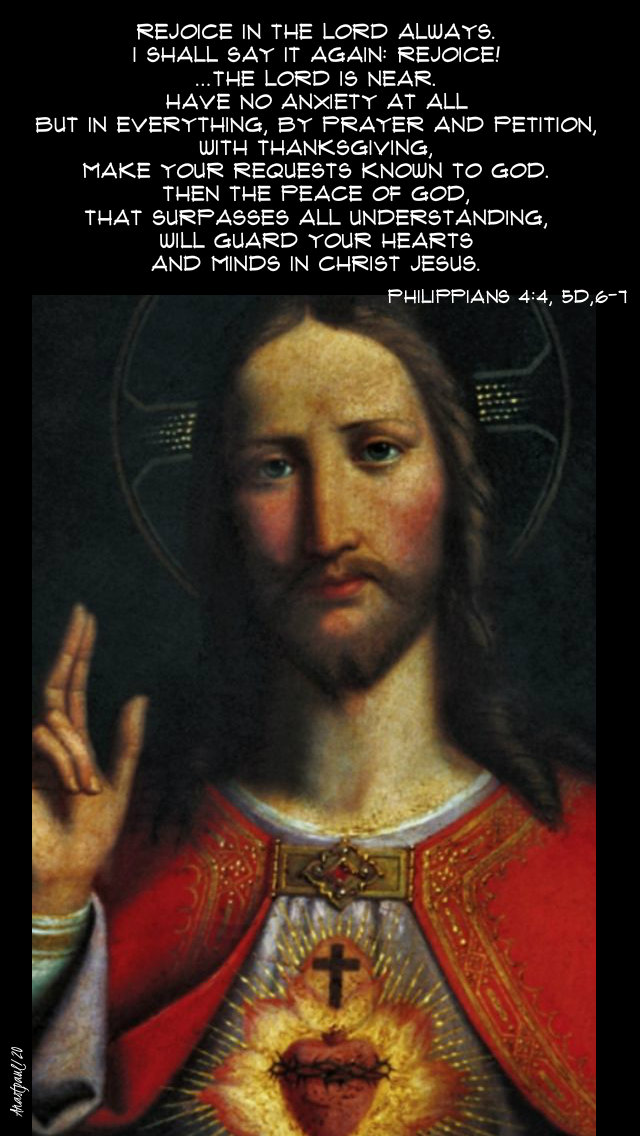
Rejoice in the Lord always. I shall say it again: rejoice! …The Lord is near. Have no anxiety at all but in everything, by prayer and petition, with thanksgiving, make your requests known to God. Then the peace of God, that surpasses all understanding, will guard your hearts and minds in Christ Jesus.
Philippians 4:4, 5d,6-7
“The Christian should be an ‘alleluia’ from head to foot.
St Augustine (354-430)
Father & Doctor of the Church
“May Christ be heard in our language, may Christ be seen in our life, may He be perceived in our hearts”
St Peter Damian (1007-1072)
Doctor of the Church
(Sermo VIII, 5)
“The one you are looking for, is the One who is looking.”
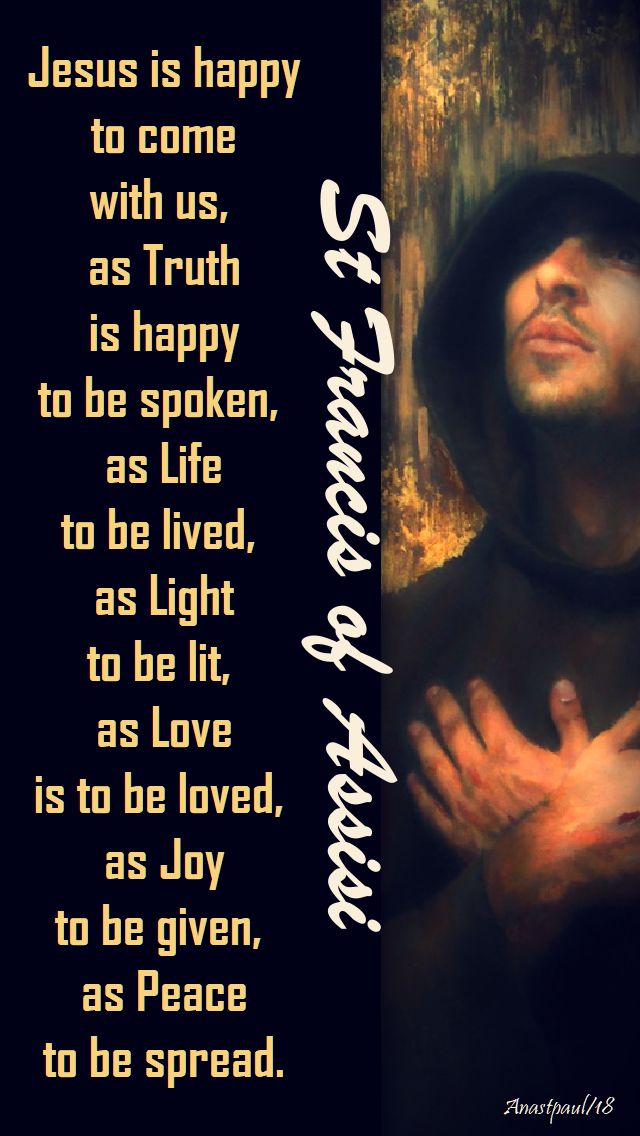
“Jesus is happy to come with us, as Truth is happy to be spoken, as Life to be lived, as Light to be lit, as Love is to be loved, as Joy to be given, as Peace to be spread.”
St Francis of Assisi (1181/2–1226)
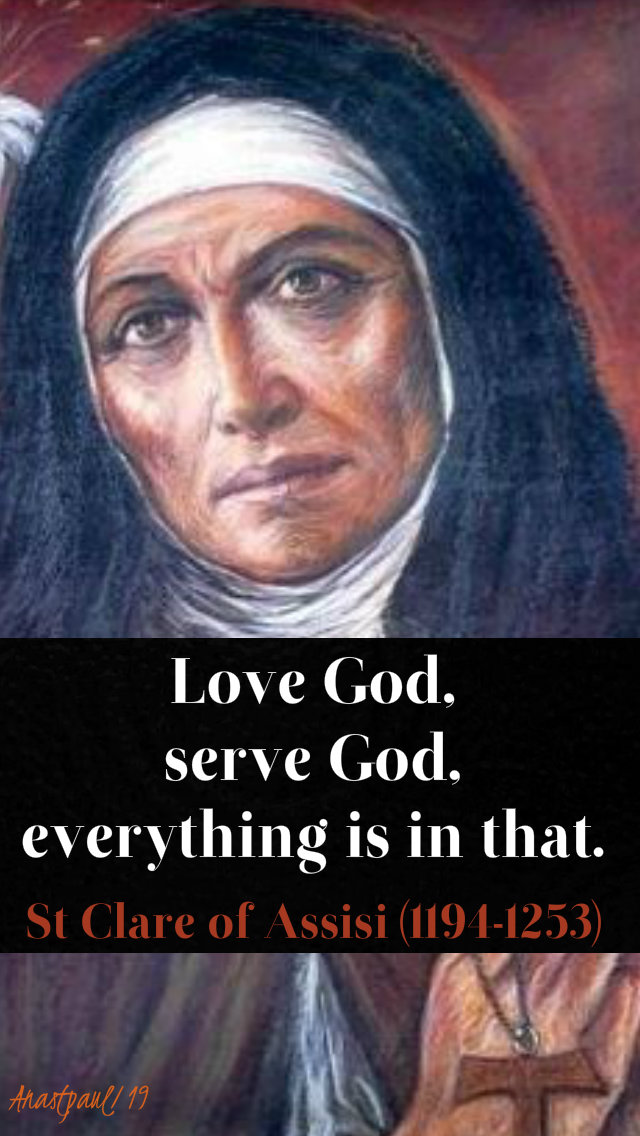
“Love God, serve God, everything is in that.”
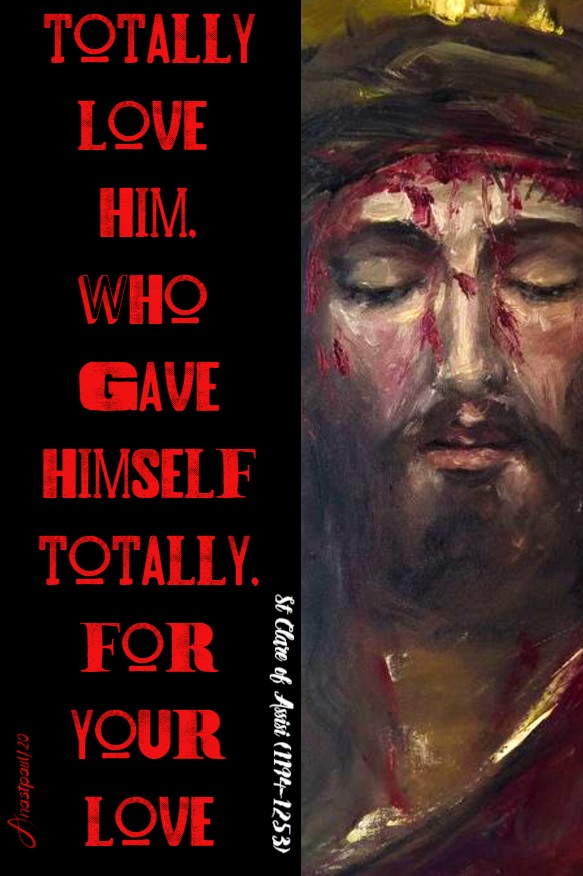
“Totally love Him, who gave Himself totally, for your love.”
St Clare of Assisi (1194-1253)
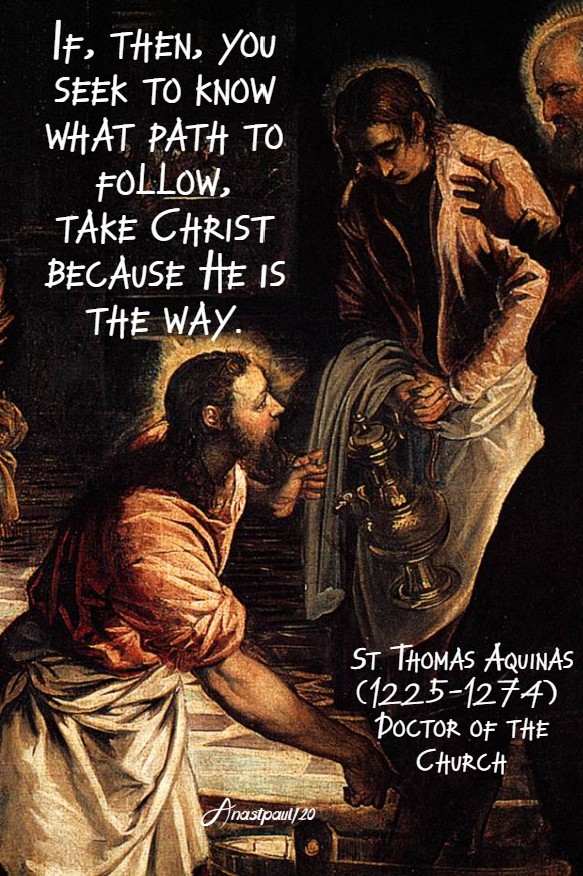
“If, then, you seek to know what path to follow, take Christ because He is the way.”
St Thomas Aquinas (1225-1274)
Doctor of the Church
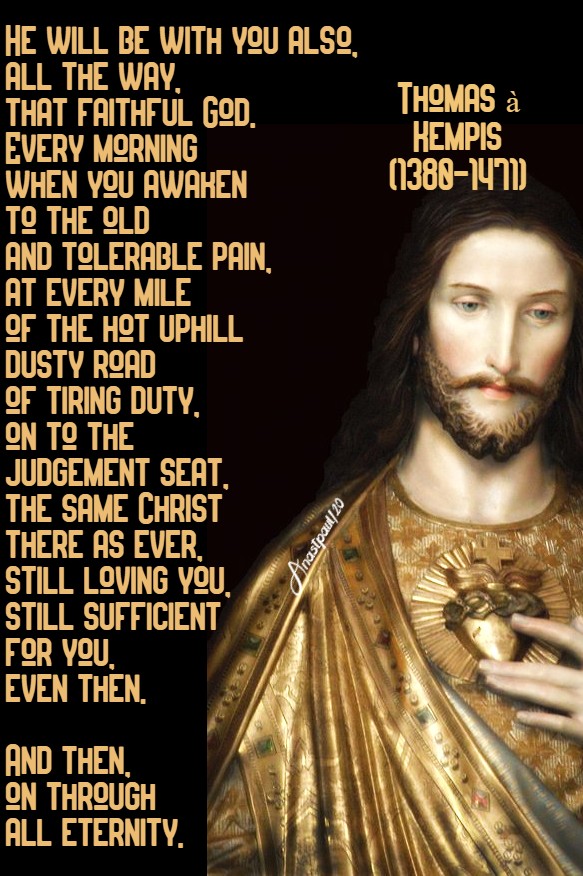
“He will be with you also, all the way, that faithful God. Every morning when you awaken to the old and tolerable pain, at every mile of the hot uphill dusty road of tiring duty, on to the judgement seat, the same Christ there as ever, still loving you, still sufficient for you, even then. And then, on through all eternity.”
Thomas à Kempis (1380-1471)
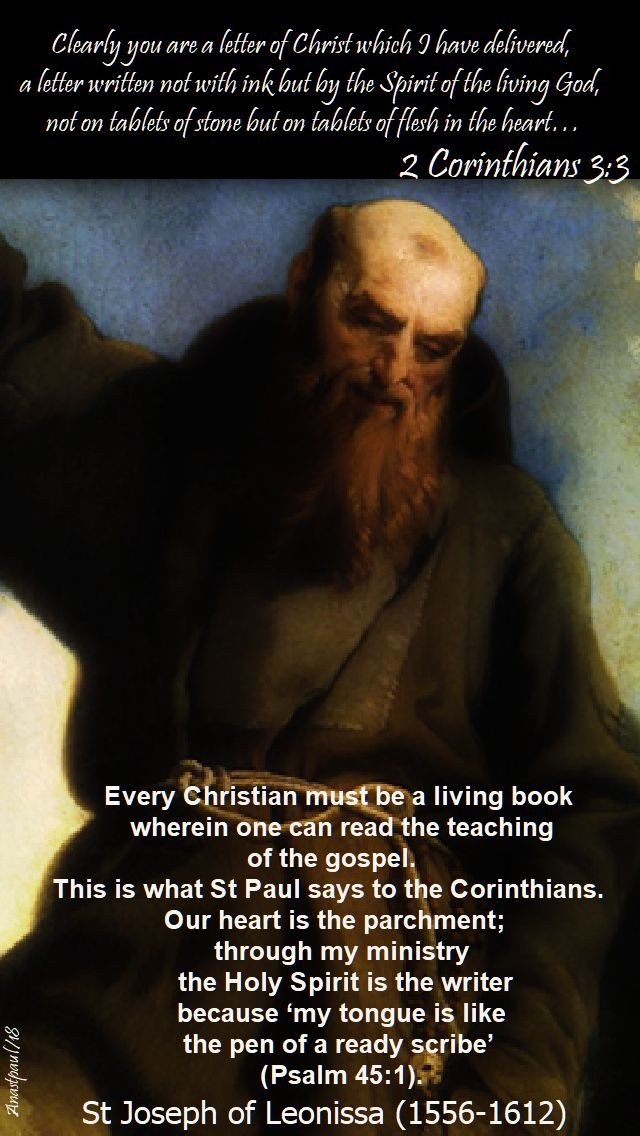
“Every Christian must be a living book wherein one can read the teaching of the gospel. This is what St Paul says to the Corinthians. Our heart is the parchment; through my ministry the Holy Spirit is the writer because ‘my tongue is like the pen of a ready scribe’ (Psalm 45:1).”
One Minute Reflection – 17 July – “Month of the Most Precious Blood” – Friday of the Fifteenth Week in Ordinary Time, Year A, Readings: Isaiah 38:1-6, 21-22, 7-8, Responsorial psalm Isaiah 38:10-12, 16, Matthew 12:1-8 and the Feast of The Madonna of Humility
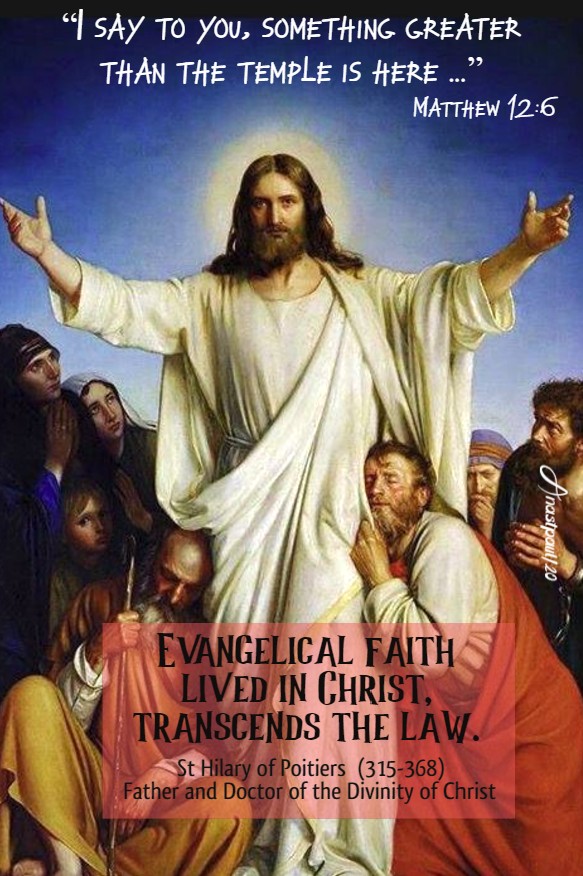
“I say to you, something greater than the temple is here …” … Matthew 12:6
REFLECTION – ““Christ also reminded them of another prophecy, so that they might learn, that all things that were spoken of previously, were accomplished in Him through the law, that the priests in the temple broke the sabbath without offence, clearly revealing that Jesus Himself was the temple.
In Him, salvation was given to the Gentiles, through the teaching of the apostles, while the people who were bound by the law, wandered about faithlessly, so that He Himself might be greater than the sabbath.
Evangelical faith lived in Christ, transcends the law.” … St Hilary of Poitiers (315-368) – Father and Doctor of the Divinity of Christ – On Matthew, 12
PRAYER – Almighty God, to whom this world with all its goodness and beauty belongs, give us grace joyfully to begin this day in Your name and to fill it, with an active love for You and for our neighbour. Grant us the grace to repent of our sins, to turn to the Cross of Your Son and to beg Him in His great love and suffering to forgive us again! Mary, the Madonna of Humility, intercede for us in our weakness and help us become humble and look only at the face of Christ. Amen
Our Morning Offering – 17 July – “Month of the Most Precious Blood” – Friday of the Fifteenth Week in Ordinary Time
Prayer for the Gift of Prayer By St Alphonsus Liguori (1696-1787) Doctor of the Church
O Incarnate Word,
You have given Your Blood and Your Life
to confer on our prayers that power by which,
according to Your promise,
they obtain for us all that we ask.
And we, O God,
are so careless of our salvation,
that we will not even ask You for the graces
that we must have, if we should be saved!
In prayer You have given us the key
of all Your Divine treasures
and we, rather than pray,
choose to remain in our misery.
Alas! O Lord, enlighten us,
and make us know the value of prayers,
offered in Your name and by Your merits,
in the eyes of Your Eternal Father.
Amen
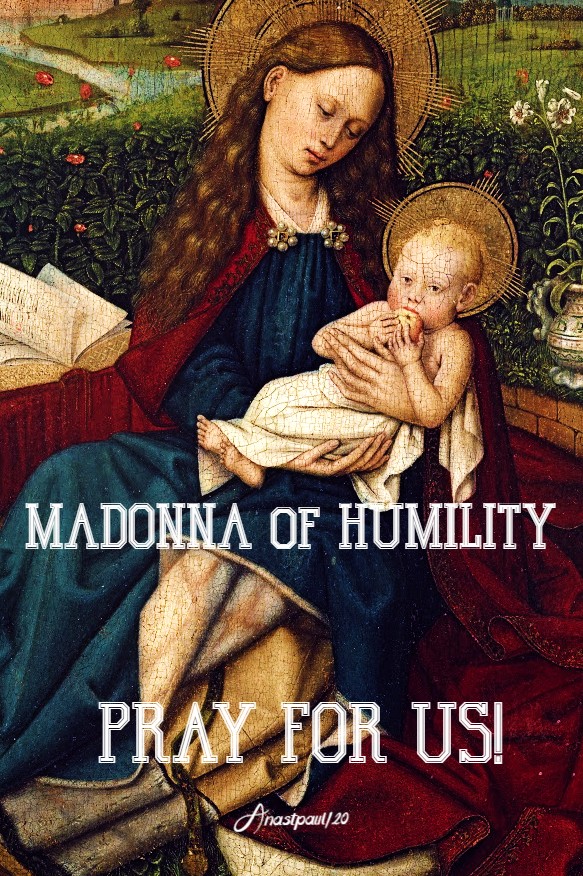
Saint of the Day – 17 July – Madonna dell’Umiltà / The Madonna of Humility -Pistoia, Tuscany, Italy (1490) of which City the Madonna is the Patron.
In 1383, Paolo Serafini painted the fresco of the Madonna dell’Umiltà for the Chapel of Santa Maria Forisportam (St Mary Outside the Gate) outside town. A century later, Pistoia erupted in bloody civil strife due to internal conflict between local families of the Panciatichi and Cancellieri.
On 17 July 1490, a group of people took refuge in the Chapel. While the Mass was being celebrated by the Priest, Fr Tommaso Benannati at the Altar of the Madonna. In the light of a rays of the sun, they could see oozing from the front of the Virgin’s image, a few drops of liquid of vermilion colour – which was immediately understood to be blood, descended to the Virgin’s feet, trickling down and tracing wide streaks. Some witnesses rang the bell, while others ran to spread the news. he combat ended and both sides ran to see the miracle. This miracle lasted for several months and it’s traces are still visible.
The Pistoiese wept for this painful sorrow of the heavenly Mother, caused by their obstinacy in hatred and divisions, they swore peace and forgiveness and promised to build a Holy Shrine to the heavenly Mediatrix.
The authenticity of the miracle, after careful examination, was confirmed by the Bishop Niccolò Pandolfini, the Podestà Pietro Vettori, the Capitano del Popolo, the Gonfaloniere and the Priori. The enthusiasm and popular devotion to the Madonna of Humility grew dramatically, so much so, that the need arose immediately to provide for an expansion of the small Church to contain the crowds of believers who came from everywhere and still do. And, to fulfil their promise, a magnificent new sanctuary, renamed for the painting, was dedicated at the site on 31 December 1582. In 1931, Pope Pius XI elevated the church to the status of Minor Basilica.
The Altar of the Madonna of HumilityThe Basilica of the Madonna in Pistoia
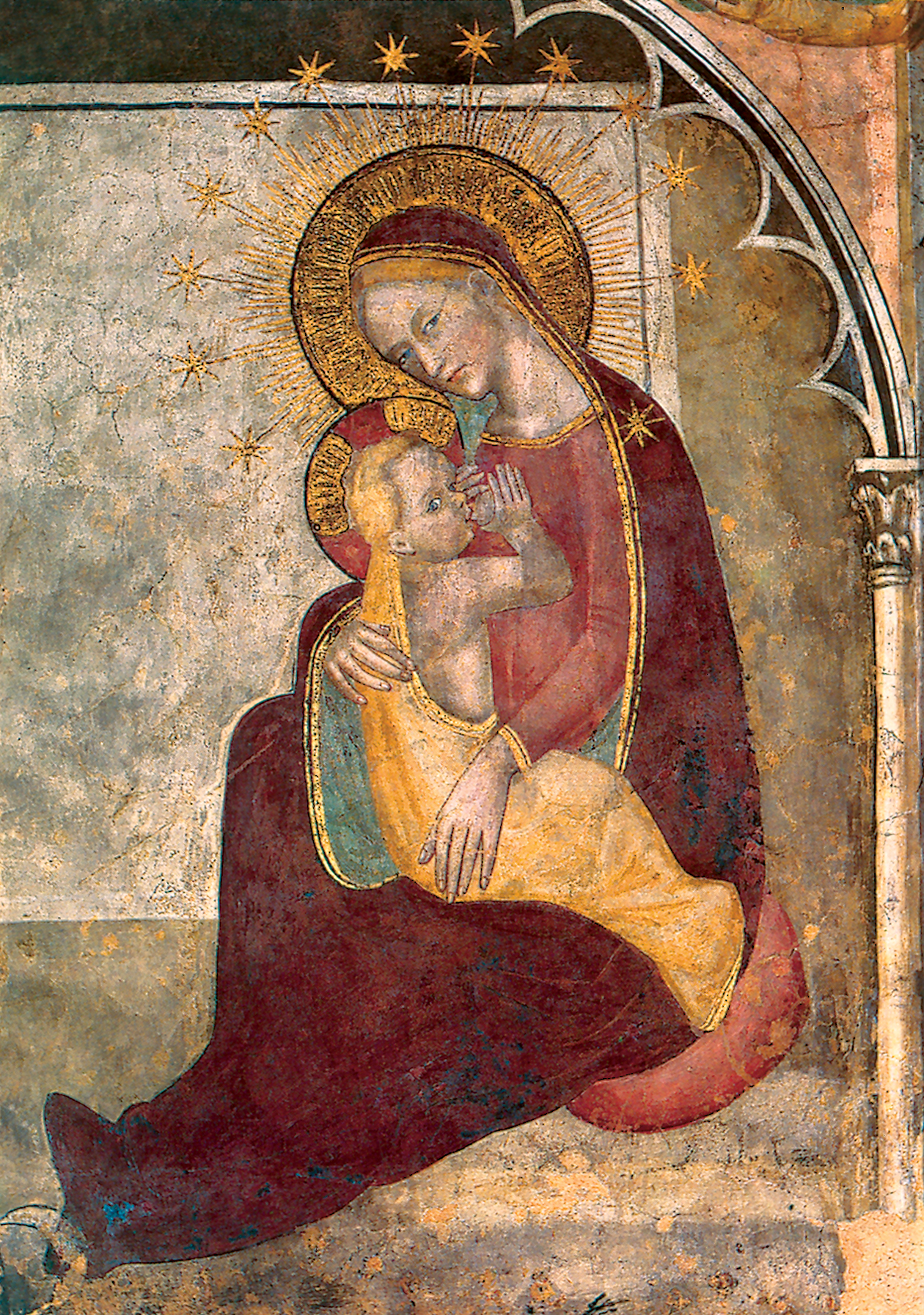
The image shows the humble Madonna seated on a cushion on the floor, nursing the child at her right breast. The Basilica celebrates the Feast of the Madonna of Humility on 17 July with solemn Mass and vespers.
There is also a beautiful Chapel to the Madonna of Humility in Rome, a favourite of Pope Pius IX. It is said that, as a boy, Pius IX, born Giovanni Maria Mastai-Ferretti, regularly attended Mass in the Chapel of the Madonna of Humility.
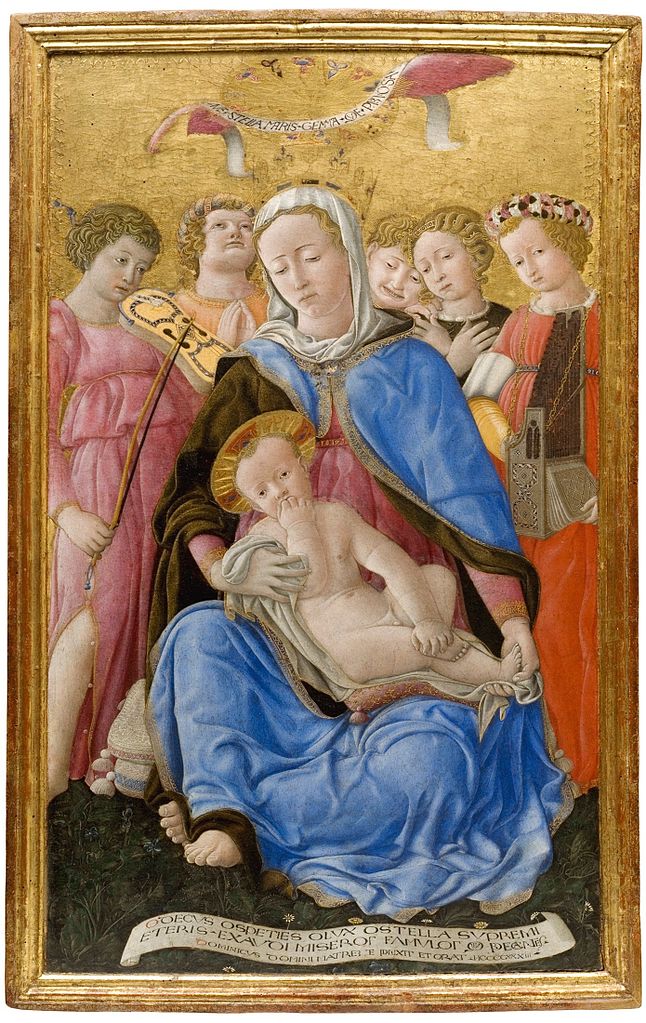
The original Miracle and painting by Paolo Serafini occurred in 1383 but their have been earlier depictions of the Madonna under this title, though not accompanied by a Miracle. The earliest known painting of this type dates to 1346 and is at the Museo Nazionale in Palermo, Sicily. It represents a Madonna seated on a small cushion just above the ground. The Child Jesus that she holds partially looks at the viewer. Domenico di Bartolo’s Madonna of Humility, painted in 1433, was described by art historian Andrew Ladis as one of the most innovative devotional images from the early Renaissance.
Madonna of humility by Domenico di Bartolo, 1433.
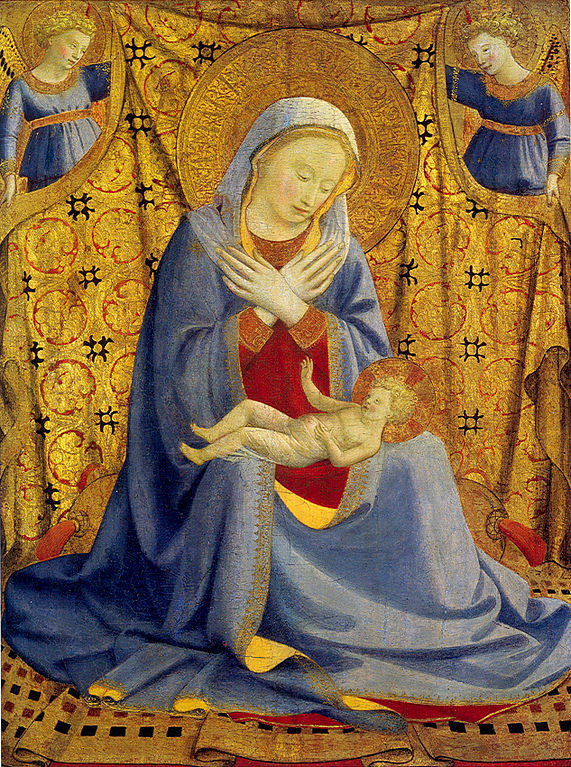
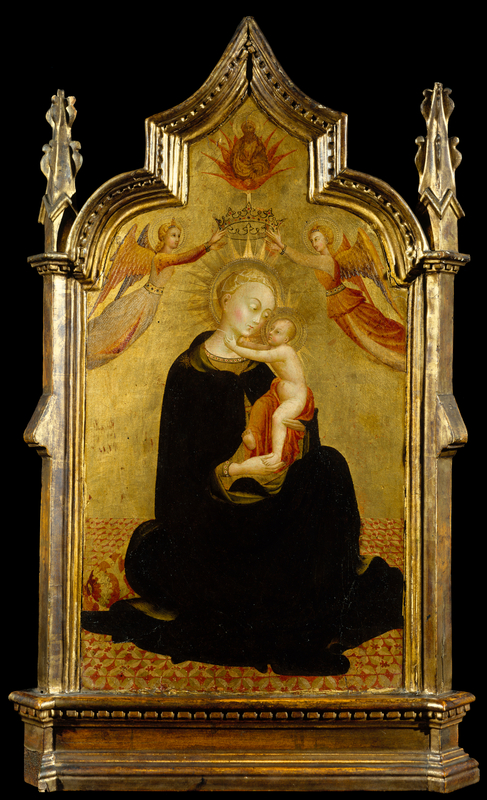
Other key examples include the Madonna dell’Umiltà, a tempera painting on wood by Gentile da Fabriano , dating from around 1420 – 1423. Fra Angelico’s representation of about 1430 (which includes two angels) is notable in that Jesus is approached from above, focusing on his divinity. Giovanni di Paolo’s depiction of about 1456 represents a transition in the perception of nature, with the visual landscape forming itself around the seated Madonna.
Gentile da Fabriano
Fra Angelico
Another rendition by Fra Angelico
Giovanni di Paolo
Sassesta
This Feast of Our Lady of Humility is not celebrated much today, yet I have a fondness for this particular Feast, perhaps because it is so important to recognize the need for all of us to be humble as Jesus told us: “Take My yoke upon you and learn of Me for I am Meek and Humble of Heart…” (Mt. 11:29)
Mary is His first and most perfect disciple who indeed took His yoke – His Father’s Will – even to Calvary! Mary continually learned throughout her life as we are called to do. In looking at the painting I noticed something similar to the icon of Our Lady of Tenderness – Mary is not looking at Jesus but looking at us! As Jesus looks at us, so does she. How important it is for us to find God in prayer and then find Him in all those He sends us to serve!
Jesus Meek and Humble of Heart, make my heart like Yours. Our Lady of Humility, Pray for Us.
St Petrus Liu Zeyu
Bl Sebastian of the Holy Spirit
Bl Tarsykia Matskiv
St Theodosius of Auxerre
St Theodota of Constantinople
St Turninus
— Martyrs of Compiegne (16 beati): Sixteen Blessed Teresian Martyrs of Compiègne.
Eleven Discalced Carmelite nuns, three lay sisters and two lay women servants who were martyred together in the French Revolution. They were the earliest martyrs of the French Revolution that have been recognised.
• Angelique Roussel • Anne Pelras • Anne-Marie-Madeleine Thouret • Catherine Soiron • élisabeth-Julitte Vérolot • Marie Dufour • Marie Hanniset • Marie-Anne Piedcourt • Marie-Anne-Françoise Brideau • Marie-Claude-Cyprienne Brard • Marie-Françoise de Croissy • Marie-Gabrielle Trezel • Marie-Geneviève Meunier • Marie-Madeleine-Claudine Lidoine • Rose-Chretien de Neuville • Thérèse Soiron •
They were guillotined on 17 July 1794 at the Place du Trône Renversé (modern Place de la Nation) in Paris, France.
Martyrs of Scillium (12 saints): A group of twelve Christians martyred together, the final deaths in the persecutions of Emperor Marcus Aurelius. Upon their conviction for the crime of being Christians, the group was offered 30 days to reconsider their allegiance to the faith; they all declined. Their official Acta still exist. Their names –
• Acyllinus • Cythinus • Donata • Felix • Generosa • Januaria • Laetantius • Narzales • Secunda • Speratus • Vestina • Veturius
They were beheaded on 17 July 180 in Scillium, Numidia (in North Africa).
Thought for the Day – 16 July – Meditations with Antonio Cardinal Bacci (1881-1971)
Entrusting Ourselves to God
“If a boat is running with the stream, it has little need of the pull of the oars, nor of the guidance of the helm. It’s passage is smooth and peaceful.
The same applies to those who place absolute confidence in God in their journey through life. God knows that I love Him, they reason; He knows the dangers to which I am exposed and knows how weak I am. He will not allow me to be tempted beyond my strength. “God is faithful and will not permit you to be tempted beyond your strength but, with the temptation, will also give you a way out, that you may be able to bear it” (1 Cor 10:13).
Why should I worry, when I know that whatever God has in store for me, is for my own good? Do I suffer from poor health? Let the will of God be done, for this is for my spiritual welfare. Am I strong and able to work for His glory? Let me thank God for making me the instrument of His goodness.
Am I calumniated or misunderstood? This humiliation is good for me. Am I esteemed and honoured? Let me accept this also from God’s hands and make the best possible use of the gifts which He has give me, for my responsibility is all the greater because of them. It would be a sad loss if these gifts were to make me vain and proud, for they do not belong to me but to God. There is no need to be disturbed. Everything must be accomplished for God, with God and in God and, with complete abandonment to His will.”
Quote/s of the Day – 16 July – The Memorial of Our Lady of Mount Carmel
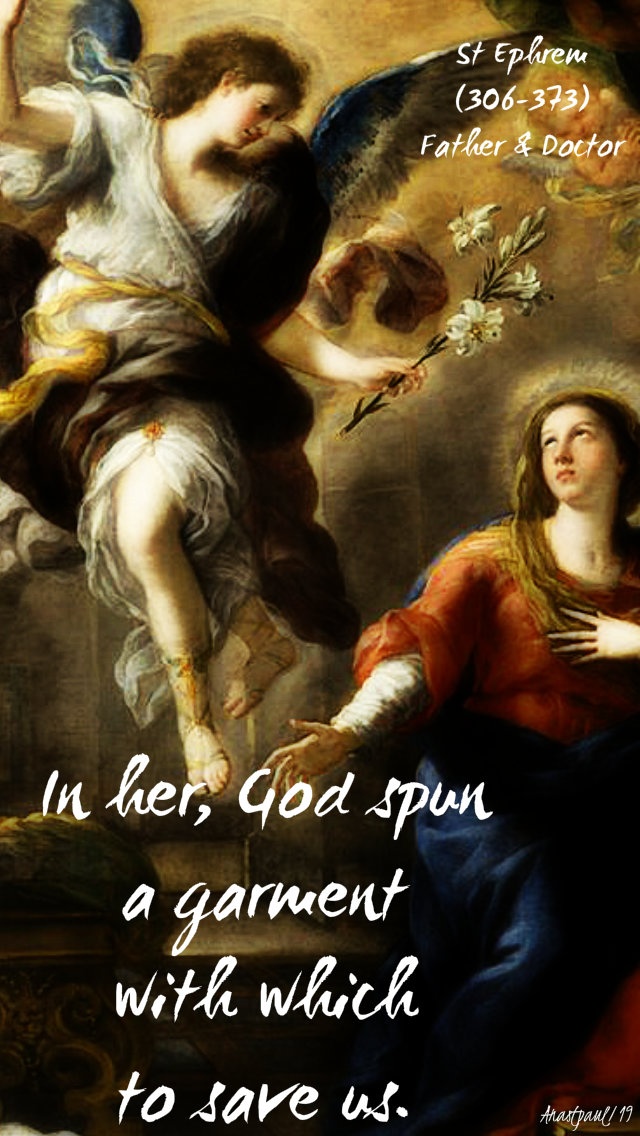
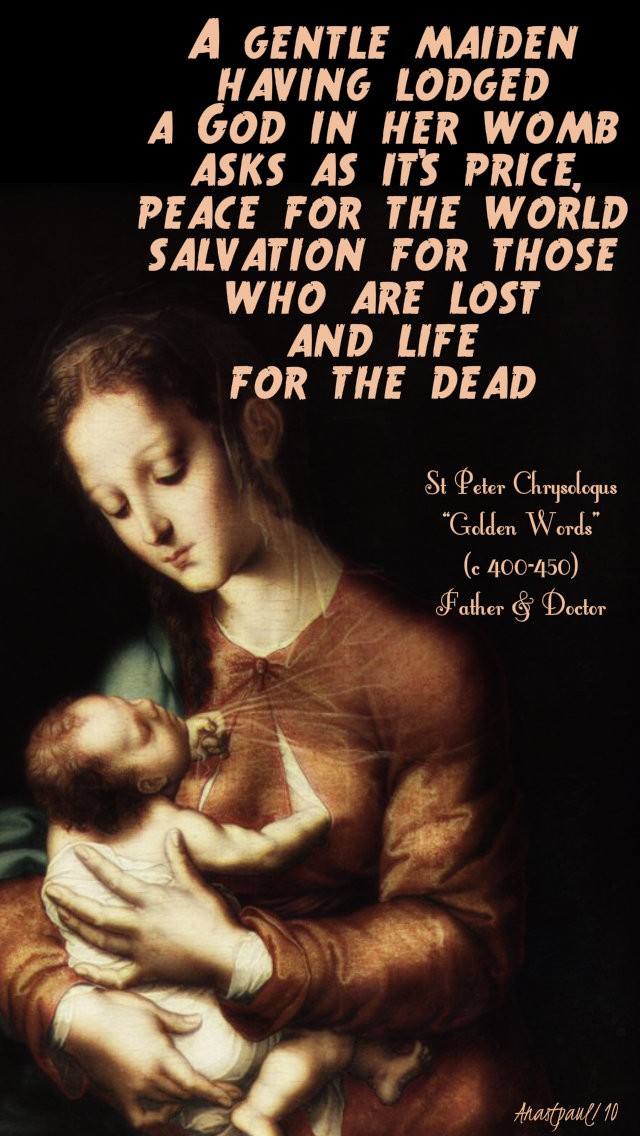
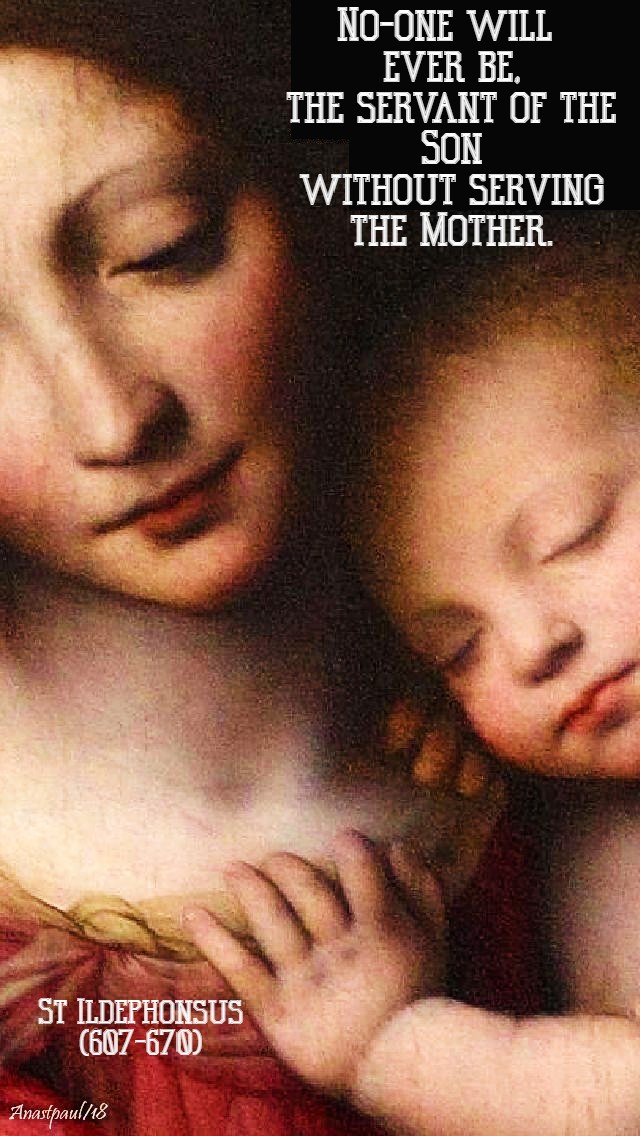
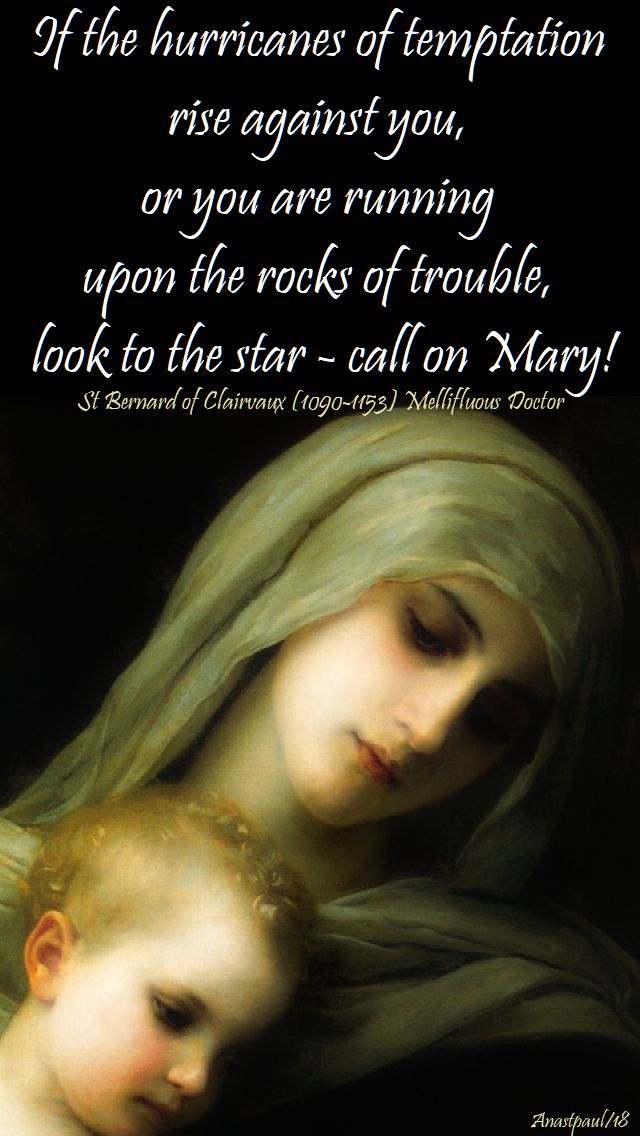
“Speaking of Mary”
“In her, God spun a garment with which to save us.”
St Ephrem (306-373) Father & Doctor
“A gentle maiden having lodged a God in her womb, asks as it’s price, peace for the world, salvation for those who are lost and life for the dead.”
St Peter Chrysologus “Golden Words”
(c 400-450) Father & Doctor
“No-one will ever be, the servant of the Son without serving the Mother.”
St Ildephonsus (607-670)
“If the hurricanes of temptation rise against you, or you are running upon the rocks of trouble, look to the star – call on Mary!”
St Bernard of Clairvaux (1090-1153)
Mellifluous Doctor
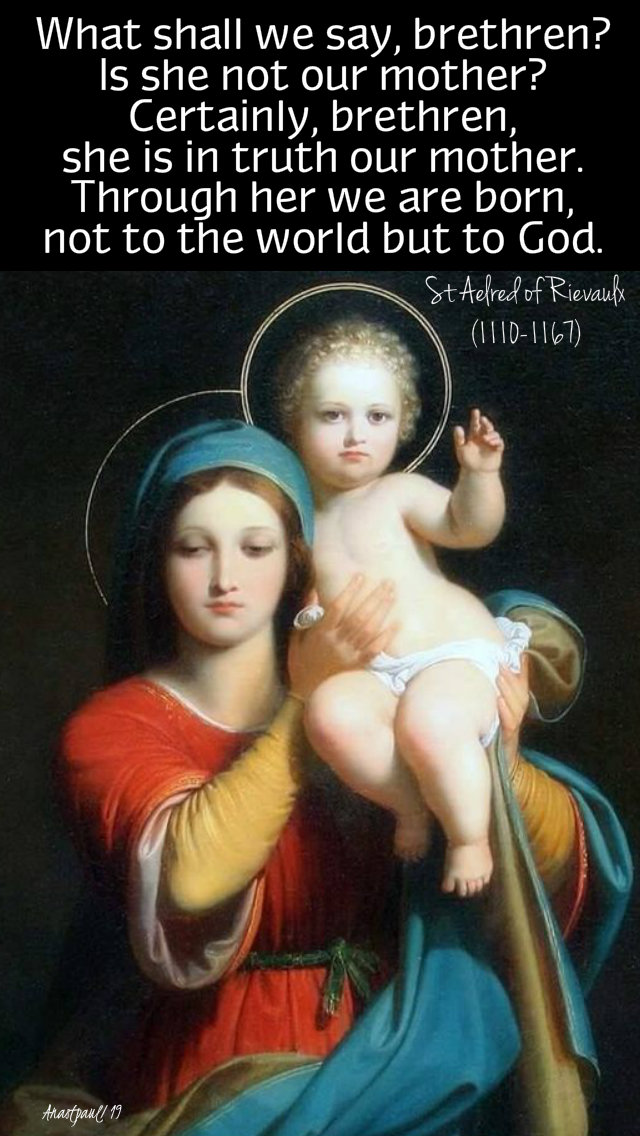
“What shall we say, brethren? Is she not our mother? Certainly, brethren, she is in truth our mother. Through her we are born, not to the world but to God.”
St Aelred of Rievaulx (1110-1167)
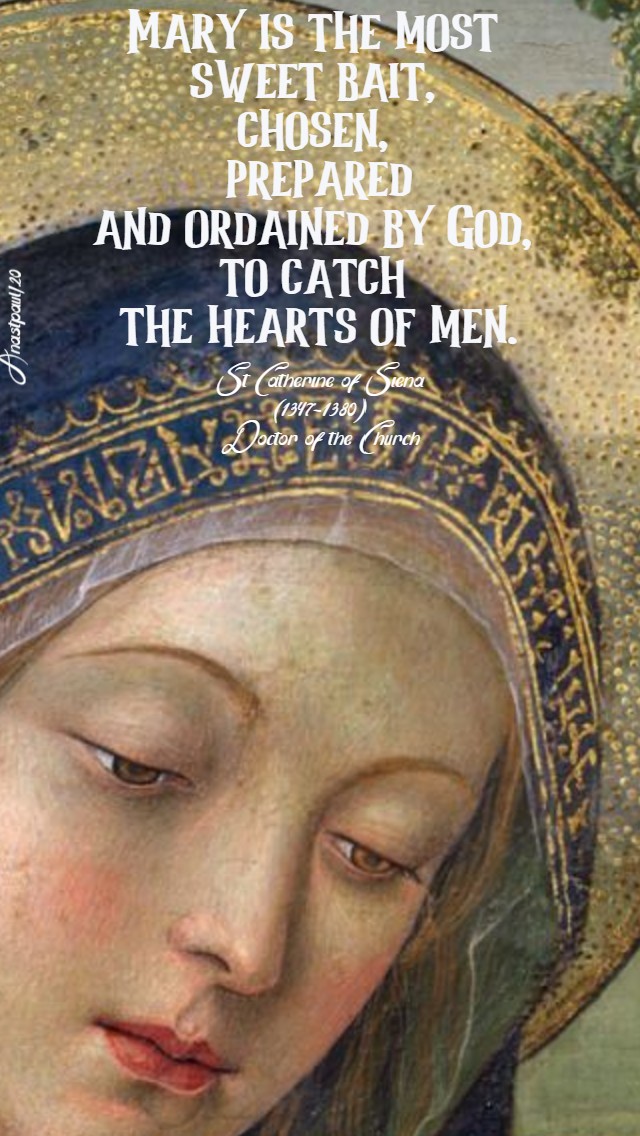
“Mary is the most sweet bait, chosen, prepared and ordained by God, to catch the hearts of men.”
St Catherine of Siena (1347-1380)
Doctor of the Church
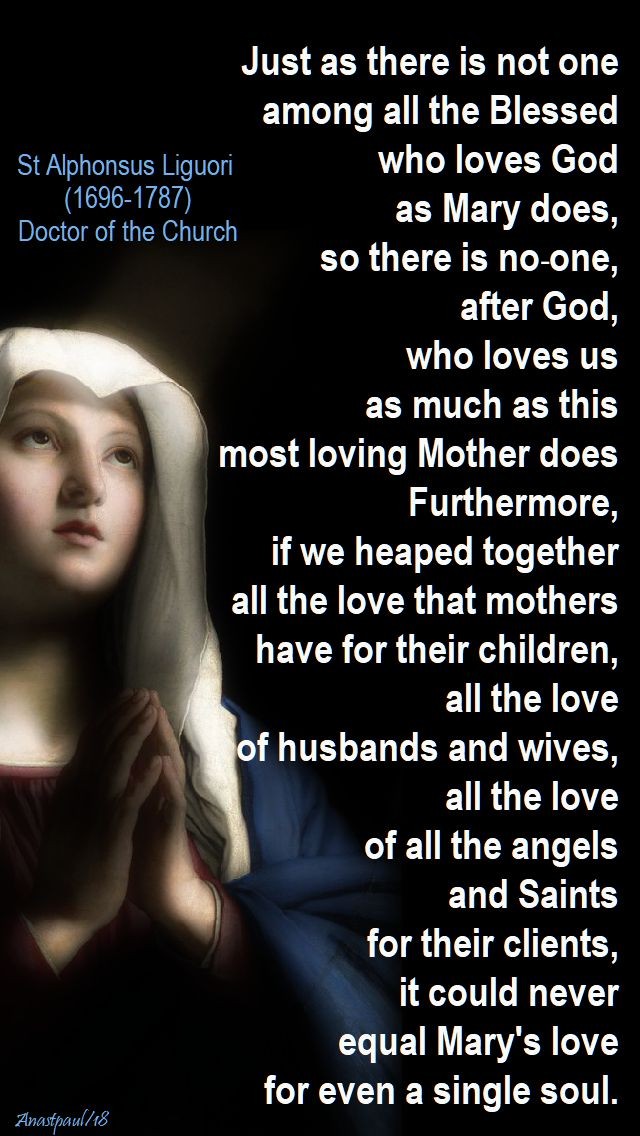
“Just as there is not one among all the Blessed who loves God as Mary does, so there is no-one, after God, who loves us as much as this most loving Mother does. Furthermore, if we heaped together all the love that mothers have for their children, all the love of husbands and wives, all the love of all the angels and Saints for their clients, it could never equal Mary’s love for even a single soul.”
St Alphonsus Liguori (1696-1787)
Doctor of the Church
(The Glories of Mary)
“Only after the Last Judgment will Mary get any rest; from now until then, she is much too busy with her children.”
“To serve the Queen of Heaven, is already to reign there and to live under her commands, is more than to govern.”
St John Marie Baptiste Vianney (1786-1859)
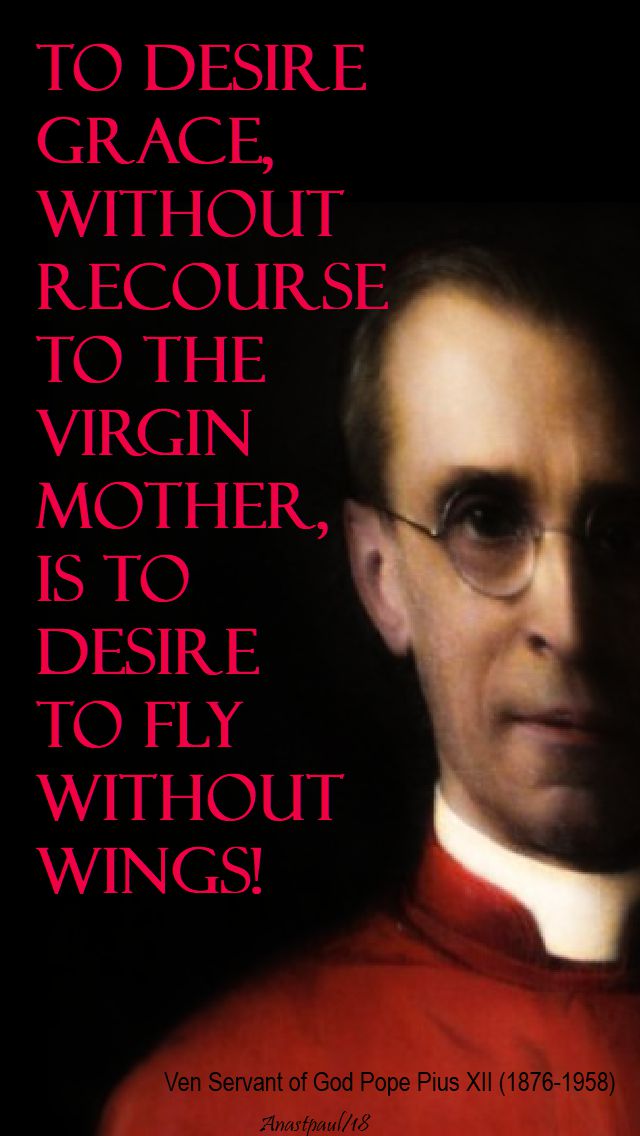
”To desire grace, without recourse to the Virgin Mother, is to desire to fly without wings!”
Ven Servant of God Pope Pius XII (1876-1958)
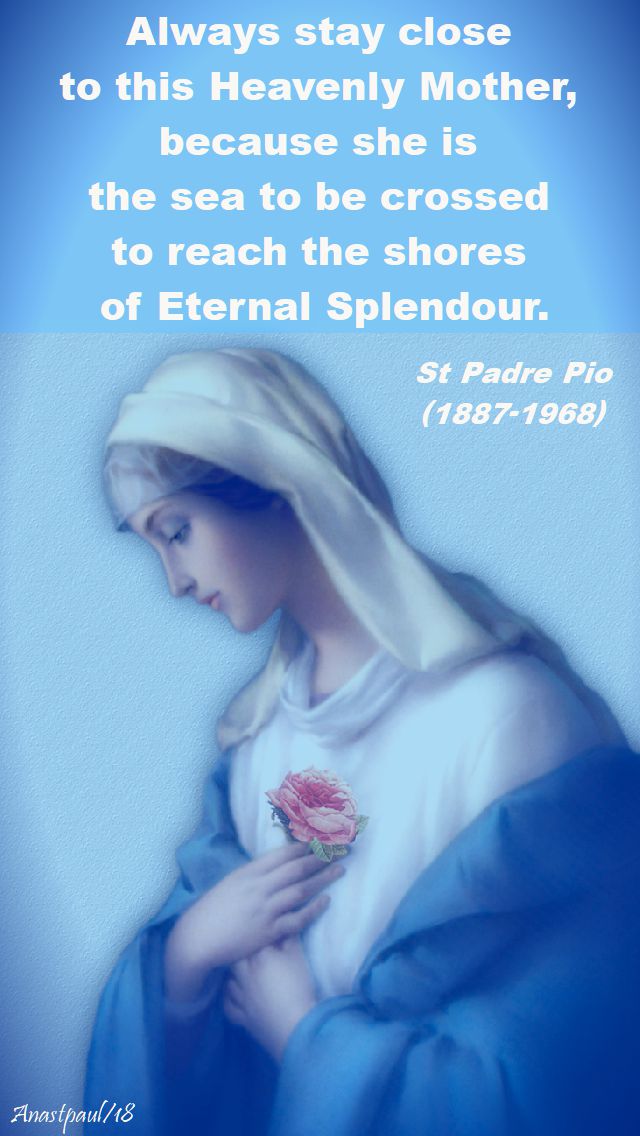
“Always stay close to this Heavenly Mother, because she is the sea to be crossed to reach the shores of Eternal Splendour.”
St Padre Pio (1887-1968)
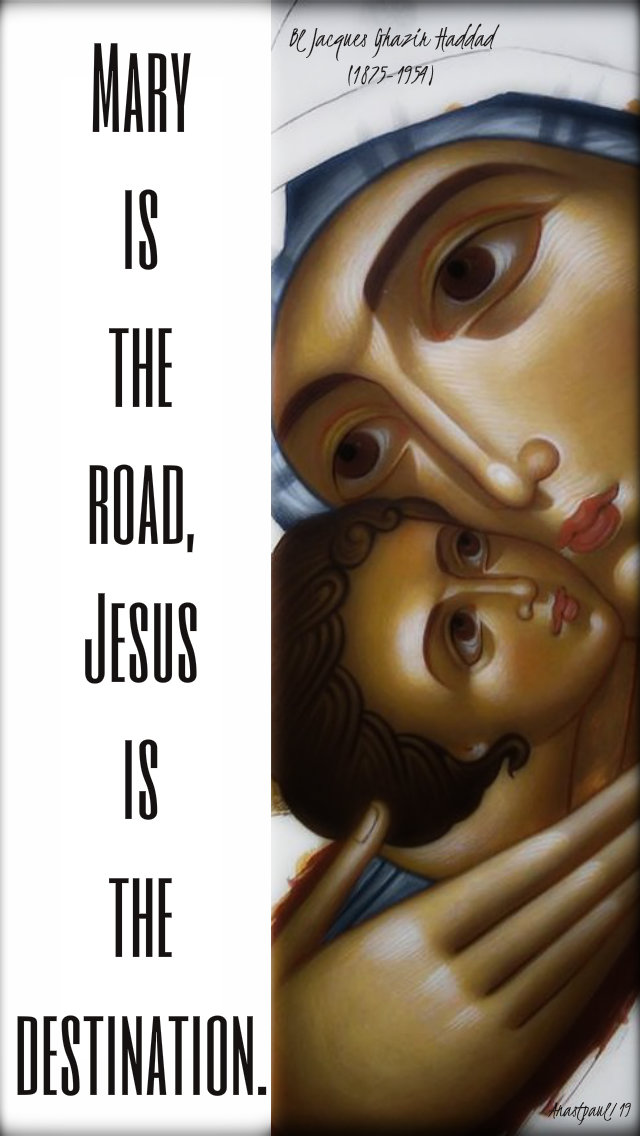
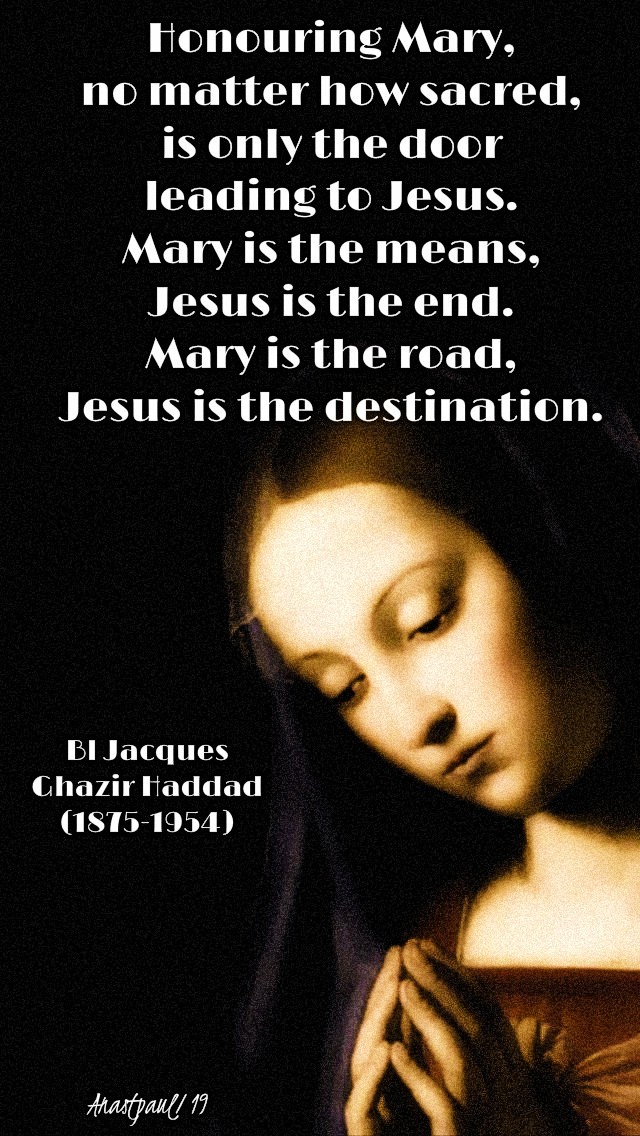
“Honouring Mary, no matter how sacred, is only the door leading to Jesus. Mary is the means, Jesus is the end. Mary is the road, Jesus is the destination.”
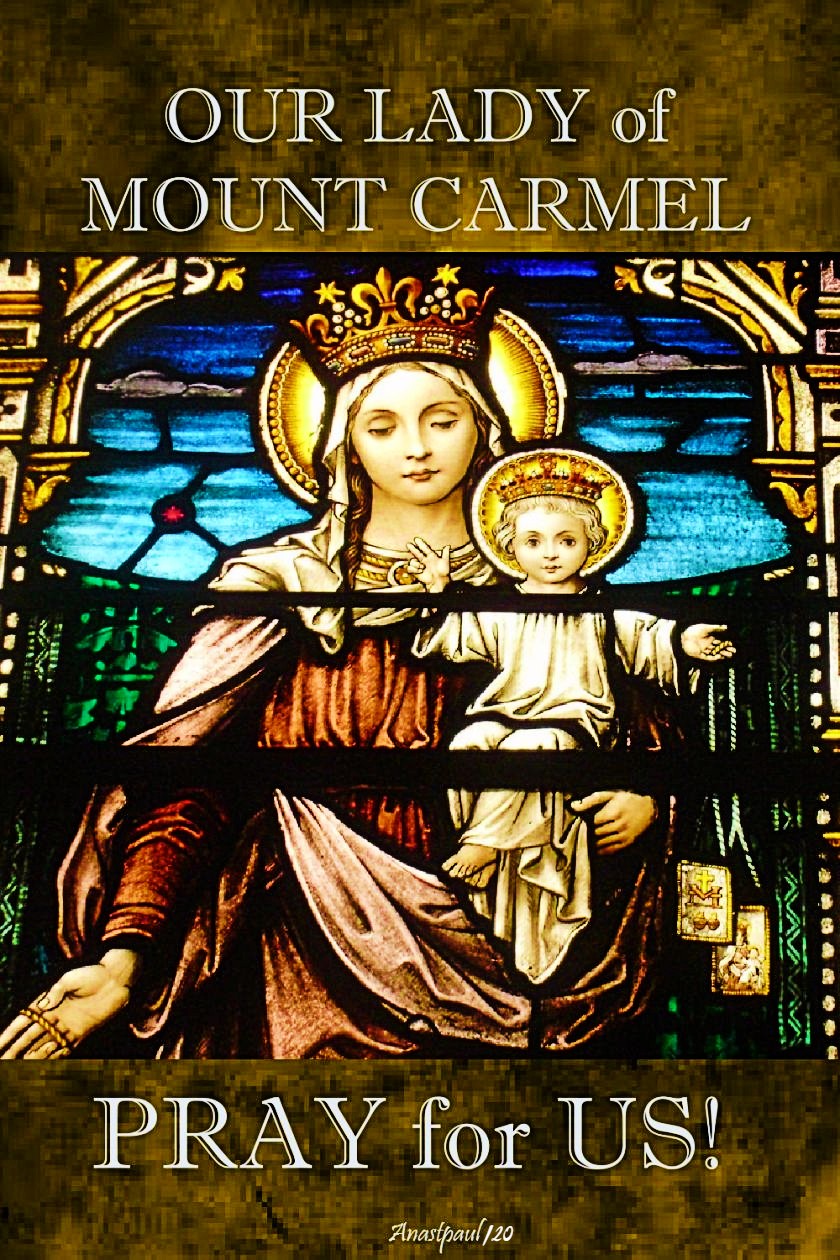
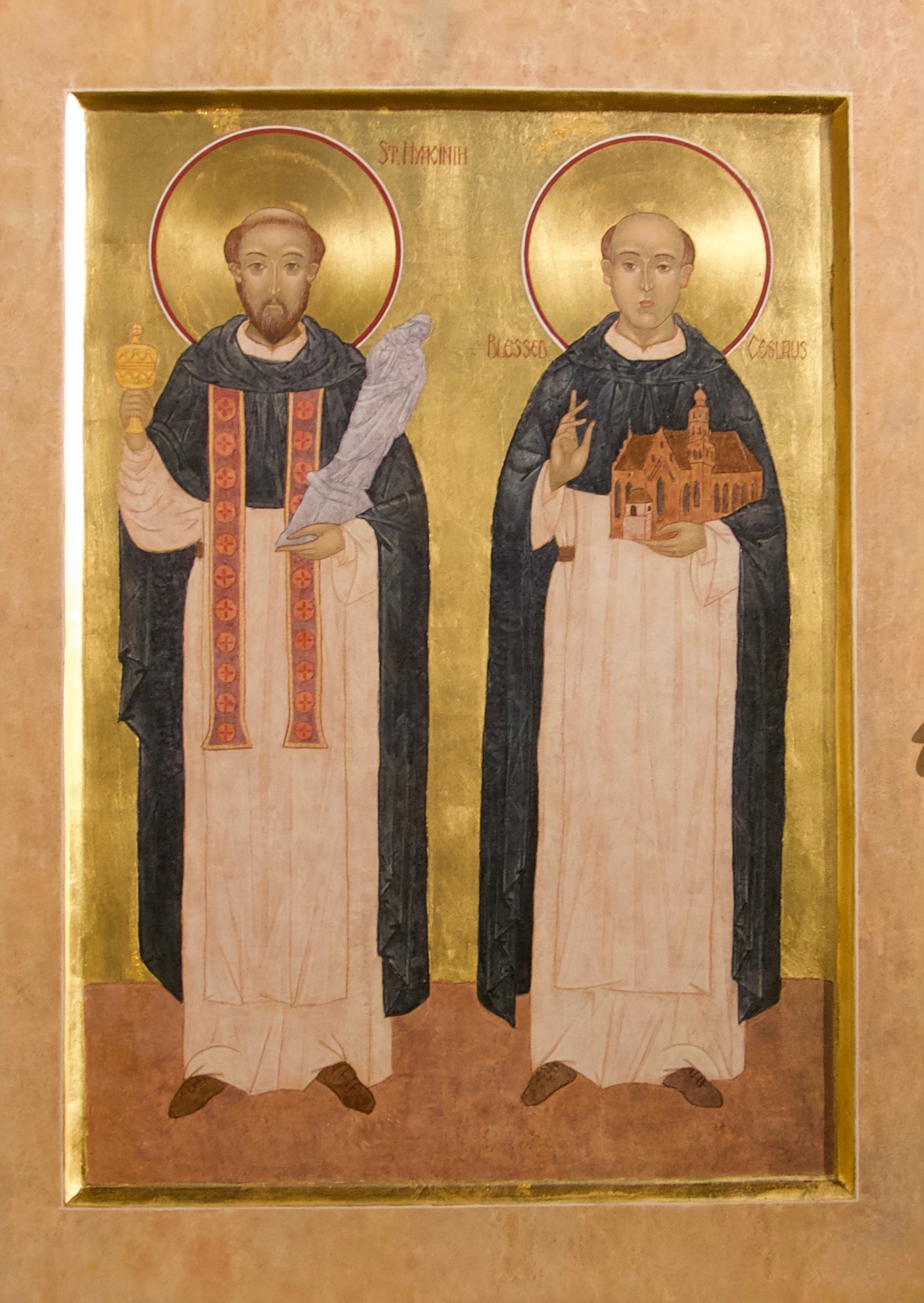
One Minute Reflection – 16 July – “Month of the Most Precious Blood” – Thursday of the Fifteenth week in Ordinary Time, Year A, Readings: Isaiah 26:7-9, 12, 16-19, Psalm 102:13-21, Matthew 11:28-30 and the Memorial of Our Lady of Mount Carmel and of Blessed Ceslaus Odrowaz OP (c 1184– 1242) (Brother of St Hyacinth)
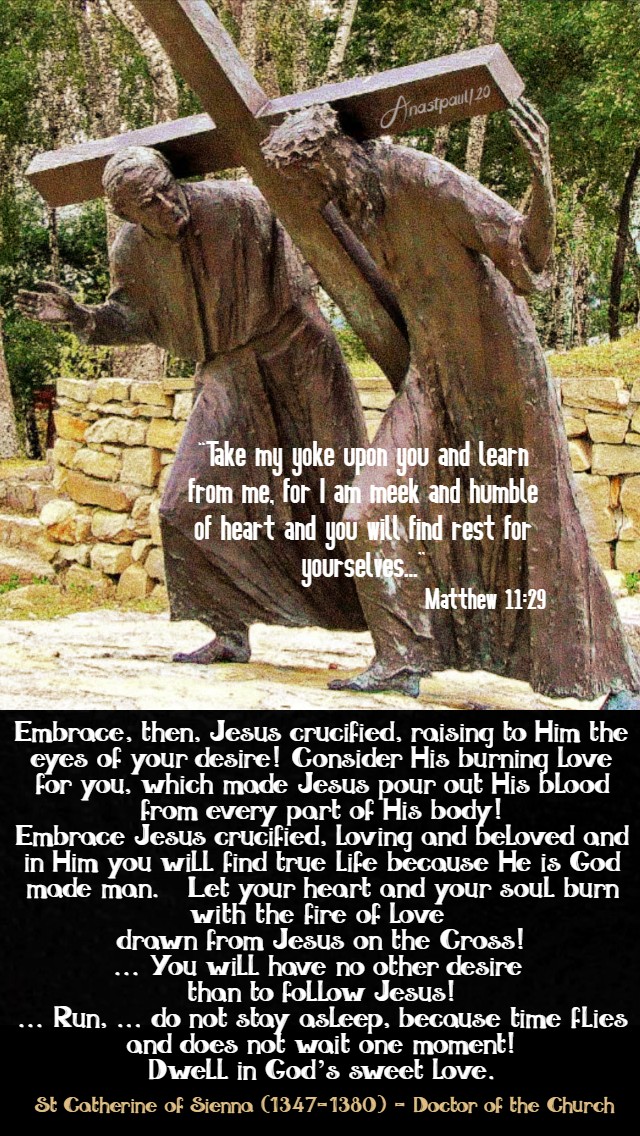
“Take my yoke upon you and learn from me, for I am meek and humble of heart and you will find rest for yourselves…” … Matthew 11:29
REFLECTION – “Dearest sister in Jesus. I, Catherine, servant of the servants of Jesus, write to you in His Precious Blood, wishing only that you feed yourself with God’s love and nourish yourself with it, as at a mother’s breast. Nobody, in fact, can live without this milk!
Who possesses God’s love, finds so much joy that every bitterness transforms itself into sweetness and that every great weight becomes light. One must not be astonished because living in charity you live in God – “God is love and he who abides in love, abides in God and God abides in him”(1 John 4:16)
Thus, living in God, you can have no bitterness because God is delight, gentleness and never-ending joy!
This is why God’s friends are always happy! Even if we are sick, poor, grieved, troubled, persecuted, we are always joyful.
… We do not seek joy elsewhere than in Jesus and we avoid any glory which is not that of the Cross.
Embrace, then, Jesus crucified, raising to Him the eyes of your desire! Consider His burning love for you, which made Jesus pour out His blood from every part of His body!
Embrace Jesus crucified, loving and beloved and in Him you will find true life because He is God made man. Let your heart and your soul burn with the fire of love drawn from Jesus on the Cross!
You must, then, become love, looking at God’s love who loved you so much not because He had any obligation towards you but out of pure gift, urged only by His ineffable love.
You will have no other desire than to follow Jesus! As if you were drunken with Love, it will no longer matter whether you are alone or in company – do not think about many things but only about finding Jesus and following Him!
Run, Bartolomea, do not stay asleep, because time flies and does not wait one moment!
Dwell in God’s sweet love.
Sweet Jesus, Jesus love.” … St Catherine of Sienna (1347-1380) – Doctor of the Church – From the “Letters” (letter no. 165 to Bartolomea, wife of Salviato of Lucca).
PRAYER – “Holy God, our Father, we turn to You in confidence as children and pray, give us meekness of heart, make us “poor in spirit” that we may recognise that we are not self-sufficient, that we are unable to build our lives on our own but need You, we need to encounter You, to listen to You, to speak to You. Help us to understand that we need Your gift, Your wisdom, which is Jesus Himself, in order to do the Your will in our lives and thus to find rest in the hardships of our journey.” Hear the prayers we request of the Mother of our Jesus Crucified and our Mother, Our Lady of Carmel, dear Lord and holy God, which we pray through Christ, our Light, in the Holy Spirit, one God for all eternity, amen. … Pope Benedict XVI, General Audience, 7 December 2011
Our Morning Offering – 16 July – The Memorial of Our Lady of Mount Carmel
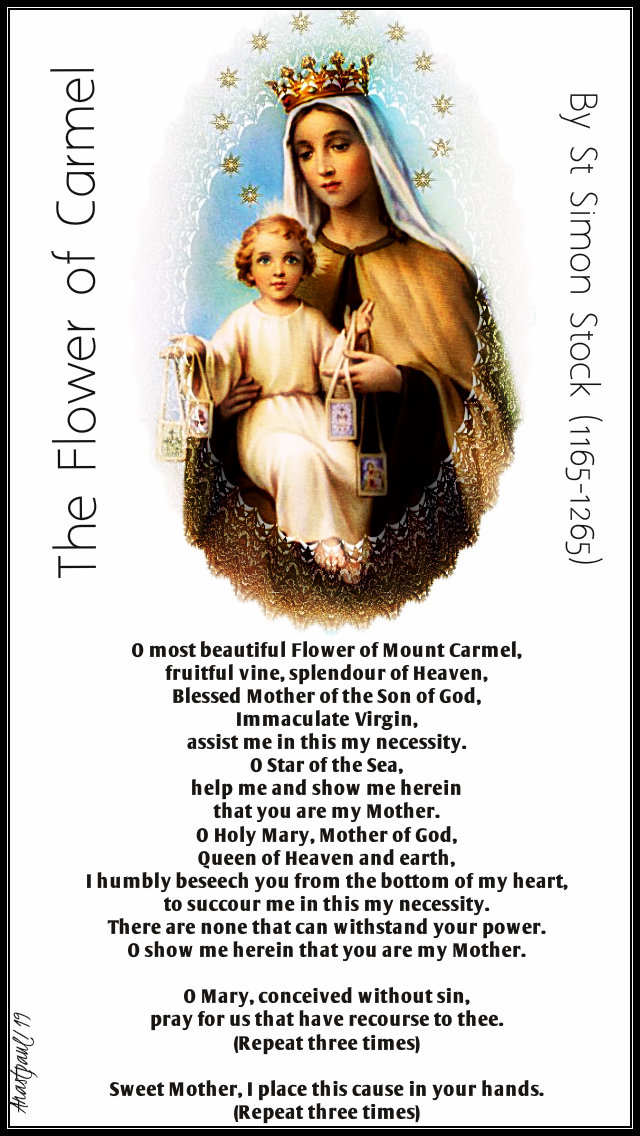
“The Flower of Carmel” By St Simon Stock (1165-1265)
This prayer, also known as the “Flos Carmeli” (“The Flower of Carmel”), was composed by St Simon Stock (1165-1265), a Carmelite, so-called because he and other members of his order lived atop Mount Carmel in the Holy Land. St Simon Stock was visited by the Blessed Virgin Mary on 16 July 1251, at which time, she bestowed upon him a scapular, or habit, (commonly called “the Brown Scapular”), which became part of the liturgical clothing of the Carmelite order.
O most beautiful Flower of Mount Carmel,
fruitful vine, splendour of Heaven,
Blessed Mother of the Son of God,
Immaculate Virgin,
assist me in this my necessity.
O Star of the Sea,
help me and show me herein
that you are my Mother.
O Holy Mary, Mother of God,
Queen of Heaven and earth,
I humbly beseech you from the bottom of my heart,
to succour me in this my necessity.
There are none that can withstand your power.
O show me herein that you are my Mother.
O Mary, conceived without sin,
pray for us that have recourse to thee.
(Repeat three times)
Sweet Mother, I place this cause in your hands.
(Repeat three times)
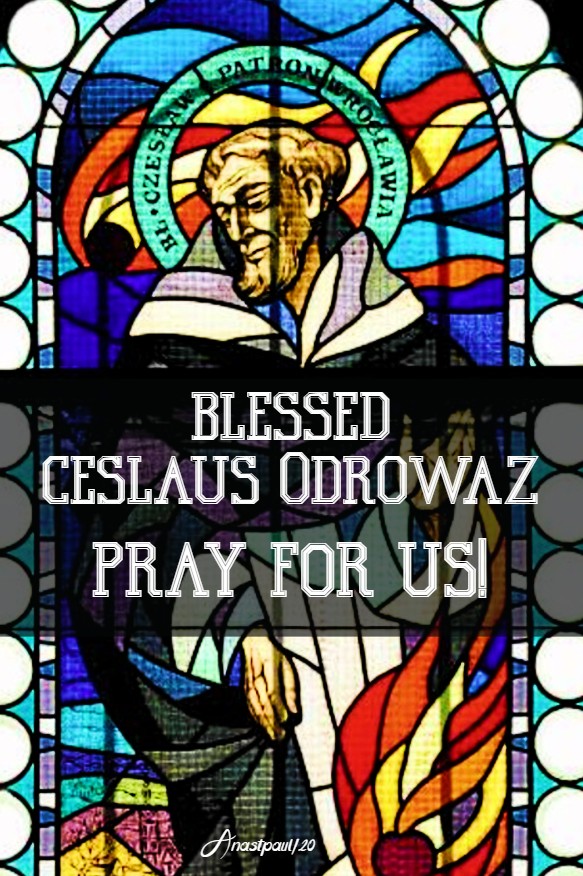
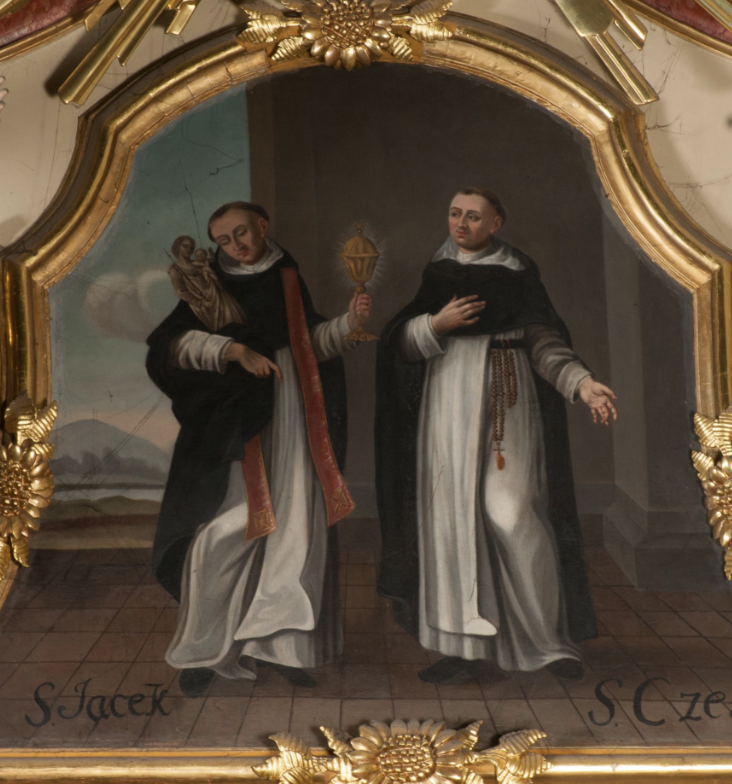
Saint of the Day – 16 July – Blessed Ceslaus Odrowaz OP (c 1184– 1242) (Brother of St Hyacinth – Polish – Jacek) Priest and Friar of the Order of Preachers/Dominicans, Confessor, Spiritual Advisor, miracle-worker – born as Czesław Odrowaz in Kamień Śląski in Silesia, Poland and died in 1242 in Wroclaw, Poland of natural causes. Patronage – Wroclaw.
Born of the noble family of Odrowąż in the town of Kamień Śląski in Silesia, Poland, he is believed to have been Saint Hyacinth Odrowąż’s brother.
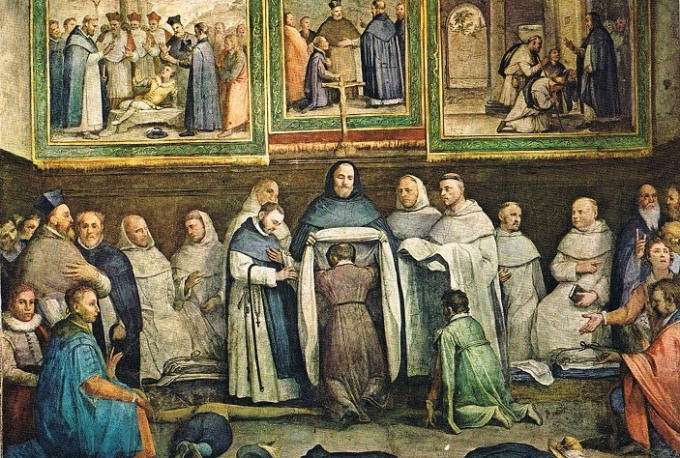
Having completed his philosophical studies in Prague, he went onto study theology and jurisprudence at the University of Bologna and possibly that of Paris. After being Ordained a Priest, in about 1218 he accompanied his uncle Ivo, Bishop of Cracow, to Rome. Hearing of the great sanctity of Saint Dominic, who had recently been attributed the miracle of resuscitating the nephew of Cardinal Stefano di Fossa Nova who had been killed in a fall from his horse, Ceslaus, together with St Hyacinth, sought admission into the Order of Friars Preachers.
The clothing of the St Hyacinth and Ceslaus by St Dominic
In 1222, accompanied by a group of his fellow friars, he arrived in Cracow whence he soon set off for Prague. It was there that he set up the first Dominican Monastery. A few years later, Ceslaus was appointed Abbot of a Priory in the Polish city of Wrocław.
Statue of Bl Ceslaus in Wroclaw
At the feet of the Statue of Blessed Ceslaus above, you will see a dog carrying a torch. The dog is the symbol of the Dominicans. It comes from a play on words in Latin: “Dominicanus” sounds like “Domini canis” – “dog of the Lord.” A traditional story is that when St Dominic’s mother was pregnant with him, she dreamed of a dog running around the whole world with a torch in its mouth. When her son became the Founder of an Order of Preachers – spreading the light of the Gospel throughout the world – this dream was looked on as prophetic. And so the symbol of a dog carrying a torch has become a symbol of the Dominican order.
A pious and generous man, Ceslaus became spiritual advisor to St Hedwig of Silesia. In those days, Poland was plagued by numerous attacks by the Tartars. In 1240 they laid siege to the city of Wrocław and the townspeople naturally turned to Ceslaus, who had made a name for himself as a holy man, for spiritual comfort and help. Ceslaus’ ardent prayers and outstanding moral courage miraculously averted the fall of the city.
Ceslaus remained in Wroclaw until his death in 1242.
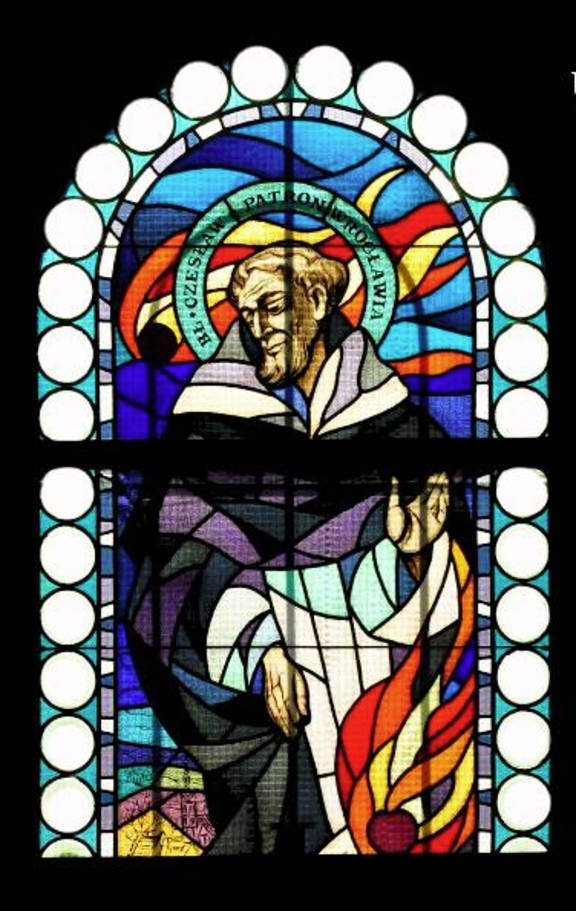
He was raised to the altars by Pope Clement XI in 1713. In 1963, Pope Paul VI recognised Bl Ceslaus – next to St John the Baptist – as the main Patron Saint of City of Wrocław. In iconography, Bl Ceslaus is portrayed with a ball (or column) of fire above his head, which appeared during the siege of Wroclaw. The miracle horrified the invaders and made them run away and subsequently retreat.
Chapel of Blessed Ceslaus Dominican Church of St Wojciech (Adalbert) Wrocław, Poland
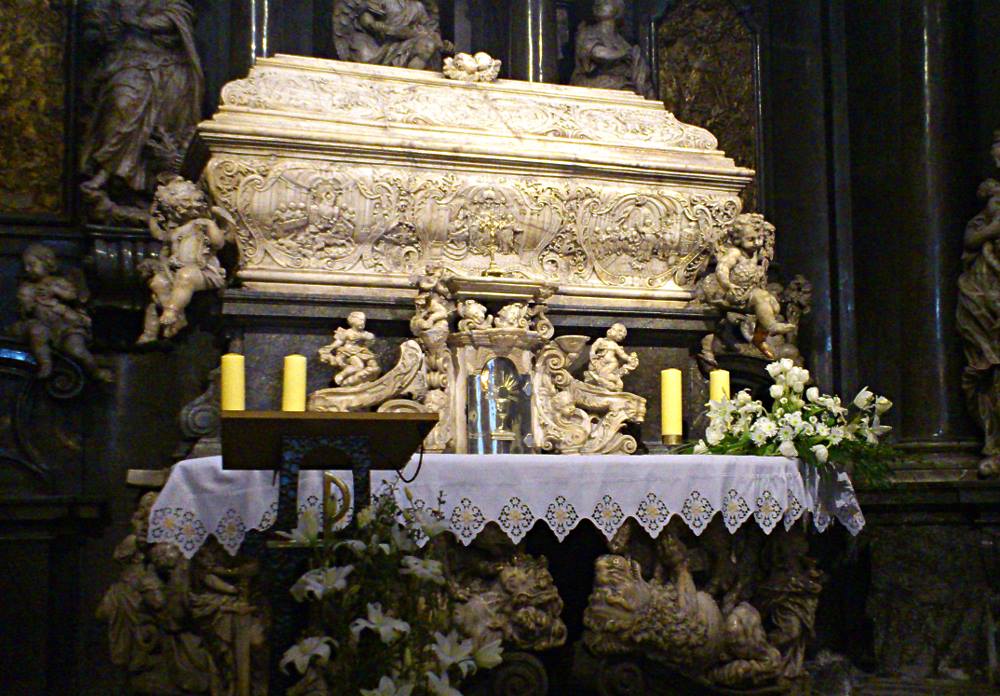
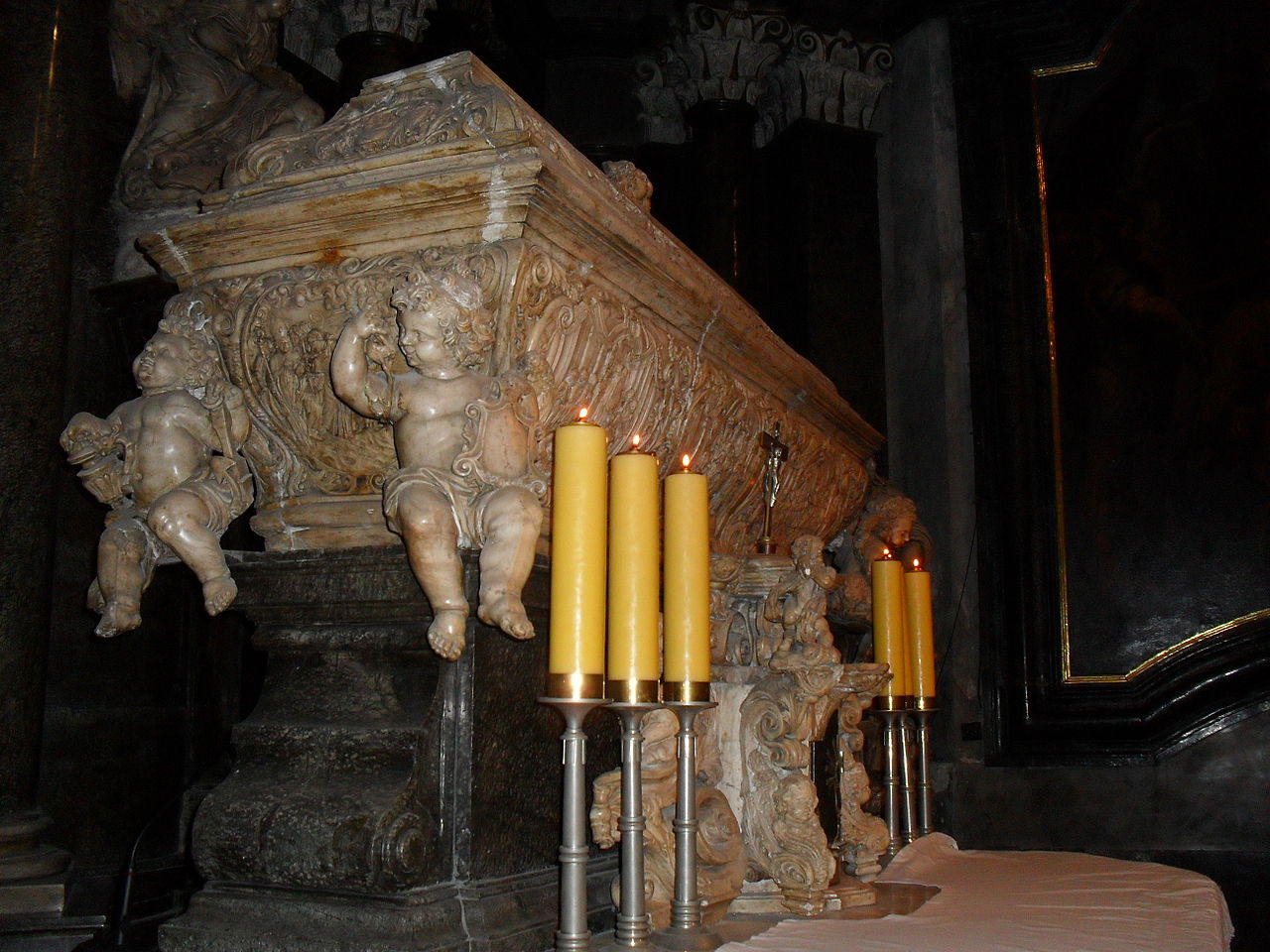
Sarcophagus of Blessed Ceslaus with relic for veneration of the faithful
Bl André de Soveral
St Andrew the Hermit
St Antiochus of Sebaste
Bl Arnold of Clairvaux
Bl Arnold of Hildesheim
St Athenogenes of Sebaste St Bartholomew of Braga OP – ArchBishop of Braga also known as Bl Bartholomew of the Martyrs (Bartolomeu Fernandez dei Martiri Fernandes) (1514-1590) St Bartholomew: https://anastpaul.com/2018/07/16/saint-of-the-day-16-july-blessed-bartholomew-of-the-martyrs-1514-1590/
On 8 July 2019, Pope Francis approved the favourable votes cast by the Eminent and Excellent members of the Congregation and extended to the Universal Church the liturgical worship in honour of Blessed Bartholomew of the Martyrs (born Bartolomeu Fernandes), of the Order of Preachers, Archbishop of Braga, born in Lisbon, Portugal on 3 May 1514 and died in Viana do Castelo, Portugal, on 16 July 1590, inscribing him in the book of Saints (Equipollent Canonisation).
Alleluia! Saint Bartholomew of the Martyrs, Pray for Us!
St Benedict the Hermit Blessed Ceslaus Odrowaz OP (c 1184– 1242) (Brother of St Hyacinth)
Bl Claude Beguignot
Bl Domingos Carvalho
St Domnin
St Domnio of Bergamo
Bl Dorothée-Madeleine-Julie de Justamond
St Elvira of Ohren
St Eugenius of Noli
St Faustus
St Faustus of Rome and Milan
St Fulrad of Saint Denis
St Generosus of Poitou
St Gobbán Beg
St Gondolf of Saintes
St Grimoald of Saintes
St Helier of Jersey
Bl Irmengard
Bl John Sugar
St Landericus of Séez
Bl Madeleine-Françoise de Justamond
Bl Marguerite-Rose de Gordon
Bl Marguerite-Thérèse Charensol
Bl Marie-Anne Béguin-Royal
Bl Marie-Anne Doux St Marie-Madeline Postel (1756-1846)
Her Life: https://anastpaul.com/2019/07/16/saint-of-the-day-16-july-st-marie-madeline-postel-
Bl Marie-Rose Laye
Bl Milon of Thérouanne
Bl Nicolas Savouret
Bl Ornandus of Vicogne
St Paulus Lang Fu
St Reinildis of Saintes
Bl Robert Grissold
Bl Simão da Costa
St Sisenando of Cordoba
St Tenenan of Léon
St Teresia Zhang Heshi
St Valentine of Trier
St Vitalian of Capua
St Vitaliano of Osimo
St Yangzhi Lang
—
Martyrs of Antioch – 5 saints: Five Christians who were martyred together. No details about them have survived by the names – Dionysius, Eustasius, Maximus, Theodosius and Theodulus. They were Martyred in Antioch, Syria, date unknown.
Apologies for the late posts today – my image app was blocked due a late payment. 😥
Your donation, regardless of how big or small it may be, makes a big difference in helping me to continue existing to spread the glory of our beautiful Faith.
Unfortunately, I am still not able to have a Holy Mass said for Donors but you are all always in my prayers.
May God bless you all!
I will bless the Lord at all times, his praise shall continually be in my mouth. My soul makes its boast in the Lord, let the afflicted hear and be glad. O magnify the Lord with me, and let us exalt his name together!
Thought for the Day – 15 July – Meditations with Antonio Cardinal Bacci (1881-1971)
A Life of Fervour
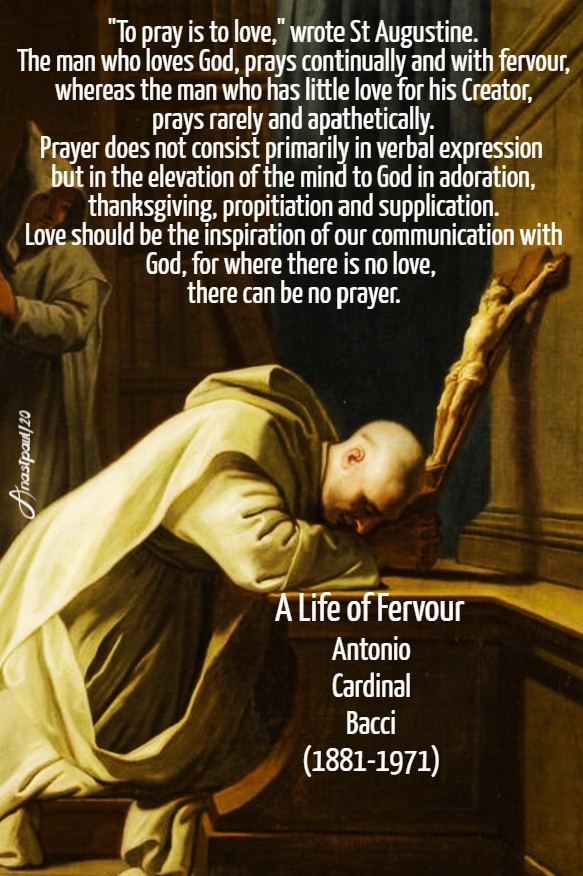
“To pray is to love,” wrote St Augustine.
The man who loves God, prays continually and with fervour, whereas the man who has little love for his Creator, prays rarely and apathetically.
Prayer does not consist primarily in verbal expression but in the elevation of the mind to God in adoration, thanksgiving, propitiation and supplication.
Love should be the inspiration of our communication with God, for where there is no love, there can be no prayer.
Jesus tells us that we “must always pray and not lose heart” (Lk 18:1).
We may be working, talking, eating or sleeping but, whatever we are doing, the love of God, can transform it into a prayer.
This is so, if we are engaged in our work but have offered it to God in advance.
If we are in trouble, our sufferings will be pleasing to God.
If we are walking about, everything will speak to us of God and cause us to make acts of gratitude and of love.
We shall have dealings with men of the world but they will perceive and appreciate, that we are spiritually united to God.
We shall sleep because sleep is necessary but, what appears to be hours of fruitless inactivity, will be dedicated to our Creator.
Fervour in prayer and in action, should be the constant ideal of the good Christian, because, it makes his entire life pleasing to God.”
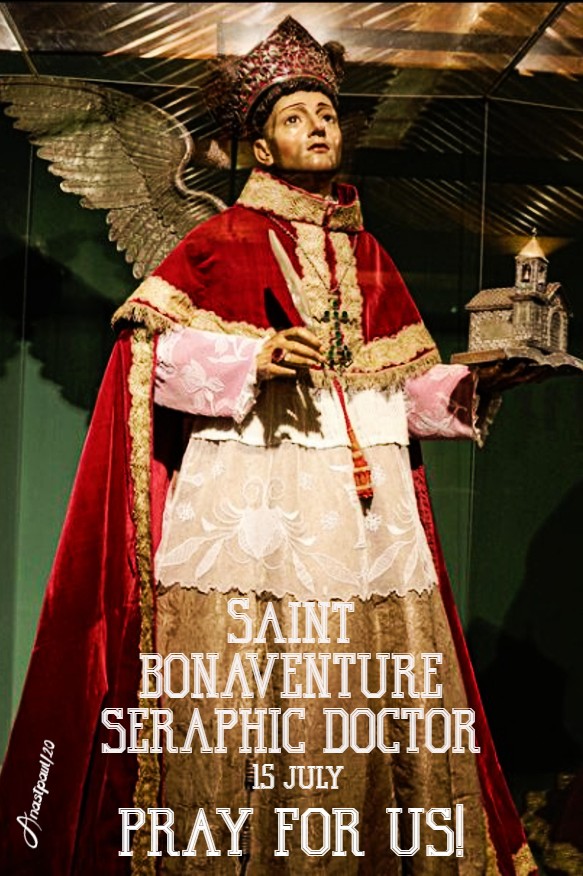
Quote/s of the Day – 15 July – The Memorial of St Bonaventure (1221-1274) Doctor of the Church
“Bonaventure so united holiness and theological knowledge that he rose to the heights of mysticism, while remaining a very active preacher and teacher, one beloved by all who met him. To know him was to love him; to read him is still for us today to meet a true Franciscan and a gentleman.”
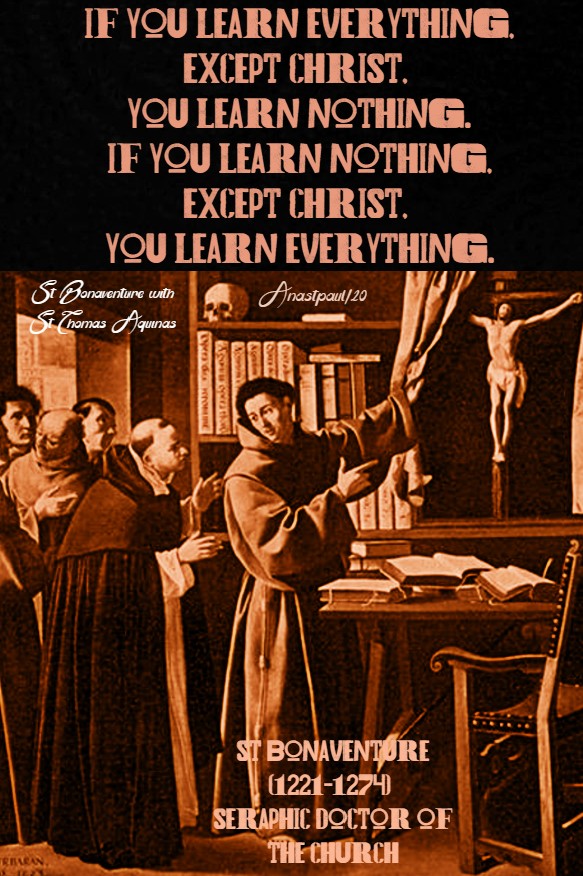
“If you learn everything, except Christ, you learn nothing. If you learn nothing, except Christ, you learn everything.”
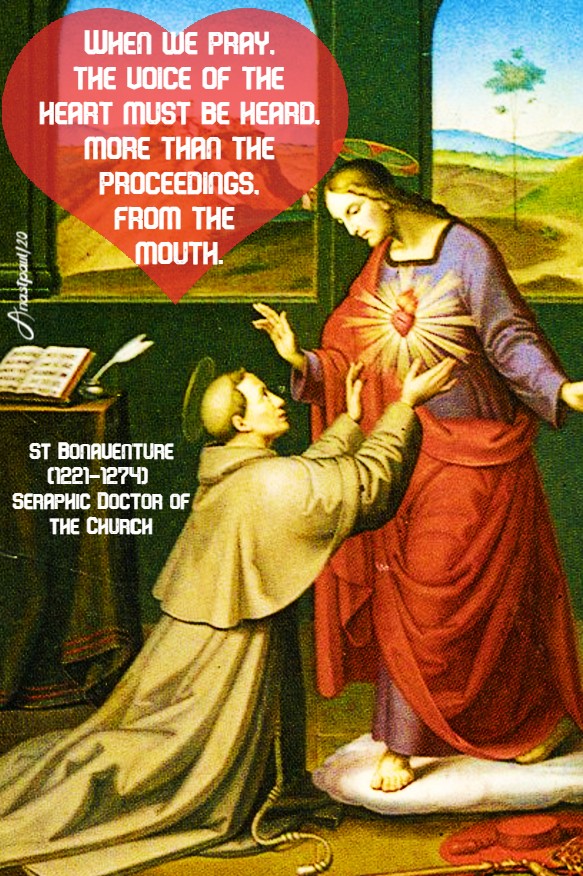
“When we pray, the voice of the heart must be heard, more than the proceedings, from the mouth.”
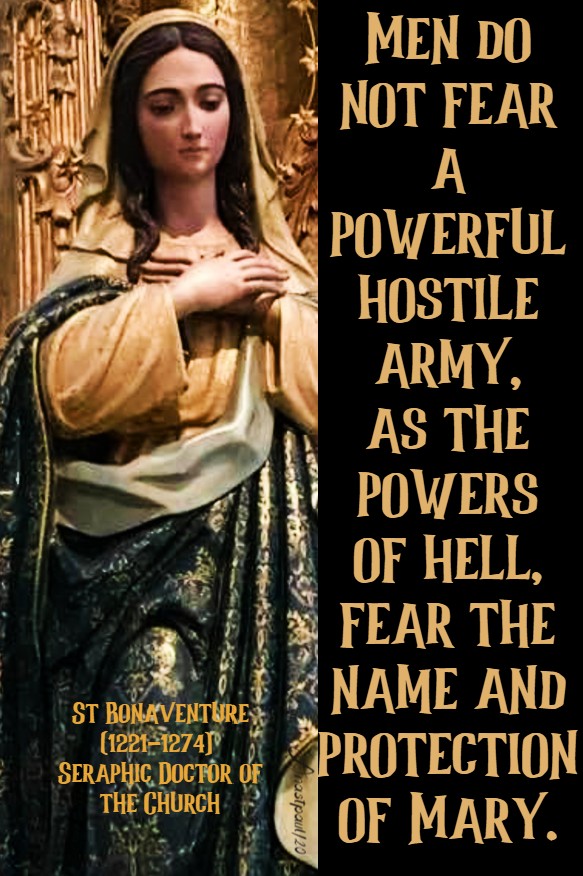
“Men do not fear a powerful hostile army, as the powers of hell, fear the name and protection of Mary.”
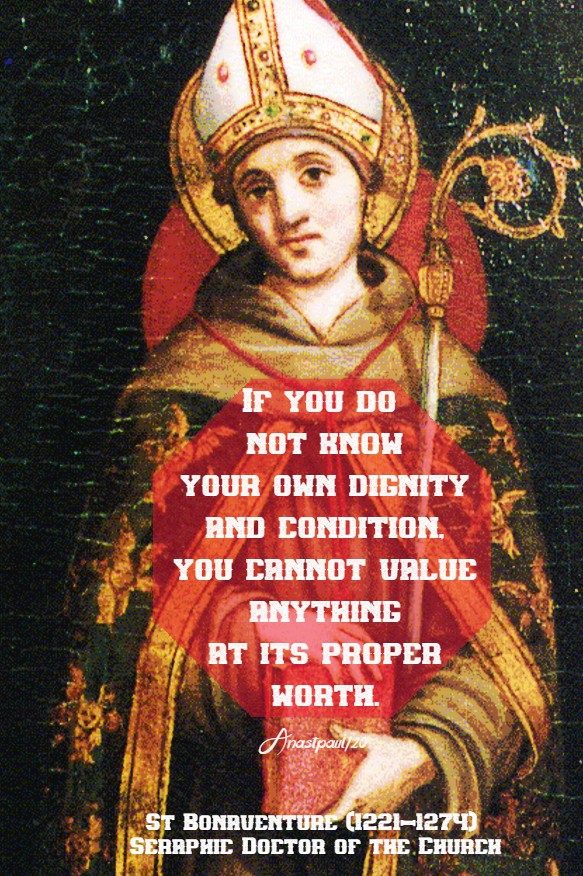
“If you do not know your own dignity and condition, you cannot value anything at its proper worth.”
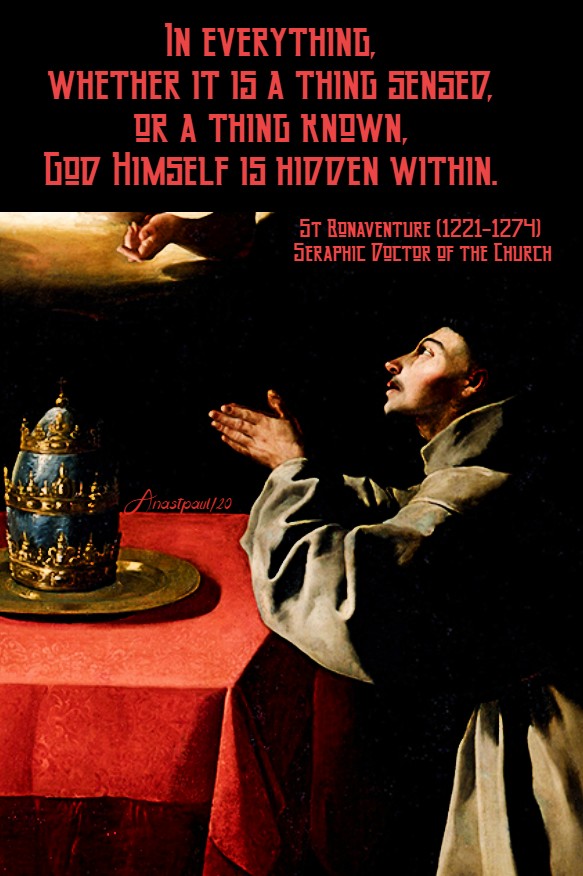
“In everything, whether it is a thing sensed, or a thing known, God Himself is hidden within.”
St Bonaventure (1221-1274)
Seraphic Doctor of the Church
One Minute Reflection – 15 July – Monday of the Fifteenth week in Ordinary Time, YearA, Readings: Isaiah 10:5-7, 13-16, Psalm 94:5-10, 14-15, Matthew 11:25-27 and the Memorial of St Bonaventure OFM (1221-1274)
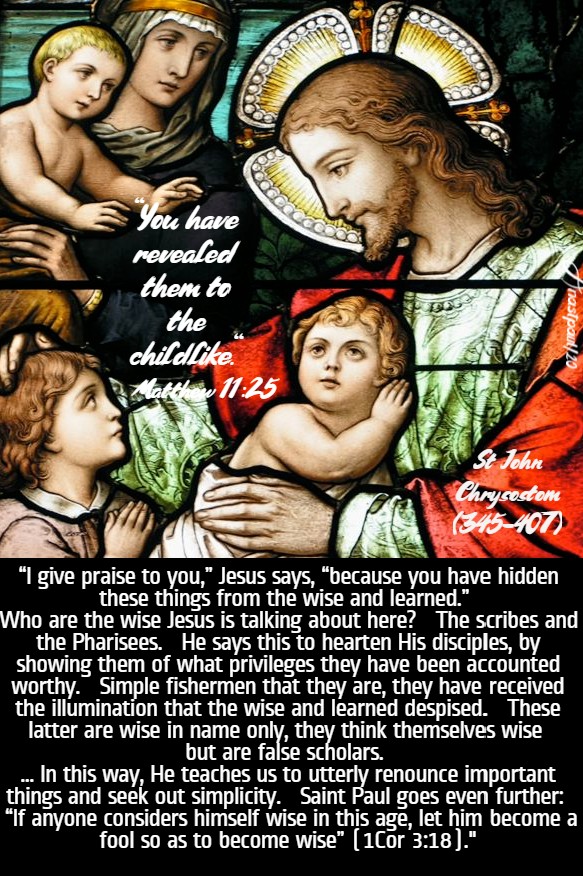
“You have revealed them to the childlike.” … Matthew 11:25
REFLECTION – “I give praise to you,” Jesus says, “because you have hidden these things from the wise and learned.” What? Is He glad at the loss of those who don’t believe in Him? Certainly not. How wonderful are God’s designs for people’s salvation! When they turn away from the truth and refuse to accept it, God never forces them but lets them be. Their wandering away stimulates them to find the path again. Returning to their senses, they hastily seek out the grace of the call to faith they had rejected before. As for those who had remained faithful, their devotion becomes even stronger like this. So Christ is glad these things are revealed to some but saddened they are hidden from others. This is made known when He weeps over the city (Lk 19:41). Saint Paul writes in the same spirit: “Thanks be to God! You were once slaves of sin but you have become obedient from the heart” to the Gospel (Rom 6:17). …
Who are the wise Jesus is talking about here? The scribes and the Pharisees. He says this to hearten His disciples, by showing them of what privileges they have been accounted worthy. Simple fishermen that they are, they have received the illumination that the wise and learned despised. These latter are wise in name only, they think themselves wise but are false scholars. That is why Christ did not say: “You have revealed them to the ignorant” but to “the childlike,” that is to say, simple, honest people. … In this way, He teaches us to utterly renounce important things and seek out simplicity. Saint Paul goes even further: “If anyone considers himself wise in this age, let him become a fool so as to become wise” (1Cor 3:18).” … St John Chrysostom (345-407) – Bishop of Constantinople, Father and Doctor of the Church – Sermons on Saint Matthew’s Gospel, no.38, 1
PRAYER – Lord God, in Your wisdom You created us, by Your Providence, You rule us. Penetrate our inmost being with Your holy light so that our way of life may always be one of faithful service and childlike trust in You. Grant that we may always follow behind Your Son and grasp His hand, to lead us to You. May we grow in faith and love daily, by the intercession of Saint Bonaventure and may be a light of love, to all around us, as he was. We make our prayer through our Lord Jesus with You in the unity of the Holy Spirit, God forever, amen.
Our Morning Offering – 15 July – “Month of the Most Precious Blood” – Monday of the Fifteenth week in Ordinary Time and the Memorial of St Bonaventure OFM (1221-1274)
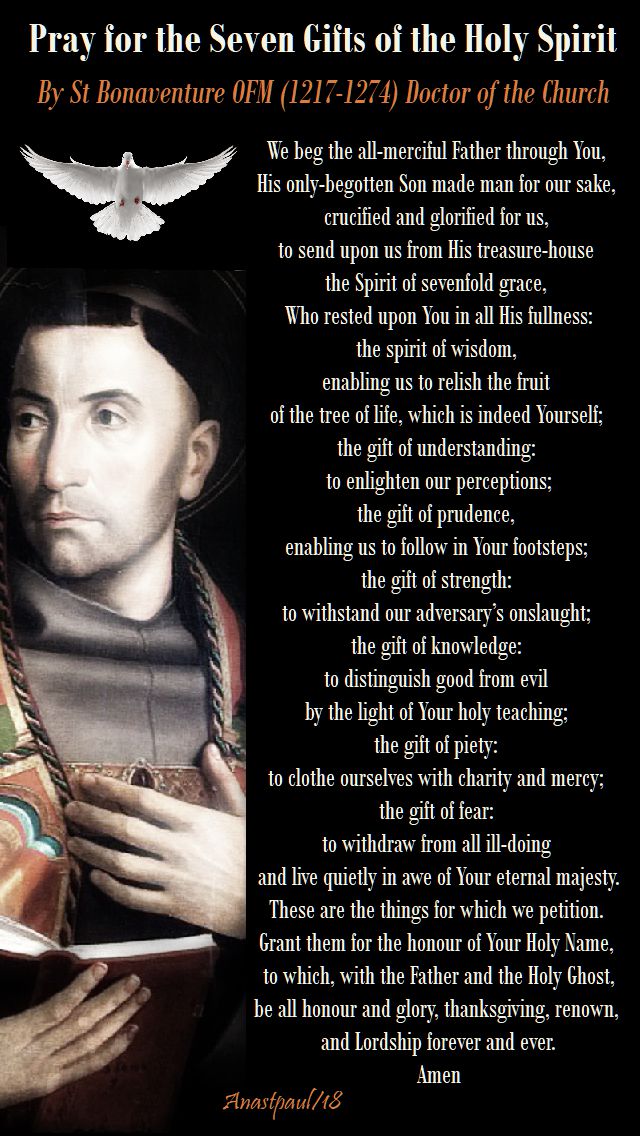
Prayer for the Gifts of the Holy Spirit By St Bonaventure (1221-1274) Seraphic Doctor of the Church
We beg the all-merciful Father through You,
His only-begotten Son made man for our sake,
crucified and glorified for us,
to send upon us, from His treasure-house,
the Spirit of sevenfold grace,
Who rested upon You in all His fullness.
The spirit of wisdom,
enabling us to relish the fruit of the tree of life,
which is indeed Yourself.
The gift of understanding:
to enlighten our perceptions.
The gift of prudence,
enabling us to follow in Your footsteps.
The gift of strength:
to withstand our adversary’s onslaught.
The gift of knowledge,
to distinguish good from evil
by the light of Your holy teaching.
The gift of piety,
to clothe ourselves with charity and mercy.
The gift of fear,
to withdraw from all ill-doing
and live quietly in awe
of Your eternal majesty.
These are the things for which we petition.
Grant them for the honour of Your Holy Name,
to which, with the Father and the Holy Spirit,
be all honour and glory, thanksgiving, renown
and Lordship forever and ever.
Amen
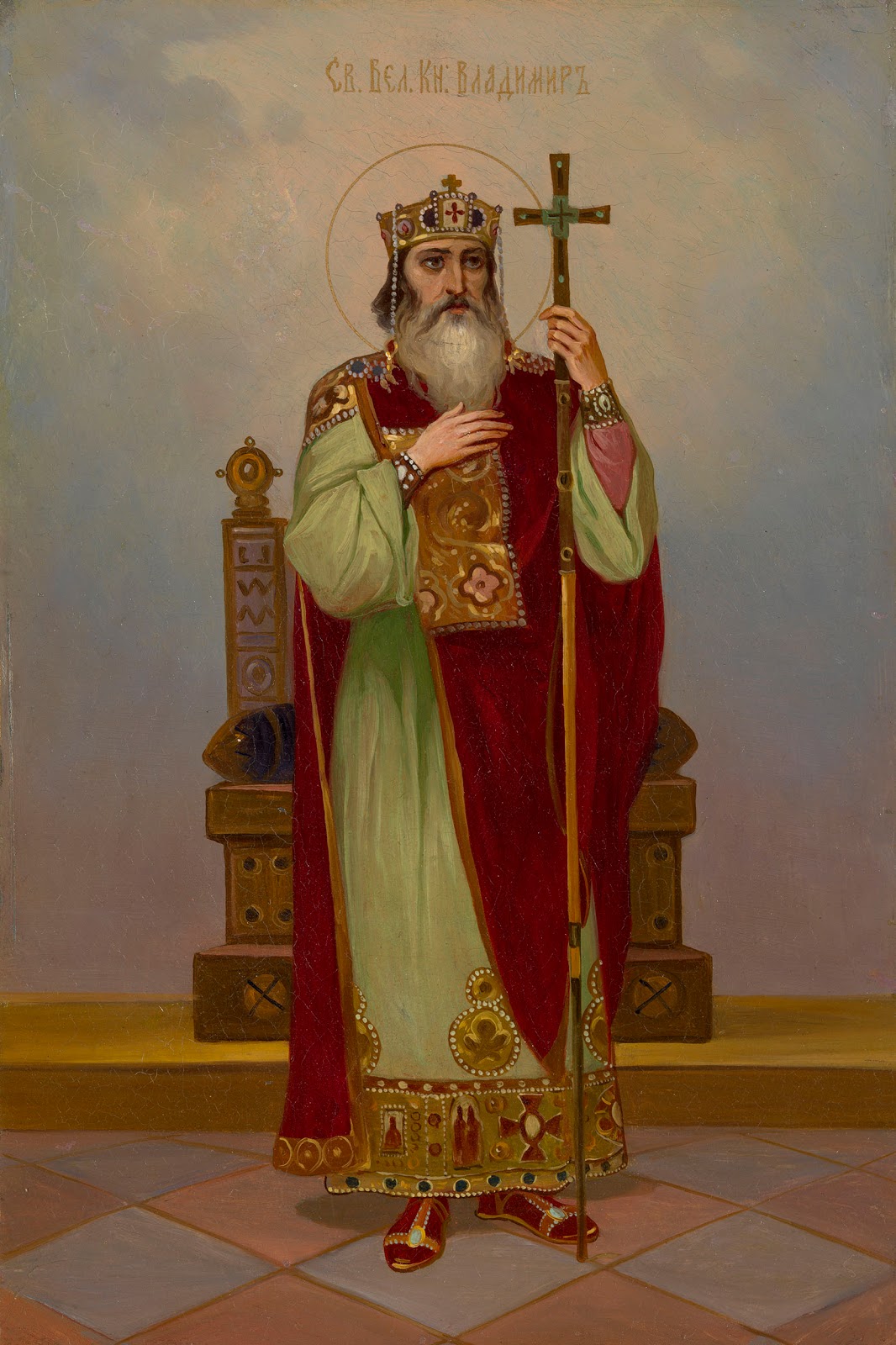
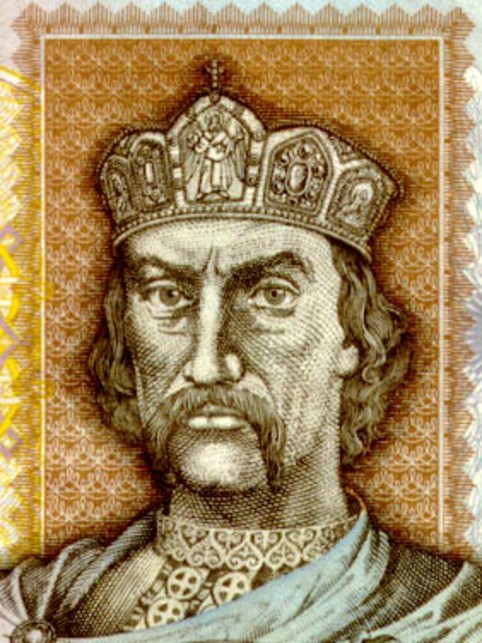
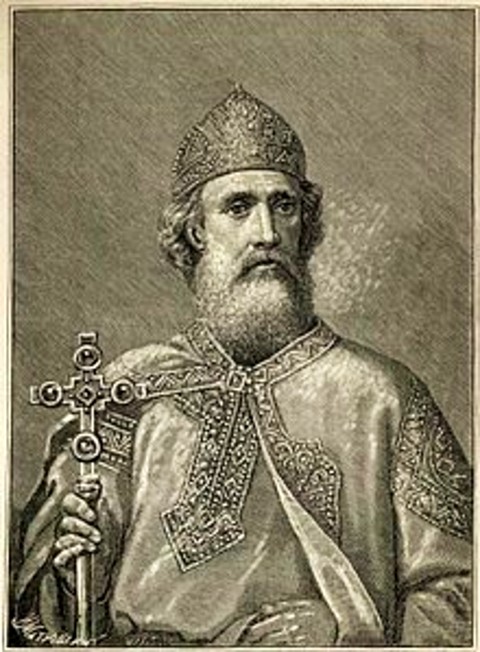
Saint of the Day – 15 July – Saint Vladimir the Great of Kiev (c 956-1015) Grand Prince of Kiev and All Russia, Grandson of St Olga of Kiev, the first Russian ruler to embrace Christianity – born as Vladimir Svyatoslavich in 956 and died on 15 July 1015 at Berestova, near Kiev of natural causes. Patronages – converts, parents of large families, reformed and penitent murderers, Russia, Ukrainian Catholic Diocese of Stamford, Connecticut, Archeparch of Winnipeg, Manitoba.
440518-1
St Olga could not convert her son and successor, Sviatoslav, for he lived and died a pagan and brought up his son Vladimir as a pagan chieftain. Sviatoslav had two legitimate sons, Yaropolk and Oleg and a third son, Vladimir, borne him by his court favourite Olga Malusha. Shortly before his death (972) he bestowed the Grand Duchy of Kiev on Yaropolk and gave the land of the Drevlani (now Galicia) to Oleg. The ancient Russian capital of Novgorod threatened rebellion and, as both the princes refused to go thither, Sviatoslav bestowed its sovereignty upon the young Vladimir. Meanwhile, war broke out between Yaropolk and Oleg and the former conquered the Drevlanian territory and dethroned Oleg. When this news reached Vladimir he feared a like fate and fled to the Varangians (Variags) of Scandinavia for help, while Yaropolk conquered Novgorod and united all Russia under his sceptre.
A few years later Vladimir returned with a large force and retook Novgorod. Becoming bolder he waged war against his brother towards the south, took the city of Polotzk, slew its prince, Ragvald and married his daughter Ragnilda, the affianced bride of Yaropolk. Then he pressed on and besieged Kiev. Yaropolk fled to Rodno but could not hold out there and was finally slain upon his surrender to the victorious Vladimir; the latter thereupon, made himself ruler of Kiev and all Russia in 980.
As a heathen prince Vladimir had four wives besides Ragnilda and by them had ten sons and two daughters. Since the days of St Olga, Christianity, which was originally established among the eastern Slavs by Sts Cyril and Methodius, had been making secret progress throughout the land of Russ (now eastern Austria and Russia) and had begun to considerably alter the heathen ideas. It was a period similar to the era of the conversion of Constantine.
Notwithstanding this undercurrent of Christian ideas, Vladimir erected in Kiev many statues and shrines (trebishcha) to the Slavic heathen gods, Perun, Dazhdbog, Simorgl, Mokosh, Stribog and others. In 981 he subdued the Chervensk cities (now Galicia), in 983 he overcame the wild Yatviags on the shores of the Baltic Sea, in 985 he fought with the Bulgarians on the lower Volga and in 987 he planned a campaign against the Greco-Roman Empire, in the course of which he became interested in Christianity.
The Chronicle of Nestor relates that he sent envoys to the neighbouring countries for information concerning their religions. The envoys reported adversely regarding the Bulgarians who followed (Mohammedan), the Jews of Khazar and the Germans with their plain missionary Latin churches but they were delighted with the solemn Greek ritual of the Great Church (St Sophia) of Constantinople and reminded Vladimir that his grandmother, St Olga had embraced that Faith.
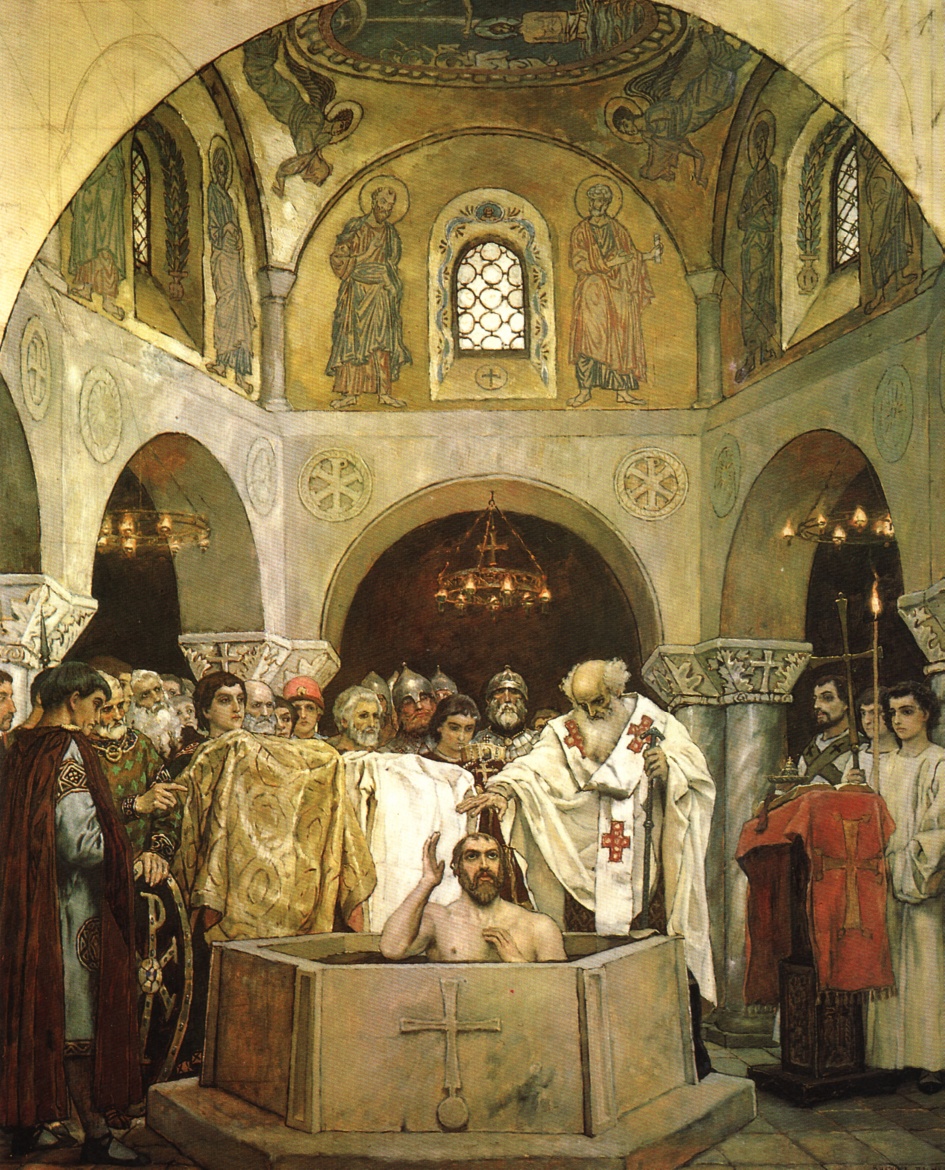
The next year (988) he besieged Kherson in the Crimea, a city within the borders of the eastern Roman Empire and finally took it by cutting off its water supply. He then sent envoys to Emperor Basil II at Constantinople to ask for his sister Anna in marriage, adding a threat to march on Constantinople in case of refusal. The emperor replied that a Christian might not marry a heathen but if Vladimir were a Christian Prince he would sanction the alliance. To this Vladimir replied, that he had already examined the doctrines of the Christians, was inclined towards them and was ready to be Baptised. Basil II sent this sister with a retinue of officials and clergy to Kherson and there Vladimir was Baptised, in the same year, by the Metropolitan Michael and took also the Baptismal name of Basil.
The Baptism of Saint Prince Vladimir, by Viktor Vasnetsov (1890)
A current legend relates that Vladimir had been stricken with blindness before the arrival of Anna and her retinue and had recovered his sight upon being Baptised. He then married Princess Anna and, thereafter, put away his pagan wives. He surrendered the city of Kherson to the Greeks and returned to Kiev in state with his bride.
When Vladimir returned to Kiev he took upon himself the conversion of his subjects. He ordered the statues of the gods to be thrown down, chopped to pieces and some of them burned; the chief god, Perun, was dragged through the mud and thrown into the River Dnieper. These acts impressed the people with the helplessness of their gods and when they were told that they should follow Vladimir’s example and become Christians, they were willingly Baptised, even wading into the river that they might the sooner be reached by the Priest for Baptism.
In 989 he erected the large Church of St Mary ever Virgin and in 996 the Church of the Transfiguration, both in the city of Kiev. He gave up his warlike career and devoted himself principally to the government of his people.
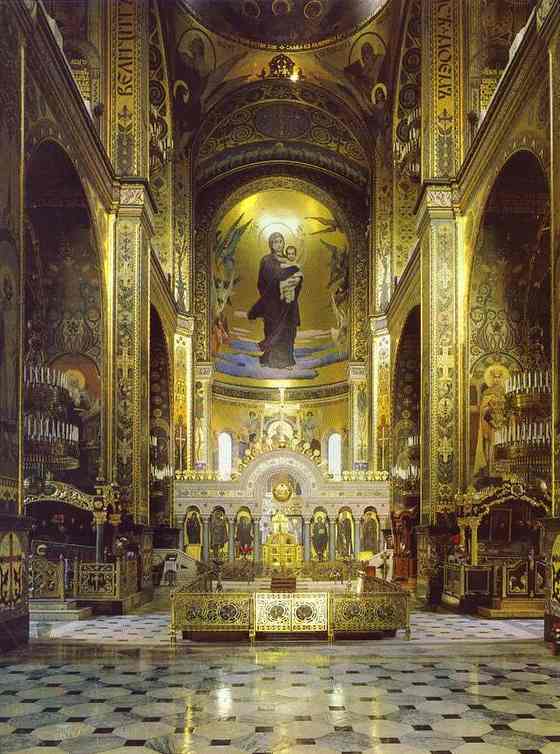
St Vladimir’s Cathedral
He established schools, introduced ecclesiastical courts and became known for his mildness and for his zeal in spreading the Christian faith. His wife died in 1011, having borne him two sons, Boris and Glib (also known as Sts Roman and David, from their Baptismal names).
Vladimir fell ill, most likely of old age and died at Berestove, near Kiev. The various parts of his dismembered body were distributed among his numerous sacred foundations and were venerated as relics.
During his Christian reign, Vladimir lived the teachings of the Bible through acts of charity. He would hand out food and drink to the less fortunate and made an effort to go out to the people who could not reach him. His work was based on the impulse to help one’s neighbours by sharing the burden of carrying their cross. He founded numerous churches, including the Cathedral of the Tithes (989), established schools, protected the poor and introduced ecclesiastical courts. He lived mostly at peace with his neighbours, the incursions of the Pechenegs alone disturbing his tranquillity.

























You must be logged in to post a comment.